
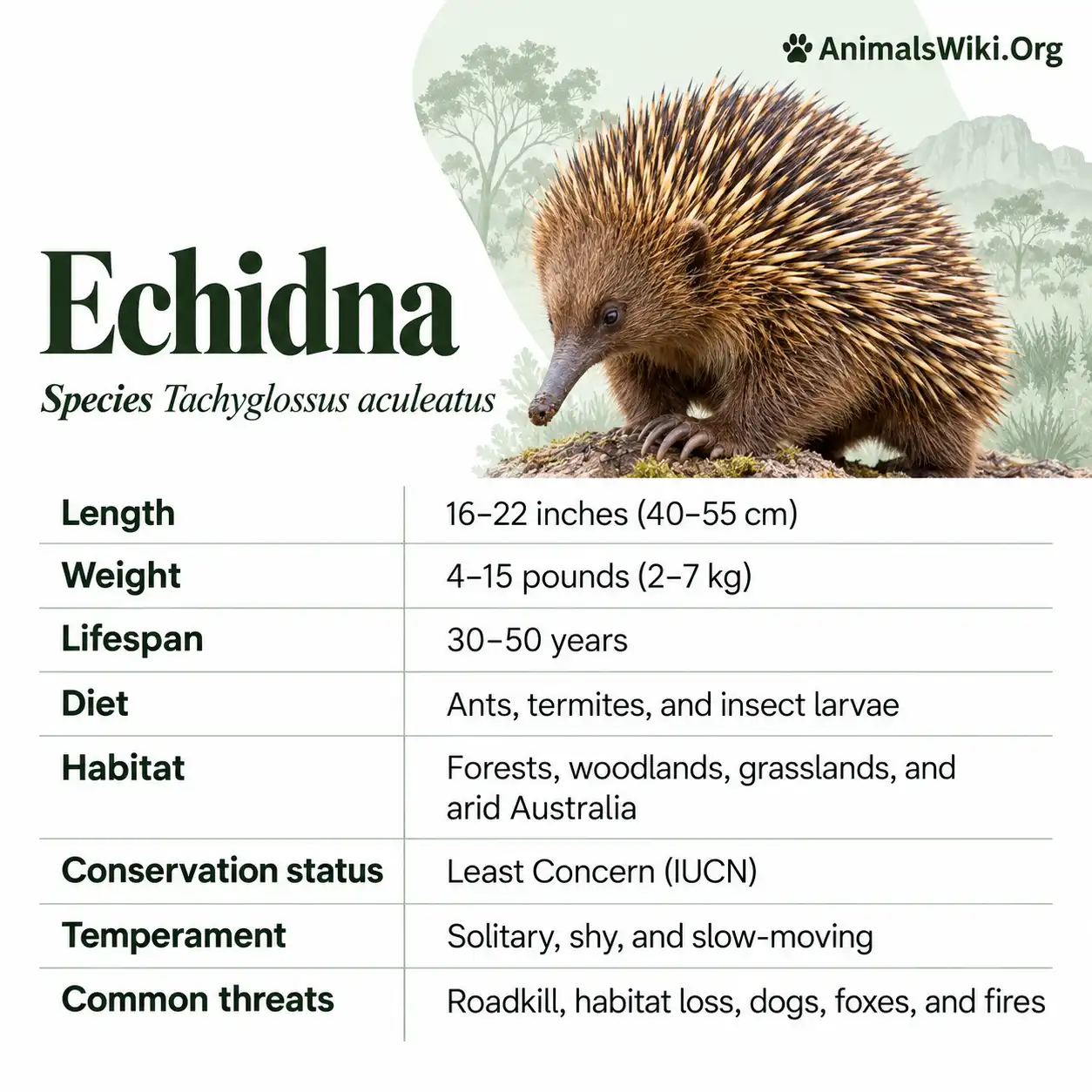
Echidna, The Spiny Egg-Laying Mammals of Australia & New Guinea
The Echidna looks as though several completely different animals were combined into one extraordinary mammal.
It has:
- Sharp spines like a porcupine
- Powerful digging claws like an anteater
- A long snout used to investigate food
- A specialized tongue for collecting prey
- A compact body built for digging
But its strangest feature cannot be seen from the outside.
The Echidna:
lays eggs.
That sounds more like a reptile or bird than a mammal.
Yet echidnas are unquestionably:
mammals.
They have fur.
They are warm-blooded endothermic vertebrates.
Females produce:
milk.
Their young drink that milk and grow rapidly after hatching.
Echidnas belong to an extraordinary group of mammals called:
monotremes.
Only five living monotreme species survive:
- One Platypus
- Four Echidna species
Together, these animals preserve one of the most unusual reproductive systems found among living mammals.
Instead of giving birth to fully developed live young, female echidnas lay:
a single leathery egg.
The egg is incubated in a temporary abdominal pouch.
After roughly:
10 days
the tiny baby hatches.
The young echidna is commonly called a:
puggle.
But another surprise follows.
Female echidnas produce milk, yet they have:
no nipples.
Milk is secreted through specialized mammary areas of the skin.
The puggle laps milk from:
milk patches inside the pouch.
As it grows, something dangerous begins to happen.
Its spines develop.
A mother carrying an increasingly spiny baby inside a pouch eventually faces an obvious problem.
The young echidna is therefore moved to a protected:
nursery burrow
where the mother returns periodically to feed it.
Echidnas are also impressive survival specialists.
When threatened, a Short-beaked Echidna may:
- Curl partly into a ball
- Wedge itself into rocks
- Dig rapidly downward
- Leave only its spiny back exposed
Its claws and muscular body can make it surprisingly difficult for a predator to:
pull from the ground.
Its feeding adaptations are equally remarkable.
Short-beaked Echidnas mainly search for:
- Ants
- Termites
- Other small invertebrates
They do not have conventional adult teeth.
Instead, they use a long sticky tongue and specialized structures inside the mouth to process:
small prey.
Their elongated snout also contains sensory receptors.
Among the most fascinating are:
electroreceptors.
These allow an echidna to detect weak electrical signals associated with living organisms.
Electroreception is much more developed in its aquatic relative:
the Platypus.
But its presence in echidnas reveals just how unusual monotreme sensory biology is.
There is also no single animal that represents every echidna.
Four living species are recognized.
The widespread Short-beaked Echidna occurs across:
Australia and New Guinea.
The much rarer long-beaked echidnas belong to the genus:
Zaglossus
and are associated primarily with:
New Guinea.
Some are among the world’s least familiar mammals.
This comprehensive guide explores Echidna facts, species, scientific classification, spines, snout, size, habitat, Australia and New Guinea distribution, diet, tongue, digging, electroreception, egg laying, pouch, puggle, milk, reproduction, lifespan, predators, defenses, Echidna vs Porcupine, Echidna vs Hedgehog, Echidna vs Platypus, conservation, and the remarkable biology that makes echidnas some of Earth’s strangest mammals.
Echidna Facts
| Feature | Information |
|---|---|
| Common Name | Echidna |
| Animal Type | Mammal |
| Mammal Group | Monotreme |
| Order | Monotremata |
| Family | Tachyglossidae |
| Living Species | 4 |
| Genera | Tachyglossus and Zaglossus |
| Best-Known Species | Short-beaked Echidna |
| Short-beaked Scientific Name | Tachyglossus aculeatus |
| Distribution | Australia & New Guinea |
| Body Covering | Fur and spines |
| Reproduction | Egg-laying |
| Eggs per Breeding Attempt | Usually 1 |
| Young | Commonly called a puggle |
| Milk | Yes |
| Nipples | No |
| Teeth | Adults lack conventional teeth |
| Main Short-beaked Diet | Ants & termites |
| Long-beaked Diet | Especially worms and other invertebrates |
| Major Defense | Spines and digging |
| Special Sense | Electroreception |
| Closest Living Relatives | Other monotremes, including Platypus |
What Is an Echidna?
An Echidna is a:
spiny egg-laying mammal.
Echidnas belong to the mammalian order:
Monotremata.
They are among the only living mammals that reproduce by:
laying eggs.
Is an Echidna Really a Mammal?
Yes.
Despite laying eggs, echidnas possess defining mammalian characteristics.
They:
- Have fur
- Produce milk
- Are endothermic
- Possess mammalian skeletal and physiological features
Egg laying does not make them reptiles.
What Is a Monotreme?
A monotreme is an egg-laying mammal.
Living monotremes consist of:
echidnas and the Platypus.
They represent a very ancient branch of mammalian evolution.
How Many Echidna Species Are There?
There are four living species commonly recognized:
- Short-beaked Echidna
- Western Long-beaked Echidna
- Eastern Long-beaked Echidna
- Sir David’s Long-beaked Echidna
Echidna Species
| Species | Scientific Name | General Distribution |
|---|---|---|
| Short-beaked Echidna | Tachyglossus aculeatus | Australia & New Guinea |
| Western Long-beaked Echidna | Zaglossus bruijnii | New Guinea |
| Eastern Long-beaked Echidna | Zaglossus bartoni | New Guinea |
| Sir David’s Long-beaked Echidna | Zaglossus attenboroughi | New Guinea |
What Is the Most Common Echidna?
The Short-beaked Echidna is by far the most widespread and familiar species.
Its scientific name is:
Tachyglossus aculeatus.
It occurs throughout much of Australia and also in:
New Guinea.
What Are Long-beaked Echidnas?
Long-beaked Echidnas belong to the genus:
Zaglossus.
Compared with Short-beaked Echidnas, they generally have:
- Longer snouts
- Larger bodies
- Different feeding ecology
- Much more restricted distributions
They are particularly associated with:
New Guinea.
Scientific Classification
| Classification | Name |
|---|---|
| Kingdom | Animalia |
| Phylum | Chordata |
| Class | Mammalia |
| Order | Monotremata |
| Family | Tachyglossidae |
| Short-beaked Genus | Tachyglossus |
| Long-beaked Genus | Zaglossus |
What Does an Echidna Look Like?
A typical Short-beaked Echidna has:
- Rounded body
- Strong limbs
- Large claws
- Short tail
- Long narrow snout
- Small eyes
- Fur
- Numerous stiff spines
Its appearance can superficially resemble:
a porcupine or hedgehog.
But echidnas are not closely related to either.
What Are Echidna Spines Made Of?
Echidna spines are modified:
hairs.
They are composed primarily of:
keratin, the same structural protein found in human hair and nails.
Are Echidna Spines Poisonous?
No.
Echidna spines are:
not poisonous.
They provide physical protection.
Can Echidnas Shoot Their Spines?
No.
This is a myth.
Echidnas cannot:
launch or shoot their spines.
The spines remain attached to the body.
Do Echidna Spines Hurt?
Yes.
They are stiff and sharp enough to make handling an echidna:
difficult and potentially painful.
Do Echidnas Have Fur?
Yes.
Fur grows between and beneath the spines.
In colder regions, individuals may have particularly:
dense fur.
Why Do Echidnas Have Spines?
Spines are primarily a:
defensive adaptation.
When threatened, an echidna positions its body so that a predator encounters:
sharp spines instead of vulnerable skin.
How Big Is an Echidna?
Size depends strongly on species.
Short-beaked Echidnas are often approximately:
30–45 cm long, although larger individuals occur.
Long-beaked species can become substantially:
larger.
How Much Does an Echidna Weigh?
Short-beaked Echidnas commonly weigh roughly:
2–7 kg.
Body mass varies according to:
- Sex
- Subspecies
- Region
- Food availability
- Individual condition
Long-beaked Echidnas can exceed:
10 kg in some cases.
Are Male Echidnas Bigger Than Females?
Males can be somewhat larger in some populations, but size alone is not always a reliable way to:
determine sex.
Where Do Echidnas Live?
Echidnas occur naturally in:
- Australia
- New Guinea
The exact range depends on:
species.
Do Echidnas Live in Australia?
Yes.
The Short-beaked Echidna occurs across an extraordinary range of Australian environments.
Do Echidnas Live in New Guinea?
Yes.
New Guinea is home to:
- Short-beaked Echidnas
- Long-beaked Echidnas
Do Echidnas Live Anywhere Else?
Their natural modern distribution is centered on:
Australia and New Guinea.
Echidna Habitat
Short-beaked Echidnas occupy remarkably diverse habitats, including:
- Forests
- Woodlands
- Grasslands
- Shrublands
- Mountains
- Semi-arid areas
- Desert-edge environments
Their primary requirements include:
food and suitable shelter.
Do Echidnas Live in Deserts?
Short-beaked Echidnas can survive in relatively dry environments.
They avoid extreme conditions by adjusting:
- Activity
- Shelter use
- Body temperature
Do Echidnas Live in Rainforests?
Yes.
Some echidna populations live in:
forested and rainforest environments.
Do Echidnas Live in Snow?
Short-beaked Echidnas can inhabit cold mountainous regions where:
snow occurs.
They possess remarkable physiological flexibility for dealing with temperature extremes.
Where Do Echidnas Sleep?
They may shelter in:
- Hollow logs
- Burrows
- Rock crevices
- Dense vegetation
- Spaces beneath roots
They often use whatever protected structure is available.
Do Echidnas Dig Burrows?
Yes.
Their extremely strong claws allow them to dig effectively.
Females also use nursery burrows while raising:
young.
What Do Echidnas Eat?
Diet varies between species.
Short-beaked Echidnas primarily consume:
- Ants
- Termites
- Larvae
- Other small invertebrates
Long-beaked Echidnas consume more:
- Earthworms
- Worm-like invertebrates
- Other soil animals
Are Echidnas Anteaters?
They are sometimes called:
spiny anteaters.
However, they are not true anteaters.
True anteaters live in the Americas and belong to an entirely different mammalian lineage.
Do Echidnas Eat Ants?
Yes.
Ants are an important food for:
Short-beaked Echidnas.
Do Echidnas Eat Termites?
Yes.
They can tear into termite colonies using their:
powerful claws.
Do Echidnas Eat Earthworms?
Long-beaked Echidnas are particularly adapted to consuming:
worms and other soil invertebrates.
Do Echidnas Eat Plants?
Their diet is primarily based on:
invertebrate prey, rather than vegetation.
Do Echidnas Have Teeth?
Adult echidnas do not have conventional functional:
teeth.
Instead, they process prey using specialized structures in the mouth and tongue.
How Do Echidnas Eat Without Teeth?
Small prey does not require extensive chewing.
The animal captures prey with its:
tongue
and processes it against specialized surfaces inside the mouth.
Echidna Tongue
The tongue is:
- Long
- Slender
- Sticky
- Rapidly protrusible
It is ideal for collecting ants and termites from:
narrow spaces.
How Long Is an Echidna’s Tongue?
The Short-beaked Echidna’s tongue can extend roughly:
15–18 cm
beyond the mouth in some individuals.
Why Is the Tongue Sticky?
Sticky secretions help ants and termites adhere to the tongue.
The echidna can then rapidly pull prey back into:
its mouth.
Does an Echidna Have a Beak?
The word “beak” in names such as Short-beaked Echidna refers to the elongated:
snout.
It is not a bird’s beak.
Can Echidnas Smell?
Yes.
Smell is important when searching for:
food.
Their snout is a sophisticated sensory organ.
Can Echidnas Detect Electricity?
Yes.
Echidnas possess:
electroreceptors.
These receptors can detect weak electrical fields associated with biological activity.
Why Would an Echidna Need Electroreception?
It may help detect prey or environmental information around the:
snout.
However, echidna electroreception is much less developed than that of the Platypus.
How Does Electroreception Work?
Muscle and nerve activity in living animals generates extremely weak:
electrical signals.
Specialized receptors can detect disturbances in these fields.
The Platypus uses this ability extensively while hunting underwater.
Echidnas retain a more limited form of:
electroreception.
Are Echidnas Blind?
No.
They can see, although vision is not their only or necessarily their most important sense.
They also rely strongly on:
- Smell
- Touch
- Hearing
- Snout sensation
Can Echidnas Hear?
Yes.
Their ears are not dramatically visible externally, but echidnas can:
hear.
Are Echidnas Nocturnal?
Their activity pattern is flexible.
Depending on:
- Season
- Temperature
- Region
they may be:
- Nocturnal
- Crepuscular
- Day-active
During extreme heat, nighttime activity becomes particularly useful.
Are Echidnas Solitary?
Generally, yes.
Outside breeding periods, echidnas usually live:
largely solitary lives.
Do Echidnas Have Territories?
They use home ranges that can overlap.
They are not necessarily aggressively territorial in the way some carnivores are.
Can Echidnas Climb?
They can scramble over:
- Logs
- Rocks
- Rough terrain
and are surprisingly capable movers despite their stocky appearance.
Can Echidnas Swim?
Yes.
Echidnas are capable:
swimmers.
They can cross streams and other bodies of water when necessary.
Can Echidnas Run?
They generally move with a:
slow, deliberate walking gait.
Their greatest physical strength lies in:
digging, not running.
How Fast Can an Echidna Dig?
An exact universal digging speed is difficult to assign.
But an echidna can begin burying itself with impressive speed when threatened.
Within a short period, much of its vulnerable underside can disappear beneath:
soil.
Why Are Echidnas So Strong?
Their shoulders, forelimbs and claws are highly developed for:
- Breaking termite nests
- Digging
- Defense
- Moving soil
An echidna can be surprisingly difficult to pull from a:
burrow or crevice.
How Does an Echidna Defend Itself?
When threatened, an echidna may:
- Freeze.
- Curl its body.
- Raise its spines.
- Wedge into a crevice.
- Dig downward rapidly.
The goal is to leave a predator facing:
spines.
Can an Echidna Roll Into a Ball?
To some extent.
It can curl and protect vulnerable areas, but it does not always form the same tight spherical ball associated with some:
hedgehogs.
Why Does an Echidna Dig When Threatened?
Its underside is less protected than its back.
By digging downward, the echidna hides its:
soft belly
and leaves only its heavily spined surface exposed.
Echidna Reproduction
Echidna reproduction is among the most extraordinary reproductive systems in mammals.
Females:
lay eggs.
Do Echidnas Lay Eggs?
Yes.
This is one of their defining characteristics.
Echidnas and the Platypus are the only living mammals that:
lay eggs.
How Many Eggs Does an Echidna Lay?
A female typically lays:
one egg.
What Does an Echidna Egg Look Like?
The egg is:
- Small
- Soft-shelled
- Leathery
rather than having the hard shell typical of many bird eggs.
Where Does an Echidna Lay Its Egg?
The egg is transferred into a temporary:
abdominal pouch.
Do Echidnas Always Have Pouches?
Females develop a temporary pouch-like fold during:
reproduction.
It is not the permanent pouch system characteristic of many marsupials.
How Long Does an Echidna Egg Take to Hatch?
The egg generally hatches after approximately:
10 days.
What Is a Baby Echidna Called?
A baby echidna is popularly called a:
puggle.
This is a widely used common term.
How Big Is a Newborn Echidna?
A newly hatched puggle is:
tiny, hairless and extremely undeveloped.
It weighs only a fraction of the adult’s body mass.
Does a Baby Echidna Have Spines?
Not immediately.
A newborn puggle is:
spineless.
Spines develop later.
That is fortunate for:
the mother.
Do Echidnas Produce Milk?
Yes.
Milk production is one of the clearest reasons echidnas are unquestionably:
mammals.
Do Echidnas Have Nipples?
No.
This is one of their strangest characteristics.
Female echidnas produce milk but lack:
nipples.
How Does a Baby Echidna Drink Milk?
Milk is secreted from mammary glands through specialized:
milk patches on the skin.
The puggle laps milk from these areas.
Does Milk Leak Through the Mother’s Skin?
In simplified terms:
yes.
Milk is released through openings associated with mammary glands onto specialized skin areas rather than through nipples.
How Long Does the Baby Stay in the Pouch?
The puggle remains in the pouch during its earliest development.
As its spines begin to develop, the mother eventually moves it to:
a nursery burrow.
Why Does the Mother Remove the Baby From Her Pouch?
Because the baby’s growing:
spines
would make continued pouch life increasingly impractical.
What Is an Echidna Nursery Burrow?
It is a protected burrow where the developing puggle remains while its mother leaves to:
forage.
Does the Mother Feed the Puggle Every Day?
No.
One of the most remarkable features of echidna motherhood is that the female may leave the young alone for:
several days
between nursing visits.
Her milk is highly nutritious, allowing the young to grow despite relatively infrequent feeding.
How Long Does a Puggle Stay With Its Mother?
The young remains dependent for:
several months
before becoming independent.
Do Male Echidnas Care for Babies?
Direct parental care is primarily:
maternal.
Males do not normally participate substantially in raising the puggle.
What Is an Echidna Train?
During breeding season, something remarkable can happen.
Several males may follow a female in a line.
This procession is called an:
echidna train.
How Many Males Can Follow a Female?
Several males may participate, sometimes forming a surprisingly long line behind:
one female.
Why Do Males Follow the Female?
They are competing for an opportunity to:
mate.
The procession may continue for days or even weeks.
Do Male Echidnas Fight for Females?
Competition can become physical.
Males may attempt to:
push rivals away
from the female.
Do Male Echidnas Have Spurs?
Yes.
Males possess hind-leg:
spurs.
Unlike the male Platypus, however, the adult echidna’s spur system is not used to deliver potent venom.
Are Echidnas Venomous?
Living echidnas are not considered dangerously:
venomous.
This differs from the male Platypus, which possesses functional venom-delivering ankle spurs.
Echidna Lifespan
Echidnas are surprisingly:
long-lived.
Short-beaked Echidnas can live for several decades.
Individuals under managed care have survived:
well beyond 30 years, with exceptional longevity approaching or exceeding half a century reported in some cases.
Wild lifespan is more difficult to measure precisely.
Why Do Echidnas Live So Long?
Their longevity may be associated with:
- Relatively slow metabolism
- Low reproductive rate
- Strong defenses
- Slow life-history strategy
However, longevity results from multiple biological factors.
Echidna Body Temperature
Echidnas have a lower typical body temperature than many placental mammals.
Their body temperature is often around:
32°C, although it varies.
This is unusually low compared with the approximately:
37°C
typical of humans.
Can Echidnas Lower Their Metabolism?
Yes.
They can use:
torpor
to reduce energy expenditure.
What Is Torpor?
Torpor is a physiological state in which:
- Metabolism decreases
- Body temperature falls
- Energy use drops
This helps an animal survive:
cold or food shortages.
Do Echidnas Hibernate?
Some Short-beaked Echidnas in colder regions can undergo extended periods of:
torpor or hibernation-like dormancy.
Their seasonal physiology is remarkably flexible.
Can Echidnas Survive Bushfires?
Echidnas have an extraordinary strategy for some fires.
They may:
- Shelter in burrows
- Hide beneath logs
- Enter torpor
- Reduce activity
Studies suggest their ability to lower metabolism can help them survive periods after fire when food is scarce.
This does not mean all echidnas survive severe fires.
Echidna Predators
Potential predators vary by region and age.
They can include:
- Dingoes
- Large monitor lizards
- Snakes
- Feral dogs
- Foxes
- Cats
Young echidnas are particularly vulnerable.
Do Dingoes Eat Echidnas?
They can.
However, the echidna’s spines make it a:
difficult prey animal.
Do Foxes Eat Echidnas?
Introduced foxes can threaten young or vulnerable echidnas in Australia.
Do Eagles Eat Echidnas?
Large raptors may pose a greater risk to:
young animals
than to heavily armored adults.
Can a Predator Get Through Echidna Spines?
A determined predator may occasionally succeed.
But the combination of:
- Spines
- Curling
- Digging
- Wedging behavior
provides formidable protection.
Are Echidnas Dangerous to Humans?
No.
Echidnas are not predatory or naturally aggressive toward:
humans.
Their main defense is:
avoidance and protection.
Can an Echidna Bite?
Their feeding apparatus is not designed for delivering a powerful defensive bite.
The spines and claws are much more relevant defensive structures.
Can Echidna Spines Injure You?
Yes.
The spines can puncture or scratch skin if an animal is handled improperly.
Wild echidnas should therefore be:
left alone.
Can You Keep an Echidna as a Pet?
Echidnas are wild native mammals with:
- Specialized diets
- Complex environmental needs
- Powerful digging behavior
- Legal protection in their native range
They are not appropriate:
ordinary pets.
Echidna vs. Hedgehog
Echidnas and hedgehogs look superficially similar because both possess:
spines.
But they are not close relatives.
| Feature | Echidna | Hedgehog |
|---|---|---|
| Mammal Group | Monotreme | Placental mammal |
| Reproduction | Egg-laying | Live birth |
| Native Range | Australia & New Guinea | Europe, Asia & Africa |
| Snout | Elongated | Shorter |
| Main Diet | Invertebrates | Invertebrates and varied foods |
| Milk | Yes | Yes |
| Nipples | No | Yes |
Their resemblance is an example of:
convergent evolution.
Echidna vs. Porcupine
| Feature | Echidna | Porcupine |
|---|---|---|
| Group | Monotreme | Rodent |
| Spines | Modified hairs | Modified hairs/quills |
| Eggs | Yes | No |
| Main Food | Invertebrates | Mostly plants |
| Distribution | Australia & New Guinea | Multiple continents |
| Teeth | Adult lacks conventional teeth | Large rodent incisors |
Echidna vs. Anteater
| Feature | Echidna | True Anteater |
|---|---|---|
| Group | Monotreme | Placental mammal |
| Range | Australia/New Guinea | Americas |
| Eggs | Yes | No |
| Tongue | Long and sticky | Long and sticky |
| Ant Diet | Common | Common |
| Relationship | Distant |
Their similar feeding adaptations evolved:
independently.
Echidna vs. Platypus
The Platypus is the echidna’s famous monotreme relative.
| Feature | Echidna | Platypus |
|---|---|---|
| Mammal Type | Monotreme | Monotreme |
| Eggs | Yes | Yes |
| Milk | Yes | Yes |
| Nipples | No | No |
| Lifestyle | Mainly terrestrial | Semi-aquatic |
| Body Covering | Fur + spines | Dense fur |
| Feeding | Invertebrates | Aquatic invertebrates |
| Electroreception | Limited | Highly developed |
| Male Venom | Not functional like Platypus | Functional venom spur |
| Swimming | Capable | Highly specialized |
Are Echidnas Related to Porcupines?
No, not closely.
Porcupines are:
rodents.
Echidnas are:
monotremes.
Their spines evolved separately.
Are Echidnas Related to Hedgehogs?
Not closely.
Their common ancestor lived far back in mammalian evolutionary history.
Are Echidnas Related to Platypuses?
Yes.
The Platypus and echidnas are the only surviving representatives of the ancient:
monotreme lineage.
Why Are Echidnas Important?
Echidnas can influence ecosystems through:
digging.
While searching for food, they disturb soil.
This can:
- Mix soil layers
- Move organic material
- Create small pits
- Influence water infiltration
- Affect seed and litter accumulation
They can therefore function as:
ecosystem engineers.
Do Echidnas Help the Soil?
Yes.
Their digging can contribute to:
soil turnover and ecosystem processes.
A single echidna can disturb substantial amounts of soil while foraging over time.
Are Echidnas Endangered?
There is no single conservation status for all echidnas because:
Echidna refers to multiple species.
The widespread Short-beaked Echidna is much more secure globally than:
long-beaked echidnas.
Several long-beaked species face serious conservation threats.
Why Are Long-beaked Echidnas Threatened?
Threats can include:
- Hunting
- Habitat degradation
- Forest loss
- Agricultural expansion
- Human development
- Low reproductive rates
Their restricted distributions make them especially vulnerable.
Is the Short-beaked Echidna Endangered?
The Short-beaked Echidna remains widespread compared with its long-beaked relatives.
However, local populations can still face:
- Road deaths
- Habitat degradation
- Predation by introduced animals
- Human disturbance
What Threatens Echidnas in Australia?
Important threats can include:
- Vehicle collisions
- Habitat loss
- Habitat fragmentation
- Dogs
- Introduced predators
- Extreme environmental events
Why Are Cars Dangerous to Echidnas?
Their defensive strategy is poorly suited to:
roads.
When threatened, an echidna may stop or curl rather than rapidly flee.
This makes road crossings particularly dangerous.
Echidna Conservation
Conservation measures include:
- Protecting habitat
- Reducing hunting
- Protecting New Guinea forests
- Monitoring populations
- Reducing road mortality
- Controlling introduced predators
- Protecting nesting and nursery areas
- Studying poorly known long-beaked species
50 Interesting Echidna Facts
- Echidnas are mammals.
- Echidnas lay eggs.
- They belong to the order Monotremata.
- Only echidnas and the Platypus are living monotremes.
- Four living echidna species are recognized.
- The Short-beaked Echidna is the most widespread.
- Its scientific name is Tachyglossus aculeatus.
- Three living long-beaked species belong to Zaglossus.
- Echidnas naturally occur in Australia and New Guinea.
- Short-beaked Echidnas occupy many different habitats.
- Echidnas have fur.
- They also possess protective spines.
- Their spines are modified hairs.
- Spines contain keratin.
- Echidnas cannot shoot their spines.
- Their spines are not poisonous.
- Echidnas are powerful diggers.
- Their claws can tear open termite nests.
- Short-beaked Echidnas eat many ants.
- They also eat termites.
- Long-beaked Echidnas eat many worms.
- Adult echidnas lack conventional teeth.
- Their tongues are long.
- Their tongues are sticky.
- The tongue helps capture small prey.
- Echidnas have elongated sensory snouts.
- They possess electroreceptors.
- Platypus electroreception is more highly developed.
- Echidnas are generally solitary.
- They can swim.
- They can enter torpor.
- Some populations undergo prolonged winter dormancy.
- Their body temperature is relatively low for a mammal.
- Females usually lay one egg.
- The egg has a leathery shell.
- The egg is incubated in a temporary pouch.
- It hatches after roughly 10 days.
- A baby echidna is commonly called a puggle.
- Newborn puggles do not initially have spines.
- Female echidnas produce milk.
- Echidnas do not have nipples.
- Milk is released onto specialized skin patches.
- Growing puggles are moved into nursery burrows.
- Males may form echidna trains behind females during breeding season.
- Male echidnas possess hind-leg spurs.
- They do not deliver dangerous venom like male Platypuses.
- Echidnas can live for several decades.
- Their digging helps disturb and aerate soil.
- Long-beaked echidnas are generally more threatened than Short-beaked Echidnas.
- Echidnas combine egg laying, milk production, spines, electroreception and powerful digging in one of the most unusual mammalian body plans on Earth.
Did You Know?
An Echidna can hatch from an egg and then drink milk—even though its mother has no nipples.
Imagine a female Echidna during breeding season.
For most of the year, she does not carry a permanent pouch like a:
kangaroo.
But as reproduction begins, folds of skin form a temporary:
pouch-like structure.
Then she produces something almost unimaginable for a mammal:
an egg.
The egg is tiny compared with her body.
Its shell is not hard like a chicken egg.
Instead, it is:
soft and leathery.
The egg is transferred into the pouch.
Inside, the developing embryo continues growing.
After roughly:
10 days
the shell breaks.
Out comes a tiny:
puggle.
It is helpless.
It has no protective covering of adult spines.
It needs:
milk.
But when the puggle searches for a nipple, there is none.
Female Echidnas do not have nipples.
Instead, milk passes from mammary glands through openings onto specialized:
milk patches.
The puggle laps it directly from the mother’s skin.
For a while, this system works beautifully.
Then the baby begins developing the feature that will protect it for the rest of its life:
spines.
Now imagine carrying an increasingly spiny youngster against your abdomen.
The solution is simple.
The mother places the growing puggle in:
a nursery burrow.
She leaves to search for food.
Days may pass.
Then she returns.
The youngster drinks another enormous meal of rich milk.
The mother leaves again.
Month by month, the puggle becomes:
- Larger
- Furrier
- Spikier
- Stronger
Eventually, the tiny animal that once emerged from a leathery egg becomes an adult capable of digging into the earth and leaving a predator staring at:
a wall of spines.
That single life cycle combines traits that people usually associate with:
reptiles, marsupials, anteaters and porcupines.
Yet the Echidna is none of those things.
It is something far more evolutionarily unusual:
a monotreme.
Frequently Asked Questions About Echidnas
What is an Echidna?
An Echidna is a spiny egg-laying mammal belonging to the monotreme lineage.
Is an Echidna a mammal?
Yes.
Why is an Echidna a mammal if it lays eggs?
Because mammalian classification depends on evolutionary ancestry and multiple characteristics, including milk production and hair—not live birth alone.
Do Echidnas lay eggs?
Yes.
Are Echidnas the only mammals that lay eggs?
Echidnas and the Platypus are the only living egg-laying mammals.
What is a monotreme?
A monotreme is an egg-laying mammal.
How many Echidna species are there?
Four living species are generally recognized.
What is the scientific name of the Short-beaked Echidna?
Tachyglossus aculeatus.
What are the Long-beaked Echidnas?
They are three living species in the genus Zaglossus.
Where do Echidnas live?
Australia and New Guinea.
Do Echidnas live in Australia?
Yes.
Do Echidnas live in Tasmania?
Yes. Short-beaked Echidnas occur in Tasmania.
Do Echidnas live in New Guinea?
Yes.
Do Echidnas live in deserts?
Short-beaked Echidnas can inhabit dry and semi-arid environments.
Do Echidnas live in rainforests?
Yes.
Can Echidnas live in cold climates?
Yes. Some populations inhabit cold mountainous environments.
Do Echidnas have spines?
Yes.
Are Echidna spines quills?
They are stiff modified hairs and are often informally described as spines or quills.
What are Echidna spines made of?
Keratin.
Are Echidna spines poisonous?
No.
Can Echidnas shoot their spines?
No.
Do Echidnas lose their spines?
Individual spines can be lost and replaced, but they cannot deliberately fire them at predators.
Do Echidnas have fur?
Yes.
Why do Echidnas have spines?
For defense against predators.
Can Echidnas roll into a ball?
They can curl protectively, although not always into the extremely tight ball characteristic of some hedgehogs.
Why do Echidnas dig when threatened?
Digging hides the vulnerable underside and exposes the spiny back.
Are Echidnas strong?
Yes. They possess exceptionally powerful digging muscles.
What do Echidnas eat?
Short-beaked Echidnas mainly eat ants, termites and other small invertebrates, while Long-beaked Echidnas consume many worms and soil invertebrates.
Do Echidnas eat ants?
Yes.
Do Echidnas eat termites?
Yes.
Do Echidnas eat worms?
Yes, particularly Long-beaked Echidnas.
Are Echidnas carnivores?
They are specialized consumers of animal prey, particularly invertebrates.
Do Echidnas eat plants?
Plant material is not the primary component of their natural diet.
Do Echidnas have teeth?
Adults lack conventional functional teeth.
How do Echidnas eat without teeth?
They use a sticky tongue and specialized mouth surfaces to capture and process small prey.
How long is an Echidna’s tongue?
A Short-beaked Echidna can extend its tongue roughly 15–18 cm in some cases.
Why is an Echidna’s tongue sticky?
Sticky secretions help trap ants, termites and other small prey.
Does an Echidna have a beak?
It has an elongated snout commonly referred to as a beak.
Can Echidnas smell?
Yes.
Can Echidnas see?
Yes.
Are Echidnas blind?
No.
Can Echidnas hear?
Yes.
Can Echidnas detect electricity?
Yes.
What is electroreception?
It is the ability to detect weak electrical fields.
Why do Echidnas have electroreceptors?
They may assist sensory detection around the snout, including information associated with prey.
Is Echidna electroreception as strong as a Platypus’s?
No. The Platypus possesses much more highly developed electroreception.
Are Echidnas nocturnal?
They can be nocturnal, crepuscular or day-active depending on environmental conditions.
Are Echidnas solitary?
Generally, yes.
Can Echidnas swim?
Yes.
Can Echidnas climb?
They can negotiate rough terrain, logs and rocks surprisingly well.
Can Echidnas run fast?
No. They are not specialized runners.
Are Echidnas good diggers?
Excellent.
Do Echidnas dig burrows?
Yes.
Where do Echidnas sleep?
They shelter in burrows, logs, vegetation, crevices and other protected locations.
Do Echidnas hibernate?
Some Short-beaked Echidnas undergo prolonged torpor or hibernation-like winter dormancy.
What is torpor?
A temporary reduction in metabolism and body temperature that conserves energy.
What is an Echidna’s body temperature?
It is often around 32°C, relatively low for a mammal.
How do Echidnas survive hot weather?
They alter their activity times and seek sheltered, cooler environments.
Can Echidnas survive bushfires?
Some survive by sheltering and reducing metabolic activity, but severe fires can still kill them or destroy habitat.
How do Echidnas reproduce?
Females lay eggs.
How many eggs does an Echidna lay?
Usually one.
Are Echidna eggs hard?
No. They have a soft, leathery shell.
Where does the egg go?
The female incubates it within a temporary pouch-like fold.
How long does an Echidna egg take to hatch?
Approximately 10 days.
What is a baby Echidna called?
A puggle.
Is “puggle” the scientific name?
No. It is a popular common term for a baby Echidna.
Are puggles born with spines?
No. Spines develop later.
Why aren’t puggles born spiny?
A spineless newborn is much safer for a young animal developing inside its mother’s pouch.
Do Echidnas have pouches?
Females form a temporary pouch-like fold during reproduction.
Are Echidnas marsupials?
No.
What is the difference between an Echidna and a marsupial?
Echidnas are monotremes that lay eggs; marsupials give birth to extremely underdeveloped live young.
Do Echidnas produce milk?
Yes.
Do Echidnas have nipples?
No.
How does a puggle drink milk?
It laps milk secreted onto specialized mammary patches on the mother’s skin.
Why does the mother put the puggle in a burrow?
Once its spines develop, it becomes impractical to carry continuously in the pouch.
Does the mother stay with the puggle all day?
No. She may leave the youngster in a nursery burrow while foraging.
How often does the mother feed it?
Feeding intervals can be several days during later burrow development.
Do fathers care for puggles?
Parental care is primarily maternal.
What is an Echidna train?
A line of males following a female during breeding season.
Why do Echidnas form trains?
Males are competing for mating opportunities.
How long can an Echidna train last?
Courtship associations can continue for extended periods, potentially days or weeks.
Do male Echidnas fight?
They may push and compete physically for access to females.
Do male Echidnas have spurs?
Yes.
Are Echidna spurs venomous?
They do not function as a dangerous venom-delivery system like those of male Platypuses.
Are Echidnas poisonous?
No.
Are Echidnas venomous?
Modern echidnas are not considered dangerously venomous.
How long do Echidnas live?
They can live for several decades.
Can an Echidna live 50 years?
Exceptional individuals under managed conditions have approached or exceeded very long multi-decade lifespans, although this is not a typical wild expectation.
What animals eat Echidnas?
Potential predators include dingoes, large reptiles, dogs and introduced predators, with younger animals being more vulnerable.
Do dingoes eat Echidnas?
They can.
Do foxes kill Echidnas?
Introduced foxes can threaten vulnerable individuals.
How do Echidnas defend themselves?
Mainly through spines, curling, digging and wedging themselves into protected spaces.
Are Echidnas dangerous to humans?
No.
Can Echidnas bite humans?
Their mouth is not specialized for a powerful defensive bite.
Can Echidna spines hurt humans?
Yes.
Can you touch a wild Echidna?
Wild animals should generally be observed without handling or disturbing them.
Can Echidnas be pets?
They are not suitable ordinary pets and are protected wildlife in their native range.
Are Echidnas related to hedgehogs?
Not closely.
Are Echidnas related to porcupines?
Not closely.
Are Echidnas related to anteaters?
Not closely.
Why do Echidnas look like porcupines?
Both independently evolved protective spines—an example of convergent evolution.
Why do Echidnas resemble anteaters?
Both independently evolved adaptations for consuming small invertebrates such as ants.
Are Echidnas related to Platypuses?
Yes.
What is the closest living relative of an Echidna?
Other monotremes, particularly the Platypus and other echidna species.
What is the difference between an Echidna and a Platypus?
Echidnas are mostly terrestrial, spiny diggers, while Platypuses are semi-aquatic mammals specialized for underwater feeding.
Are Echidnas endangered?
Conservation status depends on species.
Is the Short-beaked Echidna endangered?
It is substantially more widespread and secure than Long-beaked Echidnas, though local threats remain.
Are Long-beaked Echidnas endangered?
Long-beaked species face serious conservation concerns and restricted distributions.
Why are Long-beaked Echidnas threatened?
Hunting, habitat loss, degradation and low reproductive rates are important factors.
Do roads kill Echidnas?
Yes. Vehicle collisions are a significant local threat.
Are dogs dangerous to Echidnas?
Dogs can injure or kill echidnas.
Do Echidnas help the environment?
Yes. Their digging contributes to soil turnover and ecosystem processes.
Are Echidnas ecosystem engineers?
They can reasonably be described this way because their extensive digging physically modifies soil.
What is the strangest Echidna fact?
An Echidna is a spiny mammal that lays a leathery egg, hatches a tiny puggle, produces milk without nipples and can detect weak electrical signals with its snout.
Conclusion
The Echidna is one of those animals that seems to break the rules until you realize that the rules of mammalian evolution are far more diverse than they first appear.
It has:
fur.
It has:
spines.
It lays:
eggs.
It produces:
milk.
But it has:
no nipples.
Its baby develops in:
a temporary pouch.
But it is not:
a marsupial.
It has a long sticky tongue for eating ants.
But it is not:
an anteater.
It has spines.
But it is not:
a porcupine or hedgehog.
It possesses electroreception.
But it is primarily:
a land animal.
These apparently contradictory characteristics make sense only when we recognize what an Echidna truly represents:
an ancient surviving branch of mammalian evolution.
Monotremes separated from the lineage leading to marsupial and placental mammals deep in evolutionary history.
Their modern descendants preserve a combination of features found nowhere else among living mammals.
Yet Echidnas are not primitive evolutionary leftovers frozen in time.
They are highly specialized modern animals.
Their claws can tear through:
hard soil and termite nests.
Their spines can transform the exposed back into:
armor.
Their metabolism can slow dramatically during:
torpor.
Their snouts combine multiple sensory systems.
And their reproductive biology allows a tiny animal to hatch from an egg and grow entirely on:
milk.
The Short-beaked Echidna has used these adaptations to occupy an extraordinary range of environments across Australia and New Guinea.
Its Long-beaked relatives, however, remind us that the survival of this ancient lineage is:
not guaranteed.
Some live within restricted New Guinea landscapes where hunting and habitat disturbance can have severe consequences.
Protecting echidnas therefore means protecting more than an unusual spiny mammal.
It means protecting one of the last living windows into an evolutionary experiment that began:
more than 100 million years ago.
The Echidna may look like a mixture of animals.
In reality, it is something much more interesting.
It is entirely:
an Echidna.



