
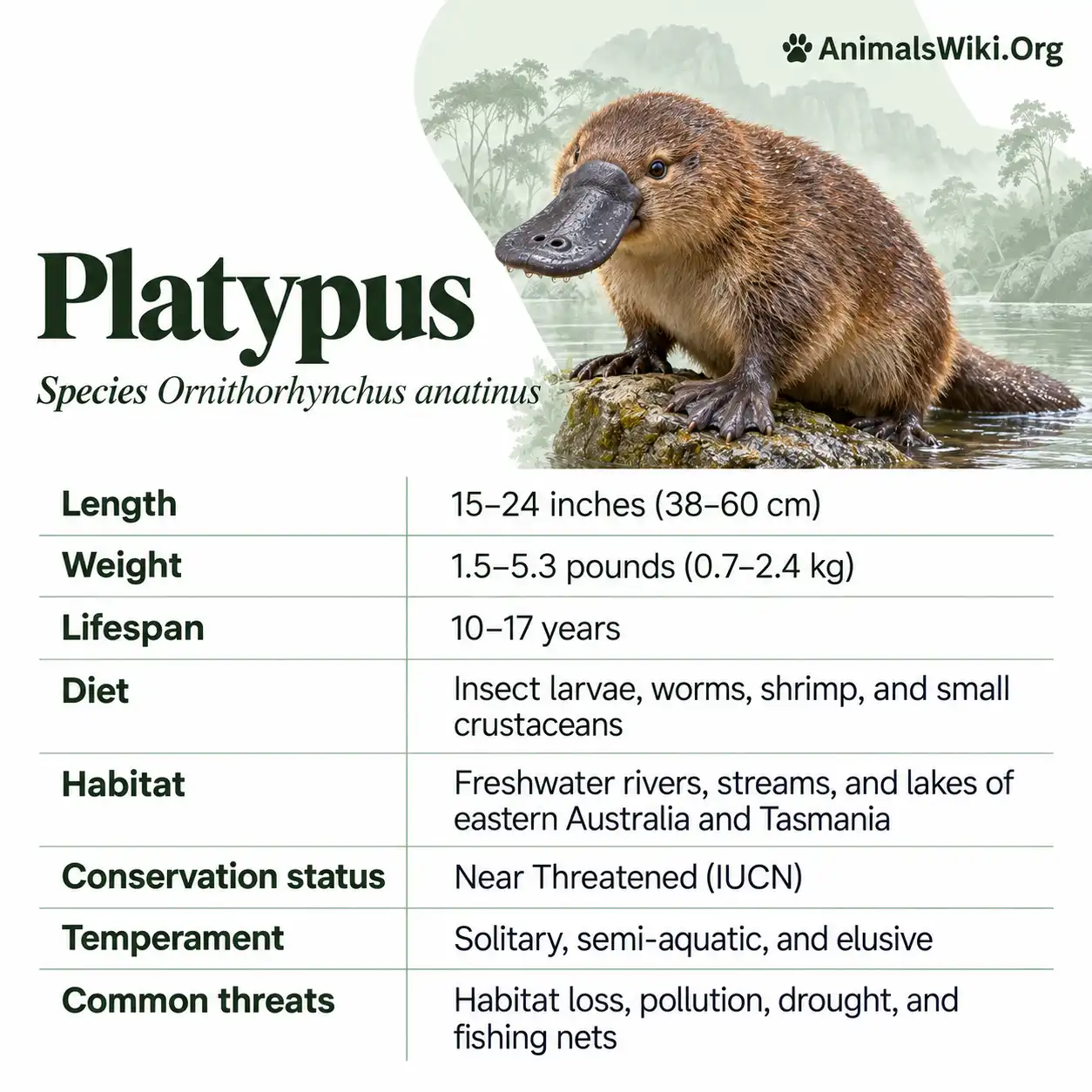
Platypus, The Venomous Egg-Laying Mammal of Australia’s Rivers
The Platypus is one of the most unusual mammals ever to evolve.
When European naturalists first examined specimens from Australia, the animal seemed so improbable that some suspected:
a hoax.
It appeared to combine features associated with several completely different animals.
It had:
- A broad bill resembling a duck’s
- Dense fur like an aquatic mammal
- Webbed feet
- A flattened tail
- A streamlined body
- Egg-laying reproduction
Then scientists discovered even stranger characteristics.
The Platypus hunts underwater while closing its:
eyes, ears and nostrils.
Instead of relying primarily on sight, it detects prey using thousands of specialized receptors in its bill.
Some detect:
touch and pressure.
Others detect extremely weak:
electrical signals.
Every time a shrimp, insect larva or other small animal contracts its muscles, tiny electrical fields are produced.
The Platypus can detect them.
It effectively hunts using:
electroreception.
And that is still not the strangest part.
Male Platypuses possess a sharp spur on each:
hind ankle.
These spurs connect to venom-producing glands.
During the breeding season, males can use them as:
weapons.
Platypus venom can cause intense and persistent pain in humans.
The animal is therefore one of the extremely small number of living mammals capable of delivering:
venom.
Yet females possess another extraordinary system.
They:
lay eggs.
The Platypus belongs to an ancient mammalian group known as:
monotremes.
Only five living monotreme species survive:
- The Platypus
- Four species of Echidna
Like echidnas, the female Platypus produces milk but has:
no nipples.
Milk is secreted through openings in the skin and collects in grooves on the abdomen, where the young:
lap it up.
The Platypus is therefore simultaneously:
- A mammal
- An egg-layer
- An electroreceptive hunter
- A powerful swimmer
- A burrow-builder
- A venomous animal
Yet none of these features makes it a strange mixture of unrelated creatures.
Every one is part of a single highly specialized evolutionary design adapted to:
freshwater life in eastern Australia.
Scientifically known as:
Ornithorhynchus anatinus
the Platypus inhabits freshwater environments in:
- Eastern mainland Australia
- Tasmania
It depends on rivers, streams and other suitable freshwater systems with stable banks where it can construct:
burrows.
Despite its worldwide fame, the Platypus faces growing environmental pressures.
These include:
- Habitat degradation
- River modification
- Drought
- Water extraction
- Dam construction
- Bank disturbance
- Fishing gear
- Climate-related changes
Understanding the Platypus therefore means looking beyond its bizarre appearance.
It is a highly specialized predator whose survival depends on:
healthy freshwater ecosystems.
This comprehensive guide explores Platypus facts, scientific classification, duck-like bill, electroreception, venom, male spurs, size, weight, habitat, Australian distribution, swimming, diving, diet, underwater hunting, burrows, reproduction, eggs, babies, milk without nipples, lifespan, adaptations, predators, Platypus vs Echidna, conservation, and the remarkable biology behind one of the world’s strangest mammals.
Platypus Facts
| Feature | Information |
|---|---|
| Common Name | Platypus |
| Scientific Name | Ornithorhynchus anatinus |
| Animal Type | Mammal |
| Mammal Group | Monotreme |
| Order | Monotremata |
| Family | Ornithorhynchidae |
| Genus | Ornithorhynchus |
| Native Range | Eastern Australia & Tasmania |
| Habitat | Freshwater rivers, streams and connected waters |
| Diet | Aquatic invertebrates and other small prey |
| Reproduction | Egg-laying |
| Typical Clutch | 1–3 eggs, often 2 |
| Young | Commonly called puggles |
| Milk | Yes |
| Nipples | No |
| Famous Sense | Electroreception |
| Venom | Adult males possess venomous ankle spurs |
| Swimming | Excellent |
| Main Propulsion | Webbed front feet |
| Tail | Broad and flattened |
| Body Covering | Dense waterproof fur |
| Closest Living Relatives | Echidnas |
| Major Threats | Freshwater habitat degradation and alteration |
What Is a Platypus?
The Platypus is a semi-aquatic egg-laying mammal native to:
Australia.
Its scientific name is:
Ornithorhynchus anatinus.
It belongs to the mammalian order:
Monotremata.
Is a Platypus Really a Mammal?
Yes.
The Platypus is unquestionably a:
mammal.
It possesses:
- Fur
- Mammary glands
- Three middle-ear bones
- Mammalian skeletal characteristics
- Endothermic physiology
Its egg-laying reproduction represents an ancient branch of mammalian evolution.
Why Does the Platypus Lay Eggs?
The Platypus belongs to the:
monotremes.
Monotremes diverged early from the lineage leading to marsupial and placental mammals.
They retained:
egg-laying reproduction.
Scientific Classification of the Platypus
| Classification | Name |
|---|---|
| Kingdom | Animalia |
| Phylum | Chordata |
| Class | Mammalia |
| Order | Monotremata |
| Family | Ornithorhynchidae |
| Genus | Ornithorhynchus |
| Species | Ornithorhynchus anatinus |
Is There More Than One Living Platypus Species?
No.
Only one living species is recognized:
Ornithorhynchus anatinus.
Fossils show that other platypus-like monotremes existed in the past.
What Does a Platypus Look Like?
A Platypus has:
- Streamlined body
- Broad sensitive bill
- Small eyes
- Dense brown fur
- Short limbs
- Webbed feet
- Broad flattened tail
Its unusual appearance reflects adaptations for:
freshwater hunting.
Does a Platypus Have a Duck Bill?
The bill looks superficially similar to a duck’s, but structurally it is very different.
A Platypus bill is:
soft, flexible and highly sensitive.
It contains specialized receptors used for:
- Touch
- Pressure detection
- Electroreception
It is therefore much more than a feeding scoop.
Is a Platypus Bill Hard?
No.
It is covered with soft, sensitive skin.
This makes it an extraordinarily sophisticated:
sensory organ.
Does a Platypus Have Teeth?
Adult Platypuses do not possess conventional functional teeth.
Young animals initially develop tooth structures, but adults use hardened:
keratinous grinding pads
to process food.
How Does a Platypus Chew Without Teeth?
It collects prey in:
cheek pouches
while underwater.
At the surface, food is crushed and ground using specialized pads inside the mouth.
How Big Is a Platypus?
Adults are generally around:
40–60 cm long, including the tail.
Males are usually:
larger than females.
How Much Does a Platypus Weigh?
Adults commonly weigh approximately:
0.7–2.4 kg, depending on sex, location and individual condition.
Large males are substantially heavier than small females.
Are Male Platypuses Bigger Than Females?
Yes.
Males are generally:
larger and heavier.
This is one form of sexual dimorphism in the species.
Where Do Platypuses Live?
Platypuses occur naturally in:
eastern Australia and Tasmania.
Their distribution extends through suitable freshwater systems from tropical Queensland southward through eastern Australia and into:
Tasmania.
Do Platypuses Live Everywhere in Australia?
No.
They are primarily associated with:
eastern and southeastern Australia.
They are absent naturally from much of the dry interior and western part of the continent.
Do Platypuses Live in Tasmania?
Yes.
Tasmania supports important Platypus populations.
Platypus Habitat
Platypuses inhabit freshwater environments including:
- Rivers
- Streams
- Creeks
- Lakes
- Ponds
- Connected freshwater systems
Suitable habitat needs both:
aquatic feeding areas and stable banks for burrows.
Do Platypuses Live in Saltwater?
They are primarily:
freshwater animals.
They are not marine mammals.
Do Platypuses Build Burrows?
Yes.
They excavate burrows into:
riverbanks and stream banks.
Different burrows can be used for:
- Resting
- Shelter
- Reproduction
How Long Is a Platypus Burrow?
Burrow length varies greatly.
Breeding burrows can be:
several meters long
and more elaborate than ordinary resting burrows.
Are Platypuses Good Swimmers?
Yes.
The Platypus is a highly specialized:
semi-aquatic swimmer.
How Does a Platypus Swim?
Unlike many semi-aquatic mammals, it obtains most of its swimming propulsion from:
the front feet.
The front feet are heavily:
webbed.
They paddle through the water while the hind feet and tail contribute largely to:
steering and stability.
Why Are Platypus Feet Webbed?
Webbing increases the surface area of the feet, allowing them to push more:
water
during swimming.
Can a Platypus Walk on Land?
Yes.
When walking, the webbing of the front feet folds back, exposing:
strong claws.
These claws help with:
digging.
Why Does a Platypus Walk Strangely?
Its limbs extend outward from the sides of the body more than in many mammals.
This creates a somewhat:
reptile-like sprawling gait.
Its body is much better adapted to:
swimming than running.
Can a Platypus Dive?
Yes.
Diving is essential to its feeding behavior.
How Long Can a Platypus Stay Underwater?
A typical feeding dive lasts roughly:
30–60 seconds, although dives can vary.
After surfacing, the animal usually spends a short period:
breathing and processing food.
Can a Platypus Breathe Underwater?
No.
It has lungs and must surface for:
air.
Does a Platypus Close Its Eyes Underwater?
Yes.
When diving, the Platypus closes its:
- Eyes
- Ears
- Nostrils
This makes its sensory bill especially important.
How Does a Platypus Hunt If Its Eyes Are Closed?
It uses:
mechanoreception and electroreception.
The bill detects physical movement and weak electrical fields produced by prey.
What Is Electroreception?
Electroreception is the ability to detect:
weak electrical fields.
Living animals generate tiny electrical signals when:
- Muscles contract
- Nerves activate
The Platypus can detect these signals.
Where Are the Electroreceptors?
They are concentrated in the:
bill.
Thousands of specialized sensory structures allow the Platypus to investigate the riverbed without relying on sight.
How Good Is Platypus Electroreception?
It is exceptionally well developed for a mammal.
The Platypus is one of the world’s best-known:
electroreceptive mammals.
Can a Platypus Detect a Shrimp’s Heartbeat?
Popular descriptions sometimes simplify electroreception as detecting “heartbeats.”
More accurately, it detects weak electrical signals generated by:
muscular and nervous activity.
This can help locate moving prey.
Do Platypuses Use Echolocation?
No.
Their electrical sense should not be confused with:
echolocation.
Bats and toothed whales use reflected sound.
Platypuses detect:
electrical fields.
What Do Platypuses Eat?
Platypuses are carnivorous predators of small aquatic animals.
Their diet includes:
- Aquatic insect larvae
- Worms
- Freshwater shrimp
- Crayfish
- Small crustaceans
- Other aquatic invertebrates
Occasionally, small vertebrate prey may also be taken.
Do Platypuses Eat Fish?
Small fish or other vertebrates may occasionally be consumed, but fish are not generally the main component of their diet.
Aquatic:
invertebrates
are much more important.
Do Platypuses Eat Plants?
They are primarily:
carnivorous.
Plant material is not a major normal food source.
How Does a Platypus Find Food?
A hunting Platypus:
- Dives.
- Closes its eyes, ears and nostrils.
- Searches the bottom using its bill.
- Detects movement and electrical signals.
- Collects prey in cheek pouches.
- Returns to the surface.
- Grinds and swallows the food.
Does a Platypus Store Food in Its Cheeks?
Yes.
Food can be temporarily held in:
cheek pouches
during a dive.
How Much Does a Platypus Eat?
Platypuses have substantial energy requirements.
An adult may consume roughly:
15–30% of its body weight per day, depending on conditions and reproductive demands.
Lactating females may require considerably more energy.
Is Platypus Fur Waterproof?
Its dense fur is highly effective at:
trapping air and insulating the body.
The coat helps protect the animal from cold water.
How Dense Is Platypus Fur?
Platypuses possess extremely dense fur consisting of:
- Underfur
- Longer guard hairs
The trapped air layer helps keep the skin relatively:
dry and warm.
Does Platypus Fur Glow Under UV Light?
Studies have shown that Platypus fur can exhibit:
biofluorescence under ultraviolet illumination.
The biological function, if any, remains uncertain.
It should not be interpreted as meaning Platypuses visibly glow in ordinary darkness.
What Is the Platypus Tail Used For?
The broad tail has several functions.
It helps with:
- Steering
- Stability
- Fat storage
Females also use the tail when transporting nesting material.
Does a Platypus Store Fat in Its Tail?
Yes.
The tail serves as an important:
fat reserve.
Changes in tail condition can provide information about an individual’s nutritional state.
Platypus Behavior
Platypuses are generally:
solitary.
They spend much of their active period:
- Swimming
- Diving
- Searching for food
- Resting in burrows
Are Platypuses Nocturnal?
They are often:
nocturnal or crepuscular.
However, activity patterns vary with:
- Location
- Season
- Temperature
- Human disturbance
Some may be observed during daylight.
Do Platypuses Live in Groups?
Generally no.
They are mainly:
solitary animals, although individual home ranges can overlap.
Are Platypuses Territorial?
Males may show territorial or competitive behavior, particularly during:
breeding season.
Do Platypuses Make Sounds?
Yes.
They can produce:
- Growls
- Grunts
- Squeaks
- Other vocalizations
They are not usually extremely noisy animals.
Are Platypuses Venomous?
Adult male Platypuses are:
venomous.
They possess a spur on each hind ankle connected to:
venom glands.
Do Female Platypuses Have Venom?
Females do not retain the same functional adult venom-delivery system as males.
The effective venomous spur apparatus is characteristic of:
adult males.
Where Is the Platypus Venom Spur?
The spur is located on the:
hind ankle.
It can be driven into an opponent.
Why Are Male Platypuses Venomous?
Venom is thought to function mainly in:
competition between males during breeding season.
Venom production increases around the reproductive period.
Is Platypus Venom Deadly to Humans?
Platypus venom is not generally considered lethal to healthy adult humans.
However, envenomation can cause:
extreme pain and severe swelling.
The pain can be prolonged and difficult to manage.
Can Platypus Venom Kill a Dog?
Platypus envenomation can be extremely serious for:
smaller animals.
Historically, dogs have reportedly suffered severe or fatal effects after being spurred.
Can a Platypus Sting You?
People often describe it as a “sting,” but technically the male drives a:
venomous spur
into the victim.
Do Platypuses Bite?
They are not adapted for a conventional powerful toothed bite because adults lack:
functional teeth.
The male’s venomous spur is the more important defensive weapon.
Are Platypuses Dangerous?
They are not aggressive predators of humans.
However, a male Platypus should never be handled casually because its:
venomous ankle spurs can cause severe injury.
Platypus Reproduction
Platypuses reproduce by:
laying eggs.
This makes them one of only five living egg-laying mammal species.
When Do Platypuses Breed?
Breeding timing varies geographically but generally occurs during:
late winter through spring in much of their range.
How Many Eggs Does a Platypus Lay?
A female generally lays:
1–3 eggs, with two being common.
What Do Platypus Eggs Look Like?
They are:
- Small
- Rounded
- Soft-shelled
- Leathery
They are very different from large hard-shelled bird eggs.
Where Does a Platypus Lay Its Eggs?
The female constructs a specialized:
nesting burrow.
Inside a nest chamber, she lays and incubates her eggs.
Does a Platypus Have a Pouch?
No.
Unlike an echidna, the female Platypus does not incubate eggs in:
a pouch.
She incubates them in a:
burrow nest.
How Does a Platypus Incubate Its Eggs?
The female curls her body around the eggs, holding them close between:
her abdomen and tail.
How Long Do Platypus Eggs Take to Hatch?
Incubation lasts approximately:
10 days after laying, although development begins before the eggs are laid.
What Is a Baby Platypus Called?
Baby Platypuses are popularly called:
puggles.
The term is informal rather than a strict scientific designation.
What Does a Baby Platypus Look Like?
Newly hatched young are:
- Tiny
- Hairless
- Blind
- Extremely undeveloped
- Completely dependent on their mother
Do Baby Platypuses Drink Milk?
Yes.
Like all mammals, Platypuses produce:
milk.
Do Platypuses Have Nipples?
No.
Milk is secreted through specialized openings in the mother’s:
skin.
How Do Baby Platypuses Drink Milk?
Milk collects in grooves in the mother’s abdominal skin and fur.
The young:
lap or suck milk from these areas.
Why Don’t Platypuses Have Nipples?
Monotremes diverged from other mammalian lineages before the evolution of the nipple arrangement characteristic of marsupial and placental mammals.
Their milk-delivery system represents a different:
mammalian reproductive strategy.
Does the Father Care for the Babies?
No substantial paternal care is known.
The female handles:
- Nest construction
- Incubation
- Nursing
- Protection of young
How Long Do Young Platypuses Stay in the Burrow?
The young remain in the nesting burrow for approximately:
three to four months
while developing and nursing.
When Do Baby Platypuses Start Swimming?
Young Platypuses begin emerging and learning to forage after they have developed sufficiently to:
leave the burrow.
Platypus Lifespan
Platypuses are relatively:
long-lived small mammals.
Wild individuals can survive for:
more than 20 years, and longevity records from monitored animals demonstrate that some live well into their twenties.
Platypus Adaptations
Electroreceptive Bill
Detects weak electrical signals from prey.
Mechanoreceptors
Detect touch and movement in the water.
Webbed Front Feet
Provide powerful swimming propulsion.
Dense Fur
Insulates against cold water.
Flattened Tail
Stores fat and assists stability.
Cheek Pouches
Temporarily store prey during dives.
Grinding Pads
Process food despite the absence of adult teeth.
Burrowing Claws
Excavate resting and nesting chambers.
Venomous Male Spurs
Provide a weapon during male competition.
Egg-Laying Reproduction
Represents the monotreme reproductive strategy.
What Animals Eat Platypuses?
Potential predators include:
- Foxes
- Dogs
- Large snakes
- Raptors
- Goannas
- Large eels
- Other opportunistic predators
Predation risk varies according to:
age and habitat.
Do Crocodiles Eat Platypuses?
In northern parts of their distribution where habitats overlap, large crocodiles could potentially prey on Platypuses.
However, this interaction is geographically limited.
Do Foxes Eat Platypuses?
Introduced red foxes can threaten Platypuses, particularly when the mammals travel:
over land.
Do Snakes Eat Platypuses?
Large snakes may prey on:
young or vulnerable individuals.
How Do Platypuses Defend Themselves?
Their primary strategies include:
- Escaping into water
- Diving
- Retreating into burrows
- Avoiding predators
Adult males additionally possess:
venomous ankle spurs.
Platypus vs. Echidna
Platypuses and echidnas are each other’s closest living monotreme relatives, but their lifestyles are very different.
| Feature | Platypus | Echidna |
|---|---|---|
| Mammal Group | Monotreme | Monotreme |
| Eggs | Yes | Yes |
| Milk | Yes | Yes |
| Nipples | No | No |
| Main Lifestyle | Semi-aquatic | Terrestrial |
| Spines | No | Yes |
| Bill/Snout | Broad sensory bill | Long narrow snout |
| Electroreception | Highly developed | More limited |
| Main Food | Aquatic invertebrates | Ants, termites, worms |
| Male Venom | Functional venomous spur | No comparable dangerous adult venom system |
| Egg Incubation | Nesting burrow | Temporary pouch |
| Swimming | Highly specialized | Capable but not aquatic specialist |
Platypus vs. Beaver
The flattened tail sometimes causes comparisons with a:
beaver.
But the animals are not close relatives.
| Feature | Platypus | Beaver |
|---|---|---|
| Mammal Type | Monotreme | Placental rodent |
| Eggs | Yes | No |
| Diet | Carnivorous | Herbivorous |
| Tail | Broad fat-storing tail | Broad swimming/support tail |
| Teeth | No functional adult teeth | Large incisors |
| Native Range | Australia | Northern Hemisphere |
Platypus vs. Duck
The Platypus is sometimes called “duck-billed,” but it is not related closely to ducks.
A duck is a:
bird.
A Platypus is a:
mammal.
Their superficially similar bills evolved independently.
Platypus vs. Otter
Both are aquatic mammals, but otters are:
placental carnivorans.
Platypuses are:
monotremes.
Their similarities result from adaptation to aquatic environments rather than close relationship.
Are Platypuses Endangered?
The Platypus faces significant conservation pressures, but conservation terminology should be tied to the specific authority and assessment date being cited.
Populations have been affected by:
- Habitat degradation
- River regulation
- Drought
- Water extraction
- Bank modification
- Climate change
- Fishing gear
Some populations are more secure than others.
How Many Platypuses Are Left?
There is no precise census of every Platypus.
Population estimates are difficult because Platypuses are:
- Secretive
- Aquatic
- Often nocturnal
- Widely distributed
Any exact population estimate should therefore be presented with:
its source, methodology and date.
What Threatens Platypuses?
Drought
Reduced water availability can fragment aquatic habitat.
Dams
Dams alter river flow and connectivity.
Water Extraction
Removing too much water can reduce suitable feeding habitat.
Habitat Destruction
Clearing riverbanks removes shelter and burrowing sites.
Bank Erosion
Unstable banks may reduce suitable burrow habitat.
Fishing Gear
Animals can become entangled in nets or traps.
Pollution
Poor water quality can affect both Platypuses and their prey.
Climate Change
Changes in rainfall, temperature, drought and extreme events can alter freshwater ecosystems.
Can Platypuses Drown in Fishing Nets?
Yes.
Because Platypuses breathe air, entanglement in submerged fishing equipment can prevent them from reaching the surface.
Why Are Healthy Riverbanks Important?
Riverbanks provide:
- Resting burrows
- Breeding burrows
- Shelter
- Vegetation
- Stable soil
Protecting the water alone is therefore:
not enough.
Platypus Conservation
Important conservation measures include:
- Protecting freshwater habitat
- Maintaining natural river flows
- Protecting riverbank vegetation
- Reducing water pollution
- Preventing entanglement
- Restoring degraded waterways
- Monitoring populations
- Maintaining connectivity between habitats
- Protecting breeding banks
Why Is the Platypus Important?
The Platypus is both an ecological predator and an extraordinary evolutionary:
lineage.
Protecting it helps conserve:
- Freshwater invertebrates
- Riverbank habitat
- Streams
- Wetlands
- Broader freshwater biodiversity
It can also serve as an important indicator of:
freshwater ecosystem health.
50 Interesting Platypus Facts
- The Platypus is a mammal.
- Its scientific name is Ornithorhynchus anatinus.
- It is a monotreme.
- Platypuses lay eggs.
- Only one living Platypus species exists.
- Its closest living relatives are echidnas.
- Platypuses are native to Australia.
- They occur in Tasmania.
- They are freshwater animals.
- They are excellent swimmers.
- Their front feet are strongly webbed.
- Front feet provide most swimming propulsion.
- The hind feet help with steering.
- The tail also assists stability.
- The tail stores fat.
- Platypus fur is extremely dense.
- Dense fur helps insulate the body.
- The bill is soft and sensitive.
- The bill contains mechanoreceptors.
- The bill also contains electroreceptors.
- Platypuses detect electrical signals from prey.
- They close their eyes underwater.
- They also close their ears underwater.
- Their nostrils close during dives.
- They hunt without relying on underwater vision.
- Their main prey consists of aquatic invertebrates.
- They eat insect larvae.
- They eat freshwater crustaceans.
- They store prey in cheek pouches.
- Adult Platypuses lack conventional functional teeth.
- They grind food using hardened pads.
- Platypuses dig riverbank burrows.
- Females build specialized nesting burrows.
- Females usually lay one to three eggs.
- Two eggs are common.
- Platypus eggs are leathery.
- The female curls around the eggs during incubation.
- Baby Platypuses are commonly called puggles.
- Newly hatched young are tiny and helpless.
- Female Platypuses produce milk.
- Platypuses have no nipples.
- Milk is secreted onto the skin.
- Adult males have ankle spurs.
- Male ankle spurs deliver venom.
- Platypus venom can cause severe pain in humans.
- Venom probably functions mainly in male competition.
- Platypuses can live for more than 20 years.
- Platypus fur can fluoresce under ultraviolet light.
- Freshwater habitat degradation threatens populations.
- The Platypus combines egg laying, lactation, electroreception and venom in one of the most extraordinary mammalian body plans on Earth.
Did You Know?
A Platypus can close its eyes, ears and nostrils—and still hunt successfully underwater.
Imagine a Platypus entering a dark Australian stream.
Its webbed front feet push against the water.
The animal dives.
Then something remarkable happens.
Its eyes:
close.
Its ear openings:
close.
Its nostrils:
close.
For many predators, losing sight, hearing and smell simultaneously would make hunting almost impossible.
But the Platypus possesses another sensory world.
Its broad bill sweeps above:
the riverbed.
A tiny freshwater crustacean moves beneath the sediment.
Its muscles contract.
Those contractions generate incredibly weak:
electrical signals.
The Platypus’s bill detects them.
At the same time, pressure-sensitive receptors detect disturbances in:
the water.
The brain combines these signals.
The Platypus changes direction.
Its bill reaches the bottom.
The prey disappears into:
a cheek pouch.
Another insect larva is found.
Then another.
The Platypus returns to the surface.
Its eyes open.
Its nostrils open.
It breathes.
Then it uses hardened grinding pads to process the prey collected during:
the dive.
This hunting system is so specialized that the animal can find food in murky water where vision would provide:
very little advantage.
Now imagine the same animal several months later during breeding season.
If it is male, another unusual adaptation becomes important.
Hidden near each hind ankle is:
a spur.
Connected to that spur is a venom gland.
During competition with another male, the spur can become:
a weapon.
If the animal is female, an entirely different biological system takes center stage.
She digs a nesting burrow.
She lays:
eggs.
She curls around them.
Tiny young hatch.
Then they begin drinking:
milk.
But there are no nipples.
The milk emerges through specialized openings in:
her skin.
Few animals challenge our everyday assumptions about mammals as dramatically as the Platypus.
It does not merely possess one unusual adaptation.
It combines:
egg laying, milk production, electroreception, venom, webbed feet, underwater hunting and burrow nesting
in a single animal.
That is why the Platypus is not simply one of Australia’s strangest creatures.
It is one of the most biologically extraordinary:
mammals on Earth.
Frequently Asked Questions About Platypuses
What is a Platypus?
A Platypus is a semi-aquatic egg-laying mammal native to Australia.
What is the scientific name of the Platypus?
Ornithorhynchus anatinus.
Is a Platypus a mammal?
Yes.
Is a Platypus a reptile?
No.
Is a Platypus a bird?
No.
Is a Platypus a monotreme?
Yes.
What is a monotreme?
A monotreme is an egg-laying mammal.
How many Platypus species exist?
There is one living species.
Are Platypuses related to Echidnas?
Yes. Echidnas are their closest living monotreme relatives.
Why does a Platypus lay eggs?
Egg laying is an ancestral reproductive characteristic retained by monotremes.
Where do Platypuses live?
In eastern Australia and Tasmania.
Do Platypuses live in Tasmania?
Yes.
Do Platypuses live in rivers?
Yes.
Do Platypuses live in lakes?
They can inhabit suitable freshwater lakes and connected aquatic environments.
Do Platypuses live in saltwater?
They are freshwater specialists.
Do Platypuses live in the ocean?
No.
Do Platypuses build burrows?
Yes.
Where do Platypuses sleep?
Usually inside riverbank burrows.
Can Platypuses swim?
Yes, extremely well.
How do Platypuses swim?
They paddle mainly with their webbed front feet.
What are the hind feet used for?
They assist with steering and stability.
What is the Platypus tail used for?
It assists stability and stores body fat.
Does a Platypus have a duck’s bill?
No. Its bill only superficially resembles a duck’s bill.
Is the Platypus bill hard?
No. It is soft, flexible and highly sensitive.
What does the bill do?
It detects touch, water movement and weak electrical fields.
Can Platypuses detect electricity?
Yes.
What is Platypus electroreception?
It is the ability to detect weak electrical signals produced by living prey.
Can a Platypus detect a heartbeat?
It detects electrical activity associated with muscles and nerves; describing this simply as detecting heartbeats is an oversimplification.
Do Platypuses use echolocation?
No.
Do Platypuses hunt with their eyes closed?
Yes, while submerged.
Why do Platypuses close their eyes underwater?
They rely heavily on sensory information from the bill rather than vision.
Do their ears close underwater?
Yes.
Do their nostrils close underwater?
Yes.
Can Platypuses breathe underwater?
No.
How long can a Platypus stay underwater?
Typical feeding dives often last around 30–60 seconds, although duration varies.
What do Platypuses eat?
Mainly aquatic invertebrates such as insect larvae, worms and crustaceans.
Do Platypuses eat shrimp?
Yes.
Do Platypuses eat crayfish?
Yes.
Do Platypuses eat fish?
They may occasionally take small vertebrates, but fish are not usually their primary food.
Do Platypuses eat plants?
Not as a major normal component of their diet.
Are Platypuses carnivores?
Yes.
Do Platypuses have teeth?
Adults do not have conventional functional teeth.
How do Platypuses chew?
They grind food using hardened pads inside the mouth.
Do Platypuses have cheek pouches?
Yes.
Why do they use cheek pouches?
To temporarily store prey collected underwater.
Is Platypus fur waterproof?
It is extremely dense and highly effective at trapping an insulating layer of air.
Does Platypus fur glow?
Under ultraviolet illumination it can show biofluorescence, but Platypuses do not visibly glow in ordinary darkness.
Are Platypuses nocturnal?
They are commonly nocturnal or crepuscular, although activity patterns vary.
Are Platypuses solitary?
Generally, yes.
Are Platypuses territorial?
Home ranges can overlap, although competition occurs, particularly among males.
Are Platypuses venomous?
Adult males are venomous.
Are female Platypuses venomous?
They do not possess the functional adult venom-spur system characteristic of males.
Where is the venom?
Venom glands connect to spurs on the hind ankles.
Why are male Platypuses venomous?
The system is believed to function mainly in competition between males during breeding.
Is Platypus venom deadly?
It is not generally considered lethal to healthy humans, but it can cause extreme pain and swelling.
Can Platypus venom hurt humans?
Yes, severely.
Can Platypus venom kill dogs?
Serious and potentially fatal effects have historically been reported in dogs and other smaller animals.
Can a Platypus sting?
A male can drive a venomous ankle spur into an opponent.
Do Platypuses bite?
Their adult mouths lack conventional teeth and are not designed for a powerful mammalian bite.
Are Platypuses dangerous to humans?
They generally avoid humans, but males should never be handled because of their venomous spurs.
Do Platypuses attack humans?
They do not normally attack or hunt humans.
Can you keep a Platypus as a pet?
No. Their specialized diet, aquatic habitat, burrowing needs, protected status and male venom make them completely unsuitable ordinary pets.
Do Platypuses lay eggs?
Yes.
How many eggs does a Platypus lay?
Usually one to three.
Does a Platypus usually lay two eggs?
Two is common.
What do Platypus eggs look like?
They are small, rounded and leathery.
Does a Platypus have a pouch?
No.
Where are the eggs kept?
Inside a protected nesting burrow.
How does the mother incubate the eggs?
She curls around them and holds them against her body.
How long do Platypus eggs take to hatch?
Roughly 10 days after laying.
What is a baby Platypus called?
It is popularly called a puggle.
Are baby Platypuses born alive?
No. They hatch from eggs.
What does a newborn Platypus look like?
It is tiny, hairless, blind and highly dependent.
Do baby Platypuses drink milk?
Yes.
Do Platypuses have nipples?
No.
How do babies drink milk without nipples?
Milk is secreted onto specialized areas of the mother’s skin and fur, where the young consume it.
Does the father raise the babies?
No substantial paternal care is known.
How long do babies remain in the burrow?
Approximately three to four months before emerging.
How long do Platypuses live?
Wild individuals can live for more than 20 years.
What animals eat Platypuses?
Potential predators include foxes, dogs, snakes, raptors, goannas and other opportunistic predators.
Do crocodiles eat Platypuses?
Potentially where their distributions overlap, although this is geographically limited.
Do foxes kill Platypuses?
They can prey on Platypuses, particularly when the animals move over land.
How do Platypuses defend themselves?
They escape through water or burrows; adult males can additionally use venomous ankle spurs.
Are Platypuses fast?
They are much more efficient swimmers than terrestrial runners.
Can Platypuses walk?
Yes.
Why do Platypuses walk strangely?
Their limbs project outward in a relatively sprawling posture.
Can Platypuses dig?
Yes. Their claws are excellent for excavating riverbank burrows.
What is the difference between a Platypus and an Echidna?
Both are egg-laying monotremes, but the Platypus is a semi-aquatic electroreceptive hunter, while echidnas are primarily terrestrial spiny diggers.
What is the difference between a Platypus and a Beaver?
Platypuses are carnivorous egg-laying monotremes; beavers are herbivorous placental rodents.
Is a Platypus related to a duck?
No.
Why does it look partly like a duck?
Its broad bill and webbed feet are independent adaptations to feeding and swimming.
Are Platypuses endangered?
They face significant conservation pressures, but the exact formal status should always be checked against the latest assessment authority.
How many Platypuses are left?
There is no exact global census.
Why are Platypuses threatened?
Freshwater habitat degradation, drought, dams, water extraction, riverbank damage, entanglement and climate-related changes can harm populations.
Can fishing nets kill Platypuses?
Yes. Entanglement can prevent them from surfacing to breathe.
Do dams affect Platypuses?
Yes. Dams can alter flow, habitat connectivity and aquatic prey communities.
Does drought affect Platypuses?
Yes. Severe drought can shrink and fragment freshwater habitat.
Does climate change affect Platypuses?
Changes in drought, rainfall, temperature and extreme events can affect their freshwater ecosystems.
Why should riverbanks be protected?
Platypuses depend on stable banks for resting and breeding burrows.
Why are Platypuses important?
They are freshwater predators, evolutionary unique mammals and important symbols of Australia’s aquatic biodiversity.
What is the strangest Platypus fact?
A male Platypus is an egg-laying mammal that hunts with electroreception, swims with webbed feet, has no adult teeth and carries venomous spurs on its hind ankles.
Conclusion
The Platypus is sometimes described as though nature assembled it from spare parts.
A bill from:
a duck.
A tail from:
a beaver.
Webbed feet from:
a waterbird.
Venom from:
a snake.
Eggs from:
a reptile.
But biologically, that description misses what makes the animal truly remarkable.
The Platypus is not a collection of borrowed features.
Every part of its body belongs to an evolutionary lineage that has been developing independently for:
millions upon millions of years.
Its broad bill is not a duck’s bill.
It is an extraordinarily sensitive:
electroreceptive hunting instrument.
Its webbed feet are not bird feet.
They are powerful paddles capable of driving a mammal through:
freshwater streams.
Its tail is not a beaver’s tail.
It is a multifunctional structure used for:
stability and energy storage.
Its eggs do not make it a reptile.
They reveal the ancient reproductive biology of:
monotreme mammals.
And its venom does not make it a snake.
It represents one of the rarest defensive and competitive systems found anywhere among:
living mammals.
Perhaps the most extraordinary moment occurs underwater.
The Platypus dives.
Its eyes close.
Its ears close.
Its nostrils close.
For a moment, the familiar sensory world disappears.
But another world becomes available.
The bill detects:
movement.
Then:
pressure.
Then:
electricity.
Somewhere beneath the sediment, an invertebrate moves.
The Platypus finds it without needing to:
see it.
That ability alone would make the species remarkable.
Combined with egg laying, venom, milk without nipples, dense insulating fur and specialized underwater hunting, it produces one of the most distinctive mammals ever to evolve.
Yet even such extraordinary adaptations cannot protect a Platypus from every modern threat.
A river that dries can no longer provide:
feeding habitat.
A damaged bank can no longer hold:
a breeding burrow.
A submerged net can prevent an air-breathing animal from:
reaching the surface.
And a fragmented freshwater system can separate populations that once moved through:
connected waterways.
Protecting the Platypus therefore requires something much larger than protecting one unusual animal.
It requires protecting the:
rivers, streams, banks and freshwater ecosystems that made its extraordinary evolution possible.
The Platypus may be one of the strangest mammals on Earth.
But within an Australian river, every strange feature makes perfect:
sense.



