
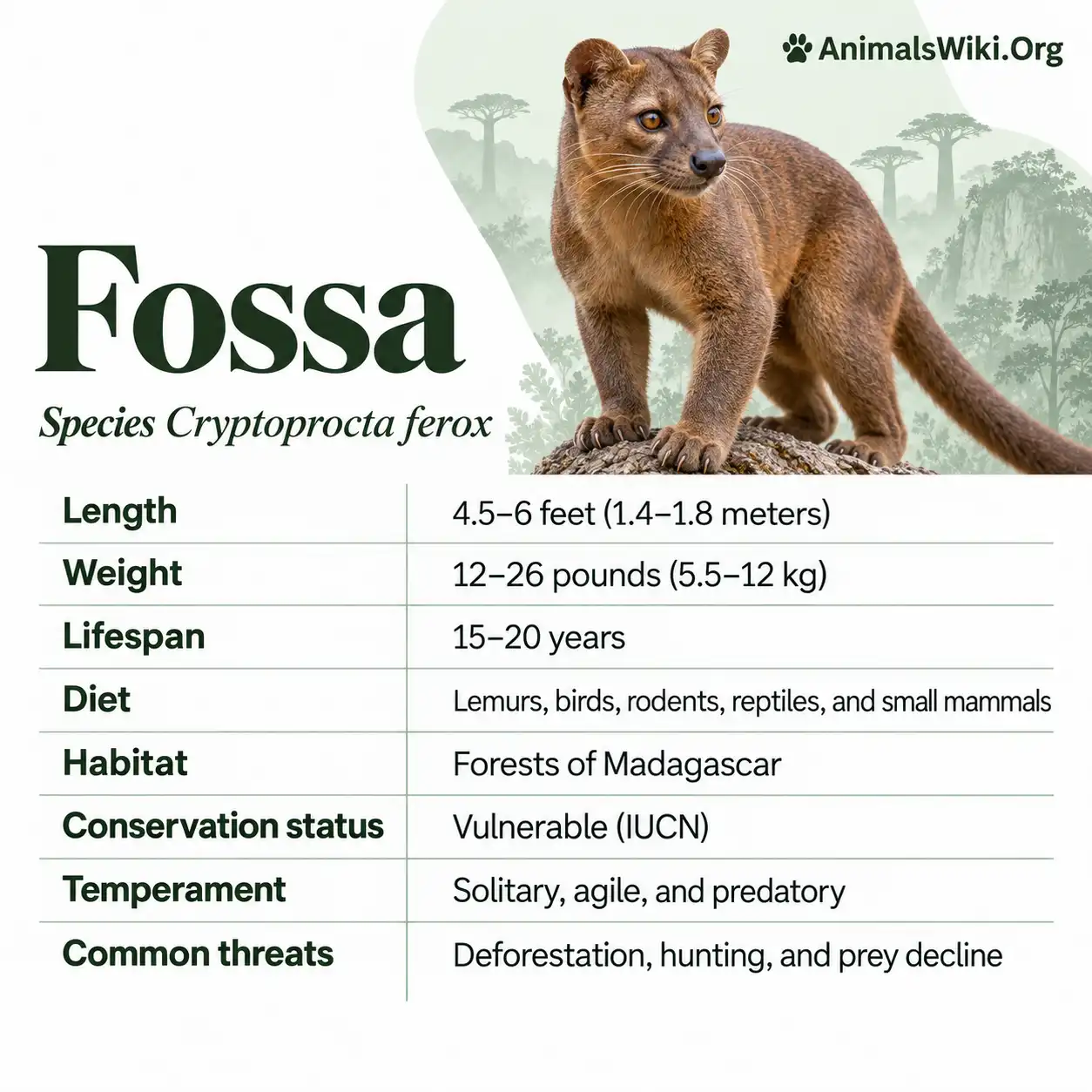
Fossa, The Powerful Lemur-Hunting Predator of Madagascar’s Forests
The Fossa is one of Madagascar’s most remarkable—and frequently misunderstood—predators.
At first glance, it looks almost like a strange combination of:
- Cat
- Mongoose
- Civet
- Small cougar
Its body is:
long, lean and muscular.
Its legs are powerful.
Its coat is usually reddish-brown.
Its face is relatively short.
And behind the body stretches an extraordinarily long tail that can be nearly as long as the animal itself.
But the Fossa is:
not a cat.
It is not a true civet either.
Scientifically known as:
Cryptoprocta ferox
the Fossa belongs to the family:
Eupleridae.
This is a remarkable radiation of carnivorous mammals found naturally only on:
Madagascar.
Among them, the Fossa is the:
largest living native terrestrial mammalian carnivore on the island.
It occupies a particularly important ecological role because Madagascar lacks many of the large predators found elsewhere.
There are no native:
- Lions
- Tigers
- Leopards
- Wolves
Instead, the Fossa has become one of Madagascar’s dominant:
mammalian predators.
And one group of animals is especially important to it:
lemurs.
A Fossa can pursue a lemur not only across the forest floor but also:
through the trees.
This is where the animal becomes truly extraordinary.
Its ankles are remarkably flexible.
Its feet can rotate substantially.
Its claws provide excellent grip.
Its long tail functions as:
a counterbalance.
A Fossa can climb a trunk, move along branches and descend a tree:
headfirst.
It can leap between branches and rapidly change direction in the canopy.
Few medium-sized mammalian predators combine terrestrial and arboreal hunting ability so effectively.
The Fossa is therefore not simply a forest carnivore.
It is a predator capable of hunting in:
three-dimensional forest space.
Its prey includes:
- Lemurs
- Rodents
- Birds
- Reptiles
- Small mammals
- Other available animals
Yet the Fossa itself faces a serious challenge.
It exists naturally in only:
one country.
Madagascar has lost and fragmented substantial areas of native forest.
Because the Fossa requires relatively large areas and depends on healthy prey populations, habitat destruction can affect it particularly strongly.
It is also sometimes killed because of:
- Poultry predation
- Fear
- Retaliation
- Local persecution
As Madagascar’s forests become fragmented, maintaining connected habitat becomes increasingly important for this remarkable carnivore.
This comprehensive guide explores Fossa facts, scientific classification, Madagascar habitat, appearance, size, weight, diet, lemur hunting, climbing, speed, behavior, reproduction, babies, lifespan, adaptations, predators, Fossa vs Cat, Fossa vs Mongoose, Fossa vs Civet, danger to humans, conservation, and why the Fossa is one of Madagascar’s most important predators.
Fossa Facts
| Feature | Information |
|---|---|
| Common Name | Fossa |
| Scientific Name | Cryptoprocta ferox |
| Animal Type | Mammal |
| Order | Carnivora |
| Family | Eupleridae |
| Genus | Cryptoprocta |
| Native Range | Madagascar |
| Habitat | Mainly forests |
| Diet | Carnivorous |
| Important Prey | Lemurs |
| Lifestyle | Mainly solitary |
| Activity | Flexible; often active day and night |
| Body Length | Roughly 70–80 cm |
| Tail Length | Roughly 65–70 cm |
| Weight | Commonly about 5–10 kg |
| Largest Sex | Male |
| Climbing Ability | Excellent |
| Major Adaptation | Flexible ankles and long balancing tail |
| Claws | Semi-retractile |
| Ecological Role | Major native predator |
| Major Threat | Habitat loss and fragmentation |
What Is a Fossa?
The Fossa is a medium-sized carnivorous mammal found only naturally on:
Madagascar.
Its scientific name is:
Cryptoprocta ferox.
It is the largest surviving native terrestrial mammalian carnivore on the island.
Is a Fossa a Cat?
No.
Its:
- Short face
- Rounded ears
- Muscular body
- Hunting behavior
can make it look somewhat cat-like.
But it does not belong to the cat family:
Felidae.
Is a Fossa a Mongoose?
Not exactly.
The Fossa belongs to:
Eupleridae, the family containing Madagascar’s endemic carnivorans.
Euplerids are evolutionarily related to mongooses and other feliform carnivorans.
So the Fossa is closer to mongooses than to cats, despite its:
cat-like appearance.
Is a Fossa a Civet?
No.
It was historically associated with civet-like carnivores because of anatomical similarities, but modern classification places it in:
Eupleridae.
Scientific Classification of the Fossa
| Classification | Name |
|---|---|
| Kingdom | Animalia |
| Phylum | Chordata |
| Class | Mammalia |
| Order | Carnivora |
| Suborder | Feliformia |
| Family | Eupleridae |
| Genus | Cryptoprocta |
| Species | Cryptoprocta ferox |
What Does a Fossa Look Like?
The Fossa has a:
- Long slender body
- Relatively short face
- Rounded ears
- Strong limbs
- Large paws
- Long tail
- Short reddish-brown coat
Its overall appearance can resemble a small:
cougar.
But this resemblance is superficial.
What Color Is a Fossa?
The coat is usually:
- Reddish-brown
- Tawny
- Brown
The underside may be somewhat lighter.
Why Does a Fossa Look Like a Cat?
Cats and Fossas share certain adaptations associated with:
predatory lifestyles.
Similar ecological pressures can produce similar body shapes in animals that are not especially close relatives.
This is an example of:
convergent evolution.
How Big Is a Fossa?
Adult Fossas commonly have a head-and-body length of approximately:
70–80 cm.
The tail can add another:
65–70 cm.
That means an adult from nose to tail tip can measure well over:
1 meter.
How Much Does a Fossa Weigh?
Adults commonly weigh approximately:
5–10 kg.
Large males can be heavier than typical females.
Are Male Fossas Bigger Than Females?
Yes.
Males are generally:
larger and heavier
than females.
Why Is the Fossa’s Tail So Long?
The long tail is extremely important for:
balance.
When moving through trees, the Fossa uses its tail as a counterweight.
This becomes especially valuable when:
- Running along branches
- Climbing
- Leaping
- Changing direction
Is a Fossa’s Tail Prehensile?
No.
It cannot grasp branches like the tail of some monkeys.
Instead, it primarily functions as a:
balancing organ.
Where Do Fossas Live?
Wild Fossas occur naturally only in:
Madagascar.
This makes the species:
endemic to Madagascar.
What Does Endemic Mean?
An endemic species occurs naturally in a particular geographic area and nowhere else.
The Fossa is therefore one of Madagascar’s many:
endemic animals.
Fossa Habitat
Fossas primarily inhabit:
forested habitats.
They can occur in:
- Tropical rainforest
- Dry deciduous forest
- Other native forest environments
Habitat quality and connectivity are especially important because individual Fossas can use:
large areas.
Do Fossas Live in Rainforests?
Yes.
They occur in Madagascar’s humid eastern:
rainforests.
Do Fossas Live in Dry Forests?
Yes.
They also occur in western:
dry deciduous forests.
This demonstrates considerable ecological flexibility.
Do Fossas Live in Trees?
Fossas use both:
the ground and trees.
They are not exclusively arboreal.
Instead, they are highly capable predators in both environments.
Are Fossas Good Climbers?
Yes.
They are among the most impressive climbers among medium-sized mammalian carnivores.
Their climbing adaptations include:
- Flexible ankles
- Strong limbs
- Large paws
- Sharp claws
- Long balancing tail
Can a Fossa Climb Down a Tree Headfirst?
Yes.
Its flexible ankle joints allow the hind feet to rotate substantially.
This gives the Fossa excellent control when descending:
headfirst.
Why Is This Important?
Many mammals can climb upward more easily than they can climb downward.
The Fossa’s flexible ankles allow it to maintain grip while:
descending rapidly.
This is extremely useful when pursuing arboreal prey.
Can Fossas Jump Between Trees?
Yes.
They are capable of powerful leaps and agile movement among:
branches.
Their long tail helps stabilize the body during these movements.
Do Fossas Have Retractable Claws?
Fossas possess:
semi-retractile claws.
These provide useful grip while climbing and capturing prey.
Can Fossas Run Fast?
Yes.
Fossas are:
quick and agile predators.
However, precise maximum speed figures commonly repeated online are poorly standardized.
Their ecological advantage comes less from a single top-speed number and more from their ability to:
- Accelerate
- Climb
- Jump
- Turn
- Pursue prey through complex forest environments
What Do Fossas Eat?
Fossas are:
carnivores.
Their diet can include:
- Lemurs
- Rodents
- Tenrecs
- Birds
- Reptiles
- Amphibians
- Other small animals
Lemurs are particularly important prey in many areas.
Do Fossas Eat Lemurs?
Yes.
The Fossa is one of the most important natural predators of:
lemurs.
It can hunt lemurs both:
on the ground and in trees.
Can a Fossa Catch a Lemur in a Tree?
Yes.
Its exceptional climbing ability allows it to pursue arboreal prey through:
the canopy.
This distinguishes it from many terrestrial predators.
Do Fossas Eat Sifakas?
Fossas can prey on various lemur species, potentially including:
sifakas, depending on location and opportunity.
Do Fossas Eat Ring-Tailed Lemurs?
Yes.
Ring-tailed lemurs can be vulnerable to Fossa predation where their ranges overlap.
Do Fossas Eat Birds?
Yes.
Birds can form part of the diet.
Do Fossas Eat Reptiles?
Yes.
They may consume:
- Lizards
- Snakes
- Other reptiles
when available.
Do Fossas Eat Chickens?
They sometimes kill:
domestic poultry.
This can bring Fossas into conflict with people living near forest habitat.
How Does a Fossa Hunt?
The Fossa hunts using:
- Stealth
- Speed
- Agility
- Climbing
- Strong jaws
- Sharp claws
It can stalk prey on the ground or pursue it:
through trees.
Does a Fossa Hunt Alone?
Usually.
Fossas are primarily:
solitary hunters.
However, observations have shown that males can occasionally hunt cooperatively.
This suggests their social and hunting behavior can be more flexible than once assumed.
Are Fossas Apex Predators?
They are often described as Madagascar’s:
top native mammalian predator.
Within many Malagasy forest ecosystems, the Fossa occupies a very high trophic position.
Does Madagascar Have Lions or Leopards?
No native populations of:
- Lions
- Leopards
- Tigers
exist in Madagascar.
The Fossa fills part of the ecological role that larger mammalian carnivores occupy elsewhere.
Does Madagascar Have Other Native Carnivores?
Yes.
Madagascar has several endemic carnivorans belonging to:
Eupleridae.
The Fossa is the largest living member.
Fossa Behavior
Fossas are generally:
solitary.
Individuals spend much of their lives:
- Hunting
- Traveling
- Resting
- Scent marking
- Exploring large home ranges
Are Fossas Nocturnal?
They are sometimes described as nocturnal, but this is too simplistic.
Fossas can be active:
during both day and night.
Their activity varies according to:
- Habitat
- Season
- Prey
- Human disturbance
They are better described as having:
flexible activity patterns.
Where Do Fossas Sleep?
They may rest in:
- Trees
- Tree hollows
- Caves
- Sheltered ground sites
- Dense vegetation
They do not depend on one single type of sleeping site.
Are Fossas Territorial?
Individuals use large home ranges.
They communicate through:
scent marking, and spatial overlap varies by sex and reproductive condition.
How Do Fossas Mark Territory?
They possess scent glands and use chemical signals to communicate information about:
- Identity
- Sex
- Reproductive status
- Presence
Scent communication is important because Fossas often live:
alone.
Do Fossas Make Sounds?
Yes.
Their vocalizations can include:
- Growls
- Hisses
- Yowls
- Other calls
Vocal behavior becomes particularly noticeable during:
breeding.
Fossa Reproduction
Fossa reproduction is one of the species’ most fascinating behaviors.
During the breeding season, females may repeatedly use prominent:
mating trees.
Several males can gather nearby and compete for mating opportunities.
What Is a Fossa Mating Tree?
A receptive female may occupy a large, conspicuous tree.
Males gather below or nearby.
The female can mate with:
multiple males.
Certain trees may be used repeatedly across years.
Why Do Fossas Mate in Trees?
Elevated mating sites may function as:
traditional mating arenas.
They allow males and females to gather in predictable locations.
The precise evolutionary advantages are still studied.
When Do Fossas Breed?
Breeding generally occurs during Madagascar’s:
spring, particularly around September to November, although timing can vary.
How Long Does Fossa Mating Last?
Individual mating sessions can be remarkably:
long.
Copulation may continue for several hours and can be repeated.
Do Female Fossas Mate With Multiple Males?
Yes.
A female may mate with several males during a breeding period.
How Long Is Fossa Pregnancy?
Gestation lasts approximately:
three months.
How Many Babies Does a Fossa Have?
A female typically gives birth to around:
2–4 young, although litter size varies.
What Is a Baby Fossa Called?
There is no widely established unique zoological term equivalent to “cub” that is exclusive to Fossas.
The young can simply be called:
Fossa young or cubs.
What Do Baby Fossas Look Like?
Newborns are:
- Small
- Vulnerable
- Poorly developed
- Dependent on their mother
Their eyes remain closed initially.
Where Are Baby Fossas Born?
Females give birth in protected:
dens.
Potential den sites include:
- Tree hollows
- Rocky shelters
- Other concealed locations
Does the Mother Care for the Young?
Yes.
The female provides:
- Milk
- Protection
- Warmth
- Guidance
The young remain dependent for an extended period.
Do Male Fossas Raise the Young?
Parental care is primarily:
maternal.
Males are not known for substantial direct care of offspring.
When Do Young Fossas Become Independent?
Development is relatively slow.
Young may remain associated with their mother for more than:
a year
before becoming fully independent.
When Do Fossas Become Adults?
Sexual maturity generally occurs after several years, with females maturing at roughly:
3–4 years in many accounts.
Development varies between individuals.
Fossa Lifespan
Wild lifespan is difficult to determine precisely.
In managed care, Fossas can live for:
around two decades or more.
Wild animals may experience shorter average lifespans because of:
- Competition
- Disease
- Injury
- Food availability
- Human threats
Fossa Adaptations
Flexible Ankles
Allow exceptional climbing and headfirst descent.
Semi-Retractile Claws
Provide grip on bark and prey.
Long Tail
Maintains balance in trees.
Muscular Body
Provides strength and acceleration.
Large Paws
Assist climbing and movement across branches.
Strong Jaws
Help subdue prey.
Keen Senses
Assist in locating prey in dense forest.
Flexible Activity
Allows hunting under varying environmental conditions.
What Animals Eat Fossas?
Adult Fossas have relatively few natural predators.
They occupy one of the highest predatory positions in Madagascar’s native mammalian ecosystems.
Young animals are more vulnerable.
Humans represent an important source of mortality.
Do Crocodiles Eat Fossas?
Madagascar has Nile crocodiles in some aquatic habitats.
A Fossa near crocodile habitat could potentially be vulnerable, but crocodiles are not generally considered a major routine predator of Fossas.
Do Large Snakes Eat Fossas?
Madagascar lacks the enormous constrictors found in some other tropical regions.
Young Fossas may be vulnerable to various predators, but healthy adults have relatively:
few natural enemies.
Are Fossas Dangerous to Humans?
Fossas are wild carnivores equipped with:
- Teeth
- Claws
- Strong jaws
But humans are:
not normal prey.
They generally avoid people.
Do Fossas Attack Humans?
Serious attacks are:
very uncommon.
A cornered or handled Fossa could defend itself, but it does not normally hunt humans.
Can a Fossa Kill a Human?
A Fossa is capable of inflicting significant bites and scratches.
However, it is far too small to regard adult humans as:
normal prey.
Are Fossas Aggressive?
They can be defensive, territorial or competitive under certain circumstances.
Calling the species generally “aggressive” oversimplifies its behavior.
Most wild Fossas prefer to:
avoid unnecessary conflict.
Can You Keep a Fossa as a Pet?
No.
Fossas are:
- Wild predators
- Strong climbers
- Active hunters
- Ecologically specialized animals
They require professional care and are not suitable:
domestic pets.
Fossa vs. Cat
| Feature | Fossa | Cat |
|---|---|---|
| Family | Eupleridae | Felidae |
| Native Range | Madagascar | Various regions |
| Body Shape | Long and slender | Typically more compact |
| Tail | Extremely long | Variable |
| Climbing | Excellent | Excellent |
| Claws | Semi-retractile | Usually retractile |
| Main Wild Prey | Lemurs and other animals | Varies |
| Closest Affinity | Malagasy carnivorans/mongoose-related lineage | Other cats |
Fossa vs. Mongoose
| Feature | Fossa | Typical Mongoose |
|---|---|---|
| Family | Eupleridae | Herpestidae |
| Distribution | Madagascar | Africa, Asia & elsewhere |
| Size | Larger than most mongooses | Usually smaller |
| Climbing | Highly developed | Varies |
| Tail | Very long | Often long |
| Main Lifestyle | Forest predator | Highly variable |
Fossas and mongooses share evolutionary ancestry within:
Feliformia.
Fossa vs. Civet
Fossas were once associated taxonomically with civets.
Modern evidence places them within Madagascar’s endemic:
Eupleridae.
Their civet-like appearance reflects shared feliform ancestry and similar anatomical features.
Fossa vs. Cougar
The Fossa can look like a miniature:
cougar.
But the resemblance is misleading.
A Cougar:
- Belongs to Felidae
- Is much larger
- Lives in the Americas
A Fossa:
- Belongs to Eupleridae
- Is much smaller
- Lives only in Madagascar
Fossa vs. Lemur
These animals have a very different relationship.
The Fossa is a:
predator.
Many lemurs are:
prey.
Both, however, are iconic examples of Madagascar’s extraordinary endemic wildlife.
Why Is the Fossa Important to Lemur Populations?
Predation is a natural ecological process.
By hunting lemurs and other animals, Fossas can influence:
- Prey behavior
- Population structure
- Forest food webs
The Fossa should therefore not be viewed as “bad” because it eats lemurs.
Predators are essential components of:
healthy ecosystems.
Are Fossas Endangered?
Fossas face significant conservation pressure.
They are generally assessed as:
Vulnerable
on the IUCN Red List, although the latest formal assessment should be checked when publishing time-sensitive conservation information.
How Many Fossas Are Left?
There is no precise current census of every wild Fossa.
Estimates are difficult because the animals are:
- Secretive
- Wide-ranging
- Often solitary
- Forest-dwelling
Population estimates should therefore always be tied to:
a specific study and year.
Why Are Fossas Threatened?
Major threats include:
- Deforestation
- Forest fragmentation
- Habitat degradation
- Hunting
- Retaliatory killing
- Poultry conflict
- Declining prey
- Small isolated populations
Why Is Deforestation Dangerous to Fossas?
A Fossa requires enough habitat to:
- Hunt
- Reproduce
- Travel
- Find mates
When forests are divided into small fragments, populations can become:
isolated.
Why Does Forest Fragmentation Matter?
Imagine one large forest divided into several tiny islands of trees.
A Fossa may struggle to:
- Move safely between them
- Find enough prey
- Locate mates
- Maintain genetic exchange
Connectivity is therefore extremely important.
Do People Kill Fossas?
Yes.
Some Fossas are killed because they:
attack poultry.
Others may be killed because of fear or traditional attitudes toward the animal.
Do Fossas Attack Livestock?
Their conflict with people is mainly associated with smaller domestic animals, especially:
chickens and poultry.
Can Better Chicken Coops Help Fossas?
Yes.
Protecting poultry securely can reduce:
human-wildlife conflict.
If a Fossa cannot enter a coop, farmers have less reason to kill it.
This illustrates how relatively simple management can benefit both:
people and predators.
Fossa Conservation
Important conservation measures include:
- Protecting Madagascar’s forests
- Connecting forest fragments
- Preventing illegal hunting
- Reducing retaliatory killing
- Protecting prey populations
- Improving poultry enclosures
- Monitoring wild populations
- Researching movement and genetics
- Supporting protected areas
- Working with local communities
Why Are Protected Areas Important?
Large protected forests provide Fossas with:
- Hunting grounds
- Denning habitat
- Mating areas
- Movement corridors
- Prey populations
Because Fossas require substantial space, conserving them can indirectly protect:
many other species.
Is the Fossa an Umbrella Species?
The concept can apply well to large-ranging predators such as the Fossa.
Protecting enough connected forest for a viable Fossa population can also protect habitat for:
- Lemurs
- Birds
- Reptiles
- Amphibians
- Plants
- Invertebrates
50 Interesting Fossa Facts
- The Fossa is a mammal.
- Its scientific name is Cryptoprocta ferox.
- It belongs to the order Carnivora.
- It belongs to the family Eupleridae.
- It is not a true cat.
- It is not a true civet.
- It is evolutionarily closer to mongooses than cats.
- Fossas live naturally only in Madagascar.
- They are Madagascar’s largest living native terrestrial mammalian carnivore.
- Fossas have reddish-brown coats.
- Their bodies are long and muscular.
- Their tails are exceptionally long.
- The tail helps maintain balance.
- Fossas are excellent climbers.
- They can descend trees headfirst.
- Their ankles are highly flexible.
- Their claws are semi-retractile.
- Fossas can move rapidly through trees.
- They also hunt on the ground.
- Fossas are carnivores.
- Lemurs are important prey.
- They can pursue lemurs through trees.
- Fossas also eat rodents.
- They can eat tenrecs.
- They can prey on birds.
- They can eat reptiles.
- They sometimes kill domestic poultry.
- Fossas are primarily solitary.
- They have flexible day-and-night activity patterns.
- They communicate with scent.
- Fossas possess scent glands.
- They can make growls and other vocalizations.
- Males are generally larger than females.
- Adults commonly weigh about 5–10 kg.
- Their tail can nearly equal their body length.
- Females may mate in prominent trees.
- Several males may gather around one breeding female.
- Females can mate with multiple males.
- Individual mating sessions can last for hours.
- Gestation lasts roughly three months.
- Litters commonly contain several young.
- Females raise the young.
- Young Fossas develop relatively slowly.
- Fossas can live for many years.
- Healthy adults have few natural predators.
- Humans are not normal Fossa prey.
- Habitat destruction is a major threat.
- Retaliatory killing can threaten Fossas.
- Protecting Fossas can protect large areas of Malagasy forest.
- The Fossa is one of the world’s most remarkable examples of an island predator evolving to fill an ecological role occupied by larger carnivores elsewhere.
Did You Know?
A Fossa can chase a lemur through the trees almost as naturally as another predator might chase prey across the ground.
Imagine a Madagascar forest at dawn.
High above the ground, a lemur moves through:
the canopy.
It leaps to another branch.
Then another.
For many terrestrial predators, reaching the trees would end:
the chase.
Not for the Fossa.
The predator reaches the trunk.
Its claws grip the bark.
Its body rises rapidly.
Then something remarkable happens at:
the ankle.
The hind feet can rotate substantially.
This allows the Fossa to maintain its grip from angles that would be difficult for many other mammalian carnivores.
It reaches a branch.
The lemur runs.
The Fossa follows.
Its long body bends around:
the branch.
Its tail extends in the opposite direction.
That tail is not decoration.
It acts as:
a counterbalance.
The lemur changes direction.
So does the Fossa.
The prey leaps.
The predator can leap too.
Now the chase moves downward.
The lemur descends.
Instead of awkwardly reversing down the trunk, the Fossa can rotate its hind feet and move:
headfirst.
This ability transforms the forest from a collection of obstacles into:
hunting space.
Ground.
Trunk.
Branch.
Canopy.
Each becomes part of the predator’s environment.
This helps explain why the Fossa is so important in Madagascar.
On continents such as Africa or Asia, predatory roles are divided among many carnivores.
Madagascar evolved in relative isolation.
There were no native:
lions, leopards or tigers.
Instead, evolution produced something entirely different.
A mongoose-related carnivoran became:
larger.
Its body became:
powerful.
Its ankles became:
extraordinarily flexible.
Its tail became:
an enormous balancing tool.
And it became capable of hunting one of Madagascar’s most famous groups of mammals:
lemurs.
The result was not a cat.
It only looks somewhat like one.
The result was:
the Fossa.
Frequently Asked Questions About Fossas
What is a Fossa?
A Fossa is a medium-sized carnivorous mammal native only to Madagascar.
What is the scientific name of the Fossa?
Cryptoprocta ferox.
Is a Fossa a mammal?
Yes.
Is a Fossa a carnivore?
Yes.
Is a Fossa a cat?
No.
Is a Fossa a mongoose?
Not exactly. It belongs to Eupleridae, a Malagasy carnivoran family closely related evolutionarily to mongooses.
Is a Fossa a civet?
No.
What family does the Fossa belong to?
Eupleridae.
What does Cryptoprocta ferox mean?
The scientific name refers to anatomical and behavioral characteristics of the species; ferox is Latin for fierce or wild.
Where do Fossas live?
Madagascar.
Are Fossas found anywhere outside Madagascar?
Not naturally.
Are Fossas endemic to Madagascar?
Yes.
What habitat do Fossas prefer?
Primarily native forest habitats.
Do Fossas live in rainforests?
Yes.
Do Fossas live in dry forests?
Yes.
Do Fossas live in trees?
They use trees extensively but also spend substantial time on the ground.
Are Fossas arboreal?
They are highly capable climbers but are better described as both terrestrial and arboreal.
Can Fossas climb trees?
Yes, exceptionally well.
Can Fossas climb down headfirst?
Yes.
Why can Fossas descend trees headfirst?
Their highly flexible ankles allow the hind feet to rotate and maintain grip.
Can Fossas jump between branches?
Yes.
Do Fossas have retractable claws?
They have semi-retractile claws.
Why is a Fossa’s tail so long?
It helps maintain balance during climbing and jumping.
Is a Fossa’s tail prehensile?
No.
How long is a Fossa?
Its body is commonly around 70–80 cm long, with a similarly impressive tail.
How much does a Fossa weigh?
Adults commonly weigh roughly 5–10 kg.
Are male Fossas larger?
Generally, yes.
What color is a Fossa?
Usually reddish-brown or tawny brown.
Why does a Fossa look like a cat?
Similar predatory lifestyles produced some superficially similar anatomical features.
What do Fossas eat?
Lemurs and other mammals, birds, reptiles and other animal prey.
Do Fossas eat lemurs?
Yes.
Are lemurs the Fossa’s main prey?
Lemurs can be an extremely important component of the diet, although diet varies with habitat and prey availability.
Can Fossas catch lemurs in trees?
Yes.
Do Fossas eat ring-tailed lemurs?
They can where their ranges overlap.
Do Fossas eat sifakas?
They can prey on different lemur species, including sifakas where available.
Do Fossas eat birds?
Yes.
Do Fossas eat snakes?
They can consume reptiles, including snakes.
Do Fossas eat rodents?
Yes.
Do Fossas eat chickens?
They sometimes kill domestic poultry.
How does a Fossa hunt?
Using stealth, agility, speed, climbing ability, claws and strong jaws.
Does a Fossa hunt in trees?
Yes.
Does a Fossa hunt on the ground?
Yes.
Do Fossas hunt alone?
Usually, although occasional cooperative hunting has been observed.
Are Fossas apex predators?
They occupy one of the highest predatory positions among Madagascar’s native mammals.
Are Fossas nocturnal?
Not exclusively. They can be active during both day and night.
Are Fossas solitary?
Generally, yes.
Are Fossas territorial?
They use large home ranges and communicate through scent marking.
How do Fossas communicate?
Through scent signals, body behavior and vocalizations.
What sounds do Fossas make?
They can growl, hiss, yowl and make other calls.
Where do Fossas sleep?
In sheltered sites such as trees, hollows, caves and dense vegetation.
How fast can a Fossa run?
There is no well-established universal maximum speed; they are best characterized as quick and extremely agile forest predators.
Can a Fossa swim?
Fossas are capable of moving through water when necessary, though swimming is not their defining specialization.
When do Fossas mate?
Breeding generally occurs during Madagascar’s spring.
Where do Fossas mate?
Females may use prominent traditional mating trees.
What is a Fossa mating tree?
A tree where a receptive female attracts and mates with competing males.
Do female Fossas mate with multiple males?
Yes.
How long do Fossas mate?
Individual copulations can last for several hours.
How long is a Fossa pregnant?
Approximately three months.
How many babies do Fossas have?
Typically around two to four young.
What is a baby Fossa called?
It can simply be called a young Fossa or cub.
Are baby Fossas born helpless?
Yes. They are dependent on their mother.
Does the mother raise the babies?
Yes.
Does the father raise them?
Direct paternal care is not normally an important part of Fossa reproduction.
How long do young Fossas stay with their mother?
They can remain dependent for more than a year.
How long do Fossas live?
They can live for many years, with individuals in managed care reaching around two decades or more.
What animals eat Fossas?
Healthy adults have relatively few natural predators.
Do Fossas have predators?
Young animals are more vulnerable, while adults occupy a high trophic position.
Are humans predators of Fossas?
Humans can kill Fossas through hunting or retaliation.
Are Fossas dangerous to humans?
They can defend themselves but do not normally regard humans as prey.
Do Fossas attack people?
Serious attacks are very rare.
Can a Fossa kill a human?
It could cause serious injuries, but adult humans are not normal prey.
Can Fossas be pets?
No. They are wild predators with complex ecological and behavioral needs.
Is a Fossa bigger than a house cat?
Generally, yes, particularly in overall body length.
Is a Fossa bigger than a Cougar?
No. A Cougar is dramatically larger.
Is a Fossa related to a Cougar?
Only distantly as fellow members of Carnivora; the Fossa is not a cat.
Is a Fossa related to a mongoose?
Yes, through the broader feliform carnivoran lineage, with Malagasy euplerids having close evolutionary links to mongoose-like ancestors.
Why are Fossas important?
They regulate prey populations and occupy a major predatory role in Madagascar’s forests.
Do Fossas help control lemur populations?
Predation by Fossas is part of the natural ecological regulation of lemur and other prey populations.
Are Fossas endangered?
They face substantial conservation concerns and are generally classified as Vulnerable, subject to the latest formal assessment.
How many Fossas are left?
No exact current global census exists.
Why are Fossas threatened?
Habitat loss, forest fragmentation, hunting and human conflict are major threats.
Does deforestation hurt Fossas?
Yes.
Why do Fossas need large forests?
They require substantial areas for hunting, movement, reproduction and finding mates.
Does forest fragmentation hurt Fossas?
Yes. It can isolate populations and reduce access to prey and mates.
Why do farmers kill Fossas?
Predation on poultry can cause conflict and retaliatory killing.
Can chicken coops help conserve Fossas?
Better-secured poultry enclosures can reduce livestock losses and therefore reduce conflict.
Are Fossas protected?
They receive conservation attention and occur within several protected areas in Madagascar.
Can zoos breed Fossas?
Yes. Fossas are maintained and bred in some professional zoological institutions.
What is the difference between a Fossa and a cat?
Fossas belong to Eupleridae; cats belong to Felidae.
What is the difference between a Fossa and a mongoose?
They belong to different families, although their evolutionary histories are relatively closely connected within Feliformia.
What is the difference between a Fossa and a civet?
They belong to different modern taxonomic families despite some superficial similarities.
What is the difference between a Fossa and a lemur?
A Fossa is a carnivoran predator; a lemur is a primate and can be Fossa prey.
What is the most interesting Fossa fact?
The Fossa can pursue lemurs through Madagascar’s forest canopy using flexible ankles that allow it to descend trees headfirst while its nearly body-length tail keeps it balanced.
Conclusion
The Fossa demonstrates what can happen when evolution unfolds for millions of years on an:
isolated island.
Madagascar did not develop native lions.
It did not develop native tigers.
It did not develop native leopards.
Instead, a lineage related to mongoose-like carnivorans evolved into something that, at first glance, looks almost:
cat-like.
Its body became long and muscular.
Its claws became effective climbing tools.
Its ankles became extraordinarily:
flexible.
Its tail became almost as long as its body.
And its hunting ability expanded beyond the forest floor into:
the trees.
For a lemur, escaping upward does not necessarily mean:
escaping the predator.
The Fossa can follow.
It can climb.
It can balance.
It can leap.
It can descend:
headfirst.
That makes it one of the most remarkable mammalian hunters in any forest.
Yet the Fossa’s importance extends far beyond its athletic ability.
Predators help shape:
ecosystems.
By hunting lemurs, rodents and other animals, the Fossa participates in ecological relationships that have developed across Madagascar over immense spans of evolutionary time.
Remove the predator and those relationships:
change.
Unfortunately, the Fossa’s greatest challenge cannot be solved simply by climbing faster or hunting more efficiently.
Its greatest challenge is:
losing the forest itself.
When a large continuous forest becomes many small fragments, a wide-ranging predator loses more than trees.
It loses:
- Hunting space
- Prey
- Travel routes
- Mating opportunities
- Genetic connections between populations
This is why protecting the Fossa means protecting:
connected Malagasy forests.
It also means reducing conflict with people.
A farmer who loses chickens to a predator experiences a genuine economic problem.
Better livestock protection can therefore become a conservation tool.
Protect the chickens.
Reduce the conflict.
Protect the:
Fossa.
And because the Fossa requires extensive forest, conserving enough habitat for this predator can simultaneously protect countless:
- Lemurs
- Birds
- Reptiles
- Amphibians
- Invertebrates
- Plants
Few animals better represent the uniqueness of Madagascar.
The Fossa may resemble a cat.
It may have evolutionary connections to mongoose-like carnivores.
It may hunt like something entirely its own.
And that is precisely what makes it extraordinary.
The Fossa is not Madagascar’s version of another predator.
It is:
Madagascar’s Fossa.



