
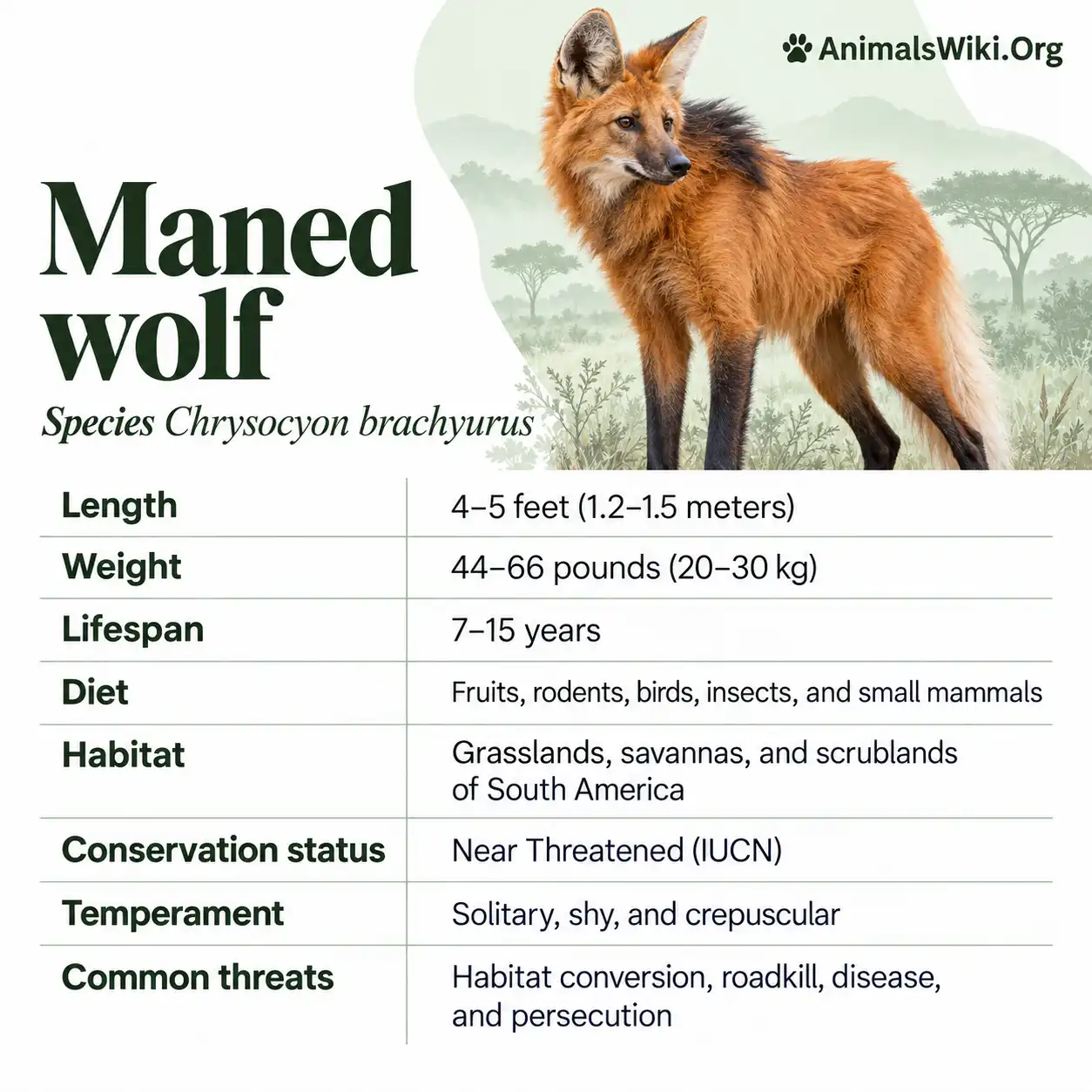
Maned Wolf, The Long-Legged Canid of South America’s Grasslands
The Maned Wolf looks like an animal created by combining a wolf, a fox and a deer.
It has:
- Extremely long legs
- A reddish-orange coat
- Large upright ears
- A narrow fox-like face
- Black lower legs
- A dark mane along its shoulders
- A white-tipped tail
But despite its appearance, the Maned Wolf is:
neither a true wolf nor a fox.
Scientifically known as:
Chrysocyon brachyurus
it belongs to the dog family:
Canidae.
Yet it represents its own distinctive evolutionary lineage.
It is the only living species in the genus:
Chrysocyon.
The Maned Wolf is also the:
tallest living wild canid.
Its extraordinary height comes mainly from its:
legs.
These long limbs are perfectly suited to the tall grasses and open landscapes of central South America.
When a Maned Wolf walks through dense grass, its elevated body gives it an advantage.
It can:
- See above vegetation
- Move through tall grass
- Search for prey
- Detect potential danger
Its habitat includes landscapes such as:
- Cerrado
- Grasslands
- Savannas
- Shrublands
- Wet grasslands
It is especially associated with:
Brazil, although its range extends into several neighboring South American countries.
Despite the word “wolf” in its name, the Maned Wolf does not normally behave like the famous Gray Wolf.
It does not usually live in a large cooperative:
pack.
It does not normally hunt large prey through long coordinated chases.
Instead, it is generally:
solitary.
A Maned Wolf often walks alone through the grass, searching for:
- Rodents
- Small mammals
- Birds
- Reptiles
- Insects
- Fruit
That final category is particularly important.
Unlike the strongly meat-focused image many people associate with wolves, the Maned Wolf consumes a substantial amount of:
plant food.
One fruit has become especially famous in connection with the species.
It is called:
lobeira, or the wolf apple.
Its scientific name is:
Solanum lycocarpum.
The fruit can make up a significant portion of the Maned Wolf’s diet in some regions and seasons.
As the animal eats fruit and travels through its large home range, seeds can pass through its digestive system and be deposited elsewhere.
The Maned Wolf can therefore act not only as a predator but also as a:
seed disperser.
Its unusual appearance is matched by unusual communication.
A Maned Wolf can produce a deep, explosive vocalization often called a:
roar-bark.
Across open grassland, this call can travel considerable distances.
Its scent communication is equally distinctive.
Maned Wolf urine has an exceptionally powerful odor that has famously been compared to:
cannabis or hops.
For the animal, however, the smell is not a curiosity.
It is part of an important chemical communication system used to:
mark areas and communicate with other Maned Wolves.
The species faces a very different world today from the vast uninterrupted grasslands in which its ancestors evolved.
Agriculture, roads, habitat conversion, vehicle collisions, disease from domestic dogs and conflict with humans all create challenges.
The survival of the Maned Wolf therefore depends heavily on protecting something that receives far less global attention than tropical rainforest:
South America’s grasslands and savannas.
This comprehensive guide explores Maned Wolf facts, scientific classification, size, height, long legs, mane, habitat, South American distribution, Cerrado, diet, wolf apple, hunting, speed, behavior, roar-bark, smell, reproduction, pups, lifespan, adaptations, predators, Maned Wolf vs Gray Wolf, Maned Wolf vs Fox, danger to humans, conservation, and the remarkable biology of the world’s tallest wild canid.
Maned Wolf Facts
| Feature | Information |
|---|---|
| Common Name | Maned Wolf |
| Scientific Name | Chrysocyon brachyurus |
| Animal Type | Mammal |
| Family | Canidae |
| Genus | Chrysocyon |
| Living Species in Genus | 1 |
| Native Region | South America |
| Important Stronghold | Brazil |
| Main Habitat | Grasslands, savannas & shrublands |
| Famous Ecosystem | Cerrado |
| Shoulder Height | Roughly 75–90 cm |
| Weight | Commonly around 20–30 kg |
| Diet | Omnivorous |
| Famous Food | Lobeira/Wolf Apple |
| Social Structure | Primarily solitary |
| Activity | Often crepuscular/nocturnal |
| Famous Vocalization | Roar-bark |
| Distinctive Feature | Extremely long legs |
| Pack Hunter | Generally no |
| Ecological Roles | Predator & seed disperser |
What Is a Maned Wolf?
The Maned Wolf is a large, long-legged wild canid native to:
South America.
Its scientific name is:
Chrysocyon brachyurus.
Although its common name contains the word “wolf,” it is not simply a South American version of the:
Gray Wolf.
Is a Maned Wolf Really a Wolf?
Not in the same sense as the Gray Wolf.
The Gray Wolf belongs to the genus:
Canis.
The Maned Wolf belongs to:
Chrysocyon.
It represents a separate canid lineage.
Is a Maned Wolf a Fox?
No.
Its reddish fur, pointed face and large ears can make it look:
fox-like.
But true foxes belong to other canid lineages.
The Maned Wolf is neither:
a true wolf nor a true fox.
Scientific Classification
| Classification | Name |
|---|---|
| Kingdom | Animalia |
| Phylum | Chordata |
| Class | Mammalia |
| Order | Carnivora |
| Family | Canidae |
| Genus | Chrysocyon |
| Species | Chrysocyon brachyurus |
What Does Chrysocyon brachyurus Mean?
The genus name Chrysocyon comes from roots referring approximately to:
“golden dog.”
The species name brachyurus refers to:
a relatively short tail.
What Does a Maned Wolf Look Like?
The Maned Wolf has an unmistakable appearance.
Its major characteristics include:
- Reddish-orange fur
- Black lower legs
- Black mane
- Large upright ears
- Long narrow muzzle
- White throat markings
- White tail tip
- Extremely long legs
From a distance, it can resemble:
a giant red fox standing on stilts.
Why Does the Maned Wolf Have Such Long Legs?
The long legs are an adaptation to:
tall grasslands.
They elevate the body above dense vegetation and help the animal move through:
- Tall grasses
- Wetlands
- Savanna vegetation
They may also improve its ability to:
spot prey and danger.
Is the Maned Wolf the Tallest Wild Dog?
It is generally regarded as the:
tallest living wild canid.
This refers to shoulder height rather than total body mass.
How Tall Is a Maned Wolf?
Adults typically stand approximately:
75–90 cm at the shoulder.
Those long legs create an animal much taller than its relatively moderate weight might suggest.
How Much Does a Maned Wolf Weigh?
Adults commonly weigh around:
20–30 kg.
Exact weight varies by:
- Sex
- Age
- Individual
- Geographic region
- Physical condition
Is a Maned Wolf Bigger Than a Gray Wolf?
This depends on what “bigger” means.
A Maned Wolf can appear exceptionally tall because of its legs.
However, a large Gray Wolf is usually:
much heavier and more powerfully built.
So the Maned Wolf wins in:
leggy height
while the Gray Wolf generally wins in:
body mass and robustness.
Why Does the Maned Wolf Have a Mane?
Long black hairs run along the:
neck and shoulders.
When the animal feels threatened or excited, these hairs can stand upright.
This can make the Maned Wolf appear:
larger and more intimidating.
Is the Mane Like a Lion’s Mane?
No.
It is more like an elongated strip of dark hair along the neck and shoulders.
It can be raised during:
social or defensive displays.
Why Are Its Ears So Large?
Large ears help detect:
small prey moving through vegetation.
They are especially useful when hunting rodents and other small animals hidden in:
grass.
Where Do Maned Wolves Live?
The species occurs in parts of central and eastern:
South America.
Its range includes areas of:
- Brazil
- Paraguay
- Bolivia
- Argentina
with historical or limited occurrence associated with neighboring regions as well.
Brazil contains a particularly important proportion of the species’ habitat.
What Is the Main Maned Wolf Habitat?
Maned Wolves are associated primarily with:
- Grasslands
- Savannas
- Shrublands
- Wet grasslands
- Open woodland mosaics
One of their most important ecosystems is the:
Brazilian Cerrado.
What Is the Cerrado?
The Cerrado is a vast tropical savanna region of:
Brazil and neighboring areas.
It contains an extraordinary mixture of:
- Grassland
- Shrubland
- Woodland
- Wetlands
- Gallery forests
It supports enormous biodiversity.
The Maned Wolf is one of its most iconic:
large mammals.
Do Maned Wolves Live in the Amazon Rainforest?
They are not primarily animals of dense:
Amazonian rainforest.
They are much more strongly associated with:
open habitats.
Do Maned Wolves Live in Forests?
They can use open woodland and habitat mosaics, but dense closed forest is not their classic preferred environment.
Do Maned Wolves Live in Mountains?
They can occur across varied elevations where suitable open habitat exists, but they are most famous as animals of:
grassland and savanna ecosystems.
What Do Maned Wolves Eat?
Maned Wolves are:
omnivores.
Their diet contains both:
animal and plant food.
Animal prey may include:
- Rodents
- Rabbits and other small mammals
- Birds
- Reptiles
- Amphibians
- Insects
Plant food includes:
- Fruits
- Other vegetation
One fruit is particularly famous:
the wolf apple.
What Is a Wolf Apple?
The wolf apple, or:
lobeira
is a South American fruit produced by:
Solanum lycocarpum.
It can be an important food for Maned Wolves.
Do Maned Wolves Really Eat Fruit?
Yes.
Fruit can form a substantial portion of the diet.
This is one of the biggest differences between the Maned Wolf and the stereotypical image of a large:
meat-eating wolf.
Why Do Maned Wolves Eat Wolf Apples?
Wolf apples are:
- Available in their habitat
- Nutritionally useful
- Relatively abundant in some areas
The relationship may also benefit the plant because the Maned Wolf can disperse:
its seeds.
Do Maned Wolves Spread Seeds?
Yes.
After eating fruit, seeds can pass through the digestive tract.
The animal then travels and deposits them elsewhere.
The Maned Wolf can therefore function as:
a seed disperser.
Are Maned Wolves Carnivores?
Taxonomically they belong to the order:
Carnivora.
Ecologically, however, their diet is:
omnivorous.
Being a member of Carnivora does not mean an animal must eat only meat.
Do Maned Wolves Eat Deer?
Their hunting strategy focuses much more heavily on:
small prey.
They are not specialized large-ungulate hunters like Gray Wolves.
Do Maned Wolves Eat Rodents?
Yes.
Rodents are important prey.
Their large ears help them detect movement hidden within:
vegetation.
Do Maned Wolves Eat Birds?
Yes.
They can catch birds and may also take eggs when opportunities arise.
Do Maned Wolves Eat Snakes?
Reptiles can be part of the diet, including:
snakes and lizards.
Do Maned Wolves Eat Insects?
Yes.
Insects can supplement their varied omnivorous diet.
How Does a Maned Wolf Hunt?
A Maned Wolf typically hunts:
alone.
It moves through grassland listening and watching for small prey.
Once prey is detected, it may:
- Freeze
- Listen carefully
- Stalk
- Pounce
Its hunting style can sometimes appear surprisingly:
fox-like.
Does a Maned Wolf Jump on Prey?
Yes.
It may use a pouncing motion to capture small animals concealed in:
tall vegetation.
Why Are Large Ears Useful for Hunting?
A rodent may be completely hidden by grass.
The Maned Wolf may still detect:
its movement by sound.
Large mobile ears help pinpoint the location.
Do Maned Wolves Hunt in Packs?
Generally:
no.
This is one of the major differences between Maned Wolves and Gray Wolves.
Maned Wolves are usually:
solitary foragers.
Are Maned Wolves Solitary?
Yes.
They typically travel and hunt:
alone.
However, adults can form monogamous breeding pairs whose territories overlap.
Being solitary does not mean they have:
no social relationships.
Do Maned Wolves Mate for Life?
They are often described as:
monogamous.
A male and female may maintain a pair bond and share or overlap a territory, although they often spend much of their time:
apart.
Do Maned Wolf Couples Hunt Together?
Usually not.
Even paired adults often:
forage separately.
This differs dramatically from the cooperative hunting system of Gray Wolves.
How Large Is a Maned Wolf Territory?
Home-range size varies enormously according to:
- Habitat
- Food availability
- Human disturbance
- Population density
- Study location
Individual home ranges can cover:
many square kilometers.
Exact figures should always be tied to a particular population and study.
How Do Maned Wolves Mark Territory?
They use:
urine and feces
as chemical signals.
Scent marks can communicate information about:
- Identity
- Presence
- Reproductive condition
- Territory use
What Does a Maned Wolf Smell Like?
Its urine has a remarkably strong odor.
People have compared the scent to:
cannabis, hops or skunk-like smells.
The comparison became particularly famous from observations of captive animals.
Why Does Maned Wolf Urine Smell Like Cannabis?
The similarity comes from volatile chemical compounds that can produce a comparable:
odor impression.
It does not mean the animal consumes cannabis.
The smell functions as part of:
chemical communication.
What Sound Does a Maned Wolf Make?
Its most famous vocalization is called a:
roar-bark.
It is a loud, deep call that can carry across:
open habitat.
Why Does a Maned Wolf Roar-Bark?
The call may help:
- Maintain contact
- Advertise presence
- Communicate over distance
- Define spacing between individuals
Open grassland is ideal for:
long-distance sound communication.
Does a Maned Wolf Howl?
It does not produce the same famous long communal howls associated with:
Gray Wolves.
The roar-bark is much more characteristic.
Are Maned Wolves Nocturnal?
They are commonly most active during:
dusk, night and dawn.
However, activity can change according to:
- Human disturbance
- Weather
- Season
- Food availability
Do Maned Wolves Sleep During the Day?
They often rest during hotter daylight periods.
They may shelter in:
- Tall grass
- Dense vegetation
- Shrub cover
Can Maned Wolves Run Fast?
They can run efficiently, but they are not specialized high-speed pursuit predators like:
Cheetahs.
Their long legs are especially useful for:
moving through tall vegetation.
Can Maned Wolves Swim?
Like many canids, they are physically capable of swimming when necessary, although swimming is not a defining specialization of the species.
Maned Wolf Reproduction
Maned Wolves generally form:
monogamous breeding pairs.
Even so, partners may spend substantial periods apart.
When Do Maned Wolves Breed?
Breeding is seasonal and varies geographically.
In the Southern Hemisphere, mating commonly occurs during:
autumn, with births occurring later in the year.
How Long Is a Maned Wolf Pregnant?
Gestation lasts approximately:
two months, commonly around 60–65 days.
How Many Babies Do Maned Wolves Have?
Litters commonly contain approximately:
2–5 pups, although litter size can vary.
What Is a Baby Maned Wolf Called?
A baby Maned Wolf is called a:
pup.
What Do Maned Wolf Pups Look Like?
Newborn pups are much darker than adults.
Their early coat can be:
very dark gray to nearly black.
As they mature, the characteristic reddish adult coloration develops.
Why Are Baby Maned Wolves Black?
The dark juvenile coat is a normal developmental characteristic.
It gradually changes as the pup:
grows.
Where Are the Pups Born?
Females use protected denning sites among:
- Dense vegetation
- Tall grass
- Natural cover
The young remain sheltered during their earliest development.
Does the Mother Care for the Pups?
Yes.
Females provide:
- Milk
- Protection
- Warmth
- Care
Does the Father Help Raise the Pups?
Male parental care has been observed, particularly under managed conditions, including:
food provisioning and pup care.
The exact degree of paternal involvement in the wild can vary and is harder to observe.
How Fast Do Maned Wolf Pups Grow?
Pups gradually:
- Open their eyes
- Become mobile
- Begin eating solid food
- Develop reddish coloration
- Learn to forage
They remain dependent during early development.
When Do Maned Wolves Become Adults?
Sexual maturity is generally reached at around:
one to two years, although successful breeding may occur later.
Maned Wolf Lifespan
In managed care, Maned Wolves can live for roughly:
12–15 years, with variation among individuals.
Wild lifespan is often more difficult to determine precisely.
Maned Wolf Adaptations
Extremely Long Legs
Help the animal move and see through tall vegetation.
Large Ears
Detect small prey hidden in grass.
Omnivorous Diet
Allows use of both animal and plant foods.
Long-Distance Vocalization
Roar-barks carry through open landscapes.
Scent Marking
Allows communication between widely separated animals.
Reddish Coat
Blends with dry grassland and savanna vegetation.
Dark Mane
Can be raised to make the animal appear larger.
Solitary Hunting
Matches a diet dominated by relatively small, dispersed food items.
Why Doesn’t the Maned Wolf Hunt in Packs?
Large cooperative packs are most advantageous when animals benefit from jointly defending resources or hunting:
large prey.
The Maned Wolf often searches for:
- Small mammals
- Birds
- Insects
- Fruit
These foods can be efficiently collected:
alone.
What Animals Eat Maned Wolves?
Healthy adult Maned Wolves have relatively few natural predators.
Their size and open-country awareness provide substantial protection.
Young animals are more vulnerable.
Humans and human-related threats represent some of the most important dangers.
Do Jaguars Kill Maned Wolves?
Jaguars are large enough to kill a Maned Wolf, and potential predatory interactions are biologically possible where their ranges overlap.
However, Maned Wolves are not generally regarded as a primary Jaguar prey species.
Do Pumas Kill Maned Wolves?
Pumas can potentially kill smaller carnivores, including Maned Wolves, where they overlap.
Such interactions are not the primary threat to the species.
Are Maned Wolves Dangerous to Humans?
Generally:
no.
They are shy animals that normally avoid people.
Humans are not their:
prey.
Do Maned Wolves Attack Humans?
Attacks are exceptionally rare.
A cornered or threatened wild animal can defend itself, but Maned Wolves do not normally:
hunt or stalk humans.
Can a Maned Wolf Kill a Human?
They possess teeth and are capable of inflicting injury, but humans are far outside their normal prey range.
They should be treated as:
wild animals, not dangerous human predators.
Are Maned Wolves Friendly?
“Friendly” is not an appropriate assumption for a wild animal.
They are generally:
shy and wary.
Wild individuals should be observed without approaching or attempting to touch them.
Can You Keep a Maned Wolf as a Pet?
No.
Maned Wolves have:
- Large territories
- Specialized behavior
- Strong scent marking
- Wild dietary needs
- Conservation and legal considerations
They are not suitable:
domestic pets.
Maned Wolf vs. Gray Wolf
| Feature | Maned Wolf | Gray Wolf |
|---|---|---|
| Scientific Name | Chrysocyon brachyurus | Canis lupus |
| Genus | Chrysocyon | Canis |
| Main Region | South America | Northern Hemisphere |
| Build | Tall and slender | Heavy and powerful |
| Legs | Extremely long | Proportionally shorter |
| Diet | Omnivorous | Primarily carnivorous |
| Fruit | Important | Usually minor |
| Social Structure | Mainly solitary | Often pack-living |
| Hunting | Mostly solitary | Often cooperative |
| Famous Call | Roar-bark | Howl |
Maned Wolf vs. Fox
| Feature | Maned Wolf | Typical Fox |
|---|---|---|
| Genus | Chrysocyon | Often Vulpes or others |
| Size | Much larger | Usually smaller |
| Legs | Extremely long | Shorter |
| Main Region | South America | Widespread depending on species |
| Diet | Omnivorous | Usually omnivorous |
| True Fox | No | Yes for Vulpes species |
Maned Wolf vs. Red Fox
Both have:
- Reddish fur
- Pointed faces
- Large ears
- Omnivorous diets
But the Maned Wolf is:
much taller.
The Red Fox belongs to:
Vulpes.
The Maned Wolf belongs to:
Chrysocyon.
Maned Wolf vs. Coyote
| Feature | Maned Wolf | Coyote |
|---|---|---|
| Scientific Name | Chrysocyon brachyurus | Canis latrans |
| Native Region | South America | North & Central America |
| Build | Extremely tall/slender | More wolf-like |
| Social Behavior | Primarily solitary | Flexible |
| Fruit Importance | Often substantial | Variable |
| Genus | Chrysocyon | Canis |
Is the Maned Wolf Related to Wolves?
Yes, in the broad sense that both belong to:
Canidae.
However, they occupy separate branches of the canid evolutionary tree.
What Is the Maned Wolf’s Closest Living Relative?
The evolutionary relationships among South American canids are complex.
The Maned Wolf belongs to a distinct lineage within the South American canid radiation and has no other living member of:
Chrysocyon.
It should not be described simply as a close relative of the Gray Wolf based on its name.
Maned Wolf Evolution
South America has a fascinating radiation of native canids.
Ancestors of these animals ultimately entered South America after terrestrial connections with North America allowed faunal exchange.
Over evolutionary time, different lineages adapted to:
- Forests
- Grasslands
- Mountains
- Open savannas
The Maned Wolf evolved a particularly unusual:
long-legged grassland body plan.
Why Is the Maned Wolf Important?
The species performs at least two major ecological roles.
It acts as a:
predator
by consuming rodents and other small animals.
And it acts as a:
seed disperser
by consuming fruits such as the wolf apple.
Few large canids combine these roles so prominently.
Does the Maned Wolf Help Farmers?
By eating rodents and other small animals, Maned Wolves may provide ecological benefits through:
natural prey regulation.
However, interactions with livestock can also create conflict.
Do Maned Wolves Kill Chickens?
They can occasionally take:
poultry.
This can cause conflict with people.
Secure livestock enclosures can help reduce such losses.
Are Maned Wolves Endangered?
The Maned Wolf faces significant conservation challenges.
Its exact conservation category should be checked against the latest formal assessment when publishing current status information.
Globally, it has generally been assessed as:
Near Threatened, while it may receive stronger threat classifications within individual countries or regions.
How Many Maned Wolves Are Left?
There is no precise count of every wild Maned Wolf.
Population estimates depend on:
- Survey method
- Geographic area
- Assessment year
- Habitat assumptions
Any exact number should therefore be presented together with:
its source and date.
What Threatens Maned Wolves?
Major threats include:
- Habitat conversion
- Agricultural expansion
- Road collisions
- Habitat fragmentation
- Disease
- Domestic dogs
- Human persecution
- Conflict with livestock owners
Why Is Agriculture a Threat?
Large areas of South American grassland and Cerrado have been converted for:
- Crops
- Cattle
- Roads
- Settlements
- Infrastructure
This can reduce and fragment:
native habitat.
Why Are Roads Dangerous?
Maned Wolves travel over:
large home ranges.
Roads crossing those ranges create a substantial risk of:
vehicle collisions.
Are Domestic Dogs Dangerous to Maned Wolves?
Yes.
Domestic and free-ranging dogs can create several problems, including:
- Disease transmission
- Competition
- Harassment
- Direct attacks
What Diseases Affect Maned Wolves?
Diseases associated with domestic canids can pose risks, including pathogens such as:
- Canine distemper virus
- Canine parvovirus
- Rabies
Disease risk varies among populations.
Does Habitat Fragmentation Affect Maned Wolves?
Yes.
Fragmentation can:
- Restrict movement
- Increase road crossings
- Increase contact with humans
- Increase contact with domestic dogs
- Isolate populations
Maned Wolf Conservation
Important conservation strategies include:
- Protecting Cerrado and grasslands
- Maintaining habitat corridors
- Reducing road mortality
- Installing wildlife crossings where appropriate
- Protecting natural prey
- Managing domestic dogs
- Reducing disease transmission
- Improving livestock protection
- Preventing persecution
- Monitoring wild populations
- Working with local communities
Why Should the Cerrado Be Protected?
The Cerrado supports an enormous diversity of:
- Mammals
- Birds
- Reptiles
- Amphibians
- Insects
- Plants
Protecting Maned Wolf habitat therefore helps conserve an entire:
savanna ecosystem.
50 Interesting Maned Wolf Facts
- The Maned Wolf is a mammal.
- Its scientific name is Chrysocyon brachyurus.
- It belongs to the dog family Canidae.
- It is not a true wolf.
- It is not a true fox.
- It is the only living species in Chrysocyon.
- Maned Wolves are native to South America.
- Brazil contains major populations.
- They are strongly associated with the Cerrado.
- They live mainly in open habitats.
- The Maned Wolf is the tallest living wild canid.
- Its extraordinary height comes from its long legs.
- Adults can stand roughly 75–90 cm at the shoulder.
- They commonly weigh around 20–30 kg.
- Their coat is reddish-orange.
- Their lower legs are black.
- They have a dark mane.
- Their tail often has a white tip.
- Their ears are exceptionally large.
- Large ears help locate hidden prey.
- Their long legs help them move through tall grass.
- Maned Wolves are omnivores.
- They eat rodents.
- They eat birds.
- They eat reptiles.
- They eat insects.
- They also eat substantial amounts of fruit.
- The wolf apple is a famous component of their diet.
- The wolf apple is also called lobeira.
- Its scientific name is Solanum lycocarpum.
- Maned Wolves can disperse plant seeds.
- They usually hunt alone.
- They do not normally form Gray Wolf-style hunting packs.
- Adults can form monogamous pairs.
- Pair members often forage separately.
- They use scent marking extensively.
- Their urine has an exceptionally powerful odor.
- The smell has been compared to cannabis or hops.
- Their famous vocalization is the roar-bark.
- Roar-barks can communicate across open landscapes.
- They are often active around dusk and at night.
- Pregnancy lasts about two months.
- Females commonly produce several pups.
- Newborn pups are much darker than adults.
- The pups gradually develop reddish fur.
- Healthy adults have relatively few natural predators.
- Humans are not normal Maned Wolf prey.
- Road collisions are an important conservation problem.
- Habitat conversion threatens the species.
- The Maned Wolf is both a predator and a seed disperser, making it one of South America’s most ecologically unusual canids.
Did You Know?
The Maned Wolf is a large wild canid that regularly eats fruit—and may help create future generations of the plants that feed it.
Imagine a Maned Wolf walking through Brazil’s:
Cerrado.
Its black legs disappear into tall grass.
Its body remains elevated above the vegetation because of those extraordinary:
long limbs.
The animal stops.
Its enormous ears rotate.
Somewhere beneath the grass, a rodent moves.
The Maned Wolf listens.
It steps forward.
Stops again.
Then:
pounces.
The rodent becomes part of its meal.
That looks exactly like what we might expect from a:
predator.
But later, the same animal discovers something completely different.
A plant has produced large greenish fruits.
This is:
lobeira.
The wolf apple.
The Maned Wolf eats the fruit.
Then it continues traveling.
A kilometer passes.
Then another.
Eventually, the seeds leave its digestive system in a completely different:
location.
Now the animal is no longer acting simply as a predator.
It has become:
a seed disperser.
This combination reveals something important about the Maned Wolf.
Its ecological role cannot be summarized by saying:
“It is a wolf.”
Because it isn’t really a wolf in the conventional sense.
It does not normally chase large hoofed animals with a pack.
It does not rely almost entirely on meat.
Instead, evolution produced a South American canid adapted to an ecosystem of:
- Tall grasses
- Small prey
- Seasonal fruits
- Huge open spaces
Its legs became:
long.
Its ears became:
large.
Its diet became:
extraordinarily flexible.
And its social system became very different from that of the Gray Wolf.
Even its voice is distinctive.
Across the grassland, instead of a classic wolf howl, the night may suddenly be interrupted by a deep:
roar-bark.
Another Maned Wolf may be far away.
But the message can still travel across:
the open landscape.
This is an animal designed not for the frozen forests of the Northern Hemisphere but for:
South America’s savannas.
And that is why calling it simply a strange wolf misses the point.
The Maned Wolf is something far more interesting:
a unique canid lineage built for life above the grass.
Frequently Asked Questions About Maned Wolves
What is a Maned Wolf?
A Maned Wolf is a long-legged wild canid native to South America.
What is the scientific name of the Maned Wolf?
Chrysocyon brachyurus.
Is a Maned Wolf a mammal?
Yes.
Is a Maned Wolf a dog?
It belongs to the dog family Canidae, but it is a distinct wild species.
Is a Maned Wolf actually a wolf?
No. It is not a true wolf of the genus Canis.
Is a Maned Wolf a fox?
No.
Why does a Maned Wolf look like a fox?
Its reddish fur, large ears and narrow face create a fox-like appearance, but these similarities do not make it a true fox.
What family does the Maned Wolf belong to?
Canidae.
What genus does it belong to?
Chrysocyon.
Are there other Chrysocyon species alive today?
No. The Maned Wolf is the only living species in the genus.
Where do Maned Wolves live?
In parts of South America, particularly Brazil and neighboring countries.
Do Maned Wolves live in Brazil?
Yes. Brazil contains a major part of their range.
Do Maned Wolves live in Argentina?
Yes, in parts of northern Argentina.
Do Maned Wolves live in Paraguay?
Yes.
Do Maned Wolves live in Bolivia?
Yes.
Do Maned Wolves live in the Amazon?
They are primarily associated with open savannas and grasslands rather than dense Amazon rainforest.
What is the Maned Wolf’s habitat?
Grasslands, savannas, shrublands, wetlands and open habitat mosaics.
What is the Cerrado?
A highly biodiverse South American tropical savanna ecosystem, especially extensive in Brazil.
Do Maned Wolves live in forests?
They can use open woodland, but they are primarily adapted to open landscapes.
Why are Maned Wolf legs so long?
Long legs help them move and see through tall vegetation.
Is the Maned Wolf the tallest wolf?
It is better described as the tallest living wild canid rather than a true wolf.
How tall is a Maned Wolf?
Roughly 75–90 cm at the shoulder.
How much does a Maned Wolf weigh?
Commonly around 20–30 kg.
Is a Maned Wolf taller than a Gray Wolf?
It can stand remarkably tall because of its legs, although Gray Wolves are usually much heavier.
Is a Maned Wolf stronger than a Gray Wolf?
A Gray Wolf generally has a heavier, more powerful body adapted for tackling larger prey.
What color is a Maned Wolf?
Reddish-orange with black legs, a dark mane and usually white markings.
Why does it have black legs?
The dark lower-leg coloration is a characteristic feature of the species.
Why does it have a mane?
The mane can be raised during excitement or threat displays, making the animal appear larger.
Why are its ears so big?
Large ears improve sound detection, especially when locating small prey in grass.
What do Maned Wolves eat?
Small mammals, birds, reptiles, insects, fruit and other available foods.
Are Maned Wolves carnivores?
They belong to Carnivora but are ecologically omnivorous.
Do Maned Wolves eat fruit?
Yes, extensively.
What is the Maned Wolf’s favorite fruit?
The wolf apple, or lobeira, is one of its best-known plant foods.
What is the scientific name of the wolf apple?
Solanum lycocarpum.
Do Maned Wolves eat wolf apples every day?
Consumption varies with location, season and availability.
Why is the wolf apple important?
It provides food, while the Maned Wolf can help disperse its seeds.
Do Maned Wolves spread seeds?
Yes.
Do Maned Wolves eat meat?
Yes.
Do Maned Wolves eat rodents?
Yes.
Do Maned Wolves eat rabbits?
Small mammalian prey can include rabbit-like animals and other suitable species.
Do Maned Wolves eat birds?
Yes.
Do Maned Wolves eat snakes?
They can eat reptiles.
Do Maned Wolves eat insects?
Yes.
Do Maned Wolves hunt deer?
They are not specialized hunters of large deer like pack-hunting Gray Wolves.
How do Maned Wolves hunt?
Usually alone, locating small prey through sight and especially hearing before stalking or pouncing.
Do Maned Wolves pounce like foxes?
Yes, they can use pouncing behavior to capture prey hidden in vegetation.
Do Maned Wolves hunt in packs?
Generally no.
Why don’t Maned Wolves form packs?
Their dispersed small prey and fruit-based foods can usually be gathered efficiently by solitary individuals.
Are Maned Wolves solitary?
Yes, especially while foraging.
Do Maned Wolves have mates?
Adults can form monogamous breeding pairs.
Do Maned Wolves mate for life?
Long-term monogamous pair bonds can occur, although the details of pair relationships vary.
Do Maned Wolf couples stay together all day?
No. Pair members frequently spend substantial time apart and forage separately.
How do Maned Wolves communicate?
Through scent marking, vocalizations and body language.
What sound does a Maned Wolf make?
Its most famous sound is the roar-bark.
Do Maned Wolves howl?
They are not known for the classic communal howling behavior of Gray Wolves.
What is a roar-bark?
A deep, loud call used for long-distance communication.
Why does Maned Wolf urine smell strange?
It contains powerful volatile scent compounds used in chemical communication.
Does Maned Wolf urine smell like marijuana?
Its odor has famously been compared with cannabis or hops.
Do Maned Wolves eat marijuana?
No. The scent comparison does not imply cannabis consumption.
Are Maned Wolves nocturnal?
They are often most active during dusk, night and dawn.
Do Maned Wolves come out during the day?
They can, depending on environmental conditions and human activity.
Can Maned Wolves run?
Yes.
Are Maned Wolves fast?
They are capable runners but are not specialized extreme-speed predators.
Can Maned Wolves swim?
They can swim when necessary.
How large is a Maned Wolf territory?
Home-range size varies considerably between locations and ecological conditions.
How do Maned Wolves mark territory?
Primarily with urine and feces.
How do Maned Wolves reproduce?
A male and female breed seasonally, followed by a pregnancy of roughly two months.
How long is a Maned Wolf pregnant?
Approximately 60–65 days.
How many pups do Maned Wolves have?
Litters commonly contain around two to five pups.
What is a baby Maned Wolf called?
A pup.
What color are baby Maned Wolves?
They are much darker than adults, often dark gray or nearly black.
Do Maned Wolf pups have long legs?
Their distinctive adult proportions become increasingly apparent as they develop.
Does the mother raise the pups?
Yes.
Does the father help?
Male parental behavior has been documented, although the extent of paternal care in wild populations can vary.
How long do Maned Wolves live?
They can live around 12–15 years under managed conditions, with wild longevity varying.
What predators eat Maned Wolves?
Healthy adults have relatively few natural predators.
Do Jaguars eat Maned Wolves?
Jaguars could potentially kill them where ranges overlap, but Maned Wolves are not a major routine Jaguar prey.
Do Pumas kill Maned Wolves?
Potentially, although this is not a primary conservation threat.
Are Maned Wolves dangerous?
They are generally shy and avoid humans.
Do Maned Wolves attack humans?
Attacks are exceptionally rare.
Can a Maned Wolf kill a human?
It can inflict injury if forced to defend itself, but humans are not normal prey.
Are Maned Wolves friendly?
They are wild animals and should not be treated as tame or approached.
Can Maned Wolves be pets?
No. Their behavioral, ecological and space requirements make them unsuitable domestic animals.
Are Maned Wolves related to Gray Wolves?
Both are canids, but they belong to different evolutionary lineages.
Are Maned Wolves related to foxes?
They share canid ancestry but are not true foxes.
What is the difference between a Maned Wolf and a Gray Wolf?
Maned Wolves are tall, solitary, omnivorous South American canids; Gray Wolves are heavier Canis species that often live and hunt cooperatively.
What is the difference between a Maned Wolf and a Red Fox?
Maned Wolves are much larger and belong to Chrysocyon, while Red Foxes belong to Vulpes.
What is the difference between a Maned Wolf and a Coyote?
They belong to different genera, live on different continents and have distinct body proportions and ecology.
Are Maned Wolves endangered?
They face significant threats and have generally been globally assessed as Near Threatened, though current formal status should be verified against the latest assessment.
How many Maned Wolves are left?
There is no precise count of every wild individual.
Why are Maned Wolves threatened?
Habitat conversion, roads, fragmentation, disease, domestic dogs and human conflict are major threats.
Are roads dangerous to Maned Wolves?
Yes. Vehicle collisions are an important cause of mortality.
Are domestic dogs dangerous to Maned Wolves?
Yes. Dogs can spread disease, attack them and create competition.
Does climate change affect Maned Wolves?
Climate-driven changes to fire, vegetation, water and habitat conditions can affect their ecosystems alongside other human pressures.
How can Maned Wolves be protected?
By conserving grasslands and Cerrado, maintaining habitat corridors, reducing road mortality, managing domestic dogs and reducing human-wildlife conflict.
Why are Maned Wolves important?
They help regulate small prey and disperse plant seeds.
What is the most interesting Maned Wolf fact?
Despite looking like a long-legged fox-wolf hybrid, the Maned Wolf is neither a true wolf nor a fox; it is the sole living member of its genus and an omnivorous grassland canid that helps disperse the seeds of the fruit it eats.
Conclusion
The Maned Wolf demonstrates why animal names can sometimes be:
misleading.
It is called a wolf.
But it is not a true:
wolf.
It looks like a fox.
But it is not a:
fox.
Its body stands almost impossibly high above the ground.
But it is not built to chase large prey in a pack.
Instead, the Maned Wolf represents its own extraordinary answer to life in:
South America’s grasslands.
The tall vegetation shaped its body.
Its legs became:
long.
Small hidden prey shaped its senses.
Its ears became:
large and sensitive.
Widely scattered food shaped its hunting behavior.
It became primarily:
solitary.
And abundant seasonal fruit helped produce something especially unusual for a large wild canid:
a strongly omnivorous lifestyle.
A Maned Wolf can spend one moment listening for a rodent beneath the grass.
Minutes later, it may be eating:
fruit.
Hours later, it may deposit those fruit seeds kilometers away.
In this way, the same animal can function as both:
predator and gardener.
Its communication system is equally suited to an animal whose neighbors may be far away.
Urine leaves powerful:
chemical messages.
And the roar-bark carries through:
open grassland.
Every major characteristic of the Maned Wolf tells the same evolutionary story.
It was not designed to behave like the Gray Wolves of northern forests.
It evolved for:
the Cerrado and other South American open landscapes.
Today, those landscapes are changing.
Grasslands become farms.
Roads divide territories.
Vehicles cross movement routes.
Domestic dogs bring competition and disease.
And habitat fragments become increasingly separated.
Protecting the Maned Wolf therefore requires protecting something much larger than:
one unusual canid.
It requires conserving the enormous biological diversity of South America’s:
grasslands and savannas.
The Maned Wolf may resemble several familiar animals.
But evolution produced something entirely distinct.
Standing above the grass on extraordinarily long black legs, listening for a rodent while carrying the seeds of a fruit in its digestive system, it represents one of the most unusual members of the dog family.
Not quite wolf.
Not fox.
Entirely:
Maned Wolf.



