
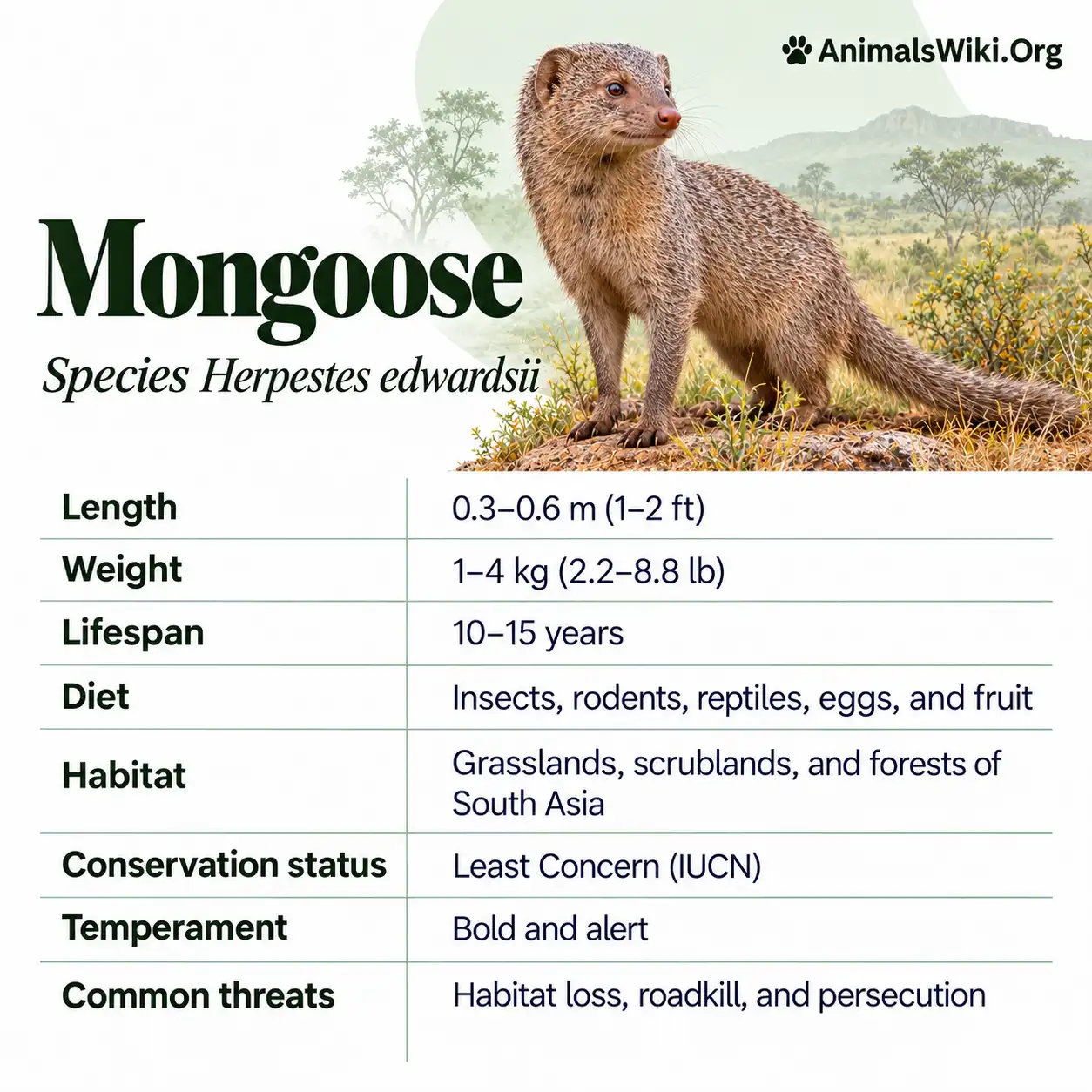
Mongoose, A Complete Guide to These Remarkable Small Predators
A mongoose is a small, agile mammal best known for its ability to confront snakes. However, that familiar reputation reveals only a small part of its life. Mongooses include many different species, ranging from highly social insect hunters to largely solitary predators that search forests, grasslands, and wetlands for food.
Some live in cooperative groups where adults watch for danger and help raise young. Others spend much of their time alone. Their diets can include insects, rodents, reptiles, eggs, amphibians, and fruit, with the balance depending on the species and its environment.
The word “mongoose” therefore does not describe one animal with a single scientific name, standard size, or universal behavior. It refers to a diverse group whose members have evolved different ways of surviving.
Their relationships with people are equally varied. Native mongooses contribute to local food webs, while introduced populations can threaten vulnerable island wildlife. Some species remain widespread, whereas others face habitat loss and other conservation pressures.
This guide explains mongoose classification, appearance, distribution, feeding, reproduction, social intelligence, and ecological importance. It also separates evidence from common myths about snake fighting, venom immunity, and keeping mongooses as pets.
Information checked: October 18, 2026.
Mongoose Facts
| Feature | Details |
|---|---|
| Animal type | Mammal |
| Main family | Herpestidae |
| Order | Carnivora |
| Suborder | Feliformia |
| Scientific name | Depends on the species |
| Native distribution | Mainly Africa and parts of Asia; some species also occur in southern Europe |
| Typical appearance | Long body, short legs, pointed muzzle, and a relatively long tail |
| Diet | Often insects and other animal foods; some species also consume fruit |
| Activity | Daytime or nighttime, depending on species |
| Social organization | Ranges from largely solitary to cooperative groups |
| Young | Commonly called pups |
| Famous adaptation | Resistance to certain snake neurotoxins in studied species |
| Complete immunity to venom? | No |
| Conservation status | Different for each species |
| Plural | Mongooses |
1. What Is a Mongoose?
A mongoose is a member of a group of small carnivorous mammals usually associated with the family Herpestidae.
Most have elongated bodies, relatively short legs, small ears, and pointed faces. Their overall shape allows them to investigate dense vegetation, holes, crevices, and other places where small prey may hide.
Although a mongoose can resemble a weasel, the two belong to different evolutionary branches.
Mongooses are feliform carnivores, placing them within the catlike branch of the order Carnivora. Weasels belong to the doglike branch, Caniformia.
These classifications describe ancestry rather than a requirement to look or behave like a domestic cat or dog.
The family also contains considerable behavioral diversity. A description based entirely on a social dwarf mongoose would not accurately represent every larger, solitary species.
For this reason, the most useful mongoose facts identify whether they apply broadly or concern a particular species. Understanding that distinction makes the animal’s biology much easier to follow.
2. Mongoose Scientific Classification
Because mongoose is a group name, there is no single species-level scientific name for every mongoose.
The classification shared by members of Herpestidae includes the following levels:
| Classification level | Name |
|---|---|
| Kingdom | Animalia |
| Phylum | Chordata |
| Class | Mammalia |
| Order | Carnivora |
| Suborder | Feliformia |
| Family | Herpestidae |
Below the family level, mongooses are divided into different genera and species.
For example, the Indian grey mongoose is Urva edwardsii, the banded mongoose is Mungos mungo, and the common dwarf mongoose is Helogale parvula.
Older references may use different combinations of genus and species names. Several Asian mongooses formerly placed in Herpestes are now commonly classified in Urva.
A name change does not necessarily mean scientists have discovered a new animal. It can reflect an improved understanding of relationships among known species.
When comparing sources, scientific synonyms help explain why two accounts use different names for the same mongoose.
3. Common Types of Mongoose
Mongooses differ in body size, habitat, coat, and social behavior. The following examples show some of that diversity.
| Common name | Scientific name | Notable characteristic |
|---|---|---|
| Indian grey mongoose | Urva edwardsii | Familiar South Asian species |
| Small Indian mongoose | Urva auropunctata | Introduced to several island ecosystems |
| Common dwarf mongoose | Helogale parvula | Small, cooperative African mongoose |
| Banded mongoose | Mungos mungo | Dark bands across the body |
| Yellow mongoose | Cynictis penicillata | Often associated with open southern African habitats |
| Marsh or water mongoose | Atilax paludinosus | Frequently uses wetland environments |
| White-tailed mongoose | Ichneumia albicauda | Large mongoose with a conspicuous pale tail |
| Liberian mongoose | Liberiictis kuhni | Forest species of conservation concern |
| Meerkat | Suricata suricatta | Social member of the mongoose family |
This table is a selection rather than a complete checklist.
Names such as “Indian mongoose” can also be ambiguous. Identifying the exact species is important when discussing distribution, conservation, or introduced populations.
4. Where Do Mongooses Live?
The native distribution of the mongoose family is centered on Africa, with several species occurring in Asia.
Some species also occur in southern Europe and adjoining regions. Their present distributions reflect a mixture of natural history and, in certain locations, human introductions.
In South Asia, mongooses occur in countries including Pakistan, India, Nepal, and Sri Lanka, although the exact species and suitable habitats vary geographically.
A mongoose seen in one country should not automatically be assumed to be the same species seen in another.
Introduced populations create another layer of complexity. The small Indian mongoose occurs on islands far outside its native range because people transported it there.
Consequently, a modern range map may show both native and introduced populations.
That distinction matters ecologically. A predator that belongs naturally within one food web may cause substantial damage when placed into another.
Distribution should therefore be described using both location and origin: where an animal occurs, and whether it arrived naturally or through human activity.
5. Mongoose Habitat: From Dry Scrub to Wetlands
There is no single mongoose habitat shared by every species.
Some favor open grassland, scrub, or savanna. Others use woodland, tropical forest, agricultural landscapes, or wetlands.
Shelter can include burrows, rock crevices, hollow logs, dense vegetation, and termite mounds, depending on the animal involved.
The marsh mongoose provides a useful example of habitat specialization. It frequently occurs near rivers, streams, swamps, and other water bodies, where aquatic prey are available.
The yellow mongoose illustrates a different strategy. It is strongly associated with open habitats and suitable ground for burrowing.
These differences influence where each animal searches for food and escapes danger.
Habitat suitability also depends on smaller features that a broad map may not show. Soil condition, cover, den sites, prey availability, and disturbance can determine whether a particular patch is useful.
Protecting a mongoose therefore requires understanding its species-specific needs rather than preserving any area that simply looks green or undeveloped.
6. What Does a Mongoose Look Like?
Most mongooses have a long body carried relatively close to the ground, a narrow muzzle, and a tail that contributes substantially to their overall length.
Their coats vary from pale yellowish or reddish tones to gray, brown, or nearly black.
Some have distinctive markings. Banded mongooses display dark transverse bands, while Indian grey mongooses have a grizzled appearance.
Ear size and visibility also differ. In some species, the ears are small and partly concealed by surrounding fur.
These features can help identification, but appearance alone may be misleading when an animal is seen briefly.
Lighting changes coat color, photographs distort apparent size, and several species can share a broadly similar silhouette.
A useful identification combines location, body proportions, coat pattern, tail appearance, and behavior.
For example, a group of banded animals moving together offers different clues from a single dark mongoose beside a stream.
The most reliable identification uses several features together rather than relying on one memorable characteristic.
7. How Big Is a Mongoose?
Mongoose size varies substantially between species.
A common dwarf mongoose may weigh only a few hundred grams, while larger species weigh several kilograms.
Published measurements for dwarf mongooses include a head-and-body length of approximately 18–28 centimeters, with the tail measured separately.
A large water mongoose can approach roughly 0.8–1 meter in total length, including its tail.
These figures illustrate why a single statement such as “a mongoose is two feet long” is not useful for the whole family.
Measurement methods also matter.
Head-and-body length excludes the tail, while total length includes it. Confusing the two can make an animal appear much larger or smaller than it really is.
Sex, age, nutrition, and geographic variation create additional differences within a species.
For an accurate comparison, use adult measurements from the same species and confirm whether the source reports total length, body length, or tail length.
8. Senses and Physical Adaptations
Mongooses depend on several complementary abilities when searching for food.
Their pointed muzzles help them investigate narrow spaces, while their senses provide information about prey, predators, and other mongooses.
Claws assist with digging or disturbing material that conceals food. The exact shape and use of the feet differ between species and habitats.
A mongoose searching among leaves faces different demands from one working through mud beside a stream.
Body flexibility is also useful when turning quickly or moving through cover.
However, the popular image of an exceptionally fast snake fighter should not overshadow these ordinary adaptations.
Much of mongoose life involves locating small food items, choosing safe routes, maintaining shelter, and responding to nearby activity.
The value of an adaptation depends on the task.
A strong sense of smell can be useful in finding hidden food, while effective communication may help a social species forage safely. Survival emerges from these abilities working together rather than from one spectacular trait.
9. What Do Mongooses Eat?
The mongoose diet differs between species, but insects and other small animals are important foods for many.
Possible items include beetles, termites, grasshoppers, larvae, worms, small mammals, reptiles, eggs, and amphibians.
Some mongooses also consume fruit or other plant material.
The white-tailed mongoose, for example, is strongly insectivorous, with insects forming a major component of its diet.
This is an important correction to the idea that mongooses spend most of their lives hunting snakes.
Snakes can be prey, but they are only one potential food source.
Diet also changes with season and local availability. A species may eat more of one food when it becomes abundant and switch as conditions change.
Scientists distinguish between occasional consumption and dietary importance.
Finding one unusual item in a mongoose’s diet does not mean that item supports the population. Understanding its main foods requires repeated observations or other systematic evidence collected across time.
10. How Mongooses Find and Handle Food
Mongoose foraging often involves repeated searching, sniffing, scratching, and investigating objects or patches of ground.
For many species, successful feeding depends on finding numerous small items rather than capturing one large animal.
Different foods require different handling methods.
Soft prey can be eaten directly, while eggs, snails, or other hard items may require additional processing.
Banded mongooses can break hard food by throwing it against a firm surface. This behavior makes use of the surrounding environment to gain access to the edible contents.
Individuals may also develop different feeding preferences within the same group.
Research on banded mongooses found that competition among group members was associated with individual dietary specialization.
Thus, living together does not mean every animal eats precisely the same mixture of foods.
Individual differences can reduce direct overlap while allowing the group to exploit a wider range of resources.
Foraging behavior therefore combines physical ability, experience, available food, and competition from nearby animals.
11. Mongoose vs. Snake: What Really Happens?
Some mongooses can attack and kill snakes, including venomous species.
These encounters involve risk. The mongoose must avoid strikes, assess the opponent, and find an opportunity to bite effectively.
Rapid movement and defensive behavior matter, but a short video cannot show how frequently such encounters occur across an animal’s life.
It may also conceal important context: whether the animals encountered each other naturally, whether escape was possible, and what happened afterward.
A mongoose does not automatically defeat every snake.
The species, sizes, condition, and circumstances of both animals influence the outcome.
Nor should every confrontation be interpreted as hunting. A mongoose may mob or respond defensively to an animal it perceives as dangerous.
The famous snake-fighting reputation is based on real behavior, but it has been expanded into a universal story.
A more accurate view recognizes that mongooses are flexible predators with several defenses, while snakes remain capable of injuring or killing them.
12. Are Mongooses Immune to Snake Venom?
Mongooses are not completely immune to all snake venom.
Research has identified resistance to certain neurotoxins in studied mongooses.
Some snake toxins act by binding to nicotinic acetylcholine receptors involved in communication between nerves and muscles.
Changes in the receptor can reduce how effectively particular toxins attach.
Experiments involving mongoose receptor components have demonstrated reduced sensitivity to specific toxins, providing a molecular explanation for part of the resistance.
However, snake venom is a mixture of substances rather than a single chemical.
Different snakes produce venoms with different effects, and resistance to one toxin does not establish protection against every venom component.
Dose, bite location, the snake involved, and the mongoose species also matter.
The distinction is between resistance and universal invulnerability.
A resistant animal may be less susceptible under particular conditions while still facing danger from envenomation, physical injury, or other consequences of an encounter.
13. The Indian Grey Mongoose
The Indian grey mongoose is among the best-known mongooses in South Asia.
Its scientific name is Urva edwardsii, although older accounts commonly use Herpestes edwardsii.
It occurs across parts of South Asia and adjoining regions, including Pakistan and India.
The grizzled gray coat helps distinguish it from some other mongooses, although reliable identification still requires attention to location and other features.
This species is frequently associated with the familiar mongoose-and-cobra story, but its life should not be reduced to snake encounters.
Like other adaptable small predators, it must locate varied foods and suitable shelter while responding to changing conditions.
The Indian grey mongoose is also different from the small Indian mongoose introduced to several islands.
Their similar common names have encouraged confusion in older and general-interest accounts.
Using the scientific name helps keep discussions of distribution, invasive populations, and conservation accurate.
The available species information lists the Indian grey mongoose as Least Concern, but this does not remove the need to address local threats.
14. The Common Dwarf Mongoose
The common dwarf mongoose, Helogale parvula, provides a striking contrast to the image of a lone snake hunter.
It is a small African mongoose living in cooperative groups.
Members forage, groom, communicate, and use shared sleeping sites. Their small size makes vigilance especially important because danger can come from larger terrestrial predators and birds.
Termite mounds, rocks, and other raised features can provide useful positions for watching the surroundings.
The species has become an important subject for long-term behavioral research.
Scientists can follow individually recognized animals and investigate how cooperation develops across repeated interactions.
This reveals a social world that is easy to miss during a brief sighting.
Helping is not simply an unchanging characteristic possessed by every individual to the same degree. Contributions differ, relationships matter, and circumstances influence behavior.
Studying dwarf mongooses therefore helps explain how small mammals coordinate activities while maintaining distinct individual relationships within a group.
15. The Banded Mongoose
The banded mongoose, Mungos mungo, is recognizable by the dark bands across its body.
It is also notable for its cooperative social life.
Groups forage together, use shared dens, and contain multiple breeding females. Births can be closely synchronized, producing communal groups of pups.
These young eventually form strong associations with adult carers known as escorts.
The escort system allows researchers to examine how food, protection, and learning influence development.
Banded mongooses demonstrate that cooperation can extend beyond an adult’s own offspring.
However, their society also contains competition and conflict. A group should not be imagined as a collection of animals sharing everything equally and peacefully.
Benefits from cooperation coexist with differences in reproductive interests and access to resources.
The species is therefore especially useful for understanding how group living evolves.
Its biology shows how animals can depend on one another while still competing over food, breeding opportunities, and the future of their own offspring.
16. Yellow and Water Mongooses: Different Ways of Life
The yellow mongoose and water mongoose illustrate how much variation exists within the family.
The yellow mongoose, Cynictis penicillata, commonly uses open southern African habitats and relies on burrows.
Its coat can vary geographically, and its social organization is flexible rather than identical in every population.
The water mongoose, Atilax paludinosus, is associated more strongly with wet environments and is generally solitary and nocturnal.
It takes aquatic foods as well as other available prey.
These differences affect almost every part of daily life: when the animal is active, where it searches, which shelters it uses, and how often it encounters others.
Calling both animals mongooses is taxonomically useful, but it does not mean their ecological needs are interchangeable.
An article about the group should therefore avoid giving one activity pattern or habitat as a universal rule.
The family is best understood as a collection of related mammals that have adapted to different environments.
17. Is a Meerkat a Mongoose?
Yes. The meerkat, Suricata suricatta, belongs to the family Herpestidae.
Its common name does not contain “mongoose,” but its classification places it within the same family.
Meerkats are particularly familiar for standing upright, living in groups, and using burrow systems in southern Africa.
However, their behavior should not be used as a description of every mongoose.
The same principle works in reverse: a fact about an Indian grey mongoose does not automatically apply to a meerkat.
Scientific classification reveals relationships, while ecology explains differences.
Meerkats are valuable in studies of cooperation and development because adults and older group members help support young.
Research has shown that helpers modify the condition of prey offered to pups as the pups grow, including providing disabled prey before more difficult live items.
This is a specific example from one member of the family, rather than proof that every mongoose species teaches in the same way.
18. Do Mongooses Live Alone or in Groups?
Both patterns occur.
Some mongoose species are largely solitary, while others live in enduring social groups. There are also species whose social organization changes with habitat and population conditions.
Consequently, a single mongoose seen alone may not be a permanently solitary animal.
It could be separated temporarily from group members, moving between locations, or foraging away from its usual associates.
Similarly, several mongooses seen together may represent a temporary gathering rather than a large stable society.
Researchers distinguish between repeated association and a brief coincidence.
They also examine whether individuals share dens, cooperate in defense, help raise young, or maintain recognizable relationships over time.
The yellow mongoose provides an example of flexibility. Its social arrangements can vary with environmental conditions and local density.
This variation reminds us that species descriptions are summaries, not instructions every animal must follow identically.
Behavior emerges from the interaction between evolutionary history and present circumstances.
19. Sentinels and Cooperative Vigilance
In some social mongooses, an individual watches from a raised position while others forage.
This behavior is commonly described as sentinel duty.
The watcher can detect approaching danger and communicate with animals whose attention is directed toward the ground.
However, vigilance is not necessarily a permanent job held by one animal throughout its life.
Research on dwarf mongooses has examined how sentinel contributions relate to later social interactions.
In an experiment, playback of an individual’s surveillance calls increased its apparent contribution. That animal subsequently received more grooming from group members.
This suggests that mongooses can respond to information about a partner’s earlier cooperative behavior.
The result does not require assuming that the animals use human ideas about payment or gratitude.
It shows an observable link between one kind of contribution and a later social response.
Such studies help explain how cooperation can remain valuable when individuals differ in how much effort they contribute.
20. How Mongooses Communicate
Mongooses use a combination of sounds, odors, posture, and physical interaction.
The importance of each channel differs between species and circumstances.
A contact call can help group members remain aware of one another, while an alarm call can change the behavior of animals nearby.
Research on dwarf mongooses has identified both general alert calls and calls associated with particular predator situations.
These signals should not be translated too confidently into human sentences.
Researchers test meaning by recording the circumstances of production and observing how listeners respond, sometimes using carefully controlled playback experiments.
Scent provides another way to exchange information without direct visual contact.
Marks can remain after an animal has moved away, making them useful in a landscape where individuals are not always together.
Communication therefore supports several tasks: maintaining contact, responding to threats, negotiating interactions, and gathering information.
Its value lies in how it changes behavior rather than how closely it resembles human language.
21. Learning, Memory, and Mongoose Intelligence
Mongooses show learning abilities suited to the challenges of their lives.
These include identifying food opportunities, responding to warning signals, and adjusting behavior through experience.
In banded mongooses, young animals can acquire aspects of their adult foraging niche from social role models rather than simply following their genetic parents.
Research using stable isotopes helped separate these influences.
The findings suggest that learning can maintain behavioral differences among animals living in the same group.
This is a useful example of cultural transmission in a broad biological sense: behavior is influenced by information acquired from other individuals.
It does not imply that mongoose culture is identical to human culture.
Nor is there a single reliable scale on which every mongoose can be ranked against every other animal for intelligence.
The more informative question is which abilities an animal possesses and how those abilities help it survive.
For social species, learning about companions and learning about food can become closely connected.
22. Mongoose Reproduction
Mongoose reproduction varies substantially across the family.
There is no single gestation period, breeding season, or litter size that accurately describes all species.
For example, published figures for common dwarf mongooses place gestation at approximately 49–56 days.
Yellow mongooses have a somewhat different reproductive schedule, including seasonal patterns in parts of their range.
Social organization also changes the breeding system.
In some cooperative species, reproduction is concentrated among dominant animals. In banded mongooses, several females can breed within the same group.
These differences influence the distribution of care, competition among adults, and the number of young present at one time.
Food and environmental conditions affect success as well.
Producing young is only the first stage. Adults must support growth until the pups can obtain food and avoid danger effectively.
For a species-level article, reproductive figures should therefore identify the animal studied rather than presenting a family-wide average with false precision.
23. Baby Mongooses and Parental Care
Baby mongooses are commonly called pups.
Their development involves more than growth in body size. They must acquire effective movement, feeding skills, and responses to danger.
In social species, care can come from adults other than the biological parents.
Banded mongoose pups provide an especially well-studied example.
Once accompanying the group, a pup often associates closely with an adult escort that feeds and protects it.
These relationships influence the youngster’s access to food and opportunities to learn.
A study manipulating food available to pregnant females found that postnatal care could reduce initial inequalities among pups.
The findings are important because they connect conditions before birth with assistance after birth.
However, this is a particular cooperative system. It should not be used to claim that every mongoose species raises young communally.
A largely solitary mother and a pup with a regular group escort face very different developmental environments.
24. Cooperation Does Not Eliminate Competition
Social mongooses cooperate, but they also compete.
Food, breeding opportunities, and access to care can create conflicting interests within a group.
Competition can become especially significant when resources are limited or when several animals have young at the same time.
Relations with neighboring groups can also be dangerous.
Long-term research on banded mongooses has linked intergroup conflict with competition over food and mates, along with costs to adult and pup survival.
This means group living should not be described as automatic safety and harmony.
It provides benefits while creating new challenges.
The same animals that assist one another may compete under different conditions.
Understanding that balance is one of the main goals of behavioral research.
Rather than dividing animals into “cooperative” or “aggressive” categories, researchers ask when each behavior occurs, which individuals participate, and how the outcome affects survival and reproduction over time.
25. What Eats a Mongoose?
Mongooses are predators, but many are also prey.
Potential threats include larger carnivores, birds of prey, and snakes, depending on the species and region.
Small body size creates particular risks when an animal must forage in exposed places.
Shelter, vigilance, alarm calls, and rapid escape can reduce those risks.
Some mongooses also use information produced by other species.
Experiments have shown that dwarf mongooses respond to certain alarm calls from neighboring animals, demonstrating that useful warning information can cross species boundaries.
This does not mean every sound produces the same reaction.
The identity of the caller, the animal’s own observations, and the surrounding conditions may influence the response.
Predator avoidance is therefore an information problem as well as a physical one.
A mongoose must decide whether to keep feeding, look up, approach cover, or flee—often with incomplete knowledge about what is happening nearby.
26. The Ecological Role of Native Mongooses
Within their native environments, mongooses participate in food webs as consumers and as prey.
Their feeding can influence populations of insects, small vertebrates, and other organisms.
They also transfer energy to larger predators that eat them.
However, describing all native mongooses as beneficial pest controllers goes beyond the evidence.
An animal can consume organisms that people regard as pests while also eating native species or creating conflict around poultry.
The actual ecological effect depends on the species, its abundance, the prey community, and local conditions.
A native predator’s role cannot be reduced to whether people approve of every item it eats.
Conservation instead considers how the animal fits into the functioning ecosystem.
This perspective also helps distinguish native and introduced populations.
The same general feeding abilities that contribute to one established food web can become destructive when moved into an environment containing vulnerable prey with little evolutionary experience of similar mammals.
27. Why Introduced Mongooses Can Harm Islands
People introduced mongooses to several islands, often hoping they would reduce rodents around agriculture.
These introductions had serious unintended consequences.
A mongoose capable of eating many kinds of small animals does not restrict itself to the target pest chosen by people.
It can also consume native birds, reptiles, amphibians, and eggs.
Island wildlife can be especially vulnerable because some species evolved without comparable terrestrial mammalian predators.
The problem is therefore broader than a predator simply eating at the wrong time of day.
Prey vulnerability, alternative food, habitat access, and the mongoose’s ability to reproduce and spread all matter.
The history illustrates why relocating predators requires rigorous ecological assessment.
An animal’s desirable behavior in one context does not guarantee a desirable outcome elsewhere.
It also explains why conservation can involve protecting native mongooses in one country while controlling an introduced mongoose population on an island.
Those actions address different ecological situations rather than contradicting one another.
28. The Mongoose in Hawaii
The small Indian mongoose, Urva auropunctata, was introduced to Hawaii in the nineteenth century in connection with attempts to control rats in sugarcane landscapes.
It subsequently became an important threat to native wildlife.
Hawaiian conservation authorities identify predation on ground-nesting birds, eggs, and young sea turtles among its impacts.
Older accounts often use names such as Herpestes javanicus, reflecting historical taxonomic treatment. Current Hawaiian information uses Urva auropunctata.
This naming issue matters because the introduced animal should not automatically be identified as the Indian grey mongoose.
The Hawaiian case is also more informative than the simplified statement that mongooses failed only because rats were nocturnal.
Their broad diet and effects on non-target wildlife are central to the problem.
Preventing transport to additional islands is particularly important.
Once an adaptable predator becomes established, removing it across a large and varied landscape can be much more difficult than preventing its arrival.
29. Are Mongooses Endangered?
There is no single conservation category for all mongooses.
Each species receives its own assessment based on evidence about distribution, population, threats, and other factors.
Examples illustrate the difference:
| Species | Conservation category in the consulted information |
|---|---|
| Indian grey mongoose | Least Concern |
| Banded mongoose | Least Concern |
| Liberian mongoose | Vulnerable |
A widespread species and a forest species with a more restricted distribution can face very different conservation circumstances.
The Liberian mongoose is listed as Vulnerable, with a decreasing population trend in its available assessment.
Assessment dates matter as well. A webpage accessed recently may still contain an assessment conducted years earlier.
It should not automatically be presented as a newly completed population survey.
Conservation reporting is strongest when it identifies the species, category, assessment context, and local evidence separately.
A general statement that “mongooses are common” can conceal the needs of less familiar members of the family.
30. Habitat Loss, Persecution, and Wildlife Trade
Threats differ among mongoose species, but several pressures can overlap.
Habitat conversion may remove cover, reduce prey, or interrupt movement between suitable areas.
Persecution can follow concerns about poultry or the belief that any small predator near a settlement must be dangerous.
Roads create direct collision risk and can change how animals use the surrounding landscape.
Wildlife trade is another concern.
In India, conservation organizations have documented enforcement operations involving mongoose-hair paintbrushes and raw hair.
These cases reveal a threat that many consumers would never associate with a small wild mammal.
The practical response includes reducing demand for products connected to illegal wildlife exploitation and supporting appropriate enforcement.
Threats should nevertheless be described with geographic precision.
A pressure documented for South Asian mongooses is not automatically the principal problem for every African species.
Effective conservation begins with identifying which animals are affected, where the pressure occurs, and how it influences survival or reproduction.
31. Heat and Noise Can Change Mongoose Behavior
Environmental pressures can affect mongooses without immediately destroying habitat.
Research on dwarf mongooses has shown that traffic-noise playback can interfere with responses to predator-related information.
One study found changes in the animals’ use of predator scent cues, demonstrating that noise can influence more than hearing alone.
Heat creates another challenge.
A 2025 study found that dwarf mongooses changed some daily timing on hot days but did not fully compensate for the effects on body mass.
Adults and pups gained less mass under the studied hot conditions, and repeated hot days created additional concerns.
These findings do not prove that every mongoose species responds identically.
They show how detailed research can reveal costs hidden behind an animal’s apparently normal activity.
An animal may still be present and moving through its habitat while experiencing reduced feeding performance or altered information use.
Conservation therefore benefits from examining behavior and condition alongside simple presence or absence.
32. How Scientists Study Mongooses
Mongoose research combines observation with methods chosen for particular questions.
Long-term studies allow scientists to follow individuals through growth, changes in social position, breeding attempts, and survival.
Researchers may record who associates with whom, which animals provide care, and how behavior changes after an event.
Playback experiments help test responses to calls.
Other studies use dietary evidence, genetics, body measurements, or environmental data.
Each method has limits.
An observed association does not automatically establish cause, while an experiment involving one population may not describe the entire family.
This is why replicated research and long-term monitoring are valuable.
A finding becomes more useful when researchers can identify the circumstances under which it applies.
For conservation, such detail can distinguish a harmless behavioral adjustment from a change that reduces survival or reproduction.
Studying mongooses also addresses broader questions about cooperation, learning, communication, and how animals respond to human-altered environments.
33. Mongooses and People
People encounter mongooses around farms, gardens, roadsides, protected areas, and settlements.
The nature of the relationship depends on the species and setting.
A native mongoose may consume insects or rodents nearby, yet it can also create concerns if domestic birds are poorly protected.
Practical coexistence focuses on reducing access to vulnerable animals and avoiding unnecessary attraction through food.
Wild mongooses should not be fed, handled, or moved casually.
A mongoose raised around people remains a wild animal with its own behavioral and environmental needs.
Keeping one is also not equivalent to adopting a domestic pet, and applicable wildlife rules differ by location.
For observation, distance is usually the best approach.
Allow the animal to continue foraging or traveling without blocking its route.
A natural encounter can reveal much more about its behavior than one created by baiting, crowding, or attempting to provoke a dramatic response.
34. Mongoose Myths and Facts
| Common claim | More accurate explanation |
|---|---|
| Mongoose is one species | The name covers many species |
| All mongooses eat mainly snakes | Insects and other foods dominate many diets |
| Every mongoose is immune to venom | Resistance is toxin-specific and does not mean complete protection |
| A mongoose always defeats a cobra | Outcomes depend on the animals and circumstances |
| Mongooses are weasels | They belong to a different family and evolutionary branch |
| Every mongoose lives in a large group | Some are largely solitary |
| Every group has the same breeding system | Reproductive organization differs between species |
| Meerkats are unrelated to mongooses | Meerkats belong to Herpestidae |
| Every animal called a mongoose belongs to Herpestidae | Some Malagasy animals with that common name belong to Eupleridae |
| Mongooses are beneficial everywhere | Introduced populations can seriously harm native wildlife |
| All mongooses have the same conservation status | Status is assessed separately for each species |
| A tame mongoose becomes a domestic animal | Tameness and domestication are different |
These distinctions make the subject more interesting rather than less.
The mongoose family contains several evolutionary solutions to finding food, avoiding danger, and raising young. Its diversity is the central story.
35. Frequently Asked Questions About Mongooses
What is the scientific name of a mongoose?
There is no single scientific name for every mongoose. The family is Herpestidae, while each species has its own name. Examples include Urva edwardsii for the Indian grey mongoose, Mungos mungo for the banded mongoose, and Helogale parvula for the common dwarf mongoose.
What is the plural of mongoose?
The standard plural is mongooses. The word is not related to “goose,” so “mongeese” is not the usual plural. In writing, “mongoose species” can also be useful when referring collectively to different kinds without implying that they share identical biology.
Is a mongoose a rodent?
No. Mongooses belong to the order Carnivora, whereas rodents belong to Rodentia. A small body and frequent feeding on small items do not make an animal a rodent. Classification depends on evolutionary relationships and anatomical evidence.
Is a mongoose related to a cat?
Mongooses and cats both belong to Feliformia, the catlike branch of Carnivora. They are nevertheless members of different families. A mongoose is not a kind of cat, just as membership in the same broader branch does not make all its animals interchangeable.
Where are mongooses naturally found?
Their native distribution is concentrated in Africa and parts of Asia, with some species also occurring in southern Europe. Introduced populations exist elsewhere. When describing an animal’s range, it is important to distinguish naturally occurring populations from those established through human transport.
Are mongooses found in Pakistan?
Yes. Pakistan is within the distribution of some mongoose species, including the Indian grey mongoose. However, identifying an individual requires more than knowing the country. Locality, coat, size, and other features help distinguish the species present in a particular area.
What do mongooses eat most often?
That depends on the species. Insects are important for many mongooses, while other foods can include small mammals, reptiles, amphibians, eggs, and fruit. A species capable of eating snakes may still spend most of its feeding time searching for other prey.
Do mongooses eat cobra snakes?
Some mongooses can attack and consume cobras. However, such encounters are dangerous and do not define the diet of the entire family. The ability to handle a venomous snake should not be confused with a requirement to hunt one regularly.
Can a snake kill a mongoose?
Yes. Mongooses are not invulnerable. Their defenses and toxin resistance reduce particular risks but do not guarantee survival. The species, size, physical condition, venom involved, and circumstances of the encounter can all influence the result.
Why can some mongooses resist venom?
Studies have identified changes in receptors targeted by certain snake neurotoxins. These changes can reduce toxin binding. The mechanism helps explain resistance to particular substances, but snake venoms contain multiple components, so it does not provide universal protection.
Do mongooses need an antidote plant after a bite?
There is no sound basis for treating stories about a universal mongoose antidote plant as established biology. Documented resistance involves physiological mechanisms, while behavior also helps reduce risk. Folklore should be distinguished from tested explanations of how the animals survive.
Are mongooses active during the day?
Many are, but not all. Dwarf and banded mongooses are familiar daytime-active examples, while the water mongoose is generally nocturnal. Activity also responds to weather and local conditions, making a family-wide daytime rule inaccurate.
Do all mongooses live in groups?
No. Social organization ranges from largely solitary lifestyles to cooperative groups. Even within some species, conditions influence how animals associate. A mongoose seen alone may be temporarily separated from companions rather than belonging to a strictly solitary species.
What is a baby mongoose called?
A baby mongoose is commonly called a pup. Development and parental care differ by species. In some social mongooses, other group members help provide food and protection, while young of more solitary species have a different care arrangement.
How long is a mongoose pregnant?
Gestation depends on the species. Common dwarf mongooses have a reported gestation of roughly 49–56 days, while other species differ. A precise pregnancy length should always identify the mongoose concerned rather than being presented as universal.
How many babies does a mongoose have?
Litter size varies among species and breeding conditions. Some produce relatively small litters, while others can have several pups. Group size, litter size, and the number of breeding females are separate measurements and should not be confused.
Is a meerkat a type of mongoose?
A meerkat belongs to the mongoose family, Herpestidae. Its scientific name is Suricata suricatta. It has its own ecological and social characteristics, so meerkat facts should not automatically be applied to every other mongoose.
Can mongooses swim?
Some can, and species associated with wet environments may use water regularly. The water mongoose is a clear example of a mongoose adapted to wetland feeding opportunities. Swimming ability and dependence on aquatic habitat are different characteristics, however.
Are mongooses dangerous to people?
They are wild mammals capable of biting, particularly if cornered or handled. The sensible approach is to maintain distance and avoid contact. Their generally small size does not make close handling appropriate, and feeding can encourage unwanted approaches.
Can a mongoose be kept as a pet?
Mongooses are unsuitable as ordinary household pets. Their behavioral needs, feeding requirements, potential to bite, and ecological risks require serious consideration. Wildlife rules also vary by location. A hand-raised animal remains different from a domesticated companion species.
Are mongooses good for farms?
They may consume insects or rodents, but the effects depend on the species and farming system. They can also create problems around vulnerable poultry. Their presence should be assessed in context rather than assuming every mongoose is either entirely beneficial or entirely harmful.
Why are mongooses a problem on some islands?
Introduced mongooses can prey on native wildlife that evolved without similar mammalian predators. Eggs, birds, reptiles, and other animals may be vulnerable. Their flexible diet allows impacts beyond the rodents people originally hoped to control.
Are all mongoose species common?
No. Some are widespread, while others have restricted distributions or face significant threats. The Liberian mongoose is one example of a species listed as Vulnerable. Conservation statements should identify the species rather than treating the family as uniformly secure.
How long do mongooses live?
Lifespan varies by species and conditions. Survival in the wild differs from longevity under professional care, where food and veterinary support are available. A maximum recorded age should not be presented as the normal lifespan of every wild mongoose.
How can people help protect mongooses?
Protect native habitat, avoid wildlife products linked to exploitation, and support conservation appropriate to the species and region. Preventing the transport of mongooses to places outside their native range is equally important because introduced populations can threaten other wildlife.



