
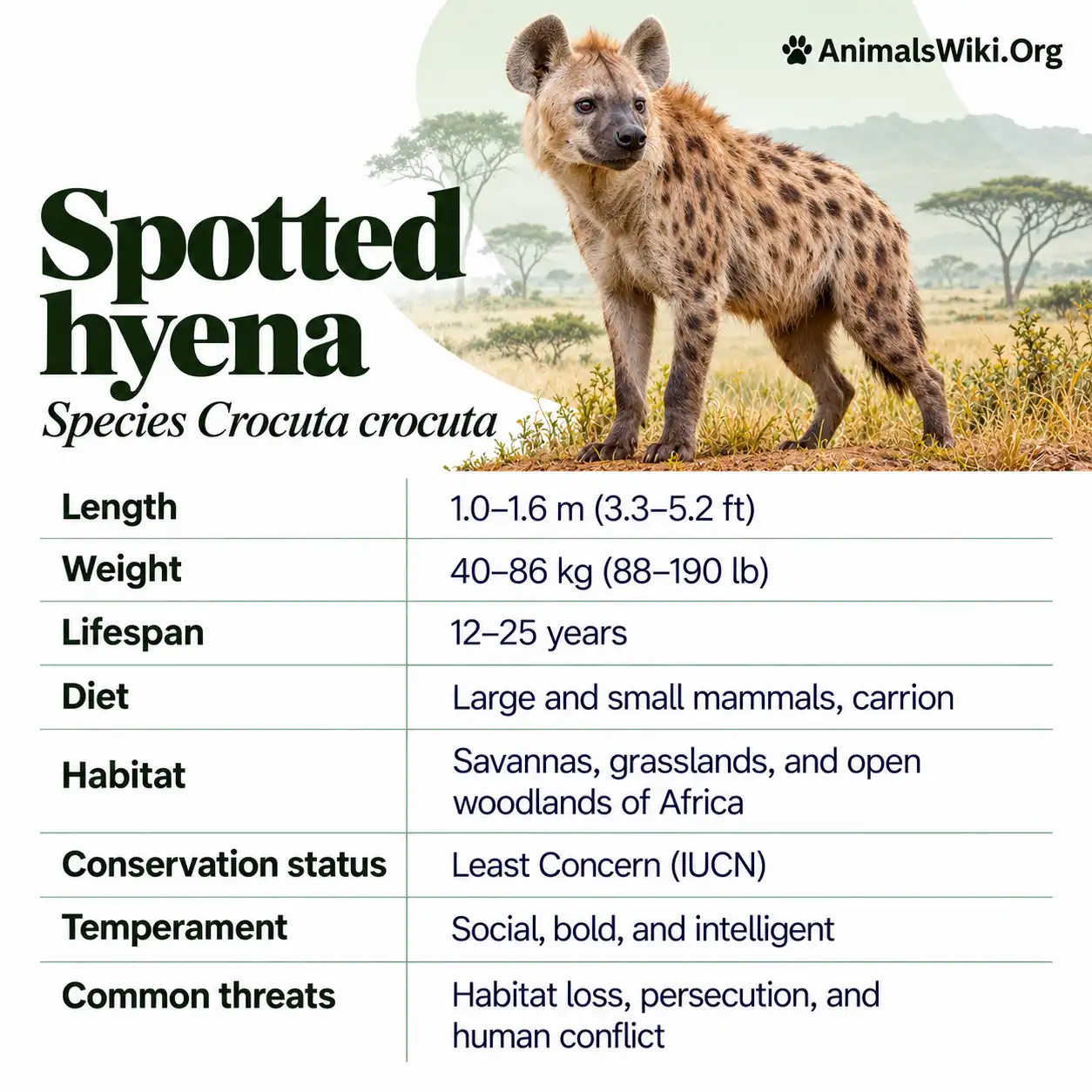
Spotted Hyena, Africa’s Intelligent Hunter and Complex Social Survivor
The spotted hyena is one of Africa’s most recognizable and misunderstood carnivores. Its sloping back, powerful jaws, spotted coat, and distinctive calls have made it familiar around the world. Yet its real life is far more interesting than the scavenging villain often portrayed in films and stories.
Spotted hyenas are capable hunters, attentive mothers, and socially sophisticated mammals. They live in clans where relationships influence access to food, opportunities to reproduce, and the survival of young. Their communication includes long-distance calls, close-range sounds, scent markings, facial expressions, and body postures.
Their feeding abilities are equally impressive. Strong jaws and specialized teeth allow them to process tough animal remains, while flexible hunting strategies help them exploit changing prey populations.
These animals also face challenges. Habitat loss, persecution, poisoning, wire snares, roads, and declining prey can threaten populations even where the species remains widespread overall.
Understanding the spotted hyena requires looking beyond its reputation. Its hunting, scavenging, cooperation, competition, and maternal care are interconnected parts of a demanding life.
This guide explores spotted hyena identification, habitat, diet, adaptations, social structure, reproduction, ecological importance, and conservation. It also answers common questions about their laughter, female dominance, unusual anatomy, and relationships with lions.
Information checked: October 18, 2026.
Spotted Hyena Facts
| Feature | Details |
|---|---|
| Common name | Spotted hyena |
| Alternative spelling | Spotted hyaena |
| Scientific name | Crocuta crocuta |
| Other familiar name | Laughing hyena |
| Animal group | Mammal |
| Order | Carnivora |
| Suborder | Feliformia |
| Family | Hyaenidae |
| Geographic range | Parts of sub-Saharan Africa |
| Main foods | Animal prey and carrion |
| Social group | Clan |
| Social structure | Usually female-dominated, with strong maternal family relationships |
| Usual litter size | One or two cubs |
| Gestation | Approximately 110 days |
| Familiar vocalizations | Whoops, giggles, growls, and other calls |
| Global IUCN category | Least Concern |
| Listed global population trend | Decreasing |
The available IUCN assessment classifies the species as Least Concern while documenting a decreasing population trend. Its assessment dates to 2014 and is marked as needing an update; it should not be described as a new 2026 population assessment.
Contents
- Classification and identification
- Distribution and habitat
- Diet, hunting, and scavenging
- Teeth, jaws, and physical adaptations
- Clans, female dominance, and social intelligence
- Communication and laughter
- Reproduction and cub development
- Relationships with lions and other wildlife
- Threats and conservation
- Common myths and frequently asked questions
1. What Is a Spotted Hyena?
The spotted hyena is a large African carnivore belonging to the family Hyaenidae. It is the largest living member of that family and the only living species in the genus Crocuta.
Although its overall appearance can seem doglike, it belongs to the catlike branch of the carnivore order, Feliformia. This places it closer to cats, mongooses, and civets than to dogs in evolutionary terms.
However, a spotted hyena is neither a dog nor a cat. It belongs to its own distinct family.
Its most recognizable features include rounded ears, a broad head, a muscular neck, dark spots, and a body profile that slopes downward toward the hindquarters.
The species combines several ways of obtaining food. It can pursue living prey, feed on animals killed by other predators, and consume remains that many carnivores cannot process effectively.
This flexibility helps explain its success across different African environments. Rather than depending on a single feeding technique, it adjusts its behavior to local opportunities. Animals & Plants
2. Scientific Classification and the Hyena Family
The spotted hyena’s scientific classification provides a useful starting point for understanding its relationships.
| Classification level | Name |
|---|---|
| Kingdom | Animalia |
| Phylum | Chordata |
| Class | Mammalia |
| Order | Carnivora |
| Suborder | Feliformia |
| Family | Hyaenidae |
| Genus | Crocuta |
| Species | Crocuta crocuta |
Four living species are commonly recognized within the hyena family: the spotted hyena, striped hyena, brown hyena, and aardwolf.
These relatives differ substantially in appearance, diet, and social organization. The aardwolf, for example, specializes largely in termites, making it very different from a spotted hyena hunting hoofed mammals.
Consequently, statements about “hyenas” should identify which species they describe.
The female dominance, elaborate clan relationships, and familiar giggling calls discussed in this article concern the spotted hyena. They should not automatically be applied to every member of Hyaenidae.
The alternative spelling “hyaena” appears frequently in scientific publications. It refers to the same animals rather than a different taxonomic group.
3. Spotted Hyena Appearance and Identification
An adult spotted hyena has a sturdy body, thick neck, broad muzzle, and powerful shoulders. Its forequarters are especially prominent, contributing to the characteristic sloping profile.
The coat is generally sandy, beige, brownish, or grayish, with darker spots across much of the body. Color varies with age, individual characteristics, lighting, and the condition of the coat.
The ears are rounded, an important distinction from the more pointed ears of some other hyenas.
Researchers use spot patterns to identify individuals. The arrangements differ between animals, and the left and right sides of one animal are not identical.
This makes good photographs valuable for long-term monitoring. However, mud, poor lighting, vegetation, and changes in coat appearance can complicate identification.
A single blurred photograph may be insufficient to distinguish two similar animals confidently.
Field researchers therefore combine multiple body markings, photographs, and other recognizable features when possible. Individual identification allows scientists to connect observations of feeding, reproduction, injuries, and social relationships across many years.
4. Spotted Hyena Size: Are Females Bigger?
Adult spotted hyenas are substantial carnivores, although their size varies between populations and individuals.
A broad published weight range is approximately 40–86 kilograms, or about 88–190 pounds. This range should not be interpreted as the typical weight of every animal.
Females often weigh more than males, but the difference is relatively modest compared with the dramatic male–female size differences seen in some other mammals.
Age, nutrition, pregnancy, and local environmental conditions also influence body mass.
A large female may look noticeably more robust than a male, yet appearance alone can make sex identification difficult.
Importantly, larger average female size does not fully explain the species’ social structure. A smaller individual can dominate a larger one when relationships and established rank favor the smaller animal.
For readers comparing African predators, weight is only one part of the picture. Hunting ability, group support, endurance, experience, and the circumstances of an encounter all influence what an animal can accomplish.
5. Where Do Spotted Hyenas Live?
Today, spotted hyenas occur in parts of sub-Saharan Africa. Their distribution is uneven, with important populations in eastern and southern Africa and more fragmented occurrence elsewhere.
They are strongly associated with famous wildlife landscapes such as the Serengeti and Maasai Mara, but they are not restricted to those ecosystems.
Their presence depends on suitable food resources, space, and the ability to survive human pressures.
A map showing the species across a broad region does not mean every location within that region supports a healthy population.
Local populations can disappear while the species remains present in surrounding countries. Conversely, some protected landscapes support many clans.
This distinction matters when discussing conservation. A widespread species can still experience serious regional losses.
Historical and prehistoric distributions were different again. Ancient members of the genus Crocuta occurred beyond modern African populations, including Eurasian cave hyena lineages.
Modern distribution, historical records, and prehistoric fossils therefore describe different time periods and should not be combined into one present-day range.
6. Spotted Hyena Habitat
Spotted hyenas occupy a wider variety of habitats than the familiar image of open savanna suggests.
They occur in grasslands, savannas, open woodland, semi-arid environments, and some mountainous regions. Suitable habitat can include both open hunting areas and places offering cover for resting or denning.
Their needs are practical: food, access to suitable resting conditions, and locations where cubs can remain while mothers forage.
Adults often rest in shade, shallow depressions, or other cool places. A communal den is primarily important for young rather than serving as a permanent underground home for the entire clan.
Habitat quality also changes through time. Rainfall can alter vegetation and the distribution of herbivores, affecting where hyenas find food.
An area that supports plentiful prey during one season may offer much less during another.
This creates a need for movement and behavioral flexibility. Protecting only a den entrance or a small patch of suitable land may leave the broader feeding landscape unprotected.
7. What Do Spotted Hyenas Eat?
The spotted hyena diet is predominantly carnivorous. Hoofed mammals are important prey in many populations, but the exact menu varies with location and season.
Common prey can include wildebeest, gazelles, zebra, topi, impala, and other locally available animals. Smaller mammals and additional animal foods may also be consumed.
Hyenas also feed on carrion, whether an animal died naturally or was killed by another predator.
Seasonal prey movements can change the diet substantially. A long-term study in the Maasai Mara documented a shift from resident herbivores toward migratory wildebeest when large herds arrived.
This flexibility helps hyenas respond to opportunities rather than depending entirely on one prey species.
Their diet should therefore be described at two levels: the broad range of foods the species can consume and the foods that dominate in a particular population.
A prey list alone cannot reveal how often an animal is eaten or how important it is energetically. Those questions require direct observations and other ecological evidence.
8. Are Spotted Hyenas Hunters or Scavengers?
Spotted hyenas are both hunters and scavengers. The common portrayal of them as animals that survive mainly by stealing leftovers is inaccurate for many studied populations.
They are effective predators capable of obtaining a substantial share of their food through hunting.
The balance between hunting and scavenging changes according to local conditions. Prey abundance, availability of carcasses, competition, season, and human food sources can all influence it.
A hyena feeding beside a lion kill does not establish how it obtains most of its food across the year.
Likewise, one observed hunt cannot represent the feeding strategy of an entire population.
Researchers distinguish between feeding events and food biomass. Numerous visits to small remains may contribute less total food than a smaller number of successful hunts.
This is why apparently different percentages can appear in scientific accounts without necessarily contradicting one another.
The most accurate description is that spotted hyenas are flexible carnivores whose hunting and scavenging strategies complement each other.
9. How Do Spotted Hyenas Hunt?
Spotted hyenas can hunt alone or in groups. The number of hunters depends partly on prey type and the circumstances of the encounter.
Larger groups are not required for every successful hunt.
In one seven-year study, more than three-quarters of recorded hunting attempts involved lone hyenas, while zebra were more commonly pursued cooperatively.
A hunt can involve locating prey, approaching, testing possible targets, chasing, and abandoning attempts that appear unlikely to succeed.
Experience matters. Young animals must develop the judgment and physical skills needed to capture prey effectively.
The same study found that hunting performance continued improving well beyond early independence.
Group hunting introduces additional decisions. More participants may help capture difficult prey, but the resulting food must be shared among more mouths.
Consequently, the largest possible hunting party is not always the most advantageous.
A spotted hyena’s hunting strategy reflects a balance between likely reward, energetic cost, risk of injury, and competition over the eventual meal.
10. Scavenging and the Use of Carcasses
Scavenging is an efficient way to obtain food when an opportunity is available. It does not imply that an animal lacks hunting ability.
Spotted hyenas may find carcasses through their senses, by following the activity of other animals, or while traveling through their ranges.
Their ability to process tough remains allows them to use portions that other carnivores may leave behind.
However, access is not guaranteed. A carcass may be occupied by a dangerous competitor or provide too little food to justify approaching.
The condition and size of the remains also matter. A large carcass can support more feeding animals than a small one.
At feeding sites, established relationships influence access. Some individuals obtain preferred positions, while others wait, retreat, or carry away pieces.
Watching a crowded carcass therefore reveals both feeding ecology and social organization.
The feeding scene may look disorderly, but much of the activity reflects recognizable relationships, threats, and opportunities among animals that know one another.
11. Teeth, Jaws, and Bone-Crushing Adaptations
Spotted hyenas have skulls and teeth adapted to processing demanding foods, including bone.
Their robust premolars are especially important for cracking hard material, while other teeth help cut and handle flesh.
The skull provides attachment areas for powerful jaw muscles, creating a feeding system suited to high mechanical loads.
However, claims that spotted hyenas have the strongest bite of every mammal are misleading. Bite comparisons depend on the species, animal size, tooth position, and measurement method.
A more useful fact is that their feeding equipment allows access to resources that many other carnivores cannot exploit as effectively.
This specialization also creates developmental challenges.
A study of skull growth found that different aspects of the feeding apparatus reached maturity at different ages. Juveniles could be weaned before achieving adult skull form and feeding performance.
Thus, becoming independent does not mean a young hyena already has all the physical abilities of a mature adult.
12. Why Young Hyenas Face Feeding Challenges
A newly weaned hyena must obtain enough food while competing with animals that are larger, stronger, and more experienced.
Its difficulties are partly mechanical. Teeth, jaw muscles, skull shape, and overall body growth continue developing after the transition away from milk.
Research measuring bite strength and bone-processing behavior showed that juvenile hyenas had not reached adult feeding performance around the age when many are weaned.
That creates a vulnerable stage between maternal milk dependence and full adult efficiency.
Social support can help bridge the gap. A mother may assist her offspring in gaining access to food, even after nursing has ended.
This connects anatomy with social behavior. The length of time required to develop effective feeding equipment can influence the value of maternal assistance.
It also explains why researchers separate several milestones: weaning, independent movement, reproductive maturity, adult body form, and adult hunting competence.
These events do not all happen together, and each creates a different challenge for a growing animal.
13. Daily Activity, Rest, and Long-Distance Travel
Spotted hyenas are often most active at night, but they can also travel, feed, and interact during daylight.
Their schedule responds to heat, prey availability, social events, and human activity. Describing them as strictly nocturnal would overlook this flexibility.
Resting is an important part of their daily routine. During hot conditions, shade or shallow water can help them avoid excessive heat.
When food is distant, individuals may travel considerable distances.
In the Serengeti, some populations use a commuting system: animals leave their clan territory to feed near migratory herbivores and later return.
This differs from the whole clan permanently moving with a herd.
Mothers must combine these feeding trips with returns to dependent cubs at the communal den.
A hyena seen traveling alone may therefore remain a member of a large, stable clan.
Its immediate companions tell only part of the social story; understanding its life requires knowing where it is going and which relationships connect it to other animals.
14. What Is a Spotted Hyena Clan?
A clan is the spotted hyena’s enduring social group. It contains females, their offspring, and males with different histories of membership.
Clans vary in size. Some include relatively few individuals, while others contain many dozens.
They are described as having a fission–fusion society. Members separate into smaller parties and later gather again, while retaining membership in the same larger group.
This arrangement allows flexibility. Animals can forage separately when food is scattered and assemble when cooperation becomes valuable.
Clan members may cooperate in defending territory, maintaining access to food, or responding to competitors.
However, cooperation exists alongside strong competition within the group.
A clan is therefore not a peaceful collection of animals sharing everything equally. It is a network of individuals balancing personal interests, family relationships, alliances, and collective benefits.
This complexity has made spotted hyenas especially valuable for studying the evolution of social behavior outside primates.
Their society demonstrates that sophisticated relationships can evolve in large carnivores facing very different feeding challenges from monkeys or apes.
15. Why Do Female Spotted Hyenas Dominate?
Spotted hyena society is usually female-dominated, but the explanation extends beyond females being slightly larger on average.
Research has shown that social support strongly influences dominance.
Females commonly remain among relatives, while many males leave their birth clan. Dispersal disrupts existing social bonds and places immigrant males at a disadvantage.
An individual backed by stronger relationships can dominate another without being the larger or more aggressive animal.
The degree of female dominance can also vary with clan composition. Native males with family support do not face exactly the same circumstances as immigrant males.
This makes absolute statements such as “every female always dominates every male” too simplistic.
The important principle is that power in hyena society is relational.
An encounter between two animals can be influenced by the wider network around them, even when potential supporters do not physically intervene.
Female dominance therefore provides a striking example of how social structure can shape outcomes that might otherwise be attributed only to strength.
16. Rank, Alliances, and Changes in Status
Social rank affects access to valuable resources, particularly food.
Higher-ranking animals can obtain advantages that influence their condition and reproductive success. However, rank is not simply recalculated whenever two animals compare body size.
Maternal relationships help establish positions, and alliances help maintain them.
Long-term research has also documented changes in rank. Females supported by strong coalitions can sometimes challenge individuals above them.
These changes are relatively uncommon, but they show that the hierarchy is not completely fixed.
An analogy with human politics may make the idea familiar, yet the animals should not be assigned human motives. Scientists study observable behavior: who supports whom, which animal retreats, and whether relationships change.
Coalitions matter because an individual’s effective competitive ability includes more than its own body.
Understanding rank therefore requires following interactions over time.
A brief encounter may show which animal dominates, but years of observations are needed to understand how that relationship formed and what consequences it has.
17. Social Inheritance: Cubs Learn More Than Hunting
Young spotted hyenas inherit genes from their parents, but their development is also shaped by inherited social opportunities.
Research based on decades of observations found that offspring relationships resembled their mothers’ social networks.
This resemblance could persist for years and was particularly strong among offspring of high-ranking mothers.
A cub therefore grows within a social environment that is already structured. Its mother’s associates, opponents, and position influence the relationships available to it.
This does not mean every friendship is mechanically predetermined.
Instead, maternal relationships provide a starting framework through which the youngster encounters other clan members.
Such social inheritance can influence survival and long-term opportunities.
It also helps explain why researchers pay attention to ordinary interactions rather than only dramatic fights. Repeated associations may reveal connections with consequences that become visible much later.
For a young hyena, learning which animals are safe to approach and which relationships matter can be as important as developing the ability to catch food.
18. Why Do Spotted Hyenas Laugh?
The familiar hyena “laugh” is usually called a giggle. It is a vocal signal rather than evidence that the animal finds something amusing.
Giggles often occur during socially tense situations, including competition around food.
Analysis of their acoustic structure has found information associated with individual identity, age, and dominance relationships.
That does not mean researchers can translate every giggle into a precise sentence. Communication signals can provide information without functioning like human language.
Context is essential.
A call heard beside a crowded carcass may accompany different circumstances from another sound produced during a greeting or territorial encounter.
The phrase “laughing hyena” captures a memorable resemblance to human laughter, but it can encourage misleading emotional interpretations.
The animal is communicating within its own social world.
Its vocal behavior is better understood by asking who is calling, which animals are nearby, what is happening, and how listeners respond. Those questions reveal much more than labeling the sound funny or sinister.
19. Whoops and Recognition at a Distance
The spotted hyena’s long-distance whoop is another important vocalization.
Whoops allow communication when animals are separated and cannot rely on close visual contact.
Playback experiments have shown that hyenas can distinguish individuals using calls. Mothers respond differently to the whoops of their own cubs than unrelated listeners do.
Other experiments have tested responses to calls from unfamiliar animals.
Hyenas became more vigilant when hearing more apparent intruders and were more willing to approach when their own group had a numerical advantage.
These results suggest sensitivity to both identity and relative numbers.
It would be excessive to describe the animals as performing human-style arithmetic. The evidence instead shows that they can assess socially relevant differences in the calling group.
For a species that sometimes faces dangerous territorial encounters, such abilities can influence whether approaching is worth the risk.
Communication therefore supports practical decisions about family, allies, rivals, and the balance of forces in an encounter.
20. Scent Marking and Chemical Communication
Sound is only one part of spotted hyena communication. Scent also carries information.
Hyenas deposit secretions from a specialized scent pouch onto vegetation, a behavior commonly called pasting.
Other individuals can inspect these deposits after the animal that left them has moved away.
Research has connected the chemical properties of these secretions with bacterial communities living in the scent system.
The bacteria appear to contribute to the production of odor compounds. Differences in those communities and compounds are associated with characteristics such as sex and reproductive condition.
This provides an interesting example of microbes participating in animal communication.
A scent mark is therefore more than a simple “keep out” sign.
Chemical signals can contribute to recognition and social information in a landscape where clan members are often separated.
For human observers, such communication is easy to miss because it is less dramatic than a loud call. For the hyenas, however, information left on a grass stem can remain relevant after the immediate encounter ends.
21. How Intelligent Are Spotted Hyenas?
Spotted hyenas display several forms of sophisticated cognition.
They recognize individuals, respond to social relationships, and adjust behavior according to rank and group circumstances.
Experiments have also demonstrated cooperative problem solving. In a study involving captive animals, pairs coordinated their actions to obtain food.
Performance depended partly on relationships between partners. Aggression could interfere with cooperation, while attention to the other animal helped improve coordination.
These findings are more informative than declaring hyenas universally “smarter” than another species.
Intelligence includes different abilities, and performance depends on the task, motivation, experience, and setting.
An animal familiar with human-made objects may respond differently to an apparatus than a wild individual encountering it for the first time.
The strongest conclusion is that spotted hyenas possess flexible social and problem-solving abilities suited to their lives.
Their intelligence becomes especially apparent when they must balance cooperation with competition—working with another animal while still having individual interests in the result.
22. Play and Body Language
Spotted hyenas do not spend all their time hunting, feeding, or competing. Play is also part of their behavior.
Young animals play frequently, and adults can participate as well.
Play fighting creates a communication challenge. Actions that resemble biting or attacking must be understood as playful rather than serious aggression.
Research published in 2026 described flexible use of facial and vocal signals during wild hyena play.
A relaxed open-mouth expression can help communicate playful intent. Additional vocal signals become useful when several animals are involved and not every participant can clearly see the face of another.
This suggests that communication changes with the social setting.
Play also offers observers a reminder that a powerful predator’s behavior includes more than the moments usually highlighted in documentaries.
The animals have a varied daily life involving relationships, exploration, rest, and interaction.
Understanding those activities helps replace one-dimensional portrayals with a more complete account of the species.
23. Spotted Hyena Reproduction
Spotted hyenas can reproduce throughout the year, although local conditions affect reproductive success.
Gestation is commonly reported at approximately 110 days. Litters usually contain one or two cubs, with larger litters uncommon.
The species does not rely on permanent male–female pair bonds comparable to those of some other mammals.
Female choice plays an important role in mating relationships.
Research has linked female preferences with male dispersal decisions. Many males leave their birth clan and establish reproductive careers elsewhere, although some remain and can reproduce successfully.
The presence of dispersal does not mean every male follows an identical life history.
Reproduction is also shaped by social circumstances and food access. A female must obtain enough resources to support pregnancy and prolonged nursing.
This connects breeding success with the same feeding and social relationships that influence the rest of her life.
Birth is only the beginning of the investment. Raising cubs requires months of maternal provisioning and continued access to suitable feeding opportunities.
24. Understanding the Female’s Unusual Anatomy
Female spotted hyenas have unusually developed external genital anatomy.
The clitoris is elongated and is commonly described as a pseudopenis. Other external tissues can resemble a scrotum.
Females nevertheless possess female reproductive organs and are not hermaphrodites.
The anatomical resemblance between the sexes has contributed to historical misunderstandings and sensational claims.
Urination, mating, and birth involve the female’s specialized urogenital passage. Its internal structure differs from that of the male despite the superficial external similarity.
This arrangement creates particular reproductive challenges, including during birth.
However, frequently repeated claims about universal birth outcomes or fixed mortality percentages should not be presented without appropriate population-specific evidence.
The anatomy also should not be reduced to a simple explanation that females “have more testosterone.” Its development and biological significance are more complex.
A clear description is sufficient: the female spotted hyena has distinctive reproductive anatomy, but remains biologically female, produces eggs, becomes pregnant, and nurses her cubs.
25. Spotted Hyena Cubs and Communal Dens
A young spotted hyena is called a cub.
Newborns have dark coats and are relatively well developed in some respects, including being born with open eyes and erupted teeth.
Their familiar spotted appearance develops as the coat changes.
Mothers may initially use separate natal dens before moving cubs to a communal den shared with other young members of the clan.
The communal den provides a central location where cubs spend time while adults move through the surrounding landscape.
However, “communal” does not mean that every adult equally feeds every cub.
Each mother remains responsible for the main nutritional support of her own offspring.
At the den, cubs encounter other youngsters and begin participating in the social environment of the clan.
Their activities include play, competition, greeting, and exploration.
These early interactions take place while the cubs are still dependent, creating a long developmental period in which physical growth and social learning occur together.
26. Maternal Care and Long Nursing Periods
Spotted hyena mothers provide prolonged care, with nursing commonly continuing around a year and sometimes longer.
The exact duration varies among individuals and populations.
This long dependence creates a demanding logistical problem. Cubs remain associated with the den while mothers travel to obtain enough food to produce milk.
In the Serengeti, the distance between a clan territory and migratory herbivores can change substantially.
Mothers may therefore alternate between feeding trips and returns to nurse.
Research on this commuting system found that maternal attendance and cub growth were influenced by prey availability.
When food was closer or more accessible, mothers could return more frequently.
A mother absent from the den is therefore not necessarily neglecting her cubs. Her absence may reflect the effort required to support them.
This is an important distinction when interpreting wildlife observations. A brief view of an unattended youngster cannot reveal the full pattern of maternal investment occurring over days or weeks.
27. Sibling Competition and Cub Survival
Spotted hyena siblings can compete intensely, especially for access to milk.
Because litters are small and maternal investment is substantial, differences in feeding access can affect growth and survival.
Research in the Serengeti found that sibling aggression was associated with maternal provisioning. Competition increased when nursing input was lower and cub growth was poor.
The species can show facultative siblicide, meaning sibling aggression may contribute to a littermate’s death under some circumstances.
However, it is inaccurate to claim that one cub inevitably kills the other in every twin litter.
Many siblings survive together.
The important biological issue is how limited resources influence competition within a litter.
Maternal social rank, feeding opportunities, and the distance traveled for food can all affect the conditions under which cubs develop.
This creates a connection between events far from the den and behavior inside it: a mother’s difficulty finding food can influence milk availability, which can influence competition between her young.
28. Spotted Hyenas and Lions
Lions and spotted hyenas compete over food and can kill one another, but their relationship is more complicated than a permanent battle between two uniform teams.
Encounters depend on numbers, the individuals present, the value of the food, and the risks involved.
Lions can take food from hyenas, while groups of hyenas can sometimes challenge lions.
Male lions are particularly dangerous opponents.
A study of hyena collective action found that cooperative approaches to lions were more likely when the costs were lower—for example, when more hyenas were present and male lions were absent.
Participation also depended on social relationships.
This shows why a fixed statement such as “a certain number of hyenas always defeats a lion” is unreliable.
Animals make decisions under changing circumstances, and avoiding a dangerous encounter can be as important as winning one.
The rivalry is best understood through risk, resources, and social coordination rather than a universal ranking of which species is stronger.
29. The Spotted Hyena’s Ecological Role
Spotted hyenas influence ecosystems through both predation and scavenging.
As predators, they participate in food webs involving herbivores and other carnivores. As scavengers, they help process carcasses and redistribute nutrients.
Their ability to consume tough remains means they can continue using a carcass after other animals have removed preferred portions.
The resulting ecological effects vary with local conditions.
One study in a peri-urban Ethiopian system combined feeding observations with disease-transmission modeling. It estimated potential health and economic benefits from hyenas removing carcass waste.
Those findings concern a particular system and modeled outcomes. They should not be generalized into a claim that hyenas eliminate disease everywhere.
Nor do they mean unmanaged waste or close contact with predators is desirable.
The broader lesson is that an animal often viewed only as a nuisance can provide important services.
Recognizing these benefits can improve conservation discussions, especially when local communities also experience genuine costs from living alongside large carnivores.
30. Are Spotted Hyenas Endangered?
The spotted hyena is globally classified as Least Concern, rather than Endangered, under the available IUCN assessment.
However, Least Concern does not mean that the species faces no conservation problems.
The assessment identifies a decreasing global population trend and notes pressures including persecution and habitat loss.
Status also depends on geographic scale.
A species can remain widespread globally while disappearing from particular landscapes or becoming locally vulnerable.
Population estimates repeated online may come from older assessments and should not automatically be presented as a fresh worldwide count.
For this reason, conservation reporting should distinguish between the category, the assessment date, the population trend, and local evidence.
These describe related but different things.
A useful approach is to ask whether particular populations are secure, whether movement between habitats remains possible, and whether breeding adults can survive human pressures.
Maintaining a widespread species is generally easier than trying to restore it after extensive regional losses.
31. Habitat Loss, Poisoning, Snares, and Roads
Human activities create several overlapping threats.
Habitat conversion can reduce prey and bring hyenas into closer contact with livestock. Retaliatory killing may follow real or perceived losses.
Poisoned carcasses can affect multiple scavenging species, extending the damage beyond the animal originally targeted.
Wire snares are another problem. Hyenas may be caught incidentally in devices set for other wildlife.
Research has shown that surviving a snare does not necessarily mean escaping its long-term consequences. Debilitating injuries can reduce reproductive performance, including effects on litter size and offspring survival.
Roads add direct mortality risk.
Long-term Serengeti research linked collision patterns with road characteristics and movements associated with migratory prey.
These findings show why protected-area boundaries alone cannot prevent all human-caused losses.
An animal may remain inside a national park while still encountering fast vehicles, illegal snares, or other hazards.
Effective protection requires identifying how animals use the landscape and addressing the risks associated with those movements.
32. Spotted Hyenas Near Towns and Cities
Some spotted hyenas use human-dominated landscapes, including areas around towns and waste sites.
Their flexible diet and behavior can allow them to exploit food sources unavailable to less adaptable carnivores.
Research in Ethiopia has documented young and adult hyenas feeding in groups of changing composition at a city waste dump.
Even in that setting, elements of their fission–fusion social organization remained visible.
However, successful use of urban resources should not be confused with universal safety or absence of conflict.
Conditions differ among communities. Waste management, livestock husbandry, cultural attitudes, and the behavior of individual animals all influence coexistence.
A population living near people also may face risks from roads, persecution, or harmful materials in discarded food.
Urban wildlife research is valuable because it reveals how animals respond to rapidly changing environments.
It also emphasizes that conservation solutions must fit local circumstances. Approaches developed in an open savanna cannot automatically be transferred unchanged to a densely settled landscape.
33. Climate, Rainfall, and Behavioral Flexibility
Climate influences spotted hyenas partly through its effects on prey.
Changes in rainfall can alter vegetation, herbivore movements, and the timing of feeding opportunities.
A long-term Serengeti study found that changing rainfall patterns were associated with reduced presence of migratory herds inside monitored clan territories.
Despite this, the studied mothers maintained important patterns of den attendance through adjustments in foraging behavior.
This demonstrates flexibility, but it does not establish that hyenas are immune to climate change.
An adjustment that works under one set of conditions may become more costly if travel distances, food scarcity, or other pressures increase.
Behavioral resilience should therefore be understood as a capacity with limits.
The same movement that helps an animal reach food can expose it to roads or snares.
Evaluating climate responses requires considering both the immediate behavioral change and the wider landscape in which it occurs.
Long-term studies are especially useful because they can reveal gradual shifts that short research projects might miss.
34. How Scientists Study Spotted Hyenas
Long-term individual-based research has transformed our understanding of spotted hyenas.
Researchers identify animals through spot patterns and other features, then record events across their lives.
This allows them to investigate questions that cannot be answered from isolated sightings: how rank develops, which animals reproduce, how friendships persist, and what happens after an injury.
Camera traps can contribute information about occurrence, identity, and activity.
However, identification has challenges. Mud, camera angle, fading markings, and incomplete views can create uncertainty.
Researchers also use behavioral observations, genetic analyses, acoustic experiments, and other methods appropriate to the question.
Each approach answers a different part of the story.
A genetic sample can establish parentage, while direct observation reveals who supports whom during a confrontation.
Combining evidence makes explanations stronger.
For conservation, the value is practical. Understanding whether a population is limited by mortality, reproduction, food, or movement barriers helps identify which interventions are likely to make a difference.
35. Spotted Hyena Myths and Facts
| Common claim | More accurate explanation |
|---|---|
| Hyenas are dogs | Spotted hyenas belong to Hyaenidae within Feliformia |
| They survive only on leftovers | They are skilled hunters and opportunistic scavengers |
| Their laughter means happiness | Giggles are communication signals often associated with tense social situations |
| The largest animal always dominates | Rank and social support can outweigh body size |
| Every female dominates every male in every situation | Dominance patterns depend partly on social and demographic circumstances |
| The whole clan always hunts together | Individuals often hunt alone or in smaller parties |
| All mothers nurse every cub | Mothers mainly provide nutritional support to their own offspring |
| Females are hermaphrodites | They have unusual external anatomy but female reproductive organs |
| One cub always kills its sibling | Sibling competition varies, and many twins survive |
| Least Concern means no protection is needed | Regional declines and human pressures still require attention |
These corrections do not turn the spotted hyena into a harmless or idealized animal. It remains a powerful predator with intense competition and potentially dangerous behavior.
They simply replace familiar stereotypes with explanations grounded in the animal’s biology.
36. Conservation and Responsible Wildlife Watching
Spotted hyena conservation requires healthy prey populations, connected habitat, and practical ways to reduce conflict with people.
Measures can include improved livestock protection, reduced poisoning, snare removal, safer road management, and monitoring of vulnerable populations.
Local participation is essential. People living beside carnivores experience the costs and benefits directly, so their knowledge and concerns must shape workable solutions.
For visitors, responsible behavior begins with distance.
Observe from a vehicle or an approved viewing location, follow local guidance, and avoid surrounding animals or blocking their movement.
Communal dens deserve particular care because repeated disturbance can affect mothers and cubs.
Never offer food or encourage animals to approach for photographs.
A hyena resting, traveling, or communicating naturally provides a more valuable observation than one responding to bait or crowding.
Supporting responsible tourism and reliable conservation work can contribute to protection while allowing people to appreciate the species on its own terms.
37. Frequently Asked Questions About Spotted Hyenas
What is the scientific name of the spotted hyena?
The spotted hyena’s scientific name is Crocuta crocuta. It belongs to the family Hyaenidae and is the only living species in the genus Crocuta. Scientific publications may use the spelling “hyaena,” which refers to the same animal.
Is a spotted hyena a dog or a cat?
It is neither. A spotted hyena belongs to its own family within Feliformia, the catlike branch of the carnivore order. Its doglike appearance does not reflect a close relationship with dogs. Evolutionary classification depends on ancestry rather than overall resemblance.
Where do spotted hyenas live?
They occur in parts of sub-Saharan Africa, including eastern and southern African wildlife landscapes. Their distribution is uneven, and local populations can be fragmented. They use several habitats rather than being restricted to open savanna.
What do spotted hyenas eat most often?
Their most important foods vary by location. Many populations feed heavily on hoofed mammals, including animals they kill themselves. Carrion also contributes to the diet. Seasonal prey movements can change which species dominate their meals.
Do spotted hyenas hunt alone?
Yes. Lone hunting is common in some studied populations. They also hunt in groups, particularly when pursuing prey for which cooperation is advantageous. The full clan does not need to assemble for every hunt, and hunting-party size can change during a night.
Why are they called laughing hyenas?
Their giggling call resembles human laughter. The sound functions in communication and often occurs during tense interactions, including competition around food. It should not automatically be interpreted as amusement, happiness, or a response equivalent to human laughter.
Are female spotted hyenas bigger than males?
Females are often somewhat heavier, but individual sizes overlap. The difference is not sufficient to explain the entire social system. Relationships, maternal connections, established rank, and access to social support play important roles in dominance.
Why do females usually dominate?
Females commonly retain strong relationships within their birth clan, while dispersing males lose much of their original support network. Research shows that this difference in social support helps explain female dominance. The balance can vary with the composition of the clan.
What is a group of spotted hyenas called?
A group is called a clan. Clan membership can remain stable even when individuals spend time apart. Smaller parties separate and reassemble, producing a fission–fusion society in which immediate group size changes without every separation representing the formation of a new clan.
How many cubs does a spotted hyena have?
One or two cubs are usual. Larger litters are uncommon. Small litter size does not mean low parental investment: mothers provide prolonged nursing, and offspring require considerable time to develop adult feeding abilities.
How long is a spotted hyena pregnant?
Gestation is commonly reported at approximately 110 days. This is a useful general reference rather than a guarantee that every recorded pregnancy lasts exactly the same length. Reproduction can occur throughout the year.
Are spotted hyena cubs born with spots?
Newborn cubs have a dark coat. The coat becomes lighter and the familiar spotted pattern emerges during development. This is one reason identifying very young cubs from coat patterns alone can be more difficult than recognizing older individuals.
Do all cubs at a communal den share mothers?
No. A communal den can contain cubs from several females. The shared location provides opportunities for interaction, but each mother mainly supports her own offspring. “Communal” describes the den’s use rather than equal sharing of all maternal care.
Do spotted hyenas eat bones?
Yes. Their teeth, jaws, and skulls are adapted to processing hard material. This allows them to obtain food from parts of a carcass that many other carnivores use less effectively. Young hyenas take time to develop adult bone-processing performance.
Do they have the strongest bite of any animal?
That claim is inaccurate. Spotted hyenas have powerful bites, but comparisons depend on measurement conditions and which animals are included. Their specialized ability to process bone is more informative than an unsupported ranking against every other species.
Can spotted hyenas kill lions?
Hyenas and lions can kill one another, but outcomes depend on the animals and circumstances involved. Lions are dangerous competitors, especially adult males. Hyenas may cooperate during encounters, yet there is no reliable rule that a fixed number always defeats a lion.
Are spotted hyenas intelligent?
They show sophisticated social recognition, flexible decision-making, and cooperative problem-solving abilities. Their performance varies with experience, relationships, and the task involved. These findings support a detailed view of intelligence rather than a simple claim that one species is universally smarter than another.
Are female spotted hyenas hermaphrodites?
No. Females have female reproductive organs and produce eggs, become pregnant, and nurse young. Their elongated clitoris and other external features can resemble male anatomy, which historically caused confusion. External resemblance does not make them hermaphrodites.
How long do spotted hyenas live?
Lifespan depends on environment and individual circumstances. Animals under professional care can live into their twenties, but this should not be treated as the average for wild hyenas. Wild survival is influenced by food, injuries, disease, competition, and human pressures.
Are spotted hyenas endangered?
They are globally classified as Least Concern under the available IUCN assessment. Nevertheless, the listed population trend is decreasing, and some regional populations face serious pressures. A global category does not describe the condition of every local population.
Are spotted hyenas dangerous to people?
They are large predators and should be treated with appropriate caution. Risk depends on circumstances and local conditions. Visitors should follow wildlife authority guidance, maintain distance, avoid feeding animals, and never approach cubs or den sites for a closer photograph.
Why are spotted hyenas important?
They contribute to ecosystems as predators and scavengers. Their feeding influences animal communities, processes carcasses, and moves nutrients through food webs. Research in particular human-dominated systems has also identified potential benefits associated with removing animal waste.
Can spotted hyenas be kept as pets?
They are unsuitable as household pets. Their strength, specialized needs, complex behavior, and potential danger require professional management in appropriate settings. A hand-raised individual remains a wild carnivore rather than becoming equivalent to a domestic dog.
How can people help protect spotted hyenas?
Support conservation programs that address habitat, prey, and coexistence with local communities. Avoid wildlife feeding, choose responsible tourism operators, and follow park rules. Effective protection focuses on practical threats such as poisoning, snares, unsafe roads, and conflict over livestock.



