
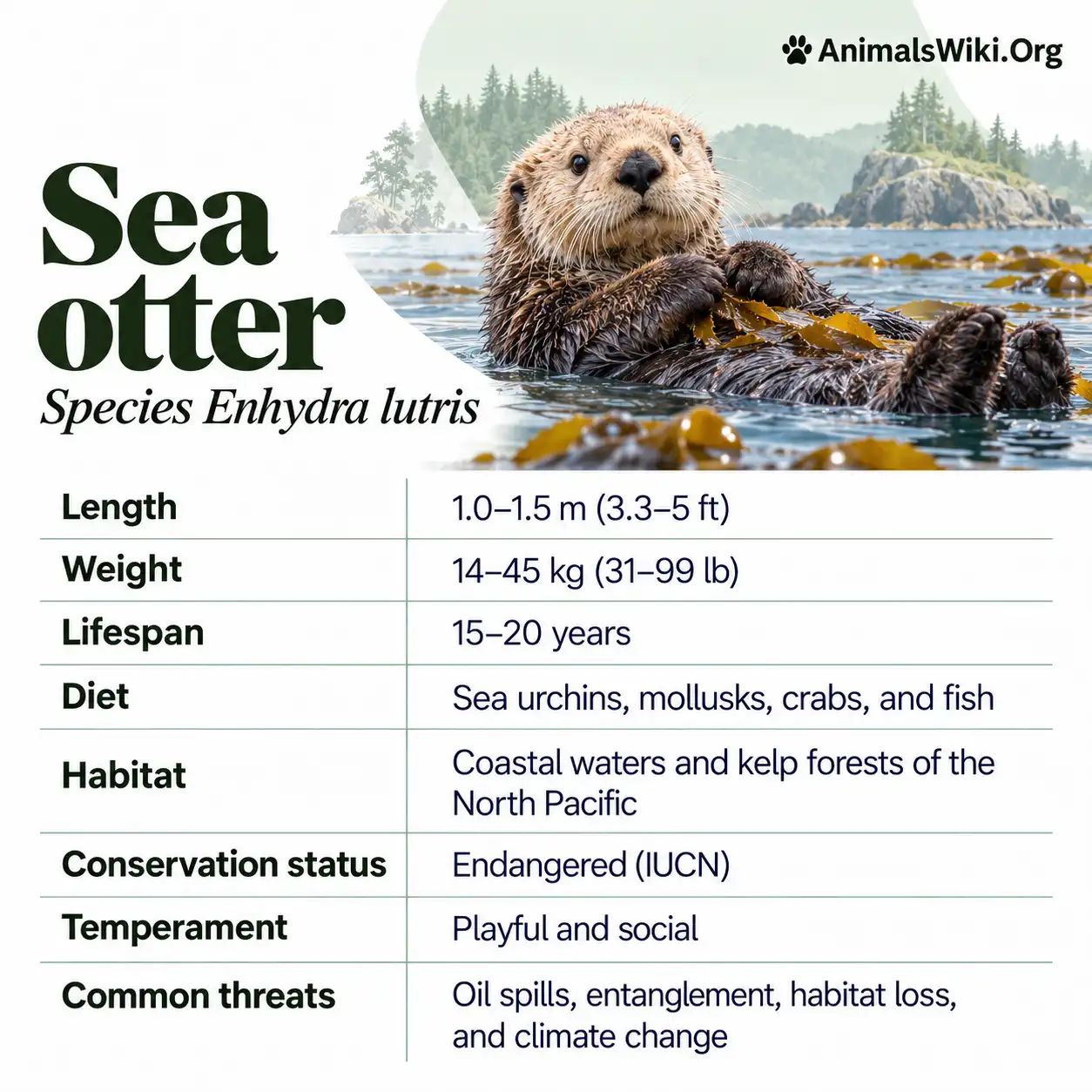
Sea Otter, A Complete Guide to Its Life, Habitat and Conservation
The sea otter is a marine mammal famous for floating on its back, cracking shellfish with rocks, and carrying its young on its chest. These familiar behaviors make it easy to recognize, but they reveal only part of its remarkable life.
Living in the cold coastal waters of the North Pacific, sea otters face a constant challenge: staying warm while finding enough food to support their demanding metabolism. Their survival depends on exceptionally dense fur, careful grooming, effective hunting skills, and access to productive coastal habitats.
Sea otters also influence the environments around them. By eating sea urchins, crabs, and other invertebrates, they can change entire food webs. In some locations, their feeding helps kelp forests persist. In others, it benefits underwater eelgrass meadows or reduces damage to salt marsh edges.
Their conservation story combines dramatic recovery with continuing vulnerability. Commercial hunting once eliminated sea otters from much of their historical range. Protection allowed some populations to rebound, while others still face serious threats.
This guide explores sea otter identification, distribution, adaptations, feeding, reproduction, social behavior, ecological importance, and conservation. It also explains several popular claims about these animals, including whether they always hold hands and whether every sea otter carries a favorite rock.
Sea Otter Facts
| Feature | Details |
|---|---|
| Common name | Sea otter |
| Scientific name | Enhydra lutris |
| Animal group | Mammal |
| Family | Mustelidae, the weasel family |
| Main environment | Nearshore marine waters |
| Geographic region | North Pacific |
| Recognized subspecies | Southern, northern, and Asian sea otters |
| Main foods | Marine invertebrates; some populations also eat fish |
| Typical feeding method | Diving for prey and processing food at the surface |
| Insulation | Dense fur combined with high internal heat production |
| Usual number of pups | One |
| Main caregiver | Mother |
| Resting group | Raft |
| Important ecological role | Predator that can influence coastal food webs |
| Global conservation category | Endangered |
1. What Is a Sea Otter?
A sea otter is an air-breathing mammal adapted to spending most of its life in coastal seawater. It belongs to the same family as weasels, badgers, and other otters, although its appearance and daily activities reflect a particularly strong dependence on the ocean.
Unlike a fish, a sea otter has lungs and must return to the surface to breathe. Like other mammals, it produces milk to nourish its young.
Its scientific name, Enhydra lutris, identifies a single species. The terms “northern sea otter” and “southern sea otter” refer to subspecies within that species rather than entirely separate kinds of animals.
A sea otter’s body is compact, its hind feet are broad, and its forepaws are useful for handling food. Its rounded face, prominent whiskers, and habit of resting belly-up are especially recognizable.
Understanding its classification helps avoid a common mistake: assuming that any otter swimming in salt water must be a sea otter. Several other otter species also use coastal environments.
2. The Three Sea Otter Subspecies
Scientists generally recognize three sea otter subspecies. Their distributions and average physical characteristics differ, although they share the same basic adaptations.
| Subspecies | Scientific name | Main geographic association |
|---|---|---|
| Southern sea otter | Enhydra lutris nereis | California |
| Northern sea otter | Enhydra lutris kenyoni | Alaska, British Columbia, and Washington |
| Asian sea otter | Enhydra lutris lutris | Northwestern Pacific, particularly Russian waters |
These names help researchers describe differences in population history, body size, distribution, and management.
However, a subspecies name alone does not explain whether a particular population is increasing or declining. Sea otters in different parts of Alaska, for example, have experienced very different population trends.
The southern sea otter is also commonly called the California sea otter. That name is useful in everyday writing, but the scientific name provides a clearer reference when discussing research or conservation.
All three subspecies belong to Enhydra lutris. They should not be confused with the smaller marine otter, Lontra felina, found along parts of South America’s Pacific coast.
3. Where Do Sea Otters Live?
Sea otters live around parts of the North Pacific rim. Their distribution includes coastal areas of Russia, Alaska, British Columbia, Washington, and California.
Historically, their range was more continuous. It extended from the northern Japanese region around the North Pacific and south along western North America toward Baja California.
Commercial hunting fragmented that distribution. Modern populations occupy only parts of the coastline where sea otters once occurred.
Sea otters generally remain associated with coastal feeding grounds rather than making the long, open-ocean migrations familiar from some whales. Individuals can move between areas, and populations can expand along a coastline, but this differs from a regular migration across ocean basins.
A useful way to understand their distribution is to imagine a narrow band of suitable coastal habitat. Within that band, food, shelter, water depth, disturbance, and local population history determine where otters are most likely to occur.
Their presence on one stretch of coastline does not mean they occupy every nearby bay or island.
4. Sea Otter Habitat: More Than Kelp Forests
Kelp forests are strongly associated with sea otters, but they are only one part of the species’ habitat.
Sea otters also use sheltered bays, rocky coastlines, sandy-bottom feeding areas, estuaries, inlets, and fjords. Some occur near harbors where suitable food and resting conditions remain available.
The most important habitat features are practical. Otters need accessible prey, places to rest, and conditions that allow them to maintain their energy balance.
A productive feeding ground may contain clams buried in sediment, crabs moving across the bottom, or sea urchins attached to rocky surfaces. Different seabed types therefore support different hunting opportunities.
Shelter also matters. Exposed coastlines and protected waterways offer different conditions for resting mothers, inexperienced juveniles, and feeding adults.
Because sea otters depend on underwater resources, their habitat cannot be evaluated from the shoreline alone. A quiet-looking bay may offer poor feeding, while a less visually dramatic area may contain rich shellfish beds.
Protecting sea otter habitat requires attention to both the animals and the underwater communities that sustain them.
5. Sea Otter Size and Appearance
Sea otter size varies with sex, subspecies, age, and individual condition. Males are generally larger than females, and northern sea otters are usually larger than southern sea otters.
Large northern males can approach or exceed 100 pounds, while females are smaller. Consequently, a single weight presented as the size of every adult sea otter can be misleading.
Their bodies are covered in brown fur that may appear almost black when wet. Longer hairs can look lighter, and the head may become noticeably pale with age.
The head is broad, with a dark nose and conspicuous whiskers. The front paws are relatively small, while the hind feet are large and webbed for movement through water.
Their appearance changes with posture. An otter floating on its back can look short and round, while the same animal stretched out during a dive appears much longer.
For identification, body shape and behavior are often more useful than color alone, especially when viewing an animal from a distant shoreline.
6. Why Sea Otter Fur Is So Important
Sea otter fur is an essential survival system. Its extraordinary density helps maintain an insulating layer of air close to the skin.
The coat contains dense underfur and longer guard hairs. Together, these layers reduce the amount of cold water reaching the skin when the coat is clean and properly maintained.
Hair density differs across the body, so exact figures should be treated as measurements from particular areas rather than a uniform number covering every square inch. Estimates commonly reach hundreds of thousands of hairs per square inch, with the densest areas approaching or exceeding a million.
This insulation is especially important because sea otters lack the thick blubber layer used by many other marine mammals.
Their fur is therefore more than an attractive covering. Damage or contamination can interfere with temperature control and quickly turn an otherwise healthy animal’s environment into a dangerous one.
The same coat that supports life in cold water also explains why sea otters were so heavily targeted during the historical fur trade.
7. Why Sea Otters Spend So Much Time Grooming
A grooming sea otter may roll, rub its face, comb its coat with its paws, and work through the fur with its mouth. These movements help maintain the coat’s insulating properties.
Food remains, dirt, and other material can interfere with the way the hairs trap air. Grooming removes debris and helps restore the air layer that separates the skin from cold water.
This behavior belongs alongside feeding and resting as a basic requirement of daily life. An otter cannot simply finish hunting and ignore its coat indefinitely.
Grooming also explains why seemingly minor interruptions can matter. An animal repeatedly forced to move may lose time that it would otherwise devote to feeding, resting, or maintaining its insulation.
For observers, vigorous rubbing and rolling can look playful. Sometimes the movements are entertaining to watch, but their practical function is central.
A clean, well-maintained coat allows the sea otter’s other adaptations to work effectively. Without it, producing enough internal heat becomes a much harder task.
8. How Sea Otters Stay Warm Without Thick Blubber
Fur reduces heat loss, but insulation alone does not explain how sea otters survive in cold water. Their bodies also produce substantial amounts of heat.
Research on sea otter skeletal muscle has identified an important mechanism inside mitochondria, the structures involved in cellular energy production.
Some energy passing through these systems is released as heat rather than being captured for other cellular work. In sea otter muscle, this heat-producing capacity is unusually high.
A 2021 study found that this mechanism could help explain their elevated resting metabolism. The researchers also found that young sea otters already showed substantial muscle metabolic capacity.
The result is a useful partnership between insulation and internal heat production. Fur slows the escape of warmth, while metabolism replaces heat that is lost.
This arrangement has an obvious cost: energy must come from food. A sea otter’s appetite is therefore closely connected to its temperature regulation.
Its frequent feeding is a consequence of living in a cold environment with a body that continually spends energy to remain warm.
9. How Sea Otters Swim and Move
Sea otters use their broad hind feet and body movements to travel through water. Their swimming equipment differs from that of a river otter, whose longer, more muscular tail is especially noticeable.
At the surface, a sea otter can float belly-up, paddle, turn, and reposition itself while keeping its forepaws available for grooming or handling food.
Underwater, its body becomes more streamlined. Swimming and steering allow it to reach feeding sites and return with prey.
On land, the same broad hind feet that help in water make movement look awkward. Sea otters can come ashore, but their locomotion is clearly specialized for aquatic life.
This does not mean they are helpless outside the water. Their ability to haul out is part of their behavioral flexibility, especially in regions where suitable resting places are available.
Watching the same animal at the surface, underwater, and on shore reveals how strongly its body design favors the sea.
Its posture changes according to the task: traveling, diving, resting, grooming, or processing a meal.
10. How Long Can a Sea Otter Stay Underwater?
Sea otters breathe air and must interrupt their underwater activity to surface. Most feeding dives are relatively brief.
A scientific review describes routine foraging as occurring largely in shallow coastal waters, with many dives lasting less than two minutes. Deeper and longer dives occur, but exceptional records should not be presented as the normal pattern.
A feeding session often consists of repeated dives rather than one long underwater hunt. An otter descends, searches for prey, returns to the surface, handles its catch, and dives again.
This repeated cycle is called a feeding bout.
Dive duration depends on several factors, including depth, prey type, search difficulty, and the time needed to capture food.
For a sea otter, a successful dive is not necessarily the longest dive. The useful outcome is obtaining enough energy to justify the effort.
A short trip that produces a valuable clam may be more worthwhile than a longer search that yields little food.
11. What Do Sea Otters Eat?
The sea otter diet consists mainly of marine animals found on or within the seabed.
Common prey include clams, mussels, sea urchins, crabs, snails, and other invertebrates. Some populations also consume fish.
Diet is influenced by local availability. An otter hunting above a rocky bottom encounters different foods from one searching in sediment.
Experience matters as well. Two otters sharing the same coastline may specialize in different prey, reflecting their hunting skills and feeding history.
A study of an expanding Washington population found strong differences between established and newly occupied areas. Otters in the established range ate a varied diet with many bivalves, while those entering new habitat relied more heavily on red sea urchins.
This illustrates why a simple statement such as “sea otters eat sea urchins” is incomplete. Sea urchins can be important, but they are one part of a flexible feeding strategy.
The species’ overall diet is broad, even when individual animals develop narrower preferences.
12. Why Do Sea Otters Eat So Much?
An adult sea otter may need food equivalent to roughly 20–30 percent of its body mass in a day. Actual requirements vary with body size, condition, activity, water temperature, and reproductive demands.
That percentage describes food mass. It does not mean every prey item provides the same amount of usable energy.
A shell-heavy meal and a softer meal can differ greatly in the amount of edible tissue they contain. Time spent finding and opening prey also affects the value of a feeding opportunity.
For an illustrative example, 25 percent of a 60-pound animal’s body mass would equal 15 pounds. This calculation shows the scale of the appetite, rather than prescribing an exact daily ration for every otter.
High food requirements make productive feeding habitat especially important.
They also create a close relationship between disturbance and energy balance. Time spent avoiding boats or repeatedly moving away from people may reduce opportunities to eat or rest.
A sea otter’s daily schedule is shaped by the need to acquire energy while limiting unnecessary expenditure.
13. How Sea Otters Find and Capture Food
Sea otters search for prey using their senses and sensitive forepaws. Depending on the habitat, they may inspect rocky surfaces or feel for animals within sediment.
The hunting process involves more than simply spotting something edible. Prey may be attached, hidden, buried, protected by a shell, or difficult to grip.
Once captured, food is often brought to the surface for processing. This separates the search-and-capture stage from the handling stage.
An otter floating on its back can use its body as a working surface while manipulating a shellfish item.
Scientists studying foraging observe both successful and unsuccessful dives. They also record prey type, handling time, dive depth, and the amount of time devoted to feeding.
These details reveal how efficiently an animal is meeting its needs.
For example, a change toward longer feeding effort may indicate that preferred prey have become harder to obtain. However, interpretation requires context: a mother supporting a pup may naturally need to forage more than an adult without dependent young.
14. How Sea Otters Use Rocks as Tools
Sea otters are among the best-known tool-using mammals. A rock can help an otter open prey that would otherwise be difficult to process.
One familiar method involves placing a hard object on the chest and striking a shellfish against it. In other cases, an otter may strike prey with a stone or use a hard surface as an anvil.
The important feature is that an external object assists the feeding task.
Tool use is not equally common in every individual. Research has connected variation in tool use with prey characteristics, food availability, and individual dietary specialization.
An otter eating easily accessible soft prey has different mechanical needs from one relying on thick-shelled snails.
This makes tool use an adaptable solution to a feeding problem rather than a performance that happens at every meal.
The ability is especially interesting because it connects behavior with ecology. Changes in available prey can influence how often an animal needs tools and which feeding techniques are useful.
15. Can Tool Use Protect a Sea Otter’s Teeth?
Tool use can provide benefits beyond opening a shell.
A 2024 study followed southern sea otters and examined the relationship between tool use, prey access, and tooth condition. Tool-using individuals, particularly females, could process larger or harder prey while experiencing less tooth damage.
This matters because teeth are valuable equipment for an animal that must eat frequently throughout its life.
Biting directly into hard shells creates mechanical demands. A stone can take on part of that work, allowing an otter to reach food without relying entirely on its teeth.
The benefit may become especially important where preferred prey are limited and alternative foods require more effort to open.
The study does not imply that every sea otter must use tools to survive. It shows that tools can improve feeding opportunities under particular conditions.
For readers interested in animal intelligence, this provides a concrete example of how a behavior can influence an animal’s physical condition and ability to obtain energy.
16. Do Sea Otters Have Pockets?
Sea otters have loose folds of skin beneath their forearms. These folds can temporarily hold prey during a dive.
The arrangement allows an otter to collect food while keeping its paws available for further searching and handling.
Calling these folds “pockets” is a useful everyday comparison, although they are part of the animal’s body rather than separate containers.
The popular claim that every sea otter keeps one favorite rock for its entire life goes much further than the evidence supports. Otters can retain and reuse tools, but a universal lifelong attachment should not be assumed.
It is helpful to separate an observed behavior from an appealing story about that behavior.
Temporary storage under the forearms is a physical adaptation. Tool selection and reuse are behaviors that vary between individuals and circumstances.
Together, these features show how anatomy and learning can complement each other during feeding.
An otter can gather prey, transport it, and then use a suitable object to help gain access to the edible parts.
17. Sea Otter Social Life and Rafts
A group of resting sea otters is called a raft. Rafts can contain relatively few animals or become much larger where conditions encourage otters to gather.
Their social organization differs from the closely bonded family groups associated with some other otter species.
Sea otter groups are often separated by sex, and the animals resting together should not automatically be described as a permanent family.
Breeding males may defend areas used by females. Other males can gather outside those breeding territories.
An individual’s social surroundings may therefore change according to sex, age, reproductive condition, and location.
Resting together provides opportunities for contact and coordinated positioning, but sea otters still commonly hunt as individuals.
For observers, a raft can be a useful reminder that feeding and resting have different spatial requirements. Animals may spread out while searching for food and gather again in suitable resting areas.
The number visible in one raft is also not a reliable estimate of the entire local population.
18. Do Sea Otters Really Hold Hands?
Sea otters sometimes touch or hold one another’s paws while resting. However, the idea that every otter always sleeps hand-in-hand exaggerates a behavior that is less universal.
A raft can remain together through several methods, including body contact and small adjustments in position.
Otters may also rest among kelp, where the floating vegetation provides a useful setting for remaining in one area.
The exact behavior of an individual pair should not be turned into a rule for the whole species. Photographs and short videos naturally favor unusual or especially appealing moments.
This is a good example of how wildlife becomes simplified online. A real observation can gradually acquire an explanation that sounds more certain than the evidence allows.
The accurate version is still interesting: sea otters have several ways to maintain proximity while resting, and paw contact can be one of them.
Their social behavior does not need a romantic interpretation to be worth observing.
19. What Does a Sea Otter Do All Day?
A sea otter’s daily activities revolve around feeding, grooming, resting, traveling, and, for mothers, caring for young.
The balance between these activities is flexible. An animal with easy access to profitable prey may meet its needs with less feeding effort than one facing strong competition.
A mother must support both herself and her dependent pup, making her energy budget especially demanding.
Weather, season, habitat, and disturbance can also affect the schedule.
There is no single timetable that describes every sea otter. Presenting the animals as strictly daytime or nighttime feeders overlooks the flexibility required in different environments.
Rest is a functional part of this schedule. An otter floating quietly is conserving energy between other activities.
For researchers, time budgets help connect behavior with habitat quality. If animals consistently spend more time feeding, scientists can investigate whether food conditions, population density, or reproductive demands explain the change.
Understanding the whole day provides more insight than focusing only on dramatic feeding or playful-looking moments.
20. Sea Otter Reproduction
Sea otter reproduction involves a long period of maternal investment.
Females usually give birth to one pup. Mating and births can occur throughout the year, although regional seasonal peaks are possible.
Pregnancy timing is influenced by delayed implantation. After fertilization, the embryo may remain unimplanted for a period before further development proceeds.
This means the interval between mating and birth can vary. A single exact gestation length is therefore less informative than an explanation of the reproductive process.
Long-term research on tagged females found an average gestation of about six months and a similar average period of pup dependency in the studied population.
These figures are useful reference points rather than a schedule that every female follows precisely.
Age at first reproduction and the interval between pups also depend on individual and environmental conditions.
Because a mother must remain healthy enough to support an extended period of care, reproduction is closely tied to food supply and physical condition.
21. Baby Sea Otters: Birth and Early Development
A baby sea otter is called a pup. Newborn pups depend heavily on their mothers for food, grooming, transport, and protection.
Their early coat is especially buoyant. A young pup can float, but that does not mean it already possesses the diving skills of an adult.
The distinction between floating and effective swimming is important. Finding food underwater requires coordination, strength, practice, and experience.
A mother frequently supports her pup on her chest while resting at the surface. She also spends considerable time maintaining its coat.
As the pup grows, it gradually develops the abilities needed to move underwater and handle food.
Observations from rescued pups illustrate how many different skills are involved. Diving, grooming, gripping objects, and processing hard prey all develop over time.
A small otter playing with an object may be building abilities that will later become important for feeding.
Its early life is therefore a period of physical growth combined with extensive behavioral development.
22. How Mothers Raise Sea Otter Pups
The mother is the primary caregiver. She nurses, grooms, protects, and provisions the pup while continuing to meet her own demanding needs.
When she dives to forage, the pup may remain at the surface. Kelp can sometimes help keep a resting pup in place.
As the youngster develops, it begins receiving solid food and gaining experience with prey.
Maternal care commonly continues for approximately six months in southern sea otters, although individual timing varies.
This period is energetically expensive. The mother must obtain enough food to support milk production, her own metabolism, and the growing needs of the pup.
Consequently, the end of the dependency period can be especially demanding for a female in poor feeding conditions.
The image of a mother carrying a pup is appealing, but it also represents a substantial investment of time and energy.
Successful reproduction depends on more than giving birth. The mother must remain capable of supporting the youngster until it can function independently.
23. How Long Do Sea Otters Live?
Sea otters can live well into their teens, with females generally having the potential to live longer than males. Estimates vary by population and by the way lifespan is measured.
A distinction is needed between maximum lifespan and average survival.
An animal that reaches adulthood may live for many additional years, while mortality among young animals lowers the average calculated across all births.
Research summaries from Alaska have described female lifespans of approximately 15–20 years and shorter typical lifespans for males.
Animals under professional care can sometimes reach advanced ages, but an individual record should not be treated as the normal lifespan of a wild sea otter.
Survival depends on food, disease, injury, environmental conditions, and other local risks.
Age also changes an animal’s challenges. A young otter must become an efficient hunter, while an older individual may face worn teeth or reduced physical capacity.
Lifespan is therefore best understood as the outcome of many interacting biological and environmental factors.
24. Sea Otter vs. River Otter
Sea otters and river otters share a family, but they differ in body form, habitat use, and behavior.
| Characteristic | Sea otter | North American river otter |
|---|---|---|
| Scientific name | Enhydra lutris | Lontra canadensis |
| Typical environment | Coastal marine waters | Rivers, lakes, wetlands, and some coastal waters |
| General build | Broad, compact body | Long, streamlined body |
| Tail | Relatively short | Long and muscular |
| Hind feet | Broad and strongly adapted for swimming | Webbed, with a different overall shape |
| Familiar resting posture | Floating on the back | Often resting on land |
| Feeding pattern | Frequently processes prey at the surface | Often captures fish and other aquatic prey |
The word “river” does not prevent a river otter from entering the sea. Coastal river otters can be mistaken for sea otters, especially when only a small part of the animal is visible.
Look for several clues together: tail length, body shape, swimming posture, and what the animal does when it stops moving.
Location is useful, but it should support identification rather than replace it.
25. Why Sea Otters Are Called a Keystone Species
A keystone species has an ecological influence that is unusually large relative to its abundance.
Sea otters can fill this role because their feeding changes the numbers and behavior of animals that influence underwater vegetation.
The classic example involves sea urchins and kelp. Urchins eat kelp, while otters eat urchins. When otters reduce grazing pressure, kelp may have a better chance to grow and persist.
This relationship is called a trophic cascade: a change at one feeding level produces effects elsewhere in the food web.
The term “keystone” does not mean that every sea otter produces an identical result in every habitat. Ecological effects depend on which prey are present, how those prey behave, and what other environmental pressures operate locally.
It also differs from the term “indicator species,” which refers to organisms that provide information about environmental conditions.
An animal can be useful in both contexts, but the two terms describe different concepts.
26. Sea Otters and Kelp Forests
Kelp forests provide three-dimensional habitat for many coastal organisms. Sea otters can help maintain these forests by reducing grazing pressure from sea urchins.
However, recent research shows why this relationship needs a regional explanation.
A study comparing long-term datasets from Vancouver Island and San Nicolas Island found different responses to sea otter recovery.
At Vancouver Island, otter arrival produced a strong decline in urchins followed by kelp recovery. Around San Nicolas Island, otters, urchins, and kelp coexisted at intermediate levels for an extended period.
Both outcomes are consistent with sea otters influencing the system. They simply show that influence taking different forms.
Kelp growth also depends on conditions such as temperature, nutrients, storms, and the wider food web.
Protecting otters can therefore support kelp ecosystems without guaranteeing that every damaged forest will immediately recover.
This more complete explanation strengthens the conservation case by showing what the animals can accomplish and why local evidence remains important.
27. Why Sea Otters Do Not Automatically Remove Urchin Barrens
An urchin barren is an area where intense grazing has left little standing kelp.
It may seem logical that a large concentration of urchins would attract enough otters to restore the forest quickly. However, prey abundance is only part of the feeding decision.
The condition of the prey matters too.
Urchins in productive kelp habitat can offer a different energetic reward from poorly nourished urchins in a barren. An otter must obtain enough edible tissue to justify the cost of searching, diving, and handling.
Research in a landscape containing both kelp patches and barrens has shown that predator behavior and prey condition can alter the expected trophic cascade.
This helps explain why otters may contribute to the persistence of remaining kelp patches without rapidly reversing every nearby barren.
Restoration planning must therefore consider the state of the whole system.
The presence of an important predator is valuable, but recovery can still be limited by prey behavior, environmental conditions, and the history of ecosystem change.
28. Sea Otters and Eelgrass Meadows
Sea otters can influence coastal habitats that contain no kelp forest at all.
In California’s Elkhorn Slough, researchers found that otter recovery helped eelgrass through an indirect food-web pathway.
Otters ate crabs. Reduced crab pressure allowed certain small animals that graze algae to become more effective. By removing algae growing on eelgrass blades, these grazers helped improve conditions for the plants.
This is a more complicated cascade than the familiar otter–urchin–kelp example, but the principle is similar: a predator can benefit vegetation by changing relationships among smaller animals.
The study combined long-term observations with comparisons and experiments, providing several lines of evidence.
However, research comparing California and British Columbia has also shown that seagrass responses depend on local ecosystem features.
The same predator does not enter an identical food web everywhere.
These findings expand our understanding of sea otter habitat while emphasizing that effective conservation should be grounded in the particular community being protected.
29. How Sea Otters Can Reduce Salt Marsh Erosion
A study published in 2024 identified another effect of sea otter recovery in Elkhorn Slough: reduced erosion along salt marsh edges.
In this system, burrowing crabs can weaken creek banks and affect vegetation.
Otters eat the crabs. When crab pressure decreases, marsh edges can become stronger and less vulnerable to erosion.
The researchers used both observational evidence and experiments that excluded otters from selected areas. This helped test the relationship rather than relying only on the fact that otters and healthier banks occurred together.
The result connects animal feeding behavior with the physical shape of a coastline.
It does not mean sea otters can prevent every form of coastal erosion. Rising water levels, storms, tidal forces, and other processes still matter.
Instead, the study shows that food webs can influence shoreline stability in ways that are easy to overlook.
A predator floating at the surface may be helping shape the marsh banks surrounding it through repeated feeding choices beneath the water.
30. Sea Otters, Biodiversity, and Coastal Carbon
The ecological importance of sea otters extends beyond the prey they consume directly.
Where their feeding supports kelp or eelgrass, other organisms may benefit from the habitat those plants and algae provide.
Underwater vegetation offers surfaces, shelter, feeding areas, and nursery habitat. Changes in that vegetation can therefore influence many species at once.
These habitats also participate in the carbon cycle. Marine plants and algae use carbon during growth, while some coastal ecosystems store organic material in sediments.
This creates a possible indirect connection between sea otters and carbon storage.
However, carbon taken up during growth is not automatically stored for the long term. Some material is consumed, decomposes, or moves elsewhere.
Any estimate of climate benefit must consider those pathways, the habitat involved, and how long carbon remains out of circulation.
The strongest practical message is that functioning coastal ecosystems provide several connected benefits. Biodiversity, food-web structure, sediment stability, and carbon processes can all matter, without reducing an otter’s value to a single numerical climate claim.
31. The Fur Trade and Sea Otter Decline
The historical commercial fur trade transformed sea otter populations.
Their dense pelts became valuable commodities, and intensive hunting removed animals from large stretches of the North Pacific coast.
By the early twentieth century, surviving populations were small and widely separated. Many areas that once supported otters had lost them entirely.
The 1911 international agreement protecting sea otters was a major turning point, although recovery took time and did not occur uniformly.
This history matters when interpreting their modern distribution. An empty coastline may represent a historical loss rather than habitat the species never used.
It also shows how exploitation can affect ecosystems beyond the hunted animal. Removing a predator can change its prey communities and the vegetation influenced by those prey.
Sea otter history should also recognize the experiences of Indigenous peoples, including coercion associated with colonial commercial hunting.
The story involves human communities, trade, ecological change, and the eventual development of protective measures.
32. Are Sea Otters Endangered?
Globally, the sea otter is classified as Endangered on the IUCN Red List.
Legal protection within the United States uses different categories and applies to particular groups.
The southern sea otter remains listed as Threatened under the U.S. Endangered Species Act. The southwest Alaska distinct population segment of the northern sea otter is also listed as Threatened.
These classifications do not mean that every northern sea otter population has the same status.
| Assessment or legal framework | Group | Category |
|---|---|---|
| IUCN Red List | Sea otter species globally | Endangered |
| U.S. Endangered Species Act | Southern sea otter | Threatened |
| U.S. Endangered Species Act | Southwest Alaska northern sea otter population segment | Threatened |
This distinction helps explain why apparently conflicting descriptions can both be correct.
“Endangered” may refer to a global extinction-risk assessment, while “Threatened” may describe a specific legal listing.
Population recovery should also be evaluated geographically. Growth in one region does not cancel out serious declines elsewhere or eliminate risks faced by a restricted population.
33. Major Threats to Sea Otters
Sea otters face several threats, and their relative importance varies by region.
Oil contamination is especially dangerous because it can interfere with the coat’s insulation. An oiled otter may also ingest contaminants while grooming.
Entanglement and other fishery interactions can injure or kill animals. Competition over shellfish can create management challenges even where direct injury does not occur.
Predation and bite injuries have different roles across the range. In California, white shark bites are a major documented cause of mortality among recovered carcasses, even though sharks are not known to routinely consume sea otters.
In southwest Alaska, research on a major decline found evidence consistent with increased predation rather than a simple shortage of food.
Disease, toxins, and disturbance create additional pressures.
These threats should not be combined into a single universal explanation for every population trend. Effective protection depends on identifying what is limiting survival and reproduction in the particular area being managed.
34. Disease, Runoff, and Harmful Algal Blooms
Sea otters live close enough to land that coastal water quality can expose them to problems originating within watersheds.
One example is Toxoplasma gondii, a parasite whose life cycle involves cats. Infective stages can reach aquatic environments, creating a connection between conditions on land and wildlife health at sea.
Research across the Pacific Rim has found that infection patterns depend on both broad landscape factors and individual characteristics such as prey choice.
Harmful algal blooms provide another pathway.
Some algae produce domoic acid, which can move through marine food webs. Research on southern sea otters has linked exposure with serious health effects, including cardiac disease.
These examples show why conservation cannot stop at the shoreline.
Habitat protection also involves understanding runoff, food-web exposure, and the conditions that influence toxin-producing blooms.
A sea otter can be feeding in apparently natural habitat while encountering biological hazards carried through water or concentrated in prey.
35. Sea Otter Recovery, Reintroduction, and Rescue
Sea otter recovery has occurred through several routes, including natural population growth, expansion from surviving groups, and historical translocations.
Washington provides one example. Otters moved from Alaska in 1969–1970 helped establish a population along that coastline.
Proposals for further reintroduction require careful evaluation. Suitable habitat, animal welfare, ecological effects, fisheries, local communities, and long-term monitoring all matter.
Rescue and rehabilitation provide another contribution.
Monterey Bay Aquarium’s surrogacy program pairs suitable orphaned pups with experienced adult female otters. The pups learn essential behaviors while human contact is limited.
After appropriate development and assessment, releasable animals can return to the wild.
Monitoring has shown that surrogate-reared otters can survive, reproduce, and contribute to local population growth.
These approaches address different problems. Rehabilitation assists individual animals, while population recovery also requires habitat, survival, reproduction, and space for expansion.
Successful conservation combines those scales rather than expecting one program to solve every challenge.
36. Sea Otters, Fisheries, and Coastal Communities
Sea otter recovery can produce ecological benefits while also changing access to valuable shellfish.
An otter consuming clams, crabs, or other invertebrates may be eating the same resources used by commercial, recreational, or subsistence harvesters.
This creates a real management issue.
Benefits such as healthier vegetated habitats may be spread across a region, while losses from reduced shellfish availability can be concentrated among particular communities or occupations.
Conservation planning therefore needs more than a statement that otters are beneficial. It requires clear information about who benefits, who bears costs, and how decisions are made.
Indigenous knowledge, cultural relationships, legal rights, and local experience also belong in that discussion.
Proposed reintroduction work has recognized the need to examine social and economic effects alongside biology.
A durable recovery strategy should explain ecological expectations, acknowledge uncertainty, and provide meaningful opportunities for affected communities to participate.
Protecting a species and understanding human dependence on coastal resources are connected parts of the same management challenge.
37. How to Watch Sea Otters Responsibly
Watching a wild sea otter is most rewarding when the animal can continue its normal activities.
Observe from shore where possible, and use binoculars or a zoom lens for a closer view.
From a kayak or boat, avoid approaching directly or placing yourself between an animal and its route of travel.
An otter that stops resting, repeatedly looks toward you, changes direction, or moves away may be responding to your presence. Increase your distance.
Never feed an otter. Food can encourage it to approach people or vessels and create dangerous interactions.
Keep pets from approaching wildlife, including around docks and shorelines.
A pup floating alone is not automatically abandoned. Its mother may be feeding underwater nearby. Concerns should be reported to an appropriate wildlife response organization rather than addressed by attempting a rescue yourself.
Responsible viewing gives the animal control over the encounter.
A distant observation of natural behavior is more valuable than a close photograph obtained by interrupting feeding, rest, or maternal care.
38. How Scientists Study Sea Otters
Sea otter research uses several methods because no single observation can explain an entire population.
Surveys estimate abundance and distribution. Repeated observations reveal changes over time.
Foraging studies record prey, dive patterns, and handling behavior. These data help researchers understand food availability and individual specialization.
Where authorized and appropriate, tracking methods provide information about movements, habitat use, and survival.
Health studies and examinations of dead animals help identify disease, toxins, trauma, and other causes of mortality.
Each method has limits.
A count can miss animals that are underwater or difficult to see. Recovered carcasses represent only some deaths. A feeding study from one bay may not describe another region.
Combining methods creates a stronger picture.
For example, a decline accompanied by abundant prey and improved body condition points toward different explanations from a decline associated with poor feeding success.
The aim is to connect population patterns with the processes that cause them, making conservation decisions more precise.
39. Frequently Asked Questions About Sea Otters
What is the scientific name of the sea otter?
The sea otter’s scientific name is Enhydra lutris. It belongs to the family Mustelidae, which also includes weasels, badgers, and other otters. Southern, northern, and Asian sea otters are recognized as subspecies within this species.
Is a sea otter a mammal or a fish?
A sea otter is a mammal. It breathes air through lungs, has fur, and produces milk for its young. Although it spends much of its life in water, it must return to the surface to breathe and cannot extract oxygen from seawater through gills.
Where are sea otters found?
Sea otters occur in parts of the North Pacific, including coastal waters of Russia, Alaska, British Columbia, Washington, and California. Their modern distribution is fragmented compared with their historical range because commercial hunting eliminated populations from many areas.
What do sea otters eat most often?
Their diet mainly includes marine invertebrates such as clams, crabs, mussels, snails, and sea urchins. The most important prey vary by location and individual. Some sea otters also eat fish, so their diet should not be reduced to shellfish alone.
How much food does a sea otter eat daily?
A commonly reported daily requirement is approximately 20–30 percent of body mass. This varies with the animal’s condition and circumstances. A mother supporting a pup, for example, faces different demands from an adult without dependent young.
Why do sea otters float on their backs?
Floating on the back provides a useful posture for resting, grooming, caring for a pup, and handling food. It allows the forepaws to remain available above the water. Sea otters also use other postures while traveling and diving.
Do all sea otters use rocks?
No. Tool use varies between individuals and feeding situations. Hard-shelled prey may make a rock useful, while softer or more accessible prey may not require one. An otter’s diet and experience influence how often tools appear in its feeding behavior.
Does every sea otter keep a favorite rock?
That popular claim is too broad. Sea otters can retain and reuse tools, but there is no basis for assuming every individual carries the same rock throughout its life. Tool use is better understood as a flexible feeding behavior.
Can sea otters breathe underwater?
No. They breathe air and must surface between dives. Their underwater hunting occurs in repeated trips, with breathing and food handling taking place at the surface. Many routine feeding dives are much shorter than the maximum durations sometimes highlighted in animal fact lists.
Do sea otters live on land?
They can come ashore, and hauling out is part of their behavior in some locations. However, they depend strongly on marine feeding habitats. Their broad hind feet make them effective swimmers but give them a noticeably awkward appearance when moving on land.
What is a baby sea otter called?
A baby sea otter is called a pup. It relies on its mother for milk, grooming, protection, and assistance while developing the skills needed for independence. Floating from birth does not mean a pup can immediately dive and hunt effectively.
How many babies does a sea otter have?
A single pup is the usual outcome. Raising that pup requires extensive maternal care. The mother must support its growth while maintaining her own body condition, making reproduction a substantial energetic commitment.
How long does a pup stay with its mother?
Approximately six months is a useful general reference for southern sea otters, although timing varies. During dependency, the pup gradually develops swimming, grooming, and feeding skills. Independence involves more than reaching a certain size; it requires effective self-maintenance.
Why are sea otter pups so fluffy?
Their early coat contains a substantial amount of trapped air when properly groomed. This helps with insulation and buoyancy. The fluffy appearance is therefore functional, but the coat still requires careful maintenance while the pup develops.
Do sea otters always hold hands?
No. Paw holding occurs, but it is not a universal resting behavior. Otters can maintain proximity through body contact and small movements, and they may rest among kelp. A memorable photograph should not be treated as a complete description of the species.
Why do sea otters groom so frequently?
Grooming keeps the fur clean and helps maintain the insulating air layer. Because sea otters lack a thick blubber layer, coat condition is especially important. Rubbing, combing, and rolling can all contribute to the maintenance of this insulation.
Are sea otters important to kelp forests?
They can be very important. By consuming sea urchins, otters can reduce grazing pressure on kelp. However, the strength of this effect varies among locations, and environmental conditions can limit kelp recovery even where otters are present.
Are sea otters the same as giant river otters?
No. The sea otter is Enhydra lutris, while the giant river otter is Pteronura brasiliensis. They differ in distribution, habitat, appearance, diet, and social organization. The giant river otter is associated with freshwater systems in South America.
Are sea otters safe to approach?
They should be observed from a respectful distance. Sea otters are wild animals with strong teeth and demanding daily routines. Close approaches can disturb feeding or rest, and feeding them can encourage problematic interactions with people.
Can people keep sea otters as pets?
Sea otters require specialized care, appropriate facilities, professional expertise, and relevant legal authorization. They are unsuitable as household pets. Their feeding requirements, aquatic lifestyle, behavioral needs, and protected status make ordinary home care inappropriate.
What is the biggest threat to sea otters?
There is no single answer for the entire species. Important threats include oil spills, disease, toxins, fishery interactions, and region-specific mortality pressures. Conservation work must identify which factors are most important for the population being studied.
How can ordinary people help sea otters?
Respect wildlife-viewing distances, avoid feeding marine mammals, keep pets away from wildlife, and support coastal habitat protection. Reducing pollution and reporting injured or potentially stranded animals through appropriate wildlife channels can also contribute to responsible stewardship.



