
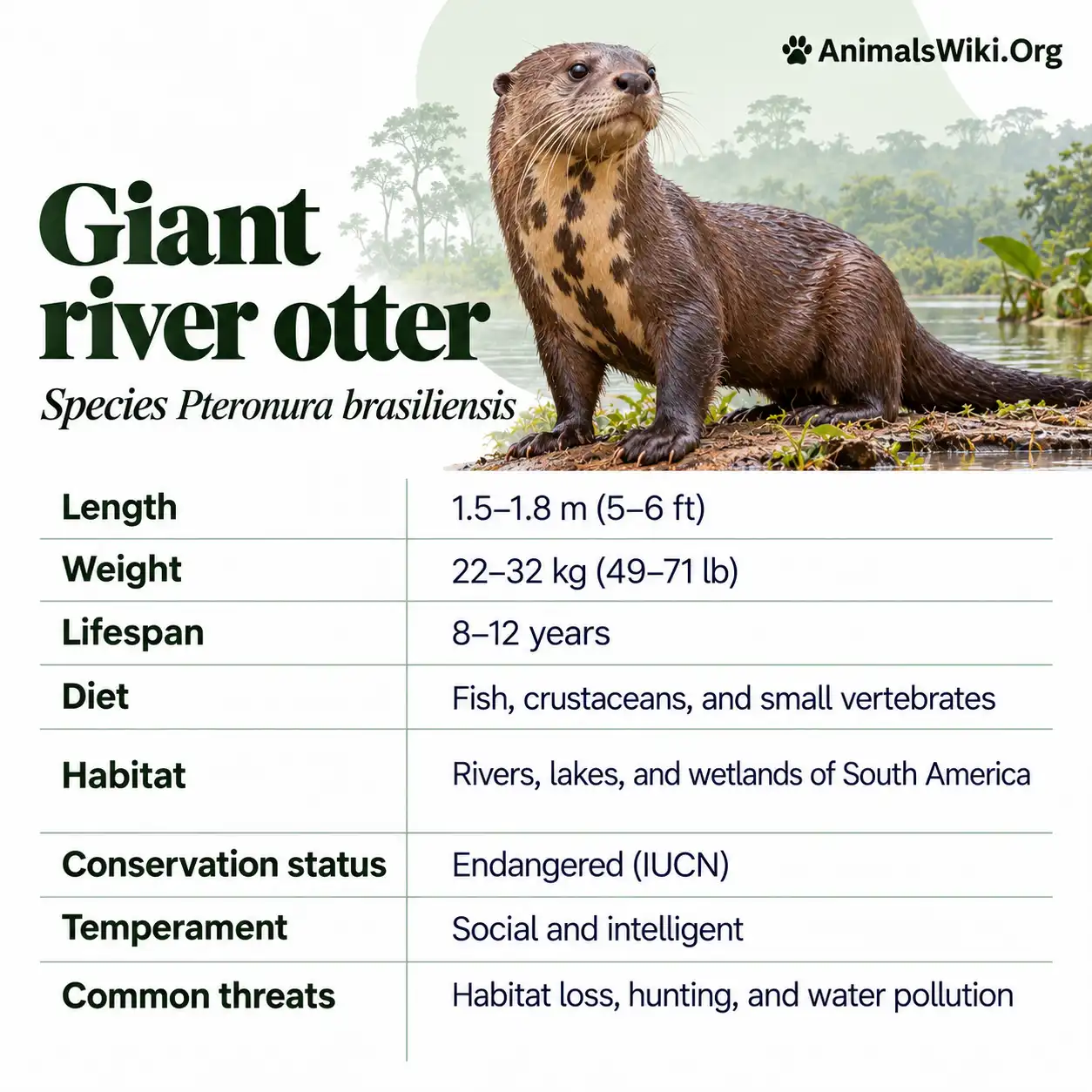
Giant River Otter, The Remarkable Family Hunter of South America
A group of dark shapes moves across a South American lake. Broad heads rise above the surface, pale throat markings flash, and sharp calls carry across the water. Within moments, the animals dive again, searching for fish along the margins.
These are giant river otters, also called giant otters. Their scientific name is Pteronura brasiliensis.
They are among the most striking mammals of South America’s freshwater ecosystems. Long bodies, webbed feet, powerful tails, and close family relationships support a lifestyle divided between water and land.
Their reputation sometimes centers on dramatic confrontations with caimans or other predators. Their everyday lives tell a richer story: catching fish, caring for young, maintaining territories, communicating with relatives, and responding to seasonal changes in rivers and wetlands.
Giant otters are also conservation symbols. Historical hunting devastated populations, while habitat loss, pollution, fishing conflict, and disturbance continue to affect them. Their recovery depends on healthy aquatic systems and safe places to rest and reproduce.
Understanding this species means looking beyond its size. A giant river otter belongs to a social group, occupies a changing waterscape, and depends on the quality of both riverbanks and the water between them.
This guide explores its biology, behavior, family life, ecological role, threats, and conservation.
Giant River Otter Facts
| Feature | Information |
|---|---|
| Common name | Giant river otter |
| Other names | Giant otter, ariranha, and river wolf |
| Scientific name | Pteronura brasiliensis |
| Animal group | Mammal |
| Order | Carnivora |
| Family | Mustelidae |
| Subfamily | Lutrinae |
| Native region | South America |
| Typical adult length | Approximately 1.45–1.8 meters, including the tail |
| Commonly reported adult weight | Approximately 24–34 kilograms, with individual variation |
| Main habitats | Rivers, lakes, floodplains, and wetlands |
| Diet | Primarily fish |
| Activity | Mainly diurnal |
| Social structure | Family groups commonly centered on a breeding pair |
| Gestation | Approximately 65–70 days |
| Litter size | Commonly reported as one to five pups |
| Identification feature | Individually distinctive pale throat markings |
| Global conservation status | Endangered |
| Major threats | Habitat degradation, pollution, persecution, and other human pressures |
1. What Is a Giant River Otter?
The giant river otter is a large, semiaquatic carnivorous mammal native to South America.
Semiaquatic means its life depends on both aquatic and terrestrial environments.
It hunts and travels in water but uses land for resting, grooming, scent marking, denning, and giving birth.
The word “river” describes an important habitat association without limiting the species to flowing channels. Giant otters also use lakes, seasonally flooded areas, and other connected wetlands.
Their family groups distinguish them from the solitary image many people associate with otters.
Individuals frequently travel, rest, and interact together. Their social organization includes long-term relationships and cooperative care of young.
The nickname “river wolf” reflects their conspicuous group behavior and predatory lifestyle. It does not indicate a close relationship with wolves.
Giant otters belong to the mustelid family, alongside other otters, weasels, badgers, and related carnivores.
Their biology combines the body of an effective aquatic hunter with the social complexity of a closely connected family.
2. Classification and Scientific Name
The giant river otter belongs to the following groups.
| Classification level | Group |
|---|---|
| Kingdom | Animalia |
| Phylum | Chordata |
| Class | Mammalia |
| Order | Carnivora |
| Family | Mustelidae |
| Subfamily | Lutrinae |
| Genus | Pteronura |
| Species | Pteronura brasiliensis |
It is the living representative of its genus.
The name Pteronura refers to the distinctive broad, flattened tail, a useful feature separating it visually from some other otters.
Its classification also explains several familiar traits: fur, milk production, a carnivore’s feeding anatomy, and shared characteristics with other mustelids.
Nevertheless, being related to other otters does not make their behavior identical.
Sea otters, small-clawed otters, North American river otters, and giant otters occupy different environments and have different social and feeding patterns.
An accurate article therefore uses species-specific information whenever possible.
A general fact about “otters” may provide context, but it cannot automatically establish the details of giant otter reproduction, diving, group organization, or conservation.
3. How Big Is a Giant River Otter?
Giant river otters are exceptionally long otters.
Specialist accounts commonly report total adult lengths of approximately 1.45–1.8 meters, including the tail, with weights around 24–34 kilograms.
The total length matters. A statement that an animal is nearly two meters long does not mean its torso alone reaches that measurement.
Sex, age, condition, and individual history influence size.
Males may be larger on average, but field researchers cannot reliably identify every individual’s sex by apparent body size.
Perspective also changes perception. An otter raising its head beside a small boat can look very different from the same animal viewed from a distant bank.
Claims about the “largest otter” should specify the measurement being compared. Length and body mass answer different questions.
The giant otter’s long body is a defining feature, while other otter species can be extremely heavy.
For educational comparisons, clear measurements are more useful than an unqualified size title.
4. Appearance and Distinctive Throat Markings
A giant otter has a long muscular body, a broad head, small ears, webbed feet, and a powerful flattened tail.
Its coat is generally brown, appearing darker when wet.
The most useful identification feature is the pale marking on the throat and upper chest.
Each animal’s pattern is distinctive enough for researchers to follow individuals through time.
Markings can vary from broad patches to smaller arrangements of pale areas.
When an otter lifts its neck above the water, the pattern becomes visible. Researchers photograph or film these moments and compare them with an identification catalog.
This provides a way to study life histories without relying entirely on capture or artificial tags.
However, a throat photograph does not answer every question. Determining sex and age can require additional observations.
Long-term identification becomes especially valuable when scientists track births, dispersal, changes in breeding pairs, and survival.
An individual’s pale throat pattern becomes a practical link between a brief encounter and years of ecological information.
5. Adaptations for Life in Water
Several body features support swimming and underwater hunting.
Webbed feet increase the area available to push against water. The long body and broad tail contribute to propulsion and maneuvering.
Small ears and nostrils can close during submersion, helping limit water entry.
The fur provides insulation and helps maintain a suitable condition at the skin.
These adaptations work together. Swimming performance depends on body shape, muscular movement, sensory information, and the condition of the coat.
A giant otter must also return to the surface to breathe. It has lungs and obtains oxygen from air, just like other mammals.
Its streamlined appearance should therefore not be confused with a fish’s respiratory system.
The animal repeatedly moves between underwater searching and surface activity.
On land, the same body must support walking, grooming, digging, and caring for young.
Its form represents a compromise that performs effectively in both environments rather than a body designed exclusively for swimming.
6. Fur, Grooming, and Resting
Giant otters spend time grooming and resting between periods of activity.
Coat maintenance helps preserve the protective functions of the fur.
Grooming also creates opportunities for social contact, especially within family groups.
Resting places can include banks, fallen trees, and other suitable structures near the water.
These areas are part of the habitat rather than incidental places where animals happen to stop.
An otter group needs access to locations where its members can recover, maintain their coats, and remain together.
The importance of land becomes particularly clear during reproduction, when dependent pups remain in a den.
A water body with fish can still be unsuitable if safe banks and resting areas are unavailable.
This is a recurring theme in giant otter ecology: aquatic feeding resources and terrestrial refuge must occur together.
Protecting only the water surface overlooks a substantial part of the animal’s daily needs.
7. Where Do Giant River Otters Live?
Giant river otters are native to South America.
Important populations occur within parts of the Amazon basin, the Pantanal, the Guianas, and other connected freshwater landscapes.
Their historical range was broader than their current secure distribution.
Hunting, habitat change, and local extinctions created gaps.
A map showing the species across a large region should therefore not be interpreted as continuous occupation of every river.
Some areas support established breeding groups, while others contain few animals or are the focus of restoration.
Their conservation status also varies locally, even though the global classification remains Endangered.
Recent reintroduction work has changed the situation in parts of the former range, making old claims of complete absence unreliable without checking dates.
The useful distinction is between historical occurrence, current observation, and a self-sustaining breeding population.
Those categories provide a clearer picture than one broad colored distribution map.
8. Rivers, Oxbow Lakes, and Floodplains
Giant otters use several kinds of freshwater habitat.
Rivers provide travel corridors and feeding areas. Oxbow lakes—former river bends separated from the main channel—can provide productive, relatively sheltered waters.
Floodplains create seasonal connections among habitats.
These environments change through time.
A lake that is isolated during low water may reconnect during floods. Fish can move into newly inundated areas, changing where food is concentrated.
Giant otters respond to that changing landscape.
A territory observed during the dry season may not describe the group’s full annual space use.
The physical arrangement also affects observation. Animals are easier to locate in a restricted lake than in an extensive flooded forest.
Population estimates must account for this difference.
The habitat is best understood as a connected waterscape containing feeding areas, refuge, den sites, and seasonal routes.
An isolated photograph captures only one moment within that larger ecological system.
9. Why Riverbanks and Forest Cover Matter
Giant otter habitat extends beyond the water.
Bank vegetation, cover, and suitable denning locations help determine how a group uses an area.
Research in Peru found associations between otter use and features including forest cover, open water, and fallen logs.
The findings demonstrate that habitat quality operates at several scales.
A feeding area may offer accessible fish, while a nearby bank provides shelter and resting space.
Removing vegetation can change shade, bank structure, disturbance levels, and access to den sites.
Likewise, floating vegetation and obstacles can influence the ease of movement within a lake.
These relationships vary with local conditions, so the findings should not become a rigid rule that every otter always selects the same feature.
The broader point is that a river predator depends on a mosaic of resources.
Conservation plans that consider both land and water are better matched to the species’ biology than plans focused only on fish abundance.
10. Dens, Campsites, and Communal Latrines
Giant otters use dens in riverbanks and other suitable locations near water.
Dens provide shelter and places for raising young.
Groups also use campsites and communal latrines associated with their occupied area.
These sites serve several functions, including resting and scent communication.
Their distribution helps researchers understand where groups spend time and how they maintain territories.
A den is not necessarily a permanent home used unchanged throughout an animal’s life.
Groups may use multiple sites, and water levels or disturbance can alter which locations remain suitable.
Moving young between dens has been observed.
That behavior can reduce exposure to a local problem but also requires effort and creates vulnerable moments.
The network of sites matters more than a single hole in a bank.
A functioning territory gives the group alternatives as conditions change.
This flexibility is especially important in floodplain environments where dry land and water depth vary strongly by season.
11. How Territories Change With the Seasons
Giant otter groups defend access to important resources.
Chemical signals, calls, and direct encounters contribute to territorial behavior.
The defended area can change with the flood cycle.
During low water, fish and usable waterways may be concentrated. During floods, both prey and otters can spread into newly available habitat.
Research in the Pantanal found substantial variation in territory use and fidelity between seasons.
Some groups maintained familiar areas, while others shifted their use.
Group size and the presence of neighboring groups also influenced territorial patterns.
This means home-range size is not a fixed species-wide number.
Measurements differ depending on whether researchers describe river length, two-dimensional area, core use, or the entire observed range.
A useful account explains what was measured and when.
For giant otters, seasonal habitat connections are part of territorial ecology rather than an exception to it.
12. What Do Giant River Otters Eat?
Giant river otters are primarily fish-eaters, or piscivores.
Fish dominate their diet across many studied populations.
The particular species consumed depend on the local fish community and opportunities for capture.
Research in the Pantanal documented differences between a lake and a river branch, showing how habitat helps shape diet.
Catfish, cichlids, and several other fish groups can contribute.
Other prey, including crustaceans and mollusks, may occur, but they do not replace the central importance of fish.
Diet studies often examine remains in feces, called spraints.
These provide evidence of consumption, although researchers must consider differences in how prey remains survive digestion and can be identified.
A dramatic video of one unusual meal cannot establish the normal diet.
The most useful description combines repeated observations and samples across relevant seasons.
For everyday life, the giant otter is fundamentally a specialist aquatic hunter supported mainly by fish.
13. How Do Giant Otters Hunt?
Giant otters search underwater, pursue prey, and use their mouths and forefeet to manage captured fish.
They often hunt along margins, submerged structures, and other places where fish can be encountered.
Their swimming abilities allow rapid changes in direction.
A successful capture is followed by handling and consumption, which may occur at the surface or at a suitable location nearby.
Hunting is demanding because prey are mobile and can use vegetation, roots, and other refuges.
Otters must search, choose where to dive, and repeatedly return for air.
Local water conditions influence performance.
Visibility, depth, fish abundance, and structural complexity can change the balance between searching and capture.
A group moving together can also include individuals making separate prey captures.
It is therefore useful to distinguish being near relatives during feeding from every individual participating in one coordinated hunt.
Both individual skill and social context shape the feeding activity.
14. Do Giant Otters Hunt Cooperatively?
Giant otters frequently forage in groups, and coordinated behavior has been observed.
However, group foraging does not mean that every fish is captured through a planned collective maneuver.
Individuals can search close together while catching their own prey.
Different situations may create opportunities for coordination, particularly when fish become concentrated or are driven toward restricted areas.
Researchers distinguish these possibilities because the word “cooperation” can imply different levels of joint action.
The species’ strongest evidence of cooperation extends beyond hunting.
Family members help care for young and participate in defense.
Experimental research has also investigated cooperative problem-solving in giant otters, connecting their social lives with questions about cognition.
Careful descriptions preserve that complexity.
They recognize genuine social coordination without turning every feeding bout into a human-style team strategy.
The result is more informative than either extreme of portraying the animals as completely solitary hunters or perfectly synchronized pack predators.
15. Do Giant River Otters Eat Caimans?
Giant otters have been documented preying on caimans.
These observations are scientifically interesting because they extend the known range of prey.
A study from the Pantanal recorded individual otters capturing subadult caimans in shallow pools during the late dry season.
The authors considered the possibility that local conditions and resource limitations influenced the behavior.
This does not establish caimans as the species’ everyday staple.
Nor does one encounter show that giant otters invariably defeat crocodilians of any size.
Age, size, location, and the circumstances of the interaction matter.
Some videos emphasize the most unusual or dramatic moments because they attract attention.
An educational article should place them within the broader dietary evidence.
Fish remain the central food resource.
Caiman predation demonstrates behavioral opportunity and the potential breadth of the diet, rather than replacing the fish-based ecology that supports normal family life.
16. What Threatens Giant Otters Naturally?
Giant otters can encounter large predators, including jaguars, caimans, and other animals capable of threatening vulnerable individuals.
Risk depends strongly on age and circumstances.
A small pup, a solitary disperser, and a cohesive group of adults do not face identical situations.
Group defense can make approaching dangerous, but it does not remove all risk.
The animals may vocalize, gather together, or respond directly to a perceived threat.
These behaviors should be interpreted in context rather than described as fearlessness.
Predator avoidance and defense involve balancing immediate danger against the need to feed, move, and care for young.
Natural predation is also only one influence on survival.
For an endangered species, human-driven habitat change and persecution can create pressures far beyond normal predator encounters.
Understanding that distinction keeps the conservation discussion focused on the factors people can alter rather than blaming the ordinary presence of native predators.
17. Giant Otter Family Groups
Giant otters live in cohesive social groups, commonly centered on a breeding pair and offspring of different ages.
Group size varies.
Some are small, while others contain several juveniles and older helpers.
Membership can change through births, deaths, dispersal, and the arrival of unrelated individuals.
The family is therefore a continuing social system rather than a fixed collection of animals.
Members travel, rest, communicate, and defend resources together.
The presence of multiple age classes also creates opportunities for younger animals to experience the routines of feeding and territorial life.
Researchers studying these groups follow identifiable individuals across years to understand how roles develop.
A group containing many otters does not mean every adult is reproducing.
In well-studied populations, reproduction is strongly concentrated in a dominant pair.
That reproductive structure becomes important when estimating how quickly a protected population can increase.
18. How Helpers Support the Young
Older siblings and other group members can assist with raising pups.
Observed contributions include defense, grooming, sharing food, and remaining near young while others leave.
The amount and form of help vary among individuals and circumstances.
A study of giant otters in Brazil reported parental and alloparental care, while other observations found differences in whether a babysitter remained at a den.
This variation is useful.
It shows that cooperative care is flexible rather than a single routine performed identically by every family.
The mother still bears important costs, especially during pregnancy and early nursing.
Helpers do not make reproduction effortless.
As pups become able to accompany the group, shared food can contribute substantially to their growth.
The social system therefore links the survival of dependent young with the condition and behavior of other family members.
Protecting a breeding adult can have consequences extending to several related animals.
19. Communication: Calls, Contact, and Identity
Giant otters are conspicuously vocal.
Their calls occur in contexts including contact, alarm, group movement, and interactions between adults and young.
A detailed study classified 22 adult vocalization types and described additional sounds within the babbling of newborn pups.
That number belongs to the study’s classification, not a claim that every sound is equivalent to a word in human language.
The important finding is the richness of the repertoire and its relationship with social behavior.
Communication helps animals remain connected when visibility is limited or individuals become separated during feeding.
It can also convey information relevant to disturbance or social interactions.
Researchers analyze recordings alongside observed behavior because the sound alone does not always reveal its meaning.
The species’ vocal activity makes it memorable to observers, but it is also a serious field of research.
Calls provide a window into the organization of family life.
20. Can Giant Otters Recognize Individual Voices?
Research supports individual discrimination through certain vocal signals.
Studies of cohesion calls examined acoustic differences among individuals and used playback experiments to investigate responses.
These findings suggest that calls can help maintain contact with particular group members.
The distinction is meaningful in a family whose members may be equally related yet have different histories and roles.
Knowing who is calling can support an appropriate response.
However, scientific terms should remain precise.
Evidence of vocal individuality does not mean researchers have translated a complete otter language.
Different call types may carry different information, and some acoustic distinctions are easier to demonstrate than others.
The broader lesson is that group communication contains more than a general announcement that an otter is nearby.
It can include information about identity and social context.
This helps explain why maintaining stable relationships is biologically important for such a vocal, cohesive species.
21. Scent Marking and Territorial Signals
Giant otters communicate chemically as well as acoustically.
Groups use scent marks and communal latrines along banks and at important sites.
These signals can remain after the animals leave.
That persistence makes scent useful for communicating occupation without requiring a direct confrontation every time a neighboring group approaches.
Marking also takes effort.
A larger or changing territory can require repeated use and maintenance of signaling sites.
Seasonal flooding may alter which locations remain available.
Researchers use the distribution of active dens, latrines, and marks to investigate space use, but signs must be interpreted carefully.
One marked location can reflect repeated use, temporary overlap, or a recent change.
The presence of scent does not draw an exact permanent boundary on the river.
Territories are dynamic outcomes of resources, group capacity, neighbors, and environmental conditions.
Chemical signals are one mechanism through which the animals maintain that changing arrangement.
22. Reproduction and Gestation
Giant otter reproduction usually occurs within the established breeding pair.
Gestation is approximately 65–70 days in commonly reported accounts.
Litters may contain one to five pups, although observed litter size later in development is not necessarily the number originally born.
Some young may die before they become visible to researchers.
Seasonal timing varies geographically and with environmental conditions.
A birth season reported from one zoo or region should not become a universal calendar for the species.
In the wild, food concentration, water level, and den availability can influence the conditions into which pups are born.
A breeding pair must therefore have more than access to fish.
It needs a secure place for birth and enough resources to support the mother and developing young.
Reproductive biology connects directly with habitat quality and disturbance around dens.
23. Birth and Early Pup Development
Pups are born in a sheltered den on land.
They begin life highly dependent on maternal care.
During the earliest weeks, nursing and protection dominate their needs.
They do not emerge as miniature expert swimmers capable of joining an adult hunt.
Physical development, introduction to water, and experience occur progressively.
The group’s behavior must accommodate that dependence.
A family may use dens and nearby resources differently while young are small.
Disturbance can create additional demands if pups must be moved.
The early period is also difficult to study because the young remain concealed.
Researchers often first count them after emergence, creating uncertainty about births and early mortality.
That is why a litter observed at a later census represents surviving pups rather than a complete record of every birth.
Careful demographic studies make this distinction explicit.
It matters when estimating reproductive success and population recovery.
24. Learning to Feed and Becoming Independent
Young giant otters depend on adults and older siblings as they develop.
Once able to accompany the family, they encounter hunting activity, prey handling, territorial routines, and social signals.
Food sharing can continue while their own skills improve.
The transition from nursing to independent feeding is gradual.
Catching enough fish consistently requires more than being physically able to swim.
A young animal must locate prey, pursue it, handle it, and manage the energetic costs of repeated activity.
The family provides a social setting in which these abilities develop.
However, observing learning does not establish that every adult action is deliberate teaching in the human sense.
Researchers distinguish the behavior demonstrated from possible explanations of motivation.
What is clear is that development extends beyond birth and rapid growth.
The survival of a young otter depends on continuing support and a habitat that provides opportunities to acquire the skills needed for adult life.
25. Dispersal and Lifespan
Young giant otters eventually may leave their birth group and seek breeding opportunities elsewhere.
Dispersal can expose them to unfamiliar waterways, territorial groups, and gaps between suitable habitats.
It is therefore an important period of risk.
Remaining with a family, reaching physical maturity, and becoming a successful breeder are different milestones.
Long-term research in Peru showed that not every reproductively mature individual established successful reproduction.
Longevity also needs context.
Wild survival varies, while managed-care records show that some individuals can approach two decades.
A maximum record is different from average lifespan or expected survival for a newborn.
The most useful life-history picture combines survival, dispersal, breeding opportunity, and reproductive tenure.
For conservation, this means protecting a corridor can matter even when no resident family occupies every part of it.
Safe movement helps connect existing groups with future breeding possibilities.
26. Why Population Recovery Can Be Slow
Giant otters do not necessarily increase rapidly once direct hunting stops.
Their social system concentrates reproduction in relatively few adults.
Pups experience mortality, dispersers face risk, and suitable territories can limit the number of breeding groups.
A long-term study in Manu National Park documented these constraints and estimated a low population growth rate under its study conditions.
The result helps explain why legal protection and suitable habitat may require years or decades to produce substantial recovery.
Counting the number of animals in a group is not enough to estimate future growth.
Researchers need to know which individuals breed, how many young survive, and whether dispersers establish new groups.
The same information reveals vulnerabilities.
The loss of a breeder or a productive territory can have effects beyond one immediate mortality.
Recovery depends on maintaining the relationships and habitat that allow the next generation to become successful adults.
27. Ecological Importance
Giant otters are influential predators within freshwater food webs.
Their fish-based diet connects them with the abundance, behavior, and distribution of aquatic prey.
Their use of land also moves resources between water and banks through feeding remains, waste, and other activities.
They are often described as indicators of freshwater ecosystem condition because they require substantial food and suitable habitat.
However, an indicator must be interpreted carefully.
An observed group establishes that animals are using a location. It does not prove that every aspect of the ecosystem is healthy.
Some otters persist in disturbed habitats, while reproductive performance or long-term survival may still be affected.
Their value as a flagship species is similarly important.
Protecting waterways for a large, recognizable mammal can support fish, riverbank vegetation, and other animals.
The conservation benefit is greatest when management addresses the full ecosystem rather than only creating opportunities to see otters.
28. Endangered Status and Historical Hunting
The giant otter is globally classified as Endangered.
Historical hunting for the fur trade caused severe population losses and local disappearances.
The species’ diurnal activity, vocal behavior, and group living made it conspicuous to hunters.
Restrictions on trade and hunting helped reduce that pressure, allowing recovery in some locations.
However, ending one major threat does not remove all the others.
Remaining populations face habitat degradation, pollution, persecution, and disturbance.
Their distribution is also uneven, with some important strongholds separated by depleted areas.
Conservation status should therefore be treated as a summary of risk rather than a claim that every local population is declining at the same rate.
Successful protection in one region can coexist with severe problems elsewhere.
The history shows both vulnerability and recovery potential.
Giant otters can return where conditions permit, but their slow demographic response makes sustained protection essential.
29. Mining, Pollution, and Habitat Degradation
Gold mining can affect giant otters through several connected pathways.
Physical habitat change alters banks and water bodies. Suspended sediment changes water conditions. Mercury associated with some mining activities can enter aquatic food webs.
A fish-eating predator can encounter contaminants through its prey as well as its surroundings.
The exact risk varies with location and exposure.
Mining impacts also interact with food availability and disturbance.
Recent research in Peru found relationships among mining-related water conditions, otter occurrence, and abundance, while also identifying the possibility of persistence and recolonization in some disturbed settings.
That resilience should not be interpreted as evidence that degradation is harmless.
An animal’s presence can demonstrate use without establishing equal survival or reproduction.
The conservation objective is to maintain productive, connected habitat where families can complete their life cycle, rather than merely ensuring an occasional individual remains visible.
30. Fishing Conflict and Coexistence
Giant otters and people can use the same aquatic resources.
This sometimes produces conflict when otters are perceived as reducing catches or damaging equipment.
Understanding the actual overlap requires evidence.
A study in the western Brazilian Amazon compared fish consumed by people and otters and found that overlap varied seasonally and was lower than some perceptions suggested.
Such findings do not mean conflict never occurs.
They show why management should distinguish measured impacts from assumptions.
Coexistence depends on maintaining fish resources, reducing harmful encounters, and working with local communities.
People living alongside wildlife have practical concerns that conservation programs need to understand.
At the same time, persecution can damage a slowly recovering endangered population.
The strongest solutions address both ecological evidence and human circumstances.
Simply portraying fishermen as enemies or otters as thieves obscures the conditions that create conflict and the opportunities to reduce it.
31. Reintroduction and Recovery in Argentina
Restoration can help return giant otters to areas where breeding populations disappeared.
A notable milestone occurred in 2025, when a family group was released in Argentina’s Iberá landscape.
The project involved conservation organizations and public authorities, following years of preparation and breeding work.
This update matters because older accounts often describe the species as absent from Argentina without acknowledging the release.
However, a reintroduction milestone and a fully recovered national population are different achievements.
Released animals must survive, reproduce, and contribute to a population that persists.
Monitoring remains central.
Projects also need suitable prey, safe banks, connected habitat, and attention to the causes of earlier disappearance.
The value of restoration extends beyond adding a species to a checklist.
It can rebuild ecological interactions while supporting local interest in functioning wetlands.
Long-term outcomes will determine how the initial release develops into lasting recovery.
32. Research and Responsible Wildlife Observation
Researchers study giant otters through direct observation, throat-pattern identification, cameras, recordings, habitat mapping, and long-term population monitoring.
Different methods answer different questions.
A photograph identifies an individual, while repeated observations reveal survival and family changes.
Behavioral research can also assess responses to human activity.
A study comparing disturbance settings found that responses differed among managed ecotourism, fishing, and mining contexts.
Its findings support careful regulation rather than a blanket assumption that every human presence has the same effect.
Responsible observation allows animals to maintain normal feeding, movement, and den access.
Feeding, pursuing, or crowding a group changes the encounter and can create problems.
The most informative viewing is often patient and unobtrusive.
An otter continuing its own routine reveals more about its life than one responding continuously to an approaching boat.
Protecting refuge areas also ensures that tourism does not occupy every usable part of a family’s habitat.
33. Common Giant River Otter Myths
| Myth | More accurate explanation |
|---|---|
| The giant otter is a type of wolf. | It is a mustelid; “river wolf” is a nickname. |
| All otter species have the same behavior. | Giant otters have a distinctive social and ecological pattern. |
| Every hunt is fully coordinated. | Group foraging can include individual captures. |
| Caimans are their main food. | Fish dominate the diet. |
| Every adult in a family breeds. | Reproduction is commonly concentrated in a breeding pair. |
| Pups are immediately skilled swimmers. | They begin life dependent on den-based care and develop progressively. |
| Body size always identifies sex. | Field researchers often need additional evidence. |
| Throat markings are identical across animals. | Their distinctive patterns support individual identification. |
| An otter seen in a degraded lake proves no harm occurred. | Presence alone does not establish long-term performance. |
| A reintroduction release means recovery is complete. | Survival, reproduction, and population persistence require continued monitoring. |
34. Frequently Asked Questions About Giant River Otters
1. What is the scientific name of the giant river otter?
Its scientific name is Pteronura brasiliensis. “Giant otter” and “giant river otter” commonly refer to the same species. The scientific name helps distinguish it from other South American otters and from species that share a general river-dwelling lifestyle.
2. Where do giant river otters live?
They inhabit parts of South America, including suitable waters in the Amazon basin, Pantanal, Guianas, and other freshwater systems. Their distribution is fragmented. A region within the historical range does not necessarily contain a current breeding population.
3. How large do they grow?
Adults commonly reach roughly 1.45–1.8 meters in total length, including the tail. Weight varies with individual and population. Comparisons should distinguish total length from body length and avoid assuming that the longest otter must also be the heaviest.
4. Why are they called river wolves?
The nickname reflects their conspicuous group living and predatory behavior. It is not a taxonomic relationship. Giant otters belong to Mustelidae, the family containing other otters, weasels, badgers, and related carnivores.
5. What do giant otters eat?
Fish provide the main food. The species can also consume other aquatic animals, but diet differs with habitat and available prey. Repeated dietary studies give a more reliable picture than unusual feeding events captured in short videos.
6. Do giant otters eat piranhas?
They can consume fish belonging to the wider groups that include piranhas, alongside many other fishes. Their diet is not restricted to one dramatic prey type. Local fish communities and capture opportunities determine what a particular family eats.
7. Do giant otters hunt caimans?
Documented cases exist, including predation on subadult caimans. These observations broaden knowledge of their diet but do not make caimans the everyday staple. The size of the animals and the circumstances of the encounter are important.
8. Are they active during the day?
Giant otters are mainly diurnal. This makes feeding, social activity, and territorial behavior comparatively visible in protected settings. Their activity still changes with conditions, and they use dens and resting sites as part of the daily routine.
9. How many live in a group?
Group size varies. Families commonly include a breeding pair and offspring of different ages, sometimes with additional members. Births, dispersal, deaths, and changes in breeding status alter membership, so one number cannot describe every group.
10. Do they cooperate?
Yes, particularly in caring for young and defending the group. Coordinated behavior can also occur during foraging. However, individuals feeding near one another may make separate captures, so cooperation should be described according to the behavior actually observed.
11. Why do they make so much noise?
Calls help coordinate a highly social lifestyle. They occur during contact, alarm, movement, and interactions with young. Researchers have documented a rich repertoire, but its sounds should not be treated as a fully translated human-like language.
12. Can researchers tell individuals apart?
Yes. Distinctive pale throat markings allow photographic identification in most individuals. Repeated observations can then reveal births, group changes, dispersal, and survival. Sex and age may require additional evidence because body size alone is unreliable.
13. Where do giant otters sleep?
They use dens and other suitable resting places near water. Groups may have access to several sites. Water levels, reproductive needs, and disturbance influence which locations are used, making a network of safe banks important.
14. How long is pregnancy?
Gestation is commonly reported at approximately 65–70 days. Females give birth on land in a sheltered den. Birth timing varies among regions and conditions, so one seasonal schedule should not be applied across the entire range.
15. How many pups are born?
Litters are commonly reported as containing one to five pups. Counts made after emergence may miss animals that died earlier. Researchers therefore distinguish births from the number surviving to a later observation or annual census.
16. Do older siblings help raise pups?
They can help through defense, grooming, food sharing, and other care. Contributions vary, and the mother retains important responsibilities, especially during early nursing. Cooperative breeding supports young without eliminating the energetic costs of reproduction.
17. How long do giant otters live?
Wild survival varies, while some managed-care individuals approach two decades. Maximum longevity differs from average lifespan. Long-term studies track identifiable animals to understand how survival, dispersal, and reproductive opportunity shape their lives.
18. Are giant otters endangered?
Yes. The species is globally classified as Endangered. Historical fur hunting caused major losses, and continuing threats include habitat degradation, pollution, persecution, and disturbance. Local recovery in one place can coexist with serious problems elsewhere.
19. Are they still absent from Argentina?
Older statements require updating. A giant otter family was released in Argentina’s Iberá landscape in 2025. This is an important restoration milestone, while the establishment of a lasting, self-sustaining population remains a longer-term objective.
20. Are giant river otters suitable pets?
No. They are large, social wild carnivores with complex habitat, dietary, behavioral, and conservation needs. Their family relationships and extensive use of waterways cannot be represented adequately by the image of a playful individual in a short video.
21. Can tourists observe them responsibly?
Carefully managed observation can be compatible with conservation. Maintaining space, allowing normal movement, and respecting refuge areas are important. The animal’s tolerance should not be assumed simply because it approaches or looks toward a boat.
22. Why should people care about giant river otters?
They are important freshwater predators, socially complex mammals, and symbols of healthy connected wetlands. Conserving them involves protecting fish resources, riverbanks, water quality, and movement corridors—benefits that extend to many other species and local communities.



