Freshwater Pearl Mussel, The Century-Living Animal Hidden Beneath Riverbeds
A freshwater pearl mussel can remain partly buried in a riverbed while generations of fish pass above it. Some individuals survive for more than a century, experiencing decades of floods, droughts, and changes in the surrounding landscape.
Despite that longevity, the species depends on an exceptionally delicate beginning. Its microscopic larvae must encounter a compatible fish, develop on the fish’s gills, and eventually reach suitable sediment. The young mussels then face several vulnerable years beneath the riverbed before becoming easier to detect.
The species most commonly called the freshwater pearl mussel is Margaritifera margaritifera. In North America, it is also known as the eastern pearlshell.
Its name comes from its occasional ability to form pearls, but its ecological importance is far greater than its historical value to collectors. Living pearl mussels process suspended food, recycle nutrients, and contribute to river communities.
Their condition can also reveal changes that are difficult to see from the bank. A river may contain apparently healthy adults while producing almost no surviving young. Because those adults live so long, the population can appear stable even as its future disappears.
This detailed guide explores the freshwater pearl mussel’s identity, habitat, feeding, unusual development, exceptional lifespan, threats, and conservation.
Information checked: October 18, 2026.
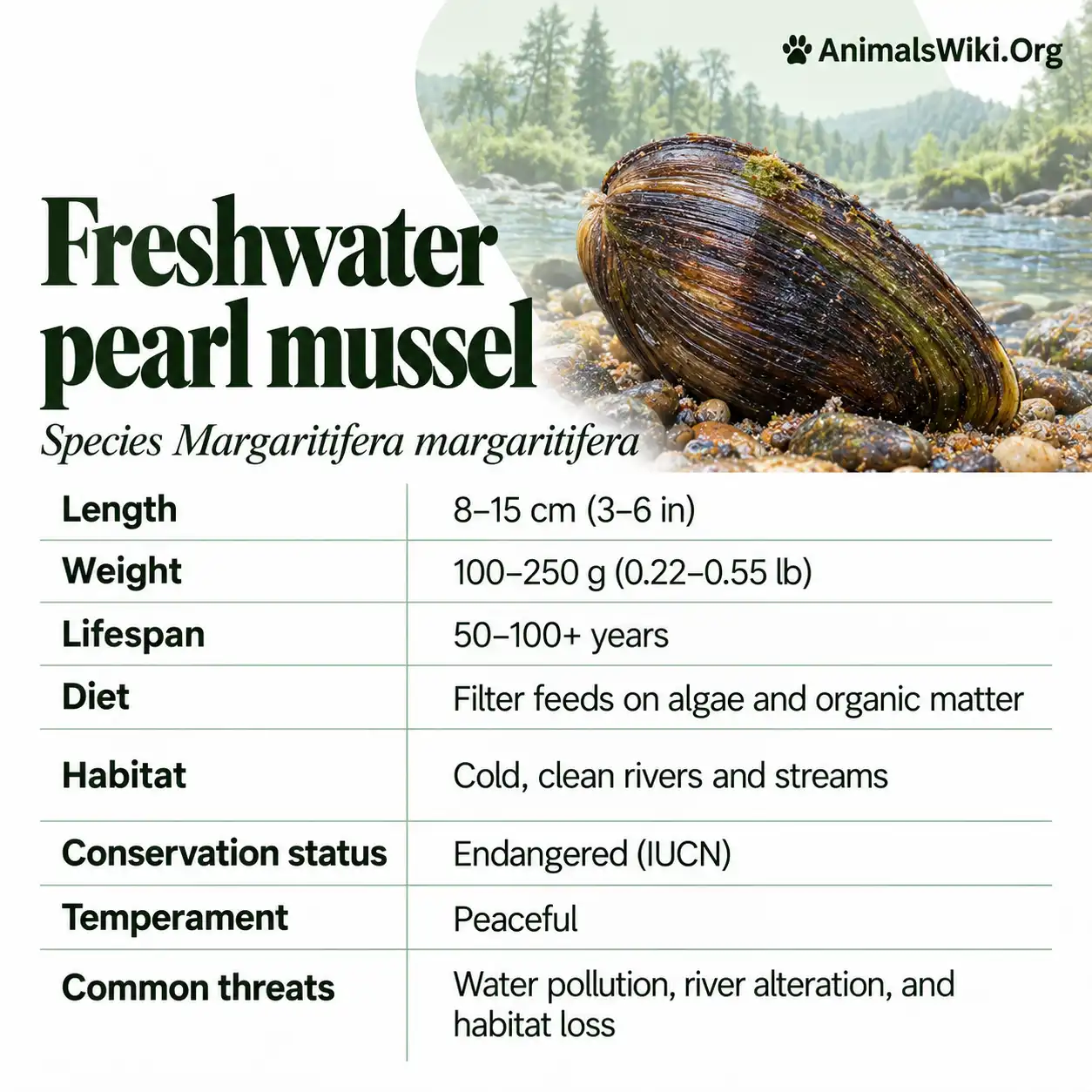
Freshwater Pearl Mussel Facts
| Feature | Information |
|---|---|
| Common name | Freshwater pearl mussel |
| Other common name | Eastern pearlshell |
| Scientific name | Margaritifera margaritifera |
| Phylum | Mollusca |
| Class | Bivalvia |
| Order | Unionida |
| Family | Margaritiferidae |
| Main habitat | Cool, flowing freshwater systems with suitable riverbed conditions |
| Distribution | Parts of Europe and eastern North America |
| Adult appearance | Elongated, dark shell enclosing a soft body |
| Size | Large adults can reach approximately 14–15 centimeters |
| Diet | Fine organic particles and microscopic food |
| Breathing | Gills |
| Movement | Slow movement and burrowing using a muscular foot |
| Larval stage | Glochidium; plural, glochidia |
| Principal European hosts | Atlantic salmon and brown trout |
| Maturity | Usually reached after several years; timing varies among populations |
| Lifespan | Often many decades; some populations include individuals over 100 years old |
| Main conservation concern | Adult losses combined with widespread failure of juvenile recruitment |
1. What Is a Freshwater Pearl Mussel?
The freshwater pearl mussel, Margaritifera margaritifera, is a long-lived bivalve mollusk adapted primarily to flowing fresh water.
Its body is enclosed between two shell halves, called valves. These protect the soft tissues while allowing the animal to open sufficiently for water exchange and movement.
Adults usually live partly buried in the riverbed. Their posterior openings remain positioned to receive and release water.
The animal’s slow movement and dark shell make it easy to overlook among stones.
However, it is an active participant in the river. It collects food, obtains oxygen, grows, reproduces, and responds to environmental conditions.
Its early life creates an additional relationship with salmonid fish. The microscopic larvae require a suitable host before becoming independent juveniles.
The combination of a brief, host-associated beginning and a potentially century-long adult life makes this species especially interesting.
Its survival depends on events occurring at very different scales—from microscopic conditions between sediment particles to the movement of fish through entire river systems.
2. Classification and Scientific Identity
The freshwater pearl mussel belongs to Mollusca, the animal phylum containing snails, slugs, octopuses, squid, and bivalves.
Within Bivalvia, it belongs to Margaritiferidae.
| Classification level | Group |
|---|---|
| Kingdom | Animalia |
| Phylum | Mollusca |
| Class | Bivalvia |
| Order | Unionida |
| Family | Margaritiferidae |
| Genus | Margaritifera |
| Species | Margaritifera margaritifera |
The scientific name is important because “pearl mussel” can be used loosely.
Several other freshwater bivalves are associated with natural pearls or pearl cultivation. Their distribution, growth, host requirements, and conservation status may differ.
The eastern pearlshell name used in North America refers to the same species discussed here.
Scientific identification also prevents confusion with the western pearlshell, Margaritifera falcata, a different species found in western North America.
Related names reflect shared ancestry, but they do not make the animals interchangeable.
For accurate educational writing, the full scientific name should appear near the beginning of an article.
3. What Does the Freshwater Pearl Mussel Look Like?
Adult freshwater pearl mussels usually have elongated shells ranging from dark brown to almost black.
The shell can appear somewhat kidney-shaped, with a curved outline and an older region near the hinge called the umbo.
Older shell surfaces may be worn or eroded.
Their appearance changes through growth, so a young animal does not necessarily resemble a large adult in every detail.
The outside often blends with surrounding stones and sediment. This camouflage-like appearance contributes to the difficulty of spotting them from above the water.
Size and color alone are insufficient for reliable identification.
Other mussels may have similarly dark, elongated shells.
Specialists examine the overall shape, hinge region, shell thickness, internal structures, and geographical context.
A photograph can be useful, especially when it shows several angles and a scale, but uncertainty should remain clear when diagnostic details are missing.
The shell is the most visible part of the animal, yet its ecological requirements extend far beyond that exterior.
4. Shell Structure and the Animal Inside
A pearl mussel’s shell protects a soft body containing specialized tissues and organs.
The mantle produces shell material. The gills support respiration and feeding. A muscular foot helps the animal anchor, burrow, and move.
Adductor muscles bring the valves together.
The shell includes an outer organic covering and underlying mineralized layers. Its inner surface includes lustrous material commonly called mother-of-pearl or nacre.
| Structure | Main function |
|---|---|
| Shell valves | Protection |
| Mantle | Shell production and enclosure of the body cavity |
| Gills | Gas exchange, food collection, and reproductive brooding functions |
| Foot | Anchoring, movement, and burrowing |
| Adductor muscles | Valve closure |
| Incurrent opening | Water entry |
| Excurrent opening | Water exit |
| Digestive system | Processing ingested material |
The same water flow brings oxygen, food particles, and exposure to surrounding substances.
This makes the animal closely connected to water quality.
Closing the valves provides temporary protection, but extended closure also limits normal feeding and exchange.
5. Where Does the Species Live?
Margaritifera margaritifera occurs in parts of Europe and eastern North America.
Its distribution is associated with suitable freshwater systems rather than every river within that broad geographical area.
Many populations have disappeared, and surviving populations can be fragmented.
In Europe, remaining important populations occur in several northern and western regions. Conditions and population histories differ across the range.
Geography alone cannot establish whether a particular river supports a viable population.
Suitable substrate, water conditions, hosts, and recruitment must all be present.
Some rivers contain substantial adult aggregations. Others retain scattered survivors from formerly larger populations.
This difference is essential when interpreting distribution maps.
A dot showing presence may represent either a functioning population with young mussels or an aging remnant with little prospect of replacement.
Distribution data therefore become more useful when accompanied by population structure and evidence of recent reproduction. NatureScot
6. The River Habitat It Needs
Freshwater pearl mussels are associated primarily with cool, well-oxygenated flowing waters.
Suitable reaches often contain combinations of sand, gravel, pebbles, and larger stones.
The substrate must provide stable positions while allowing water to move through the spaces used by young mussels.
The species is commonly associated with relatively nutrient-poor waters.
This does not mean a river should contain no food. It means excessive enrichment can alter the conditions needed for successful survival and development.
Flow also has several roles.
It delivers resources, maintains exchange, moves sediment, and supports the host-fish community.
A fast current alone does not make a site suitable. Severe instability or repeated scouring can create different problems.
The useful description is therefore a functioning combination of water quality, flow, substrate stability, and host availability.
No single feature can substitute for the others.
The adult mussel occupies a small patch, but that patch depends on processes operating throughout the catchment. Special Areas of Conservation
7. Why Sediment Conditions Are So Important
The riverbed contains water-filled spaces between its particles.
This interstitial environment is particularly important to young freshwater pearl mussels.
A juvenile buried beneath the surface experiences the chemistry and oxygen conditions in those spaces, which may differ from the water flowing overhead.
Fine sediment can reduce permeability and restrict exchange.
If oxygen becomes inadequate, suitable-looking gravel at the surface can conceal poor conditions below.
This helps explain why a river can appear clear while juvenile survival remains low.
Researchers assess more than the visual cleanliness of the bed.
Measurements can include sediment texture, penetration resistance, oxygen-related conditions, and chemistry at different depths.
Such work connects the survival of a tiny juvenile with the movement of water through the riverbed.
The essential habitat is therefore three-dimensional.
Protecting only the exposed surface misses the environment where some of the most vulnerable years of the life cycle occur. Wiley Online Library
8. What Does a Freshwater Pearl Mussel Eat?
The species obtains food from fine organic material and microscopic organisms.
Adults collect suspended resources while water passes through the body.
Food can include material originating within the river and material derived from surrounding land.
Research using stable isotopes has shown that terrestrial and bottom-associated organic resources can contribute substantially to the diet.
This broadens the familiar picture of a mussel surviving only on free-floating algae.
The surrounding catchment therefore influences food as well as water chemistry.
Vegetation, wetlands, soils, and drainage routes help determine what material reaches the stream.
However, more suspended organic material does not automatically improve feeding.
Food quality, particle properties, oxygen conditions, and the animal’s physiological state all matter.
A river carrying excessive fine material can create harmful conditions even when some particles contain organic matter.
The species depends on an appropriate resource supply within a suitable physical environment, rather than simply the greatest possible concentration of particles. Helmholtz-Centre for Environmental Research
9. How Feeding and Breathing Work Together
Water enters the mantle cavity through the incurrent opening and passes across the gills.
Cilia help maintain movement and transport collected material.
The gills obtain oxygen and participate in directing potential food toward the mouth.
Material is sorted, ingested, rejected, or passed onward as waste according to different processes.
This is a living feeding system with variable activity.
An individual does not necessarily maintain one constant pumping rate throughout every day.
Temperature, food, disturbance, and physiological condition influence performance.
Researchers distinguish the volume of water processed from the rate at which particular particles are removed.
The difference matters when interpreting statements about how much water a mussel “cleans.”
A measurement applies to the animal, particle type, and conditions studied.
It should not become a universal number for every pearl mussel in every river.
The biological importance remains clear: the animal continuously links resources and oxygen in flowing water with tissues and processes in the riverbed.
10. Its Role in River Filtration and Nutrient Cycling
A large pearl mussel population can influence the movement of suspended resources.
Feeding transfers some material into tissues and moves some toward the bottom through deposition.
Released nutrients can become available to other organisms.
The scale of the effect depends on abundance, body size, activity, flow, and food conditions.
A recent study in a German catchment combined measured clearance rates with historical population information to estimate how the collapse of pearl mussel numbers reduced natural filtration capacity.
The study illustrates an important principle: losing a population can remove an ecological function, even when the individual animals were rarely noticed.
However, filtration should not be described as complete pollution treatment.
Collected material is not necessarily destroyed, and a mussel cannot compensate for unlimited contamination.
Its role is best understood within a functioning ecosystem.
Conserving the population preserves a biological process alongside the animals themselves. Springer Nature Link
11. Can Freshwater Pearl Mussels Move?
Freshwater pearl mussels can reposition themselves using a muscular foot.
The foot extends, anchors, and helps draw the body through or into the substrate.
Movement can be horizontal or involve changes in burial depth.
However, adults are comparatively sedentary.
Their ability to respond does not allow them to relocate quickly across long stretches of unsuitable river.
A drying reach, sudden contamination event, or severe channel disturbance can develop faster than an adult can escape.
Studies of managed water-level changes have examined these behavioral responses and their limitations.
This matters because a shell provides protection without removing dependence on suitable surroundings.
The larval host phase offers a much greater opportunity for dispersal.
Thus, different stages solve different movement problems: the fish-associated larva can travel with its host, while the adult establishes a long-term relationship with a relatively small area of riverbed. eprints.gla.ac.uk
12. The Freshwater Pearl Mussel Life Cycle
The life cycle connects adults, water movement, fish, and sediment.
| Stage | Main event |
|---|---|
| Adult reproduction | Sperm reaches a female through the water |
| Brooding | Embryos develop in specialized gill regions |
| Larval release | Microscopic glochidia enter the river |
| Host encounter | Compatible salmonid fish take in larvae |
| Gill-associated development | Larvae remain on the host while transforming |
| Juvenile release | Young mussels leave the fish |
| Buried juvenile phase | Development continues within suitable substrate |
| Later growth | Mussels become larger and eventually reproductive |
Success at one stage does not guarantee completion of the cycle.
A female can release many viable larvae, yet few may encounter a suitable host.
Those that develop successfully on a fish must still arrive in suitable sediment.
The life cycle therefore contains several potential bottlenecks.
Conservation requires identifying which bottleneck limits a particular population rather than assuming all declining rivers have the same problem.
13. Fertilization and Brooding
The species usually has separate male and female individuals, although reproductive variation has been documented.
In the familiar pattern, males release sperm into the water.
Females take in sperm while processing water, and fertilization occurs internally.
Developing embryos are brooded in the gills before being released as larvae.
The reproductive cycle is influenced by local conditions.
Research in Scottish populations found differences in spawning and larval-release timing associated with water temperature and river conditions.
Warmer and colder rivers did not follow identical schedules.
This means a month listed in one regional guide should not be applied automatically across the species’ entire range.
Larval release can also occur in concentrated events.
That timing affects the opportunity to encounter hosts.
Reproduction therefore involves more than adult maturity: it requires coordination between physiological development, the river environment, and the presence of suitable young fish. onlinelibrary.wiley.com
14. What Are Glochidia?
A glochidium is the microscopic larva of the mussel. The plural is glochidia.
After release, these larvae have a limited opportunity to encounter a compatible host.
For freshwater pearl mussels, development occurs in association with the gills of suitable salmonid fish.
The larvae become enclosed in host tissue while undergoing transformation.
They are not miniature filter-feeding adults at this stage.
Their structures and requirements reflect a temporary host-associated life.
The relationship is described as parasitic because the larva benefits through its association with the host.
Under natural conditions, compatible relationships commonly have limited effects on the fish, but the outcome depends on burden and circumstances.
The species’ enormous larval output reflects the many losses expected during early life.
Only a fraction complete host development and enter suitable sediment.
A large reproductive investment therefore does not mean the river will receive an equally large number of surviving juveniles.
15. Why Salmon and Trout Matter
Atlantic salmon and brown trout are principal hosts for European populations of Margaritifera margaritifera.
Their role extends beyond carrying the larvae.
Successful development depends on biological compatibility between host and mussel.
A river can contain many fish while still providing poor opportunities if the appropriate host is scarce or unsuitable.
The fish also provides movement.
A larva attached to a host can travel through connected habitat, including against the direction of river flow.
This helps distribute future juveniles beyond the limited movement of adults.
However, each population does not necessarily use salmon and trout equally well.
Research has found differences in host suitability among pearl mussel populations.
These differences make local ecological knowledge important.
Restoring a generic fish community is not automatically equivalent to restoring the specific relationship needed by a particular mussel population.
The conservation unit includes the interaction, not just two species listed separately. onlinelibrary.wiley.com
16. Local Host Adaptation
Some freshwater pearl mussel populations are more closely associated with salmon, while others depend mainly on trout.
Research also indicates that local fish strains can differ in their suitability.
This suggests a history of adaptation within particular river systems.
The finding has practical implications for conservation breeding and fish management.
Using fish simply because they belong to the correct broad species may overlook local compatibility.
It also helps explain genetic differences among mussel populations.
A host with extensive movements can connect populations differently from one whose movements are more restricted.
Host ecology therefore influences the genetic history of the mussel.
These connections demonstrate why moving adults between rivers is not a simple substitute for restoring their original habitat.
A population carries an evolutionary relationship with its environment and hosts.
Preserving that relationship can be as important as preserving the visible animals. onlinelibrary.wiley.com
17. Life on the Host’s Gills
The host-associated phase can extend through much of a year in familiar northern European patterns.
Its exact duration varies with temperature and population.
During that period, the larva transforms toward an independent juvenile.
Research has shown that time spent on the host can influence the size and subsequent performance of young mussels.
A shorter host phase is therefore not automatically an improvement.
Developmental timing affects the condition in which the juvenile enters the riverbed.
The host also continues its own life, moving, feeding, and responding to environmental conditions.
Changes affecting that fish can consequently affect attached mussels.
This is one reason climate effects cannot be understood only by measuring adult mussel tolerance.
Temperature may alter the timing and outcome of the host-associated stage, creating consequences that appear later during juvenile survival.
The relationship links two organisms and several seasons within one developmental process. Wiley Online Library
18. The First Years Beneath the Riverbed
After leaving the host, the young mussel settles into the substrate.
This is a critical transition from host-associated development to independent life.
The juvenile is small and may remain deeply concealed.
It needs appropriate food, oxygen, and physical conditions while its organs continue developing.
Its feeding method changes through growth.
Research on gill development has documented a transition from feeding associated with the foot toward increasingly effective gill-based filtration.
That transition depends on body development rather than a universal birthday.
A juvenile cannot be treated simply as a scaled-down adult.
It occupies a different microhabitat and has different feeding capabilities.
These first years help explain why adult survival and successful recruitment can become disconnected.
The surface population may remain visible while hidden juveniles repeatedly fail to pass through their most vulnerable stages.
Understanding those stages is essential to diagnosing decline. Oxford Academic
19. Recruitment: The Key to Population Health
Recruitment describes the addition of surviving young to a defined later stage of the population.
For pearl mussels, successful recruitment means more than finding larvae or proving that eggs were fertilized.
The young must survive host development, settle, grow, and continue toward maturity.
A population containing many adults but very few young may be living on past success.
Because adults can persist for decades, this imbalance can remain visually hidden.
A healthy-looking bed can therefore be functionally declining.
Researchers examine size and age structure alongside abundance.
They also investigate why young stages are missing.
Possible explanations include unsuitable sediment, host limitations, altered developmental timing, or combinations of pressures.
The conservation priority depends on the cause.
Producing additional larvae will not solve a problem caused primarily by poor riverbed survival.
Recruitment is consequently one of the most informative links between an individual’s life cycle and the future of the population.
20. When Do Freshwater Pearl Mussels Become Adults?
Sexual maturity takes several years and varies among populations.
Scientific accounts report different ages depending on region, growth conditions, and the methods used.
This delayed maturity is part of a slow life history.
A juvenile must survive a substantial period before contributing offspring.
Growth and maturity should also be distinguished.
Two mussels of similar size may have different ages, and reproductive condition cannot always be inferred from shell length alone.
The slow schedule creates challenges for recovery.
A restoration project may improve juvenile survival without producing a large reproductive population for many years.
Short monitoring periods can therefore miss important progress.
At the same time, the survival of existing adults provides an opportunity.
If habitat and recruitment problems are corrected while reproductive animals remain, the population retains biological capacity for recovery.
Longevity creates both a delay in visible decline and a window in which action can still matter.
21. How Long Can the Species Live?
The freshwater pearl mussel is among the longest-lived freshwater animals.
Individuals in some populations exceed 100 years, and substantially older ages have been reported in northern regions.
Longevity varies geographically.
Research comparing populations has found much shorter maximum ages in some southern rivers than in colder northern settings.
A century-long lifespan should therefore be understood as a capability of certain populations rather than a guarantee for every individual.
The relationship among growth, temperature, and age is complex.
Slow growth can accompany long life, but environmental damage can still shorten survival.
The species’ longevity also makes individual losses consequential.
Removing an old reproductive mussel can eliminate decades of potential future reproduction, depending on its condition.
Its age reflects successful survival through many events, while the time required to replace it can be considerable.
A shell on the riverbed may therefore represent a biological history extending far beyond what a casual observer expects. PubMed
22. Can Shell Rings Reveal Exact Age?
Shell growth produces increments that can contain information about the animal’s history.
However, counting external rings is not a universally reliable way to establish exact age.
The surface can erode, growth can slow, and closely spaced increments become difficult to interpret.
Disturbance can also complicate visible patterns.
Researchers use validated approaches, sometimes involving internal shell structures and retrospective growth analysis.
The need for reliable aging must be balanced against conservation.
Destructive sampling of rare living individuals can itself create a cost.
Recent research has therefore investigated methods using limited material to reconstruct growth.
Age information is valuable because it helps reveal whether a population contains a range of generations.
It also supports understanding of growth conditions and recovery times.
The shell is a potential archive, but reading that archive requires careful interpretation rather than a simple visual count.
23. Do Freshwater Pearl Mussels Contain Pearls?
A freshwater pearl mussel may occasionally form a pearl.
Its common name does not mean every individual contains one.
Natural pearls vary in shape, size, and appearance, and many mussels never produce a pearl of commercial interest.
Pearl formation involves shell-related material deposited within tissues.
The familiar story of every pearl beginning around a grain of sand oversimplifies a more varied biological process.
For this species, the most important conservation fact is the damage caused by searching.
Opening or killing many mussels to find a rare pearl removes long-lived animals from already vulnerable populations.
Historical pearl fishing contributed substantially to declines in parts of the range.
The living animal’s ecological and reproductive value is therefore far greater than the possibility of finding a decorative object inside.
Responsible interest focuses on its biology and habitat rather than treating wild populations as potential treasure.
24. Historical Harvesting and Present Protection
Freshwater pearl mussels have a long relationship with people.
Their occasional pearls created demand, and repeated harvesting reduced populations over many generations.
The damage can be disproportionate to the number of pearls obtained because numerous animals may be disturbed or killed during searching.
The species is now protected in many parts of its range.
In Scotland, official guidance states that activities including taking, injuring, disturbing, or killing wild freshwater pearl mussels can constitute offenses, with licensing applying to particular authorized activities.
Rules vary by jurisdiction, so local official guidance is the relevant reference.
Protection also involves safeguarding habitat rather than only preventing direct collection.
A population can decline even where nobody removes adults if water quality, sediment, or hosts become unsuitable.
The historical lesson is that a slow-growing animal can be depleted much faster than it replaces itself.
Legal protection helps address direct harm, while ecological recovery requires additional work. NatureScot
25. Why Clear Water Can Still Be Unsuitable
A river’s appearance reveals only part of its condition.
Clear surface water may flow over sediment where oxygen exchange is poor.
It may also contain dissolved substances invisible to the eye.
Juveniles beneath the bed experience those conditions directly.
This explains why visual impressions can conflict with biological observations.
A reach that looks attractive to visitors may lack recent mussel recruitment.
Conversely, a short natural increase in turbidity does not automatically explain a long-term decline.
Researchers need measurements across seasons and relevant depths.
Water chemistry, sediment permeability, oxygen conditions, host abundance, and flow history provide a fuller picture.
The species is often described as an indicator of river health, but interpreting that indicator requires care.
An old adult’s presence can reflect suitable conditions decades earlier.
Evidence of surviving young offers stronger information about whether the river currently supports the complete life cycle.
The distinction turns a simple sighting into a more useful ecological question.
26. Pollution, Nutrients, and Fine Sediment
Freshwater pearl mussels are affected by changes in water quality and riverbed condition.
Excess nutrient inputs can alter biological production and oxygen demand.
Fine sediment can reduce water exchange within the substrate.
Chemical contamination adds further pressures, while the effects of mixtures depend on concentration, timing, and life stage.
Sources can occur well upstream of the mussel bed.
Road drainage, disturbed soils, wastewater, and land-management practices influence what enters a river.
This makes catchment management central to conservation.
Protecting a narrow strip around visible adults may fail to address the processes causing damage.
Official conservation guidance emphasizes reducing sediment and nutrient delivery and maintaining suitable river conditions.
The goal is to support a functioning system rather than make one small patch look clean.
For a long-lived mussel with a vulnerable buried juvenile stage, repeated low-level changes can matter even when no dramatic pollution event occurs. GOV.UK
27. Dams, Channel Changes, and Host Declines
River engineering can affect pearl mussels through several pathways.
Changes in flow alter sediment movement and the stability of occupied habitat.
Water abstraction can reduce depth or wetted area.
Barriers can affect fish movement and disconnect parts of the system.
Host availability may also decline because of changes elsewhere in the fish’s life cycle.
The mussel’s future therefore depends partly on conditions beyond its immediate location.
A channel project can have consequences through altered sediment supply, temperature, or access rather than direct contact with adults.
This is why conservation planning considers connected reaches and the surrounding catchment.
The relevant objective is to maintain conditions supporting the whole life cycle.
Protecting adult habitat while overlooking hosts can leave reproduction incomplete.
Similarly, improving fish passage without addressing unsuitable sediment may fail to restore juvenile survival.
Several components often need attention together.
28. Climate Change, Drought, and Heat
Climate change can affect pearl mussels through temperature, river flow, drought frequency, and related changes in habitat.
Low water can expose adults or reduce the quality of remaining refuges.
Warmer conditions influence metabolism, oxygen availability, and developmental timing.
However, responses should not be reduced to a single temperature threshold applied everywhere.
Experiments have shown that juveniles can survive some brief heat exposures when other conditions remain favorable.
That finding highlights the importance of combined pressures.
Heat accompanied by low oxygen, drying, or poor food may produce a different outcome.
Regional modeling has also examined how reduced flow and habitat fragmentation could affect southern populations and their hosts.
Such studies are projections under specified scenarios, rather than guarantees of identical change in every river.
The practical conservation implication is to preserve resilience: suitable flow, shaded habitats, healthy catchments, and connected host populations provide more options as conditions change. PubMed
29. Genetics and Conservation Breeding
Freshwater pearl mussel populations can differ genetically and in their host relationships.
Those differences matter when designing conservation programs.
Mixing animals from different rivers is not automatically beneficial.
A program must consider population history, compatibility, disease risks, and the suitability of receiving habitat.
Captive breeding can help young mussels survive stages that are failing in the wild.
Specialists maintain adults, obtain larvae, use appropriate hosts, and collect juveniles after transformation.
The juveniles then require carefully managed conditions while they grow.
This process supports population reinforcement, but it does not remove the need for habitat recovery.
A hatchery can produce young mussels without making the riverbed suitable for them.
The strongest approach connects propagation with evidence about what limits natural recruitment.
Conservation breeding is a bridge toward self-sustaining populations, rather than a permanent substitute for a functioning river ecosystem.
30. Restoration Projects and Long-Term Recovery
Recovery programs combine breeding, habitat assessment, catchment improvements, and monitoring.
The Environment Agency’s work at Kielder illustrates the effort required to rear young pearl mussels through vulnerable stages.
Other programs evaluate where, when, and at what size juveniles should return to their original rivers.
The Freshwater Biological Association has used tagged juveniles to investigate reinforcement outcomes.
These questions matter because release alone is not the final measure of success.
Researchers need to establish whether the mussels survive, grow, mature, and eventually contribute to new generations.
Habitat work may include reducing diffuse pollution, improving riverside vegetation, and restoring more natural channel processes.
The Pearls in Peril project demonstrated how several measures can be coordinated across river systems.
For a long-lived species, results develop over extended periods.
An effective recovery plan therefore requires continuity, repeated assessment, and realistic expectations about how quickly a restored age structure can appear. Environment Agency: For homes and habitats.
31. How Scientists Find and Monitor Them
Pearl mussel monitoring combines several approaches.
Surveys locate visible individuals and describe their habitat. Measurements and tagging can help track growth and survival.
Juvenile assessments address recruitment, while fish studies investigate host availability and compatibility.
Environmental DNA, or eDNA, provides another tool.
Organisms release genetic material into their surroundings, and suitable assays can detect species-associated DNA in water samples.
However, detection requires interpretation.
River transport can carry material downstream, and concentrations can vary with season and reproductive activity.
A positive sample does not directly reveal the number or exact position of living adults.
Research has demonstrated both the promise and limitations of this method.
Its greatest value comes from combination with other evidence.
Monitoring becomes stronger when molecular detection, direct surveys, habitat measurements, and knowledge of the life cycle are used together rather than treating one technique as a complete replacement for all others. Wiley Online Library
32. Responsible Observation and Public Support
Freshwater pearl mussels are best appreciated in ways that preserve their habitat and position.
A visible shell is part of a living system, and removing or opening it can cause harm.
Sensitive population locations are sometimes withheld to reduce illegal collection.
Public support can instead focus on river protection, responsible access, reporting suspected pollution, and participating in established conservation activities.
Healthy riparian vegetation and reduced sediment inputs benefit more than the mussel alone.
They also support hosts and other members of the river community.
Education is particularly valuable because the species is easy to overlook.
A person who understands the fish-host stage and the hidden juvenile years sees more than a dark shell.
They recognize a century-spanning life cycle connected to the condition of an entire catchment.
That understanding helps explain why protecting a small, quiet animal can require broad and sustained environmental work.
33. Common Freshwater Pearl Mussel Myths
| Myth | More accurate explanation |
|---|---|
| Every individual contains a pearl. | Pearls occur only occasionally. |
| The species is the same as every pearl-producing freshwater mussel. | Margaritifera margaritifera is one particular species. |
| Adults cannot move at all. | They can reposition slowly using a foot. |
| Any fish can host their larvae. | Compatibility can be highly specific. |
| Salmon and trout are equally suitable in every river. | Host preference and local adaptation vary among populations. |
| Many larvae guarantee many young mussels. | Several later stages can limit survival. |
| A bed of old adults proves the population is healthy. | Recruitment may have failed for decades. |
| Clear water guarantees suitable habitat. | Conditions within the substrate may still be poor. |
| Shell size gives exact age. | Growth varies, and reliable aging needs validated methods. |
| Captive breeding solves habitat degradation. | Recovery requires suitable rivers as well as juveniles. |
These distinctions reveal the main conservation challenge: keeping adults alive is essential, but securing the next generation is what gives the population a future.
34. Frequently Asked Questions About Freshwater Pearl Mussels
1. What is the scientific name of the freshwater pearl mussel?
The species discussed here is Margaritifera margaritifera. It is also known as the eastern pearlshell in North America. Other mussels can produce pearls, so the scientific name helps distinguish this species from different freshwater bivalves with similar common names.
2. Is it a fish or a shellfish?
It is a bivalve mollusk, commonly included among shellfish. It lacks a backbone and lives inside two shell valves. Its temporary association with fish occurs during larval development and does not make the mussel a fish.
3. Where does it live?
It occurs in suitable freshwater systems in parts of Europe and eastern North America. Adults are associated mainly with flowing waters and appropriate riverbed conditions. Presence varies among catchments, and some surviving populations consist mostly of older animals.
4. How large can it grow?
Large adults can reach approximately 14–15 centimeters, although size varies with age, population, and conditions. A large shell does not establish exact age. Growth rates differ, so shell length must be interpreted alongside other information.
5. What does it eat?
It consumes fine organic particles and microscopic food. Resources can originate within the river or arrive from surrounding land. Research shows that terrestrial and bottom-associated organic material can contribute substantially, making the catchment important to its food supply.
6. How does it breathe?
Water passes across the gills, allowing oxygen uptake. The same flow supports food collection. Conditions affecting water quality and oxygen therefore influence several functions at once, particularly for juveniles living within the riverbed.
7. Can it move?
Yes, slowly. Its muscular foot allows repositioning and burrowing. However, its movement cannot reliably protect it from rapid drying, contamination, or major habitat disturbance. Long-distance dispersal is mainly associated with the larval host stage.
8. Why does it need salmon or trout?
Its larvae require a compatible host to complete development. Salmon or trout also carry them through connected habitats. A river containing fish is not automatically sufficient because the species and local compatibility of the host matter.
9. What are glochidia?
Glochidia are the microscopic larvae released by the female. After reaching a suitable host, they develop in association with the gills before leaving as juveniles. Many are lost before completing this sequence, making early development a major conservation concern.
10. How long do larvae remain on a fish?
The duration varies with population and environmental conditions. In familiar northern European patterns it can extend through much of a year. Temperature influences development and detachment, and the timing can affect the condition of the juvenile entering the riverbed.
11. Does the mussel eat the fish carrying its larvae?
The adult does not consume the fish. The larval phase is a temporary parasitic association. After metamorphosis, juveniles leave the host and develop their independent feeding biology within suitable substrate.
12. Why are young mussels so difficult to find?
They are small and live concealed within sediment. Their habitat may require specialized survey methods. The presence of visible adults therefore provides an incomplete picture of recruitment, especially when young stages are surviving poorly.
13. What does recruitment mean?
Recruitment means surviving young are being added to a later stage of the population. Finding eggs or larvae proves only part of the cycle is functioning. Successful recruitment requires survival through host development, settlement, and subsequent juvenile growth.
14. How old can the species become?
Individuals in some populations exceed 100 years, with older ages reported in northern regions. Other populations are shorter-lived. Longevity depends on growth conditions and geography, so one maximum age should not be applied to every individual.
15. Can you tell its age by counting shell rings?
Visible lines can contain growth information, but exact aging is more complicated. Erosion, slow growth, and disturbance marks can affect interpretation. Researchers use validated methods rather than assuming every external ring represents one year.
16. Does every freshwater pearl mussel have a pearl?
No. Pearls occur occasionally, and their appearance and value vary. The species’ name reflects its historical association with pearls, not a promise that each individual contains one. Searching wild animals can destroy valuable reproductive adults.
17. Why is pearl fishing damaging?
Collectors may disturb or kill many mussels to obtain a small number of pearls. Because the animals grow slowly and can reproduce over long lives, those losses can have lasting effects. Historical exploitation contributed substantially to declines in some regions.
18. Why can clear rivers still lose pearl mussels?
The water between sediment particles can have poor oxygen or chemical conditions even when the surface looks clear. Host limitations and other pressures may also interrupt the life cycle. Visual appearance alone cannot diagnose whether juveniles can survive.
19. Can captive breeding save the species?
It can support recovery by helping young survive vulnerable stages. However, animals returned to the wild still need suitable habitat and hosts. Breeding works best alongside catchment restoration and long-term monitoring of survival and reproduction.
20. Is it suitable for an ordinary home aquarium?
Its specialized habitat, host-dependent development, long lifespan, and conservation needs make it unsuitable as a routine aquarium animal. Wild collection may also be prohibited. Conservation programs use controlled facilities and specialist expertise to maintain the required conditions.
21. Is it the same as a zebra mussel?
No. Zebra mussels belong to a different bivalve group and have a free-swimming larval stage rather than this salmonid-dependent cycle. Their adult attachment and ecological behavior also differ. The shared word “mussel” does not make their biology identical.
22. Why should people care about this species?
It contributes to river processes and represents a long biological history tied to fish, sediment, and water quality. Its decline exposes failures that may remain hidden beneath the riverbed. Conserving it supports the recovery of functioning freshwater ecosystems rather than one isolated shellfish.