Freshwater Mussel, The Remarkable Shellfish Supporting Rivers and Lakes
A freshwater mussel can spend decades partly buried beneath a riverbed. Its shell may resemble a stone, and its movements are slow enough to escape casual observation. Yet the animal inside is continuously interacting with the water, collecting food, obtaining oxygen, and participating in the life of the river.
Its early life is far more mobile. Many native freshwater mussels begin with microscopic larvae that must temporarily attach to a suitable fish. After completing development, the young mussels leave the host and settle into the bottom.
Some females attract those hosts with remarkable lures resembling small fish, insects, or other prey. Others release packages of larvae that encourage a fish to investigate.
These unusual relationships make freshwater mussels more than filter-feeding animals in shells. Their survival connects water quality, fish communities, sediment conditions, river flow, and the surrounding landscape.
They also have important effects on their environment. Mussel beds process suspended material, recycle nutrients, provide food for predators, and create structure used by smaller organisms.
However, many native species are declining. Their long lives and limited adult mobility can conceal problems until populations have already lost the ability to replace themselves.
This guide explains what freshwater mussels are, how their bodies work, why many depend on fish, and how their survival reflects the condition of freshwater ecosystems.
Information checked: October 18, 2026.
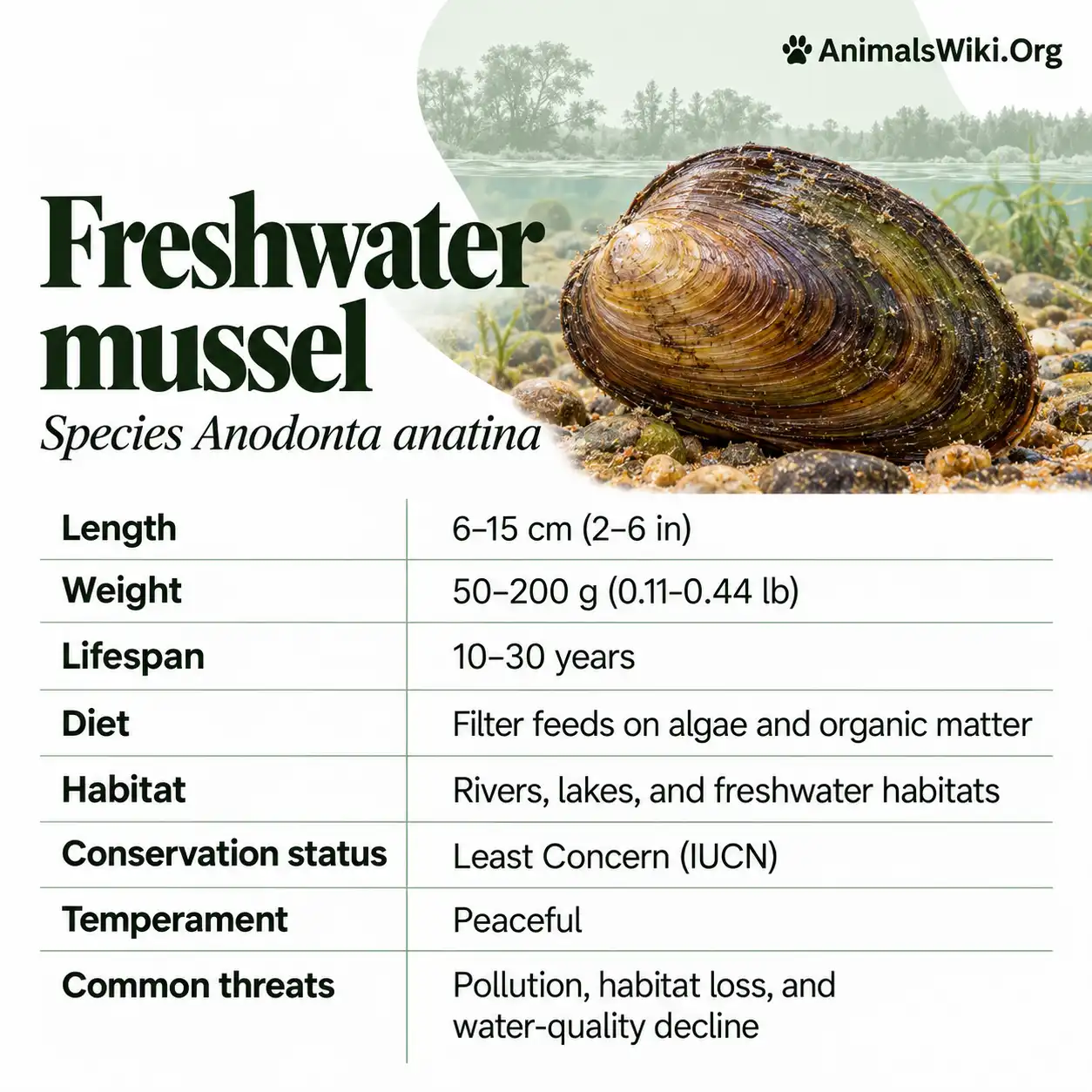
Freshwater Mussel Facts
| Feature | Information |
|---|---|
| Common name | Freshwater mussel |
| Animal group | Bivalve mollusks |
| Phylum | Mollusca |
| Class | Bivalvia |
| Main group discussed here | Native river and lake mussels, primarily Unionida |
| Body protection | Two shell valves |
| Main adult habitat | Sediment in rivers, streams, lakes, and other suitable fresh waters |
| Diet | Microscopic organisms and organic particles |
| Feeding method | Suspension feeding in adults; young stages can use additional methods |
| Breathing | Gills |
| Movement | Slow burrowing or crawling using a muscular foot |
| Reproduction | Often separate males and females, with variation among species |
| Familiar larval stage | Glochidium; plural, glochidia |
| Host relationship | Many species require a suitable fish during larval development |
| Lifespan | Highly variable; some species live beyond 100 years |
| Ecological roles | Particle processing, nutrient cycling, habitat provision, and food-web support |
| Major threats | Habitat alteration, pollution, disrupted flow, host loss, and invasive species |
1. What Is a Freshwater Mussel?
A freshwater mussel is a bivalve mollusk adapted to living in fresh water. Its soft body is enclosed between two shell halves called valves.
The word “mussel” is a common name rather than a guarantee that every animal bearing it belongs to the same family.
Native river mussels, freshwater pearl mussels, zebra mussels, and marine mussels differ in their evolutionary relationships and life histories.
Many conservation discussions focus on Unionida, the group containing numerous native freshwater mussels with host-dependent larvae.
Adults often live partly buried in sediment, with their water openings exposed.
Their appearance can make them seem inactive, but feeding, respiration, reproduction, and growth continue inside the shell.
A mussel is also a complete animal rather than a protective shell occupied by something unrelated.
Its tissues produce and maintain the shell throughout life.
Understanding this relationship is the first step toward recognizing why an apparently ordinary riverbed can contain long-lived, highly specialized animals.
2. Freshwater Mussel Classification
Freshwater mussels belong to Mollusca, the phylum that also includes snails, slugs, octopuses, and squid.
Within that phylum, they are bivalves.
| Classification level | Group |
|---|---|
| Kingdom | Animalia |
| Phylum | Mollusca |
| Class | Bivalvia |
| Main order discussed | Unionida |
| Example family | Unionidae |
| Another important family | Margaritiferidae |
| Example species | Western pearlshell, Margaritifera falcata |
The classification distinguishes them from crustaceans such as crayfish, copepods, and barnacles.
A freshwater mussel does not have jointed walking legs or grow through the same molting process as those animals.
Instead, its mantle produces shell material as the body grows.
Scientific names help connect an observation with a particular species and its requirements.
They are especially important when discussing host fish. Two mussels living in the same river may depend on different hosts.
Taxonomy also changes as scientists compare anatomy and genetic information. Older and newer publications can therefore use different names for the same lineage.
3. Freshwater Mussel Diversity
Freshwater mussels occur in many forms.
Some have thick, rounded shells. Others are elongated, flattened, ridged, or relatively delicate.
Common names such as pocketbook, snuffbox, pigtoe, fanshell, and pearlshell reflect this variety, although a name alone does not provide a reliable identification.
Their diversity is not limited to shape.
Species differ in habitat, lifespan, reproductive timing, host use, and tolerance of environmental conditions.
A mussel adapted to a cool gravel-bed stream may struggle in a slow, muddy reservoir.
Another species may occupy a broader range of conditions.
North America is especially rich in native freshwater mussels, but these animals also inhabit other parts of the world.
Their distribution reflects the history of river systems and the movement of their hosts.
For readers, the most useful principle is that “freshwater mussel” introduces a diverse group.
Detailed claims become more meaningful when tied to a species, river system, or clearly defined biological pattern.
4. What Does a Freshwater Mussel Look Like?
The most visible feature is the pair of shell valves.
They may be brown, black, greenish, yellowish, or patterned with rays and markings.
The surface can be smooth, ridged, folded, or decorated with raised structures.
Near the hinge is an older, often rounded region called the umbo, sometimes referred to as the beak.
Shell shape changes during growth, and older areas may become worn or eroded.
This can make identification difficult.
Two young individuals may resemble each other more closely than two adults of the same species growing under different conditions.
Color also changes with age and surface wear.
Reliable identification therefore considers several features together: overall shape, thickness, sculpture, hinge structures, and the interior.
A photograph showing only the outside may be insufficient.
The challenge is especially important where rare native mussels occur alongside common species or introduced bivalves.
5. Shell Layers and Mother-of-Pearl
A mussel shell is a layered biological structure.
The outer covering is the periostracum, an organic layer that helps protect the mineralized material beneath it.
Underlying layers contain calcium carbonate arranged through biological processes.
Many native freshwater mussels have a lustrous inner layer called nacre, or mother-of-pearl.
Nacre can appear white, pink, purple, or other shades depending on the species and the shell.
Its appearance comes from its microscopic structure and interaction with light.
The shell also records growth and damage.
Scars inside indicate where muscles and other tissues attached, while hinge structures help maintain alignment.
The “teeth” seen along some hinges are structural projections rather than feeding teeth.
They do not bite or chew food.
A shell is therefore both protection and a record of the animal’s development.
Examining it can reveal useful information, but interpreting its features requires more than counting visible lines or judging its shine. AMNH
6. Inside the Shell
The soft body contains several specialized structures.
The mantle lines the shell and participates in shell formation. The gills support gas exchange and food collection. A muscular foot helps the animal burrow and move.
Adductor muscles pull the valves together.
| Structure | Main role |
|---|---|
| Shell valves | Protect the enclosed body |
| Mantle | Produces shell material and surrounds the body cavity |
| Gills | Obtain oxygen and participate in feeding |
| Foot | Burrowing, anchoring, and movement |
| Adductor muscles | Close the valves |
| Incurrent opening | Allows water to enter |
| Excurrent opening | Allows water to leave |
| Digestive system | Processes ingested material |
These structures operate together.
Water moving through the body supplies both oxygen and potential food, while closing the shell reduces exposure during disturbance.
However, the same flow brings the animal into contact with substances in its environment.
Its feeding system therefore connects its wellbeing closely with surrounding water and sediment conditions.
7. How Do Freshwater Mussels Feed?
Adult native mussels generally collect suspended food from water.
Cilia help move water through the mantle cavity and across the gills.
Particles become associated with mucus and are transported toward structures that help sort and direct food.
Suitable material reaches the mouth and digestive system.
The process is often called filter feeding, but the animal is not an inert sieve.
Feeding activity depends on temperature, oxygen, available food, and the mussel’s physiological condition.
Not every particle entering the body becomes food.
Some material is rejected before ingestion, while material that has passed through digestion follows a different waste pathway.
This distinction matters when explaining ecological effects.
Mussels can transfer suspended material toward the bottom without incorporating all of it into their tissues.
Their activities therefore change where resources are located as well as how much remains suspended.
The visible result may be clearer water, but the underlying process involves food collection, sorting, digestion, and deposition.
8. What Do Freshwater Mussels Eat?
Freshwater mussels obtain food from a mixture of microscopic organisms and organic particles.
Depending on species and conditions, these can include algae, bacteria, protists, and detrital material.
The relative contribution of each source varies.
A river during a seasonal bloom offers a different mixture from the same river during low flow or after heavy rainfall.
Particle abundance alone does not establish nutritional quality.
Mussels require usable resources for tissue maintenance, growth, and reproduction.
A water body can contain many particles while providing limited suitable food.
Young mussels also differ from adults.
Their developing feeding structures and position within sediment can make bottom-associated resources especially important.
Research on juvenile rainbow mussels documented behaviors using the foot to help bring particles toward the feeding area.
This demonstrates why an adult-only description cannot explain every life stage.
The diet of a freshwater mussel is connected both to the water above the bed and to the small-scale environment within it. journals.uchicago.edu
9. Do Mussels Clean Water?
Mussel feeding removes some suspended particles from water.
In a functioning ecosystem, that can influence clarity, nutrient movement, and food availability.
However, “cleaning” is an incomplete description.
Material may be incorporated into tissues, deposited on the bottom, released in dissolved form, or transferred to another organism.
Rejected particles bound in mucus form pseudofeces. These differ from true feces, which result from digestion.
Both contribute to the movement of material between the water column and the bottom.
Filtration also does not mean every contaminant is destroyed.
Some substances can accumulate in tissues, and organisms collected from water may retain microorganisms or chemicals they encountered.
EPA research uses bivalves partly because they can concentrate material from their surroundings.
The accurate conclusion is that mussels contribute to ecosystem processing.
Their presence does not certify water as safe to drink, eliminate the need for pollution control, or turn an unhealthy river into a healthy one automatically. Springer Nature Link
10. Can Freshwater Mussels Move?
Freshwater mussels can move, although usually much more slowly than fish or crayfish.
Their muscular foot extends into sediment, anchors, and helps pull the body forward or downward.
An individual may change position horizontally, bury more deeply, or return toward the surface.
The ability varies with species, size, condition, and substrate.
A mussel’s trail can sometimes be visible in soft sediment.
This movement is important for positioning the animal, responding to disturbance, and maintaining suitable access to water.
Nevertheless, adult movement has limits.
A mussel cannot reliably escape a rapidly drying river reach or a major contamination event by traveling long distances.
Descriptions such as “stationary” or “sedentary” therefore refer to limited mobility rather than complete inability to move.
The major dispersal opportunity in many native species occurs earlier, when larvae are transported by a host.
Different life stages solve the problem of movement in very different ways.
11. Where Do Freshwater Mussels Live?
Native freshwater mussels inhabit rivers, streams, lakes, and other suitable permanent waters.
Some species favor flowing water, while others tolerate or prefer slower conditions.
Their distribution within a water body is often patchy.
A river can contain long stretches with few mussels and smaller areas supporting diverse beds.
This reflects more than the presence of water.
Suitable flow, stable sediment, food, oxygen, host animals, and historical colonization all matter.
The depth used by a species can also vary with river size and local conditions.
Mussels are often partly buried, making them less obvious than animals swimming above the bottom.
An apparently empty stretch of river may therefore contain individuals hidden beneath the surface.
Surveys must account for that imperfect visibility.
Finding a shell on a bank also requires interpretation. It may indicate a nearby population, a predator’s feeding site, or material transported from elsewhere.
Location and condition help determine what the observation means.
12. Why the Riverbed Matters
The riverbed is a living habitat, not simply a support beneath the water.
Mussels interact with the spaces among gravel, sand, cobbles, and other material.
Those spaces contain water whose oxygen and chemical conditions may differ from the water above.
A substrate must be stable enough for the animal while allowing appropriate exchange.
Too much mobile sediment can bury individuals or fill important spaces.
At the same time, “clean gravel” is not a universal requirement for every species.
Different mussels occupy different combinations of sand, gravel, silt, and larger material.
The relevant question is whether the substrate supports the species and life stage present.
Young mussels can be especially dependent on conditions within the bed.
Laboratory studies have shown that exposure to ammonia in sediment pore water can affect juvenile survival and growth.
This explains why measuring only the open water may miss conditions experienced by the youngest animals. pubs.usgs.gov
13. What Is a Mussel Bed?
A mussel bed is an area where mussels occur together at relatively high abundance.
It may contain one dominant species or a mixture.
The bed reflects repeated settlement, survival, reproduction, and interaction with flow and sediment.
Mussels within it alter the surrounding environment through feeding, movement, waste production, and the physical presence of shells.
The spaces among individuals can provide habitat for smaller organisms.
A diverse bed also contains animals with different feeding rates, reproductive schedules, and life spans.
That variation can influence how the community functions across seasons.
However, a dense group is not automatically a secure population.
It may contain mostly old adults with little recent recruitment.
Understanding the bed therefore requires examining age or size structure and evidence of successful reproduction.
Counting large shells is useful, but it does not reveal whether enough young mussels are surviving to replace the adults.
That distinction becomes crucial in long-lived species.
14. The Freshwater Mussel Life Cycle
Many native freshwater mussels have a life cycle involving a temporary host.
| Stage | Main event |
|---|---|
| Adult reproduction | Sperm released into water reaches a female |
| Brooding | Fertilized eggs develop in specialized regions associated with the gills |
| Glochidium | A microscopic larva is released |
| Host attachment | The larva attaches to a compatible host |
| Metamorphosis | Development into a juvenile occurs |
| Detachment | The young mussel leaves the host |
| Bottom-dwelling life | The juvenile settles and grows |
| Maturity | The cycle can begin again |
This pattern differs from the life cycle of zebra and quagga mussels, whose larvae develop as free-swimming veligers.
The distinction is essential.
A freshwater mussel article that describes every species as requiring fish would combine different bivalve groups incorrectly.
Even within native unionid-type mussels, host use and developmental timing vary.
The familiar cycle is a framework for understanding their biology, not a single schedule followed identically worldwide.
15. How Do Adult Mussels Reproduce?
Many freshwater mussel species have separate males and females, although reproductive arrangements vary.
In the familiar pattern, males release sperm into the water.
Females take in sperm as water passes through the body, allowing fertilization internally.
Developing embryos are retained in specialized brooding areas associated with the gills.
The length of brooding differs among species.
Some retain developing larvae over a relatively short period, while others brood for months.
This timing coordinates larval release with opportunities to encounter hosts.
Adult density can also matter. A sparse population may experience reproductive challenges even when individual animals remain alive.
Water movement influences transport, but more flow is not automatically better.
The successful sequence requires sperm transfer, viable embryos, suitable release timing, host contact, and later juvenile survival.
An adult producing larvae has completed only part of the process.
Population persistence depends on success through all the stages that follow. U.S. Fish & Wildlife Service
16. What Are Glochidia?
A glochidium is the microscopic larval stage of many native freshwater mussels. The plural is glochidia.
These larvae possess tiny shells adapted for attachment during a temporary host-associated phase.
The required host is usually a fish.
Depending on the species, attachment can occur on gills, fins, or other suitable tissues.
A compatible host supports development until the juvenile mussel is ready to detach.
Simply contacting any fish is not enough.
A larva attached to an unsuitable host may fail to complete development.
This requirement creates a direct ecological link between mussel conservation and host availability.
A river can contain apparently suitable adult habitat yet fail to support successful reproduction if the necessary host is absent.
The larval stage therefore explains why protecting mussels involves understanding another animal’s distribution and behavior.
Their survival depends on a relationship that is invisible to most casual observers of the adult shells. U.S. Fish & Wildlife Service
17. Why Do Mussel Larvae Need Fish?
The temporary host phase supports development and dispersal.
A fish can move through a river system much farther than an adult mussel generally travels.
That movement can carry larvae upstream, across suitable habitats, or between connected areas.
Without such transport, downstream water movement would strongly influence where new juveniles arrived.
The host relationship provides a different dispersal pathway.
It also creates dependence.
Anything affecting the host’s abundance, migration, or habitat can affect the mussel’s future.
The relationship is commonly described as temporary parasitism.
Under natural circumstances, effects on compatible hosts are often limited, but “always completely harmless at any burden” would be too absolute.
The outcome depends on the organisms and conditions involved.
The important distinction is that the larvae use a host during development without turning the adult mussel into a fish-eating predator.
The adult and larval feeding relationships belong to different stages of the same life cycle. U.S. Fish & Wildlife Service
18. Specialist and Generalist Host Relationships
Some freshwater mussels use several host species.
Others have a much narrower set of compatible hosts.
A mussel with several suitable hosts is often described as a host generalist, while one relying on very few is more specialized.
These categories are relative rather than simple guarantees of resilience.
A broadly compatible species can still decline if its habitat becomes unsuitable.
Likewise, a specialist can persist where its host remains abundant and the rest of the life cycle functions successfully.
The snuffbox mussel illustrates a close relationship with particular fishes, especially the logperch.
Western pearlshell development is associated with salmonid hosts.
Such examples show why a generic statement that “the river still has fish” is insufficient.
The identity of those fish matters.
Host research therefore forms a major part of mussel propagation and conservation.
Scientists test whether larvae complete development, rather than assuming that temporary attachment proves a fish is a successful host. U.S. Fish & Wildlife Service
19. Mussels That Use Fishlike Lures
Some female mussels possess mantle structures that resemble small prey animals.
Movements, shape, and markings can attract an investigating fish.
When the fish approaches or strikes, larvae are released near the host’s mouth or gills.
This creates a much greater opportunity for contact than releasing every larva at random into a large volume of water.
Different species use different designs.
A lure may resemble a small fish, an insect, or another food item relevant to the host.
The resemblance does not mean the mussel consciously imagines what the fish wants.
It is an evolved interaction between the female’s structures and the host’s feeding behavior.
These displays are among the most engaging examples of freshwater reproductive biology because an apparently motionless shell becomes an active participant in an intricate encounter.
The adult does not need to pursue the fish. It brings the fish close through a specialized presentation. U.S. Fish & Wildlife Service
20. Conglutinates and Other Larval Delivery Methods
Not all mussels use a living mantle lure.
Some package larvae in structures called conglutinates.
These packages can resemble prey items and release larvae when a fish investigates or bites them.
Other species release larvae in mucus-associated strands or use different ways of increasing host contact.
The western fanshell provides an example of a species producing wormlike larval packages.
The strategy connects reproductive anatomy with the host’s behavior.
A package must encounter a suitable animal before its contents lose viability.
Its form and timing therefore matter.
These adaptations also show why the reproductive output of a mussel cannot be measured only by counting larvae.
The probability of reaching a compatible host is equally important.
Producing many larvae helps address losses, but elaborate delivery mechanisms can increase the usefulness of that investment.
Different species solve the same broad problem through different combinations of numbers, packaging, behavior, and host specialization. U.S. Fish & Wildlife Service
21. The Salamander Mussel: An Unusual Exception
The salamander mussel, Simpsonaias ambigua, demonstrates why host dependence should not always be described as fish dependence.
Its known host is the mudpuppy, Necturus maculosus, a fully aquatic salamander.
The larvae develop in association with the mudpuppy’s gills before detaching as juveniles.
This unusual relationship makes conservation dependent on an amphibian as well as suitable mussel habitat.
It also shows that a broad educational rule can have an important biological exception.
The species does not abandon the host-associated pattern; it uses a different kind of vertebrate host.
The interaction links animals that share sheltered river habitats but occupy different ecological roles.
Protecting only the adult mussel’s immediate patch would miss part of its requirements.
Suitable conditions must also allow the host to survive and move through the system.
The example is especially useful because it turns an exception into a clearer understanding of the underlying process. U.S. Fish & Wildlife Service
22. The Vulnerable Juvenile Stage
After successful metamorphosis, juvenile mussels detach from the host and settle toward the bottom.
Their next challenge is finding suitable conditions in the substrate.
They are small and easily overlooked.
The conditions they experience can differ substantially from those of adults protruding above the bed.
Oxygen, food, fine sediment, and contaminants within the pore water influence survival.
A population can therefore produce larvae and infect hosts successfully while still failing to recruit new adults.
This is one reason conservation problems can remain hidden.
Large mussels persist, creating an impression of stability, while the youngest stages repeatedly fail.
Researchers studying recruitment examine juveniles and their habitat directly.
The relevant question is not simply whether adults remain present.
It is whether the entire sequence—from reproduction through host development and bottom settlement—produces enough surviving young to maintain the population.
For a long-lived animal, this failure may take years to become obvious.
23. How Do Mussels Grow?
Freshwater mussels enlarge their shells by adding material through the mantle.
They do not discard the complete shell in the way a crayfish sheds its exoskeleton.
Shell shape changes as growth continues.
Food, temperature, flow, reproductive investment, and other conditions influence the growth pattern.
Visible rings can reflect past growth, but interpreting them as a simple annual calendar is not always reliable.
External surfaces can erode, closely spaced increments can be difficult to distinguish, and additional disturbance marks may complicate counting.
Researchers use species-appropriate methods, sometimes examining internal shell sections and validating patterns.
Growth studies can reveal more than age.
By comparing the timing and width of increments, scientists investigate how animals responded to past environmental conditions.
The shell is therefore a biological structure that can preserve useful history.
Reading that history requires careful methods rather than assuming every visible line equals exactly one year. U.S. Geological Survey
24. How Long Do Freshwater Mussels Live?
Freshwater mussel lifespans vary greatly.
Some species are relatively short-lived, while others survive for many decades.
Certain freshwater pearl mussels and pearlshells can exceed 100 years.
This longevity allows an adult to experience many floods, droughts, and changes in the surrounding landscape.
However, long life creates a monitoring challenge.
A population can remain visible even when successful reproduction has been absent for an extended period.
The survivors become a biological legacy rather than proof of a healthy future.
Longevity also influences recovery. Replacing a large reproductive adult may take much longer than replacing an individual in a rapidly reproducing plankton population.
The lifespan of a species must be separated from the age of a particular shell.
A large specimen is not automatically a century old.
Species identity, growth history, and validated aging methods are necessary to establish age reliably. NatureScot
25. Can Freshwater Mussels Produce Pearls?
Some freshwater mussels can form pearls.
Pearls develop through the deposition of shell-related material within specialized tissue arrangements.
Their occurrence does not mean every mussel contains a valuable gem.
Natural pearls may be absent, small, irregular, or of little commercial value.
Cultured pearl production is a separate, managed activity and should not be confused with opening wild mussels in search of treasure.
Historically, pearl collection contributed to pressure on some native populations.
Shells also supported a large button industry and have been used as material in cultured-pearl production.
These uses connect mussels with economic and cultural history, but they also demonstrate the consequences of heavy harvesting.
A long-lived animal can take years to replace.
The ecological value of a wild mussel is therefore not measured by whether its shell contains something valuable to a collector.
Its living role continues every day through feeding, reproduction, and participation in the river community. fws.gov
26. What Eats Freshwater Mussels?
Mussels provide food for several aquatic and terrestrial predators.
Muskrats are particularly well known for consuming them and leaving accumulations of opened shells.
Otters, raccoons, and some other animals also use mussels where access and handling ability allow.
The shell provides protection but does not eliminate predation.
Size, thickness, burial depth, and position influence vulnerability.
Predators can also select particular species or sizes.
Research on muskrat feeding has shown that bivalves can contribute substantially to diet in some settings.
However, a pile of shells does not automatically indicate that predation is the primary cause of a population decline.
Interpretation requires information about the animals eaten, the remaining population, and other pressures.
Natural predation belongs within the food web.
Its significance can change when a population has already been reduced by habitat damage or reproductive failure.
The same number of losses can have different consequences for a large recruiting population and a small declining one. pubs.usgs.gov
27. Mussels as Ecosystem Engineers
Freshwater mussels influence their surroundings through more than food collection.
Their shells create physical structure, their movements disturb small areas of sediment, and their waste products redistribute resources.
These effects connect the water column with the riverbed.
Smaller organisms may use shells and spaces within a bed for attachment or shelter.
Nutrients released by mussels can become available to other members of the community.
Living tissue and shells also retain material for different periods.
The term ecosystem engineer describes organisms that alter the physical or resource environment in ways affecting other species.
Its use does not mean every mussel bed has the same influence.
Density, species composition, flow, and food conditions determine the scale and direction of effects.
A diverse community may function differently from a bed dominated by one species.
Understanding these processes helps explain why conservation considers the restoration of functioning beds rather than only the survival of isolated individuals. U.S. Geological Survey
28. Native Mussels Versus Zebra and Quagga Mussels
Zebra and quagga mussels are freshwater bivalves, but they differ from the native unionidan mussels emphasized here.
| Feature | Native unionidan mussels | Zebra and quagga mussels |
|---|---|---|
| Scientific relationship | Unionida | Dreissenidae |
| Familiar larval pattern | Usually host-associated | Free-swimming veliger |
| Adult position | Commonly partly buried in sediment | Commonly attached using byssal threads |
| Reproductive ecology | Closely linked to compatible hosts | Does not require a fish-host stage |
| Ecological concern | Many native species are declining | Invasive outside their native ranges |
| Typical identification approach | Shell form, hinge, anatomy, and species knowledge | Shell form, attachment, and species-specific features |
The comparison is not a division between real and false mussels.
Both are bivalves, but their evolutionary histories and life cycles differ.
A photograph labeled simply “freshwater mussel” can therefore mislead readers if it shows an invasive dreissenid while discussing host-dependent native reproduction.
Species identity remains essential. webapps.usgs.gov
29. How Invasive Mussels Harm Native Species
Zebra mussels can attach directly to native mussel shells.
Heavy colonization interferes with valve movement, water openings, movement, and other functions.
They also compete for suspended food and alter resource distribution.
Research has documented severe losses of native mussels following invasion in some North American waters.
The exact outcome varies among environments, but the mechanism is clear: an animal adapted to living partly buried can become burdened by attached competitors.
This is different from ordinary shell fouling that has no substantial effect.
Invasive dreissenids also influence the wider food web by changing the movement of particles and nutrients.
Greater water clarity after invasion does not automatically represent ecological improvement.
It can reflect resources being diverted from existing consumers and redistributed toward the bottom.
The lesson is that one visible environmental change cannot summarize ecosystem condition.
Understanding impacts requires following the consequences for native species, food, habitat, and biological interactions. U.S. Geological Survey
30. Pollution, Dams, Drought, and Habitat Change
Freshwater mussels experience several interacting pressures.
Pollution affects the water they process and the sediment they inhabit.
Dams can alter flow, temperature, sediment movement, and access for hosts.
Excess fine sediment can fill spaces needed by juveniles, while strong channel disturbance can displace adults.
Drought reduces available habitat and can expose animals to heat, low oxygen, or drying.
Mussels may move or burrow in response, but those responses have limits.
Different species and life stages do not tolerate the same conditions.
A surviving adult does not establish that juveniles are unaffected.
Recent research has therefore investigated combined pressures, including contaminants alongside elevated temperature.
The aim is to understand realistic exposure rather than assume every environmental stress occurs alone.
Protecting mussels requires attention to these interacting conditions across the catchment.
The riverbed receives the consequences of activities on land as well as changes made directly within the channel. PMC
31. Restoration and Hatchery Propagation
Conservation programs can raise juvenile mussels and return them to suitable historical habitats.
For host-dependent species, propagation requires understanding the larval relationship.
Specialists obtain viable larvae, use compatible hosts where required, collect transformed juveniles, and support their growth.
The process is technically demanding because success depends on several developmental transitions.
Releasing animals is only one stage.
The receiving site must provide suitable substrate, water conditions, hosts, and connectivity.
Monitoring then investigates survival, growth, and eventual reproduction.
A 2024 project in Texas released hatchery-produced mussels into the San Antonio River, illustrating the collaboration involved in this work.
Such projects are strongest when propagation accompanies habitat improvement.
Stocking animals into conditions that still prevent recruitment cannot by itself restore a self-sustaining population.
The long-term goal is a community capable of completing its life cycle without continual replacement from a hatchery. U.S. Fish & Wildlife Service
32. Research, Monitoring, and Responsible Observation
Scientists study mussels through surveys, host trials, water analysis, genetics, growth studies, and tracking.
Each method reveals a different part of the system.
A survey can locate adults, while sediment sampling may reveal young stages overlooked at the surface.
Host experiments investigate compatibility, and tagging can help track individuals after restoration.
Long-term observations are especially important because slow-growing populations can change gradually.
Responsible public observation also has value.
Photographs showing the shell, habitat, and scale can document an encounter without requiring the animal to be opened or removed.
Moving mussels casually between waters can disrupt populations or transfer unwanted organisms.
An apparently suitable pond may lack the host relationship or sediment conditions needed by the species.
The most useful approach is to treat a living mussel as part of its habitat.
Its story includes the water above, the substrate below, and the hosts moving through the system.
33. Common Freshwater Mussel Myths
| Myth | More accurate explanation |
|---|---|
| A mussel is only a shell. | A living mollusk produces and occupies the shell. |
| All freshwater mussels have identical life cycles. | Different bivalve groups and species have important differences. |
| Native mussels cannot move. | Many can crawl or burrow slowly using a foot. |
| Any fish can host their larvae. | Compatibility is species-specific. |
| All native mussels require fish. | The salamander mussel uses a mudpuppy host. |
| Adult mussels eat the fish carrying their larvae. | Adults collect small food particles; the host relationship concerns development. |
| Every shell contains a pearl. | Pearls are occasional and vary greatly. |
| Shell size reveals exact age. | Growth rates vary, and aging requires validated methods. |
| Clearer water always means a healthier ecosystem. | Filtration can accompany major ecological disruption. |
| A bed full of large adults must be reproducing successfully. | Young stages may be failing even while old adults persist. |
These distinctions make freshwater mussels easier to understand and their conservation needs more apparent.
34. Frequently Asked Questions About Freshwater Mussels
1. What is a freshwater mussel in simple words?
A freshwater mussel is a soft-bodied animal enclosed within two shell valves. Many native species live partly buried in river or lake sediment and collect tiny food particles from water. Their early development often depends on temporarily attaching to a suitable host.
2. Is a freshwater mussel a fish?
No. It is a mollusk belonging to Bivalvia. Fish are vertebrates, while mussels lack a backbone. Some mussels depend on fish during larval development, but that relationship does not make the mussel part of the fish or place them in the same animal group.
3. Are freshwater mussels the same as clams?
Both are bivalves, but common names are applied to different groups. Native unionidan mussels differ from fingernail clams, Asian clams, and other bivalves in anatomy and development. A general shell resemblance is not enough to establish that two animals share the same life cycle.
4. What do freshwater mussels eat?
Their food includes microscopic algae, bacteria, protists, and organic particles. The exact mixture depends on species and conditions. Juveniles can use feeding behaviors associated with the foot and sediment, so the familiar adult suspension-feeding description does not explain every stage.
5. How do freshwater mussels breathe?
They obtain oxygen through their gills as water passes through the body. The same general flow also brings potential food. This links respiration and feeding closely with surrounding water conditions, including temperature, dissolved oxygen, and the material carried in the water.
6. Can freshwater mussels move?
Yes. Their muscular foot allows slow crawling, repositioning, and burrowing. Movement varies among species and conditions. However, they cannot generally escape rapidly developing environmental problems in the way a fish can, making suitable habitat important throughout their long lives.
7. Why are mussels partly buried?
Burial helps position and anchor them while their openings remain accessible to water. Depth and orientation vary with the animal and environment. Young stages may live more fully within the substrate, where they experience conditions different from those above the riverbed.
8. What are glochidia?
Glochidia are the microscopic larvae of many native freshwater mussels. They temporarily attach to a compatible host and complete a developmental transformation. After detachment, the juveniles settle into suitable bottom habitat and continue growing toward adulthood.
9. Why do mussels need fish?
Many native species require fish for larval development and transport. Hosts can carry young mussels through connected habitats, including upstream. This creates a direct dependence on the right host species rather than simply the presence of any fish in the river.
10. Can freshwater mussels develop on any fish?
No. Some have several compatible hosts, while others are specialized. Attachment alone does not prove successful compatibility. Researchers evaluate whether larvae complete metamorphosis and produce viable juveniles before identifying a fish as an effective host.
11. Do mussel larvae hurt fish?
Natural host relationships often have limited effects, but the outcome depends on the species, burden, and conditions. The relationship is still temporary parasitism. Describing every attachment as either completely harmless or severely damaging would oversimplify the biology.
12. How do mussels attract fish?
Some females display mantle lures resembling prey. Others release larval packages called conglutinates or use different delivery methods. These adaptations bring larvae close to suitable hosts and increase the chance of contact compared with entirely random release.
13. Do all native freshwater mussels use fish hosts?
Fish hosts are widespread, but there are important exceptions. The salamander mussel uses the mudpuppy, an aquatic salamander. This example shows why understanding the particular species is more reliable than applying one host description to every mussel.
14. How long do freshwater mussels live?
Lifespan varies from relatively short lives to more than a century in certain species. Large shell size does not establish exact age. Species identification and appropriate aging methods are necessary to distinguish exceptional longevity from an assumption based on appearance.
15. Can freshwater mussels produce pearls?
Some can, but not every animal contains one. Natural pearls may be rare, irregular, or commercially unimportant. Cultured pearl production is a managed process. Opening wild mussels in search of pearls can destroy long-lived animals and damage vulnerable populations.
16. Do freshwater mussels make water safe to drink?
Their feeding can remove suspended material, but it is not complete drinking-water treatment. Some contaminants and microorganisms can be retained rather than destroyed. Mussel presence and visual clarity should not be used as proof that untreated water is safe.
17. Why are zebra mussels different?
Zebra mussels belong to a different bivalve group. Their larvae develop as free-swimming veligers rather than using the familiar fish-host stage. Adults attach using byssal threads and can heavily colonize native mussels and manufactured surfaces.
18. Why are native freshwater mussels declining?
Causes include altered flow, pollution, sediment changes, loss of hosts, invasive species, drought, and direct habitat disturbance. Their importance differs by species and river. The complete life cycle must be considered because adults can survive while recruitment fails.
19. Can a river contain many mussels but still have a problem?
Yes. Long-lived adults may remain after successful reproduction has declined. A bed dominated by old individuals can appear substantial while lacking replacement generations. Researchers examine young stages and population structure to understand whether the community has a future.
20. What eats freshwater mussels?
Predators include muskrats, otters, raccoons, and other animals able to access them. The importance of each predator varies. Shell accumulations can provide evidence of feeding, but identifying the cause of a population decline requires additional information.
21. Can freshwater mussels be moved to another pond?
A new water body may lack suitable habitat or compatible hosts. Moving animals can also transfer unwanted organisms and disrupt local populations. Restoration is most effective when specialists assess species identity, environmental conditions, and the full reproductive requirements.
22. Why should people care about freshwater mussels?
They connect water, sediment, microbes, fish, and larger predators. Their beds process resources, create habitat, and preserve long biological histories. Conserving them helps protect entire freshwater systems, including ecological relationships that are difficult to see from the riverbank.