
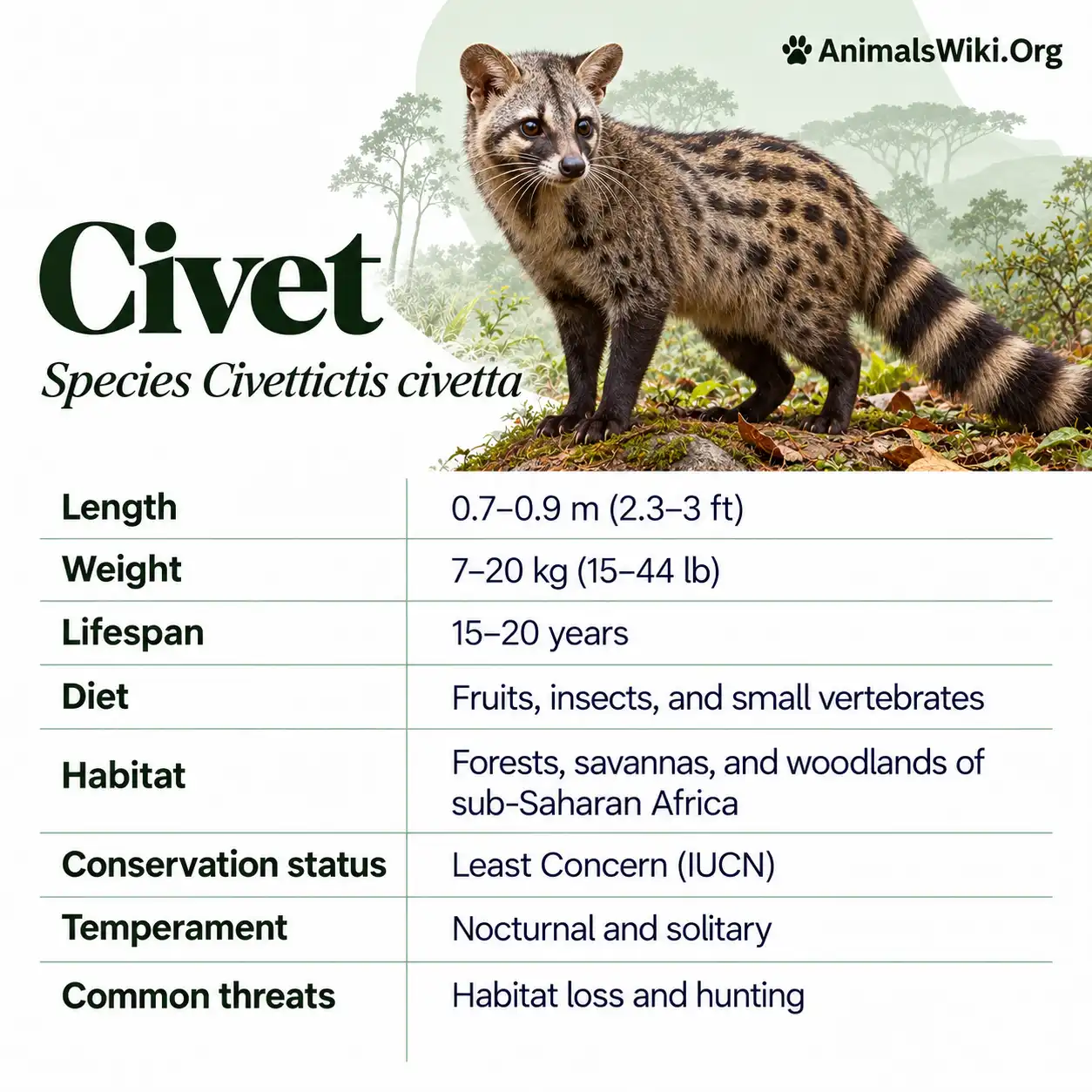
Civet, A Complete Guide to These Secretive Nighttime Mammals
A civet is a secretive mammal often recognized by its pointed face, long body, short legs, and patterned coat. Many people first hear about civets through perfume or coffee, but these unusual associations reveal only a small part of their biology.
Civets include several different species. Some spend much of their time in trees, while others forage mainly on the ground. Their diets range from fruit-rich meals to varied combinations of insects, small vertebrates, eggs, and other foods.
They are frequently called civet cats, although they are not true cats. Most belong to the family Viverridae, which also includes genets and the binturong. A few animals bearing the common name “civet” belong to other families.
Their ecological importance is considerable. Fruit-eating civets can move seeds through forests and human-modified landscapes. Other feeding activities connect them with insect populations, small animals, and larger predators.
Their conservation needs are equally diverse. Some species remain widespread, while others are threatened by hunting, trapping, habitat loss, and trade.
This guide explains civet classification, appearance, habitat, food, reproduction, scent communication, conservation, and coexistence with people. It also examines civet coffee and explains why the survival of adaptable urban civets should not distract from the problems facing rarer forest species.
Information checked: October 18, 2026.
Civet Facts
| Feature | Details |
|---|---|
| Animal group | Mammal |
| Main family | Viverridae |
| Order | Carnivora |
| Suborder | Feliformia |
| Scientific name | Different for each species |
| Main native regions | Africa and Asia |
| Typical appearance | Elongated body, pointed muzzle, short legs, and a long tail |
| Coat | Often spotted, striped, banded, or masked |
| Diet | Varies; many are omnivorous |
| Activity | Mostly nocturnal, with exceptions |
| Social organization | Often solitary or loosely associated |
| Shelter | Species-dependent; vegetation, tree cavities, and other protected sites |
| Young | Commonly called kits, cubs, or pups |
| Communication | Scent, sound, posture, and direct interaction |
| Ecological role | Predation, scavenging, and seed dispersal |
| Conservation status | Assessed separately for each species |
Important distinction: The African palm civet belongs to Nandiniidae rather than Viverridae. The Malagasy civet, or spotted fanaloka, belongs to Eupleridae. Common names do not always match modern family boundaries.
Contents
- What civets are and how they are classified
- Major species and identification
- Distribution, habitat, and daily activity
- Diet, feeding, and seed dispersal
- Scent glands and communication
- Reproduction and development
- Civets near people
- Coffee, perfume, and wildlife trade
- Conservation and responsible observation
- Myths and frequently asked questions
1. What Is a Civet?
“Civet” is a common name applied to several small and medium-sized mammals, most of which belong to Viverridae.
It does not identify one species with a single scientific name, body size, or conservation status.
Many civets have a long torso, pointed muzzle, relatively short legs, and a substantial tail. However, the family contains important differences in build and behavior.
A palm civet moving through branches faces different challenges from an African civet searching along the ground.
Some species are familiar around settlements, while others remain closely associated with forest environments and are rarely observed.
The most useful approach is therefore to distinguish general characteristics from species-specific facts.
A statement that accurately describes a common palm civet may not fit an Owston’s civet or African civet.
Understanding these differences helps avoid misleading claims about what all civets eat, where they live, and how they should be protected.
2. Are Civets Cats?
Civets are not members of the cat family, Felidae.
The name “civet cat” reflects superficial similarities such as a whiskered face, flexible movements, and a generally catlike silhouette.
Most civets belong to Viverridae, a separate family within Feliformia, the catlike branch of the carnivore order.
This places them within a broader evolutionary grouping that also contains cats, mongooses, and hyenas, but it does not make those animals interchangeable.
A civet is also not a mongoose or a weasel.
Similar body shapes can occur in mammals that move through dense vegetation, hunt small prey, or use narrow spaces.
For identification, family relationships are only part of the picture. The animal’s location, markings, proportions, and behavior are also important.
A long-tailed mammal seen briefly at night should not automatically be labeled a civet simply because it resembles one.
3. Scientific Classification and Changing Names
For civets belonging to Viverridae, the main classification is:
| Classification level | Name |
|---|---|
| Kingdom | Animalia |
| Phylum | Chordata |
| Class | Mammalia |
| Order | Carnivora |
| Suborder | Feliformia |
| Family | Viverridae |
| Genus and species | Depend on the animal |
Examples include Civettictis civetta, the African civet, and Paguma larvata, the masked palm civet.
Palm civet names require particular care. Animals once grouped broadly under Paradoxurus hermaphroditus have been separated into more than one species in modern classifications.
Consequently, older research may use one scientific name for populations now treated differently.
This does not make the research useless, but the study location becomes important when interpreting it.
For general writing, “Asian palm civets” can describe the broader group, while detailed accounts should identify the species and classification being followed.
Taxonomy organizes biological knowledge; it should also make differences clearer rather than conceal them.
4. Main Types of Civet
The following examples illustrate the variety hidden behind the common name.
| Common name | Scientific name or group | Notable feature |
|---|---|---|
| African civet | Civettictis civetta | Large, boldly patterned, mainly ground-foraging civet |
| Asian palm civets | Paradoxurus species | Agile climbers with varied, often fruit-rich diets |
| Masked palm civet | Paguma larvata | Distinctive facial pattern |
| Small Indian civet | Viverricula indica | Widespread Asian civet |
| Large Indian civet | Viverra zibetha | Larger-bodied Asian species |
| Malay civet | Viverra tangalunga | Patterned Southeast Asian civet |
| Large-spotted civet | Viverra megaspila | Threatened species of mainland Southeast Asia |
| Owston’s civet | Chrotogale owstoni | Threatened, strongly ground-associated forest species |
| Brown palm civet | Paradoxurus jerdoni | Fruit-eating species endemic to India’s Western Ghats |
| African palm civet | Nandinia binotata | Belongs to a separate family |
This is a selection rather than a complete checklist.
5. Civet Appearance and Identification
Many civets have patterned coats, but the patterns vary considerably.
An African civet has conspicuous dark markings on a pale background, a facial mask, and a crest of hair along the back.
A masked palm civet has a contrasting facial pattern that includes pale areas and a white stripe running along the forehead.
Other species may show bands, spots, faint stripes, or relatively uniform brown coloration.
The tail is useful for identification, but not every civet has the same tail pattern. Some tails are ringed, while others are dark or only partly marked.
Body proportions also matter.
A ground-foraging civet can appear sturdier and longer-legged than a more arboreal relative.
Nighttime photographs make identification harder because lighting changes apparent color and may conceal details.
A reliable identification combines several features with geographic location rather than depending on one spot, stripe, or familiar nickname.
6. How Big Is a Civet?
There is no single correct size for all civets.
Some palm civets weigh only a few kilograms, while the African civet is substantially larger.
Published descriptions of African civets commonly place adult mass within approximately 7–20 kilograms, although individuals vary.
Head-and-body measurements must be distinguished from total length, which includes the tail.
This difference can make two accurate descriptions appear inconsistent.
Age, sex, body condition, and geographic variation create further differences.
An animal under professional care may also differ in condition from a free-ranging animal.
For a useful comparison, identify the species, confirm which length is measured, and separate typical values from exceptional records.
A description such as “the size of a cat” may help someone imagine the animal, but it is too imprecise for the entire group.
Some civets are much larger and more robust than that comparison suggests.
7. Where Do Civets Live?
Civets occur naturally across parts of Africa and Asia, with different species occupying different regions.
The African civet is distributed through much of sub-Saharan Africa.
Asian species occur across South Asia, Southeast Asia, and parts of East Asia.
Some populations outside their original distribution reflect human introductions or historical transport.
A range map therefore needs interpretation. A species can be listed for a country without occurring throughout it.
Likewise, a record from a particular island does not necessarily establish that the population arrived naturally.
Pakistan is within the distribution of the small Indian civet, and research has also examined palm civets in parts of the country.
The broader lesson is that “civets live in Asia” or “civets live in Africa” is only a starting point.
The exact species determines which habitats and conservation circumstances are relevant.
8. Civet Habitat: Forests, Farms, and Cities
Civet habitats include forests, woodland, scrub, agricultural mosaics, mangroves, and some urban environments.
However, tolerance of human activity varies sharply.
An adaptable palm civet may use gardens and roof spaces, while a rarer forest species may not persist under the same conditions.
Shelter and food are central requirements.
A habitat may provide fruit but lack safe resting places, or offer cover while becoming disconnected from feeding areas.
The structure of the landscape matters as much as the label attached to it.
A plantation beside forest is different from an extensive monoculture far from natural vegetation.
Similarly, a city containing mature trees, vegetated waterways, and connected gardens offers different opportunities from a dense commercial district.
Habitat descriptions are most useful when they explain which resources an animal uses and how it moves between them.
Presence alone does not establish that every need is being met.
9. The African Civet
The African civet, Civettictis civetta, is one of the largest and most recognizable animals commonly called a civet.
Its bold coat and dark facial mask distinguish it from many Asian palm civets.
It is primarily associated with ground-level movement and feeding, although the broader habitat can include woodland and forested areas.
Its diet is flexible rather than limited to one prey type.
This adaptability helps it use varied environments, but does not eliminate threats.
Regional conservation assessments identify concerns including snares, poisoning directed at other predators, hunting, and barriers created by certain fences.
Its scent secretion has also played a historical role in the perfume trade.
The African civet illustrates why generalist behavior should not be confused with complete security.
An animal may remain widespread while suffering local losses or reduced movement across increasingly altered landscapes.
Conservation requires understanding those local pressures as well as the global category.
10. Asian Palm Civets
Asian palm civets are among the civets most frequently encountered near people.
They are agile climbers and can move through trees, along walls, across roofs, and through other elevated routes.
Fruit is important in many populations, alongside insects and small animals.
Some use human-modified environments successfully, particularly where food and shelter remain available.
However, the familiar name “common palm civet” has been applied broadly in older accounts.
Modern classifications recognize divisions within the former species grouping, so names may differ between publications and wildlife agencies.
This is especially relevant when comparing animals from mainland Asia with those on different islands.
The everyday behavior may appear similar, but geographic and evolutionary differences still matter.
For practical identification, photographs should be accompanied by a location whenever possible.
For conservation, evidence from a common urban population should not be generalized to every palm civet species.
11. Masked Palm Civets
The masked palm civet, Paguma larvata, is named for its contrasting facial markings.
It occurs across parts of Asia and uses both natural and human-modified environments in portions of its range.
Radio-tracking research in China found predominantly nocturnal activity, with intermittent daytime movement.
The study also recorded overlapping home ranges.
Such overlap does not automatically prove a simple social arrangement. Animals can use the same space at different times or interact in ways that require more detailed observation.
The researchers also found reduced activity during winter without evidence that the animals continuously hibernated.
These findings show why species behavior should be based on direct study rather than inferred from one general label.
A civet can be mainly nocturnal without being inactive every daylight hour, and it can change its schedule without entering true hibernation.
12. Small Indian Civets and Civets in Pakistan
The small Indian civet, Viverricula indica, occurs across a broad Asian range that includes Pakistan.
It should not be confused with the small Indian mongoose, which belongs to a different family.
Research around Pir Lasura National Park examined the ecology of small Indian civets and Asian palm civets living in the same wider landscape.
Studying such overlap helps scientists ask how similar animals coexist.
Species may differ in the places they use, their activity patterns, or the foods they consume.
These differences are called aspects of ecological niche partitioning.
The subject is relevant in landscapes shared with agriculture and settlements, where animals must obtain food while responding to human activity.
It also demonstrates the value of local research.
Information from a tropical island or African woodland cannot fully describe the circumstances faced by civets in the Himalayan foothills.
13. Brown Palm Civets and Forest Fruit
The brown palm civet, Paradoxurus jerdoni, is endemic to India’s Western Ghats.
Its feeding ecology provides a particularly clear example of fruit consumption within the carnivore order.
A study examining more than 1,000 scats recorded fruits from dozens of native plant species, with fruit remains occurring in the great majority of samples.
The animals adjusted their feeding as different fruits became available.
This flexibility required access to plant diversity rather than reliance on one crop.
The findings also support an important seed-dispersal role.
However, a percentage of scats containing fruit is not identical to the percentage of calories supplied by fruit.
The distinction does not weaken the conclusion that the species is strongly frugivorous. It simply keeps the measurement accurate.
This civet illustrates how a small carnivoran can connect the reproductive cycles of many rainforest plants through routine feeding and movement.
14. Owston’s Civet and Other Threatened Species
The Owston’s civet, Chrotogale owstoni, occurs in a relatively restricted part of mainland Asia.
It is associated with forest environments and spends much of its time near the ground.
Its feeding includes invertebrates, making it different from strongly fruit-eating palm civets.
Ground-level movement also exposes it to snares.
Owston’s civet is classified as Endangered. Other civets have different levels of risk, including the Endangered large-spotted civet and Critically Endangered Malabar civet.
These examples show why the word “civet” cannot be assigned a single conservation category.
The success of an adaptable species in a city tells us little about the future of a geographically restricted forest species.
Effective protection requires accurate identification, reliable monitoring, and attention to the particular threats affecting each population.
For poorly known species, improving basic field knowledge is itself an important conservation priority.
15. What Do Civets Eat?
Many civets are omnivores, eating both animal and plant material.
Possible foods include fruit, insects, worms, small mammals, birds, eggs, amphibians, and other locally available items.
The proportions differ substantially among species.
A brown palm civet can have a strongly fruit-dominated diet, while another civet may consume more invertebrates or vertebrate prey.
Season also matters.
Fruit availability changes as plants flower and ripen, while rainfall can affect insects and other foods.
An animal’s ability to eat a particular item should not be confused with that item being its main food.
Likewise, a species described as omnivorous does not necessarily eat every available food equally.
Diet studies use observations, scat analysis, and other methods to establish actual patterns.
These patterns are more informative than assuming that sharp teeth mean a diet dominated by meat.
16. Hunting, Searching, and Food Handling
Civet feeding often involves investigation rather than a dramatic chase.
An animal may sniff through vegetation, inspect fallen fruit, search leaf litter, or approach a productive feeding tree.
Small foods can be obtained through repeated short feeding events across the night.
Climbing species can exploit resources above ground, while terrestrial species encounter different opportunities.
This creates variation even where species share a landscape.
Food handling also matters.
Swallowing a fruit whole, removing only its pulp, or damaging a seed produces different ecological outcomes.
A civet capable of swallowing seeds may transport them, while another feeding event may leave the seed beneath the parent tree.
These details connect feeding behavior with forest regeneration.
The useful question is not simply “does this animal eat fruit?” but which fruits it eats, how it handles them, and where the seeds eventually arrive.
17. Climbing, Feet, and Tails
Many palm civets are capable climbers.
Their feet, claws, balance, and flexible movement allow them to use branches and other elevated supports.
A long tail helps with positioning and balance, but it should not automatically be described as prehensile.
A prehensile tail can grasp a support. This is a distinctive feature of the binturong, not a universal property of civet tails.
Terrestrial civets have different movement patterns and should not be portrayed as spending all their time in trees.
This diversity affects how habitat fragmentation influences them.
A climbing palm civet may benefit from connected canopy routes, while a ground-foraging species needs safe movement through vegetation at lower levels.
Conservation structures should therefore match the species.
A useful crossing for one animal is not automatically effective for every mammal sharing the area.
18. Are Civets Nocturnal?
Most familiar civets are mainly active at night.
Darkness provides opportunities to search for food and move through the landscape while avoiding some daytime disturbance.
However, nocturnal does not mean that an animal can never be seen during daylight.
Activity may vary with season, food, weather, reproductive condition, and human presence.
An animal disturbed from its resting place may also move at an unusual time.
For this reason, a single daylight sighting should not be used to diagnose health or establish a new species-wide behavior.
Researchers study activity through repeated observations, tracking, and camera records.
The distribution of activity across many days reveals more than one memorable encounter.
For wildlife watching, the practical implication is simple: respect resting animals and avoid forcing activity for a photograph.
Natural behavior is more informative than a response created by disturbance.
19. Home Ranges and Social Life
Many civets are described as solitary, although their social arrangements are not identical.
Adults may forage independently while sharing portions of the same landscape.
Mothers and dependent young form an obvious exception to solitary movement.
A home range is the area used during routine life. It is not automatically an exclusively defended territory.
Overlapping ranges therefore do not necessarily indicate permanent group living.
Tracking research on masked palm civets has documented substantial variation in the area used by individuals.
Urban studies have also shown that large roads, rivers, and railway lines can influence movement.
These findings highlight the difference between habitat being visible and habitat being accessible.
A garden may contain food, yet a busy road may separate it from a resting site.
Understanding a civet’s life requires following the connections between resources, not simply mapping where vegetation remains.
20. Civet Scent Glands and Communication
Civets are famous for strong-smelling secretions.
In species such as the African civet, specialized glands produce material used in scent marking.
The animal can deposit scent on objects, leaving information after it has moved away.
This is useful for mammals that do not remain in constant visual contact.
A scent mark can potentially communicate presence, identity, or reproductive information, depending on the species and signal.
However, the exact message should not be invented simply because humans notice an odor.
Chemical communication is studied through the substances produced, where marks occur, and how other animals respond.
The same general category of behavior can differ among species.
Civet scent is therefore best understood as part of an information system rather than merely an unpleasant by-product.
Its strong smell is meaningful within the animal’s own sensory environment.
21. Latrines and Repeated Marking Sites
Some civets repeatedly deposit droppings in particular places.
These locations are often called latrines, and African civet latrines are sometimes called civetries.
They can concentrate signs of activity and provide useful locations for researchers studying diet or occurrence.
Scent marking may also occur nearby.
A study of African civets in Ethiopia documented marking on vegetation and other objects, with many recorded sites near latrines.
However, a latrine does not necessarily belong to only one individual.
Nor does a large quantity of droppings automatically indicate a large local population.
The accumulation reflects repeated use over time.
For ecological research, such sites are valuable but require careful interpretation.
They provide a record of feeding and activity, while cameras or genetic methods may be needed to identify the animals responsible.
22. Civet Musk and Perfume
The word “civet” can refer both to the animal and to a scent secretion historically used in perfumery.
Civetone is an important odor compound associated with that material, but it should not be treated as identical to the entire natural secretion.
The perfume trade created demand for keeping African civets and collecting the secretion.
Research on farms in Ethiopia documented serious welfare concerns associated with confinement, restraint, and collection practices.
Those findings concern studied facilities and periods rather than a complete description of every modern perfume supply chain.
Nevertheless, they show why sourcing matters.
The historical use of an animal product does not establish that obtaining it is harmless.
Synthetic alternatives also mean that a fragrance description alone does not necessarily reveal whether animal-derived material was used.
For wildlife education, the key distinction is between the civet’s natural communication system and the human industry built around exploiting it.
23. Civet Reproduction and Babies
Reproduction varies among civet species.
There is no universal gestation period, litter size, or breeding season for every animal carrying the name.
African civets commonly have small litters, with reports of one to four young.
Pregnancy is approximately two months in commonly cited records for that species.
Young depend initially on maternal care and gradually begin leaving the nest and taking solid food.
They are variously called kits, cubs, or pups in different accounts.
Their development involves more than gaining weight.
They must learn appropriate feeding behavior, movement, shelter use, and responses to unfamiliar animals.
A young palm civet developing climbing skills faces different physical challenges from a strongly terrestrial species.
Information from professional care can document these stages closely, but one litter’s timetable should not become an exact schedule for every wild population.
24. How Long Do Civets Live?
Civet lifespan differs by species and circumstances.
Individuals under professional care can survive into their teens or beyond, while maximum records can be considerably higher.
The African civet has documented longevity into its twenties under human care.
However, maximum longevity is not the same as average wild lifespan.
Wild survival is difficult to establish when animals are nocturnal, secretive, and not monitored continuously.
An individual disappearing from a study may have died, dispersed, or simply moved beyond the surveyed area.
This uncertainty matters when interpreting attractive but overly precise lifespan claims.
For conservation, survival across life stages is more useful than one headline number.
A population can contain long-lived adults while still declining if hunting removes breeding animals or too few young survive.
Reliable assessment therefore considers reproduction, mortality, movement, and age together.
25. Predators and Natural Defenses
Civets occupy an intermediate position in many food webs.
They consume smaller organisms while potentially becoming prey for larger carnivores, large snakes, or other predators appropriate to the region.
Their defenses differ by species.
Concealment, nocturnal activity, climbing, vigilance, and retreat can all reduce risk.
The African civet’s raised dorsal hair can make it appear larger during a threatening encounter.
However, a defensive display does not make an animal invulnerable.
The most successful avoidance often occurs before an observer sees a confrontation.
A civet may choose cover, delay movement, or change its route in response to information about danger.
This makes apparently uneventful behavior ecologically important.
Resting safely and moving cautiously can matter as much to survival as speed or aggression.
Descriptions of civets should therefore include avoidance and decision-making rather than only dramatic encounters.
26. Civets as Seed Dispersers
Fruit-eating civets can transport seeds away from the plant where the fruit was consumed.
Seeds swallowed intact may remain in the digestive tract while the animal travels.
A study in Borneo combined feeding trials with radio tracking to estimate dispersal of large-seeded fruit.
The results demonstrated movement of seeds over meaningful distances in the studied landscape.
This is especially relevant where other large fruit-eating animals have become scarce.
However, seed dispersal involves several stages.
A seed must survive handling and digestion, arrive somewhere suitable, germinate, and survive afterward.
Distance alone does not guarantee success.
A seed carried far into unsuitable ground may perform worse than one deposited closer in a favorable site.
The civet’s ecological contribution therefore depends on both movement and the quality of the eventual destination.
27. Why the Place of Deposition Matters
Different animals create different patterns of seed arrival.
A civet repeatedly using particular routes or deposition sites can produce a pattern unlike that of a bird or monkey.
Research in Borneo found that palm civets deposited seeds non-randomly in locations including gaps and riverbanks.
For the plant studied, some of those sites supported better subsequent survival and growth than others.
This is why the ecological role cannot be summarized only as “fruit goes in and seeds come out.”
Behavior shapes where regeneration becomes possible.
Other research in India has also examined how deposition patterns affect seed predation and later outcomes.
The general lesson is that seed dispersers are not interchangeable.
Maintaining a variety of fruit-eating animals can preserve different movement distances, handling methods, and deposition patterns within the same ecosystem.
28. Civets in Degraded and Urban Landscapes
Some palm civets persist in places heavily influenced by people.
They may use gardens, plantations, forest edges, parks, and buildings.
A large study found associations between common palm civets and human-modified or degraded environments across the areas examined.
This adaptability can allow continued seed dispersal where more disturbance-sensitive animals have disappeared.
However, it creates new risks.
Roads, traps, conflict, and capture can accompany access to human food and shelter.
A population using a settlement also should not be assumed to experience ideal conditions.
Presence demonstrates that the animal can use the area, not that every aspect of survival and reproduction is secure.
The conservation opportunity is to retain useful vegetation and safe connections while reducing avoidable hazards.
The caution is that the success of adaptable civets cannot substitute for protecting forest specialists.
29. What Is Civet Coffee?
Civet coffee, commonly associated with the name kopi luwak, is made using coffee seeds that have passed through a civet’s digestive system.
The civet consumes coffee fruit, including the pulp surrounding the seeds.
Seeds recovered from droppings are subsequently cleaned and processed for coffee production.
The terminology can be confusing: the animal eats coffee cherries, not a prepared cup of coffee.
Digestion and processing can influence chemical characteristics, but a biological origin does not automatically establish superior flavor or quality.
Authenticity is a separate concern.
Researchers have investigated chemical methods for distinguishing civet coffee from ordinary coffee and mixed products.
A label alone therefore does not verify composition or production history.
For an animal article, the most important point is that coffee consumption represents one interaction between civets and cultivated fruit, not the natural purpose of the animal or its entire diet.
30. Animal Welfare and Civet Coffee Tourism
Commercial demand can encourage the capture and confinement of civets.
A study assessing civets at coffee tourism facilities in Bali documented problems involving diet, mobility, shelter, hygiene, and other care conditions.
The findings challenge the assumption that a tourist attraction automatically provides suitable treatment.
An animal being visible, quiet, or available for photographs does not establish good welfare.
Likewise, a civet resting during daylight may simply be following its normal schedule; that observation alone does not prove it has been sedated.
Claims should follow evidence.
The broader concern is that an animal adapted to ranging, searching, climbing, and choosing resting sites may have few opportunities to perform those behaviors in a small enclosure.
Understanding the coffee industry therefore requires considering the animals’ lives rather than only the novelty or price of the product.
31. Are Civets Endangered?
There is no single answer for the entire group.
Conservation status is assessed separately for each species.
| Species | Global category reported in the consulted information |
|---|---|
| African civet | Least Concern |
| Small Indian civet | Least Concern |
| Owston’s civet | Endangered |
| Large-spotted civet | Endangered |
| Malabar civet | Critically Endangered |
National or regional status can differ from the global category.
A species widespread across Asia may be extremely rare within one country or island.
Taxonomic changes can also complicate comparisons because an older assessment may have covered a broader species concept.
The correct approach is to identify the animal and the scale of assessment.
Neither “all civets are endangered” nor “civets are common” accurately describes the group.
Conservation must address the circumstances of each species rather than relying on the visibility of the most adaptable members.
32. Major Threats to Civets
Habitat loss, hunting, trapping, roads, and trade affect civets in different combinations.
Forest conversion can remove food and shelter or divide usable habitat into isolated patches.
Snares can be particularly damaging to animals moving along ground-level routes, whether or not they were the intended target.
Trade for meat, pets, coffee production, or other purposes creates additional pressure in some regions.
The importance of each threat varies geographically.
A forest species exposed to intensive snaring faces a different situation from an urban palm civet frequently crossing roads.
This is why conservation should begin with local evidence.
It also explains why protection on paper may be insufficient.
A forest can retain its trees while losing wildlife through hunting, and an animal can occur inside a protected area while remaining exposed to illegal traps.
33. Connectivity, Rescue, and Conservation Breeding
Keeping habitat connected can help civets reach food, shelter, and other individuals.
For climbing species, carefully designed canopy crossings may provide alternatives to dangerous ground routes.
Research in Indonesian agroforestry landscapes documented palm civets using artificial canopy bridges.
Such evidence is encouraging, but a structure should be monitored rather than assumed effective simply because it has been installed.
Rescue and conservation breeding address different needs.
Programs for Owston’s civets aim to maintain healthy, genetically managed populations while supporting wider recovery planning.
Successful breeding is valuable, but it does not remove the need to reduce hunting and protect suitable release environments.
Conservation works best when these elements support one another.
Safe habitat, reduced mortality, scientific monitoring, professional care, and local participation contribute different parts of the solution.
34. Living Alongside Civets Responsibly
A civet appearing near a home is not automatically aggressive or abandoned.
It may be traveling, feeding, or using a sheltered resting location.
Observe from a distance and allow it an escape route.
Avoid feeding, handling, chasing, or attempting to keep the animal.
Where a civet uses a building, seek locally appropriate wildlife advice before blocking an entrance. Dependent young could be present, and poorly timed exclusion can create further problems.
Secure vulnerable poultry and reduce access to avoidable food attractants rather than encouraging repeated close contact.
For wildlife tourism, choose experiences that prioritize suitable care and accurate education.
An encounter should not depend on an animal being restrained for photographs.
Respectful observation preserves the most valuable part of wildlife watching: seeing the animal make its own choices and continue its normal activities.
35. Civet Myths and Facts
| Common claim | More accurate explanation |
|---|---|
| Civets are cats | Most belong to Viverridae |
| Civet describes one species | It covers several different animals |
| Every civet lives in trees | Some are strongly ground-associated |
| All civets mainly eat meat | Some have highly fruit-rich diets |
| Every long civet tail can grasp | Prehensility is not universal |
| Civets exist to produce coffee | Coffee is one human-associated feeding interaction |
| Civet coffee is automatically superior | Composition, processing, authenticity, and taste are separate questions |
| A quiet captive civet must be comfortable | Welfare requires broader assessment |
| Solitary means no communication | Scent and other signals connect animals |
| All civets have the same status | Risk varies greatly by species |
| Urban survival proves habitat loss is harmless | Adaptable species do not represent all civets |
| Seed dispersal always guarantees a new tree | Germination and survival depend on subsequent conditions |
The diversity of civets is more informative than any single stereotype.
36. Frequently Asked Questions About Civets
What is the scientific name of a civet?
There is no single species-level scientific name for every civet. The African civet is Civettictis civetta, the masked palm civet is Paguma larvata, and the small Indian civet is Viverricula indica. The correct name depends on the species.
Is a civet a cat?
No. Most civets belong to Viverridae, while true cats belong to Felidae. Both families are within Feliformia, but this broader relationship does not make civets cats. “Civet cat” is a familiar common name rather than a taxonomic definition.
Is a civet a mongoose?
No. Mongooses belong to Herpestidae. Civets and mongooses share broader evolutionary relationships and can resemble one another, but they are different groups. Identification should consider location, coat pattern, tail, proportions, and behavior.
Where do civets naturally live?
Different civets occur across Africa and Asia. Some populations elsewhere reflect introductions. Their exact distribution depends on the species, and broad range maps do not mean that suitable habitat or healthy populations exist throughout every listed country.
Are civets found in Pakistan?
Yes. Pakistan is within the distribution of the small Indian civet, and research has examined palm civets there as well. Local evidence is useful because the ecology of civets in these landscapes can differ from populations studied elsewhere.
What do civets eat?
Foods can include fruit, insects, worms, small vertebrates, eggs, and other available items. The proportions vary. Some palm civets are strongly fruit-eating, while other species consume more animal material. No single menu accurately represents every civet.
Do civets eat coffee beans?
Some eat coffee fruit and swallow the seeds inside. Those seeds are commonly called coffee beans. This behavior forms the basis of civet coffee, but coffee is not a complete natural diet and should not define the animal’s biology.
What is kopi luwak?
Kopi luwak is coffee associated with seeds recovered after passage through a civet’s digestive system. The seeds are then cleaned and processed. The term does not independently verify authenticity, production conditions, animal welfare, or beverage quality.
Is civet coffee always produced from wild animals?
No. Some production uses confined civets. Research has documented welfare problems at studied facilities. Claims about origin require verification rather than assuming that an expensive or wildlife-themed product was obtained without capture or confinement.
Why do civets smell strong?
Specialized scent secretions help communication. Animals can leave marks on surfaces that other individuals investigate later. The smell may be unpleasant to people while remaining useful information within the civet’s own sensory world.
Is civet musk the same as civetone?
Not exactly. Natural civet secretion is a complex material, while civetone is an important associated odor compound. Confusing the compound with the complete secretion oversimplifies both the chemistry and its historical use in perfume.
Do all civets smell like popcorn?
No. The famous popcorn-like scent is especially associated with the binturong, another member of Viverridae. It should not be assigned automatically to every animal called a civet. Different species produce different chemical profiles.
Are civets nocturnal?
Most familiar species are mainly active at night. Daytime movement can still occur, and schedules differ with conditions. A single daylight sighting does not establish that an animal is sick or that the species is normally daytime-active.
Do civets live in groups?
Many forage independently, but social arrangements differ and are incompletely understood in some species. Mothers associate with young, and adults can share portions of a landscape. Overlapping ranges do not necessarily mean permanent group living.
What is a baby civet called?
Young civets are commonly called kits, cubs, or pups. Usage differs between sources and institutions. Their development depends on species, including whether they must acquire advanced climbing abilities or spend more time moving on the ground.
How many babies do civets have?
Litter size varies. African civets commonly produce small litters, with one to four young reported. That range should not be treated as a universal figure for every civet species or every breeding event.
How long is a civet pregnant?
It depends on the species. African civet records commonly place pregnancy at approximately two months. Other civets differ, so a precise gestation figure should always identify the animal rather than being presented as a group-wide rule.
Can civets climb trees?
Many palm civets climb very well. Other civets spend more time on the ground. Their shared common name does not mean they use the same habitat layer, and climbing ability should not be confused with having a grasping tail.
Are civet tails prehensile?
Not generally. A long tail can assist balance without grasping branches. The binturong’s prehensile tail is a distinctive adaptation within the broader viverrid family, not a standard feature of every civet.
Are civets important to forests?
Fruit-eating civets can disperse seeds and influence where seedlings establish. Their contribution depends on the plant, handling, movement, and deposition site. They can remain useful dispersers in some modified landscapes, although outcomes vary.
Are civets endangered?
Some are, while others are assessed as Least Concern. Owston’s civet and the large-spotted civet are Endangered, while the Malabar civet is Critically Endangered. Always identify the species and distinguish global status from regional assessments.
Are civets dangerous to people?
They are wild mammals capable of biting or scratching if handled or cornered. Give them space, avoid feeding, and follow local wildlife guidance. Their presence near a building does not automatically mean they are approaching people aggressively.
Can civets be pets?
They are unsuitable as ordinary household pets. Their nocturnal activity, scent marking, movement needs, diet, and wild behavior require specialized care. Familiarity with people does not make them domesticated, and pet demand can contribute to wildlife capture.
Why might a civet enter a roof space?
A roof can provide a sheltered resting location, especially in environments used by adaptable palm civets. Before exclusion, seek appropriate guidance and check for dependent young. Simply sealing an entrance can trap animals or separate a mother from offspring.
How can people help protect civets?
Protect suitable habitat, avoid wildlife exploitation, observe responsibly, and support conservation appropriate to the species. Practical coexistence and reduced trapping matter alongside research, because the most familiar civets do not represent the needs of every threatened relative.



