
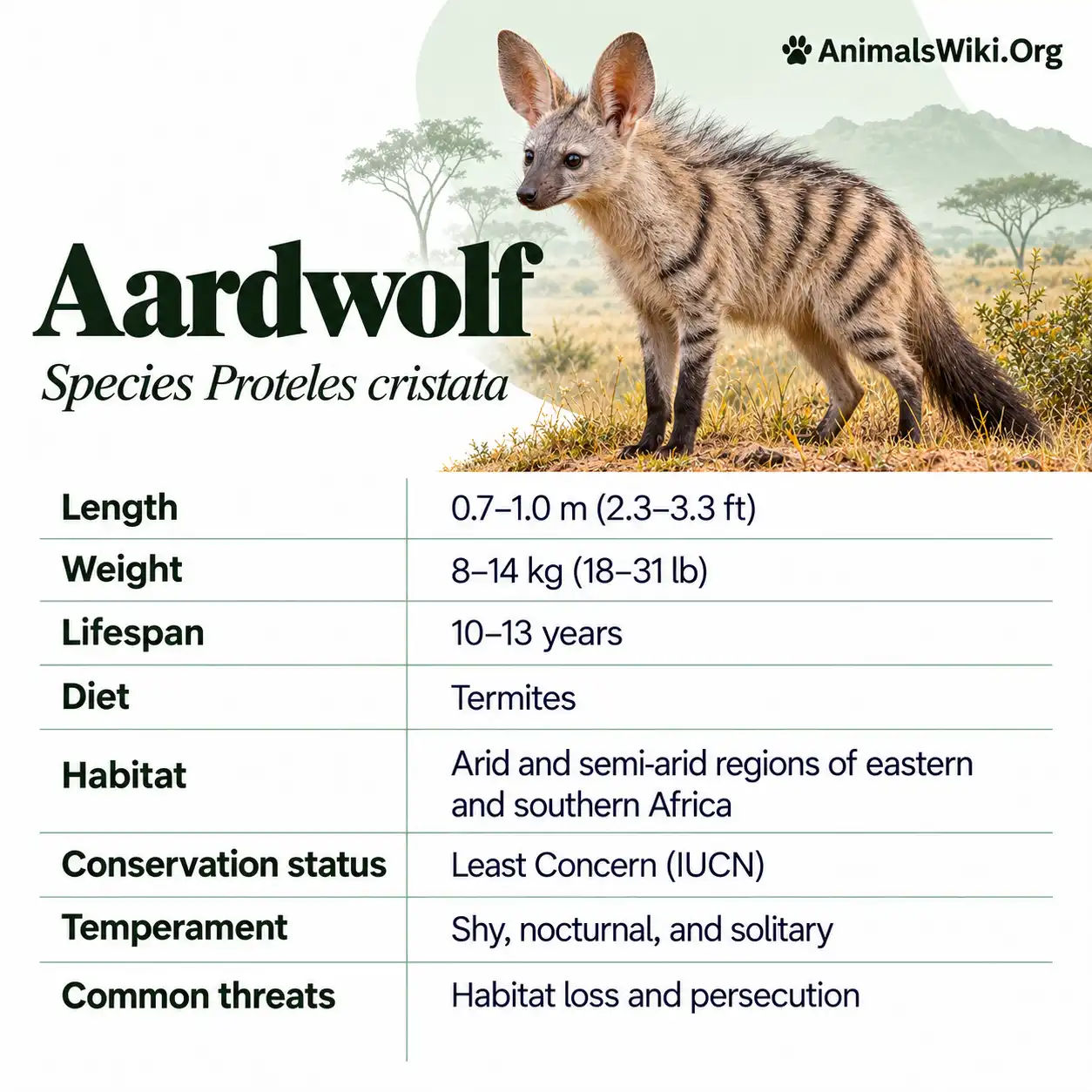
Aardwolf, Africa’s Remarkable Termite-Eating Hyena
The aardwolf is a small African member of the hyena family with a feeding strategy unlike that of its better-known relatives. Instead of hunting large animals or crushing bones, it obtains most of its food by licking termites from the ground.
Its appearance can be misleading. A striped coat, pointed ears, bushy tail, and long mane give it the outline of a miniature striped hyena. Its name means “earth wolf,” yet it is neither a wolf nor a close relative of domestic dogs.
The aardwolf’s survival depends on a precise relationship with its prey. The right termites must be present, active, and accessible. Changes in temperature and season can therefore influence when it feeds, how much energy it obtains, and how much time it spends underground.
Its social life is equally interesting. Adults often forage separately while maintaining a pair relationship, and males can help protect young at the den. Scent marking allows communication even when animals are not together.
Although aardwolves are generally assessed as having relatively low extinction risk, misunderstanding, road collisions, habitat changes, and threats to their food supply remain relevant.
This guide explores aardwolf identification, distribution, feeding, adaptations, reproduction, conservation, and common myths. It also explains an important taxonomic update concerning eastern and southern aardwolves.
Information checked: October 18, 2026.
Aardwolf Facts
| Feature | Details |
|---|---|
| Common name | Aardwolf |
| Animal group | Mammal |
| Order | Carnivora |
| Family | Hyaenidae |
| Genus | Proteles |
| Traditional scientific name | Proteles cristatus, also widely published as P. cristata |
| Current taxonomic distinction | Some modern classifications recognize southern and eastern species |
| Main distribution | Separate regions of southern and eastern Africa |
| Typical habitat | Open grassland, scrub, and savanna |
| Main food | Termites |
| Feeding method | Lapping exposed termites, usually from the soil surface |
| Typical activity | Mainly nocturnal, with seasonal changes |
| Shelter | Underground dens |
| Social pattern | Pair-associated but commonly solitary while feeding |
| Pregnancy length | Approximately three months in commonly reported southern records |
| Typical litter | Two to four cubs, with variation |
| Major threat misconception | It is often wrongly regarded as a livestock predator |
Taxonomy note: The Mammal Diversity Database recognizes the southern aardwolf, Proteles cristatus, and eastern aardwolf, Proteles septentrionalis. Many older studies, general references, and conservation accounts treat them together as one species.
Contents
- Classification and identification
- Size, distribution, and habitat
- Termite diet and feeding adaptations
- Activity, energy, and underground shelter
- Social behavior and communication
- Reproduction and cub development
- Relationships with other wildlife
- Conservation and coexistence
- Myths and frequently asked questions
1. What Is an Aardwolf?
An aardwolf is a small, highly specialized insect-eating member of the hyena family.
Its name comes from Afrikaans and means “earth wolf.” The name refers to its appearance and association with underground shelter rather than its ancestry.
An aardwolf is not a wolf, and it does not obtain its meals in the same way as a spotted hyena.
Its main feeding equipment includes a broad tongue, abundant saliva, and a mouth adapted to processing many small insects.
It usually searches alone, moving between places where termites are available.
This combination makes it unusual among mammalian carnivores. Its family relationships suggest one way of life, while its actual diet reveals another.
Understanding the aardwolf requires separating resemblance from function.
The stripes and mane help identify it as a hyena relative, but the details of its tongue, teeth, metabolism, and behavior explain how it survives as a termite specialist.
2. Aardwolf Classification and the Two-Species Question
Aardwolf taxonomy has changed as genetic evidence has improved.
Traditionally, aardwolves were treated as one species containing geographically separated southern and eastern forms.
A genomic study published in 2021 found substantial differentiation between those forms and supported recognizing them as separate species.
The Mammal Diversity Database now follows that division:
| Recognized form | Scientific name | Broad region |
|---|---|---|
| Southern aardwolf | Proteles cristatus | Southern Africa |
| Eastern aardwolf | Proteles septentrionalis | Eastern and northeastern Africa |
Other sources continue using the older combined treatment.
The spelling cristata also remains common in publications, although a nomenclatural review supported cristatus.
These differences explain why reliable references may display different names.
In this article, “aardwolf” refers broadly to the group unless a particular population is identified. Much detailed behavioral and physiological research comes from southern Africa and should not automatically be treated as a complete description of eastern populations.
3. Is an Aardwolf Really a Hyena?
Yes. Aardwolves belong to Hyaenidae, the hyena family.
Their specialized diet does not remove them from that family.
Scientific classification reflects evolutionary relationships rather than a requirement that every relative eat the same food.
Spotted hyenas, striped hyenas, brown hyenas, and aardwolves share family membership but differ substantially in their feeding and social behavior.
Aardwolves represent the insect-specialist branch.
They lack the massive bone-processing teeth associated with larger hyenas and do not depend on carcasses or large prey.
This difference is important for conservation. Treating every hyena-like animal as a threat to livestock can lead to unnecessary persecution.
It is also important when interpreting behavior.
An aardwolf alone at night is not necessarily searching for the same resources as a spotted hyena traveling across the same landscape.
Family resemblance provides context; direct observations explain the animal’s ecological role.
4. What Does an Aardwolf Look Like?
An aardwolf resembles a small, slender striped hyena.
Its coat is generally pale yellowish, grayish, or sandy, with dark stripes along the sides and legs.
The ears are large and pointed. The muzzle is relatively narrow, and the tail is bushy with a dark end.
A long mane runs along the neck and back.
When raised, the mane makes the animal appear larger and changes its outline dramatically.
This means photographs taken during defensive encounters can exaggerate its apparent body size.
The forequarters stand higher than the hindquarters, producing the sloping profile familiar from other hyena relatives.
However, the body is much lighter than that of a large bone-crushing hyena.
For identification, look at several features together: small size, narrow build, vertical striping, prominent ears, and the long mane.
A single stripe pattern seen briefly at night may not be sufficient.
5. Aardwolf Size and Weight
Aardwolves are approximately the size of a small dog.
Commonly reported adult measurements include a head-and-body length of roughly 55–80 centimeters, with a tail adding around 20–30 centimeters.
Body mass often falls within approximately 7–15 kilograms, depending on the individual and population.
Seasonal condition also matters.
An animal with abundant food can differ noticeably from one emerging from a difficult winter.
Measurements should therefore be presented as ranges rather than one exact standard.
Head-and-body length excludes the tail, which explains some apparently inconsistent descriptions.
The mane creates another source of confusion. Raised hair changes the silhouette but does not indicate an equally dramatic change in actual body mass.
The practical distinction is that an aardwolf is a relatively light, narrow-bodied hyena relative, built for prolonged searching and insect collection rather than overpowering large prey.
6. Where Do Aardwolves Live?
Aardwolves occur in two widely separated African regions.
One lies in southern Africa, while the other extends through parts of eastern and northeastern Africa.
Under the modern split, these correspond broadly to southern and eastern aardwolves.
The gap between them is biologically important because it reflects a long history of separation rather than a minor break in one continuous population.
However, a broad regional range does not mean that aardwolves occupy every available area.
Their distribution depends strongly on suitable habitat and prey.
Even where an animal has been recorded, local abundance can be low and detections infrequent.
Maps also vary because some references combine the two forms while others separate them.
For accurate interpretation, check which taxonomic treatment a source uses and whether its information concerns southern Africa, eastern Africa, or the group as a whole.
7. Aardwolf Habitat Requirements
Aardwolves are especially associated with open landscapes such as grassland, scrub, and savanna.
They generally avoid dense forest and environments lacking suitable termite resources.
Open appearance alone does not guarantee suitability.
The important issue is whether the habitat supports enough accessible prey and appropriate den sites.
Different grasslands can contain different termite communities, and seasonal changes alter when those insects are available at the surface.
Soil and existing burrows also matter.
An area with food but little secure shelter may present different risks from one with both resources.
Some agricultural or ranching landscapes can support aardwolves when prey remains abundant and animals are not persecuted.
This creates opportunities for conservation outside formal reserves.
However, tolerance of modified habitat should not be confused with independence from habitat quality. The animal remains dependent on particular ecological conditions even when it occurs near people.
8. What Do Aardwolves Eat?
Aardwolves feed overwhelmingly on termites.
Many studies identify Trinervitermes harvester termites as their principal prey, although the exact species differs geographically.
This is a much narrower diet than that of a generalist insect-eater consuming many unrelated insects.
A South African study examining samples from several localities found termites dominating the diet, with other insects contributing only small traces.
It found no vertebrate remains or carrion in those samples.
That result supports the description of an extreme feeding specialist rather than a miniature scavenging hyena.
The distinction between occasional capability and normal diet is important.
A rare unusual feeding event does not overturn the much larger body of evidence showing termite dependence.
For understanding survival, the key question is which food supplies the animal consistently, not every item it has ever been observed investigating or consuming.
9. Why Particular Termites Matter
Not all termites offer the same feeding opportunity.
Species differ in body size, defenses, nest structure, surface activity, and seasonal behavior.
Aardwolves specialize particularly strongly on termites that can be gathered while foraging above ground.
This creates a close relationship between predator and prey schedules.
A colony can be present beneath the soil yet provide little usable food if workers do not emerge.
That distinction helps explain why termite abundance and termite accessibility are different measurements.
A researcher counting nests may not capture the resource conditions experienced by an aardwolf on a cold night.
The animal needs insects within reach, not simply somewhere in the landscape.
Its feeding specialization therefore depends on both the identity of the prey and its behavior.
This is one reason environmental changes can affect a predator indirectly, even without visibly removing its habitat.
10. How an Aardwolf Feeds
The aardwolf’s usual technique is to lap exposed termites from the soil surface.
It does not normally obtain food by excavating deeply into hard nests in the manner of an aardvark.
This difference explains much of its anatomy.
Aardwolves do not possess the aardvark’s massive digging apparatus or extremely elongated feeding muzzle.
Instead, the tongue and mouth are suited to rapid collection of accessible insects.
Searching and feeding occur repeatedly across the night.
An animal may walk between patches, pause where termites are active, and then continue when the immediate opportunity declines.
The process can look undramatic, but it must provide enough energy to support a mammal weighing several kilograms.
Its success depends on collecting small prey efficiently while limiting the costs of travel, exposure, and unsuccessful searching.
11. The Aardwolf’s Tongue and Saliva
The aardwolf has a broad, spoon-shaped tongue rather than simply a miniature version of an aardvark’s narrow tongue.
Its surface includes structures suited to repeated contact with insects and the ground.
Saliva helps gather termites, while the shape of the palate accommodates rapid licking movements.
These internal features are easier to overlook than stripes or a mane, yet they are central to the animal’s survival.
The feeding system also includes substantial salivary glands and digestive adaptations.
Together, these features allow a hyena relative to exploit food that does not require tearing flesh or crushing bones.
The broad lesson is that specialization may be hidden inside a familiar-looking body.
An aardwolf’s outward silhouette suggests its ancestry. Its tongue and mouth reveal the distinctive ecological route it has taken.
12. Teeth: A Hyena Without Bone-Crushing Equipment
Aardwolf teeth differ markedly from those of larger hyenas.
The cheek teeth are reduced and relatively simple, while the canines remain conspicuous.
This arrangement is consistent with a diet requiring little conventional chewing.
It does not mean the animal is toothless or unable to bite.
The canines can still function during defense and interactions with other aardwolves.
However, possessing canines is not evidence that hunting large vertebrates forms part of the normal feeding strategy.
Dental specialization also limits dietary flexibility.
An aardwolf cannot simply become a spotted hyena when termites are unavailable. Its body is not equipped to process carcasses in the same manner.
This helps explain why food shortages can be serious despite membership in a family famous for strong jaws.
Evolutionary adaptations create opportunities, but they also involve trade-offs.
13. How Aardwolves Tolerate Termite Defenses
Termites are not defenseless food.
Some produce chemical secretions that discourage predators.
The termites most important to aardwolves include species with particularly effective defensive chemicals.
Experimental research compared responses to termite defensive material in aardwolves and other mammals.
Aardwolves tolerated concentrations that other tested species rejected or tolerated less readily.
This supports the idea that chemical tolerance helps them exploit a resource unavailable to many competitors.
However, it should not be described as universal immunity to all poisons.
The evidence concerns particular termite secretions and feeding conditions.
The practical advantage is access to abundant prey with fewer competing mammalian consumers.
This adaptation complements the tongue and feeding behavior: the aardwolf can locate and collect the insects while tolerating a defense that would make them less profitable for another predator.
14. Do Aardwolves Ever Eat Anything Else?
Rare departures from the normal diet have been reported.
These include unusual insect foods and exceptional observations involving vertebrates.
One published report described a wild aardwolf preying on captive geese.
Such a record is scientifically useful because it documents a real exception.
It does not establish that aardwolves normally threaten poultry or livestock across their range.
The correct interpretation balances the unusual observation with extensive dietary evidence.
Most evidence still identifies a highly specialized termite-eater.
This distinction matters because absolute statements can fail in both directions.
“An aardwolf can never eat a vertebrate” is too strong, while “aardwolves are regular poultry predators” misrepresents the evidence.
Wild animals can show exceptional behavior without that behavior defining their usual ecological role.
15. How Much Food Does an Aardwolf Need?
Aardwolves may collect very large numbers of termites, but a fixed nightly total is misleading.
Intake varies with prey size, activity, season, and the animal’s condition.
Counting insects is also different from measuring energy.
A large number of small termites may provide less nourishment than a smaller number of larger insects.
Researchers therefore examine feeding time, energy expenditure, water balance, and changes in body mass.
The aardwolf must balance searching costs against food gained.
Longer activity is not automatically better if prey remains unavailable.
During difficult periods, reducing expenditure can become as important as increasing intake.
This creates a more complete picture than the popular claim that every aardwolf eats the same enormous number of termites each night.
Its energy budget is flexible, but its narrow food base places real limits on that flexibility.
16. Seasonal Changes in Feeding
Southern African research has documented important seasonal differences.
During warmer periods, preferred termites can be accessible at the surface.
On cold winter nights, those insects may remain underground.
Aardwolves can then shift some feeding toward other termites, including Hodotermes, where available.
However, the alternative may not fully compensate for the lost resource.
Field research has recorded changes in activity budgets and lower energy expenditure during winter.
The animal is responding to a changed balance between food availability and the costs of obtaining it.
These findings are particularly relevant to southern populations.
They should not be converted into one calendar describing every aardwolf across Africa.
Eastern environments have different seasonal conditions, emphasizing the importance of local evidence when describing a geographically separated group.
17. Metabolism and Energy Conservation
The aardwolf’s physiology helps it survive on a demanding food niche.
Laboratory research has documented seasonal changes in metabolism and heat loss.
Winter animals in the studied population showed lower metabolic requirements and improved heat retention compared with summer measurements.
These changes reduce the amount of energy needed during a period when food can be difficult to obtain.
Behavior contributes as well.
Resting underground limits exposure, while changes in activity timing can align feeding with available prey.
The adaptations work together rather than providing an unlimited safety margin.
A lower metabolic requirement does not create food where none is accessible.
It reduces costs, potentially allowing survival through a difficult period.
This is a useful example of conservation through adjustment: the animal changes expenditure and behavior instead of relying only on increased feeding.
18. Water Requirements
Aardwolves obtain much of their moisture from termites.
This contributes to their ability to occupy relatively dry landscapes.
However, obtaining water through food does not mean environmental dryness is irrelevant.
Changes in rainfall and vegetation can affect the termites themselves.
An animal may therefore experience a food problem even when it does not depend heavily on drinking from open water.
Researchers studying water balance consider both intake and loss.
Moisture from prey, evaporation, activity, and seasonal physiology all contribute.
The common description “independent of water” is best understood as limited dependence on surface drinking water under suitable conditions.
It should not be read as an absence of biological water needs.
Like every mammal, an aardwolf must maintain water balance. Its feeding strategy simply supplies much of that requirement through a less visible route.
19. Are Aardwolves Nocturnal?
Aardwolves are mainly nocturnal, but their schedules are not rigid.
Food availability and temperature can shift activity toward twilight or daylight.
This is especially relevant in southern winters, when preferred termites may be unavailable during cold nights.
The animal’s schedule follows ecological opportunity rather than a strict rule that darkness is always required.
A daylight sighting therefore does not automatically indicate illness.
The season, local prey, behavior, and body condition provide more useful context.
For observers, the best approach is to allow the animal to continue naturally.
Crowding it or forcing movement changes the behavior being observed.
For researchers, repeated activity records reveal patterns that a single sighting cannot establish.
The distinction is between an animal being mostly nocturnal and every individual being active exclusively at night throughout the year.
20. Dens and Underground Shelter
Aardwolves use underground dens for resting, avoiding harsh conditions, and raising young.
They commonly use or enlarge burrows made by other animals rather than excavating elaborate systems entirely from scratch.
A study of southern aardwolf dens found relatively simple structures, usually with one entrance and a tunnel.
The burrows provided a more stable thermal environment than the surface.
This matters because the aardwolf’s energy balance depends partly on avoiding unnecessary costs.
The den also provides cover for vulnerable cubs.
Its value therefore combines physical protection and environmental buffering.
Not every hole within a territory is occupied at the same time, and animals may change dens.
A den entrance is evidence of a potential resource rather than a direct count of resident aardwolves.
Researchers need fresh signs, cameras, or repeated observations to establish current use.
21. Mane, Posture, and Defense
The aardwolf’s long mane is an important visual feature.
Raising it changes the animal’s outline and can make it appear larger during an encounter.
Posture and movement add to the display.
Such signals can discourage escalation by influencing how another animal assesses the situation.
However, a dramatic display does not mean the aardwolf is seeking a fight.
Avoidance, retreat, and access to shelter are also important.
Its narrow body and specialized feeding equipment do not suit prolonged confrontation with a large predator.
The mane is therefore best understood as part of a risk-management strategy rather than proof of exceptional aggression.
This distinction also helps people interpret photographs.
An animal with hair raised may be responding to the photographer’s presence.
The resulting image can look impressive while representing disturbance rather than normal relaxed behavior.
22. Scent Marking and Territorial Communication
Aardwolves deposit scent material on objects such as grass stems.
This behavior is commonly called pasting.
The marks allow communication after the animal that deposited them has moved away.
Chemical analysis has identified a mixture of compounds, with differences among individuals.
Behavioral experiments have also shown that aardwolves respond differently to scent according to the donor and situation.
They may investigate, mark over an existing deposit, or alter their activity.
These responses support a role in territorial and reproductive communication.
However, a scent mark should not be translated into a precise human sentence.
Researchers infer function from patterns of production and response.
The important point is that aardwolves can maintain information about neighbors and potential mates without traveling together or meeting continuously.
23. Social Life and Pair Relationships
Aardwolves commonly forage alone while participating in longer-lasting pair associations.
This distinction explains why they can be described as both solitary feeders and socially monogamous.
A pair may share a territory and contribute to raising young without spending every active hour together.
Social monogamy also does not necessarily mean exclusive mating.
Studies have documented extra-pair mating, making the reproductive system more complex than a simple lifelong exclusive partnership.
These terms describe different aspects of behavior.
Social organization concerns association and shared living arrangements, while mating patterns concern reproductive interactions.
Keeping them separate prevents confusion.
The aardwolf’s life is organized around defending access to food, maintaining relationships, and supporting cubs, rather than gathering in a large clan comparable to that of spotted hyenas.
24. Territory and Movement
A territory provides access to feeding areas and den sites.
Its usefulness depends on the distribution of termites rather than size alone.
A large area with poor prey accessibility may be less valuable than a smaller, productive one.
Territorial behavior can involve scent marking, investigation, and direct encounters.
Movement also changes with breeding and dispersal.
A nightly feeding route, the area used over months, and movement away from the birth territory are different measurements.
They should not be combined into one universal travel distance.
For conservation, the differences matter.
Everyday routes connect food and shelter, while dispersal connects populations across generations.
A landscape can retain enough habitat for temporary feeding yet still become difficult for young animals searching for a place to establish themselves.
25. Aardwolf Reproduction
Commonly reported southern African records place gestation at approximately 90 days.
Litters often contain two to four cubs, although variation occurs.
Birth timing can be seasonal, with southern records commonly associated with spring and early summer.
This schedule should not be applied automatically to eastern populations.
The female gives birth in a den, where the young remain protected during their earliest development.
Reproduction must fit within the broader energy budget.
A mother needs food to support herself and milk production, while the pair must maintain access to suitable shelter and feeding areas.
Seasonal food shortages can therefore affect reproduction indirectly.
The relevant question is not only how many cubs are born, but whether the adults can support them through the period before effective independent feeding.
26. Baby Aardwolves and Development
Young aardwolves are called cubs or pups.
They initially remain in or close to the den, dependent on maternal milk and adult protection.
As they grow, they explore nearby ground and begin developing feeding skills.
Later, they accompany an adult farther into the territory.
Weaning, independent foraging, and departure from the birth area are separate stages.
A youngster may eat termites while still receiving support or remain within the family territory after it can feed alone.
Research on growth emphasizes the importance of sustained lactation and parental care.
This prolonged investment helps young develop in a system where food availability changes seasonally.
The progression is gradual rather than a sudden switch from helplessness to adult competence.
Exact ages vary between individuals and study conditions, so developmental milestones are best presented as approximate patterns.
27. The Father’s Role
Male aardwolves can contribute substantially by guarding the den while the female feeds.
This protects young during a period when they cannot accompany the adults effectively.
The contribution also illustrates why the pair association matters even though the animals usually search for food separately.
Parental roles need not involve identical activities.
The female supplies milk, while guarding by the male can create opportunities for her to obtain food.
However, paternal care varies.
It should not be described as a fixed number of hours performed by every father every night.
The benefits depend on circumstances, including cub age, danger, and adult condition.
Observations of professional breeding have also recorded den guarding, providing a closer view of behavior that can be difficult to monitor in the wild.
These observations complement field research without replacing it.
28. How Long Do Aardwolves Live?
Wild aardwolf lifespan is not well established.
Following a secretive, nocturnal mammal from birth to death is difficult, particularly when individuals disperse beyond a study area.
Records under human care provide evidence of potential longevity.
A documented female reached approximately 20 years, but that maximum should not be treated as a normal wild lifespan.
Average survival, maximum age, and reproductive lifespan are different measurements.
An animal can reach an old age under protected conditions while facing much greater risks in the wild.
For population conservation, survival through the juvenile period and the ability of adults to reproduce successfully are particularly important.
A single impressive longevity record says little about whether a population is increasing or declining.
Reliable assessments need information across many individuals and life stages.
29. Aardwolf vs. Aardvark
The similar names often cause confusion, but the animals are very different.
| Feature | Aardwolf | Aardvark |
|---|---|---|
| Family | Hyaenidae | Orycteropodidae |
| General appearance | Small striped hyena relative | Heavy-bodied mammal with long snout and large ears |
| Main food | Especially surface-accessible termites | Ants and termites |
| Typical feeding method | Laps insects from exposed areas | Excavates to obtain insects |
| Digging equipment | Not specialized like an aardvark’s | Powerful digging limbs and claws |
| Shelter | Often uses existing burrows | Excavates substantial burrows |
| Social pattern | Pair-associated, often feeds alone | Generally solitary |
The aardwolf and aardvark share a feeding theme without being close relatives.
Their different methods also explain how they can occur in the same environment.
One exploits exposed insects, while the other can open underground resources and create shelter.
30. Can Aardwolves Benefit from Aardvarks?
Research suggests that aardwolves can benefit from aardvark activity.
Excavation by an aardvark may increase access to insects, while abandoned burrows can provide useful shelter.
A camera-trap study in the Serengeti found overlapping activity and a positive association in occurrence between the animals.
The researchers interpreted the pattern as consistent with aardwolves benefiting from aardvark presence.
However, an association does not mean the animals form a permanent partnership or deliberately cooperate.
They can share a landscape while pursuing their own needs.
The ecological relationship is interesting precisely because assistance can arise without intention.
An aardvark feeding or digging for itself changes conditions that another animal can exploit.
This connects the aardwolf to the broader network of species influenced by underground excavation.
31. Ecological Role and Livestock Misunderstandings
Aardwolves participate in food webs mainly as termite consumers and as potential prey for larger predators.
Their specialization gives them a different role from large scavenging or hunting hyenas.
They should not be assumed to attack livestock because of their family membership or striped appearance.
The broad dietary evidence does not support treating them as routine livestock predators.
This distinction has practical value in farming landscapes.
Misidentification can lead to killing an animal that was searching for termites rather than threatening domestic stock.
At the same time, conservation claims should remain proportionate.
Eating termites does not automatically prove a measurable increase in agricultural production.
The ecological role is real without inventing a universal economic benefit.
Accurate identification and evidence about local feeding are stronger foundations for coexistence than either fear or exaggerated promises.
32. Conservation Status and Taxonomic Caution
Traditional global assessments classify the aardwolf as Least Concern.
The southern aardwolf is also listed as Least Concern in the Mammal Diversity Database.
The separately recognized eastern aardwolf is listed there as Not Evaluated.
Not Evaluated does not mean endangered, safe, or absent. It means the taxon has not received its own assessment in that treatment.
This distinction matters because older assessments may cover the combined group.
| Assessment context | Category |
|---|---|
| Traditional combined aardwolf assessment | Least Concern |
| Southern aardwolf in the consulted database | Least Concern |
| Eastern aardwolf as a separate species | Not Evaluated |
Regional information also varies.
A widespread southern population does not establish the condition of every eastern population.
The appropriate response is to retain the distinction, improve monitoring, and avoid transferring an older combined category without explanation.
33. Threats to Aardwolves
Aardwolves can be affected by road collisions, accidental trapping, persecution, and habitat changes.
Their food supply can also be reduced when termite resources are destroyed or altered.
The severity of these pressures varies between landscapes.
An animal crossing a road faces a direct mortality risk, while one losing access to prey may experience a slower decline in condition.
Climate-related changes could affect termite availability and seasonal feeding opportunities, but precise population outcomes remain uncertain.
It is therefore better to identify the mechanisms than to present unsupported predictions.
Conservation can focus on retaining suitable open habitat, reducing unnecessary killing, and understanding the effects of land management.
Aardwolves may persist on working land when essential resources remain and people recognize their feeding specialization.
Their relatively low assessed global risk should encourage preventative management rather than complacency.
34. Studying and Watching Aardwolves Responsibly
Aardwolf research uses camera traps, tracking, direct observation, dietary analysis, and physiological measurements.
Their stripes can help researchers recognize individuals in suitable images, supporting population studies.
However, detections depend on where cameras are placed and how animals move.
Few photographs do not automatically prove absence.
For visitors, patient observation is preferable to pursuit.
Keep distance, avoid blocking access to a den, and do not use food to draw an animal closer.
A resting adult or exploring cub should be allowed to control its movements.
If an animal appears injured, contact appropriate local wildlife personnel rather than attempting handling.
The best encounter reveals the aardwolf’s own choices: searching, feeding, scent marking, or returning to shelter.
Such observations are more valuable than a dramatic image produced by forcing a defensive display.
35. Aardwolf Myths and Facts
| Common claim | More accurate explanation |
|---|---|
| An aardwolf is a wolf | It belongs to Hyaenidae |
| It is another name for aardvark | They belong to different mammalian lineages |
| It normally hunts livestock | Its diet is overwhelmingly termite-based |
| It crushes bones like a spotted hyena | Its cheek teeth are highly reduced |
| It has no teeth | It retains teeth, including conspicuous canines |
| It digs deeply for every meal | It usually laps exposed termites |
| Every termite species is equally useful | Prey identity and accessibility matter |
| It is active only at night | Seasonal daytime activity can occur |
| Pair living means constant joint feeding | Adults commonly forage separately |
| Social monogamy guarantees exclusive mating | Extra-pair mating has been documented |
| All references recognize one species | Some modern classifications recognize two |
| Least Concern means no local threats | Roads, persecution, and resource changes still matter |
The aardwolf is distinctive enough without turning every useful adaptation into an absolute rule.
36. Frequently Asked Questions About Aardwolves
What is the scientific name of the aardwolf?
Many references use Proteles cristatus or the older spelling Proteles cristata. The Mammal Diversity Database separates southern P. cristatus from eastern P. septentrionalis. Naming differences often reflect changes in classification rather than entirely different animals being discussed.
Is an aardwolf a real wolf?
No. Wolves belong to the dog family, Canidae. Aardwolves belong to Hyaenidae, the hyena family. Their name is an everyday description and should not be used to infer ancestry.
Is an aardwolf a hyena?
Yes. It is a highly specialized member of the hyena family. Its termite diet and reduced cheek teeth distinguish it from larger relatives that hunt substantial prey or process carcasses.
Are aardwolves and aardvarks related?
They are not close relatives. Their similar names and insect-based feeding can cause confusion, but aardvarks belong to Tubulidentata. Aardwolves are carnivorans within Hyaenidae and use a different feeding method.
Where do aardwolves live?
They occur in separate regions of southern and eastern Africa. Suitable open habitat and termite resources determine local presence. Their distribution should not be described as continuous across the entire continent.
What do aardwolves eat most often?
Termites dominate the diet. Species in the genus Trinervitermes are particularly important in many studied populations. Other foods have been recorded, but they do not replace the broad pattern of extreme specialization.
Do aardwolves eat ants?
Small amounts of ants or other insects can occur in dietary records. However, describing them as general ant-and-termite feeders can obscure their much stronger dependence on particular termites.
Do aardwolves dig open termite mounds?
They do not normally use the powerful nest-excavating strategy associated with aardvarks. Their usual method is to lap exposed termites from the surface. Access to foraging insects is therefore especially important.
Do aardwolves have sticky tongues?
Their saliva assists with collecting termites, and their broad tongue is adapted to rapid lapping. Its shape differs from the very elongated narrow tongue familiar from some other ant- and termite-eating mammals.
Do aardwolves have teeth?
Yes. They have reduced cheek teeth and retain larger canines. The teeth are not suited to bone crushing like those of spotted hyenas, but the animal can still bite during defense or interactions.
Can an aardwolf eat meat?
Exceptional vertebrate feeding has been documented. However, such observations do not establish a normal meat-based diet. Extensive evidence still identifies aardwolves as termite specialists rather than routine hunters of livestock or poultry.
Are aardwolves dangerous to livestock?
They are not normal livestock predators. Misunderstanding and resemblance to other carnivores have contributed to persecution. An unusual feeding report should not be generalized into a claim that aardwolves routinely threaten farm animals.
Why does an aardwolf raise its mane?
Raising the mane makes its outline appear larger during a confrontation. This can help discourage an opponent. It is a defensive display, not evidence that the animal is naturally aggressive toward everything nearby.
Are aardwolves nocturnal?
They are mainly nocturnal, but timing changes with season and prey availability. Daytime feeding can occur, especially where cold nighttime conditions reduce access to preferred termites.
Do aardwolves live in packs?
They do not form wolf-like packs or spotted-hyena-style clans. Adults can maintain a pair association while feeding separately. Mothers, fathers, and dependent young may share aspects of the same territory.
Do aardwolves mate for life?
They can maintain social pair relationships, but the phrase “mate for life” oversimplifies the evidence. Extra-pair mating occurs, and social association is not the same as guaranteed exclusive reproduction.
What is a baby aardwolf called?
A baby is called a cub or pup. Young initially depend on the den and parental care before gradually exploring, eating termites, and becoming more independent.
How many babies do aardwolves have?
Two to four cubs are commonly reported in southern populations, although litter size varies. These figures should not be treated as an exact rule for every animal or every taxonomic treatment.
How long is an aardwolf pregnant?
Approximately three months is the commonly reported duration. Reproductive timing and birth season vary geographically, so southern seasonal records should not automatically be assigned to eastern populations.
Does the father help raise the cubs?
Yes. Males can guard the den while females forage. The amount of care varies, but this contribution can help protect young during the period when they cannot accompany adults effectively.
How long do aardwolves live?
Wild average lifespan is poorly established. A record of approximately 20 years exists under human care, but a maximum record should not be presented as the usual lifespan in nature.
Are aardwolves endangered?
Traditional combined assessments place them in Least Concern. Modern recognition of separate eastern and southern species complicates the picture because the eastern taxon lacks its own assessment in the consulted database.
Can aardwolves survive on farmland?
They can use suitable working landscapes where termites, shelter, and tolerance remain available. Their presence does not mean every agricultural practice is harmless. Land management influences the resources and risks they encounter.
Can an aardwolf be kept as a pet?
It is unsuitable as an ordinary household pet. Its specialized diet, nocturnal habits, territorial communication, and environmental needs require expert care. Familiarity with people does not make the animal domesticated.
How can people help protect aardwolves?
Learn to identify them correctly, avoid unnecessary persecution, retain suitable habitat, and support responsible land management. Reporting injured animals through appropriate local channels and observing without disturbance also contribute to coexistence.



