
Meerkat, Inside the Remarkable Life of Africa’s Social Survivor
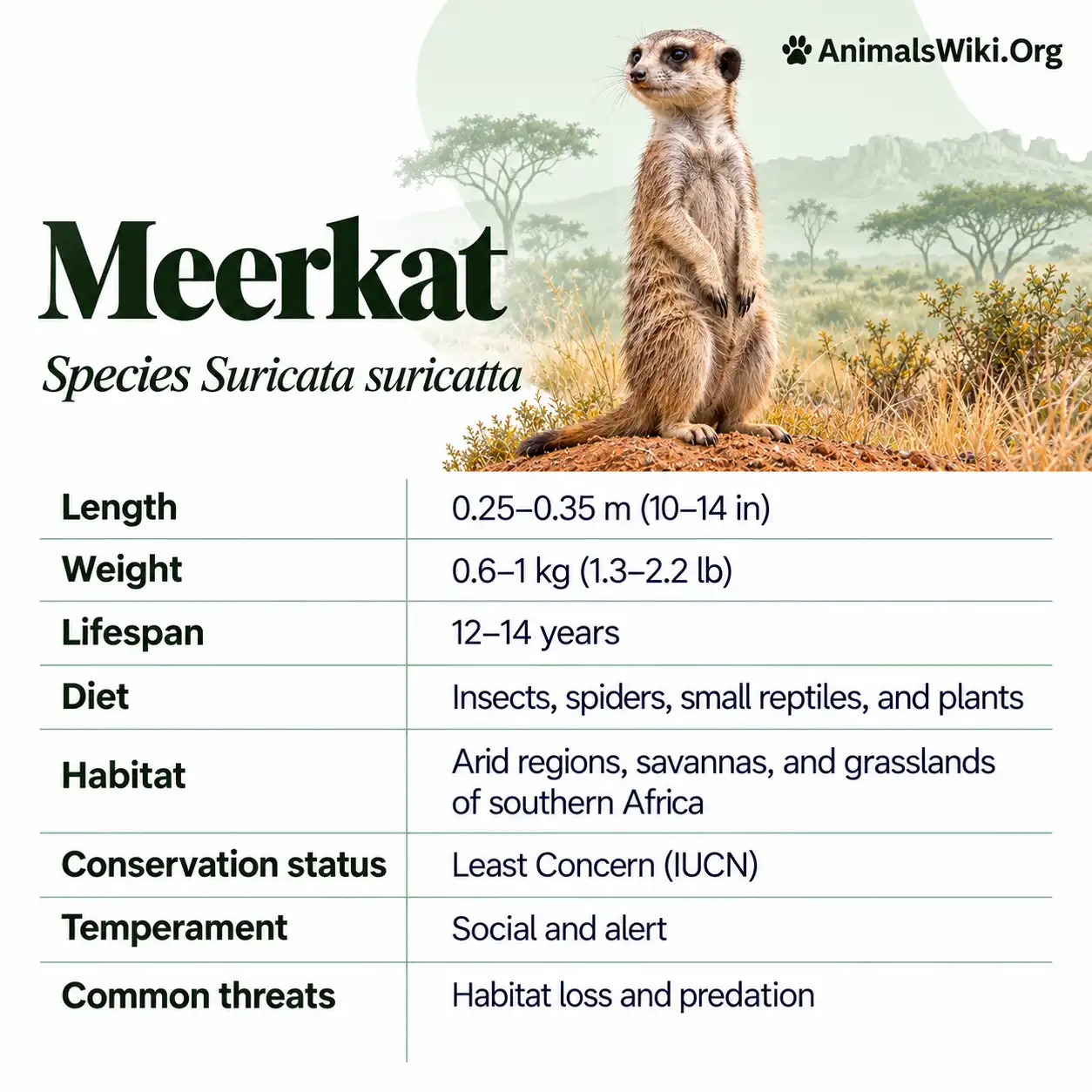
The meerkat is a small African mammal famous for standing upright and watching over its companions. Its alert posture, dark eye patches, and busy social life have made it one of the world’s most recognizable animals.
However, there is much more to a meerkat than its familiar lookout pose.
Meerkats live in cooperative groups where individuals help protect, feed, and sometimes nurse young that are not their own. They communicate through calls, scents, and body movements. Adults can even help pups learn how to handle difficult prey.
Their society also contains competition. Breeding opportunities are unevenly distributed, rival groups defend territories, and disagreements can have serious consequences. Cooperation and conflict are both essential parts of meerkat life.
Their environment presents further challenges. Food availability changes with rainfall, predators create constant risks, and small groups can struggle when too few animals remain to share important tasks.
Understanding the meerkat therefore means looking beyond the appealing photograph. Its digging, feeding, communication, parenting, and social decisions form an interconnected survival system.
This guide explores meerkat classification, habitat, adaptations, diet, reproduction, conservation, and frequently asked questions. It also examines popular claims about guard duty, scorpion venom, and the idea that every member of a group performs an identical role.
Information checked: October 18, 2026.
Meerkat Facts
| Feature | Details |
|---|---|
| Common name | Meerkat |
| Alternative name | Suricate |
| Scientific name | Suricata suricatta |
| Animal group | Mammal |
| Order | Carnivora |
| Suborder | Feliformia |
| Family | Herpestidae |
| Native region | Southern Africa |
| Typical habitats | Dry grassland, scrub, and savanna |
| Head-and-body length | Approximately 25–35 centimeters |
| Adult weight | Commonly around 0.6–1 kilogram |
| Main foods | Insects and other small animals |
| Activity | Primarily diurnal |
| Social group | Commonly called a mob, group, or gang |
| Breeding system | Cooperative breeding, usually dominated by one pair |
| Young | Pups |
| Typical pregnancy | Approximately 10–11 weeks |
| Global conservation category | Least Concern |
1. What Is a Meerkat?
A meerkat is a small, social member of the mongoose family that lives in southern Africa.
Its scientific name is Suricata suricatta, and “suricate” is another common name for the same species.
Meerkats spend much of their active time searching for food on or beneath the ground. Their pointed faces and strong foreclaws help them investigate concealed prey.
They also depend on underground shelter for sleeping, breeding, and escaping dangerous conditions.
Their social organization is particularly distinctive. A group usually contains a dominant breeding pair and other members that contribute to raising young.
Those helpers are not simply inactive adults waiting beside a burrow. They forage, watch for predators, defend the group, and provide food to pups.
The result is a society in which individual survival is closely connected with the size, composition, and condition of the group.
2. Scientific Classification and Family Relationships
The meerkat’s classification can be summarized as follows:
| Classification level | Name |
|---|---|
| Kingdom | Animalia |
| Phylum | Chordata |
| Class | Mammalia |
| Order | Carnivora |
| Suborder | Feliformia |
| Family | Herpestidae |
| Genus | Suricata |
| Species | Suricata suricatta |
Membership in Carnivora describes its evolutionary ancestry rather than requiring it to eat large amounts of meat.
Many carnivorans specialize in insects, fruit, or mixed diets.
Within Herpestidae, meerkats share ancestry with other mongooses, including dwarf mongooses and banded mongooses.
However, family membership does not mean identical social behavior.
The breeding system of a meerkat group differs from that of a banded mongoose group, where several females may breed together.
Comparisons are useful when they reveal these differences rather than treating all small social mongooses as interchangeable.
3. What Does a Meerkat Look Like?
A meerkat has a slender body, short legs, a pointed muzzle, and a long, narrow tail.
Its coat is generally grayish, sandy, or brownish, with darker bands across the back.
Dark patches surround the eyes, while the ears and nose are also dark.
The tail often ends in a dark tip.
Its forefeet carry strong, curved claws suited to digging. Unlike a cat’s claws, these are not fully retractile.
The body appears especially narrow when the animal stands upright.
That posture raises the head above surrounding vegetation and allows a wider view of the landscape.
However, a meerkat does not spend its whole day standing.
Much of its activity occurs close to the ground, where it searches, digs, handles food, and moves with companions.
Its familiar upright silhouette represents one useful posture within a varied daily routine.
4. Meerkat Size and Weight
Meerkats are small mammals, commonly weighing approximately 600 grams to 1 kilogram.
Head-and-body length is generally around 25–35 centimeters, with the tail adding roughly another 18–25 centimeters.
These figures vary between individuals and sources.
Age, sex, reproductive condition, recent feeding, and longer-term nutrition influence body mass.
Length measurements also require care. A value that includes the tail cannot be compared directly with one describing only the head and body.
Their small size creates both opportunities and challenges.
It allows them to investigate narrow spaces and live in underground systems, but it also makes them vulnerable to many predators.
Small mammals can gain or lose condition relatively quickly when feeding opportunities change.
For researchers, repeated measurements therefore reveal more than one isolated weight. Changes across days and seasons help connect food availability with individual performance.
5. Where Do Meerkats Live?
Meerkats are native to southern Africa.
Their recognized distribution includes parts of South Africa, Botswana, Namibia, and Angola.
They are particularly associated with the Kalahari region, although they should not be described as occurring only in one desert.
The Kalahari itself contains varied environments, including grass, shrubs, trees, and seasonally productive areas.
A range map does not mean meerkats occupy every location within the outline.
Food, soil, cover, shelter, and local conditions determine where groups can persist.
The species is also different from mammals inhabiting the Sahara or the tropical forests of central Africa.
Its adaptations reflect southern African open environments.
This geographic distinction matters when selecting photographs or describing habitat. A sand dune image may look appropriate for a “desert animal” while failing to represent the setting used by a particular meerkat population.
6. Meerkat Habitat Requirements
Meerkats use dry grasslands, scrub, savanna, and other open habitats where they can find food and suitable shelter.
Their environment must provide more than an unobstructed view.
They need prey beneath the soil or among vegetation, resting burrows, and places to escape when danger appears.
Habitat quality can vary over short distances.
A location suitable for sleeping may not provide the highest feeding returns.
Recent research has shown how the placement of sleeping burrows can influence group movements and create trade-offs between refuge and foraging.
This means an animal’s preferred habitat cannot be understood only by asking where it finds the most food.
Safety, breeding, temperature, and travel costs also matter.
The whole landscape functions as a network of resources, and a group must connect those resources repeatedly throughout the day.
7. Meerkat Burrows and Bolt Holes
Underground shelter is central to meerkat life.
Groups use sleeping burrows and smaller escape refuges, often called bolt holes.
A sleeping system can contain several entrances, tunnels, and chambers, although the arrangement differs among sites.
Meerkats can excavate and modify burrows, but they also use systems originally created by other animals.
This saves effort and connects them with a wider community of burrowing mammals.
The number of entrances should not be treated as a fixed species-wide figure.
Soil, history, other occupants, and repeated modification influence the structure.
Groups may also change sleeping locations rather than remaining permanently at one entrance.
The availability of nearby escape holes affects how safely animals can forage.
A productive patch becomes more valuable when a predator can be avoided without a long exposed run.
Burrows therefore shape both nighttime shelter and daytime decisions.
8. Sunbathing, Huddling, and Temperature Control
Meerkats often emerge in the morning and expose their bodies to sunlight before beginning extended foraging.
Their upright posture is useful for more than watching predators; it can also accompany warming after a cool night.
During hotter periods, shade, reduced activity, and underground shelter help limit heat exposure.
At night, animals may rest close together.
These behaviors influence the amount of energy spent maintaining body temperature.
However, meerkats are not simply passive recipients of desert heat.
Their bodies must regulate temperature across changing conditions, and heat stress can increase water loss and physiological costs.
Laboratory research has documented responses to temperature, including increased evaporative loss at high temperatures.
Behavior and physiology work together.
The group’s daily schedule therefore reflects a balance between obtaining food, maintaining a suitable temperature, avoiding predators, and returning to secure shelter.
9. A Typical Day in a Meerkat’s Life
Meerkats are diurnal, meaning they are primarily active during daylight.
A typical day can include emerging from the sleeping burrow, warming, grooming, traveling, and prolonged searching for food.
Individuals alternate between feeding and monitoring their surroundings.
Some periods involve caring for pups or remaining near a breeding burrow.
The group may pause in shade during hot conditions before continuing.
Eventually, the animals return to a sleeping location.
This pattern is flexible rather than a precise timetable.
Weather, season, pup age, food, and encounters with other groups can change what happens.
A group with dependent young faces different demands from one without pups.
Likewise, a dry year can require different decisions from a productive year.
The interesting feature is not a clock-based routine but the way group members coordinate activities while responding to immediate needs.
10. What Do Meerkats Eat?
Meerkats eat mainly insects and other small animals.
Foods can include beetles, larvae, caterpillars, scorpions, spiders, millipedes, and occasional small vertebrates.
Eggs and some plant material may also be consumed.
The proportions depend on place, season, and prey availability.
A 2025 field study found insects dominating the recorded diet, with beetles particularly prominent.
Those results describe the studied population and sampling method rather than a universal menu for every meerkat.
The distinction between prey counts and nutritional contribution also matters.
A frequently eaten small insect may contribute less energy than a larger, less frequent item.
Meerkats are therefore best described as flexible small-prey foragers with strong insectivorous tendencies.
Their diet differs from the aardwolf’s much narrower specialization on particular termites, even though both belong to the broader carnivore order.
11. How Meerkats Find Food
A foraging meerkat repeatedly investigates the ground, sniffs, scratches, and digs.
Its claws help expose animals hidden beneath soil or within other material.
The search requires judgment as well as physical effort.
An individual must decide where to investigate, whether to continue digging, and when to move elsewhere.
Not every excavation produces food.
These skills improve with development and experience.
Young animals also face mechanical limits because their bodies and handling abilities are still growing.
Group foraging does not mean that all food is placed into a common pile.
Adults often obtain and consume their own prey, while making separate decisions about feeding pups.
This arrangement combines individual competition with cooperative care.
It also explains why remaining near companions can be useful without requiring every animal to search the same patch in exactly the same way.
12. Meerkats and Scorpions
Meerkats can capture and eat scorpions, but this ability should not be exaggerated into complete immunity to danger.
Effective handling reduces the chance of being stung.
Experienced animals may disable the prey before consumption, while inexperienced pups require assistance.
This makes scorpions useful for studying how feeding skills develop.
The frequently repeated claim that meerkats are immune to every venom is inaccurate.
Research has identified receptor changes associated with resistance to certain snake neurotoxins in the mongoose family, including meerkats.
That does not establish universal protection against all snake or scorpion venoms.
Different toxins affect different biological targets.
The safest biological explanation is that meerkats combine specialized traits, experience, and handling behavior while still facing real risks.
A dangerous food item can become manageable without becoming harmless.
13. Predators and Escape Strategies
Meerkats are prey for several kinds of animals, including birds of prey, jackals, snakes, and other carnivores appropriate to the region.
Their small size makes early detection valuable.
A warning received before a predator approaches closely gives the group more options.
Animals may run to shelter, gather, inspect the threat, or respond defensively, depending on the situation.
Not every predator requires the same response.
A danger approaching through the air creates different immediate demands from one moving along the ground.
This helps explain the value of distinct alarm information.
The presence of burrows also changes the landscape of risk.
A group foraging close to escape cover faces different circumstances from one crossing exposed ground.
Predator avoidance therefore depends on communication, habitat knowledge, shelter, and individual decisions working together.
14. Why Do Meerkats Stand Guard?
A meerkat acting as a sentinel watches from a raised position while companions forage.
Elevation improves visibility above grass, shrubs, or uneven ground.
The watcher may call, providing information to nearby animals.
This allows foragers to adjust their own vigilance rather than constantly stopping to scan.
However, there is no evidence of a strict military-style duty roster in which every individual takes an identical scheduled turn.
Research has shown that condition and recent feeding can influence sentinel contributions.
Watching can also benefit the sentinel itself.
A well-positioned animal may detect danger early and remain near an escape route.
The behavior can therefore help companions without being explained entirely as self-sacrifice.
This is an important lesson about cooperation: benefits to others and benefits to the performer can occur in the same activity.
15. Alarm Calls and the Watchman’s Call
Meerkat vocal communication includes calls associated with watching and calls responding to danger.
A sentinel’s presence can be signaled through quiet vocalizations, allowing companions to know that someone is monitoring the surroundings.
Alarm calls contain more specific information.
Research has shown that their acoustic structure varies with predator type and the urgency of the situation.
This can influence how listeners respond.
However, translating each call into a human sentence would overstate what has been demonstrated.
The evidence concerns patterns of sound and behavior.
Researchers examine when calls are produced, their acoustic differences, and what happens when recordings are played to listeners.
The system is sophisticated without being equivalent to human language.
It provides a way for animals with their heads near the ground to receive useful information about events beyond their immediate view.
16. Coordinating Movement Through Calls
Communication also helps a meerkat group remain together while changing feeding locations.
If every animal moved independently whenever it wished, the group could become fragmented.
Research on “moving calls” found that the probability of coordinated movement increased when several individuals called.
The pattern resembled a quorum response: support from more than one animal increased the likelihood of a collective change.
Dominant callers did not simply produce a stronger response in every situation.
This provides a useful contrast with the idea that one leader makes every group decision.
Dominance matters in meerkat life, but collective movement can also emerge from information contributed by several members.
The animals do not need to hold a human-style vote.
Repeated signals and responses can coordinate behavior, linking individual experience of a feeding patch with the group’s next action.
17. Scent Marking and Group Identity
Meerkats use scent as well as sound.
Secretions deposited on surfaces can provide information after the marking animal has moved away.
Research has found differences associated with sex and group membership in the chemical composition of meerkat scent material.
Bacterial communities associated with the secretions also vary.
These findings are consistent with microbes contributing to some social odors.
The result is a communication system involving the animal, its glands, associated microorganisms, and the environment.
A scent mark is therefore more than an unpleasant smell.
It can remain relevant when companions or neighbors are not within sight.
However, identifying chemical differences is not the same as fully decoding every message.
Understanding function also requires studying how animals inspect marks and change their behavior afterward.
The chemistry and behavioral evidence complement one another.
18. How Meerkat Groups Are Organized
A group commonly contains a dominant female, a dominant male, and other individuals of different ages.
The dominant pair produces most of the young in many studied groups.
Other members can include older offspring and immigrants.
Group size varies through births, deaths, departures, and arrivals.
Descriptions of a fixed number should therefore be treated as examples rather than a rule.
Small groups face different challenges from large ones.
They have fewer potential helpers, sentinels, and defenders, while each individual’s contribution can become more important.
Larger groups also experience competition, including competition over breeding opportunities.
The social system is therefore not simply “more animals is always better.”
It is a balance between the benefits of numbers and the costs of sharing space and resources.
That balance changes with food conditions and the composition of the group.
19. Dominant Females and Competition
The dominant female has an especially important reproductive role.
However, dominance does not mean every interaction is peaceful or that subordinate females never attempt to breed.
Competition can involve aggression, eviction, and infanticide.
These behaviors are part of the species’ biology, even though they contrast with its appealing public image.
They should be explained without assigning moral labels.
Individuals face different reproductive interests, and helping does not erase those differences.
Research has also shown that body size and growth influence competition for dominant positions.
In an experiment, increasing the growth of younger siblings led older siblings to increase their own food intake and growth.
This suggests that individuals respond to the development of close competitors.
The social hierarchy therefore interacts with physiology and behavior rather than existing as a simple permanent title.
20. Why Do Meerkats Help Raise Other Young?
Helping can provide several kinds of benefit.
When helpers assist relatives, they may increase the survival of animals carrying shared genes.
Helping may also strengthen the group in ways that improve a helper’s own future prospects.
These explanations are not mutually exclusive.
The contribution of each depends on circumstances and the behavior involved.
A helper’s age, condition, experience, and opportunities influence how much it can contribute.
Research has shown that helping can create short-term energetic costs, while animals adjust later feeding and effort to reduce longer-term consequences.
This makes cooperation a flexible investment rather than an unlimited resource.
A helpful animal still needs enough food and recovery.
The evolutionary question is how these costs and benefits combine over an individual’s life, not whether the animal understands a human concept of generosity.
21. Babysitting at the Burrow
Before pups can accompany the group, they remain associated with the breeding burrow.
Helpers can stay behind as babysitters while others forage.
This creates a substantial cost: time spent guarding young is time unavailable for obtaining food.
Studies have documented weight loss associated with frequent babysitting.
Contributions differ among individuals and are influenced by condition.
Providing additional food experimentally can increase an individual’s babysitting effort.
These findings help explain why the task is shared rather than performed indefinitely by one animal.
They also show that cooperation depends on the resources available to helpers.
A group facing food scarcity may struggle not only because the mother needs nourishment, but because the wider support system becomes harder to maintain.
Babysitting is therefore a direct connection between individual energy balance and successful group reproduction.
22. How Meerkats Teach Their Pups
Meerkats provide one of the best-known examples of teaching in wild mammals.
Helpers alter the prey supplied to young animals according to the pups’ developmental stage.
Younger pups may receive dead or disabled prey.
As the pups grow, they receive more difficult live items.
With scorpions, helpers may remove the sting before allowing a young animal to handle the prey.
They can also intervene if the pup struggles or loses control of it.
Experiments using begging calls helped show that helpers respond to information associated with pup age.
This behavior meets a functional biological definition of teaching because the helper changes its behavior in a way that facilitates learning.
It does not require assuming human-like awareness of a pupil’s mind.
The important result is improved opportunity to acquire a demanding survival skill.
23. Meerkat Reproduction
Meerkat pregnancy is commonly described as lasting approximately 10–11 weeks.
Litters often contain several pups, with two to five frequently reported and larger litters also documented.
Breeding success depends strongly on conditions.
A dominant female may produce more than one litter during a favorable year, but food shortages can sharply reduce successful reproduction.
The presence of helpers allows maternal investment to be distributed across several activities.
However, the breeding system does not mean every adult female reproduces equally.
Most successful breeding is concentrated among dominant animals in well-studied groups.
Age at physiological maturity also differs from age at first successful breeding.
An animal may be capable of reproduction yet lack the social opportunity to raise offspring.
That distinction is essential when interpreting simple maturity figures in species summaries.
24. Baby Meerkats and Early Growth
Baby meerkats are called pups.
They are born underground and initially depend on milk, warmth, and protection.
Their eyes and ears are closed at birth.
As they develop, they begin appearing above ground and later join the group’s feeding excursions.
This does not mean they immediately become effective independent hunters.
Helpers continue supplying food while the pups practice searching, digging, and handling prey.
The transition includes several milestones: emergence, movement with the group, eating solid food, improving prey capture, and eventual nutritional independence.
These stages overlap.
A youngster can consume prey while still relying heavily on assistance.
Its success is shaped by both its own development and the support provided by the group.
For this reason, pup growth is a useful indicator of how food conditions and cooperative care are interacting.
25. Feeding Pups and Shared Nursing
Helpers influence more than whether pups receive an occasional meal.
Research has shown that the ratio of helpers to pups affects growth and later survival.
Better early weight gain can be associated with advantages that continue beyond the immediate feeding period.
Some subordinate females also nurse young that are not their own.
This behavior is called allolactation or allonursing.
A long-term study found it in a substantial portion of the monitored litters, with participation related to the female’s reproductive history and other characteristics.
This does not mean every female nurses every litter.
It shows another way care can extend beyond the biological mother.
Together, provisioning and occasional shared nursing illustrate the depth of cooperation while also emphasizing that contributions vary between individuals and circumstances.
26. Learning to Forage Independently
Young meerkats improve through growth and experience.
Finding prey, judging a digging site, capturing it, and processing it are separate skills.
A youngster may become competent at one while still developing another.
Recent research found that prey capture and handling performance continue improving after the earliest period of nutritional dependence.
Foraging efficiency approached adult levels around the transition into adulthood in the studied animals.
This helps distinguish learning from social opportunity.
Delayed successful breeding is not necessarily caused by an inability to find food.
An animal may already forage well while remaining subordinate.
The same distinction applies to many social mammals: physical competence, independence, and access to reproduction do not automatically occur together.
Understanding development requires following each process rather than assigning one age at which an animal suddenly becomes “fully adult.”
27. Play, Grooming, and Social Relationships
Meerkats spend time grooming, wrestling, chasing, and playing.
These activities are especially conspicuous among young animals, although adults also participate.
Play requires resources.
An animal under nutritional pressure may devote less time to behavior that does not immediately provide food or safety.
Experimental work has shown that additional food can increase play in free-ranging meerkats.
That result connects a familiar entertaining behavior with measurable condition.
Grooming also forms part of social interaction, although its exact function depends on context.
A group’s relationships are built through many repeated encounters rather than one dramatic event.
Observing ordinary contact can therefore reveal important information about association and tolerance.
Playful behavior does not erase competition, but it helps demonstrate that meerkat society includes a wide range of interactions beyond feeding and defense.
28. Conflicts Between Meerkat Groups
Different meerkat groups compete over space and resources.
Encounters can involve watching, displaying, chasing, retreating, or fighting.
The familiar “war dance,” with raised tails and expanded outlines, is part of this behavior.
However, not every meeting ends in physical violence.
Many encounters are resolved when one group withdraws.
Research has shown that larger groups are more likely to win contests and that outcomes can influence subsequent use of territory.
This creates another advantage to maintaining group numbers.
Nevertheless, fighting can injure or kill individuals, so escalation carries costs.
The balance between cooperation within a group and hostility toward outsiders is an important part of meerkat biology.
It should not be romanticized as either perfect teamwork or constant warfare.
The animals respond to particular opponents, circumstances, and risks.
29. Dispersal and the Formation of New Groups
Meerkat groups change through more than births and deaths.
Individuals can leave, be evicted, or enter from elsewhere.
Dispersal creates opportunities to breed but also exposes animals to new risks.
A departing individual loses some benefits of an established group and must navigate unfamiliar surroundings.
New groups may struggle when too few animals are available to share important tasks.
This helps explain why an empty territory is not automatically filled immediately after a group disappears.
Suitable space is only one requirement.
Animals must reach it, associate successfully, reproduce, and maintain enough members to survive difficult conditions.
The social system therefore influences population recovery.
Conservation assessments need to consider group-level processes alongside the number of individual animals present.
30. How Long Do Meerkats Live?
Meerkat lifespan varies substantially.
Many wild individuals die young because of predation, environmental pressures, and other causes.
Successful adults can live considerably longer, while animals under professional care experience a different set of risks.
A maximum recorded age should not be presented as the average expectation for a newborn.
Likewise, a long-lived dominant female does not represent every animal in the population.
Age, social position, sex, condition, and local circumstances all influence survival.
For researchers, detailed life histories help distinguish these effects.
Knowing an individual’s birth, group membership, reproductive attempts, and eventual fate provides a much stronger picture than a general lifespan estimate.
For conservation, the key issue is whether enough animals survive and reproduce to maintain both individual numbers and functioning groups.
31. The Meerkat’s Ecological Role
Meerkats influence their environment mainly through feeding, digging, and participation in food webs.
They consume many invertebrates and occasional vertebrates, while providing food for larger predators.
Their excavation also disturbs patches of soil.
However, being ecologically active does not automatically establish that meerkats are a keystone species everywhere.
The term keystone describes a particularly large influence relative to abundance and requires appropriate evidence.
The meerkat’s role is valuable without adding an unsupported label.
Its biology also contributes greatly to scientific understanding.
Because researchers can follow recognizable individuals over many years, meerkats have become important for studying cooperation, communication, development, and population responses to environmental variation.
That scientific importance complements, rather than replaces, their place within southern African ecosystems.
32. Drought, Heat, and Climate Pressures
Meerkats inhabit dry environments, but this does not make them immune to drought.
Rainfall influences food availability and the chances that pups will survive to independence.
A 2025 study using 25 years of Kalahari data found that rainfall variation strongly influenced reproduction and recruitment.
High temperatures also had effects, but low rainfall explained larger demographic changes in that study.
Severe drought years could greatly reduce successful breeding and contribute to the loss of small groups.
This is an important distinction.
Climate effects cannot always be summarized as animals simply becoming too hot.
Changes in food supply and group structure can be equally important.
The findings also concern a studied population rather than an exact forecast for every meerkat.
Long-term monitoring helps identify which mechanisms matter and how repeated poor years affect recovery.
33. Are Meerkats Endangered?
Meerkats are globally classified as Least Concern.
They also occur in several protected areas within southern Africa.
However, Least Concern does not mean that every group or local population is stable.
A species can remain widespread while particular populations decline during drought or face local pressures.
Regional assessments identify potential concerns involving changing rainfall and unsuitable treatment of animals taken into private care.
The welfare needs of a social, digging, scent-marking mammal are very different from those of a conventional household pet.
Conservation should therefore combine habitat protection and monitoring with accurate public education.
The aim is to retain healthy wild populations before severe losses occur.
A familiar animal does not need to become globally endangered before its ecology and local challenges deserve attention.
34. How Scientists Study Meerkats
The Kalahari Meerkat Project has followed wild groups for decades.
Researchers record births, deaths, movements, social interactions, feeding, and reproductive success.
Habituated animals tolerate close observation under controlled research procedures, allowing detailed information to be collected without treating them as domesticated.
Individuals can be recognized and repeatedly weighed.
Such long-term data reveal effects that a short survey would miss.
For example, the consequences of poor early growth may become apparent only later, and rare changes in dominance require many years of observation.
Experimental work complements these records.
Researchers can test responses to calls, manipulate limited feeding conditions, or compare behavior before and after carefully designed interventions.
The strength comes from combining methods and following individuals through time rather than relying on one spectacular observation.
35. Watching Meerkats and Understanding Their Care Needs
Responsible observation allows meerkats to continue normal behavior.
Keep an appropriate distance, follow local guidance, and avoid feeding or touching wild animals.
Do not surround a group or block access to a burrow.
A meerkat climbing on a person in a familiar research or tourism setting is not evidence that all wild meerkats should be encouraged to approach.
Under professional care, suitable housing must provide digging opportunities, shelter, appropriate social management, and species-specific feeding.
A visible lookout platform alone does not meet all those needs.
Their popularity can help people appreciate southern African wildlife, but it can also encourage unrealistic expectations about keeping them.
The most useful public image combines their appealing behavior with an understanding of their social complexity, competition, and dependence on a suitable environment.
36. Meerkat Myths and Facts
| Common claim | More accurate explanation |
|---|---|
| Meerkats are cats | They belong to the mongoose family |
| They live only on bare sand | They use varied dry grassland, scrub, and savanna habitats |
| One animal is permanently the guard | Sentinel contributions change among individuals |
| Guards follow a fixed rota | Research does not support a regular schedule |
| Standing upright always means danger | The posture also occurs during scanning and warming |
| They are immune to all venom | Resistance and handling abilities are limited and specific |
| Every group member breeds equally | Reproduction is strongly concentrated in dominant animals |
| Helpers are always self-sacrificing | Helping can involve direct and indirect benefits |
| Group living eliminates conflict | Competition occurs within and between groups |
| Pups become expert hunters immediately after weaning | Feeding skills continue developing |
| Desert adaptation prevents drought problems | Low rainfall can severely reduce reproduction |
| A tame meerkat is a domesticated pet | Habituation and domestication are different |
37. Frequently Asked Questions About Meerkats
What is the scientific name of the meerkat?
The scientific name is Suricata suricatta. It belongs to Herpestidae, the mongoose family. “Suricate” is another common name for the same species rather than a different animal.
Is a meerkat a mongoose?
Yes. A meerkat is a member of the mongoose family. However, its breeding system and social behavior differ from those of some other mongooses, so facts about one species should not automatically be applied to the whole family.
Is a meerkat a cat?
No. Meerkats belong to Herpestidae, while cats belong to Felidae. Both are within the broader catlike branch of carnivorans, but that shared ancestry does not make meerkats true cats.
Where do meerkats naturally live?
They occur in southern Africa, including parts of South Africa, Botswana, Namibia, and Angola. Their presence depends on suitable food and shelter, so they do not occupy every location within that broad range.
What is a group of meerkats called?
A group is commonly called a mob, gang, or simply a group. Group size changes through births, deaths, arrivals, and departures. A maximum group size should not be treated as the number present in every population.
What do meerkats eat most often?
Insects and other invertebrates dominate much of their feeding. They also take occasional small vertebrates, eggs, and some plant material. The precise mixture changes with season, location, and availability.
Do meerkats eat scorpions?
Yes. Experienced meerkats can handle and consume scorpions. Helpers may disable prey before giving it to pups, allowing young animals to gain experience with reduced risk.
Are meerkats immune to venom?
They are not universally immune to every venom. Some biological traits can provide resistance to particular toxins, but this does not establish protection against all snakes or scorpions. Skillful handling remains important.
Why do meerkats stand upright?
Standing raises the head and improves the view over surrounding vegetation. It is useful during vigilance and can also occur while warming in sunlight. The posture does not always mean a predator has been spotted.
Does one meerkat always stand guard?
Not continuously. Individuals contribute different amounts, and behavior changes with circumstances. Research indicates no fixed regular rota. An animal’s condition and recent feeding can influence its sentinel activity.
How do meerkats warn each other?
They use alarm calls that vary with the type and urgency of danger. Listeners can adjust their responses accordingly. These signals are sophisticated, but they should not be translated as exact equivalents of human sentences.
Do meerkats teach their babies?
Research supports teaching in prey handling. Helpers modify the difficulty of food offered to pups and may intervene during handling. This gives young animals opportunities to acquire skills before managing dangerous prey independently.
What is a baby meerkat called?
A baby meerkat is called a pup. Pups initially remain at the breeding burrow and depend on milk and care. They later accompany the group while continuing to receive food from helpers.
How long is a meerkat pregnant?
Pregnancy is commonly reported at approximately 10–11 weeks. Exact timing varies, and reproductive success depends heavily on food and environmental conditions.
How many babies does a meerkat have?
Litters commonly contain several pups, often two to five, with larger litters documented. Litter size is different from the number of young successfully raised to independence.
Do male meerkats help raise pups?
Yes. Males can contribute to babysitting, food provision, and other activities. Helping is not restricted to one sex, although contributions differ among individuals and tasks.
Can females nurse another meerkat’s pups?
Yes. Allolactation has been documented in wild meerkats. Participation varies and is associated with factors including reproductive history. It does not mean every female nurses every litter.
Are meerkats friendly to one another?
They show cooperation, grooming, and play, but also competition and aggression. Their social system cannot be described accurately as either constant friendliness or constant hostility.
Do meerkat groups fight?
Yes. Encounters can involve displays, chases, and sometimes physical fighting. Larger groups often have an advantage, but many contests end without lethal violence.
Are meerkats nocturnal?
No. They are primarily diurnal and conduct most routine activity during daylight. They usually rest underground at night, although particular circumstances can alter the normal schedule.
How long do meerkats live?
Lifespan varies greatly. Many wild individuals die young, while successful adults can survive for many years. Longevity under professional care should not be presented as the average lifespan of a wild pup.
Are meerkats endangered?
Their global IUCN category is Least Concern. This does not mean every local population is secure. Drought and poor recruitment can cause serious losses within particular landscapes.
Can meerkats be pets?
They are unsuitable as ordinary household pets. Their social needs, digging, scent marking, diet, and potential aggression require specialized management. A hand-raised individual remains different from a domesticated companion animal.
What is the difference between a meerkat and a prairie dog?
They belong to different mammalian groups. Meerkats are African mongooses within Carnivora, while prairie dogs are North American rodents. Their upright posture and burrowing habits reflect different evolutionary histories.
How can people help protect meerkats?
Support suitable habitat, responsible wildlife tourism, and credible research. Observe without feeding or disturbance, and avoid treating wildlife popularity as evidence that an animal belongs in a home.



