
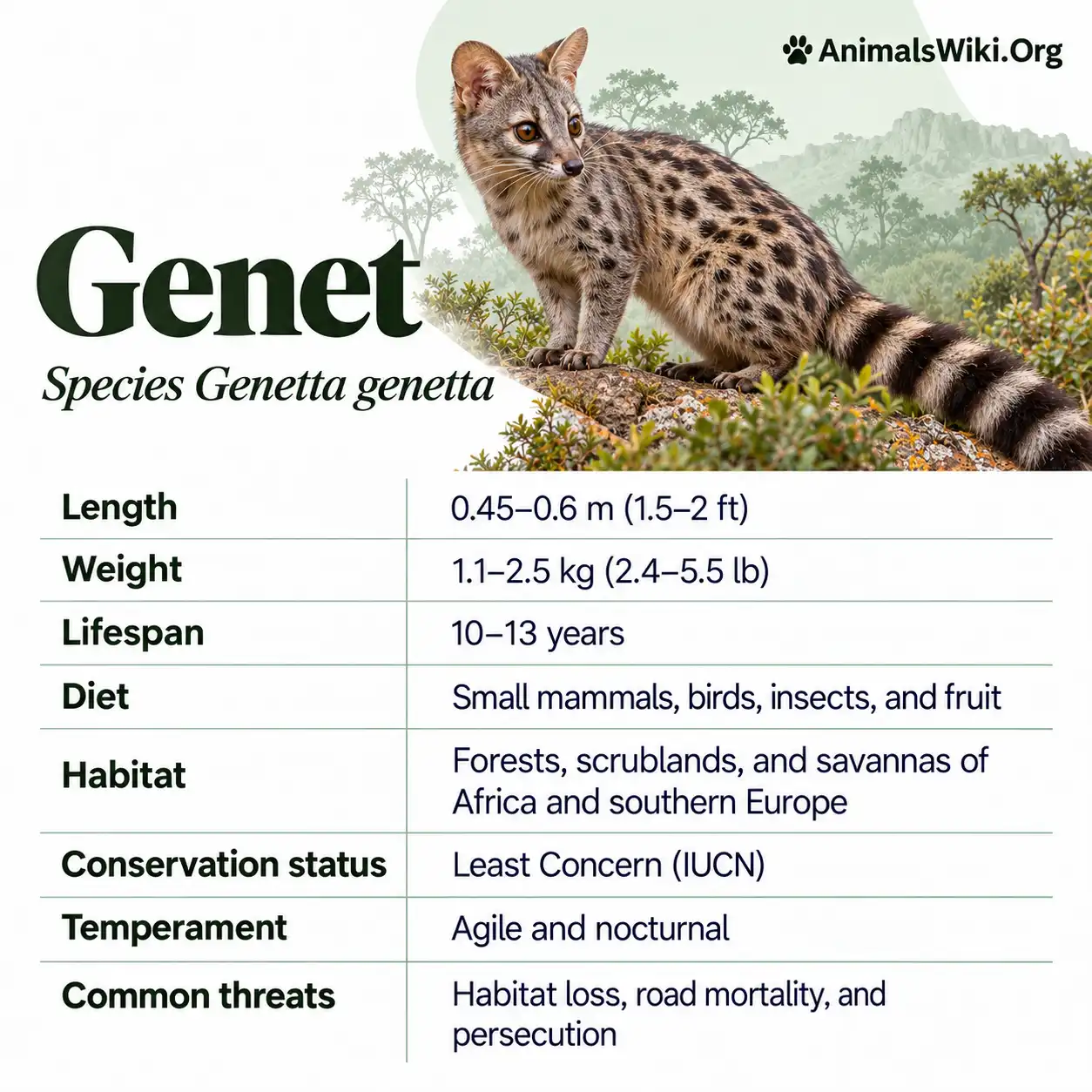
Genet, A Complete Guide to These Elusive Spotted Mammals
A genet is a slender mammal with a spotted coat, pointed face, flexible body, and long, usually ringed tail. Its appearance can suggest a small wild cat, but genets belong to a different family.
Most are secretive nighttime hunters that move between the ground, rocks, dense vegetation, and trees. Their agility helps them investigate narrow spaces and pursue small prey, while scent marks allow communication without constant direct contact.
“Genet” does not describe one species. The genus Genetta contains several species with different distributions, habitat preferences, and conservation needs. Some are widespread and adaptable, while others remain poorly studied or face greater pressure from forest loss and hunting.
The common genet has an especially unusual history. Although genets are primarily associated with Africa, common genets also occur in parts of Europe, where evidence links their presence to historical human introductions.
Their relationships with people vary. Some use farms and suburban gardens, occasionally creating conflict around poultry or buildings. Others live in forests where their presence is detected mainly through camera traps, specimens, or field signs.
This guide explores genet classification, appearance, distribution, diet, climbing, reproduction, communication, ecological importance, and conservation. It also explains how genets differ from cats, civets, and mongooses.
Information checked: October 18, 2026.
Genet Facts
| Feature | Details |
|---|---|
| Common name | Genet |
| Animal group | Mammal |
| Main genus | Genetta |
| Family | Viverridae |
| Order | Carnivora |
| Suborder | Feliformia |
| Main geographic association | Africa |
| Species occurring in Europe | Common genet |
| Typical appearance | Slender body, pointed muzzle, dark markings, and long tail |
| Activity | Mostly nocturnal |
| Main foods | Small animals, with fruit and other foods varying by species |
| Movement | Ground travel and skilled climbing |
| Social pattern | Generally solitary |
| Communication | Scent marking, sounds, posture, and direct encounters |
| Young | Commonly called kits, kittens, or cubs |
| Conservation status | Different for each species |
1. What Is a Genet?
A genet is a small or medium-sized carnivoran belonging to the family Viverridae, which also includes civets and the binturong.
Most animals called genets belong to the genus Genetta.
Their long bodies, short legs, and substantial tails create a distinctive outline. Many have dark spots against a lighter background, together with bands around the tail.
Genets are capable climbers, but they are not confined to the trees. Much feeding and travel can occur on the ground.
They are also not simply miniature predators of one kind of food. Their diets vary with species, season, and local opportunities.
A woodland genet feeding heavily on rodents may use its habitat differently from a forest species encountering more invertebrates or aquatic prey.
Understanding the group therefore requires separating broad similarities from the characteristics of individual species.
2. Is a Genet a Cat?
No. Genets belong to Viverridae, while true cats belong to Felidae.
Both families fall within Feliformia, the catlike branch of the carnivore order, but that broader relationship does not make a genet a feline.
The resemblance is understandable.
Genets have whiskered faces, flexible movements, sharp teeth, and claws useful for climbing and capturing prey.
However, their muzzles are generally more elongated, their bodies are particularly slender, and their tails are proportionally conspicuous.
The term “genet cat” sometimes appears informally, but it can create confusion.
A genet is also different from a serval, leopard cat, or domestic cat.
These distinctions matter beyond naming. Different evolutionary groups have different behavior, care requirements, and ecological roles.
Identifying an animal accurately is the first step toward understanding how it lives and what protection it needs.
3. Scientific Classification
The main classification of genets is:
| Classification level | Name |
|---|---|
| Kingdom | Animalia |
| Phylum | Chordata |
| Class | Mammalia |
| Order | Carnivora |
| Suborder | Feliformia |
| Family | Viverridae |
| Subfamily | Genettinae |
| Genus | Genetta |
| Species | Depends on the animal |
The common genet is Genetta genetta, the servaline genet is Genetta servalina, and Johnston’s genet is Genetta johnstoni.
Scientific names are especially valuable because common names overlap.
Older publications may also use a broader species definition than a modern reference.
For example, some southern African small-spotted genets were historically included within the common genet but are now recognized separately as Genetta felina in the Mammal Diversity Database.
When reading research, both the name and the study location help establish which animals were actually examined.
4. Main Types of Genet
The following examples show the range of species included in the group.
| Common name | Scientific name | Broad association |
|---|---|---|
| Common genet | Genetta genetta | Africa and parts of the wider Mediterranean region |
| Cape genet | Genetta tigrina | Southern Africa |
| Feline genet | Genetta felina | Southern African small-spotted genet |
| Servaline genet | Genetta servalina | African forest environments |
| Pardine genet | Genetta pardina | West Africa |
| Johnston’s genet | Genetta johnstoni | Upper Guinean region |
| Crested genet | Genetta cristata | Restricted part of western Central Africa |
| Aquatic genet | Genetta piscivora | Central African forest waterways |
| Abyssinian genet | Genetta abyssinica | Northeastern Africa |
This table is a selection rather than a complete checklist.
It also demonstrates why one universal description of genet habitat or conservation status is insufficient.
A widespread common genet and a poorly known forest species can face very different ecological conditions.
5. What Does a Genet Look Like?
A typical genet has a long, narrow body, short legs, and a pointed muzzle.
Its eyes are relatively large, and the ears are noticeable without being as oversized as those of a bat-eared fox or aardvark.
Many species have dark spots arranged across the body and bands along the tail.
Some also have a line of longer hair along the back that can become more conspicuous during defensive displays.
Coat color and markings vary between species and individuals.
This variation helps researchers and field observers, but it can also complicate identification.
A dark, blurred nighttime photograph may conceal the shape and placement of spots.
Likewise, a ringed tail alone is not enough to identify the species.
A useful assessment combines location, body proportions, facial markings, tail pattern, and other visible details rather than relying on one familiar feature.
6. Genet Size and Weight
Many familiar genets weigh approximately 1–3 kilograms, although the range differs among species.
Head-and-body length commonly falls around 40–60 centimeters, with a long tail adding substantially to total length.
These figures are broad descriptions, not fixed measurements for every genet.
Age, sex, condition, and geographic variation also influence size.
An important source of confusion is the difference between head-and-body length and total length.
A genet described as nearly a meter long may have much of that measurement in its tail.
Its slender build also makes visual estimates unreliable.
An animal stretched along a branch looks very different from one curled inside a resting site.
For accurate comparisons, use measurements from the same species and confirm whether the tail is included.
Weight provides another reference point, but it should also be interpreted in relation to age and condition.
7. Where Do Genets Live?
Genets are primarily African mammals, with different species distributed across different parts of the continent.
Some occur in relatively dry environments, while others are closely associated with forests.
The common genet also occurs in parts of southwestern Europe and adjoining regions beyond Africa.
This makes it unusual among the group.
However, a broad range does not mean continuous occupancy. Suitable habitat can be separated by towns, agricultural land, open terrain, or other barriers.
The distribution of rarer species may also be incompletely documented.
A lack of observations can indicate low abundance, unsuitable survey methods, or simply limited fieldwork.
Consequently, range maps should be treated as summaries rather than precise descriptions of local population health.
Knowing that a genet species occurs within a country is only the beginning. Conservation requires information about where it remains, how frequently it is detected, and which pressures affect it.
8. How Did Common Genets Reach Europe?
Evidence strongly supports a role for human transport in the common genet’s European history.
Genetic and archaeological studies link European populations with North African origins and indicate a more complex history than one simple introduction.
The precise timing and routes remain subjects of investigation.
Some findings support arrivals earlier than the medieval period often mentioned in popular accounts.
This matters because the animal’s current presence does not automatically establish ancient natural colonization.
It also illustrates how historical human activity can shape modern wildlife distributions.
However, “introduced” and “invasive” are not interchangeable terms.
The first concerns origin; the second involves spread and harmful effects under a particular definition.
An accurate article should therefore explain the evidence for introduction without assuming that every introduced population has the same ecological consequences.
The common genet’s European story is a combination of transport, establishment, dispersal, and adaptation over time.
9. Genet Habitat Requirements
Genets use habitats including woodland, scrub, savanna, forest, rocky areas, and some agricultural landscapes.
The exact combination depends on the species.
Cover is often important because it provides concealed travel routes, resting opportunities, and access to prey.
Trees can contribute shelter and climbing routes, while rocks and dense vegetation provide alternatives at ground level.
An apparently suitable landscape may still lack a critical resource.
For example, abundant prey is less useful if secure daytime shelter is absent.
Likewise, isolated patches can be difficult to reach if the surrounding terrain is exposed or dangerous.
Habitat quality is therefore more than a label such as “forest” or “farmland.”
It involves the arrangement of resources and the animal’s ability to move between them.
This is particularly relevant for adaptable genets living in mixed landscapes where natural and human-made features occur together.
10. Climbing Adaptations and Flexible Movement
Genets are skilled climbers.
Their flexible bodies, sharp curved claws, and long tails help them navigate branches, rocks, and irregular surfaces.
The claws are generally described as retractile or semi-retractile, depending on the species and source.
Keeping them away from constant ground wear helps preserve useful gripping points.
However, a genet is not exclusively arboreal.
It can travel and hunt on the ground, climb to investigate prey, and rest in elevated shelter.
This combination creates flexibility.
A tree may provide safety or a route across an obstacle, while the ground offers abundant small animals.
The tail contributes to balance, but it is not a grasping tail equivalent to that of a binturong.
Its value comes from coordinated body movement rather than wrapping around a branch as an additional gripping limb.
11. Daytime Resting Sites
A genet’s resting place is an essential part of its habitat.
Common genets have been recorded using dense thickets, trees, and other concealed locations.
Individuals can maintain several resting sites and return to them with varying frequency.
A study in Mediterranean habitat found selection for protected locations, including densely vegetated ravines and sites away from roads or tracks.
This shows why preserving cover matters even when an area contains food.
A resting site provides concealment and reduces exposure during inactive periods.
The animal may also need different options as weather, disturbance, or reproductive condition changes.
One hollow tree should not therefore be assumed to meet every requirement indefinitely.
Protecting a network of shelters and connecting vegetation can be more useful than focusing on a single location where an animal happened to be observed.
12. Are Genets Nocturnal?
Most studied genets are strongly nocturnal.
They usually begin activity around darkness and spend much of the day in concealed resting sites.
However, activity patterns vary among populations and individuals.
A brief daylight observation does not automatically mean the animal is sick.
It may have been disturbed, be changing shelter, or be responding to particular conditions.
Research using radio tracking provides a more complete picture than occasional sightings.
A study in southwestern Spain documented nighttime movement and repeated use of different resting locations.
Other research on African genets also found activity concentrated between sunset and sunrise.
The general pattern is clear, but exact schedules should not be presented as universal.
For wildlife watching, the implication is to avoid disturbing resting animals merely to make them visible.
The behavior observed afterward would reflect the interruption rather than a normal undisturbed routine.
13. What Do Genets Eat?
Genets consume a variety of foods.
Small mammals are important in many studied populations, alongside birds, insects, other invertebrates, reptiles, amphibians, and fruit.
The mixture changes with species and environment.
A common genet living in Mediterranean woodland may rely heavily on rodents, while an African population encounters a different prey community.
This variation is central to their feeding ecology.
They should not be described as animals that eat only birds or only mice.
Likewise, calling them omnivores does not mean plant and animal foods contribute equally everywhere.
A review of common genet diets found substantial geographic variation, including populations with broad diets and others more strongly focused on small mammals.
The best description combines flexibility with the importance of particular local foods.
Their survival depends on what they can obtain consistently, not simply the full list of items ever recorded.
14. How Genets Hunt
A hunting genet moves through suitable cover while investigating potential prey.
It can search along the ground, examine crevices, or climb into vegetation.
Its agility allows access to places that a heavier predator may find difficult to use.
Small prey can be captured through short bursts of movement rather than prolonged pursuit.
The animal must judge distance, approach opportunities, and the costs of continuing an unsuccessful search.
Hunting therefore includes repeated decisions, not just the final pounce.
The usefulness of climbing depends on the food available.
Birds or nests may be reached above ground, while rodents and invertebrates provide opportunities elsewhere.
This flexible use of vertical space helps explain why genets often combine terrestrial and arboreal behavior.
A genet seen in a tree is not necessarily spending its entire night there, just as one crossing a road is not exclusively a ground-dwelling animal.
15. Seasonal Changes in Diet
Food availability changes throughout the year, and genets can adjust their feeding accordingly.
Research in Algeria found seasonal shifts involving arthropods, mammals, birds, and plant material.
In that study, insects were especially prominent during warmer periods, while other foods gained importance at different times.
A separate Portuguese study also documented seasonal changes in the foods recorded.
These findings do not establish one calendar for every population.
Rainfall, temperature, plant fruiting, and prey reproduction differ geographically.
The useful principle is that a flexible predator can respond to changing opportunities.
However, flexibility has limits.
A change in diet does not prove that every substitute provides the same energy or is equally easy to obtain.
Condition, reproductive success, and survival are needed to determine whether the animal is merely changing its meals or successfully compensating for a resource shortage.
16. Fruit Consumption and Seed Dispersal
Fruit is part of the diet of some genets.
When seeds are swallowed and passed intact, the animal can move them away from the original plant.
However, eating fruit does not automatically make a genet an effective disperser for every plant involved.
The eventual destination matters.
A seed deposited on exposed rock or in an unsuitable latrine may have little chance of establishing.
Research on common genets in Mediterranean island environments found fruit consumption but also raised questions about the suitability of many deposition sites.
This distinction is useful because ecological benefits should be assessed rather than assumed.
Dispersal involves handling, survival through digestion, movement, germination, and seedling survival.
Genets can participate in that process without being equivalent to strongly fruit-eating palm civets or binturongs.
Their role depends on the plant and the particular feeding event.
17. Understanding Diet Studies
Much information about genet food comes from examining droppings.
Researchers identify remains such as hair, bones, feathers, insect parts, and seeds.
This can reveal a broad food spectrum, but the measurement requires interpretation.
The frequency of a food item is not identical to its contribution to energy intake.
Many small insects can appear frequently while supplying less biomass than a smaller number of rodents.
A study in northern Spain showed this difference clearly: the importance of food categories changed when researchers considered estimated biomass rather than only occurrence.
This is why two summaries can appear inconsistent while describing different measurements.
For readers, the useful question is what the percentage represents.
Accurate interpretation helps avoid turning a detailed feeding study into a misleading claim about what a genet “mostly eats” everywhere.
18. Home Ranges and Travel
A genet uses a home range containing feeding sites, resting locations, and opportunities to encounter other individuals.
Home range is not the same as a nightly route.
It also is not automatically an area from which every other genet is excluded.
Research has found considerable variation in range size between individuals and environments.
Food distribution, shelter, sex, season, and analytical method can all influence estimates.
A study of male common genets in northern Spain found notably different range sizes even among animals using broadly similar habitat types.
This makes a single universal space requirement inappropriate.
For conservation, the important issue is whether the landscape contains enough connected resources.
A genet may need to move through several habitat patches to complete ordinary activities.
Protecting one resting tree or feeding location therefore addresses only part of its needs.
19. Solitary Does Not Mean Socially Disconnected
Adult genets are generally solitary.
They usually travel and forage independently rather than forming packs, mobs, or clans.
Mothers with dependent young are an important exception.
However, solitary animals can still exchange substantial information.
Home ranges may overlap, scent marks remain after their makers leave, and encounters occur during breeding or other interactions.
This means direct companionship is only one form of social connection.
A genet can respond to another individual without seeing it.
The distinction is important when comparing genets with meerkats or spotted hyenas.
Their social organization is less visibly group-based, but it is not an absence of communication or recognition.
Understanding that organization requires following movement and scent use over time rather than expecting all relationships to appear as animals resting together.
20. Scent Marking and Recognition
Genets use scent to communicate.
Sources can include glandular secretions, urine, and other material associated with marking behavior.
Marks can be left through contact with objects and surfaces.
The information may remain available after the animal moves on, making scent especially useful for solitary mammals.
Experimental research on common genets found that females could distinguish familiar male scent marks from unfamiliar ones after a period of separation.
This supports the role of odor in individual recognition.
It does not mean scientists can translate every mark into a precise message.
Researchers infer function from patterns of investigation and response.
The broader lesson is that a genet’s social world includes information distributed across its habitat.
A branch, rock, or frequently used route can carry evidence that influences later behavior.
21. Genet Latrines
Genets often use repeated defecation sites called latrines.
These can occur on conspicuous surfaces such as rocks, branches, or old trees.
They provide useful locations for studying diet, but they also form part of the communication landscape.
Research in Portuguese cork oak woodland found latrine placement associated with features including understory cover, potential refuges, and limited disturbance.
Old trees could therefore serve more than one function: resting shelter and a site for scent communication.
A latrine does not necessarily represent only one individual.
Likewise, many droppings do not automatically mean many animals.
Repeated use creates an accumulation over time.
For population monitoring, cameras or genetic evidence may be needed to establish which animals contribute.
The latrine is a valuable clue, but it should not be treated as a straightforward census.
22. Body Language and Defensive Behavior
Genets can respond to threats through posture, movement, sounds, and scent.
A defensive common genet may arch its back, raise hair along the body and tail, hiss, or expose its teeth.
These actions change its apparent size and communicate readiness to defend itself.
However, a dramatic display does not prove the animal is habitually aggressive.
It may be reacting to being cornered or approached.
Avoidance and retreat are also important defenses.
The flexible body and climbing ability can provide routes away from danger, while dense cover offers concealment.
For observers, interpreting the context matters.
An animal photographed with raised hair may be responding directly to the photographer.
A respectful encounter allows the genet to continue its own activity rather than forcing a visible defensive reaction for a more striking image.
23. Genet Reproduction
Reproduction differs among genet species and populations.
There is no single breeding season or litter size that accurately describes the whole genus.
For the common genet, pregnancy is commonly reported at approximately 10–11 weeks, with small litters.
Other species can differ in timing and the number of young.
Local conditions influence when reproduction is advantageous.
Food availability and suitable shelter affect whether a female can support herself and her offspring.
Genets do not generally form the cooperative breeding groups familiar from meerkats.
Maternal care is therefore especially important.
A safe birth site provides concealment while the young are unable to travel effectively.
For an accurate species account, reproductive figures should identify the animal and location rather than presenting one average as a universal genet timetable.
24. Baby Genets and Early Development
Young genets are commonly called kits, kittens, or cubs.
Newborns depend on their mother and are initially unable to function independently.
Their eyes open after birth, and movement and coordination improve gradually.
They begin taking solid food before complete nutritional independence.
This transition involves several separate abilities.
A young genet must learn to move safely, handle prey, investigate unfamiliar surroundings, and use shelter.
A youngster that can leave the den is not necessarily capable of feeding as efficiently as an adult.
Likewise, eating its first solid meal does not end maternal dependence immediately.
Descriptions of development should therefore use stages rather than imply one sudden moment of adulthood.
Observation under professional care can document these stages closely, while field studies are needed to understand how they unfold under natural conditions.
25. How Mothers Raise Young
Female genets provide the main care for their offspring.
The arrangement differs from aardwolf pairs, where a male can contribute substantially to den guarding, and from meerkat groups with numerous helpers.
For Cape genets, professional accounts describe mothers keeping young in protected roosts and caring for them without a lasting pair bond.
As offspring develop, the demands shift.
Early care centers on nursing and protection, while later development involves exposure to solid food and increasing movement.
The mother must balance those needs with her own feeding.
Shelter quality can therefore influence reproduction as well as adult survival.
A resting site that is adequate for one adult may not offer the same security for a litter.
This is another reason to protect varied cover and suitable refuges rather than considering only the places where adults hunt.
26. How Long Do Genets Live?
Lifespan varies between species and conditions.
Records under human care demonstrate that some genets can live for more than two decades.
However, maximum longevity is not the same as a typical wild lifespan.
The AnAge database records a common genet surviving at least 22.7 years in captivity and specifically treats a widely repeated 34-year claim as doubtful.
This illustrates why impressive numbers should be checked before being repeated.
Wild survival is harder to establish because animals can disperse beyond the monitored area.
Predation, roads, injuries, food, and human conflict all influence outcomes.
For conservation, survival across life stages is more informative than one exceptional age.
A population needs enough young to survive and enough adults to reproduce successfully, regardless of what the oldest individual can achieve under protected conditions.
27. Predators and Natural Risks
Genets can become prey for larger carnivores, large snakes, and birds of prey.
The relevant predators differ across their geographic range.
Young animals face different vulnerabilities from adults, particularly while learning to move and hunt.
Their main defenses include concealment, climbing, rapid changes of direction, and retreat into protected spaces.
Nocturnal activity may also alter exposure to particular threats.
However, agility does not eliminate danger.
An animal crossing open ground or a road may have fewer options than one moving through connected vegetation.
This explains why habitat structure matters even to an adaptable predator.
Cover can provide both food and a means of avoiding becoming food.
The ecological picture is therefore more complete when genets are viewed as intermediate members of food webs rather than simply hunters acting without risk.
28. The Genet’s Ecological Role
Genets consume small animals and participate in food webs as both predators and prey.
Their feeding can influence local rodent, insect, and other prey communities.
Some also move seeds through fruit consumption.
However, it is too broad to promise that every genet provides effective pest control or improves every ecosystem where it occurs.
Ecological effects depend on abundance, diet, prey vulnerability, and whether the population is native or introduced.
An animal eating rodents may also take birds or other wildlife.
The useful approach is to describe documented feeding relationships and evaluate wider effects.
The genet’s role remains interesting without calling it a universal solution to pests.
Its presence can reflect a landscape offering cover, prey, and connectivity, but that alone does not establish overall ecosystem health.
Different processes require different evidence.
29. Genets in Towns and Suburbs
Some genets use urban and suburban environments.
Research in the Durban area documented animals using human-made structures for resting or breeding and obtaining food in residential settings.
These observations show flexibility, but they do not mean all genet species adapt equally well.
They also reveal risks.
Domestic animals and vehicles were reported among causes of mortality in the studied setting.
Food left outside can change movements and encourage repeated visits, potentially increasing conflict.
A genet seen near a house may be using one resource within a much larger range.
Its presence should not automatically be interpreted as dependence on people.
The conservation opportunity is to retain useful vegetation and reduce avoidable hazards.
The challenge is to do so without encouraging handling, feeding, or expectations that a wild animal will behave like a household pet.
30. Roads, Movement, and Dispersal
Roads affect genets through direct collisions and changes in movement.
A motorway study in Portugal combined mortality records, tracking, and genetics.
Resident animals often used space differently near the road, while some dispersing younger animals crossed it.
The findings demonstrate why road effects cannot be evaluated from one measurement alone.
A population may retain some gene flow while still suffering substantial deaths.
Likewise, an animal avoiding a road may survive but lose access to useful habitat.
Mitigation needs to address both problems.
Crossing structures can help, but design and monitoring matter.
Separate research found that dry ledges encouraged genet use of some culverts, while the fencing tested did not produce a clear reduction in recorded road mortality.
A crossing being used is encouraging evidence, not automatic proof that the entire problem has been solved.
31. Are Genets Endangered?
There is no single conservation category for all genets.
The common genet and Cape genet are listed as Least Concern in the consulted information.
Other species face greater concern.
| Species | Conservation category in the consulted sources |
|---|---|
| Common genet | Least Concern |
| Cape genet | Least Concern |
| Servaline genet | Least Concern |
| Pardine genet | Least Concern |
| Johnston’s genet | Near Threatened |
| Aquatic genet | Near Threatened |
| Crested genet | Vulnerable |
These differences matter.
A familiar common genet in Europe does not represent the condition of a forest species in Africa.
Older sources can also contain outdated categories, particularly for poorly known animals.
Assessment date, taxonomic treatment, and geographic scale should therefore be checked.
Near Threatened is different from Vulnerable, while regional assessments may differ from the global category.
32. Threats to Genets
Threats vary across species and landscapes.
Habitat loss can remove forest, cover, or resting trees.
Hunting and trapping can affect animals directly, while persecution may follow real or perceived poultry losses.
Vehicles and domestic animals create additional risks near settlements.
Poison can also affect genets, including indirectly through contaminated prey.
These pressures can overlap.
A genet using an altered landscape may find food while also encountering more roads and conflict.
For restricted forest species, habitat change can be especially important because there may be fewer alternative areas available.
Conservation therefore begins with identifying the relevant species and local circumstances.
A broad statement that genets are adaptable should not be used to dismiss documented losses or the needs of animals with narrower distributions.
33. How Scientists Study Genets
Researchers use direct observation, tracking, camera traps, genetic samples, and dietary analysis.
Each method answers different questions.
A camera can establish that an animal used a location, while tracking reveals routes between detections.
Droppings provide information about food, but reliable species identification may require additional evidence where similar carnivores coexist.
Movement models can separate activities such as resting, traveling, and foraging.
This matters because the same location may be used for different purposes.
A roadside detection could represent a brief crossing, nearby feeding, or resting in adjacent cover.
Repeated data help distinguish those possibilities.
The strongest studies combine methods rather than expecting one photograph or one latrine to reveal population size, reproductive success, and habitat quality simultaneously.
For secretive mammals, careful interpretation is as important as collecting more records.
34. Living Alongside Genets
A genet near a home is not automatically aggressive or abandoned.
It may be traveling, hunting, or using shelter.
Observe from a distance and give it a route away.
Do not attempt to pick it up, corner it, or encourage close contact with food.
Where poultry losses occur, practical protection is more useful than assuming every nocturnal visitor is responsible.
Secure enclosures and appropriate management can reduce conflict.
If an animal is using a roof or other structure, seek locally suitable wildlife advice before blocking access, especially when dependent young may be present.
The goal is to reduce problems without trapping animals inside or separating a mother from offspring.
Genets are wild mammals with their own behavior and needs.
Tolerance works best when combined with boundaries that prevent avoidable conflict.
35. Genet vs. Cat, Civet, and Mongoose
| Feature | Genet | Cat | Civet | Mongoose |
|---|---|---|---|---|
| Main family | Viverridae | Felidae | Usually Viverridae | Herpestidae |
| Typical body form | Slender, long-tailed | Highly variable | Variable, often elongated | Variable, often long-bodied |
| Familiar markings | Spots and tail rings in many species | Variable | Masks, spots, stripes, or bands | Often plainer, with exceptions |
| Common feeding pattern | Small prey with variable other foods | Predominantly animal prey | Often mixed diets | Insects and other foods, depending on species |
| Social pattern | Usually solitary | Variable | Often solitary | Solitary or social, depending on species |
| Climbing | Often highly capable | Common in many species | Strong in many palm civets | Variable |
These are broad comparisons rather than rules covering every member.
The closest everyday comparison for a genet is often a civet relative with a particularly slender body and long tail, rather than a small domestic cat.
36. Genet Myths and Facts
| Common claim | More accurate explanation |
|---|---|
| A genet is a wild cat | It belongs to Viverridae |
| Genet describes one species | Several species belong to Genetta |
| Every genet has the same habitat | Requirements differ among species |
| Small-spotted always identifies one species | The name is used differently across regions and references |
| Its tail grips branches | It primarily assists balance |
| It spends its whole life in trees | Much feeding and travel can occur on the ground |
| Solitary means no social communication | Scent and repeated marking sites connect individuals |
| Many droppings mean many genets | Latrines accumulate through repeated use |
| All genets are harmless to poultry | Predation can occur, although identification matters |
| Every genet is endangered | Conservation status varies |
| Introduced automatically means equally harmful everywhere | Origin and ecological impact are separate questions |
| A tame genet is domesticated | Tameness does not change its wild biology |
37. Frequently Asked Questions About Genets
What is the scientific name of a genet?
There is no single species-level name for every genet. The genus is Genetta. Examples include Genetta genetta, the common genet, and Genetta tigrina, the Cape genet. Accurate information should identify the species concerned.
Is a genet a cat?
No. Genets belong to Viverridae, while cats belong to Felidae. Their flexible movement and appearance create a resemblance, but their family relationships and biology differ.
Is a genet related to a civet?
Yes. Genets and most animals commonly called civets belong to Viverridae. However, civet is a broad common name, and not every animal carrying it belongs to that family.
Where do genets naturally live?
They are primarily associated with Africa. The common genet also occurs beyond Africa, including parts of Europe. European populations have a history strongly linked to human introduction rather than a simple assumption of native occurrence.
How big is a genet?
Many familiar species weigh around 1–3 kilograms. Their long tails add substantially to total length, so a head-and-body measurement can look much smaller than the full animal. Exact size depends on species and individual condition.
What do genets eat?
Small mammals, birds, insects, other invertebrates, reptiles, amphibians, and fruit can be included. Their proportions vary considerably. A feeding study from one population should not be treated as the universal diet of the genus.
Do genets eat mice and rats?
They can consume rodents, and small mammals are important in many common genet diets. However, this does not establish that every local population provides measurable pest control or eats only unwanted species.
Do genets eat birds?
Yes. Birds and eggs can be part of the diet. The importance varies with habitat and season. Poultry predation can create conflict, but losses should be investigated rather than automatically attributed to any genet seen nearby.
Can genets climb trees?
Yes. Many are skilled climbers using sharp claws, balance, and flexible movement. Climbing complements ground-level feeding and travel rather than requiring the animal to remain permanently in trees.
Is a genet’s tail prehensile?
No. Its long tail is useful for balance but does not function like the grasping tail of a binturong. A long tail and a prehensile tail are different adaptations.
Are genets nocturnal?
Most studied species are mainly nocturnal. Daytime activity can still occur, particularly if an animal is disturbed or changing shelter. A single daytime observation does not establish illness.
Where do genets sleep?
Depending on species and habitat, they can rest in dense vegetation, trees, cavities, rocky shelters, or human-made structures. Individuals may use several sites rather than one permanent den.
Do genets live in groups?
Adults are generally solitary, with breeding encounters and mothers with young providing important exceptions. Overlapping home ranges or shared marking locations do not automatically indicate permanent group living.
How do genets communicate?
They use scent marking, posture, sounds, and direct encounters. Scent is especially valuable because information can remain after the marking animal has departed.
What is a genet latrine?
It is a repeatedly used defecation site. Latrines can contribute to communication and provide dietary evidence for researchers. They may be used by more than one animal and should not be counted as individual genets.
What is a baby genet called?
Young are commonly called kits, kittens, or cubs. They initially depend on their mother and gradually develop movement, feeding, and hunting abilities.
How long is a genet pregnant?
It varies by species. Common genet pregnancy is often reported at approximately 10–11 weeks, while other genets differ. A precise figure should always identify the animal being described.
How many babies does a genet have?
Genets generally produce small litters, but litter size differs among species and individual births. Common genet accounts often report one to three young, while some other species can have larger litters.
Does the father help raise the young?
Genets do not generally have the cooperative family system seen in meerkats. Mothers provide the main care, and Cape genet accounts describe no lasting pair bond or paternal care.
How long do genets live?
Longevity varies. Some have lived beyond 20 years under human care, but such records do not describe normal wild lifespan. Exceptionally high ages should be checked carefully before being repeated.
Are genets dangerous to people?
They are wild mammals capable of biting or scratching if handled or cornered. Their usually secretive behavior does not make close contact appropriate. Give them space and avoid feeding.
Can genets be pets?
They are unsuitable as ordinary household pets. Their nocturnal habits, scent marking, movement needs, feeding, and defensive behavior require specialized management. A hand-raised genet remains a wild animal.
Are genets endangered?
Some species are of conservation concern, while others are Least Concern. The crested genet is Vulnerable, and Johnston’s genet and the aquatic genet are Near Threatened in the consulted information.
Do genets smell strong?
They can produce noticeable scent secretions used in communication and defense. The presence and intensity of odor depend on circumstances. Scent marking is part of normal biology rather than a behavior that disappears through taming.
How can people help protect genets?
Retain suitable habitat and shelter, reduce unnecessary persecution, secure vulnerable poultry, and observe responsibly. Supporting research and well-designed road mitigation also helps address risks that can remain hidden in secretive species.



