
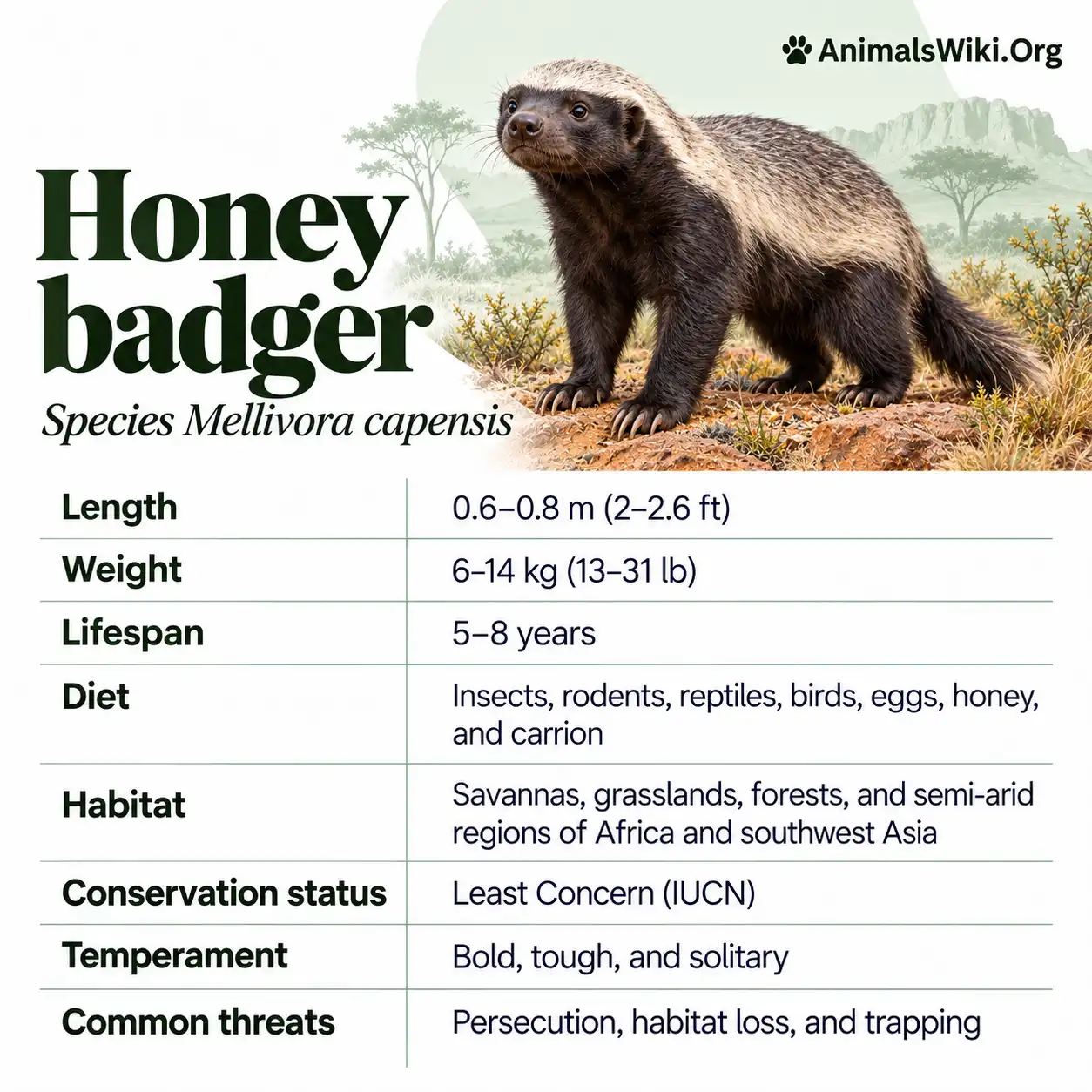
Honey Badger, A Complete Guide to the Remarkable Ratel
The honey badger is a powerful, adaptable mammal famous for its determined behavior, digging ability and striking black-and-gray coat. Also called the ratel, it has become one of the most recognizable small carnivores in the world.
Much of that fame comes from dramatic wildlife footage. A honey badger confronting a snake or standing its ground against a larger predator makes an unforgettable scene. However, these encounters reveal only a small part of its life. Most of a honey badger’s time is devoted to finding food, moving through its surroundings and resting in sheltered places.
Behind its reputation lies an animal with an interesting combination of physical defenses, flexible feeding habits and a surprisingly lengthy period of maternal care. Scientific research also reveals that several popular claims about honey badgers need qualification, especially statements about complete venom immunity or universal cooperation with honeyguide birds.
Understanding the honey badger means looking beyond its internet personality. Its relationships with prey, predators, beekeepers and changing landscapes tell a richer story about survival.
This guide explores honey badger identification, distribution, habitat, diet, hunting, reproduction, conservation and the evidence behind its most famous abilities.
Information checked: October 18, 2026.
Honey Badger Facts
| Feature | Information |
|---|---|
| Common name | Honey badger |
| Alternative name | Ratel |
| Scientific name | Mellivora capensis |
| Animal group | Mammal |
| Order | Carnivora |
| Family | Mustelidae |
| General appearance | Stocky body, dark underparts and a pale upper mantle |
| Size difference | Adult males are generally larger than females |
| Distribution | Parts of Africa and Asia |
| Feeding pattern | Primarily carnivorous and opportunistic |
| Common foods | Small mammals, reptiles, invertebrates and bee brood |
| Social behavior | Mostly solitary |
| Shelter | Burrows and other protected resting places |
| Parental care | Provided by the mother |
| Global conservation category | Least Concern |
1. What Is a Honey Badger?
A honey badger is a ground-dwelling carnivorous mammal with a broad head, muscular body, short legs and strong digging claws. It belongs to the family Mustelidae and is classified in the genus Mellivora.
Although the word “badger” appears in its common name, it is a distinct animal with its own evolutionary history. Its scientific classification places it in the subfamily Mellivorinae.
One useful way to understand the species is to think of it as a mobile hunter equipped to reach food hidden beneath the ground. Its body allows it to investigate burrows, excavate prey and defend itself during difficult encounters.
This combination helps explain several features that might otherwise seem unrelated. Strong shoulders support digging. A well-developed nose helps locate concealed food. Tough skin offers protection when prey or predators fight back.
The honey badger’s biology is therefore closely connected to how it earns a living. Its celebrated toughness is part of a broader package of adaptations for a demanding lifestyle.
2. Why Is It Called a Honey Badger or Ratel?
The name “honey badger” reflects its association with beehives. However, a hive contains more than honey. It also holds developing bees, including larvae and pupae, which provide animal food.
Descriptions that present the honey badger as a mammal surviving mainly on sweet honey create a misleading picture. Hive raiding is one part of a much broader feeding strategy. Small animals and other accessible foods are central to its diet.
“Ratel” is another established common name for the same species. A ratel and a honey badger are not separate animals. San Diego Zoo Wildlife Alliance uses both names in its species information.
Common names often emphasize an animal’s most memorable behavior. In this case, the name highlights an activity that also brings the species into conflict with people.
When reading about honey badgers, it helps to keep the common name separate from the full biological picture. A memorable label can be accurate without describing everything the animal eats or does.
3. What Does a Honey Badger Look Like?
The honey badger has a distinctive two-tone appearance. Its face, sides and underparts are dark, while a broad pale mantle covers much of the upper head and back.
The mantle may appear white, gray or gray-brown. Its exact appearance varies, so photographs do not always show an identical pattern. The hair is coarse, and the animal has a compact, heavily built outline.
Other recognizable features include small eyes, inconspicuous ears, a broad nose and a short tail. Its low stance and strong forequarters contribute to its solid appearance. Detailed anatomical descriptions also note variation in coat characteristics with age and location.
For identification, the overall combination is more useful than any single feature. A pale back alone is not sufficient because other mammals can have contrasting coats.
Look for the broad upper mantle together with the dark face, stocky body, short legs and digging forefeet. Even in a brief camera-trap image, that combination can make a honey badger recognizable.
4. Honey Badger Size and Weight
Honey badgers are substantial small carnivores, but their size is often exaggerated in online discussions. They are muscular animals rather than exceptionally large mammals.
Measurements vary with sex, population and the individuals sampled. San Diego Zoo Wildlife Alliance’s fact-sheet summary gives approximate body lengths of 72 centimeters for males and 64 centimeters for females, with representative weights of about 9.4 kilograms and 6.2 kilograms respectively.
These figures are examples rather than universal limits. Adult males are generally heavier than adult females.
It is also important to distinguish body length from total length. Some descriptions include the tail, while others measure only the head and body. Mixing these measurements can create the impression that sources disagree more than they actually do.
A clear size description should therefore identify what was measured and avoid presenting an unusually large animal as typical. The honey badger’s defensive effectiveness comes from several traits working together, rather than body weight alone.
5. How Tough Is Honey Badger Skin?
Honey badger skin is both tough and loose. These qualities contribute to its defense, particularly during close contact with an attacker.
Loose skin can make it harder for another animal to hold the honey badger securely. It may also allow the badger to turn and bite while part of its body is being gripped.
Anatomical accounts describe especially thick skin around parts of the neck, with thinner skin on the underparts. Protection is therefore uneven across the body.
Calling this skin “armor” can be a useful comparison, provided it is not taken literally. It does not make the animal invulnerable, and it cannot prevent every bite, sting or serious injury.
The practical advantage is more modest and biologically meaningful: skin that reduces damage or makes capture difficult can improve the chance of surviving a dangerous encounter.
Even partial protection matters. An animal does not need perfect defenses to discourage an attacker or create an opportunity to escape.
6. Claws, Feet and the Digging Body
The honey badger’s forefeet are important feeding tools. They are broad and equipped with long, powerful claws that help break into soil and other material.
Its hind claws are smaller. This difference reflects the greater excavation work performed by the front limbs. Anatomical descriptions also identify powerful shoulders and neck muscles, robust teeth and five toes on each foot.
Digging requires a coordinated body rather than strong claws alone. The animal must brace itself, loosen material and move the displaced soil out of the way.
A useful comparison is with a person using a shovel. The blade matters, but so do the arms, shoulders, stance and repeated movements that make excavation possible.
For a honey badger, this physical equipment opens access to food that another predator might walk past. An animal concealed beneath the surface is not necessarily safe from a hunter that can detect it and dig efficiently.
7. Where Do Honey Badgers Live?
Honey badgers occur across a broad but uneven range in Africa and Asia. Their distribution includes much of sub-Saharan Africa and extends through parts of southwestern and southern Asia.
This broad geographic description should not be interpreted as continuous occupation of every landscape between known records. Suitable habitat, human pressure and local history all influence where populations persist.
Species summaries describe the honey badger as a habitat generalist, with populations occurring in environments ranging from forest to arid country.
A range map is best understood as an overview. Within a large shaded area, some places may support regular populations while others have few records or no suitable conditions.
This distinction is especially useful when discussing an elusive animal. “Occurs in the country” does not necessarily mean “commonly seen throughout the country.”
Local surveys are needed to turn a broad distribution outline into a detailed understanding of where honey badgers live and how they use those places.
8. Honey Badgers in Asia
The Asian part of the honey badger’s range receives less public attention than its African populations. Nevertheless, Asian records are important for understanding the species as a whole.
Published research has documented honey badgers through camera trapping in India. One study from the Tarai East Forest Division in Uttarakhand reported photographs from a riverbank–canal habitat and emphasized the need for further ecological research.
The authors also highlighted gaps in knowledge about local populations and behavior.
A confirmed photograph establishes that an animal was present at a particular place and time. It does not, by itself, establish how many honey badgers live nearby or whether their numbers are increasing.
That is why occasional records are valuable starting points rather than complete population assessments.
Research priorities in Asian landscapes include repeated surveys, better information about habitat use and careful documentation of threats. Findings from African studies can guide questions, but regional differences still need to be investigated directly.
9. Honey Badger Habitat Requirements
Honey badgers use diverse environments, but habitat flexibility does not mean they can live successfully anywhere.
Food and shelter remain essential. A landscape must offer enough accessible prey and suitable places to rest. Cover can also matter, even where the species occupies relatively open country.
South African assessment information notes that honey badgers use many habitat types but are generally absent from some of the most open central parts of particular biomes, suggesting the importance of cover.
Habitat quality is therefore more complicated than a label such as “grassland” or “forest.” Two areas with the same broad vegetation type may differ greatly in food availability, disturbance and safe resting sites.
For conservation, the useful question is whether a landscape supports the animal’s daily needs over time.
A patch that a honey badger crosses once is not necessarily equivalent to a place where it can repeatedly feed, rest and raise a cub.
10. Burrows and Resting Places
Honey badgers excavate their own shelters and also use spaces created by other animals. Reported resting places include burrows, rock crevices and cavities around tree roots.
San Diego Zoo describes the use of abandoned dens made by several other mammals, including aardvarks. This illustrates how one species’ digging can create opportunities for another.
A resting place provides more than somewhere to sleep. It separates the animal from surface conditions and offers concealment during periods when it is inactive.
It is useful to distinguish a temporary resting shelter from a place used to rear young. The risks and requirements of these situations differ, even when both involve an underground chamber.
For anyone monitoring wildlife, an empty entrance is not enough to identify its current occupant. A burrow may be reused, enlarged or visited by several species over time.
Repeated observations provide stronger evidence than assumptions based only on the shape of a hole.
11. Are Honey Badgers Nocturnal?
Honey badgers are often active at night, but describing them as strictly nocturnal oversimplifies their behavior.
Research in the Kalahari found substantial seasonal changes in activity. The animals became more active during daylight in colder conditions and more nocturnal during hotter periods. Temperature appeared to be an important influence on their schedules.
The study also described morning and evening activity peaks that did not always correspond neatly with twilight.
This flexibility helps explain why one observer may see a honey badger during the day while another records it mainly at night.
Activity patterns should be interpreted in relation to place, season and local conditions. A daytime sighting is not automatically evidence that something is wrong.
For wildlife photography or surveys, relying on a single assumed timetable can lead to missed observations. Recording the actual timing of detections is more informative than forcing every population into one universal schedule.
12. What Does a Honey Badger Do All Day?
A typical active period involves extensive searching, walking, sniffing and digging. The honey badger’s daily life is dominated by obtaining food rather than confronting larger animals.
Behavioral summaries describe a meandering search pattern and substantial time devoted to intensive foraging. Resting occupies another major portion of its time.
The searching process is easy to underestimate. A predator feeding on small, scattered prey may need many successful captures to meet its needs.
This creates a different rhythm from that of an animal taking one large prey item and feeding from it for an extended period. Progress across the landscape can consist of repeated investigations and short digging attempts.
A few seconds of dramatic footage rarely represent this ordinary routine. Watching a honey badger forage reveals its persistence more clearly than watching a confrontation.
Its survival depends on making repeated, practical decisions about where to search and when to move on.
13. What Do Honey Badgers Eat?
Honey badgers are opportunistic feeders whose diets are dominated by animal food. Recorded prey includes small mammals, reptiles and invertebrates.
An early study in the Kalahari found rodents to be especially important, followed by lizards and scorpions. The researchers also recorded larger prey and snakes.
Diet varies across locations, so no single list describes every population equally well.
| Food category | Examples or feeding opportunities |
|---|---|
| Small mammals | Rodents and other accessible small prey |
| Reptiles | Lizards and snakes |
| Invertebrates | Scorpions, insects and developing bees |
| Other animal foods | Birds, eggs or carrion when available |
| Plant material | Some fruit and other occasional items |
The term “opportunistic” means the animal can exploit different resources. It does not mean every potential food is equally important.
Understanding its diet requires attention to frequency, quantity and nutritional contribution. One unusual prey record may be interesting without representing an ordinary meal.
14. How Honey Badgers Find and Capture Food
Much honey badger hunting involves detecting food that is hidden from view. The animal investigates potential prey locations and uses its foreclaws to excavate.
Feeding summaries describe most food being obtained through digging. They also note that honey badgers can hold food between their forefeet while eating.
This method combines sensory information with physical effort. Detecting an animal underground is only the first step; the badger must reach it before it escapes deeper into the soil or out through another opening.
Different targets create different costs. A shallow excavation may be worthwhile even for a small reward, while a longer digging effort requires a more substantial return.
Thinking about hunting in these terms helps explain why the honey badger is continually moving and investigating.
Its feeding success comes from repeated decisions about effort and reward. The reputation for determination has a practical basis in a lifestyle that often requires persistent work to uncover a meal.
15. Seasonal Changes in Honey Badger Diet
Honey badgers adjust their feeding as available prey changes.
A detailed Kalahari study followed habituated, free-living individuals and found significant seasonal differences in the consumption of several prey categories. The animals maintained food intake through changes in prey choice and dietary breadth.
Despite the size difference between males and females, the study did not find the expected broad separation in their foraging behavior or prey size.
These findings show why a diet description needs a time frame. A list assembled during one season may miss foods that become important later.
Seasonal flexibility can help a predator cope when a preferred resource becomes harder to find. However, it does not mean every substitute offers the same benefit.
For researchers, observing what is eaten alongside what is available provides a stronger explanation than recording food items alone. A change in diet may reflect changing opportunity rather than a fixed preference.
16. Do Honey Badgers Really Eat Honey?
Honey badgers do raid beehives, but developing bees are an important attraction. The familiar image of a honey badger seeking only honey leaves out much of the nutritional value inside a hive.
SANBI’s species account emphasizes bee larvae and describes the honey badger as a mainly carnivorous generalist. It also discusses fruit consumption in dry environments, where moisture may be an important benefit.
A hive combines a concentrated food reward with considerable risk. Reaching the contents may require breaking through material while defending bees attack.
This helps explain both the animal’s persistence and its conflict with beekeepers. A successful raid can damage the structure of a managed hive as well as remove food.
For understanding the species, “hive raider” is a more complete description than “honey eater.” It draws attention to the entire resource and the behavior needed to access it.
17. Can Bee Stings Kill a Honey Badger?
Yes. Honey badgers are well defended, but they can be killed by bees.
South African assessment information records deaths associated with bee attacks, including situations involving wild hives and animals caught in traps near commercial hives.
This is an important correction to the claim that honey badgers are immune to bee stings.
Protection can reduce risk without removing it. The number of stings, their locations and the animal’s ability to leave the attack all matter when considering the outcome of an encounter.
A trapped animal faces a particularly different situation from one that can retreat. Observations from one setting should therefore not be used casually to predict every other case.
The broader lesson is that effective defenses have limits. Honey badgers can exploit a resource defended by many insects, yet that ability does not make every hive raid safe or successful.
18. Honey Badgers and Venomous Snakes
Honey badgers are known to attack and eat venomous snakes. Their ability to survive some bites has attracted scientific attention as well as popular fascination.
Researchers have investigated changes in a muscle receptor targeted by certain snake neurotoxins. Comparative genetic work identified changes associated with reduced toxin binding.
However, “snake venom” is not a single substance. Different snakes produce mixtures of toxins with different effects.
That makes broad statements about immunity unreliable. Evidence relating to one toxin mechanism cannot automatically be extended to every venom component or snake species.
The outcome of a snake encounter also involves behavior. Avoiding a bite, controlling the snake and limiting exposure are separate advantages from physiological resistance.
The most accurate description is that honey badgers possess adaptations associated with resistance to certain venom effects. Their ability is impressive without needing to portray every bite as harmless.
19. How Honey Badger Venom Resistance Works
Some snake neurotoxins interfere with communication between nerves and muscles. They do this by binding to receptors involved in normal muscle activation.
Research has examined how particular changes in the honey badger’s receptor affect this interaction. A later experimental study confirmed reduced binding of alpha-neurotoxins associated with a previously proposed amino-acid change.
A simple analogy is a lock whose shape or electrical properties have changed. A toxin that fits one version may bind less effectively to another.
This is a specialized molecular defense. It does not imply that the honey badger produces a universal antidote or can neutralize every harmful substance entering its body.
It is also different from claiming that exposure to small bites automatically creates complete immunity. The research concerns inherited biological features and specific toxin interactions.
Keeping the explanation precise makes the discovery more interesting: evolution can alter a vulnerable target in ways that reduce the effectiveness of a predator’s or prey animal’s chemical weapon.
20. Why Honey Badgers Confront Larger Animals
Honey badgers can respond strongly when threatened. Documented defensive behavior includes loud vocalizations, an erect tail, charging and biting.
Their loose skin and offensive-smelling secretions contribute to this defensive package. Behavioral accounts also indicate that they can avoid predators when possible.
A confrontation should therefore be understood in context. An animal may stand its ground because it is cornered, surprised or defending itself at close range.
Successful defense does not require defeating the attacker in a prolonged fight. Making an encounter painful, difficult or risky may be enough to discourage pursuit.
This distinction helps explain footage in which a larger animal backs away. The larger animal may simply decide that continuing is not worth the potential injury.
Interpreting every encounter as proof of absolute fearlessness misses the practical value of defensive behavior. The honey badger is responding to a particular threat with the tools available to it.
21. What Animals Prey on Honey Badgers?
Honey badgers have natural predators despite their reputation.
Research on interactions among southern Kalahari carnivores records predation by lions and leopards, with spotted hyenas also implicated. Cubs can be killed by black-backed jackals.
Age and circumstances matter. A young cub does not have the same defensive capacity as a healthy adult, and an animal caught in an unfavorable position may have fewer options.
Predator–prey relationships also involve more than direct killing. Animals can compete over food or space, encounter each other incidentally, or use the same productive habitat.
This complexity is why isolated videos cannot establish a universal ranking of “strongest” animals.
A honey badger surviving one encounter demonstrates what happened in that case. It does not establish that the same outcome is inevitable in every meeting.
Its defenses improve its prospects, but they operate within an ecological community that still includes larger and potentially dangerous carnivores.
22. Do Other Animals Follow Honey Badgers?
Other predators sometimes benefit from a honey badger’s foraging.
Southern Kalahari research describes associations involving pale chanting goshawks and black-backed jackals. These animals can gain hunting opportunities when prey is disturbed by the badger’s activity.
The documented benefits were clearer for the followers than for the honey badger itself.
This is a useful distinction when describing animal relationships. Two species moving together are not necessarily cooperating in a way that benefits both.
One animal may simply take advantage of opportunities created by another. If digging flushes prey into the open, a nearby bird or mammal may be well positioned to capture it.
Observing the sequence matters: who initiates the activity, who catches food and whether either animal changes its behavior.
These associations show how a solitary hunter can still influence the feeding opportunities of other species sharing the same landscape.
23. Do Honeyguide Birds Lead Honey Badgers to Hives?
The familiar story of a honeyguide leading a honey badger to bees’ nests remains uncertain.
A 2023 study reviewed published evidence and conducted 394 interviews with honey-hunters across nine African countries. The researchers found that convincing direct scientific documentation was lacking.
However, some interviewees, particularly in parts of Tanzania, reported observations suggesting that the interaction may occur locally. The study’s conclusion allowed for cooperation that is localized, difficult to observe, or both.
The responsible interpretation avoids two extremes. It should not present the partnership as a routinely demonstrated behavior everywhere, and it should not dismiss all local accounts as worthless.
Different evidence types can contribute different information. Repeated video records could clarify the sequence, while experienced observers can identify places where investigation is worthwhile.
The honeyguide story remains a good example of an appealing natural-history claim that still deserves careful testing.
24. Are Honey Badgers Solitary?
Honey badgers are mostly solitary, but solitude does not mean the absence of social relationships.
Kalahari research describes a roaming mating system in which males and females use large areas. Interactions and scent marking help structure relationships among individuals.
The same work suggests that access to receptive females influences adult male movement and social behavior.
A solitary mammal may spend most of its time alone while still recognizing other individuals, investigating their scent and responding to their presence.
This is different from the continuous group living seen in animals such as meerkats. It also differs from assuming that every meeting between honey badgers is hostile.
For observers, the social meaning of an encounter depends on the animals involved. A mother with a cub, two adults near a mating opportunity and unrelated animals meeting while foraging represent different situations.
“Mostly solitary” describes the general pattern while leaving room for these important interactions.
25. Honey Badger Home Ranges
Honey badgers may use remarkably large home ranges relative to their body size.
A southern Kalahari study found average adult male ranges of approximately 541 square kilometers and female ranges of about 126 square kilometers. These figures came from a specific population and environment.
The researchers linked the extensive female ranges to relatively low prey availability and the prolonged dependence of cubs.
These measurements should not be treated as minimum space requirements applying identically everywhere. Home-range estimates depend on habitat, food, sex, study duration and analytical methods.
A home range is also different from a territory. An animal can repeatedly use an area without defending every part of it against others.
The conservation implication is that a small carnivore can depend on a large landscape. Protecting a resting site alone may leave much of the animal’s feeding area exposed to disturbance, roads or conflict.
26. Scent Marking and Communication
Scent is an important part of honey badger communication.
Research in the southern Kalahari identified several forms of marking, including latrine use, small amounts of urination along foraging routes and marking at other sites.
Adult males and females differed in how frequently they used particular marking behaviors. The study suggested multiple possible functions rather than one simple explanation.
This matters because scent marks are often described casually as territorial boundary signs. In reality, a scent deposit may communicate information without marking the edge of a defended area.
For a mostly solitary animal, chemical information can persist after the sender has moved away. That allows communication without continuous direct contact.
Researchers interpret scent behavior by examining where marking occurs, who performs it and how other animals respond.
A mark on the ground is evidence of activity, but understanding its message requires more than identifying the substance or location.
27. Honey Badger Reproduction
Detailed field research has helped correct older uncertainty about honey badger reproduction.
A study of free-living animals in the southern Kalahari reported gestation lasting approximately 50–70 days. It did not find support for delayed implantation in that population.
The study also recorded unusually small litters, generally consisting of one cub, and found no distinct breeding season.
These findings are useful because some older descriptions gave very different reproductive timelines.
When sources disagree, direct observations of known individuals can provide stronger evidence than repeated estimates with unclear origins.
Reproduction should still be discussed with attention to the population studied. A detailed Kalahari result does not automatically settle every possible regional variation.
For the reader, the most important pattern is the substantial investment in a small number of offspring. Honey badgers are not animals that routinely compensate for losses by producing large litters at short intervals.
28. Baby Honey Badgers and Maternal Care
A baby honey badger is called a cub. The mother provides the care needed during its early development.
Field research found that cubs remained dependent for approximately 12–16 months. This extended period contributed to birth intervals longer than a year.
Dependence should not be confused with constant nursing. A growing cub can become increasingly active and capable while still relying on its mother for food, protection or the development of independent foraging skills.
Species accounts describe young honey badgers developing digging, climbing and hunting abilities during this period.
This lengthy association helps explain why seeing two honey badgers together does not necessarily mean the species forms permanent adult pairs.
It also gives maternal care a major role in conservation. Losing an adult female may affect a dependent cub as well as the mother herself.
Understanding family relationships therefore adds important context to population numbers.
29. Why Raising a Cub Takes Time
The honey badger’s feeding lifestyle helps make a long learning and development period understandable.
Finding concealed prey, excavating effectively and dealing with difficult food sources involve more than growing to adult size. A young animal must become capable of obtaining enough food consistently.
Developmental summaries report year-round reproduction and note that females may become receptive while still caring for an older cub.
This does not mean every aspect of development follows an identical timetable. Physical growth, weaning, independent movement and full independence are different milestones.
Combining them into a single “maturity age” can create confusion.
For example, an animal may look like a smaller version of an adult before it can survive alone. Similarly, the end of milk feeding does not necessarily mark the end of maternal dependence.
Keeping these stages separate gives a more realistic picture of what a baby honey badger needs before it can establish an independent life.
30. Honey Badger Lifespan
Honey badger lifespan is often presented too confidently.
There is a major difference between an average lifespan in the wild and the maximum age reached by an exceptional animal in managed care.
The AnAge longevity database records a captive honey badger living for 31.3 years. That is a documented maximum record, not a typical lifespan for every honey badger.
A maximum answers the question, “How old has at least one recorded individual become?” An average asks a different question about survival across a population.
Wild animals face risks that vary by place and age. Reliable estimates require long-term monitoring and sufficient information about births, deaths and disappearances.
For this reason, a single confident number can be less useful than a careful explanation of what the figure represents.
When comparing animal lifespans, always check whether the source describes wild survival, captive survival, a typical age or a record-holder.
31. Are Honey Badgers Intelligent?
Honey badgers display behavioral flexibility, but intelligence is difficult to summarize with a simple ranking.
They adjust activity patterns, exploit different foods and investigate their surroundings. Accounts from managed care also describe the use of training with honey badgers, demonstrating opportunities for learned responses under controlled conditions.
Nevertheless, a memorable escape or problem-solving video is not a standardized comparison with other species.
Animal cognition includes different abilities: learning associations, remembering locations, manipulating objects and responding flexibly to changing circumstances. Success in one task does not measure all of them.
The most useful question is what a particular honey badger did, under what conditions and with what previous experience.
This approach makes room for impressive behavior without turning it into an unsupported claim that the species is “the smartest” small mammal.
Its capacity to learn is interesting enough to examine carefully on its own terms.
32. The Honey Badger’s Ecological Role
Honey badgers participate in food webs as predators, scavengers and prey.
By feeding on many kinds of animals, they connect several parts of the ecosystem. Their excavation and foraging can also create opportunities for other species.
As members of the mustelid family, they belong to a broader group whose ecological effects often involve interactions with prey populations. However, the exact effects of a honey badger population need to be studied locally.
It is reasonable to recognize that they consume rodents and other animals sometimes regarded as agricultural pests. It is less reasonable to assume that every honey badger produces a measurable financial benefit on every farm.
Ecological importance and economic benefit are related questions, but they require different evidence.
A fuller assessment considers prey consumption, conflict costs, other wildlife and the surrounding land use. This gives a more balanced view than labeling the species either entirely useful or entirely troublesome.
33. Honey Badger Conservation Status
The honey badger is globally categorized as Least Concern, but that category does not mean it is abundant everywhere.
Conservation summaries describe a broad distribution, a declining population trend and recognized local declines. A reliable global population total is not available.
Global status and local experience can therefore differ. A species may remain widespread overall while becoming scarce in particular landscapes.
The age and scope of an assessment also matter. A global category should not be presented as a real-time count or as proof that every regional population is secure.
For conservation planning, useful questions include whether the species continues to occupy suitable habitat, whether breeding animals survive and whether threats are increasing.
Maintaining a widespread species is usually easier than rebuilding it after severe local losses. Least Concern is a reason to continue monitoring and prevention, rather than a reason to stop paying attention.
34. Major Threats to Honey Badgers
Human persecution is an important threat to honey badgers.
South African assessment information identifies killing associated with hive damage and small-livestock conflict, as well as deaths from non-selective control measures. Poisoning and road collisions are also recorded concerns.
The consequences of these losses depend partly on the species’ life history. A population with small litters and prolonged cub dependence may not replace lost adults quickly.
Threats also interact. An animal ranging widely may encounter several properties, each with different management practices.
This makes landscape-level cooperation valuable. Protecting an animal on one property may not remove the risks it faces nearby.
Effective conservation starts by identifying the actual source of losses. General concern is less useful than evidence showing where animals die, why conflicts occur and which practical changes reduce those events.
That information can support measures that protect livelihoods while improving survival.
35. Honey Badgers and Beekeepers
Conflict with beekeepers arises because a honey badger can damage a hive while accessing its contents.
Non-lethal prevention addresses the source of the problem by making hives harder to reach or break into.
The Endangered Wildlife Trust’s 2023–2024 reporting describes a badger-friendly honey program involving beekeeper advice and accreditation. Measures include appropriately elevated hives, secure fastening and barriers that prevent access.
The report also describes audited beekeepers successfully protecting hives without persecuting honey badgers.
The practical lesson is that prevention needs to be designed around how the animal reaches the resource. A poorly positioned stand or unsecured hive may offer little improvement.
Solutions also need to remain workable for the beekeeper. Cost, maintenance and routine access all influence whether a protective measure continues to be used.
Conservation is most durable when the people facing the damage have effective tools for preventing it.
36. How Scientists Study Honey Badgers
Honey badgers are challenging research subjects because they can be elusive, occur at low densities and use large areas.
Scientists have studied them through direct observation, radio tracking, camera trapping and analysis of feeding evidence.
A Serengeti camera-trap study demonstrated that extensive survey effort could produce useful information about distribution and activity, even when detections at individual cameras were uncommon.
Different methods answer different questions. A camera can establish presence and record timing, while tracking helps describe movement and space use.
Absence from a photograph is harder to interpret. The animal may be absent, or it may simply have passed elsewhere.
This distinction between presence and detectability is central to wildlife surveys.
The strongest conclusions often come from combining methods and repeating observations. Careful study design matters especially when a species is difficult to see, because a small number of records can otherwise encourage conclusions that the evidence cannot support.
37. Honey Badgers Compared With Other Badgers
The name “badger” is used for several distinct mustelid lineages. Honey badgers, Eurasian badgers and American badgers are not the same species.
| Animal | Scientific name | Broad native distribution |
|---|---|---|
| Honey badger | Mellivora capensis | Parts of Africa and Asia |
| Eurasian badger | Meles meles | Eurasia |
| American badger | Taxidea taxus | North America |
These animals share a broad family connection, but their classification and distributions differ. Eurasian and American badger accounts identify them in the genera Meles and Taxidea, respectively.
Common names can make relationships appear simpler than they are. Similar body shapes can also reflect comparable demands, such as moving near the ground and excavating soil.
When comparing badgers, identify the species before discussing behavior. Information about the social life, diet or conservation of one species should not be transferred automatically to another.
38. Common Honey Badger Myths
The honey badger’s reputation mixes documented adaptations with exaggeration.
| Popular claim | More accurate explanation |
|---|---|
| Honey badgers cannot be killed | They face predation, injury and human-caused mortality |
| They are immune to every snake venom | Evidence supports resistance to particular toxin effects |
| They live mainly on honey | Their diet includes many animal foods |
| Bee stings cannot harm them | Fatal bee attacks have been recorded |
| They are active only at night | Activity varies with season and conditions |
| Every honeyguide leads honey badgers | The proposed relationship remains incompletely documented |
| They spend their lives fighting | Foraging and resting dominate ordinary activity |
These corrections do not make the animal less remarkable. They make its abilities easier to understand.
A species can have powerful defenses without being invincible. It can respond aggressively without constantly seeking fights.
Separating observation from interpretation also improves wildlife writing. Readers gain more from an explanation of how an adaptation works than from an absolute claim that collapses under the first exception.
39. Frequently Asked Questions About Honey Badgers
What is the scientific name of the honey badger?
The honey badger’s scientific name is Mellivora capensis. It belongs to the family Mustelidae and the subfamily Mellivorinae. “Ratel” is another common name for the same animal, rather than a separate species.
Is a honey badger a rodent?
No. A honey badger is a carnivoran mammal belonging to the mustelid family. Its low body and digging habits do not make it a rodent. Classification depends on evolutionary relationships, rather than appearance or a single behavior.
Are honey badgers related to otters?
Yes. Honey badgers and otters belong to Mustelidae. They are different branches of the same mammal family and have different ways of life. Family membership does not mean that their feeding, habitat needs or social behavior are identical.
Where are honey badgers found?
Honey badgers occur in parts of Africa and Asia. Their broad range includes many different environments, but local occurrence is uneven. Being recorded in a country does not mean the species is common in every part of it.
Do honey badgers live in deserts?
They occur in some arid landscapes, including desert margins. However, they are not distributed uniformly across the driest regions. Access to food and shelter still matters, so “desert animal” is an incomplete description of their habitat requirements.
Are male honey badgers larger than females?
Adult males are generally larger and heavier than adult females. Exact measurements vary among animals and populations. Any size comparison should also distinguish head-and-body length from total length, which includes the tail.
What do honey badgers eat most often?
Their diet depends on location and season. Small mammals, reptiles and invertebrates are important foods in studied populations. A list of everything the species has eaten should not be confused with a ranking of its most important everyday foods.
Do honey badgers eat fruit?
Yes, fruit and other plant material are recorded in their diet. However, animal food is central to their feeding ecology. In dry environments, the moisture available from some fruits may also be important, alongside any nutritional contribution.
Do honey badgers eat bees?
They raid hives for developing bees, including larvae and pupae. Describing them only as honey eaters overlooks this food. Hive contents offer a concentrated resource, although gaining access can expose the badger to defending bees.
Are honey badgers immune to snake venom?
They should not be described as universally immune. Research supports resistance involving particular alpha-neurotoxins and their receptor targets. Snake venoms vary, so evidence about one mechanism does not establish protection against every venom or every bite.
Can a honey badger survive a cobra bite?
Resistance to certain neurotoxins helps explain survival in some encounters with venomous snakes. However, survival cannot be guaranteed for every animal or bite. Exposure, venom composition, injury and the circumstances of the encounter all matter.
Can bees kill a honey badger?
Yes. Fatal bee attacks have been recorded. Tough skin and other defenses reduce some risks but do not make the animal completely protected. Statements that bee stings are always harmless to honey badgers are inaccurate.
Can honey badgers climb?
Yes. Honey badgers can climb despite their strong association with ground-level foraging and digging. Their climbing ability is one reason accessible structures near a food source need to be considered when designing practical conflict-prevention measures.
Can honey badgers swim?
Honey badgers are capable of swimming. This ability does not make them aquatic specialists. They remain primarily terrestrial mammals whose feeding and sheltering habits are largely associated with land rather than a water-based lifestyle.
Are honey badgers aggressive toward people?
They can defend themselves forcefully, especially at close range or when cornered. That does not mean they routinely seek encounters with people. Give a wild animal space, leave it an escape route and avoid approaching it for photographs or contact.
Do honey badgers have predators?
Yes. Larger carnivores can prey on them, and cubs face particular risks. Defensive adaptations can discourage attacks without eliminating predation. A successful defense shown in a video does not establish the outcome of every possible encounter.
Do honey badgers live in groups?
They are mostly solitary. Exceptions include mothers accompanying dependent cubs and temporary interactions among adults. Solitary living still allows communication, recognition and mating relationships; it does not imply that individuals never encounter one another.
How many cubs does a honey badger have?
One cub is the usual pattern reported in detailed field research, although accounts also report occasional litters of two. Small litter size is an important feature of their reproductive biology and contributes to relatively slow population replacement.
How long is honey badger pregnancy?
Detailed research on free-living southern Kalahari honey badgers reported gestation of approximately 50–70 days. This evidence is more useful than repeating older, widely varying estimates without explaining where those estimates originated.
Does the father help raise the cub?
Maternal care is the documented pattern. The mother raises the cub rather than relying on a permanent pair to share the work. This makes the survival and condition of breeding females especially important for dependent young.
How long do cubs stay with their mothers?
Research in the southern Kalahari reported dependence lasting about 12–16 months. This is longer than the period of nursing alone. A youngster can be weaned and physically active while still depending on its mother during development.
How long can a honey badger live?
AnAge records a captive maximum of 31.3 years. That figure is an exceptional longevity record, rather than a typical wild lifespan. Average survival and maximum recorded age answer different questions and should be presented separately.
Are honey badgers endangered?
The global category is Least Concern. However, local declines and threats are recognized. Conservation categories summarize risk at a particular scale; they do not guarantee that every population is healthy or that monitoring is unnecessary.
Do honeyguide birds cooperate with honey badgers?
The relationship remains incompletely demonstrated. A 2023 investigation found limited direct scientific evidence but also local accounts suggesting it may occur in some places. It is best described as a possibility requiring stronger documentation, rather than a universal partnership.
What makes the honey badger remarkable?
Its combination of digging adaptations, physical defenses, flexible feeding and prolonged maternal investment makes it unusual. Understanding those traits provides a richer picture than the familiar claim that it is simply fearless.



