
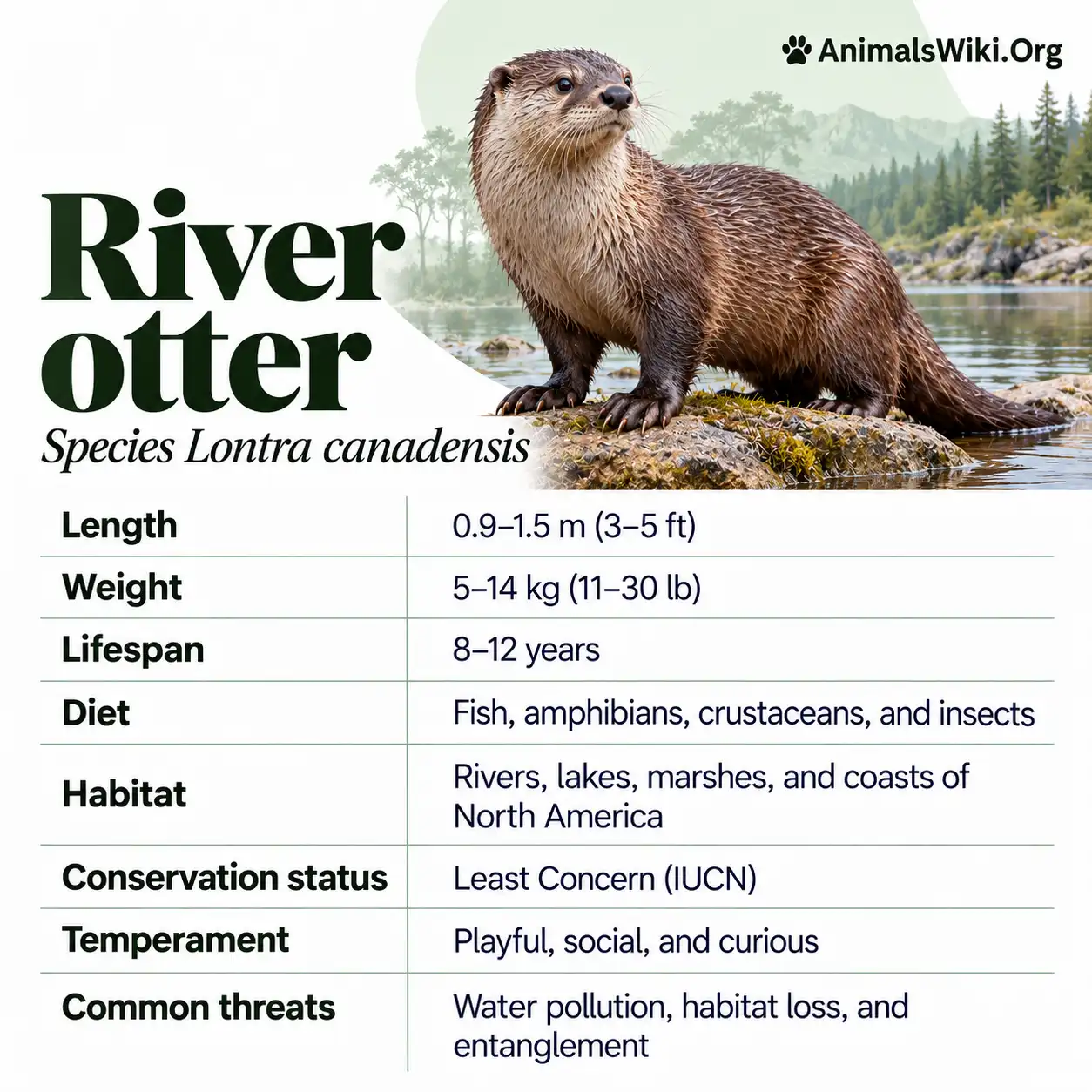
River Otter, The Agile Hunter of Rivers, Lakes and Wetlands
A river otter slipping through the water can look almost effortless. Its streamlined body bends through tight turns, its whiskered face briefly breaks the surface, and its powerful tail disappears beneath the ripples. On shore, the same animal may roll, wrestle or slide down a muddy bank.
These engaging behaviors make river otters popular wildlife subjects, but there is much more to them than playfulness. They are capable predators whose lives depend on productive waterways, accessible shelter and connections between feeding areas.
The term river otter also needs a little explanation. In North America, it usually refers to the North American river otter, Lontra canadensis. Elsewhere, people may use it more broadly for several otters associated with freshwater habitats.
This guide focuses mainly on the North American river otter while explaining how it differs from other freshwater otters, sea otters and similar-looking mammals. It covers identification, habitat, diet, swimming, reproduction, conservation and responsible wildlife watching.
Understanding these animals reveals why protecting a river involves more than protecting the water alone. Banks, wetlands, fish populations and nearby land all contribute to the places otters call home.
River Otter Facts
| Feature | North American river otter |
|---|---|
| Scientific name | Lontra canadensis |
| Other common name | Northern river otter |
| Animal class | Mammalia |
| Family | Mustelidae |
| Subfamily | Lutrinae |
| General appearance | Long body, short legs, brown fur and a tapered tail |
| Adult size | Commonly around 1–1.4 meters long, including the tail |
| Adult weight | Roughly 5–15 kilograms, with geographic and individual variation |
| Native distribution | Much of Canada and the United States |
| Habitats | Rivers, lakes, wetlands, estuaries and some coastal environments |
| Diet | Primarily fish and other aquatic animals |
| Activity | Active year-round; timing varies |
| Young | Called pups or cubs |
| Reproductive feature | Delayed implantation |
| Global conservation category | Least Concern |
1. What Is a River Otter?
A river otter is a semiaquatic mammal adapted to finding food in water while also using land for movement, resting and raising young.
“Semiaquatic” describes this combination. Unlike a fish, an otter breathes air and must return to the surface. Unlike a fully terrestrial predator, it obtains much of its food by searching and hunting underwater.
The North American river otter is also known as the northern river otter. The U.S. Fish and Wildlife Service lists both names for Lontra canadensis.
Its lifestyle connects two environments that people often consider separately. A feeding area may be underwater, a resting place may be inside a riverbank, and the route to another hunting site may cross dry ground.
That connection explains why an otter needs more than a pool containing fish. Suitable habitat must support its complete daily routine, including secure places to leave the water and move between resources.
2. Is There More Than One Kind of River Otter?
Yes. Several otter species inhabit rivers and other freshwater environments, although “river otter” does not identify one universal worldwide species.
The IUCN SSC Otter Specialist Group currently recognizes 14 living otter species. These include freshwater-associated species as well as the sea otter and marine otter.
| Otter | Scientific name | Broad geographic association |
|---|---|---|
| North American river otter | Lontra canadensis | North America |
| Mesoamerican otter | Lontra annectens | Mexico and Central America |
| Neotropical otter | Lontra longicaudis | Much of South America |
| Southern river otter | Lontra provocax | Southern South America |
| Eurasian otter | Lutra lutra | Europe, Asia and parts of North Africa |
| Smooth-coated otter | Lutrogale perspicillata | Parts of Asia |
| Giant otter | Pteronura brasiliensis | South America |
Recent classification changes matter. The Mesoamerican otter was previously included within the broader Neotropical otter classification, so older literature may use different names.
3. River Otter Classification and Relatives
River otters belong to Mustelidae, the mammal family that also includes weasels, badgers, martens and wolverines.
Their otter relatives belong to the subfamily Lutrinae. Within this group, the North American river otter belongs to the genus Lontra.
| Classification level | North American river otter |
|---|---|
| Kingdom | Animalia |
| Phylum | Chordata |
| Class | Mammalia |
| Order | Carnivora |
| Family | Mustelidae |
| Subfamily | Lutrinae |
| Genus | Lontra |
| Species | Lontra canadensis |
This classification helps explain why an otter is neither a rodent nor a small seal. Its aquatic appearance reflects adaptations within a family of carnivorous mammals.
Common names can sometimes obscure these relationships. A river otter and a beaver may occupy the same waterway, yet they belong to different mammal groups and obtain food in very different ways.
Identifying the animal correctly is the first step toward understanding its behavior.
4. What Does a River Otter Look Like?
The North American river otter has an elongated body, short legs, a relatively small head and a muscular tail that narrows toward the tip.
Its fur is generally dark brown, with a lighter throat and underside. The face carries conspicuous whiskers, while the ears are small and rounded.
Yellowstone National Park describes its body as sleek and cylindrical, with webbed feet and a tail that forms a substantial part of its length.
An otter swimming at the surface may reveal surprisingly little of this body. Sometimes observers see only a head, a curved back or a brief movement through vegetation.
For identification, look at several features together. The long, flexible body and tapered tail are especially useful when the animal climbs onto shore.
Wet fur can also change its appearance. An otter emerging from the water may look darker, narrower and less fluffy than the same animal after grooming and drying.
5. River Otter Size and Weight
Adult North American river otters vary in size across their range. Males are generally larger than females.
The IUCN assessment describes adult weights of approximately 5–15 kilograms, with geographic variation. Yellowstone gives a representative total-length range of about 40–54 inches, or roughly 1–1.4 meters.
These measurements need context. Total length includes the tail, while head-and-body length does not. Mixing them can make two accurate descriptions appear contradictory.
The largest reported individual should also not be treated as a typical adult. Age, sex, nutrition and regional differences all influence measurements.
For someone observing an otter at a distance, apparent size can be deceptive. Water hides part of the body, and a nearby rock or branch may provide a poor scale reference.
Body proportions are often more dependable than a quick size estimate. A long, tapered tail and flexible outline can help distinguish an otter even when its exact dimensions are impossible to judge.
6. How River Otter Fur Keeps It Warm
Water removes body heat rapidly, making insulation especially important for an animal that hunts underwater.
River otters have dense underfur protected by longer guard hairs. Their coat helps retain an insulating layer of air close to the body.
Yellowstone’s winter ecology information describes interlocking structures on the guard hairs and oily secretions that help prevent water from reaching the skin. Rolling and shaking after swimming help restore air within the fur.
This makes grooming a functional part of survival. An otter rolling on the bank may be maintaining its coat rather than simply entertaining itself.
Insulation also depends on condition. A coat must remain clean and properly arranged to function effectively.
The important idea is that an otter does not merely endure cold water through toughness. Its body has specialized equipment for reducing heat loss, and its behavior helps maintain that equipment throughout ordinary daily activity.
7. Webbed Feet, Body Shape and Tail
River otter movement depends on several structures working together.
The feet provide useful surfaces for pushing against water. The flexible body contributes to propulsion and turning, while the muscular tail assists movement and control.
National Park Service descriptions emphasize the combination of webbed feet, body flexing and powerful tail movements.
A streamlined outline reduces the resistance an animal encounters as it moves. Short legs and a smooth body profile help an otter travel through water without the broad, projecting limbs of many terrestrial mammals.
Different movements also serve different situations. Quiet searching near the bottom requires different control from a rapid turn after prey or a climb onto a slippery bank.
These adaptations should therefore be understood as a flexible system. The tail is not simply an underwater motor, and the feet do more than provide speed.
Together, body shape and coordinated movement allow the otter to search, pursue, surface, maneuver and leave the water efficiently.
8. River Otter Whiskers and Senses
The long whiskers on an otter’s face are sensory structures, not decoration.
They help the animal gather information while searching for food, particularly when visibility is limited. The U.S. Fish and Wildlife Service describes river otters using their whiskers to locate prey along muddy bottoms or in dark water.
This is useful because underwater conditions change constantly. Sediment, vegetation, shadows and low light can make vision less dependable.
An otter’s hunting success therefore does not rely on seeing every target from a distance. Close-range sensory information can help it investigate places where prey is concealed.
It is easy to overstate this ability by describing whiskers as perfect underwater radar. A better explanation is that they provide another source of information alongside the animal’s other senses.
Multiple sensory systems allow an otter to respond to a more complicated environment than clear aquarium water might suggest.
9. Where Do North American River Otters Live?
North American river otters occur across much of Canada and the United States. Their distribution includes inland waterways as well as suitable coastal environments.
However, broad range maps do not mean they occupy every stream or lake within the mapped area. Food, shelter, water availability and local history all influence their presence.
A useful way to understand their distribution is to think in terms of connected watersheds. An otter may move through a network of rivers, tributaries, wetlands and lakes rather than remaining beside one short stretch of bank.
Past persecution and habitat degradation also shaped where populations survived. Some places now occupied by otters regained them through recovery or reintroduction.
Local wildlife agencies usually provide more useful information than a continental map when the question is whether otters occur in a particular county, park or river system.
Even then, an elusive animal may be present without being frequently seen.
10. River Otter Habitat
River otters use rivers, lakes, ponds, marshes, sloughs and other aquatic habitats. They can also occupy estuaries and coastal waters.
Ohio’s wildlife information describes their use of both marine and freshwater environments, emphasizing that the common name does not restrict them to flowing rivers.
Several habitat features matter together:
- Sufficient prey.
- Places to enter and leave the water.
- Sheltered resting sites.
- Cover along banks.
- Routes between feeding areas.
- Conditions that support successful reproduction.
A large water body is not automatically better habitat than a smaller one. A smaller wetland with abundant food and protected banks may provide valuable resources.
Likewise, apparently attractive water can be less useful if nearby banks are heavily disturbed or access between feeding sites is blocked.
Habitat quality is therefore a combination of aquatic and terrestrial conditions. Conserving the channel while removing all bank vegetation may protect only part of what the otter needs.
11. Can River Otters Live in Salt Water?
Yes. North American river otters can forage in coastal and estuarine environments.
In coastal Alaska, research has documented river otters feeding on marine fish and depositing marine-derived nutrients at shoreline latrines. Their presence beside the ocean does not make them sea otters.
This distinction is important for wildlife identification. Habitat alone cannot settle the question when two different otter species can occur along a coast.
A river otter retains the same long, tapered tail and semiaquatic lifestyle whether it is feeding in freshwater or along a marine shoreline.
Coastal feeding also illustrates the flexibility of the species. The name describes its familiar association rather than the full range of environments it can exploit.
When describing an observation, “otter seen in the sea” is a useful location note, but the animal’s body shape, posture and behavior are still needed for identification.
12. River Otter Dens and Resting Places
River otters use sheltered spaces near water for resting and raising young.
These may include cavities along banks, spaces beneath roots and structures originally made by other mammals. Isle Royale National Park lists old muskrat burrows and beaver structures among places used for litters.
A resting site and a nursery den serve related but different purposes. A mother with dependent young needs a secure place where vulnerable pups can remain while she obtains food.
An adult traveling through its range may use shelter more temporarily.
This is one reason undisturbed bank structure matters. Roots, cavities, woody material and vegetation can provide useful cover that a neat, cleared shoreline lacks.
It is also why investigating a suspected den too closely can be harmful. Repeated approaches may turn a sheltered location into a place of disturbance.
From a distance, an entrance alone rarely identifies the current occupant. Several species may use the same area over time.
13. What Do River Otters Eat?
River otters are carnivores that feed mainly on aquatic animals.
Fish are important, but they also eat crayfish, amphibians and other available prey. Wisconsin’s wildlife agency lists fish, crayfish, frogs, muskrats and reptiles among recorded foods.
| Food group | Examples |
|---|---|
| Fish | Locally available freshwater or coastal fish |
| Crustaceans | Crayfish and crabs |
| Amphibians | Frogs and other accessible species |
| Mollusks | Some aquatic shellfish |
| Other animals | Occasional reptiles, birds or small mammals |
The importance of each food varies among habitats and seasons.
A river otter is an opportunistic predator, meaning it can exploit different prey rather than depending on an identical menu everywhere.
However, flexibility has limits. A substitute must be available, catchable and sufficiently rewarding.
This is why changes in a waterway’s fish community can matter even when other animals remain present. The existence of potential food does not guarantee that it can replace a resource on which local otters have strongly depended.
14. How River Otters Hunt
River otters search underwater, investigate likely prey locations and pursue animals they can capture.
They may hunt individually or alongside another otter. Smithsonian information describes a diet dominated by aquatic organisms and notes the energetic demands associated with their active lifestyle.
Hunting is more selective than the image of an otter chasing any fish it sees. Prey differ in size, speed, defenses and accessibility.
A target hidden in shallow vegetation may present a different opportunity from a fast fish moving through deep open water.
The otter must balance the energy gained from food against the effort required to locate, chase and handle it.
This helps explain why the most abundant fish is not necessarily the most frequently eaten. Accessibility matters alongside abundance.
Watching an otter hunt also requires patience. Repeated dives may include searching and unsuccessful attempts, while only a small part of the activity produces a visible capture.
15. Seasonal Feeding and Fish Availability
River otter diets can change when prey becomes more or less accessible.
Fish spawning, changing water levels and seasonal shifts in other aquatic animals can create temporary feeding opportunities.
Research at Yellowstone Lake demonstrated the importance of native cutthroat trout to local otters. Introduced lake trout were much less accessible because of their deeper-water habits.
The lesson is that one fish species cannot automatically replace another from an otter’s perspective.
Two fish populations may occupy the same lake while differing in where they occur, when they gather and how easily an otter can catch them.
Diet studies also require careful interpretation. Finding a prey species in many droppings shows repeated consumption, but it does not directly reveal the exact percentage of food biomass it supplied.
Combining feeding evidence with information about prey ecology gives a more useful picture of what supports an otter population through the year.
16. How Long Can a River Otter Stay Underwater?
River otters can remain submerged for several minutes, although ordinary dives are often shorter than published maximums.
Yellowstone National Park describes underwater swimming periods of around two to three minutes. Other regional accounts report longer capabilities under some circumstances.
A maximum dive duration is a capability, not a schedule that every animal follows on every dive.
An otter searching in shallow water may surface frequently because there is no advantage in staying submerged longer. A dive also ends when the animal needs air, changes its search area or handles food at the surface.
Several factors can affect duration, including activity, depth and the purpose of the dive.
For observers, counting seconds from a single disappearance can be misleading if the otter surfaces behind vegetation or farther along the bank.
The animal may have taken an unseen breath rather than remaining underwater for the entire interval.
17. How River Otters Move on Land
River otters are adapted for swimming, but they also walk, run and bound on land.
Washington’s wildlife agency describes bounding as a fast terrestrial gait, with the back arching as the feet move toward one another. Otters also create trails along waterways and shortcuts between nearby water access points.
Sliding can become part of travel when the surface allows it. Snow, ice or wet mud may let an otter move forward with less continuous stepping.
This movement is often entertaining to watch, but its function depends on the circumstances.
A slide down a bank may provide a quick route into the water. Repeated sliding during a social interaction may have a playful component.
Land movement also matters for conservation. An otter crossing between water bodies may encounter roads, fences or developed areas.
Its ability to travel overland does not make every route equally safe or equally easy to use.
18. When Are River Otters Active?
River otters can be active at different times of day and night.
They are often described as crepuscular, meaning activity commonly occurs around dawn and dusk. However, daylight and nighttime activity are also recorded.
This flexible pattern means a daytime observation is not automatically unusual or a sign of illness.
Local conditions influence when an otter is likely to be visible. Food opportunities, season and human activity can all affect what observers record.
For wildlife watching, the practical approach is to look for evidence of local routines rather than rely entirely on a generalized timetable.
A quiet location with repeated sightings may be more promising than a busy viewpoint visited at a supposedly ideal hour.
Activity also differs from visibility. An otter can remain active beneath the surface or inside dense bank vegetation while appearing absent to a person nearby.
Patient observation often reveals more than repeated movement along the shoreline.
19. What Do River Otters Do in Winter?
North American river otters remain active during winter rather than hibernating.
They continue hunting in cold water and use available openings to reach the surface. A 2026 U.S. Fish and Wildlife Service account describes winter feeding beneath ice and the use of holes for breathing access.
Winter survival depends on more than a warm coat. Otters also need accessible prey, breathing opportunities and suitable shelter.
Ice changes the structure of the environment. Places that are easy to enter during summer may become blocked, while moving water or gaps near shore may remain useful.
Snow can make their presence easier to detect because tracks and slides become visible.
For people watching winter wildlife, staying on secure public routes is important. An otter’s ability to use thin ice or openings says nothing about whether that surface can support a person.
Observing from shore protects both the animal’s access route and the observer.
20. Are River Otters Social Animals?
River otters show flexible social behavior.
They may be seen alone, in mother–young groups or in other associations. Alaska’s wildlife agency describes family groups and bachelor male groups among the social arrangements observed.
This makes simple labels such as “strictly solitary” or “always group-living” unsuitable for the species as a whole.
Group composition matters. Three otters together could be a mother and young, related animals traveling together or another temporary association.
A photograph rarely establishes those relationships.
It is also useful to distinguish moving together from cooperating in every activity. Animals may share space or travel as a group without dividing food or coordinating each capture.
Research on otter society therefore asks several separate questions: which animals associate, how long the relationships last, what activities they perform together and how those patterns vary among habitats.
21. Why Do River Otters Play?
River otters are well known for wrestling, chasing, rolling and sliding.
Some activities appear socially playful, while others overlap with grooming, movement or exploration. Smithsonian’s account discusses possible benefits involving social bonds and skills.
The same visible movement can have more than one function.
Rolling may help maintain the coat. Sliding may provide efficient travel. Wrestling between familiar animals may be part of social interaction.
This does not make play unreal. It means observers should avoid assigning one explanation to every entertaining action.
Play is also difficult to measure from a brief clip. Researchers consider the sequence, setting, participants and repetition rather than judging only by how amusing the behavior looks to people.
For a wildlife article, the most accurate description is that river otters display a range of playful behaviors, while the exact function of a particular event depends on its context.
22. River Otter Sounds and Scent Communication
River otters communicate through both sound and scent.
Vocalizations include chirps, whistles, growls and other calls. Scent marks can involve droppings, urine and glandular secretions.
Repeatedly used marking areas are called latrines. These are more than convenient toilet sites.
Camera-based research documented a variety of behaviors at latrines and described them as communication stations where information can pass between individuals. Both solitary and group visits occurred.
Chemical information is especially useful when animals do not meet directly. A scent deposit remains after the animal has left.
However, a pile of droppings does not translate neatly into a count of otters. One animal may return repeatedly, and several may use the same site.
For research and wildlife tracking, latrines provide valuable evidence of use. Interpreting their meaning requires more than simply counting deposits.
23. Home Ranges and Travel Routes
A river otter’s home range is the area it repeatedly uses for activities such as feeding, resting and social interaction.
Its shape may follow waterways rather than resemble a neat circle. A long stretch of connected river can function differently from the same area divided among isolated ponds.
Research on reintroduced otters in the Upper Rio Grande used methods designed for branching river networks, recognizing that movement along waterways affects population estimates.
Home range and territory are also different concepts. Repeated use does not necessarily mean the animal excludes every other otter.
For conservation, the important point is connectivity. A protected patch may offer good habitat while remaining difficult to reach from another useful area.
Road crossings, barriers and developed banks can affect those connections.
Thinking in terms of routes and networks gives a more realistic view of otter habitat than focusing only on isolated points where an animal has been photographed.
24. River Otter Reproduction and Delayed Implantation
North American river otters have an unusual reproductive feature called delayed implantation.
After mating, early development pauses before the embryo implants and active pregnancy continues. As a result, the interval between mating and birth is much longer than the period of active fetal growth.
Minnesota’s wildlife agency describes this delayed process and reports litters of one to five young. Exact timing varies across regional descriptions.
This distinction explains why sources may give an approximately year-long reproductive interval while describing active gestation as roughly two months.
Those figures refer to different stages, rather than necessarily contradicting one another.
Breeding and birth dates should also be presented regionally. A calendar from a northern population should not be imposed on every population throughout North America.
The central biological feature is the delay itself, which separates mating from the later period of rapid development before birth.
25. Baby River Otters and Maternal Care
Baby river otters are commonly called pups or cubs.
Newborns are dependent on their mother and remain sheltered in a den during early development. Ohio’s wildlife account describes them as blind and helpless at birth, with young beginning to emerge at around two months.
The mother provides care, and the family can remain together well beyond the earliest stages of development.
Several milestones should be kept separate:
- Opening the eyes.
- Leaving the den.
- Entering the water.
- Eating solid food.
- Weaning.
- Becoming independent.
These events do not all happen at once.
A pup seen outside the den is not necessarily ready to survive alone. Similarly, an animal capable of swimming may still depend on its mother for food and protection.
This is why a lone young otter should not automatically be assumed abandoned. Its mother may be temporarily out of sight.
26. Lifespan and Natural Predators
River otter lifespan varies with the population, environment and age at which survival is measured.
Isle Royale National Park gives an average lifespan of approximately eight to nine years, while some individuals live longer. Captive longevity figures should not be treated as typical survival in the wild.
Averages also need interpretation. Survival from birth is different from expected remaining life after an animal has already survived its vulnerable early years.
Natural predators can include larger carnivores. Minnesota’s wildlife agency identifies bobcats, coyotes and wolves as potential predators of otters on land.
Risk therefore changes with location. An otter moving underwater and one crossing open ground face different circumstances.
Its swimming ability is an important defense, but it does not make the animal invulnerable.
Age, condition, surprise and access to escape cover all influence what happens during a particular encounter.
27. The River Otter’s Ecological Importance
River otters connect aquatic food webs with the land around them.
They consume aquatic prey and then deposit material at resting and marking sites on shore. Research around Yellowstone Lake used stable isotopes to demonstrate the transfer of aquatic-derived nutrients to terrestrial plants at otter latrines.
This means their ecological role extends beyond the fish they catch.
However, the effects are not uniformly positive for every plant. Coastal research in Alaska found different responses among trees and shrubs, with physical disturbance affecting some vegetation even where nutrients were added.
That complexity is typical of ecosystems. One animal’s activity can create several effects at the same location.
Understanding otters as nutrient movers provides a richer picture than calling them simply fish predators.
Their feeding, movement and communication together influence how material passes between water and land.
28. Do River Otters Indicate Clean Water?
River otters can provide useful information about aquatic environments, but their presence is not a certificate of pollution-free water.
A study in Washington’s Green-Duwamish watershed found substantial contaminant exposure in otters, including animals using industrialized areas. Scat samples helped researchers assess patterns of pollution exposure.
This illustrates an important distinction: an animal can occupy a place while being exposed to contaminants there.
A separate British Columbia study found higher mercury concentrations at a contaminated site without detecting clear differences in several measured population and health indicators. The authors emphasized remaining knowledge gaps.
Otters are therefore useful as part of environmental monitoring, especially when biological samples are analyzed.
A sighting alone cannot replace water testing, contaminant measurements or broader ecological assessment.
Their presence is encouraging evidence of habitat use, but the condition of that habitat requires more detailed investigation.
29. Are River Otters Endangered?
The North American river otter is globally listed as Least Concern.
That category applies to Lontra canadensis, rather than every species described informally as a river otter.
Other freshwater-associated otters face different levels of risk.
For example, the Otter Specialist Group lists the southern river otter as Endangered and the smooth-coated otter as Vulnerable.
The distinction matters because conservation statements are often copied too broadly. Recovery of North American populations does not establish that otters are recovering everywhere.
Even within one species, global status can differ from local conditions.
A species may remain widespread while facing losses in a particular watershed. Conversely, a local population may recover while the species remains threatened elsewhere.
Clear conservation writing identifies the species, geographic scale and assessment being discussed.
30. River Otter Recovery and Reintroduction
North American river otter recovery provides an example of conservation producing substantial results.
A 2020 assessment of U.S. management and distribution documented broad population increases and range expansion over previous decades. It linked recovery with improved habitat conditions and management efforts, including reintroductions.
These results describe the period studied, rather than a guarantee of continued growth in every state.
Reintroduction also involves more than releasing animals. Suitable habitat, survival, reproduction and continued monitoring determine whether a population becomes established.
The Upper Rio Grande research demonstrates why genetic and demographic monitoring can remain valuable after releases. Evidence of sightings alone provides less information than tracking population development over time.
A successful program should therefore be judged by sustained outcomes.
Returning a species is an important milestone, but maintaining the conditions that allow it to persist is the longer conservation task.
31. Major Threats to River Otters
Threats vary among places, but habitat degradation, pollution, accidental capture and conflict with people can affect river otters.
The condition of the whole watershed matters. Activities upstream may alter water or prey conditions downstream, while development along banks can reduce shelter and movement options.
Research and agency accounts connect historical losses with degraded habitat and water conditions, and recovery with improvements in those same systems.
Threats can also interact. A waterway may retain fish while losing safe banks, or provide suitable shelter while receiving contaminated runoff.
Conservation is therefore strongest when it addresses several requirements together.
Useful priorities include protecting wetlands, maintaining vegetated banks, preventing pollution and identifying hazardous movement routes.
Local evidence helps determine which issue deserves attention first. A general list of possible threats becomes more useful when surveys show what is actually limiting survival or reproduction in a particular population.
32. River Otters, Fish Ponds and Human Conflict
River otters can create problems where valuable fish are concentrated in small ponds or aquaculture facilities.
Missouri’s wildlife agency distinguishes their generally limited effects on fish populations in large waters from potentially significant losses in smaller streams and ponds.
It recommends physical exclusion for suitable small facilities, including appropriately designed fencing.
The key difference is concentration. A small enclosure stocked with fish can provide an unusually accessible food source.
Preventing access addresses the immediate cause of the conflict more directly than repeatedly replacing lost fish.
Before acting, identify the animal and assess how it enters. Fish losses can have several causes, and an incorrect diagnosis leads to ineffective measures.
Management should also follow current local wildlife requirements. Appropriate solutions depend on the site, the species involved and the surrounding habitat.
Practical coexistence works best when it protects both the resource and the animal’s wider role in the landscape.
33. River Otter Tracks, Slides and Droppings
Signs often reveal river otters more readily than direct sightings.
Look for tracks in soft mud, damp sand or fresh snow. Trails may connect water access points, and slides can occur along banks.
Washington’s wildlife guidance describes slides in grass, dirt, sand and snow, often associated with nearby trails.
Droppings can contain recognizable fragments of fish scales, bones or crustacean remains. Repeated deposits may occur at latrines.
Minnesota guidance also notes grooming areas where vegetation is flattened or disturbed.
Interpret signs as a combination rather than relying on one clue.
A smooth bank alone could result from several causes, and one indistinct footprint may not show enough detail for identification.
Photographing tracks with a scale, recording the habitat and noting nearby signs produces more useful evidence than a close-up without context.
Avoid disturbing marking areas simply to obtain a clearer picture.
34. How to Watch River Otters Responsibly
A good otter sighting usually depends on patience and distance.
Choose a location with a clear view of water and nearby banks. Stay quiet, remain still and allow the animal to continue its routine.
Binoculars or a longer camera lens provide better observations without requiring a close approach.
Useful practices include:
- Keep dogs controlled and away from the shoreline.
- Leave routes between land and water open.
- Avoid suspected nursery areas.
- Do not feed otters.
- Let the animal choose whether to remain visible.
Feeding changes the encounter by introducing a reward connected with people. It can also encourage repeated visits to places where conflict is more likely.
An otter that disappears into cover has not spoiled the observation. Retreat is part of its normal response to the environment.
The best wildlife encounter leaves the animal able to resume feeding, resting or traveling without having to accommodate the observer.
35. River Otter vs Sea Otter
River otters and sea otters are different animals, even where both occur along a coast.
| Feature | North American river otter | Sea otter |
|---|---|---|
| Scientific name | Lontra canadensis | Enhydra lutris |
| General lifestyle | Uses both land and water extensively | Strongly marine |
| Tail | Long and tapered | Relatively short |
| Typical surface appearance | Often travels with a streamlined outline | Frequently floats on its back |
| Coastal occurrence | Possible | Characteristic habitat |
| Identification warning | Ocean location does not prove sea otter | Back-floating is a useful clue alongside body shape |
Alaska’s wildlife-viewing information describes sea otters commonly resting, grooming and eating while floating on their backs.
No single posture should be treated as an infallible identification rule. Consider body size, tail proportions, location and behavior together.
This is particularly important in coastal areas where a river otter may be mistaken for its marine relative.
36. River Otter vs Giant River Otter
The giant otter, Pteronura brasiliensis, is a distinct South American species.
It is larger and has a different appearance from the North American river otter. Features include conspicuous throat markings and a broad, flattened tail.
The Otter Specialist Group describes giant otters as vocal, social animals living in family groups and currently lists the species as Endangered.
These differences affect more than identification.
Information about group structure, threats or conservation status from a giant otter article should not be copied automatically into an article about Lontra canadensis.
The shared word “otter” reflects their broader relationship, while the species names preserve essential distinctions.
For readers exploring related animals, comparing these species is especially useful. It shows how the otter body plan supports different sizes, habitats and social arrangements across separate evolutionary lineages.
37. Common River Otter Myths
Several familiar claims need qualification.
| Myth | More accurate explanation |
|---|---|
| River otters live only in rivers | They also use lakes, wetlands, estuaries and some coasts |
| An otter beside the ocean must be a sea otter | River otters can forage in marine environments |
| Every slide is play | Sliding can also be part of travel |
| Otters are always solitary | Social arrangements vary |
| Seeing an otter proves the water is clean | Otters can occupy contaminated habitats |
| All otter species are recovering | Conservation conditions differ among species |
| A pup outside a den is independent | Young may remain dependent after emerging |
| A long reproductive interval means continuous fetal growth | Delayed implantation separates reproductive stages |
Correcting these ideas improves the picture without diminishing the animal’s appeal.
River otters remain remarkable because of their real adaptations: insulation, sensory abilities, coordinated swimming and flexible use of connected aquatic habitats.
Their biology is more interesting when each claim is tied to the right species and circumstances.
38. Frequently Asked Questions About River Otters
What is a river otter?
A river otter is a semiaquatic carnivorous mammal. In North America, the name usually refers to Lontra canadensis. More broadly, people sometimes use the term for several otter species associated with freshwater habitats.
What is the scientific name of the North American river otter?
Its scientific name is Lontra canadensis. It belongs to Mustelidae, the family containing weasels, badgers and other related carnivores. Within that family, it belongs to the otter subfamily Lutrinae.
Is a river otter a rodent?
No. River otters are carnivorans, while beavers and muskrats are rodents. Sharing a waterway or having brown fur does not indicate a close relationship. Their classification reflects different evolutionary histories.
Where do river otters live?
North American river otters occupy suitable waterways across much of Canada and the United States. Other freshwater otter species occur elsewhere. Always identify the species before applying a distribution description.
Can river otters live in the ocean?
Yes. North American river otters can use coastal waters and estuaries. A marine location alone does not make an animal a sea otter; body proportions and behavior are also important for identification.
What do river otters eat?
They eat mainly aquatic animals, especially fish and crustaceans in many habitats. Amphibians and other prey also contribute. The importance of particular foods changes with location, season and accessibility.
Do river otters eat crayfish?
Yes. Crayfish can be an important food where they are available. Their contribution varies among populations, so a crayfish-rich diet in one waterway should not be assumed for every river otter.
How big do river otters get?
North American adults commonly measure around 1–1.4 meters in total length and weigh roughly 5–15 kilograms. These are broad guides rather than fixed limits. Males are generally larger than females.
Why do river otters have whiskers?
Their whiskers provide sensory information useful during foraging. This helps when prey is close to the bottom or visibility is limited. Whiskers complement other senses rather than functioning as a perfect replacement for vision.
How long can a river otter hold its breath?
River otters can remain submerged for several minutes. Routine dives are often shorter than maximum reported capabilities. Duration depends on activity and circumstances, so one number cannot describe every dive.
Do river otters hibernate?
No. North American river otters remain active through winter. They continue searching for food and use accessible openings in ice-covered waters. Winter conditions change their opportunities rather than sending them into hibernation.
Are river otters nocturnal?
They can be active at night, around dawn and dusk, or during daylight. Local patterns vary. Seeing a river otter during the day is not, by itself, evidence that the animal is unwell.
Why do river otters slide?
Sliding can provide efficient movement on suitable surfaces and may also occur during play. Context matters. A repeated social activity and a quick descent into the water need not have exactly the same function.
Are river otters friendly?
Their playful appearance should not be confused with an invitation to approach. They are wild predators capable of defending themselves. Observe from a distance and avoid feeding, touching or cornering them.
Do river otters live in groups?
Sometimes. They may occur alone, in mother–young groups or in other associations. A single sighting does not reveal the relationships among individuals, and group size alone cannot establish whether they form a family.
What is a baby river otter called?
A baby river otter is commonly called a pup or cub. Young animals remain dependent during early development, including a period spent sheltered in a den before they begin appearing outside regularly.
How many babies do river otters have?
Litter size varies, with regional accounts commonly reporting a few pups and a broader range of about one to five. A typical litter size should not be confused with an absolute maximum.
What is delayed implantation?
Delayed implantation is a pause before an embryo implants and active pregnancy proceeds. It makes the interval from mating to birth much longer than the period of rapid fetal development.
Do baby river otters swim immediately?
Newborns are not independent aquatic hunters. Swimming develops alongside other physical and behavioral abilities. Leaving the den, entering water, weaning and independence are separate milestones rather than one simultaneous event.
How long do river otters live?
Lifespan varies, and some regional summaries give averages around eight to nine years. Exceptional ages, especially in managed care, are different from typical wild survival and should be identified separately.
Do river otters have predators?
Yes. Larger carnivores can prey on them, particularly when they are on land. Their swimming ability reduces some risks but does not eliminate predation or make every water-to-land crossing safe.
Do otters prove a river is healthy?
They provide useful ecological information, but a sighting does not prove that water is free of pollutants. Otters may use contaminated areas. Environmental assessment requires biological and chemical evidence alongside wildlife observations.
Are river otters endangered?
The North American river otter is globally categorized as Least Concern. Other freshwater otter species have different categories, including threatened ones. Conservation statements should always name the species being discussed.
What should I do if I find a young otter alone?
Keep people and pets away and observe from a distance. A mother may be temporarily out of sight. If the animal appears injured or is in immediate danger, contact the relevant wildlife authority or licensed rehabilitator for guidance.
How can people help river otters?
Protect wetlands and riverbank vegetation, prevent litter and fishing line from entering waterways, avoid feeding wildlife and support local habitat restoration. Maintaining connections between feeding and shelter areas helps conserve the wider landscape otters use.



