
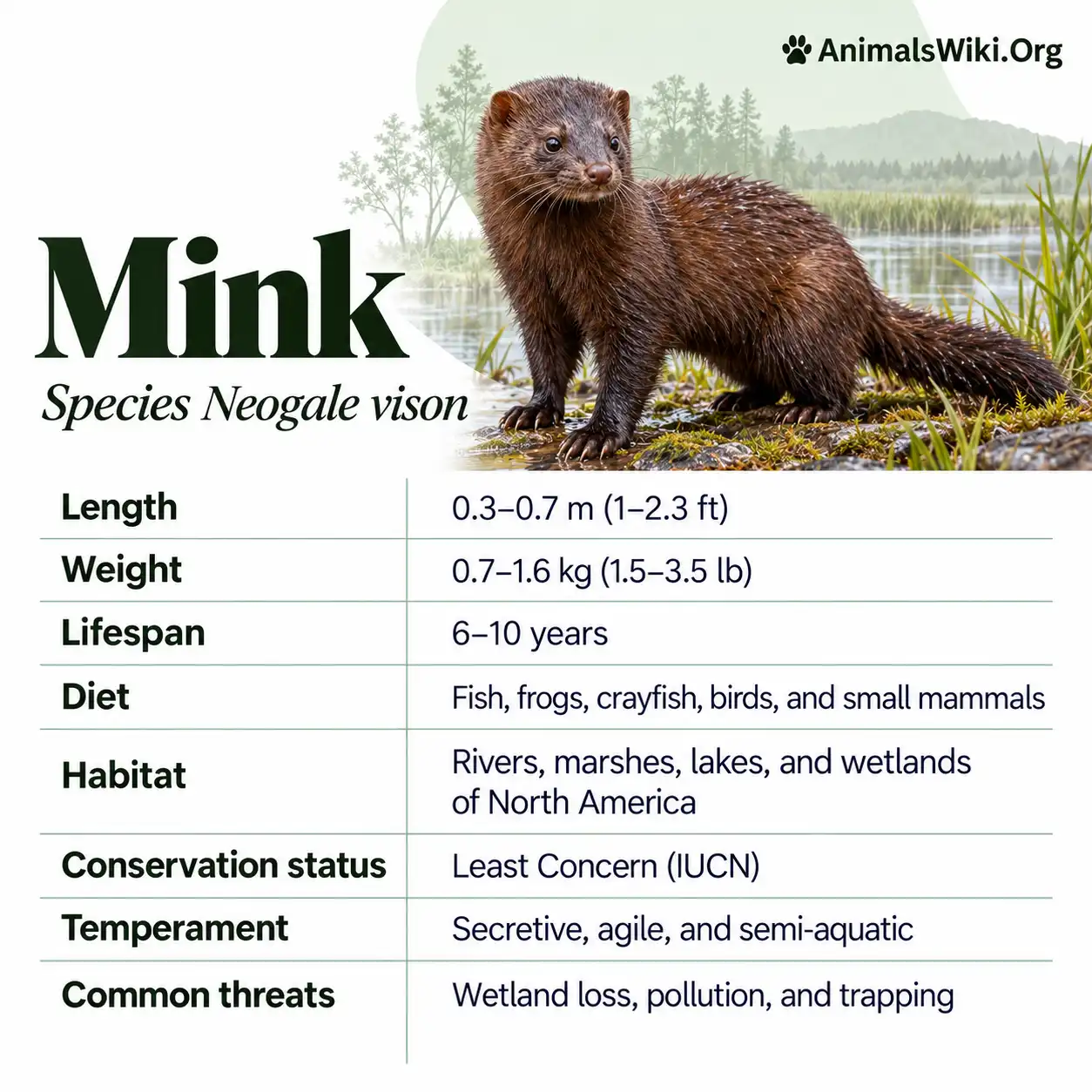
Mink, The Adaptable Hunters of Rivers, Wetlands and Coasts
A mink moving along a riverbank can be surprisingly difficult to follow. One moment, its dark body appears between roots; the next, it disappears beneath vegetation or slips into the water. This ability to move between land and water is central to its success as a predator.
Mink belong to the weasel family. Their long bodies, short legs, dense coats and flexible movements help them search for animals hiding along shorelines, inside cavities and beneath the water’s surface.
However, “mink” does not refer to one worldwide species. The American mink and European mink are different animals with different evolutionary histories. Their conservation stories are also strikingly different.
The American mink is widespread in its native North America and has established introduced populations elsewhere. In some of those places, it threatens vulnerable native wildlife. The European mink, meanwhile, is critically endangered and depends on protection, habitat conservation and restoration efforts.
Understanding these distinctions makes mink biology much clearer. It also explains why conservationists may protect mink in one setting while working to remove an introduced mink population in another.
This guide explores mink identification, species, habitat, diet, swimming, reproduction, family development and conservation, while separating information about the two living species.
Mink Facts
| Feature | Information |
|---|---|
| Animal group | Mammals |
| Family | Mustelidae |
| Living species commonly called mink | American mink and European mink |
| American mink scientific name | Neogale vison |
| European mink scientific name | Mustela lutreola |
| General appearance | Long body, short legs, rounded ears and a furred tail |
| Typical wild coloration | Brown to very dark brown, often with pale facial markings |
| Lifestyle | Semiaquatic |
| Main habitats | Rivers, streams, wetlands, lakeshores and some coastal environments |
| Diet | Fish, small mammals, birds, amphibians and other available animals |
| Social organization | Mostly solitary |
| Young | Called kits |
| Main parental caregiver | Mother |
| American mink global category | Least Concern |
| European mink global category | Critically Endangered |
| Extinct relative | Sea mink, Neogale macrodon |
1. What Is a Mink?
A mink is a small, elongated carnivorous mammal adapted to hunting around water.
It belongs to Mustelidae, the family containing weasels, otters, martens, badgers and other related carnivores.
The mink’s body combines features useful on land with adaptations that help it swim. It can investigate bank cavities, move through dense vegetation and enter the water during a search for food.
This makes it a semiaquatic animal.
The American mink occupies wetland environments ranging from streams and ponds to ocean bays, according to Maine’s wildlife agency.
Semiaquatic does not mean that it spends every moment beside water or obtains every meal underwater.
A mink may leave the immediate shoreline to pursue terrestrial prey or move between feeding areas.
Its flexibility is one of its defining characteristics. The animal’s success depends on being able to exploit several parts of a wetland landscape rather than specializing exclusively in either the land or the water.
2. The Two Living Mink Species
The two living animals most commonly called mink are the American mink and European mink.
Their similar appearance can obscure important differences.
| Feature | American mink | European mink |
|---|---|---|
| Scientific name | Neogale vison | Mustela lutreola |
| Native geographic association | North America | Europe |
| Current conservation situation | Widespread; introduced populations can be invasive | Critically endangered |
| General size | Often larger | Generally smaller |
| Facial markings | Commonly pale on lower lip and chin | Characteristically pale around upper and lower lips |
| Reproduction | Delayed implantation occurs | Delayed implantation is not normally present |
| Main conservation issue | Context depends on native or introduced range | Preventing further decline and restoring populations |
The European mink is not an American mink that happens to live in Europe.
American mink have been introduced into European countries, so both species can occur within the same broad region.
Conservation organizations emphasize that reliable species identification is essential wherever the endangered native species could be present.
3. Mink Classification and Scientific Names
The American mink’s current scientific name is Neogale vison.
Older sources commonly use Neovison vison or Mustela vison. These names generally refer to the same living species under earlier classifications.
The Integrated Taxonomic Information System lists those older combinations as synonyms of Neogale vison.
The European mink remains Mustela lutreola in current mammal taxonomy.
| Classification level | American mink | European mink |
|---|---|---|
| Class | Mammalia | Mammalia |
| Order | Carnivora | Carnivora |
| Family | Mustelidae | Mustelidae |
| Subfamily | Mustelinae | Mustelinae |
| Genus | Neogale | Mustela |
| Species | N. vison | M. lutreola |
Scientific names are useful when comparing research.
They help distinguish genuine species differences from simple changes in terminology.
A wildlife page using an older genus name may still contain useful observations, but readers should check which animal and geographic population it describes.
4. What Does a Mink Look Like?
Mink have long bodies, short legs, small rounded ears and relatively narrow heads.
Their tails are well furred, and their coats usually appear brown to very dark brown in wild populations.
Pale markings can occur on the chin, throat or underside.
An American mink emerging from water may look almost black because its wet coat reflects light differently from dry fur.
The Mammal Society describes this change in appearance and the variable distribution of pale patches.
The complete silhouette is often more useful than color alone.
A mink moves with a flexible, low body rather than the upright posture of many cats. On land, its back bends noticeably during bounding.
A partial photograph can make identification difficult. If the tail, feet or surrounding scale are missing, mink may be confused with other mustelids.
Whenever possible, consider the whole animal, its movement and the habitat together.
5. Mink Size and Weight
Mink size varies with species, sex, population and whether the animal comes from a farmed lineage.
Male American mink are generally substantially larger than females.
For British populations, the Mammal Society gives representative adult male weights of approximately 800–1,500 grams and female weights around 500–800 grams.
Some native North American populations contain larger animals. Alaska’s wildlife account describes adult males reaching several pounds.
These differences explain why a single narrow weight range can be misleading.
Measurements also need clear definitions:
- Head-and-body length excludes the tail.
- Total length includes the tail.
- Body mass changes with age, condition and season.
Farmed mink can differ markedly from free-ranging animals, so commercial breeding records should not automatically define the size of a typical wild mink.
For identification, proportions and context usually provide better evidence than an unsupported estimate of weight.
6. How to Distinguish American and European Mink
Facial markings provide a useful starting point.
European mink characteristically have white fur around both the upper and lower lips. American mink more commonly have pale markings on the lower lip and chin.
Conservation organizations also describe differences in average size and tail proportions.
However, no distant glimpse should be treated as a perfect identification.
Markings can be partly concealed by water, vegetation or the angle of the head. Variation also occurs, and other mustelids may complicate the comparison.
A clear photograph of the face is valuable, but experts may need additional evidence.
In an area with European mink, uncertain animals should not be captured, moved or treated as invasive American mink by an untrained observer.
Accurate identification is a practical conservation requirement.
A mistaken label can turn an intended management action into a threat to the species it was meant to protect.
7. Fur and Aquatic Adaptations
Mink have dense underfur beneath longer guard hairs.
These layers help retain insulation and reduce the penetration of water toward the skin.
American mink also have partly webbed toes, which assist movement through water.
Alaska’s wildlife agency describes both the semi-webbed feet and oily guard hairs as adaptations associated with their aquatic lifestyle.
The coat does not make water exposure free of energetic cost.
A small animal still loses heat while swimming, particularly during prolonged activity or cold conditions.
This helps explain why mink combine aquatic hunting with terrestrial movement and sheltered rest.
Their bodies support a flexible balance rather than the highly marine lifestyle of a seal.
Unlike ermines in many snowy regions, American mink do not normally change to an entirely white winter coat.
Minnesota wildlife information specifically distinguishes their persistent brown coloration from seasonal whitening in some weasels.
8. How Well Can Mink Swim and Dive?
Mink are capable swimmers and divers, but they should not be imagined as miniature otters with identical performance.
They often hunt in shallow water and along complex shorelines.
A study using depth recorders on free-ranging American mink found that short, shallow dives were common, although deeper and longer dives also occurred.
The important distinction is between a maximum capability and ordinary behavior.
An animal does not need to remain underwater for several minutes to exploit fish or investigate submerged cover successfully.
Repeated short dives can provide access to food while allowing frequent breathing.
Later research also recorded prolonged sequences of diving separated by brief surface intervals. Such a sequence is not one continuous breath-hold.
Descriptions that combine those different measurements can exaggerate underwater endurance.
The mink’s real advantage is versatile movement through shallow water, banks and terrestrial cover.
9. Where American Mink Live Naturally
American mink are native to North America.
Their natural distribution includes much of Canada and the United States, although they are not uniformly distributed across every landscape.
The Mammal Diversity Database describes a broad native range and separates it from the many countries where the species has been introduced.
Water availability, cover, prey and local history influence occurrence.
A continental map should therefore not be read as a claim that every stream contains mink.
Regional conditions also affect population density.
A productive marsh system with abundant prey may support more use than an exposed channel with little cover.
Mink can occur near towns when suitable habitat remains, but presence in a developed landscape does not mean development has no effects.
The same animal may use a promising feeding area while encountering roads, disturbance or polluted water elsewhere within its range.
10. Introduced American Mink Populations
American mink have established populations outside North America.
Introductions were closely associated with fur farming, followed by escapes and intentional releases.
A recent genome publication summarizes introduced populations across Europe, Asia and South America and describes the species’ non-native status in Britain.
An introduced population consists of animals living outside the species’ natural range because of human activity.
It becomes an invasive concern when its presence causes significant ecological harm.
That distinction is important because the same American mink is a native component of North American ecosystems.
It is not biologically “bad” in one place and “good” in another.
The difference concerns ecological history and the vulnerability of local species.
Prey communities that developed without a comparable predator may experience much stronger effects when mink arrive, particularly on islands or along narrow habitat corridors.
11. Mink Habitat Requirements
Mink use rivers, streams, ponds, marshes, lakeshores and coastal environments.
Shelter and prey are as important as the presence of water.
New York’s wildlife agency describes American mink using several wetland types, including freshwater and saltwater settings.
Useful habitat features include:
- Vegetated banks.
- Root systems and cavities.
- Rocks and fallen timber.
- Shallow feeding areas.
- Connections between wetlands.
- Places to rest above water.
European mink are particularly associated with densely vegetated freshwater margins.
Conservation assessments emphasize their use of riverbanks, streams, marshes and other wetland habitats.
Habitat quality can change over a short distance.
A bank with cavities and cover may offer resources that a cleared, reinforced edge does not.
Maintaining those features can matter as much as preserving the channel itself.
12. Dens and Resting Places
Mink use sheltered spaces in banks, among roots, beneath logs and within rock or brush piles.
They also occupy structures made by other animals.
New York’s wildlife information identifies abandoned bank burrows, particularly those of muskrats, among commonly used American mink shelters.
A resting place and a breeding den are related but different resources.
An adult moving through its range may use temporary cover. A female with dependent kits needs a secure place that remains suitable during repeated hunting trips.
The surrounding area matters too.
A well-hidden den becomes less useful if nearby food disappears or access is repeatedly disturbed.
For observers, a hole along a bank does not establish the identity of its current occupant.
Several species may use similar cavities, and a mink can inspect a structure without remaining there.
Repeated observations provide stronger evidence than assumptions based on the entrance alone.
13. What Do American Mink Eat?
American mink are opportunistic carnivores.
They eat fish, small mammals, birds, amphibians and invertebrates, with local conditions determining the balance.
Maine’s wildlife agency lists foods including fish, frogs, ducks, mice, muskrats, freshwater mussels and insects.
| Food category | Examples |
|---|---|
| Small mammals | Mice, voles and other accessible prey |
| Larger mammalian prey | Muskrats and rabbits |
| Fish | Locally available species |
| Birds | Adults, chicks or nestlings |
| Eggs | Taken from accessible nests |
| Amphibians | Frogs and related prey |
| Invertebrates | Crayfish, crabs, insects and mollusks |
“Opportunistic” means the mink can exploit several resources.
It does not mean every listed food contributes equally.
A striking photograph of a mink carrying a large fish may show a genuine capture without representing the animal’s most frequent meal.
The most informative diet studies examine repeated samples and the prey available around them.
14. What Do European Mink Eat?
European mink also consume a mixture of aquatic and terrestrial prey.
Their diet can include small mammals, fish, birds, amphibians and crustaceans.
A study in northern Spain found substantial contributions from small mammals and fish, with birds also represented. The results reflected the population and habitats sampled.
This matters because a generic description such as “mink eat mainly fish” can overlook regional variation.
Prey access changes among rivers, seasons and individual animals.
Size can also affect which prey is profitable to pursue.
A larger fish may provide more energy but require greater effort to capture and handle.
For European mink conservation, restoring habitat includes maintaining a functioning prey community rather than providing one assumed favorite food.
Healthy banks and wetlands support the variety of animals on which the mink may depend as conditions change.
15. How Mink Hunt
Mink search actively through the boundary between land and water.
They investigate holes, submerged cover, root systems and vegetation, moving quickly between potential feeding locations.
Minnesota’s wildlife description emphasizes their ability to pursue prey on land and in water.
The hunt is often a sequence of investigations rather than a long visible chase.
A mink may enter a cavity, emerge, cross a log and dive beneath an overhang within seconds.
This behavior makes it difficult to follow and contributes to its elusive reputation.
The animal’s narrow body gives access to spaces unavailable to larger predators.
However, every investigation does not produce a meal.
Daily success depends on repeated decisions about where to search and whether an opportunity justifies further effort.
Its flexibility allows it to switch between prey types when one becomes difficult to obtain, although alternatives are not always equally rewarding.
16. Seasonal Diet Changes
Mink diets change with seasonal opportunities.
Birds and eggs may become more accessible during breeding seasons. Aquatic prey can become more important under other conditions.
Research on American mink diets emphasizes geographic differences and the importance of local prey availability when interpreting feeding patterns.
Sex differences can also occur because males and females differ in size.
However, those differences should be measured rather than assumed.
Methods matter as well.
Finding a prey item in many droppings does not directly establish the proportion of dietary energy it supplied.
Stable-isotope analysis provides another view, but it depends on understanding the local isotopic signatures of potential foods.
These details explain why scientific studies may describe diet differently without necessarily disagreeing.
They may be measuring different populations, seasons or aspects of food consumption.
17. Activity Patterns and Winter Behavior
Mink are often active around dusk, nighttime and early morning, but daytime activity also occurs.
They do not follow an identical schedule across all habitats.
New York’s wildlife information describes American mink as primarily nocturnal and documents year-round movement along streams, including winter foraging around openings in ice.
Winter changes the feeding environment rather than producing hibernation.
Ice, snow and water levels alter access to prey and shelter.
An opening beside a bank may connect the animal with food below the surface, while covered terrestrial routes help it move between sites.
Tracks can make winter presence easier to detect even when sightings remain uncommon.
For an observer, daylight appearance is not automatically evidence of abnormal behavior.
The more useful questions concern the animal’s condition, movements and immediate circumstances rather than the hour alone.
18. Solitary Life and Home Ranges
Mink are generally solitary outside breeding and maternal care.
Individuals repeatedly use areas containing feeding places and shelter.
Males often range over larger areas than females, but the arrangement is not a universal set of perfectly separate territories.
A River Thames study found substantial overlap and examined how competition for prey could influence the space used by American mink.
This is why “home range” and “territory” need distinction.
A home range describes repeated use. A territory includes some form of defense or exclusion.
The same landscape may contain overlapping routes while individuals avoid direct encounters.
Food distribution, reproductive opportunities and neighboring animals all influence spacing.
For conservation or management, a mink seen at one point may be using a much longer section of waterway.
Acting only at the sighting location can miss the wider system supporting its movements.
19. Scent, Sounds and Communication
Mink communicate through scent as well as direct behavior.
Like other mustelids, they possess scent glands associated with strong-smelling secretions.
Alaska’s wildlife agency describes the release of these secretions when mink are frightened or excited.
Scent also has value for an animal that spends much of its time alone.
Information can remain at a location after the animal has moved away.
Droppings and scent deposits along routes therefore have potential social significance beyond waste disposal.
However, a marked rock should not automatically be interpreted as the exact boundary of a defended territory.
The meaning depends on the context and the behavior of other animals.
Mink can also vocalize, especially during close interactions, but they are not animals whose ordinary presence is reliably identified from distant dramatic calls.
Clear photographs and physical signs usually provide stronger identification evidence.
20. American Mink Reproduction
American mink breed seasonally, with timing influenced by latitude and local conditions.
Their reproduction includes delayed implantation: early development pauses before the embryo implants and active pregnancy proceeds.
The University of Minnesota Duluth describes a variable mating-to-birth interval of roughly 40–75 days for American mink.
The important point is that this interval contains different biological stages.
A longer interval does not mean the fetus grows at the same rate throughout.
Females normally produce one litter in a year.
Litter size varies, and regional sources give different typical figures.
Food supply, maternal condition and offspring survival affect how many young eventually become independent.
A potential litter size should therefore not be confused with the number of young recruited into the next generation.
That distinction becomes especially important when comparing a common species with one requiring conservation breeding.
21. European Mink Reproduction Is Different
European mink do not normally show the delayed implantation characteristic of American mink.
Conservation-breeding guidance based on European mink at Tallinn Zoo describes pregnancy lasting approximately 40–43 days.
This is an important species difference.
An article that gives one reproductive timeline for all mink can easily become inaccurate.
Seasonal breeding also needs geographic context.
Dates recorded in one managed population should not be imposed on every wild population.
For a critically endangered species, understanding successful mating, pregnancy and kit development has practical conservation value.
Breeding programs need to manage relationships and environmental conditions while maintaining genetic diversity.
The goal is more than producing a birth.
Young must survive, develop appropriate abilities and, where release is planned, adapt successfully to suitable habitat.
Reproductive success is therefore measured across several stages rather than by counting newborns alone.
22. Baby Mink and Maternal Care
Baby mink are called kits.
They begin life highly dependent on their mother and remain sheltered during early development.
As they grow, they begin eating solid food, exploring and developing hunting abilities.
Maine wildlife information describes American mink litters born in spring, while regional timing varies elsewhere.
The stages of development should be kept separate:
- Birth.
- Opening the eyes.
- Leaving the den.
- Eating solid food.
- Entering water.
- Catching prey.
- Independence.
A kit capable of swimming is not necessarily able to obtain enough food consistently.
Young may continue relying on maternal care after becoming active outside the den.
This is why a small mink briefly seen alone should not immediately be assumed abandoned.
Its mother may be hunting or hidden nearby.
Unnecessary handling can interrupt an otherwise functioning situation.
23. Dispersal and Lifespan
Young mink eventually leave their natal area and seek their own living space.
Dispersal timing varies with sex, individual development and local conditions.
Minnesota wildlife information describes differences among young American mink, including some females remaining longer before dispersing.
This stage connects reproduction with landscape conditions.
A litter can survive well in the den but later encounter difficulty finding food or safe routes.
Lifespan also needs careful wording.
The AnAge database records a captive American mink reaching 11.4 years. That is a maximum record, not the typical lifespan of every wild mink.
Average survival, maximum age and expected life after reaching adulthood are different measurements.
A useful wildlife account identifies which one is being discussed rather than presenting one impressive number as a universal rule.
24. Predators and Natural Mortality
Mink can be killed by larger carnivores and birds of prey.
Their small size and active hunting lifestyle do not make them immune to predation.
The University of Minnesota Duluth identifies raptors and larger mammalian carnivores as occasional predators.
Risk changes between settings.
An animal investigating open ground has different escape options from one beside deep cover or water.
Young mink can also face risks from other mink.
Disease, parasites, food shortages and accidents contribute additional mortality, with importance varying among populations.
A list of possible causes should not be mistaken for a ranking applying everywhere.
The most informative studies follow known animals or examine deaths systematically.
They can distinguish an occasional threat from one that meaningfully affects survival across a particular population.
For European mink, even relatively small additional losses can be important where populations are already tiny and fragmented.
25. Mink and Otter Interactions
Mink and otters can use the same waterways and eat some of the same prey.
Otters are generally larger and more specialized for aquatic foraging, while American mink can switch more readily between terrestrial and aquatic resources.
A study examining changing otter abundance found a shift in American mink diet toward mammals and birds under greater otter presence, particularly during winter.
This shows that competition can affect behavior without making coexistence impossible in every setting.
It also cautions against the claim that restoring otters automatically eliminates mink.
Outcomes depend on habitat, prey and alternative resources.
The relationship is better understood as a changing balance of competition and resource use.
One animal’s presence may influence the other while both remain within the broader landscape.
Effective conservation therefore needs direct evidence rather than relying on one predator to solve every introduced-species problem.
26. Ecological Importance in North America
Within their native range, American mink are part of established food webs.
They consume aquatic and terrestrial animals and are themselves prey for larger predators.
Their use of shorelines connects several parts of a wetland community.
Minnesota wildlife information describes their role as versatile predators and identifies threats from altered shallow-water habitats.
It is reasonable to recognize this ecological role without assuming mink regulate every prey population.
Effects depend on predator abundance, prey availability and the surrounding community.
A fish population may change because of water conditions, harvest, disease or several interacting factors.
The presence of a predator is only one part of that explanation.
Native mink conservation therefore fits within broader wetland protection.
Maintaining prey communities, bank cover and habitat connections supports the relationships in which mink evolved, alongside many other animals sharing those places.
27. Why Introduced Mink Threaten Water Voles
American mink have had serious effects on water voles in Britain.
Water voles depend strongly on narrow strips of bankside habitat and use burrows for shelter.
Female mink can be small enough to enter those burrows, reducing the protection they provide.
NatureScot identifies invasive American mink predation, alongside habitat damage, as an important cause of water vole decline.
This illustrates how the same physical adaptation can have different consequences in different ecosystems.
A narrow body is useful for a predator entering prey spaces. Where prey lacks effective defenses against that introduced hunter, local losses can be severe.
Habitat restoration alone may therefore be insufficient if mink pressure remains high.
Likewise, removing mink without maintaining suitable vegetation and banks may not restore water voles.
Conservation requires attention to both the introduced predator and the conditions needed by the native prey.
28. Mink and Ground-Nesting Birds
Introduced mink can also threaten birds nesting on the ground or among shoreline rocks.
Eggs, chicks and incubating adults may be accessible.
Colonies can concentrate vulnerable prey in a small area, allowing one predator to cause substantial damage.
NatureScot describes breeding failures and bird losses associated with mink in parts of Scotland and the Western Isles.
Island settings can be especially vulnerable where native birds developed without similar mammalian predators.
However, impacts still need local evidence.
The presence of mink near a colony does not measure the exact number of birds lost.
Monitoring nests, predator activity and breeding outcomes helps identify the problem and assess whether management improves conditions.
This is why conservation programs often work across entire island groups or connected catchments rather than responding only after a single damaged nest is found.
29. American Mink and European Mink Competition
American mink are a major threat to the remaining European mink populations.
The two species overlap in habitat and food use, but American mink can have competitive advantages associated with size and ecological flexibility.
A twelve-year Spanish study found patterns consistent with competitive exclusion: European mink were more likely to disappear from sites occupied by the introduced species.
This does not mean European mink decline began solely with American mink.
Historical overexploitation and habitat change had already reduced the native species.
The introduced competitor added a serious pressure to weakened and fragmented populations.
Conservation must therefore address several problems together.
Removing American mink from a suitable area may be necessary, but secure banks, adequate prey and protection of remaining native animals are also essential.
The goal is to create conditions in which the European mink can persist, rather than simply change which animal occupies a damaged waterway.
30. Mink Conservation Status
The two living mink species have sharply different conservation situations.
American mink are globally categorized as Least Concern.
European mink are Critically Endangered.
The IUCN SSC Small Carnivore Specialist Group identifies European mink as a high conservation priority, with only small remaining populations and a tiny fraction of its former range occupied.
A global category should not be interpreted as an exact count.
American mink can face local habitat problems even while remaining widespread overall.
Similarly, a successful European mink restoration site does not mean the species has recovered across Europe.
Conservation writing must identify the species, place and scale.
The question “Are mink endangered?” cannot be answered accurately without first establishing which mink is being discussed.
31. European Mink Recovery and Reintroduction
European mink conservation includes habitat protection, management of invasive American mink, coordinated breeding and carefully planned releases.
Tallinn Zoo’s work on Hiiumaa provides a well-documented example.
Its restoration account describes removing American mink, identifying suitable habitat and releasing European mink over several years, followed by continued monitoring.
The important achievement is more than the number released.
Successful restoration requires survival, reproduction and persistence after releases stop.
It also requires protection against renewed threats.
Island settings can offer advantages when competitors are absent, but they need biosecurity and continued attention.
A breeding program cannot substitute permanently for suitable wild habitat.
Instead, it supports a wider recovery plan.
The strongest approach links managed populations, genetic planning, threat reduction and long-term field monitoring rather than treating each activity as an isolated solution.
32. Pollution and Habitat Degradation
Mink can be exposed to contaminants through their prey.
Their position as predators makes them useful subjects for studying how pollutants move through food webs.
A study of wild male mink in Sweden found associations between certain contaminants and reproductive-system measurements, while emphasizing the complexity of environmental exposure.
Experimental research using farm-raised mink also demonstrated reduced kit survival under particular PCB-contaminated dietary conditions.
These findings should not be translated into identical effects for every wild population.
Exposure, dose and outcome are separate questions.
Habitat degradation adds other pressures.
Wetland drainage, simplified banks and altered channels can reduce shelter and prey even where water remains present.
Protecting mink habitat therefore requires more than preventing direct killing.
The quality and structure of the surrounding aquatic system matter throughout the animal’s life.
33. Mink Fur and Farmed Animals
Mink are widely known because of the fur trade.
Most commercial farmed mink belong to American mink lineages, but selective breeding has changed their appearance and other characteristics.
Research comparing farmed and feral animals found differences in body size and shape associated with breeding history.
Other work describes a wider range of coat colors in farmed mink than the typical dark brown of wild populations.
These differences matter when choosing photographs or describing size.
A pale farmed animal should not be presented as the standard wild appearance.
A large breeding male also may not represent an ordinary free-ranging mink.
Farmed, feral and native wild are different descriptions:
- Farmed animals live under human management.
- Feral populations descend from managed animals living independently.
- Native wild populations occur within the species’ natural range.
Those categories describe history and circumstances rather than separate mink species.
34. Monitoring and Responsible Management
Mink can be difficult to detect reliably.
Researchers use cameras, tracks, hair samples, live-trapping under appropriate authority and environmental DNA.
A European mink study found that several methods detected the species, but their effectiveness varied. Combining methods revealed animals missed by other approaches.
American mink research has likewise tested environmental DNA against camera surveys.
In introduced ranges, monitoring can support coordinated removal programs.
The Scottish Invasive Species Initiative uses trained staff and volunteers to detect American mink and reduce impacts on native wildlife.
Such work should be distinguished from unplanned intervention by an observer.
Species identification, animal welfare, non-target risks and local requirements all matter.
A mink management decision should begin with the right species and the ecological problem being addressed, rather than the assumption that every mink requires the same response.
35. Mink Near Homes and Poultry
Mink may visit areas containing poultry, ornamental fish or other concentrated food.
Preventing access is usually more useful than repeatedly replacing losses.
Practical measures include maintaining secure enclosures, checking gaps and removing unnecessary food attractants.
A predator can exploit a small opening that appears insignificant to a person.
However, damage should be investigated before identifying the cause.
Several animals can take poultry or fish, and a nearby mink sighting does not prove responsibility.
For pets, supervision and secure housing reduce risks from multiple predators.
Avoid attempting to handle or corner a wild mink.
If management is needed, seek advice appropriate to the species and location.
This is especially important in European mink areas, where mistaken identification can threaten a critically endangered animal.
The aim is to address a demonstrated problem while avoiding unnecessary harm.
36. Mink vs Otter and Other Mustelids
Mink are often confused with otters, polecats and other weasels.
| Animal | Helpful clues |
|---|---|
| Mink | Small, elongated body; brown coat; furred tail; frequent shoreline use |
| European otter | Much larger body; heavier muscular tail; broader head |
| Ermine or stoat | Usually smaller and more slender; black-tipped tail; may whiten in winter |
| Polecat | Often has a contrasting facial mask and visible pale underfur |
| Fisher | Larger, heavier forest animal with a substantial bushy tail |
Identification works best when several features agree.
A wet mink can look darker and sleeker, while a distant otter may appear small without a scale reference.
Location helps but does not decide the answer alone.
Otters travel on land, and mink can move away from the immediate waterline.
A clear photograph showing the face, body and tail is more useful than an isolated close-up of one feature.
37. Common Mink Myths
| Myth | More accurate explanation |
|---|---|
| There is only one mink species | American and European mink are distinct |
| Every mink in Europe is European mink | Introduced American mink are widespread |
| Mink eat only fish | They take varied aquatic and terrestrial prey |
| Mink are small otters | They are different mustelids with different specializations |
| All mink are endangered | Status differs sharply between species |
| Mink are harmful everywhere | Native and introduced ecological contexts differ |
| Mink turn white like ermines | American mink normally retain brown winter coats |
| Every pale mink is a wild color form | Farmed lineages contain many selected colors |
| A long diving sequence means one long breath-hold | Surface intervals separate individual dives |
| Releasing farmed mink helps conservation | Releases can create ecological and welfare problems |
The animal is best understood through its species, location and life history rather than one reputation applied everywhere.
38. Frequently Asked Questions About Mink
What is a mink?
A mink is a small semiaquatic carnivorous mammal in the weasel family. It hunts around water but also uses terrestrial cover and prey. Its lifestyle combines swimming, shoreline investigation and movement on land.
How many living mink species are there?
Two living species are commonly called mink: the American mink and European mink. The sea mink is extinct. These names should not be confused with the many coat-color varieties produced through farming.
What is the American mink’s scientific name?
The current name is Neogale vison. Older sources commonly use Neovison vison or Mustela vison. Those names usually refer to the same species under earlier classifications.
What is the European mink’s scientific name?
It is Mustela lutreola. It is a separate species from the American mink and has its own conservation needs, reproductive biology and remaining distribution.
Are mink rodents?
No. Mink belong to Carnivora and Mustelidae. Rodents such as mice, voles and muskrats can be their prey, but sharing a small size or a wetland habitat does not make them close relatives.
Are mink related to otters?
Yes. Both belong to the mustelid family. However, mink and otters differ in size, anatomy and the degree of aquatic specialization, so information about one should not automatically be applied to the other.
Where do American mink live naturally?
They are native to much of North America. Introduced populations occur elsewhere, including parts of Europe, Asia and South America. Native and introduced ranges need to be distinguished when discussing ecology.
Where do European mink live?
They persist in small, fragmented populations within parts of their former European range. Restoration has also established or reinforced populations in selected areas. Exact local status requires recent monitoring.
What do mink eat?
They eat animal foods including fish, small mammals, birds, amphibians and invertebrates. Diet varies among species, places, seasons and individuals rather than following one fixed worldwide menu.
Do mink eat fish?
Yes, but fish are not their only food. Mink also hunt on land. Their flexibility distinguishes them from a description that treats them as entirely aquatic fish specialists.
Can mink swim?
Yes. They are capable swimmers and divers. Many hunting dives are relatively short and shallow, which can be effective for investigating shoreline cover and obtaining prey.
Can mink live beside the sea?
American mink can use saltwater shorelines and ocean bays. A mink observed near the sea is not necessarily the extinct sea mink. The living American species can occupy coastal habitats.
Do mink hibernate?
No. They remain active during winter. Ice, snow and water levels change their opportunities, but they continue feeding and using sheltered places throughout the colder season.
Are mink nocturnal?
They are often active around darkness and twilight, but daylight activity occurs. A daytime sighting is not, by itself, evidence that the animal is behaving abnormally.
Do mink turn white in winter?
American mink normally remain brown rather than adopting the white winter coat seen in some ermines and other weasels. Pale farmed mink should not be confused with normal seasonal whitening.
Do mink live in groups?
They are generally solitary outside breeding and maternal care. A female with kits forms a temporary family association, while overlapping ranges do not necessarily mean continuous group living.
What is a baby mink called?
A baby mink is called a kit. Kits depend on maternal care and develop gradually. Swimming ability, eating solid food and full independence are separate milestones.
Do all mink have delayed implantation?
No. American mink have delayed implantation, but European mink do not normally show the same reproductive strategy. This is an important reason to separate their breeding descriptions.
How long do mink live?
Lifespan depends on species, conditions and the measurement used. Exceptional captive ages are different from typical wild survival. Many animals die before reaching the maximum age the species can attain.
Are mink endangered?
European mink are Critically Endangered. American mink are globally Least Concern. A general question about “mink” needs species identification before an accurate conservation answer is possible.
Why are American mink invasive in some countries?
They were introduced beyond their native range and established populations that can harm native wildlife. Ground-nesting birds, water voles and European mink are among the species affected in some regions.
Why not remove every mink?
American mink are native components of North American ecosystems, while European mink urgently need protection. Management must consider species and location rather than applying one response to every animal.
Can mink attack chickens?
They can prey on accessible poultry. Secure housing and maintained barriers reduce risk. Confirming the source of damage is important because several predators can produce similar losses.
Are mink suitable pets?
They are active carnivores with demanding behavioral needs. A farmed background does not make care equivalent to keeping an ordinary domestic pet. This article describes wildlife biology rather than a pet-care recommendation.
What should I do if I see a mink?
Observe from a distance and avoid handling it. Photograph the complete animal if possible. In areas running invasive-species or European mink conservation projects, report sightings through the appropriate local program.



