
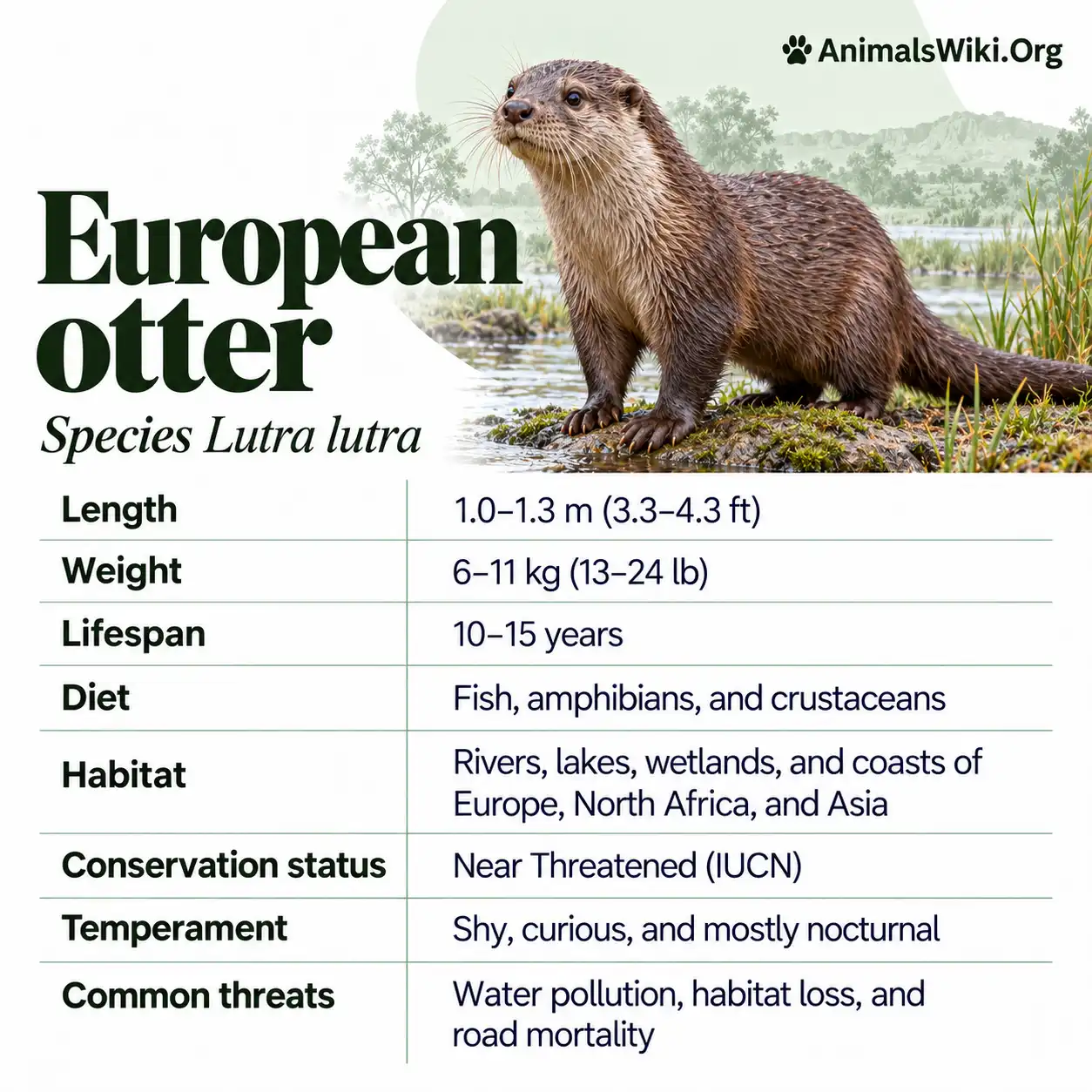
European Otter, The Elusive Hunter of Rivers, Wetlands and Coasts
The European otter is a graceful but powerful predator that connects life in the water with life along its banks. Its streamlined body, muscular tail and sensitive whiskers help it search for food beneath the surface, while sheltered vegetation and hidden dens provide places to rest and raise young.
Despite its familiar name, this animal is not restricted to Europe. The same species occurs across large parts of Asia and in parts of North Africa. For that reason, Eurasian otter is another widely used name.
Its story combines remarkable adaptability with continuing vulnerability. European otters can occupy rivers, lakes, wetlands and coastal environments, yet their survival depends on suitable food, shelter and access between habitats. They have recovered in some regions after severe historical declines, but that recovery has not removed threats from pollution, traffic, disturbance and changing waterways.
Otters are also frequently misunderstood. A coastal European otter is not a true sea otter, a daytime sighting is not necessarily unusual, and an otter’s presence does not prove that a river is free from contaminants.
This guide explains European otter identification, habitat, diet, reproduction, behavior and conservation, with attention to the differences between broad species patterns and local conditions.
European Otter Facts
| Feature | Information |
|---|---|
| Common name | European otter |
| Other common names | Eurasian otter, common otter |
| Scientific name | Lutra lutra |
| Animal class | Mammalia |
| Family | Mustelidae |
| Subfamily | Lutrinae |
| Distribution | Europe, much of Asia and parts of North Africa |
| General appearance | Brown coat, pale throat, long body and muscular tail |
| Size difference | Males are generally larger than females |
| Main foods | Fish, with other aquatic and terrestrial prey |
| Habitats | Rivers, lakes, wetlands, canals, estuaries and coastal environments |
| Social organization | Mostly solitary; mothers remain with dependent young |
| Young | Called cubs or pups |
| Pregnancy | Approximately nine weeks |
| Shelter | Enclosed holts and other sheltered resting places |
| Global conservation category | Near Threatened |
1. What Is a European Otter?
The European otter is a semiaquatic carnivorous mammal belonging to Mustelidae, the family that also includes weasels, badgers and martens.
“Semiaquatic” means that its life depends on both water and land. It obtains much of its food underwater but uses banks, vegetation and enclosed shelters for other essential activities.
Its scientific name is Lutra lutra, and it belongs to the otter subfamily, Lutrinae.
This combination of aquatic and terrestrial needs is central to understanding the animal. A river with fish may still provide poor habitat if its banks lack shelter. Conversely, a well-covered bank cannot support an otter if nearby waters provide insufficient food.
The European otter is therefore best understood as a user of connected habitats. Its living space includes the channel, shoreline and routes between feeding and resting areas.
Protecting only the visible water surface leaves much of that system unaccounted for.
2. European Otter or Eurasian Otter?
Both names refer to the same species.
“European otter” is familiar in European wildlife writing, while “Eurasian otter” better reflects its extensive distribution. “Common otter” is another established name.
The species occurs across Europe, large parts of Asia and portions of North Africa. Its range includes freshwater and marine-associated habitats.
However, a broad distribution does not mean that populations are continuous or equally secure throughout that area.
Some regions have well-studied recovering populations. Others have limited survey information or continuing losses.
The name should also not be confused with “European river otter” as though this were a separate river-only form. Coastal and inland European otters belong to the same species.
For readers researching a local population, the scientific name helps connect sources using different common names. It also prevents accidental mixing with the North American river otter, which is a distinct species in another genus.
3. What Does a European Otter Look Like?
The European otter has an elongated body, short legs, a broad muzzle and a muscular tail.
Its coat is generally brown or gray-brown, with a paler throat and underside. Small ears, prominent whiskers and eyes positioned high on the head contribute to its recognizable appearance.
The Mammal Society describes these features and the contrast between the darker upper body and paler lower surfaces.
An otter at the surface may reveal only its head and part of its back. The full shape becomes clearer when it climbs onto a bank or moves across exposed ground.
Wet fur also changes the appearance. An animal emerging from water can look narrower and darker than one resting with a dry coat.
For identification, body proportions are more reliable than apparent color alone. A long, flexible outline and substantial tapered tail help distinguish an otter from smaller mammals such as mink.
4. European Otter Size and Weight
Adult European otters vary in size, and males are generally larger than females.
Representative descriptions commonly place adults around a meter or more in total length, with much of the variation reflecting sex, location and whether the tail is included.
The International Otter Survival Fund gives a useful general guide of approximately 1.1–1.3 meters and around 7–9 kilograms.
These figures are not strict limits. A large male and a young female should not be expected to match the same measurement.
When comparing sources, distinguish:
- Head-and-body length.
- Tail length.
- Total length.
- Body mass.
A description that excludes the tail cannot be compared directly with one that includes it.
Size is also difficult to judge in water. Without a reliable scale reference, a swimming otter can appear unexpectedly small or surprisingly large.
Photographs showing the complete animal usually provide better identification evidence than an estimate made from its head alone.
5. Fur, Insulation and Grooming
European otters rely heavily on their fur for insulation.
The coat retains air close to the body, helping reduce heat loss during repeated exposure to water. Maintaining that coat is an essential part of daily life.
Research-based accounts of otter insulation emphasize the importance of fur condition and the relationship between grooming, swimming and body temperature.
An otter rubbing against vegetation or rolling on the bank may therefore be performing practical coat maintenance.
This is one reason apparently playful behavior needs context. Rolling can look entertaining while also helping restore the coat after a feeding trip.
Insulation is particularly important because an otter repeatedly enters water to obtain food. It cannot simply avoid wet conditions whenever temperatures fall.
Its survival involves a balance between gaining energy from prey and managing the costs of searching for that prey.
Fur, behavior and access to suitable resting places all contribute to that balance.
6. How European Otters Swim
Swimming involves coordinated movements of the body, feet and tail.
At the surface, otters can paddle while using the tail to help control direction. During diving and underwater movement, body flexion and hind-limb movements contribute to propulsion.
A scientific species account describes these different movements rather than treating the tail as the animal’s only source of power.
Their streamlined shape helps them move through water, but hunting requires more than speed. An otter must turn, investigate submerged structures, change depth and return to the surface.
Those demands explain the value of flexibility.
A straight-line swimming race would measure only one part of the animal’s abilities. Close control can be equally important when prey hides beneath a ledge or moves around roots.
The otter also remains an air-breathing mammal. Its underwater activity is divided into dives and surface intervals rather than continuing indefinitely below the water.
7. Sensitive Whiskers and Underwater Senses
The European otter’s whiskers are important sensory structures.
They provide information during close investigation and underwater foraging, complementing vision when water is dark, cloudy or obstructed.
A study published in 2026 examined Eurasian otter whisker arrangement, shape, muscles and movements. It documented the ability to move the whiskers underwater and highlighted specializations supporting active sensing.
This helps explain why the muzzle is such an important part of the hunting animal.
The otter is not simply watching fish from a distance. It also investigates spaces where visual information may be limited.
Whiskers should not be described as perfect radar. They provide tactile information, and their usefulness depends on the situation.
The broader advantage comes from combining senses. An otter can adjust how it searches as visibility, depth and surrounding structures change.
That flexibility helps it exploit environments far more complicated than clear aquarium water.
8. European Otter Habitat
European otters use rivers, streams, lakes, canals, marshes, estuaries and some coastal environments.
A suitable habitat provides more than water. It also needs food, sheltered resting places and opportunities to move between resources.
The Woodland Trust describes their use of a broad range of freshwater and coastal habitats.
Important features can include:
- Vegetated banks.
- Root systems and cavities.
- Wetland connections.
- Accessible prey.
- Undisturbed shelter.
- Routes beneath or around infrastructure.
A small stream can be valuable if it connects larger feeding areas or provides secure cover. A large river can be less useful where banks are heavily altered and shelter is scarce.
Habitat quality also changes with water levels.
A place that is accessible during low flow may become difficult during floods. Conservation therefore benefits from maintaining options across the surrounding landscape rather than protecting one isolated feature.
9. Coastal European Otters Are Not Sea Otters
European otters can forage in the sea, especially around parts of Scotland and nearby islands.
These coastal animals are still Lutra lutra. They are not the true sea otter, Enhydra lutris, of the North Pacific.
NatureScot explicitly makes this distinction in its description of Scottish coastal otters.
The difference matters because the two species have separate evolutionary histories, body proportions and ecological specializations.
A European otter hunting among shoreline rocks may spend much of its feeding time in salt water while returning to land and freshwater sources.
Calling it a “sea otter” informally can therefore create confusion.
For identification, use the species’ shape and geographic setting together. Habitat alone is insufficient: seeing an otter in seawater does not establish that it belongs to the sea otter species.
The same warning applies to photographs shared without accurate locations.
10. Why Coastal Otters Use Freshwater
Coastal European otters frequently wash in freshwater after feeding in the sea.
This is connected with maintaining the insulating properties of the coat.
Experiments involving otter pelts and living animals found that repeated seawater exposure affected fur performance, while freshwater access helped maintain suitable conditions.
The behavior makes freshwater pools important even where most food comes from marine environments.
A rocky shore may appear extensive, yet only certain sections offer the combination of feeding opportunities, shelter and freshwater access.
Research on Skye found that otters did not use all available pools equally. Characteristics such as depth and surrounding conditions influenced use.
This gives coastal conservation a broader focus than protecting the sea alone.
Small freshwater features above the shoreline can be part of an otter’s essential habitat.
Removing or disturbing them may affect animals that are usually photographed in an entirely different-looking environment nearby.
11. Holts, Couches and Other Resting Places
An enclosed otter shelter is commonly called a holt.
Holts can occur in natural cavities, beneath roots, among rocks or in other protected structures. Otters also use above-ground resting places, sometimes called couches.
NatureScot describes both forms of shelter.
Not every hole visited by an otter is a regularly used holt, and not every resting place is used for breeding.
Camera-based research found that otters sometimes entered potential shelters only briefly. Longer stays provided stronger evidence of actual resting.
That distinction is important for both research and conservation.
A structure may be inspected, marked or passed without being occupied for hours.
Conversely, the absence of obvious footprints does not prove that a sheltered site is unused.
For wildlife watchers, the appropriate response is to leave suspected shelters undisturbed. Trying to confirm occupation by approaching an entrance can interfere with the behavior being investigated.
12. What Do European Otters Eat?
Fish are the main food in many European otter populations.
Other prey includes amphibians, crustaceans, birds, insects and small mammals. The contribution of each category varies with habitat and season.
Cardiff University’s Otter Project emphasizes this broad diet while identifying fish as the principal resource.
| Food group | Examples |
|---|---|
| Fish | Locally available species in rivers, lakes or coastal waters |
| Amphibians | Frogs and toads |
| Crustaceans | Crayfish, crabs and other accessible species |
| Birds | Waterbirds and other occasional prey |
| Small mammals | Taken opportunistically |
| Invertebrates | Insects and other available animals |
A dietary list should not imply equal importance.
An unusual prey record may be genuine without representing an ordinary meal.
Likewise, a food that dominates one river system may be much less important elsewhere.
The European otter’s flexibility helps it exploit changing opportunities, but flexibility does not mean that any food shortage is easy to overcome.
13. Hunting and Prey Choice
European otters search underwater and pursue prey they can capture efficiently.
The best target is not necessarily the biggest fish. Size, speed, habitat and handling difficulty all influence the value of a potential meal.
Research in France found diets dominated by small and medium-sized fish in the two systems studied.
This fits the practical demands of repeated feeding.
A series of manageable prey may provide a better return than a long pursuit of one difficult target.
The otter also uses habitat structure. Shallow margins, submerged objects and areas where fish gather can create opportunities.
However, the presence of a particular fish in droppings does not reveal how many were killed or whether the wider fish population was affected.
Understanding hunting requires information about prey availability as well as what the otter consumed.
That distinction is especially important when discussing rare fish or conflict with fisheries.
14. Seasonal Diet Changes
European otters adjust their diet as food availability changes.
Fish remain important, but amphibians can contribute substantially at particular times and places.
A study in southern Italy found that amphibians became an important alternative where fish availability was limited, contributing strongly during spring.
Research in Danish freshwater habitats also found seasonal differences associated with prey availability.
These findings show why a single seasonal sample cannot represent every population throughout the year.
Spawning movements, changing flows and the availability of other prey all influence feeding opportunities.
Alternative food can provide a useful buffer, but it is not necessarily a complete replacement.
If a river loses substantial fish biomass, an otter may need to search farther or rely on resources that are available only briefly.
Protecting food supplies therefore involves maintaining the functioning of the wider aquatic community.
15. Diving and the Cost of Feeding
European otters often make repeated, relatively short dives while foraging.
Their objective is to obtain food efficiently, rather than remain underwater for as long as possible.
Research on coastal otters in Shetland found a strong preference for shallow water. The study examined how travel time, searching and heat loss could influence that pattern.
A deeper dive requires time to reach the feeding area and return.
That travel may reduce the time available for searching near the bottom.
Feeding also involves thermal demands. Research on free-ranging Eurasian otters examined changes in body temperature before and during swimming bouts, showing that behavior helps manage those costs.
This is why a maximum breath-holding figure provides only a limited picture.
A routine feeding dive is a decision about energy, oxygen and prey access.
Several short successful dives can be more useful than one unusually long one.
16. Are European Otters Nocturnal?
European otters are often predominantly nocturnal in freshwater environments, but their activity is flexible.
Coastal populations can be conspicuously active during daylight.
The Otter Specialist Group describes this contrast, including daytime coastal foraging around Scottish islands.
The difference reflects local ecology rather than two separate species.
Prey behavior, weather, disturbance and environmental conditions influence when feeding is worthwhile.
A daytime sighting is therefore not, by itself, evidence of illness or abnormal behavior.
It is also useful to distinguish activity from visibility.
An otter can remain active beneath the water or within dense bankside cover while appearing absent to someone watching from a path.
For wildlife observation, local routines are more informative than a universal timetable.
Repeated distant sightings or properly gathered camera records can reveal when animals tend to use a particular location.
17. Winter Survival and Changing Water Levels
European otters remain active in winter.
They continue obtaining food and using shelter rather than entering a winter hibernation.
Cold, ice and changing flows can alter which feeding places remain accessible.
A river outlet that stays open may become more valuable than a frozen margin, while flood conditions can change routes beneath bridges or along banks.
The animal’s needs remain interconnected: food, resting places and safe access must all continue functioning.
Winter survival is therefore not explained by fur alone.
Insulation helps, but the otter still needs to replace energy used during movement and feeding.
Periods of heavy flow can also make familiar routes difficult.
A place that looks like a continuous water corridor on a map may temporarily offer no dry bank beneath a road crossing.
These seasonal changes help explain why infrastructure design needs to consider high flows as well as ordinary conditions.
18. Solitary Life and Home Ranges
European otters are mostly solitary, apart from breeding interactions and the prolonged association between mothers and dependent young.
Solitary living still involves awareness of other otters.
Individuals use space in relation to food, shelter and neighbors.
A radio-tracking study of twenty otters on lowland rivers found differences between male and female space use and evidence that neighboring animals influenced range boundaries.
Home ranges can follow long sections of river rather than form compact circles.
Their size depends on habitat productivity and resource distribution.
A food-rich coastal section may support different spacing from a long inland waterway.
This is why one published range length should not become a minimum requirement applied everywhere.
For conservation, the important question is whether an animal can reach the necessary resources across its actual landscape.
Protecting one resting place while blocking its feeding routes may leave the larger habitat system incomplete.
19. Spraints and Scent Communication
Otter droppings are commonly called spraints.
They are often deposited at noticeable locations and can contribute to communication.
Chemical research found that Eurasian otter scent profiles were associated with individual identity in the samples studied.
Other work has investigated differences related to age, sex and reproductive condition.
Cardiff University’s Otter Project describes scent marks as an important way that these largely solitary animals exchange information.
A mark can remain after the animal has moved away, allowing communication without direct contact.
However, counting spraints does not automatically count otters.
One animal may leave several deposits, and multiple animals may use the same location.
Weather and water levels can also remove evidence.
Spraints are therefore valuable for surveys, but their interpretation requires care.
Presence is usually easier to establish than the exact number, sex or identity of animals using a site.
20. European Otter Reproduction
European otters can breed at different times of year, although local populations may show seasonal patterns.
Pregnancy lasts approximately 63–65 days, or around nine weeks.
Litter size varies, with a few cubs being typical.
This reproductive pattern should not be confused with the long delayed-implantation cycle commonly described for North American river otters.
Facts from one otter species should not be copied automatically into an account of another.
Birth timing also needs geographic context.
A seasonal pattern in one coastal population may differ from that of otters using an inland river elsewhere.
The mother needs secure shelter during the period when cubs cannot accompany her.
Food availability and the distance between shelter and feeding areas influence the demands of care.
Successful reproduction therefore depends on a combination of suitable habitat and maternal survival, rather than the presence of a den alone.
21. Baby European Otters
Baby European otters are called cubs or pups.
They are born dependent and remain inside shelter during early development.
The Woodland Trust describes cubs beginning to leave the holt at around ten weeks and entering the water later as their abilities develop.
These ages are useful guides rather than exact deadlines for every litter.
Development involves several distinct stages:
- Opening the eyes.
- Moving around the holt.
- Leaving shelter.
- Entering water.
- Eating solid food.
- Catching prey.
- Becoming independent.
A cub capable of swimming is not necessarily able to feed itself reliably.
Young can remain with the mother for an extended period while acquiring experience.
That is why an apparently active youngster should not automatically be treated as independent or abandoned.
Its mother may be temporarily out of view, particularly in vegetation or beneath the surface.
22. Lifespan and Natural Risks
European otter lifespan varies considerably.
Some individuals survive for many years, while others die young. Published figures differ according to whether they describe an average, a maximum or survival after the earliest life stages.
The IUCN assessment summarizes wild life expectancy as substantially shorter than the longest ages reached in captivity.
Young animals face particular challenges as they develop and eventually disperse.
Adults encounter risks associated with feeding, movement and competition, while roads and fishing equipment add human-related hazards.
Natural predation also differs across the species’ enormous range.
A predator list from one country should not be transferred automatically to every European population.
For an animal distributed across several continents, local conditions matter as much as broad generalizations.
The most accurate lifespan description therefore avoids suggesting that every otter normally reaches one fixed age.
23. Ecological Importance
European otters participate in food webs as predators of fish and other animals.
Their feeding links them with prey populations, while their movement connects aquatic habitats with riverbanks and surrounding land.
The species can also draw conservation attention to whole catchments.
Protecting a viable otter population often requires functioning wetlands, shelter, prey and routes between them.
However, its ecological role should not be reduced to the claim that it controls every fish population.
The effect of predation depends on local abundance, prey ecology and other environmental pressures.
Recent research at fishways and spawning areas found varied diets but emphasized that dietary detection alone could not establish predation rates or population-level effects.
That distinction helps keep discussion balanced.
An otter can be an important predator without being the explanation for every change in a fishery.
24. Does an Otter Mean the Water Is Clean?
An otter sighting is encouraging evidence of habitat use, but it does not prove that the water is pollution-free.
Otters can accumulate contaminants through their food.
Researchers therefore use tissue samples to investigate exposure and environmental conditions.
Cardiff University’s Otter Project explains how samples collected from animals found dead help track chemical pollution over time.
This creates an important distinction between an indicator species and an instant certificate of environmental quality.
An animal may occupy a contaminated river because prey remains available or because exposure is not immediately fatal.
Its presence can coexist with chemical problems.
Environmental assessment therefore needs measurements of contaminants, habitat and prey alongside wildlife observations.
The otter is useful because it integrates information through its position in the food web, not because it refuses every place containing pollution.
25. Historical Decline and Recovery
European otters declined severely in parts of Europe during the twentieth century.
Pollution, persecution and habitat degradation contributed to those losses.
In Britain, restrictions on harmful chemicals, stronger protection and environmental improvements supported substantial recovery.
The Otter Specialist Group identifies the British comeback since the 1980s as a notable conservation development.
This is an important success, but recovery should not be treated as a permanent condition.
A population can expand after one pressure is reduced and later face different problems.
Monitoring is needed to distinguish continued improvement from stability or renewed decline.
Historical survey records provide a useful baseline.
England’s national surveys used repeated searches for spraints and footprints, allowing distribution changes to be assessed across survey periods.
Such evidence is more reliable than assuming that an increase in photographs always means an equivalent increase in animals.
26. Current Conservation Status and Regional Differences
The European otter is globally categorized as Near Threatened.
That category applies across the species’ range and does not mean every regional population has the same condition.
A protected river system may support regular breeding while another catchment loses suitable habitat or prey.
Regional assessments and surveys are therefore essential.
For example, a Welsh survey comparing repeated sites reported a decline in the proportion containing otter signs between the earlier survey and work conducted in 2015–2018.
The reasons were not established by that survey alone.
A decline in positive survey sites should also not be translated casually into an identical percentage decline in individual otters.
Distribution indicators and population counts are different measurements.
The practical conclusion is that past recovery does not remove the need to investigate local changes.
27. Roads, Bridges and Safe Passage
Road traffic is an important source of otter mortality.
The problem often involves the relationship between a road and a waterway.
An otter following a bank may encounter a bridge or culvert with no usable route beside the water, particularly during high flows.
Research on British road deaths recommended maintaining continuous bank access beneath crossings where possible.
It also discussed ledges and other measures designed to provide passage without forcing animals onto the carriageway.
A culvert that carries water is not automatically a safe wildlife crossing.
The relevant questions include whether there is usable space, whether it remains available during floods and whether the surrounding route guides animals toward it.
Good design considers the whole journey.
It should preserve movement rather than simply place a structure at one point and assume the problem is solved.
28. Chemical Pollution Remains a Concern
The pollution story did not end when some older chemicals were restricted.
Persistent substances can remain in the environment, and newer replacements can create additional monitoring questions.
Research reported by Cardiff University in 2024 found legacy and replacement PFAS compounds in English otters.
A later report described rising PCB concentrations in sampled Welsh otters over the studied period.
These findings do not mean every exposed animal suffered the same effects.
Exposure, dose and biological consequences must be distinguished.
They do demonstrate that an otter population can persist while contaminants remain a concern.
Long-term sample collections are valuable because they allow researchers to compare periods and investigate whether environmental measures are working.
The combination of historical samples and current analysis can reveal problems that a casual river visit would not detect.
29. Otters and Fisheries
European otters can create conflict where fish are concentrated in ponds or production facilities.
Research in Finland found increased use of salmonid-rich settings, including fish farms, illustrating how predictable food can attract otters.
This does not establish that otters have the same effect on every natural fish population.
A stocked enclosure differs from a large river in prey density, escape opportunities and management goals.
For vulnerable facilities, prevention commonly focuses on well-designed physical exclusion.
Current Natural England guidance emphasizes fencing that prevents animals passing through, climbing over or digging beneath it, with continued inspection and maintenance.
The general lesson is to address access points before repeated losses occur.
Any management also needs to follow the requirements applying in that jurisdiction.
Conservation and livelihoods are better served by evidence-based prevention than by assuming every fish loss has one cause.
30. How Scientists Monitor European Otters
Otter research uses several complementary methods.
These include searches for field signs, camera trapping, genetic work and examination of animals found dead.
Each answers different questions.
Field signs can establish use of a site. Cameras reveal timing and behavior. Genetic analysis can help distinguish individuals, while postmortem research provides information about health and contaminants.
Studies of holts also show why camera placement and survey duration matter.
A long-term investigation found that different camera arrangements affected the information captured, and that excluding daylight would have missed some registrations.
A blank camera or an empty bank does not automatically establish absence.
Detection depends on effort, positioning and animal movement.
Reliable monitoring accounts for those limitations rather than treating every non-detection as proof that a population has disappeared.
31. Protecting Habitat and Avoiding Disturbance
Otter conservation requires attention to water, banks and routes between them.
Useful measures include retaining riparian vegetation, protecting resting places and maintaining connections between feeding areas.
Natural England’s planning guidance emphasizes habitat retention, movement routes and the possible effects of noise, light and development near water.
A riverbank clearance can matter even when the channel remains untouched.
Similarly, artificial lighting can alter the conditions around a route or shelter without removing the physical structure.
The aim is to maintain a usable environment over time.
Legal protection also varies by jurisdiction, so local requirements should be checked before works near suspected shelters.
In Wales, for example, official guidance identifies protection for breeding sites and resting places as well as the animals themselves.
This reflects the practical reality that protecting an otter while destroying its shelter would offer incomplete protection.
32. How to Watch European Otters Responsibly
Successful otter watching depends more on patience than proximity.
Choose a place with a clear view, remain quiet and let the animal decide whether to continue using the area.
Binoculars and a longer camera lens help reveal behavior without forcing a close approach.
Good practice includes:
- Keep dogs controlled.
- Avoid feeding.
- Leave routes between land and water open.
- Stay away from suspected holts.
- Avoid surrounding an animal with people.
- Allow it to leave without following.
A resting otter may need recovery time between feeding bouts.
An animal watching a person closely may be vigilant rather than relaxed.
The best encounter lets the otter continue normal activity.
If it disappears beneath the surface or into vegetation, wait. Repeatedly changing position can make observation harder while increasing disturbance.
A distant view of ordinary hunting or grooming is more informative than a close encounter dominated by escape behavior.
33. European Otter vs Other Otters
The European otter is one member of a diverse group.
| Animal | Scientific name | Main distinction |
|---|---|---|
| European or Eurasian otter | Lutra lutra | Widespread across Eurasia and parts of North Africa |
| North American river otter | Lontra canadensis | Separate North American species |
| Giant otter | Pteronura brasiliensis | Much larger South American otter with distinctive throat patches |
| Sea otter | Enhydra lutris | Marine species of the North Pacific |
| Asian small-clawed otter | Aonyx cinereus | Smaller species with distinctive claw and foraging adaptations |
Names such as “river otter” describe habitat associations but do not always identify one worldwide species.
This is why the scientific name is useful in comparisons.
Behavior should also remain species-specific.
The family structure of giant otters, for example, should not be copied into an account of the usually solitary European otter.
Likewise, the sea otter’s specialized marine lifestyle does not describe every otter seen along a coast.
34. Common European Otter Myths
| Myth | More accurate explanation |
|---|---|
| European otters live only in Europe | Their range extends through Asia and into North Africa |
| They live only in rivers | They also use lakes, wetlands, canals and coasts |
| A coastal otter must be a sea otter | Coastal Lutra lutra remain European otters |
| Otters are always nocturnal | Daylight activity occurs, especially in some coastal settings |
| Seeing an otter proves the water is clean | Contaminant exposure can occur where otters remain present |
| Every group is a permanent adult family | A mother with young differs from stable group living |
| Every fish remains in a spraint represents major fishery damage | Dietary presence does not measure population-level impact |
| Recovery means protection is no longer needed | Regional pressures and renewed declines remain possible |
The real animal is remarkable because of its adaptability, sensory abilities and connection with complex aquatic habitats.
Those features provide a stronger picture than a collection of absolute claims.
35. Frequently Asked Questions About European Otters
What is a European otter?
The European otter is a semiaquatic carnivorous mammal belonging to the weasel family. It hunts mainly in water but depends on terrestrial shelter and routes along banks. Its scientific name is Lutra lutra.
Is the European otter the same as the Eurasian otter?
Yes. Both names refer to Lutra lutra. “Eurasian” reflects its broad distribution more clearly, while “European otter” remains common in regional wildlife writing.
Does it live outside Europe?
Yes. Its natural range extends across much of Asia and into parts of North Africa. Occurrence is uneven, and some areas have much less detailed population information than well-studied European regions.
Is it related to weasels?
Yes. Otters and weasels belong to Mustelidae. Sharing a family does not mean they have identical diets or lifestyles; otters have developed substantial adaptations for obtaining food in water.
How large is a European otter?
A representative adult may measure around 1.1–1.3 meters including the tail, although individuals vary. Males are generally larger than females. Total length should not be confused with body length alone.
What color are European otters?
They are generally brown or gray-brown, with paler fur on the throat and underside. Wetness and lighting change their appearance, so coat color alone is not a dependable identification method.
What do European otters eat?
Fish are important in many populations. Amphibians, crustaceans and other animals also contribute. The balance changes with habitat, season and prey availability rather than remaining identical everywhere.
Do they eat only fish?
No. Their diet is broader, and alternative prey can become important. However, dietary flexibility does not mean the loss of a major fish resource is always easy to compensate for.
Can European otters live in salt water?
They can forage in coastal marine environments. Many coastal individuals also use freshwater pools and land-based shelter. Their use of seawater does not make them the North Pacific sea otter.
Why do coastal otters wash in freshwater?
Freshwater washing helps maintain the performance of their fur after seawater exposure. Research supports its importance for insulation, making nearby freshwater features valuable parts of coastal habitat.
How long can a European otter stay underwater?
Routine feeding involves repeated dives, often much shorter than an animal’s maximum capability. The purpose of a dive, depth and feeding conditions matter more than one universal breath-holding number.
Are European otters nocturnal?
Often, particularly in freshwater environments, but not exclusively. Some coastal populations are frequently active by day. A daytime sighting is not automatically a sign that something is wrong.
Do European otters hibernate?
No. They remain active in winter. Cold conditions and ice can change feeding opportunities and movement routes, but the animal continues seeking food and using shelter.
Are European otters social?
They are mostly solitary. Mothers remain with dependent young, and adults interact during breeding or other encounters. Seeing several otters together does not establish a permanent group of unrelated adults.
What is an otter holt?
A holt is an enclosed shelter used by an otter. It may occur in a bank, beneath roots or among rocks. Otters also use other resting places, including sheltered above-ground sites.
What are spraints?
Spraints are otter droppings, often deposited at noticeable locations. They provide evidence for surveys and can carry scent information. Several deposits do not necessarily indicate several animals.
What are baby European otters called?
They are called cubs or pups. They begin life dependent on maternal care and develop swimming and hunting abilities gradually. Emerging from a holt is not the same as becoming independent.
How long is European otter pregnancy?
Pregnancy lasts approximately nine weeks. This differs from the prolonged mating-to-birth interval associated with delayed implantation in some other otter species.
How many cubs do they have?
A few cubs are typical, although litter size varies. A broad maximum should not be presented as the normal number produced by every female.
Does the male help raise the cubs?
Maternal care is the usual pattern described for European otters. The mother’s access to food and secure shelter is therefore particularly important during the dependent period.
How long do European otters live?
Survival varies, and maximum age differs from average wild lifespan. Some animals live many years, while others die young. Published figures need to be interpreted according to what was measured.
Are European otters endangered?
Their global IUCN category is Near Threatened. Regional conditions differ, so the global category should not be used to claim that every local population is secure or declining at the same rate.
Do otters prove a river is healthy?
They provide useful information, but their presence does not prove the absence of pollution. Researchers can detect contaminants in otters using tissue analysis, even where the species continues to occupy the habitat.
What should I do if I find a cub alone?
Keep people and pets away and observe from a distance. Its mother may be nearby or temporarily out of sight. If injury or immediate danger is evident, seek guidance from the relevant wildlife authority or experienced rescue organization.
How can people help European otters?
Protect riverbank vegetation, prevent litter and discarded fishing line from entering waterways, avoid feeding wildlife and support habitat restoration. Maintaining safe movement routes and sheltered banks benefits otters alongside many other species.



