
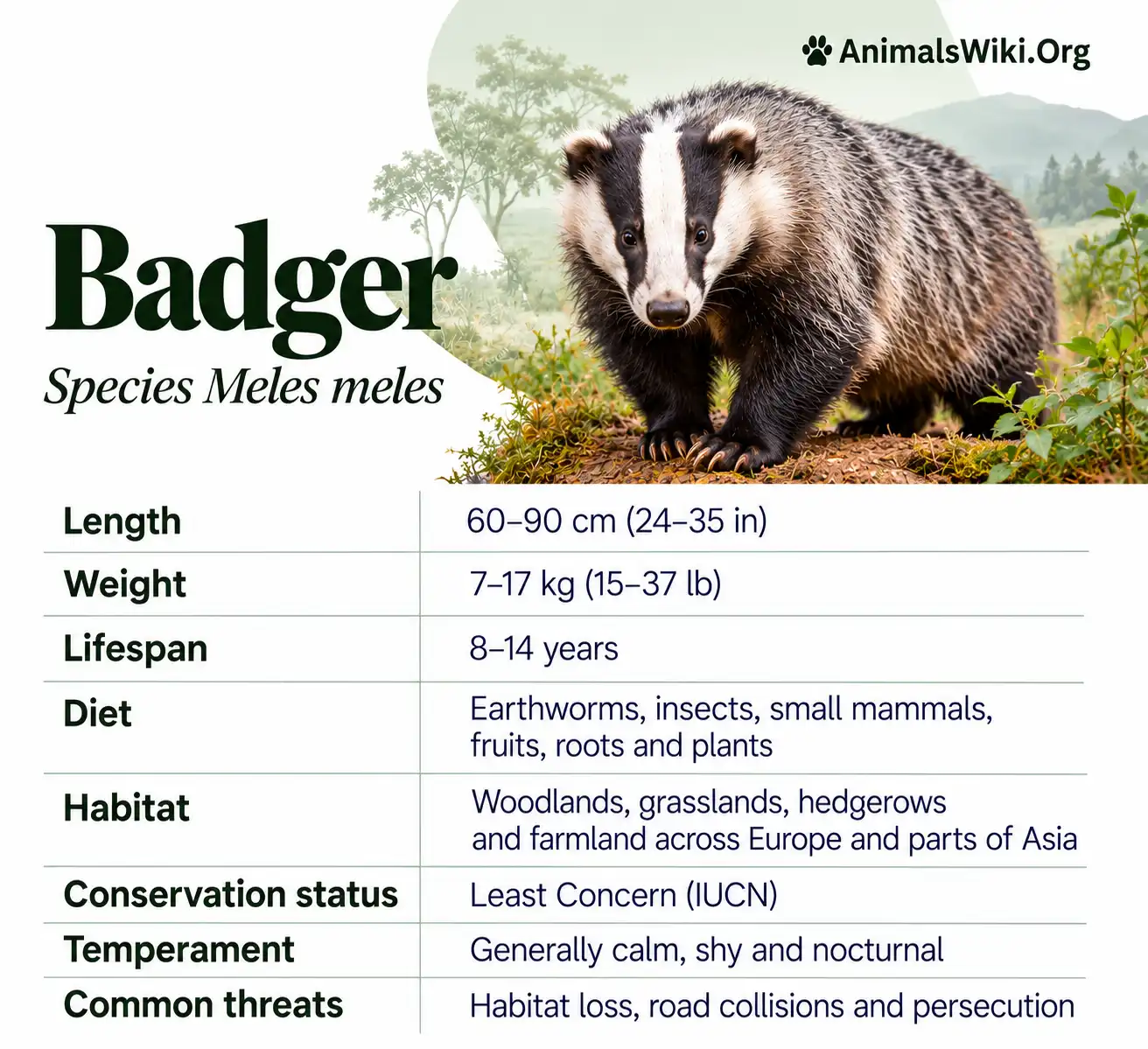
Badger, The Powerful Digger with a Remarkable Underground Life
A badger is a powerful, ground-dwelling mammal best known for its sturdy body, strong claws and impressive digging ability. For many people, the name brings to mind a gray animal with a sharply striped black-and-white face. However, badgers are more diverse than that familiar image suggests.
Different badgers inhabit woodlands, grasslands, mountain slopes and other environments across several continents. Some live in social groups and maintain extensive underground homes. Others spend much of their lives alone, excavating burrows as they search for prey.
Their diets are equally varied. Earthworms are important to many European badgers, while American badgers frequently pursue rodents underground. Honey badgers have their own distinctive feeding habits, appearance and behavior.
Understanding these differences makes badgers especially interesting. Their shared reputation as determined diggers hides a collection of animals with different ecological relationships and survival strategies.
This guide explains what a badger is, introduces the main groups, and explores their habitats, diets, reproduction and conservation. Whenever a fact applies mainly to one species, that species is identified.
Most animals commonly called badgers belong to Mustelidae, the family that also includes otters, weasels and wolverines. An important exception is the stink badgers, which belong to the skunk family, Mephitidae.
Badger Facts
| Feature | Details |
|---|---|
| Animal group | Mammal |
| Scientific identity | Several species rather than one |
| Main family | Mustelidae |
| Important exception | Stink badgers belong to Mephitidae |
| Familiar examples | European badger, American badger, honey badger |
| Typical build | Sturdy body, short legs and strong digging claws |
| Habitats | Woodlands, grasslands, scrublands and other environments |
| Diet | Varies from broadly omnivorous to strongly meat-based |
| Activity | Many species are mainly active at night |
| Underground home | Often called a sett, particularly for European badgers |
| Young | Commonly called cubs |
| Social behavior | Group-living in some populations; solitary in others |
| Conservation | Varies by species and region |
| Main threats | Habitat loss, roads, persecution and other local pressures |
1. What Is a Badger?
“Badger” is a common name applied to several mammals that often share a sturdy build and adaptations for life close to, or beneath, the ground.
The name does not identify one species with one universal lifestyle. A European badger living in a woodland sett and an American badger hunting on open prairie may look broadly similar, but their daily lives can differ substantially.
Most badgers are mustelids. This connects them with a surprisingly varied family containing small, slender weasels, aquatic otters and powerful wolverines. Family membership reflects evolutionary relationships rather than identical appearances.
Digging is central to the popular understanding of a badger, but it serves several purposes. Excavation may create shelter, expose food, provide a place to raise young or help an animal reach prey already underground.
A useful introduction therefore begins with two questions: Which badger species is involved, and where does it live? Those details help explain almost everything else about its behavior.
2. Badger Classification: Why the Name Can Be Confusing
Badger classification is more complicated than a single common name suggests.
Several genera include animals called badgers. Examples include Meles, Taxidea, Mellivora, Arctonyx and Melogale. These represent different branches within the mustelid family.
The genus Mydaus, containing stink badgers, belongs instead to Mephitidae. Their common name preserves a resemblance to other ground-dwelling diggers, while modern classification places them with skunks.
Species boundaries also change as researchers compare anatomy and other evidence. Older accounts may combine populations that more recent references recognize separately.
For example, the Mammal Diversity Database currently recognizes the Amur badger, Meles amurensis, separately from the Asian badger, following a taxonomic study published in 2025.
This explains why different references may give different totals for “how many badger species exist.” The answer depends partly on the date of the source and which common-name groups it includes. Scientific names make those differences easier to understand.
3. Main Types of Badgers
The following table introduces representative badgers and their general identities. It is a guide to major groups rather than an exhaustive species checklist.
| Badger | Scientific name or genus | General distribution or association |
|---|---|---|
| European badger | Meles meles | Europe and nearby areas |
| Asian badger | Meles leucurus | Parts of temperate Asia |
| Japanese badger | Meles anakuma | Japan |
| Caucasian badger | Meles canescens | Southwest Asia and surrounding regions |
| Amur badger | Meles amurensis | Parts of northeastern Asia |
| American badger | Taxidea taxus | North America |
| Honey badger | Mellivora capensis | Africa and parts of Asia |
| Hog badgers | Arctonyx | Parts of Asia |
| Ferret-badgers | Melogale | Parts of Asia |
| Stink badgers | Mydaus | Parts of Southeast Asia |
Geographic descriptions in a table cannot capture every boundary or local gap. A species listed for a country may occupy only certain habitats within it.
The table also shows why photographs need careful labels. An image of a honey badger should not illustrate a detailed section about European badger cubs or American badger hunting. Matching the correct species to each description keeps an animal article accurate and useful.
4. The European Badger
The European badger, Meles meles, is the striped-faced animal familiar to many readers in Britain and continental Europe.
It has a broad, sturdy body, short legs, a relatively short tail and a grizzled coat. Two dark facial bands extend along the sides of the head, contrasting with pale fur.
European badgers are especially associated with underground homes called setts. In some areas, these are occupied by social groups whose members share shelter while usually searching for food individually.
Their diet is flexible. Earthworms can be important, but they also eat insects, fruit and other available foods.
Older references sometimes use “Eurasian badger” for a much broader collection of populations. Modern treatments distinguish several Meles species, so historical range descriptions need to be read with that change in mind.
For a general article, “European badger” is a useful name for M. meles. It helps separate the species from Asian relatives that may have been included under the same name in older literature.
5. The American Badger
The American badger, Taxidea taxus, is a North American digging specialist strongly associated with open environments.
Its body is broad and flattened, with short, muscular legs. The face has contrasting pale and dark markings, including a pale stripe running over the head.
Unlike European badgers in many British populations, American badgers are generally solitary. They frequently dig in pursuit of ground-dwelling prey, including rodents.
Grasslands, fields and other open habitats can provide both food and suitable soil. Their burrows serve as resting places, shelters and sites associated with hunting.
Watching an American badger search for prey reveals how closely its body matches its feeding strategy. The animal can apply its forelimbs directly to the ground while its low profile helps it work at a burrow entrance.
Its appearance should not lead to assumptions about European-style clan life. American and European badgers share a common name, but their social organization and feeding emphasis are meaningfully different.
6. Asian, Japanese, Caucasian and Amur Badgers
Several members of Meles occur across Asia and nearby regions.
The Asian badger, Meles leucurus, inhabits parts of continental Asia. Current distribution records include countries such as China, Mongolia, Kazakhstan and Russia.
The Japanese badger, Meles anakuma, occurs in Japan, including Honshu, Shikoku and Kyushu. Its island distribution makes it a distinct subject rather than simply a European badger living farther east.
The Caucasian badger, Meles canescens, is recognized separately in modern taxonomy and occurs across parts of Southwest Asia and surrounding regions.
The Amur badger, Meles amurensis, represents another recent distinction, with current records placing it in parts of northeastern Asia.
These names matter when comparing studies. Research published decades ago may use a broader scientific name than a current database.
The underlying observations may remain valuable, but their species labels need context. A careful reader can retain useful information about feeding or movement while checking how the studied population is classified today.
7. The Honey Badger
The honey badger, also called the ratel, is Mellivora capensis. It occurs in Africa and parts of Asia.
Its coloration differs sharply from the classic European badger pattern. Honey badgers generally have a dark lower body and a broad, pale mantle extending over the upper surface.
They possess strong forelimbs and digging claws, but they can also climb and swim. Their diet includes a range of animal foods, with some plant material.
The familiar name can be misleading. Honey badgers investigate beehives partly for the nutritious bee brood, rather than living on honey alone.
Their reputation for toughness has encouraged exaggerated claims. They are capable wild predators, but dramatic descriptions should not replace an understanding of their normal feeding, sheltering and reproductive behavior.
Most honey badgers live largely alone, and females raise their young. Their appearance, ecology and family life should be described separately from the clan-based behavior often associated with European badgers.
8. Hog Badgers and Ferret-Badgers
Hog badgers belong to Arctonyx. Modern classifications distinguish species that older sources sometimes combined.
For example, the northern hog badger, Arctonyx albogularis, is recognized separately from the greater hog badger, Arctonyx collaris. Their distribution records and conservation assessments are therefore not interchangeable.
The greater hog badger is currently listed as Vulnerable, showing why it would be inaccurate to describe all badgers as secure simply because some familiar species are widespread.
Ferret-badgers belong to Melogale. The group includes several Asian species, such as the Javan ferret-badger.
These less familiar animals broaden the meaning of “badger.” They also highlight a common limitation of general wildlife information: the best-known species often receives most of the attention.
A complete overview should acknowledge the smaller or less frequently discussed groups without inventing one shared lifestyle for them. Where detailed evidence is limited, species identity and verified distribution are more useful than borrowing facts from a better-studied relative.
9. What Does a Badger Look Like?
Many badgers have a compact body, short legs and a head that appears well suited to investigating the ground.
However, their coats and proportions differ. European badgers have a conspicuous striped face and grayish body. American badgers appear particularly broad and low, while honey badgers have their distinctive pale upper mantle.
Strong claws are an important feature, especially on the forefeet. They help the animal break into soil, uncover food and construct shelter.
The familiar black-and-white face is therefore useful for recognizing certain badgers, but it is not a universal design shared by every species.
Photographs can also distort proportions. A low camera angle may make an animal look taller, while thick fur can conceal the shape of the body.
For identification, consider several features together: facial markings, body profile, tail length, habitat and geographic location. One memorable trait is helpful, but a combination provides a stronger identification than color alone.
10. How Big Are Badgers?
Badger size varies by species, sex, age, season and local conditions.
The Wildlife Trusts gives European badger figures of approximately 8–12 kilograms, with a listed length of 75–100 centimeters. These are general reference figures, not limits applying to every individual.
For American badgers, a National Park Service profile gives a weight of approximately 13–25 pounds, or about 5.9–11.3 kilograms.
Length descriptions require particular care because some sources include the tail while others separate it. Two apparently conflicting figures may simply measure different things.
Seasonal body condition also matters. European badgers can accumulate fat before winter and lose weight during periods of reduced feeding.
The most useful comparison identifies the species and the measurement. “An adult European badger weighing ten kilograms” conveys more information than “a large badger.”
It also avoids implying that a small ferret-badger, an American badger and a large European badger should all fall within one universal size range.
11. Why Are Badgers Such Good Diggers?
A badger’s digging ability depends on several features working together.
Strong forelimbs apply force to the soil. Long claws help break and move material. A sturdy body provides support while the animal works at ground level.
The importance of digging differs with the species. An American badger may excavate directly after burrowing prey, while a European badger can spend substantial effort maintaining a shelter system.
Digging also involves decisions about location. Soil that is easy to excavate but prone to flooding may be unsuitable for a long-term home. Secure shelter requires more than the ability to create an opening.
This is why habitat quality includes underground conditions. A field may appear suitable from above while offering poor soil or inadequate shelter opportunities below.
The badger’s body is impressive, but successful excavation also depends on the landscape. Physical adaptations and environmental conditions together determine where digging becomes useful for feeding, resting and reproduction.
12. Where Do Badgers Live?
There is no single badger habitat.
European badgers can use landscapes containing woodland, pasture, farmland, hedgerows and gardens. American badgers are particularly associated with open country containing burrowing prey. Other species inhabit different Asian and African environments.
For European badgers, a mixture of shelter and feeding ground can be valuable. Woodland or scrub may provide cover around a sett, while nearby open areas offer feeding opportunities.
NatureScot notes that suitable sett locations often have dry, workable soil. Banks, hedgerows and wooded areas can provide appropriate conditions, although setts also occur in less obvious places.
The distinction between shelter habitat and feeding habitat is useful. Both may be essential even when they occupy different parts of the landscape.
Protecting only a sett entrance would not preserve every resource its residents need. An animal must also be able to reach food and travel between useful places without encountering excessive barriers or disturbance.
13. What Is a Badger Sett?
A sett is an underground system of tunnels and chambers associated particularly with European badgers.
Some setts are relatively small and used intermittently. Others are extensive structures with numerous entrances, maintained and enlarged over many years.
Large, established setts can be used across generations. Their age should not be confused with the lifespan of one animal: the structure persists while its occupants change.
A sett provides shelter, places to rest and a protected environment for raising cubs. Its entrances are only the visible part of a larger underground system.
Badger territories can contain more than one sett. A main sett may be accompanied by smaller alternatives used at different times.
This arrangement helps explain why a single quiet entrance does not reveal the entire situation. Occupancy and activity can shift, and the full extent of underground tunnels is not obvious from the surface.
For wildlife observers, a sett is a living shelter system that should be appreciated without entering, blocking or probing it.
14. How Do Badgers Maintain Their Underground Homes?
European badgers do more than dig a tunnel and leave it unchanged.
They move bedding materials such as dry grass and leaves, and used material may appear outside entrances. Excavated soil can also form conspicuous heaps near active openings.
Maintenance changes the appearance of a sett over time. Fresh earth, recently moved bedding and well-used paths can indicate activity, although signs should be interpreted together.
A badger’s relationship with its shelter is therefore ongoing. The sett is adjusted as occupants use different chambers and entrances.
Different sett types can also serve different roles. Survey guidance distinguishes main setts, annexes, subsidiary setts and outliers according to their features and patterns of use.
For a casual observer, learning these categories is less important than recognizing that not every hole has the same function.
A small, occasionally used shelter should not be judged against the appearance of a large main sett. Both can form part of the same animal’s wider network of usable places.
15. What Do Badgers Eat?
The badger diet depends strongly on the species and the foods available locally.
European badgers are omnivores. Their meals can include earthworms, insects, fruit, small mammals and other resources.
American badgers have a stronger emphasis on animal prey, particularly burrowing rodents. Honey badgers consume a broad selection of animal foods and some plant material.
Even within one species, diet is not fixed. Food availability changes through the year and between habitats.
The scientific order Carnivora can create confusion here. Membership does not mean an animal eats only meat. European badgers belong to that order while consuming substantial amounts of invertebrate and plant food.
A useful way to understand a badger’s diet is to ask what foods are accessible in its immediate environment. A short, productive feeding patch can matter more than a distant resource.
This flexible relationship with food helps explain differences in movement, body condition and social organization across populations.
16. Why Are Earthworms Important to European Badgers?
Earthworms can be a major food resource for European badgers, particularly in suitable grassland landscapes.
Their availability near the surface changes with conditions. Moist soil can make worms more accessible, while drought can push them deeper underground.
NatureScot describes badgers shifting toward other foods when worms become less available. This is one reason a varied landscape can be valuable: alternative resources may become important when a preferred food is difficult to obtain.
It is tempting to assign one percentage to the entire species’ diet, but that can be misleading. A figure from a particular region or season does not necessarily describe badgers everywhere.
The same animal may feed differently after a change in weather or as fruit ripens.
Earthworms therefore help explain European badger ecology without defining it completely. Their significance lies partly in being abundant under the right conditions and partly in how changes in availability influence the animal’s feeding choices.
17. How Do American Badgers Hunt?
American badgers often obtain prey by digging into the ground.
Their targets include animals such as ground squirrels, pocket gophers and prairie dogs. Rather than relying only on speed across open terrain, a badger can pursue food into the places where it shelters.
This creates a close link between predator distribution, prey populations and soil conditions. Open habitat alone is insufficient if suitable prey is absent or difficult to reach.
Hunting excavation can also produce new shelter opportunities. A hole created during a feeding attempt may later be used for resting or by another animal.
American badgers may store food as well. A remarkable study documented individuals burying calf carcasses in Utah, including one carcass that was completely covered.
That finding demonstrates their capacity to exploit a substantial food resource. It does not mean badgers killed the calves or that livestock is their typical prey. The observation concerned scavenging and food storage, making that distinction essential.
18. How Does Badger Diet Change with the Seasons?
Seasonal feeding is shaped by changing opportunities.
Invertebrates may become more accessible during certain weather conditions. Fruit becomes available as plants ripen. Other foods may be important when a preferred resource declines.
Research on Japanese badgers in a grassland-and-forest landscape found that invertebrates, particularly earthworms and beetles, formed much of the diet. The occurrence of fruit and larvae partly followed seasonal availability.
This is a useful example because it connects feeding with habitat diversity. A landscape containing several resource types may offer different foods at different times.
Seasonal variation also affects how studies should be read. Samples collected in summer may reveal a different diet from those collected in winter.
For an animal profile, the clearest description separates foods that a species can eat from foods that dominate at a particular time. Both are informative, but they describe different aspects of feeding.
A varied diet is a changing pattern of resource use rather than a list of equally important ingredients.
19. Do Badgers Live Alone or in Groups?
Both patterns occur, depending on the species and population.
European badgers in Britain often live in social groups, sometimes called clans. Members may share a sett while searching for food separately.
American badgers are generally solitary outside breeding and maternal care. A mother accompanied by cubs is an important exception.
These differences show why “badgers are social” and “badgers are solitary” are both incomplete generalizations.
Even group-living animals do not necessarily cooperate in every activity. Sharing shelter is different from hunting together, and living near relatives does not eliminate competition.
Food distribution can influence how many animals a territory supports. NatureScot guidance links European badger group size and territory characteristics to the abundance and distribution of important foods.
The most useful picture is therefore flexible. Social organization emerges from species biology and local conditions rather than from the common name alone.
A photograph of several animals together provides evidence of an association, but its meaning depends on their identity, age and behavior.
20. How Do Badgers Communicate?
Scent is particularly important in European badger communication.
Animals use scent in identifying one another and marking areas they occupy. Latrines, where droppings accumulate in shallow pits, form part of the visible evidence associated with territorial activity.
Communication also occurs through close interactions around the sett, including grooming. These behaviors can be difficult to appreciate during a short sighting but become clearer through repeated observation.
A scent mark can remain after an animal has left, allowing communication without a direct encounter. That is useful for mammals active over an area at different times.
However, individual behaviors should not be given precise meanings without context. A pause near a path or a brief interaction does not reveal everything about the animals involved.
For observers, the best approach is to describe what happened before interpreting why. A record of grooming, sniffing or marking is more dependable than an elaborate story about dominance or friendship based on one brief encounter.
21. Are Badgers Nocturnal?
Many badgers are mainly active at night, although their activity is not governed by an absolute rule.
European badgers often emerge around dusk. American badgers can also be seen during daylight, especially in areas with relatively little disturbance.
Season, food availability and local conditions can influence when animals move.
A daytime sighting therefore does not automatically mean a badger is ill. Its condition and behavior matter more than the clock alone.
For people hoping to watch badgers, the mismatch between human activity and wildlife activity explains many missed encounters. A place can support badgers even when daytime visitors rarely see them.
It is also important to distinguish not seen from not present. An underground resting animal can remain completely invisible from the surface.
Camera footage or repeated observations may reveal a much fuller activity pattern than an occasional walk. The animal’s schedule should be understood through evidence rather than assumptions based on one visit.
22. Do Badgers Hibernate?
There is no single winter pattern shared by every badger.
European badgers generally reduce their activity during cold periods, spend more time underground and draw on accumulated body reserves. They may emerge to forage in suitable weather rather than remaining continuously inactive throughout winter.
American badgers can also show winter torpor and reduced activity. Conditions vary across their range.
Some Asian badger accounts describe more prolonged winter dormancy in colder environments. Species, climate and the meaning assigned to “hibernation” all matter.
For a broad wildlife article, it is more accurate to describe the actual pattern than to give a universal yes-or-no answer.
The important distinction is between an animal that remains active regularly and one that substantially reduces activity and energy expenditure.
A quiet sett during winter should therefore not be assumed empty. Reduced visible activity can reflect seasonal behavior rather than abandonment, which is another reason not to investigate burrows physically.
23. How Do Badgers Reproduce?
Reproduction differs between species, but delayed implantation is an important feature in European and American badgers.
After fertilization, early development can pause before the embryo implants and active development continues. Consequently, the interval between mating and birth may be much longer than the main period of fetal growth.
In European badgers, mating can occur across an extended part of the year, while births are concentrated in a more limited season. British accounts commonly place births in winter or early spring.
American badgers also use delayed implantation, with mating generally occurring in summer or early autumn and births later.
This process explains apparently conflicting pregnancy figures. One source may describe time since mating, while another describes active gestation.
It also illustrates why reproductive timing must be linked to the species and region.
A female seen during one season cannot be assigned a birth date simply by counting a standard number of weeks from an assumed mating event. The pause in development changes that calculation.
24. What Are Baby Badgers Like?
Baby badgers are commonly called cubs.
European badger cubs are born underground and depend on maternal care. British welfare guidance describes litters of one to five, with two or three being common.
Newborns are small compared with adults, and their familiar facial pattern becomes more distinct as they develop.
The early weeks are spent inside the sett. Cubs later begin exploring outside, where their movements and interactions become visible to observers.
A first emergence does not mean immediate independence. Young animals still need to develop feeding skills, coordination and familiarity with their surroundings.
This makes the sett important beyond the moment of birth. It remains a center of shelter and early development.
For people living nearby, an adult repeatedly entering an underground opening may be caring for hidden young. Disturbing the entrance or blocking a route can affect animals that have never appeared above ground.
The safest observation preserves the family’s access to shelter.
25. How Long Do Badgers Live?
Badger lifespan varies between species and conditions.
For European badgers, the Wildlife Trusts gives an average lifespan of approximately five to eight years. Some individuals live longer.
American badger profiles report that individuals may survive into their teens, but a maximum age should not be mistaken for the age most animals reach.
Young animals also face different survival challenges from established adults. An average calculated across all births can differ from one describing animals that have already survived their earliest years.
Managed-care records introduce another distinction because those animals experience different food supplies, hazards and veterinary support.
For a general reader, the useful conclusion is that badgers can live for several years, while survival depends on many circumstances.
A precise age is rarely obvious from a casual sighting. Body size may help distinguish a small cub from an adult, but it cannot reliably reveal how old a mature wild badger is.
26. Do Badgers Really Hunt with Coyotes?
American badgers and coyotes sometimes form temporary hunting associations.
Their abilities can complement one another. A coyote can pursue prey above ground, while a badger can dig after animals that retreat underground.
Research has examined these associations and identified circumstances in which they may improve access to prey. A more recent field project has also investigated when and where the behavior occurs.
This does not mean every badger travels with a coyote, or that the relationship is a permanent partnership.
The animals remain separate predators with their own needs. Their interaction is best understood through observed behavior rather than human ideas about friendship.
The association is especially interesting because it shows that different hunting strategies can interact. Prey avoiding one predator may become more exposed to another.
For wildlife watchers, seeing the two species together is worth documenting carefully. A clear account of their movements and actions is more informative than assuming that simple proximity proves coordinated hunting.
27. How Do Badgers Help Shape Their Environment?
Badgers affect their surroundings through feeding and excavation.
Digging moves soil, exposes material from below the surface and creates holes or burrows. Other animals may later investigate or use those spaces.
A study in Wyoming placed cameras at 23 abandoned American badger burrows and recorded interactions involving 31 other species of mammals, birds and reptiles.
Those interactions were varied. Some animals entered burrows, while others used the surrounding area for activities such as foraging.
This is an example of ecosystem engineering: an organism changes physical conditions in ways that affect other species.
It is important to preserve the distinction between visiting a burrow and depending on it. Nevertheless, the research shows that excavation can have consequences beyond the original badger’s immediate needs.
The empty hole left behind after a feeding or sheltering event may become part of another animal’s environment, connecting the badger’s underground activities with a broader community.
28. Badgers, Soil and Vegetation
The environmental effects of badgers extend beyond providing holes.
Excavation and occupation can alter local soil conditions, which may influence vegetation around burrows. A study in a European temperate forest examined these relationships around badger and fox burrows.
The important point is the connection between animal behavior and plant habitat. Soil is not an unchanging background beneath wildlife; animals can redistribute it and modify small patches through repeated activity.
A sett entrance and its surrounding spoil heap may therefore differ from nearby undisturbed ground.
These differences should not automatically be described as beneficial or harmful in every situation. The outcome depends on the location, the organisms involved and the scale being considered.
In a garden, disturbed soil may be inconvenient. In ecological research, the same process can reveal how mammals contribute to habitat variation.
Understanding both perspectives allows a more realistic discussion than treating every dig as either damage or improvement.
29. What Animals Prey on Badgers?
Predators differ between badger species and regions.
For American badgers, National Park Service information lists larger predators such as mountain lions and bears as potential threats to adults, while young can be taken by other predators.
European badgers in Britain have few natural predators as adults, although cubs can be vulnerable.
A badger’s strength reduces some risks without eliminating them. Body size, age, health and the circumstances of an encounter all affect vulnerability.
Predator lists also require care. A documented event does not prove that a particular predator is responsible for most deaths in every population.
In human-modified landscapes, roads and other hazards may be more important than natural predators.
The most accurate question is therefore not simply, “What can kill a badger?” It is, “Which causes of mortality matter to this population?”
That distinction helps move the discussion from dramatic encounters toward the factors that actually influence survival.
30. How Can You Recognize Badger Tracks and Other Signs?
Badgers can leave useful evidence even when the animals remain unseen.
European badger prints typically show five toes, a broad pad and claw marks. The clarity of those features depends on the surface.
Other signs include well-used paths, shallow feeding excavations, hairs, bedding material and latrines.
A group of signs is more dependable than one isolated clue. A hole alone may belong to another species, and a partial print may omit important details.
The appearance of the entrance can help, but it should never be investigated by inserting objects or attempting to look deep inside.
Photographing tracks with a familiar object nearby can help show scale without disturbing the shelter itself.
For readers learning field identification, start by recording visible features. Note the number of toes, the shape of the print, the ground conditions and nearby evidence.
Identification becomes stronger when several observations support the same conclusion. Certainty should come from evidence rather than from how confidently a single sign is described.
31. What Threats Do Badgers Face?
Threats vary, but roads and habitat changes are important in several badger populations.
A Canadian recovery strategy for American badgers identifies road mortality as a major concern in British Columbia. It also discusses habitat loss, pressures on prey and the risk of secondary poisoning through contaminated food.
Roads can be dangerous because animals must move between resources, and roadside conditions may themselves attract prey.
Habitat change is similarly complex. A landscape can retain open ground while losing suitable soil, shelter or food.
Persecution also affects some badgers. Human responses may be shaped by concerns about agriculture, gardens or livestock, even when the actual circumstances differ between locations.
Conservation therefore needs local evidence. The most useful measures address demonstrated problems rather than assuming one solution fits every species.
Protecting a sett, maintaining feeding habitat and reducing dangerous road exposure are related tasks, but none automatically substitutes for the others.
32. Are Badgers Endangered?
Some badgers are widespread, while others face more serious conservation concerns.
The European badger is globally categorized as Least Concern. The greater hog badger is listed as Vulnerable.
A species’ global status does not describe every local population. American badger populations in parts of Canada have received conservation attention because of regional risks.
The reverse distinction matters too: a concern affecting one local population does not automatically mean every population of the species is equally threatened.
Recently separated species can also lack a dedicated assessment. “Not Evaluated” indicates an assessment gap rather than proof of either security or danger.
For readers comparing conservation information, check the species, geographic scope and assessment date.
A statement such as “badgers are endangered” is too broad to be dependable. Conservation becomes clearer when the animal and population are named, allowing the actual threats and available evidence to guide the discussion.
33. Can Badgers Live Near People?
Yes. European badgers can use gardens, parks and other human-modified areas where suitable shelter and feeding opportunities remain.
Their presence can be quiet and occasional. A badger crossing a garden does not necessarily have a sett there.
Sometimes conflict arises when animals dig for food, enter vulnerable structures or create burrows in inconvenient places.
The first useful step is to understand what is happening. Repeated feeding in a lawn requires a different response from an occupied underground shelter.
Secure rubbish, protect vulnerable food stores and keep pets away from visiting wildlife. Avoid cornering or trying to handle a badger.
If a suspected sett may affect building work or land management, seek appropriate local wildlife advice before making changes. Rules vary by jurisdiction, and underground structures can extend beyond the visible entrance.
A good response addresses the specific problem while preserving safe movement and avoiding unnecessary disturbance to animals that may be raising young.
34. How to Watch Badgers Responsibly
Badger watching works best when the observer becomes an unobtrusive part of the surroundings.
Choose a distant viewpoint that leaves entrances and travel routes open. Keep conversation, movement and artificial lighting to a minimum.
Do not place yourself where an emerging animal must pass close to you. Give it room to choose its route.
A long lens or distant camera can produce useful images without approaching a sett. Avoid repeatedly revisiting simply to obtain a closer photograph.
Be cautious about sharing the exact location of vulnerable shelters publicly. An interesting wildlife record does not need to direct large numbers of visitors to one entrance.
Useful notes include the date, approximate time, number of animals and visible behavior. Descriptions such as “one adult carrying dry grass” or “two cubs exploring near an entrance” preserve information without assuming motives.
The best observation allows the animal to continue its activity. Patience usually provides more insight than pursuit.
35. Common Badger Myths
Several familiar claims oversimplify badger biology.
“All badgers live in clans.”
Group-living is important in some European badger populations. American badgers are generally solitary.
“All badgers eat the same food.”
Earthworms can dominate some European diets, while American badgers frequently target burrowing mammals.
“Every badger hibernates all winter.”
Winter behavior varies between species and climates. Reduced activity does not always mean continuous hibernation.
“A badger outside during daylight must be sick.”
Daytime activity can occur. The animal’s condition and behavior provide essential context.
“Badgers are impossible to harm because they are so tough.”
They remain vulnerable to vehicles, habitat changes and other hazards.
“One conservation label applies to every badger.”
Different species and populations have different assessments.
Replacing these claims with species-specific information makes badgers more interesting, not less. Their real diversity is richer than a single stereotype about an aggressive, striped animal living underground.
Frequently Asked Questions About Badgers
What kind of animal is a badger?
A badger is a mammal. Most animals called badgers belong to the mustelid family, alongside weasels and otters. The common name covers several species rather than one animal with a single scientific name.
What is the scientific name of a badger?
It depends on the species. The European badger is Meles meles, the American badger is Taxidea taxus, and the honey badger is Mellivora capensis. There is no scientific name that identifies every badger as one species.
Are badgers rodents?
No. Badgers belong to the mammalian order Carnivora. Their digging habits can create confusion with burrowing rodents, but behavior alone does not determine classification. American badgers frequently prey on rodents rather than belonging to that group.
Are badgers related to otters?
Most badgers and otters belong to Mustelidae. Their appearances and habitats differ substantially, but family membership reflects evolutionary relationships. Stink badgers are an exception because they belong to Mephitidae, the skunk family.
Where do badgers live?
Different badgers occur across North America, Europe, Asia and Africa. Their habitats include woodlands, grasslands and other environments. The correct answer depends on the species; no single badger occupies all those regions.
What is a badger’s home called?
The underground home of a European badger is called a sett. It may contain several tunnels and chambers. Other badgers also use burrows, but their shelters do not necessarily have the same size or social function.
How large can a badger sett become?
Some European badger setts become extensive underground systems with many entrances. Others remain small or are used only occasionally. Large established setts develop through repeated excavation and maintenance over years or generations.
What do badgers eat?
Diet varies by species. European badgers eat earthworms, insects, fruit and other foods. American badgers commonly hunt burrowing rodents. Honey badgers consume a wide selection of animal foods and some plant material.
Do badgers eat earthworms?
Yes. Earthworms can be especially important to European and Japanese badgers. Their availability changes with soil and weather conditions. The proportion eaten varies, so one dietary percentage should not be applied to all badgers.
Do badgers eat fruit?
Many do. European and Japanese badgers can consume fruit when it is available. Seasonal plant foods form part of a flexible diet, but their importance differs between locations and times of year.
Are badgers active at night?
Many are mainly nocturnal. However, daytime activity also occurs, particularly under certain local conditions. A daylight sighting should be assessed through the animal’s behavior and condition rather than treated automatically as evidence of illness.
Do badgers hibernate?
Winter behavior varies. European and American badgers can reduce activity and spend longer underground, sometimes emerging during suitable conditions. Some Asian populations show more prolonged dormancy. A universal answer would conceal these differences.
Do badgers live in families?
European badgers in some populations live in social groups sharing setts. American badgers are generally solitary, although mothers remain with young. Sharing a shelter also does not necessarily mean animals forage cooperatively.
What is a baby badger called?
A baby badger is commonly called a cub. Young are born in protected shelters and depend on maternal care. Their appearance, development and period of dependence vary between species.
How many cubs do European badgers have?
Litters commonly contain two or three cubs, although one to five are reported. Birth timing and litter outcomes vary. These figures describe European badgers rather than every animal carrying the badger name.
What is delayed implantation?
It is a reproductive process in which an early embryo pauses development before implantation and continued growth. European and American badgers use it. The interval from mating to birth can therefore exceed the active development period considerably.
How long do badgers live?
The answer depends on the species and conditions. European badgers are often described as living about five to eight years on average, while some individuals survive longer. Maximum age and average lifespan are different measurements.
Can badgers climb?
Abilities vary between species. Honey badgers can climb, despite their strong association with ground-level activity. It is better to check the particular species than assume that every badger has identical movement abilities.
Do coyotes hunt with badgers?
Coyotes and American badgers sometimes form temporary hunting associations. Their above-ground and underground hunting abilities can complement each other. This is a documented behavior, but it does not describe every encounter between the two species.
Why do badgers have strong claws?
Claws assist excavation for food and shelter. Their importance is especially clear in species that pursue underground prey or maintain burrows. Digging performance also depends on muscular limbs, body structure and workable soil.
Are badgers dangerous to people?
Badgers are wild animals capable of biting and defending themselves. Give them space, avoid handling them and never corner one. A quiet sighting at a distance generally calls for observation rather than intervention.
Should you feed wild badgers?
Routine feeding is unnecessary for enjoying or observing them. Preserve access to natural habitat and secure food that might cause conflict. For an animal needing help, seek appropriate wildlife advice rather than attempting to manage its diet yourself.
Are badgers endangered?
Some species are globally Least Concern, while others face greater risk. The greater hog badger is categorized as Vulnerable. Local populations may also require protection even when the broader species is widespread.
Is a honey badger the same as a European badger?
No. They are different species in different genera. Honey badgers have a distinctive pale upper mantle and occur in Africa and parts of Asia. European badgers have the familiar striped face and different ecological characteristics.
What should you do if you find an injured badger?
Keep a safe distance, move pets away and contact an appropriate local wildlife rescue service. Avoid attempting to handle the animal. Provide its location and describe the visible situation so responders can assess what help is needed.



