
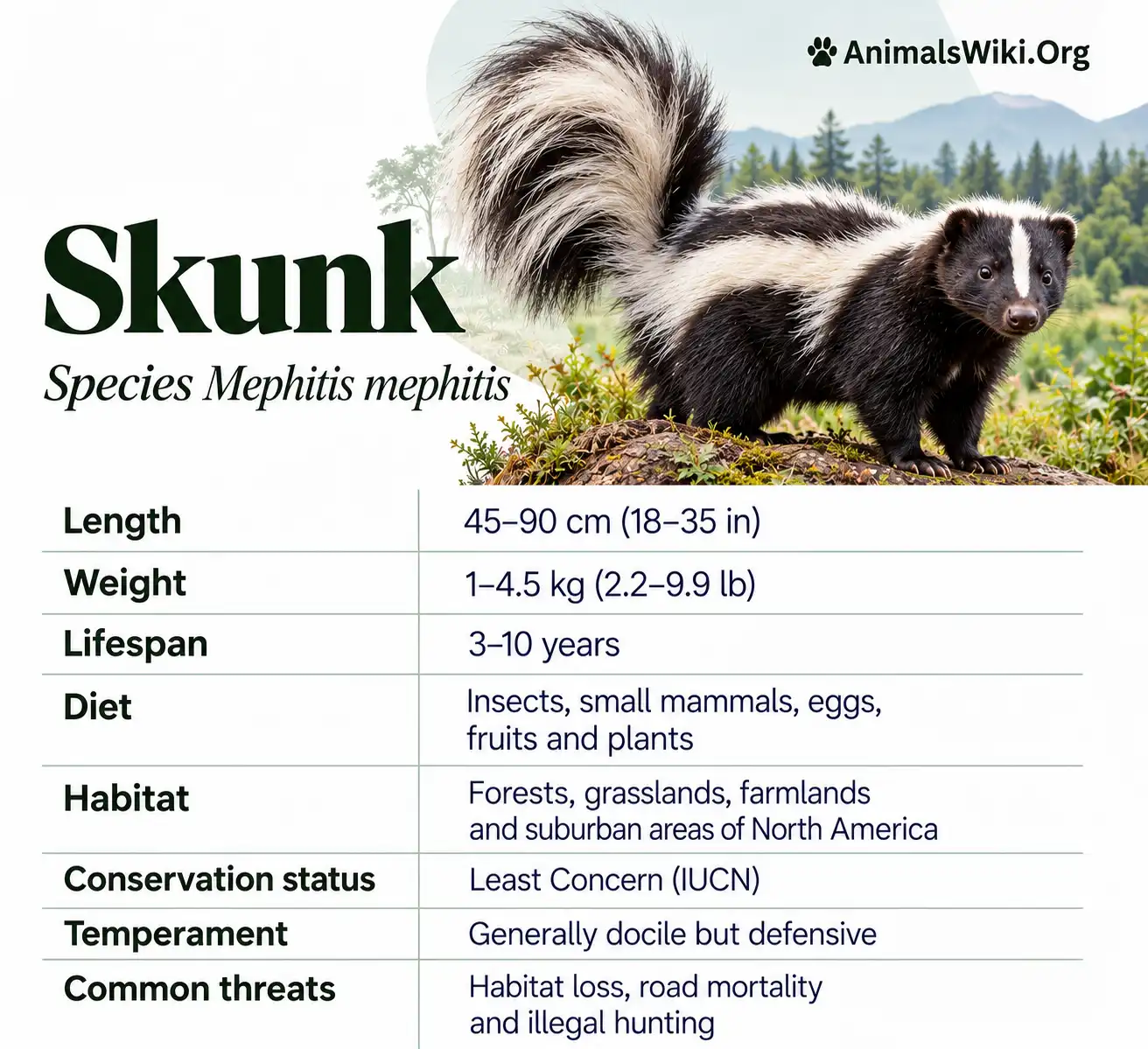
Skunk, The Remarkable Mammal Behind Nature’s Most Famous Smell
A skunk is a small to medium-sized mammal best known for its contrasting fur and powerful defensive spray. Its reputation often arrives before the animal itself: many people recognize the smell without ever seeing the creature responsible.
However, a skunk’s life involves much more than producing an unpleasant odor. Skunks search for insects, investigate underground shelters, raise dependent young and adjust their activities to changing weather and food supplies. Some species thrive near people, while others remain much less familiar.
The classic image is a black animal with two white stripes and a bushy tail. That describes the familiar striped skunk reasonably well, but the wider group includes spotted skunks, hooded skunks and hog-nosed skunks with different appearances and habits.
Skunks belong to the family Mephitidae, which also contains the Southeast Asian stink badgers. They are classified separately from the weasel family, despite their placement with weasels in many older accounts.
This guide explores the main types of skunks, explains how their spray defense works and examines their habitats, diets, reproduction and conservation. Facts about the widespread striped skunk, Mephitis mephitis, are identified where they should not be applied automatically to every species.
Skunk Facts
| Feature | Details |
|---|---|
| Animal group | Mammal |
| Family | Mephitidae |
| Familiar species | Striped skunk, Mephitis mephitis |
| Other main groups | Hooded, spotted and hog-nosed skunks |
| General distribution | Skunks occur in the Americas; related stink badgers occur in Southeast Asia |
| Diet | Omnivorous, with important differences between species and seasons |
| Main activity period | Many are mainly nocturnal or active around twilight |
| Main defense | Strong-smelling secretion from paired anal scent glands |
| Warning behaviors | Tail raising, foot stamping, hissing and defensive postures |
| Young | Commonly called kits |
| Striped skunk litter | Often several young; reported ranges vary |
| Social pattern | Usually solitary, with exceptions for mothers and young or shared winter dens |
| Underground shelter | A den or burrow |
| Conservation | Depends on species and population |
1. What Is a Skunk?
A skunk is a mammal belonging to a group especially recognized for chemical defense. Its body typically combines a pointed muzzle, relatively short legs, a substantial tail and conspicuous pale markings against darker fur.
The familiar smell comes from a secretion released when the animal feels threatened. It is a defense against danger rather than a method of catching ordinary prey.
Most of a skunk’s activity is much less dramatic. It walks through suitable habitat, searches for food and uses sheltered places for resting. A mother also spends considerable time caring for her young.
The common name covers several species, so a general description has limits. A small spotted skunk moving through vegetation is different from a heavier striped skunk crossing a suburban lawn.
Understanding skunks begins with recognizing that diversity. Their shared defensive ability provides a useful connection, while their individual habitats, proportions and behaviors explain how different species live.
2. Are Skunks Members of the Weasel Family?
Modern classifications place skunks in Mephitidae, rather than Mustelidae, the family containing weasels, otters, badgers and wolverines.
Older books and some wildlife pages still describe skunks as mustelids. Those references reflect a previous classification and should not be mistaken for the current arrangement.
Skunks remain part of the mammalian order Carnivora. However, that scientific name does not mean they eat only meat. Many members of the order consume significant amounts of plant food or invertebrate prey.
The family also contains stink badgers, whose common name can create another misunderstanding. These Asian animals belong with skunks even though most other animals called badgers are mustelids.
Classification therefore separates evolutionary relationships from appearance and everyday naming. A striped skunk may resemble certain black-and-white mustelids, but resemblance alone does not establish close family membership.
For a species profile, scientific names help keep these relationships clear without requiring readers to memorize an entire mammal family tree.
3. Main Types of Skunks
The principal American skunk groups belong to three genera: Mephitis, Spilogale and Conepatus.
The current Mammal Diversity Database recognizes two species in Mephitis, seven in Spilogale and four in Conepatus. The family also includes two stink badgers in Mydaus.
| Group | Genus | General identifying features |
|---|---|---|
| Striped and hooded skunks | Mephitis | Long tails and contrasting dark and pale markings |
| Spotted skunks | Spilogale | Smaller bodies with broken stripes and spots |
| Hog-nosed skunks | Conepatus | Prominent, relatively bare noses suited to ground investigation |
| Stink badgers | Mydaus | Asian relatives included in the skunk family |
These categories describe evolutionary groups rather than identical lifestyles.
Recognized species totals can change when new research revises relationships. A recent reference may therefore differ from a book published decades ago.
For identification, begin with location, body shape and coat pattern. The broad group can often be recognized before the exact species is established.
4. The Striped Skunk
The striped skunk, Mephitis mephitis, is the species most familiar to people across much of North America.
Its coat is usually black with prominent white markings extending from the head over the back. A narrow pale stripe may also appear on the face.
The amount of white varies considerably. Some individuals have broad pale areas, while others look much darker. The familiar two-stripe pattern is therefore a helpful starting point rather than an exact template.
Striped skunks use a wide range of environments, including rural landscapes and suburban neighborhoods. Their ability to exploit different foods and shelters helps them persist near people.
Their commonness also explains why so much general skunk information concerns this species. However, details about its litter size, winter behavior or body weight should not automatically be assigned to spotted or hog-nosed skunks.
When an article refers simply to “the skunk,” checking whether the author means M. mephitis can prevent considerable confusion.
5. The Hooded Skunk
The hooded skunk, Mephitis macroura, occurs in parts of the southwestern United States, Mexico and Central America.
Its name refers to the longer fur around the head and neck, which can form a hoodlike ruff. Compared with striped skunks, hooded skunks generally have a more slender appearance and a proportionally long tail.
Color patterns vary. Some show a broad pale back, while others have darker upperparts with pale markings along the sides.
This variation can make photographs difficult to identify. A white back alone is insufficient, because striped skunks can also have extensive white fur.
Look instead at the overall proportions, the length and texture of the fur, and the geographic location.
The hooded skunk demonstrates why wildlife identification works best through several features together. An unusual-looking individual may belong to a familiar species, while a superficially familiar pattern may conceal a different one.
6. Spotted Skunks: Small, Agile and Surprisingly Diverse
Spotted skunks belong to Spilogale. They are generally smaller and more agile than the familiar striped skunk.
Their markings often combine spots with broken white stripes. The resulting pattern looks more intricate than the long bands typically associated with Mephitis.
Research published in 2021 analyzed genetic material from 203 specimens and supported recognizing seven spotted skunk species.
Museum specimens were important because they provided material from places where fresh samples were difficult to obtain. This allowed researchers to investigate relationships across a broad geographic area.
The work revealed that animals previously grouped together contained more evolutionary diversity than the older arrangement suggested.
Spotted skunks are also capable climbers, expanding the places they can investigate for food or shelter.
Their small size does not make them defenseless. They possess the family’s chemical protection and add one of the most memorable warning displays in mammal behavior: a handstand.
7. Hog-Nosed Skunks
Hog-nosed skunks belong to Conepatus. Their prominent noses are especially useful identifying features.
The nose is relatively broad and fleshy, giving the group its common name. Together with the claws, it assists investigation of soil and concealed food.
Different hog-nosed skunks occur across parts of the Americas. Their geographic ranges and markings vary, so a description of one species should not represent the entire genus.
For example, accounts of Molina’s hog-nosed skunk describe nocturnal foraging for insects and other foods. Its pale markings differ from the familiar facial stripe of a striped skunk.
The group highlights how feeding behavior can shape an animal’s appearance. A conspicuous nose is not simply a decorative distinction; it is part of the structure used while exploring the ground.
When comparing photographs, examine the muzzle as carefully as the back. The face may offer a clearer clue than the amount of white fur alone.
8. Are Stink Badgers Really Related to Skunks?
Yes. Stink badgers belong to Mephitidae, the same family as American skunks.
They are placed in the genus Mydaus and occur in Southeast Asia. The Palawan stink badger, Mydaus marchei, is associated with the Philippines.
Their inclusion means the skunk family is not restricted entirely to the Americas, even though the animals most commonly called skunks occur there.
This distinction is useful when discussing distribution. “American skunks” and “the whole family Mephitidae” do not cover exactly the same set of animals.
Common names can obscure this relationship because the word “badger” usually suggests a mustelid. Scientific classification instead groups stink badgers with skunks.
For a general reader, the lesson is straightforward: names often preserve historical impressions, while family relationships depend on biological evidence.
The animal’s scientific name provides a dependable reference when everyday terminology points in a different direction.
9. What Does a Skunk Look Like?
A typical striped skunk has a small, pointed head, rounded ears, short legs and a long, bushy tail.
Its feet have five toes, and the forefeet carry strong claws used for digging. The animal’s low build can produce a characteristic waddling appearance as it walks.
Black-and-white coloration is highly recognizable, but the arrangement of markings differs between species and individuals.
A photograph taken from behind may emphasize the tail and pale back. A side view reveals the muzzle and body proportions more clearly.
These differences matter because one viewpoint can conceal useful identifying features.
For a reliable identification, record the whole animal when possible. Note the shape of the head, the relative length of the tail, the pattern on the face and the animal’s size compared with nearby objects.
A dark photograph showing only a white stripe may suggest a skunk, but it offers less certainty about which species is present.
10. How Big Are Skunks?
Skunk size differs substantially between species.
For striped skunks, a National Park Service profile gives a total length of approximately 52–80 centimeters and a weight of about 2.7–4.5 kilograms. Other regional accounts give broader ranges.
Spotted skunks are generally much smaller, with many individuals weighing less than a kilogram.
Sex, location, age and season can all influence body size. A young animal should not be compared directly with a fully grown adult.
Measurement methods also matter. Total length includes the tail, while head-and-body length does not. Two figures can appear contradictory when they describe different measurements.
The bushy tail can further exaggerate apparent size in photographs.
The clearest description identifies both the species and the measurement. That provides a more accurate picture than saying every skunk is “the size of a cat,” especially when comparing a small spotted skunk with a large striped one.
11. Why Are Skunks Black and White?
The contrasting pattern functions as warning coloration, also called aposematism.
Rather than relying entirely on concealment, a skunk advertises that approaching it can have an unpleasant consequence. The visible pattern and chemical defense form parts of the same protective system.
However, striped skunks do not all display identical markings.
A study of 749 museum skins found relationships between pattern variation and potential predator pressure. Skunks from areas with more potential predators tended to show greater conformity in certain aspects of their markings.
The findings help explain why an effective warning signal can still vary across a species.
They also connect a familiar feature with a larger ecological question: how do predators influence the appearance of animals they might attack?
For readers, the important point is that the stripes are more than a recognizable design. They are part of communication between prey and potential predators, shaped over evolutionary time.
12. Where Do Skunks Live?
American skunks occur across portions of North, Central and South America, with different species occupying different regions.
The striped skunk has a particularly broad North American distribution, including much of the United States, southern Canada and parts of northern Mexico.
Other species have more restricted ranges. The pygmy spotted skunk, for example, occurs in western coastal regions of Mexico.
A species’ overall range does not mean it lives everywhere within the countries listed. Suitable habitat, local conditions and geographic barriers influence actual occurrence.
The distinction becomes important when identifying a sighting. A photograph should be compared with the species known from that particular area, rather than with every skunk in the world.
Distribution also changes as evidence improves. Verified observations, museum records and systematic surveys help establish where species occur.
A broad map is a useful beginning, while local information provides the detail needed for confident identification.
13. What Is a Skunk’s Habitat?
Skunk habitat varies, but many species use environments containing both cover and accessible feeding ground.
Striped skunks can occupy agricultural areas, woodland edges, grasslands, neighborhoods and other human-modified landscapes.
Spotted skunks often receive less attention because they can be associated with more remote or structurally complex habitats.
Food and shelter help explain these differences. A patch of vegetation may provide insects and cover, while a nearby cavity offers a resting place.
Human development can unintentionally supply similar resources. A shed may resemble a protected shelter, and accessible pet food creates a concentrated feeding opportunity.
This does not mean every developed area is equally suitable. Traffic, disturbance and the arrangement of green spaces can affect how animals use it.
A useful habitat description therefore goes beyond scenery. The important question is whether the animal can find food, rest safely and move between those resources.
14. Where Do Skunks Sleep?
Skunks use protected places for resting. Striped skunks may occupy abandoned burrows, hollow logs, brush piles or spaces beneath structures.
They can excavate their own shelter, but using an existing cavity may avoid some of that effort.
Den choice changes with conditions. A warm-season resting place may differ from a shelter used during prolonged cold weather.
Underground dens are especially important in colder climates. They provide a more protected environment than an exposed resting site.
A shelter may also serve as a nursery, making its importance difficult to judge from the outside.
One adult entering a space does not reveal whether young remain inside or whether other animals use it at different times.
For people living nearby, this is why sealing an opening requires care. The visible entrance is only one part of the situation. Confirming that a space is unoccupied protects animals from being trapped and prevents dependent young from becoming separated from their mother.
15. What Do Skunks Eat?
Most skunks are omnivores, consuming both animal and plant material.
Foods can include insects, larvae, small mammals, eggs, fruit and carrion. The importance of each item changes between species, seasons and locations.
Striped skunks are opportunistic feeders. They investigate available resources rather than relying on one specialized food.
This flexibility helps them occupy varied environments. A natural area may provide insects and fruit, while a suburban setting adds accessible rubbish or pet food.
Human food sources are opportunities rather than requirements. A skunk crossing a garden may be searching for naturally occurring prey in the soil.
It is also important to distinguish foods a species can eat from those that dominate its diet. A long list of possible items does not imply they contribute equally.
Local studies offer the best detail, while a general species profile should explain the broad pattern without assigning one universal menu.
16. How Do Skunks Find Food?
Skunks frequently forage by moving slowly, sniffing and investigating the ground.
Their pointed muzzle helps them examine small spaces, while the foreclaws allow them to uncover food beneath the surface.
In a lawn or garden, this can leave small feeding pits. The animal may be searching for larvae or other invertebrates rather than attempting to build a den.
That difference matters when interpreting disturbance. A cluster of shallow holes indicates a different activity from repeated entry into a protected opening.
Skunks also search fallen material, vegetation and other places where food accumulates.
Their foraging illustrates the value of resources that people often overlook. A small patch of soil can contain many potential food items, especially when weather conditions bring prey closer to the surface.
For residents, understanding the activity can guide a proportionate response. Identifying why an animal visits is more useful than assuming every dig means it has moved permanently beneath the property.
17. How Does Skunk Diet Change with the Seasons?
Seasonal diets reflect changing food availability.
For striped skunks, insects can be especially important during warmer months. Colder periods may increase reliance on other animal foods, while ripe fruit creates additional opportunities when available.
Research on western spotted skunks in the Pacific Northwest documented a varied diet containing invertebrates, small vertebrates and plants.
The study found more insects in the dry season and somewhat more mammals in the wet season. It also documented scavenging-related food items.
These findings show that “skunk diet” is a shifting pattern rather than a fixed recipe.
They also demonstrate why species identity matters. A forest-dwelling spotted skunk and a suburban striped skunk may encounter different foods even during the same month.
A flexible diet allows animals to respond to those opportunities. Understanding the seasonal pattern is therefore part of understanding their movements, habitat use and relationships with other organisms.
18. What Is Skunk Spray?
Skunk spray is a strong-smelling, oily secretion stored in paired scent glands near the anus.
The secretion contains sulfur-bearing compounds, including thiols, responsible for much of the characteristic odor.
Its main purpose is defense. By directing an unpleasant substance toward a threat, a skunk can discourage an attack without needing to overpower a larger animal.
The smell is only part of the effect. Contact can also cause irritation, especially around sensitive tissues.
Spray should therefore be understood as a biological defense rather than a harmless bad smell.
The glands contain a limited supply, and replenishment takes time. This gives the animal a reason to use other warnings before releasing it.
The overall system combines appearance, posture and chemistry. The coat attracts attention, warning behavior signals escalation, and the secretion provides the consequence if the threat continues.
Together, these features help explain why many potential predators avoid close encounters.
19. How Far Can a Skunk Spray?
A striped skunk can direct spray over several meters. Common wildlife accounts describe effective distances of approximately three to four-and-a-half meters, or 10–15 feet.
Exact figures vary because a directed stream and drifting droplets are different things.
Wind can carry odor farther than the distance over which the animal can accurately target a threat. Smelling a skunk therefore does not reveal precisely where it is.
A person should never treat a quoted maximum as a safe boundary. Conditions change, the animal may move, and mist can spread beyond the main stream.
Distance is useful for understanding the defense, but the practical response is to avoid testing it.
If a skunk notices you, give it space and an open route away. A raised tail or stamping feet indicates that backing off is more sensible than remaining nearby to see what happens next.
20. Why Do Skunks Warn Before Spraying?
Spraying is effective, but the secretion is a limited resource.
A skunk can often resolve an encounter through warning behavior, avoiding the need to use its chemical supply.
Common displays include raising the tail, arching the back, hissing and stamping the front feet. The animal may then turn its hindquarters toward the threat.
These signals are useful only if they are respected. Continuing to approach removes the space that might have allowed the encounter to end quietly.
A warning sequence should not be treated as a guaranteed countdown. A startled or cornered animal may react quickly, and observers may fail to notice an earlier signal.
The practical lesson is simple: respond to the first sign of discomfort.
For the skunk, preventing a fight is generally preferable to participating in one. Its impressive defense supports avoidance rather than requiring constant aggression toward every animal it encounters.
21. Why Do Spotted Skunks Perform Handstands?
Spotted skunks are famous for balancing on their forefeet while lifting their hindquarters and tail.
The posture forms part of a defensive display. It makes the animal conspicuous and communicates that approaching further may lead to spraying.
This behavior is especially striking because it combines balance, contrasting coloration and a chemical threat.
It should not be interpreted as an invitation to approach a small animal that looks playful. The display indicates that the skunk is responding to danger.
A handstand also illustrates the importance of species differences. Spotted skunks are notably agile, and their movement abilities differ from the stockier image associated with striped skunks.
For wildlife photographers, a defensive posture may produce a dramatic image, but repeatedly provoking it is unnecessary disturbance.
Observing ordinary foraging or travel offers a fuller picture of the animal’s life than focusing exclusively on the moment when it feels threatened.
22. Are Skunks Always Smelly?
A skunk does not continuously release its defensive spray as it walks.
The powerful odor most people recognize is associated with secretion, not a permanent cloud surrounding every individual.
This distinction explains why a skunk can pass through an area without leaving a conspicuous smell. Absence of odor does not establish absence of the animal.
Likewise, a lingering smell does not prove that a skunk remains nearby. Odorous material can persist after the original encounter.
University extension guidance specifically cautions that odor is not a reliable indicator of current skunk presence or activity.
For identification, combine evidence such as sightings, tracks and repeated use of shelter.
The distinction also improves our understanding of behavior. Skunks spend much of their time feeding and resting without deploying their defense.
Their reputation is built around an exceptional response to danger, while most of their everyday life is considerably quieter and less noticeable.
23. Are Skunks Nocturnal?
Many skunks are mainly nocturnal or active around twilight.
However, striped skunks can also move during daylight. A daytime sighting alone does not prove illness.
A healthy animal may be feeding, traveling or responding to disturbance. The complete situation matters more than the hour.
For observers, signs such as purposeful movement and normal foraging provide useful context, while obvious disorientation or difficulty moving warrants greater caution.
Even a healthy-looking skunk should be left unhandled. Casual observation cannot establish whether an animal carries a disease.
The distinction is important because two mistakes are possible: assuming every daytime skunk is dangerous, or assuming an apparently normal animal is safe to touch.
A balanced response gives the animal space while seeking wildlife assistance when its condition appears abnormal.
Nighttime habits explain why skunks are frequently overlooked, but they should not become a rigid rule used to diagnose an individual.
24. Do Skunks Live Alone?
Striped skunks are generally solitary, although important exceptions occur.
A mother remains with her dependent young. In colder regions, several animals may also share a winter den.
These associations do not necessarily mean the species normally lives in permanent social groups.
The same individual may spend one part of the year largely alone and another in shared shelter.
Home ranges can also overlap without animals traveling together. Using the same feeding area at different times is different from cooperative foraging.
This flexibility helps explain why a photograph of several skunks requires context. The animals may be a family, temporary den companions or individuals responding to a concentrated resource.
The most useful description records what they are doing rather than assigning a social relationship immediately.
For a species often imagined as permanently solitary, winter sheltering and maternal care reveal a more varied pattern of interaction.
25. Do Skunks Hibernate?
Striped skunks are not generally described as true hibernators.
In cold regions, they may spend extended periods inactive in dens and rely more heavily on stored body reserves.
They can emerge during suitable weather, so a warm winter night may still bring skunk activity.
This creates an important distinction between reduced activity and continuous seasonal disappearance.
Winter behavior also varies with climate. An animal living where winters are mild does not face the same conditions as one near the colder part of the species’ range.
For homeowners, a quiet entrance during cold weather should not automatically be considered abandoned.
An animal may remain inside longer than expected, which makes casual checks unreliable.
The biological point is that skunks adjust their energy use to conditions. Their winter lives are not simply a switch between constant summer activity and complete inactivity until spring.
26. How Do Skunks Reproduce?
Striped skunks usually breed in late winter or early spring, with timing varying across their range.
Females generally produce one litter annually. Males may mate with more than one female, while the mother provides care for the young.
Pregnancy is commonly described as lasting around two months, although published ranges differ and short delayed implantation can affect the interval.
Births typically occur during spring or early summer in many North American populations.
A protected den is important because newborns are unable to travel independently.
The separation between mating and maternal care means a male observed nearby should not automatically be described as a father helping raise the litter.
For readers, reproductive information is clearest when the species and geographic setting are named.
A breeding schedule from Illinois or Massachusetts provides a useful regional example, but it should not be imposed on every skunk species across both American continents.
27. What Are Baby Skunks Like?
Baby skunks are commonly called kits.
Striped skunk kits are born blind and dependent on their mother. Their contrasting pattern can already be visible before they develop the full appearance of older young.
Litters contain several kits, with four to six being common in some regional accounts.
They remain in the den during their earliest development. Later, they begin accompanying their mother while she searches for food.
The familiar procession of small skunks following an adult is therefore part of a learning and development stage.
A kit outside is not automatically abandoned. Its mother may be nearby, and unnecessary handling can create a problem where none existed.
Young animals can also develop defensive capability early. Small size is not a reason to approach or pick one up.
For observers, the most helpful action is usually to watch from a distance and contact a wildlife professional if there is clear evidence of injury or distress.
28. How Do Young Skunks Become Independent?
Independence develops gradually.
Young striped skunks begin leaving the den with their mother after several weeks. Their eyes have opened, their movements are stronger and they can start participating in foraging trips.
Weaning generally occurs around the second month, although the precise timing varies among accounts and individuals.
Leaving the den does not mean a kit has immediately mastered every skill needed for solitary life.
It must learn to locate food, use shelter and respond to unfamiliar situations.
As development continues, young animals disperse and begin using areas independently. The timing can vary by sex and local conditions.
This progression explains why several young may remain associated with one adult after they appear capable of walking and feeding.
For wildlife watchers, repeated distant observations can reveal this changing relationship far better than one photograph. A family seen together represents a stage in development rather than a permanent group structure.
29. How Long Do Skunks Live?
Wild skunks often have relatively short lives, even though some individuals survive much longer.
Massachusetts wildlife guidance gives an average of approximately two to three years for striped skunks in the wild.
Longevity depends on survival through early life, weather, food availability, disease and hazards such as roads.
A maximum recorded age should not be confused with the lifespan most animals reach.
Managed-care animals can live longer because they experience different food supplies and protection from some environmental risks.
The distinction between an average, a maximum and an individual prediction is important.
A healthy adult seen in a garden cannot be assigned a precise age from appearance alone.
For a general wildlife profile, the clearest description is that many wild striped skunks live only a few years, while survival varies substantially. Other skunk species require their own evidence rather than borrowing the striped skunk’s figures.
30. What Animals Eat Skunks?
Chemical defense discourages many predators, but it does not make skunks invulnerable.
Great horned owls are especially well-known skunk predators. Their hunting behavior and relatively limited sensitivity to the odor help them capture prey that many mammals avoid.
Other predators can include coyotes, foxes and larger carnivores, depending on location.
Young skunks may be more vulnerable than adults because of their size and experience.
A predator list should not be interpreted as a ranking that applies everywhere. The importance of a particular predator varies across habitats and populations.
The same distinction applies to defense. A powerful spray lowers risk without eliminating every possible attack.
For readers accustomed to the idea that “nothing eats a skunk,” this is an important correction.
Skunks remain part of food webs in which they consume other organisms and can themselves become food, despite possessing one of the most recognizable defensive systems among mammals.
31. What Role Do Skunks Play in Ecosystems?
Skunks connect several parts of a food web.
They consume insects and other small animals, take plant foods and scavenge when opportunities arise.
Their consumption of insects and rodents can be useful in human-dominated landscapes, although the effect on a particular pest population depends on local circumstances.
Fruit consumption can contribute to seed movement, while scavenging participates in the use and redistribution of animal material.
Skunks also serve as prey for larger predators.
These roles are overlapping relationships rather than one fixed ecological job.
Describing a skunk only as a pest controller misses its interactions with plants, predators and carrion.
Likewise, calling it a nuisance because it digs in a lawn overlooks activities that occur throughout its normal habitat.
The most complete view recognizes an adaptable consumer whose everyday feeding decisions connect organisms above ground, near the soil surface and within sheltered spaces.
32. How Can You Recognize Skunk Tracks?
Skunks have five toes on each foot, although a print may not show all five clearly.
Claw marks are often visible, and the front and hind impressions differ in shape.
Soft mud, snow or fine soil can preserve useful details. Hard ground or a partial impression may conceal them.
This means one unclear print should not be treated as definitive proof.
A sequence of tracks provides more information about movement than an isolated mark. Nearby feeding pits, repeated sightings or photographs can strengthen the identification.
University guidance notes that striped skunk prints may show only four toes because the fifth is less obvious.
For beginners, the most useful habit is to record the evidence carefully. Photograph the print with a scale, note the surface and preserve the direction of travel.
Avoid handling droppings or searching inside a suspected den. Good identification does not require direct contact with the animal or its shelter.
33. Are Skunks Endangered?
Conservation status differs between species.
The striped skunk is globally listed as Least Concern. Its broad distribution and use of varied habitats help explain that assessment.
The pygmy spotted skunk, by contrast, is categorized as Vulnerable.
A common striped skunk in a neighborhood therefore cannot represent the conservation situation of every member of the family.
Local trends matter as well. A species may remain widespread overall while becoming uncommon in particular regions.
Taxonomic revisions can reveal additional conservation questions by distinguishing populations that were previously grouped together.
The key is to match the assessment to the correct scientific name.
A statement such as “skunks are doing well” is too broad to be useful. Naming the species, the geographic scope and the assessment provides a clearer picture of where concern is justified and where populations remain comparatively secure.
34. What Is Happening with the Plains Spotted Skunk?
The plains spotted skunk has received conservation attention because of concerns about its distribution and abundance.
In July 2026, the U.S. Fish and Wildlife Service announced that a new petition contained substantial information supporting a further status review.
The agency indicated that newer data suggested the species might occupy a reduced distribution or occur at very low numbers in parts of the Great Plains.
This announcement began a review process. It was not itself a final decision to list the animal as endangered.
The distinction is important when reporting conservation news. An agency can identify enough evidence to investigate without having completed the assessment.
For readers, this is also a reminder that wildlife status is not permanently settled.
New surveys, revised species boundaries and better information can change the questions conservation agencies need to examine, even for animals living in comparatively well-studied regions.
35. Why Do Skunks Visit Gardens and Homes?
Skunks are usually attracted by food, shelter or both.
Accessible rubbish, pet food, spilled bird seed and fallen fruit can create feeding opportunities. Spaces beneath decks, sheds or porches can provide cover.
A visiting skunk may simply be passing through. Repeated entry into one opening suggests a different situation from occasional foraging.
Prevention begins with reducing unnecessary attractants. Secure rubbish, bring pet food inside and address accessible building gaps before animals occupy them.
However, do not seal a space while a skunk or dependent young may remain inside.
Where occupation has already occurred, appropriate wildlife assistance can help determine when and how exclusion is possible.
The goal is to address the resource attracting the animal. Removing one individual without changing access to food or shelter may leave the same opportunity available to another.
Understanding the cause produces a more durable response than treating every sighting as an emergency.
36. What Should You Do If a Skunk Sprays Your Dog?
First, prevent another encounter and keep the dog away from the skunk.
Spray can irritate the eyes, mouth and airways. Direct exposure to the eyes or mouth, breathing difficulty, marked weakness or other significant symptoms requires prompt veterinary attention.
For odor on the coat without serious distress, ask your veterinarian about an appropriate skunk-odor product and follow its instructions.
Tomato juice does not reliably neutralize the compounds responsible for the smell.
Avoid applying cleaning mixtures near the eyes or improvising with household chemicals. Treatment should protect the dog’s tissues as well as address the odor.
Cornell veterinary guidance also notes that severe exposures can occasionally cause more serious effects, so heavily sprayed animals need careful assessment.
Finally, distinguish spraying from biting. If the dog was bitten or may have had direct physical contact, tell the veterinarian. The need to assess injury or possible rabies exposure is separate from removing the smell.
37. Do Skunks Carry Rabies?
Skunks can become infected with rabies, and they are among the wildlife groups associated with the disease in parts of North America.
However, not every skunk is infected, and a daytime sighting alone cannot establish a diagnosis.
Avoid handling wild skunks, including young animals. Keep pets appropriately vaccinated and prevent close encounters.
If a person is bitten or scratched, wash the wound immediately with soap and water for 15 minutes and seek urgent medical advice. Contact local public health authorities for an exposure assessment.
Do not wait for symptoms or attempt to determine risk from the animal’s appearance alone.
An animal showing severe disorientation, paralysis or unusual aggression should be reported to appropriate local responders rather than approached.
The important distinction is between responsible caution and assuming every sighting is a medical emergency. Distance prevents most encounters, while actual exposure requires prompt professional assessment.
Frequently Asked Questions About Skunks
What kind of animal is a skunk?
A skunk is a mammal belonging to Mephitidae. The name includes several species rather than one animal. Familiar groups include striped, hooded, spotted and hog-nosed skunks, which differ in size, appearance and behavior.
What is the scientific name of a skunk?
The familiar striped skunk is Mephitis mephitis. Other skunks have different scientific names. There is no single species name covering every animal commonly called a skunk.
Are skunks rodents?
No. Skunks belong to the mammalian order Carnivora. Their digging habits and small size can create confusion, but neither feature makes them rodents. Many skunks consume rodents as part of a varied diet.
Are skunks related to badgers?
Skunks are related to other carnivoran mammals, but most familiar badgers belong to Mustelidae. Stink badgers are an exception: they belong to Mephitidae, the same family as skunks.
How many types of skunks are there?
The current Mammal Diversity Database recognizes 13 species across the three American skunk genera. Two stink badgers also belong to the family. Species totals depend on the classification and whether stink badgers are included.
Where do striped skunks live?
Striped skunks occur across much of the United States, southern Canada and parts of northern Mexico. They occupy varied habitats, including agricultural and suburban landscapes, rather than being restricted to wilderness areas.
Do skunks live in forests?
Some do, although habitat preferences differ. Striped skunks frequently use edges and mixed landscapes, while western spotted skunks can inhabit forest environments. The species and local habitat structure both matter.
What do skunks eat?
Skunks eat various combinations of insects, larvae, small animals, eggs, fruit and carrion. Their diet changes with opportunity. A food that is important in one season or location may be less significant elsewhere.
Why do skunks dig holes in lawns?
They may be searching for grubs or other food beneath the surface. Shallow feeding holes are different from a den entrance. Repeated sightings and the pattern of disturbance help explain the activity.
Why do skunks spray?
Spray is a defensive response to a perceived threat. It discourages an attacker through odor and irritation. Skunks generally use warnings when possible, but a startled or cornered individual may respond quickly.
How far can a skunk spray?
A striped skunk can spray several meters, with common accounts giving approximately 10–15 feet. Drifting droplets and odor can travel farther. A quoted distance should never be used to test how closely you can approach.
What does skunk spray contain?
It contains a mixture of compounds, including sulfur-bearing thiols responsible for much of the strong odor. The secretion is oily and can cling to surfaces, making the smell difficult to remove.
Can a skunk run out of spray?
Yes. The glands hold a limited quantity, and replenishment takes time. This is one reason warning behavior is useful. However, never assume a skunk that has sprayed once can no longer defend itself.
What warnings do skunks give?
Warnings can include tail raising, stamping the front feet, hissing and defensive body postures. Spotted skunks may perform handstands. Back away calmly rather than waiting for the display to escalate.
Why do spotted skunks do handstands?
The handstand is part of a defensive display. It makes the animal conspicuous and warns a potential threat. It is not play directed at an observer or a reason to move closer.
Do skunks smell all the time?
They do not continually release defensive spray. A skunk may pass through without leaving a strong odor. Conversely, lingering odor does not prove the animal is still nearby.
Are skunks active during the day?
They can be. Many are mainly nocturnal, but healthy individuals may forage or travel during daylight. Time of day alone does not diagnose illness; condition and behavior provide additional context.
Do skunks hibernate?
Striped skunks reduce activity during cold periods but are not generally considered true hibernators. They may emerge in suitable weather. Winter behavior varies with climate and should not be generalized to every species.
What is a baby skunk called?
A baby skunk is commonly called a kit. Kits begin life dependent on their mother and later accompany her while learning to forage. An apparently unattended young animal is not automatically abandoned.
Can baby skunks spray?
Young skunks develop defensive capability early. Their small size does not make handling safe. Leave them alone and seek wildlife advice if there is clear evidence of injury or distress.
How long do skunks live?
Wild striped skunks often live only a few years, although some survive longer. Average lifespan and maximum recorded age are different. Other species require their own longevity information.
What predators eat skunks?
Great horned owls are notable predators. Coyotes, foxes and other carnivores may also take skunks. Spray reduces the risk of attack but does not provide complete protection from every predator.
Does tomato juice remove skunk odor?
It does not reliably neutralize the odor-producing compounds. For a sprayed pet, use veterinary guidance and a suitable product. Eye or mouth exposure and significant symptoms require prompt veterinary attention.
Does seeing a skunk mean it has rabies?
No. Skunks can carry rabies, but ordinary presence does not establish infection. Keep your distance. Any bite, scratch or other possible exposure needs prompt assessment by medical or public health professionals.
Are all skunks endangered?
No. The striped skunk is globally Least Concern, while the pygmy spotted skunk is Vulnerable. Other species and local populations have their own conservation circumstances.
What should you do when you encounter a skunk?
Stop approaching, give it space and leave an escape route. Keep pets back. If it raises its tail or stamps, retreat calmly rather than trying to photograph the warning display more closely.



