
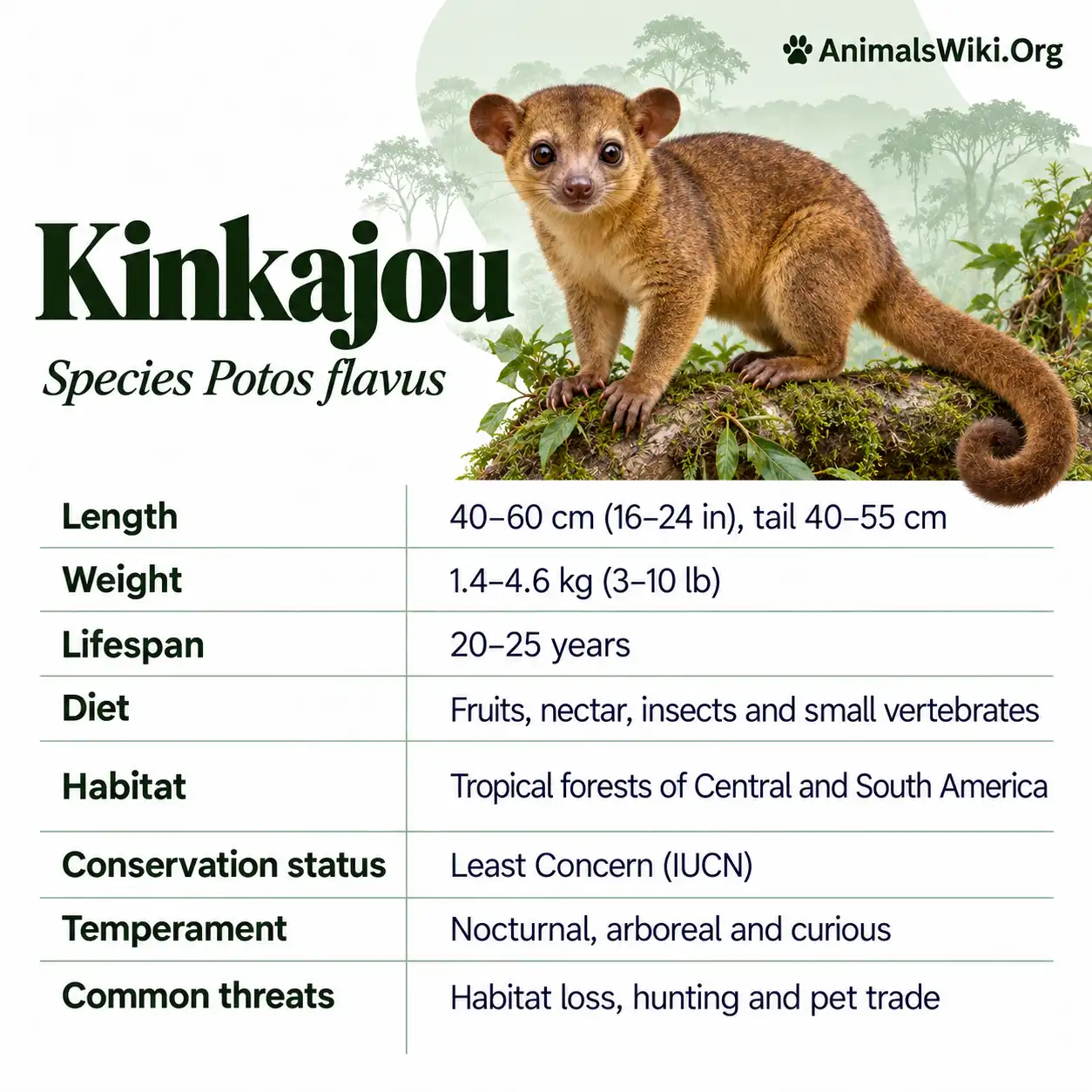
Kinkajou, The Golden Rainforest Mammal with a Gripping Tail
The kinkajou is a tree-dwelling mammal known for its golden-brown fur, large eyes and remarkable gripping tail. Moving through tropical forests after dark, it searches for ripe fruit and flowers while much of the daytime wildlife is resting.
At first glance, a kinkajou may resemble a small monkey or an unfamiliar bear. However, it belongs to the raccoon family, Procyonidae. Its unusual appearance reflects a life spent climbing, reaching and feeding among branches.
Scientifically called Potos flavus, the kinkajou occurs from parts of Mexico through Central America and into South America. It inhabits several forest types, although its dependence on trees makes the structure of those forests especially important.
The animal is sometimes called a honey bear, but fruit is much more central to its natural diet than the nickname suggests. Its feeding also connects it with the wider forest: kinkajous move seeds and visit flowers, participating in relationships that extend beyond their own survival.
This guide explores the kinkajou’s appearance, habitat, diet, behavior, reproduction and conservation. It also explains why the animal is neither a monkey nor a bear, how its tail works, and why an apparently solitary nighttime traveler can still have meaningful social relationships.
Kinkajou Facts
| Feature | Details |
|---|---|
| Common name | Kinkajou |
| Scientific name | Potos flavus |
| Other familiar nickname | Honey bear |
| Animal group | Mammal |
| Family | Procyonidae |
| Native region | Mexico, Central America and parts of South America |
| Main habitat | Tropical forests |
| Lifestyle | Mainly arboreal and nocturnal |
| Typical adult weight | Approximately 1.4–4.6 kilograms |
| Head and body length | Commonly around 36–55 centimeters in detailed reference measurements |
| Tail length | Approximately 40–57 centimeters |
| Main food | Fruit |
| Other foods | Nectar, flowers and some additional plant or animal material |
| Tail type | Prehensile, meaning capable of grasping |
| Pregnancy | Approximately 98–120 days |
| Young | Usually one; twins are uncommon |
| Conservation category | Least Concern |
1. What Is a Kinkajou?
A kinkajou is a medium-sized tropical mammal adapted to life in trees. Its rounded face, woolly coat and long tail create an appearance unlike that of the raccoon most people know.
The animal spends much of its active life above the ground. Branches provide travel routes, fruit-bearing trees provide meals, and sheltered places in trees offer daytime resting sites.
Several features support this lifestyle. The tail grips, the feet hold branches, and the flexible body helps the animal adjust its position while reaching for food.
These adaptations are particularly useful near the outer portions of branches, where food may be accessible only from an awkward position.
A kinkajou should therefore be understood as a complete climbing and feeding system rather than as an ordinary mammal with an unusually long tail.
Its movements, proportions and feeding habits fit together, allowing it to use resources high above the forest floor.
2. Is a Kinkajou a Monkey, Bear or Raccoon Relative?
The kinkajou belongs to Procyonidae, the family containing raccoons, coatis, ringtails and olingos.
It is not a primate. Its monkeylike movements and gripping tail can create that impression, but similar adaptations can evolve in animals with different ancestry.
It is also not a bear. The nickname “honey bear” describes a familiar impression rather than a scientific relationship.
The distinction illustrates an important principle: animals living in similar environments can develop similar solutions. A branch-gripping tail can be useful to unrelated tree-dwelling mammals.
Historical classification reflects this confusion. The kinkajou was originally described under the name Lemur flavus, whereas modern references place it in Potos.
For readers, the clearest description is “a tropical, tree-dwelling raccoon relative.”
That phrase identifies its family while leaving room for the many ways it differs from a ground-foraging raccoon.
3. Why Is It Called a Honey Bear?
Honey bear is one of the kinkajou’s best-known nicknames. Other local names reflect its nighttime activity or the sounds it produces.
The honey association can lead people to exaggerate the importance of honey in its diet. Wild kinkajous are primarily fruit eaters, even though popular accounts also describe visits to beehives.
A common name is often memorable precisely because it highlights one striking feature. It rarely describes the animal’s full ecology.
The same problem occurs with “bear.” A round face and thick fur may suggest a small bear to an observer, but those features do not establish family membership.
For an accurate animal profile, the nickname works best alongside the scientific name, Potos flavus.
This lets readers enjoy familiar terminology without confusing the kinkajou with bears, primates or other mammals sometimes given similar names.
The animal’s real identity is more interesting than the nickname alone.
4. What Does a Kinkajou Look Like?
Kinkajous typically have soft, dense fur in golden-brown, brown or slightly olive tones. The underside can appear paler.
Their eyes are large, their ears are rounded, and the muzzle is relatively short. A long, well-furred tail extends behind the body.
Unlike a ringtail, a kinkajou does not have a conspicuous series of black-and-white tail bands.
Its overall appearance can change under different lighting. A nighttime photograph may make the coat seem dull brown, while a photograph taken in softer daylight reveals warmer tones.
The eyes may also look unusually bright when reflecting a light source.
For identification, body shape and proportions matter alongside color. Look for the rounded face, long gripping tail and compact, tree-adapted build.
A blurry image of a brown mammal in a tree is not enough by itself. Location and visible structural features help distinguish a kinkajou from other nighttime forest visitors.
5. How Big Is a Kinkajou?
Adult kinkajous commonly weigh a few kilograms. Detailed reference summaries give a broad weight range of approximately 1.4–4.6 kilograms.
Head-and-body measurements are often around 36–55 centimeters, with a tail approximately 40–57 centimeters long.
Different sources report wider length ranges, partly because they draw on different populations or do not always separate body length from total length clearly.
The tail contributes substantially to the animal’s overall outline. A photograph showing the whole animal can therefore make its torso appear larger than it really is.
Size also changes with age and individual condition.
When comparing kinkajous with other mammals, separate measurements are more useful than saying they are “cat-sized.”
A cat and a kinkajou may overlap in weight while having very different proportions and movement abilities. The kinkajou’s long tail and climbing posture are essential parts of that difference.
6. How Does a Kinkajou’s Prehensile Tail Work?
A prehensile tail can grasp and hold an object. In the kinkajou, that object is often a branch.
The tail provides an additional point of support while the animal climbs or reaches for food. It also contributes to balance as the body changes position.
This becomes especially useful when a kinkajou needs its forepaws free to handle fruit.
The tail should not be imagined as functioning independently of the rest of the body. Feet, posture and branch choice remain important.
A secure feeding position may combine the tail with one or both hindfeet, allowing the forelimbs to manipulate food.
Its usefulness therefore extends beyond the dramatic image of an animal hanging upside down.
The tail expands the range of positions available during ordinary movement and feeding. For a mammal living among branches of different sizes and angles, that flexibility can determine which foods it can reach.
7. How Can Kinkajous Climb Down Trees Headfirst?
Kinkajous can reposition their hindfeet extensively, allowing the feet to maintain useful contact while the body faces downward.
This helps them descend trunks and negotiate branches headfirst.
Research comparing kinkajous, coatis and raccoons documented the kinkajou’s combination of reversed hindfeet, spinal flexibility and gripping tail.
These features work together. A tail provides support, flexible joints change the direction of contact, and the body adjusts to the shape of the route.
Headfirst descent is useful because the animal can continue looking and moving toward its next support.
The behavior also shows why “good climber” is an incomplete description. Different mammals climb using different postures and degrees of flexibility.
For the kinkajou, climbing ability is closely connected with feeding. The same movements that allow it to negotiate a trunk also help it position itself beneath or beside a fruit-bearing branch.
8. How Do Kinkajous Handle Food?
Kinkajous use their forepaws to hold and manipulate food.
Their grasp differs from the way a raccoon handles objects or a coati digs and tears material apart.
Comparative research describes a one-handed converging grip that helps kinkajous hold fruit while supported by other parts of the body.
This is important near the ends of branches. An animal must maintain stability while bringing food toward its mouth.
The tail and hindfeet can provide support, leaving a forepaw available to grasp a small fruit.
The relationship between movement and feeding is therefore direct. A kinkajou does not simply climb to a meal and then abandon its climbing adaptations.
It continues using them throughout the feeding event.
Watching how the animal distributes support between feet and tail can reveal more about its abilities than focusing only on whether it can hang upside down.
9. Why Does a Kinkajou Have a Long Tongue?
The kinkajou’s long, narrow tongue helps it reach foods such as nectar.
Zoo descriptions report that the tongue can extend to approximately 12–13 centimeters, although that should not be treated as an exact measurement for every individual.
A narrow tongue can enter spaces that the muzzle cannot reach comfortably. This makes it useful when feeding from flowers.
The tongue is part of a wider set of feeding adaptations. The paws position food, the body reaches toward a resource, and the mouth extracts edible material.
Its length should not lead to the conclusion that nectar or honey supplies every meal.
Fruit remains central to kinkajou feeding ecology.
The best interpretation connects the structure with dietary flexibility: a kinkajou can exploit several kinds of plant resources, using different parts of its body according to the shape and location of the food.
10. Where Do Kinkajous Live?
Kinkajous are native to the Neotropics, the tropical region of the Americas.
Their distribution extends from parts of Mexico through Central America and into South America.
Current country records include places such as Belize, Costa Rica, Panama, Colombia, Ecuador, Peru, Bolivia and Brazil.
A country list does not mean the animal occupies every habitat within those borders. Forest distribution, elevation, local conditions and barriers all affect actual occurrence.
This is particularly important for an arboreal mammal. A map showing a broad range can conceal large differences in habitat continuity.
For travelers, local wildlife knowledge is more useful than assuming any forest within the range will provide an encounter.
The species may be present but difficult to observe, especially when activity occurs high above the observer after dark.
Range describes geographic possibility; habitat and behavior explain where and when the animal might actually be seen.
11. What Is the Kinkajou’s Habitat?
Kinkajous inhabit several tropical forest types, including evergreen rainforest, some seasonal dry forest and areas of secondary forest.
Their use of more than one forest type shows flexibility, but it does not remove their dependence on trees.
The physical arrangement of branches, shelter sites and fruiting plants matters.
A forest is more than a collection of trunks. For a climbing mammal, it contains routes, gaps, feeding patches and places where movement becomes easier or more difficult.
Older trees may provide cavities, while connected crowns offer travel opportunities above the ground.
Secondary vegetation can also provide resources, depending on its structure and surrounding landscape.
It is therefore better to ask what a particular forest supplies than to rely only on its label.
A patch that looks green from above may differ greatly from another in usable routes, resting sites and seasonal food availability.
12. Why Is the Forest Canopy So Important?
The canopy is the upper network of crowns and branches formed by forest trees.
For a kinkajou, it provides much of the space used for movement and feeding.
Connected branches allow travel between trees without repeatedly descending to the ground. Breaks in that network can change the routes available.
The important issue is not simply how much forest remains. Its arrangement also matters.
Two patches with the same area may offer different movement opportunities if one contains connected crowns and the other has wide gaps.
Research in fragmented landscapes has shown that kinkajou movement can differ between ordinary activity within a home range and longer-distance dispersal.
That finding adds useful nuance: an animal’s ability to cross an unsuitable area once does not mean the area supplies everything it needs for everyday life.
Habitat use and travel connectivity are related, but they are not identical.
13. Where Do Kinkajous Sleep?
Kinkajous rest in protected tree sites during the day.
These can include hollows, sheltered forks and other secure places among the branches.
An individual may use more than one resting site rather than returning permanently to a single cavity.
Radio-tracking research in French Guiana recorded several roosts for the animals studied, with some sites used more frequently than others.
This suggests a network of shelter opportunities rather than one isolated “home tree.”
The placement of those shelters can influence daily travel. A resting place near one part of a range creates a different starting point from a shelter elsewhere.
Shared resting also forms part of kinkajou social behavior.
For conservation, shelter trees are therefore relevant alongside feeding trees. Fruit alone does not meet every requirement.
A usable forest needs places where an animal can spend the inactive part of its day concealed and supported.
14. Are Kinkajous Nocturnal?
Yes. Kinkajous are mainly active at night and rest during the day.
Their nighttime activity helps explain why people can live near suitable habitat without seeing them often.
A forest walk at midday samples a very different community from a walk after dark.
Research using canopy cameras in French Guiana documented nighttime activity and a variety of movements, including walking, bridging gaps and leaping.
The observations also showed that ordinary quadrupedal movement was important. A kinkajou’s life is not a continuous series of spectacular acrobatics.
Much of its travel involves placing feet carefully and choosing suitable supports.
The combination of darkness and height makes this behavior difficult to observe from the ground.
Cameras positioned in the canopy reveal activity that would otherwise be missed, providing a fuller picture of a mammal whose presence can be much more substantial than daytime sightings suggest.
15. How Far Do Kinkajous Travel at Night?
Kinkajous can travel substantial distances while searching for food.
A study in central Panama reported an average nightly distance of approximately 2.2 kilometers for the population investigated.
That figure is an example rather than a daily requirement applying to every kinkajou.
Routes change with food availability, individual behavior and the arrangement of the forest.
A night’s journey also involves more than straight-line distance. The animal may climb, circle branches, return toward a feeding patch and change height repeatedly.
This makes a map only a partial representation of movement.
Fruit distribution helps explain the need to travel. A productive tree can supply a concentrated meal, but another suitable tree may be some distance away.
The animal must connect those feeding opportunities with resting sites and other activities.
Its effective environment is therefore a three-dimensional network of resources, rather than one tree occupied continuously.
16. What Do Kinkajous Eat?
The kinkajou diet is dominated by fruit.
Flowers and nectar are also important components, while animal foods appear in broader natural-history accounts.
A detailed field study in Panama found ripe fruit in 90.6% of observed feeding bouts and in 99% of fecal samples.
Researchers detected fruit from 78 plant species, demonstrating substantial dietary breadth within a fruit-based feeding strategy.
These percentages describe that study population and its methods. They should not be converted into a universal feeding formula.
The main conclusion is nevertheless clear: the kinkajou is strongly frugivorous.
It can consume multiple fruit species and respond to what is available rather than depending on one food throughout the year.
For readers, “fruit-eating raccoon relative” captures a central feature of its ecology more accurately than imagining a small predator that occasionally snacks on fruit.
17. Why Are Figs Important to Kinkajous?
Figs are among the best-documented kinkajou foods.
Field research identified Ficus as an important plant genus in the diet of the studied animals.
A fruiting tree provides a patch of food concentrated in one place. Its value depends on how much ripe food is available and whether the kinkajou can reach it.
Large patches can also influence social encounters because more than one animal may feed without immediately exhausting the resource.
This connects diet with behavior. The location and size of a fruit crop can affect where animals travel and whether they tolerate company.
Figs are therefore important not simply as a favorite item, but as part of the structure of feeding opportunities.
However, kinkajous are not restricted to figs. Their use of many fruit species allows them to respond to seasonal changes and differences between forests.
A diverse plant community can provide a changing sequence of meals.
18. Why Is a Fruit Eater Classified in Carnivora?
Carnivora is an evolutionary classification, not a rule that every member must eat only meat.
Kinkajous belong to the order because of their ancestry and biological relationships.
Their actual feeding ecology is strongly centered on plant resources.
The same distinction applies to several other mammals whose scientific grouping can mislead a casual reader.
When describing an animal, it helps to separate three ideas: evolutionary identity, physical adaptations and observed diet.
A kinkajou’s family identifies its relatives. Its climbing structures explain how it uses the canopy. Field observations reveal what it eats.
These categories overlap without becoming interchangeable.
The animal is particularly interesting because it demonstrates how extensively feeding behavior can change within an evolutionary group.
Its nearest familiar relatives may search the ground for a broad assortment of foods, while the kinkajou spends much of its life reaching for fruit among tropical branches.
19. Do Kinkajous Pollinate Flowers?
Kinkajous can contribute to pollination when feeding from flowers.
As an animal reaches for nectar, pollen may contact its face or fur. A later visit to another flower can transfer some of that pollen.
The process links feeding behavior with plant reproduction.
However, a flower visit is not automatically proof of effective pollination. The animal must contact the relevant flower structures and move compatible pollen where it can contribute to fertilization.
Research and scientific reviews identify kinkajous among nonflying mammals associated with potential or demonstrated pollination of tropical trees.
Their role is especially interesting because many people associate pollination mainly with bees, butterflies or birds.
Nighttime mammals add another part to that picture.
For the kinkajou, nectar is a food resource. For the plant, the visitor’s movements can create an opportunity to transport pollen beyond the original flower.
20. Kinkajous and Balsa Flowers
Balsa trees provide a particularly informative example of mammal flower visitation.
Research in Panama examined nectar production, animal visits and movement around flowering Ochroma pyramidale.
Kinkajous were the most frequent flower visitors in the observations and spent substantial time feeding.
The researchers recorded heavy pollen loads on nocturnal mammals, while preliminary experiments suggested that these animals were important pollinators.
The study also showed that nectar production and visitor activity changed through the night.
This creates a dynamic relationship rather than a simple meeting between one animal and one flower.
A tree offers a changing reward. Animals respond by visiting and moving between flowers or trees.
The timing of those movements can affect where pollen goes.
The example illustrates how a nocturnal mammal’s feeding schedule becomes part of a plant’s reproductive ecology, connecting behavior at the scale of a single visit with processes across the forest.
21. How Do Kinkajous Disperse Seeds?
Kinkajous can move seeds away from the plants where they feed.
Some seeds are swallowed with fruit and deposited later, after the animal has traveled.
This creates a connection between nightly movement and the distribution of future plants.
The eventual outcome depends on several stages. A seed must survive handling or digestion, reach a suitable place and encounter conditions that allow germination and growth.
Dispersal therefore creates an opportunity rather than guaranteeing a new tree.
Canopy-camera research has highlighted kinkajous as frequent visitors to fruiting tropical nutmeg trees.
Those observations help reveal a role that can be underestimated when studies focus mainly on daytime animals.
The forest continues moving seeds after dark.
A kinkajou’s journey between feeding and resting sites can participate in that movement, making its diet relevant to the plant community as well as to its own energy needs.
22. Can Kinkajous Help Rare Trees?
Studies of particular plants show why identifying their animal visitors matters.
Research on the rare Costa Rican tree Pleodendron costaricense documented kinkajous and olingos feeding on its fruits.
Camera footage showed these mammals investigating fruit and consuming the ripe material, including pulp and seeds.
This does not mean that one mammal alone determines the plant’s future.
It does show that conserving a threatened tree can involve understanding the animals that interact with it.
A plant may survive as an adult while the processes supporting its next generation become disrupted.
Protecting seeds or seedlings is one part of the challenge; preserving feeding visitors and suitable forest conditions can be another.
The example expands the meaning of wildlife conservation.
A kinkajou is not simply an animal occupying space between trees. Its ordinary feeding can connect it with the reproduction and movement of particular plant species.
23. Are Kinkajous Solitary or Social?
Kinkajous combine substantial solitary activity with recurring social relationships.
Field research based on hundreds of observation hours found animals feeding alone frequently while also participating in stable groups.
Some observed groups included an adult female, two adult males and younger animals. At least one breeding female in the study lived outside that arrangement.
Group interactions occurred around resting sites and productive fruit trees.
This is why the phrase “solitary group life” is sometimes used.
It describes a social system in which animals do not need to travel together continuously to maintain relationships.
A solitary nighttime sighting therefore does not establish that the individual lacks social connections.
Conversely, several kinkajous in one tree do not prove that all feeding occurs cooperatively.
The most accurate picture includes both patterns: individual foraging and repeated association, with resource distribution helping shape when animals come together.
24. How Do Kinkajous Communicate?
Kinkajous use sounds, scent and close physical interactions.
Reported calls include squeaks, barks, hisses and louder cries.
These sounds can make an animal noticeable even when foliage prevents a clear view.
Scent marking provides information that remains after an individual moves away. Grooming and other close interactions also form part of social behavior.
For an observer, communication is easier to describe than to interpret precisely.
A bark heard once does not reveal the animal’s identity, relationship or purpose without context.
The surrounding situation matters: another kinkajou may be nearby, food may be concentrated in the tree, or the animal may be reacting to a disturbance.
Listening quietly can therefore be more informative than immediately approaching with a light.
The soundscape of a forest contains evidence of activity above the ground, and kinkajous contribute a distinctive set of signals to that nighttime community.
25. What Has Genetics Revealed About Kinkajou Groups?
Genetic research has added detail to observations of social groups.
A study using microsatellite markers investigated relationships among 25 kinkajous from four groups.
The results supported a family component to group organization and provided evidence about paternity.
The study also suggested differences between male and female dispersal patterns, with neighboring males more closely related than neighboring females.
These findings matter because animals sharing a den or feeding tree are not necessarily related in the way an observer might assume.
Behavior shows who associates. Genetics can help establish biological relationships.
The two forms of evidence complement one another.
For a general reader, the main lesson is that kinkajou social life is structured and worth investigating, even though many encounters involve a single animal.
Their relationships cannot be reduced to the simple alternatives of “always alone” or “living in a troop like monkeys.”
26. How Do Kinkajous Reproduce?
Female kinkajous usually give birth to one offspring, although twins are reported.
Pregnancy lasts approximately 98–120 days.
Breeding patterns can vary geographically, so a single season should not be assigned automatically to every population.
A protected tree shelter provides a place for birth and early development.
The mother supplies the main parental care, including nursing and protection.
Reproduction also changes her feeding needs because pregnancy and lactation require resources.
Accounts from managed populations emphasize individual variation in reproductive timing. This reinforces the importance of distinguishing broad patterns from an exact schedule.
For a wildlife article, the dependable essentials are the relatively long pregnancy, the usually small litter and the mother’s central role.
Those features also help explain why the loss of adult females can have consequences beyond the immediate disappearance of one visible animal.
27. What Are Baby Kinkajous Like?
A newborn kinkajou is dependent on maternal care and lacks the climbing competence of an adult.
Its eyes are closed at birth, and development continues inside a protected shelter.
As it grows, the young animal begins eating solid foods and developing the strength and coordination needed for life among branches.
The gripping tail and feet become increasingly useful as movement improves.
A first successful climb does not equal complete independence.
Young animals still need familiarity with routes, food sources and the conditions around them.
Published accounts differ on exact milestones such as weaning and independence, so those events are better understood as a process unfolding over several months.
The contrast between a sheltered newborn and an accomplished climber is substantial.
It reveals why secure resting and nursery sites are essential parts of kinkajou habitat, alongside the fruit trees that receive more obvious attention.
28. How Long Do Kinkajous Live?
Kinkajous can be long-lived, especially under managed care.
The AnAge longevity database records a maximum captive lifespan of 38.4 years.
That figure describes an exceptional longevity record, not the age most wild kinkajous reach.
Reliable average lifespan information for wild populations is much less certain.
This distinction is important because some popular summaries mix captive records with general lifespan statements.
Wild animals face different circumstances, including changes in food availability, injuries, predators and human pressures.
A maximum recorded age shows what has occurred under particular conditions. It does not predict the future of an individual animal.
For an accurate profile, the clearest statement is that kinkajous have considerable longevity potential, while a precise typical wild lifespan should not be presented as firmly established.
Their capacity to live for decades also reinforces the long-term demands involved in professional care.
29. What Animals Prey on Kinkajous?
Kinkajous share forests with predators capable of reaching them in trees or intercepting them during movement.
Natural-history accounts identify large birds of prey and climbing cats among potential predators.
The precise importance of each predator differs by location and circumstance.
A gripping tail and flexible feet help a kinkajou travel, but they do not make it invulnerable.
Concealed resting sites and access to multiple routes remain relevant.
Predator lists should also be interpreted carefully. A species capable of taking a kinkajou is not necessarily responsible for most deaths in every population.
For readers, the useful point is that canopy life includes risks as well as feeding opportunities.
A tree is not automatically a safe refuge simply because it stands above the ground.
The kinkajou’s nighttime movements occur within a community of other animals that use some of the same vertical space.
30. Kinkajou vs. Binturong, Olinguito and Ringtail
Several mammals resemble kinkajous in one feature while differing in others.
The binturong also has a prehensile tail, but it is a larger, shaggy mammal from South and Southeast Asia and belongs to a different family.
The olinguito is a smaller procyonid from Andean cloud forests. Its woolly appearance and tree-dwelling habits can create a superficial resemblance.
The ringtail is another procyonid, recognizable by its long, boldly banded tail and different overall appearance.
| Animal | Useful distinction |
|---|---|
| Kinkajou | Golden-brown procyonid with a prehensile tail |
| Binturong | Larger, shaggy Asian mammal with a prehensile tail |
| Olinguito | Small, woolly procyonid associated with Andean cloud forests |
| Ringtail | Slender procyonid with a conspicuously banded tail |
| Monkey | Primate; a kinkajou is not a primate |
These comparisons are most useful when several features are considered together.
A gripping tail does not establish family identity, and brown fur does not establish species identity.
Geography, proportions and behavior complete the comparison.
31. Is the Kinkajou Endangered?
The kinkajou is currently classified globally as Least Concern.
That category does not mean every population is equally secure or fully studied.
A broad geographic range can contain areas with good habitat and others experiencing substantial change.
Habitat loss, hunting and capture for trade are recurring concerns in conservation accounts.
There is also uncertainty about population size across much of the range.
For an elusive, canopy-dwelling species, limited sightings are difficult to translate directly into reliable abundance estimates.
Conservation information should therefore distinguish global classification from local conditions.
It is possible for a species to remain widespread while disappearing from particular forests.
The most useful approach is to preserve the resources and ecological connections it needs, rather than waiting for a global category to become more severe.
For kinkajous, that includes trees, food plants, shelter sites and connections through the canopy.
32. What Threatens Kinkajous?
Deforestation and habitat alteration are major concerns because kinkajous depend strongly on trees.
Removing forest can eliminate feeding plants, resting cavities and the branches connecting one resource with another.
Hunting for meat or fur and capture for the pet trade add other pressures.
These threats can interact. A smaller forest patch may support fewer resources while also becoming easier for people to enter.
The impact is not measured only by the number of trees removed.
The type of trees, their arrangement and their role in the animal’s routine can matter.
A single large shelter tree or an important connection between crowns may provide more than its area alone suggests.
Conservation therefore benefits from understanding how animals actually use the forest.
Protecting the visible animal and protecting the network of resources supporting its life are closely related tasks.
33. Can Canopy Bridges Help Kinkajous?
Canopy bridges maintain connections above gaps created by human infrastructure.
In Peru, researchers investigated natural branch connections retained across a pipeline clearing.
Camera traps recorded kinkajous among the mammals using those bridges.
The findings demonstrate that maintaining an overhead route can reduce one form of disruption for arboreal wildlife.
A bridge does not replace an entire forest or solve every conservation problem.
Its value lies in preserving a particular function: movement between habitat on opposite sides of a gap.
This is an example of why animal behavior matters in planning.
A route suitable for a ground-dwelling mammal may not serve a canopy specialist equally well.
By studying how animals move and then monitoring a proposed solution, researchers can assess whether a connection is actually used.
For kinkajous, keeping branches linked can preserve access to parts of the landscape that would otherwise become harder to reach.
34. Are Kinkajous Suitable Pets?
A kinkajou’s attractive appearance does not make it a domesticated companion.
It is a nocturnal, climbing wild mammal with specialized environmental and behavioral needs.
A household schedule can conflict with its active period, while ordinary rooms do not recreate a complex canopy.
The animal can also bite, and close contact should not be encouraged simply because it looks gentle.
Professional animal-care guidance emphasizes individual management, appropriate nutrition and opportunities to express natural behavior.
That level of care should not be confused with keeping a familiar domestic pet.
For most people, the better relationship is observation, education and support for habitat conservation.
Avoiding demand for wild-caught animals also addresses one of the pressures identified in conservation accounts.
An animal can be fascinating precisely because it is adapted to a life very different from ours, without needing to become part of a household.
35. How Can You Observe a Kinkajou Responsibly?
Responsible observation begins with allowing the animal to continue its normal activity.
Use a suitable local guide where available, remain on permitted routes and avoid approaching a resting hollow.
At night, follow local wildlife-viewing guidance on lighting and minimize prolonged illumination.
Do not offer food to attract an animal or encourage it to move closer.
A distant view of natural behavior is more informative than an encounter shaped by feeding.
Useful observations include the time, habitat, height above the ground and visible activity.
A note such as “one kinkajou feeding in a fruiting tree after dark” preserves information without inventing a social relationship or precise age.
Photographs can help with identification, but a perfect image is not necessary for a worthwhile encounter.
The best experience leaves the observer with a clearer understanding and the animal free to continue feeding, traveling or resting.
Frequently Asked Questions About Kinkajous
What kind of animal is a kinkajou?
A kinkajou is a tropical mammal in the raccoon family, Procyonidae. It is adapted to tree-dwelling life and is mainly active at night. Its scientific name is Potos flavus.
Is a kinkajou a monkey?
No. Kinkajous are not primates. Their gripping tails and climbing abilities resemble adaptations found in some monkeys, but they evolved within a different mammal family.
Is a kinkajou a bear?
No. “Honey bear” is a nickname rather than a scientific classification. The kinkajou belongs with raccoons and their relatives, not with true bears.
How do you pronounce kinkajou?
A common English pronunciation is “KINK-uh-joo.” The final syllable sounds like “joo.” Pronunciation may vary slightly between speakers.
Where do kinkajous live?
They occur from parts of Mexico through Central America and into South America. Their distribution is associated with forests, rather than every habitat within the countries where they are recorded.
What is a kinkajou’s habitat?
Kinkajous use several tropical forest types, including evergreen rainforest and some seasonal or secondary forests. Tree structure, food availability and protected resting sites help determine habitat usefulness.
Are kinkajous nocturnal?
Yes. They are mainly active at night and rest during the day. Their combination of nighttime activity and canopy use helps explain why they are difficult to observe.
What do kinkajous eat?
Fruit dominates their diet. They also consume nectar, flowers and other foods. The importance of particular items changes with location and availability.
Do kinkajous eat figs?
Yes. Figs are well-documented foods, and Ficus was particularly important in a detailed field study. Kinkajous also use many other fruit species.
Do kinkajous eat meat?
Broader natural-history accounts report occasional animal foods. However, fruit is far more central to their feeding ecology. Their classification in Carnivora should not be interpreted as a meat-only diet.
Why are kinkajous called honey bears?
The familiar nickname is associated with popular accounts of honey feeding and their appearance. It should not obscure the importance of fruit or imply that the animal is a true bear.
What is a prehensile tail?
It is a tail capable of grasping. A kinkajou can wrap its tail around a support, helping stabilize its body during movement and feeding.
Can kinkajous hang upside down?
Yes. They can use their gripping tail and hindfeet for support while reaching or handling food. The exact combination of supports depends on the situation.
Can kinkajous climb down trees headfirst?
Yes. Extensive hindfoot movement helps maintain contact during descent. Their flexible body and tail contribute to the overall climbing system.
How large is a kinkajou?
Adults commonly weigh approximately 1.4–4.6 kilograms. Body and tail measurements vary. Separating head-and-body length from tail length provides a clearer comparison than total length alone.
Where do kinkajous sleep?
They rest in sheltered tree sites, including hollows and protected forks. An individual may use several resting places, and some shelters are shared with other kinkajous.
Do kinkajous live alone?
They frequently forage alone but can maintain recurring social relationships. Feeding trees and resting sites provide places for interaction. Solitary activity does not mean complete social isolation.
What sounds do kinkajous make?
Reported sounds include squeaks, barks, hisses and loud cries. Context matters when interpreting a call, and sound alone may not establish exactly what an unseen animal is doing.
How many babies does a kinkajou have?
Usually one. Twins are reported but are uncommon. The mother supplies the main care, and the young depend on shelter while their climbing and feeding abilities develop.
How long is a kinkajou pregnant?
Pregnancy lasts approximately 98–120 days. Reproductive timing varies, so one fixed breeding season should not be applied to every population.
How long do kinkajous live?
They have substantial longevity potential. A captive record of 38.4 years is documented, but this is not a typical wild lifespan. Reliable wild averages remain less certain.
Do kinkajous pollinate plants?
They can transfer pollen while visiting flowers for nectar. Studies identify them as important visitors and potential or demonstrated pollinators in particular plant systems.
Do kinkajous disperse seeds?
Yes. Feeding and movement can transport seeds away from the original plant. Successful establishment still depends on seed survival and conditions at the deposition site.
Are kinkajous endangered?
Their current global category is Least Concern. Local populations can still face habitat loss, hunting and capture. Global status does not mean every forest population is secure.
Are kinkajous good pets?
They are wild mammals with specialized needs and a nocturnal lifestyle. Their appearance should not be confused with domestication. Observation and habitat conservation offer more appropriate ways to appreciate them.



