
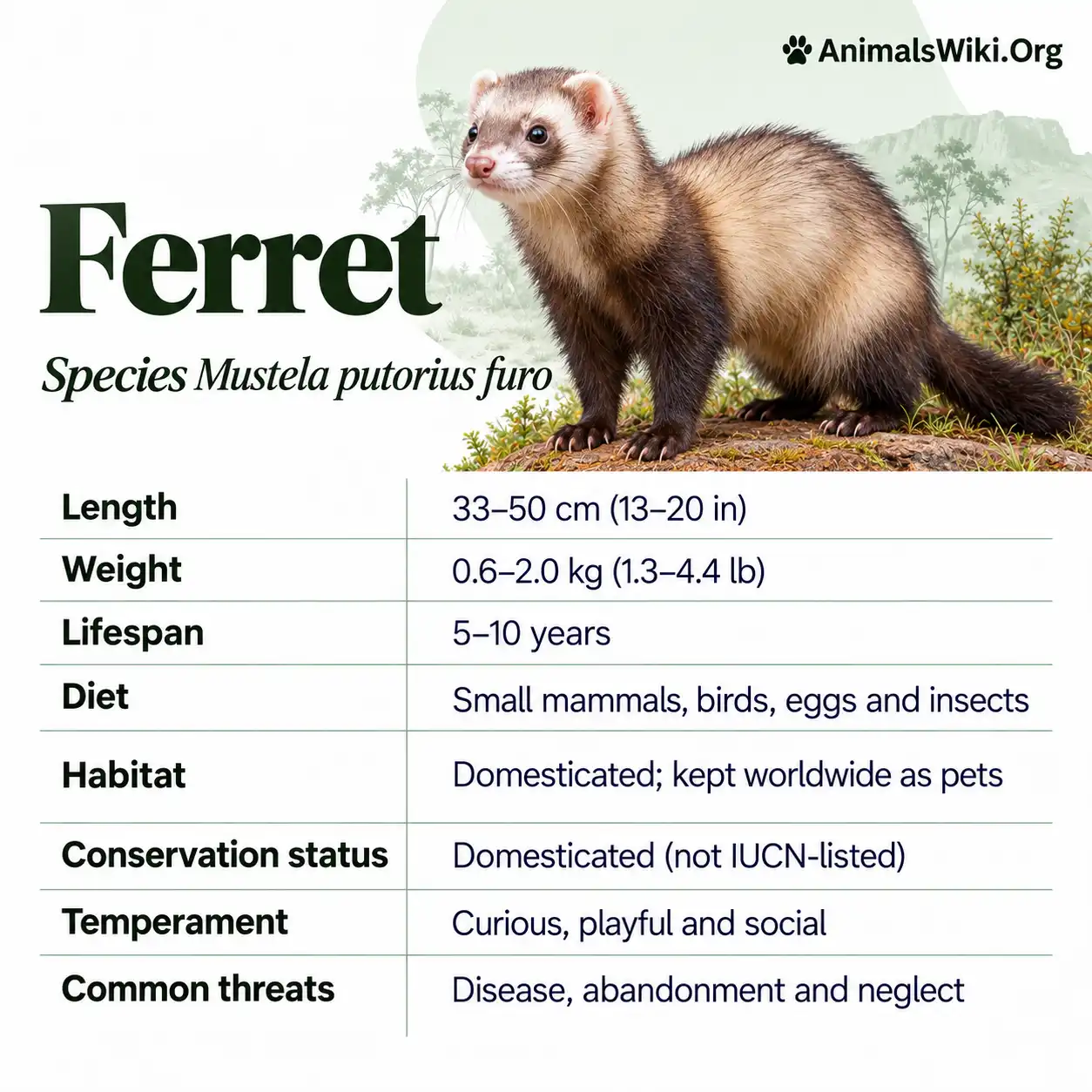
Ferret, The Curious Companion with a Remarkable Personality
A ferret is a domesticated mammal known for its long body, playful movements and extraordinary curiosity. Whether investigating a tunnel, carrying away a toy or sleeping in a hammock, it often approaches everyday surroundings as something to explore.
Ferrets belong to Mustelidae, the family containing weasels, polecats, mink, otters and badgers. Their elongated shape reflects that ancestry, while domestication has helped shape their relationship with people.
The domestic ferret is commonly identified as Mustela furo, although many veterinary references use Mustela putorius furo. Both names appear in useful information about the same domestic animal.
A pet ferret should not be confused with the black-footed ferret, Mustela nigripes, an endangered wild species native to North America.
Understanding the distinction is important because their habitats, conservation needs and relationships with people are different.
This guide focuses mainly on the domestic ferret. It explores its history, appearance, diet, behavior, reproduction and lifespan, alongside the practical requirements of responsible care.
Ferrets can become engaging companions, but their intelligence and curiosity create real responsibilities. Their small size does not make them animals that can thrive with little space, occasional attention or an improvised diet.
Ferret Facts
| Feature | Details |
|---|---|
| Common name | Domestic ferret |
| Scientific name | Mustela furo |
| Alternative scientific usage | Mustela putorius furo |
| Animal group | Mammal |
| Family | Mustelidae |
| Closest wild comparison | European polecat |
| Male name | Hob |
| Female name | Jill |
| Young | Kits |
| Diet | Obligate carnivore |
| Typical lifespan | Approximately 6–10 years |
| General behavior | Curious, playful and often sociable |
| Sleep | Long daily resting periods |
| Reproduction | Pregnancy approximately 42 days |
| Domestic status | Domesticated |
| Important distinction | Not the same species as the black-footed ferret |
| Main care priorities | Suitable diet, companionship, exercise, safe housing and veterinary care |
1. What Is a Ferret?
A ferret is a domesticated carnivorous mammal with a long torso, short legs, rounded ears and a relatively narrow head.
Its body is well suited to investigating confined spaces.
That ability once made ferrets useful in hunting and pest-related work. In modern homes, the same tendency appears as persistent exploration of furniture, cupboards and tunnels.
Domestication distinguishes a ferret from a wild animal that has simply become accustomed to people.
A domestic lineage has undergone changes across generations through its association with humans.
However, domestication does not remove every behavior connected with ancestry.
Ferrets remain predators, use scent, investigate with their mouths and need opportunities for physical activity.
A realistic understanding therefore combines both sides of their identity: they are domestic companions with a strong behavioral heritage.
Meeting those behaviors appropriately is more effective than expecting a ferret to act like a smaller version of a cat or dog.
2. Why Do Ferrets Have Two Scientific Names?
The domestic ferret appears as Mustela furo in the Mammal Diversity Database.
Many veterinary and historical sources instead use Mustela putorius furo, treating it as a domestic form associated with the European polecat.
These naming conventions can confuse readers who assume that two names must identify different pets.
In this context, both commonly refer to domestic ferrets.
The distinction concerns classification rather than separate feeding or housing requirements.
Scientific naming becomes especially useful when comparing domestic ferrets with wild relatives.
The European polecat is Mustela putorius. The black-footed ferret is Mustela nigripes.
Those are meaningful biological distinctions.
For a general article, using “domestic ferret” clearly and consistently prevents most misunderstanding.
When reading a research paper or veterinary text, check how the authors define the animal rather than dismissing useful information because a different scientific combination appears.
3. Where Did Domestic Ferrets Come From?
Domestic ferrets have been associated with people for more than two thousand years.
Their early history is not documented precisely enough to identify every stage of domestication with certainty.
The European polecat is strongly supported as their principal wild ancestor.
A genomic study examining ferrets and polecats supported that relationship while also exploring genetic mixing between domestic and wild populations.
Historically, people used ferrets for practical purposes, especially pursuing animals through burrows.
Their shape and willingness to enter confined spaces made that role possible.
Over time, ferrets also became companion animals.
That history explains why a household pet still shows behaviors such as investigating openings, carrying objects and searching through cover.
These are not random habits created by boredom alone.
They belong to an inherited behavioral background that responsible care should recognize and accommodate.
4. Ferret vs. Polecat: What Is the Difference?
A domestic ferret and a European polecat are closely related, but they are not interchangeable descriptions.
The polecat is a wild mammal. The ferret is domesticated.
Their appearance can overlap considerably, particularly in sable-colored ferrets.
Domestic ferrets also display a much wider variety of coat patterns than the familiar wild polecat appearance.
Behavior can help explain the distinction, although it is not a perfect identification test.
A ferret accustomed to people may seek contact and interaction, while a wild polecat normally maintains a different relationship with humans.
The two can interbreed and produce fertile offspring.
Consequently, an unfamiliar ferret-shaped animal outdoors may be a domestic escapee, a wild polecat or a hybrid.
A brief photograph may not settle the question.
For identification, combine location, coat pattern and behavior while allowing for uncertainty where the evidence is incomplete.
5. Is the Black-Footed Ferret a Pet Ferret?
No. The black-footed ferret, Mustela nigripes, is a separate wild species.
It is native to North America and closely associated with prairie dog ecosystems.
Its black feet, dark facial mask and pale body can remind observers of a sable domestic ferret.
However, visual similarity does not make the two animals equivalent.
Black-footed ferrets depend strongly on prairie dogs for food and use their burrows for shelter and reproduction.
Domestic ferrets live worldwide in human care and have a different history.
| Feature | Domestic ferret | Black-footed ferret |
|---|---|---|
| Scientific name | Mustela furo | Mustela nigripes |
| Status | Domesticated | Wild species |
| Main setting | Human-managed environments | North American prairie ecosystems |
| Feeding | Managed carnivore diet | Strong dependence on prairie dogs |
| Conservation context | Responsible care and escape prevention | Endangered-species recovery |
A photograph or article should identify which animal is being discussed before presenting facts about its ecology.
6. What Does a Ferret Look Like?
Ferrets have elongated bodies, short legs, small ears and a moderately long, fur-covered tail.
Their overall shape resembles that of a polecat, but coat colors and markings vary widely.
Some have a dark facial mask, darker limbs and a pale undercoat. Others are white, silver, pale cream or differently patterned.
The body often looks especially flexible during movement.
A ferret can stretch forward, curl tightly while resting and turn within spaces that appear surprisingly narrow.
Its appearance also changes with posture.
Standing upright to investigate something makes it seem taller, while low movement emphasizes its length.
For identification, the complete animal matters more than one color.
A pale coat does not establish that an animal is albino, and a dark mask does not prove it is a wild polecat.
Eye color, coat pattern, context and ancestry all contribute to the picture.
7. How Big Do Ferrets Get?
Male ferrets are generally larger and heavier than females.
Body mass varies with sex, age, reproductive status, season and individual condition.
Veterinary references describe adult males reaching approximately two kilograms, while many females are substantially lighter.
These figures should not become weight targets for every pet.
A smaller female and a large male can both be healthy while differing greatly in size.
Seasonal changes can also alter body condition.
Owners should assess trends with a veterinarian rather than comparing a ferret with the heaviest animal in an online photograph.
The useful question is whether the individual maintains appropriate body condition and normal function.
Length is similarly easy to misunderstand because some measurements include the tail.
When comparing references, check exactly what was measured.
Separate descriptions of sex, body mass and body condition provide more information than a single label such as “small” or “large.”
8. Ferret Colors and Patterns
Domestic ferrets occur in many colors and patterns.
Common descriptions include sable, albino, silver, cinnamon and dark-eyed white, although terminology varies between organizations and countries.
Color labels should not be confused with entirely separate species.
They also do not necessarily represent breeds in the same sense used for dogs.
An albino ferret lacks the usual pigmentation and has pink or reddish-looking eyes.
A dark-eyed white ferret has pale fur but dark eyes.
Sable animals often retain the familiar combination of a pale undercoat and darker markings.
Appearance can change with age and seasonal coat replacement.
For someone choosing a companion, temperament, health history and care requirements matter more than a fashionable color name.
The same broad welfare needs remain: suitable food, social opportunities, safe space and veterinary support.
A coat pattern does not provide a shortcut around those responsibilities.
9. Why Are Ferrets So Flexible?
Ferrets have a body structure suited to movement through restricted spaces.
Their elongated torso and flexible movements allow them to bend, twist and investigate narrow routes.
This reflects their connection with ancestors that searched burrows and dense cover.
In a home, the advantage becomes a management challenge.
An opening that appears insignificant may lead behind a cabinet or into furniture.
Flexibility does not mean a ferret cannot become trapped.
The animal may enter a space without being able to leave safely, especially where mechanical parts, loose fabric or hidden openings are involved.
Owners therefore need to think beyond whether a room is large enough.
They must consider what lies inside furniture and behind appliances.
The ferret’s physical abilities are impressive, but they are not a substitute for a carefully prepared environment.
Safe care anticipates exploration instead of assuming the animal will avoid unsuitable places.
10. What Senses Do Ferrets Use?
Ferrets rely heavily on smell and hearing while exploring.
Their eyesight does not function like human vision, and they should not be expected to recognize every hazard visually.
Smell provides information about food, familiar individuals and the surrounding environment.
This helps explain why a new object can receive intense investigation even when it appears ordinary to a person.
Ferrets also explore with their mouths.
That behavior is not always a deliberate attempt to damage belongings. It is part of how they interact with their environment.
Nevertheless, it can create serious risks when objects can be swallowed.
A safe room therefore needs to account for both movement and investigation.
A rubber item lying on the floor is not merely something the ferret might step over.
It may become something to bite, carry or ingest.
Understanding sensory behavior turns household preparation into a more realistic exercise.
11. How Much Do Ferrets Sleep?
Ferrets spend long periods sleeping or resting.
Published care references give varying estimates, often ranging from roughly 12 to 20 hours daily, depending on age and circumstances.
Their awake periods can be energetic, producing a striking contrast between deep rest and active exploration.
A sleeping ferret still needs a stimulating environment.
Long resting time does not justify keeping the animal in a small, empty enclosure.
Comfortable, protected sleeping places are important, along with opportunities to be active when awake.
Owners should also learn the individual’s normal pattern.
An unusual reduction in activity, difficulty waking normally or failure to eat should not automatically be dismissed as ordinary sleepiness.
The important distinction is between a familiar resting routine and a change in condition.
A healthy pattern is best understood through daily familiarity with the animal rather than a rigid number copied from a fact sheet.
12. Are Ferrets Nocturnal?
Ferrets are often described as crepuscular, meaning especially active around dawn and dusk.
Domestic routines can also influence when they interact with people.
They should not be imagined as animals that remain active all night and sleep through every daylight hour.
Instead, activity is interspersed with substantial rest.
A predictable household routine can help provide opportunities for exercise and interaction.
However, convenience should not override the animal’s need to sleep undisturbed.
Repeatedly waking a ferret for entertainment is different from offering activity when it is naturally alert.
The practical goal is to observe its pattern and create suitable opportunities within it.
This supports a calmer relationship than expecting the animal to perform on demand.
Its schedule is one reason potential owners should consider daily care arrangements before adoption rather than discovering the requirements afterward.
13. Why Are Ferrets So Playful?
Ferret play can include running, hopping, chasing, wrestling and investigating objects.
Play offers opportunities to develop and use physical and social abilities.
The behavior may look chaotic to a person, especially during a rapid sideways hop or sudden burst of movement.
Context matters.
Loose, voluntary interaction between comfortable animals differs from repeated distress, injury or one animal being unable to escape.
A useful play environment offers choices.
Tunnels, safe objects and hiding places let the ferret switch between chasing, exploring and retreating.
Human participation can add interest, provided handling remains gentle.
The goal is to support the animal’s motivation rather than simply tire it out.
An engaging environment gives a ferret something appropriate to do with its curiosity.
That is more effective than expecting lively behavior to disappear through confinement.
14. Do Ferrets Need Companions?
Domestic ferrets are often sociable and can benefit from compatible ferret company.
Many enjoy playing, resting and exploring with others.
However, compatibility should not be assumed.
Individual history, reproductive status, available space and personality influence relationships.
A pair needs enough resources for both animals.
That includes food, water, sleeping areas and places to withdraw.
Companionship does not mean forcing constant contact.
A ferret should be able to rest separately or move away from an interaction.
Introductions require supervision and adjustment rather than simply placing unfamiliar animals together.
Repeated fighting, wounds or persistent fear deserve professional advice.
Human attention remains valuable, but it is not always an equivalent replacement for compatible conspecific interaction.
For anyone planning care, social arrangements should be considered alongside enclosure design and daily time commitments.
15. What Do Ferret Sounds and Body Language Mean?
Ferrets communicate through movement, posture, scent and sound.
The familiar “dook” is a chuckling noise often heard during excitement or active interaction.
Hissing can occur when an animal wants distance or is uncomfortable.
A loud scream demands attention to the situation.
No sound should be interpreted without considering the animal’s posture and surroundings.
The same broad behavior can occur in different contexts.
Watch whether the ferret can leave, whether another animal is pursuing it and whether the interaction results in injury or continued distress.
Quiet behavior also needs context.
An animal resting comfortably differs from one withdrawn because it feels unwell.
Learning an individual’s normal communication takes time.
A short list of sounds provides a starting point, while repeated observation builds the understanding needed for appropriate responses.
16. Are Ferrets Intelligent and Trainable?
Ferrets can learn routines and respond to consistent, rewarding interactions.
Training can make care easier by encouraging behaviors such as entering a carrier, approaching a familiar cue or using a suitable toilet area.
Research has also investigated how domestic ferrets respond to people.
One study found differences between domestic ferrets and wild-form hybrids in tasks involving owners and human communication.
That does not mean ferrets think exactly like dogs.
It shows that their relationship with people is a meaningful subject of study.
For owners, the useful principle is consistency.
Reward the behavior you want, keep sessions manageable and avoid frightening or punishing the animal.
A reluctant response may indicate distraction, fatigue or an unclear task rather than stubbornness.
Training works best as communication and cooperation, with care needs guiding the objective.
17. What Do Ferrets Eat?
Ferrets are obligate carnivores.
They require an appropriately balanced diet based on animal-derived nutrients.
A complete commercial food formulated for ferrets is a practical starting point for many households.
The correct choice should account for age, health and life stage.
A diet consisting only of pieces of ordinary muscle meat is not automatically complete.
Likewise, being able to nibble a fruit does not make fruit a suitable dietary foundation.
Ferret nutrition is about meeting the animal’s requirements, not assembling foods that seem healthy for people.
For homemade, raw or whole-prey feeding, seek advice from a veterinarian with relevant nutrition knowledge.
Those approaches can introduce nutritional and hygiene issues when planned poorly.
The most useful feeding decision is one that provides reliable adequacy and can be maintained consistently.
18. How Often Should a Ferret Eat?
Ferrets have a short digestive tract and relatively rapid passage of food.
They generally need to eat frequently rather than being managed like an animal receiving one large daily meal.
Care guidance commonly recommends access to suitable food throughout the day.
However, feeding also needs to account for the individual.
Body condition, illness and a tendency to overeat can require an adjusted veterinary plan.
Owners should know whether each ferret in a group is actually eating.
A full bowl does not prove that every animal has access, and a hidden food store can complicate assumptions about intake.
Sudden changes in appetite deserve attention.
Do not impose fasting or an improvised weight-loss routine without veterinary guidance.
The objective is a feeding arrangement that supports health while allowing regular access appropriate to the animal’s needs.
19. Water, Treats and Foods to Avoid
Ferrets need continuous access to clean drinking water.
Bowls or bottles must function reliably and be checked regularly.
A container can appear full while the animal cannot use it properly, and spilled water may leave an enclosure without a usable supply.
Treats should remain a small part of the diet.
Suitable options should fit the animal’s carnivorous nutritional needs rather than adding large amounts of sugar.
Avoid chocolate, dairy products and sugary snacks.
Do not assume a food is appropriate because it is safe for a dog or person.
The same applies to supplements.
A complete diet does not automatically require extra vitamins, and unnecessary additions can complicate feeding.
If a ferret’s drinking or eating changes, investigate the cause with a veterinarian rather than attempting to correct it by repeatedly changing foods.
20. What Kind of Home Does a Ferret Need?
A suitable ferret home provides space for movement, secure shelter, clean resources and opportunities to perform normal behavior.
A sleeping area should be protected and comfortable.
Food, water and toilet areas need sensible placement.
The enclosure should be well ventilated, dry and protected from unsuitable weather or heat.
Height alone does not meet every need.
An arrangement with platforms still requires usable movement space and safe access between levels.
The design should also allow cleaning and daily observation.
A beautiful enclosure that makes the animal difficult to check or leaves inaccessible dirty areas is not automatically practical.
Most importantly, housing should be part of the care system rather than the animal’s entire world.
Regular access to a safe activity area remains important.
The ferret needs opportunities to explore beyond one unchanged sleeping-and-feeding compartment.
21. What Does Ferret-Proofing Mean?
Ferret-proofing means preparing an environment for an animal likely to squeeze, climb, investigate and chew.
Block access to dangerous or unreachable spaces.
Check behind furniture, around appliances and inside structures the animal might enter.
Soft furniture can contain hidden cavities and moving parts.
Foam, rubber, loose plastic and small detachable components can create swallowing hazards.
Electrical wires, cleaning products and medicines also need secure separation.
A room that is safe for a walking adult person is not automatically safe at ferret level.
Preparation should include inspecting from low down and considering what happens inside objects, not only on top of them.
Safety checks also need repeating.
Furniture moves, toys wear out and new gaps appear.
The most effective approach combines a prepared space with supervision, rather than relying on the animal to avoid danger through instinct.
22. Which Toys and Activities Suit Ferrets?
Good enrichment provides opportunities to investigate, move, hide and search.
Wide tunnels, suitable boxes and food-based puzzles can support those behaviors.
Objects need to be evaluated for the individual animal.
A toy marketed for pets is not automatically safe for a ferret that tears or swallows material.
Research involving ferret keepers identified tunnels, digging and exploration among valued activities, while also highlighting hazards involving rubber, narrow spaces and snagging fabrics.
That distinction is important.
Enrichment should provide an appropriate challenge without creating a trap or ingestion risk.
Inspect items regularly and remove damaged materials.
Variety can come from changing layouts and presentation rather than constantly purchasing more objects.
A familiar safe tunnel arranged differently may create a new route to explore.
The aim is meaningful choice and activity, supported by careful observation.
23. Why Is Heat a Serious Concern for Ferrets?
Ferrets are vulnerable to overheating.
Housing must be protected from direct sun and poorly ventilated hot conditions.
Indoor environments can also become unsafe, especially where sunlight enters through glass or airflow is restricted.
Water is essential, but a water bowl alone does not make a hot enclosure safe.
Temperature management requires attention to the whole environment.
Provide a comfortably cool setting and check conditions where the animal actually rests.
Do not leave a ferret in a parked vehicle.
If an animal becomes weak, collapses, pants unusually or appears distressed in heat, contact a veterinarian urgently.
Do not assume it will recover simply by being left alone.
Heat management is especially important in warm climates, but the underlying lesson applies everywhere: assess the ferret’s immediate surroundings rather than relying on the room’s general appearance.
24. How Should Ferrets Be Handled?
Handle ferrets gently and support their body securely.
Allowing an alert animal to notice and approach you can reduce surprise.
Do not grab at a sleeping ferret or expect every individual to tolerate unfamiliar handling immediately.
Young or poorly socialized animals may bite, and a frightened ferret should not be punished for reacting defensively.
Children require close supervision.
Other pets also need careful management.
A friendly dog or cat is not a guarantee of safety, while prey animals can experience stress from a predator’s presence.
The goal is predictable interaction with an escape from unwanted contact.
A ferret that struggles should prompt reassessment of support, duration and context.
Handling is a skill developed through trust and repetition.
It should make routine care easier without turning every encounter into restraint.
25. Why Do Ferrets Smell?
Ferrets have a natural musky odor associated largely with skin glands.
Intact males can smell particularly strong.
Anal scent glands also produce secretion, but removing those glands does not eliminate the ordinary body odor.
This distinction explains why “descented” should not be interpreted as odorless.
Clean bedding, sensible hygiene and appropriate reproductive management can influence the household situation.
Repeated bathing is not a reliable solution.
Frequent washing can affect the coat and skin without removing the biological source of normal scent.
An abrupt or unusual odor may also deserve investigation rather than simply more cleaning.
For prospective owners, the practical question is whether the household can accept a normal ferret smell.
It is better to make that decision before adoption than expect a procedure or product to transform the animal into something scent-free.
26. Can Ferrets Be Litter Trained?
Many ferrets can learn to use a litter tray.
Their tendency to choose particular corners can help establish suitable placement.
A tray should be accessible, clean and separated sensibly from food and sleeping areas.
Additional trays may be needed in larger activity spaces.
Success depends partly on making the desired option convenient.
Expecting a ferret to travel a long distance across an unfamiliar room can produce avoidable accidents.
Use consistency and reward appropriate behavior rather than punishment.
Accidents also deserve context.
A sudden change in toilet habits may reflect stress, access problems or illness.
The goal is a workable routine rather than a promise of perfect reliability.
Cleaning remains necessary even when training is successful.
A litter tray reduces mess only when it is maintained and remains easy for the animal to use.
27. What Veterinary Care Do Ferrets Need?
Ferrets need a veterinarian comfortable treating their species.
Establish that relationship before an emergency.
Routine examinations provide opportunities to discuss body condition, teeth, vaccination, parasite prevention and changes in behavior.
Vaccination requirements and available products vary by location.
A veterinarian should determine appropriate protection against diseases such as canine distemper and, where relevant, rabies.
Do not copy a dog or cat vaccination schedule without professional advice.
The same caution applies to parasite products.
A medicine suitable for another pet may be inappropriate for a ferret.
Keep records of treatments and previous reactions.
Owners should also know which clinic can provide urgent care outside normal hours.
Planning this in advance is more useful than searching for an experienced service while an animal is already deteriorating.
28. What Health Problems Can Affect Ferrets?
Ferrets can develop dental disease, digestive obstruction, infections and several hormonal disorders.
Insulinoma and adrenal gland disease are particularly important conditions discussed in veterinary references.
These are not diagnoses an owner should make from a symptom list.
Weakness, reduced appetite, hair loss or changes in urination can have more than one cause.
The useful response is to notice change and obtain assessment.
Collapse, seizures, breathing difficulty, inability to urinate or suspected swallowing of a foreign object require urgent veterinary attention.
Do not wait for every sign to appear.
Daily familiarity helps because an owner may notice a departure from normal behavior before a problem becomes obvious.
The aim is early recognition, not home treatment based on a general article.
A species guide can explain the importance of veterinary care without replacing an examination.
29. Can Ferrets Catch Human Flu?
Yes. Ferrets can be infected with human influenza viruses.
People can transmit flu to ferrets, and transmission in the other direction is possible.
This makes everyday hygiene relevant to both animal and human health.
Wash hands when handling the animal, its food and enclosure items.
If someone has flu symptoms, avoid close contact with the ferret where possible and arrange suitable care.
A ferret developing respiratory illness should be assessed by a veterinarian.
This issue also helps explain why ferrets have been used in respiratory research.
Their susceptibility is biologically important, but for a household the practical lesson is straightforward.
A person’s illness can matter to the pet.
Care planning should therefore include what happens when the usual caregiver is sick, rather than assuming health risks operate only from animals toward humans.
30. How Do Ferrets Reproduce?
Female ferrets are called jills, males hobs, and young kits.
Pregnancy lasts approximately 42 days.
Ferrets are seasonal breeders, and reproductive development is connected with environmental conditions, including light.
For pet care, the most important reproductive issue is that an intact female can remain in heat.
Persistent high estrogen exposure can suppress bone marrow and become life-threatening.
Owners need a veterinary reproductive-management plan.
Available approaches and the balance of benefits and risks should be discussed for the individual animal.
Breeding is not a necessary household solution.
Surgical and hormonal options require professional assessment, and treatment timing should not be improvised.
The key point is that reproductive management affects health, behavior and care requirements.
It belongs in routine planning rather than being postponed until the animal is visibly unwell.
31. What Are Baby Ferrets Like?
Newborn ferret kits are dependent on their mother.
Their eyes and ears are closed initially, and they cannot function as miniature independent adults.
Growth brings changes in movement, hearing, vision and feeding.
As the kits develop, they begin exploring and interacting more actively.
Weaning is a process rather than a single meal replacing all maternal dependence.
Young animals need suitable nutrition and careful social experience.
Their curiosity should be guided into safe environments.
An energetic kit may look physically confident while still lacking the experience to avoid household hazards.
For prospective owners, age alone does not describe readiness.
Health, weaning status, handling history and the quality of early care all matter.
Obtain reliable records and appropriate advice rather than assuming every small ferret being offered for sale is ready for the same routine.
32. How Long Do Ferrets Live?
A commonly quoted domestic ferret lifespan is approximately six to ten years.
Some individuals live longer, while illness and accidents shorten others’ lives.
This is a substantial commitment for an animal sometimes mistaken for an inexpensive short-term pet.
Daily care continues through changes in work, housing and family circumstances.
Older ferrets may need closer observation and more frequent veterinary assessment.
A lifespan range should not be interpreted as a guarantee.
Good care improves the conditions an animal experiences without allowing an owner to control every outcome.
The most useful planning assumption is that responsibility may continue for many years.
That includes suitable housing, companionship arrangements, holiday care and access to treatment.
A ferret’s appealing personality is part of the attraction, but the long-term commitment is part of the same decision.
33. Can Domestic Ferrets Live in the Wild?
Escaped or released domestic ferrets can sometimes establish feral populations.
That does not mean releasing a pet is safe or acceptable.
Many individuals lack the conditions needed to survive, while successful feral populations can threaten native wildlife.
New Zealand provides a well-documented example.
Ferrets were introduced during attempts to control rabbits and subsequently contributed to pressure on native species.
This creates two different welfare and conservation concerns: the fate of the released animal and the consequences for wildlife.
Domestic status is not a reason to assume ecological harmlessness.
A well-fed pet can still retain predatory behavior.
Secure housing and responsible ownership therefore support both individual welfare and environmental protection.
If a ferret can no longer be kept, use an appropriate rescue or rehoming route rather than releasing it outdoors.
34. Why Is the Black-Footed Ferret Endangered?
The black-footed ferret has a separate conservation story from the domestic pet.
It depends heavily on prairie dog ecosystems, which provide food and burrows.
Habitat changes, prairie dog losses and disease have made recovery difficult.
A surviving population discovered near Meeteetse, Wyoming, in 1981 became central to subsequent conservation work.
Captive breeding and reintroduction have helped restore animals to suitable landscapes.
Those efforts still require habitat and disease management.
The species is not recovered simply because breeding is possible.
A viable wild population needs the ecological setting that supports its life.
This is why conservation includes landowners, prairie dog colonies, veterinary measures and long-term monitoring.
The familiar name “ferret” connects the animals linguistically, but the endangered wild species should never be treated as simply another pet color or variety.
35. How Is Cloning Being Used in Ferret Conservation?
Cloning research has been used to address genetic-diversity concerns in black-footed ferrets.
Much of the recovery population descended from a small number of founders.
Preserved tissue from an animal whose genes were not represented in that breeding population offered another potential source of variation.
The U.S. Fish and Wildlife Service has reported successful reproduction involving cloned lineages.
A 2025 update described 12 kits across four litters, adding another stage to the research.
This is a conservation tool, not a replacement for habitat.
Cloning cannot provide prairie dog colonies, remove every disease threat or create a functioning ecosystem by itself.
Its value concerns a particular genetic challenge within a broader program.
The distinction is important because a striking technological achievement can attract attention away from the continuing work needed on the ground.
36. Is a Ferret the Right Companion for Your Household?
A ferret can suit someone who enjoys interactive care and can provide a secure, stimulating environment.
It is less suitable when the expectation is an animal that spends almost all its time confined.
Consider daily exercise, cleaning, companionship and veterinary access.
Also consider the household’s other animals.
Predator and prey species should not be treated as potential playmates.
Children require appropriate supervision, and very young children face particular bite risks.
Local rules should be checked before adoption because ownership and movement requirements differ.
Finally, plan for illness, travel and changes in routine.
A compatible ferret or pair is only one part of the decision.
The household must also be able to maintain care over the animal’s lifetime.
Meeting those requirements makes the relationship more rewarding because the animal can express normal behavior within a safe, predictable setting.
Frequently Asked Questions About Ferrets
What kind of animal is a ferret?
A ferret is a domesticated mammal in Mustelidae, the family containing weasels, polecats, mink, otters and badgers. It is not a rodent.
What is a ferret’s scientific name?
The domestic ferret is commonly called Mustela furo. Many veterinary sources also use Mustela putorius furo. Both names refer to the domestic animal.
Are ferrets related to polecats?
Yes. The European polecat is strongly supported as the principal wild ancestor of domestic ferrets. The two can interbreed.
Is a ferret the same as a weasel?
No. Ferrets belong to the weasel family, but they are not the same species as the least weasel or long-tailed weasel.
Is a black-footed ferret a domestic ferret?
No. Mustela nigripes is a separate wild species native to North America. Its conservation needs center on prairie dog ecosystems.
How long do ferrets live?
A typical reference range is approximately six to ten years, although individual outcomes vary. Some live longer, while illness and accidents can shorten lifespan.
What is a male ferret called?
A male is called a hob. A female is a jill, and a young ferret is a kit.
Do ferrets need other ferrets?
Many benefit from compatible ferret company. Introductions and resource provision matter, and individual circumstances should guide decisions with appropriate advice.
How much do ferrets sleep?
They sleep or rest for long periods, with published estimates varying roughly between 12 and 20 hours daily. Age, routine and health influence the pattern.
Are ferrets nocturnal?
They are often described as crepuscular, with activity around dawn and dusk. Domestic schedules can influence interaction, but substantial undisturbed rest remains important.
What do ferrets eat?
Ferrets are obligate carnivores. A complete diet formulated for ferrets is a practical option. Homemade or raw feeding requires informed planning.
Can ferrets eat fruit?
Fruit should not form part of their routine diet. Their nutritional needs differ from those of omnivorous pets. Use suitable carnivore treats sparingly.
Can ferrets drink milk?
Dairy products are inappropriate routine foods and can cause digestive problems. Fresh drinking water should remain continuously available.
Do ferrets smell?
They have a natural musky odor, largely associated with skin glands. Cleaning helps manage the environment, but it does not make the animal odorless.
Does descenting remove all ferret odor?
No. Removing anal scent glands does not eliminate ordinary skin-related odor. It should not be understood as a guarantee of an odor-free pet.
Do ferrets need frequent baths?
Routine frequent bathing is unnecessary and can affect skin and coat condition. Ask a veterinarian about an appropriate grooming approach.
Can ferrets be litter trained?
Many can learn to use a litter tray. Accessible placement, cleanliness and consistency help, although occasional accidents can still occur.
Are ferrets easy to train?
They can learn useful routines through consistent, rewarding interaction. Training should support cooperation rather than rely on frightening or punishing them.
Why does a ferret make a dooking sound?
Dooking is a chuckling sound often associated with excitement or active interaction. Interpret it alongside the animal’s posture and situation.
Do ferrets bite?
They can. Fear, surprise, pain and handling history can contribute. Gentle interaction and supervision reduce risk, but sharp teeth still require respect.
Can ferrets live with rabbits?
They should not be treated as companions for prey animals. A ferret’s predatory identity remains relevant despite domestication.
Are ferrets sensitive to heat?
Yes. They can overheat, so housing must remain suitably cool and protected from direct sun. Distress or collapse in heat requires urgent veterinary attention.
Can ferrets catch human flu?
Yes. Human influenza can infect ferrets, and transmission in the other direction is possible. Hygiene and reduced contact during illness are important.
How long is a ferret pregnant?
Pregnancy lasts approximately 42 days. Reproductive management should be planned with a veterinarian, especially because persistent heat can endanger intact females.
Can you release a pet ferret outdoors?
No. Release can endanger the animal and harm wildlife. Use a responsible rescue or rehoming route if continued care is impossible.



