
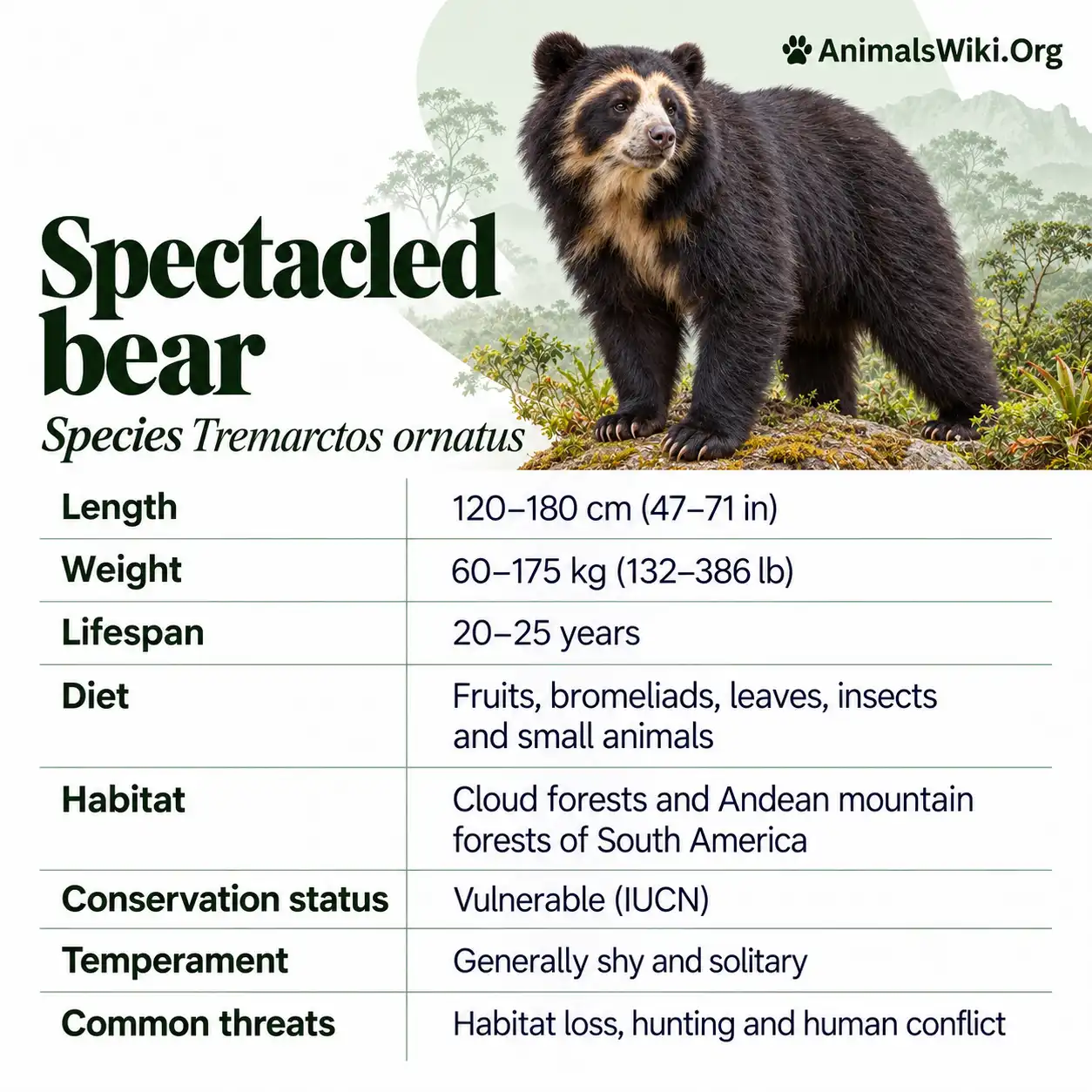
Spectacled Bear, South America’s Remarkable Andean Bear
The spectacled bear is a tree-climbing bear recognized by the pale markings that often surround its eyes. These cream-colored patterns can resemble eyeglasses, giving the animal one of the most memorable names in the bear family.
Also called the Andean bear, it is the only living bear species native to South America. Its range follows the Andes and nearby mountain systems, where it occupies forests, scrublands and high-elevation grasslands.
Scientifically known as Tremarctos ornatus, the spectacled bear combines the strength of a bear with an impressive ability to move through trees. It can climb in search of food and construct leafy platforms used for feeding or resting.
Although it belongs to the order Carnivora, plants dominate much of its diet. Fruit, bromeliads, palms and other vegetation connect its daily movements with the changing resources of Andean landscapes.
Its survival also depends on relationships with people. Forest clearance, hunting and conflict around crops or livestock create pressures, while community conservation and protected areas offer opportunities.
This guide explores the spectacled bear’s appearance, habitat, diet, reproduction and conservation. It also explains why the species is more adaptable than the familiar image of a bear living only in misty cloud forest suggests.
Spectacled Bear Facts
| Feature | Details |
|---|---|
| Common name | Spectacled bear |
| Other common name | Andean bear |
| Scientific name | Tremarctos ornatus |
| Family | Ursidae |
| Subfamily | Tremarctinae |
| Native continent | South America |
| Core range countries | Venezuela, Colombia, Ecuador, Peru and Bolivia |
| Typical adult length | Approximately 1.3–2 meters |
| General size pattern | Males substantially larger than females |
| Main foods | Fruit, bromeliads and other plant material |
| Other foods | Invertebrates, carrion and some vertebrate prey |
| Climbing ability | Excellent |
| Social pattern | Generally solitary, with important exceptions |
| Young | Cubs |
| Typical litter | One or two cubs; larger litters are less common |
| Seasonal hibernation | No prolonged annual hibernation |
| Conservation category | Vulnerable |
| Population trend | Decreasing |
1. What Is a Spectacled Bear?
A spectacled bear is a medium-sized bear adapted to a varied South American landscape.
It belongs to Ursidae, the family containing all living bears, but represents a distinctive branch within that family.
The species occupies habitats ranging from dry forest to moist mountain forest and high Andean vegetation.
Its daily life involves locating food, traveling between useful places, resting and avoiding disturbance.
Climbing is an important part of that routine rather than an occasional curiosity.
The bear can use trees as feeding sites and resting locations while also foraging extensively on the ground.
This combination makes it more versatile than the phrase “forest bear” alone suggests.
Understanding the species requires considering both the vertical structure of trees and the larger arrangement of habitats across mountain slopes.
Its environment is a network of resources distributed through changing terrain.
2. Why Is It Called a Spectacled Bear?
The name comes from pale facial markings that often surround the eyes.
Against dark fur, these markings can resemble spectacles.
However, the pattern is highly variable.
Some bears have conspicuous pale rings, while others show incomplete markings or relatively little light fur around the eyes.
The pale areas can extend over the muzzle, throat and chest.
This variation gives individuals distinctive appearances.
The alternative name Andean bear emphasizes geography rather than facial pattern and remains appropriate even for an animal without obvious “glasses.”
Both common names identify the same species.
For readers comparing photographs, the important point is that the name describes a frequent impression, not a feature that must appear identically on every bear.
An individual lacking a complete pale eye ring is not automatically a different species.
3. Spectacled Bear Classification
The accepted scientific name is Tremarctos ornatus.
The species belongs to the subfamily Tremarctinae, a lineage with a history distinct from that of most living bears.
It is the only living representative of that subfamily.
Its scientific identity is useful when comparing sources because common names vary.
“Andean bear” and “spectacled bear” are both widely used, while regional names include forms such as ucumari.
Classification also prevents confusion with unrelated mammals carrying “bear” in a nickname.
A kinkajou may be called a honey bear, for example, but it belongs to the raccoon family.
The spectacled bear is a true bear.
Its distinctive evolutionary position adds conservation importance: protecting it preserves the last living member of a once more diverse bear lineage.
That history extends far beyond the facial markings that first attract attention.
4. What Does a Spectacled Bear Look Like?
Spectacled bears usually have dark coats, ranging from black to brown, sometimes with reddish tones.
Their pale markings can appear on the face, throat and chest.
They have rounded ears, a relatively short muzzle and a sturdy body.
The tail is short and often difficult to see beneath the fur.
A thick coat can conceal the animal’s underlying proportions, especially in photographs taken from the front.
Side views more clearly reveal body length and the relationship between the shoulders, torso and legs.
Lighting also affects apparent color.
A bear in deep forest shade may look almost black, while sunlight reveals warmer tones.
For identification, consider the complete animal together with location.
A pale facial marking is useful, but a reliable identification combines appearance, geography and the broader context of the observation.
5. How Big Is a Spectacled Bear?
Adult spectacled bears are substantial animals, although they are smaller than the largest brown and polar bears.
Body length commonly falls around 1.3–2 meters.
Males are noticeably larger than females.
Zoo reference summaries give approximate female weights around 60–80 kilograms and male weights commonly around 100–175 kilograms, with variation beyond those general figures.
Age, condition, sex and the population involved affect size.
A photograph without scale can make estimation difficult.
Thick fur, body posture and camera angle can change the impression considerably.
Standing upright also makes the animal look different from its normal four-footed posture.
For a species profile, separate body measurements from visual descriptions.
Calling a bear “large” provides less information than identifying whether the figure concerns a mature male, an adult female or a growing youngster.
6. Can Facial Markings Identify Individual Bears?
Distinctive pale markings help researchers recognize individual spectacled bears in photographs.
This can make camera traps especially useful.
A clear view of the face or chest may allow an animal to be matched with earlier images.
However, the quality and angle of the photograph matter.
A blurred side view may conceal the features needed for comparison.
Researchers also need to distinguish identification from other conclusions.
Recognizing the same bear does not automatically reveal its age, parentage or entire movement history.
Studies using photographs have investigated these limits, including what appearance can reveal about age and kinship.
For conservation, the practical benefit is substantial: recognizable individuals can provide information without requiring every bear to be physically captured.
Careful image records help connect separate encounters into a more useful picture of an animal’s life.
7. Where Do Spectacled Bears Live?
The species’ established core range includes Venezuela, Colombia, Ecuador, Peru and Bolivia.
Its distribution follows the Andes and associated mountain landscapes rather than covering the whole continent.
Reports near the outer limits require careful interpretation, so uncertain records should not be presented as equivalent to well-established populations.
A country list also does not mean the bear occupies every part of each country.
Suitable vegetation, food, terrain and human pressure influence local occurrence.
Some populations are connected through extensive habitat, while others occupy more isolated areas.
For wildlife watchers, recent local information is more useful than a broad continental map.
Even within suitable habitat, bears may remain difficult to see.
Their presence is often established through tracks, feeding signs and cameras rather than frequent direct encounters.
Distribution therefore reflects both where bears live and how effectively those places have been surveyed.
8. What Is the Spectacled Bear’s Habitat?
Spectacled bears use several environments, including moist mountain forest, dry forest, scrub and high-elevation grassland.
Cloud forest is important, but it is not the entire habitat story.
Food resources and shelter occur in different combinations across the range.
A fruiting tree provides one kind of opportunity. A patch of terrestrial bromeliads provides another.
This means a bear may benefit from access to more than one vegetation type.
Habitat quality also depends on arrangement.
Two useful patches separated by a dangerous or heavily disturbed gap may not function like one connected landscape.
The bear’s requirements therefore extend beyond a small feeding site.
It needs space to move between resources as availability changes.
A complete habitat description should consider food, resting places, reproductive shelter and the routes linking them.
That is more informative than imagining the species against one postcard view of the Andes.
9. Why Are Cloud Forests Important?
Cloud forests contain dense vegetation, complex tree structure and many potential food plants.
They can offer fruit, cover and places to rest or climb.
Their steep terrain and thick foliage also make bears difficult for people to observe.
This creates a difference between ecological importance and visibility.
A forest may support bears while yielding very few direct sightings.
For conservation, cloud forest protection can help preserve resources used by many other species as well.
However, the bear’s needs should not be reduced to simply maintaining tree cover.
The variety of plants, the presence of large trees and connections to adjacent habitats can matter.
A bear may use forest together with nearby highland vegetation.
Protecting the forest while losing its surroundings can therefore leave part of the ecological system incomplete.
The useful conservation unit is often a landscape containing several complementary habitats.
10. Do Spectacled Bears Live in Dry Forests?
Yes. Some spectacled bears inhabit much drier environments than their popular image suggests.
Research and conservation work in northwestern Peru has documented bears using equatorial dry forest and adjoining habitats.
The term Tumbes bear is used by a conservation organization for a distinctive regional population; it does not identify a separate recognized bear species.
In these landscapes, resources such as waterholes and particular fruiting trees can become especially important.
The distribution of food and water may concentrate activity in limited places.
This has implications for both research and protection.
An area that looks sparse compared with cloud forest can still contain essential bear habitat.
Conservation should therefore avoid valuing only lush, wet landscapes.
Dry forest populations demonstrate the species’ ecological breadth while also highlighting how vulnerable specialized local resource networks can become.
11. What Are Páramo and Puna Habitats?
Páramo and puna refer to high-elevation Andean environments, although their vegetation and regional usage differ.
They should not be treated as perfectly interchangeable terms.
These landscapes can contain grasses, shrubs and terrestrial bromeliads used by spectacled bears.
The transition between forest and open highland vegetation is especially interesting.
A bear can encounter different foods over a relatively short horizontal distance while also changing elevation.
This creates a landscape shaped by both altitude and vegetation.
Open terrain does not mean the bear has left useful habitat.
It may be feeding on resources unavailable inside nearby forest.
For visitors, a bear photographed among grasses is therefore not necessarily displaced or lost.
The species naturally uses a wider selection of environments than dense woodland alone.
Understanding those habitats helps explain both movement and conservation requirements.
12. Are Spectacled Bears Good Climbers?
Spectacled bears are excellent climbers.
They use trees to reach food and can rest above the ground.
Climbing depends on strength, claws, coordination and the structure of the tree.
An adult bear moving confidently among branches can seem surprising because people often associate bears mainly with ground travel.
However, arboreal activity is a significant part of this species’ biology.
A tree may function as a feeding site, lookout point or resting place.
These uses help explain why the loss of particular trees can matter beyond the area of canopy removed.
The animal also needs suitable approaches and supports.
A large trunk without accessible branches may offer different opportunities from a complex crown.
For conservation, maintaining forest structure means preserving more than the number of standing trees.
It includes the features that make those trees usable.
13. Why Do Spectacled Bears Build Tree Platforms?
Spectacled bears can assemble branches and vegetation into platforms in trees.
These structures are used for feeding or resting.
A platform should not automatically be described as a maternal den.
An elevated feeding or resting structure and a protected site used for giving birth serve different purposes.
The distinction is important because a dramatic photograph of a bear in a tree can lead to overly broad descriptions.
Platforms show that bears modify parts of their surroundings to support activity.
They also leave signs that researchers may detect after the animal moves away.
The structure can therefore provide evidence of habitat use even without a direct sighting.
For the bear, a suitable arrangement of branches can make a feeding position more stable.
For an observer, the platform reveals a behavioral relationship between the animal and the physical structure of its habitat.
14. What Do Spectacled Bears Eat?
The spectacled bear diet is mainly plant-based.
Important foods include fruit, bromeliads and parts of palms, along with other vegetation.
Animal material is also consumed, making the species an omnivore rather than an exclusive herbivore.
The exact mixture changes between habitats and seasons.
A bear using dry forest may encounter a different selection of foods from one feeding above the cloud-forest boundary.
This flexibility helps explain the species’ wide ecological range.
It also prevents one dietary percentage from describing every population accurately.
A list of foods shows what the species can use. Field studies reveal what particular bears consumed under particular conditions.
Both are useful, but they answer different questions.
For a general description, the central point is that plants dominate while feeding remains opportunistic enough to include other resources.
15. Why Are Bromeliads Important?
Bromeliads are a diverse family of plants that includes both tree-growing and ground-growing forms.
Spectacled bears feed on parts of several bromeliads, including terrestrial Puya species in high Andean habitats.
The edible tissues can remain available when some other foods are less accessible.
Feeding often leaves recognizable remains, helping researchers document bear activity.
However, finding plant remains does not by itself reveal every nutritional benefit the animal receives.
Research has investigated selective feeding on bromeliads rather than assuming bears consume plants indiscriminately.
This is an important distinction.
A plant patch contains individuals and tissues that differ in accessibility and value.
The bear’s choices can therefore be more specific than the broad statement “it eats vegetation.”
Bromeliad feeding also demonstrates why open highland habitats can be essential parts of the species’ range, even when nearby forest receives more public attention.
16. What Role Does Fruit Play in the Diet?
Fruit can provide concentrated food and influence where bears spend time.
When several trees or shrubs produce ripe fruit, a normally dispersed resource becomes temporarily abundant.
The bear’s movements can respond to that opportunity.
Fruit also connects feeding with plant reproduction.
Seeds swallowed with pulp may later be deposited away from the parent plant.
This does not guarantee a new tree, but it creates a pathway for movement.
Different fruiting plants also operate on different schedules.
A bear using a varied landscape may encounter a changing sequence of resources rather than one constant food supply.
That helps explain the value of plant diversity and connections between habitat types.
A productive tree is important, but the animal’s annual needs extend beyond the short period when that particular tree carries fruit.
17. Do Spectacled Bears Disperse Seeds?
Yes. Research supports a seed-dispersal role for spectacled bears.
A study in Bolivia examined seeds recovered from bear feces and tested germination.
For some plants, passage through bears was associated with differences in germination timing rather than a simple increase in the final percentage germinating.
This illustrates why seed dispersal should be described carefully.
Moving a viable seed is one stage.
Germination and successful establishment depend on later conditions.
A seed deposited on unsuitable ground may never become a plant, while another reaches a useful site.
The bear’s importance comes from participating in that movement across the landscape.
Its ordinary feeding and travel can link fruiting plants with places beyond their immediate crowns.
The process is meaningful without claiming that every fruit meal automatically regenerates forest.
18. Do Spectacled Bears Eat Meat?
They do consume animal material.
Their diet can include invertebrates, carrion and vertebrate prey.
Plant dominance should not be confused with an inability to hunt or scavenge.
At the same time, occasional animal feeding should not be exaggerated into a primarily meat-based lifestyle.
The distinction is particularly important around livestock.
A bear observed feeding on a carcass may have scavenged it, while other incidents involve documented predation.
The correct explanation depends on evidence from the event.
Neither “bears never kill livestock” nor “every bear near a dead animal killed it” is reliable.
A balanced account recognizes feeding flexibility.
The animal’s diet is shaped by local opportunities, and its relationship with people can be affected by both actual losses and assumptions about those losses.
That is why careful investigation matters in coexistence work.
19. How Far Do Spectacled Bears Travel?
Spectacled bears use areas containing multiple feeding and resting locations.
Home-range size varies with sex, habitat, resources and the methods used to estimate it.
Research in Ecuador’s Intag region found larger annual ranges for males than females in the studied animals.
The study also recorded overlap between individual ranges.
These results show that the species cannot be understood as occupying one tree or one small feeding patch.
Movement connects resources distributed across a wider area.
A home-range outline should not be mistaken for a rigid border.
Some parts are used more intensively than others, and activity can change with season.
For land management, the practical implication is that preserving isolated attractive patches may be insufficient.
The bear needs usable routes between them, especially where food availability changes over time.
20. Are Spectacled Bears Nocturnal or Diurnal?
Spectacled bears should not be described as exclusively nocturnal.
Field studies have documented substantial daytime activity.
Research in Bolivia followed two radio-collared males and found both to be diurnal.
Other camera studies have also recorded daytime movement and marking.
This corrects a frequent oversimplification in general animal descriptions.
Activity can vary with location, resources, individual circumstances and disturbance.
The useful question is when bears in a particular setting are active, rather than which single label must apply everywhere.
For observers, a bear seen during daylight is not behaving abnormally simply because an older reference calls the species nocturnal.
For researchers, sampling across the full day provides a stronger basis than assuming the schedule in advance.
The bear’s elusive nature is not proof that it moves only after dark.
21. Do Spectacled Bears Hibernate?
Spectacled bears do not undergo the prolonged annual hibernation associated with some bears in strongly seasonal northern environments.
They remain active through the year.
This does not mean every day involves identical activity or feeding.
Resource availability changes, and bears respond to local conditions.
A female using a maternal den is also performing a different behavior from whole-population winter hibernation.
Those concepts should not be combined simply because both involve a bear spending time in shelter.
The species’ tropical and subtropical range contains seasonal variation, but not the same pattern of prolonged winter conditions experienced by many northern bears.
Understanding that difference helps explain the animal’s annual routine.
Rather than preparing for one universal period of winter inactivity, spectacled bears must maintain access to changing resources across their landscapes.
22. Are Spectacled Bears Solitary?
Spectacled bears are generally solitary, but that description has important exceptions.
Mothers remain with dependent cubs.
Males and females associate during breeding.
Several bears may also use a concentrated food resource.
Solitary living does not mean individuals never share space or communicate.
Home-range overlap has been documented, so the animal should not automatically be portrayed as defending every part of its range exclusively.
A photograph of multiple bears also needs context.
It may show a family, a breeding association or animals drawn to the same food.
The useful distinction is between regular group living and temporary association.
Understanding that difference avoids turning one observation into a universal social rule.
The species’ social life is spread across encounters and signals that can be difficult for a brief visitor to detect.
23. How Do Spectacled Bears Communicate?
Spectacled bears use vocalizations and scent-related behavior.
Tree marking provides a particularly informative example.
Camera research in Ecuador documented sniffing and rubbing involving the neck, shoulders, flanks and back.
These actions place the animal in contact with surfaces that other bears may investigate later.
Chemical communication is useful because individuals do not need to meet directly.
A mark can remain after its maker moves away.
Recent research has continued examining differences in marking behavior between ages and sexes.
The meaning of an individual action should nevertheless be interpreted in context.
A bear rubbing a tree is performing observable behavior; the exact information conveyed requires evidence.
For researchers, repeated visits to marking sites can help reveal patterns that ordinary trail sightings miss.
For readers, communication expands the picture beyond the misleading idea of a solitary animal living without social information.
24. How Do Spectacled Bears Reproduce?
Spectacled bear reproduction includes delayed implantation.
After fertilization, early development can pause before implantation and continued growth.
This means the interval between mating and birth differs from the shorter period of active fetal development.
A single pregnancy number can therefore be misleading unless the measurement is explained.
Breeding and birth timing also vary between populations.
Observations from one country should not establish a fixed calendar for every bear across the Andes.
Food availability and local conditions are relevant to understanding reproductive patterns.
Females usually produce small litters, commonly one or two cubs.
The mother provides the essential early care.
A male seen near a female should not automatically be described as remaining to raise the cubs.
Reproductive association and maternal care are different parts of the life cycle.
25. Where Do Females Give Birth?
Females use protected maternal dens.
A study in the dry forest of northwestern Peru documented natal dens in pre-existing cavities beneath rocks.
The researchers also examined the surrounding terrain, finding associations with rugged, relatively steep sites.
Those findings concern a specific population and do not mean every mother uses an identical rock formation.
Their broader importance is that the shelter’s surroundings can matter as much as the cavity itself.
A den provides concealment during a vulnerable period.
Disturbance can therefore affect animals not yet visible outside.
This is why a suspected maternal den should never become a viewing attraction.
Protecting the species includes preserving secure reproductive sites, not only the more conspicuous fruiting trees and feeding areas.
The young bear’s life begins in a hidden setting that can be easily overlooked in general habitat maps.
26. What Are Spectacled Bear Cubs Like?
Newborn cubs are small, blind and dependent on their mother.
Their size contrasts dramatically with the adult bear they will become.
They remain in protected shelter while their senses and movement abilities develop.
Later emergence does not mean immediate independence.
The mother continues to provide care while cubs gain experience with terrain and food.
Wild observations from Colombia have added information about litter size, estimated births and family associations.
Such studies are valuable because reproductive details were historically drawn heavily from managed animals.
A cub’s development is a process rather than one milestone.
Walking, climbing, feeding and traveling all improve over time.
For observers, a youngster that appears confident still needs space and protection.
A mother may be nearby even when vegetation conceals her.
27. How Long Do Spectacled Bears Live?
Spectacled bears can live for several decades under managed care.
Zoo records include animals reaching their late twenties or early thirties.
However, their average lifespan in the wild is not firmly established.
This distinction is important because general summaries sometimes present managed-care longevity as a universal species average.
A maximum recorded age answers a different question from typical survival in a wild population.
Food conditions, injuries, conflict and other hazards affect wild outcomes.
The most accurate description acknowledges both facts: spectacled bears have substantial longevity potential, while precise average wild longevity remains uncertain.
For conservation, adult survival matters because reproduction involves small litters and extended maternal care.
Losing an adult female can also affect dependent young.
The biological significance extends beyond the age reached by one unusually long-lived zoo animal.
28. What Is Their Ecological Role?
Spectacled bears interact with plants through fruit consumption, seed movement and feeding on other tissues.
They also consume animal material and participate in the broader food web.
Their movements connect different parts of a landscape.
The species is therefore more than a recognizable emblem on a conservation poster.
Its ordinary behavior contributes to processes occurring across forests and highland vegetation.
However, ecological importance should not be inflated into claims that one bear alone maintains an entire ecosystem.
Other animals also disperse seeds, consume plants and use similar spaces.
The value lies in a network of relationships.
Protecting bear habitat can preserve resources used by many organisms, while maintaining those organisms helps preserve the environment supporting bears.
This interdependence offers a stronger explanation for conservation than assigning the species one simplified ecological job.
29. How Is It Related to Extinct Short-Faced Bears?
The spectacled bear is the only living member of Tremarctinae.
This group once included several extinct American bears, including giant short-faced forms.
Ancient DNA research has investigated relationships between Tremarctos, South American Arctotherium and North American Arctodus.
The findings show that outward similarity and giant size do not necessarily indicate the simplest family arrangement.
Some large-bodied forms evolved along different branches.
The spectacled bear is not simply a surviving miniature version of one giant extinct species.
It is a distinct living lineage within that broader history.
This makes its conservation evolutionarily significant.
Protecting it preserves a branch of bear diversity with no other living representative.
The animal’s importance therefore extends beyond its current habitat and appearance to a history spanning major changes in the wildlife of the Americas.
30. Is the Spectacled Bear Endangered?
The spectacled bear is globally categorized as Vulnerable.
Its population trend is assessed as decreasing.
“Vulnerable” is a specific conservation category, not a casual description of an animal that looks fragile.
It indicates elevated extinction risk under the assessment framework.
Population estimates are uncertain, so a precise global count should not be presented as if every bear has been recorded.
Different summaries may also use different dates or population definitions.
The dependable message is that the species faces meaningful conservation concern.
A broad range does not remove that concern when habitat is fragmented and pressure varies among regions.
Some populations can persist well while others become isolated or decline.
Conservation therefore needs both a species-wide perspective and local evidence about what is happening in particular landscapes.
31. What Threatens Spectacled Bears?
Major threats include habitat loss, fragmentation, hunting and conflict with people.
Forest clearance can remove food plants, shelter and movement routes.
Fragmentation can leave suitable patches separated by dangerous or heavily disturbed areas.
Hunting may occur for meat or body parts, or in response to perceived losses.
These pressures can interact.
A bear whose habitat shrinks may spend more time near crops, increasing conflict.
The resulting response can create additional mortality.
Protecting one isolated patch may therefore be insufficient if the animal must travel outside it for essential resources.
A useful conservation strategy considers the complete landscape, including settlements, farms, roads and protected areas.
The challenge is not simply to keep bears away from people.
It is to maintain viable habitat while reducing circumstances that create harmful encounters.
32. Do Spectacled Bears Attack Livestock?
Livestock predation by spectacled bears has been documented.
However, bears can also scavenge, and they may be blamed for losses without adequate evidence.
Both realities matter.
A bear feeding on a dead cow does not, by itself, establish that it killed the animal.
Conversely, verified attacks should not be dismissed merely because the species eats mostly plants.
Research in Peru has examined conflict landscapes and documented the importance of forest, bromeliad habitat and livestock management.
Effective coexistence begins with investigating the event and understanding where animals overlap.
Farmers’ losses can be serious, while indiscriminate killing creates conservation harm.
The aim is a response grounded in evidence and local circumstances.
That approach is more constructive than portraying either bears or rural communities through a single stereotype.
33. Do Protected Areas Help Spectacled Bears?
Protected areas can make a meaningful difference when they preserve habitat and reduce pressure.
A large Bolivian study reported in 2025 found higher bear occupancy inside protected areas than outside them.
The work covered approximately 38,000 square kilometers and used signs such as trails, feeding evidence and tracks.
The researchers also identified negative associations with proximity to roads and settlements.
Occupancy concerns use or presence across sampled areas; it is not a direct count of every bear.
Nevertheless, the result provides important evidence about conservation value.
It also shows why protected areas need a wider landscape context.
A bear may use resources across boundaries, and the conditions around a reserve can affect what happens inside it.
Protection works best when it preserves functioning habitat rather than an isolated outline on a map.
34. How Do Scientists Study Spectacled Bears?
Researchers use cameras, feeding signs, tracks, genetic samples and tracking technology.
Each method answers different questions.
Cameras can establish presence and identify recognizable animals.
GPS collars provide information about movement and habitat use.
Feeding remains show which places and plants have been used.
Genetic material can contribute information that appearance alone cannot supply.
Conservation work in Peru combines several approaches, including monitoring important water and food resources.
No method provides the entire picture.
The strength comes from connecting observations across time and place.
For an elusive animal, a lack of direct sightings does not make research impossible.
It makes careful methods especially important.
The resulting information helps identify priority areas and test assumptions that might otherwise become repeated as facts without sufficient evidence.
35. Why Are Local Communities Essential?
Many bears live in landscapes used by people for farming, grazing and daily livelihoods.
Conservation cannot function well if it treats those communities as an afterthought.
Local knowledge can help locate bears, interpret changing conditions and identify sources of conflict.
Community members can also participate directly in monitoring.
A conservation program in southern Bolivia has worked with trained local participants while supporting improved livestock management and habitat restoration.
The goal is to reduce pressure while making livelihoods more sustainable.
This approach recognizes that ecological and human needs are connected.
A family facing repeated losses is unlikely to support a strategy that ignores its circumstances.
Likewise, short-term responses that eliminate bears can damage the landscape’s long-term conservation prospects.
Durable progress depends on practical cooperation, trusted information and benefits that extend beyond a single wildlife project.
36. How Can You Observe Spectacled Bears Responsibly?
Observe from a distance and follow local guidance.
Never approach a bear, surround it or block its route.
Keep away from cubs and suspected dens.
Do not use food to attract an animal or encourage it toward visitors.
A feeding opportunity can change behavior in ways that create later risks for both bears and people.
Use a suitable local guide where available and accept that sightings cannot be guaranteed.
A brief natural encounter is more valuable than one created through pursuit.
Record visible details without making assumptions about age, parentage or intent.
If a bear notices visitors and changes its activity, give it more space.
Responsible observation allows the animal to continue feeding, moving or resting.
The experience should leave the habitat functioning as a home rather than turning it into a stage.
Frequently Asked Questions About Spectacled Bears
What is another name for the spectacled bear?
It is also called the Andean bear. Both names refer to Tremarctos ornatus. “Spectacled” describes the facial markings, while “Andean” emphasizes the species’ geographic association.
What is its scientific name?
The scientific name is Tremarctos ornatus. It belongs to Ursidae, the bear family, and is the only living member of the subfamily Tremarctinae.
Is the spectacled bear South America’s only bear?
It is the only living bear species native to South America. Other bears occurred there in the past, including extinct members of the short-faced bear lineage.
Why does it look as though it wears glasses?
Pale markings often surround the eyes and contrast with dark fur. Their shape varies, so not every animal has complete rings resembling spectacles.
Do all spectacled bears have the same markings?
No. Facial, throat and chest markings vary substantially. Distinctive patterns can help researchers recognize individuals in suitable photographs.
Where do spectacled bears live?
Their established core range includes Venezuela, Colombia, Ecuador, Peru and Bolivia. They occupy suitable habitats within that region rather than every part of those countries.
Do they live only in cloud forests?
No. They also use dry forest, scrub and high-elevation vegetation. Cloud forest is important but represents only part of the species’ ecological range.
What do spectacled bears eat?
Plants dominate much of the diet, including fruit and bromeliads. Animal material is also consumed, so the species is omnivorous.
What are bromeliads?
They are a diverse plant family containing both ground-growing and tree-growing forms. Spectacled bears feed on parts of several species, including terrestrial Puya.
Do spectacled bears eat meat?
Yes. Their diet can include invertebrates, carrion and vertebrate prey. Plant dominance should not be interpreted as exclusive herbivory.
Can spectacled bears climb trees?
Yes. They are accomplished climbers and use trees for food and rest. Their arboreal activity is an important part of their natural history.
Why do they build platforms?
Platforms made from branches and vegetation can support feeding or resting. These structures should not automatically be described as maternal dens.
Are they active during the day?
Yes. Field studies have documented substantial daytime activity. The species should not be labeled exclusively nocturnal.
Do spectacled bears hibernate?
They do not undergo prolonged annual hibernation. Maternal denning is a different behavior and should not be confused with whole-population winter inactivity.
Are spectacled bears solitary?
They generally travel alone, with exceptions including mothers and cubs, breeding pairs and animals using concentrated food resources.
How do spectacled bears communicate?
They use sounds and scent-related behaviors, including rubbing on trees. Interpreting the exact meaning requires context and repeated evidence.
How many cubs do they have?
One or two cubs are common, while larger litters are less frequent. Findings from a particular study should not be treated as identical outcomes for every female.
Where are cubs born?
They are born in protected maternal dens. Research in one Peruvian dry-forest population documented cavities beneath rocks, but den selection can vary.
Are newborn cubs independent?
No. They are small, blind and dependent on maternal care. Later emergence from the den does not mean they can immediately live independently.
How long do spectacled bears live?
They can reach their late twenties or early thirties in managed care. A reliable average lifespan for wild populations is less firmly established.
Do they disperse seeds?
Yes. Research supports a seed-dispersal role. Successful germination and plant establishment still depend on the seed and the conditions where it arrives.
Are spectacled bears endangered?
Their global category is Vulnerable, and their population trend is decreasing. That category reflects meaningful conservation concern.
Do they kill livestock?
Documented predation occurs, but scavenging and mistaken attribution also occur. Evidence from the individual incident is needed before assigning responsibility.
What are their main threats?
Major threats include habitat loss, fragmentation, hunting and conflict with people. The importance of each pressure differs among landscapes.
What should you do if you see one?
Keep your distance, leave its route open and follow local guidance. Never approach cubs, offer food or pursue the bear for a photograph.



