
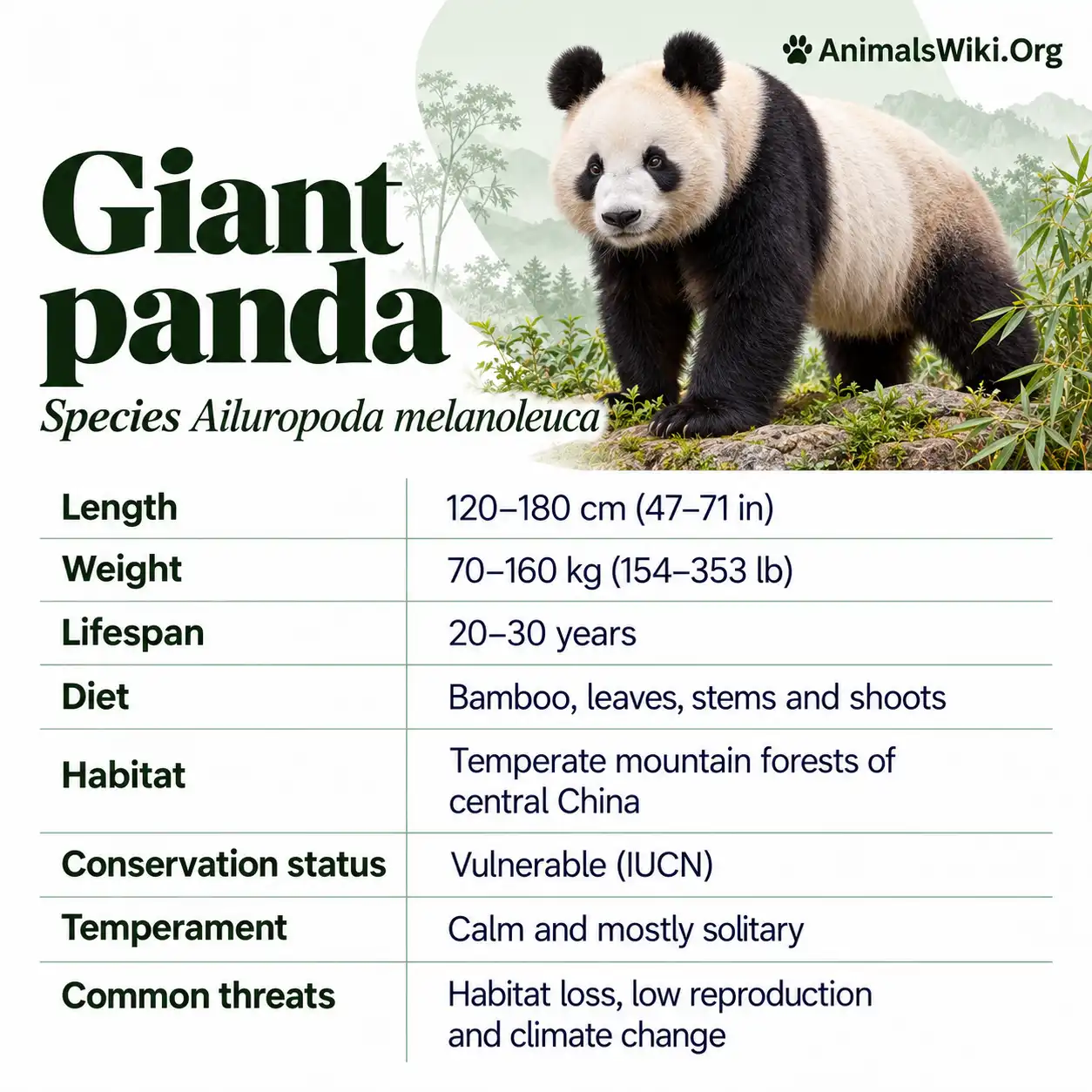
Giant Panda, A Complete Guide to China’s Bamboo-Eating Bear
The giant panda is a bear native to China, famous for its black-and-white coat, rounded ears, and remarkable dependence on bamboo. Its scientific name is Ailuropoda melanoleuca, and it belongs to the same animal family as other bears. Yet its feeding habits and several features of its anatomy make it one of the most distinctive members of that family.
A panda’s familiar appearance tells only part of its story. Behind the striking face is an animal equipped with powerful jaws, specialized gripping structures, and behaviors suited to life in mountainous bamboo forests. Understanding these features helps explain how a large bear survives on a diet dominated by tough plant material.
The giant panda is also an important conservation success story, although its future still depends on sustained protection. Forest conservation, research, and breeding programs have supported its recovery, while habitat fragmentation and changes in bamboo availability remain concerns.
This guide explores giant panda identification, habitat, food, movement, communication, reproduction, cub development, and conservation. It also explains common misconceptions, including whether pandas are true bears, whether they hibernate, and whether their dependence on bamboo makes them poorly adapted animals.
Giant Panda Facts
| Feature | Details |
|---|---|
| Common name | Giant panda |
| Scientific name | Ailuropoda melanoleuca |
| Animal group | Mammal |
| Order | Carnivora |
| Family | Ursidae |
| Subfamily | Ailuropodinae |
| Native country | China |
| Main present-day range | Sichuan, Shaanxi, and Gansu provinces |
| Typical habitat | Mountain forests with a bamboo understory |
| Main food | Bamboo |
| General adult body length | Approximately 1.2–1.8 meters |
| General adult weight | Often around 70–125 kilograms, with males usually larger |
| Social pattern | Primarily solitary |
| Young | Cubs |
| Notable adaptation | Enlarged wrist bone that helps grip bamboo |
| Global conservation category | Vulnerable |
| Recent official wild population estimate | Nearly 1,900 |
1. What Is a Giant Panda?
A giant panda is a specialized bear whose natural way of life centers on bamboo-rich forests. Although it belongs to the order Carnivora, its everyday diet consists overwhelmingly of plant material. This is not a contradiction: an animal’s taxonomic order reflects its evolutionary relationships, rather than requiring every member to eat the same foods.
The species belongs to the genus Ailuropoda. Its living representatives are unmistakable, combining a heavy body, short tail, broad head, and contrasting coat. The giant panda occupies its own branch within the bear family, recognized as the subfamily Ailuropodinae.
Calling it a bear is therefore scientifically correct. It is not an oversized raccoon, a type of red panda, or a separate category of mammal outside the bears.
Its importance extends beyond classification. The giant panda illustrates how evolution can reshape the feeding behavior and anatomy of a mammal without completely rebuilding every part of its digestive system. It also shows why conserving an animal requires understanding the habitat that supports its particular needs.
2. Giant Panda vs. Red Panda
Giant pandas and red pandas share a name, a liking for bamboo, and adaptations that help them handle food. However, they belong to different animal families.
The giant panda is a member of Ursidae, the bear family. Red pandas belong to Ailuridae. Their similarities are useful examples of animals developing comparable solutions to similar feeding challenges.
| Feature | Giant panda | Red panda |
|---|---|---|
| Family | Ursidae | Ailuridae |
| General appearance | Large black-and-white bear | Much smaller reddish mammal |
| Tail | Short | Long and bushy |
| Typical body build | Heavy and broad | Smaller and more slender |
| Native distribution | Mountain forests in China | Parts of the Himalayas and adjoining Asian mountains |
| Important food | Bamboo | Bamboo |
| Bamboo-gripping adaptation | Modified wrist bone | Modified wrist bone |
The comparison also explains why common names can be misleading. A shared word does not necessarily indicate a close evolutionary relationship.
For readers exploring both animals, the most useful distinction is simple: a giant panda is a true bear, while a red panda belongs to a separate family. Their diets overlap, but their bodies, ranges, and evolutionary histories differ.
3. What Does a Giant Panda Look Like?
The most recognizable giant panda features are its black ears, dark eye patches, black limbs, and dark band across the shoulders. Much of the remaining coat is white or off-white.
Its head appears especially broad because of the skull and powerful chewing muscles. These support a feeding system capable of repeatedly processing bamboo. Large cheek teeth provide surfaces for crushing and breaking plant material, while the front teeth help the animal manipulate and strip food.
The coat is thick and woolly, providing insulation in cool, damp mountain environments. A panda’s rounded outline can conceal how solidly built it is beneath that fur.
Close observation reveals practical feeding movements rather than a purely cuddly appearance. The animal positions a bamboo piece, grips it with a forepaw, brings it toward the mouth, and works through selected portions.
These details make the panda easier to understand as a functioning wild mammal. Its appearance is closely connected to warmth, feeding, movement, and survival in a particular forest setting.
4. How Big Is a Giant Panda?
Adult giant pandas commonly measure approximately 1.2–1.8 meters in body length. Their shoulder height is generally around 60–90 centimeters when standing on all fours.
Males are usually heavier than females. Broad reference ranges place adult females around 70–100 kilograms and adult males around 86–125 kilograms, although individual animals can fall outside these figures.
Weight deserves context. A young adult, a pregnant female, and a large mature male should not be expected to weigh the same amount. Food availability, health, and management conditions also influence body condition.
The word “giant” distinguishes this animal from the much smaller red panda; it does not mean that the species is the largest bear.
For educational comparisons, length and weight ranges are more useful than a single supposedly universal measurement. They communicate the scale of the animal without suggesting that every panda has identical dimensions. Even a smaller adult remains a substantial, muscular bear.
5. Why Are Giant Pandas Black and White?
The giant panda’s coat has attracted many explanations, but research supports an important role for camouflage.
In a forest, the visual background is rarely uniform. Dark trunks and shadows occur beside pale leaves, bright gaps, rocks, and sometimes snow. Different parts of the panda’s coat can blend with different components of that scene.
A study using photographs of wild pandas and visual models found support for both background matching and disruption of the body’s outline. At some viewing distances, the contrasting patches help break up the animal’s recognizable shape.
This is more complex than saying that white always matches snow and black always matches shade. Natural backgrounds contain many tones, and the effectiveness of a pattern changes with lighting, distance, and viewing conditions.
Camouflage also does not exclude other functions. Facial and body markings may have roles in recognition or communication. An evolved feature can have more than one useful effect, and not every proposed function has equal supporting evidence.
6. Are Brown Giant Pandas Real?
Yes. A small number of giant pandas have brown-and-white coats rather than the familiar black-and-white pattern.
These rare animals are associated with the Qinling region. Their unusual coloring does not make them a separate species, nor does it mean that every panda from that region is brown.
Research published in 2024 identified a small deletion in the gene Bace2 as a likely cause of the brown coloration. The study combined genetic evidence with investigations into how the change affects pigmentation.
For a general reader, the main lesson is that coat color can vary within a species. A difference in pigmentation does not automatically indicate a different kind of animal.
Brown pandas are especially memorable because their appearance challenges the usual image of the species. Nevertheless, their conservation needs remain connected to the same essentials: suitable forest, accessible bamboo, opportunities to reproduce, and protection from habitat disruption. Their rarity makes careful scientific documentation more useful than speculation about their origins.
7. The Giant Panda’s “Thumb”
One of the giant panda’s most useful adaptations is commonly called a false thumb or pseudothumb.
This structure is an enlarged radial sesamoid, a bone associated with the wrist. It is not an additional true finger. Together with the normal digits, it helps the panda hold bamboo while feeding.
The arrangement creates a practical grip. A panda can stabilize a stem, turn it, and bring selected sections toward its mouth. The adaptation becomes especially clear when watching the forepaw during a feeding session.
Fossil research involving the ancient panda relative Ailurarctos suggests that an enlarged wrist bone associated with bamboo handling existed roughly six to seven million years ago.
The modern structure also reflects competing demands. A forepaw must help handle food while still supporting the animal during movement. Evolution does not simply produce the longest possible gripping projection; the result must remain workable for the whole animal.
The false thumb is therefore an example of an existing structure taking on an expanded function.
8. Where Do Giant Pandas Live?
Wild giant pandas live in China. Their present distribution is concentrated in mountain ranges within Sichuan, Shaanxi, and Gansu provinces.
This range is much more restricted than many people assume. Giant pandas do not naturally occupy bamboo forests throughout Asia, and they should not be confused with red pandas living in parts of the Himalayan region.
Their current mountain distribution also reflects historical habitat changes. Farming, forest clearance, and development have reduced or altered areas that previously supported pandas.
Looking at a map of China can make the remaining range seem substantial, but suitable habitat is not continuous across those provinces. Panda populations occupy particular forest landscapes, with varying degrees of separation between them.
This distinction matters for conservation. Protecting a species requires more than identifying the country in which it lives. Managers need to understand which forests contain pandas, how those forests connect, and where animals can move between feeding areas and potential mates.
9. What Makes Good Giant Panda Habitat?
Bamboo is essential, but a collection of bamboo plants does not automatically create good panda habitat.
A suitable forest must provide enough food across seasons, places to rest, and conditions that allow animals to move through the landscape. Terrain, vegetation structure, water availability, and disturbance all affect how useful an area may be.
A variety of bamboo resources can be valuable because different species and plant parts become useful at different times. Larger trees and sheltered structures may also provide important resting or denning opportunities.
The surrounding landscape matters as well. A productive patch of forest may offer limited long-term security if roads, settlements, or unsuitable land isolate it from neighboring habitat.
This is why habitat quality and habitat area should be considered together. A large area with poor food resources may support fewer pandas than expected, while a smaller but productive patch can still face problems if animals cannot leave it.
Effective protection considers the forest as a living system rather than treating bamboo abundance as the only requirement.
10. What Do Giant Pandas Eat?
Bamboo makes up almost all of a wild giant panda’s diet. Pandas eat different portions, including leaves, stems, and tender shoots.
They are highly practiced feeders. Rather than chewing every piece indiscriminately, they handle bamboo, strip away unwanted material, and select portions that are useful or palatable.
The species is not an absolute vegetarian in the sense of being incapable of consuming other foods. Occasional animal material and other plants have been recorded. However, these foods do not change the central fact that bamboo dominates its natural feeding ecology.
Food offered under professional care may include carefully selected supplementary items. Those managed diets should not be confused with a description of what wild pandas normally seek in the forest.
The important question is therefore not simply whether a panda can eat something. Its natural diet reflects what it can obtain repeatedly and reliably within its habitat.
For the giant panda, bamboo provides that foundation, shaping everything from daily activity to habitat choice.
11. How Much Bamboo Does a Giant Panda Eat?
A giant panda may consume tens of kilograms of fresh bamboo during a day. WWF gives a broad daily range of approximately 12–38 kilograms, depending on the bamboo portion being eaten.
These figures require interpretation. Fresh shoots contain substantial water, while leaves and mature stems differ in texture and nutrient composition. A kilogram of one part is not nutritionally identical to a kilogram of another.
This explains why published feeding quantities sometimes differ. Studies and animal-care descriptions may involve different individuals, seasons, bamboo species, and measurement methods.
Feeding also occupies many hours. Pandas must spend considerable time obtaining and processing food to meet their needs.
A useful way to understand this is to picture a daily feeding budget rather than one enormous meal. The animal alternates among collecting food, handling it, chewing, resting, and feeding again.
The large volume is part of an established feeding strategy. It does not mean that every mouthful is useless or that pandas gain no nourishment from their food.
12. Why Pandas Choose Different Bamboo Parts
A bamboo plant is not a nutritionally uniform package. Leaves, shoots, and mature stems differ in water, fiber, and available nutrients.
Pandas can respond to those differences by changing what they eat. A feeding choice that looks repetitive to a human observer may actually involve careful selection among plant species, growth stages, and individual portions.
Research on seasonal bamboo chemistry has found changes in carbohydrates and fiber that help explain some feeding preferences. In one study, seasonal differences in bamboo stems were associated with changes in their nutritional value.
This makes food selection an important part of the panda’s adaptation. The animal is not simply accepting any nearby stalk.
Seasonal feeding also connects diet with movement. When a preferred food becomes available elsewhere, access to that area may become valuable.
For conservation planning, this means that protecting a single feeding patch may be insufficient. A panda benefits from a landscape that offers useful resources at different times, allowing it to respond to the changing condition of its food.
13. How Does a Giant Panda Digest Bamboo?
The giant panda’s digestive system creates an interesting evolutionary puzzle.
Unlike a cow, it does not possess a multi-chambered stomach adapted for prolonged fermentation of vegetation. Several features of its digestive tract remain more similar to those of its carnivorous relatives than to those of highly specialized grazing mammals.
Research on panda gut microorganisms has also found a community that differs from the strongly fiber-processing communities found in many herbivores.
However, saying that pandas cannot digest bamboo at all is misleading. Bamboo contains more than tough cellulose. Pandas can obtain nutrients from accessible plant tissues, particularly when they choose useful parts and process them extensively.
Their feeding strategy combines selection, mechanical breakdown, food quantity, and energy management. No single feature explains the entire system.
The lesson is that digestive specialization can take different forms. A panda does not need to function like a cow to survive on plants, although its approach places substantial importance on dependable access to suitable bamboo.
14. Does the Panda’s Gut Change With Its Diet?
The microorganisms in a panda’s digestive system are not a completely fixed community.
Research has investigated how feeding on different bamboo parts relates to changes in gut microbial composition and function. Leaves, shoots, and stems present different nutritional conditions, and the microbial community can respond.
This does not mean that gut microbes transform a panda into a highly efficient cellulose-fermenting animal. It means that the relationship between food and digestion is more flexible than a simple claim that pandas have “the wrong gut” suggests.
Scientists continue to study which changes are useful, how consistently they occur, and how results from managed animals compare with conditions in the wild.
For readers, the distinction is valuable: an animal can retain limitations while also showing adaptations that help it work within them.
The panda’s feeding system is therefore best understood as a combination of strengths and constraints. Food choice, jaw action, microbial activity, and daily behavior all contribute to the overall result.
15. How Giant Pandas Conserve Energy
A bamboo-based diet makes energy expenditure an important part of panda biology.
A 2015 study measured daily energy use in a small sample of captive and wild giant pandas. The researchers found expenditure substantially below the level predicted for similarly sized mammals.
The study examined possible contributions from behavior and physiology. Its results support the view that pandas combine food intake with relatively economical energy use.
This should not be translated into the claim that every panda uses one fixed percentage of a “normal” mammal’s energy. Sample size, individual differences, activity, and conditions affect such measurements.
It is also more informative to describe pandas as energy-conserving animals than to call them lazy. Human judgments about effort do not explain ecological strategies.
A bear that spends time resting between feeding bouts may be managing its energy budget effectively. Its success depends on balancing the energy obtained from bamboo with the costs of movement, digestion, temperature regulation, growth, and reproduction.
16. What Does a Giant Panda Do All Day?
Much of a giant panda’s day revolves around feeding and resting. These activities occur in repeated bouts rather than fitting neatly into a human schedule.
A panda may sit while processing bamboo, change position to reach food, walk to another patch, and then settle down again. The pattern changes with food availability, environmental conditions, and the animal’s individual needs.
This makes a short video an incomplete picture of its daily life. Footage of a sleeping panda captures a real behavior, but it does not show the preceding hours of feeding or the next period of movement.
Similarly, playful clips do not mean that play occupies most of an adult’s day.
A useful description of panda activity combines the ordinary with the memorable. Eating, walking, resting, scent marking, and occasional social interactions are all parts of the animal’s routine.
The result is a lifestyle organized around maintaining an adequate food supply while avoiding unnecessary expenditure.
17. Can Giant Pandas Climb Trees?
Giant pandas can climb trees, including individuals whose weight makes that ability surprising to viewers.
Their climbing involves muscular limbs, gripping paws, and claws that help them maintain contact with the trunk. Young pandas develop these skills as they grow and explore.
A panda may use a tree as a place to rest or as part of its movement and response to its surroundings. Climbing is therefore more than a source of entertaining photographs.
Size can influence how an animal uses branches, but adulthood does not automatically remove the ability to climb.
Watching a panda descend can look awkward because its body proportions differ from those of a small, light tree-dwelling mammal. Apparent awkwardness should not be confused with an absence of skill.
The broader point is that pandas use a three-dimensional forest. Protecting ground-level feeding areas while overlooking trees and the wider structure of the habitat would leave out part of their environment.
18. Are Giant Pandas Social Animals?
Giant pandas are primarily solitary, but solitary does not mean socially unaware.
An individual can spend much of its time alone while still monitoring the presence, identity, and reproductive condition of other pandas. Communication allows animals to exchange information without remaining together.
This distinction is important because people often imagine only two possibilities: living in a permanent group or having no social relationships. Wild mammals use many arrangements between those extremes.
For a panda, indirect contact can be especially useful in a forest where individuals are spread across the landscape. A message left on a tree can remain after the animal itself has moved elsewhere.
Interactions also change with circumstances. A mother and dependent cub have a close relationship, while breeding creates another context in which adult pandas seek one another.
Their social system is therefore better described through patterns of contact, avoidance, communication, and reproduction than through a simple label such as “friendly” or “antisocial.”
19. How Giant Pandas Communicate Through Scent
Scent marking is a major part of giant panda communication.
Pandas investigate and mark objects in their environment, including trees. Chemical signals can provide information that remains available after the sender leaves, making them useful for animals that do not travel together.
Field research has examined the characteristics of marking trees and the timing of marking behavior. Such studies show that scent communication is connected to the structure and use of the habitat.
A marking tree is therefore more than a convenient object. It can become part of an information network within the forest.
Pandas may rub parts of the body against a surface or position themselves to deposit a signal. Other animals can later inspect that location.
For observers, these behaviors explain why a panda may spend time sniffing one particular trunk. The animal is gathering information that humans cannot directly perceive.
Scent communication also demonstrates why conserving habitat involves preserving opportunities for behavior, alongside food and shelter.
20. Why Do Pandas Sometimes Perform Handstands?
A giant panda’s handstand-like posture is usually associated with scent marking rather than exercise or deliberate entertainment.
By changing its position, an animal can deposit a mark at a different height. Researchers have investigated whether the height of a scent mark affects how other pandas respond.
Experiments suggest that marking height can influence interest and discrimination, making body position part of the information conveyed.
However, it would be too strong to assign one exact message to every handstand. Meaning depends on context, the signal itself, and the animal investigating it.
This behavior is a useful example of how an unusual movement can have a practical biological role. A posture that looks comical to a person may matter in communication between bears.
It also encourages closer observation. Instead of treating the movement as an isolated trick, consider where the panda is marking, what surface it chooses, and how other individuals later respond. Those details turn a memorable image into a question scientists can investigate.
21. What Sounds Does a Giant Panda Make?
Giant pandas produce several kinds of vocalizations. Their sounds include bleats, chirps, and harsher calls used in different situations.
A vocal signal can carry information about the caller and its circumstances. Researchers studying panda bleats have examined how characteristics associated with identity and sex travel through a bamboo environment.
This is important because a forest changes sound. Vegetation, distance, and background conditions influence what reaches a listener.
A call that carries useful detail nearby may become harder to interpret farther away. Communication therefore depends on both the animal producing the sound and the environment through which it passes.
Scent and sound also have different advantages. A call can provide immediate information, while a scent mark may persist after an animal leaves.
Together, these channels help pandas communicate despite spending much of their time alone. Their vocal behavior is another reason not to mistake a quiet feeding animal for one with a simple or undeveloped social life.
22. How Do Giant Pandas Reproduce?
Giant pandas usually reach reproductive maturity several years after birth, commonly within a broad range of four to seven years.
Females have a short annual period when conception is possible. This brief fertile window makes timing important, particularly in managed breeding programs where staff monitor behavior and reproductive hormones.
Reproduction involves more than bringing two animals together. Health, maturity, timing, behavior, and compatibility can all affect the outcome.
Pandas also experience delayed implantation. After fertilization, development does not immediately proceed through a continuous, fixed-length pregnancy. This helps explain why the time between mating and birth varies.
Ultrasound research has improved understanding of later pregnancy and fetal development. It has also shown why mating dates alone cannot provide a simple, precise birth forecast.
These reproductive features are natural aspects of panda biology. They should not be treated as proof that the species is incapable of reproducing without humans. Wild reproduction remains essential to maintaining wild populations.
23. Why Are Giant Panda Cubs So Small?
A newborn giant panda is dramatically smaller and less developed than its mother.
Cubs weigh roughly around 100 grams at birth, with individual variation. They are pink, sparsely haired, and born with closed eyes. Their familiar black-and-white appearance develops later.
The contrast with an adult bear makes early maternal care especially important. A newborn needs warmth, milk, protection, and careful handling.
A panda mother supports and positions her cub using movements that can appear remarkably delicate for such a large animal. During the earliest period, the youngster is unable to follow her through the forest or regulate its life independently.
Small newborn size does not mean that the cub has reached the wrong stage of development. It reflects a reproductive pattern in which substantial growth and maturation occur after birth.
Understanding this helps explain why the first weeks attract so much attention in breeding centers. The cub is passing through a demanding stage, and changes that seem small can represent significant developmental progress.
24. How Giant Panda Mothers Raise Their Cubs
The mother provides the direct care needed by a dependent giant panda cub.
Early care includes nursing, maintaining close contact, and protecting the youngster in a suitable sheltered location. As the cub grows, the relationship changes from nearly constant physical support to increasing exploration and movement.
Research on maternal behavior has documented how intensive this care can be, particularly during the first weeks.
A cub does not become independent simply because it can walk. Learning to move effectively, handle food, and function in a complex forest takes considerably longer.
Young pandas may remain with their mothers for roughly one and a half to two and a half years, although the exact duration varies.
This extended dependence also affects reproduction. A female caring for a cub does not necessarily produce another surviving youngster every year.
The mother–cub relationship is therefore central to panda population biology. Protecting breeding females and the habitat they use helps support both current animals and the next generation.
25. Do Giant Pandas Have Twins?
Giant pandas can give birth to twins. Twin births are especially familiar from managed breeding programs, where staff can monitor both newborns closely.
Raising two tiny, dependent cubs presents a substantial challenge. A mother often concentrates her care on one youngster rather than successfully rearing both without assistance.
Under professional care, teams may use carefully managed cub swapping and supplementary support. This can allow each cub to receive maternal attention while staff care for the other.
These practices should be understood as specialized animal management, not as instructions for ordinary handling of wildlife.
Twin births also show why birth totals and surviving cub totals are different measures. A successful breeding program must consider survival, health, development, and long-term welfare.
For wild populations, the meaningful outcome is not merely the number of cubs born. It is the number that survive, become independent, reach breeding age, and contribute to future generations.
26. How Long Do Giant Pandas Live?
Wild giant panda lifespan is often estimated at approximately 15–20 years. Individuals under managed care can live longer, with some reaching their late twenties or thirties.
These figures describe broad patterns rather than a fixed expiry date. An individual’s lifespan depends on health, environmental conditions, nutrition, injury, and other factors.
Managed care changes several of those conditions. Food is supplied, veterinary attention is available, and some hazards are reduced. That makes a direct comparison with wild survival more complicated than simply deciding which environment is “better.”
Age records also require careful interpretation. The oldest known individual does not represent the age most pandas reach.
For conservation, age structure can be as important as maximum longevity. A population containing breeding adults, dependent cubs, and younger animals approaching maturity has different prospects from a population dominated by older individuals.
Understanding lifespan therefore contributes to a wider question: whether enough animals survive through each stage of life to maintain a functioning population.
27. What Happens When Bamboo Flowers?
Some bamboo species flower in large, synchronized events. In species that die after flowering and seed production, these events can temporarily remove important food resources.
The consequences for pandas depend on which bamboo species are affected, how much alternative food remains, and whether animals can move into other suitable areas.
Not every bamboo species flowers on the same schedule. It is inaccurate to assign one universal flowering interval to all bamboo or to assume that every flowering event causes the same outcome.
Field research has documented changes in panda habitat use during bamboo flowering, illustrating the importance of access to alternative feeding areas.
This connects a botanical event with landscape conservation. A panda may cope better when neighboring forests contain different bamboo resources and movement routes remain available.
A fragmented landscape can make the same food shortage harder to navigate. Protecting a network of usable habitats therefore helps address natural fluctuations as well as human-caused disturbance.
28. Is the Giant Panda Endangered?
The giant panda’s global IUCN Red List category is Vulnerable. Its classification changed from Endangered to Vulnerable in 2016.
This improvement reflects conservation progress, but Vulnerable remains a threatened category. It does not mean that habitat protection can stop or that every local population is secure.
The distinction matters because “endangered” is used in two ways. In ordinary conversation, people may use it to describe any animal facing extinction risk. In formal conservation reporting, Endangered is a specific category.
For accurate writing, identify the formal category and explain its meaning. The panda has improved from an earlier, higher-risk classification while continuing to need conservation.
Its story is encouraging precisely because protection has made a difference. Treating the change as evidence that conservation is no longer necessary would misunderstand the result.
The relevant goal is a secure, connected, self-sustaining wild population, supported by habitat that remains suitable over time.
29. How Many Giant Pandas Are Left?
Recent official reporting places the wild giant panda population at nearly 1,900.
A figure of 1,864 remains common in educational material because it comes from an earlier national survey. These figures should be presented with their reporting context rather than treated as competing live counts.
Counting wild pandas is difficult. They occupy mountainous, densely vegetated habitat, and individuals are not all visible at once. Population estimates depend on systematic evidence and survey methods.
Official reporting in 2025 described nearly 1,900 wild pandas, and that approximate figure was reiterated in 2026.
It would be misleading to turn the rounded estimate into an exact total or claim that it represents a fresh nationwide census conducted on the day an article is published.
National totals also conceal local differences. A larger overall population can still include small, isolated groups that need particular attention.
A useful conservation update therefore considers both the broad population estimate and the condition of separate habitat areas.
30. Why Habitat Fragmentation Matters
Habitat fragmentation occurs when usable forest becomes divided into separate patches.
For giant pandas, the problem is not limited to losing feeding space. Separation can make it harder to find mates, reach alternative bamboo supplies, and maintain connections among local populations.
A road or developed valley may occupy a relatively narrow strip on a map while still creating a significant obstacle in practice. The effect depends on traffic, surrounding land use, terrain, and the availability of other routes.
Small isolated populations can face additional demographic and genetic difficulties. A local decline may also be harder to reverse when animals cannot arrive from neighboring areas.
This is why conservation planning needs a landscape view. Protecting individual forest patches is valuable, but their arrangement influences how well they function together.
A corridor can help when it provides a route that pandas can actually use. Its effectiveness depends on habitat conditions and monitoring, rather than the corridor existing only as a line in a planning document.
31. How Climate Change Could Affect Giant Pandas
Climate change can alter the conditions that determine where different bamboo species grow.
For pandas, the concern includes changes in food distribution, seasonal availability, and the relationship between suitable bamboo and accessible forest habitat.
Scientific models do not produce one identical forecast. Results depend on the bamboo species studied, geographic region, climate scenario, and assumptions about how plants can spread.
Some studies project losses in suitable areas for particular bamboo species. Other research finds possible gains in certain places alongside changes in diversity and distribution.
The practical lesson is not that one map predicts the panda’s exact future. It is that conservation should allow for changing conditions.
Connected habitats, protection across different elevations, and monitoring of bamboo communities can help managers respond as evidence develops.
Claims that all panda bamboo will certainly disappear oversimplify the science. Equally, the possibility of suitable areas expanding somewhere does not guarantee that pandas will be able to reach and use them.
32. Giant Panda National Park
China established Giant Panda National Park in 2021. The park spans approximately 22,000 square kilometers across Sichuan, Shaanxi, and Gansu.
Its importance lies partly in bringing habitat protection across a wider landscape. Official descriptions report that the park covers habitat used by roughly 72% of the wild panda population.
A national park can provide a framework for coordinating protection, restoration, research, and management across areas that previously operated more separately.
However, designation is a starting point for continuing work. Effective conservation still depends on staffing, ecological monitoring, management decisions, and cooperation with surrounding communities.
Restoring connections between habitat areas is especially valuable where fragmentation has separated local populations.
The park also illustrates the difference between protecting individual animals and protecting the processes that support them. Bamboo growth, forest regeneration, movement, reproduction, and interactions with other species all occur at landscape scales.
A secure future for pandas requires that broader system to remain functional, rather than simply maintaining recognizable animals within boundaries.
33. What Breeding Centers Contribute
Professional breeding centers contribute to panda conservation through animal care, reproduction research, veterinary work, and the maintenance of managed populations.
They provide opportunities to study stages of life that can be difficult to observe closely in the wild, including pregnancy, newborn development, and maternal behavior.
Knowledge gained under managed conditions can improve care and inform wider scientific understanding. However, results still need careful interpretation when applied to free-ranging animals.
A successful program considers more than the number of births. Genetic management, health, behavioral development, and long-term welfare all matter.
Managed pandas also provide opportunities for public education, helping people connect the familiar animal with the less familiar forests on which wild populations depend.
Breeding centers complement habitat conservation. They cannot replace a functioning wild landscape.
The strongest approach links different kinds of expertise: field ecology, forest management, reproductive biology, genetics, veterinary medicine, and public engagement. Each addresses a different part of the conservation challenge.
34. Can Captive-Bred Giant Pandas Return to the Wild?
Some captive-bred giant pandas have been prepared and released as part of carefully managed reintroduction work.
Release is not simply a matter of opening an enclosure. An animal must be assessed, prepared for relevant conditions, and placed in suitable habitat. Follow-up monitoring is necessary to understand what happens afterward.
Official reporting in June 2026 stated that 11 captive-bred pandas had been released and that nine had survived at the time described.
Those numbers represent a particular program update. They should not be interpreted as a universal survival rate for all future releases.
The broader conservation question includes whether released animals survive independently, use habitat successfully, and eventually contribute to the population.
Reintroduction can support recovery in appropriate circumstances, but it does not make habitat loss unimportant. Releasing an animal into inadequate habitat would not solve the underlying problem.
Its value depends on preparation, suitable release conditions, monitoring, and the wider objectives of population management.
35. How Scientists Study Wild Giant Pandas
Researchers combine several kinds of evidence to understand wild pandas.
Camera traps can record presence, activity, and use of particular routes. Field surveys document signs and habitat conditions. Genetic analysis of suitable samples can help investigate identity, population relationships, and diversity.
Different methods answer different questions. A photograph may show that a panda used a location, while repeated surveys can reveal a broader pattern of habitat use.
Chemical and microbial research also investigates the information contained in panda scent signals. Work examining different sample types shows why researchers must be precise about what each kind of evidence can reveal.
Combining methods is especially valuable in mountainous forests where direct observation is difficult.
Long-term monitoring adds another dimension. It can distinguish a temporary observation from a persistent change in distribution or population condition.
The result is a more detailed picture than any single count, photograph, or laboratory measurement could provide on its own.
36. Why Protecting Pandas Also Means Protecting Forests
Giant panda conservation directs attention toward entire mountain forest landscapes.
Protecting these places can benefit other organisms that share the habitat. Forest restoration, reduced disturbance, and maintained connections may support broader ecological processes as well as pandas.
However, the needs of other species should still be assessed directly. A habitat plan designed around one mammal does not automatically solve every conservation problem in the same region.
People are also part of the landscape. Long-term protection benefits from practical cooperation with local communities and careful consideration of how land is used.
For visitors, responsible behavior includes following site rules, avoiding feeding wildlife, and respecting barriers and restricted areas. The panda’s appealing appearance does not remove its strength or need for space.
The most useful public message connects fascination with understanding. A panda eating bamboo is memorable, but the deeper story includes forest quality, food resources, reproduction, movement, and the continuing work required to keep wild populations secure.
Frequently Asked Questions About Giant Pandas
1. What is the scientific name of the giant panda?
The giant panda’s scientific name is Ailuropoda melanoleuca. It belongs to Ursidae, the bear family. Scientific names help distinguish it clearly from the red panda, which shares part of its common name but belongs to a different family.
2. Is the giant panda a real bear?
Yes. The giant panda is a true bear. Its bamboo-based diet does not change its classification. Taxonomy reflects evolutionary relationships, so a species can belong to the bear family while having feeding habits unlike those of many other bears.
3. Where do giant pandas live naturally?
Wild giant pandas live in China, primarily in mountain forests within Sichuan, Shaanxi, and Gansu provinces. Their distribution is limited to suitable habitat areas rather than extending continuously across those provinces or throughout Asian bamboo forests.
4. What is the main food of a giant panda?
Bamboo is the main food of a giant panda. Pandas consume different parts, including leaves, stems, and shoots. Their choices can change with the season, bamboo species, and the nutritional characteristics of the available food.
5. Do giant pandas eat meat?
They can occasionally consume animal material, but bamboo dominates their natural diet. Describing them as specialized bamboo eaters is more informative than suggesting that they routinely hunt or that their bodies are completely incapable of processing animal food.
6. How much does a giant panda weigh?
Many adults weigh roughly 70–125 kilograms, with males generally larger than females. This is a broad reference range. Age, sex, individual build, health, and other conditions influence weight, so one figure cannot represent every adult panda.
7. Why do pandas eat so much bamboo?
Bamboo differs from concentrated foods in its nutrient content and accessibility. Pandas combine substantial food intake with selective feeding and economical energy use. They also spend considerable time processing the plant material rather than consuming one quick daily meal.
8. Is a panda’s thumb a real finger?
No. The structure commonly called a panda’s thumb is an enlarged wrist bone, known as the radial sesamoid. It works with the normal digits to help hold bamboo, making it a useful gripping adaptation rather than an additional true finger.
9. Why are giant pandas black and white?
Research supports a camouflage function involving background matching and disruption of the body’s outline. The coat interacts with the varied light, shade, and surfaces in natural habitat. Other possible functions, including communication, are not necessarily excluded.
10. Are brown pandas a different species?
No. Brown-and-white pandas are rare color variants of the giant panda. Research has identified a likely genetic explanation for their pigmentation. Unusual coat color alone does not make an animal a separate species.
11. Can adult giant pandas climb trees?
Yes. Adult giant pandas can climb, despite their substantial size. Their limbs, paws, and claws help them use trunks and branches. Young pandas also develop climbing skills as they become more mobile and explore their surroundings.
12. Are giant pandas nocturnal?
Their activity is not best reduced to a strict nighttime-only schedule. Pandas organize much of their lives around repeated feeding and resting periods. The timing of those bouts can vary with conditions and individual circumstances.
13. Do giant pandas live in groups?
They are primarily solitary rather than permanent group-living animals. However, they communicate, interact during breeding, and form close mother–cub relationships. Spending substantial time alone does not mean that social information is unimportant to them.
14. How do giant pandas communicate?
They use scent signals, vocalizations, and behavior. Scent marks can remain after an animal leaves, while calls provide more immediate information. These different communication channels are useful for animals distributed across a forest landscape.
15. Why do pandas do handstands?
Handstand-like positions are associated with scent marking. Changing posture allows a panda to place a mark at a different height. Research suggests that marking height can affect responses, although every instance should not be assigned one identical meaning.
16. How small is a newborn giant panda?
A newborn is roughly around 100 grams, although individual birth weights vary. Cubs are pink, sparsely haired, and born with closed eyes. Their tiny size and limited development make intensive maternal care essential during early life.
17. Do panda cubs look black and white immediately?
No. Newborn cubs do not have the familiar appearance of older pandas. Their coat and dark markings develop after birth. This visible transformation is one of several major changes occurring as the cub grows.
18. Can a giant panda give birth to twins?
Yes. Twin births occur, although raising both cubs without assistance can be difficult. Managed breeding programs may provide specialized support, including carefully coordinated cub swapping, to help both youngsters receive care.
19. How long do cubs stay with their mothers?
Young pandas may remain with their mothers for approximately one and a half to two and a half years. Walking and beginning to eat bamboo are developmental milestones, but neither means that the cub has immediately become fully independent.
20. How long do giant pandas live?
Wild lifespan is commonly estimated at around 15–20 years. Some pandas under managed care live into their late twenties or thirties. These are broad patterns, and individual survival depends on health, conditions, and other factors.
21. Are giant pandas still endangered?
Their formal global IUCN category is Vulnerable, following a change from Endangered in 2016. Vulnerable remains a threatened category. The improvement represents progress, while continued protection is necessary to maintain and strengthen that recovery.
22. How many giant pandas remain in the wild?
Recent official reporting gives an approximate figure of nearly 1,900 wild pandas. The widely repeated figure of 1,864 comes from an earlier survey. Population estimates should always be understood alongside their dates and methods.
23. What are the main threats to giant pandas?
Important concerns include habitat fragmentation, habitat degradation, and changes affecting bamboo resources. Isolated populations can have difficulty maintaining connections. Climate-related shifts in food distribution add uncertainty that conservation planning needs to consider.
24. Can giant pandas be kept as pets?
Giant pandas are wild bears requiring specialized facilities, diets, expertise, and professional management. Their appealing appearance does not make them suitable household companions. Adult pandas are strong animals, and respectful separation is important.
25. Why is giant panda conservation important?
It protects a distinctive bear and the forest systems supporting its survival. Panda conservation also provides opportunities to study habitat connections, reproduction, and recovery. Its progress demonstrates the value of sustained work while highlighting the need to maintain successful protection.



