
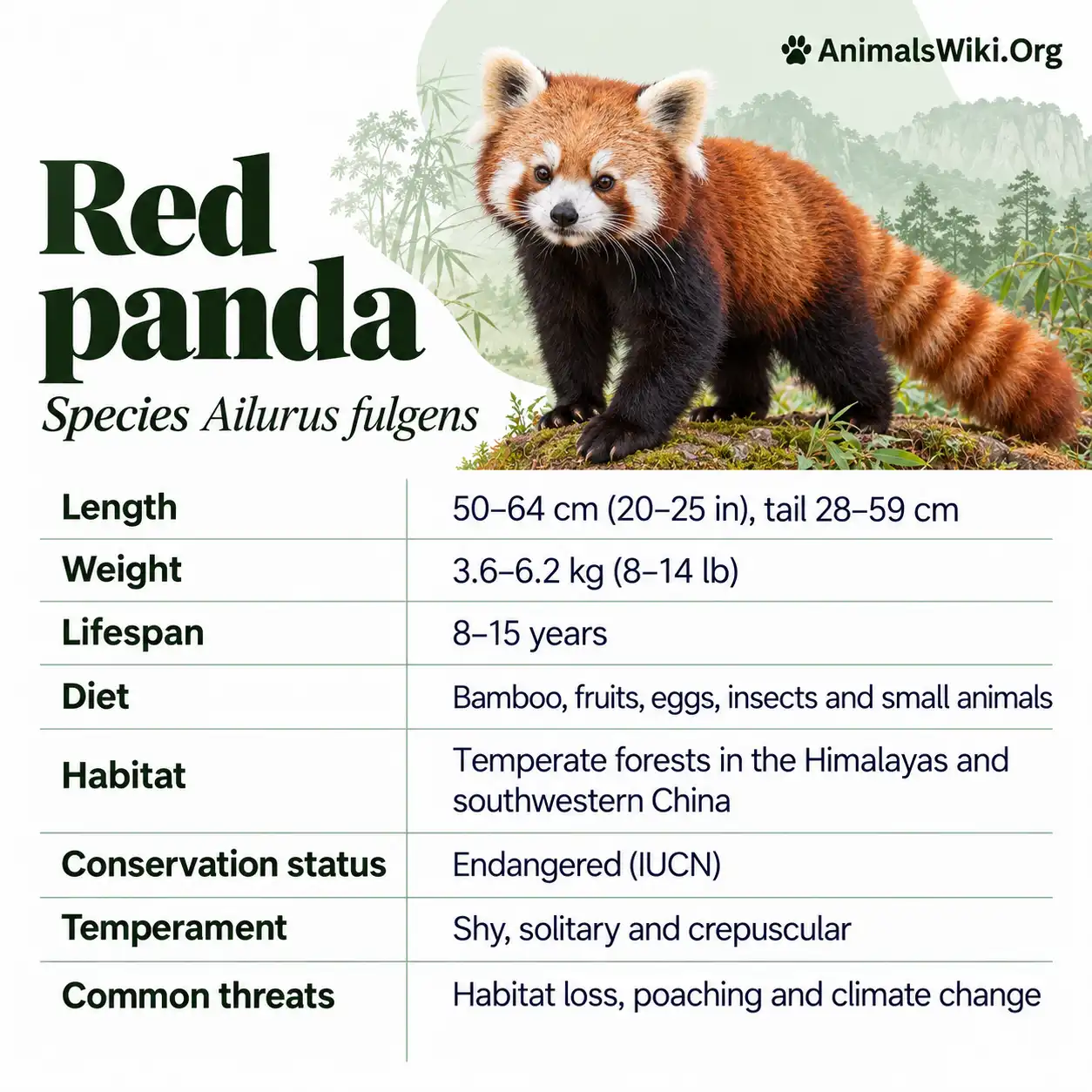
Red Panda, The Remarkable Bamboo Eater of Asia’s Mountain Forests
The red panda is a small, tree-climbing mammal recognized by its reddish coat, pale facial markings, dark legs, and long, ringed tail. Native to mountainous parts of Asia, it spends much of its life navigating forests where bamboo provides its main food.
Despite its name, the red panda is not a small version of the giant panda. It belongs to a separate animal family, Ailuridae, and has its own evolutionary history. Its appearance may remind people of a raccoon, fox, or domestic cat, but none of those comparisons fully captures what makes it distinctive.
A closer look reveals an animal equipped for a demanding lifestyle. Curved claws help it climb, a modified wrist bone assists with gripping bamboo, and thick fur provides insulation. Its movements, feeding choices, and resting behavior reflect the conditions of cool mountain forests.
The red panda also faces serious conservation challenges. Habitat loss, fragmented forests, disturbance, and other threats affect its survival. Protecting it requires attention to bamboo, trees, movement routes, and the communities sharing its landscape.
This guide explores red panda identification, classification, habitat, food, behavior, reproduction, cub development, and conservation, while explaining the uncertainties behind some widely repeated facts.
Red Panda Facts
| Feature | Details |
|---|---|
| Common name | Red panda |
| Other common names | Lesser panda, firefox, red cat-bear |
| Animal group | Mammal |
| Order | Carnivora |
| Family | Ailuridae |
| Genus | Ailurus |
| Scientific name commonly used in broad references | Ailurus fulgens |
| Taxonomic qualification | Some authorities recognize Ailurus fulgens and Ailurus styani separately |
| Native countries across the broader red panda range | Nepal, India, Bhutan, Myanmar, and China |
| Main habitat | Mountain forests with a bamboo understory |
| Main food | Bamboo leaves and shoots |
| General adult weight | Commonly about 3–6 kilograms; variation is substantial |
| Approximate head-and-body length | Often around 50–65 centimeters |
| Approximate tail length | About 28–49 centimeters |
| Social pattern | Primarily solitary |
| Young | Cubs |
| Typical litter | One or two cubs |
| Global conservation category in the broad IUCN assessment | Endangered |
| Population trend in that assessment | Decreasing |
1. What Is a Red Panda?
A red panda is a specialized forest mammal belonging to the order Carnivora. That classification describes its evolutionary relationships; it does not mean that meat must dominate its diet.
In everyday life, the animal is primarily a bamboo eater. It combines this feeding specialization with strong climbing abilities and a preference for suitable forest cover.
The red panda belongs to Ailuridae, a family separate from bears, raccoons, and cats. Modern red pandas represent the surviving members of that distinctive family.
This makes the species especially interesting from an evolutionary perspective. Protecting red pandas preserves a branch of mammalian diversity that cannot be represented simply by conserving another small carnivore.
Its biology also challenges easy labels. It is a member of a largely meat-eating order that depends heavily on plants, and it is a tree climber that still uses the ground.
Understanding the red panda therefore means looking beyond its attractive face and recognizing the combination of traits that supports its particular way of life.
2. Is There One Red Panda Species or Two?
Red panda classification remains an active scientific discussion.
Many references use Ailurus fulgens for red pandas as a whole, traditionally recognizing Himalayan and Chinese forms as subspecies. Other authorities recognize two species:
- Himalayan red panda: Ailurus fulgens
- Chinese or eastern red panda: Ailurus styani
A major genomic study published in 2020 found substantial genetic differences and supported recognizing two species. However, later work has challenged aspects of that interpretation, including the geographic sampling and the meaning of the observed differences.
The Mammal Diversity Database currently retains two species while acknowledging the continuing debate.
For a general wildlife article, the clearest approach is to explain which usage is intended. Here, “red panda” refers broadly to the animals commonly discussed under that name, with differences identified where relevant.
Taxonomic disagreement does not reduce their conservation importance. Whether managed as species, subspecies, or distinct populations, geographic variation and genetic diversity require careful consideration.
3. Red Panda vs. Giant Panda
The red panda and giant panda share an important food resource, but they belong to different families.
The giant panda is a bear in Ursidae. The red panda belongs to Ailuridae. Their shared name can obscure this basic distinction.
| Feature | Red panda | Giant panda |
|---|---|---|
| Family | Ailuridae | Ursidae |
| General appearance | Small, reddish mammal | Large, black-and-white bear |
| Tail | Long and bushy | Short |
| Body build | Relatively light and agile | Heavy and broad |
| Main natural food | Bamboo leaves and shoots | Bamboo leaves, shoots, and stems |
| Present native range | Parts of five Asian countries | China |
| Typical forest use | Strongly associated with climbing and elevated resting sites | Substantial ground use, with climbing ability |
Both possess a modified wrist structure often called a false thumb. Similar feeding challenges have helped produce comparable gripping functions in animals with different evolutionary histories.
The red panda was formally described in 1825, before the giant panda. This is why it is sometimes called the “original panda,” although that phrase is a historical nickname rather than a scientific category.
4. What Does a Red Panda Look Like?
A red panda usually has rusty-red to chestnut fur across its upper body, darker limbs and underside, and pale markings around the face and ears.
Its rounded head, short muzzle, upright ears, and contrasting facial pattern make it easy to recognize in a clear photograph. In a forest canopy, however, branches and vegetation can conceal much of that outline.
The tail is especially conspicuous. It is densely furred and marked with alternating lighter and darker bands.
Individual appearance varies. Some red pandas have stronger tail contrasts or redder faces than others, and geographic forms can differ in average coloration.
Identification should therefore use several features together rather than relying on one exact shade of red.
The animal’s coat also has practical importance. A dense undercoat provides insulation, while longer outer hairs form part of its protective covering.
What looks soft and decorative in a photograph is part of the equipment that allows the animal to occupy cool, damp environments.
5. How Big Is a Red Panda?
Red pandas are small mammals, but their thick fur and substantial tails can make them appear larger than their bodies alone would suggest.
A useful general reference is a head-and-body length of roughly 50–65 centimeters, with a tail adding approximately 28–49 centimeters. Adult weights commonly fall around 3–6 kilograms, although broader records include heavier animals.
Measurements vary among geographic forms and between wild and managed populations. Some compiled managed-care records show considerable overlap between males and females.
For that reason, claims that every male is much larger than every female are too simple.
Body length should also be distinguished from total length. An animal described as nearly a meter long may include a substantial tail rather than having a meter-long trunk.
For readers comparing animals, the clearest description is that a red panda has a relatively compact body and a disproportionately noticeable tail. It is vastly smaller than a giant panda, despite sharing the name.
6. What Is the Red Panda’s Tail Used For?
The long tail helps a red panda maintain balance while moving along branches and other uneven surfaces.
It also serves as an insulating wrap. A resting animal can curl up and bring the bushy tail around its body, reducing exposure to cold air.
These functions explain why the tail is more than a recognizable visual feature. It contributes to both movement and heat conservation.
However, a red panda’s tail is not prehensile. It does not grasp branches in the manner of a kinkajou’s tail or the tails of some monkeys.
This distinction matters when describing climbing. The paws, claws, limb movements, and body position provide the main physical contact with the tree, while the tail assists balance.
The tail’s apparent size also changes with posture. Draped below a branch, it can look exceptionally long; curled around the body, it becomes part of a compact resting shape.
Both positions are useful clues to how the animal is using its surroundings.
7. How Do Red Pandas Climb So Well?
Red pandas combine several features that support climbing.
Their curved, semi-retractable claws help grip bark and branches. Their paws and limb movements allow them to adjust contact as they cross uneven surfaces.
Flexible hind-limb anatomy also contributes to their ability to descend trunks headfirst. This is a distinctive skill, because going down a vertical surface presents different mechanical challenges from climbing upward.
The animal must manage both grip and body position while gravity pulls it toward the ground.
Climbing is not merely an occasional escape trick. Trees provide routes, resting locations, shelter, and access to parts of the forest environment.
Watching a red panda carefully shows frequent adjustments: a paw changes position, the body lowers toward a branch, and the tail shifts as balance changes.
Its agility is therefore the result of coordinated anatomy and behavior. A forest with useful climbing structures offers opportunities that a simple stand of food plants cannot provide.
8. The Red Panda’s False Thumb
A red panda’s false thumb is an enlarged wrist bone called the radial sesamoid.
It assists with gripping, including the handling of bamboo. The animal has not evolved a completely new true finger; an existing skeletal structure has taken on a more prominent role.
The adaptation is especially interesting because giant pandas also possess an enlarged radial sesamoid, despite belonging to a different family.
Anatomical research shows that the two gripping systems are not identical. Their similarities exist alongside differences in the surrounding muscles and structures.
Work on the red panda’s hand suggests that features useful for climbing may have helped prepare the way for effective bamboo manipulation.
This is an example of evolution using available structures for additional functions. A feature does not need to originate for its present-day use to become useful in that role.
When a red panda holds food between its paws, the movement provides a visible result of changes accumulated through its evolutionary history.
9. What Fossils Reveal About Red Panda Relatives
The red panda’s living distribution does not show the full historical reach of its broader family.
Fossils demonstrate that relatives occupied places far beyond the modern Asian range. One particularly informative animal is Simocyon batalleri, a much larger extinct relative known from European fossils.
Research found that Simocyon possessed an enlarged radial sesamoid even though its diet was not specialized around bamboo in the same way as that of living red pandas.
This finding supports an important interpretation: the gripping structure in the red panda lineage may have developed in connection with climbing before becoming useful in specialized plant feeding.
An extinct relative should not be imagined as a modern red panda enlarged to a different size. Its anatomy and ecology had their own combination of features.
Fossils help reveal that evolutionary histories are branching and varied. The living red panda represents one surviving outcome, rather than a complete picture of everything its family once included.
10. Where Do Red Pandas Live?
Across the broader red panda range, these animals occur in parts of Nepal, India, Bhutan, Myanmar, and China.
They are associated with mountainous forest landscapes, particularly where bamboo grows beneath suitable tree cover.
This distribution should not be interpreted as continuous occupation across all five countries. Red pandas occur in particular habitat areas, with gaps created by unsuitable environments and human land use.
The distinction between a range map and actual habitat is important. A shaded region on a map may include settlements, agricultural land, open areas, and forests with very different conditions.
Geographic variation also contributes to the discussion about Himalayan and Chinese red pandas. Exact boundaries between forms require careful interpretation, especially where sampling remains incomplete.
For conservation, local knowledge is essential. A general statement that red pandas live in the Himalayas does not identify which forests support them, where populations connect, or which areas are becoming isolated.
Effective protection depends on that finer-scale understanding.
11. What Kind of Habitat Does a Red Panda Need?
Red pandas require more than the presence of bamboo.
A useful habitat provides food, appropriate vegetation structure, access to water, resting opportunities, and conditions that allow movement through the landscape.
Research across Nepal found that habitat associations varied geographically. Bamboo abundance was important, but the influence of canopy cover, tree characteristics, and other variables differed between regions.
This means that one universal habitat formula is unlikely to work everywhere.
A forest suitable in a wetter eastern location may differ from one used in a drier western landscape. Local climate and vegetation influence the combination of conditions available.
Conservation planning should therefore be based on regional evidence rather than assuming every red panda needs an identical arrangement of trees.
The practical goal is a functioning habitat where the animal can meet its needs across seasons. Measuring forest area alone cannot fully describe whether those needs are being met.
12. Why Fallen Logs, Stumps, and Water Matter
The smaller details of a forest can influence how useful it is to a red panda.
Fallen logs, stumps, and elevated branches provide structures from which animals can move, rest, or reach bamboo foliage. These features add complexity to the habitat rather than simply occupying space.
Access to water is another recurring feature in habitat studies. Research in Nepal has associated red panda occurrence with suitable vegetation and proximity to water sources.
These findings help explain why a heavily simplified forest may differ from a more structurally varied one, even if both contain trees.
Removing every fallen trunk or clearing the understory can alter the environment in ways that are not obvious from a distant view.
Habitat management therefore benefits from attention to both living vegetation and other natural structures.
A red panda experiences the forest at the scale of paws, branches, feeding patches, and travel routes. Conservation becomes more effective when it considers that practical perspective.
13. What Do Red Pandas Eat?
Bamboo leaves and shoots dominate the red panda’s natural diet.
Other recorded foods include fruits, acorns, flowers, insects, eggs, and occasional small animals. Their importance varies, and these items should not be presented as equal alternatives to bamboo in a typical diet.
The red panda is therefore best described as a specialized bamboo feeder with some dietary flexibility.
Its classification in Carnivora can cause confusion, but membership in that order does not dictate one menu. Evolutionary relatives can develop very different feeding strategies.
Food offered under professional care also needs context. Managed diets may contain specially formulated products and selected produce alongside bamboo.
Such diets are designed for particular care conditions and should not be copied into a description of wild feeding.
The central ecological point remains the same: a dependable supply of suitable bamboo is fundamental. Occasional dietary additions do not allow red pandas to thrive in any forest or substitute freely for lost bamboo habitat.
14. Why Red Pandas Choose Certain Leaves and Shoots
A red panda does not encounter every bamboo portion as an identical food item.
Tender shoots, young leaves, and older foliage differ in moisture, fiber, and available nutrients. The animal’s choices can influence how much useful nourishment it obtains.
Feeding trials have found differences in the digestion of bamboo leaves and shoots, with shoots more easily digested under the conditions studied.
Seasonal changes also affect food quality. A food source that is useful at one time may become less valuable as its tissues mature or its composition changes.
This makes selective feeding an important part of the red panda’s strategy.
To a casual observer, choosing one leaf rather than another may look insignificant. Across many feeding bouts, however, those choices help shape the balance between intake and digestive limitations.
Protecting varied bamboo resources can therefore matter as much as preserving a visually dense patch. Quantity and nutritional usefulness are related, but they are not the same thing.
15. How Red Pandas Digest Bamboo
Red pandas do not process vegetation in the same way as animals with highly developed fermentation systems, such as cattle.
Their digestive system retains features associated with their carnivoran ancestry. Research has found relatively poor processing of some bamboo components, particularly tough plant cell-wall material.
However, poor digestion of certain components does not mean that bamboo provides no nutrition.
Red pandas compensate through food selection, substantial intake, and relatively rapid passage of food through the digestive tract. They obtain useful nutrients without extracting every possible resource from each leaf.
This strategy has limitations. It depends on repeated access to enough suitable food.
It also explains why bamboo quality matters. If an animal can digest only part of what it eats, selecting useful portions becomes especially valuable.
The red panda’s digestive biology is therefore a combination of capabilities and constraints. Calling its gut “wrong” overlooks the behaviors and feeding patterns that allow the whole system to function.
16. How Much Does a Red Panda Eat?
Red pandas can consume a substantial amount of fresh bamboo relative to their body weight.
However, one universal daily figure is difficult to apply accurately. Leaves and shoots differ greatly in water content, bulk, and nutritional composition.
Measurements also depend on whether researchers report fresh weight, dry matter, food offered, or food actually consumed.
For readers, the most useful principle is that a small animal can need frequent feeding when its main food is fibrous and not especially concentrated in accessible energy.
Much of the feeding process involves selecting, handling, and chewing individual portions. A red panda may repeatedly draw foliage toward its mouth rather than breaking through large stems in the manner associated with giant pandas.
This creates a distinctive feeding rhythm.
The animal’s requirements also connect directly to habitat quality. A forest must supply enough appropriate food within a workable daily routine, rather than merely containing a few bamboo plants somewhere within its boundaries.
17. Are Red Pandas Nocturnal?
Red pandas are often described as most active around dawn, dusk, or nighttime. However, research shows that their schedules are more variable than a strict nocturnal label suggests.
Some studies have recorded substantial daytime activity. Feeding opportunities, season, local conditions, breeding behavior, and disturbance can influence when animals move.
A useful description is that red pandas alternate feeding and movement with resting periods across the daily cycle, with peaks that can differ between populations.
This flexibility is important in human-influenced landscapes. Animals may adjust activity to reduce encounters with traffic, people, or other disturbances.
It also explains why a sleeping animal during a zoo visit does not establish that the species is inactive throughout every daylight hour.
Daily activity is best understood as a pattern measured over time. Short observations show real behavior, but they capture only part of a schedule that responds to several competing needs.
18. How Red Pandas Rest and Manage Temperature
Red pandas use body position and resting locations as part of their response to environmental conditions.
A curled posture with the tail wrapped close reduces exposed surface area. A more stretched posture changes that relationship.
Thick fur provides insulation, but temperature management is not controlled by fur alone. Activity, shelter, sun exposure, and physiological heat production also matter.
Research measuring resting metabolism found differences between summer and winter conditions. It also produced values higher than those in an earlier small study, illustrating why broad claims about an exceptionally low metabolism need qualification.
The animal’s energy use should therefore be discussed alongside the conditions in which it was measured.
Resting is not simply an absence of useful behavior. It can help organize the balance among food intake, movement, and temperature regulation.
For a forest specialist, suitable resting sites are part of habitat quality, especially when weather conditions make shelter or a particular position more valuable.
19. Are Red Pandas Social?
Red pandas are primarily solitary, but they are not disconnected from the lives of other red pandas.
Individuals exchange information through scent, sounds, and behavior. Breeding creates opportunities for adult contact, while mothers and dependent cubs form close associations.
A solitary social system can be effective when food and other resources are distributed across a forest.
Remaining alone for much of the day does not eliminate the need to identify neighbors, detect potential mates, or respond to unfamiliar animals.
The word “solitary” also should not be converted into a personality judgment. It does not mean that every red panda is aggressive, unhappy alone, or incapable of interaction.
Likewise, photographs of two animals together do not establish permanent group living.
Understanding social organization requires attention to who is interacting, why contact occurs, and how long it lasts. A breeding pair, a mother with cubs, and unrelated adults sharing space under managed conditions represent different situations.
20. How Red Pandas Use Scent
Scent marking allows red pandas to leave information in the environment.
An animal can inspect a marked location even after the sender has moved elsewhere. This makes chemical communication especially useful for mammals that do not remain in close groups.
Research on captive red pandas found preferences for particular marking locations, including prominent points within their surroundings. Marking frequency also differed among individuals and contexts.
These findings suggest that where a signal is placed can be part of its usefulness.
A familiar branch or other noticeable object may serve as a location where information is repeatedly left and investigated.
For an observer, sniffing and marking can look less dramatic than climbing or play. Biologically, however, they can be important components of social behavior.
Scent communication helps explain how a mostly solitary animal can remain aware of others. Its social environment includes signals distributed across space, rather than only animals visible nearby.
21. What Sounds Do Red Pandas Make?
Red pandas produce a range of vocalizations rather than one characteristic sound.
A study of captive adults described seven call types during the breeding season: growls, barks, squeals, bleats, hoots, grunts, and twitters.
The sounds occurred in different behavioral situations. However, identifying call categories is not the same as proving an exact translation for every vocalization.
A particular sound may occur in more than one context, and its interpretation can depend on accompanying behavior.
This makes careful observation important. Researchers examine the acoustic structure of a call, the identity of the caller, the animals nearby, and what happens before and afterward.
Red panda vocal behavior also challenges the idea that a quiet-looking species has little to communicate.
An animal can be silent during a long resting period and still possess a varied repertoire used when social circumstances change. Sound is one part of a communication system that also includes scent and visible behavior.
22. How Far Do Red Pandas Travel?
Red pandas move through home ranges containing feeding sites, resting places, and travel routes.
There is no single daily distance that applies to every animal. Sex, age, season, habitat arrangement, and disturbance can influence movement.
A GPS study in eastern Nepal recorded a median daily distance of approximately 756 meters in its monitored sample. Some individuals also undertook much longer dispersal movements.
These findings should be treated as results from a particular study, rather than a worldwide daily rule.
The distinction between routine movement and dispersal is especially important. Moving among familiar feeding areas differs from leaving an established area and traveling toward a new one.
Both processes matter for conservation. Routine movement supports immediate survival, while dispersal can connect populations and help maintain genetic exchange.
A landscape that permits feeding but prevents safe movement between habitat areas may therefore be less secure than it appears from food availability alone.
23. Why Do Red Pandas Stand on Their Hind Legs?
A red panda standing upright can look amusing, but the posture needs to be understood in context.
Standing on the hind legs may be associated with defensive behavior, allowing the animal to raise its forelimbs and respond to a perceived threat.
It should not automatically be interpreted as a request for a hug or an invitation to approach.
This is a useful example of how human impressions can differ from animal behavior. A posture that seems playful in a short clip may occur during uncertainty or confrontation.
Other behaviors, including play between young animals or during social interactions, can also involve exaggerated movements. The surrounding circumstances help distinguish them.
Respecting distance allows the animal to respond without additional pressure.
The red panda’s attractive appearance does not make it a domestic companion. Its claws, teeth, signals, and need for control over its surroundings remain those of a wild mammal.
24. How Do Red Pandas Reproduce?
Red panda reproduction is seasonal, with mating generally occurring during the winter period in the Northern Hemisphere.
Females have a relatively brief fertile period. Successful breeding therefore depends on timing as well as maturity, health, and compatible behavior.
Researchers and animal-care teams monitor reproductive changes using observations and, in some studies, hormone analysis.
A study following females across multiple years examined pregnancy-related hormones using fecal samples. Such work helps investigate reproductive processes without requiring repeated invasive sampling.
Pregnancy is not always straightforward to identify from external appearance alone. Hormonal patterns and observed outcomes must be interpreted carefully.
This is one reason professional breeding programs collect detailed records rather than relying on a single sign.
The biological importance extends beyond managed populations. Understanding reproduction contributes to knowledge of population recovery, because the number of offspring born and surviving influences whether local groups can remain stable over time.
25. How Long Is Red Panda Pregnancy?
The interval between mating and birth varies.
Managed-care references commonly report an average around 130–135 days, with a broader range extending on either side of that figure.
Embryonic diapause, or a pause in early development, is thought to contribute to this variation. The precise timing and mechanisms should not be described with greater certainty than the evidence supports.
Births in the Northern Hemisphere usually occur from late spring into summer, although exact timing varies.
A female prepares a sheltered nesting location, often using a hollow or crevice and gathering material for the nest.
This preparation makes the quality and security of denning sites important during reproduction.
A simple statement such as “red pandas are pregnant for exactly four months” loses useful biological detail. The better explanation recognizes a typical range, seasonal timing, and the difference between the full mating-to-birth interval and later active development.
26. What Are Red Panda Cubs Like?
Red panda cubs are small, dependent, and already covered in fur when born.
Their eyes are closed, and their appearance differs from the familiar bright coat and long tail of an adult.
A typical litter contains one or two cubs, although larger litters occur less commonly. Birth weight varies with the geographic form and individual circumstances.
The nest provides a protected setting during this early stage. Cubs depend on their mother for milk, warmth, grooming, and care.
As they grow, their eyes open, movements become more coordinated, and their coat changes. These developments happen gradually rather than all at once.
A young animal beginning to explore its nest is still dependent, even if it looks increasingly recognizable as a red panda.
This distinction matters when describing development. Appearance, mobility, feeding independence, and social independence are separate milestones, each reached through a continuing period of growth.
27. How Mothers Care for Red Panda Cubs
The mother provides the main direct care for red panda cubs.
Early life is centered on the den, where the young nurse and develop before spending more time outside.
A mother must balance attending to her cubs with obtaining enough food for herself. Safe denning conditions can therefore influence both the youngsters and the female caring for them.
Detailed observations of this period are difficult in the wild because nests are concealed and the animals are elusive.
Research on maternal behavior has consequently drawn substantially on carefully monitored animals under professional care.
Even there, observation needs restraint because disturbance around the den can interfere with normal behavior.
This makes remote monitoring and well-designed studies valuable. They can improve understanding without requiring constant close human presence.
The mother–cub relationship is not simply a charming part of the species’ story. It is a stage on which future population growth depends, linking breeding success with habitat security and survival after birth.
28. How Long Do Red Pandas Live?
Red panda lifespan is often summarized as roughly eight to ten years, with longer lives possible under managed care.
However, wild longevity is not known with the same precision as the ages of animals whose births and deaths are recorded in zoos.
Different references give different upper ages, partly because they describe different populations or exceptional individuals.
A maximum recorded age should not be treated as the age every animal is expected to reach.
Survival is influenced by health, food availability, environmental conditions, injury, and exposure to threats.
For conservation, the most useful question is often not “What is the oldest possible red panda?” but “How many survive through each life stage?”
A population needs enough cubs to survive, enough young animals to become established adults, and enough adults to reproduce.
Longevity contributes to that process, but it is only one part of the demographic picture.
29. Are Red Pandas Endangered?
Yes. The broad IUCN Red List assessment for Ailurus fulgens classifies the red panda as Endangered, with a decreasing population trend.
The assessment was published in 2015, with an errata version in 2017. Its age should be kept distinct from the date on which an article checks the listing.
Endangered is a formal conservation category. It indicates a high risk of extinction in the wild, rather than merely describing an animal as uncommon.
The category also applies to a broader assessment framework that does not exactly match every newer taxonomic treatment.
This is why taxonomy, assessment scope, and publication date should be considered together.
The practical conclusion is clear despite those technical distinctions: red pandas require sustained conservation attention.
Protecting remaining habitat, limiting avoidable deaths, maintaining connections, and improving monitoring are all relevant to reducing risk. A familiar appearance and widespread public affection do not by themselves make a wild population secure.
30. How Many Red Pandas Are Left?
There is no reliable, continuously updated worldwide headcount of wild red pandas.
Educational and conservation sources often repeat estimates below 10,000, while some describe substantially smaller possible numbers. These figures do not all refer to the same methods, years, or population definitions.
An estimate of mature animals is also different from a count including dependent young.
For these reasons, presenting one precise number as today’s confirmed total would create false certainty.
The animal’s habitat makes surveys difficult. Forest cover, mountainous terrain, elusive behavior, and uneven research coverage all affect detection.
Improving estimates requires systematic fieldwork and clear reporting of uncertainty.
A useful article should therefore distinguish the well-supported conservation message from the less certain total: red pandas are threatened, their broad assessment describes decline, and their exact wild abundance remains inadequately resolved.
The uncertainty is a reason to improve research, rather than a reason to disregard the pressures affecting them.
31. Habitat Loss and Fragmentation
Habitat loss removes usable forest. Fragmentation divides what remains into smaller or less connected patches.
Both can affect red pandas, but they do not operate in exactly the same way.
An isolated patch may still contain bamboo and trees while offering limited opportunities for animals to move elsewhere.
GPS research found that red pandas responded to roads, forest cover, and disturbance. Animals spent more time in larger patches away from certain human activities, while roads appeared to create barriers to movement.
A smaller observed home range near roads does not necessarily indicate better habitat. It may reflect restricted movement.
This is an important conservation lesson: an animal remaining within one patch can be a sign of limitation rather than comfort.
Protection should therefore consider the arrangement of habitat across the landscape. Keeping feeding areas connected can support routine movement, dispersal, and access to potential mates.
32. Dogs, Livestock, and Disease
Domestic animals can affect red pandas through several routes.
Free-roaming dogs may attack wildlife, while contact with domestic animals and contaminated environments can create disease concerns.
Livestock can also alter habitat through grazing, trampling, and associated forest use.
Research comparing red panda and livestock fecal samples in Nepal found several parasite taxa shared between them. The findings raised concerns about possible cross-transmission, although shared parasites alone do not establish the direction of every infection.
Managing these risks requires cooperation among conservation teams, veterinary professionals, and local communities.
The aim is practical prevention: reducing harmful encounters, improving animal management, and understanding where exposure occurs.
This issue also shows why wildlife conservation cannot be separated completely from surrounding land use.
A protected forest boundary does not automatically prevent dogs, livestock, parasites, or pathogens from crossing it. Effective management considers the interactions taking place around and within habitat areas.
33. Poaching, Snares, and Illegal Trade
Red pandas face risks from illegal capture and killing, including situations involving wildlife trade.
They may also be harmed by traps intended for other animals. A snare does not need to target red pandas specifically to create danger.
Research on wildlife seizures and arrests in Nepal documented red panda-related cases among broader patterns of illegal trade.
Such records provide evidence of the problem, but they require interpretation. More recorded seizures can reflect several influences, including enforcement activity and reporting, as well as underlying trade.
It is therefore better to avoid turning seizure figures directly into an exact estimate of animals removed from the wild.
Conservation responses include monitoring, enforcement, community engagement, and efforts to reduce demand.
The animal’s popularity also creates a responsibility for online content. Describing it as a desirable exotic pet can encourage the wrong kind of interest.
Appreciation is more useful when it supports survival in appropriate habitat and responsible professional care.
34. Climate Change and Future Habitat
Climate change can alter temperature, rainfall, vegetation, and the geographic distribution of suitable conditions.
For red pandas, the concern includes how forest habitat and bamboo resources may shift in relation to one another.
Recent modeling of Chinese red panda habitat suggests a complicated pattern, with potential gains in some areas and losses in others.
Some projected suitable areas occur at higher elevations or outside existing protected boundaries.
However, a model showing newly suitable climate does not prove that animals can reach the location or that a complete functioning habitat will develop there.
Movement routes, vegetation establishment, disturbance, and other factors affect that possibility.
The most useful response is flexible conservation planning supported by monitoring. Protecting connections and evaluating habitat across elevations can help prepare for change.
Claims that climate change will affect every red panda forest identically overlook regional differences. Equally, projected expansion somewhere does not cancel the risks facing populations elsewhere.
35. How Scientists Study Wild Red Pandas
Researchers study red pandas using field signs, camera traps, habitat measurements, genetic samples, and, in some projects, GPS tracking.
Each method answers different questions.
A camera can show that an animal used a location. Tracking can reveal movement between locations. Genetic evidence may help investigate relationships and population connections.
Camera placement is particularly important for an animal that uses trees.
A 2025 study in eastern Nepal found that cameras placed in the canopy detected red pandas much more effectively than paired ground-based cameras under the study conditions.
The result illustrates how survey design influences what researchers see.
A forest can appear to contain few animals if monitoring overlooks the places they use most.
Combining methods and repeating surveys over time creates a stronger picture of presence, behavior, and change.
Better evidence can then guide decisions about restoration, disturbance, and the protection of important habitat areas.
36. Community Conservation and Forest Guardians
Local people play an essential role in protecting red panda habitat.
They know the landscape, use its resources, and often encounter changes long before they appear in a formal report.
Red Panda Network’s Forest Guardian program employs local people to monitor habitat, support protection, and provide conservation education.
This approach connects ecological work with paid opportunities and local skills.
Community participation is especially important where red pandas occur outside strictly protected areas.
A conservation plan that ignores household needs, forest use, or local priorities may be difficult to maintain over time.
Practical cooperation can include monitoring, fire awareness, restoration, and discussion of how to reduce damaging pressure.
The value of community conservation is not simply that people live near wildlife. It is that durable protection depends on institutions and decisions that continue functioning between research visits and funding announcements.
Red panda conservation becomes stronger when local knowledge and scientific methods inform one another.
37. Restoring Red Panda Forests
Restoration aims to improve habitat condition and reconnect areas that have become separated.
For red pandas, planting trees can be one component, but successful restoration requires more than a tree count.
Native vegetation, bamboo resources, survival of planted seedlings, disturbance control, and long-term management all influence the result.
Red Panda Network describes restoration work involving nurseries, planting, protection of young plants, land stewardship, and cooperation with communities.
The wider objective is to create usable habitat connections rather than isolated plantations.
A newly planted area does not immediately function like a mature forest. Structural development and ecological recovery take time.
Monitoring is therefore necessary to establish whether vegetation survives and whether wildlife begins to use the area.
This distinction helps readers evaluate conservation claims. The number of seedlings planted measures an activity; improved habitat and successful animal movement measure outcomes.
Both can be valuable, but they describe different stages of the work.
38. How Zoos and Visitors Can Support Red Pandas
Well-managed zoo programs can contribute through coordinated breeding, veterinary care, research, education, and support for field conservation.
Maintaining healthy animals requires attention to genetics, behavior, enclosure design, nutrition, and suitable environmental conditions.
Breeding decisions may consider age, health, and genetic relationships rather than simply placing any available pair together.
These managed populations complement conservation in the wild; they do not replace forests.
Visitors can support the wider goal by respecting barriers, avoiding attempts to attract or feed animals, and choosing experiences that prioritize welfare.
In natural habitat, observation should avoid chasing, surrounding, or disturbing red pandas for photographs.
The best encounter allows the animal to continue normal behavior.
Public enthusiasm becomes especially useful when it leads beyond the appealing image to informed interest in habitat, local conservation, and the evidence behind protection.
The red panda’s future depends on that connection between appreciation and sustained practical work.
Frequently Asked Questions About Red Pandas
1. Is a red panda a bear?
No. Red pandas belong to Ailuridae, while bears belong to Ursidae. The giant panda is a bear, but sharing the word “panda” does not place the red panda in the same animal family.
2. Is a red panda related to a raccoon?
Red pandas and raccoons belong to different families within the broader musteloid grouping. Their somewhat similar appearance contributed to historical classification debates, but red pandas are not a type of raccoon.
3. What is the red panda’s scientific name?
Ailurus fulgens is widely used in broad references. Some authorities distinguish the Himalayan red panda, Ailurus fulgens, from the Chinese red panda, Ailurus styani. The species-versus-subspecies treatment remains debated.
4. Are there two red panda species?
Some current authorities recognize two species, supported by genomic research. Other research argues for one species with geographic variation. A careful explanation should acknowledge the disagreement rather than suggesting every scientific source uses the same classification.
5. Where do red pandas live?
Across their broader range, red pandas occur in parts of Nepal, India, Bhutan, Myanmar, and China. They occupy suitable forest areas rather than being continuously distributed throughout those countries.
6. What do red pandas eat most often?
Bamboo leaves and shoots dominate their natural diet. Other foods occur, but they should not be presented as equally important substitutes. The availability of suitable bamboo remains central to habitat quality.
7. Why are red pandas classified as carnivores?
They belong to the order Carnivora because of their evolutionary relationships. An order’s name does not require all its members to eat mainly meat. Red pandas have developed a feeding strategy centered on bamboo.
8. Do red pandas eat small animals?
Occasional animal foods have been recorded, including insects, eggs, and small vertebrates. However, red pandas are not best described as active meat specialists. Bamboo accounts for the dominant part of their usual feeding ecology.
9. How much does a red panda weigh?
A general adult reference is approximately 3–6 kilograms, although substantial variation occurs. Geographic form, age, condition, and managed-care circumstances influence weight. A single measurement cannot represent every individual.
10. Why is the red panda’s tail so long?
The tail assists balance and provides insulation when wrapped around the body. It is not prehensile, so it does not grasp branches. Its usefulness comes from supporting movement and helping the animal manage exposure while resting.
11. Can red pandas climb down headfirst?
Yes. Their climbing anatomy allows them to descend trunks headfirst. Flexible hind-limb positioning and gripping claws contribute to this ability, helping them move between elevated locations and the forest floor.
12. Do red pandas stay in trees all the time?
No. They use trees extensively but also move on the ground. Feeding, travel, habitat structure, and other circumstances influence where they spend time. Calling them tree-climbing mammals does not mean they never descend.
13. What is a red panda’s false thumb?
It is an enlarged radial sesamoid, a wrist bone that assists gripping. It works with the normal digits rather than functioning as a completely separate true finger.
14. Are red pandas active only at night?
No. Their schedules vary, and studies have recorded activity at different times of day. Dawn and dusk can be important, but seasonal conditions, feeding opportunities, and disturbance influence the pattern.
15. Do red pandas live in groups?
They are primarily solitary. However, they communicate and interact, especially during breeding and between mothers and cubs. Solitary behavior does not mean an absence of social information or relationships.
16. What sounds do red pandas make?
Their repertoire includes twitters, bleats, barks, growls, and other calls. Researchers study how these sounds relate to behavior, but assigning one exact meaning to every call would overstate current knowledge.
17. Why does a red panda stand upright?
An upright posture may be associated with defensive behavior. It should not automatically be interpreted as friendliness or a request for contact. The surrounding situation and other body movements are important.
18. How many cubs do red pandas have?
One or two cubs is typical. Larger litters can occur but are less common. Litter size is only one part of reproductive success, because survival and development also matter.
19. Are red panda cubs born with fur?
Yes. Newborn red pandas are furred, although their appearance differs from adults. Their eyes are closed, and they remain highly dependent on their mother during early development.
20. How long is red panda pregnancy?
Managed-care records commonly give an average around 130–135 days, with broader variation. A pause in early embryonic development is thought to contribute to differences in the interval between mating and birth.
21. How long do red pandas live?
Many summaries give a lifespan around eight to ten years, with longer lives possible under managed care. Wild longevity remains less precisely documented, and exceptional ages should not be confused with an average.
22. Are red pandas endangered?
Yes. The broad IUCN assessment classifies them as Endangered and describes a decreasing population trend. That assessment’s date and scope should be distinguished from newer research or different taxonomic treatments.
23. How many red pandas remain?
The exact worldwide wild total is uncertain. Commonly repeated estimates vary in age, method, and whether they refer to mature animals. It is more accurate to explain that uncertainty than to present a precise live count.
24. What is the biggest threat to red pandas?
Habitat loss and degradation are central concerns, while fragmentation, disturbance, dogs, disease, and illegal killing add pressures. The importance of each threat varies locally, so conservation needs regional evidence.
25. Can red pandas be pets?
Red pandas are wild mammals with specialized needs. Their appealing appearance does not make them suitable household companions. Conservation should support secure wild habitat and responsible professional care rather than demand for private ownership.



