
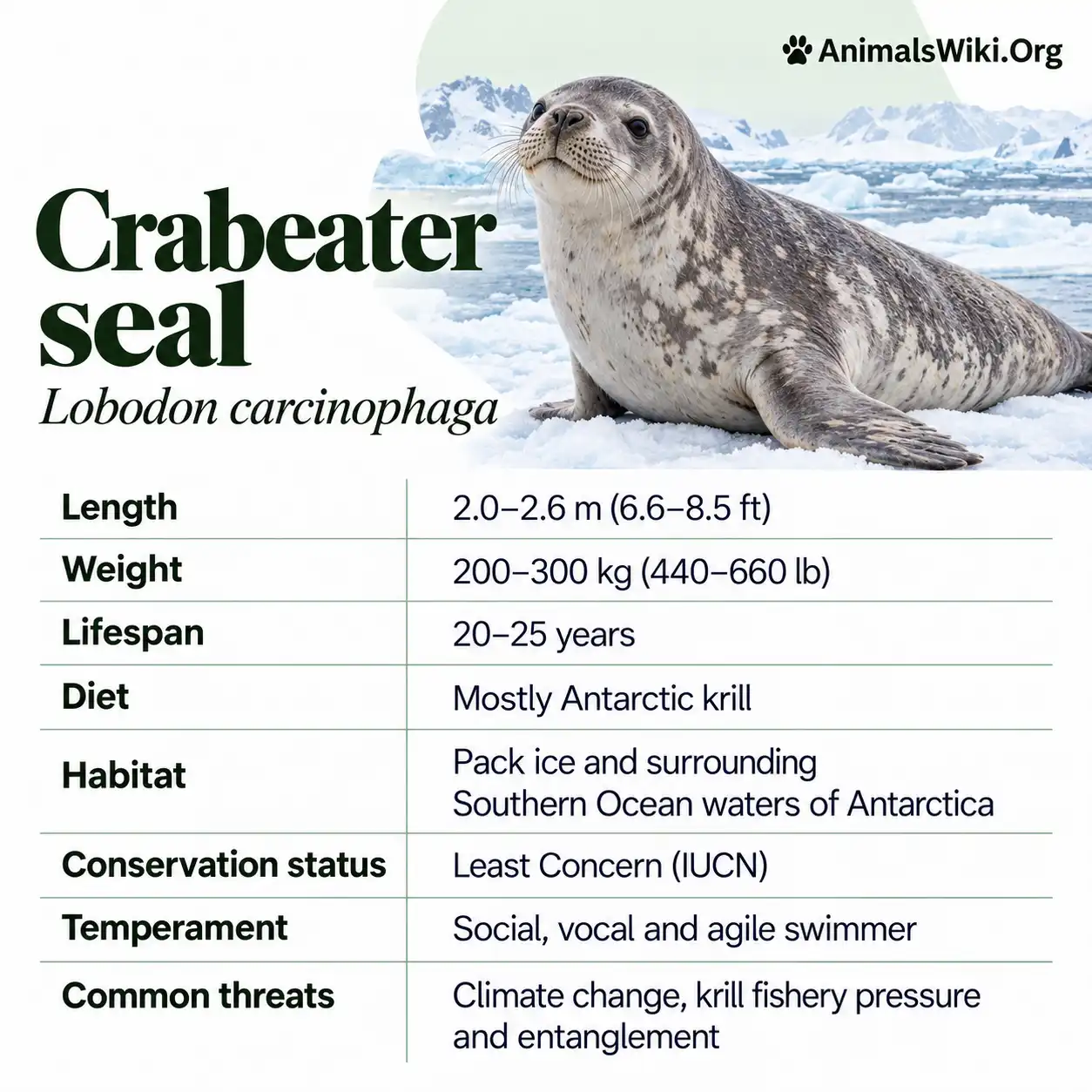
Crabeater Seal, Antarctica’s Remarkable Krill-Eating Marine Mammal
The crabeater seal is an Antarctic marine mammal with one of the most misleading names in the animal kingdom. Despite being called a crabeater, it feeds overwhelmingly on krill: small, shrimp-like crustaceans that support much of the Southern Ocean food web.
Its most remarkable feeding adaptation is hidden inside its mouth. Elaborately shaped cheek teeth form a filtering structure that helps retain small prey while water escapes. This allows a substantial marine mammal to obtain its food from animals only a few centimeters long.
Crabeater seals are closely associated with the floating sea ice surrounding Antarctica. They use the ice for resting, giving birth, nursing pups, and replacing their coats. Beneath and between the floes, they swim through a changing environment shaped by currents, seasonal light, and the movements of their prey.
They are also among the most abundant seals, although their exact population is difficult to establish. Their remote, shifting habitat makes a reliable count much harder than their apparent abundance might suggest.
This guide explores crabeater seal identification, habitat, diet, teeth, diving, reproduction, pup development, predators, and conservation. It also explains how these seals differ from other Antarctic species and why their future is connected to both sea ice and krill.
Crabeater Seal Facts
| Feature | Details |
|---|---|
| Common name | Crabeater seal |
| Scientific name | Lobodon carcinophaga |
| Alternative scientific spelling in older sources | Lobodon carcinophagus |
| Animal group | Mammal |
| Order | Carnivora |
| Family | Phocidae |
| Seal type | True or earless seal |
| Native region | Southern Ocean around Antarctica |
| Main habitat | Antarctic pack ice and surrounding water |
| Main prey | Antarctic krill |
| Feeding specialization | Tooth-based filtering |
| General adult length | Approximately 2–2.6 meters |
| General adult weight | Often around 200–300 kilograms, with substantial variation |
| Newborn size | Roughly 1.2 meters long and several tens of kilograms |
| Young | Pups |
| Usual litter | One pup |
| Breeding season | Antarctic spring |
| Nursing period | Approximately two to four weeks |
| Important predator | Leopard seal, particularly for young animals |
| Global conservation category | Least Concern |
| Global abundance | Millions, but the precise total remains uncertain |
1. What Is a Crabeater Seal?
A crabeater seal is a true seal belonging to the family Phocidae. It is adapted to life in Antarctic waters and the floating ice surrounding the continent.
Like other seals, it is a mammal. It breathes air, maintains a warm body, gives birth to live young, and feeds its pup with milk.
Its marine lifestyle does not remove the need to return to the surface to breathe. It also spends important periods out of the water on ice.
The species is especially distinctive because of its dependence on small crustaceans. Rather than relying mainly on large fish or squid, it has developed a feeding system suited to capturing krill.
This specialization connects its anatomy with its wider ecology. The teeth, feeding behavior, distribution, and reproductive habitat are all parts of the same survival strategy.
Understanding a crabeater seal therefore requires looking beyond the animal resting on an ice floe. Much of its life depends on the distribution of food beneath that apparently empty frozen landscape.
2. Why Is It Called a Crabeater Seal?
The name creates an understandable misconception: crabeater seals do not normally make a living by hunting crabs.
Their main prey is krill, which belongs to a different crustacean group.
Historical explanations connect the common name with older, broader uses of words for crustaceans. The Australian Antarctic Program associates it with the German word “Krebs,” which can refer more broadly to crustaceans as well as crabs.
Whatever the naming history, the animal’s actual diet is the important distinction.
A crabeater seal is not a seabed specialist cracking crab shells. Its feeding system is suited to retaining small prey from water.
This is a useful reminder that common names do not always describe an animal accurately.
The name can still serve as a starting point for learning. Asking what a crabeater really eats leads directly to its extraordinary teeth, its connection with Antarctic krill, and its role in the Southern Ocean ecosystem.
3. Scientific Name and Classification
The scientific name commonly accepted today is Lobodon carcinophaga.
Older scientific papers and educational pages frequently use Lobodon carcinophagus. Readers may therefore encounter both spellings when researching the species.
These names do not describe two different seals.
| Taxonomic level | Classification |
|---|---|
| Class | Mammalia |
| Order | Carnivora |
| Pinniped group | Pinnipedia |
| Family | Phocidae |
| Subfamily | Monachinae |
| Tribe | Lobodontini |
| Genus | Lobodon |
| Species | Lobodon carcinophaga |
The crabeater seal shares its Antarctic seal tribe with the Weddell, leopard, and Ross seals.
However, related animals can use very different diets and habitats. A leopard seal’s ability to take larger prey contrasts with the crabeater’s strong specialization on krill.
Classification explains evolutionary relationships; it does not mean every member of the group behaves identically.
Using the scientific name is particularly helpful when checking studies, because it separates this species from other pale-colored Antarctic seals.
4. What Does a Crabeater Seal Look Like?
Crabeater seals have relatively slender bodies and elongated, narrow snouts.
Their appearance is less bulky than that of some other true seals, although an adult is still a substantial animal.
Coat color changes through the year. Newly replaced fur can look darker, while an older coat often becomes much paler.
Individuals may therefore appear brown, gray, silver, or almost creamy white, depending on condition, season, and lighting.
Darker markings can occur along the body and flippers.
Scars are also common, especially long marks associated with earlier predator encounters.
Identification should use the overall shape rather than color alone. A pale seal resting on ice is not automatically a crabeater.
The narrow muzzle, proportions, location, and visible markings help create a more reliable identification.
Photographs can exaggerate differences because bright snow, wet fur, and reflected light change how the coat appears. An animal in water may look noticeably darker than the same animal after drying.
5. How Big Is a Crabeater Seal?
Adults commonly measure around two to two and a half meters, with some individuals exceeding that range.
A broad weight reference is approximately 200–300 kilograms, although season and body condition produce substantial variation.
Some general references give higher maximum weights. Those figures should not be mistaken for the mass of every adult.
Unlike seal species with extremely large males, crabeater seals show relatively modest differences between the sexes. Females may be slightly larger on average.
Body mass is also not constant throughout life or the annual cycle.
A nursing female, a recently weaned pup, and an adult preparing for another demanding period can have very different energy reserves.
For readers, the most useful comparison is to recognize a long, streamlined marine mammal weighing several hundred kilograms.
It may look relaxed and approachable while lying on ice, but its size and strength deserve respect. Its body is built for an environment very different from a person’s.
6. True Seal vs. Sea Lion
Crabeater seals are true seals, sometimes called earless seals.
“Earless” does not mean they cannot hear. It means they lack the external ear flaps visible on sea lions and fur seals.
Their movement on a solid surface also differs.
True seals cannot rotate their hind flippers beneath the body in the same way as sea lions. They move through body undulations and assistance from the flippers rather than walking upright on all four limbs.
In water, that body arrangement supports effective swimming.
| Feature | Crabeater seal | Sea lion |
|---|---|---|
| Family | Phocidae | Otariidae |
| External ear flaps | Absent | Present |
| Hind flippers used beneath body on land | No | Yes |
| Typical movement on solid ground | Body undulation and flipper assistance | More effective four-limbed walking |
| Marine lifestyle | Strong swimming and diving | Strong swimming and diving |
The distinction helps explain why a seal can appear awkward on ice while remaining highly capable underwater.
7. Where Do Crabeater Seals Live?
Crabeater seals have a circumpolar Antarctic distribution.
This means they occur around the continent rather than being restricted to one small coastal region.
Their normal environment is the Southern Ocean pack-ice zone, where floating ice and water form a changing habitat.
They are not Arctic seals and do not share their natural home with polar bears.
Occasional individuals have appeared far beyond the usual Antarctic range, including on southern continental coasts. These unusual records should not be confused with established breeding populations.
A wandering seal can travel a considerable distance without demonstrating that the species normally occupies the destination.
Within Antarctic waters, distribution is also uneven.
Food, ice conditions, ocean depth, and season influence where animals concentrate.
A circumpolar range therefore does not imply a uniform ring of seals around Antarctica. It describes a broad geographic pattern within which local habitat use can vary considerably.
8. What Is Pack Ice?
Pack ice is floating sea ice that forms a shifting collection of floes rather than remaining permanently attached to the coast.
Wind and currents move the ice, opening gaps in some places and compressing floes in others.
This differs from fast ice, which is attached to the shoreline or another fixed feature.
The distinction matters because crabeater seals use a habitat that continually changes position and structure.
An ice floe can provide a resting platform while drifting away from its earlier location.
The surrounding water remains essential for feeding and movement.
From the seal’s perspective, habitat is therefore a combination of ice and ocean.
A suitable platform alone is insufficient if food is unavailable nearby. Likewise, abundant prey does not remove the need for appropriate ice during breeding.
Understanding pack ice makes the species’ lifestyle easier to picture: it occupies a moving mosaic rather than a permanent terrestrial territory.
9. Why Sea Ice Matters So Much
Sea ice supports several parts of a crabeater seal’s life.
It provides a surface for resting, giving birth, nursing, and molting.
It also influences the food environment below.
Antarctic krill use sea-ice-associated resources during important stages of their lives, creating an indirect connection between ice conditions and seal nutrition.
These roles should be considered together.
A change in ice can affect more than the amount of dry space available. It may alter access to food, the distance between feeding areas and resting platforms, and the timing of breeding conditions.
Research comparing crabeater and Weddell seals in the Weddell Sea emphasized that different seal species can respond differently because their diets and breeding habitats differ.
This means one broad prediction for “Antarctic seals” may conceal important biological contrasts.
For crabeaters, sea ice is part of both the physical home and the ecological system supplying food.
10. What Do Crabeater Seals Eat?
Antarctic krill, Euphausia superba, dominates the diet of crabeater seals.
However, the exact proportion varies among individuals, regions, seasons, and research methods.
Studies using chemical tracers have confirmed strong krill dependence while also detecting contributions from other prey.
One investigation estimated krill contributions of approximately 84% and 91% using two different analytical approaches.
These are study results, not a universal daily percentage applying to every seal.
Other krill species and occasional fish or other marine animals have also been reported.
The clearest description is therefore that crabeater seals are highly specialized krill predators with some dietary flexibility.
That flexibility should not be exaggerated. Occasional alternatives do not mean the species can easily replace a major loss of its main food.
The relationship with krill remains central to its distribution, feeding behavior, and sensitivity to changes in the Southern Ocean.
11. What Exactly Are Antarctic Krill?
Antarctic krill are small crustaceans that can gather in dense swarms.
They are often described as shrimp-like, although they are not simply miniature shrimp.
Krill consume microscopic food and other available resources, packaging that energy into bodies accessible to larger predators.
This makes them an important connection between tiny organisms and large animals.
Seals, penguins, fish, squid, seabirds, and baleen whales use krill directly or depend on food webs that include them.
Young krill can feed on algae associated with the underside of sea ice.
Their distribution also changes vertically. In many conditions they occur nearer the surface at night and deeper during the day, although actual behavior varies.
For crabeater seals, the important issue is not only how much krill exists across the entire Southern Ocean.
The seals need prey concentrated in places and at depths where feeding produces enough energy to justify the effort.
12. The Crabeater Seal’s Extraordinary Teeth
The cheek teeth are among the species’ most distinctive features.
Instead of having simple pointed crowns, they possess multiple projections and deep spaces between them.
When the jaws close, the upper and lower teeth form a filtering arrangement.
This allows the seal to retain small prey while water passes out.
The teeth are therefore not primarily miniature crab-cracking tools.
Their shape reflects a different task: separating many small food items from surrounding water.
Comparative research on seal skulls and jaws supports this interpretation, connecting the unusual dentition with a specialized feeding strategy.
It also shows why tooth shape can reveal more than whether an animal is a predator.
Two seals can both consume animal prey while using very different mechanisms.
The crabeater’s mouth is a reminder that anatomical specialization can involve collecting small prey efficiently rather than developing the largest or sharpest possible teeth.
13. How Does Tooth-Based Filtering Work?
The basic process combines taking prey and water into the mouth with removing the water while retaining food.
The cheek teeth provide the filtering structure.
This differs from biting a single large fish and swallowing it directly.
It also differs from the baleen system of whales, although both strategies allow mammals to exploit aggregations of small prey.
Crabeater seals retain their teeth; baleen whales use flexible keratin plates.
Comparative research has examined the differences between tooth-based filtering and teeth suited to capturing and processing larger prey.
That work is also relevant to interpreting fossil marine mammals.
However, a modern crabeater seal should not be treated as a simple living copy of an early whale. Similar feeding challenges can produce different anatomical solutions in separate lineages.
The useful comparison concerns function: both systems separate food from water, but the structures and evolutionary histories are different.
14. Why Dense Krill Swarms Are Valuable
A large seal cannot meet its needs by pursuing scattered tiny prey one individual at a time.
Concentrations matter.
When many krill occur close together, each feeding action can provide a greater return.
This helps explain why prey distribution can be as important as total prey abundance.
A region containing a substantial quantity of krill may still be less useful if the animals are widely dispersed or consistently beyond accessible feeding conditions.
Physical features influence those concentrations. Currents, water-column structure, sea ice, and the shape of the seabed can all affect where prey gathers.
Research along the western Antarctic Peninsula linked crabeater diving with habitat conditions associated with krill availability.
The seal’s feeding problem is therefore a moving search problem.
It must locate profitable patches and adjust when those patches change.
Its specialized teeth help process prey once encountered, but successful feeding still depends on finding the right concentration in the first place.
15. How Deep Can Crabeater Seals Dive?
Many descriptions emphasize relatively shallow dives, and that pattern is useful in some conditions.
However, it is incomplete.
Winter tracking along the western Antarctic Peninsula recorded much deeper and longer dives than earlier summer observations suggested.
In one study, recorded depths extended to more than 700 meters, although that extreme was not the typical dive.
This distinction matters: a recorded maximum describes capability under observed conditions, while an average or common depth describes routine behavior within a study.
Neither should replace the other.
A crabeater seal’s diving changes with prey distribution, season, and local ocean conditions.
Describing the species as feeding only within the upper 20 meters would therefore exclude important documented behavior.
The better explanation is that many feeding dives can be shallow, but the seals have substantial flexibility and can use deeper parts of the water column when circumstances require it.
16. Why Diving Changes Between Day and Night
Krill and other prey do not remain at one fixed depth.
Their movements alter the places where a seal can feed efficiently.
Research in the Marguerite Bay region found that studied crabeater seals generally made deeper, longer dives during daylight than at night.
The animals also used local depth features in ways consistent with exploiting changes in prey concentration.
This is more informative than simply calling them nighttime feeders.
The appropriate schedule depends on where profitable prey is available.
A seal may adjust the timing, depth, and duration of diving rather than follow a rigid pattern throughout the year.
The relationship also explains why information from one short summer visit may differ from winter tracking.
Both observations can be valid within their circumstances.
Understanding crabeater behavior requires connecting the animal’s activity with the shifting three-dimensional environment beneath the ice.
17. Breathing, Swimming, and Returning to the Surface
Crabeater seals are air-breathing divers.
They must balance time spent searching underwater with the need to return to the surface.
A dive therefore includes more than reaching a particular depth. Travel, feeding opportunity, and recovery at the surface all contribute to the overall cycle.
For a krill specialist, the value of a dive depends partly on how much prey can be obtained during the available underwater period.
A deeper dive can reach useful food but also requires more travel.
This creates a practical relationship between prey depth and feeding efficiency.
The seal’s streamlined body supports movement through water, while its life remains tied to access to air.
That combination distinguishes it from the fish and crustaceans around it.
The ocean is its feeding environment, but it cannot remain submerged indefinitely. Successful behavior involves repeatedly moving between underwater resources and the surface world above them.
18. What Does Hauling Out Mean?
A seal hauls out when it leaves the water and rests on ice or land.
For crabeater seals, sea ice provides the usual platform.
Hauling out supports resting, breeding, nursing, and molting, but its timing varies.
A study following adults and juveniles across several months found differences in haul-out schedules and showed that not all animals were on the ice at the same time.
This has a direct consequence for population surveys.
Researchers counting seals on floes see only the fraction currently hauled out.
Animals in the water remain largely unavailable to a visual count.
The timing of a survey therefore influences the apparent number of seals.
Understanding haul-out behavior is not just a behavioral detail. It helps scientists interpret abundance, compare surveys, and avoid treating the number visible on ice as the complete population using the area.
19. Why Does the Coat Change Color?
A crabeater seal’s appearance changes as its coat ages and is replaced.
New fur tends to look darker. Over time, the coat becomes paler.
The annual molt replaces old hair and contributes to the range of colors seen in photographs.
This means a brown seal and a pale seal can belong to the same species.
Wetness and lighting introduce further variation.
A coat-change description should not be confused with a claim that every individual becomes the same shade on an exact date.
Season, age, condition, and observation circumstances all matter.
Molting is also part of why seals need suitable haul-out opportunities.
Replacing the coat is an important biological process, rather than a cosmetic event.
For wildlife identification, the practical lesson is to combine coloration with body shape and facial features. Color alone can be misleading in an animal whose appearance changes through the annual cycle.
20. Are Crabeater Seals Social?
Crabeater seals may be encountered alone, in small groups, or in larger aggregations.
They can gather on ice and sometimes travel together in the water.
However, a large gathering does not necessarily represent a permanent social group with fixed membership.
The circumstances matter.
Animals may share a useful floe, a productive feeding area, or a period of breeding activity.
The familiar breeding arrangement of a female, pup, and accompanying male is also temporary.
It should not be described as a lifelong family.
This flexibility makes the species different from an animal that spends its entire life in one stable herd or colony.
The important question is what brings individuals together and how long the association lasts.
Descriptions of group size are best treated as observed possibilities rather than a standard number.
A photograph of many seals resting together captures one situation within a broader range of social arrangements.
21. What Sounds Do Crabeater Seals Make?
Crabeater seals produce underwater vocalizations, including low and high moan calls.
Acoustic research in East Antarctica identified these call types in recordings made by a stationary hydrophone.
The calls were detected primarily during Antarctic spring, linking vocal activity with the breeding period.
Their sound also differed in frequency and occurrence through the daily cycle.
Such recordings provide information that visual observation alone cannot supply.
An animal beneath the ice may be impossible to see while remaining acoustically detectable.
However, a call should not be translated into a specific sentence or motive without supporting evidence.
Researchers study the structure, timing, location, and context of vocalizations to understand their possible functions.
For readers, the most striking point is that the Antarctic underwater environment is not silent.
Crabeater seals contribute to a seasonal soundscape that can reveal their presence even when the surface appears empty.
22. When Do Crabeater Seals Breed?
Crabeater seals give birth during Antarctic spring, generally from late September into early November.
A study combining embryo observations with published reproductive information estimated peak births around the middle of October.
The timing places early pup development within a particular seasonal window.
Reproduction also involves delayed implantation, or embryonic diapause.
After conception, development does not proceed continuously at the same rate through the entire mating-to-birth interval.
This helps distinguish total pregnancy duration from the period of more active fetal growth.
The cited study estimated conception-to-birth duration at approximately 11.3 months.
That figure should be interpreted as a biological estimate based on the available evidence, rather than an exact stopwatch for every female.
Understanding the delay explains why a roughly annual reproductive cycle does not mean the embryo is growing rapidly throughout nearly the entire year.
23. The Female, Pup, and Accompanying Male
During the breeding period, a female and her pup are often accompanied by an adult male.
This arrangement can look like a family group, but the male’s presence should not be equated with paternal care.
His association is connected to mating opportunities.
He may remain near the female and respond aggressively to competing males.
Tracking during the breeding season documented extended periods hauled out, including cases in which a male and female remained together and entered the water at the same time.
These observations help reveal behavior that is difficult to follow continuously in shifting pack ice.
The group is temporary rather than a permanent parental partnership.
This distinction is important because an animal’s position beside a pup does not establish that it feeds, protects, or otherwise raises that youngster.
The female supplies the direct maternal investment through nursing and attendance.
24. What Are Crabeater Seal Pups Like?
A newborn crabeater seal is already a substantial youngster.
Pups are roughly 1.2 meters long and weigh several tens of kilograms at birth, with reported measurements varying.
They have a soft early coat, often described as light gray or brownish.
This coat is replaced as development proceeds.
The pup depends on its mother’s milk during a short nursing period.
Unlike a land mammal growing in a fixed den, it begins life on a floating platform influenced by weather and ice movement.
That setting makes the condition of the floe and access to surrounding water important.
The youngster must grow rapidly and then make the transition toward independent feeding.
Its early life is therefore a concentrated period of maternal investment and development.
A pup resting quietly on ice may appear to be doing very little, but substantial physiological change is occurring over a matter of weeks.
25. Why Do Pups Grow So Quickly?
Crabeater seal pups receive a substantial transfer of energy during nursing.
Their brief dependence period requires rapid growth before the mother–pup association ends.
Field observations near Enderby Land recorded very fast weight gain in two pups, with weaning masses between approximately 80 and 110 kilograms among the animals studied.
Those measurements describe a small observed sample, not a required growth curve for every pup.
The broader pattern is the important one: nursing is short and growth can be rapid.
After weaning, body mass may decrease as the youngster transitions to independent life.
This change does not automatically indicate that every pup is failing.
Energy intake and expenditure are changing.
For researchers, following pups beyond weaning is valuable because a successful birth and rapid early growth do not establish later survival.
The demanding next stage involves locating food and avoiding predators without continued maternal support.
26. Leopard Seals and the Meaning of Scars
Leopard seals are important predators of young crabeater seals.
Many surviving crabeaters carry scars consistent with earlier attacks.
The marks often attract attention because they can extend along the body.
However, a scar records survival from an injury. It does not show every attack that occurred or every young animal that failed to escape.
This distinction matters when interpreting photographs.
Visible scars demonstrate that predation pressure can shape the lives of animals that reach adulthood.
They should not be used alone to calculate a precise current mortality rate.
Other injuries can also result from interactions during breeding or different encounters.
The ecological relationship is nevertheless clear: early life involves substantial predator risk.
A species can be abundant while experiencing heavy losses among young animals.
Those losses are part of why reproduction, pup growth, and access to appropriate habitat need to be considered together.
27. Do Killer Whales Eat Crabeater Seals?
Killer whales can prey on crabeater seals, but their feeding choices vary among groups and situations.
It would be misleading to assume every Antarctic killer whale hunts every seal species equally.
A study of pack-ice killer whales off the western Antarctic Peninsula found strong selection for Weddell seals during the observed hunts, even though crabeater seals were much more numerous on the surveyed floes.
The whales avoided taking crabeaters in those particular observations.
This does not prove that crabeater predation never occurs.
It demonstrates the importance of prey choice and context.
Predators may respond to differences in handling difficulty, experience, opportunity, and other factors.
For a general wildlife article, the most accurate statement recognizes killer whales as potential predators while explaining that actual predation patterns are not uniform.
A list of possible predators is only the beginning of understanding a food-web relationship.
28. How Long Do Crabeater Seals Live?
Crabeater seals can live for decades.
Specialist accounts commonly describe a lifespan around 20–25 years, with some individuals reaching substantially older ages.
These figures should not be interpreted as a guaranteed age.
A maximum record differs from an average, and survival changes greatly across life stages.
Young animals face risks that successful adults have already survived.
Food availability, predation, injury, and environmental conditions all influence how long an individual lives.
For conservation, the most useful information includes how many animals survive to breeding age and how adult survival changes over time.
A long-lived species can still decline if reproduction and survival fail to replace losses.
Likewise, an exceptional old individual does not prove that conditions are favorable for the population.
Lifespan is one part of the wider demographic picture, alongside birth rates, pup survival, age at maturity, and movement between regions.
29. How Many Crabeater Seals Are There?
Crabeater seals number in the millions and are widely regarded as among the most abundant seals.
The precise global total remains uncertain.
Educational sources often repeat estimates such as 15 million, while scientific and institutional discussions emphasize much broader uncertainty.
The main difficulty is the habitat.
Seals occupy a huge, moving pack-ice zone, and many are underwater during surveys.
Visibility, survey coverage, season, and the proportion hauled out all affect estimates.
Regional studies provide important information, but their totals should not be mistaken for worldwide counts.
For example, a survey covering part of the Ross and Amundsen seas produced a large regional estimate without counting every Antarctic crabeater.
A useful article therefore reports abundance at the appropriate scale.
“Millions, with an uncertain global total” is more defensible than presenting an old rounded estimate as a precise count for the current year.
30. Why Counting Crabeater Seals Is Difficult
A seal survey must account for animals that observers cannot see.
Some are underwater. Others lie beyond the surveyed area or are difficult to distinguish against ice and shadows.
Researchers use statistical methods to connect observations with estimates of wider abundance.
Regional aerial studies have incorporated sighting probability, haul-out probability, ice concentration, and ocean-depth information.
These adjustments are essential because a raw count is not the same as a population estimate.
The ice also moves, making repeated surveys more complicated than returning to a permanent terrestrial colony.
Weather can restrict access and reduce visibility.
New imagery and analytical methods can improve coverage, but they do not eliminate every uncertainty.
The most informative population statement includes the region, survey period, method, and confidence around the estimate.
That context allows scientists to compare results and investigate change without confusing differences in observation with differences in actual seal numbers.
31. Are Crabeater Seals Endangered?
The crabeater seal is listed as Least Concern in the referenced global conservation information.
That category does not mean the species is free from threats.
It indicates that the available evidence does not place it within a higher global extinction-risk category under that assessment.
A widespread, abundant animal can still experience regional declines or increasing pressure.
For crabeaters, strong connections to sea ice and krill make future environmental change particularly relevant.
The distinction between global category and local condition is important.
A favorable category should not be used to dismiss habitat change, while concern about future risks should not be rewritten as a claim that the species is currently classified as Endangered.
Accurate conservation communication preserves both facts.
The species remains numerous, and continued research is needed to understand how its populations respond to changing Antarctic conditions.
32. Climate Change, Krill, and Habitat Shifts
Climate change can affect crabeater seals through both habitat and food.
Changes in sea ice influence resting and breeding platforms. Changes in water conditions and krill distribution can alter feeding opportunities.
Research along the western Antarctic Peninsula projected shifts in suitable foraging habitat toward offshore waters and farther south under modeled future conditions.
These are projections, not direct observations of every future outcome.
They depend on environmental scenarios and the relationships represented in the model.
The practical concern is that food and suitable ice may not remain arranged as they were previously.
A seal’s flexibility in diving does not guarantee that every change can be accommodated without cost.
Regional differences also matter. Conditions around Antarctica do not change identically everywhere.
Conservation planning therefore benefits from location-specific research rather than one simple statement about all Antarctic ice.
The relevant questions include where seals can feed, where they can breed, and how those locations remain connected.
33. Krill Fishing and Ecosystem Management
Antarctic krill are commercially harvested as well as eaten by wildlife.
This creates a management question involving the distribution and timing of fishing, environmental change, and the needs of predators.
A large ocean-wide krill total does not automatically show that local prey availability is adequate.
Seals need food where and when they can use it.
Research on Antarctic pack-ice seals has examined the combined implications of habitat change, krill availability, and fishing.
The concern is not a simple claim that every catch removes a meal from one identifiable seal.
It is whether concentrated extraction and environmental pressures can alter access to food at meaningful ecological scales.
CCAMLR’s ecosystem approach considers harvested species alongside dependent and associated organisms.
For crabeaters, effective management also requires better information, because their drifting habitat makes repeated monitoring difficult.
Understanding the seal therefore contributes to a broader discussion about maintaining ecological relationships in the Southern Ocean.
34. How Scientists Study Crabeater Seals
Scientists use several complementary methods.
Tracking tags reveal movement and diving. Aerial photographs document animals on ice. Acoustic instruments record underwater calls. Chemical analysis provides clues about diet.
Each method answers a different question.
Dietary tracers can integrate feeding information across a longer period than a single visible meal.
Long-term acoustic recordings can detect seasonal activity when ships and observers are absent.
Imagery creates records that can be reviewed and compared.
Recent British Antarctic Survey datasets include photographs and mapped seal locations from aerial surveys, providing material for future comparisons.
Technology is also improving the detection of seals in large image collections.
However, interpretation remains important. A detected shape needs to be identified correctly, and the animals visible on ice represent only part of the population.
The strongest understanding comes from combining methods rather than expecting one instrument to explain the whole life of the species.
35. Why Crabeater Seals Matter
Crabeater seals connect small crustaceans with the wider Antarctic marine ecosystem.
Their abundance and strong krill dependence make them significant consumers, while their young provide food for predators.
Their behavior also reflects the distribution of resources beneath the ice.
Studying them can therefore reveal information about more than the seals themselves.
Changes in diet, movement, body condition, or breeding habitat may provide clues about the surrounding ecosystem.
However, a useful indicator must be interpreted carefully. One change can have several possible causes, so researchers need environmental information alongside animal measurements.
For visitors, respectful observation means allowing seals space, following expedition guidance, and avoiding disturbance of resting adults or mother–pup pairs.
The crabeater seal’s story shows how closely an animal can be tied to a particular food and habitat.
Its future depends on a functioning relationship among ice, ocean conditions, krill, and the many organisms sharing the Southern Ocean.
Frequently Asked Questions About Crabeater Seals
1. Do crabeater seals really eat crabs?
Crabs are not their normal main food. Crabeater seals feed overwhelmingly on krill, especially Antarctic krill. Their common name reflects a historical naming issue rather than a crab-hunting lifestyle.
2. What is the scientific name of the crabeater seal?
The current commonly accepted spelling is Lobodon carcinophaga. Many older papers and educational sources use Lobodon carcinophagus. These names refer to the same seal species.
3. Where do crabeater seals live?
They live mainly in the Southern Ocean pack-ice zone around Antarctica. Their distribution is circumpolar, although local concentrations vary with ice, food, season, and ocean conditions.
4. Are crabeater seals found in the Arctic?
No. Their normal distribution is Antarctic. They do not naturally live alongside polar bears, which belong to the Arctic rather than the Antarctic ecosystem.
5. How big are crabeater seals?
Adults are generally around two to two and a half meters long and often weigh approximately 200–300 kilograms. Larger measurements occur, and body mass changes with season and condition.
6. Are males much larger than females?
No. The size difference is modest compared with strongly dimorphic species such as elephant seals. Females may be slightly larger on average, but individuals overlap substantially.
7. Why do crabeater seals have unusual teeth?
Their multi-cusped cheek teeth form a filtering structure. This helps retain small prey while water escapes, making the teeth especially suited to feeding on krill.
8. Do crabeater seals have baleen?
No. Their filtering structure consists of teeth. Baleen whales use keratin plates, which are anatomically different even though both systems help separate small prey from water.
9. Do crabeater seals eat anything besides krill?
Yes. Other prey has been recorded, including fish and additional marine animals. Nevertheless, krill remains dominant, and occasional alternatives do not remove the species’ strong dietary specialization.
10. How deep can crabeater seals dive?
Many dives are relatively shallow, but winter tracking has recorded much deeper behavior, including dives beyond 700 meters. A recorded extreme should not be confused with the normal depth of every feeding dive.
11. Do they feed only at night?
No. Feeding schedules vary. Some studies found substantial daytime diving during winter, with differences linked to prey distribution. A rigid nighttime-only description does not capture the full pattern.
12. What is pack ice?
Pack ice is floating sea ice made up of floes that move with winds and currents. It differs from fast ice attached to the coast or another fixed feature.
13. Why do crabeater seals need sea ice?
They use it for resting, breeding, nursing, and molting. Sea ice also influences krill ecology, linking the seal’s physical habitat with the availability of its main food.
14. Why are some crabeater seals almost white?
Their coats become paler as the fur ages. Newly replaced coats can appear darker. Lighting and whether the animal is wet also affect its apparent color.
15. Do crabeater seals live in groups?
They can occur alone, in small groups, or in larger gatherings. Those aggregations do not necessarily have permanent membership or represent stable family groups.
16. What sounds do they make?
Underwater recordings include low and high moan calls. Vocal activity is particularly associated with the breeding season, although interpreting the exact function of calls requires additional evidence.
17. When are crabeater seal pups born?
Births generally occur during Antarctic spring, from late September into early November. Research has estimated a peak around mid-October.
18. How many pups does a female have?
A female normally gives birth to one pup. Successful reproduction also depends on that youngster surviving nursing, weaning, and the transition to independent feeding.
19. How long do pups nurse?
Nursing lasts only a few weeks, broadly around two to four weeks in published accounts. Study estimates differ, so one exact duration should not be applied to every mother–pup pair.
20. Does the accompanying male help raise the pup?
His presence is mainly associated with mating opportunities rather than paternal care. The female supplies the direct nursing and maternal investment.
21. Why do so many adults have scars?
Many scars are associated with unsuccessful leopard seal attacks when the animals were younger. Other interactions can also cause injuries, so not every mark has an identical origin.
22. How long do crabeater seals live?
They can live for decades. Specialist summaries commonly describe around 20–25 years, with older individuals recorded. Maximum ages differ from typical survival.
23. Are crabeater seals endangered?
They are listed as Least Concern in the referenced global information. That does not mean every local population is secure or that future habitat and food changes are unimportant.
24. How many crabeater seals exist?
The population numbers in the millions, but the precise global total is uncertain. Their vast, shifting habitat and time spent underwater make reliable counting difficult.
25. What are the main conservation concerns?
Important concerns involve changing sea ice, shifts in krill availability, and interactions with other ecosystem pressures. Their dependence on both suitable ice and accessible food makes those relationships central to conservation.



