
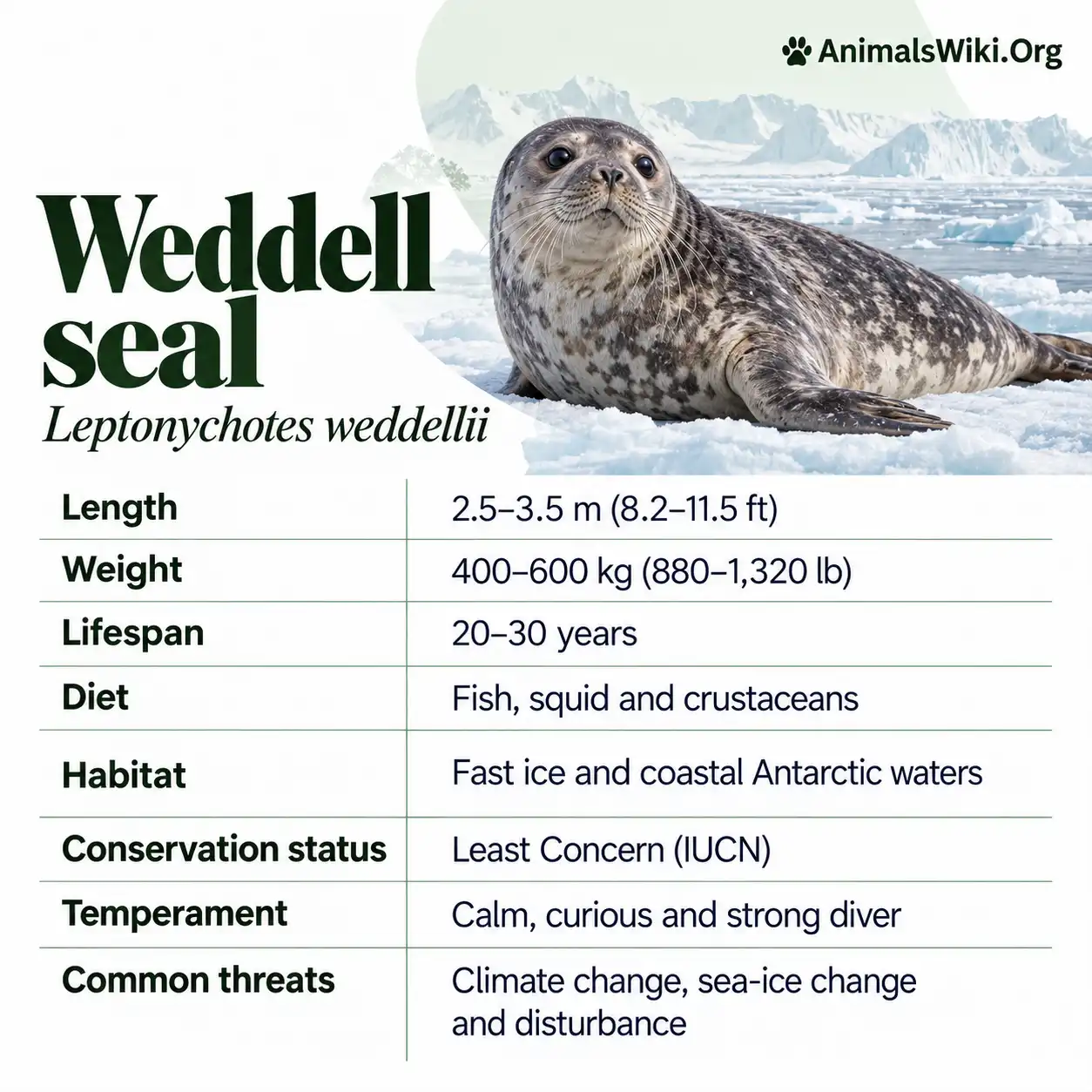
Weddell Seal, Antarctica’s Extraordinary Under-Ice Diver
The Weddell seal is a large Antarctic marine mammal famous for its deep dives, underwater calls, and ability to live beneath extensive sea ice. Its rounded face and resting posture can make it appear unhurried, but underwater it navigates an environment where finding the next breath is a demanding task.
Unlike an animal swimming in open water, a Weddell seal cannot always rise directly to the surface. Ice may block the route. Instead, it must locate cracks or maintain breathing holes, sometimes using its teeth to keep access points open.
This remarkable lifestyle combines physical adaptations with learned knowledge of the surrounding environment. Large oxygen stores support diving, while movement decisions help the seal balance feeding opportunities against the need to breathe.
Weddell seals also raise their pups on coastal sea ice. The young grow rapidly, enter the water during the nursing period, and develop the abilities needed for an independent marine life.
Although the species is currently classified as Least Concern, its future remains connected to suitable ice, accessible prey, and changing Antarctic conditions.
This guide explores Weddell seal identification, habitat, diet, diving, communication, reproduction, pup development, predators, population research, and conservation. It also explains several widely repeated facts that need context, including record dive times and satellite population estimates.
Weddell Seal Facts
| Feature | Details |
|---|---|
| Common name | Weddell seal |
| Scientific name | Leptonychotes weddellii |
| Animal group | Mammal |
| Order | Carnivora |
| Family | Phocidae |
| Seal type | True or earless seal |
| Main geographic region | Antarctica and surrounding Southern Ocean |
| Characteristic habitat | Coastal waters and fast ice |
| General adult length | Approximately 2.5–3 meters |
| General adult weight | Often around 400–500 kilograms, with considerable variation |
| Main foods | Fish, with squid, other cephalopods, and crustaceans also consumed |
| Young | Pups |
| Usual litter | One pup |
| Main pupping period | Antarctic spring |
| Nursing period | Roughly six to seven weeks |
| Notable adaptations | Under-ice navigation, substantial oxygen stores, breathing-hole maintenance |
| Diving capability | Documented dives beyond 900 meters and exceptional durations exceeding an hour |
| Communication | Diverse underwater calls, including ultrasonic elements |
| Global conservation category | Least Concern |
1. What Is a Weddell Seal?
A Weddell seal is a true seal adapted to the coastal marine environment around Antarctica.
It is a mammal, meaning it breathes air, maintains a warm body, gives birth to live young, and feeds its pup with milk.
Its life is divided between the water and a surface platform. Feeding takes place underwater, while ice provides opportunities for resting, breeding, and replacing the coat.
The species is particularly associated with coastal fast ice, where cracks and breathing holes connect the underwater environment with the air above.
This creates a different challenge from living beside a permanently open shoreline.
The seal must not only find food but also remain connected to usable access points.
Its biology therefore brings together diving physiology, navigation, seasonal behavior, and reproductive timing.
Understanding the Weddell seal means recognizing these relationships. The animal resting beside a hole is occupying the visible edge of a much larger underwater world.
2. Scientific Name and Classification
The Weddell seal’s scientific name is Leptonychotes weddellii.
It belongs to Phocidae, the family of true seals. Within that family, it is grouped with the Antarctic lobodontine seals.
| Taxonomic level | Classification |
|---|---|
| Class | Mammalia |
| Order | Carnivora |
| Pinniped group | Pinnipedia |
| Family | Phocidae |
| Subfamily | Monachinae |
| Tribe | Lobodontini |
| Genus | Leptonychotes |
| Species | Leptonychotes weddellii |
Its relatives include the crabeater, leopard, and Ross seals.
However, close relatives can occupy different ecological roles. Crabeater seals specialize strongly on krill, while Weddell seals consume a broader range of prey.
The scientific name helps distinguish the species from other Antarctic seals, especially when common descriptions such as “spotted seal” or “ice seal” become ambiguous.
Older publications occasionally use different spellings. Those variations should not automatically be interpreted as references to separate living species.
The current Mammal Diversity Database recognizes the familiar Weddell seal under the name used here.
3. What Does a Weddell Seal Look Like?
Weddell seals have broad, heavy bodies, relatively small heads, and short muzzles.
Their faces often appear rounded, with noticeable whiskers around the mouth.
The coat is typically gray to dark gray, with pale mottling and a lighter underside. The exact contrast varies among individuals and with the condition of the fur.
A wet seal may look considerably darker than one resting after drying.
Lighting also affects appearance. Snow glare, shade, and reflected blue light from ice can change the colors visible in a photograph.
The overall body shape is therefore useful for identification.
A Weddell seal generally appears more rounded than the relatively slender crabeater seal and lacks the elongated head associated with a leopard seal.
No single feature should be used alone when the view is poor.
Combining head shape, body proportions, coat pattern, location, and behavior creates a stronger identification than deciding from one patch of spotted fur.
4. How Big Is a Weddell Seal?
Adult Weddell seals are substantial animals, commonly approaching three meters in length.
A general weight reference is around 400–500 kilograms, although individual measurements vary with sex, age, season, and body condition.
Females can be larger than males, particularly when comparing mature animals in good condition.
This differs from species such as elephant seals, where adult males are dramatically larger than females.
Weight also changes during the annual cycle.
A female beginning the breeding season with substantial reserves may lose considerable mass while supporting her pup.
The same animal can therefore have different weights at different times without changing its skeletal size.
For readers, the most useful approach is to separate typical dimensions from exceptional maximum records.
A photograph can also conceal scale. A seal alone on a large ice surface may look small until a known object provides comparison.
Even a resting individual has the strength and mass of a large wild mammal.
5. Weddell Seal vs. Crabeater Seal
Weddell and crabeater seals both live around Antarctica, but their lifestyles differ.
The Weddell seal is strongly associated with coastal fast ice. The crabeater is more closely linked to the drifting pack-ice zone.
Their diets also provide a clear contrast.
| Feature | Weddell seal | Crabeater seal |
|---|---|---|
| General build | Broad and heavy | More slender |
| Head | Rounded, relatively short muzzle | Longer, narrower snout |
| Characteristic ice habitat | Coastal fast ice | Drifting pack ice |
| Main feeding pattern | Broad animal diet, especially fish | Strong specialization on krill |
| Teeth | Used in prey capture and ice maintenance | Specialized cheek teeth for filtering |
| Nursing period | Approximately six to seven weeks | Usually only a few weeks |
| Under-ice lifestyle | Closely connected to maintained access holes | Different movement opportunities within pack ice |
These are broad distinctions rather than absolute boundaries.
Both animals respond to local conditions, and their distributions can overlap.
The comparison is especially useful because protecting “seal habitat” is not one uniform task. Different species depend on different combinations of ice structure, prey, and breeding conditions.
6. Where Do Weddell Seals Live?
Weddell seals occur around Antarctica and associated islands.
They have a circumpolar distribution, meaning their range extends around the continent rather than occupying only one Antarctic sector.
They are especially associated with coastal waters and fast-ice environments.
Some populations occur at extremely high southern latitudes, making the species famous as the world’s southernmost-breeding mammal.
However, not every Weddell seal remains in one small coastal area throughout its life.
Movement varies among individuals and life stages, and unusual records occur beyond the main Antarctic range.
A wandering animal reaching a distant coast does not establish a normal breeding population there.
Within Antarctica, distribution is also uneven.
Ocean depth, ice conditions, prey, and access points influence where seals concentrate.
A range map therefore shows the broad geographic setting, while local studies reveal how animals use particular bays, coastlines, and underwater habitats.
7. What Is Fast Ice?
Fast ice is sea ice attached to the coast or another fixed feature.
The word “fast” means held in place, rather than moving quickly.
This distinguishes it from pack ice, which consists of drifting floes.
Fast ice can provide a relatively stable platform for Weddell seals to rest and raise pups.
Yet stability does not mean permanence.
The ice changes seasonally, cracks under physical forces, and may break out during particular conditions.
Those changes alter the relationship between the surface and the water below.
For a seal, a crack can be an essential opening rather than a minor irregularity.
The structure of fast ice therefore matters as much as its overall area.
A broad sheet with few accessible openings presents different opportunities from one containing usable cracks.
Thinking about the habitat in this way helps explain why the species’ distribution cannot be predicted simply by asking where ice exists.
8. Why Breathing Holes Are Essential
Weddell seals must return to air after diving.
Under extensive ice, they cannot assume that the nearest point above them offers an open surface.
Breathing holes and cracks provide access.
The seals use their front teeth to maintain openings, scraping away newly forming ice.
This allows them to use under-ice habitat that would be inaccessible without a dependable route back to air.
A breathing hole is therefore more than a resting location.
It is a connection between the seal’s feeding environment and a physiological necessity.
The surrounding area may also become important during breeding, when animals repeatedly use access points.
Maintaining a hole requires effort, and the condition of openings can change.
A seal’s daily decisions involve where to feed, how far to travel, and how to return safely.
That relationship between air access and underwater opportunity is one of the defining features of Weddell seal life.
9. The Cost of Using Teeth on Ice
The same behavior that keeps breathing holes open can damage the teeth.
Repeated abrasion wears the front teeth, potentially exposing deeper structures and increasing the risk of infection.
A classic study examined Weddell seal skulls and found increasing dental wear and damage in older animals.
The findings linked tooth condition with an important challenge of the species’ lifestyle.
However, it would be too simple to claim that every Weddell seal dies because its teeth wear out.
Survival has several causes, and the relative importance of dental condition can vary.
The broader lesson is that an adaptation can involve costs.
Using teeth to maintain air access opens a valuable habitat, but the action places demands on structures also involved in feeding.
This trade-off makes Weddell seals especially interesting.
Their survival is not based on one perfect solution. It depends on managing opportunities and limitations throughout life.
10. How Do Weddell Seals Navigate Under Ice?
Returning to a small opening after a long dive requires accurate navigation.
Researchers have investigated several possible sources of information, including visual landmarks and magnetic cues.
A study using detailed movement records found evidence that seals followed routes associated with features visible through or beneath the ice.
Under the tested summer conditions, the results supported the use of visual information rather than the proposed magnetic or wake-following explanations.
This does not mean every navigational mechanism in every season has been fully resolved.
It demonstrates that low-light vision can be highly useful in an environment that may appear featureless to a human observer.
The underside of the ice contains patterns, cracks, and differences in illumination.
For an experienced seal, those features may help organize a route.
Navigation is therefore part of the animal’s relationship with a familiar landscape, even when that landscape is underwater and overhead.
11. What Do Weddell Seals Eat?
Weddell seals consume a varied animal diet.
Fish are important, while squid, octopuses, and crustaceans also occur.
The balance changes with region, season, individual behavior, and prey availability.
Antarctic silverfish are especially relevant in several Ross Sea diet studies.
However, no single prey species should be presented as the universal food of all Weddell seals.
Research using cameras on nursing females recorded several prey categories and substantial differences among individuals and locations.
Some animals appeared to focus more strongly on particular groups of prey.
This makes the species more flexible than a strict dietary specialist such as the crabeater seal.
Flexibility is useful, but it does not make food shortages irrelevant.
The available alternatives must still be accessible and provide enough energy.
For a diving mammal, finding prey is only part of the task. The energetic return must also justify travel, pursuit, and the limited time available underwater.
12. Do Weddell Seals Eat Antarctic Toothfish?
Weddell seals can take Antarctic toothfish.
Large toothfish provide a potentially substantial food resource, and direct observations have attracted scientific attention.
However, the importance of toothfish varies among seal populations and study methods.
One difficulty is that food remains do not preserve every feeding event equally.
If a seal consumes flesh without swallowing structures used for identification, analysis of droppings may underestimate that prey.
Conversely, one dramatic observation does not establish that the same food dominates the diet everywhere.
Researchers therefore compare direct observations, biochemical evidence, and other dietary methods.
This issue illustrates why studying marine predators requires several approaches.
The question is not merely whether a Weddell seal can catch a toothfish.
It is how often that happens, which individuals do it, where it occurs, and how much energy the prey contributes over time.
Those details determine its wider ecological importance.
13. Hunting in a Three-Dimensional Environment
A Weddell seal searches through a water column rather than across one flat surface.
Prey can occur beneath ice, in midwater, or near the seabed.
The seal must adjust depth and movement to the opportunities available.
A dive toward bottom-associated prey presents different demands from searching for fish distributed higher in the water.
Travel time matters because it reduces the portion of a dive available for feeding.
Prey behavior also changes with light and environmental conditions.
This means hunting cannot be understood by listing food species alone.
Researchers examine where encounters occur, how seals move, and what happens during the underwater period.
Animal-borne cameras are particularly useful because they connect a dive record with visible prey.
A change in depth may suggest feeding, but video can provide direct evidence of what the animal encountered.
Combining the two creates a more detailed account of how the seal makes its living.
14. How Deep Can Weddell Seals Dive?
Weddell seals are exceptional divers.
Modern research reviews report documented depths reaching approximately 904 meters.
However, a recorded maximum is not a description of the average dive.
Depth changes with individual condition, prey, location, season, and the purpose of the excursion.
A seal may make relatively shallow dives when useful food is accessible near the surface or when moving between openings.
A deeper dive may reach another resource but also require more travel.
The animal’s objective is not to break a depth record.
It is to obtain food or accomplish another task while returning safely to air.
This distinction keeps impressive measurements in perspective.
The remarkable capability reflects physiological adaptations and behavioral decisions, rather than every seal repeatedly descending to its maximum.
For readers, the most useful fact is the combination of substantial depth capacity with flexible use of the water column.
15. How Long Can a Weddell Seal Stay Underwater?
Exceptional Weddell seal dives have lasted around 96 minutes.
That is an extraordinary record, but it should not be confused with a routine feeding duration.
Many dives are much shorter.
Long dives also involve costs, including longer recovery at the surface under some circumstances.
Research on dive timing shows that seals organize their behavior around the balance between feeding opportunity and physiological limits.
A maximum duration therefore tells only part of the story.
The more informative questions include how frequently long dives occur, what the animal does underwater, and how much time is needed afterward.
A sequence of efficient shorter dives may be more useful than one extreme excursion.
Weddell seals demonstrate that performance and strategy are closely connected.
Their ability to remain submerged is impressive, but their success depends on choosing how and when to use that capacity.
16. How Do They Store Enough Oxygen?
Weddell seals carry substantial oxygen reserves in the blood and muscles.
Hemoglobin transports oxygen in blood, while myoglobin stores it within muscle.
Their physiology allows much more than simply filling the lungs before a dive.
Research has examined how blood volume, oxygen-carrying capacity, muscle stores, and circulation contribute to underwater performance.
The system involves trade-offs.
Increasing an oxygen-related feature indefinitely does not necessarily improve diving, because blood properties and delivery requirements also matter.
A modeling study found that adding more muscle myoglobin did not automatically extend the useful aerobic dive limit in every scenario.
This illustrates why the adaptations work as a coordinated system.
Oxygen must be stored, delivered, and used at an appropriate rate.
The seal’s behavior contributes too. Efficient movement can reduce expenditure and make available stores last longer.
Its diving capability emerges from physiology and activity together.
17. What Is the Aerobic Dive Limit?
The aerobic dive limit concerns how long a dive can be supported primarily through stored oxygen before anaerobic metabolism becomes more important.
It is not the same as the longest possible breath hold.
Researchers distinguish measured physiological responses from calculated limits based on oxygen stores and metabolic demand.
Both can vary with age, body size, activity, and conditions.
A seal actively pursuing prey may use oxygen differently from one making a less demanding exploratory dive.
This explains why one universal limit is misleading.
Exceeding an aerobic threshold can also affect the surface interval needed before another dive.
The concept therefore helps connect underwater activity with recovery.
For readers, the main point is straightforward: a seal can sometimes remain submerged beyond the duration that is most economical for repeated diving.
Exceptional performance and efficient everyday foraging are related, but they are not identical measures.
18. How Polar Light Changes Diving Behavior
Weddell seals experience extraordinary seasonal changes in daylight.
At high Antarctic latitudes, summer can bring continuous light, while winter brings prolonged darkness.
Between those periods, daily light-and-dark cycles return.
Research tracking seals across the year found changes in the timing of diving, including seasonal shifts between stronger nighttime and daytime patterns.
This shows why labeling the species simply nocturnal or diurnal is inadequate.
The animal responds to an environment where the usual meaning of day and night changes through the year.
Prey distribution also changes with light.
A useful feeding strategy must therefore balance the physical opportunity to see and capture prey with physiological constraints.
The seal’s schedule is not merely a fixed internal routine.
It reflects interactions among seasonal illumination, resource availability, recovery needs, and the timing of profitable underwater activity.
That flexibility helps make life possible in a strongly seasonal polar environment.
19. How Do Weddell Seals Stay Warm?
A thick body and blubber layer help limit heat loss.
However, warmth is not explained by insulation alone.
Heat production, circulation, exposed surfaces, activity, and environmental conditions all contribute.
The challenge also changes with age.
A small pup has a greater surface area relative to its volume than a large adult, making thermal balance more demanding.
Research comparing pups, yearlings, and adults found differences in blubber and heat-management characteristics.
This means an adult’s apparent comfort on ice should not be assumed to describe a newborn’s physiology.
Water and air create different conditions as well.
A pup entering the sea faces a different thermal environment from one resting beside its mother.
The species succeeds through a combination of body structure and physiological responses.
Those mechanisms develop over time, making early life a period of substantial adjustment rather than a fully formed copy of adult performance.
20. Why Do Weddell Seals Haul Out?
Hauling out means leaving the water to rest on ice or another surface.
Weddell seals haul out for several reasons, including resting, breeding, nursing, and molting.
The timing and duration change through the year.
Research in the southern Weddell Sea found strong seasonal differences in time spent on the ice.
This matters because the number visible during a survey depends partly on how many animals are currently hauled out.
An absence from the surface does not necessarily mean the seals have left the area.
They may be diving nearby.
Likewise, a crowded resting location does not alone reveal the complete population.
Understanding haul-out behavior therefore contributes to both natural history and abundance estimates.
For the individual seal, it is part of balancing underwater feeding with activities that require a surface platform.
The ice is not simply a place to sleep between identical dives; its role changes across the annual cycle.
21. Molting and the Annual Coat Change
Weddell seals replace their coat during the annual molt.
This process involves changes in hair and skin and creates physiological demands.
The coat’s condition can influence appearance, while the animal’s need to maintain body temperature continues.
Research on molting females examined surface temperature and heat transfer under different environmental conditions.
The work showed that wind and ambient temperature were important influences.
This is useful because the seal is not experiencing one fixed Antarctic climate.
A calm, sunny period and strong cold winds create different conditions even at the same location.
Molting also connects with haul-out behavior, making suitable resting opportunities valuable.
The process should therefore be understood as part of the energy budget.
It occurs alongside the need to maintain reserves and prepare for future demands.
An annual coat change may look ordinary, but for a polar marine mammal it forms part of a carefully balanced cycle of feeding, reproduction, maintenance, and recovery.
22. What Do Weddell Seals Sound Like?
Weddell seals produce a diverse range of underwater sounds.
Listeners often describe them as whistles, trills, chirps, pulses, or descending calls.
The resulting soundscape can seem surprising because the animal looks quiet while resting on the ice.
Both sexes vocalize, and calls are particularly important in discussions of breeding behavior.
Researchers study their frequency, duration, sequence, and context.
A trill is not simply an entertaining noise. Its structure may provide information relevant to interactions among seals.
However, assigning one exact meaning to every recording would overstate what is known.
The most useful approach connects sound with the identity, location, and behavior of the caller.
Acoustic research also makes it possible to detect activity beneath ice when direct observation is difficult.
The species therefore offers an example of how much animal behavior can remain hidden until scientists listen as well as look.
23. Do Weddell Seals Use Ultrasound?
Yes. Research has documented Weddell seal vocalizations containing ultrasonic frequencies.
These are above the normal upper range of human hearing.
A 2020 study identified several previously undescribed call types with fundamental frequencies extending to nearly 50 kilohertz.
The recordings expanded knowledge of the species’ acoustic repertoire.
However, ultrasonic sound production does not establish that Weddell seals use echolocation.
Echolocation requires evidence that an animal emits sound and interprets returning echoes to locate objects or prey.
That function was not demonstrated by the study.
This distinction matters because impressive discoveries can become exaggerated as they are repeated.
The correct conclusion is already remarkable: Weddell seals produce a wider range of sounds than earlier equipment and surveys had revealed.
Their high-frequency calls create new research questions about communication, perception, and life in winter darkness, rather than supplying an immediate answer to all of them.
24. Underwater Territories and Breeding Males
During breeding, male Weddell seals may defend underwater areas associated with access holes and females.
This differs from the familiar image of a male guarding a large harem on a beach.
The important interactions can occur below the surface.
Vocalizations contribute to territorial behavior, with powerful trills studied as part of male communication.
Researchers have investigated how the calls are produced and amplified.
Their acoustic characteristics reflect both the sound source and the vocal tract.
For a seal beneath ice, communication can extend beyond the area directly visible.
That makes underwater calls relevant to maintaining spacing and responding to rivals.
However, territorial behavior should not be generalized into the claim that every individual owns an exclusive year-round feeding area.
Breeding territories concern a particular context.
The distinction helps separate the places animals use routinely from areas actively defended during reproductive interactions.
25. When Do Weddell Seals Have Pups?
Weddell seals usually give birth during Antarctic spring, with timing varying among locations.
A female normally produces one pup.
The breeding season places early development within a particular combination of ice conditions, weather, and seasonal food dynamics.
However, not every mature female gives birth every year.
Long-term research in Erebus Bay shows substantial variation in age at first reproduction and in later breeding patterns.
Some females skip a season.
This is important because statements such as “all females begin breeding at six and then produce one pup annually” are too rigid.
Reproduction depends on individual history and condition.
A female must balance current investment with survival and future opportunities.
The species is therefore especially useful for studying the costs of reproduction.
The meaningful outcome is not only whether a pup is born, but whether both mother and offspring survive and contribute to later generations.
26. What Are Newborn Weddell Seal Pups Like?
Newborn pups weigh several tens of kilograms, with approximately 25–30 kilograms commonly given in introductory references.
They have a soft early coat and a body very different in scale from the large adult beside them.
The mother supplies milk and close attendance.
Rapid growth helps the pup develop reserves and prepares it for life in water.
Yet size alone does not establish readiness for independence.
Swimming ability, diving capacity, thermal balance, and knowledge of the environment all develop during early life.
A pup may spend much of its visible time resting, but that period supports substantial growth and physiological change.
The ice surface also presents changing conditions.
Wind, snow, temperature, and access to water influence the setting in which the mother–pup relationship unfolds.
A newborn is therefore not simply a small adult waiting to become larger. It is passing through a demanding developmental stage with its own needs and limitations.
27. When Do Pups Enter the Water?
Weddell seal pups begin entering the water during the nursing period.
However, there is substantial individual variation.
A large study following hundreds of pups recorded first entries between 11 and 29 days of age, with an average close to 15 days in that population.
Those results show why one fixed age should not be assigned to every pup.
Birth mass and maternal characteristics were associated with differences in timing.
Water entry is an important milestone, but it is not equivalent to full independence.
The pup still relies on its mother and must continue developing its underwater abilities.
Early experience creates both benefits and costs.
Time in the water provides practice, while also exposing a small body to a more demanding thermal environment.
Understanding pup development therefore means following several changes together rather than treating the first swim as the end of maternal care.
28. How Mothers Help Pups Develop Diving Skills
Mother and pup do not always dive independently.
Recent research on paired animals recorded synchronized diving and changes in pup performance over time.
During paired dives, mothers and pups showed similarities in depth and duration.
Mothers also made longer, deeper solo dives, allowing them to meet their own needs.
The findings suggest that females adjust some behavior in ways that support developing young.
However, “teaching” should be used carefully unless the specific behavioral criteria are demonstrated.
A clear description is that coordinated diving provides a context in which pups gain experience while maternal behavior changes.
This makes the nursing period more complex than resting and drinking milk.
The mother must balance attendance, the youngster’s development, and her own energy requirements.
The pup gradually acquires abilities needed for independent survival within that changing relationship.
29. Nursing, Growth, and the Mother’s Energy Budget
Weddell seal mothers nurse for roughly six to seven weeks.
Producing milk requires substantial energy, and females can lose considerable body mass during this period.
However, it is inaccurate to assume every mother fasts continuously until weaning.
Research shows that some females forage during lactation.
This creates a mixed strategy: stored reserves support reproduction, while food obtained during the nursing period can also contribute.
The balance varies among individuals.
A female’s body condition, experience, and the age of her pup may influence behavior.
This also explains why maternal success cannot be measured from milk production alone.
A mother must support her offspring while retaining enough capacity to survive and recover.
The pup’s growth and the mother’s condition are therefore connected parts of the same reproductive investment.
Understanding that relationship helps explain why females may differ in whether and when they reproduce again.
30. How Long Do Weddell Seals Live?
Weddell seals can live for several decades.
Long-term field studies have followed known individuals to ages exceeding 30 years.
However, maximum age should not be confused with the expected lifespan of every animal.
Survival changes across life stages and differs among individuals.
A pup faces different risks from a mature female or an older male.
Research based on decades of repeated observations has revealed age-related changes in survival and reproduction.
The species is especially valuable because researchers can connect an animal’s known early history with later outcomes.
This allows questions about aging, maternal effects, and reproductive costs to be investigated in the wild.
For conservation, the key issue is how survival across ages contributes to the population.
An exceptional old individual demonstrates longevity, while a stable population requires enough animals to survive, reproduce, and replace losses throughout the age structure.
31. What Predators Hunt Weddell Seals?
Killer whales and leopard seals can prey on Weddell seals.
Risk depends on location, age, and access to the seal’s habitat.
Extensive fast ice can reduce opportunities for some predators, but it does not create a universally safe environment.
Near open water or accessible floes, circumstances differ.
Pups and other vulnerable individuals may face different risks from healthy adults.
The species also encounters dangers unrelated to predation, including loss of suitable access points and challenging environmental conditions.
A predator list therefore describes only part of survival.
The important ecological questions concern where encounters occur, which animals are taken, and how seals adjust habitat use.
Life beneath ice provides opportunities as well as constraints.
It may reduce some predator exposure while making breathing access more demanding.
The Weddell seal’s strategy works through that balance rather than through complete freedom from danger.
32. How Many Weddell Seals Are There?
Global abundance is difficult to establish precisely.
An important study published in 2021 used satellite imagery from 2011 and estimated approximately 202,000 adult and subadult females.
This number is often repeated incorrectly as the total number of Weddell seals.
It does not include all males and all age classes.
The estimate also had a wide confidence interval, reflecting substantial uncertainty.
Its value lies partly in providing a broad baseline using a consistent approach.
However, it should not be described as a live count made in 2026.
The study illustrates why population numbers need clear labels: what was counted, when the evidence was collected, and which animals the estimate represents.
Automatically doubling the female estimate would also require assumptions that may not be justified.
A careful article therefore explains the population component rather than turning a useful scientific result into a misleading precise total.
33. Are Weddell Seals Endangered?
The Weddell seal is classified as Least Concern in the current referenced global information.
IUCN’s 2026 Antarctic assessment announcement retained that category.
Least Concern does not mean that all populations are stable or that environmental change is harmless.
A widespread species can experience serious declines in particular places.
The category describes global extinction risk under the assessment framework, rather than guaranteeing local security.
This distinction is especially important in Antarctica, where conditions differ greatly among regions.
The appropriate message combines the two points: Weddell seals are not currently classified as globally Endangered, and their dependence on Antarctic ecosystems still warrants monitoring and protection.
Conservation success is not measured only by avoiding a higher-risk category.
Maintaining functioning populations, suitable breeding habitat, and access to food remains valuable even for a species that is currently widespread.
34. What Does Climate Change Mean for Weddell Seals?
Changing sea ice can alter breeding platforms, access routes, and the distribution of prey.
The consequences are not identical everywhere.
Too little stable ice can reduce suitable pupping habitat, while particular heavy-ice conditions can also affect access and local productivity.
This makes the timing and structure of ice important, rather than its presence alone.
A 2025 study reported a substantial long-term decline in Weddell seal numbers at Signy Island in the South Orkneys.
The reported decline was approximately 54% over almost five decades.
That is a regional result, not evidence that the global population fell by the same percentage.
Its importance comes from sustained observations linked with environmental records.
Long time series can reveal relationships that short visits miss.
For conservation, the practical goal is to identify where conditions are changing, how populations respond, and which habitat features remain essential under different regional circumstances.
35. How Scientists Study and Protect Weddell Seals
Weddell seals are among the most intensively studied Antarctic mammals.
Long-term projects combine individual identification with repeated observations of survival, breeding, and movement.
Tracking instruments reveal diving and habitat use. Cameras show prey encounters. Acoustic recorders document calls beneath the ice.
Satellite imagery extends observation across areas that are difficult to visit.
Each method contributes a different part of the picture.
A photograph can show presence, while a long-term individual history reveals whether an animal survived and reproduced.
Effective conservation depends on connecting those scales.
Protecting a pupping location is valuable, but the seals also need accessible underwater resources across the year.
For visitors, responsible behavior includes maintaining distance, keeping routes to breathing holes clear, and following local guidance around mothers and pups.
The Weddell seal’s importance extends beyond impressive records.
Its life reveals how physiology, behavior, food, and ice combine to support a mammal in one of Earth’s most demanding environments.
Frequently Asked Questions About Weddell Seals
1. What is the scientific name of the Weddell seal?
The scientific name is Leptonychotes weddellii. It belongs to Phocidae, the true-seal family, and is one of the Antarctic seals grouped within the tribe Lobodontini.
2. Where do Weddell seals live?
They occur around Antarctica and associated islands, especially in coastal waters and fast-ice environments. Local distribution depends on ice structure, food, ocean conditions, and access to breathing openings.
3. Are Weddell seals Arctic animals?
No. Their natural home is the Antarctic region. They do not normally live alongside polar bears, which inhabit the Arctic.
4. How large is a Weddell seal?
Adults commonly approach three meters and often weigh around 400–500 kilograms. Measurements vary with age, sex, season, and condition, so one number cannot describe every individual.
5. What do Weddell seals eat?
Their diet includes fish, squid, other cephalopods, and crustaceans. Antarctic silverfish are important in several studied populations, but prey use differs among locations and individuals.
6. Do Weddell seals eat krill?
They can consume crustaceans, but they are not krill specialists in the same way as crabeater seals. Their broader feeding ecology includes several types of fish and other animal prey.
7. How deep can they dive?
Documented dives reach approximately 904 meters. That is an exceptional depth, not the depth of every feeding dive.
8. How long can they stay underwater?
Exceptional records reach around 96 minutes. Routine dives are often considerably shorter, and extreme dives can require longer recovery periods.
9. Do Weddell seals breathe underwater?
No. They breathe air. Under ice, they must locate cracks or breathing holes rather than simply rising wherever they happen to be.
10. How do they maintain breathing holes?
They use their front teeth to scrape away forming ice. This supports access to air but can cause substantial tooth wear.
11. Do all Weddell seals die from worn teeth?
No. Dental damage is an important cost, but survival has several causes. It is inaccurate to assign one inevitable cause of death to every animal.
12. How do they find their way beneath ice?
Research supports the use of visual landmarks under tested conditions. Their complete navigation system across every season remains an active scientific question.
13. What is fast ice?
Fast ice is sea ice attached to the coast or another fixed feature. It differs from drifting pack ice and provides important Weddell seal resting and breeding habitat.
14. Why are Weddell seals called earless seals?
They lack visible external ear flaps. They still possess ears and can hear; “earless” describes external appearance rather than an absence of hearing.
15. What sounds do Weddell seals make?
They produce a varied underwater repertoire, including trills, whistles, chirps, and pulses. Researchers investigate how those sounds relate to social interactions and breeding.
16. Do Weddell seals use ultrasound?
Yes. Calls containing ultrasonic frequencies have been documented. These discoveries expanded the known range of their vocal behavior.
17. Does ultrasound prove they echolocate?
No. Producing high-frequency sound does not by itself demonstrate echolocation. The function of those calls requires additional evidence.
18. When do Weddell seals have pups?
Births generally occur during Antarctic spring, with timing varying by location. A female normally gives birth to one pup.
19. Does every adult female breed annually?
No. Long-term research shows variation in first reproduction and later breeding frequency. Some mature females skip breeding seasons.
20. How long do pups nurse?
Nursing commonly lasts approximately six to seven weeks. During that period, pups grow and begin developing important swimming and diving abilities.
21. When do pups begin swimming?
They enter the water during nursing. A large study recorded first entries between 11 and 29 days, showing considerable variation rather than one universal starting age.
22. Do mothers fast throughout nursing?
Not always. Some mothers forage during lactation, combining stored energy with newly obtained food to support themselves and their pups.
23. How long do Weddell seals live?
They can live for decades, with known individuals exceeding 30 years. Maximum age differs from average survival and should not be treated as a guaranteed lifespan.
24. Are Weddell seals endangered?
Their referenced global category is Least Concern. Nevertheless, regional declines and dependence on changing sea-ice ecosystems make continued monitoring important.
25. Does the estimate of 202,000 include all Weddell seals?
No. The widely cited satellite study estimated adult and subadult females using imagery from 2011. It was not a count of all males, females, and pups.



