
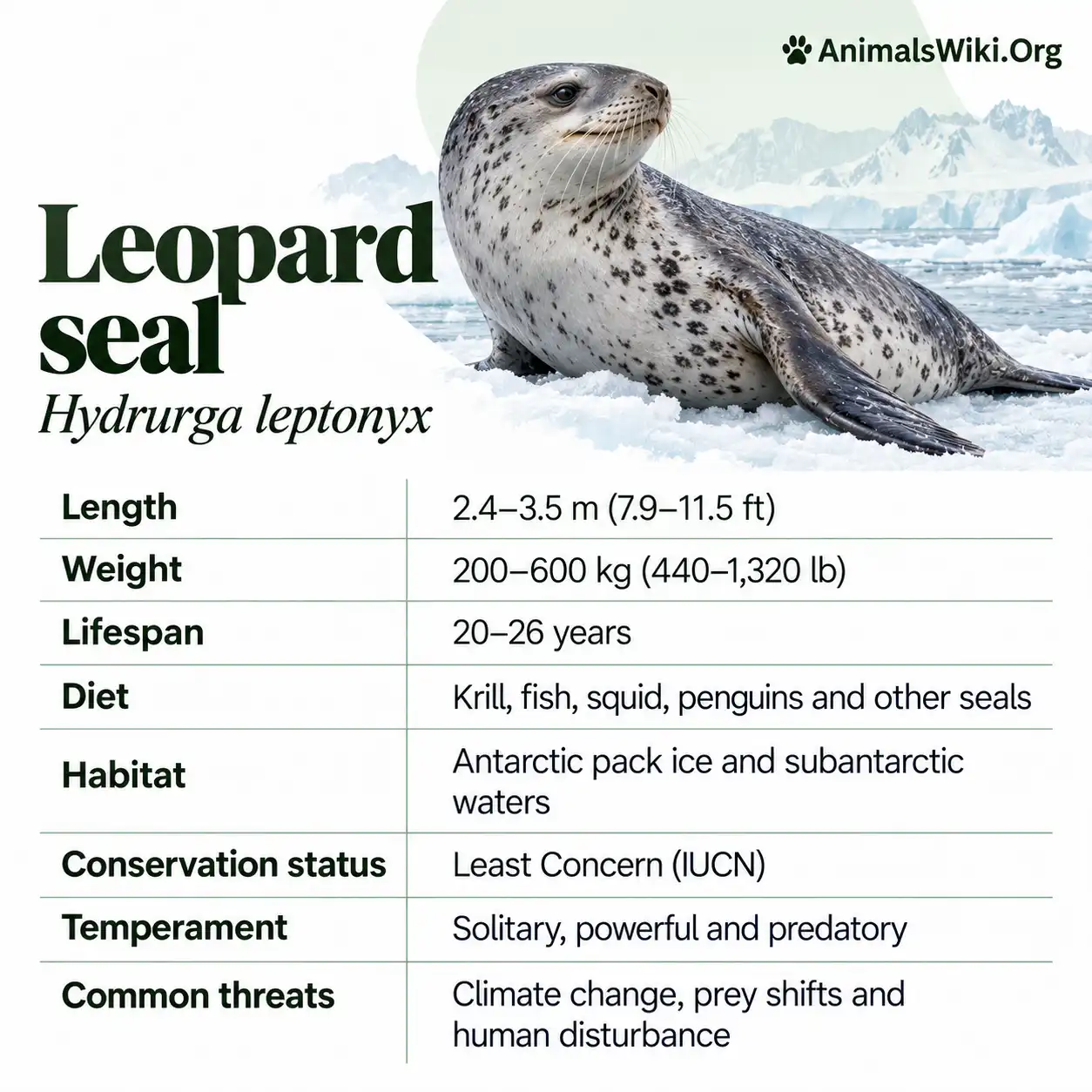
Leopard Seal, Antarctica’s Powerful and Surprisingly Versatile Predator
The leopard seal is a large marine mammal known for its spotted coat, elongated head, powerful jaws, and impressive swimming ability. It lives mainly in Antarctic and surrounding Southern Ocean waters, where it occupies an important position in marine food webs.
Its reputation usually centers on penguin hunting. However, that familiar image reveals only part of its biology. Leopard seals also eat fish, squid, other seals, and tiny crustaceans called krill. Their unusual teeth allow them to handle prey ranging from small swarming animals to comparatively large vertebrates.
This dietary range makes the species especially interesting. A leopard seal can be a predator of penguins during one feeding opportunity and a filter feeder during another. Different individuals may also develop persistent preferences, so the diet of the species does not necessarily describe the routine of every seal.
Although often associated with Antarctic pack ice, leopard seals travel widely. Research has documented long-distance movements, repeated use of particular locations, and regular occurrence farther north.
Their behavior is equally varied. They rest alone, produce elaborate underwater calls, interact around food, and raise single pups whose early development remains incompletely understood.
This guide explores leopard seal identification, habitat, diet, teeth, hunting, movement, diving, reproduction, ecological importance, and conservation. It also explains the difference between documented facts, exceptional records, and details that scientists are still investigating.
Leopard Seal Facts
| Feature | Details |
|---|---|
| Common name | Leopard seal |
| Alternative name | Sea leopard |
| Scientific name | Hydrurga leptonyx |
| Animal group | Mammal |
| Order | Carnivora |
| Family | Phocidae |
| Seal type | True or earless seal |
| Main geographic region | Antarctica and the Southern Ocean |
| Characteristic habitat | Pack ice, coastal waters, and some sub-Antarctic shorelines |
| General adult length | Approximately 2.5–3.5 meters |
| General adult weight | Several hundred kilograms |
| Larger sex | Females |
| Main food categories | Krill, fish, cephalopods, penguins, and other seals |
| Typical social pattern | Mainly solitary |
| Young | Pups |
| Usual litter | One pup |
| Notable feeding adaptations | Large gripping teeth and multi-cusped filtering teeth |
| Recorded diving extreme | A published dive to 1,256 meters lasting 25 minutes |
| Important natural predator | Killer whale |
| Global conservation category | Least Concern |
| Global population total | Uncertain |
1. What Is a Leopard Seal?
A leopard seal is a true seal belonging to the family Phocidae.
It is a mammal that breathes air, maintains a warm body, gives birth to live young, and feeds its offspring with milk.
Its name refers to the spotted appearance of its coat and its predatory reputation. It is not related to the leopard cat beyond the distant relationships shared by mammals.
The species combines an elongated body with a large head and unusually substantial foreflippers.
These features support an aquatic lifestyle involving maneuvering, prey capture, travel, and repeated dives.
Like other seals, it also needs suitable places to leave the water.
Ice floes and shorelines provide opportunities to rest and perform other important activities.
The leopard seal is therefore more than a hunting animal observed beside penguin colonies. Its life includes feeding on different resources, moving through changing habitats, communicating, reproducing, and balancing energy expenditure with the need to survive in cold marine conditions.
2. Scientific Name and Classification
The leopard seal’s scientific name is Hydrurga leptonyx.
It belongs to the true-seal family, Phocidae, and is grouped with the Antarctic lobodontine seals.
| Taxonomic level | Classification |
|---|---|
| Class | Mammalia |
| Order | Carnivora |
| Pinniped group | Pinnipedia |
| Family | Phocidae |
| Subfamily | Monachinae |
| Tribe | Lobodontini |
| Genus | Hydrurga |
| Species | Hydrurga leptonyx |
Its relatives include the Weddell, crabeater, and Ross seals.
These relationships do not imply identical diets.
The crabeater seal is strongly specialized on krill, while the leopard seal uses a much broader collection of prey.
Classification is especially useful when common names become confusing. “Sea leopard” refers to the leopard seal, but an informal description such as “spotted Antarctic seal” could fit more than one animal.
Using the scientific name allows researchers and readers to connect observations with the correct species.
It also makes comparisons among studies more reliable across different countries and languages.
3. What Does a Leopard Seal Look Like?
A leopard seal has a long body, a large head, and a broad mouth.
Its muzzle gives the head a distinctive profile, sometimes described as reptile-like. That is an appearance comparison, not an indication that the animal is a reptile.
The coat is generally darker above and lighter below, with spotting especially noticeable along the lower body and throat.
Color can range from dark gray to silvery tones.
Wetness, lighting, age, and coat condition influence how the markings appear.
The foreflippers are conspicuously long compared with those of several other true seals.
A clear side view often makes identification easier than a photograph of the face alone.
Look for the combination of head shape, body proportions, flipper length, and spotting.
The Australian Museum identifies these same broad features as useful characteristics.
An animal resting on ice may look much less elongated than one stretched out in the water, so posture also matters when interpreting photographs.
4. How Big Is a Leopard Seal?
Adult leopard seals weigh several hundred kilograms and can exceed three meters in length.
Females are generally larger than males.
This is an important distinction because many familiar marine mammals show the opposite pattern.
A large female can exceed 3.5 meters and weigh more than 500 kilograms, although such measurements should not be treated as the standard for every adult.
A study of seals off the western Antarctic Peninsula documented a substantial difference between adult male and female body mass.
The result reinforces the importance of identifying sex and age when comparing size.
Body condition adds further variation.
An individual with substantial reserves may weigh more than another of similar length.
For educational descriptions, a range is more useful than a single supposedly exact measurement.
The animal’s strength also deserves perspective. Even a smaller adult remains a large marine predator, and an appealing resting posture does not reduce its physical capabilities.
5. Leopard Seal vs. Weddell Seal
Leopard and Weddell seals both occur around Antarctica, but they differ in appearance and ecology.
The Weddell seal usually looks heavier and rounder, with a smaller, more rounded head.
The leopard seal has a more elongated profile and a larger mouth.
| Feature | Leopard seal | Weddell seal |
|---|---|---|
| General body shape | Long and relatively streamlined | Broad and heavy |
| Head | Large and elongated | Smaller and more rounded |
| Foreflippers | Especially long | Less conspicuous |
| Characteristic habitat | Pack ice and varied coastal environments | Strong association with coastal fast ice |
| Diet | Broad, including birds and other seals | Mainly fish and other marine prey |
| Familiar behavior | Varied hunting and filtering | Under-ice diving and breathing-hole maintenance |
| Social pattern | Mainly solitary | Seasonal breeding aggregations |
Neither animal should be identified from spotting alone.
Both can have contrasting coat patterns, and poor photographs can obscure their proportions.
The distinction becomes clearer when several features are considered together.
Their differences also explain why one general description of “Antarctic seal habitat” cannot represent every species equally well.
6. Leopard Seal vs. Crabeater Seal
Leopard and crabeater seals share an ability to filter small prey with specialized cheek teeth.
However, their overall feeding strategies are different.
Crabeater seals depend heavily on krill. Leopard seals combine filtering with the ability to capture much larger animals.
A leopard seal’s large front teeth help grip prey, while the cheek teeth contribute to retaining smaller food.
The head is broader and more powerful-looking than the narrow muzzle of a crabeater seal.
Their relationship also includes predation.
Leopard seals take young crabeater seals, and many surviving crabeaters carry scars associated with unsuccessful attacks.
That interaction should not hide the fact that both species also use krill.
Marine food webs contain relationships that overlap rather than fitting into one simple ladder.
Two animals can share a food resource while one also preys on the other.
Understanding that complexity makes the comparison more useful than labeling one seal peaceful and the other aggressive.
7. Where Do Leopard Seals Live?
Leopard seals occur primarily around Antarctica and across parts of the Southern Ocean.
Their distribution is circumpolar, meaning they occur around the continent rather than in only one Antarctic sector.
Pack ice forms a major part of their core habitat.
However, the species is not restricted to one narrow ring of frozen water.
Individuals also use sub-Antarctic islands and appear along more northerly coastlines.
Some of these movements are seasonal, while others involve repeated residency in particular areas.
The important distinction is between the species’ main habitat and the full range of places where individuals can occur.
A seal found outside Antarctica is not automatically lost, starving, or behaving abnormally.
Its condition, history, season, and location need to be considered.
Modern research has shown that the leopard seal’s geographic flexibility is greater than the simplest textbook description suggests.
That wider perspective is particularly important in New Zealand and sub-Antarctic regions.
8. Why Is Pack Ice Important?
Pack ice consists of floating sea-ice floes that move with wind and currents.
For leopard seals, it provides places to rest and, in many cases, raise young.
The surrounding water supplies access to prey.
This means habitat is a combination of the platform and the marine environment around it.
A floe without useful food nearby offers something different from a floe beside productive feeding waters.
The ice also changes through the year.
As it expands, contracts, drifts, and breaks, the relationship between resting sites and food changes.
Leopard seals can respond through movement, but that flexibility does not make sea ice irrelevant.
Breeding and other activities still depend on appropriate conditions.
The ecological importance of ice also extends to prey species.
A change in the frozen environment can influence the distribution of seals, penguins, and krill, creating several routes through which habitat change affects the predator.
9. Are Leopard Seals Found in New Zealand?
Yes. Leopard seals occur regularly in New Zealand waters.
A major review compiled thousands of historical and modern records and challenged the older view that they were only rare, unhealthy visitors.
The records included adults in good condition, sightings across seasons, repeated individuals, and documented births.
This does not mean every New Zealand coastline supports a dense leopard seal population.
It means the region is a meaningful part of the species’ occurrence and should not be dismissed as a collection of accidents.
The distinction affects both research and public understanding.
An animal resting on a beach may be using the location normally rather than needing immediate human intervention.
Its behavior and condition should be assessed appropriately.
New Zealand records also create opportunities to investigate individuals over time, including their diet and movement.
Accessible coastlines can reveal aspects of leopard seal biology that are difficult to document within Antarctic pack ice.
10. Do Leopard Seals Migrate?
Some leopard seals make long-distance seasonal movements, but their movement patterns are not identical.
Research tracking animals associated with South Georgia documented journeys between sub-Antarctic waters and regions closer to Antarctic pack ice.
Other individuals spend longer periods around relatively localized feeding areas.
This variation makes “migratory” an incomplete description unless the population and behavior are specified.
A seal may repeatedly return to a familiar area while also traveling widely during another part of the year.
Movement also reflects changing opportunities.
Prey, sea temperature, ice conditions, and reproductive demands can influence where an animal goes.
The journey should therefore be understood as part of its wider annual strategy.
A line on a tracking map shows where the animal traveled, but interpreting why requires information about the environment and what the seal was doing.
That combination helps explain how a solitary predator connects distant marine regions.
11. What Do Leopard Seals Eat?
Leopard seals consume a broad range of animal prey.
Important categories include:
- Antarctic krill and other crustaceans.
- Fish.
- Squid and other cephalopods.
- Penguins and other seabirds.
- Other seals, particularly vulnerable young animals.
The relative importance of these foods changes.
Location, season, sex, body size, and individual preferences all influence diet.
A leopard seal feeding near a fur seal colony may have a different routine from one using offshore krill resources.
This is why a universal percentage for penguins, fish, or krill is misleading.
Research combining several dietary methods found meaningful variation across years and among individuals.
The species can be described as a dietary generalist, but that population-level description does not mean every individual eats the full menu.
Understanding the difference between a species’ combined diet and an individual’s habits is central to leopard seal ecology.
12. Why Individual Food Preferences Matter
Some leopard seals develop consistent patterns of resource use.
A 2025 study analyzed chemical signatures along whiskers and found substantial individual specialization within a population that collectively used a broad range of foods.
Some animals appeared to remain at similar feeding levels over time, while others changed.
This matters because a small number of specialized predators can have a large local effect.
A seal repeatedly targeting pups at one colony may influence that prey population differently from an individual feeding mainly on lower-trophic-level resources.
The distinction also helps explain why two leopard seals in the same region can behave differently.
Neither observation needs to be wrong.
They may represent different individuals pursuing different opportunities.
For readers, the practical lesson is to avoid treating one dramatic feeding event as the complete diet of every leopard seal.
The species’ flexibility includes differences among individuals, not only changes within one animal’s daily menu.
13. The Leopard Seal’s Two-Part Feeding Equipment
The leopard seal’s mouth supports two very different feeding tasks.
Large front teeth help grip comparatively large prey.
Farther back, multi-cusped cheek teeth can act as a filtering structure.
This combination allows the animal to use both large vertebrates and small crustaceans.
It is more informative than describing every tooth as a weapon for tearing penguins.
Different parts of the mouth contribute differently.
The animal’s jaws, lips, tongue movements, and water flow also participate in feeding.
Research on suction and filtering demonstrated that the leopard seal is capable of changing feeding mechanisms rather than relying on one fixed action.
This makes it an unusual example of anatomical versatility.
Its broad diet is supported by more than willingness to try different foods.
It has physical structures and behaviors that help it obtain resources differing enormously in size, movement, and handling requirements.
14. How Do Leopard Seals Filter Krill?
When feeding on small prey, a leopard seal can take food and water into its mouth and then remove water while retaining prey.
The cheek teeth contribute to that separation.
This differs from biting and holding a single large animal.
Suction can also assist prey capture by drawing food toward or into the mouth.
The animal therefore uses water movement as part of the feeding mechanism.
Its ability to filter krill helps explain how a predator famous for taking penguins can also feed at a much lower level in the food web.
The two behaviors are not contradictory.
They reflect a flexible feeding system responding to available resources.
The comparison with crabeater seals is useful, but the leopard seal is not simply a larger version of that specialist.
Its filtering ability operates alongside a capacity for other forms of predation, giving it access to a wider range of feeding opportunities.
15. How Do Leopard Seals Hunt Penguins?
Penguin hunting often takes place near places where birds enter or leave the water.
A leopard seal may wait around an ice edge, shoreline, or underwater approach route.
The important opportunity is not simply the presence of penguins on land.
The seal needs access to birds within its aquatic hunting environment.
Once captured, larger prey may be handled at the surface through vigorous movements that help separate edible portions.
These events can appear dramatic because the predator must process food without hands or a stable cutting surface.
However, the visible handling stage should not be confused with the entire hunt.
Finding an opportunity, approaching, accelerating, capturing, and retaining prey are separate challenges.
Individual experience and local conditions influence success.
The familiar image of a leopard seal beside a penguin colony therefore represents a specialized interaction within a much broader life that includes travel, resting, other foods, and reproduction.
16. Hunting Other Seals
Leopard seals prey on other pinnipeds, with pups and young animals particularly important in several documented interactions.
Antarctic fur seal pups have been studied extensively at some colonies.
Crabeater and other Antarctic seal young also occur among recorded prey.
The significance varies by location.
A leopard seal using one colony repeatedly can have a concentrated effect that would be hidden within an ocean-wide average.
Animal-borne video research documented ambush tactics used by some adult females hunting fur seal pups.
The observations also showed that not every animal in the study used the same tactics.
This helps explain why the predator’s ecological effect depends on identity as well as abundance.
Ten seals do not necessarily produce ten equivalent patterns of predation.
Their size, experience, food preferences, and use of particular sites can create substantial differences in how they interact with prey populations.
17. Can Leopard Seals Eat Sharks?
Some leopard seals consume cartilaginous fishes.
Research in New Zealand documented prey including spiny dogfish, elephantfish, and ghost sharks.
These are not interchangeable animals: spiny dogfish are sharks, while elephantfish and ghost sharks are chimaeras.
The findings expanded the known diet and reinforced the importance of northern feeding areas.
However, they should not be rewritten as evidence that leopard seals routinely hunt large sharks throughout Antarctica.
The observations concern particular prey, locations, and individuals.
Some animals appeared to target these foods repeatedly, fitting the wider pattern of individual specialization.
The study also combined direct observations with analysis of droppings.
That approach strengthened the evidence beyond a single unusual encounter.
For readers, the useful conclusion is that leopard seal diets can be broader than familiar polar documentaries suggest, especially when scientists investigate populations outside the most frequently studied Antarctic sites.
18. Scavenging, Prey Theft, and Shared Feeding
Leopard seals do not obtain every meal through a fresh capture.
Researchers have recorded scavenging and the theft of prey from other leopard seals.
Prey theft is called kleptoparasitism.
It can create competition around a food item even when the animals otherwise spend much of their time alone.
Rare observations have also documented two leopard seals feeding from the same carcass with unusual tolerance.
Whether a particular event represents cooperation, tolerance, or difficulty defending the food requires careful interpretation.
A shared carcass does not automatically prove a stable hunting partnership.
Likewise, stealing food is not evidence that an individual lacks hunting ability.
Different strategies can provide energy under different conditions.
These interactions add complexity to the species’ role.
Its impact includes capturing prey, consuming remains, and changing how other predators retain or lose food.
19. How Do Leopard Seals Swim?
Leopard seals are powerful, maneuverable swimmers.
Their long foreflippers are particularly important.
Although true seals are often described as using the hindquarters for propulsion, leopard seals demonstrate that swimming styles form a broader continuum.
Research on forelimb-propelled swimming found features in leopard seals that support effective use of the front flippers during movement, turning, and acceleration.
This is a useful correction to an overly rigid division between true seals and sea lions.
The leopard seal remains a true seal even though some aspects of its swimming resemble patterns associated with eared seals.
Its elongated body also supports movement through water.
On ice or land, the same anatomy produces a very different result.
The animal uses muscular body movements rather than walking efficiently like a sea lion.
Comparing the two settings shows why an animal that looks awkward while hauled out can be highly capable in its principal feeding environment.
20. How Deep Can Leopard Seals Dive?
A published tracking study recorded a leopard seal diving to 1,256 meters during a dive lasting 25 minutes.
That observation greatly exceeded earlier published depth records.
However, it was an exceptional event.
The same research found that the studied seals generally made much shallower, shorter dives.
This distinction is essential.
A maximum record describes demonstrated capacity, while routine diving reflects what is useful under ordinary circumstances.
An animal hunting near the surface has no reason to make its deepest possible dive every time.
Deep capability and shallow habits can therefore coexist.
For a leopard seal, feeding opportunities may often be available without prolonged travel into deep water.
The record expands understanding of what the species can do, but it should not replace the more representative description of flexible diving, commonly involving relatively shallow water and short underwater periods.
21. Why Are Many Dives Short and Shallow?
Much of the leopard seal’s accessible food can occur near the surface or in coastal water.
Penguins and other air-breathing prey must return to the surface, while some fish and krill resources can also be reached without an extreme dive.
This makes feeding efficiency more important than depth alone.
A short dive may allow repeated opportunities with less travel and recovery.
The animal must balance time underwater against the need to breathe.
It also needs to retain and process prey after capture.
A dive lasting only a few minutes is therefore not evidence of poor adaptation.
It may be appropriate to the task.
The same general principle applies across marine predators: the most successful strategy is not necessarily the one that uses maximum physical capacity.
Leopard seals illustrate this especially clearly because their documented ability to dive deeply contrasts with the shallower behavior frequently observed during coastal feeding.
22. What Does Hauling Out Mean?
A leopard seal hauls out when it leaves the water to rest on ice or land.
Hauling out supports several activities, including resting, molting, and maternal care.
The amount of time spent out of the water changes among individuals and seasons.
Long-term tracking has recorded substantial variation in both haul-out periods and continuous time at sea.
This matters when scientists count animals.
A shore or ice survey sees only the individuals available to observation.
Seals in the water may remain undetected.
The number visible therefore depends partly on behavior, not only on population size.
For the individual, hauling out also forms part of the energy budget.
An animal resting on a beach is not necessarily stranded.
It may be performing a normal activity.
The appropriate response is to observe without forcing it back into the water or surrounding it with people.
23. Are Leopard Seals Solitary?
Leopard seals are mainly solitary.
However, solitary does not mean that individuals never meet or gather.
Productive feeding areas can attract several animals.
Breeding introduces another context for interaction, and mothers remain associated with dependent pups.
A temporary gathering should not automatically be described as a stable colony or social pack.
The underlying reason for proximity matters.
Some interactions around food are aggressive, while rare events show tolerance.
This range makes simple personality labels unhelpful.
An animal can spend most of its time alone while communicating extensively and responding to neighbors.
The species’ social life is therefore better understood through specific contexts: feeding, reproduction, maternal care, and the use of resting sites.
A photograph of two animals together captures one moment within that wider system.
It does not establish that leopard seals routinely cooperate or maintain lifelong partnerships.
24. Underwater Calls and Breeding Displays
Leopard seals produce distinctive underwater vocalizations.
Research has identified different sound types and connected some broadcast calls with the reproductive period.
Both males and females can vocalize.
A study of managed animals linked certain calls with reproductive condition, while other sounds occurred during direct interactions.
Field research has also documented differences associated with age and size.
Calling can therefore carry information beyond the mere presence of an animal.
The acoustic environment matters because individuals may be widely separated or hidden by water and ice.
Sound creates opportunities for contact without a close visual encounter.
However, exact messages require evidence.
A low call is not automatically a threat, and every underwater sound should not be translated into a human sentence.
Scientists examine timing, structure, caller characteristics, and behavioral context to investigate function.
That approach reveals a more complex animal than the silent predator often shown in photographs.
25. Why Do Calling Rates Change?
Producing repeated underwater calls takes time and energy.
Researchers have investigated whether leopard seal calling patterns differ among animals and across the breeding season.
One study found that larger males maintained more consistent calling rates, while smaller animals showed greater disruption at the seasonal peak.
Another examined differences between adult and younger male vocal behavior.
These results suggest that calling patterns can reflect characteristics of the caller.
However, they do not provide a simple rule allowing anyone to calculate body size from one recording.
The relationship involves repeated measurements and context.
The broader point is that communication is part of the animal’s biological performance.
It occurs alongside feeding, diving, and maintaining condition.
For a solitary marine mammal, a broadcast display may be important precisely because potential mates and rivals are not always nearby.
Listening therefore reveals behavior that visual surveys alone can miss.
26. When Do Leopard Seals Give Birth?
Leopard seal births are associated broadly with the austral spring and early summer, but timing varies geographically.
A review of documented records found births from September through December.
It also showed that reproduction is not confined exclusively to Antarctic pack ice.
Births have been recorded farther north, including in New Zealand and Chile.
These findings challenge the simplified description that every female gives birth on an Antarctic floe in one particular month.
However, the records are sparse and unevenly distributed.
They should not be treated as a complete picture of worldwide birth timing.
The practical conclusion is that the reproductive range is broader than older generalizations suggested.
For conservation, northern records matter because they show that areas outside the core Antarctic environment can contribute to important life-history events.
Understanding where births occur is necessary before assuming which habitats require protection during reproduction.
27. What Are Leopard Seal Pups Like?
A female normally gives birth to one pup.
The young animal depends on maternal milk and care during early development.
Compared with the adult, it is small and must grow, develop swimming abilities, and make the transition toward independent feeding.
Newborn measurements are less securely documented than many popular fact sheets suggest.
A review found that some widely repeated statements were based on very limited records or unclear age categories.
This makes it important to distinguish a newborn from an older pup.
A large young seal photographed beside a female may already be weeks or months old.
Its dimensions should not automatically become a birth measurement.
The most reliable description emphasizes the known pattern: single young, maternal dependence, and a period of rapid development.
Exact growth schedules remain an important research need, especially because observing the complete early life of an animal in remote ice habitat is difficult.
28. How Long Do Leopard Seal Pups Nurse?
The nursing period is often summarized as approximately two to four weeks.
However, the scientific literature contains a wider range of estimates, and direct evidence remains limited.
It is therefore better to describe the usual figure as an estimate rather than a precisely established duration applying everywhere.
Maternal attendance also needs more study.
A female’s absence during one observation does not show that she has abandoned her pup.
Likewise, a mother remaining on a floe for several days does not prove that every female fasts continuously throughout lactation.
Recent research has emphasized these gaps.
The uncertainty should not make the animal seem poorly adapted.
It reflects the difficulty of observing a solitary marine mammal through an entire reproductive event.
Following mothers and pups with appropriate methods would improve understanding of nursing, movement, weaning, and the youngster’s transition to independent survival.
29. How Long Do Leopard Seals Live?
Leopard seals can live for more than two decades.
The Australian Antarctic Program reports that individuals may live for 26 years or more.
That is useful as a longevity reference, but it should not be interpreted as a guaranteed lifespan.
Survival varies with age, condition, injury, food access, and environmental circumstances.
A maximum record differs from an average.
Wild longevity is also more difficult to establish than the age of an animal whose entire life is documented.
For population research, repeated observations of recognizable individuals are valuable.
They help distinguish survival from temporary absence and reveal whether animals return to familiar places.
The ecological significance of longevity includes experience.
An individual may develop repeated use of feeding areas and particular prey over time.
Understanding that history can therefore contribute to knowledge of both survival and the predator’s continuing influence on local food webs.
30. What Eats Leopard Seals?
Killer whales are the main recognized natural predators of leopard seals.
However, the relationship should not be simplified into the idea that every killer whale hunts them regularly.
Killer whale populations and groups differ in feeding habits.
Actual encounters depend on location, opportunity, and prey choice.
Other fatal interactions have occasionally been reported, but rare incidents should not become a standard predator list.
The term apex predator also needs context.
It describes a high position within a food web, not complete immunity from being killed or eaten.
A leopard seal can exert strong predatory effects while remaining vulnerable in some circumstances.
Its survival is also influenced by factors unrelated to predation.
Injury, changing food conditions, and human-associated threats can matter.
The most useful picture is of a powerful consumer within an interconnected ecosystem rather than an invulnerable animal outside the normal processes affecting wildlife.
31. Are Leopard Seals Dangerous to Humans?
Leopard seals are large wild predators and can be dangerous.
A documented fatal attack occurred in 2003, when marine biologist Kirsty Brown was pulled underwater while snorkeling near Rothera Research Station.
That event should be acknowledged without turning the species into a sensationalized monster.
Research on human interactions found that context mattered, including whether encounters occurred near hunting opportunities at an ice edge.
An approaching animal may be investigating, but apparent curiosity does not make close contact safe.
Photographs of calm encounters do not remove the risks associated with size, teeth, and unpredictable behavior.
The practical approach is to follow professional local guidance, maintain distance, and avoid entering the water to seek an interaction.
On shore, do not surround a resting seal or block its route.
Respectful separation protects both people and animals and allows behavior to be observed without unnecessary pressure.
32. How Many Leopard Seals Are There?
The worldwide population is not known with high precision.
Published estimates differ considerably because they come from different periods, methods, and survey coverage.
A widespread solitary animal living in moving pack ice is difficult to count.
Animals underwater are unavailable to a visual survey, and remote regions may be poorly sampled.
Genetic research provides another kind of information, but its estimates require careful interpretation.
A study estimating an effective population size did not produce a direct headcount of all living leopard seals.
Effective population size describes a genetic concept related to breeding and inheritance.
It should not be substituted for census abundance.
For a general article, the accurate message is that leopard seals are widespread, but their precise global number and trend remain uncertain.
Repeating a rounded historical estimate as a current live total would create more confidence than the available evidence supports.
33. Are Leopard Seals Endangered?
The leopard seal is currently classified as Least Concern in the referenced global conservation information.
The latest listed assessment is from 2026 and retains that category.
Least Concern does not mean the species faces no threats.
It indicates that the assessment does not place it within a higher global extinction-risk category.
Local conditions can differ from the global picture.
A species may remain widespread while its distribution, prey relationships, or use of particular habitats changes.
This is especially relevant for an Antarctic predator whose biology is still incompletely documented.
The appropriate conservation message is therefore balanced.
Leopard seals are not currently classified as globally Endangered, and continued research remains important.
Maintaining suitable habitat and understanding population change are worthwhile before a species reaches a higher-risk category.
Conservation is more effective when it supports functioning ecosystems rather than waiting for a dramatic decline to become undeniable.
34. Climate Change and Effects on Other Species
Changes in sea ice can influence where leopard seals rest, reproduce, and encounter prey.
Those effects can extend beyond the seals themselves.
If animals shift feeding areas or concentrate around breeding colonies, local prey populations may experience altered predation pressure.
Research at Cape Shirreff linked heavy leopard seal predation with serious losses among Antarctic fur seal pups.
That is a local ecological result, not proof that every fur seal population faces the same pattern.
It nevertheless demonstrates how environmental change can interact with predator behavior.
A flexible predator may continue finding food while causing new pressures elsewhere.
Adaptability therefore does not mean ecosystem relationships remain unchanged.
Understanding climate effects requires attention to indirect pathways as well as immediate habitat loss.
The important questions include where seals move, which prey they target, and how those changes combine with food availability and other pressures affecting the wider community.
35. How Scientists Study Leopard Seals
Researchers combine tracking, photographs, cameras, acoustic recordings, dietary analysis, and genetics.
Each method reveals a different part of the animal’s life.
Tracking shows movement and diving.
Animal-borne video connects those movements with visible feeding behavior.
Photographic identification helps follow recognizable individuals across time.
Aerial photogrammetry can estimate body dimensions and condition from carefully collected images.
A study using unoccupied aircraft tested those measurements against known leopard seal sizes, demonstrating the potential for less intrusive assessment.
However, scientific drone use involves suitable methods and authorization. It is not a reason for visitors to fly close to resting wildlife.
The strongest research combines information across scales.
An individual’s food preferences, a colony’s predation pressure, and an ocean-wide distribution are different questions.
Together, they help explain how leopard seals live and how their influence changes across locations and years.
36. Protecting Leopard Seals and Their Habitat
Protecting leopard seals involves more than preserving individual animals.
They need suitable marine habitat, accessible food, and places to rest and reproduce.
Human-associated risks include entanglement, disturbance, and harassment by people or dogs in coastal areas.
Responsible observation can reduce avoidable pressure.
Keep a respectful distance, secure dogs, and avoid trying to move a resting animal.
If an individual appears injured or entangled, report it to the relevant wildlife authority rather than attempting a close intervention.
Verified sightings can also support research when recorded without disturbance.
Useful details include time, location, clear photographs, and behavior.
The leopard seal’s future is tied to a functioning Southern Ocean, but its northern range also deserves attention.
Its story combines power with flexibility: a spotted predator capable of filtering tiny krill, taking larger prey, traveling widely, and revealing how much remains to be learned about Antarctic marine life.
Frequently Asked Questions About Leopard Seals
1. What is the scientific name of the leopard seal?
The scientific name is Hydrurga leptonyx. It belongs to Phocidae, the true-seal family, alongside several other Antarctic seals.
2. Why is it called a leopard seal?
The name refers mainly to its spotted coat and predatory reputation. It is a marine mammal and is not a type of cat.
3. Where do leopard seals live?
They occur mainly around Antarctica and in the Southern Ocean. They also use sub-Antarctic islands and occur regularly in some more northerly waters, including New Zealand.
4. Are leopard seals found in the Arctic?
They are not normally Arctic animals. Their main distribution is in the Southern Hemisphere, so they do not naturally share the usual habitat of polar bears.
5. How large is an adult leopard seal?
Adults are several meters long and weigh several hundred kilograms. Large females can exceed 3.5 meters and 500 kilograms, although size varies substantially.
6. Are females larger than males?
Yes. Female leopard seals are generally larger than males. This contrasts with the strongly male-biased size difference seen in animals such as elephant seals.
7. What do leopard seals eat?
Their diet includes krill, fish, cephalopods, penguins, and other seals. The balance varies with individual preferences, location, season, and other conditions.
8. Do leopard seals eat mostly penguins?
That is not a reliable universal description. Penguins are important prey in some situations, but krill and other foods can contribute substantially, and individual diets differ.
9. Can leopard seals filter feed?
Yes. Their multi-cusped cheek teeth help retain small prey while water escapes. They can also use suction during feeding.
10. Why do they have such large front teeth?
The front teeth help grip larger prey. Different parts of the mouth contribute to different feeding tasks, supporting the species’ unusually broad range of prey sizes.
11. Do leopard seals eat other seals?
Yes. They take other pinnipeds, particularly vulnerable young animals. The importance of this predation differs among locations and individual leopard seals.
12. Can leopard seals eat sharks?
Research in New Zealand has documented consumption of spiny dogfish and other cartilaginous fishes. This does not mean they routinely hunt large sharks throughout their range.
13. How deep can a leopard seal dive?
A published record reached 1,256 meters. It was exceptional; routine dives in the same research were generally much shallower.
14. How long can they remain underwater?
A documented extreme lasted 25 minutes. Many ordinary dives are much shorter, reflecting the depth and accessibility of the prey being targeted.
15. Are leopard seals good swimmers?
Yes. They are powerful and maneuverable, with long foreflippers contributing to propulsion and turning. Their movement in water differs greatly from their movement on ice or land.
16. Do leopard seals live in groups?
They are mainly solitary. Several may gather around concentrated food, but a temporary aggregation does not establish permanent group living.
17. Do leopard seals cooperate when hunting?
Rare shared-feeding events have been observed, but cooperation should not be assumed. Some interactions involve tolerance or prey theft rather than a coordinated hunting partnership.
18. What sounds do leopard seals make?
They produce several underwater call types, including broadcast calls associated with breeding. Calling patterns can vary with age, size, reproductive state, and context.
19. When do leopard seals have pups?
Birth timing varies geographically. A review documented births from September to December and showed that reproduction is not restricted exclusively to Antarctic pack ice.
20. How many pups does a female have?
A female normally produces one pup. The youngster depends on maternal milk and care during early development.
21. How long do pups nurse?
Approximately two to four weeks is frequently cited, but direct evidence remains limited and published estimates vary. A precise universal duration has not been established.
22. How long do leopard seals live?
They can live for more than two decades, with references reporting 26 years or more. That is a longevity figure rather than a guaranteed lifespan.
23. What are their natural predators?
Killer whales are the main recognized natural predators. Actual predation varies among whale groups, locations, and opportunities.
24. Are leopard seals dangerous to people?
Yes. They are large wild predators, and a fatal attack has been documented. Maintain distance and follow professional guidance rather than seeking close contact.
25. Are leopard seals endangered?
Their referenced global conservation category is Least Concern. Nevertheless, uncertain population trends and changing habitats make continued research and protection important.



