
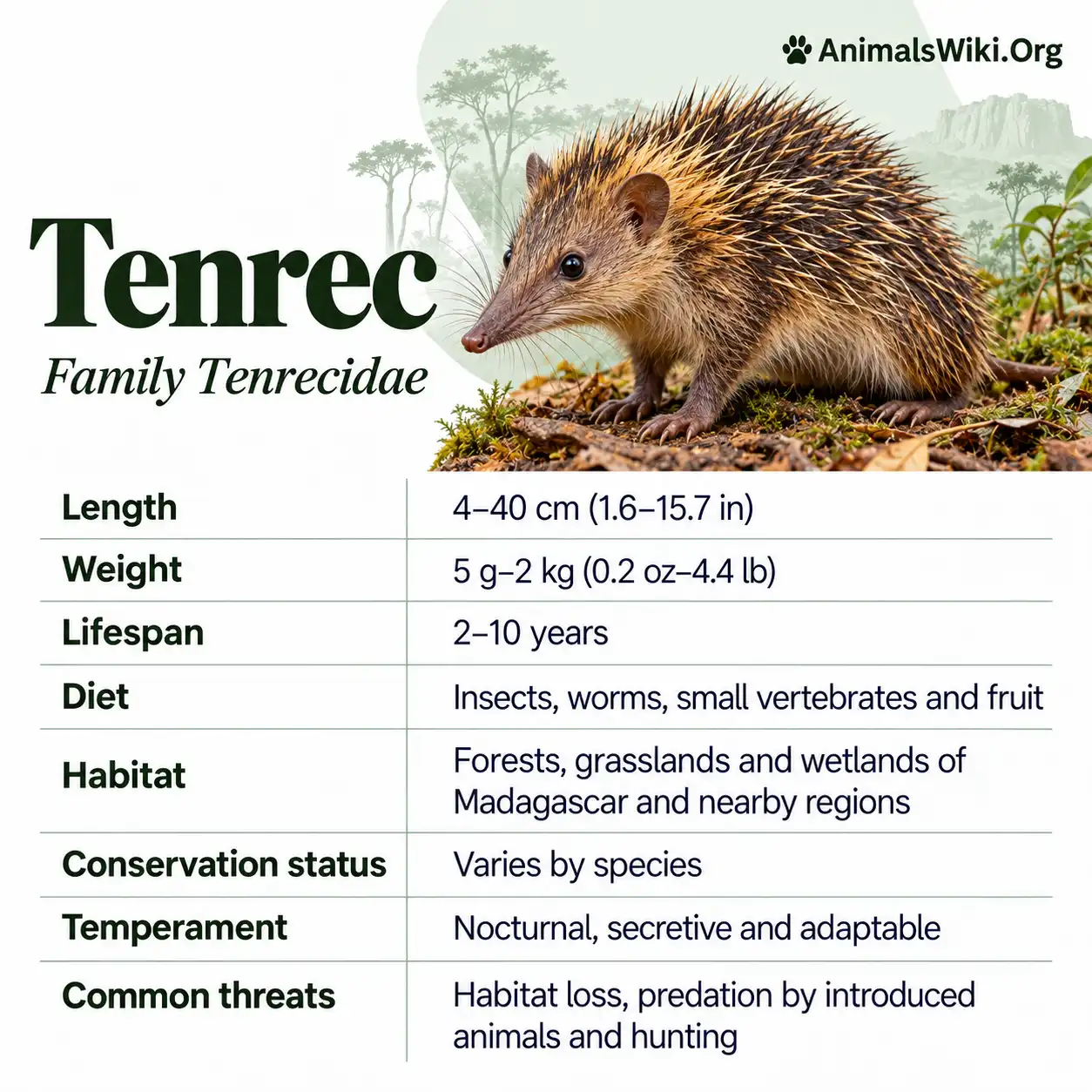
Tenrec, Madagascar’s Remarkable Mammal With Many Different Forms
A tenrec is a small mammal belonging to a remarkably diverse group native to Madagascar. Some tenrecs resemble hedgehogs, others look like shrews, and a few have adaptations associated with digging or swimming. Despite those familiar appearances, they belong to their own distinctive mammalian family.
The name does not describe one animal with one lifestyle. It covers a radiation of species that use different habitats, eat different prey, and vary considerably in size, body covering, and behavior.
The lesser hedgehog tenrec is perhaps the best-known example. Its pointed face, compact body, and protective spines make it easy to mistake for a true hedgehog. The resemblance is misleading: the two belong to different evolutionary lineages.
Other tenrecs are equally extraordinary. Streaked tenrecs can produce sound with specialized quills. The web-footed tenrec hunts in streams. Common tenrecs can enter prolonged periods of reduced activity and metabolism.
These animals also face conservation challenges. Some tolerate disturbed habitats, while others depend on restricted areas of forest or healthy freshwater systems.
This guide explores what tenrecs are, the different forms they take, how they survive Madagascar’s changing conditions, and why their conservation requires attention to much more than the familiar spiny species.
Tenrec Facts
| Feature | Information |
|---|---|
| Animal type | Mammal |
| Family | Tenrecidae |
| Order | Afrosoricida |
| Broader evolutionary group | Afrotheria |
| Recognized living species | 31 in the classification used here |
| Native distribution | Madagascar |
| Introduced populations | Some species, especially the common tenrec, occur on other islands |
| Body covering | Fur, bristles, spines, or combinations |
| Main foods | Primarily animal prey, especially invertebrates; diet varies by species |
| Activity | Many species are mainly nocturnal |
| Special adaptations | Digging, climbing, swimming, torpor, and quill-based sound production |
| Reproduction | Live birth and maternal milk |
| Conservation | Varies from Least Concern to threatened categories |
1. What Is a Tenrec?
A tenrec is a member of Tenrecidae, a family of placental mammals.
The family belongs to the order Afrosoricida, which also includes golden moles.
Tenrecs are best understood as a group rather than a single recognizable body shape. Their diversity includes spiny, shrew-like, burrowing, and semi-aquatic forms.
All living members of Tenrecidae are native to Madagascar under the modern classification used here.
Some populations have been introduced elsewhere by people, but introduction does not change their evolutionary origin.
Like other mammals, tenrecs have hair, produce milk, and give birth to live young.
Their distinctive biology includes unusual flexibility in body temperature and metabolism in several species.
However, a feature documented in one tenrec should not automatically be assigned to every other species. A stream-hunting web-footed tenrec and a spiny terrestrial tenrec face different environmental demands and have different ways of meeting them.
2. How Many Tenrec Species Are There?
The classification used in this article recognizes 31 living species.
They are distributed among several genera, including:
- Tenrec
- Echinops
- Setifer
- Hemicentetes
- Geogale
- Microgale
- Nesogale
- Oryzorictes
The largest share belongs to the shrew-tenrec genus Microgale.
This diversity is easy to underestimate because photographs and popular accounts often concentrate on hedgehog-like species.
Taxonomy has also changed.
Older references may include African otter shrews within Tenrecidae or place the web-footed tenrec in a separate genus called Limnogale.
Current treatments place that aquatic species in Microgale and recognize otter shrews as a separate family.
Scientific names help resolve these differences.
When comparing sources, check whether a species count includes only Malagasy tenrecs or also follows an older classification containing mainland African animals.
3. Tenrec vs Hedgehog: What Is the Difference?
A hedgehog tenrec and a true hedgehog can look strikingly similar.
Both may have pointed faces, compact bodies, and defensive spines.
Nevertheless, they belong to different mammalian lineages.
Their resemblance is an example of convergent evolution: similar features evolved in separate groups.
| Feature | Hedgehog tenrec | True hedgehog |
|---|---|---|
| Family | Tenrecidae | Erinaceidae |
| Order | Afrosoricida | Eulipotyphla |
| Native association | Madagascar | Parts of Africa, Europe, and Asia |
| Spiny covering | Present in hedgehog tenrecs | Present |
| Evolutionary identity | Afrotherian mammal | Different placental lineage |
| Biology | Species-specific tenrec adaptations | Hedgehog-specific adaptations |
A tenrec is therefore not a Malagasy breed of hedgehog.
The distinction matters beyond names. Reproduction, physiology, behavior, and environmental needs differ.
An observation or care recommendation about one group should not be transferred automatically to the other merely because the animals share a spiny appearance.
4. Are Tenrecs Related to Elephants?
Tenrecs belong to Afrotheria, a broad evolutionary group that also includes elephants, hyraxes, manatees, dugongs, aardvarks, golden moles, and elephant shrews.
That relationship is ancient.
It does not mean a tenrec descended from a modern elephant or that it is a tiny version of one.
Within the broader group, tenrecs are associated more closely with golden moles and otter shrews than with hedgehogs.
Modern genetics has been important in clarifying these relationships.
The findings demonstrate why outward appearance can be unreliable when reconstructing ancestry.
A small spiny animal can be more closely related to an elephant than to another small spiny mammal.
The correct lesson is not that anatomy is useless, but that evolutionary history requires several kinds of evidence.
Teeth, skeletons, molecular data, and fossils contribute different information to the scientific picture.
5. What Does a Tenrec Look Like?
There is no single appearance shared equally by every tenrec.
Many have elongated snouts, small eyes, and bodies suited to searching close to the ground.
Their coats differ dramatically.
Some have conspicuous spines. Others have soft fur, bristles, or mixtures of hair and stiff structures.
Tails also vary. A hedgehog tenrec’s tail may be barely visible, while several shrew tenrecs have long tails.
The streaked species are especially distinctive because contrasting markings run along their bodies.
The web-footed tenrec has a body and feet adapted to life around streams.
These differences explain why identifying an unfamiliar tenrec requires more than recognizing a general “hedgehog shape.”
A photograph showing the face, body covering, tail, and feet is more useful than a close-up of spines alone.
Habitat and location provide additional clues, especially when distinguishing similar-looking small forest species.
6. How Big Do Tenrecs Get?
Tenrec size varies enormously within the family.
Small shrew-like species weigh only a few grams, while the common tenrec can weigh more than a kilogram.
The lesser hedgehog tenrec occupies an intermediate range.
Smithsonian information gives approximately 14–18 centimeters in body length and 113–255 grams in weight for that species.
| Tenrec form | General size pattern |
|---|---|
| Small shrew tenrecs | Very small, lightweight mammals |
| Large-eared tenrec | Small and delicate |
| Hedgehog tenrecs | Compact animals weighing hundreds of grams |
| Common tenrec | One of the largest members of the family |
Age, sex, season, and body condition also affect measurements.
An animal preparing for a period of reduced activity may have a different mass from the same individual afterward.
For comparisons, distinguish a typical adult measurement from an exceptional maximum.
The family’s size diversity is another reason that one species cannot serve as a complete model for every tenrec.
7. Important Tenrec Species to Know
The following examples illustrate the family’s variety rather than listing every species.
| Common name | Scientific name | Notable feature |
|---|---|---|
| Common or tailless tenrec | Tenrec ecaudatus | Large body and potentially large litters |
| Lesser hedgehog tenrec | Echinops telfairi | Compact, spiny appearance |
| Greater hedgehog tenrec | Setifer setosus | Hedgehog-like defensive form |
| Lowland streaked tenrec | Hemicentetes semispinosus | Contrasting markings and specialized quills |
| Highland streaked tenrec | Hemicentetes nigriceps | Highland-associated streaked species |
| Large-eared tenrec | Geogale aurita | Small body and prominent ears |
| Common rice tenrec | Oryzorictes hova | Digging adaptations |
| Web-footed tenrec | Microgale mergulus | Semi-aquatic stream hunting |
Common tenrec
The common tenrec is also called the tailless tenrec.
It is relatively large and has a long snout.
Its coat includes hair and stiff bristles rather than the neat, dense covering familiar from a hedgehog.
Young animals can have conspicuous rows of pale spines that change as they mature.
This species is important in research on metabolism, hibernation, and reproductive biology.
Lesser hedgehog tenrec
The lesser hedgehog tenrec is among the best-known species in zoological collections.
Its spines and rounded shape create the familiar hedgehog resemblance.
It can climb and forage in more than one vertical layer of its habitat.
Its biology also includes torpor and considerable flexibility in body temperature.
Those traits make it scientifically interesting beyond its distinctive appearance.
Greater hedgehog tenrec
The greater hedgehog tenrec is a separate species in the genus Setifer.
It has a spiny coat and can curl defensively.
It is mainly active at night and shelters during the day.
Its reproduction differs from that of the common tenrec, illustrating why family-wide claims about litter size can be misleading.
A name containing “hedgehog” describes resemblance rather than membership in the hedgehog family.
Lowland streaked tenrec
The lowland streaked tenrec has a conspicuous pattern of contrasting stripes and spines.
It is associated with humid habitats in eastern Madagascar.
Its specialized sound-producing quills are among the most unusual features in the family.
The animal combines this acoustic adaptation with a lifestyle that includes searching for prey in ground-level habitats.
Highland streaked tenrec
The highland streaked tenrec is a separate species, Hemicentetes nigriceps.
It shares the streaked body form but should not be treated as merely a color variant of the lowland species.
It also has specialized quills involved in sound production.
Scientific names are useful when comparing information about the two, because general references sometimes discuss streaked tenrecs together.
Large-eared tenrec
The large-eared tenrec is a tiny species with conspicuous ears and a shrew-like appearance.
Its diet emphasizes small invertebrates, including termites.
It demonstrates how different a tenrec can look from the spiny animals most people recognize.
Its feeding and reproductive biology have been investigated in studies using animals maintained in Madagascar.
Common rice tenrec
The common rice tenrec has structural adaptations for digging.
Its forelimbs and hands help it work through the ground.
Anatomical studies have compared these features with those of other tenrecs, showing that related species can develop different degrees of specialization for underground activity.
Web-footed tenrec
The web-footed tenrec hunts in streams and has adaptations for a semi-aquatic lifestyle.
Its current scientific name is Microgale mergulus.
Older literature commonly calls it Limnogale mergulus.
It belongs to the Malagasy tenrec radiation rather than to the mainland African otter-shrew family.
8. Where Do Tenrecs Live?
Living Tenrecidae are native to Madagascar under the modern classification followed here.
The island contains very different environments, including humid forests, dry forests, highlands, and freshwater systems.
Tenrec species are distributed unevenly across that landscape.
Some have broad ranges, while others are known from restricted areas.
The common tenrec has also been introduced to other Indian Ocean islands.
Those populations should be distinguished from the native ranges of Madagascar’s tenrecs.
The distinction is important when interpreting the phrase “endemic to Madagascar.”
The family’s natural evolutionary distribution is Malagasy, even though people have moved some animals elsewhere.
A species living outside its native range does not make every member of the family naturally widespread.
For conservation, each species needs its own distribution assessment rather than a family-wide map that suggests all tenrecs occur throughout the same places.
9. What Habitats Do Tenrecs Need?
Tenrec habitats are as varied as their bodies.
Forest species use leaf litter, roots, fallen wood, cavities, and other sheltered places.
Burrowing species depend on suitable ground conditions.
The aquatic tenrec requires streams with appropriate feeding habitat.
A location is therefore not useful merely because it contains vegetation.
Its value depends on the resources needed by the particular species.
Leaf-litter depth, soil structure, moisture, water quality, and shelter can all matter.
Some tenrecs tolerate disturbed environments, but that tolerance should not be assumed for restricted forest specialists.
A farm edge occupied by common tenrecs does not demonstrate that a small shrew tenrec can survive the same disturbance.
Conserving the family requires preserving several kinds of habitat rather than one generic patch of greenery.
The diversity celebrated in tenrec biology is also a diversity of environmental requirements.
10. How Did Madagascar Produce So Many Different Tenrecs?
Tenrecs are an important example of evolutionary diversification on an island.
Their ancestors reached Madagascar long ago, and descendants developed different anatomical and ecological characteristics.
Some lineages became shrew-like hunters, others evolved spiny defenses, and some specialized in digging or using streams.
Scientists call this broad pattern an adaptive radiation.
However, the phrase should not imply that every specialization appeared rapidly at the same moment.
Research on divergence times suggests that tenrec diversity developed across an extended evolutionary history.
Different environments and opportunities contributed to that process.
Modern species therefore represent many separate branches rather than a simple progression from one “primitive” form to a more advanced one.
Each living species is a contemporary animal with its own history.
Studying their relationships helps scientists investigate how mammals diversify when descendants encounter different ecological conditions within a single island system.
11. What Do Tenrecs Eat?
Many tenrecs eat mainly invertebrates.
Depending on the species, prey can include insects, larvae, worms, and other small animals.
Some species also consume small vertebrates or occasional plant material.
The lesser hedgehog tenrec, for example, is better described as an opportunistic feeder than as an animal eating only one type of insect.
| Tenrec type | Broad dietary emphasis |
|---|---|
| Hedgehog tenrecs | Invertebrates and other available foods |
| Streaked tenrecs | Ground-associated animal prey |
| Large-eared tenrec | Small invertebrates, especially termites |
| Shrew tenrecs | Small animal prey |
| Web-footed tenrec | Aquatic prey associated with streams |
The term “insectivore” can be useful, but it is not always a complete menu.
Diet changes with prey availability and habitat.
A species hunting beneath leaf litter faces different opportunities from one searching a streambed.
Understanding feeding therefore requires identifying both the animal and the environment in which it obtains food.
12. How Do Tenrecs Find Food?
Tenrecs use a combination of sensory information and physical investigation.
Their elongated snouts allow them to search closely around soil, vegetation, and litter.
Touch, smell, and hearing can contribute to prey detection.
The large-eared tenrec provides an example of an animal strongly associated with small invertebrate prey.
Its feeding specialization connects it to the availability of insects such as termites.
Searching behavior must also fit the habitat.
A ground-foraging tenrec may investigate sheltered spaces, while a climbing species can search above the forest floor.
Finding prey is only part of the challenge.
The animal must obtain enough energy to support activity, growth, reproduction, and periods when food is less abundant.
A change in litter moisture or insect availability can therefore affect the usefulness of habitat even when the surrounding vegetation still appears intact.
13. What Makes Burrowing Tenrecs Good Diggers?
Digging requires more than having claws.
The forelimb skeleton, muscle arrangement, and movement of the hand all contribute.
Researchers comparing rice tenrecs with streaked tenrecs identified structures supporting semi-fossorial activity, meaning a lifestyle involving substantial use of the ground and shallow underground spaces.
Certain bones and muscles help transmit force during digging.
These adaptations allow animals to access shelter and prey that are unavailable to a mammal restricted to the surface.
Burrowing also changes the environmental conditions the animal experiences.
Temperature, humidity, oxygen, and carbon dioxide levels can differ below ground.
Consequently, a digging lifestyle involves both mechanical and physiological challenges.
The animal needs to enter and move through the substrate while coping with conditions inside the refuge.
Tenrecs offer useful comparisons because the family includes species with different levels of specialization rather than one uniform burrowing design.
14. How Does the Web-Footed Tenrec Hunt?
The web-footed tenrec searches for prey in stream habitats.
Its aquatic behavior includes short dives and the use of sensitive whiskers to investigate underwater surroundings.
Research accounts describe prey being located near the stream bottom and handled after capture.
This differs markedly from the behavior of a spiny tenrec moving through dry leaf litter.
The aquatic species also demonstrates how habitat quality extends beyond the immediate water surface.
Sediment, streambed conditions, surrounding vegetation, and prey communities influence feeding opportunities.
An animal may still be able to swim in a degraded stream while finding less suitable food.
Conservation therefore needs to consider the wider catchment.
Changes to the land surrounding a stream can alter erosion and sediment entering the water.
The web-footed tenrec is a clear example of a small terrestrial mammal lineage evolving a close dependence on freshwater habitat.
15. Do Tenrecs Have Good Senses?
Tenrec sensory systems differ among species, reflecting their varied environments.
Small eyes do not mean an animal is poorly informed about its surroundings.
Touch, smell, hearing, and active investigation can provide information where vision is limited.
Nocturnal and burrowing animals frequently encounter conditions in which sight alone would be insufficient.
A tenrec searching a dark shelter or litter layer benefits from close-range sensory information.
The aquatic species uses sensitive vibrissae during underwater searching.
Researchers have also investigated clicking and possible echo-based orientation in some tenrecs.
Those studies should not be generalized into a claim that every tenrec has the sophisticated sonar system of a bat or dolphin.
The useful conclusion is that the family contains several ways of gathering information.
Its sensory diversity matches the variety of problems presented by ground, tree, burrow, and stream habitats.
16. How Do Streaked Tenrecs Make Sounds With Their Quills?
Streaked tenrecs possess a specialized quill-based sound-producing apparatus.
Certain quills near the rear portion of the back are moved by specialized muscles.
Their movement produces sound through a process called stridulation.
Stridulation is more familiar from animals such as insects, making its occurrence in a mammal especially remarkable.
Anatomical research has examined the muscular mechanism involved in the lowland streaked tenrec.
The finding demonstrates that some spines have a role beyond physical defense.
The exact meaning of every sound depends on context, and not all functions are fully resolved.
Nevertheless, the structure clearly adds an unusual channel to communication.
This should not be confused with ordinary vocalization.
A hiss uses the respiratory and vocal system; stridulation involves mechanical sound production through specialized body structures.
The streaked tenrec can therefore communicate using equipment that looks, at first, like part of its protective coat.
17. Do Tenrecs Communicate Through Scent?
Scent is important in the behavior of several tenrec species.
Animals investigate one another and their surroundings through close contact and smell.
Some show self-anointing behavior, spreading saliva onto the body or interacting with scented material.
Such behavior can appear unusual to a human observer, but it forms part of the animal’s normal behavioral repertoire.
Its meaning should not be reduced to one universal explanation.
Scent-related activity can vary with species, context, new objects, and social conditions.
Communication in a small nocturnal mammal does not need to be visually dramatic to carry useful information.
A substrate or object can retain chemical information after the animal has moved away.
That creates a different kind of communication from a call requiring an immediate listener.
Tenrec behavior is therefore best understood through several sensory channels rather than through sounds or visible displays alone.
18. Are Tenrecs Nocturnal?
Many tenrecs are primarily active at night.
Nocturnal activity can fit the availability of prey and the conditions within their habitats.
During inactive periods, animals use shelters such as cavities, nests, or burrows.
However, a family-wide statement should not erase variation.
Species differ, and activity can change with season, reproduction, and local conditions.
Animals in managed care may also show activity around feeding schedules that does not reproduce every aspect of wild behavior.
For observers, this means a resting tenrec is not necessarily inactive because something is wrong.
It may simply be within its usual rest period.
The most useful description identifies the species and circumstances.
A brief daytime encounter cannot reveal the complete activity pattern of an animal whose feeding and movement largely occur after dark.
Careful monitoring across the full day provides a more accurate picture.
19. What Is Torpor?
Torpor is a regulated reduction in physiological activity that helps conserve energy.
It can involve lower metabolism and changes in body temperature.
Some tenrecs use torpor over short periods, while others enter longer seasonal states.
This flexibility is useful when environmental conditions or food availability make continuous high expenditure costly.
Torpor should not be described simply as ordinary sleep.
The changes in physiology can be much more substantial.
It also does not make a tenrec a reptile.
The animal remains a mammal even when its temperature and metabolism vary more than those of familiar domestic mammals.
Research on tenrecs has revealed considerable flexibility in how physiological processes are coordinated.
That flexibility is one reason the family attracts scientific interest.
It provides opportunities to examine energy conservation and temperature regulation beyond the patterns most familiar from rodents or other widely studied mammals.
20. Can Tenrecs Hibernate for Months?
Yes. Prolonged hibernation has been documented in common tenrecs.
A field study in western Madagascar recorded individuals remaining in hibernation for approximately eight to nine months.
The result was especially striking because the conditions were tropical rather than the freezing winter environment often associated with hibernation.
The study also described an absence of the regular brief arousals familiar from many other hibernating mammals.
These observations apply to the studied common tenrecs, not automatically to every species.
A lesser hedgehog tenrec, a streaked tenrec, and an aquatic tenrec should not all be assigned the same schedule.
The broader finding is that seasonal energy conservation can take forms very different from the standard image of a mammal sleeping through snow.
In Madagascar, seasonal food and environmental conditions can create reasons for long inactivity even when temperatures remain comparatively warm.
21. Why Are Tenrec Body Temperatures So Interesting?
Several tenrecs show considerable variation in body temperature.
This flexibility differs from the tightly regulated temperatures familiar from people and many other mammals.
The pattern can change with activity, environmental conditions, and reproduction.
Scientists use the term heterothermy for substantial variation in body temperature over time.
That does not mean temperature is uncontrolled in every circumstance.
A tenrec can use physiological and behavioral mechanisms while allowing a wider range than some other mammals.
The family therefore challenges a simplistic division between permanently warm mammals and animals whose temperature closely follows the environment.
It also creates useful research questions.
Which processes remain coordinated, and which can vary independently?
How do animals balance the costs of maintaining warmth against other energy demands?
Tenrecs help investigate those questions because their biology reveals multiple ways of operating within a mammalian body plan.
22. Do Tenrecs Have Heat-Producing Brown Fat?
Research on the lesser hedgehog tenrec identified functional brown adipose tissue.
Brown fat can generate heat without shivering.
This is scientifically important because the species does not maintain the same consistently high body temperature throughout all situations.
The study connected heat production with questions about the evolution of mammalian temperature regulation.
Reproduction was especially relevant because maintaining suitable conditions can support developing young.
The result should not be simplified into the claim that one modern tenrec directly represents the ancestor of all placental mammals.
Living species have their own evolutionary histories.
Nevertheless, the research provides evidence that helps test ideas about how different physiological systems may have developed.
A small spiny mammal can therefore contribute to broad questions about the origins and operation of mammalian biology.
Its value lies in the specific mechanisms studied, rather than in labeling it an unchanged survivor from the distant past.
23. How Do Tenrecs Cope Inside Burrows?
A sealed underground refuge can have a different atmosphere from the surface.
Oxygen may decline while carbon dioxide accumulates, especially when several animals occupy the same space.
Research on common tenrecs has investigated responses to these conditions.
Studies found that temperature influences their physiological responses to reduced oxygen and elevated carbon dioxide.
This shows that burrow survival cannot be understood by considering one environmental factor alone.
Metabolism, breathing, temperature, and activity interact.
A refuge that conserves energy also presents challenges the animal must tolerate.
The research is particularly interesting because common tenrecs can use extended periods of inactivity underground.
Their biology therefore links behavior with respiratory and metabolic flexibility.
These findings should remain species-specific. They do not establish that every tenrec tolerates the same conditions or uses identical burrows.
The family’s diversity continues to matter even within the study of one apparently shared adaptation.
24. Are Tenrecs Solitary or Social?
Social behavior varies.
Several tenrec species are often described as solitary outside reproduction or maternal care.
Others can occur in family associations or share shelters.
Researchers have also documented multiple common tenrecs occupying the same sealed burrow.
This makes a simple claim that “all tenrecs always live alone” inaccurate.
At the same time, sharing a refuge does not automatically imply a permanent social colony comparable to that of some other mammals.
The reasons for association can include reproduction, environmental conditions, and shelter use.
Age also matters.
A mother accompanied by young represents a different relationship from unrelated adults occupying a refuge.
The most useful approach is to identify the species, life stage, and season before describing its social organization.
Tenrecs offer several arrangements rather than one family-wide social system.
25. How Do Tenrecs Reproduce?
Tenrecs are placental mammals and give birth to live young.
Reproductive timing, pregnancy length, and litter size differ greatly among species.
Seasonal conditions can influence when breeding occurs.
For animals dependent on invertebrates, producing young when food is available can help support the costs of lactation and growth.
Research in Madagascar has documented reproduction and development in several species maintained under observation.
Those studies are valuable because wild births can be difficult to follow.
However, results from one species should not become a universal tenrec rule.
A common tenrec producing a large litter has a different reproductive pattern from a greater hedgehog tenrec with fewer offspring.
The diversity of reproductive strategies is part of what makes the family useful for comparative biology.
It also influences how quickly populations may respond to pressures or recover after losses.
26. Why Are Common Tenrec Litters So Large?
The common tenrec is famous for producing unusually large litters.
Accounts document exceptional litters reaching more than thirty offspring.
Those records should not be confused with the size of every litter.
Average output varies with habitat and circumstances.
A large litter creates substantial demands on the mother and does not guarantee that every young animal survives.
It also does not describe the reproductive pattern of the entire family.
For comparison, the greater hedgehog tenrec commonly produces a much smaller number.
The common tenrec’s reproductive biology is therefore best treated as a distinctive species trait.
It has attracted research interest alongside the animal’s unusual metabolism and growth.
When reading dramatic wildlife facts, always distinguish a documented maximum from an ordinary reproductive event.
The difference matters because sensational records can otherwise replace the more informative picture of how animals usually live.
27. What Are Baby Tenrecs Like?
Young tenrecs differ among species.
Some are born with limited hair or short developing bristles and remain dependent within a sheltered nest.
Eyes open later, and mobility develops as they grow.
The mother provides milk and a suitable resting environment.
Observations in zoological care allow researchers and keepers to follow changes that would be difficult to document inside a concealed wild nest.
Smithsonian accounts of lesser hedgehog tenrec young describe their development and growing activity within the family setting.
These observations also show why newborn appearance should not be confused with adult anatomy.
A young animal’s spines, coat, and proportions can change considerably.
Early development requires energy and protection even when the species eventually becomes relatively independent quickly.
The presence of several offspring creates an active nursery, but the mother’s investment remains essential to their survival.
28. What Is a Cloaca, and Why Is It Mentioned With Tenrecs?
A cloaca is a common chamber associated with the terminal openings of the digestive, urinary, and reproductive systems.
It is unusual among familiar placental mammals.
Anatomical research has confirmed a cloaca in adult lesser hedgehog tenrecs.
This feature sometimes leads to confusion with egg-laying mammals.
Tenrecs do not lay eggs.
They remain placental mammals that give birth to live young and produce milk.
The presence of one anatomical feature does not determine an animal’s entire reproductive system.
The cloaca is useful in comparative anatomy because it helps scientists investigate how body structures develop and differ among mammalian groups.
However, it should not be used to call tenrecs “half reptile” or less evolved.
Every living mammal combines inherited features with its own evolutionary history.
Tenrecs are unusual, but they are fully modern animals.
29. How Long Do Tenrecs Live?
Lifespan depends on the species and conditions.
The lesser hedgehog tenrec can live for several years, with zoological accounts reporting longevity into the early teens under expert care.
That figure should not be applied automatically to every shrew tenrec or common tenrec.
Maximum longevity and average survival are different measurements.
Wild animals face predation, food shortages, habitat disturbance, and other pressures.
Animals in managed care experience a different set of conditions.
For smaller or poorly studied species, precise wild longevity may remain uncertain.
The most reliable statements identify the species and explain what the number represents.
A record from one long-lived individual demonstrates possibility, not the lifespan expected for every newborn.
Understanding survival across ages is also important for conservation because reproduction alone cannot reveal whether enough young reach adulthood and breed.
30. How Do Tenrecs Defend Themselves?
Defense varies with body form.
Hedgehog tenrecs can use their spines and defensive posture, including curling, to make themselves difficult to attack.
Other tenrecs rely more on retreating into cover, burrows, dense vegetation, or suitable terrain.
Streaked species possess conspicuous spines and can present them toward a threat.
These structures do not make an animal invulnerable.
Predators can still capture tenrecs, and young animals face different risks from adults.
A defense also needs to fit the setting.
Curling on the ground, escaping through litter, and retreating into a stream are different responses to danger.
This is another reason to avoid describing all tenrecs through the hedgehog-like species.
The family includes multiple defensive strategies associated with different habitats, movement abilities, and body coverings.
31. What Eats Tenrecs?
Tenrecs form part of Madagascar’s food webs and can be prey for larger animals.
Predators vary by species, habitat, and region.
A small shrew tenrec, a spiny hedgehog tenrec, and a larger common tenrec do not present identical hunting opportunities.
The risk also changes with age and activity.
A young animal leaving shelter may face different dangers from an adult foraging in familiar habitat.
Natural predation should be distinguished from additional pressures introduced through human activity.
Habitat loss can remove cover or alter where animals must travel.
Hunting adds another source of mortality.
Understanding these interactions requires local evidence rather than a single predator list applied to every species.
The general ecological role remains important: tenrecs consume smaller animals and, in turn, provide food for larger members of the ecosystem.
32. Why Are Tenrecs Ecologically Important?
Tenrecs occupy several feeding roles across Madagascar.
They consume invertebrates and other small prey in forests, soil-associated habitats, and streams.
That variety connects them with different parts of the food web.
A ground hunter interacts with litter-dwelling animals, while an aquatic tenrec connects with stream communities.
Their importance is therefore broader than the popular idea of an animal that simply eats unwanted insects.
They participate in natural ecological relationships rather than functioning as universal pest-control tools.
Habitat protection for tenrecs can also benefit other organisms using the same forests, soils, and waterways.
The family’s evolutionary distinctiveness adds another conservation value.
Losing a restricted tenrec species would remove a separate lineage, not merely reduce the number of animals resembling a familiar hedgehog or shrew.
Protecting this diversity preserves both ecological relationships and an important part of Madagascar’s evolutionary history.
33. Are Tenrecs Endangered?
There is no single conservation category for the entire family.
Some species are widespread enough to be assessed as Least Concern.
Others have restricted distributions and face more serious risk.
| Species | Conservation category reported by the Mammal Diversity Database |
|---|---|
| Common tenrec, Tenrec ecaudatus | Least Concern |
| Web-footed tenrec, Microgale mergulus | Vulnerable |
| Jenkins’s shrew tenrec, Microgale jenkinsae | Endangered |
| Dark shrew tenrec, Microgale jobihely | Endangered |
A common species should not be used as evidence that all tenrecs are secure.
Likewise, a threatened shrew tenrec does not mean every species has the same risk.
Conservation assessments consider distribution, population information, threats, and other evidence.
For poorly known animals, uncertainty itself can be important.
Accurate reporting identifies the species and the assessment rather than assigning one dramatic label to the entire family.
34. How Does Habitat Loss Affect Them?
Habitat loss is a major concern across much of the tenrec family.
Forest removal can reduce shelter, alter moisture, change prey communities, and isolate remaining populations.
The consequences differ among species.
A relatively adaptable common tenrec may persist in places unsuitable for a restricted forest specialist.
Aquatic species face additional concerns.
Erosion and sediment entering streams can alter the habitat supporting their prey.
This means protecting the immediate stream channel may be insufficient if the surrounding catchment continues to degrade.
A broad conservation review identified habitat loss, fragmentation, and degradation as major pressures affecting tenrecs.
The response needs to match that diversity.
Effective protection includes maintaining suitable forest, connected habitat, and freshwater quality rather than assuming every species needs the same environmental conditions.
35. How Does Hunting Affect Tenrec Populations?
Some tenrecs are hunted for food.
The importance of hunting differs by species, location, and local circumstances.
A study in northeastern Madagascar examined how hunting, forest loss, and degradation influenced spiny tenrec populations.
Its findings emphasized the need for careful management rather than assuming that visible animals can sustain unlimited removal.
A species capable of producing large litters is not automatically protected from decline.
Survival, habitat, reproductive success, and the timing of hunting all contribute.
Conservation also needs to recognize the people involved.
Food security, livelihoods, local knowledge, and practical alternatives influence outcomes.
The strongest approaches combine biological evidence with community participation.
Treating all hunting as one identical activity across an entire island can obscure the specific conditions that need to change.
Population monitoring is essential for determining whether use and other pressures are compatible with persistence.
36. Why Do Scientists Study Tenrecs?
Tenrecs provide opportunities to investigate evolution, physiology, anatomy, and ecology.
Their varied forms allow comparisons among digging, climbing, terrestrial, and semi-aquatic mammals within one family.
Their flexible metabolism makes them valuable for studying energy conservation and temperature regulation.
Genetic research helps clarify relationships that outward appearance can obscure.
A chromosome-level genome assembly for the common tenrec published in 2026 expanded the resources available for such work.
These studies do not require treating tenrecs as unchanged ancestors.
Instead, scientists examine particular traits and compare them with evidence from other mammals.
The family’s value comes from its diversity and unusual combinations of features.
A better understanding can also support conservation by identifying distinct lineages, clarifying species boundaries, and improving knowledge of animals that remain difficult to observe in the wild.
37. How Can People Observe and Support Tenrecs Responsibly?
Observe without chasing, handling, or removing animals from their habitat.
Give a tenrec room to retreat into cover.
Avoid feeding wild individuals or disturbing nests and burrows.
For nocturnal species, a brief sighting should not become prolonged pursuit with bright lights.
The most useful observations include an accurate location, date, photographs taken without interference, and an honest level of identification certainty.
A small brown animal in a forest photograph may not be identifiable to species.
Supporting habitat conservation and responsible local research is more useful than demanding a definite name from an unclear image.
Tenrec diversity also benefits from accurate communication.
Use photographs of the correct species and avoid presenting every tenrec as a hedgehog look-alike.
The less familiar forms deserve attention because their conservation needs can be very different from those of the animals most often shown in zoos.
Frequently Asked Questions About Tenrecs
1. What is a tenrec?
A tenrec is a mammal belonging to Tenrecidae. The family includes spiny, shrew-like, burrowing, and semi-aquatic species native to Madagascar.
2. How many living species are recognized?
The classification used here recognizes 31 living species. Older counts may differ because mainland African otter shrews were previously included in the family.
3. Is a tenrec a hedgehog?
No. Tenrecs and hedgehogs belong to different evolutionary lineages. Similar spines and body shapes evolved independently.
4. Are all tenrecs covered in spines?
No. Some have conspicuous spines, while others have fur or bristles. Many shrew tenrecs look very different from the familiar hedgehog-like species.
5. Are tenrecs native only to Madagascar?
Living Tenrecidae are native to Madagascar under the classification used here. People have introduced some species to other islands.
6. Are African otter shrews tenrecs?
Modern classification places them in a separate family, Potamogalidae. Older literature may include them within Tenrecidae.
7. Are tenrecs related to elephants?
They share ancient ancestry within Afrotheria. This does not mean that modern elephants evolved from modern tenrecs.
8. What is the largest tenrec?
The common or tailless tenrec is one of the largest living members of the family and can weigh more than a kilogram.
9. What do tenrecs eat?
Most rely heavily on animal prey, especially invertebrates. Diet differs by species, and some consume small vertebrates or occasional plant material.
10. Do tenrecs eat termites?
Some do. The large-eared tenrec is particularly associated with small invertebrates, including termites.
11. Can tenrecs swim?
The web-footed tenrec is adapted to a semi-aquatic lifestyle and hunts in streams. That does not mean every tenrec has the same swimming ability.
12. What is the aquatic tenrec’s scientific name?
Its current name is Microgale mergulus. Older references often use Limnogale mergulus.
13. Can tenrecs climb?
Some species climb effectively. Movement ability varies, so climbing should be considered in relation to the particular species.
14. Why do streaked tenrecs vibrate their quills?
Specialized quills form a sound-producing apparatus. Muscles move them to generate signals through stridulation.
15. Do tenrecs use echolocation?
Echo-based orientation has been investigated in some species. This should not be generalized into a claim that all tenrecs possess bat-like sonar.
16. Are tenrecs nocturnal?
Many are mainly nocturnal, but activity varies among species and conditions. Season, temperature, reproduction, and food can influence their schedule.
17. What is torpor?
Torpor is a regulated reduction in physiological activity that conserves energy. It is more than ordinary sleep and can involve substantial metabolic changes.
18. Can tenrecs hibernate for nine months?
A field study documented approximately eight to nine months of hibernation in common tenrecs. That schedule should not be assigned to every tenrec species.
19. Are tenrecs cold-blooded?
No. They are mammals. Some allow considerable variation in body temperature, but that does not make them reptiles.
20. Do tenrecs lay eggs?
No. Tenrecs are placental mammals and give birth to live young, even though some possess a cloaca.
21. How many babies can they have?
Litter size varies greatly. Common tenrecs can produce exceptionally large litters, while other species usually have far fewer young.
22. How long do they live?
Lifespan is species-specific. Lesser hedgehog tenrecs can live for several years, with some reaching the early teens under expert care.
23. Are tenrecs endangered?
Some are threatened, while others are Least Concern. The web-footed tenrec is Vulnerable, and certain shrew tenrecs are Endangered.
24. Are tenrec spines poisonous?
Their spines are protective structures, not known venom-delivery organs. A spiny appearance should not be confused with poison or venom.
25. What is the best way to help tenrecs?
Support habitat conservation, accurate research, responsible wildlife observation, and locally informed conservation measures. Avoid removing animals from the wild.
Tenrecs and the Importance of Madagascar’s Small Mammals
Tenrecs demonstrate how much biological variety can exist within one mammalian family.
Their story includes protective spines, stream hunting, specialized digging limbs, unusual communication, and extraordinary flexibility in metabolism.
That diversity also creates different conservation needs.
A forest shrew tenrec, an aquatic specialist, and an adaptable common tenrec cannot all be protected through one identical measure.
Understanding their differences is the foundation of effective conservation.
Protecting Madagascar’s forests, soils, streams, and connected habitats helps preserve the evolutionary history represented by these animals—far beyond the few familiar species that resemble hedgehogs.



