
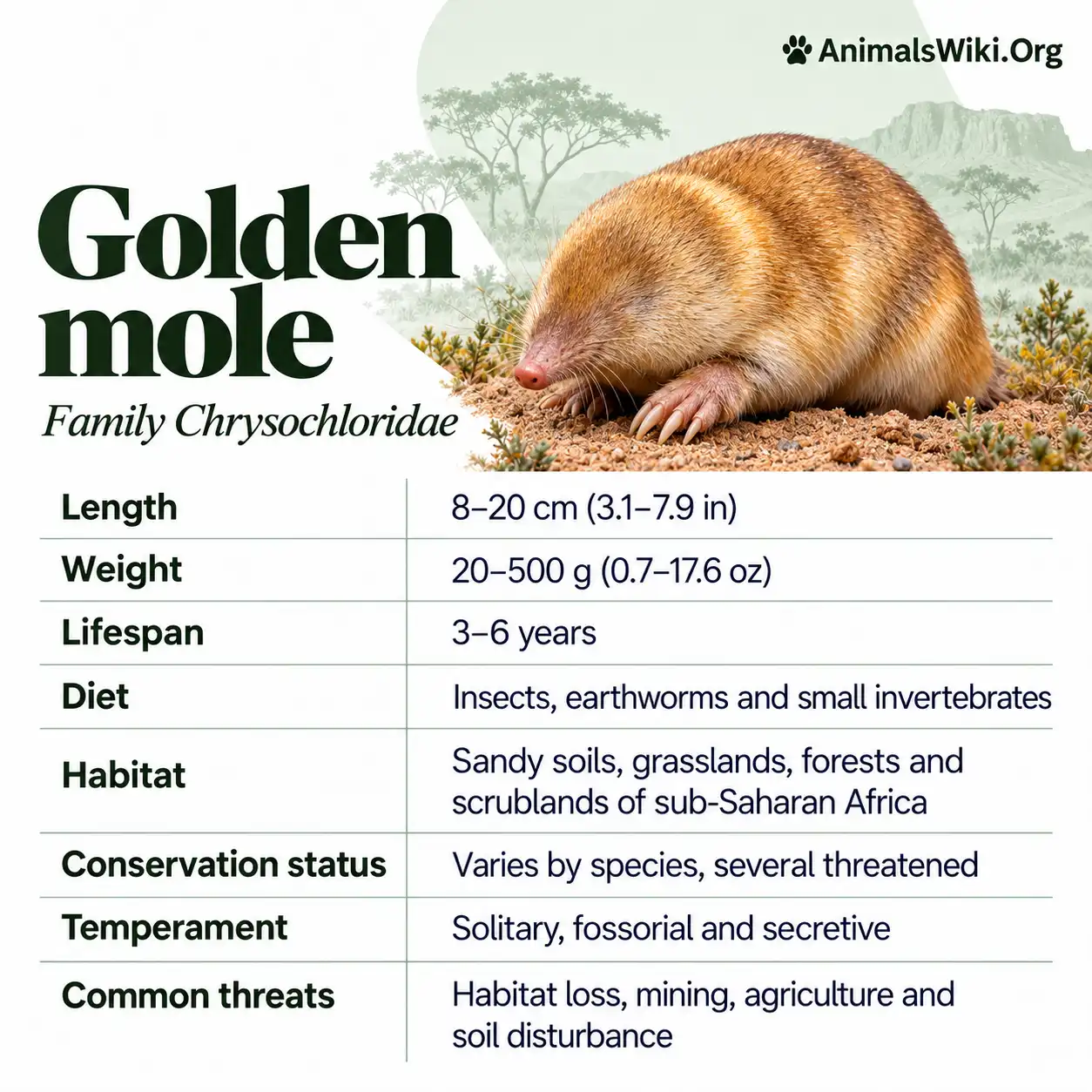
Golden Mole, A Complete Guide to Africa’s Remarkable Underground Mammal
A golden mole moves through a world that most animals experience only briefly. Beneath grasslands, forest floors and coastal dunes, these small African mammals search for food, build shelters and navigate without functional eyesight. Some travel through loose sand so effectively that their movement is often described as swimming.
Their appearance is equally unusual. Golden mole fur can reflect bronze, green, violet or coppery tones, giving an ordinary brown coat a metallic sheen. However, their most remarkable features are hidden beneath that fur: powerful digging limbs, protective skin and sensory systems suited to detecting activity underground.
The name “golden mole” describes an entire family rather than a single species. Current classification recognizes 21 living species, each with its own distribution, habitat requirements and conservation concerns. A forest-dwelling giant golden mole lives very differently from a tiny golden mole searching for termites among desert dunes.
This guide explores what golden moles are, where they live, what they eat and how their adaptations work. It also explains the rediscovery of De Winton’s golden mole and why protecting these secretive animals requires attention to the ground beneath our feet.
Golden Mole Facts
| Feature | Information |
|---|---|
| Common name | Golden mole |
| Scientific family | Chrysochloridae |
| Order | Afrosoricida |
| Broader mammal group | Afrotheria |
| Recognized living species | 21 |
| Native distribution | Sub-Saharan Africa, especially southern Africa |
| Main habitats | Grasslands, forests, shrublands and sandy coastal or desert environments |
| Diet | Mainly insects and other small invertebrates |
| Lifestyle | Primarily underground; some species forage above ground |
| Eyesight | Functionally blind, with reduced eyes beneath the skin |
| Distinctive features | Compact body, powerful claws and often iridescent fur |
| Reproduction | Live birth; small litters documented in studied species |
| Conservation | Varies by species; several face serious extinction risks |
1. What Is a Golden Mole?
A golden mole is a small, burrowing mammal belonging to the family Chrysochloridae. Its body is built for moving through soil or sand, with a compact shape, strong forequarters and claws that function as digging tools.
The word fossorial is often used to describe these animals. It means adapted to digging and living underground.
Golden moles are mammals in the same fundamental sense as more familiar animals such as otters, elephants or cats. They have hair, give birth to live young and nurse their offspring with milk.
Their underground lifestyle can make them seem almost absent from the landscapes they occupy. An area may contain active golden moles even when people rarely encounter one. Tracks, shallow feeding ridges and genetic traces can provide evidence of their presence.
Because the family includes multiple species, there is no single set of measurements, daily habits or habitat preferences that describes every golden mole accurately.
2. Is a Golden Mole a True Mole?
Golden moles and true moles belong to different mammal families.
True moles belong to Talpidae, the family that includes familiar burrowing moles from parts of Europe, Asia and North America. Golden moles belong to Chrysochloridae.
Their similar appearance illustrates convergent evolution. Animals from different evolutionary branches can develop comparable body shapes when they face similar environmental demands.
Moving underground favors features such as powerful digging limbs, reduced external projections and bodies that pass efficiently through confined spaces. Those similarities can develop independently.
This distinction matters when reading about their biology. A fact about a European mole cannot automatically be applied to a golden mole. Their reproductive systems, sensory anatomy and evolutionary histories need to be studied on their own terms.
3. Golden Mole Classification
Golden moles are classified within the order Afrosoricida and the broader group Afrotheria.
| Classification level | Golden mole placement |
|---|---|
| Kingdom | Animalia |
| Phylum | Chordata |
| Class | Mammalia |
| Superorder | Afrotheria |
| Order | Afrosoricida |
| Family | Chrysochloridae |
Afrotheria includes several mammals that look very different from one another, including elephants, hyraxes, manatees, aardvarks and sengis.
This does not mean that a golden mole is a miniature elephant or that all afrotherians share the same lifestyle. It means genetic and anatomical evidence connects them within a broader evolutionary lineage.
Within Afrosoricida, golden moles are grouped with tenrecs and otter shrews, although each belongs to its own family. Their relationships show why outward resemblance alone can give an incomplete picture of mammal evolution.
4. How Many Golden Mole Species Are There?
The Mammal Diversity Database currently recognizes 21 living golden mole species.
These are distributed among genera including Amblysomus, Calcochloris, Huetia, Neamblysomus, Carpitalpa, Chlorotalpa, Chrysochloris, Chrysospalax, Cryptochloris and Eremitalpa.
Classification can change as researchers compare DNA, skeletons and specimens from different locations. Some populations that appear similar externally may have a more complicated evolutionary history than their appearance suggests.
Older books may also use different scientific names or place species in different genera. When comparing accounts, the publication date and scientific name are useful clues.
For example, current classification places the Congo golden mole in Huetia. Older sources may list it under Calcochloris. Such differences can reflect a revised classification rather than the discovery of an entirely new animal.
5. What Does a Golden Mole Look Like?
Most golden moles resemble small, rounded digging machines covered in dense fur.
Their bodies taper toward the head, while the forequarters provide the strength needed to displace soil. They lack conspicuous external ear flaps and a visible external tail.
A toughened nose region helps protect the front of the head during excavation. Their reduced eyes lie beneath the skin, where they are shielded from the material through which the animal moves.
The resulting shape has few exposed features that could snag against tunnel walls.
Although photographs often emphasize their unusual appearance, each feature has a practical context. A projecting ear, long tail or exposed eye would face repeated contact with soil particles. Golden mole anatomy reflects the demands of spending much of life in that environment.
6. Why Are Golden Moles Called Golden?
Golden moles are not all bright yellow or gold.
Depending on the species and lighting, their coats may appear brown, grayish, reddish or dark. The “golden” part of the name refers to the reflective sheen that can appear across the fur.
This sheen may show copper, bronze, green or violet tones when the viewing angle changes.
The distinction between coat color and iridescence is useful. A brown animal can still display a metallic-looking highlight because the reflection comes partly from microscopic hair structure.
Photographs taken under different lighting conditions may therefore make the same species look surprisingly different. A golden mole photographed in diffuse shade may appear much less colorful than one illuminated at an angle.
7. How Does Golden Mole Fur Produce Its Shimmer?
Research on golden mole hairs has identified a structural basis for their iridescence.
The outer hairs are flattened and have unusually smooth surfaces. Microscopic layers within their cuticles interact with light, producing color through a process known as thin-film interference.
This differs from color produced entirely by pigments.
The research also raises an interesting evolutionary question: why would an animal without functional vision have shimmering fur?
One possibility is that the optical effect developed as a by-product of hair properties useful for resisting wear or moving through soil. Researchers have proposed such mechanical explanations, but these remain hypotheses requiring further testing.
The safe conclusion is that the fur’s structure produces the shimmer. Its precise evolutionary function is less certain.
8. How Big Is a Golden Mole?
Golden mole size varies considerably among species.
Grant’s golden mole is a small example, with published measurements around 7.6–8.6 centimeters in total length and approximately 20–35 grams in body mass.
Cape golden moles are somewhat larger in the measurements presented by the specialist group, while rough-haired golden moles can reach substantially greater lengths and weights.
These figures should be treated as representative measurements rather than absolute limits. Age, sex, population and the method used to record body length can affect comparisons.
When reading a size claim, check whether it refers to one species or the entire family. A single average for all golden moles hides meaningful biological differences.
9. Where Do Golden Moles Live?
Golden moles are native to sub-Saharan Africa, with their greatest diversity in southern Africa.
South Africa supports many species. Other members of the family occur in areas farther north, including parts of central and eastern Africa.
Their distribution is uneven. Some species occupy relatively broad areas, while others are known from scattered localities or small habitat patches.
A country-level range map can therefore be misleading if interpreted too broadly. A species recorded in South Africa does not necessarily occur throughout South Africa.
For a burrowing specialist, the distribution of suitable ground can matter as much as the distribution of vegetation. Two nearby sites may look similar above ground while offering very different conditions below the surface.
10. Golden Mole Habitat: More Than Desert Dunes
The golden mole family occupies a surprisingly wide range of environments.
Some species inhabit coastal sands and desert dunes. Others occur in grasslands, shrublands, woodland or indigenous forest.
The giant golden mole, for example, is associated with forest environments. The rough-haired golden mole uses densely vegetated grasslands and related habitats. Desert-adapted forms of Grant’s golden mole occupy a very different setting.
This diversity explains why golden mole conservation cannot depend on one habitat type.
Protecting dunes alone would overlook forest species. Protecting forests alone would miss animals dependent on grasslands or coastal sands.
The phrase “golden mole habitat” is therefore best understood as a family of different ecological requirements, connected by a shared dependence on suitable conditions for digging and finding underground food.
11. Why Soil Matters So Much
For a golden mole, soil is a place to move, hunt, rest and raise young.
Research on Juliana’s golden mole shows that soil characteristics help explain where the species occurs. The distribution of sand particle sizes affects properties such as density and how the ground compacts.
These details influence the physical demands of burrowing.
A patch of vegetation may appear suitable to a human observer but contain ground that offers poor digging conditions. Conversely, a relatively modest-looking site may contain the particular substrate a specialist needs.
This is one reason habitat surveys should look beneath the surface. Describing a site only as “grassland” or “woodland” can omit a critical part of the animal’s environment.
For underground wildlife, habitat quality includes the structure of the ground itself.
12. How Golden Moles Dig
Golden moles use coordinated movements of the forelimbs and head to displace soil.
Their strong claws break and move material, while the shape and movements of the head help open a path. During shallow digging, the displaced ground can form raised ridges visible from above.
This method is different from simply pushing through the earth nose-first. Excavation involves repeated mechanical work by several parts of the body.
The physical demands also help explain their compact proportions. Strong forequarters provide force, while the streamlined body follows through the passage created.
In firmer ground, an animal must overcome more resistance than in loose sand. The effectiveness of a particular digging style therefore depends partly on substrate conditions.
Golden mole anatomy makes more sense when viewed as a coordinated system rather than a collection of isolated unusual features.
13. Do Golden Moles Really Swim Through Sand?
Some golden moles move through loose sand in a way commonly called sand swimming.
The phrase is descriptive. The animal is moving through granular material rather than through water.
In the Namib Desert, golden moles can pass beneath the surface without maintaining the lasting open tunnels associated with many soil-burrowing mammals. Sand shifts around them as they move.
However, this behavior should not be assigned to every member of the family.
A golden mole hunting beneath forest litter faces different conditions from one crossing a dune. Both are adapted to life close to or beneath the ground, but their methods of movement reflect their respective environments.
“Sand swimmer” is a useful description for certain species and populations, rather than a complete definition of all golden moles.
14. Why Some Golden Moles Travel Above Ground
Living underground does not mean remaining there continuously.
Namib golden moles can move across the surface between feeding opportunities. This may seem surprising for an animal so strongly adapted to burrowing, but the energy costs help explain it.
Research comparing surface movement and underground movement found that exclusive underground foraging would have been energetically impractical at the study site.
Moving through sand requires the animal to displace material. Traveling over the surface can reduce that work when crossing between useful feeding patches.
The animal’s route therefore reflects a balance between access to food, the cost of movement and exposure above ground.
An underground specialist can still benefit from choosing the surface for part of its journey.
15. Are Golden Moles Blind?
Golden moles are functionally blind.
Their eyes are reduced and covered by skin, so they do not navigate using ordinary visual images in the way a squirrel or fox does.
This condition has an evolutionary history. Research comparing eye-related genes in golden moles and other subterranean mammals has documented genetic changes associated with the loss of visual functions.
The process involves more than the simple disappearance of an external eye. Different parts of the visual system can deteriorate at different rates.
Blindness also does not mean that the animal moves without information. Golden moles obtain useful information through other senses.
Their world is organized around cues such as vibration, contact and smell, allowing them to function in an environment where light provides little help.
16. How Golden Moles Hear Underground
Some golden moles have specialized middle-ear anatomy associated with sensitivity to vibrations.
The malleus, one of the small bones involved in hearing, is enlarged in certain species. However, the size and shape of this structure vary within the family.
Research on the Cape golden mole found different mechanical responses to low-frequency vibration and airborne sound.
This supports a more detailed explanation than saying that golden moles simply have “excellent hearing.” Their hearing apparatus can respond to different kinds of physical input in different ways.
Ground-borne vibrations may carry useful information when the animal is beneath the surface. Airborne sound becomes relevant when sound reaches the animal through other routes or when it is near or above ground.
The system reflects the physical conditions in which it operates.
17. Can Golden Moles Detect Food Through Vibrations?
Vibration sensitivity can help an animal gather information about its surroundings, but claims about exactly what it detects should remain specific.
Studies of desert golden moles have examined seismic sensitivity in connection with foraging and navigation.
One particularly interesting possibility involves dune vegetation. In the Namib, insects gather beneath scattered grass clumps. Wind moving the grass can generate vibrations in the surrounding sand.
Research has provided preliminary evidence that golden moles may use these cues when locating productive patches.
This would allow an animal to benefit from information produced by a plant’s movement, rather than detecting every individual insect directly.
The broader lesson is that underground navigation can depend on relationships among wind, vegetation, substrate and prey.
18. What Do Golden Moles Eat?
Golden moles mainly eat animal prey, especially insects and other invertebrates.
Depending on the species and location, food can include:
- Termites.
- Insect larvae.
- Beetles and other insects.
- Earthworms.
- Millipedes.
- Other small animals encountered while foraging.
Diet reflects local opportunities. Earthworms are relevant to some forest and grassland species, while termites can be particularly important to desert populations.
Calling golden moles insectivores is useful shorthand, although some prey items are not insects. Earthworms, for example, belong to a different animal group.
A precise diet description should therefore identify both the species and the environment being discussed. There is no reason to expect every golden mole to consume the same proportions of prey.
19. How Golden Moles Find Enough Food
Underground food is often distributed unevenly.
A productive patch might contain a concentration of prey, while surrounding ground offers little reward. The animal must find useful feeding areas without spending more energy than the food can replace.
Work on Namib golden moles has examined their movements in relation to dune habitat and feeding opportunities. Termites can dominate the diet in studied populations, making the location of suitable prey patches especially important.
This creates a connection between movement and nutrition. A route is valuable because of where it leads and what it costs to travel.
Such studies also caution against imagining an endless supply of insects beneath every patch of sand. Successful foraging depends on locating the right places within a larger landscape.
20. How Golden Moles Conserve Water
Water conservation is especially important for golden moles living in arid environments.
Research on the Namib Desert golden mole found that efficient kidney function, low energy use and torpor contribute to reduced water requirements.
Moisture obtained through food and normal metabolic processes can help support the animal without regular drinking from open water.
However, this is a documented physiological strategy in a particular desert-adapted form. It should not become the claim that every golden mole never drinks.
Animals from moist forests face different conditions, and their needs cannot be inferred entirely from desert research.
Water balance is best understood as a combination of intake and conservation. Reducing losses can be as important as finding a source of moisture.
21. Golden Mole Torpor and Body Temperature
Torpor is a controlled reduction in metabolic activity that helps an animal conserve resources.
Studied golden moles can lower their energy expenditure and allow body temperature to change more than many familiar mammals do.
This should not be confused with ordinary sleep. Sleep and torpor involve different physiological conditions, even though both can appear externally as inactivity.
It is also misleading to describe golden moles simply as cold-blooded. They are mammals with their own patterns of heat production and temperature regulation.
Research on the Namib Desert golden mole has examined how these patterns relate to its environment.
The practical advantage is understandable: maintaining a consistently high metabolic output can be expensive when food is scattered and environmental conditions change. Flexibility can help reduce that expense.
22. Are Golden Moles Nocturnal?
Many golden moles show substantial activity at night or during cooler periods, but their schedules vary.
Temperature, prey availability, season and species all influence when activity is practical.
An animal foraging beneath a shaded forest floor experiences different thermal conditions from one crossing exposed desert sand. A single label such as “strictly nocturnal” may conceal that variation.
The Cape golden mole, for example, has been described as active at night and during cooler transitional periods.
For readers, the useful principle is to distinguish a general tendency from a fixed rule. A golden mole encountered during daylight is not automatically behaving abnormally.
Daily activity is part of a larger balance among feeding, shelter and the conditions in which movement is least costly.
23. Golden Mole Social Behavior
Golden moles are generally described as solitary animals.
For many species, this means adults spend much of their time apart, rather than living in coordinated colonies.
However, observations of giant golden moles sharing burrows show that the family’s social behavior is not fully captured by one simple statement.
Finding several individuals together does not automatically demonstrate a permanent social group. The context matters: season, age, reproductive condition and environmental circumstances may all affect interpretation.
The most accurate description is that solitary living is common, while some observations suggest additional complexity.
This is another area where more field research would be valuable. Underground animals are difficult to observe continuously, and short encounters provide only a partial view of their relationships.
24. Golden Mole Reproduction
Golden moles give birth to live young and nurse them with milk.
Small litters are documented in studied species. Research on Amblysomus hottentotus recorded litters of one to three young, with an average close to two.
That study also found evidence of reproduction across the year in the sampled population, rather than a narrowly restricted breeding season.
These findings should remain tied to their study context. They do not establish an identical reproductive schedule for every golden mole species.
Reproduction can be affected by local climate and food conditions, so population-level observations are valuable.
For many family members, important details remain poorly documented, including precise gestation periods, nursing duration and how often females successfully raise young in the wild.
25. Baby Golden Moles and Early Development
Young golden moles depend on maternal care.
For a small underground mammal, early survival involves more than simply finding a protected location. The mother must obtain enough food to support herself and produce milk while maintaining access to shelter.
Published accounts of giant golden moles describe maternal nursing and care, although many details of development remain uncertain.
It is sensible to be cautious with exact timelines found in general animal summaries. A weaning age or developmental milestone recorded for one species should not be presented as a universal family trait.
The shortage of information does not imply that development is unimportant or uninteresting. It reflects how difficult it is to follow the lives of small mammals beneath the ground.
26. How Long Do Golden Moles Live?
There is no well-established lifespan figure that accurately represents the entire golden mole family.
For some species, even basic longevity information is limited. The Cape golden mole account in Animal Diversity Web explicitly notes the absence of lifespan information.
A reliable lifespan estimate requires evidence such as long-term monitoring, known-age individuals or carefully documented records.
Animals that are rarely seen and difficult to mark or recapture present obvious challenges.
For this reason, claims that all golden moles live a particular number of years should be treated cautiously unless the species and evidence are identified.
An honest gap in knowledge is more useful than a confident but unsupported number, particularly in an educational article intended to remain accurate over time.
27. Representative Golden Mole Species
The following species illustrate the family’s diversity. They are examples rather than a complete list.
Cape Golden Mole
Scientific name: Chrysochloris asiatica
The Cape golden mole is one of the more familiar members of the family. It occurs in southwestern South African environments and can use some cultivated areas and gardens.
Its ability to occupy modified ground should not be generalized to every golden mole.
The scientific name asiatica is also misleading as a geographic clue. The animal is African, despite a name associated with an early misunderstanding about the origin of a specimen.
It is a useful species for introducing golden mole anatomy because its form shows many of the family’s characteristic digging adaptations.
Grant’s Golden Mole
Scientific name: Eremitalpa granti
Grant’s golden mole occurs in Namibia and South Africa.
The Namib form is particularly well known for moving through loose sand and for the research it has inspired on navigation, water conservation and energy use.
Older sources sometimes use differing names or taxonomic treatments for Namib populations. Checking the scientific name helps explain these apparent inconsistencies.
The current Mammal Diversity Database entry lists Eremitalpa granti as Least Concern. That status describes assessed extinction risk; it does not establish that every population is equally secure.
De Winton’s Golden Mole
Scientific name: Cryptochloris wintoni
De Winton’s golden mole became internationally known following the announcement of its rediscovery in 2023.
It is associated with South Africa’s west coast and remains classified as Critically Endangered in the current database consulted for this article.
Its story demonstrates how an elusive animal can remain undetected for decades.
It also highlights the difference between confirming that a species survives and demonstrating that it is safe. Rediscovery answers an urgent question, but it creates the need for further work on distribution, abundance and protection.
Giant Golden Mole
Scientific name: Chrysospalax trevelyani
The giant golden mole is associated with indigenous forest environments in South Africa.
It helps correct the impression that golden moles are exclusively tiny desert animals.
Its conservation is closely connected to forest condition and the survival of suitable habitat patches. The current Mammal Diversity Database lists the species as Endangered.
The word “giant” is relative to other golden moles. It does not describe a large mammal in the everyday sense.
Learning about this species makes the family’s ecological variety much easier to appreciate.
Rough-Haired Golden Mole
Scientific name: Chrysospalax villosus
The rough-haired golden mole occurs in South Africa and uses densely vegetated grassland habitats and related environments.
Its common name reflects a coat that differs from the especially sleek appearance often associated with golden moles.
Habitat alteration is an important concern, particularly where suitable grassland is transformed or degraded.
It is listed as Vulnerable in the current database consulted here.
Its example shows why preserving an underground mammal can depend on managing vegetation above ground, including the cover and prey resources associated with that vegetation.
Juliana’s Golden Mole
Scientific name: Neamblysomus julianae
Juliana’s golden mole is a South African species with specific habitat requirements.
Research has connected its occurrence with a combination of soil conditions and vegetation cover.
It is listed as Endangered.
For this species, an apparently small change in land use can matter if it affects one of the limited areas containing suitable ground.
Its conservation also illustrates why habitat protection should be informed by ecological research. Protecting a nearby patch of land may provide little benefit if that patch lacks the physical conditions the animal needs.
Van Zyl’s Golden Mole
Scientific name: Cryptochloris zyli
Van Zyl’s golden mole is associated with sandy habitats along South Africa’s west coast.
It belongs to the same genus as De Winton’s golden mole, but they are recognized as separate species.
The current Mammal Diversity Database lists Van Zyl’s golden mole as Endangered.
Its rarity in observations makes it especially important to avoid assuming that every small mole-like animal found in coastal sand belongs to a common species.
Identification can require specialist comparison rather than a quick judgment based on a photograph.
Hottentot Golden Mole
Scientific name: Amblysomus hottentotus
This is a widely distributed and relatively well-studied golden mole.
It uses several environments, including grassland and some wooded habitats, and has provided information about anatomy, reproduction and underground living.
Like other golden moles, it has protected sensory openings, strong digging limbs and a body suited to moving through the ground.
Its greater visibility in the scientific literature does not make it a perfect model for all its relatives.
A family-wide account should use its biology carefully, distinguishing broadly shared traits from details documented specifically in this species.
28. What Eats Golden Moles?
Golden moles can be prey for other animals, particularly when they emerge above ground.
Reported or potential predators differ by species and locality. Accounts include owls, snakes, mammalian carnivores and domestic animals.
Cats and dogs can create additional risks where golden moles occur near homes or settlements.
An underground lifestyle provides shelter, but it does not eliminate predation. Animals may be exposed while foraging, moving between areas or encountering disturbance.
Predator lists also require care. A species observed killing a golden mole provides stronger evidence than a predator merely being present in the same habitat.
Understanding these differences helps avoid presenting every plausible interaction as a confirmed feeding relationship.
29. Golden Moles and Their Ecosystems
Golden moles connect underground prey communities with the larger food web.
They consume invertebrates and may themselves become prey. Their digging also moves soil, creating small-scale physical changes within the habitats they occupy.
However, their ecological importance should be described without exaggeration. Evidence that a golden mole eats insects does not automatically show that it controls agricultural pests across a large landscape.
Likewise, moving soil does not mean every species has the same effect on soil fertility or plant growth.
The strongest ecological account recognizes their participation in several processes while leaving room for measurement.
Small, secretive mammals can matter even when their effects are difficult to observe directly. Their significance does not depend on proving an immediate economic benefit to people.
30. Are Golden Moles Endangered?
Some golden moles are threatened with extinction, while others have lower assessed risk.
There is no single conservation category for the entire family.
| Species | Conservation category listed in the database consulted |
|---|---|
| De Winton’s golden mole | Critically Endangered |
| Giant golden mole | Endangered |
| Juliana’s golden mole | Endangered |
| Van Zyl’s golden mole | Endangered |
| Rough-haired golden mole | Vulnerable |
| Grant’s golden mole | Least Concern |
These categories describe different levels of assessed extinction risk. They are not direct population counts.
A Least Concern species can still experience local habitat loss. An Endangered species may remain difficult to count despite being known to face serious threats.
Assessment dates and new evidence also matter, so conservation information should be reviewed periodically.
31. The Main Threats to Golden Moles
Habitat loss and degradation are central conservation concerns.
The activities involved vary by region and species. Coastal mining can disturb dune systems, while urban development can remove or fragment suitable ground. In grasslands, mining, intensive land use and changes to vegetation management can alter habitat conditions.
The consequences extend below the surface.
Removing vegetation may change cover and prey availability. Excavation can eliminate the substrate itself. Repeated disturbance can leave a site physically different even after it appears green again.
A regional assessment of the rough-haired golden mole identifies concerns including open-cast mining, overgrazing, frequent burning and other forms of habitat transformation.
These findings support a practical principle: conservation must preserve the conditions that make the ground usable, rather than focusing only on its appearance.
32. The Rediscovery of De Winton’s Golden Mole
In November 2023, conservationists announced that De Winton’s golden mole had been rediscovered after decades without a confirmed record.
The search combined fieldwork, genetic methods and the help of a trained detection dog.
The Endangered Wildlife Trust described the discovery as the result of a sustained effort to locate an exceptionally elusive species.
The announcement drew attention partly because the animal had become a symbol of how little is known about some small mammals.
Yet the most valuable outcome was practical: researchers could move from uncertainty about survival toward questions about where the species persists and how those places can be protected.
Rediscovery is the beginning of a new conservation phase, with better information needed to guide the next steps.
33. How Environmental DNA Helps Find Hidden Animals
Environmental DNA, often shortened to eDNA, is genetic material collected from an animal’s surroundings rather than directly from a captured individual.
For golden moles, researchers have analyzed soil samples for genetic evidence.
The study associated with De Winton’s golden mole used DNA methods to investigate the presence and distribution of several west coast species.
This approach is valuable because seeing or trapping an underground animal can be difficult.
However, a positive DNA result is not a simple population census. It does not directly reveal the number of animals present, their breeding success or the long-term security of a population.
Careful sampling, reference material and checks for contamination are essential. Genetic evidence works best as part of a broader investigation rather than a replacement for every other field method.
34. Why Rediscovery Does Not Guarantee Recovery
Finding a species again is encouraging, but survival and recovery answer different questions.
Survival means the species continues to exist. Recovery involves improving its prospects through factors such as secure habitat, viable populations and reduced threats.
A newly confirmed location may still face development or disturbance. A genetic detection may also leave important questions about abundance unresolved.
The researchers studying west coast golden moles called for additional work on distribution, population viability, connectivity and protection.
That is the practical meaning of rediscovery: evidence becomes a foundation for action.
The animal was already surviving before people confirmed its presence. Conservation aims to ensure it continues to do so, rather than allowing the discovery to become only a short-lived news story.
35. Why Golden Moles Remain Difficult to Study
Golden moles present several research challenges at once.
They are small, secretive and often underground. Some occupy limited areas, while others live in environments where tracks or surface signs disappear quickly.
The animals can also resemble one another externally, making species identification difficult without detailed examination.
These challenges affect basic questions: How many are present? Where do they breed? Which habitat patches remain connected?
Historical collections and modern genetic tools can help fill some gaps. Recent phylogenetic research has combined different kinds of evidence to investigate relationships within the group.
Still, improved classification does not automatically provide detailed information about behavior in the wild. Taxonomy, ecology and population monitoring answer related but distinct questions.
36. What Effective Golden Mole Conservation Requires
Effective conservation begins with identifying the species and understanding its particular requirements.
For a coastal specialist, this may involve protecting intact dune habitat. For a forest species, maintaining forest quality and connections among suitable areas may be more relevant.
Research on Juliana’s golden mole demonstrates the value of measuring both soil and vegetation characteristics.
Conservation planning should also distinguish a historical record from evidence of current occupation. A species recorded decades ago may need renewed surveys before its present condition can be understood.
Useful priorities include:
- Surveying poorly studied areas.
- Protecting confirmed habitat.
- Considering underground conditions in development assessments.
- Monitoring changes through time.
- Combining field observations with appropriate genetic methods.
The strongest plans connect evidence to the particular animal and place involved.
37. Golden Moles and People
Many people living within golden mole ranges may never see one.
Their occasional appearance in gardens can create confusion, especially where several kinds of burrowing mammals occur.
A raised ridge or disturbed patch of soil does not identify the animal responsible. True moles, mole-rats and other digging animals can produce signs that a nonspecialist might confuse.
A useful first step is accurate identification.
For land managers and conservation organizations, records can become more valuable when accompanied by a date, a general location and clear photographs obtained without disturbing the animal.
Public interest also matters. The attention generated by De Winton’s golden mole has shown that a small underground mammal can capture widespread curiosity and bring its habitat into public discussion.
38. What Golden Moles Teach Us About Evolution
Golden moles illustrate several important evolutionary ideas.
Their resemblance to true moles shows that similar environmental pressures can produce similar body forms in separate lineages.
Their reduced visual systems show how organs can change when the information they provide becomes less useful in a particular environment.
Their unusual middle ears demonstrate how existing anatomical structures can become specialized for different physical conditions.
Their shimmering fur adds a further lesson: a striking visible feature does not necessarily function as a visual signal. Its origin may involve mechanical properties rather than appearance itself.
Together, these examples encourage a better question than “Why does this animal look strange?”
The more useful question is: “How do its features work within the world it inhabits?”
Frequently Asked Questions About Golden Moles
1. What is a golden mole?
A golden mole is an African burrowing mammal belonging to Chrysochloridae. The name covers a family of species rather than one animal. Members share a compact body and digging adaptations, although their habitats and behavior vary.
2. Is a golden mole a rodent?
No. Golden moles belong to Afrosoricida. Rodents belong to Rodentia. Some burrowing rodents are called mole-rats, which can create confusion, but golden moles and mole-rats are different mammals with separate evolutionary histories.
3. Are golden moles related to true moles?
They are distant mammalian relatives, but they belong to different families and orders. Their similar digging bodies developed through convergent evolution. The familiar name “mole” therefore describes resemblance more reliably than close taxonomic relationship.
4. How many golden mole species exist?
Current classification recognizes 21 living species. That number reflects the taxonomy used for this article. Future research could revise species boundaries or clarify the relationships among populations that remain poorly sampled.
5. Where are golden moles found?
Golden moles are native to sub-Saharan Africa, with the greatest diversity in southern Africa. Their actual distribution consists of suitable habitat areas rather than continuous occupation of every part of the countries in which they occur.
6. Do golden moles live only in deserts?
No. Some inhabit deserts or coastal dunes, while others use grasslands, shrublands, woodland or forest. The habitat depends on the species. Images of sand-swimming golden moles show only one part of the family’s diversity.
7. Why are golden moles shiny?
Their hairs contain microscopic structures that interact with light. Flattened hairs and layered cuticles help produce iridescent effects. The resulting sheen can vary with lighting and viewing angle, sometimes appearing green, violet, bronze or coppery.
8. Do golden moles glow in the dark?
No. Iridescence reflects available light; it is different from producing light. A golden mole’s fur can appear metallic under suitable illumination, but that does not mean the animal is bioluminescent.
9. Can golden moles see?
Golden moles are functionally blind. Their reduced eyes lie beneath the skin. They obtain information through other sensory channels, allowing them to move and forage in surroundings where ordinary vision would be of limited use.
10. How do golden moles find their way?
They use nonvisual information, including vibration, smell and touch. The importance of each cue can differ among species and situations. Research on Namib golden moles has explored how vibrations associated with vegetation may assist navigation.
11. What do golden moles eat?
Their food consists mainly of insects and other small invertebrates. Examples include termites, larvae, earthworms and millipedes. Diet varies with the species and the prey available in its habitat.
12. Do golden moles eat plants?
They are primarily predators of small animals. Plants can still be important indirectly by influencing prey, cover and habitat conditions. A grass clump may therefore matter to a golden mole even when the grass itself is not its food.
13. Can all golden moles swim through sand?
No. Sand swimming is associated with certain animals adapted to loose sandy substrates. Other golden moles excavate soil or forage around leaf litter. It is inaccurate to apply the same movement pattern to the whole family.
14. Do golden moles remain underground all the time?
No. Some emerge to forage or travel over the surface. In desert populations, combining surface movement with underground movement can help reduce the energetic costs of reaching scattered feeding opportunities.
15. Are golden moles social animals?
They are generally solitary. However, observations of some species suggest that their behavior can be more complex in particular circumstances. Sharing a burrow occasionally does not necessarily mean they form permanent colonies.
16. How many babies do golden moles have?
Studied species commonly have small litters. Research on Amblysomus hottentotus documented one to three young. That finding should not be treated as an exact reproductive rule for every golden mole species.
17. Do golden moles hibernate?
Torpor is documented in golden moles and helps conserve energy. It should not automatically be described as prolonged seasonal hibernation. The duration and pattern of reduced activity need to be established for the particular species being discussed.
18. Was De Winton’s golden mole extinct?
It was feared possibly extinct after a long period without confirmed records. Its rediscovery was announced in 2023. The discovery demonstrated continued survival; it did not mean that a formally extinct animal had been brought back to life.
19. Are all golden moles endangered?
No. Conservation categories differ among species. Some are listed as Least Concern, while others are Vulnerable, Endangered or Critically Endangered. The family should not be assigned one shared conservation status.
20. Why should golden moles be protected?
Golden moles represent distinctive evolutionary lineages and participate in the ecosystems they inhabit. Protecting their habitats can also preserve dunes, forests, grasslands and the less visible communities living within soil and sand.
Golden Moles Reveal the Life Hidden Beneath the Surface
Golden moles make familiar landscapes more interesting. A dune can contain a specialized mammal navigating through loose sand. A forest floor can support a predator whose daily movements remain almost invisible. A patch of apparently ordinary ground can contain the conditions required by a rare species.
Their biology also rewards careful distinctions. Golden moles are separate from true moles, their shimmering fur has a structural basis, and their lifestyles extend well beyond sand swimming. Each species combines shared ancestry with its own ecological requirements.
The rediscovery of De Winton’s golden mole renewed attention to this hidden diversity. Continuing that work means learning where these animals survive, understanding what they need and protecting the habitats that allow their underground lives to continue.



