
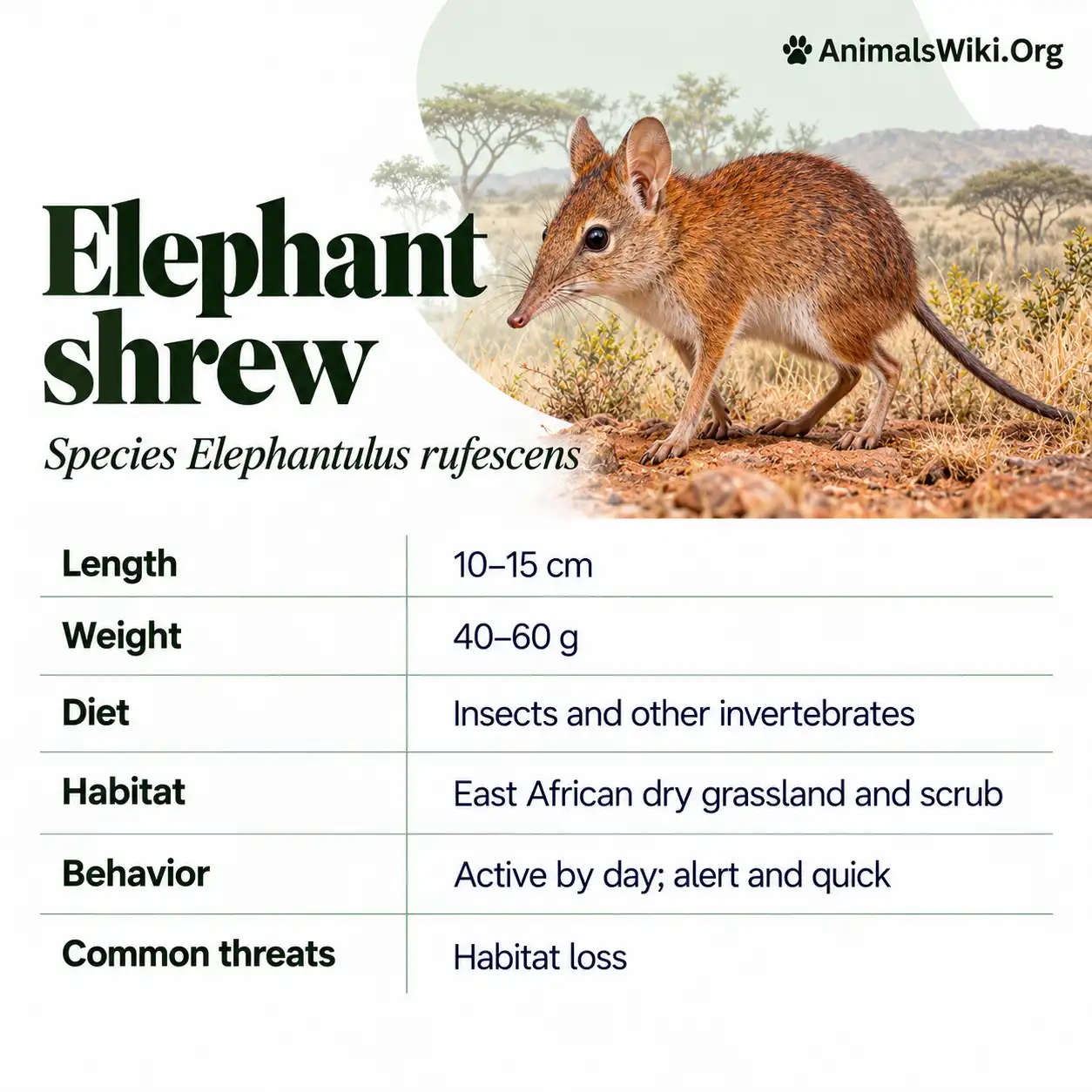
Elephant Shrew, The Remarkable Long-Nosed Mammal of Africa
An elephant shrew may be small enough to disappear behind a handful of leaves, but it belongs to one of Africa’s most distinctive mammal groups. With a flexible nose, slender legs, bright eyes and quick movements, this unusual animal combines features that seem borrowed from several familiar creatures.
Its name creates an immediate puzzle. An elephant shrew is neither a miniature elephant nor a true shrew. Scientists commonly call these animals sengis, a name that helps distinguish them from the unrelated shrew family.
The elephant connection does have an evolutionary basis. Sengis belong to Afrotheria, the broader mammal group that includes elephants, hyraxes, aardvarks, manatees, golden moles and tenrecs. Their relationships were clarified through genetic research, revealing connections that outward appearance alone could not reliably explain.
Elephant shrews also offer much more than an unusual family tree. Some maintain pathways through fallen leaves. Others shelter among rocks or survive in dry, sparsely vegetated landscapes. Certain species form pairs while spending much of their time apart, and some can conserve energy through torpor.
This guide explores elephant shrew facts, habitat, diet, behavior, reproduction and conservation, including the differences between tiny desert sengis and their larger forest relatives.
Elephant Shrew Facts
| Feature | Information |
|---|---|
| Common names | Elephant shrew, elephant-shrew, sengi |
| Scientific order | Macroscelidea |
| Family used in this article | Macroscelididae |
| Broader mammal group | Afrotheria |
| Recognized living species | 20 |
| Main groups | Soft-furred sengis and giant sengis |
| Native distribution | Africa |
| Habitats | Forests, woodlands, shrublands, rocky areas and some deserts |
| Diet | Mainly invertebrates; some species also eat plant material |
| Distinctive feature | Long, flexible snout |
| Movement | Fast terrestrial running, with some hopping or bounding |
| Social organization | Pair associations occur in several studied species |
| Reproduction | Live birth and small litters |
| Conservation | Varies by species |
1. What Is an Elephant Shrew?
An elephant shrew is a small African mammal belonging to the order Macroscelidea. Its most recognizable feature is an elongated, flexible snout that it moves while investigating its surroundings and searching for food.
Sengis are primarily ground-dwelling animals. Their bodies are carried on relatively long legs, and their movements often alternate between cautious investigation and sudden bursts of running.
Unlike animals specialized for excavating extensive underground tunnels, many sengis spend their active periods moving across the surface. They may search among leaves, cross open ground or move between the sheltered spaces around rocks.
The term “elephant shrew” covers multiple species rather than one uniform animal. A small sengi on a dry gravel plain and a colorful giant sengi on a shaded forest floor share ancestry, but their daily environments differ substantially.
Understanding those differences is essential to understanding the group.
2. Why Is It Called an Elephant Shrew?
The name describes two superficial impressions.
The elongated nose resembles a tiny elephant’s trunk, while the animal’s small size and pointed face suggest a shrew. Those comparisons helped make the name memorable, but they do not provide an accurate classification.
True shrews belong to Soricidae. Sengis belong to a separate evolutionary branch.
The name sengi is increasingly used by researchers and conservation organizations because it avoids implying that these animals are simply an unusual kind of shrew.
Both names remain useful for readers. “Elephant shrew” is widely recognized, while “sengi” often appears in scientific and conservation writing.
Using the terms together makes the connection clear: an elephant shrew is a sengi, and a sengi is an elephant shrew. The difference is terminology, not a division into two separate kinds of animals.
3. Are Elephant Shrews Related to Elephants?
Elephant shrews and elephants belong to the broader group Afrotheria.
That makes a sengi more closely related to an elephant than to a true shrew, despite the dramatic difference in size and appearance.
However, the relationship is ancient. A living elephant is not the direct ancestor of a sengi, and a sengi is not an early stage in elephant development.
Both represent branches of a much larger evolutionary history.
Afrotheria also includes animals with very different lifestyles: aquatic manatees, burrowing aardvarks, rock-dwelling hyraxes and underground golden moles. Their shared ancestry does not require them to look alike today.
This is one of the strongest lessons offered by elephant shrews. Similar appearance can be misleading, while genuine relatives can become strikingly different as their lineages adapt to different ways of life.
4. Elephant Shrew Classification
The classification used in this article places living sengis in one family with two major subfamilies.
| Classification level | Placement |
|---|---|
| Kingdom | Animalia |
| Phylum | Chordata |
| Class | Mammalia |
| Superorder | Afrotheria |
| Order | Macroscelidea |
| Family | Macroscelididae |
| Soft-furred sengi subfamily | Macroscelidinae |
| Giant sengi subfamily | Rhynchocyoninae |
The current Mammal Diversity Database recognizes six living genera: Elephantulus, Galegeeska, Macroscelides, Petrodromus, Petrosaltator and Rhynchocyon.
Some studies elevate the two main groups to separate families. Such differences concern the rank assigned to evolutionary branches rather than whether giant sengis and soft-furred sengis are distinct groups.
For a general wildlife article, the important points are consistent: sengis form their own order, are African mammals and are separate from true shrews.
5. How Many Elephant Shrew Species Exist?
Current classification recognizes 20 living elephant shrew species.
Older references may give smaller totals because species recognition and generic placement have changed over time.
These changes come from several kinds of evidence. Researchers compare external appearance, skull structure, geographic distribution and genetic sequences. A population that once seemed to belong within a widespread species may prove sufficiently distinct to receive separate recognition.
The round-eared sengis provide a good example. Research has clarified differences among members of Macroscelides, including animals previously grouped more broadly.
Species discovery also continues to depend on fieldwork. Even a mammal living above ground can remain poorly documented if it occupies a remote region, resembles related animals or is difficult to observe closely.
A changing species count therefore reflects growing knowledge rather than a contradiction about the basic identity of sengis.
6. What Does an Elephant Shrew Look Like?
An elephant shrew usually has a compact body, relatively large eyes, noticeable ears, slender legs and a long tail.
The nose is the most immediately distinctive feature. It extends beyond the mouth and can move independently while the animal investigates nearby surfaces.
Smaller sengis often have brown, gray or sandy coats that blend into their surroundings. Giant sengis can show much stronger color patterns, including reddish, black, yellowish or grizzled areas.
Their proportions also help distinguish them from a typical mouse. Sengis often look high-legged, with a body held clear of the ground and hindlimbs suited to rapid movement.
These features make the animal appear alert even while stationary. A sengi may pause with its nose moving and ears attentive before quickly crossing the next exposed patch.
Its appearance reflects an active life at ground level.
7. How Big Is an Elephant Shrew?
Elephant shrew size varies widely.
Some of the smallest sengis weigh only a few tens of grams. At the other end of the range, giant sengis weigh several hundred grams.
The grey-faced sengi is the largest known living representative of the order. Its size helps explain why a single photograph cannot represent the entire group accurately.
When comparing measurements, distinguish head-and-body length from total length. A long tail can add substantially to the second figure.
The four-toed sengi, for example, has published head-and-body measurements around 19–23 centimeters, with an additional tail roughly 15.5–17 centimeters long.
A statement that an elephant shrew is “20 centimeters long” is incomplete unless it identifies the species and explains what was measured.
8. How Does the Elephant Shrew’s Nose Work?
The sengi’s nose is a flexible extension of the snout rather than a small grasping trunk with all the abilities of an elephant’s trunk.
Anatomical research on two Elephantulus species found cartilage arrangements that permit considerable flexibility.
The same study described glands running along the snout and releasing secretions near its tip. Researchers suggested that these secretions might help protect exposed tissue against chemical defenses used by ants and termites.
That proposed function remains an interpretation rather than proof that every sengi has a specialized chemical shield.
The strongest conclusion is that the snout is an actively used, mobile structure. It allows the animal to investigate closely spaced features without constantly repositioning its whole body.
For a small hunter searching around leaves, cracks and plant debris, that flexibility is useful.
9. Elephant Shrew Senses
Elephant shrews gather information through several sensory channels.
Vision helps them detect movement and navigate above ground. Hearing can provide information about nearby activity, while smell and touch contribute to investigating food and other animals.
Research on the Cape rock sengi’s brain found substantial representation of the elongated snout, facial whiskers and tongue within the somatosensory system.
The somatosensory system processes information associated with bodily sensation, including touch.
This finding fits an animal that explores its surroundings at close range while also remaining alert to events farther away.
It would be misleading to reduce all of that to a single “super sense.” A sengi’s behavior depends on combining different streams of information.
The movement of its nose is especially conspicuous, but the rest of its sensory equipment is part of the same working system.
10. Where Do Elephant Shrews Live?
Elephant shrews are native to Africa.
Their distribution includes parts of southern, eastern, central and northwestern Africa, although individual species occupy much smaller ranges.
The North African sengi is particularly distinctive geographically. It occurs along the continent’s northwestern region, separated from the main distributions of other sengis by the Sahara.
Elsewhere, different species inhabit environments ranging from dry rocky country to moist forest.
A country appearing on a distribution map does not mean a sengi occurs everywhere within that country. Suitable habitat may be limited to certain elevations, vegetation types or terrain.
For example, two neighboring landscapes can support different small mammals if one consists of boulders and crevices while the other has loose sandy ground.
At the scale of a sengi, those differences are substantial.
11. Elephant Shrew Habitat
There is no single elephant shrew habitat.
Giant sengis are generally associated with forests and densely vegetated environments. Many smaller sengis occupy more open or arid settings, including shrublands, rocky outcrops and desert margins.
Habitat includes several connected requirements:
- Places to find food.
- Shelter from predators.
- Suitable resting sites.
- Routes for moving through the area.
- Conditions that permit successful reproduction.
These requirements help explain why simply preserving some vegetation may not be enough.
A forest-floor species depends on the structure of the forest at ground level. A rock specialist depends on the arrangement of cracks, ledges and nearby cover.
The most useful habitat description identifies what the animal actually uses rather than relying only on broad labels such as “forest” or “desert.”
12. How Forest Sengis Use Leaf Litter
The forest floor is an important part of the environment for giant sengis.
Fallen leaves provide a place to search for invertebrates, and some species build resting nests using leaves and other plant material.
The black-and-rufous sengi is active during the day and rests at night in nests constructed from leaves and twigs.
This creates a direct relationship between the animal and the condition of the ground layer.
A forest can retain standing trees while changes beneath them affect shelter and feeding opportunities. The canopy, understory and accumulated material on the ground form connected parts of the habitat.
For a sengi, a layer of leaves is therefore more than background scenery. It is part of the space in which daily survival takes place.
13. Rock-Dwelling Elephant Shrews
Rocky landscapes provide a different combination of opportunities and challenges.
The eastern rock sengi uses boulder formations containing cracks and crevices. These spaces provide cover and resting opportunities without requiring the animal to construct a leaf nest or excavate its own extensive burrow.
A sengi can move briefly into a more exposed area and then retreat toward a familiar protected space.
The arrangement of the rocks matters. A smooth exposed slab offers different conditions from a broken outcrop with multiple sheltered passages.
This helps explain why habitat specialists can occupy only certain parts of a wider region.
To a person, two hillsides may seem similar. To an animal depending on narrow escape spaces, their practical value can be very different.
14. Desert and Semi-Desert Sengis
Some sengis occupy dry landscapes with sparse vegetation.
Round-eared sengis illustrate this way of life. Their habitats can include open, arid ground where shade, cover and food occur unevenly.
The Etendeka round-eared sengi was described from a remote part of northwestern Namibia. Its discovery drew attention to the small mammals living among gravel plains and rocky terrain.
An arid habitat does not mean an animal simply tolerates the same conditions continuously. Shelter choice, activity timing and physiological flexibility can all influence exposure to difficult conditions.
Nor does “desert species” imply that all desert sengis behave identically.
Differences in terrain and local climate can create distinct ecological settings within a region that appears uniformly dry on a large map.
15. What Do Elephant Shrews Eat?
Elephant shrews mainly eat invertebrates.
Depending on the species and location, prey can include ants, termites, beetles, larvae, spiders, centipedes and other small animals.
Some soft-furred sengis also consume plant material, including small fruits, seeds and green vegetation.
This makes “insectivore” a useful general description, but it is not a complete menu. Spiders and centipedes are not insects, and plant foods can contribute to the diets of some species.
The balance also varies. A forest sengi searching among leaves encounters a different prey community from a sengi living among rocks or sparse shrubs.
An accurate elephant shrew diet therefore describes both the animal and its surroundings.
The shared pattern is a strong dependence on small food items gathered through active searching near ground level.
16. How Elephant Shrews Find Food
Foraging combines movement, close investigation and rapid handling of small prey.
The black-and-rufous sengi uses its flexible snout while searching among fallen leaves. Its tongue helps collect small food items.
A useful feeding patch may contain several prey animals close together. Other stretches of ground may provide little reward.
That uneven distribution creates decisions about where to investigate and when to move on.
The animal also needs to remain responsive to danger. Feeding is not an isolated activity performed without interruption; it takes place while the sengi monitors its surroundings.
The familiar image of a moving nose captures only part of this process. Legs, tongue, sensory attention and familiarity with the local terrain all contribute to finding enough food.
17. Can Elephant Shrews Pollinate Flowers?
Some elephant shrews visit flowers for nectar and can transfer pollen.
Research has documented the Cape rock sengi, Elephantulus edwardii, pollinating the plant Hyobanche atropurpurea.
As the animal reaches into a flower, parts of its face can contact reproductive structures. Pollen can then be carried to another flower.
This is a particularly interesting interaction because sengis are primarily associated with eating small animals.
It demonstrates that a dietary label does not capture every feeding opportunity an animal uses.
However, pollination should remain a species-specific example. The evidence does not establish that every elephant shrew regularly visits flowers or makes an equally important contribution to plant reproduction.
The value of the observation lies in revealing a relationship that might otherwise be overlooked.
18. Another Unexpected Nectar Connection
The Cape rock sengi has also been reported as a pollinator of the pagoda lily, Whiteheadia bifolia.
This adds a second example of a small mammal participating in pollination while obtaining an energy-rich food.
The interaction depends on physical contact. A flower visitor becomes a pollinator when its movements contribute to transferring pollen appropriately, not simply because it drinks nectar.
For readers interested in animal adaptations, these cases are a reminder that ecological roles can overlap.
An animal can be primarily an invertebrate hunter and still become involved in a plant’s reproduction.
Such observations also show the value of studying behavior directly. A list of stomach contents or a general diet category might not reveal what happens during a brief visit to a flower.
19. How Do Elephant Shrews Move?
Sengis are terrestrial runners with relatively elongated limbs.
Their movement can include quick running, scrambling and occasional hopping or bounding, depending on the species and terrain.
They are not simply miniature versions of burrowing mammals. Their proportions reflect the demands of moving rapidly over surfaces and between patches of cover.
A long-legged body can cross a short gap quickly, while familiar routes help reduce hesitation.
Popular accounts sometimes compare elephant shrew speed with much larger animals. Such comparisons can be entertaining, but speed varies with species, measurement method and circumstances.
A more useful observation is that rapid movement forms part of a broader survival strategy.
The animal also needs alertness, access to shelter and an environment through which it can travel effectively.
20. Why Some Sengis Maintain Pathways
Some soft-furred sengis maintain recognizable pathways through surface litter.
They clear small obstacles using movements such as sweeping with the forefeet, biting and pushing with the head.
The result can be a network of relatively open routes across the animal’s familiar area.
These pathways serve everyday movement and can provide routes for rapid escape.
At a sengi’s scale, a twig or clump of grass can be a meaningful obstacle. Clearing it may reduce the difficulty of repeatedly traveling the same route.
This behavior is sometimes described as building tiny roads, although the animal is maintaining narrow passages through its immediate surroundings.
Not every sengi constructs the same kind of trail system. The behavior is especially associated with particular soft-furred species and the materials present in their habitats.
21. Are Elephant Shrews Active During the Day?
Activity patterns differ among species.
Black-and-rufous sengis are active during daylight, while other sengis may show substantial activity around dawn, dusk or at night.
Temperature and season can also affect when an animal is most active.
A shaded forest floor and an exposed semi-desert plain present different conditions. It is therefore unhelpful to describe every elephant shrew as strictly nocturnal or strictly diurnal.
The important question is when a particular species can feed and move while meeting its other needs.
A daily schedule is part of an animal’s ecological strategy rather than a fixed rule shared by every relative.
For observers, this means that the best time to look for a sengi depends on knowing which species occurs in the area.
22. Elephant Shrew Torpor
Some elephant shrews can enter torpor, a state of reduced metabolic activity and lowered body temperature.
Research on free-ranging eastern rock sengis documented torpor across the year, with greater use during winter.
Torpor helps reduce energy expenditure when maintaining normal activity and body temperature would be costly.
It is different from ordinary sleep. An animal in torpor undergoes physiological changes that go beyond being inactive or resting.
The finding is also species-specific. Evidence from a rock sengi should not automatically be transferred to every giant forest sengi.
Studying these differences helps explain how related animals meet contrasting environmental demands.
A small mammal can remain active and responsive for part of the day while using a very different physiological state at another time.
23. Do Elephant Shrews Hibernate?
The relationship between sengi torpor and hibernation is more complicated than a simple yes-or-no answer.
Research on the Cape rock sengi has examined how its metabolic and temperature patterns compare with those of other heterothermic mammals.
Heterothermy describes substantial variation in body temperature rather than constant maintenance of one narrow range.
The duration and depth of torpor can differ among animals and environmental conditions. A brief bout of reduced activity is not equivalent to spending an entire winter in prolonged hibernation.
For a general article, the clearest statement is that torpor is documented in some sengis.
Calling all elephant shrews hibernators would go beyond the evidence and conceal the differences that make their physiology scientifically interesting.
24. Elephant Shrew Communication
Elephant shrews communicate through more than one channel.
Scent marking is important in some species, allowing information to remain in an area after an animal has moved away.
Signals can be associated with territory use or reproductive interactions.
Some sengis also produce sounds or use physical displays, including movements of the feet or tail.
The exact meaning of a behavior depends on its context. A movement seen during a stressful encounter may not serve the same purpose during contact with a mate.
Communication research therefore needs repeated observations rather than a single striking example.
For an animal that spends much of its time moving separately from others, indirect signals can help organize relationships without requiring frequent close contact.
25. Why Do Elephant Shrews Drum Their Feet?
Foot drumming involves rapidly tapping one or both hindfeet against the ground.
It has been observed in several soft-furred sengis, including Somali sengis approached during field photography.
Researchers have proposed multiple functions, including communication between individuals, signaling during encounters and responses to potential predators.
Those possibilities should not be reduced to a universal translation such as “every foot drum means danger.”
The pattern, setting and response of another animal all matter.
Foot drumming is particularly noticeable because it turns movement into a signal. The animal is not merely relocating itself; it is producing repeated contact with the surface.
Understanding how receivers interpret that signal remains an interesting part of sengi behavioral research.
26. Are Elephant Shrews Solitary or Social?
Several studied sengi species form male-female pair associations.
However, pair living does not necessarily mean that the two animals remain together throughout the day, share every resting place or cooperate closely in feeding.
Partners may use overlapping space while spending much of their time separately.
Research on eastern rock sengis found spatial associations consistent with monogamous pairing, even though males provided no obvious direct care to offspring.
This combination makes sengis valuable for studying mammalian social systems.
An animal can have a stable relationship with one partner while retaining a largely independent daily routine.
The familiar human image of a devoted pair doing everything together is therefore an unreliable guide to what “pair living” means in this context.
27. Do Elephant Shrews Mate for Life?
The phrase “mate for life” is too broad to apply confidently to every elephant shrew.
Researchers distinguish social monogamy from genetic monogamy. Social monogamy describes an association between partners; genetic monogamy concerns the parentage of their offspring.
Studying one does not automatically establish the other.
Work on round-eared sengis has examined why males associate with single females and how the spacing of females affects those relationships.
These studies help explain pairing through ecology and behavior rather than assuming it reflects a universal lifelong commitment.
A more accurate general statement is that monogamous social associations occur in several sengi species.
Their duration, exclusivity and reproductive consequences require evidence from the particular population being studied.
28. Mate Guarding in Sengis
Research on round-eared sengis found that males stayed closer to their partners around the females’ fertile periods.
This behavior is called mate guarding.
The study also found costs associated with the behavior, including changes in male body mass. Remaining close to a mate can affect how an animal allocates time and energy.
The finding is useful because it connects a social relationship with measurable behavior.
Rather than merely describing the species as monogamous, researchers examined when proximity changed and what consequences followed.
It also illustrates why pairing cannot always be explained by direct care of young. In the studied species, males did not provide paternal care, yet pair associations and mate guarding still occurred.
Different benefits and constraints can produce similar-looking social arrangements.
29. Elephant Shrew Reproduction
Elephant shrews give birth to live young and nurse them with milk.
Studied species generally produce small litters, often one or two offspring, although details vary.
Pregnancy length also differs. Smithsonian information for black-and-rufous sengis gives a range of approximately 45–60 days.
A long pregnancy relative to the animal’s small size can support substantial development before birth.
Breeding schedules are not identical across the group. Local climate and seasonal food patterns influence whether reproduction is concentrated within part of the year or occurs more continuously.
For this reason, a single breeding month or gestation figure should not be presented as the rule for every elephant shrew.
The family includes enough ecological diversity for meaningful variation in reproductive timing.
30. Baby Elephant Shrews
Many soft-furred sengi babies are relatively well developed at birth.
They can be born with fur and open eyes, and some can move effectively within hours.
This developmental condition is called precocial.
It contrasts with the helpless, hairless newborns familiar from many small rodents. However, giant sengi young are less precocial than the most advanced newborn soft-furred sengis.
That distinction matters. Statements that every baby elephant shrew immediately runs around like a small adult are too sweeping.
Being mobile also does not mean being independent. Young animals still need milk, suitable shelter and time to develop the abilities required for survival.
Early movement is one component of development rather than proof that parental care is unnecessary.
31. How Long Do Elephant Shrews Live?
There is no single lifespan figure that accurately describes all elephant shrew species.
Records differ by species and by whether an animal lived in the wild or under managed care.
Wild lifespan is especially difficult to measure. Researchers need to recognize individuals and follow them through time, while accounting for animals that disappear from a study area.
The oldest recorded individual also represents a different measure from average life expectancy.
For an educational article, these distinctions are more useful than repeating a precise number without context.
Sengis are small mammals whose survival depends on food, environmental conditions and exposure to predators, but the available evidence does not justify assigning one universal lifespan to the entire order.
32. Types of Elephant Shrews
The following species illustrate the range of living sengis.
Golden-Rumped Elephant Shrew
Scientific name: Rhynchocyon chrysopygus
The golden-rumped sengi is associated with coastal forests in Kenya.
Its conspicuous golden rump patch makes it one of the most recognizable giant sengis.
It is listed as Endangered in the current Mammal Diversity Database.
The species is especially useful for explaining how a mammal can depend on a limited area of forest even when related animals occupy much wider parts of Africa.
Its conservation centers on the survival and condition of the particular forests it uses.
Black-and-Rufous Elephant Shrew
Scientific name: Rhynchocyon petersi
This species has a striking combination of reddish and dark coloration.
It occurs in Kenya and Tanzania and is frequently represented in zoo education materials.
The current Mammal Diversity Database lists it as Least Concern, although older accounts may give a different status.
That difference is a reminder to check conservation information against the assessment framework being used.
A lower global extinction-risk category also does not imply that all local habitat pressures have disappeared.
Grey-Faced Elephant Shrew
Scientific name: Rhynchocyon udzungwensis
The grey-faced sengi inhabits Tanzania’s Udzungwa Mountains.
Its formal description was published in 2008, drawing on camera images, field sightings and specimens.
The species has a distinctive combination of facial and body coloration and is the largest living sengi.
Its discovery demonstrated that substantial gaps remained in knowledge of African mammals even within a well-established animal order.
The current database lists it as Vulnerable.
Somali Elephant Shrew
Scientific name: Galegeeska revoilii
The Somali sengi became widely known following research documenting it in Djibouti after decades without new scientific records.
The findings were published in 2020.
Its common name should not be interpreted as proof that it occurs only within Somalia.
Current confirmed distribution includes Djibouti and Somalia.
The rediscovery also contributed to a revised understanding of its evolutionary relationships, leading to its placement in Galegeeska.
Etendeka Round-Eared Sengi
Scientific name: Macroscelides micus
Described in 2014, this small Namibian sengi is notable for its tiny size and rusty coloration.
Its recognition followed the examination of an unusual specimen and further field expeditions.
Researchers combined external characteristics with genetic evidence.
The discovery shows how museum collections and fieldwork can support one another. A specimen can raise a question that later expeditions help answer.
It also highlights biodiversity in dry environments that may initially appear sparsely inhabited.
Eastern Rock Sengi
Scientific name: Elephantulus myurus
The eastern rock sengi is associated with boulder formations and rocky outcrops in southern Africa.
It has contributed to studies of social organization, reproduction and torpor.
Its biology is closely tied to access to cracks and sheltered spaces.
The species helps demonstrate why terrain can matter as much as vegetation when defining habitat.
A rocky refuge can be an essential resource for an animal whose safety depends on rapid access to cover.
Four-Toed Elephant Shrew
Scientific name: Petrodromus tetradactylus
The four-toed sengi takes its name from the four toes on each hindfoot.
It is a relatively large soft-furred sengi associated with dense undergrowth, thickets and woodland or forest environments.
Its long legs give it a distinctive elevated stance.
This species is a useful reminder that “soft-furred” does not necessarily mean extremely small or confined to open desert habitat.
The diversity within each major group is substantial.
North African Elephant Shrew
Scientific name: Petrosaltator rozeti
The North African sengi occurs in Algeria, Libya, Morocco and Tunisia.
Its distribution separates it geographically from most other living sengis.
Older references may place it in Elephantulus. Current classification uses Petrosaltator.
The database consulted here lists it as Least Concern.
Its example shows how a common name, current scientific name and historical scientific name can all refer to the same animal while reflecting different stages of classification.
33. What Eats Elephant Shrews?
Elephant shrews can be prey for snakes, birds of prey and mammalian carnivores.
The exact predators differ among regions and species.
Their defenses combine several features: alertness, speed, camouflage and access to shelter.
A rock sengi can benefit from nearby crevices. A forest sengi may disappear into dense cover or use features such as fallen wood.
No single defense makes an animal completely safe.
Rapid running is useful only if there is somewhere suitable to go, while camouflage works best when the animal’s surroundings provide an appropriate background.
Predation therefore connects anatomy and behavior with habitat quality.
Removing cover can change the risks faced by a small mammal even when its food remains available.
34. Elephant Shrews and Their Ecosystems
Sengis participate in food webs as both consumers and prey.
They feed on invertebrates, while larger animals may feed on them.
Certain species also interact with plants through nectar feeding and pollination.
These roles make them ecologically interesting, but their importance should be described carefully. Eating insects does not automatically establish that a sengi controls agricultural pests at a useful scale.
Similarly, finding a species in forest habitat does not prove that its presence measures every aspect of forest health.
The strongest ecological claims are specific and testable.
Sengis deserve attention because they are distinctive parts of their ecosystems, even where their effects have not been converted into a numerical estimate or an economic benefit.
35. Are Elephant Shrews Endangered?
Conservation status varies among elephant shrew species.
There is no single category for the whole group.
| Species | Category listed in the database consulted |
|---|---|
| Golden-rumped sengi | Endangered |
| Grey-faced sengi | Vulnerable |
| Black-and-rufous sengi | Least Concern |
| North African sengi | Least Concern |
These categories describe assessed extinction risk rather than exact abundance.
A Least Concern species can still decline locally or lose suitable habitat. A threatened species may also show improvement in one study area without becoming secure throughout its range.
Conservation information should therefore be read together with geography, assessment dates and the evidence behind the category.
Older descriptions remain useful for natural history but may contain outdated status labels.
36. Threats to Elephant Shrews
For forest-dependent sengis, habitat loss and fragmentation are major concerns.
Logging, agricultural expansion and other forms of land conversion can change the places where the animals feed, shelter and reproduce.
Hunting also affects some populations.
The golden-rumped sengi is particularly vulnerable to the loss of suitable coastal forest because its distribution is restricted.
Fragmentation creates additional questions. A remaining patch may support animals temporarily while becoming increasingly isolated from other suitable areas.
Conservation therefore involves more than counting how many trees remain. The size, condition and arrangement of habitat patches all matter.
For an animal living close to the ground, changes in cover and the forest floor can be especially relevant to daily survival.
37. What Population Studies Reveal
A study published in 2023 examined golden-rumped sengis in Kenya’s Arabuko-Sokoke Forest using field data collected in 2019.
The researchers estimated abundance by surveying nests and applying distance-sampling methods.
Their findings suggested a higher population estimate than an earlier comparison from 2009.
This is encouraging, but the dates and methods are important. A study published in 2023 does not necessarily describe the population in 2023, much less its exact condition today.
Nest-based estimates also depend on assumptions linking observed signs to animal abundance.
The researchers emphasized continued monitoring.
That is the appropriate interpretation: a valuable piece of evidence can improve understanding without ending the need for future surveys.
38. The Rediscovery of the Somali Sengi
The Somali sengi had gone decades without new documented scientific records when researchers investigated sites in Djibouti in 2019.
The results were published in 2020.
The team confirmed the animal’s presence beyond its historically documented Somali range and collected evidence about its identity.
This was a rediscovery in scientific documentation, not the return of an animal from extinction.
The species had continued living in its environment while formal knowledge remained incomplete.
The story illustrates the importance of local expertise, targeted fieldwork and a willingness to look beyond historical range assumptions.
A place left blank on a map may reflect a shortage of observations rather than a true absence of animals.
39. New Ways to Study Sengis
Sengis can be difficult to identify in the field, especially when related species share similar size and coloration.
Researchers use several complementary methods:
- Direct observation.
- Camera traps.
- Live capture under research protocols.
- Genetic comparison.
- Radio tracking.
- Footprint analysis.
A recent study investigated whether footprint measurements could distinguish eastern rock sengis from bushveld sengis.
The aim was to improve identification through a less invasive source of evidence.
Such methods are useful because repeated capture can be difficult, and fleeting observations may not reveal diagnostic details.
However, a promising identification method must be tested against known animals and appropriate comparisons.
The goal is to turn an interesting footprint into reliable biological information.
40. What Elephant Shrews Teach Us About Wildlife
Elephant shrews challenge several familiar assumptions.
A tiny animal can share deeper ancestry with elephants than with the shrews it resembles. A pair-living mammal can spend much of its day apart from its partner. An invertebrate hunter can also visit flowers and transfer pollen.
Their discoveries and rediscoveries offer another lesson: wildlife knowledge remains incomplete.
That incompleteness exists in forests, rocky hillsides and dry plains, not only in remote places imagined as unexplored.
Learning about sengis encourages attention to scale. A narrow pathway, a sheltered crack or a patch of fallen leaves can be a significant part of an animal’s world.
For these small mammals, the details of an ordinary landscape make the difference between usable habitat and unsuitable ground.
Frequently Asked Questions About Elephant Shrews
1. What is another name for an elephant shrew?
An elephant shrew is also called a sengi. Researchers often prefer this name because the animals are separate from true shrews. Both terms refer to members of Macroscelidea, and both remain common in wildlife writing.
2. Is an elephant shrew a rodent?
No. Elephant shrews belong to Macroscelidea, while rodents belong to Rodentia. Their small size, fur and long tails can make them look mouse-like, but those similarities do not establish a close evolutionary relationship.
3. Are elephant shrews actually related to elephants?
Yes, within the broader group Afrotheria. The relationship is ancient, and elephants are not their immediate closest living relatives. The important point is that sengis belong to a different major lineage from true shrews.
4. How many elephant shrew species are there?
The current classification used here recognizes 20 living species. Older references may give different totals because new species have been described and previously grouped populations have been reassessed using anatomical and genetic evidence.
5. Where do elephant shrews live?
They are native to Africa. Different species occur in forests, woodlands, rocky areas, shrublands and dry landscapes. The North African sengi occupies part of the continent’s northwestern region, geographically separated from most other sengis.
6. What does an elephant shrew eat?
Most eat insects and other small invertebrates. Some species also consume plant material, including fruits, seeds or green vegetation. Certain Cape rock sengis have been documented visiting flowers for nectar and contributing to pollination.
7. Why does an elephant shrew have a long nose?
Its flexible snout helps it investigate the immediate environment and locate food. Anatomical structures permit movement of the nose. It resembles a tiny trunk but does not have all the grasping abilities of an elephant’s trunk.
8. Are elephant shrews fast?
They can move rapidly, and running is an important part of their behavior. Exact speed depends on the species and circumstances. Their survival also depends on alertness, familiar routes and access to suitable cover.
9. Do elephant shrews build tunnels?
Some use burrows or other sheltered spaces, but tunneling is not a defining behavior of every species. Rock sengis use crevices, while giant sengis may construct nests from leaves and plant material on the forest floor.
10. Why do elephant shrews make trails?
Some species maintain pathways by clearing small obstacles. These routes support regular movement and can provide escape paths. The behavior is particularly associated with certain soft-furred sengis rather than being identical across the entire group.
11. Are elephant shrews active at night?
Some are active at night or around dawn and dusk, while others are mainly active during daylight. Activity patterns depend on the species, habitat and conditions. Black-and-rufous sengis are a familiar example of daytime-active sengis.
12. Do elephant shrews live in pairs?
Pair associations occur in several studied species. However, partners may spend much of their time separately. Sharing a social relationship does not necessarily mean sharing every resting site, feeding together or cooperating closely in parental care.
13. Do elephant shrews mate for life?
That phrase is too broad for the whole group. Several species show social monogamy, but the duration of partnerships and genetic parentage require separate study. A stable pair association alone does not answer every question about reproduction.
14. How many babies do elephant shrews have?
Studied species usually have small litters, commonly one or two young. The exact number varies. Reproductive information should be attached to the particular species rather than presented as one fixed rule for every sengi.
15. Can baby elephant shrews run after birth?
Many soft-furred sengi babies are born well developed and can move within hours. Giant sengi young are less precocial. Even mobile newborns remain dependent on maternal care and are not immediately independent.
16. Why do elephant shrews drum their feet?
Foot drumming is a signaling behavior observed in several species. Proposed functions include communication during encounters and responses to potential danger. Its meaning depends on context, and researchers have not established one universal interpretation.
17. What is the largest elephant shrew?
The grey-faced sengi, Rhynchocyon udzungwensis, is the largest known living sengi. It occurs in Tanzania’s Udzungwa Mountains and was formally described in 2008. Its size contrasts strongly with the smallest round-eared sengis.
18. Which elephant shrew was rediscovered?
The Somali sengi received renewed scientific documentation following fieldwork in Djibouti in 2019, with findings published in 2020. The work expanded its known range and helped clarify its evolutionary relationships.
19. Are elephant shrews endangered?
Some are threatened, while others are assessed as Least Concern. The golden-rumped sengi is Endangered, and the grey-faced sengi is Vulnerable in the database consulted here. Conservation status must be checked species by species.
20. Why are elephant shrews important?
They represent a distinctive branch of mammal evolution and participate in food webs as consumers and prey. Some also contribute to pollination. Their varied habitats and behavior make them valuable subjects for ecological, evolutionary and conservation research.
A Small Mammal With a Remarkable Place in Nature
The elephant shrew combines a memorable appearance with an equally interesting way of life. Its flexible nose helps it investigate food, its legs support rapid movement, and its behavior reflects the particular challenges of forests, rocky terrain or dry open country.
The differences among species are central to the story. A giant forest sengi and a tiny desert sengi share ancestry while relying on different surroundings. Their conservation needs must be understood at that same level of detail.
From maintained pathways to nectar feeding and scientific rediscovery, sengis reveal how much remains to be learned about small mammals. They remind us that Africa’s wildlife includes an extraordinary world close to the ground, where leaves, stones and narrow passages shape lives that often pass unnoticed.



