
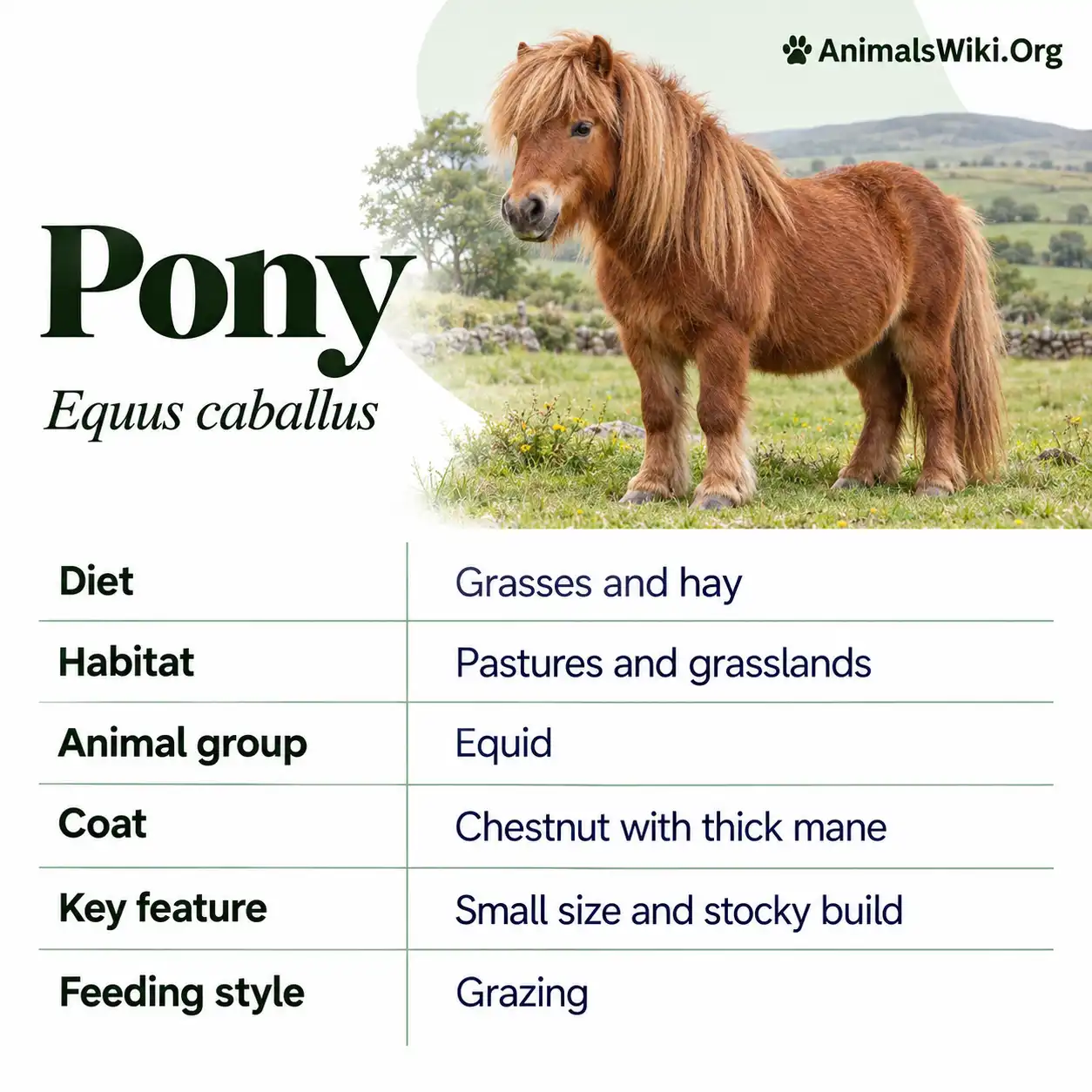
Pony, The Small Horse with a Remarkable History
A pony is a small horse, but its identity involves more than height alone. Ponies include many breeds and types, from compact Shetlands with thick winter coats to athletic riding ponies that compete in jumping and dressage. Their appearance, temperament, strength, and management needs vary considerably.
One of the most common misunderstandings is that a pony is a baby horse. In reality, a pony can be a fully grown adult. A baby horse or pony is called a foal, and a young pony generally remains within the size range associated with its breed as it matures.
Ponies have helped people farm, transport goods, travel across difficult landscapes, and learn to ride. Today, they remain important companions, sporting animals, and members of managed grazing herds.
Their smaller size can make them approachable, but it does not make them simple to manage. Ponies need appropriate nutrition, companionship, training, hoof care, and veterinary attention throughout their lives.
This guide explores what a pony is, how different breeds developed, how ponies behave, and what responsible care involves.
Pony Facts
| Feature | Details |
|---|---|
| Common name | Pony |
| Animal group | Domestic horse |
| Family | Equidae |
| Genus | Equus |
| Separate species from a horse? | No |
| Common height convention | Around 14.2 hands and below, with differences between organizations |
| Height measurement point | The withers, near the top of the shoulders |
| Diet | Herbivorous; mainly suitable forage |
| Social behavior | Social animals that benefit from compatible equine companionship |
| Baby’s name | Foal |
| Adult female | Mare |
| Adult uncastrated male | Stallion |
| Castrated male | Gelding |
| Lifespan | Often into the twenties; many reach their thirties |
| Common activities | Riding, driving, showing, companionship, and managed grazing |
| Examples | Shetland, Welsh, Connemara, Exmoor, Dartmoor, and New Forest |
What Is a Pony?
A pony is a small domestic horse that may also have physical characteristics traditionally associated with pony breeds. These can include a compact body, relatively short legs, a substantial mane and tail, and a thick seasonal coat.
However, those features are not universal. Some riding ponies have a refined appearance, while certain small horses retain proportions more commonly associated with larger horse breeds.
The word therefore has several overlapping uses. It can describe an animal within a particular height category, a member of an established pony breed, or a traditional type recognized within a regional equestrian culture.
That is why one simple definition does not resolve every example.
For everyday understanding, the most useful starting point is that ponies are horses, usually of smaller mature size. They are not a separate species, and they are not an earlier stage through which every horse passes.
Pony vs Horse: What Is the Difference?
Height is the most familiar distinction between a pony and a horse. A widely used convention places the boundary around 14.2 hands, although the precise wording and measurement rules vary.
Breed identity and tradition also matter. Some small equines are called horses despite standing below a common pony threshold. Conversely, an individual from a pony breed may grow beyond a particular competition height limit.
Ponies are often described as stockier than horses, with thicker coats and shorter limbs relative to their bodies. Those descriptions fit many native breeds but do not describe every pony.
| Feature | Pony | Larger horse |
|---|---|---|
| Mature height | Usually within a smaller height category | Usually above that category |
| Body proportions | Often compact, but variable | Highly variable |
| Seasonal coat | Often substantial in native breeds | Depends on breed and environment |
| Species identity | Domestic horse | Domestic horse |
| Suitability for a rider | Depends on individual assessment | Depends on individual assessment |
Height is useful, but it cannot explain temperament, fitness, or training.
Is a Pony a Baby Horse?
No. A pony can be newborn, young, mature, or elderly. The term describes a type or size category rather than an age.
A baby horse is called a foal. The same term applies to a baby pony. A young male is a colt, while a young female is a filly.
Imagine a Shetland mare standing beside a Thoroughbred foal. The mare may be much smaller, but she is still the adult. Size alone cannot determine which animal is younger.
This distinction is particularly useful when explaining equines to children. A pony does not necessarily “turn into a horse” as it grows. Instead, it becomes an adult pony.
Young animals also need age-appropriate management. A small foal should not be treated like a fully developed riding pony simply because both fit beneath a familiar height limit.
How Tall Is a Pony?
Equine height is traditionally expressed in hands. One hand equals four inches, or 10.16 centimeters.
The notation can be confusing because it is not an ordinary decimal system. For example, 14.2 hands means 14 hands and two inches, totaling 58 inches, or approximately 147.3 centimeters. It does not mean 14.2 multiplied by four inches.
Height is measured at the withers, the raised area where the neck meets the back, rather than at the ears or highest point of the head.
Competition organizations may use metric limits and specific procedures. The FEI’s published pony-measuring system uses regulatory heights of 148 centimeters without shoes and 149 centimeters with shoes, alongside its measurement provisions.
Owners entering competitions should check the relevant organization’s current rules. A general description in an educational article cannot replace the regulations for a particular class or discipline.
Is a Pony a Separate Species or a Breed?
“Pony” is neither a separate species nor the name of one breed.
A Shetland pony, Welsh pony, and Connemara pony are all domestic horses, but they belong to different breeding populations with their own histories and standards.
Breed societies may maintain pedigree records, establish registration requirements, and describe desired characteristics. These standards help preserve recognizable types, although individual animals still vary.
Crossbred ponies also exist. An animal can be a pony without belonging to a recognized purebred population.
This distinction prevents several common mistakes. Height alone does not establish pedigree, and resemblance to a breed does not prove registration or ancestry.
For someone choosing a pony, documented breeding can provide useful background. Nevertheless, the animal’s actual health, handling, training, and suitability remain essential considerations. A breed name cannot guarantee how an individual will behave.
What Do Ponies Look Like?
Many ponies have a compact outline, a deep body, and limbs that appear relatively short compared with those of a tall riding horse.
Their heads, necks, and movement vary with breed and ancestry. Some have broad foreheads and small ears, while others have a more refined head and longer neck.
Manes and tails can be particularly full in native breeds. Seasonal coats may become dense during colder months, changing the animal’s appearance considerably between summer and winter.
Colors are equally varied. Ponies may be bay, black, chestnut, gray, dun, or display patterned coats, depending on their genetics and breed requirements.
A thick coat can make body condition difficult to judge visually. An animal that looks comfortably rounded may be carrying too much fat, while another may appear larger because of hair rather than body tissue.
Appearance is therefore a starting point for observation, rather than a complete assessment of health.
How Much Does a Pony Weigh?
There is no single useful weight for all ponies. A small Shetland and a substantial Highland pony can differ greatly in body mass, even though both are commonly described as ponies.
Height, bone structure, muscular development, age, and body fat all influence weight.
This matters because owners sometimes estimate feed, equipment suitability, or carrying capacity from height alone. Two ponies of the same height may have very different builds and nutritional requirements.
A weighbridge provides a direct measurement when available. Weight tapes and body measurements can help monitor trends, but their estimates should be interpreted appropriately for the individual.
Weight and body condition are also different concepts. A naturally substantial pony is not automatically overweight, and a light-framed animal is not necessarily underweight.
The most useful approach combines weight monitoring with hands-on condition assessment and professional guidance when needed.
Where Did Ponies Come From?
Pony breeds developed through a combination of environmental pressures, movement of domestic horses, and human selection.
In some regions, smaller, efficient animals were useful where food resources were limited or the terrain was difficult. Over generations, local breeding populations developed recognizable characteristics.
People also selected animals for particular jobs. Riding, pulling, carrying, and agricultural work encouraged different preferences in size, build, movement, and temperament.
These histories are more complicated than the idea that every pony descended unchanged from one ancient wild population. Domestic animals have moved between regions and interbred throughout history.
Research on British and Irish native ponies has examined genetic relationships within and between breeds, highlighting their value as distinct populations and reservoirs of genetic diversity.
Modern breed identities preserve aspects of that history, but they also reflect organized breeding decisions and the development of studbooks.
Popular Pony Breeds at a Glance
The following examples show how much variety exists within the word “pony.”
| Breed or group | Region associated with its development | Recognizable features |
|---|---|---|
| Shetland | Shetland Islands, Scotland | Small size, substantial build, full coat |
| Welsh pony | Wales | Several sections with different sizes and types |
| Connemara | Western Ireland | Versatile riding type with an athletic build |
| Exmoor | Southwest England | Mealy muzzle, distinctive eye area, dense winter coat |
| New Forest | Southern England | Variable size within a defined breed standard |
| Dartmoor | Southwest England | Compact native pony type |
| Fell | Northern England | Substantial native pony associated with riding and driving |
| Dales | Northern England | Strong build and a history of working use |
| Highland | Scotland | Substantial frame and adaptation to demanding environments |
These summaries describe broad associations. They should not be read as promises about an individual pony’s behavior or suitability.
The Shetland Pony
The Shetland pony is among the most recognizable pony breeds. Its small stature, sturdy appearance, and abundant coat make it easy to distinguish from many larger riding types.
The breed’s development is associated with Scotland’s Shetland Islands. Its history includes practical working roles as well as later use in riding, driving, and companionship.
Under the UK Shetland Pony Stud-Book Society’s breed standard, registered stock must not exceed 42 inches, approximately 107 centimeters.
Despite their size, Shetlands are substantial animals that require knowledgeable handling. They should not be treated as oversized toys or assumed to be suitable for every young child.
Their feeding also needs attention. A small pony can receive far more energy than it needs when grazing rich pasture or receiving unnecessary concentrated feed.
Selecting a Shetland should involve the same consideration of health, training, and long-term care that applies to a larger equine.
Welsh Ponies and Cobs
Welsh ponies and cobs illustrate why equine classification cannot always be reduced to one height boundary.
The Welsh Pony and Cob Society maintains several sections that distinguish different types. These include the Welsh Mountain Pony, the Welsh Pony of Riding Type, the Welsh Pony of Cob Type, and the Welsh Cob.
Their differences involve size and build, while shared breed character remains important.
Welsh animals are used in riding, driving, and showing. Their popularity has also spread well beyond Wales through breeding and equestrian activity in other countries.
However, popularity and versatility should not be confused with automatic suitability. Some individuals are experienced family animals, while others are energetic competition prospects requiring skilled handling.
The Welsh Cob, registered in Section D, can stand above the usual pony height boundary while retaining the pony character described in its standard. This is a useful example of breed tradition operating alongside size-based terminology.
The Connemara Pony
The Connemara pony developed in western Ireland and is widely associated with versatility under saddle.
Its breed standards emphasize a useful combination of substance, balance, movement, and manageable character. Individual Connemaras participate in activities including jumping, dressage, general riding, and driving.
The breed’s agricultural background helps explain the emphasis on practical usefulness. People valued animals capable of performing different tasks rather than specializing in only one.
Modern breeding and management have continued to shape the population. Registration and inspection systems help define the characteristics breeders aim to preserve.
As with every breed, a Connemara should be assessed individually. A young, inexperienced competition pony and an older, established teaching pony may share ancestry while offering very different experiences to a rider.
The breed’s reputation provides context, but training history, health, and the intended partnership determine suitability.
Exmoor and Other Native Ponies
Native pony breeds preserve distinct combinations of physical characteristics and regional history.
The Exmoor pony is recognizable for its mealy-colored muzzle, pale areas around the eyes, and seasonal coat. Its breed standard describes a dense winter coat with insulating and protective layers.
Other native breeds, including Dartmoor, Fell, Dales, Highland, and New Forest ponies, have their own standards and backgrounds. They should not be treated as interchangeable simply because they share a general reputation for hardiness.
Their differences can influence equipment fit, feeding, movement, and suitability for particular activities.
A substantial native pony may look as though it can manage any workload, but appearance does not replace conditioning. Similarly, adaptation to outdoor conditions does not remove the need for shelter, monitoring, or veterinary care.
The value of native breeds lies partly in their diversity. Preserving that diversity requires recognizing the characteristics of each population.
Are Free-Roaming Ponies Wild?
A pony roaming across open land may be owned, managed, and monitored even when no person is standing nearby.
The New Forest provides a well-known example. Its free-roaming ponies are owned by members of the commoning community, whose rights allow animals to graze on the open Forest.
This differs from the everyday assumption that every free-roaming animal is unowned wildlife.
Terms such as “feral” and “semi-feral” describe aspects of an animal’s relationship with people and management. They do not necessarily establish legal ownership or prove that no care takes place.
Visitors should observe ponies from a respectful distance. Feeding can encourage animals to approach people and roads, interfere with appropriate diets, and create conflict.
A pony that approaches a visitor is not automatically inviting contact. Responsible viewing allows the animals to continue their activities without being crowded, chased, fed, or separated from companions.
Pony Behavior and Social Life
Ponies are social animals. Their relationships with other equines influence how they rest, move, feed, and respond to unfamiliar situations.
Compatible companionship allows opportunities for interaction, mutual grooming, and social reassurance. Keeping a pony physically comfortable while ignoring its social needs provides only part of appropriate care.
Group management still requires thought. Animals need enough access to food, water, shelter, and resting space without persistent bullying.
A small pony living with larger horses may need particular attention to feeding arrangements. Compatibility cannot be assumed from the fact that animals share a field without fighting.
Strong bonds can also make separation difficult. Training for necessary brief separations should be gradual and practical, particularly when animals have different exercise or veterinary needs.
Watching normal social behavior helps owners identify changes. A pony that suddenly withdraws from companions or becomes unusually irritable may need its health and environment assessed.
How Ponies Communicate
Ponies communicate through their whole bodies. Ear position, facial tension, head carriage, tail movement, posture, and movement all contribute to the picture.
No single sign provides a complete explanation. An ear turned toward a sound differs from ears held back during an uncomfortable interaction. Stillness can indicate relaxation, but it can also occur when an animal is tense.
Context and individual familiarity matter.
Handlers should learn what is normal for the pony they care for. Changes around saddling, grooming, eating, or lifting the feet can be informative.
A pony that moves away when equipment appears may be responding to discomfort or an unpleasant association. Calling it naughty without investigating can allow the underlying problem to continue.
People communicate too. Clear positioning, consistent cues, and predictable handling make interactions easier to understand. Conflicting signals can create confusion even in an animal that has previously learned the task.
Are Ponies Intelligent or Stubborn?
Ponies can learn routines, remember experiences, and become skilled at responding to their environment.
Their reputation for mischief often reflects how effectively they learn which actions produce useful outcomes. If pushing through a gate repeatedly leads to better grass, the behavior may become well established.
That does not require a human-style intention to misbehave.
Likewise, apparent stubbornness can have several causes. The pony may not understand the cue, may be frightened, may be tired, or may find the task uncomfortable.
Before treating a refusal as a training problem, consider whether the request is clear and physically appropriate.
It is also unhelpful to rank every pony as more intelligent than every larger horse. Learning ability varies between individuals and situations.
The practical goal is to recognize how behavior develops. Thoughtful management makes desired responses easier to learn and prevents unwanted habits from being repeatedly rewarded.
Training a Pony Fairly
Good training begins with ordinary handling skills: approaching calmly, leading, standing, accepting examination, and allowing hoof care.
These skills support the pony’s welfare whether it eventually becomes a riding animal, a driving pony, or a companion.
Training should break unfamiliar tasks into manageable steps. Clear cues and well-timed reinforcement help the animal understand which response is being requested.
Short, productive sessions are often more useful than repeating an exercise until the pony becomes tired or frustrated.
The handler must also consider physical readiness. A pony cannot learn its way out of a painful saddle, sore feet, or a workload beyond its fitness.
When behavior changes unexpectedly, reviewing health and equipment is part of responsible training.
Professional help can improve both safety and clarity. The aim is a pony that understands the task and can perform it comfortably, rather than one that merely stops resisting pressure.
Are Ponies Good for Children?
A suitably trained pony can help a child develop riding skills, confidence, responsibility, and an appreciation of animal care.
However, small size does not guarantee safety. Ponies can bite, kick, rush, become frightened, or respond unpredictably. A young rider needs appropriate supervision and instruction.
Matching matters more than appearance. The pony’s temperament, experience, pace, training, and physical suitability should fit the child’s ability.
A lively competition pony may be ideal for an experienced young rider while being unsuitable for a beginner. An established school pony may offer a more appropriate learning environment.
Children also benefit from learning care skills on the ground. Grooming, observing behavior, preparing equipment, and understanding feeding can teach more than riding alone.
A pony should not carry the responsibility for managing an inexperienced child without knowledgeable adults organizing the interaction. Good supervision protects both the child and the animal.
Can Adults Ride Ponies?
Some adults can ride some ponies comfortably, but there is no universal answer based on height alone.
The assessment should include the pony’s build, health, muscle development, fitness, back shape, and training. Rider balance and the fit of the saddle also matter.
The combined load includes the rider and equipment. Terrain, pace, weather, and duration influence the demands placed on the animal.
A substantial pony is not automatically suitable for every adult, and a short ride is not automatically harmless.
Some adults enjoy riding larger pony breeds because the individual animal suits their size and activity. Others participate through driving, groundwork, showing in hand, or companionship.
The responsible approach is to assess the particular partnership with knowledgeable support. A fixed claim that every pony can carry a particular percentage of its weight overlooks important differences.
Ponies in Sport, Recreation, and Education
Ponies take part in a broad range of equestrian activities. These include dressage, show jumping, eventing, driving, mounted games, showing, and leisure riding.
Competition categories often consider both pony height and rider eligibility. The relevant rules depend on the organization and discipline.
Participation also requires preparation. Fitness, suitable surfaces, transport planning, equipment, and recovery affect the pony’s experience.
A pony that enjoys one activity may not suit another. Movement, confidence, physical ability, and previous training influence what it can comfortably do.
Educational programs can extend beyond competition. Learning to recognize body language, care for equipment, assess basic needs, and work cooperatively around animals builds useful practical skills.
Organizations such as The Pony Club place welfare and horsemanship within their teaching materials, emphasizing understanding the animal alongside developing riding ability.
Achievement is most meaningful when the pony remains comfortable and well managed.
What Do Ponies Eat?
Ponies are herbivores, and suitable forage should usually form the foundation of their diet. Depending on the situation, that may include managed grazing, hay, or other appropriate forage products.
The correct ration depends on the individual. Age, body condition, workload, dental function, health, and forage quality all influence requirements.
Concentrated feed is not automatically necessary simply because a pony is ridden. Some lightly worked animals receive more than enough energy from forage.
At the same time, limiting calories must not mean neglecting protein, vitamins, minerals, or opportunities to forage.
Feed labels should be interpreted as part of the complete diet. Adding several supplements can duplicate nutrients without solving the underlying issue.
A veterinarian or qualified equine nutritionist can help when a pony is growing, elderly, underweight, overweight, or affected by a condition requiring dietary changes.
The aim is an adequate, balanced ration that supports health without encouraging unnecessary weight gain.
Why Forage and Feeding Routine Matter
Forage contributes to digestive function and allows ponies to spend time performing normal feeding behavior.
Feeding management involves more than the amount offered. Cleanliness, quality, access, and the distribution of food throughout the day also matter.
A pony kept with companions may finish its own ration and then consume another animal’s feed. Conversely, a less assertive individual may receive less than the owner assumes.
Observing feeding interactions helps reveal these problems.
Changes in the ration should be made thoughtfully. Moving suddenly between very different grazing conditions or feed types can create avoidable difficulties.
Food should also be stored securely so that a pony cannot gain unintended access to concentrated feed.
Forage-based feeding does not mean leaving every pony on unlimited rich grass. It means building a suitable diet around appropriate fiber sources while considering the animal’s total nutrient and energy intake.
Why Ponies Can Gain Weight Easily
Many ponies maintain body condition efficiently. In a modern setting with rich grazing and limited activity, that can contribute to excessive weight gain.
Owners may underestimate the amount of grass consumed because grazing does not look like a large prepared meal. A pony can take in substantial food while appearing to do little more than wander around a field.
A thick coat can further conceal changes in body shape.
Regular body-condition assessment is therefore valuable. This involves looking and feeling for fat coverage rather than relying entirely on a visual impression.
Weight management should be planned and monitored. Abrupt starvation is not an appropriate response, and a pony still needs a nutritionally adequate diet.
Exercise can help suitable, sound animals, but it must be introduced according to fitness and health.
The goal is sustainable management, not a brief period of restriction followed by a return to the same conditions.
Ponies, Insulin Dysregulation, and Laminitis
Some ponies are particularly vulnerable to metabolic problems that increase the risk of laminitis. However, being a pony does not mean an animal will inevitably develop these conditions.
Insulin dysregulation is an important concern within equine metabolic syndrome. Body fat and metabolic health are related, but outward appearance alone cannot establish a diagnosis.
Laminitis affects the tissues supporting the pedal bone within the hoof and can cause severe pain and lasting damage.
Warning signs may include shortened steps, reluctance to turn, unusual weight shifting, or obvious foot soreness. Suspected laminitis requires prompt veterinary attention.
An affected pony should not be forced to exercise in an attempt to make it lose weight.
Management needs to address the underlying situation as well as hoof comfort. A veterinarian can assess relevant risk factors and coordinate care with an appropriate hoof-care professional.
Preventive attention is particularly important when a pony has previously experienced laminitis.
Grazing Management and Clean Water
Pasture can provide food, movement, and social opportunities, but access should match the pony’s needs.
The amount and nutritional value of grass change with environmental conditions and management. A field that appears sparse may still allow significant intake, while a larger area is not necessarily more suitable.
Practical grazing arrangements should balance nutrition with opportunities to move and interact. Any equipment used to manage intake needs appropriate fitting and monitoring.
Clean drinking water must remain reliably available. Containers should be accessible, maintained, and checked for contamination or freezing where relevant.
Owners should also confirm that every animal can drink without being persistently displaced.
Water needs vary with diet, activity, temperature, and individual circumstances. A pony’s small size or hardy ancestry does not justify restricted drinking opportunities.
Daily checks should confirm actual access rather than assuming that a full container somewhere in the enclosure is sufficient.
Housing, Turnout, and Shelter
Appropriate housing supports movement, rest, ventilation, and social contact.
A stable should allow the pony to stand comfortably, turn, and lie down. It also needs safe construction, suitable bedding, and effective management of dust and waste.
Outdoor space requires equal attention. Poor drainage around gateways, feeding areas, and water points can create persistent muddy conditions.
Fencing should suit the animals using the space. Small ponies may exploit gaps that contain larger horses, so enclosure design needs to reflect actual size and behavior.
Shelter can take different forms depending on climate and management, but the animal should be able to find relief from difficult weather.
The presence of a building does not automatically establish good housing. What matters is whether the pony can use the environment comfortably and safely.
Regular inspection helps identify damage, loose fittings, sharp edges, and other problems before an injury occurs.
Grooming, Coats, and Comfortable Equipment
Grooming provides an opportunity to check the pony’s skin, coat, limbs, and general condition.
A thick mane or winter coat can conceal rubbing, small wounds, parasites, or changes in body shape. Careful observation is therefore as important as making the animal look tidy.
Blanketing decisions should reflect the individual’s coat, body condition, age, shelter, climate, and whether it has been clipped. A universal rule that every pony needs a blanket—or that none ever does—ignores these differences.
Saddles, bridles, harnesses, and protective equipment also need individual fitting.
A pony-sized label does not guarantee that an item suits every pony. Back shape, shoulder movement, head proportions, and intended activity affect fit.
Handlers should inspect contact areas and respond to changes in behavior. Reluctance during tacking up, tenderness, or recurring rubs deserve investigation rather than being accepted as routine.
Hoof Care and Dental Health
Ponies need regular hoof assessment even when their feet appear strong and they are not ridden.
Growth, wear, conformation, environment, and workload influence maintenance needs. Some ponies benefit from shoes or other protection, while others can be managed without them.
Hoof care should respond to the individual rather than a belief that native breeds never need professional attention.
Dental health is similarly important. Problems can affect chewing, comfort, body condition, and behavior around the bit.
Dropping partially chewed food, taking longer to eat, or losing weight can justify closer investigation. However, visible symptoms are not the only reason for a dental examination.
A veterinarian or appropriately qualified dental professional should assess the mouth at suitable intervals.
Combining routine checks with daily observation helps identify difficulties before they substantially interfere with eating or movement.
Veterinary Care and Recognizing Illness
A preventive healthcare plan should reflect the pony’s age, location, activity, contact with other equines, and medical history.
Vaccination and parasite management need professional guidance. Parasite control should involve appropriate testing and risk assessment rather than assuming every pony requires identical treatment at fixed intervals.
Owners should also learn what is normal for their animal. Appetite, drinking, manure production, movement, breathing, and social behavior provide useful daily information.
A sudden change can matter even when the pony remains standing quietly.
Signs of abdominal discomfort, marked lameness, difficulty breathing, inability to rise, or other serious changes require veterinary assessment. Trying to diagnose these problems from a general online description can delay necessary care.
Good records are useful. Dates of examinations, treatments, vaccinations, dental care, and significant behavioral changes help professionals understand the pony’s history and plan future management.
Pony Reproduction and Foal Development
Ponies reproduce as domestic horses do. Unlike mules, they are not generally infertile hybrids.
Responsible breeding considers the health, ancestry, temperament, and suitability of both parents. It also requires a realistic plan for pregnancy, birth, early care, and the offspring’s future.
Producing a foal simply because a mare is small or attractive overlooks those responsibilities.
Young ponies need suitable nutrition, appropriate social experiences, and gradual handling. Learning to lead, accept examination, and allow hoof care can make later management easier.
However, early education should not become excessive physical demands.
A foal’s ability to learn does not mean its body is ready for adult work. Growth and training need to progress appropriately, with professional advice where necessary.
Keeping accurate breeding and identification records also supports responsible ownership and helps preserve meaningful information about the animal.
How Long Do Ponies Live?
Many ponies live into their twenties, and substantial numbers reach their thirties. Some live longer, but exceptional ages should not be presented as the expected lifespan of every animal.
Ponies often live longer than larger horse breeds, although individual outcomes depend on health, management, injury, and other circumstances.
Older age can bring changing dental function, reduced mobility, altered body condition, and a need for closer monitoring.
Retirement does not remove the need for care. An elderly pony still requires companionship, comfortable footing, suitable food, hoof maintenance, and veterinary attention.
Activity should match the animal’s condition rather than a fixed birthday. Some older ponies remain comfortable in light work, while others need a different routine.
Daily comfort and function provide more useful information than age alone. Eating, moving, resting, and interacting normally are important parts of assessing an older pony’s quality of life.
Pony Conservation and Conservation Grazing
Ponies as a broad domestic category do not share one global conservation status. Individual breeds can nevertheless face concerns about declining breeding populations or loss of genetic diversity.
Conservation programs may maintain pedigree records, monitor breeding numbers, encourage responsible breeding, and preserve characteristic traits.
Population figures and watchlist categories can change, so conservation claims should identify the breed and the assessment being used.
Ponies can also contribute to conservation grazing. Managed herds help shape vegetation through feeding, trampling, and movement.
That role requires planning. Appropriate stocking levels, seasonal conditions, animal health, and the needs of the habitat all matter.
A pony used in habitat management remains a domestic animal with welfare requirements. Ecological usefulness does not replace monitoring or access to appropriate care.
Breed conservation and conservation grazing are related in some projects, but they describe different goals: preserving animal populations and managing habitats.
Choosing a Pony and Planning Daily Care
Choosing a pony begins with the intended relationship, not the most appealing photograph.
Consider the handler’s experience, the rider’s ability, the activity, and the support available. Ask about behavior during catching, leading, grooming, hoof care, loading, separation, and work in unfamiliar settings.
A knowledgeable assessment and veterinary examination can help identify concerns before purchase.
Ongoing care also requires practical planning. Feed, bedding, land management, equipment, hoof care, veterinary services, and emergency arrangements continue long after the initial payment.
A useful daily routine includes observing the pony closely, checking food and water, assessing the enclosure, noticing manure and movement, and confirming access to companionship and rest.
Records help reveal gradual changes that are easy to miss from day to day.
Ownership should also account for holidays, illness, changing circumstances, and retirement. The best match is one the owner can support consistently throughout the animal’s life.
Common Pony Myths Explained
| Myth | More accurate explanation |
|---|---|
| A pony is a baby horse | A pony can be any age; a baby is a foal |
| Every small equine is classified identically | Breed traditions and organizational rules can differ |
| All ponies are gentle | Temperament and behavior vary between individuals |
| Ponies are automatically safe for children | Suitability, training, supervision, and matching are essential |
| Hardy ponies need little care | They still need nutrition, companionship, hoof care, and healthcare |
| Every pony needs grain | Additional energy feed depends on the individual’s requirements |
| A pony cannot become overweight on grass | Grazing can supply more energy than some ponies need |
| Strong feet never need maintenance | All ponies need appropriate hoof assessment |
| A thick coat proves good body condition | Hair can conceal both excess fat and weight loss |
| Retirement means minimal management | Older and nonworking ponies still need comprehensive care |
Understanding these distinctions improves everyday decisions. Familiar sayings can influence feeding, training, and purchasing, so replacing them with individual assessment benefits both people and animals.
Frequently Asked Questions About Ponies
What exactly is a pony?
A pony is a small domestic horse, often associated with particular breed characteristics as well as height. The term includes many breeds and crossbred types. It does not describe one species, one breed, or one age group.
Is a pony the same animal as a horse?
Yes, ponies are domestic horses. The distinction usually involves mature size, breed identity, and tradition. A pony is not a separate species in the way that a donkey is a different species from a horse.
Does a pony grow into a horse?
A young pony grows into an adult pony. It does not automatically become a larger horse. An individual’s eventual height depends on genetics and development, although some animals may exceed a particular competition’s pony height limit.
What is a baby pony called?
A baby pony is called a foal. A young male is a colt, and a young female is a filly. These terms also apply to young horses, because ponies and larger horses belong to the same domestic animal group.
How tall can a pony be?
A common convention places ponies around 14.2 hands and below. Competition organizations may use specific metric limits and measuring procedures. Breed identity and traditional naming can also differ from a simple height-based classification.
What does 14.2 hands mean?
It means 14 hands and two inches. Since one hand equals four inches, the total is 58 inches, approximately 147.3 centimeters. The notation is not a standard decimal measurement.
Where is a pony measured?
Height is normally measured at the withers, where the neck meets the back near the shoulders. Measuring to the ears would be unreliable because the animal can raise, lower, or turn its head.
Is a miniature horse a pony?
Miniature horses are domestic horses of very small size, but registries maintain their own terminology and standards. The American Miniature Horse Association emphasizes balanced horse-like proportions and sets a mature height limit of 34 inches under its measuring system.
What is the smallest pony breed?
Shetlands are among the best-known small pony breeds. However, identifying a single smallest breed depends on which populations and definitions are being compared. Miniature horse registries also maintain very small equines under their own standards.
Are ponies stronger than horses?
Strength depends on size, build, fitness, health, and the task. Some ponies are substantial for their height, but that does not make every pony stronger than a larger horse or suitable for unlimited carrying or pulling.
Are ponies naturally stubborn?
A pony may hesitate because it is confused, frightened, uncomfortable, tired, or responding to previous learning. Calling the behavior stubborn does not explain its cause. Health, equipment, environment, and training should all be considered.
Do ponies bite?
They can. Biting may occur in different contexts, including conflict, discomfort, fear, or learned interactions around food. Safe management involves understanding the situation, addressing possible causes, and obtaining qualified help when necessary.
Are ponies suitable for beginner riders?
Some experienced, appropriately trained ponies are suitable for beginners. Others are not. The rider’s size, confidence, ability, and access to instruction must be matched with the individual pony’s characteristics.
Can an adult own a pony without riding it?
Yes. Ponies can participate in driving, groundwork, in-hand showing, or companionship. Their care needs remain important whether or not they carry a rider. Appropriate activity and enrichment can be planned around the individual.
What should a pony eat every day?
A suitable forage-based ration is the usual foundation. Additional feed and supplements depend on forage quality, age, health, workload, and body condition. There is no single daily menu appropriate for every pony.
Do ponies need carrots and apples?
No. Such foods are optional treats rather than essential components of a balanced diet. Whether they are appropriate depends on the animal’s health and management. Visitors should never feed a pony without the responsible person’s permission.
Can a pony live on unlimited pasture?
Some cannot do so safely because grazing may provide excessive energy or conflict with medical needs. Pasture access should be assessed individually, especially for ponies with weight-management difficulties or a history of laminitis.
How much water does a pony need?
Intake varies with size, diet, weather, and activity. The practical requirement is reliable access to clean drinking water, with regular checks that the pony can actually reach and use the supply.
Do ponies need another pony?
They benefit from compatible equine companionship, which may include another pony or a suitable horse. Compatibility, feeding access, and group behavior need monitoring. Human interaction alone does not provide the same social opportunities.
Can ponies live outside throughout the year?
Some can under suitable management and climate conditions. Outdoor living still requires appropriate shelter, dry resting opportunities, food, water, companionship, and regular inspection. Age, health, coat, and individual condition influence suitability.
Do all ponies need horseshoes?
No. Some are managed without shoes, while others need protection suited to their work or hoof condition. All require regular assessment and maintenance regardless of whether they are ridden.
How long does a pony usually live?
Many live into their twenties, and many reach their thirties. Individual lifespan varies considerably. Good care supports longevity, but unusually old examples should not be treated as a guarantee for every pony.
Can ponies and horses live together?
Yes, compatible individuals can share a suitable environment. Owners should monitor social relationships and feeding carefully, because animals of different sizes or nutritional needs may require separate feeding arrangements.
Are free-roaming ponies safe to pet?
They should be observed respectfully rather than approached as pets. Free-roaming ponies can react unpredictably, and feeding or crowding can create problems for both animals and visitors. Follow the guidance for the location.
Is buying a pony cheaper than buying a horse?
Purchase prices vary, and size alone does not determine cost. Ongoing expenses can be substantial for both. Professional care, land, equipment, emergency treatment, and long-term management should be budgeted before ownership.
Pony Small Domestic Horse
The pony is a diverse and capable domestic horse with a history that reaches far beyond children’s riding lessons. Different breeds have supported farming, transport, recreation, sport, and habitat management, while developing distinctive appearances and regional identities.
Understanding ponies begins with a few clear distinctions. A pony is not a baby horse, height conventions are not universal across every organization, and small size does not guarantee an easy temperament or simple care.
Each pony needs assessment as an individual. Appropriate feeding, healthy body condition, compatible companionship, clear training, comfortable equipment, and preventive healthcare all contribute to a good life.
Whether a pony is competing, teaching, grazing a conservation site, or enjoying retirement, its value is best recognized through knowledgeable and consistent care.



