
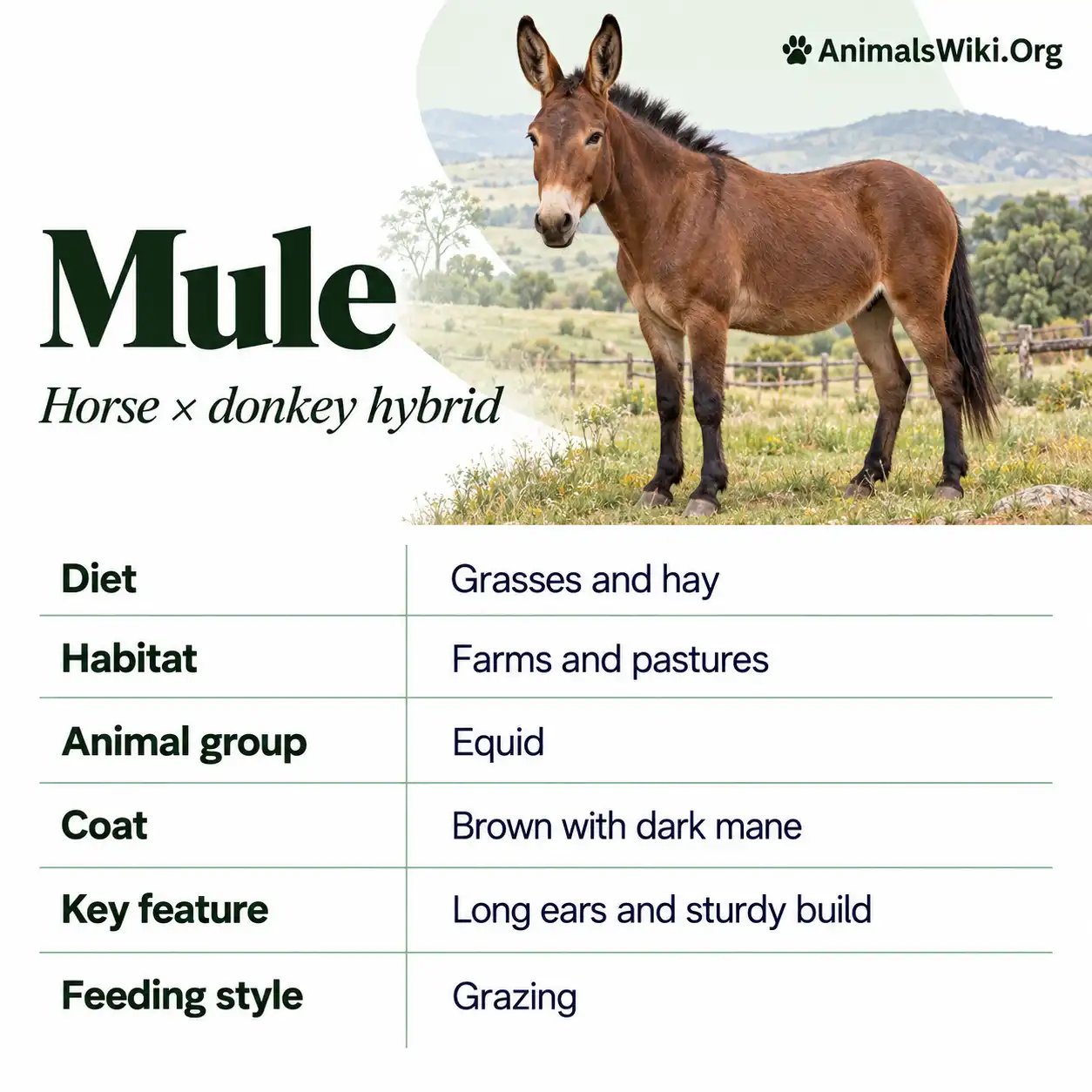
Mule, A Complete Guide to the Horse and Donkey Hybrid
A mule is the offspring of a male donkey and a female horse. Recognized for its long ears, sturdy build, and long history as a working animal, the mule combines characteristics inherited from two closely related members of the horse family.
Mules have carried supplies across mountains, pulled farm equipment, transported people, and supported communities where vehicles are difficult to use. Today, they also take part in recreational riding, trail maintenance, packing, and other activities that reward careful training and physical fitness.
However, many familiar claims about mules need a closer look. They are not all the same size, they are not automatically stubborn, and they do not thrive without proper food, water, companionship, or veterinary attention. Most are infertile, but rare female exceptions have been documented.
This guide explains mule biology, appearance, behavior, history, working roles, and everyday care. It also answers common questions about how mules differ from horses, donkeys, and hinnies.
Mule Facts
| Feature | Details |
|---|---|
| Common name | Mule |
| Animal type | Domestic equine hybrid |
| Family | Equidae |
| Genus | Equus |
| Father | Male donkey, called a jack |
| Mother | Female horse, called a mare |
| Usual chromosome count | 63 |
| Diet | Herbivorous; primarily forage |
| Size | Varies considerably with parentage |
| Typical roles | Riding, packing, transport, agricultural work, and companionship |
| Social needs | Compatible equine companionship |
| Reproduction | Usually infertile; rare fertile females are documented |
| Lifespan | Can extend into the twenties and thirties |
| Wild conservation status | Not assessed as a separate wild species |
What Is a Mule?
A mule is a domestic hybrid produced by crossing a male donkey with a female horse. Horses and donkeys are different species within the same genus, which helps explain why they can produce offspring together.
The resulting animal develops its own combination of inherited characteristics. A mule might have prominent donkey-like ears, a body that resembles its horse mother, and a mane or tail that reflects features of both parents. Its temperament and physical abilities also develop through the interaction of inheritance, early experience, health, and training.
People often describe mules as a combination of the best qualities of a horse and a donkey. That description captures their appeal, but it oversimplifies biology. An individual mule may be well suited to a particular job, while another requires different management or has different strengths.
Understanding the individual animal is more useful than expecting every mule to fit a single description.
Mule vs Hinny: What Is the Difference?
A mule and a hinny come from the same two parent species, but the sexes of their parents are reversed.
| Feature | Mule | Hinny |
|---|---|---|
| Father | Male donkey | Male horse |
| Mother | Female horse | Female donkey |
| Usual chromosome count | 63 | 63 |
| Type of animal | Domestic equine hybrid | Domestic equine hybrid |
| General fertility | Usually infertile | Usually infertile |
| Identification | Parentage records are most reliable | Parentage records are most reliable |
This difference matters because inheritance involves more than a simple mixture of outward traits. The mother also provides the environment in which the fetus develops, and early maternal relationships can influence the young animal’s experiences.
People sometimes claim that hinnies always have smaller ears, different tails, or smaller bodies than mules. Such descriptions are unreliable when applied to every individual. Parent size, breed, and ordinary variation create substantial overlap.
If accurate identification matters, documented parentage is more dependable than appearance alone.
Is a Mule a Species or a Breed?
A mule is best described as a hybrid, rather than a separate species or a single breed.
A breed usually refers to a managed population of domestic animals with recognizable inherited characteristics. Mules are generally produced by crossing horses and donkeys again, rather than by breeding successive generations of mules together.
This creates considerable variety. A mule with a large draft horse mother may differ markedly from one with a small pony mother. The donkey father’s size, build, and other inherited characteristics also influence the offspring.
Terms such as “draft mule,” “riding mule,” and “miniature mule” often describe size, ancestry, or intended use. They do not mean that all mules belong to one uniform breeding population.
For classification, mules belong to the horse family, Equidae. Their parents belong to the genus Equus. Giving every mule a separate species identity would obscure the hybrid origin that defines the animal.
How Many Chromosomes Does a Mule Have?
Most mules have 63 chromosomes in their body cells. This number comes from the different chromosome counts of their parents.
A horse usually has 64 chromosomes and contributes 32 through an egg or sperm cell. A donkey usually has 62 chromosomes and contributes 31. When a donkey sperm fertilizes a horse egg, the resulting embryo normally receives 63 chromosomes.
| Animal | Usual chromosomes in body cells |
|---|---|
| Horse | 64 |
| Donkey | 62 |
| Mule | 63 |
| Hinny | 63 |
Having 63 chromosomes does not prevent a mule from developing into a healthy adult. The main reproductive difficulty arises when the animal attempts to produce its own eggs or sperm.
During that process, chromosomes need to pair and separate appropriately. Differences between horse and donkey chromosomes make this difficult. Both chromosome number and chromosome structure matter; infertility is more complicated than the statement that an odd number automatically prevents reproduction.
Why Are Most Mules Sterile?
Most mules are sterile because their inherited horse and donkey chromosomes do not pair normally during the formation of reproductive cells.
Producing eggs and sperm requires a specialized type of cell division called meiosis. In a typical fertile animal, corresponding chromosomes pair and are distributed into reproductive cells. In a mule, the parental chromosome sets differ enough to interfere with that process.
This reproductive limitation does not mean the animal is unhealthy, weak, or unable to live a full life. Fertility is one biological function, and it should not be treated as a measure of overall well-being.
Infertility also does not necessarily eliminate reproductive hormones or associated behavior. Female mules may show reproductive cycles, and males may display sexual behavior. Management decisions therefore depend on the individual animal.
A veterinarian should advise on reproductive health, castration, and related care. Owners should not assume that an infertile animal has no reproductive management needs.
Can a Female Mule Have a Baby?
Rare female mules have produced offspring. Consequently, saying that every mule is completely incapable of reproduction is inaccurate.
Documented exceptions are unusual enough that they do not change the general rule: mules are usually infertile. Mule breeding cannot normally be approached as a self-sustaining system in which fertile mule parents reliably produce another generation.
It is also important to distinguish natural fertility from reproductive technology. An animal carrying a transferred embryo is not necessarily producing genetically related offspring from its own egg.
For most owners, the practical lesson is straightforward. Do not assume fertility, but do not make reproductive decisions based solely on a popular saying either. A veterinarian can interpret the animal’s sex, history, behavior, and any relevant examination findings.
Rare fertile females are scientifically interesting because they help researchers understand chromosome inheritance and reproductive barriers between closely related species.
What Does a Mule Look Like?
A mule often has long ears, an elongated face, and a body that combines recognizable horse and donkey features. However, there is no single appearance shared by every mule.
Some have a substantial, horse-like frame with a broad chest and strong hindquarters. Others are lighter and more refined. The neck, legs, head proportions, mane, and tail vary with parentage.
Coat colors also vary. Mules may be brown, black, gray, chestnut, or display other colors and markings inherited through their parents. A particular color does not establish the animal’s working ability or temperament.
The ears are among the most noticeable features, but ear length alone does not describe the whole animal. Two mules of similar height can differ considerably in build, movement, and physical suitability for a task.
For riders and handlers, soundness and appropriate conformation matter more than whether an animal matches a familiar picture of a mule.
How Big Can a Mule Get?
Mule size depends heavily on the size and ancestry of both parents. Small pony and donkey combinations can produce relatively small mules, while larger horse and donkey parents can produce much bigger animals.
This variation makes a single “average mule weight” potentially misleading. A figure appropriate for a moderate riding mule may be unsuitable for a large draft-type animal or a miniature individual.
Equine height is often measured in hands. One hand equals four inches, or 10.16 centimeters, and height is measured at the withers, near the top of the shoulders.
Weight should be assessed using methods appropriate to the individual animal. Visual impressions alone can be deceptive, particularly when a thick coat or unusual body proportions affect appearance.
Size is also only one part of suitability. A large mule is not automatically fit for hard work, and a smaller mule should not be overloaded simply because it appears sturdy.
What Types of Mules Are There?
Mules are often grouped according to their size and intended work.
A riding mule may be selected for comfortable movement, manageable temperament, and suitability for a particular rider. A pack mule needs appropriate fitness, training, and a build that works well with correctly fitted packing equipment.
Draft-type mules are associated with pulling work. Their breeding may include larger horse and donkey parents, but physical size does not replace careful conditioning or training.
Smaller mules can serve as companions or take part in activities suited to their abilities. They still need the same fundamental categories of care as larger animals, including social contact, appropriate nutrition, hoof maintenance, and veterinary attention.
These descriptions overlap. An individual may perform more than one role, while another may be suitable only for light activity or companionship. Responsible classification starts with the animal’s actual capabilities.
Do Mules Have Hybrid Vigor?
The phrase hybrid vigor describes situations in which hybrid offspring show advantages in particular traits compared with their parental populations. It is often used to explain the mule’s reputation for endurance, adaptability, or learning ability.
However, hybrid vigor is not a guarantee that every mule will be stronger, healthier, longer-lived, or more intelligent than every horse or donkey.
Traits are influenced by many factors. Parent selection, nutrition, growth, disease, training, workload, and management all affect the finished animal. Crossing two species does not remove inherited weaknesses or make poor care harmless.
A useful way to think about hybrid vigor is as a possibility involving specific characteristics, rather than a promise of universal superiority.
When evaluating a mule for riding or work, assess its health, behavior, and preparation directly. A broad claim about hybrids cannot establish whether one particular animal is ready for a demanding task.
Are Mules Intelligent?
Mules can learn routines, recognize cues, solve practical problems, and remember experiences. Their reputation for intelligence has also attracted scientific investigation.
In one small study, six mules performed better than groups of six ponies and six donkeys on a particular visual learning task. That finding supports the possibility of an advantage in that testing situation, but it does not establish that every mule is more intelligent than every horse or donkey.
Animal intelligence is difficult to reduce to a single ranking. Learning a visual discrimination task, navigating around a barrier, responding to a handler, and coping with a new environment involve different abilities.
For everyday management, the useful lesson is to provide clear information and allow the animal to learn. An intelligent animal can still become frightened, confused, frustrated, or physically uncomfortable.
Good training works with learning processes instead of relying on the assumption that the mule should already understand.
Are Mules Really Stubborn?
“Stubborn” is a common label for a mule that stops, hesitates, or refuses a request. The label describes the handler’s frustration more clearly than it explains the animal’s behavior.
A mule may hesitate because an obstacle is unfamiliar, the footing feels uncertain, equipment hurts, or a cue has not been learned. Fatigue, illness, fear, and previous unpleasant experiences can also influence its response.
This does not mean every refusal is a deliberate safety assessment. Mules can make mistakes, panic, or react unpredictably. Their reputation for caution should never be treated as a guarantee against accidents.
The productive response is to investigate. Check the surroundings, the equipment, the animal’s condition, and the clarity of the request. If a behavior changes unexpectedly, physical discomfort deserves attention.
Patient handling and appropriate training are more informative than escalating pressure against an animal whose difficulty has not been understood.
How Do Mules Communicate?
Mules communicate through posture, movement, facial expression, vocalization, and their responses to nearby animals and people.
Ear position can provide useful information, but one body part should not be interpreted in isolation. A handler should also notice the eyes, muzzle, neck, tail, weight distribution, and overall tension.
Context matters. An animal standing quietly while relaxed is different from one that is motionless because it is frightened. Moving away from a saddle may indicate an association with discomfort, while reluctance to lift a foot may reflect pain or balance difficulties.
Learning an individual mule’s normal behavior makes changes easier to recognize. Subtle differences in sociability, movement, eating, or willingness to approach can be meaningful.
Communication also runs in both directions. Predictable movements and consistent cues help a mule understand what a person is asking. Conflicting signals make the interaction harder for both animal and handler.
Do Mules Need Companions?
Mules are social equids and generally benefit from compatible equine companionship. Keeping one in prolonged isolation can compromise its welfare even when its basic physical needs appear to be met.
A suitable companion may be another mule, a donkey, or a horse. Compatibility depends on the individuals, their experiences, and the way the group is managed.
Simply placing two animals together does not guarantee a good relationship. Differences in size, feeding needs, activity, and social behavior can create difficulties. Introductions need sufficient space and careful supervision.
Feeding arrangements should allow each animal to obtain an appropriate ration without persistent displacement or bullying. Shelter and resting areas should also be accessible to every group member.
Strong social bonds can influence handling and separation responses. Training for brief, manageable separations should therefore be gradual and considerate, especially when bonded animals need different veterinary care or workloads.
How Should a Mule Be Trained?
Training begins with basic handling: approaching people calmly, accepting a halter, leading, standing, and allowing routine examination. These skills support welfare long before the animal carries a rider or pulls equipment.
Effective training breaks a task into manageable steps. The handler introduces clear cues, recognizes progress, and avoids asking for more than the animal understands or can physically manage.
Consistency is especially important. If the same cue means different things on different days, the mule has to guess. Predictable handling makes learning easier.
Preparation should also reflect the intended activity. A pack mule needs to become comfortable with equipment, movement beside its body, unusual objects, and balanced loads. A riding mule needs suitable groundwork and a gradual introduction to ridden work.
Training cannot compensate for pain or unsuitable equipment. When progress stops abruptly, reassessing health and management is often more useful than repeating the same exercise with increasing force.
Are Mules Sure-Footed?
Mules have a strong reputation for negotiating uneven terrain. Their history in mountain packing and trail transport reflects their usefulness in environments where careful movement matters.
Nevertheless, “sure-footed” does not mean accident-proof. Loose stones, slippery surfaces, fatigue, poor visibility, unsuitable loads, and inadequate training can create hazards for any equid.
An individual’s movement depends on conformation, hoof condition, fitness, experience, and the demands of the route. A mule accustomed to easy ground should not be expected to handle difficult terrain safely without preparation.
Handlers also influence the situation. Poor route selection, rushing, or badly balanced cargo can undermine the animal’s ability to move comfortably.
The practical value of a mule’s movement is best preserved through sensible management. Suitable footing, gradual conditioning, maintained hooves, appropriate equipment, and realistic workloads matter more than relying on a reputation.
How Much Weight Can a Mule Carry?
There is no single safe carrying percentage that applies to every mule in every situation.
A useful assessment includes the animal’s size, body condition, muscular development, age, soundness, and training. The total load includes the rider or cargo, saddle, pads, containers, and any additional equipment.
Terrain and duration matter as well. A short journey over level ground differs from a long climb in hot weather. An awkward or unstable load can create problems even when its overall weight appears modest.
For packing, balance on both sides of the animal is essential. Equipment must distribute pressure appropriately and remain secure without causing rubbing or restricting movement.
Working-equid welfare guidance emphasizes matching demands to the animal and providing suitable equipment, food, water, and recovery. Claims that all mules can safely carry a fixed fraction of their body weight overlook these conditions.
Mules in Farming and Rural Transport
Mules have served as valuable working animals in farming and rural transport. Their jobs have included pulling carts, moving supplies, helping with cultivation, and carrying goods where motorized transport is impractical.
Their usefulness depends on the entire working system. Harness fit, equipment maintenance, road conditions, workload, handler knowledge, and access to care all influence outcomes.
For a household that depends on an animal for transport or income, the mule’s health has direct economic importance. Injury or exhaustion affects both the animal and the people relying on it.
Supporting working mules therefore involves practical resources as well as good intentions. Accessible veterinary services, trained hoof-care providers, suitable harness materials, reliable water, and opportunities for rest can make a substantial difference.
Working animals should be assessed as living individuals with physical and behavioral needs. Their importance to people makes appropriate care more essential, not less.
The Mule’s Place in Agricultural History
Mules became closely associated with agricultural labor in many regions because people could produce animals suited to local working demands through parent selection.
In the United States, Missouri developed a particularly strong connection with mule production. Large mares and large donkey jacks were used to produce substantial working animals, and the state became an important center of the trade.
This history also shows why the word “mule” does not describe one fixed body type. Breeders selected parents for the tasks they wanted the offspring to perform.
Historical accounts sometimes focus on the animal’s strength while overlooking the people who bred, trained, fed, and handled it. Agricultural work depended on accumulated practical knowledge, daily labor, and access to suitable resources.
Understanding that wider context gives a more accurate picture of the mule’s contribution than treating it simply as a powerful machine from an earlier age.
George Washington and Mule Breeding
George Washington helped promote mule breeding in early American agriculture, but he did not introduce the first mules to the Americas.
His interest in donkeys and mules reflected a broader effort to improve agricultural production at Mount Vernon. Accounts of that breeding program include the Spanish donkey known as Royal Gift, which arrived in 1785.
The work also depended on enslaved people. Peter Hardiman, an enslaved worker associated with the stables and breeding operation, deserves recognition when discussing the program.
This distinction matters because popular animal histories often compress a complicated process into a story about one famous person. Successful breeding and animal management require sustained work by many people, including those whose contributions were recorded less prominently.
The historical significance of Washington’s involvement is his role in encouraging mule production, rather than a claim that he invented the hybrid or introduced it to an entire continent.
Mules in Canal Transport and Military Logistics
Before motorized transport became widespread, mules helped move goods through several kinds of transport networks.
Along the Chesapeake and Ohio Canal, mules pulled boats from adjacent towpaths. Their contribution connected animal labor with a much larger system of waterways, cargo handling, trade, and maintenance.
Mules also served in military logistics. Pack animals could carry equipment and supplies over routes that were difficult for wheeled vehicles, particularly in rugged terrain.
These roles required skilled handlers and organized support. Animals needed feeding, watering, hoof care, equipment adjustments, and rest. Supply systems that relied on mules therefore had to provide for the animals themselves.
Historical usefulness should not be mistaken for unlimited physical capacity. The same factors that affect a working mule today—load, terrain, injury, exhaustion, and management—also shaped the success and welfare of animals used in earlier transport systems.
What Are Mules Used for Today?
Mules continue to work in settings where their abilities fit the terrain and task.
In the United States, pack animals support some wilderness trail-maintenance operations by transporting tools and supplies. Recent Forest Service reports describe their contribution to work in places where access is difficult.
Another well-known example is postal delivery to Supai in the Grand Canyon, where mule transport remains part of the delivery system.
These examples illustrate a practical point: the continuing use of mules is connected to specific logistical needs. Their role is not limited to historical demonstrations.
Modern working programs still require experienced handlers, appropriate equipment, veterinary support, and careful attention to animal condition. A traditional method can remain useful while also benefiting from improved knowledge about behavior, nutrition, and welfare.
The goal is a working arrangement that meets the task without exceeding the animal’s capabilities.
Mules for Riding and Recreation
Mules are used for trail riding, organized outings, and other recreational activities. Some riders appreciate their movement, individual personalities, and response to consistent handling.
However, no animal is automatically suitable for a beginner because it is a mule. Experience, training, temperament, soundness, and the rider’s skills must all be considered.
A calm animal in familiar surroundings may respond differently on a crowded trail or near unfamiliar equipment. A purchase or riding decision should therefore involve more than a brief impression.
Fit is also important. The rider, saddle, and activity need to suit the individual mule. Equipment designed for one animal may create pressure or instability on another.
Established mule-riding operations demonstrate the continuing recreational role of these animals. Their existence does not remove the need to assess welfare, handling, route suitability, and each animal’s condition within any particular operation.
What Does a Mule Eat?
Mules are herbivores, and their diets should generally be based on suitable forage. Depending on the setting, this may include managed grazing, hay, and other appropriate sources of plant fiber.
The correct ration depends on body condition, age, workload, health, and forage quality. A lightly worked mule may require a different energy intake from an animal performing sustained physical work.
Concentrated feed is not automatically necessary. Adding grain simply because an animal is large or working can provide more energy than it needs.
A balanced diet must also supply appropriate vitamins and minerals. That does not mean adding multiple supplements without checking what the forage and existing feeds already provide.
Owners should assess the complete ration rather than focusing on one ingredient. Professional nutritional advice is especially useful when an animal is overweight, underweight, growing, elderly, or affected by a health condition that changes its dietary needs.
Why Is Forage Important for Mules?
Forage supports the normal feeding pattern and digestive function of equids. It also gives animals time to perform feeding behavior rather than consuming most of their daily food in a few brief meals.
This does not mean every forage is suitable in unlimited amounts. Nutrient content varies with plant species, maturity, growing conditions, and harvesting methods.
An owner needs to consider both the quantity and quality of the material provided. A forage analysis can help when a more precise ration is needed.
Changes should be managed thoughtfully. Sudden alterations to feed type or access can create difficulties, especially when an animal moves between environments with very different grazing.
Good feeding management combines nutritional adequacy with a suitable daily routine. The goal is to support digestive health and appropriate body condition while allowing the mule to spend meaningful time eating.
Can Mules Become Overweight?
Yes. Many mules maintain weight efficiently and can become overweight when food energy exceeds their needs.
This is particularly relevant when rich pasture, generous portions of concentrated feed, and limited activity occur together. An animal does not need to appear obviously round before a weight-management problem deserves attention.
Monitoring should involve regular assessment rather than occasional guesses. Changes in body shape, condition, movement, and the fit of equipment can provide useful clues.
Weight management must still protect welfare. Abrupt starvation or poorly planned restriction is not an appropriate solution. A professional can help adjust forage access, ration composition, and exercise while considering any underlying health problems.
Comparing a mule directly with a particular horse or donkey can also mislead. The animal’s own condition and nutritional requirements should guide decisions.
Efficient use of food is a reason to plan carefully, not a reason to provide an unbalanced diet.
How Much Water Does a Mule Need?
A mule needs reliable access to clean drinking water. Its exact intake varies with weather, body size, diet, activity, and individual circumstances.
Dry forage and physical work can increase the importance of careful water management. Hot conditions add further demands, especially when the animal is exercising or carrying a load.
Water containers should be kept clean and placed where the mule can reach them comfortably. In cold weather, the supply must remain usable rather than becoming inaccessible through freezing.
An owner should also consider whether a dominant companion is preventing another animal from drinking. Having water somewhere in an enclosure does not guarantee every group member can use it freely.
Mules should never be treated as animals that can routinely work without water. A reputation for endurance does not eliminate normal physiological needs. During work and transport, drinking opportunities need to be part of the plan.
Housing, Shelter, and Rest
Suitable housing provides protection from difficult weather while allowing movement, social contact, and comfortable rest.
A mule needs access to a dry resting area and enough room to use it without being displaced by other animals. Shelter should be appropriate to the climate and maintained so that sharp edges, unstable materials, and poor drainage do not create hazards.
Outdoor space also requires attention. Mud around gateways, water points, and feeding areas can become a persistent management problem. Safe fencing and sensible layout help reduce injuries and conflict.
Rest is part of care for working animals as well as companions. A mule should have opportunities to relax away from equipment and activity.
Housing quality cannot be judged only by whether there is a building on the property. The important question is whether the animal can comfortably eat, drink, move, socialize, and rest in the environment provided.
Hoof Care, Saddles, and Harnesses
Mules require regular hoof assessment and appropriate maintenance. The idea that their hooves are naturally strong enough to need no care is misleading.
The necessary schedule depends on growth, wear, conformation, environment, and work. Some animals may need shoes or other protection for particular activities, while others may be managed without them.
Saddles, pack systems, and harnesses also need individual fitting. Equipment that appears secure can still create concentrated pressure, rubbing, or restricted movement.
Handlers should inspect contact areas and notice whether the animal changes its behavior when equipment is introduced. Repeated reluctance, sensitivity, or skin damage should prompt reassessment.
Routine grooming creates an opportunity to notice small problems before they worsen. It also helps the handler become familiar with the mule’s normal body condition and responses.
Good maintenance connects equipment care, hoof care, workload, and observation instead of treating them as unrelated tasks.
Veterinary Care and Signs of Pain
Preventive care should be planned with a veterinarian familiar with equids and, where possible, experienced with mules.
Important areas include dental health, vaccination, parasite management, nutritional assessment, and monitoring of existing conditions. The appropriate program depends on location, exposure, age, and individual risk.
Parasite control should follow a considered plan rather than assuming every animal needs the same product on the same fixed schedule.
Recognizing illness also requires attention to behavior. A mule may show changes in appetite, movement, posture, sociability, or willingness to work. Owners should not wait for dramatic distress before taking a change seriously.
Difficulty chewing, unexplained weight change, persistent discomfort, lameness, and altered manure output all deserve appropriate attention.
Mules are not less deserving of pain relief because they may express discomfort differently from a familiar horse. Veterinary guidance is important because diagnosis, handling, and treatment cannot safely be reduced to folklore.
Breeding, Foals, and Early Development
Producing a mule involves breeding a horse mare with a donkey jack. Responsible planning considers both parents’ health, size, temperament, and suitability, along with the welfare of the mare and offspring.
The desired working role should not be the only consideration. Pregnancy, birth, early care, and the long-term future of the young animal all require resources and expertise.
A mule foal benefits from appropriate maternal care, compatible social experiences, and gradual, gentle handling. Early learning can help prepare it for ordinary tasks such as leading, examination, and hoof care.
However, early handling should not become excessive restraint or an expectation that a young animal tolerate demands beyond its development.
Growth and training are separate processes that need to progress at suitable rates. An immature mule should not be treated as ready for substantial work simply because it appears strong or is becoming easier to handle.
Mule Lifespan and Care in Old Age
Mules can live into their twenties and thirties, and some individuals live longer. Exceptional ages should not be presented as the normal lifespan of every animal.
Longevity depends on many interacting factors, including inherited health, nutrition, injury history, workload, environment, and access to care.
As a mule ages, its needs may change. Dental wear can affect chewing, reduced mobility can alter access to resources, and changes in body condition may require dietary adjustments.
Retirement also needs planning. An animal that no longer carries a rider or performs work still needs companionship, hoof care, suitable shelter, and veterinary attention.
Owners should assess quality of life through daily function and comfort. Eating well, resting comfortably, moving around, and maintaining social relationships are more useful indicators than age alone.
A long life is most meaningful when it is supported by attentive care throughout the animal’s later years.
Mule Welfare, Ownership, and Responsible Choices
Good mule welfare includes physical health, comfort, suitable nutrition, social opportunities, and handling that the animal can understand.
For working animals, welfare also requires realistic workloads and equipment that fits. For companions, it includes activity and engagement rather than simply keeping the animal fed in a small enclosure.
Prospective owners should assess their experience, facilities, time, and ongoing budget. Purchase price is only one expense. Feed, land management, equipment, professional care, transport, and emergencies continue throughout ownership.
A suitable mule should match the intended handler and activity. A knowledgeable assessment and veterinary examination can help identify limitations that a short viewing might miss.
Mules are domestic hybrids rather than a separate wild species with a global extinction category. Their central conservation-related question is therefore usually one of animal welfare and responsible management.
Their usefulness to people should support a commitment to care throughout working life and retirement.
Common Mule Myths Explained
| Myth | More accurate explanation |
|---|---|
| Every mule is stubborn | Hesitation can reflect fear, confusion, pain, fatigue, or incomplete training |
| All mules are completely sterile | Most are infertile, but rare fertile females are documented |
| A mule and a hinny are identical terms | Their parental crosses are reversed |
| Mules never need hoof care | Regular assessment and maintenance remain necessary |
| Every mule can carry the same percentage of its weight | Safe workload depends on the individual, equipment, terrain, duration, and conditions |
| Mules need very little water | They need reliable drinking water and appropriate opportunities to drink |
| Every mule is stronger than every horse | Size, fitness, conformation, and the specific task determine performance |
| Mules cannot become overweight | Many require careful management of food energy |
| A mule is automatically safe for beginners | Suitability depends on the animal’s training, temperament, health, and the handler’s ability |
| Mules do not feel or show pain | They can experience pain, and signs may require careful observation |
These corrections have a practical purpose. Familiar sayings can influence feeding, handling, purchasing, and workload decisions. Replacing them with individual assessment improves both safety and animal care.
Frequently Asked Questions About Mules
What two animals make a mule?
A mule is produced by a male donkey and a female horse. The male donkey is called a jack, and the female horse is called a mare. Reversing those parental sexes produces a hinny.
Is a mule a donkey?
No. A mule has one donkey parent and one horse parent. It may resemble a donkey in some features, especially its ears, but it is a hybrid with characteristics inherited from both parent species.
Is a mule a horse?
A mule is not simply a type of horse. It belongs to the horse family, but its hybrid parentage distinguishes it from a domestic horse. That difference affects reproduction and can influence appearance, behavior, and management.
What is the main difference between a mule and a hinny?
The main difference is their parents. A mule has a donkey father and horse mother. A hinny has a horse father and donkey mother. Appearance can overlap, so reliable parentage records provide the clearest identification.
Why does a mule usually have 63 chromosomes?
A horse normally contributes 32 chromosomes through its reproductive cell, while a donkey contributes 31. Combining those contributions usually gives a mule 63 chromosomes in its body cells.
Are all mules sterile?
Most mules are infertile, but rare female exceptions have been documented. It is more accurate to say “usually infertile” than to claim that reproduction is impossible in every mule.
Can two mules normally produce another mule?
No. Mules do not normally form a breeding population that reliably produces successive generations. Most new mules are produced through another donkey-and-horse cross.
Are mules male or female?
Mules can be male or female. Their usual infertility does not mean they lack sex-related anatomy, hormones, or behavior. Reproductive management should reflect the individual animal and professional veterinary advice.
Do mules make good riding animals?
Some mules are well suited to riding when their health, size, training, and temperament match the rider and activity. Others may be unsuitable. Being a mule does not automatically make an animal safe or comfortable to ride.
Are mules stronger than horses?
There is no useful universal comparison. A large, fit horse can outperform a smaller or unconditioned mule, and different tasks require different abilities. Evaluate strength in relation to size, soundness, preparation, and the work involved.
Are mules smarter than donkeys?
Mules have performed well in particular learning studies, including a small visual discrimination experiment. That does not establish a universal intelligence ranking. Individuals differ, and different tasks test different abilities.
Why does a mule sometimes refuse to move?
Possible reasons include uncertainty, pain, fatigue, fear, unsuitable footing, unclear cues, or incomplete training. A refusal should prompt assessment of the animal and situation rather than an automatic assumption of stubbornness.
Do mules need grain?
Not necessarily. Many can receive sufficient energy from an appropriate forage-based ration. Whether additional feed is needed depends on workload, body condition, forage quality, age, and health.
Can a mule live on grass alone?
Grass may provide much of an individual’s food, but nutritional adequacy cannot be assumed. Grazing quality, seasonal changes, mineral balance, body condition, and access to water all require consideration.
Do mules need shoes?
Some do, depending on their hooves, soundness, work, and environment. Others may be managed without shoes. Every mule still needs regular hoof assessment and suitable maintenance.
Can a mule live alone?
Prolonged isolation is generally unsuitable for a social equid. A compatible equine companion supports social needs, although introductions, feeding arrangements, and group relationships must be managed carefully.
Can a mule live with horses and donkeys?
Yes, compatible individuals can live together. Their diets and social interactions still need monitoring. Sharing an enclosure does not mean every animal should receive the same ration or be expected to tolerate bullying.
How long does a mule live?
Many mules reach their twenties or thirties, while some live longer. Individual lifespan varies, and exceptional ages should not be treated as a guarantee. Appropriate care remains important throughout old age.
Are miniature mules real?
Yes. Smaller horse or pony and donkey parents can produce small mules. Miniature size does not eliminate the need for proper nutrition, companionship, hoof care, shelter, and veterinary attention.
Are mules good animals for beginners?
Some carefully selected, well-trained individuals may suit beginners under appropriate guidance. Others will not. A novice should prioritize a suitable animal and knowledgeable support rather than relying on the species-cross label.
Are mules still used for work?
Yes. Their modern roles include packing, rural transport, agricultural work, trail maintenance, and some specialized delivery operations. These uses require suitable conditioning, equipment, handling, and welfare standards.
Is a mule an endangered animal?
A mule is a domestic hybrid rather than a separate wild species assessed for global extinction risk. The main concerns are responsible breeding, individual welfare, and appropriate management.
Can mules become overweight on pasture?
Yes. Some maintain weight efficiently and can gain excess condition on rich grazing, particularly with limited exercise. Pasture access and the complete ration should be assessed according to individual needs.
What should someone check before buying a mule?
Important considerations include health, soundness, training, handling history, temperament, intended use, and suitability for the buyer. Facilities, companionship, professional support, and long-term costs also need assessment.
What is the most important thing to understand about mules?
Treat each mule as an individual. Parentage explains what a mule is, but health, learning history, environment, and management strongly influence how that particular animal behaves and what it can comfortably do.
Mule, Domestic Equine Hybrid Animal
The mule has earned a lasting place in agriculture, transport, recreation, and everyday human life. Its horse-and-donkey ancestry produces a distinctive hybrid, but it does not create a uniform animal with unlimited strength, perfect judgment, or minimal care needs.
Understanding mules begins with a few clear facts: they have donkey fathers and horse mothers, most have 63 chromosomes, and they are usually infertile. From there, individual differences become central.
A mule’s abilities depend on its build, health, experience, training, and environment. Appropriate food, clean water, companionship, well-fitted equipment, preventive care, and realistic workloads allow those abilities to develop.
Whether working on a remote trail or living as a companion, a mule benefits most from knowledgeable people who notice its needs and respond consistently.



