
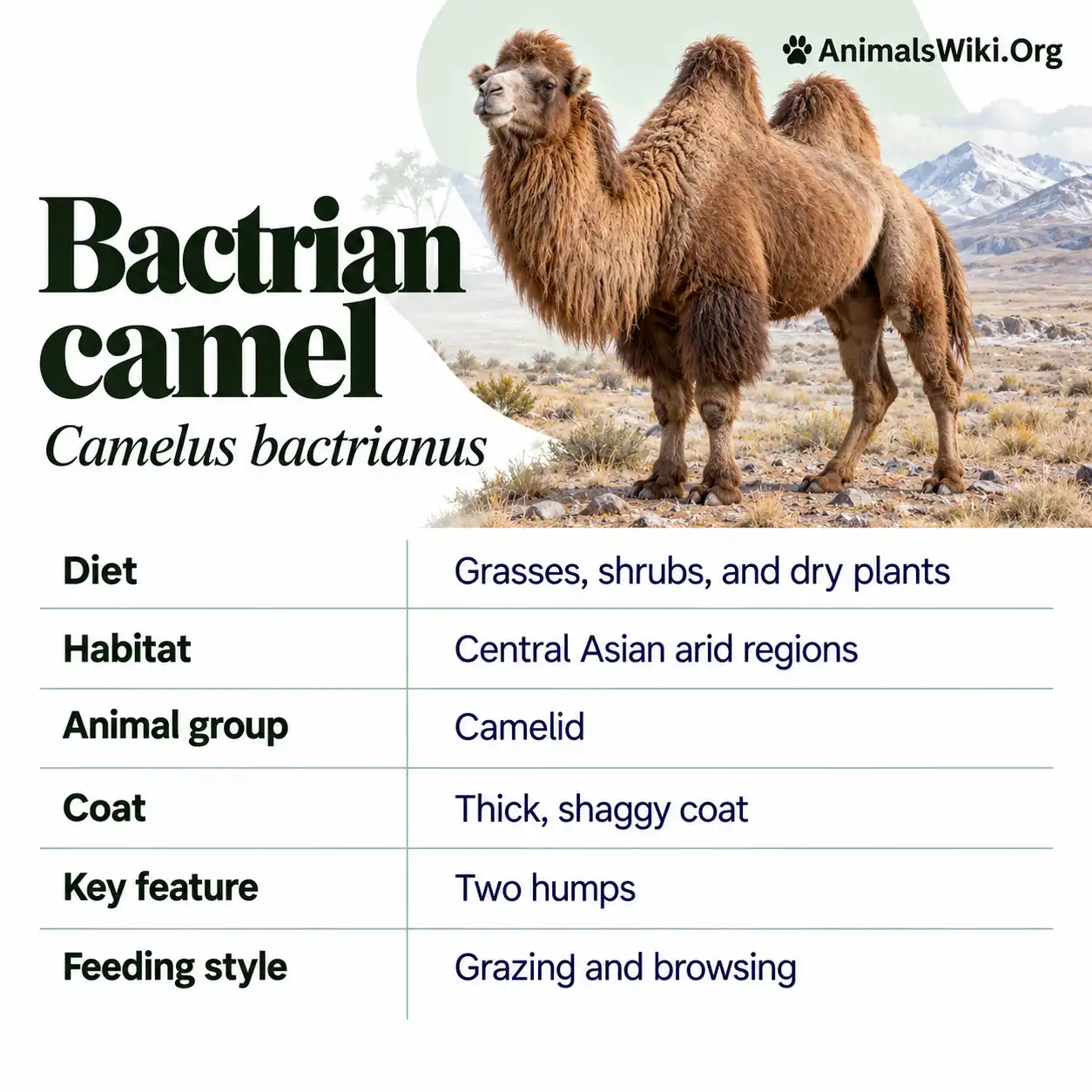
Bactrian Camel, Habitat, Diet, Adaptations, and Life
The Bactrian camel is a large, two-humped domestic camel associated with the deserts, steppes, and pastoral landscapes of Central Asia. Its shaggy winter coat, broad feet, and substantial body distinguish it from the more familiar one-humped dromedary.
This is an animal adapted to environmental contrasts. The landscapes where Bactrian camels have traditionally worked can experience freezing winters, hot summers, sparse vegetation, and widely separated water sources. Surviving there requires more than tolerance of heat.
For thousands of years, people have relied on these camels for transport, fiber, milk, and other resources. Their history is closely connected with herding communities and the trade routes linking different parts of Eurasia.
However, one distinction is essential: the domestic Bactrian camel, Camelus bactrianus, is a separate species from the wild camel, Camelus ferus. Confusing them leads to mistakes about distribution, ancestry, and conservation.
This guide explains the Bactrian camel’s characteristics, adaptations, behavior, history, and care, while clarifying the relationship between domestic camels and their threatened wild relatives.
Bactrian Camel Facts
| Feature | Details |
|---|---|
| Common name | Bactrian camel |
| Other names | Domestic Bactrian camel; two-humped camel |
| Scientific name | Camelus bactrianus |
| Class | Mammalia |
| Family | Camelidae |
| Genus | Camelus |
| Number of humps | Two |
| Hump contents | Mainly fat supported by connective tissue |
| Diet | Herbivorous; browses and grazes |
| Main domestic range | Central and East Asia |
| Typical landscapes | Dry steppes, deserts, and semi-desert pastoral areas |
| Coat | Thick in winter, substantially reduced through seasonal shedding |
| Social behavior | Social, with grouping influenced by management and breeding |
| Pregnancy | Approximately 13 months, with variation |
| Typical offspring | One calf |
| Lifespan | Often several decades; some reach their late thirties or around 40 |
| Main human uses | Transport, milk, fiber, breeding, recreation, and companionship |
| Separate wild relative | Camelus ferus, the wild camel |
What Is a Bactrian Camel?
A Bactrian camel is a domestic member of the genus Camelus distinguished by two humps on its back.
It belongs to the same broader family as dromedaries, llamas, alpacas, guanacos, and vicuñas. However, its anatomy, history, and traditional environments give it a distinctive identity within that family.
Bactrian camels are livestock rather than a single uniform breed. Different populations reflect regional breeding practices and preferences for transport, milk, fiber, or combinations of these uses.
Their appearance also varies. Individuals differ in size, coat color, body proportions, and the prominence of their humps.
The name “Bactrian” refers to Bactria, a historical region of Central Asia. It should not be interpreted as proof that the entire domestication process took place at one precisely established location.
Understanding this animal involves both natural adaptation and human influence. Its present form and distribution reflect a long relationship with people.
Domestic Bactrian Camel vs Wild Camel
The domestic Bactrian camel and the wild camel both have two humps, but they are recognized as separate species.
| Feature | Domestic Bactrian camel | Wild camel |
|---|---|---|
| Scientific name | Camelus bactrianus | Camelus ferus |
| Relationship with people | Domesticated livestock | Wild species |
| General distribution | Managed populations across Central and East Asia | Restricted populations in China and Mongolia |
| Typical appearance | Often substantial, with large humps and a heavy seasonal coat | Generally lighter in build, with smaller humps |
| Conservation focus | Welfare, sustainable management, and domestic genetic diversity | Preventing extinction and protecting wild populations |
Genetic research shows that their lineages separated long before modern domestication.
Consequently, the surviving wild camel should not be described simply as a domestic Bactrian camel that escaped. Nor should it be treated as the unchanged direct ancestor from which all living domestic Bactrians were recently bred.
This distinction matters throughout the article. A fact about one species cannot automatically be transferred to the other, even when an older source uses similar common names.
Scientific Classification and Camel Relatives
Bactrian camels belong to the mammal family Camelidae.
The living members of the genus Camelus are the domestic Bactrian camel, the dromedary, and the wild camel. South American camelids belong to other genera within the same family.
| Classification level | Bactrian camel |
|---|---|
| Kingdom | Animalia |
| Phylum | Chordata |
| Class | Mammalia |
| Family | Camelidae |
| Genus | Camelus |
| Species | Camelus bactrianus |
Shared family characteristics include padded feet and a specialized digestive system. Nevertheless, the different species should not be managed as interchangeable animals.
A Bactrian camel’s heavy winter coat, for example, reflects a different environmental background from the lighter outline associated with many dromedaries.
Scientific names are especially helpful when reading about conservation. They reveal whether an account concerns domestic livestock or the separate wild camel, even when the wording of the common name is ambiguous.
Bactrian Camel vs Dromedary Camel
The simplest difference is hump count: a Bactrian camel has two, while a dromedary has one.
There are other broad differences, although individual variation and crossbreeding can complicate identification.
| Feature | Bactrian camel | Dromedary camel |
|---|---|---|
| Scientific name | Camelus bactrianus | Camelus dromedarius |
| Humps | Two | One |
| General build | Often stockier and more substantial | Often taller-legged and lighter in outline |
| Seasonal coat | Particularly thick during winter | Usually less shaggy |
| Traditional environments | Continental Asian deserts and steppes | Predominantly hot, dry regions of Africa and Asia |
| Shared traits | Herbivory, padded feet, fat-storing humps, and domestication | Herbivory, padded feet, fat-storing humps, and domestication |
These differences describe broad patterns rather than strict guarantees about every animal.
Both species need suitable nutrition, water, rest, and healthcare. A reputation for hardiness does not establish that one can perform any task or tolerate any conditions without appropriate management.
What Does a Bactrian Camel Look Like?
A Bactrian camel has a long neck, a substantial trunk, two humps, and long limbs ending in broad, padded feet.
Its head has a divided upper lip, prominent eyelashes, and nostrils that can narrow against blowing particles. The ears are relatively small and contain protective hair.
The coat is one of its most noticeable characteristics. During winter, long hair can give the animal a bulky, shaggy appearance, particularly around the neck, shoulders, and humps.
Colors range from pale beige and sandy shades to darker browns. Some animals have very light coats.
Body outline changes through the year because of shedding and changes in condition. A heavily coated camel can look much larger than the same animal after its winter hair falls away.
For this reason, photographs alone are a limited way to assess health. Muscle, fat reserves, movement, appetite, and behavior all deserve attention.
How Big Is a Bactrian Camel?
Bactrian camels are large animals, and adult males are generally more substantial than females.
Published measurements vary considerably because they describe different populations, sexes, and measuring points. Many adults weigh several hundred kilograms, while large males may approach a metric ton.
Height also requires clarification. A measurement taken at the shoulder differs from one taken at the top of the humps or head.
This explains why two descriptions can appear inconsistent even when both concern healthy adult animals.
A useful size assessment should identify what was measured and which animals the figures describe.
For working purposes, body mass alone is insufficient. An overweight camel may be heavy without having the fitness or muscular development needed for demanding activity.
Age, soundness, conditioning, equipment, terrain, and duration all influence what the animal can comfortably do.
Large size establishes potential physical capacity, not readiness for unlimited work.
What Is Inside the Two Humps?
The humps contain mainly fat, supported by connective tissue.
They are energy reserves, not containers of drinking water. When food intake does not meet the camel’s requirements, stored fat can contribute energy.
As those reserves change, the humps may become smaller, less upright, or differently shaped. Their appearance can therefore provide useful information, but it is only part of a complete condition assessment.
Fat metabolism produces some water through normal biochemical processes. That does not turn the humps into substitutes for drinking.
The presence of two humps also does not prove that a Bactrian camel can remain without water exactly twice as long as a dromedary. Survival depends on many interacting conditions.
The clearest explanation is that humps support energy storage, while water conservation relies on several other body systems.
Keeping those functions separate prevents one of the most persistent misunderstandings about camels.
Why Does a Bactrian Camel Have Such a Thick Coat?
The winter coat provides insulation against low temperatures.
A dense covering helps reduce heat loss when the surrounding air is cold. This is particularly valuable in continental environments where winters can be severe.
The coat is seasonal. As warmer conditions arrive, much of the heavy hair is shed, leaving a noticeably lighter covering.
During this transition, camels may look untidy, with hanging patches of loose hair. That appearance can be normal seasonal shedding rather than evidence of neglect.
However, seasonal explanations should not be used to dismiss every skin or coat problem. Persistent hair loss, irritated skin, wounds, or unusual scratching may require investigation.
The practical significance is that the coat changes the animal’s needs and appearance throughout the year.
Housing, grooming, heat management, and condition monitoring should respond to those changes rather than treating the camel’s winter appearance as permanent.
How Bactrian Camels Handle Cold and Heat
A cold desert is still a desert. Low precipitation can occur alongside freezing winters and hot summers.
Bactrian camels cope with this variability through a combination of coat changes, behavior, body structure, and physiological regulation.
Winter insulation helps conserve body heat. Seasonal shedding reduces the burden of that heavy covering during warmer months.
Like other camels, they can conserve water through coordinated physiological responses. However, they do sweat, and sweating remains part of heat regulation.
Claims that camels lack sweat glands or cannot overheat are incorrect.
Environmental tolerance is also not identical to comfort. Wind, wet conditions, shade, health, body condition, and activity influence what an individual experiences.
A camel that survives an extreme temperature has not necessarily experienced good welfare throughout that exposure.
Their adaptations are best understood as advantages within demanding environments, supported by access to suitable resources and management.
Water Conservation Without a Water Tank
Bactrian camels conserve water through multiple processes rather than one storage organ.
Their kidneys regulate fluid balance and can reduce water loss through concentrated urine. Moisture conservation also involves the digestive system and respiratory passages.
Research on Bactrian camels has examined genetic and physiological mechanisms involved in water regulation, including kidney function.
These findings help explain how the animal copes with arid conditions, but they do not imply that water is unnecessary.
The interval between drinks depends on weather, workload, food moisture, health, and individual circumstances. A resting camel consuming moisture-rich plants faces different demands from a working animal in dry summer conditions.
Consequently, a fixed claim about surviving a particular number of days without water is incomplete.
Managed camels should receive reliable drinking opportunities appropriate to their needs.
Their resilience should guide understanding and planning, rather than become a reason to test how much deprivation they can endure.
Broad Feet and Movement Across Loose Ground
Each foot has two toes supported by a broad, cushioned contact surface.
When weight is placed on the foot, the broad surface helps spread the load. This is useful on loose sand and other yielding ground.
The feet differ from the compact hooves of horses. Their structure is a characteristic part of camelid anatomy.
However, broad feet do not guarantee safe movement on every surface. Slippery flooring, persistent mud, sharp material, and unsuitable routes can create difficulties.
The condition of the pads and nails also matters. Changes in gait, reluctance to move, or unusual weight distribution may indicate a problem.
For managed animals, appropriate flooring and regular observation are therefore important.
The camel’s natural abilities work best when the surroundings suit them. An anatomical adaptation is not a substitute for maintaining safe housing, selecting realistic routes, or responding when an individual becomes uncomfortable.
Eyes, Eyelashes, Nostrils, and Dust Protection
Bactrian camels have long eyelashes and protective hair around exposed areas of the face.
Their nostrils can narrow or close to help reduce the entry of blowing sand and dust. These features are useful in windy, open environments.
The eyes also have a nictitating membrane, commonly described as a third eyelid, which contributes to protection.
Such features reduce exposure; they do not make the animal completely unaffected by airborne particles.
Eye irritation, injury, or respiratory problems remain possible and should not be dismissed because camels are associated with deserts.
It is also helpful to separate functions. Narrowing the nostrils limits particle entry, while the internal nasal passages contribute to conditioning air and conserving moisture.
Several adaptations can occur in the same general body region.
Together, they improve the animal’s ability to function in dry, dusty surroundings without eliminating the value of shelter and attentive care.
Where Do Domestic Bactrian Camels Live?
Domestic Bactrian camels occur mainly across Central and East Asia.
Important camel-keeping regions include parts of Mongolia, China, Kazakhstan, and neighboring countries. Their distribution reflects pastoral traditions, movement, breeding, and changing economic uses.
This domestic range should not be confused with the much more restricted range of the wild camel.
A map showing a few isolated populations in China and Mongolia may describe Camelus ferus, not every place where domestic Bactrians are kept.
Domestic animals may also live in zoological collections, farms, or other managed settings outside their traditional range.
Their presence in a country does not mean that every local climate or management system suits them equally well.
Access to food, water, veterinary support, appropriate facilities, and knowledgeable handlers determines whether a particular setting can support them responsibly.
Geographic distribution is therefore a combination of environmental suitability and human decisions.
Bactrian Camel Habitat: More Than Sand Dunes
Bactrian camels are associated with dry steppes, semi-deserts, and continental desert landscapes.
These environments can include stony plains, sparse shrublands, grasslands, and areas with scattered water sources. Endless soft sand is only one possible setting.
Seasonality is central. Rainfall, snow, temperature, and vegetation growth affect how resources are distributed.
In pastoral systems, herders may move animals to use changing grazing and browsing opportunities.
A landscape that appears empty to an unfamiliar visitor may contain important seasonal feeding areas or routes between water points.
This is why habitat cannot be judged from a single photograph.
The resources available over an entire year matter more than whether one location looks green on a particular day.
Human infrastructure also changes access. Fences, settlement, roads, and land-use decisions can affect how livestock move through landscapes traditionally used for herding.
What Does a Bactrian Camel Eat?
Bactrian camels are herbivores that can both graze and browse.
Their food includes grasses, leaves, shoots, shrubs, and other suitable vegetation. Mobile lips help them select plant material.
They can use some coarse, prickly, or salty plants that are less attractive or accessible to other livestock.
This feeding flexibility is valuable where vegetation is scattered and seasonal.
However, “can eat difficult forage” does not mean “can eat anything.” Toxic plants, unsuitable feeds, contaminated material, and foreign objects can still cause harm.
A managed ration should reflect the individual’s age, body condition, activity, pregnancy, and milk production.
Mineral requirements also deserve appropriate attention rather than improvised supplementation.
The useful principle is to provide suitable fiber and balanced nutrition while monitoring the animal’s response.
Their digestive capabilities are impressive, but nutritional adequacy still depends on the quantity, quality, and safety of the food available.
How Does a Bactrian Camel Digest Food?
Bactrian camels obtain nutrients from fibrous plants with help from microorganisms in their digestive tract.
Their stomach is generally described as having three compartments, labeled C1, C2, and C3.
This arrangement differs from the four-compartment stomach of cattle and other true ruminants.
Camels regurgitate partly processed material and chew it again. This repeated chewing helps reduce particle size before digestion continues.
The microbial communities involved in this process are important. Researchers have examined how bacterial populations differ between parts of the Bactrian camel’s gastrointestinal tract.
These studies support a more detailed understanding of the relationship between anatomy, food, and microbial activity.
For everyday management, the lesson is that digestion depends on a functioning biological system.
A camel’s stomach should not be imagined as a container that can safely process arbitrary material. Appropriate feeding and thoughtful dietary changes remain important.
Social Behavior and Herd Relationships
Bactrian camels are social animals, but group composition varies with management, age, sex, and breeding status.
A livestock herd may be organized differently from a small zoo group or a breeding collection.
Compatibility matters within all of these settings.
Several animals sharing an enclosure do not automatically have equal access to food, water, shelter, and rest. One individual may be repeatedly displaced even when the group appears generally calm.
Observing feeding and resting behavior helps reveal such difficulties.
Young animals also learn through interaction with their mothers and companions. Their social environment influences development alongside nutrition and handling.
Human contact forms another part of the picture. Predictable care can help animals become familiar with ordinary routines, while rough or inconsistent handling may create avoidance.
Good management considers the experience of each camel rather than assuming that the needs of the whole group are identical.
How Bactrian Camels Communicate
Camels use vocalizations, posture, movement, scent, and physical contact to communicate.
A groan or grumble should not automatically be translated as anger. Meaning depends on the individual and the situation.
Sounds may occur during social interactions, handling, feeding, or changes in position.
Head carriage, neck tension, ear position, attention, and movement add information. One isolated signal rarely explains the whole interaction.
Handlers benefit from knowing what is normal for a particular animal. A change in willingness to approach, move, eat, or accept familiar care can be meaningful.
Some changes may reflect learning or social circumstances, while others may indicate discomfort.
This is why behavioral observation belongs within health monitoring rather than being treated as a separate interest.
Careful interpretation also improves training. Clear cues and consistent routines are easier to understand than unpredictable demands accompanied by increasing pressure.
Do Bactrian Camels Spit or Behave Aggressively?
Camels can expel saliva mixed with regurgitated material during disturbing or threatening interactions.
However, the familiar image of a camel that spits at every person exaggerates a behavior that depends on context.
Individual temperament, previous handling, reproductive condition, and the immediate situation all matter.
Camels can also bite or kick, and their size makes poor handling potentially dangerous.
Breeding males may require particularly careful management. A familiar animal should not be assumed safe under every circumstance.
Visitors should follow the instructions of responsible staff and avoid provoking an animal for a reaction.
Likewise, hesitation or refusal should not automatically be called stubbornness. Fear, confusion, pain, fatigue, or unfamiliar surroundings may be involved.
The most useful response is to understand what changed and whether the request is appropriate.
Respectful handling recognizes both the animal’s learning ability and its capacity to defend itself.
Walking, Pacing, and Carrying Loads
Bactrian camels have a long history as pack and transport animals.
Their movement can include a pacing gait, with limbs on the same side advancing together. Riders may experience the resulting motion as a rolling movement.
Working capacity nevertheless depends on the individual.
Body size, fitness, age, soundness, training, and the intended task all matter. So do the total load, its balance, saddle fit, terrain, weather, and duration.
There is no single universally safe load that can be assigned to every Bactrian camel.
A figure describing one trained animal or a historical journey should not become a general prescription.
Preparation also needs to be gradual. An animal that can walk freely in an enclosure is not automatically conditioned for a long loaded journey.
Good working management preserves comfort and function through sensible demands, suitable equipment, water, food, rest, and observation.
Breeding and Reproduction
Bactrian camel breeding is influenced by season, environment, management, and the condition of the animals.
Adult males can show substantial changes in behavior during the breeding period, including increased competition and more conspicuous displays.
Breeding management therefore requires suitable facilities and experienced handlers.
Females usually produce one calf after a pregnancy of approximately 13 months, although individual timing varies.
The reproductive investment is considerable. The mother needs appropriate nutrition and monitoring before and after birth, while the calf requires a secure start.
Responsible breeding considers more than whether two animals can mate.
Health, ancestry, temperament, potential inherited problems, available resources, and the future of the offspring all deserve attention.
Pregnancy also changes the animal’s workload and nutritional needs.
A breeding plan should be supported by professional veterinary advice rather than relying solely on visible behavior or general statements about camel hardiness.
Calves and Early Development
A baby Bactrian camel is called a calf.
Newborn calves are relatively well developed and can begin standing and walking soon after birth. Nevertheless, early mobility does not make them independent.
They depend on milk, maternal care, protection, and suitable surroundings.
As they grow, calves begin exploring solid food and develop the digestive functions needed for their adult diet.
Their humps also change as body reserves develop. A newborn does not carry the same substantial fat stores as a well-conditioned adult.
Early handling should introduce ordinary care gradually. Accepting examination, leading, and becoming familiar with people can make later management easier.
That process should not impose adult physical demands on a developing animal.
A recent Toronto Zoo birth report, for example, described a calf standing approximately two hours after birth and being observed nursing. Such observations illustrate early development without establishing an exact timetable for every newborn.
How Long Do Bactrian Camels Live?
Bactrian camels can live for several decades, with some reaching their late thirties or around 40 years.
Published lifespan figures are broad descriptions, not guarantees. Health, injury, nutrition, disease, and workload all influence individual outcomes.
Total lifespan should also be separated from working life. An animal may need lighter duties or retirement long before reaching an advanced age.
Older camels can require closer attention to dental function, body condition, mobility, and access to resources.
A companion that previously reached every feeding area easily may need adjustments as movement becomes more difficult.
Changes should be assessed rather than dismissed as inevitable aging.
Quality of life depends on daily comfort and function: eating adequately, resting comfortably, moving without excessive difficulty, and maintaining appropriate social contact.
Planning for these later needs is part of responsible ownership from the beginning.
Where Did Bactrian Camels Come From?
The history of domestic Bactrian camels involves Central Asian populations, movement between regions, and a domestication process reconstructed from archaeology and genetics.
The exact location and sequence remain subjects of research.
Genomic studies suggest a Central Asian domestication background followed by movement toward East Asia.
They also reinforce the distinction between the domestic lineage and the surviving wild camel.
This is important because outward similarity once encouraged a simpler story in which present-day wild camels were treated as the direct source of domestic populations.
Modern evidence supports a more complicated evolutionary history.
Domestication itself was not necessarily a single moment when one group captured a few animals. It involved changing relationships, control, breeding, and use over time.
Later exchanges between communities further shaped the distribution and diversity of domestic camels.
The modern animal therefore carries a history of both biological inheritance and human movement.
Bactrian Camels and the Silk Road
Bactrian camels became closely associated with the networks of trade commonly called the Silk Road.
Their usefulness in continental environments helped people move goods across long distances.
However, the Silk Road was not one continuous road used identically by every caravan. It consisted of interconnected routes with changing political, economic, and environmental conditions.
Camel transport depended on skilled handlers, knowledge of water sources, suitable loading, resting opportunities, and access to food.
The animals were part of a wider system that included settlements, markets, other livestock, and local expertise.
This perspective explains their historical importance more accurately than portraying them as self-sufficient freight carriers.
It also reminds us that successful journeys required care. Poor equipment or unrealistic workloads could undermine both animal welfare and transport.
The camel’s contribution emerged from a partnership between physical capabilities and accumulated human knowledge.
Bactrian Camels and Pastoral Livelihoods
For herding families, a Bactrian camel can represent food, income, mobility, and cultural continuity.
The value of a herd may come from several products rather than one specialized use.
Milk, fiber, breeding animals, transport, and other activities can contribute differently according to local circumstances.
Pastoral knowledge includes choosing seasonal areas, monitoring condition, recognizing illness, managing breeding, and adapting to weather.
That knowledge should not be reduced to a romantic image of camels crossing an empty landscape.
Herding is practical work shaped by markets, land access, services, and environmental uncertainty.
Supporting sustainable camel livelihoods may therefore require veterinary access, training, processing facilities, reliable trade relationships, and protection of useful grazing resources.
FAO accounts from Mongolia describe the importance of Bactrian camels to families living in the Gobi region.
They also show how innovation can be relevant without replacing the experience of herders.
Bactrian Camel Milk
Bactrian camel milk is used as food in several camel-keeping regions.
Production depends on genetics, nutrition, water availability, stage of lactation, calf management, and the farming system.
A single daily yield should not be presented as a fixed characteristic of the species.
Milk harvesting also needs to account for the calf. Increasing the amount collected for people does not remove the young animal’s nutritional needs.
Processing and storage matter as well. Milk is a perishable food, and suitable hygiene and heat treatment contribute to safety.
Camel milk should not be advertised as a guaranteed treatment for disease. Nutritional interest and laboratory findings do not automatically establish medical benefits in people.
Research on Bactrian camel milk includes composition, processing, quality, and commercial potential.
A responsible account can recognize its importance as food while avoiding unsupported health promises or claims that raw milk is inherently safe.
Camel Fiber and Seasonal Hair
The Bactrian camel’s coat has value beyond insulation for the animal.
Its fiber can be collected and processed into textiles. Fine undercoat material differs from coarser outer hair, and processing influences the final product.
Age, individual variation, and management can affect fiber characteristics.
Seasonal shedding provides an opportunity for collection, but welfare remains central. Handling should avoid unnecessary stress, and coat management should suit the animal’s environment.
Removing hair is not automatically beneficial in every climate or season.
Fiber production also involves work beyond the animal itself: collection, cleaning, sorting, processing, and access to markets.
Its economic value therefore depends on a supply chain and skilled labor.
Research on Alxa Bactrian camels has examined how wool fineness changes with age, illustrating why camel fiber should not be described as one completely uniform material.
The animal’s coat is both a biological adaptation and a resource people have learned to use.
Can Bactrian Camels Breed with Dromedaries?
Yes. Domestic Bactrian camels and dromedaries can interbreed, and their hybrids can be fertile.
This differs from the usual infertility associated with horse–donkey hybrids such as mules.
People have used camel crossbreeding to pursue particular combinations of working or production traits.
However, a hybrid does not automatically inherit every desirable characteristic of both parents. Outcomes depend on parentage, generation, individual development, and management.
Mixed ancestry can also complicate identification from appearance.
Hump shape alone is not always sufficient to describe an animal’s full breeding background.
It is equally important to distinguish livestock crossbreeding from conservation concerns involving the wild camel.
Hybridization within domestic production systems and introgression into a threatened wild population have different implications.
One may be an intentional breeding strategy, while the other can affect the genetic identity of a species conservation programs aim to protect.
Bactrian Camels in Zoos and Education
Domestic Bactrian camels can help visitors understand camel biology, pastoral history, and the differences between domestic and wild species.
They can also contribute to research on care, behavior, physiology, and learning.
Accurate interpretation is essential.
Displaying a domestic Bactrian camel does not mean the institution is displaying or breeding the separate wild camel species.
Nor should the wild species’ conservation category automatically be attached to every domestic camel on a sign or webpage.
Marwell Zoo, for example, explicitly distinguished its domestic Bactrian camels from wild camels when announcing new arrivals in 2026.
That kind of clarity improves public understanding.
Educational value also depends on welfare. Suitable space, social arrangements, diet, comfortable resting areas, and professional care remain important regardless of how interesting the animal is to visitors.
A good exhibit explains both the animal’s capabilities and its needs.
Everyday Care and Health Monitoring
Bactrian camel care should address food, water, shelter, movement, social relationships, and health together.
Daily observation is valuable because changes in appetite, posture, activity, manure, or willingness to interact may reveal emerging problems.
A thick coat can hide changes in body condition, so visual inspection alone may be inadequate.
Research specifically examining body-condition assessment in Bactrian camels highlights challenges associated with seasonal wool, hump appearance, and hybrid ancestry.
Feet, nails, skin, mouth, and equipment contact areas also need attention.
Preventive veterinary planning should reflect the animal’s location, exposure, age, and medical history.
A camel’s ability to tolerate difficult conditions does not establish that it will show dramatic signs whenever something is wrong.
Care should be organized around what keeps the individual comfortable and functioning well, rather than waiting until it can no longer work or eat normally.
Welfare in Working and Recreational Settings
Working and recreational camels need realistic demands, suitable equipment, rest, and access to appropriate resources.
The fact that a camel accepts a saddle or continues walking does not establish that every aspect of the activity is comfortable.
Handlers should consider load distribution, skin pressure, footing, weather, duration, and recovery.
Training should prepare the animal gradually for the actual task.
Consistent handling also matters. An animal that understands familiar cues is easier to manage than one repeatedly exposed to confusing or frightening interactions.
Tourism operations should be assessed through daily management rather than a brief visitor impression.
A clean-looking animal can still have an excessive workload, while a seasonally shedding camel is not necessarily poorly cared for.
Welfare assessment therefore requires context and observation.
Camel husbandry guidance emphasizes that humane care applies across different enterprises, including transport, production, and recreation.
Is the Bactrian Camel Endangered?
This question requires separating two species.
The domestic Bactrian camel, Camelus bactrianus, should not be assigned the wild camel’s conservation status.
The wild camel, Camelus ferus, is currently classified as Endangered on the IUCN Red List.
It was reclassified from Critically Endangered in October 2025. Older webpages and some animal profiles still display the previous category.
The change does not mean that the species is secure. It reflects updated information and assessment under Red List criteria, while substantial conservation concerns remain.
Domestic populations raise a different set of questions, including welfare, preservation of useful genetic diversity, and the sustainability of herding systems.
Using scientific names makes these distinctions clearer.
A conservation statement should identify the species, assessment, and date rather than assuming that every animal described as a “Bactrian camel” belongs to the same population.
Threats Facing the Separate Wild Camel
The wild camel survives in restricted parts of China and Mongolia.
Threats include habitat degradation, disturbance, pressure on water sources, infrastructure, and contact with domestic livestock.
Hybridization with domestic Bactrian camels is a particular concern because it can introduce domestic ancestry into small wild populations.
Small, fragmented populations also face difficulties maintaining genetic diversity and responding to environmental change.
Conservation therefore involves more than increasing the number of camels in general.
It requires protecting the wild species, its habitat, and the conditions that allow it to persist.
Domestic camel management near wild populations can form part of that effort, particularly where shared resources increase contact.
Research published in 2026 examined introgression and genetic diversity in Mongolia’s wild camels.
Such work helps conservationists assess risks that cannot be identified reliably through outward appearance alone.
Climate Change and the Future of Camel Keeping
Bactrian camels can be valuable in challenging environments, but they are not immune to environmental change.
Drought, altered vegetation, pressure on water resources, and extreme weather can affect animals and the people who depend on them.
A species’ ability to tolerate difficult conditions does not guarantee that existing herding systems can absorb unlimited change.
Access to seasonal resources, veterinary support, markets, and suitable land remains important.
Genetic diversity also deserves attention. Selecting narrowly for one production trait may overlook characteristics useful under different conditions.
Sustainable development should therefore connect animal health, land management, economic opportunity, and local experience.
FAO discussions of Mongolia’s camel sector have included pasture management, health, breeding, processing, and cooperation between producers.
This broader approach recognizes that the future of Bactrian camels depends on functioning systems, not simply on the hardiness of individual animals.
Common Bactrian Camel Myths
| Myth | More accurate explanation |
|---|---|
| The two humps store drinking water | They store mainly fat |
| Every two-humped camel is the same species | Domestic Bactrians and wild camels are distinct |
| All camels belong in hot deserts | Bactrian camels are associated with continental environments that include freezing winters |
| Camels never sweat | They do sweat as part of heat regulation |
| A shaggy shedding coat always means neglect | Seasonal shedding can produce a naturally uneven appearance |
| A large hump proves perfect health | Condition assessment requires more than one feature |
| Every camel can carry the same load | Capacity depends on the individual, equipment, task, and conditions |
| Domestic Bactrian camels are all Critically Endangered | That confuses domestic animals with an older classification of the separate wild species |
| Camel hybrids are always sterile | Bactrian–dromedary hybrids can be fertile |
| Hardiness eliminates the need for care | Food, water, rest, social needs, and healthcare remain essential |
Frequently Asked Questions About Bactrian Camels
What is a Bactrian camel?
A Bactrian camel is the domestic two-humped camel, scientifically named Camelus bactrianus. It is associated with Central and East Asian pastoral environments and has been used for transport, milk, fiber, and other purposes.
How many humps does a Bactrian camel have?
It has two humps. Dromedaries have one. The separate wild camel species also has two, so hump count alone cannot distinguish domestic Bactrian camels from wild camels.
What do the humps contain?
They contain mainly fat supported by connective tissue. The reserves can provide energy when food intake is insufficient. They are not hollow tanks of drinking water.
Can a Bactrian camel’s humps become floppy?
Their shape can change as fat reserves change. However, hump appearance should not be used as the only measure of health or nutritional condition.
What is the difference between a Bactrian camel and a dromedary?
Bactrians have two humps and generally develop a much heavier winter coat. Dromedaries have one hump and are predominantly associated with hotter dry environments. They are separate domestic species.
Is a wild camel just an escaped domestic camel?
No. Camelus ferus is a separate wild species with a distinct evolutionary history. A domestic animal living freely would be described as feral, which is a different situation.
Are Bactrian camels endangered?
Domestic Bactrian camels should not be confused with the Endangered wild camel. Conservation claims need to identify which species is being discussed.
Is the wild camel still Critically Endangered?
Its IUCN category changed to Endangered in October 2025. Older sources may still show Critically Endangered. The updated category does not remove the need for sustained conservation work.
Where do Bactrian camels live?
Domestic populations occur mainly across Central and East Asia, including important camel-keeping regions in Mongolia, China, and Kazakhstan. Managed animals also occur outside their traditional range.
Do Bactrian camels live only on sand?
No. Their traditional environments include stony deserts, dry steppes, scrublands, and semi-desert areas. Sand dunes represent only one possible part of a much more varied landscape.
Can Bactrian camels tolerate snow and freezing weather?
Their winter coat helps them cope with cold conditions. However, tolerance depends on health, age, body condition, wind, wetness, shelter, and other circumstances.
Why do they lose so much hair?
They shed much of their heavy winter coat as conditions become warmer. Large loose patches can be part of normal shedding, although skin irritation or unusual hair loss still deserves attention.
What does a Bactrian camel eat?
Its diet consists mainly of suitable vegetation, including grasses, leaves, shoots, and shrubs. Managed feeding should account for the animal’s age, body condition, activity, and reproductive needs.
Can Bactrian camels eat thorny plants?
They can use some coarse and prickly vegetation because of their specialized mouth structures and feeding behavior. This does not mean every thorny plant is safe.
How many stomachs do they have?
Their stomach is generally described as having three compartments, called C1, C2, and C3. This differs from the four-part arrangement found in cattle.
Why do camels chew cud?
Repeated chewing helps break down fibrous plant material. Microorganisms also contribute to digestion, allowing camels to obtain nutrients from forage that would otherwise be difficult to use.
How long can a Bactrian camel survive without water?
There is no universal duration. Food moisture, temperature, activity, health, and other factors change water needs. Their tolerance should not be used to justify withholding drinking opportunities.
Can Bactrian camels drink seawater?
The ability of wild camels to use highly saline water should not be generalized to domestic Bactrians. Managed animals need water of suitable quality, assessed according to their circumstances.
Do Bactrian camels spit?
They can expel saliva and regurgitated material during disturbing interactions. It is not an inevitable response to every person, and animals should never be provoked to produce it.
How long is a Bactrian camel pregnant?
Pregnancy lasts approximately 13 months, with individual variation. The mother and calf require appropriate preparation, nutrition, monitoring, and professional support.
What is a baby Bactrian camel called?
A baby is called a calf. Newborns can become mobile soon after birth, but they remain dependent on milk, maternal care, protection, and suitable management.
How long do Bactrian camels live?
They can live for several decades, and some reach their late thirties or around 40. Lifespan varies with health, care, disease, injury, and workload.
Can Bactrian camels breed with dromedaries?
Yes. These domestic species can produce hybrids that may be fertile. Crossbreeding has been used in some livestock systems, although outcomes vary and require responsible planning.
Are Bactrian camels good riding animals?
Some trained individuals are used for riding. Suitability depends on health, temperament, conditioning, equipment, rider characteristics, and the activity rather than species identity alone.
What is the most important Bactrian camel fact?
The domestic Bactrian camel and the wild camel are distinct species. Understanding that difference prevents errors about their history, habitat, ancestry, and conservation.
Bactrian Camel (Camelus bactrianus)
The Bactrian camel is a distinctive domestic animal shaped by seasonal extremes and a long relationship with people.
Its two humps store fat, its winter coat provides insulation, and its broad feet and specialized digestion support life in demanding landscapes. These adaptations help explain its historical importance without suggesting that it needs little care.
Bactrian camels have carried goods, supplied milk and fiber, and supported pastoral livelihoods across Central Asia. Their story includes the experience of herders and handlers who understood how to manage them.
Accurate information also requires separating Camelus bactrianus from the wild camel, Camelus ferus. Domestic livestock management and wild-species conservation involve related but different responsibilities.
Appreciating these animals means recognizing both their capabilities and the resources, care, and knowledge that allow them to thrive.



