
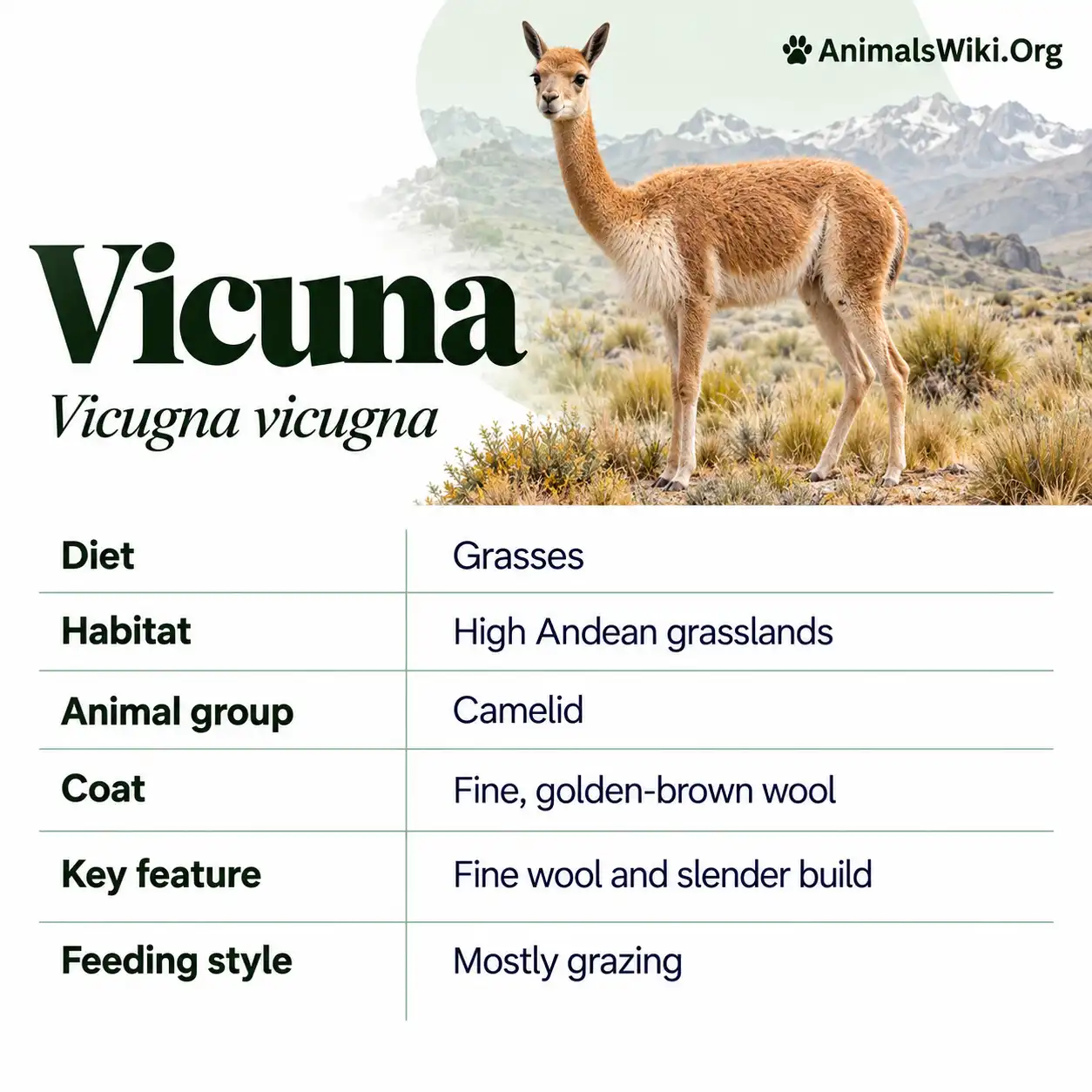
Vicuña, The Wild Camelid of the High Andes
The vicuna, usually written vicuña, is a small wild member of the camel family that lives in the high Andes of South America. With its slender neck, golden-brown coat, white underside, and alert expression, it is one of the most distinctive animals of the Andean highlands.
Vicuñas are famous for producing exceptionally fine fiber, but their importance extends beyond textiles. They are native grazers, prey for predators, participants in mountain nutrient cycles, and culturally significant animals for Andean communities.
Their history also offers an important conservation lesson. Heavy hunting once reduced their numbers dramatically. Protection, international cooperation, and community involvement helped populations recover, although threats remain.
Unlike llamas and alpacas, vicuñas are wild animals. Managing them for fiber does not automatically make them domesticated, and live shearing still requires careful attention to welfare.
This guide explores the vicuña’s appearance, habitat, adaptations, social life, reproduction, ecological role, and relationship with people. It also explains why its conservation success depends on more than protecting an expensive coat.
Vicuña Facts
| Feature | Details |
|---|---|
| Common name | Vicuña |
| Alternative spelling | Vicuna |
| Scientific names encountered | Vicugna vicugna; classified as Lama vicugna by some current authorities |
| Family | Camelidae |
| Animal type | Wild South American camelid |
| Humps | None |
| General size | The smallest living camelid |
| Typical adult weight | Approximately 35–65 kilograms, with variation |
| Typical shoulder height | Approximately 75–85 centimeters |
| Main habitat | High Andean grasslands and associated wetlands |
| Diet | Herbivorous; primarily a selective grazer |
| Main social units | Family groups, male groups, and solitary territorial males |
| Pregnancy | Approximately 11 months |
| Typical offspring | One |
| Lifespan | Often described as approximately 15–20 years |
| Main predator | Puma in many studied populations |
| Global IUCN category | Least Concern |
| Main concerns | Poaching, disease, habitat pressures, and poorly managed capture |
What Is a Vicuña?
A vicuña is a wild South American camelid adapted to life in open, high-elevation environments.
Although it belongs to the camel family, it has no hump. Its slender body, relatively small head, long neck, and fine coat give it a lighter appearance than domestic camels.
Vicuñas are particularly associated with the puna, a high Andean landscape containing grasslands, dry plains, wetlands, and surrounding slopes.
They are not miniature llamas or simply wild alpacas. They have their own evolutionary history, behavior, and ecological relationships.
Their connection with people is nevertheless longstanding. Andean communities have observed, protected, captured, and used vicuñas in different ways over many generations.
Today, some populations are managed for live-sheared fiber. The animals may still spend most of their lives ranging freely.
This distinction is important: temporary handling or economic use does not, by itself, turn a wild species into a domestic livestock population.
Scientific Classification: Why Are Two Names Used?
The name Vicugna vicugna remains widely used in conservation, research, and international wildlife-trade documentation.
However, some current taxonomic authorities, including the Mammal Diversity Database, classify the species as Lama vicugna.
These names refer to the same familiar Andean animal, not two different species commonly called vicuñas.
| Classification level | Vicuña |
|---|---|
| Kingdom | Animalia |
| Phylum | Chordata |
| Class | Mammalia |
| Family | Camelidae |
| Widely used scientific name | Vicugna vicugna |
| Alternative current combination | Lama vicugna |
Taxonomic classifications can differ as researchers interpret evolutionary relationships and decide how broadly to define a genus.
For general readers, the practical point is to recognize both combinations when researching the animal.
A change in genus does not mean the vicuña suddenly became a llama in the everyday domestic sense. Scientific classification and common animal names serve different purposes.
What Does a Vicuña Look Like?
A vicuña usually has a warm cinnamon or golden-brown upper body with a contrasting pale underside.
White or cream-colored hair covers the belly and inner surfaces of the legs. A pale chest area can be particularly noticeable, although appearance varies between populations.
The neck is long and slender, and the head is relatively small. Upright ears, large eyes, and an alert posture contribute to its characteristic appearance.
Its legs are slim, allowing efficient movement across open terrain. The tail is short compared with that of many familiar grazing mammals.
Unlike some domestic alpacas, vicuñas do not have an enormous, uniformly shaggy fleece covering the entire body.
Their coat should also be understood as functional insulation rather than merely a textile resource.
Color, posture, and body outline can change with light, season, age, and condition. Identifying an animal accurately requires considering its full appearance and location.
How Big Is a Vicuña?
Vicuñas are the smallest living members of the camel family.
A useful general description places adults around 35–65 kilograms, with shoulder heights of approximately 75–85 centimeters.
These figures are broad reference ranges. Age, sex, population, body condition, and measurement methods influence individual results.
Shoulder height should not be confused with the height of an animal holding its head upright. Its long neck adds considerably to its overall standing profile.
Their small size distinguishes them from guanacos and most adult llamas, but size alone is not a complete identification tool.
A young member of a larger species can overlap with an adult vicuña.
When comparing photographs, look at proportions, coat pattern, head shape, and context.
Small stature also does not make vicuñas suitable pets. They retain the social, environmental, and behavioral needs of a wild camelid.
Vicuña vs Alpaca, Llama, and Guanaco
South America has four familiar living camelids: vicuñas, guanacos, llamas, and alpacas.
Two are wild species, while two are domesticated forms.
| Animal | Wild or domestic? | General characteristics |
|---|---|---|
| Vicuña | Wild | Small, slender, fine-coated, strongly associated with high Andean environments |
| Guanaco | Wild | Larger-bodied, with a wider variety of environments across its range |
| Alpaca | Domestic | Bred primarily for fiber, with considerable coat variation |
| Llama | Domestic | Generally larger, historically important for carrying loads and other uses |
These categories are more informative than treating all four as differently sized versions of one animal.
Domestication has shaped appearance, behavior, and relationships with people. Wild vicuñas should not be expected to respond to handling like well-managed domestic alpacas.
At the same time, ancestry is complicated by historical interbreeding.
Understanding the four animals requires recognizing both their differences and the genetic connections that researchers continue to investigate.
Is the Vicuña the Ancestor of the Alpaca?
Vicuñas have made an important genetic contribution to alpaca ancestry.
Earlier genetic studies helped establish the close relationship between alpacas and vicuñas, while also documenting interbreeding among South American camelids.
However, the simple statement that every alpaca is only a domesticated vicuña does not capture the full history.
More recent genomic research has investigated hybrid ancestry involving vicuña and guanaco–llama lineages.
A 2025 study specifically proposed a hybrid origin for the alpaca, followed by further exchanges of genes with related camelids.
This does not erase the vicuña’s importance in alpaca evolution. It shows why domestication histories are often more complex than a single direct line.
For an educational comparison, it is accurate to describe the vicuña as a close wild relative and major contributor to alpaca ancestry.
The domestic alpaca nevertheless remains a distinct animal with a long history of human breeding.
Where Do Vicuñas Live?
Vicuñas occur in the Andes of Peru, Bolivia, Chile, and Argentina, with introduced populations in Ecuador.
Their distribution follows suitable highland environments rather than political borders.
Peru is particularly important to the species, but vicuña conservation is a regional responsibility involving several countries.
Ecuador requires a distinction. Its modern population was established through conservation introductions, including animals associated with the Chimborazo area.
Consequently, a list of countries where vicuñas live today should not automatically be interpreted as a map of their original native distribution.
Within each country, populations are unevenly distributed. Food, water, disturbance, protection, and the arrangement of suitable land influence where animals persist.
Some occupy protected areas, while others share wider landscapes with livestock and people.
Their future therefore depends on management beyond reserve boundaries as well as protection within them.
Vicuña Habitat: The High Andean Puna
The puna is a high-elevation region containing different kinds of vegetation and terrain.
Vicuñas may use open grasslands, dry plains, rocky slopes, and wet meadows. These features provide different resources and different levels of exposure to predators.
Wetlands known regionally as bofedales can be particularly valuable because they support vegetation and water in otherwise dry landscapes.
However, one habitat patch does not necessarily meet every need.
A feeding area may offer high-quality forage while also providing cover from which a puma can approach. A more open resting area may be safer but less productive.
This variation helps explain why vicuñas move between different parts of the landscape.
Their habitat is therefore best understood as a connected arrangement of resources and risks.
Protecting only the most visibly green patch may overlook routes, resting places, and surrounding areas that are also important.
How High Do Vicuñas Live?
Vicuñas are strongly associated with elevations of several thousand meters above sea level.
Many populations occupy landscapes roughly between 3,500 and 5,000 meters, with some records outside that broad band.
These environments expose animals to low atmospheric pressure, cold nights, strong sunlight, and variable food availability.
The concentration of oxygen in the air remains broadly similar to that at sea level, but lower pressure reduces the oxygen available with each breath.
That distinction is useful when explaining altitude. The challenge is not that mountain air contains an entirely different basic mixture of gases.
Vicuñas are adapted to function under these conditions, while an unfamiliar visitor may find even gentle walking demanding.
Elevation alone does not define habitat quality, though. Water, vegetation, terrain, and disturbance still determine whether a particular area can support animals.
A high mountain is not automatically suitable vicuña habitat.
Adaptations to Low Oxygen
Vicuñas have physiological traits that support life at altitude, including characteristics of oxygen transport in the blood.
Hemoglobin, the protein that carries oxygen in red blood cells, has been studied closely in Andean camelids.
Research has identified high oxygen affinity in vicuña blood, helping explain oxygen uptake under low-pressure conditions.
However, altitude adaptation should not be reduced to one measurement or one organ.
Breathing, circulation, tissue function, development, and behavior all contribute to how an animal performs in its environment.
Nor does adaptation mean that moving a vicuña anywhere else is automatically beneficial or harmless. Different environments introduce different demands.
The scientific interest lies in understanding how multiple systems work together.
Vicuñas provide an example of evolution operating through internal physiology as well as visible characteristics such as body shape and coat.
How the Fine Coat Keeps a Vicuña Warm
The vicuña’s dense coat traps air close to the body, helping reduce heat loss.
That insulation is important in landscapes where temperatures can fall sharply after sunset.
The value of the fiber to people begins with its function for the animal. It is not an unnecessary covering that can be removed without consequences.
Weather, the amount of coat retained, the animal’s condition, and the timing of shearing all influence the effects of fiber removal.
A small animal also needs to balance heat conservation with activity and feeding.
Shelter from wind can matter even in a landscape that receives strong daytime sunlight.
These details explain why “fine wool” is more than a commercial description. The coat forms part of the vicuña’s survival system.
Any management program that collects fiber needs to preserve that protective function while minimizing handling and exposure.
What Does a Vicuña Eat?
Vicuñas are herbivores that obtain much of their food through selective grazing.
Grasses are important, but the exact diet varies with location, season, and plant availability. Other low-growing plants can also contribute.
Calling the species a grazer should not imply that it consumes every plant in proportion to how much is present.
A vicuña may select particular species or plant parts that provide a better nutritional return.
Research in Chilean highland grasslands has documented seasonal variation in diet composition and quality.
This flexibility matters because breeding, lactation, weather, and vegetation growth change nutritional demands and opportunities.
A field that looks uniformly grassy to a visitor may contain meaningful differences from the animal’s perspective.
Understanding diet therefore requires examining what vicuñas actually select, rather than simply listing the vegetation growing nearby.
Teeth and Close Grazing
Vicuñas have distinctive lower incisors adapted to cropping vegetation.
These teeth grow continuously and help the animals use short plants close to the ground.
Their divided, mobile upper lip also assists with selecting food.
This arrangement supports close grazing, but it does not make vicuñas rodents. Similar-looking adaptations can evolve in unrelated animal groups.
The relationship between teeth and feeding also explains why anatomy matters in ecology.
An animal capable of cropping short growth can use resources differently from a larger browser taking leaves from shrubs.
Nevertheless, access to short vegetation does not guarantee adequate nutrition. Plant quality, quantity, seasonal growth, and competition still matter.
Studies of foraging in the Argentine puna show why diet should be understood within its local environment.
The vicuña’s feeding tools expand its opportunities, but they do not eliminate the effects of resource scarcity.
Digestion and the Importance of Water
Like other camelids, vicuñas use a specialized, compartmentalized stomach and microbial fermentation to process fibrous food.
They also regurgitate partly processed material and chew it again.
These digestive features help extract nutrients from plants that would be difficult for many animals to use efficiently.
However, their relationship with water differs from the popular image of a desert camel enduring long intervals between drinks.
Vicuñas require regular access to drinking water, and water availability influences their activity and distribution.
Streams, wetlands, and other reliable sources can therefore shape which areas are usable.
Protecting grazing habitat without considering water access gives an incomplete picture of conservation needs.
Likewise, a dry-looking landscape may support animals because small but dependable water sources occur within it.
The important relationship is between the entire feeding and drinking system, not one resource considered separately.
Family Groups and Bachelor Groups
Vicuña social organization commonly includes family groups, groups of nonbreeding males, and solitary territorial males.
A family group often contains one adult male, several females, and their young.
However, group size and membership vary. The arrangement should not be imagined as a permanently fixed household with identical behavior everywhere.
Young males may spend time in male groups before establishing themselves reproductively.
Females can also move between social units in some populations.
This flexibility matters because food distribution, population density, and local conditions influence social behavior.
A single photograph of several vicuñas cannot reveal their complete relationships.
Long-term observation provides a better understanding of group membership, territorial interactions, and reproductive activity.
Specialist accounts emphasize both the recognizable social units and the variation within the system.
The combination allows animals to organize access to resources while responding to changing circumstances.
Territory, Communication, and Daily Movement
Territorial males can defend feeding areas used by family groups.
This connects social behavior directly with resources. A useful territory supports feeding and reproduction rather than serving as an arbitrary patch of ground.
Vicuñas communicate through posture, movement, sounds, and interactions with other animals.
An alert stance, a change in spacing, or movement away from an approaching animal can convey information without a dramatic fight.
Daily movement also reflects practical trade-offs.
Some populations move between productive feeding areas and more open locations used at other times of day.
Modern tracking studies have shown that space use can be more complex than simple, nonoverlapping territories drawn on a map.
Animals may show strong familiarity with particular areas while sharing parts of the wider landscape.
Understanding these patterns helps identify which places and connections matter for conservation.
Predators and the Landscape of Risk
The puma is an important natural predator of vicuñas.
Predation influences more than survival during an individual attack. It can change where, when, and how animals feed.
A wet meadow may offer abundant food but contain features that make it easier for a predator to approach.
An open plain may offer less food while allowing earlier detection of danger.
Research has examined how vicuñas use different habitats at different times, taking advantage of periods when risky feeding areas become relatively safer.
This does not mean every vicuña makes a conscious human-style calculation. It describes the behavioral patterns produced by competing demands.
Removing predators would also change the ecosystem rather than simply removing one inconvenience.
Healthy conservation considers the relationships among prey, predators, plants, and scavengers, not only the number of vicuñas visible in one place.
Breeding and Pregnancy
Vicuña reproduction is shaped by social organization and seasonal conditions.
Territorial males gain reproductive opportunities through their relationships with feeding areas and female groups.
Pregnancy lasts approximately 11 months, and a female usually produces one offspring.
This relatively long investment means that population growth cannot be understood as a rapid process of producing many young at once.
The mother needs sufficient resources throughout pregnancy and lactation.
Timing also matters. In seasonal environments, food availability can influence the conditions into which young are born.
General breeding descriptions should not be treated as an exact calendar applying to every population.
Local climate and management circumstances can affect observed patterns.
The key point is that reproduction depends on more than adult numbers. The condition of females, survival of young, habitat quality, and disturbance all influence whether a population can maintain itself.
Vicuña Babies and Early Development
A young vicuña may be called a calf or cria.
Newborns are relatively well developed and become mobile soon after birth, but they remain dependent on milk and maternal care.
Early mobility is valuable in open environments because remaining in one place for too long can expose a young animal to danger.
However, it does not make the newborn capable of meeting its own nutritional needs.
The relationship between mother and young includes nursing, recognition, and coordinated movement.
Human disturbance can interfere with those activities, especially if animals are repeatedly approached or separated.
During managed capture events, protecting mothers and dependent young is therefore an important welfare consideration.
A newborn’s small size should never be mistaken for suitability for handling by visitors.
Observing the pair from a distance allows the animals to maintain their relationship and carry out the behaviors essential to early development.
How Long Do Vicuñas Live?
Reference accounts often describe a vicuña lifespan of approximately 15–20 years.
Actual survival varies with environment, disease, injury, predation, and other conditions.
A maximum or potential lifespan is different from the age reached by an average animal in a wild population.
Young animals face different risks from established adults, and severe events can affect several age groups at once.
Age structure also matters when assessing population health.
A count containing many older adults but few surviving young can tell a different story from an equally sized population with successful recruitment.
Consequently, monitoring should look beyond total numbers.
Long-term observations of survival, reproduction, movement, and condition help explain whether a population is stable.
The lifespan figure provides useful context, but it should not replace attention to the processes determining how animals live and reproduce within their particular landscape.
Communal Dung Piles and Ecological Importance
Vicuñas repeatedly deposit dung in particular places, creating communal latrines.
These sites concentrate nutrients and can influence nearby soil and vegetation.
Their importance becomes especially interesting when animals feed in one habitat and deposit nutrients in another.
Research in a high Andean ecosystem found that daily movements helped transfer nutrients from productive meadows into other areas.
This creates connections between patches that might otherwise appear ecologically separate.
Latrines can also affect plant growth and the conditions experienced by smaller organisms.
The ecological role is not limited to fertilizing existing grassland. Research near retreating glaciers has investigated how vicuña dung contributes to the development of newly exposed ecosystems.
These findings reveal a less familiar side of the animal.
A vicuña is not only a consumer of mountain vegetation. Its movements and waste products can influence how parts of the landscape develop.
Vicuñas, Andean History, and National Identity
Vicuñas have longstanding cultural importance in the Andes.
Their fine fiber was highly valued during the Inca period, and historical accounts describe organized capture and shearing.
Those accounts should be distinguished from the idea that modern management perfectly reproduces one unchanged ancient system. Practices, institutions, markets, and regulations have evolved.
The animal also holds a prominent place in modern Peruvian identity.
A vicuña appears on Peru’s national coat of arms, representing the country’s animal wealth alongside other symbols of natural resources.
This gives the species significance beyond its commercial value.
For communities living alongside vicuñas, cultural relationships can involve knowledge, history, responsibility, and livelihood.
An accurate account should recognize those connections without treating all Andean communities as culturally identical.
The vicuña’s history is regional and diverse, shaped by both local traditions and wider political change.
Why Is Vicuña Fiber So Fine?
Vicuña fiber is among the finest natural animal fibers used in textiles.
Studies commonly report mean diameters in the neighborhood of 12–14 micrometers, although measurements vary between animals, age groups, samples, and processing methods.
A micrometer is one-thousandth of a millimeter.
Diameter helps explain softness, but it is not the only feature affecting textile quality. Fiber length, coarse-hair content, cleanliness, processing, and consistency also matter.
Describing every fiber from every vicuña as exactly the same thickness would be inaccurate.
Research from different Andean populations documents this variation.
The useful conclusion is that vicuñas produce exceptionally fine insulating fiber, not that every fleece has one fixed technical specification.
That distinction allows appreciation of the material while keeping biological variation visible.
The coat belongs first to the animal and only becomes a textile resource through carefully managed collection and processing.
Why Is Vicuña Wool Expensive?
The price reflects a combination of limited supply, fiber characteristics, collection requirements, processing, and demand.
An individual vicuña yields relatively little usable material compared with larger domestic fiber-producing animals.
Collection also involves locating, gathering, handling, assessing, and releasing wild animals under an authorized management system.
Not every animal should be shorn whenever people would prefer to collect fiber. Condition, coat development, weather, and applicable management rules matter.
After collection, sorting and removing coarser hairs add further work.
These factors help explain why the material is associated with luxury textiles.
However, high retail prices do not automatically prove that local communities receive a fair share or that every product has a responsible origin.
Price, legality, welfare, and equitable benefits are separate questions.
Understanding the material properly requires following the full chain from living animal to finished product.
What Is a Chaccu?
A chaccu, also written chaku, is an organized gathering of vicuñas associated with capture, assessment, shearing where appropriate, and release.
People guide animals toward a temporary enclosure rather than harvesting fiber by killing them.
Modern events combine cultural practices with wildlife management, veterinary considerations, and legal requirements.
They should not be reduced to a picturesque festival or assumed to operate identically everywhere.
The success of an event depends on planning, skilled participants, suitable facilities, appropriate timing, and the condition of the animals.
Officials and community organizations may be involved in supervision and documentation.
A 2025 report from Peru’s protected-area authority described a community chaccu connected with fiber production and local income.
Such examples show how wildlife use and community activity can intersect.
The conservation value still depends on what happens to the animals and habitat over time, not simply on holding the event.
Does Live Shearing Guarantee Good Welfare?
No. Keeping animals alive is essential to live-shearing systems, but survival alone is not a complete welfare measure.
Capture, pursuit, crowding, restraint, and shearing can cause stress or injury if poorly managed.
Removing insulation can also affect an animal after release.
Researchers have measured physiological and behavioral responses associated with vicuña handling.
These studies support evaluating methods rather than assuming that every traditional or authorized event has identical effects.
Relevant considerations include pursuit intensity, handling duration, weather, animal selection, equipment, hygiene, and post-release outcomes.
Research comparing capture approaches has also found differences between methods involving people on foot and those involving motor vehicles.
The goal should be to reduce avoidable disturbance while preserving health, social relationships, and the protective function of the coat.
A responsible system monitors results and improves practices instead of relying only on the label “sustainable.”
Community Conservation and Local Income
Vicuña management is often discussed as an example of linking conservation with benefits for local communities.
The basic idea is that living wildlife can provide continuing value, creating an incentive to protect animals and habitat.
However, benefits do not distribute themselves automatically.
Access rights, decision-making, prices, labor, enforcement, and the position of different community members affect outcomes.
People responsible for monitoring and protecting animals need a meaningful role in the system.
A successful program therefore involves social institutions as well as ecology.
IUCN discussions of vicuña management have emphasized the relationship between Indigenous knowledge, scientific research, and community rights.
This approach recognizes that conservation is not simply something imposed on a landscape from outside.
It depends on the people who live there, the resources available to them, and whether the system remains fair enough to support long-term participation.
Vicuña Conservation: From Severe Decline to Recovery
Heavy hunting for fiber and meat caused a dramatic historical decline.
By the middle of the twentieth century, the species had become a major conservation concern.
Protection, cooperation between countries, enforcement, and changing approaches to fiber use helped populations recover.
The vicuña is now globally classified as Least Concern by the IUCN.
That category should not be interpreted as “no protection needed.”
A global assessment describes overall extinction risk under specified criteria. It does not establish that every population is increasing or that every threat has disappeared.
The recovery also depends partly on continuing conservation arrangements.
Removing those arrangements would not necessarily preserve the same outcome.
The vicuña’s story demonstrates that improvement is possible, but also that conservation success creates a responsibility to maintain effective protection rather than a reason to stop monitoring.
Local population trends remain important even when the species is doing better overall.
Protected Areas and Population Monitoring
Protected areas have played an important role in vicuña conservation.
Peru’s Pampa Galeras Bárbara D’Achille National Reserve, established in 1967, is closely associated with protection of the species.
Other important populations occur across the Andean range, under different national and local arrangements.
A reserve boundary alone cannot guarantee success. Animals may encounter disease, poaching, disturbance, or resource pressures within and beyond protected land.
Monitoring helps identify those changes.
Counts are useful, but their interpretation depends on survey methods, season, coverage, and whether figures describe total animals or mature individuals.
Researchers and authorities also need information on reproduction, mortality, habitat, and health.
Peru’s recent national census initiatives illustrate the continuing importance of gathering population information.
The objective is not simply to produce a large number. It is to understand where animals occur and whether management remains effective.
Vicuñas and International Wildlife Trade
International trade involving vicuñas is regulated under CITES.
The species has population-specific listings in Appendices I and II, with important annotations.
Certain Appendix II arrangements allow specified trade in fiber shorn from live animals and products made from that fiber, subject to applicable conditions and identification requirements.
This should not be simplified to “all vicuña products are freely traded.”
Nor does a Least Concern classification remove trade controls. Conservation assessment and international trade regulation serve different purposes.
The origin of material matters, along with documentation and the type of specimen or product.
For a general wildlife article, the central point is traceability: legal supply systems must distinguish authorized live-sheared fiber from material associated with illegal exploitation.
Anyone undertaking an actual transaction needs the current requirements of the relevant authorities, rather than relying on a broad educational summary.
Poaching and Illegal Fiber
The value of vicuña fiber creates an incentive for illegal exploitation as well as legal conservation-based use.
Poaching can kill animals that might otherwise contribute to a population for many years.
It can also undermine communities investing labor in protection and monitoring.
Illegal material entering a legitimate-looking supply chain creates another problem: commercial value can become detached from the conservation system meant to support it.
Preventing this requires more than patrols.
Documentation, product identification, enforcement cooperation, and accountability throughout the supply chain all matter.
Consumers also benefit from understanding that an expensive label is not proof of lawful origin.
The important distinction is not simply between using fiber and avoiding it.
It is between systems that maintain living populations under effective controls and exploitation that removes animals while bypassing responsibility.
Conservation depends on keeping those differences visible.
Disease: Why Sarcoptic Mange Matters
Sarcoptic mange is a significant health concern in some vicuña populations.
It is caused by mites and can produce severe skin damage, hair loss, itching, poor condition, and difficulty moving or feeding.
Advanced disease can contribute to death.
However, findings from one affected population should not be presented as the infection rate across the entire species.
Researchers have documented outbreaks and examined possible transmission pathways, management influences, and gaps in knowledge.
The challenge involves both wildlife conservation and animal welfare.
Where animals are gathered for management, hygiene and health assessment become especially important.
Interactions among wild animals, livestock, dogs, and shared environments also deserve investigation rather than assumptions about one universal source.
Disease monitoring should be integrated with population management.
Healthy numbers on paper do not reveal whether animals are experiencing a growing health problem that could affect future survival and reproduction.
Habitat Pressures, Climate, and Responsible Viewing
Vicuñas depend on functioning highland landscapes.
Changes to water availability, wetlands, grazing conditions, roads, and fencing can alter access to essential resources.
Climate change adds uncertainty through its effects on precipitation, temperature, and mountain hydrology.
The animals’ adaptations do not make them immune to these changes.
Responsible tourism can help people appreciate vicuñas, but viewing should avoid repeated disturbance.
Observe from a distance, allow animals to move freely, and avoid positioning vehicles or people between mothers and young.
Do not feed, chase, surround, or attempt to touch them.
An animal that remains standing nearby is not necessarily relaxed; it may be alert and deciding whether to flee.
Good viewing allows natural feeding, resting, and social behavior to continue.
The most memorable encounter need not be the closest one. A clear view of undisturbed animals often reveals more about their lives.
Common Vicuña Myths
| Myth | More accurate explanation |
|---|---|
| A vicuña is a small llama | It is a distinct wild camelid |
| Vicuñas have humps | South American camelids have no humps |
| Fiber management makes them domesticated | Wild animals can be managed without becoming domestic |
| They need water only rarely because they are camelids | Regular drinking water is important |
| Every fleece has the same diameter | Fiber varies between animals and samples |
| Live shearing is automatically harmless | Capture and shearing require welfare controls |
| Least Concern means unprotected | Conservation and trade controls remain important |
| Every population is recovering equally | Local trends can differ |
| Expensive fiber proves responsible production | Origin, documentation, welfare, and benefits require separate assessment |
| The alpaca’s ancestry is completely simple | Genetic studies reveal a more complicated history |
Frequently Asked Questions About Vicuñas
What is a vicuna?
A vicuna, usually written vicuña, is a small wild camelid from the high Andes of South America. It is known for its slender build, cinnamon-colored coat, and exceptionally fine insulating fiber.
How do you pronounce vicuña?
An accessible English approximation is vih-KOON-yuh. The Spanish letter ñ represents a sound similar to “ny” in “canyon.” “Vicuna” without the accent is also commonly used in English searches and writing.
Is a vicuña a camel?
It belongs to the camel family, Camelidae, but it is a South American camelid rather than a member of the hump-bearing genus Camelus. It shares ancestry with camels while having its own distinctive adaptations.
Does a vicuña have a hump?
No. Vicuñas, guanacos, llamas, and alpacas do not have humps. Their body form differs from the one-humped dromedary and the two-humped domestic Bactrian camel.
What is the scientific name of the vicuña?
Vicugna vicugna remains widely used. Some current taxonomic authorities use Lama vicugna. Both names refer to the same familiar wild Andean animal.
Where do vicuñas live?
They occur in high Andean regions of Peru, Bolivia, Chile, and Argentina. Introduced populations also live in Ecuador. Their distribution follows suitable habitat rather than covering every part of those countries.
Are vicuñas native to Ecuador?
The modern Ecuadorian population was established through conservation introductions. Its presence should be distinguished from the species’ native occurrence in other parts of the Andes.
How much does a vicuña weigh?
Adults are commonly described as weighing approximately 35–65 kilograms. Individual measurements vary with age, population, sex, and condition.
Is the vicuña the smallest camelid?
Yes. It is generally recognized as the smallest living member of the camel family. Its slender proportions also make it appear particularly light compared with llamas and guanacos.
What do vicuñas eat?
They mainly graze suitable low-growing vegetation, with grasses forming an important part of the diet. Plant selection changes with location, season, availability, and nutritional demands.
Do vicuñas need drinking water?
Yes. Regular access to water is important, and water availability influences their distribution and activity. Their needs should not be inferred from the popular desert-camel stereotype.
Why is vicuña wool so soft?
Its fine fibers contribute to the soft feel. Diameter is important, but textile quality also depends on fiber length, coarse-hair content, processing, and the characteristics of the finished material.
How fine is vicuña fiber?
Studies commonly report mean diameters around 12–14 micrometers, although individual samples vary. A single fixed measurement does not describe every animal or every part of a fleece.
Why is vicuña wool expensive?
Supply is limited, individual yields are small, and collection involves managed handling of wild animals. Sorting, processing, traceability, and demand also influence the value.
Are vicuñas killed to obtain legal live-sheared fiber?
Live-shearing systems collect fiber from living animals and release them. However, the method still requires appropriate welfare controls, and illegal killing remains a conservation concern.
What is a chaccu?
It is an organized gathering associated with capture, assessment, appropriate shearing, and release. Modern events involve community participation and wildlife-management requirements.
Are vicuñas domesticated?
The species is wild. Temporary capture, fenced management, or commercial use of fiber does not automatically establish domestication.
Is an alpaca the same as a vicuña?
No. Alpacas are domestic animals, while vicuñas are wild. Genetic research connects them closely but also reveals a complicated history involving other South American camelids.
Do vicuñas live in herds?
They form recognizable social units, including family groups and male groups. Solitary territorial males also occur. Group structure varies with local conditions.
What predators hunt vicuñas?
Pumas are important natural predators. Predation risk influences feeding locations, daily movement, vigilance, and the use of different habitats.
How long is a vicuña pregnant?
Pregnancy lasts approximately 11 months. A female usually gives birth to one offspring, making survival of mothers and young important to population growth.
What is a baby vicuña called?
A young vicuña may be called a calf or cria. It becomes mobile early but remains dependent on milk and maternal care.
How long do vicuñas live?
Reference accounts commonly describe a lifespan of approximately 15–20 years. Survival in the wild depends on disease, predation, resources, injury, and other conditions.
Are vicuñas endangered?
The species is globally classified as Least Concern. That does not mean every population is secure or that protection, monitoring, and trade regulation are unnecessary.
Can a vicuña be kept as a pet?
It is a wild animal with specialized social, environmental, and management needs. It should not be treated as an alternative to a domestic alpaca simply because it is small or attractive.
Vicuna (Vicugna vicugna)
The vicuna is much more than an animal associated with luxurious wool.
It is a high-altitude grazer whose physiology, coat, teeth, social organization, and daily movements support life in demanding Andean environments. It also connects different parts of the ecosystem through grazing, nutrient transfer, and relationships with predators.
Its recovery from severe historical decline shows what protection and cooperation can achieve. Continuing success depends on healthy habitat, disease monitoring, responsible handling, effective trade controls, and meaningful community participation.
Understanding the vicuña means keeping all of these relationships in view.
The finest fiber begins as insulation on a living wild animal. Protecting that animal and its landscape is what gives conservation-based use a future.



