
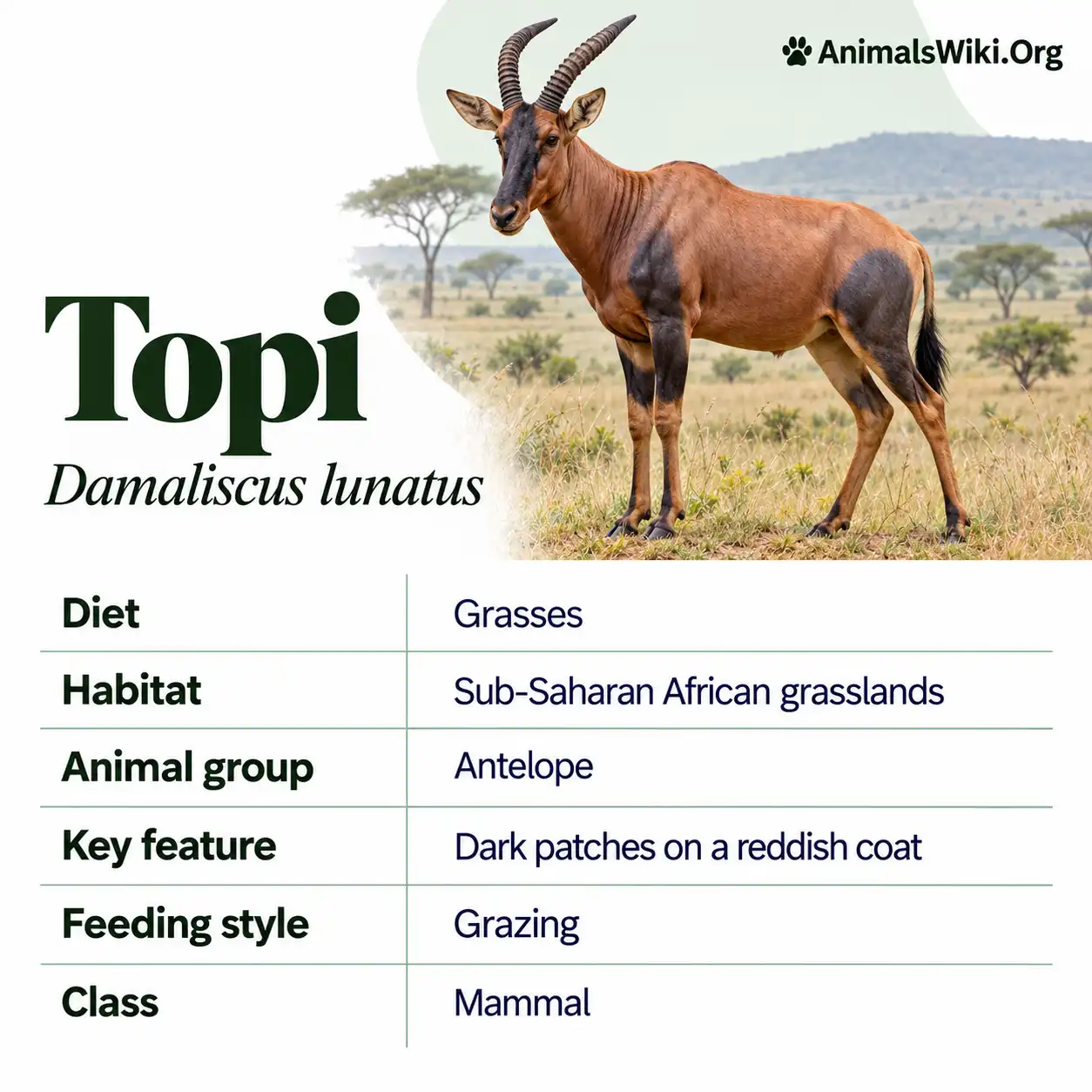
Topi Antelope, The Glossy Grassland Grazer With a Remarkable Social Life
The topi antelope is one of East Africa’s most distinctive grassland mammals. Its glossy reddish-brown coat, dark patches on the face and upper legs, and alert posture make it recognizable even among large gatherings of grazing animals. Standing on a termite mound or moving across an open plain, it presents a striking combination of elegance, strength, and vigilance.
Yet the topi’s appearance is only part of its appeal. Behind that polished coat lies a surprisingly complex social life. In some populations, males gather on mating arenas called leks, where females choose among neighboring territory holders. Research has also documented competition between females for preferred mates and alarm calls that can influence reproductive interactions.
Ecologically, the topi is a selective grazer. Its survival depends on more than having grass somewhere in the landscape. Grass growth stage, the availability of green leaves, seasonal moisture, predator exposure, and access between feeding areas can all influence where animals spend their time.
The name “topi” also needs clarification. Some sources use it broadly for the Damaliscus lunatus complex, which includes several geographically distinct forms. Others use it more specifically for the familiar East African topi, Damaliscus lunatus jimela. Those different scopes can produce apparently conflicting conservation categories and population figures.
This article focuses primarily on the East African topi while explaining the broader classification where necessary. It covers identification, scientific relationships, distribution, habitat, feeding, adaptations, behavior, reproduction, lifespan, predators, ecological importance, and conservation.
The result is a picture of an antelope whose future depends on functioning grasslands and whose behavior has helped scientists understand how food, danger, and mate choice shape animal societies.
Topi Antelope Facts
| Feature | Details |
|---|---|
| Common name | Topi |
| Main focus of this article | East African topi |
| Scientific name used here | Damaliscus lunatus jimela |
| Broader species grouping | Damaliscus lunatus |
| Family | Bovidae |
| Commonly used subfamily | Alcelaphinae |
| Main region | Eastern and parts of east-central Africa |
| Typical habitat | Open grasslands, grassy savannas, and floodplain landscapes |
| General appearance | Glossy reddish-brown coat, dark facial and leg patches, sloping back |
| Approximate shoulder height | Usually around 1–1.3 meters in reference accounts |
| Adult body mass | Roughly around 100 kilograms or more; varies with sex and population |
| Horns | Present in both sexes |
| Main food | Grass |
| Digestion | Ruminant |
| Social organization | Variable herds, territorial males, and lek breeding in some populations |
| Gestation | Approximately eight months |
| Young per birth | Normally one calf |
| Commonly reported lifespan | Around 12–15 years; not a guaranteed wild average |
| East African topi assessment | Vulnerable; assessed in 2016 and published in 2017 |
| Broader species assessment | Least Concern in the 2016 assessment |
| Current East African-wide population | No new comprehensive 2026 census verified here |
1. What Is a Topi Antelope?
The topi is a medium-to-large African antelope associated with grassy landscapes. It belongs to the bovid family, which includes antelopes, cattle, goats, and sheep.
Its relatives include other members of Damaliscus, as well as the wider alcelaphine group containing animals such as hartebeest and wildebeest.
The topi’s body has a characteristic outline: the shoulders are relatively high, the back slopes toward the hindquarters, and the head has an elongated appearance. Its short coat often looks unusually glossy in direct sunlight.
Although topi may share a plain with several other herbivores, they do not use every grassland in the same way. Their feeding choices and social behavior influence their distribution at a much finer scale.
A productive landscape must provide suitable grazing through changing conditions. It must also allow animals to balance feeding with vigilance, reproduction, and movement.
For a first-time observer, the most useful identifying combination is the chestnut-colored coat, dark upper-leg patches, dark face, and horns in both sexes.
For a biologist, the same animal offers an opportunity to investigate how ecology and reproductive behavior interact.
2. Scientific Classification and Naming
Classification of the East African Topi
| Taxonomic rank | Classification |
|---|---|
| Kingdom | Animalia |
| Phylum | Chordata |
| Class | Mammalia |
| Order | Artiodactyla |
| Family | Bovidae |
| Subfamily | Alcelaphinae in many reference treatments |
| Genus | Damaliscus |
| Species | Damaliscus lunatus |
| Subspecies discussed here | Damaliscus lunatus jimela |
The Mammal Diversity Database retains a broad Damaliscus lunatus treatment that includes forms some other authors have recognized separately. Consequently, scientific and common names differ among references.
Why “Topi” Can Mean Different Things
The broader complex includes names such as topi, coastal topi, tiang, korrigum, and tsessebe.
These names are not interchangeable population labels. A census of tiang in South Sudan, for example, should not be presented as a count of East African jimela topi.
Similarly, a conservation category for the whole complex does not automatically describe every constituent form.
How This Article Uses the Name
Here, “topi” primarily refers to Damaliscus lunatus jimela, the familiar East African form.
Information drawn from broader species accounts is treated as general background where appropriate.
This distinction is especially important for conservation. The East African form has its own assessment, while the encompassing species grouping has a different global category.
Clear naming prevents a technically correct number from becoming misleading through loss of context.
3. Identification and Physical Appearance
Size and Body Shape
Topi are substantial antelopes, commonly standing around 1–1.3 meters at the shoulder. Adult weight varies, with many reference descriptions placing them around 100 kilograms or more.
Males generally have a heavier appearance than females, but a distant view may not reveal sex reliably.
The shoulders sit relatively high, and the back slopes toward the rump. That outline helps separate a topi from more evenly proportioned antelopes.
The Glossy Coat
The coat is short and reddish brown to chestnut, with darker areas on the face, shoulders, and upper legs.
Under some light, the dark patches can have a bluish or purplish sheen. These descriptions refer to visual appearance rather than vividly colored skin.
Lighting, dust, camera processing, and individual variation all influence photographs.
Horns in Both Sexes
Both males and females have ringed horns that rise from the head and curve.
Their shape changes in appearance with viewing angle. A frontal photograph may emphasize a lyre-like outline, while a side view shows the curvature differently.
Calves Look Different
Young animals are lighter and do not immediately display every adult feature.
Age-related differences matter when identifying photographs. An unfamiliar calf should not be assigned to another species simply because it lacks the dark adult pattern.
Older zoological accounts document the topi’s elongated muzzle, glossy coat, and ringed horns, although their measurements often cover a broader taxonomic scope.
4. Topi Compared With Similar Antelopes
Topi can be confused with hartebeest, tsessebe, and other animals within or near the same evolutionary group.
| Feature | East African topi | Hartebeest | Southern tsessebe |
|---|---|---|---|
| Common scientific treatment | Damaliscus lunatus jimela | Alcelaphus buselaphus complex | Damaliscus lunatus lunatus |
| General appearance | Glossy chestnut coat with dark patches | Often a more elongated, angular-looking head | Closely similar overall body plan |
| Horn impression | Ringed and curved, often appearing lyre-like | Distinctive shape varying among forms | Different horn outline and proportions |
| Relationship | Member of the Damaliscus lunatus complex | Different genus | Another form within the broader complex |
| Identification caution | Coat shade varies with light | Several geographic forms differ | Geography and taxonomy are important |
A reliable identification uses several features together.
The elongated head of a hartebeest is useful, but body posture and camera angle can exaggerate differences. Topi and tsessebe require particular care because their relationship is much closer.
For educational writing, the image caption should identify the form only as precisely as the evidence supports.
An attractive photograph labeled merely “African antelope” is insufficient evidence for a detailed topi article.
5. Geographic Distribution
The East African Range
East African topi occur in parts of Tanzania, Kenya, Uganda, Rwanda, and eastern Democratic Republic of the Congo, with distribution varying among regions and historical accounts.
Their presence is patchy rather than continuous across every suitable-looking plain.
The Serengeti–Mara landscape is especially important in both research and conservation literature.
Important Landscapes
Tanzania supports a major portion of the East African topi population discussed in the IUCN assessment.
Kenya’s Maasai Mara has been central to studies of breeding, communication, and population change. Uganda and Rwanda also support populations in appropriate grassland settings.
Akagera’s own visitor information identifies topi among the animals associated with its open plains.
Historical Presence and Current Evidence
A historical range map can show where topi once occurred without proving present occupancy.
Populations may disappear, become restricted, or recover under management. Current records need dates and local context.
Why Country Lists Are Not Enough
A national occurrence label does not reveal abundance, connectivity, or reproductive success.
For practical conservation, the relevant question is which connected grassland areas continue to support viable groups through the full annual cycle.
6. Habitat and Grassland Structure
More Than “Open Savanna”
Topi use open grasslands, grassy savannas, and floodplain landscapes.
Within those broad categories, vegetation height, green leaf availability, drainage, and visibility can differ substantially.
A field that looks uniformly grassy to a visitor may contain several distinct feeding environments.
Grass Height and Growth Stage
Very short grass, taller leafy grass, and mature stem-heavy vegetation offer different feeding opportunities.
The topi’s needs cannot be summarized as a preference for the shortest possible lawn.
Useful habitat contains enough accessible, nutritious grass to support intake while allowing the animals to manage other demands.
Visibility and Risk
Open ground can improve the ability to detect approaching predators.
However, the safest-looking patch is not necessarily the best feeding patch. Habitat selection can reflect a compromise between food and danger.
Seasonal Habitat Research
A study published in 2025 examined resident topi and kongoni in Serengeti woodland landscapes. It described seasonal shifts among vegetation types and investigated both feeding conditions and predation risk.
Its publication date should not be confused with the dates of all underlying field observations.
The broader lesson is that habitat use changes with context. One photograph of topi on short grass cannot define the species’ requirements throughout the year.
7. Diet and Food Selection
A Grass-Eating Antelope
Topi are specialized grazers. Grass forms the core of their diet.
Their narrow muzzle helps them select suitable growth and plant parts rather than simply taking every available mouthful.
The African Wildlife Foundation emphasizes both their grazing specialization and their dependence on suitable pasture conditions.
Leaves Versus Stems
A grass plant contains components with different nutritional properties.
Green leaves may be more useful than coarse stems, while aging plants can change in digestibility and nutrient content.
Consequently, total grass height or biomass does not tell the whole feeding story.
Growth Stage Matters
Grass at an intermediate or later leafy stage may offer a different return from very short regrowth.
Experimental work comparing topi, wildebeest, and hartebeest examined feeding performance across grass growth stages, helping explain how superficially similar grazers can use resources differently.
What Diet Specialization Means
Specialization can support efficient feeding under suitable conditions, but it can also reduce flexibility when those conditions deteriorate.
A landscape may retain vegetation while losing the particular structure or quality that makes it useful to topi.
That is why grassland conservation requires attention to composition and condition, not merely the absence of buildings or trees.
8. Digestion and Nutritional Requirements
The Ruminant System
Topi use microbial fermentation to obtain nutrients from plant material.
Regurgitating and rechewing food improves physical breakdown, allowing further processing of fibrous vegetation.
This makes grass usable, but it does not turn every dry stem into an equally valuable food.
Intake and Processing
An animal must balance the rate at which it gathers food with the digestive effort required to use it.
Small, high-quality bites may be valuable, but searching for them takes time. Abundant coarse material may be easier to gather while yielding a different nutritional return.
These trade-offs help explain why feeding animals repeatedly move their heads, reposition, and leave apparently grassy patches.
Different Life Stages
A growing calf, lactating female, and breeding male have different demands.
Nutritional conditions can therefore influence individuals differently within the same herd.
Rest Is Part of Feeding Ecology
A topi lying quietly may be ruminating.
Repeated disturbance can interrupt that processing period as well as visible grazing. Evaluating habitat quality should therefore include opportunities for undisturbed rest.
The full nutritional cycle involves feeding, digestion, movement, and recovery rather than grazing time alone.
9. Water and Seasonal Conditions
Food Supplies Moisture
Green grass contributes water as well as nutrients.
When fresh pasture is available, topi can obtain part of their water requirement through food. When vegetation dries, drinking becomes more important.
This does not make them physiologically independent of water.
Rainfall Has Several Effects
Rain can stimulate grass growth, change surface-water availability, and alter the distribution of feeding areas.
However, rainfall is not a simple guarantee of improved conditions everywhere. Timing, soil, flooding, and subsequent plant growth all influence the outcome.
Dry-Season Constraints
As the landscape dries, usable grass and water may become concentrated.
Animals can then face longer journeys or increased overlap with other herbivores.
A resource that is abundant regionally may still be inaccessible to a group blocked by unsuitable terrain or human infrastructure.
Reading Seasonal Stress
Poor condition, altered movement, and reduced reproduction can have several causes.
Researchers need information about rainfall, food, health, and mortality before attributing every change to drought.
The useful question is how seasonal conditions affect the resources animals actually obtain.
10. Adaptations for Grassland Life
A Body Suited to Movement
Topi have long limbs, a substantial torso, and a body plan associated with efficient movement across open ground.
They can run rapidly, but precise top-speed rankings are difficult to verify and are unnecessary for understanding their ecology.
The practical advantage is the ability to respond to danger and move between resource patches.
A Grazing Muzzle
The relatively narrow muzzle supports selective feeding.
That feature illustrates how small anatomical details can influence habitat use. An animal’s relationship with a grassland begins at the level of the individual bite.
Vision and Vigilance
An elevated head position allows topi to inspect their surroundings.
Open habitats provide opportunities to detect predators, but vigilance takes time away from feeding. Group context and perceived danger can alter that balance.
Horns and Social Encounters
Horns contribute to interactions and defense, but their presence does not make an animal invulnerable.
Females also have horns, so horn presence alone cannot establish sex.
Adaptations Have Limits
Speed cannot compensate indefinitely for blocked movement routes, and digestive specialization cannot replace suitable forage.
Conservation must maintain the environmental conditions in which these traits remain useful.
11. Daily Activity and Vigilance
Alternating Tasks
Topi divide their time among grazing, resting, ruminating, moving, social interactions, and watching for danger.
The proportions change with weather, food conditions, reproductive activity, and disturbance.
A single daily schedule cannot describe every population and season.
The Familiar Mound-Standing Posture
Topi are often photographed on termite mounds or other raised ground.
Elevation can provide a useful view, but the purpose of an individual’s position should be interpreted cautiously. Vigilance and territorial activity can both contribute.
A photograph records posture, not necessarily the complete reason behind it.
Feeding Under Risk
An animal that raises its head repeatedly may be responding to danger, social activity, or disturbance.
The cost lies partly in lost feeding time.
Why Observation Methods Matter
Research vehicles, visitor traffic, and observation times can influence what is recorded.
Repeated sampling across conditions gives a more reliable picture than selecting only dramatic encounters.
For visitors, noting time, weather, herd composition, and nearby disturbance can make an observation more informative.
12. Movement and Seasonal Habitat Use
Resident Does Not Mean Motionless
Some well-studied topi populations are described as resident relative to the great migratory herds around them.
That does not mean the animals remain in one small patch throughout the year.
They still move among feeding areas and respond to changing conditions.
Food and Reproduction
A 2008 study used satellite-derived vegetation information to examine topi distribution before and during breeding.
It found that resource relationships depended on scale and that breeding behavior helped explain distribution during the rut.
This shows why the greenest location is not always where the greatest concentration of animals occurs.
Connections Between Patches
A grassland network can provide alternatives as conditions change.
Fragmentation reduces those choices. Even if each remaining patch looks adequate, the population may lose access to the sequence of resources it previously used.
Avoiding a Borrowed Migration Story
The enormous movements of tiang in other parts of Africa should not automatically be described as movements of East African jimela topi.
Related forms share evolutionary history without necessarily sharing identical movement patterns.
13. Herd Structure and Territorial Behavior
Flexible Social Organization
Topi social organization varies among populations and ecological conditions.
Animals can form herds, while males may defend territories of different sizes. Breeding arrangements include both resource-associated territories and clustered mating arenas.
This flexibility is a central feature of their biology.
Home Range and Territory
A home range is the area used during ordinary activities. A territory is an area actively defended.
Mapping where an animal moves does not, by itself, demonstrate territorial defense.
Researchers combine locations with observations of marking, encounters, and exclusion.
Why Territory Size Can Differ
A territory containing useful grazing has a different structure from a small plot on a lek.
Its value depends on what attracts females and whether the male can maintain it.
Group Membership
Animals seen together may not remain together permanently.
Food distribution, reproduction, and social encounters can alter associations. Repeated observations are necessary to distinguish a stable relationship from temporary proximity.
For conservation, that means a herd count is an observation unit rather than an automatic description of an enduring social family.
14. Lek Breeding Explained
What Is a Lek?
A lek is a cluster of male mating territories visited by females.
The males occupy neighboring plots, and females can move among them while choosing mates.
The arena is primarily associated with reproduction rather than the male providing direct parental care.
Topi Do Not Always Lek
Lekking is documented in some populations and circumstances. It should not be presented as the only breeding system used by every topi.
Other males defend larger territories containing resources.
Why Clustering Can Develop
Several explanations have been proposed, including female movement, male competition, mating preferences, and potential effects of predator risk.
These explanations need not operate equally in every setting.
Research on topi leks has tested predictions rather than assuming that all male clustering has one cause.
A Conservation Implication
A mating arena may occupy a relatively small area while being behaviorally important.
Protecting grazing alone may overlook such sites. Conversely, preserving a lek is insufficient if females lose access to surrounding feeding habitat.
The full reproductive system depends on the wider landscape.
15. Female Mate Choice and Competition
Females Are Active Participants
Topi research has shown that females can actively choose among males.
This challenges the simplified picture in which males compete while females merely receive the outcome.
Competition for Preferred Males
A study published in 2002 reported aggressive competition between female topi for mating opportunities with preferred males on central lek territories.
The observation does not mean every female always selects the same kind of male or that central location alone determines reproductive success.
It demonstrates that female behavior can shape the mating system.
Why Centrality Matters Scientifically
Researchers can ask whether a male’s location reflects quality, prior success, female preferences, or interactions with neighboring males.
Separating those possibilities requires observation and testing.
Beyond a Simple Story
Competition, preference, dominance, and opportunity can interact.
A female’s behavior may depend on who else is present and whether access is interrupted.
The topi is therefore valuable to behavioral science because it reveals complexity within a system that first appears to be a straightforward male display arena.
16. Communication and Alarm Calls
Signals in Open Country
Topi communicate through posture, movement, scent-related behavior, and sound.
Alarm snorts are particularly important when animals detect potential danger.
The behavior of the caller can provide additional information, such as sustained attention toward a predator.
Calls During Reproductive Interactions
Research in the Maasai Mara between 2005 and 2009 found that some territorial males gave alarm snorts without a detected predator when receptive females were present.
Playback experiments supported the interpretation that those calls could delay female departure.
What “Deceptive” Means Here
The research describes a functional effect: a signal associated with danger is used in circumstances that benefit the caller’s mating opportunities.
It does not establish human-like planning, moral intent, or a spoken lie.
Why This Matters
Signals can have costs and benefits for both sender and receiver.
A female ignoring a real alarm could face danger, while responding to a false one could alter her movements.
This creates an interesting evolutionary problem and helps explain why communication is studied through both natural observations and experiments.
17. Reproduction and Breeding Seasons
Gestation and Birth
Pregnancy lasts approximately eight months, with one calf normally born.
The exact day count varies among references. The AnAge database lists 238 days for the broader Damaliscus lunatus account.
That value is a reference figure, not a claim that every pregnancy lasts exactly the same duration.
Seasonal Timing
In the Mara–Serengeti population, research describes conceptions concentrated around the long rains and births peaking later in the year, around October–November.
Births can occur outside the main peak, so a seasonal pattern should not become an absolute prohibition on other months.
Rainfall and Reproduction
Rain influences forage conditions, which can affect reproductive timing and success.
Comparative ungulate research has investigated these relationships and found that responses differ among species.
Maturity Versus Successful Breeding
An animal can become physiologically capable of reproduction before it consistently succeeds.
Social position, nutritional condition, and access to mates all matter.
Population forecasts therefore need observed reproductive performance rather than maturity ages alone.
18. Calf Development and Maternal Care
A Mobile Young Antelope
Topi calves are relatively well developed at birth and become mobile early.
The mother provides milk and maintains a close association while the young animal develops.
Early mobility does not eliminate dependence.
Births in Groups
Seasonal concentrations of births can produce groups containing many young animals.
Researchers have considered how synchronized births relate to forage and predation. Different studies emphasize different mechanisms, so one explanation should not be treated as universally sufficient.
Growing and Learning
Calves gradually increase their use of vegetation while developing the digestive capacity needed for an adult diet.
They also learn movement patterns and respond to the behavior of nearby animals.
Recruitment
A birth contributes to population growth only if the young survives.
Monitoring should distinguish newborn numbers from later juvenile recruitment.
A season with many calves can still be followed by a decline if mortality is high or adult losses exceed the number of young entering older age classes.
19. Lifespan and Survival
How Long Do Topi Live?
A lifespan around 12–15 years is commonly given in reference accounts.
This is best treated as an approximate longevity range rather than a measured average applying to all wild East African topi.
Why Captive Records Need Care
The AnAge database includes a much longer captive record under the broad species name.
That should not be presented as a normal wild lifespan or automatically assigned to jimela without checking the animal’s identity.
Maximum age and typical survival are different measures.
Survival Factors
Nutrition, predation, disease, injury, weather, and human activity can influence survival.
Their relative importance varies geographically and among ages.
What Demographic Data Reveal
Separating adult males, adult females, and juvenile classes can help identify the process behind a decline.
A reduction in births requires a different explanation from increased mortality among adults.
Understanding those differences supports more focused conservation than relying only on a total population estimate.
20. Predators and Defensive Behavior
Natural Predators
Lions, spotted hyenas, cheetahs, and leopards can prey on topi where they overlap.
Adults and calves do not face identical risks, and predator importance varies locally.
A list of potential predators should not be interpreted as a ranking of annual mortality.
Detecting Stalkers
In open country, seeing a predator early can reduce its chance of approaching successfully.
Alarm behavior and sustained attention can be useful before a chase begins.
Running and Group Context
Topi can use rapid movement to escape, while the presence of other animals can influence detection and response.
However, a herd is not a guarantee of safety.
Natural Predation and Conservation
Predation is part of the ecosystem.
A threatened population should not automatically be managed by removing native predators. Habitat condition, hunting, recruitment, and movement constraints need investigation too.
The best explanation of a decline is the one supported by evidence, even when several causes interact.
21. Ecological Importance
Part of the Grassland Food Web
Topi convert plant material into animal tissue and support predators, scavengers, and decomposers.
Dung and urine return nutrients to the ground.
These are general ecological functions; their exact magnitude depends on abundance and local conditions.
Effects on Vegetation
Grazing can influence plant growth and structure.
The outcome depends on intensity, season, rainfall, and the plants involved. It is inaccurate to say grazing is always beneficial or always harmful.
Diversity Among Grazers
Several grass-eating species can coexist because they differ in body size, bite selection, preferred growth stages, and use of space.
Topi contribute one part of that diversity.
Scientific Value
Research on topi has informed understanding of mate choice, communication, habitat selection, and population dynamics.
That scientific importance is additional to, rather than a replacement for, their ecological and conservation value.
A familiar-looking savanna antelope can therefore reveal processes relevant far beyond one species.
22. Relationships With Other Grazers and Livestock
Shared Grassland Does Not Mean Identical Diet
Topi may occur near wildebeest, zebra, hartebeest, and smaller antelopes.
Those animals can select different plants, heights, or growth stages.
The result can include both overlap and separation.
Competition Depends on Limitation
Two species eating grass are not necessarily competing strongly at every moment.
Competition matters when shared resources become limiting and affect performance.
The same relationship can change between wet and dry conditions.
Livestock Pressure
Domestic livestock can influence forage availability and vegetation structure.
Effects depend on animal numbers, season, movement, and management rather than livestock presence alone.
Indirect Changes
Fencing, water infrastructure, settlement, and altered fire regimes can affect topi even without direct dietary competition.
A conservation response must identify the mechanism involved.
Reducing one pressure may have little effect if access to essential seasonal habitat remains blocked by another.
23. Population Estimates and Historical Trends
The East African Assessment
The 2017 IUCN assessment for Damaliscus lunatus jimela, based on an August 2016 evaluation, lists an estimated 50,000–70,000 mature individuals and a decreasing trend.
Those are assessment-era estimates, not a verified count for 2026.
Why Scope Matters
The broader Damaliscus lunatus grouping contains additional forms.
A total for the complex cannot be used as the number of East African topi.
Similarly, “mature individuals” should not be silently changed to “all animals.”
| Figure or statement | Scope and date | Appropriate interpretation |
|---|---|---|
| 50,000–70,000 mature individuals | D. l. jimela, assessment completed in 2016 and published in 2017 | Dated estimate for the East African form |
| Larger totals for D. lunatus | Broader species complex | Includes other forms and requires separate interpretation |
| Counts in one reserve | Specific area and survey | Local evidence |
| Current total in 2026 | Not established by a new comprehensive census reviewed here | Should remain unspecified |
Comparing Surveys
Survey area, season, method, and age classes affect results.
A different count does not necessarily represent the same magnitude of biological change.
Reliable monitoring documents uncertainty and uses comparable methods through time.
24. Conservation Status and Main Threats
Vulnerable or Least Concern?
Both categories appear in reputable references because they refer to different taxonomic scopes.
The East African topi, Damaliscus lunatus jimela, is assessed as Vulnerable.
The broader Damaliscus lunatus grouping was assessed as Least Concern in 2016.
This distinction should remain visible in any article, infographic, or facts table.
Habitat Loss
Conversion to agriculture, settlement, and infrastructure can remove grassland or reduce its usefulness.
The consequences include both direct area loss and disruption of movement.
Fragmentation
A set of isolated patches may fail to provide the changing resources once available across a connected landscape.
Fragmentation can also concentrate animals and human activity around remaining resources.
Hunting
Illegal or unsustainable hunting can reduce survival, particularly where monitoring and protection are limited.
Its importance needs local evaluation rather than an assumption that pressure is identical everywhere.
Drought and Cumulative Stress
Poor forage conditions can interact with competition, restricted movement, and disturbance.
The combined effect may be greater than any single pressure considered alone.
Conservation therefore needs a landscape and demographic perspective rather than a search for one universal cause.
25. Conservation Priorities
Maintain Functional Grasslands
Protection should preserve suitable forage conditions, not merely retain land classified as open space.
Plant growth, grass structure, and access across seasons all matter.
Protect Movement Options
Connections between feeding areas can help animals respond to changing conditions.
Planning should identify bottlenecks before development removes them.
Include Reproductive Sites
Leks and other repeatedly used breeding areas can have importance disproportionate to their size.
Their protection should be integrated with the surrounding habitat rather than treated separately.
Improve Monitoring
Counts become more useful when combined with age structure, reproductive success, and survival information.
Monitoring can then distinguish declining recruitment from increased adult mortality.
Work With People
Pastoral communities, landowners, protected-area staff, and researchers all influence outcomes.
Conservation arrangements need to account for livelihoods and local knowledge if they are to persist.
Evaluate Results
An action should be judged by whether it improves the intended outcome.
Removing a barrier, changing grazing management, or increasing protection should be followed by observation of habitat use and population performance.
26. Responsible Observation and Photography
Keep Natural Behavior Natural
Visitors should avoid driving animals away from grazing, resting, or breeding sites.
A photograph obtained by repeatedly approaching until an animal runs creates disturbance rather than documenting an undisturbed scene.
Respect Leks
Breeding arenas are places where close vehicle positioning can interrupt interactions.
Observation should allow females and males to move normally.
Avoid Playback
Research findings about alarm calls are not an invitation to test those calls on wild animals.
Unnecessary playback can alter vigilance and movement.
Identify Images Accurately
Check the coat pattern, horns, face, body shape, and location.
Topi, hartebeest, and tsessebe labels should not be exchanged casually.
Record Context
Dates, general locations, group composition, and observed behavior make sightings more useful.
Uncertainty is preferable to false precision, especially when identifying a regional form from one image.
27. Frequently Asked Questions
1. What is a topi antelope?
The topi is a grass-eating African antelope. This article focuses on the East African form, Damaliscus lunatus jimela. It has a glossy reddish-brown coat, dark facial and upper-leg patches, and horns in both sexes. Broader references sometimes use “topi” for several related geographic forms.
2. Where do topi live?
East African topi occur in parts of Tanzania, Kenya, Uganda, Rwanda, and eastern Democratic Republic of the Congo. Their distribution is patchy and linked to suitable grasslands. A country list does not establish that every savanna within those countries supports a current population.
3. Are topi and tsessebe the same animal?
They belong to the same broad species complex in conservative classifications, but the names usually refer to different geographic forms. Some authors recognize additional species. Population figures and conservation categories should therefore retain the scientific name and taxonomic scope used by the source.
4. How can you recognize a topi?
Look for the glossy chestnut coat, dark patches on the face and upper legs, relatively high shoulders, sloping back, and curved ringed horns. Identification is strongest when several features agree. Light and age can change appearance, making coat color alone unreliable.
5. Do female topi have horns?
Yes. Both sexes have horns. This means horn presence cannot determine whether an animal is male. Size, horn development, and other anatomical features can help, but a distant photograph may not provide enough information for a confident identification.
6. How large is a topi?
Reference accounts commonly place shoulder height around 1–1.3 meters, with adults often around 100 kilograms or more. Measurements vary with sex, age, population, and taxonomic scope. Values compiled for the entire species complex should not automatically be treated as exact limits for jimela.
7. What do topi eat?
They primarily eat grass and select suitable plant parts, especially usable leafy growth. They are grazers rather than browsers like the gray rhebok. Grass quality, growth stage, and availability matter, so a landscape can remain grassy while becoming less suitable for them.
8. Do topi drink water?
Yes. Green food supplies some moisture, but drinking becomes more important when pasture dries. Their water needs should not be reduced to an absolute statement that they either drink daily everywhere or never require water. Conditions and diet influence the balance.
9. Why do topi stand on termite mounds?
Raised ground can provide a better view and may also be used during territorial activity. The purpose of an individual posture should be interpreted in context. A photograph shows where the animal stood, but not necessarily every reason it selected that position.
10. Are topi among the fastest antelopes?
They are rapid runners, but precise speed rankings are difficult to verify and often repeated without reliable measurements. Their ecology is better explained through effective escape, vigilance, and movement between resources than through an unsupported claim that they rank at a particular place.
11. Do topi migrate?
Movement varies among populations. Some East African populations are considered resident relative to nearby long-distance migrants, while still moving seasonally within their landscapes. Migration information about tiang or other related forms should not automatically be applied to Damaliscus lunatus jimela.
12. What is a topi lek?
A lek is a cluster of male mating territories visited by females. It concentrates reproductive activity in a relatively small area. Not all topi populations use this system continuously, and some males instead defend larger territories associated with resources.
13. Do females choose their mates?
Yes. Field research has documented active female preferences in lekking topi. This demonstrates that females can shape the mating system rather than simply accept the outcome of male competition. The details depend on social context and the population being studied.
14. Do female topi compete with one another?
Research has recorded aggressive female competition for mating opportunities with preferred males on central lek territories. This is a documented behavioral finding, but it should not become a claim that every female always behaves this way or that all populations have identical mating patterns.
15. Do male topi give false alarm calls?
A Maasai Mara study found that some males produced alarm snorts without a detected predator when receptive females were present. Experiments supported an effect on female departure. “Deceptive” describes the signal’s function rather than proving human-like planning or conscious dishonesty.
16. How long is topi pregnancy?
Gestation is approximately eight months. A value of 238 days appears in a broader species database, while other references provide nearby ranges. Such values are useful guides, but they should not be presented as an exact duration shared by every individual pregnancy.
17. How many calves does a topi have?
A single calf is normally born. Successful population recruitment requires that calf to survive into later age classes. Birth observations are therefore only one part of assessing population health, alongside juvenile survival, adult survival, and the frequency of successful reproduction.
18. When are topi calves born?
Timing varies geographically. In the Mara–Serengeti population, births peak around October–November in the research reviewed here, although births can occur outside that peak. A regional seasonal pattern should not become a fixed calendar for every population across East Africa.
19. How long do topi live?
Around 12–15 years is commonly reported, but that is a broad longevity description rather than a carefully established average for all wild East African topi. Captive records can be longer and may concern other forms within the wider species complex.
20. What predators eat topi?
Lions, spotted hyenas, cheetahs, and leopards can prey on them where they overlap. The importance of each predator differs by location and age class. A calf and a healthy adult do not present the same hunting opportunity, and predator presence alone does not establish predation frequency.
21. Are topi endangered?
The East African form is classified as Vulnerable in its assessment completed in 2016 and published in 2017. The broader species complex is Least Concern. Vulnerable and Endangered are separate formal categories, so the correct term and taxonomic scope should be preserved.
22. How many East African topi remain?
The assessment-era estimate is 50,000–70,000 mature individuals. That is not a newly verified population count for 2026, and it does not include calves in the same way as a total-animal estimate. A current comprehensive census was not verified for this article.
23. Can topi coexist with livestock?
Coexistence depends on forage, seasonal use, livestock pressure, movement access, and management. Sharing grassland does not automatically mean severe competition, but different feeding preferences do not eliminate indirect effects. Local evidence is needed to understand when coexistence remains workable.
24. Why is grassland connectivity important?
Different areas provide resources at different times. Connections allow animals to move between suitable grazing, water, and reproductive sites. Isolated patches may each look adequate while failing to provide the complete annual sequence of resources needed by the population.
25. Why are topi important to scientists?
They have helped researchers investigate lek evolution, female mate choice, competition, animal communication, habitat selection, and population dynamics. Their value extends beyond one unusual behavior: they illustrate how social decisions and ecological conditions interact in a large wild mammal.
26. What would help topi conservation most?
Useful priorities include maintaining functional grasslands, preserving movement routes, reducing unsustainable hunting, monitoring reproduction and survival, and working with local communities. Actions should respond to the conditions of each population and be evaluated through measurable ecological and demographic outcomes.
Topi Antelope (Damaliscus lunatus jimela)
The topi antelope combines a distinctive appearance with an exceptionally interesting ecological and social life. Its glossy coat and mound-standing posture make it memorable, while its grazing specialization, territorial behavior, and mating systems reveal a more complex animal than a passing sighting suggests.
Research on topi shows that habitat use cannot be explained by food alone. Reproductive opportunities, female preferences, competition, and danger can all affect where animals gather and how they behave.
Its conservation story requires equally careful interpretation. The East African topi is assessed as Vulnerable, while the broader species complex has a different category. Population estimates must retain their dates, age definitions, and geographic scope.
Protecting topi means maintaining working grassland landscapes: places with suitable forage, movement options, reproductive sites, and manageable human pressures. Reliable monitoring and cooperation with the people sharing those landscapes are essential.
The topi’s future depends on more than preserving an attractive antelope. It depends on sustaining the ecological connections that allow its feeding, movement, reproduction, and survival to continue.



