
Bontebok, A Complete Guide to South Africa’s Remarkable Antelope
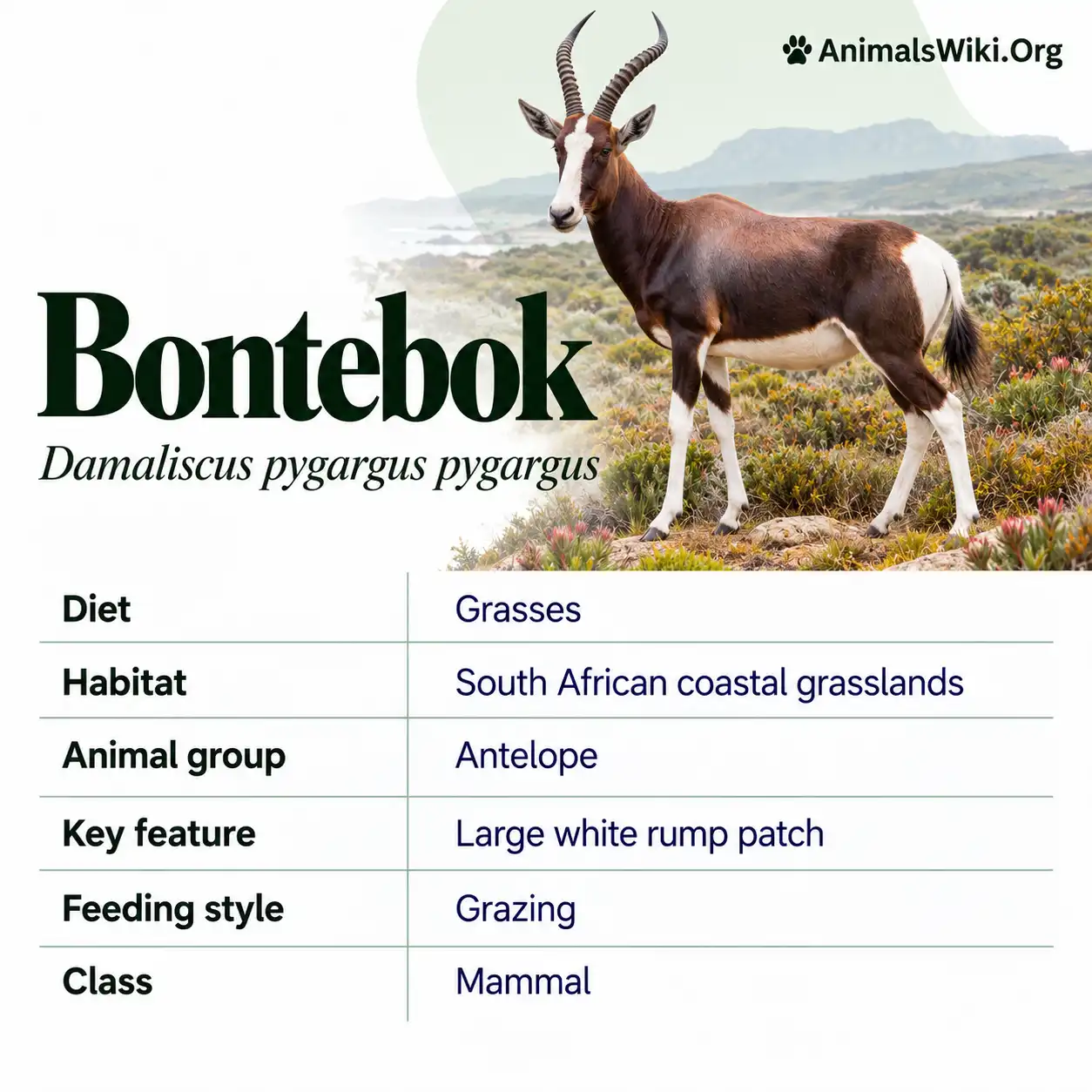
A bontebok standing in the morning sunlight is difficult to mistake for an ordinary brown antelope. Its dark coat can show a rich, almost purple sheen, while its white face, belly, legs and conspicuous rump create a striking pattern. Curved, ringed horns complete the appearance of an animal closely associated with South Africa’s southwestern Cape.
Yet the bontebok’s importance extends far beyond its looks. This antelope survived a severe historical population collapse, became the focus of dedicated protection and helped draw attention to an exceptionally threatened natural landscape.
Its recovery is often presented as a simple conservation success. The fuller story is more interesting. Bontebok numbers increased after protection, but conserving the animal still involves difficult questions about habitat, genetic diversity, hybridization and the difference between managed herds and populations that qualify for conservation assessments.
Even its name requires care. Bontebok and blesbok are close relatives, and many conservation authorities recognize them as two subspecies of Damaliscus pygargus. An article that combines their populations or assumes they share the same conservation situation can give a misleading picture.
This guide focuses on the bontebok of the southwestern Cape, Damaliscus pygargus pygargus. It explores how to identify the animal, where it belongs, what it eats, how it raises its young and why protecting suitable habitat remains essential.
Population figures are presented with their dates and definitions. Historical accounts and uncertain biological details are identified as such, helping distinguish a memorable wildlife story from claims that the available evidence cannot fully support.
Bontebok Facts
| Feature | Information |
|---|---|
| Common name | Bontebok |
| Scientific name used here | Damaliscus pygargus pygargus |
| Animal group | Antelope |
| Family | Bovidae |
| Closest comparison | Blesbok, Damaliscus pygargus phillipsi |
| Native region | Southwestern Cape, South Africa |
| Typical habitat | Open lowlands with suitable short-grass feeding areas, especially renosterveld |
| Main diet | Grass |
| Feeding system | Ruminant herbivore |
| Approximate shoulder height | Around 90–100 centimeters |
| Approximate adult weight | Commonly around 55–85 kilograms, depending on sex and source |
| Horns | Present in both sexes |
| Social organization | Female groups, bachelor groups and territorial males |
| Gestation | Approximately eight months |
| Usual number of young | One calf |
| Newborn strategy | Calves become mobile quickly and follow their mothers |
| Potential longevity | Around 15–17 years reported; this is not a measured average for wild populations |
| Global conservation assessment discussed here | Vulnerable; assessed in 2015 and published in 2017 |
| More recent regional assessment | Vulnerable in the 2025 regional assessment |
1. What Is a Bontebok?
The bontebok is a medium-sized African antelope native to a restricted part of South Africa. It belongs to the cattle family, Bovidae, alongside other antelopes, buffalo, sheep and goats.
Within that broad family, it is associated with the group containing hartebeest and their relatives. Its relatively long face, substantial body and curved horns reflect that relationship, although its markings give it a distinctive appearance.
The common name comes from Afrikaans and refers to the animal’s contrasting coloration. The white areas are especially noticeable when a herd moves across dark vegetation or stands against a green background.
Bontebok are primarily grazing animals. Their lives revolve around finding suitable grass, obtaining water, maintaining social relationships and reproducing within landscapes that are now often divided into separate managed properties.
Their limited native distribution is central to their identity. They are not naturally widespread across the African continent. Understanding them requires looking closely at the Cape lowlands and the changes those landscapes have experienced.
The bontebok also illustrates an important conservation principle: preventing extinction is a major achievement, but it does not automatically restore an animal’s former ecological freedom, habitat or genetic options.
2. Scientific Classification and Naming
Classification used in this article
This article follows the subspecies treatment used by major South African conservation sources.
| Taxonomic level | Classification |
|---|---|
| Kingdom | Animalia |
| Phylum | Chordata |
| Class | Mammalia |
| Order | Artiodactyla |
| Family | Bovidae |
| Subfamily | Alcelaphinae |
| Genus | Damaliscus |
| Species | Damaliscus pygargus |
| Bontebok subspecies | Damaliscus pygargus pygargus |
| Blesbok subspecies | Damaliscus pygargus phillipsi |
Bontebok and blesbok have sometimes been treated as separate species. Older literature also uses names such as Damaliscus dorcas. These differences can make research confusing when publications from different periods are compared.
Why the scientific name matters
A scientific name helps establish exactly which animal a population estimate or conservation assessment describes.
A source discussing Damaliscus pygargus may cover both bontebok and blesbok. Another may use the same species name while treating bontebok separately. Reading only the headline can therefore lead to incorrect conclusions.
For practical purposes, the full name Damaliscus pygargus pygargus identifies the Cape bontebok discussed here.
Taxonomic debate does not remove its conservation importance. Whether classified as a species or subspecies, it represents a geographically and biologically meaningful wildlife population whose history and management differ from those of the blesbok.
3. Identification and Physical Appearance
Coat color and white markings
An adult bontebok has a dark brown coat that can appear glossy in favorable light. Its most recognizable features are the sharply contrasting white areas.
Look for a white facial blaze, pale underparts, white lower legs and a broad white rump patch. The rump marking is especially useful because it is more extensive and conspicuous than the corresponding area on a typical blesbok.
Color changes with lighting. A photograph taken in deep shade may make the coat look nearly black, while bright sunlight can reveal warmer brown or purple tones.
For identification, the arrangement of markings is more useful than an exact description of the coat’s shade.
Horn shape
Both male and female bontebok carry horns. These rise from the head, show prominent rings along much of their length and curve through a characteristic changing angle.
Males usually have more substantial horns, although judging sex from a distant view can be difficult. Horn appearance also changes with age and individual development.
Reference descriptions place adult horns broadly around 30–36 centimeters, with differences between sexes and individuals. Treat that as an approximate field guide rather than a diagnostic measurement.
Body shape and posture
The bontebok has a sturdy torso, relatively slender lower legs and an elongated face. When grazing, its head drops close to the ground, giving it a very different outline from its alert, head-raised posture.
Young calves initially lack the fully developed appearance of adults. Their more subdued coloration and absence of developed horns can make them look like a different kind of antelope to an inexperienced observer.
A reliable identification considers several features together: body form, facial pattern, rump markings, horns and geographical context.
4. Bontebok vs Blesbok
Bontebok and blesbok are frequently confused because they share a similar body plan and a conspicuous white face. However, their native distributions and conservation circumstances differ.
| Feature | Bontebok | Blesbok |
|---|---|---|
| Scientific name in the subspecies treatment | D. p. pygargus | D. p. phillipsi |
| Native geographical association | Southwestern Cape lowlands | Inland South African grasslands |
| Typical coat impression | Rich, dark and often glossy | Usually a more uniform brown |
| Rump marking | Broad, conspicuous white patch | Less extensive contrasting rump area |
| Facial appearance | White blaze; details vary | White blaze; details vary |
| Habitat emphasis | Cape lowland grazing habitats | Interior grassland habitats |
| Conservation concern | Restricted qualifying populations, habitat and genetic management | A different population history and assessment |
| Can appearance establish ancestry conclusively? | No | No |
The table describes typical differences, not a guaranteed test for every individual.
Why photographs are not enough for conservation decisions
An animal can look convincing in a photograph while its ancestry remains uncertain. Individual variation, viewing angle and hybridization complicate visual identification.
This distinction matters when animals are moved between conservation properties. A visitor identifying a likely bontebok and a manager deciding whether an animal belongs in a conservation breeding population are answering different questions.
The first may reasonably rely on visible characteristics. The second can require records and genetic evidence.
Research on bontebok–blesbok hybridization has demonstrated why molecular tools are useful alongside physical appearance. Conservation management needs to consider ancestry across generations, including cases that may be difficult to recognize by eye.
5. Native Distribution and Introduced Populations
Where bontebok naturally belong
The bontebok’s historical distribution is associated with the southwestern Cape, particularly lowland landscapes in the Overberg region.
This is a much narrower geographical setting than the broad African grassland image often associated with antelopes.
The historical range provides the ecological background against which conservation decisions are made. It connects the animal to particular vegetation, climatic conditions and landscape processes.
Where bontebok occur today
Modern bontebok occur in protected areas and on private properties. Some herds live within their natural distribution, while others have been established in extended or extralimital areas.
“Extralimital” means outside the recognized natural or extended natural distribution used by the relevant assessment. It does not mean that every such animal is unhealthy or without conservation value.
However, an animal’s presence on a property does not automatically make that property part of its native range.
Why different distribution categories matter
Imagine two populations of the same antelope. One occupies suitable native vegetation and breeds with limited intervention. Another lives far outside its historical range under intensive management.
Both contain living animals, but they provide different evidence about the security of the original wild population.
That is why distribution maps, population totals and conservation assessments must be read together. A large managed distribution can coexist with a restricted ecological distribution.
6. Habitat and the Importance of Renosterveld
What is renosterveld?
Renosterveld is a distinctive Cape vegetation type containing a mixture of shrubs, grasses and a rich variety of other plants.
It belongs to the broader botanical setting of the Cape Floristic Region, but it should not be imagined as interchangeable with every form of fynbos.
For bontebok, the important feature is access to suitable grazing within this varied vegetation.
Their habitat is therefore more specific than “any open field.” Grass composition, growth stage, water, terrain and the surrounding vegetation all affect whether an area meets their needs.
Preferred feeding landscapes
Bontebok favor short grass and use recently burned areas where fresh growth becomes available. They can also use grassy patches within other Cape vegetation types.
Water is an essential habitat requirement. Conservation accounts describe a strong association with surface water during the dry season.
Why apparently empty land may be valuable
A low patch of natural vegetation may look less impressive than a forest or a mountain landscape, yet it can contain an exceptional concentration of plant life.
Converting such land into a simple grass pasture might increase visible grazing while reducing botanical diversity.
This creates a central management challenge. Bontebok conservation should sustain the antelope within a healthy landscape, rather than maximizing animal numbers at the expense of everything else.
CapeNature explicitly recognizes the bontebok as a flagship for renosterveld conservation. Protecting the animal can help draw support toward a habitat that might otherwise receive less public attention.
7. Bontebok Diet and Feeding Choices
What do bontebok eat?
Bontebok feed predominantly on grass. They are selective grazers, meaning they do not consume every available plant in equal proportions.
A field that appears uniformly green to a person may contain substantial differences in leaf quality, stem toughness and accessibility.
For an antelope feeding close to the ground, those differences influence how much useful food it can obtain with each bite.
Why short grass is important
Short grass can provide accessible young leaves, while older growth may contain more stems and less easily digested material.
However, “short” does not automatically mean “good.” A heavily depleted patch may offer little food even if its remaining vegetation is low.
Likewise, a grass species that is attractive while young may become less useful as it matures.
This helps explain why bontebok feeding patterns change as vegetation develops. Research in Bontebok National Park found that grass use varied with growth stage and time since fire, rather than following a simple preference for one fixed vegetation condition.
Wild feeding and captive diets
A zoo diet may include carefully selected feeds that differ from what an animal finds naturally. Such diets are designed around nutritional needs, husbandry conditions and veterinary oversight.
They should not be used as a list of foods that wild bontebok normally seek.
For understanding natural ecology, the most useful starting point remains the animal’s dependence on suitable grazing and its response to changing grass quality.
8. Digestion and Water Requirements
How a ruminant processes grass
Like other ruminant bovids, the bontebok uses microbial fermentation to help break down plant material.
Grass contains structural compounds that mammals cannot digest efficiently on their own. Microorganisms in the digestive system help convert that material into products the animal can use.
Rumination allows swallowed plant material to be returned to the mouth and chewed again. This further reduces particle size and supports digestion.
Consequently, an animal resting quietly may still be processing its previous meal.
Feeding success is not simply a matter of spending every possible minute grazing. The bontebok must balance collecting food, chewing, digestion, movement and social activity.
Dependence on drinking water
Bontebok are not desert specialists capable of treating drinking water as an occasional luxury.
Their need for reliable water affects which parts of a landscape remain usable during dry conditions. A large area with attractive grass can still provide poor habitat if water is unavailable or inaccessible.
Why water provision requires planning
Adding a water point can change where animals gather. That may help them use one area while concentrating grazing and trampling around another.
The ecological question is therefore broader than whether a trough contains water. Managers also need to consider distribution, maintenance, vegetation condition and how other animals use the same resource.
9. Adaptations to Life in Open Country
Locomotion and visibility
The bontebok’s body supports movement across relatively open terrain. Long lower limbs allow efficient travel between feeding and resting areas.
Open surroundings also provide opportunities to detect disturbances before they are immediately close.
These features fit an animal whose daily activities often involve grazing with its head lowered, then lifting it to monitor the surrounding landscape.
Social information
Living near other bontebok creates opportunities to respond to the movements and alert behavior of companions.
A single animal may notice something while others are feeding. The response can then spread through the group.
This does not eliminate danger, and group living also brings competition. Nevertheless, it changes the information available to each individual.
The famous jumping claim
Bontebok are often described as unable to jump, sometimes with the suggestion that this single characteristic explains their survival behind early farm fences.
That is too categorical a biological claim. They are not renowned as accomplished jumping antelopes, but “cannot jump” should not be treated as proof of an absolute physical limitation.
Their survival depended on protection, management and suitable conditions over many generations. Reducing that history to a fence anecdote obscures the larger conservation effort.
10. Daily Activity and Rest
Feeding periods
Bontebok are active during daylight, with grazing often prominent in the cooler parts of the day.
The exact pattern changes with temperature, food availability, season and the animal’s social role.
A territorial male, for example, may interrupt feeding to monitor other animals or respond to a rival. A lactating female faces a different set of energy demands.
A study of introduced herds in the Free State found differences among social groups, including greater grazing investment by females than territorial males. Such findings are useful, but the exact percentages should not be assumed to apply to every reserve.
Resting and rumination
During quieter periods, bontebok may stand or lie down, sometimes using available shade.
Rest is part of the daily energy budget. It allows digestion and reduces the need for movement during uncomfortable conditions.
A group standing almost motionless can still be socially attentive. Small changes in head position, spacing and orientation may reveal that individuals are monitoring one another.
Observing a full activity cycle
A brief sighting captures only a moment. An animal photographed while resting should not be described as inactive by nature.
Watching over a longer period reveals the repeated transitions between grazing, walking, vigilance, social interaction and rumination.
11. Herds and Social Organization
Different kinds of groups
Bontebok social organization includes female groups, groups of males and territorial adult males.
These categories describe recurring patterns rather than permanently fixed memberships.
Young animals develop within a social setting, and their position changes as they mature. A male that is tolerated near females when young may eventually enter a different social situation.
Why herd size varies
There is no single herd size that describes every population.
Available space, habitat distribution, management, season and local animal density can all influence how many bontebok are seen together.
A concentration on a favorable feeding patch may also look like a stable social unit even if the animals separate later.
For that reason, statements such as “bontebok always live in herds of ten” are misleading.
Benefits and costs of association
Groups provide social contact and access to information, but they also create competition for preferred feeding positions.
When food is patchy, animals may need to adjust their spacing. When a disturbance occurs, they may gather more closely or move together.
Understanding these changes requires looking at both the animals and the resources around them. Social behavior is connected to habitat rather than operating independently of it.
12. Territorial Behavior and Communication
What a territorial male defends
An adult male may defend an area that gives him opportunities to encounter females.
A territory is therefore more than a piece of ground. Its value depends partly on the resources and movements that bring other animals into it.
Territorial ownership also carries costs. Monitoring boundaries and responding to competitors consume time and energy.
Visual and scent signals
Bontebok communicate through posture, movement and scent marking.
Descriptions include the use of preorbital glands near the eyes, conspicuous marking sites and body displays. These provide information without requiring a fight every time two animals encounter one another.
A display may be difficult for a human observer to interpret. A lowered head, change in stance or deliberate movement can have social significance that is not obvious in a still photograph.
Why contests do not always become fights
Physical combat risks injury. In territorial animals, signals can help competitors assess one another before an encounter escalates.
This does not mean aggression is harmless or merely theatrical. Horned animals can inflict serious injuries.
For the observer, the useful lesson is to notice the sequence: awareness of another animal, changes in posture, approach or withdrawal, and any eventual contact.
13. Reproduction and Breeding Seasons
Seasonal breeding
Bontebok show seasonal reproduction in their South African setting.
Field accounts commonly place mating in the early part of the year, with births concentrated in spring and early summer. A recent reproductive study summarizes the usual South African mating period as January to March and calving as September to November. These are seasonal patterns rather than guaranteed dates for every animal.
Local conditions and management can influence how closely a particular herd follows that pattern.
Courtship and mating
The territorial system shapes reproductive encounters because females move through areas held by males.
Courtship involves more than the final mating event. Males assess females and respond to their reproductive condition, while females continue making feeding and movement decisions.
Classic field observations describe a relatively brief receptive period and emphasize the influence of territorial organization on which males females encounter.
Pregnancy and birth
Gestation lasts approximately eight months, and a female usually produces one calf.
A single young animal represents a substantial reproductive investment. Pregnancy is followed by milk production and the need to maintain contact with a mobile newborn.
Successful breeding therefore depends on more than mating opportunities. The female must obtain enough nutrition to support herself and her developing or nursing calf.
14. Calves and Maternal Care
A calf that follows
Bontebok calves become mobile soon after birth and follow their mothers.
This is an important distinction from antelopes whose young remain hidden for extended periods while the mother feeds elsewhere.
The bontebok calf’s early mobility allows it to remain associated with the mother and, eventually, the social group.
However, standing quickly does not mean a newborn has adult endurance or judgment.
Early appearance and development
Newborns have a softer, less sharply contrasting appearance than mature animals. Their adult markings and horn development become more evident as they grow.
They initially depend on milk, then progressively incorporate grazing into their activities.
Development occurs through repeated contact with the mother and exposure to the herd’s movements.
The mother–calf bond
Close association supports nursing and helps the pair remain together in a moving group.
For a calf, losing contact can create immediate difficulties. For a mother, responding to the calf must be balanced with feeding and awareness of the surroundings.
The government’s bontebok management material describes the species as having a follower-calf strategy and notes that females generally begin reproducing after reaching maturity, with first births often around three years of age. These are biological expectations, not identical schedules for every female.
15. Lifespan and Survival
How long do bontebok live?
General references give potential lifespans reaching approximately 15–17 years.
That should not be converted into the statement that the average wild bontebok lives for 17 years. Maximum or potential longevity and average survival are different measurements.
A managed animal receiving regular care may face a different combination of risks from an animal in a free-ranging population.
What influences survival?
Survival can be affected by food availability, age, disease, injury, environmental conditions and local management.
The importance of each factor varies among sites.
A young calf, a breeding female and an older male also face different demands. Calves must develop rapidly, females invest in reproduction and males may experience the costs of competition.
Why population monitoring matters
Counting animals once provides only a snapshot.
A population might appear stable while producing too few surviving young, or it might increase temporarily while grazing conditions deteriorate.
Useful monitoring therefore considers births, deaths, age structure and habitat together.
For long-lived animals, problems can develop gradually. Detecting them early gives managers more options than waiting until a visible collapse occurs.
16. Predators and Defensive Responses
Potential predators
Large African carnivores can prey on antelopes of the bontebok’s size, while smaller predators may threaten young animals.
However, a generic predator list should not be mistaken for a description of every present-day bontebok reserve.
Many managed populations do not coexist with the complete range of large predators that might otherwise influence antelope behavior.
An article claiming that all bontebok regularly face lions, cheetahs and hyenas would therefore exaggerate the situation.
How bontebok respond to danger
Awareness, movement and association with other animals form part of their defensive behavior.
The value of open visibility becomes apparent when a grazing animal raises its head and assesses the surroundings.
A disturbance may cause individuals to stop feeding, orient toward its source or move away. The precise response depends on distance, perceived danger and previous experience.
Predator absence does not guarantee security
Removing large predators does not remove every threat to a population.
Poor nutrition, unsuitable habitat, disease, accidents and genetic problems can still affect survival.
A successful conservation program evaluates the full range of risks present at its own site rather than assuming that protection from predators is sufficient.
17. Ecological Importance
Grazing within a plant community
Bontebok interact with vegetation through selective feeding.
By removing some plant material and leaving other material behind, grazing animals influence the conditions under which plants compete and regrow.
The result depends on grazing intensity, rainfall, soil conditions and which plants are present.
It would be inaccurate to claim that all grazing benefits all vegetation. Moderate use and excessive pressure can produce very different outcomes.
Nutrient cycling
Like other large herbivores, bontebok return nutrients to the environment through dung and urine.
Dung also becomes a resource for decomposers and associated organisms.
These are general ecological functions of herbivores. Their exact magnitude in a particular bontebok population requires local measurement rather than assumption.
A connection between animal and habitat conservation
The bontebok’s public appeal can help people recognize the value of Cape lowland vegetation.
This is particularly useful where small natural remnants are surrounded by transformed land and receive less attention than larger, more dramatic landscapes.
The wider aim is to conserve an ecological community. A healthy bontebok population should exist alongside functioning soils, native plants and other animals.
Avoiding single-species management
The desire to increase a rare animal can create pressure to maximize stocking.
Yet a reserve’s success cannot be measured solely by how many bontebok it holds. Vegetation condition and the needs of other species also matter.
That broader perspective appears in SANParks planning, which calls for active herbivore management to protect both animal populations and sensitive flora.
18. Fire, Grass and Habitat Management
Why recently burned areas attract grazers
After fire, suitable conditions can produce fresh vegetation that differs from the older growth removed by the burn.
Bontebok may respond to this changing food supply, making fire history relevant to their habitat use.
However, a recently burned patch is not automatically productive. Regrowth still depends on factors such as rainfall and the condition of surviving plants.
Why more fire is not always better
The attraction of fresh growth can tempt people to assume that frequent burning will always improve bontebok habitat.
That reasoning overlooks the wider plant community.
Different plants need different periods to mature and reproduce. Repeated disturbance at unsuitable intervals may reduce diversity or alter the vegetation in unwanted ways.
Fire management therefore needs ecological objectives beyond producing a short-lived flush of grazing.
Creating variation across the landscape
A varied landscape can contain patches at different stages of recovery and growth.
Such variation gives managers opportunities to distribute grazing pressure and maintain different habitat conditions.
The appropriate pattern depends on local vegetation, safety requirements and conservation goals. There is no universal burning timetable suitable for every property.
Carrying capacity changes
The number of animals a landscape can support is not permanently fixed.
A site may support more grazing during favorable conditions than during drought. Other herbivores also use the available resources.
Research on bontebok habitat has accordingly examined several factors together, including vegetation composition, grass height, fire history, water and topography.
19. Historical Decline and Rescue
Why the bontebok became rare
The bontebok experienced a severe historical decline as hunting and changes to the Cape landscape reduced its security.
Its restricted distribution made the situation particularly dangerous. An animal confined to a relatively small region has fewer alternative populations when pressures intensify across that region.
The conversion of lowland habitats also reduced opportunities for a natural recovery.
Early protection
Landowners who protected surviving animals played an important role in preventing their disappearance.
The establishment of dedicated conservation areas subsequently gave the recovery a more secure institutional foundation.
SANParks records that the first Bontebok National Park was proclaimed near Bredasdorp in 1931 and was later moved to a location better suited to the animals’ requirements.
How to interpret the “17 bontebok” story
Many popular accounts mention only 17 surviving animals. Historical summaries do not always define the date, population or circumstances of that number consistently.
It is safest to describe it as a widely repeated historical account of an extreme bottleneck, rather than a precise modern-style census of every bontebok alive worldwide at one clearly established moment.
The essential fact does not depend on perfect agreement over that number: the population became dangerously small and survived because people intervened.
What the rescue achieved
Protection prevented an irreplaceable loss and allowed numbers to recover.
It also created opportunities for scientific research, public education and broader habitat protection.
Those achievements remain significant even though modern conservation challenges continue.
20. Protected Areas and Private Land
Bontebok National Park
Bontebok National Park has a special place in the animal’s history because its establishment was directly connected to protection of the antelope.
Its modern importance extends to conserving native vegetation and the wider biodiversity associated with it.
This dual purpose matters. Managing the park as a healthy ecological landscape requires more than maintaining a visible herd.
The Greater De Hoop area
CapeNature identifies the Greater De Hoop Conservation Area as a major stronghold for bontebok conservation.
Its importance also demonstrates that the animal’s future cannot rest on one famous park alone.
Multiple secure populations provide options, although their management must remain coordinated.
The contribution of private land
Private properties can provide space, maintain animals and contribute to conservation partnerships.
Their value depends on factors such as habitat suitability, ancestry, management and connection to broader conservation objectives.
Ownership alone does not establish ecological quality. A well-managed private population may make an important contribution, while an intensively managed herd outside suitable habitat may answer a different set of needs.
Why cooperation matters
Bontebok populations are often separated by fences and transformed land.
Conservation therefore depends on communication among reserve managers, landowners, scientists and authorities.
Animal records, habitat information and coordinated decisions help turn isolated herds into parts of a broader conservation effort.
21. Population Estimates and Conservation Status
Why there is no single simple population number
Bontebok figures differ because sources count different animals.
Some include all known managed herds. Others focus on animals within recognized distribution areas. Red List assessments may consider mature individuals and apply additional criteria concerning wildness or population eligibility.
These totals are not interchangeable.
A statement such as “there are several thousand bontebok” can be compatible with an assessment identifying fewer than 1,000 qualifying mature animals.
Dated figures that clarify the situation
| Date or assessment | Population or category | What it describes |
|---|---|---|
| 2004 | 770 animals | Core population in protected areas within the natural range, as summarized by the later regional assessment |
| 2014 | 686 animals | The corresponding protected natural-range population |
| 2023 | 500 animals | The corresponding protected natural-range population |
| 2025 regional assessment | Approximately 375–897 mature individuals | Estimated qualifying mature population within the natural and extended natural distribution areas |
| Global assessment conducted in 2015, published in 2017 | Vulnerable | An older global assessment |
| 2025 regional assessment | Vulnerable, with a declining trend | More recent regional assessment context |
The 2025 regional assessment’s wide mature-population range reflects uncertainty about qualifying populations, including private herds and hybridization. It should not be presented as a precise census of all bontebok alive in 2025 or 2026.
Global and regional assessments
The global assessment discussed here was conducted in 2015 and published in 2017. Its age should remain visible whenever it is quoted.
The newer regional assessment provides additional context for South Africa and identifies a declining trend.
Differences between assessments may reflect timing, geographical scope, information and methodology. They should be examined rather than treated as an automatic contradiction.
What Vulnerable means
Vulnerable is a threatened category.
It indicates that the assessed population meets criteria associated with an elevated extinction risk. It does not mean extinction is inevitable, nor does it mean conservation efforts have failed.
For bontebok, the category helps explain why recovery in managed numbers has not ended the need for protection.
22. Genetic Diversity and Hybridization
The legacy of a bottleneck
When a population becomes extremely small, some genetic variation may disappear.
Increasing numbers afterward does not automatically restore every variant lost during the decline.
This is why a population can recover numerically while still carrying a genetic legacy of its past.
A 2024 study reported low neutral and functional genetic diversity in South African bontebok, reinforcing the importance of careful genetic management. The finding does not mean that every animal is unhealthy or that extinction is unavoidable.
Why diversity matters
Genetic variation can influence the options available to a population over generations.
However, genetics is not the only determinant of survival. Suitable habitat, sufficient food, healthy reproduction and effective management remain essential.
A responsible interpretation avoids both extremes: ignoring low diversity or treating it as a prediction of certain collapse.
Hybridization with blesbok
Bontebok and blesbok can interbreed.
For conservation programs seeking to maintain the Cape bontebok population, unintended mixing can complicate breeding and population assessments.
The concern is the preservation of a distinctive conservation unit and its evolutionary history.
It should not be expressed as a judgment that individual hybrid animals have less welfare value. Conservation classification and the humane treatment of animals are separate responsibilities.
Coordinated management of separated populations
A metapopulation approach treats separate populations as parts of a larger managed system.
Where natural movement is restricted, carefully planned transfers may help maintain breeding options.
Such decisions require evidence. Moving animals simply to create a larger herd can spread ancestry uncertainties or fail to improve the genetic situation.
23. Main Threats and Conservation Priorities
Habitat loss and fragmentation
The loss of suitable natural vegetation remains fundamental.
A population cannot occupy land that no longer provides the resources it needs. Fragmentation also limits movement among remaining areas.
Restoring habitat is therefore different from merely finding somewhere to place more animals.
Habitat degradation
Even protected land can decline in quality.
Overgrazing, poorly planned disturbance and invasive vegetation can alter the balance of feeding opportunities and native biodiversity.
The appropriate response begins with understanding the problem at the site. A shortage of suitable grass, for example, may have different causes in different reserves.
CapeNature identifies habitat loss, degradation, fragmentation and invasive alien species among major pressures affecting provincial mammals.
Small and isolated populations
A small population has limited room for unexpected losses.
Poor breeding over several years, an environmental event or the loss of key breeding animals can have a disproportionate effect.
Maintaining several populations helps distribute risk, but isolation creates its own challenges. Records and coordinated management become especially important.
Disease and environmental stress
Disease is a potential concern for any managed wildlife population.
Its significance depends on exposure, local conditions and the animals’ health.
Similarly, dry conditions can affect both forage and water. Predicting the exact future effect of climate change on bontebok requires more evidence than simply noting that hotter or drier conditions may create difficulties.
Practical planning can still account for uncertainty by protecting habitat variation and monitoring conditions.
Priorities for long-term conservation
Effective conservation combines several goals:
- Protect suitable native habitat.
- Restore degraded areas where restoration is ecologically appropriate.
- Maintain reliable population and breeding records.
- Monitor ancestry and genetic diversity.
- Prevent unintended bontebok–blesbok mixing in conservation populations.
- Coordinate transfers among suitable populations.
- Match herbivore numbers to changing habitat conditions.
- Assess success through both animal and ecosystem health.
These goals reinforce one another. More animals in unsuitable conditions do not necessarily create a more secure future.
24. Responsible Wildlife Observation
Watch behavior over time
Bontebok are rewarding animals to observe because their behavior becomes more understandable with patience.
Instead of focusing only on a close photograph, watch how individuals use space. Notice which animals graze together, where calves remain and whether a solitary male repeatedly monitors the same area.
These observations reveal the relationship between social organization and habitat.
Keep appropriate distance
A bontebok accustomed to vehicles is still a wild animal.
Approaching closely can interrupt feeding, separate animals or alter their behavior.
Use binoculars or a camera lens to obtain a better view, and follow the rules of the reserve.
Avoid feeding wildlife
Feeding can change how animals respond to people and interfere with normal behavior.
A food item that appears harmless to a visitor may also be inappropriate for a ruminant’s digestive system.
The most useful contribution is to allow the animal to obtain its normal food within its habitat.
Interpret sightings accurately
A photograph documents presence at a location and time.
It does not establish population size, genetic ancestry or the quality of a conservation program.
Clear captions help. Identify the reserve when known, distinguish bontebok from blesbok carefully and avoid attaching undated population claims to images.
25. Frequently Asked Questions About Bontebok
What is a bontebok?
A bontebok is a South African antelope associated with the southwestern Cape. It is usually recognized in conservation sources as Damaliscus pygargus pygargus. Its dark coat, white facial blaze and broad white rump patch are distinctive. It feeds mainly on grass and has a notable history of recovery after severe decline.
Where do bontebok live naturally?
Their native distribution is associated with the southwestern Cape lowlands, particularly the Overberg region. Modern managed herds also occur elsewhere. Those introduced populations should be distinguished from animals living within the recognized natural range, especially when discussing distribution maps or interpreting conservation population estimates.
Are bontebok and blesbok the same animal?
They are closely related, but the names refer to different recognized conservation units. Many authorities treat them as subspecies of Damaliscus pygargus. Bontebok are associated with the southwestern Cape, while blesbok are associated with inland grasslands. Their similarities make careful identification and ancestry management important.
How can you identify a bontebok?
Look for the combination of a dark, sometimes glossy coat, white face, white underparts and a broad white rump patch. Both sexes have curved horns. No single feature should be used alone, and photographs cannot conclusively establish whether an animal has bontebok ancestry without hybridization.
What do bontebok eat?
They eat predominantly grass and are selective about the material they consume. Grass species, growth stage and accessibility influence feeding choices. Recently burned areas can attract them when suitable new growth appears. Their natural feeding ecology should not be inferred from the prepared diets used in zoos.
Do bontebok need drinking water?
Yes. Reliable water is an important component of their habitat. During dry conditions, water availability can restrict which feeding areas remain usable. Conservation planning therefore needs to consider grazing and water together, rather than assuming that an area containing grass automatically provides everything a herd requires.
Do female bontebok have horns?
Yes. Both males and females carry horns. Male horns are generally more substantial, but distance, age and individual variation can make sex difficult to judge from horn appearance alone. Body build and behavior may provide additional clues, although these also need to be interpreted carefully.
How large is an adult bontebok?
Adults stand roughly 90–100 centimeters at the shoulder, with commonly reported weights broadly around 55–85 kilograms. Males are generally heavier than females. Published ranges differ, so these figures are best used as approximate guidance rather than strict limits for identifying every individual.
Are bontebok aggressive?
They can show aggression during territorial or social encounters. Displays may resolve some interactions, while others can involve physical contact. Their calm appearance during a wildlife sighting does not make them safe to approach. Observers should give them space and follow the rules established by the reserve.
Do bontebok live in herds?
Yes, although their social organization is more varied than one permanent mixed herd. Female groups, male groups and territorial males can all occur. Group size and composition depend on local conditions. A temporary gathering on a good feeding patch may not represent a stable social unit.
Can bontebok jump?
The common statement that bontebok cannot jump is too absolute. They are not celebrated for the jumping abilities of some other antelopes, but that does not establish a complete physical inability. Their conservation history also involved far more than the simple presence of fences.
When do bontebok breed?
In South Africa, mating commonly occurs during the early months of the year, with births concentrated in spring and early summer. January–March mating and September–November calving are commonly described patterns. Actual timing can vary, so these periods should not be treated as fixed deadlines.
How long is bontebok pregnancy?
Gestation is approximately eight months. A female usually produces one calf. Pregnancy and subsequent milk production require substantial nutritional investment, making food conditions relevant to reproductive success. An exact calendar prediction for an individual animal requires more information than the general gestation range.
Do bontebok calves hide?
Bontebok are generally described as follower species. Their calves become mobile soon after birth and follow the mother, rather than remaining hidden for prolonged periods as some other antelope calves do. Early mobility is useful, but young calves remain dependent and do not have adult stamina.
How long do bontebok live?
Potential longevity of approximately 15–17 years appears in general references. That is not the same as average lifespan in the wild. Survival differs with conditions, and a maximum or husbandry-based figure should not be presented as the expected lifespan of every free-ranging animal.
What eats bontebok?
Predation depends on the local carnivore community and the age of the animal. Large carnivores can threaten antelopes of their size, while calves may face additional risks. Many modern bontebok populations live in managed settings without the full range of large predators, so site-specific information matters.
Are bontebok endangered?
The assessments discussed in this article classify bontebok as Vulnerable. In everyday language, they are threatened, but “Endangered” is also a separate formal Red List category. It is more accurate to state the exact category, assessment date and geographical scope than to use those terms interchangeably.
How many bontebok remain?
There is no single total suitable for every purpose. The 2025 regional assessment estimated approximately 375–897 qualifying mature individuals within the natural and extended natural distribution areas. Broader totals can include additional managed or extralimital animals. These figures describe different populations and should not be substituted for one another.
Why do population estimates differ so much?
Sources may count all ages or only mature animals, include different geographical areas and apply different eligibility criteria. They may also use data collected in different years. A useful population figure therefore needs a date and a clear explanation of what was counted.
Were bontebok once reduced to only 17 animals?
The figure of 17 is widely repeated in historical accounts of their near-extinction. However, summaries do not always define the number consistently. It is best treated cautiously rather than as an exact worldwide census. The severe historical bottleneck and the importance of protection are well established.
Why is Bontebok National Park important?
The park was established specifically in connection with saving the bontebok and remains central to its conservation story. Its role now includes protecting valuable native vegetation and other biodiversity. Managing the whole ecosystem is essential because healthy animal populations depend on functioning habitat.
Why is genetic diversity a concern?
A severe bottleneck can remove genetic variation that does not automatically return when numbers increase. Research has documented low diversity in bontebok. This supports careful breeding and population management, but it does not mean every animal is unhealthy or that successful conservation is impossible.
Can bontebok breed with blesbok?
Yes. Their ability to interbreed creates a management concern where the objective is to conserve the distinctive Cape bontebok population. Physical appearance may not reveal all hybrid ancestry. Records and genetic testing can therefore be important when deciding which animals to include in particular conservation populations.
Are private bontebok herds useful for conservation?
They can be. Their contribution depends on ancestry, habitat, management and participation in wider conservation objectives. Private ownership alone neither proves nor disproves conservation value. It is also important to distinguish maintaining animals from maintaining populations that qualify under a particular Red List assessment.
Why does renosterveld conservation matter to bontebok?
Renosterveld forms a major part of their native ecological setting and provides important grazing opportunities. Protecting it supports more than one antelope: it also protects diverse plants and other organisms. Bontebok conservation is strongest when it maintains the wider habitat rather than simplifying the landscape solely for grazing.
Is the bontebok a conservation success story?
Yes. Preventing its extinction and rebuilding populations were major achievements. Continuing threats do not erase that success. They show that conservation is an ongoing responsibility involving habitat, genetics and management. The most accurate account recognizes both the historical recovery and the work still required.
Bontebok (Damaliscus pygargus pygargus)
The bontebok is a distinctive part of South Africa’s natural heritage. Its rich coloration and bold white markings make it memorable, but its biology and conservation history provide an even stronger reason to understand it.
This is an antelope shaped by the Cape lowlands: a selective grazer dependent on suitable vegetation, water and the social opportunities available within its landscape. Its calves follow their mothers early, its territorial males invest in communication and competition, and its populations now often depend on coordinated management.
Its rescue from near-extinction remains an important achievement. However, a recovery in animal numbers does not automatically replace lost habitat or restore genetic variation.
The most useful account of the bontebok therefore keeps several distinctions clear: bontebok versus blesbok, native distribution versus introduced occurrence, total managed animals versus qualifying mature populations, and historical estimates versus dated modern assessments.
Protecting its future means sustaining suitable habitat, maintaining well-documented populations and conserving the broader ecological community around it.
The bontebok’s story offers hope because intervention worked. Its continuing needs show why that commitment must endure.



