
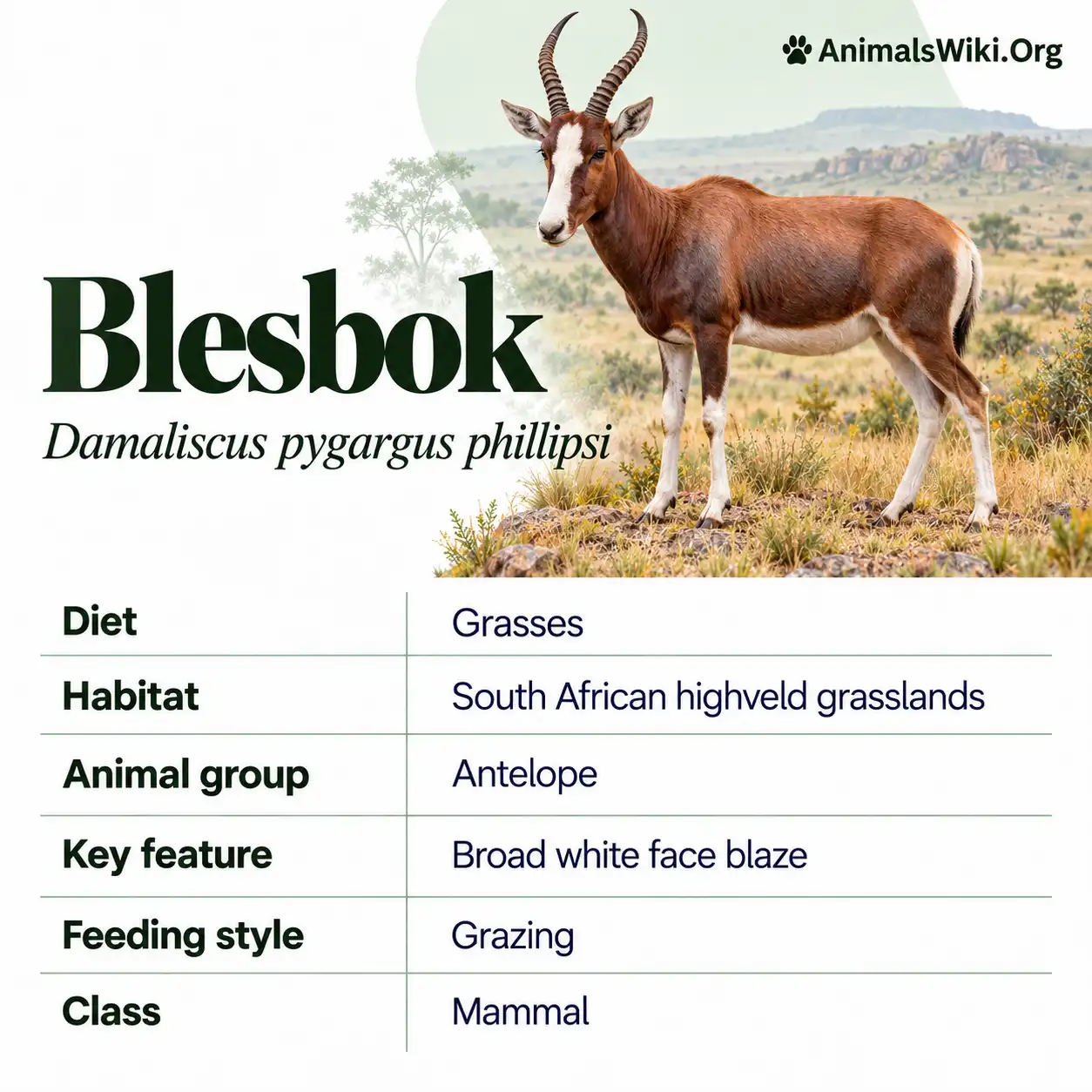
Blesbok, The White-Faced Antelope of South Africa’s Grasslands
Across an open South African grassland, a herd of brown antelopes lifts its heads almost together. Their most noticeable feature is a bright white blaze running down the face. Above it, curved horns rise in ridged arcs. These are blesbok, familiar inhabitants of southern African wildlife reserves and an important part of the region’s grassland heritage.
Their appearance may seem straightforward, but their story is anything but ordinary. Blesbok once experienced a severe decline under intense hunting pressure. Protection, management and the establishment of populations on public and private land helped them recover. Today, they provide an example of how an animal can become relatively abundant again while still requiring thoughtful conservation.
The blesbok is closely related to the bontebok, the darker antelope associated with the southwestern Cape. Their similarities have led to confusion in photographs, wildlife articles and even population summaries. However, the two have different native distributions and different conservation circumstances.
Understanding the blesbok also means understanding grassland. A seemingly simple stretch of grass is a changing environment shaped by rainfall, temperature, fire, grazing and the activities of many organisms. Blesbok respond to those changes through their feeding choices, movements and social behavior.
This guide explores their identification, classification, habitat, diet, adaptations, reproduction, predators and ecological importance. It also examines the limits of available population figures and explains why an old estimate should never be presented as a new census.
The result is a fuller picture of an antelope that deserves attention for more than its distinctive face: a selective grazer, a territorial communicator, a rapidly mobile newborn and a conservation recovery that continues to depend on healthy landscapes.
Blesbok Facts
| Feature | Information |
|---|---|
| Common name | Blesbok |
| Alternative spelling | Blesbuck |
| Scientific name used here | Damaliscus pygargus phillipsi |
| Animal group | Antelope |
| Family | Bovidae |
| Closest comparison | Bontebok, Damaliscus pygargus pygargus |
| Native geographical association | Interior southern African grasslands, especially South Africa’s Highveld |
| Typical habitat | Open grassland with suitable grazing and drinking water |
| Main diet | Grass |
| Feeding system | Ruminant herbivore |
| Approximate shoulder height | Around 85–100 centimeters |
| Commonly reported adult male weight | Approximately 65–80 kilograms |
| Commonly reported adult female weight | Approximately 55–70 kilograms |
| Horns | Present in both sexes |
| Main activity pattern | Primarily active during daylight |
| Social organization | Female groups, bachelor groups and territorial males |
| Gestation | Approximately 240 days |
| Usual offspring | One calf |
| Typical South African birth peak | November and December |
| Newborn behavior | Becomes mobile quickly and follows its mother |
| Conservation status | Least Concern in the 2025 regional assessment |
| Population trend reported regionally | Increasing, with important limitations in the age of available population data |
1. What Is a Blesbok?
The blesbok is a medium-sized antelope associated with the open grasslands of southern Africa. It belongs to Bovidae, the mammal family containing cattle, buffalo, sheep, goats and many antelopes.
Its most recognizable feature is the white facial blaze that contrasts with its brown coat. The common name comes from Afrikaans and refers to this conspicuous marking.
Blesbok are grazing animals. Their daily lives depend on finding suitable grass, obtaining water, maintaining social relationships and responding to conditions across the landscape.
Although they are sometimes described casually as deer, they are not members of the deer family. Their horns are permanent structures, unlike the antlers that most male deer grow and shed.
The blesbok’s relatives include other members of Damaliscus, while its closest familiar comparison is the bontebok.
The animal is especially interesting because it combines a successful numerical recovery with the complications of modern wildlife management. Many populations live behind fences, on land where movements, breeding opportunities and animal numbers are influenced by people.
Seeing blesbok in large numbers can therefore tell only part of the story. Their ecological role and long-term security also depend on the quality and management of the places they occupy.
2. Scientific Classification and Naming
Classification used in this article
Many conservation authorities recognize blesbok and bontebok as subspecies of Damaliscus pygargus. This article follows that treatment.
| Taxonomic level | Classification |
|---|---|
| Kingdom | Animalia |
| Phylum | Chordata |
| Class | Mammalia |
| Order | Artiodactyla |
| Family | Bovidae |
| Genus | Damaliscus |
| Species | Damaliscus pygargus |
| Blesbok subspecies | Damaliscus pygargus phillipsi |
Some sources treat the blesbok as a separate species, Damaliscus phillipsi. Older publications may use Damaliscus dorcas phillipsi.
These names do not necessarily describe different animals. They reflect changes or differences in taxonomic interpretation. Established mammal references and current South African conservation material document the subspecies treatment used here.
Why taxonomy matters when researching blesbok
A scientific name helps determine what a source is actually discussing.
A document titled Damaliscus pygargus may include both blesbok and bontebok. Another may focus on only one of them. This can affect the interpretation of measurements, geographical ranges and conservation information.
For example, a statement about the bontebok’s restricted Cape distribution should not be copied into a description of the blesbok.
The most useful approach is to check the full name, the population under discussion and the date of the source before using its information.
3. Physical Appearance and Identification
The white facial blaze
The blesbok’s face provides the easiest starting point for identification. A broad white blaze contrasts sharply with the brown head.
A narrow brown band commonly interrupts the white above the eyes. However, facial patterns vary, and a distant or poorly lit view may conceal the detail.
The blaze should therefore be considered alongside body shape, coat pattern and rump coloration.
An animal facing directly toward a viewer may appear much more strongly marked than one seen from the side. Photographs taken at different angles can make the same individual look surprisingly different.
Coat and body shape
Typical blesbok have brown bodies with lighter areas over the back and rump. The lower legs and underparts include pale or white markings.
Their overall color may look reddish, chocolate brown or muted gray-brown depending on light and coat condition.
They have an elongated face, a substantial torso and relatively slender lower limbs. The body outline changes noticeably when the head is lowered to graze.
Descriptions emphasize that male and female blesbok look broadly similar, although females usually have more slender horns.
Horns in both sexes
Both males and females carry horns. The horns have conspicuous ridges and curve as they extend upward.
Because females also have horns, their presence alone does not identify a male.
Age further complicates identification. A young male may have less substantial horns than a mature female, while an older animal may show wear.
Reliable observation involves looking at several characteristics rather than searching for one supposedly decisive feature.
4. Blesbok vs Bontebok
Blesbok and bontebok share a similar shape, white facial markings and curved horns. Their resemblance is real, but so are their differences.
| Feature | Blesbok | Bontebok |
|---|---|---|
| Scientific name used here | D. p. phillipsi | D. p. pygargus |
| Native geographical association | Interior grasslands, particularly the Highveld | Southwestern Cape lowlands |
| Typical coat impression | Brown, sometimes with a lighter saddle | Rich dark brown, often with a glossy appearance |
| Rump appearance | Generally lacks the bontebok’s broad, striking white patch | Conspicuous white patch around the rump and tail area |
| Facial pattern | White blaze, often interrupted by a brown band | White facial blaze with its own variation |
| Current conservation context | Relatively abundant; Least Concern regionally | More restricted and conservation-sensitive |
| Can appearance establish ancestry conclusively? | No | No |
The body and rump differences are useful for field identification, but there is variation within both groups. University wildlife accounts describe the contrast between the blesbok’s more subdued rump and the bontebok’s conspicuous white patch.
Why appearance is not a complete ancestry test
An animal can resemble a typical blesbok while carrying mixed ancestry.
This matters because the two forms can interbreed. Where conservation objectives involve maintaining their distinct identities, managers may need genetic evidence and breeding records.
A wildlife visitor and a conservation geneticist are answering different questions. The visitor may reasonably identify an animal from its visible features. The geneticist needs to establish relationships that cannot always be seen.
5. Native Distribution and Introduced Populations
The historical range
Blesbok are associated with the interior grasslands of southern Africa, especially the South African Highveld.
Historical accounts place them across areas including the Free State and Gauteng, with extensions into neighboring regions. They also occurred historically in western Lesotho.
This differs fundamentally from the bontebok’s southwestern Cape association.
The modern distribution
Blesbok have been moved extensively. Populations now occur on reserves and private properties both within and outside their historical range.
Introductions have occurred in countries including Namibia, Botswana, Zimbabwe and Eswatini. Presence in those places should not automatically be described as evidence of a native historical population.
The IUCN assessment distinguishes historical occurrence from introductions and records the loss of blesbok from Lesotho before 1900.
Why native and introduced ranges should remain separate
A modern distribution map can combine natural populations, reintroductions and extralimital introductions.
Those categories answer different ecological questions.
Reintroducing an animal to suitable habitat within its former range may help restore a lost ecological relationship. Establishing it outside that range can maintain animals without restoring the same historical system.
Neither label, by itself, explains the quality of management. However, keeping them separate prevents misleading claims about where the blesbok naturally belongs.
6. Habitat and the Highveld Environment
Open grassland
Blesbok are strongly associated with open grassland rather than dense woodland.
The Highveld environment includes elevated plateaus where rainfall, temperature and seasonal plant growth create changing grazing conditions.
A grassland can look uniform from a road, but the feeding opportunities within it are highly varied. Soil, drainage, slope and recent grazing all affect plant growth.
For a selective grazer, the difference between two nearby patches may be important.
Grass height and habitat quality
Blesbok generally prefer short grass. That does not mean that every closely cropped patch is good habitat.
A productive grazing area contains accessible food that can continue to grow under the prevailing conditions. A depleted patch may be short simply because too much material has been removed.
Habitat quality therefore involves both vegetation structure and nutritional opportunity.
Conservation assessments identify open plateau grasslands, short grass and drinking water as central features of blesbok habitat.
Grasslands are more than animal feeding grounds
A native grassland also contains flowering plants, invertebrates, birds and soil organisms.
Management aimed only at producing maximum grazing can overlook those other components.
The best conservation objective is a functioning grassland that supports blesbok alongside its wider biological community.
7. Blesbok Diet and Food Selection
What do blesbok eat?
Blesbok eat predominantly grass. They are selective grazers, choosing among the plants and plant parts available to them.
The phrase “eats grass” hides a complicated set of decisions. Young leaves, mature leaves and dry stems differ in their nutritional value and ease of consumption.
An animal must collect enough useful food while spending energy on walking, biting and chewing.
Changing choices across seasons
During periods of active growth, an animal may find a greater supply of green leaves. As vegetation matures or dries, obtaining an adequate diet can become more difficult.
Blesbok feeding choices can therefore change even when the same grass species remain present.
Zoo reference material lists grasses from several genera, including Themeda and Eragrostis, illustrating that the diet is not restricted to one plant. The relative importance of each depends on local availability and condition.
Why plant names alone are not enough
Knowing that an animal eats a certain grass does not establish that all growth stages of that grass are equally useful.
A mature stand may contain a large amount of plant material but relatively little of the portion the animal prefers.
This distinction helps explain why apparently lush vegetation can coexist with poor feeding conditions for a selective grazer.
8. Digestion and Rumination
How grass becomes usable energy
Blesbok are ruminants. Like other members of this feeding group, they rely on a digestive system in which microorganisms help break down plant material.
Grass contains structural substances that mammals cannot efficiently process without this microbial assistance.
Fermentation produces compounds that the animal can use, while repeated chewing helps reduce the size of swallowed material.
What rumination looks like
An animal may lie down or stand quietly while chewing in a regular pattern.
It is not necessarily collecting new food. Instead, it may be reprocessing material eaten earlier.
That quiet stage is essential to the overall feeding strategy. Grazing and digestion occupy different parts of the activity cycle.
Why digestion influences behavior
An animal cannot simply compensate for poor food by grazing without interruption.
Time, digestive capacity and the rate at which material passes through the system all matter.
This is a general principle of ruminant biology rather than a claim that a single daily feeding schedule applies to every blesbok herd.
It explains why resting animals should not be dismissed as inactive and why forage quality can matter as much as the visible quantity of vegetation.
9. Water Requirements
Drinking water is important habitat
Blesbok require regular access to water.
Their association with open grassland should not be confused with the extreme water independence of some desert-adapted mammals.
Water availability can influence where animals feed, how they travel and which parts of a property remain usable during dry conditions.
Marwell’s observations describe blesbok traveling toward watering points and emphasize their need for regular water access.
The relationship between water and grazing
Grass and water must be considered together.
A distant feeding patch may contain attractive vegetation but require additional travel. Conversely, a reliable water source surrounded by heavily depleted grazing may not provide a satisfactory long-term solution.
The animal’s usable environment is the combination of resources it can reach, not simply the total number of hectares inside a fence.
Water points can reshape a landscape
Where animals repeatedly gather, trampling and grazing pressure can become concentrated.
This does not make water provision inherently harmful. It means that placement and maintenance have ecological consequences.
For a reserve manager, useful questions include whether animals can reach water safely, whether surrounding vegetation is deteriorating and whether the distribution of water is encouraging an uneven use of habitat.
10. Adaptations to Open Grassland
Movement across open terrain
The blesbok’s limbs and hooves support travel over open ground.
Movement links feeding areas, water and social encounters. It also allows an animal to leave a disturbed location.
The ability to move matters even in fenced populations, although the available choices are constrained by property boundaries.
Grazing and awareness
Feeding near ground level limits the view available at that moment. Raising the head allows the animal to check its surroundings.
In a group, different individuals may be attentive at different times. Their movements can provide information to nearby animals.
This does not guarantee protection, but it changes how danger is detected and communicated.
Horns and social competition
Horns function in interactions among blesbok as well as in potential defense.
They are part of the animal’s social equipment, especially when males challenge one another.
A curved, ridged horn is therefore more than an identifying feature in a field guide. It belongs to a broader system of displays, assessment and occasional physical conflict.
No single adaptation explains the blesbok’s success. Its feeding system, movement, reproduction and social behavior operate together.
11. Daily Activity and Seasonal Movement
A primarily daytime animal
Blesbok are mainly active during daylight. Feeding often occupies substantial parts of the morning and afternoon.
During other periods, they rest, ruminate or engage in social activity.
Temperature, weather, food conditions and reproductive state can all influence the daily pattern.
An animal observed resting at midday should not be described as lazy or inactive. It is occupying one stage of a complete activity cycle.
Movement toward changing resources
Where space permits, blesbok can shift their use of the landscape as feeding conditions change.
However, movement within a modern reserve should not automatically be described as a long-distance migration.
A fenced population may repeatedly travel among a small set of feeding areas without having access to the larger seasonal movements available in an unfenced landscape.
Why local conditions matter
A herd on a large grassland reserve may behave differently from one on a small property.
The difference may reflect available choices rather than an inherent difference between the animals.
When interpreting behavior, it is useful to ask what alternatives the animals actually have. A repeated route can reflect the location of water, gates, fences or preferred grass rather than a universal species rule.
12. Herds and Social Organization
Different social groupings
Blesbok social organization includes groups of females and young, bachelor groups and territorial males.
These are recurring patterns, not permanently sealed categories.
Young animals develop within one social setting and may later enter another. Group membership can change with age, season and circumstances.
Herd size is variable
There is no single correct herd size for every blesbok population.
A large gathering on attractive grazing may contain several social units. A smaller group may be separated from other animals only temporarily.
Local density, habitat distribution and available space influence what observers see.
Statements that blesbok always live in one exact number are therefore less useful than descriptions of the factors shaping group formation.
Benefits and costs of living together
Association provides social contact and access to information, but it also creates competition.
Preferred feeding areas may become crowded. Individuals may need to alter their position or move to another patch.
This balance makes herd behavior dynamic. The same animals can spread widely while grazing and draw together after a disturbance.
Understanding the group requires watching both the animals and the resources around them.
13. Territorial Behavior and Communication
What a male territory represents
Territorial males defend areas that can provide opportunities to encounter females.
The value of a territory is linked to its location and use by other animals. Suitable grazing and the movement of females can make one area more attractive than another.
Holding it requires effort. Monitoring rivals and responding to intrusions take time that could otherwise be spent feeding or resting.
Scent and visual displays
Descriptions of blesbok territorial behavior include scent marking, dung concentrations, pawing and conspicuous displays.
Preorbital glands near the eyes contribute secretions used in marking behavior. Detailed mammal accounts also describe transferring glandular material through contact with vegetation and the horns.
Such behavior creates information in the environment. A territory is communicated through repeated activity, not merely occupied.
Why a dung heap is biologically interesting
A concentrated deposit can have both behavioral and ecological significance.
It may be associated with the animal’s repeated use of a location, while also changing nutrient inputs to the soil.
Researchers have even investigated associations between blesbok dung middens and the remains of termite mounds at a particular reserve. That finding illustrates the value of close observation without proving that all blesbok middens occur on termite mounds.
14. Reproduction and Breeding Seasons
Seasonal reproduction
In South Africa, blesbok commonly show a breeding season during the southern autumn.
Rutting is often described from March to May, with births peaking in November and December after approximately 240 days of gestation.
Females usually produce one calf.
These periods describe a general pattern, not an unchanging timetable for every population or individual. Local conditions and management can influence reproductive timing.
Courtship and female movements
The territorial system affects which males encounter receptive females.
Courtship includes assessing reproductive condition, attempts to retain females within a territory and behavior immediately preceding mating.
A published courtship study separated these activities into reproductive testing, herding and precopulatory responses. That framework helps show why courtship is a sequence of interactions rather than one isolated event.
Reproduction has energetic costs
Pregnancy and milk production require resources.
A female must obtain enough nutrition to maintain herself while supporting her young. Consequently, reproductive success involves food conditions as well as access to mates.
A population producing many calves is not automatically secure. The survival and development of those calves also matter.
15. Calves and Maternal Care
A rapidly mobile newborn
Blesbok calves become mobile soon after birth and follow their mothers.
Zoo observations report calves following within approximately half an hour. This should be understood as rapid early development, not a guarantee that every newborn meets an exact stopwatch-based deadline.
The important biological distinction is the follower strategy.
Unlike antelopes whose young remain concealed for long periods, blesbok calves quickly begin accompanying the mother.
Early appearance
Calves have a lighter, less strongly patterned appearance than adults.
Their adult coloration and horns develop progressively. A newborn can therefore look quite different from the conspicuously white-faced animals nearby.
This change is another reason to use caution when identifying young antelopes from a single photograph.
Milk, grazing and independence
Milk supports the calf’s early growth. Grazing becomes increasingly important as development proceeds.
Weaning is a transition rather than a sudden transformation from dependence to complete independence.
Published husbandry references place weaning within the first several months, but schedules vary. The relationship between calf and mother also includes proximity, recognition and movement, not only nursing.
Early mobility helps a calf remain with its mother, but young animals still have limited endurance and experience.
16. Lifespan and Survival
How long do blesbok live?
General references commonly report longevity reaching approximately 17 years.
Other sources list longer captive longevity. The AnAge database records a maximum of 23 years for Damaliscus pygargus, but that entry is at species level and should not be treated as a measured average for wild blesbok.
The distinction matters: maximum recorded age, potential lifespan and average survival are different quantities.
Factors affecting survival
An animal’s prospects depend on food, water, disease, injury, age and local environmental conditions.
Predators may be important at some sites and absent from others.
A young calf faces different challenges from a mature female or an older territorial male. Survival cannot be understood through one universal risk.
Why age structure matters
A herd containing many adults may look healthy, but its future depends partly on recruitment.
If too few young survive, a decline may become apparent only after several years.
Conversely, a temporary increase in numbers can place additional demands on grazing.
Good monitoring therefore examines the composition and condition of a population, not simply its total size on one day.
17. Predators and Defensive Responses
Predators of blesbok
Blesbok can form part of the prey base for large African carnivores where they coexist.
Cheetahs are a well-documented example. A comparative study of cheetah prey preferences identified blesbok among preferred prey, although local diets vary with prey availability and other conditions.
Predator lists should remain specific to place and time. Many present-day populations live in reserves or ranches without a complete large-carnivore community.
Detection and escape
An alert animal may stop feeding, raise its head and orient toward a disturbance.
Other animals can respond to that change, producing a group reaction.
Movement away from danger is only the visible outcome of an earlier assessment. Distance, cover and previous experience can affect whether an animal remains watchful or leaves.
The wider food web
A predator’s kill can provide food for scavengers.
Research in Shamwari recorded brown hyenas obtaining blesbok carcasses through scavenging from cheetah kills. This illustrates how one prey animal can support several consumers through different routes.
It also shows why observing an animal feeding on a carcass does not necessarily prove that it killed the prey.
18. Ecological Importance
Selective grazing changes vegetation
Blesbok interact with grassland through repeated feeding.
Removing some leaves while leaving other material behind can alter the competitive environment for plants.
The outcome depends on intensity, timing, rainfall and the characteristics of the vegetation. Grazing is neither automatically beneficial nor automatically destructive.
Nutrient cycling
Like other herbivores, blesbok return nutrients through dung and urine.
These inputs help connect plant consumption with soil processes and decomposer activity.
The effects are uneven because animals do not distribute themselves uniformly. Repeated use of certain sites can produce concentrated inputs.
Supporting other organisms
Dung becomes a resource for insects and microorganisms. Carcasses provide food for scavengers. Grazing can alter vegetation structure in ways that affect smaller animals.
These are general ecological pathways. Their exact strength within a particular blesbok population requires local evidence.
Why ecological context matters
An introduced herd may consume grass and produce dung while still occupying a different ecological setting from the one in which the animal evolved.
Counting functions alone does not establish that every introduction is appropriate.
The relevant question is how the animal fits into the receiving ecosystem and the conservation objectives of that site.
19. Fire, Grazing Lawns and Vegetation
Fire changes feeding opportunities
Fire removes standing material and can be followed by new growth when conditions permit.
This can attract grazers, including blesbok.
However, a burned area is not automatically rich in food. The timing of rain and the ability of plants to recover remain important.
What is a grazing lawn?
A grazing lawn is a patch dominated by short, grazing-tolerant plants maintained partly through repeated herbivore use.
It is not necessarily evidence of degradation.
Research in Mountain Zebra National Park examined lawns used by blesbok and other short-grass grazers. Some remained compositionally stable over more than 20 years, while excluding large herbivores allowed taller grasses to replace creeping species.
Grazing lawns and overgrazing are different
A healthy lawn contains plants adapted to repeated grazing and can remain productive.
A degraded patch may show loss of cover, erosion or declining plant condition.
Both can look short from a distance. Distinguishing them requires examining the vegetation and soil rather than judging grass height alone.
Managing variation
Uniform management can reduce the range of habitat conditions.
Research on South African highland grasslands has examined how fire frequency and grazing intensity combine to influence vegetation structure and plant diversity.
The practical lesson is that management should consider those processes together. A fire plan designed without regard to grazing, or a stocking decision made without regard to vegetation recovery, can miss important interactions.
20. Historical Decline and Recovery
A severe nineteenth-century decline
Blesbok were heavily hunted during the nineteenth century.
Historical syntheses describe a reduction to roughly 2,000 animals in South Africa by the late 1800s.
That figure is an estimate from historical accounts, not a census conducted with modern survey methods.
Its value lies in indicating the scale of the decline rather than providing a perfectly precise number.
Protection and population rebuilding
Protection and the maintenance of populations on public and private land helped blesbok recover.
The recovery involved retaining breeding animals, reducing losses and providing places where populations could increase.
It also involved moving animals, which contributed to the modern distribution.
What recovery means
Recovery can be measured in several ways.
An increase in total numbers is one important achievement. Restoring populations within their native range is another. Maintaining ecological processes and genetic diversity adds further dimensions.
These goals overlap, but they are not identical.
A lesson from a relatively common antelope
The blesbok’s history shows that abundance can change dramatically.
An animal familiar today may have passed through a period of serious vulnerability.
Its current status should be understood as an outcome supported by continuing land management, rather than proof that conservation is unnecessary.
21. Population Estimates and Conservation Status
The 2025 regional assessment
The 2025 regional assessment lists blesbok as Least Concern, with an Increasing population trend.
However, it also states that recent data were not robust enough to replace the population totals used in the 2016 assessment.
A recent assessment date therefore does not make every number within it a recent census.
Dated population figures
| Data period | Figure | Meaning |
|---|---|---|
| Counts from 2010–2016 | At least 77,751 animals | Recorded total across 678 protected areas and wildlife ranches |
| Same assessment framework | Approximately 54,426 mature individuals | Estimate obtained by applying a 70% mature population proportion |
| Counts from 2013–2016 | At least 17,235 animals | Animals recorded in formally protected areas |
| 2025 regional assessment | Least Concern | Conservation category; not a replacement nationwide census |
These figures are overlapping descriptions, not totals to add together.
The mature estimate is calculated from an assumed age structure. It should not be described as though every adult was separately counted.
Why other sources give much larger numbers
An older estimate from 1999 placed the population at approximately 235,000–240,000 animals.
Differences in coverage and estimation mean this cannot simply be compared with later recorded totals to calculate a population crash.
The newer assessment itself cautions about the older estimate and acknowledges incomplete knowledge of private populations.
An inconsistency worth retaining as uncertainty
The assessment page also retains a separate mature-population figure of 47,633 from earlier material.
Because that differs from the 54,426 calculation in its rationale, neither should be presented as a uniquely definitive modern total.
What Least Concern means
Least Concern indicates that the assessed taxon does not meet the thresholds for a threatened category under that assessment.
It does not mean every herd is secure or every management practice is appropriate.
The category is compatible with local problems and ongoing monitoring.
22. Genetics, Hybridization and Color Variants
Genetic diversity within blesbok
A 2024 molecular study found greater diversity in its blesbok samples than in the bontebok samples it examined.
This is an informative comparison, but it does not establish the genetic condition of every herd.
Sampling covers particular animals and locations. A widespread population can contain well-connected groups alongside isolated ones with fewer breeding options.
Hybridization with bontebok
Blesbok and bontebok can interbreed.
Where management aims to preserve their distinct conservation identities, unintended mixing is a concern.
Genetic evidence can reveal relationships that visible markings do not reliably establish. Research on their hybridization has therefore used molecular approaches rather than relying exclusively on appearance.
Unusual coat colors
Managed blesbok populations include selected color variants.
An unusual color does not automatically make an animal a separate species, nor does it establish that the animal is albino.
Different genetic changes can affect pigmentation in different ways.
Conservation and selective breeding
Breeding mainly for appearance can change which animals contribute to future generations.
If too few breeders are repeatedly selected, genetic diversity may decline. However, that is a management risk to evaluate, not proof that every color-variant herd has the same problem.
South African biodiversity assessments identify intensive selection for variants as an issue requiring genetic scrutiny. Conservation objectives should be explicit about whether the priority is appearance, production or maintenance of a representative wildlife population.
23. Protected Areas and Private Land
Different contributions
Public reserves and private properties both contribute to the modern blesbok population.
Their roles vary. Some protect native grassland and ecological relationships. Others maintain managed wildlife populations within broader land-use systems.
The conservation value of a property depends on its habitat, management and contribution to long-term objectives.
Fences create practical constraints
A fence can help manage animals while limiting their movement.
It may prevent access to alternative grazing or block natural exchange among populations.
Where populations are separated, transfers can partly replace movement that would otherwise occur naturally. Such transfers also require care concerning ancestry, health and suitability.
Larger connected management units
Cooperation among neighboring properties can create opportunities to manage wildlife across a broader landscape.
Research on southern African conservancies highlights the potential value of coordinated land management while also identifying complications such as introductions outside historical distributions.
Numbers are only one measure
A property holding many blesbok is not automatically contributing more than one holding fewer.
A smaller population within healthy native habitat may serve different goals from a larger, intensively managed herd.
Useful evaluation asks what the population contributes and whether its management is sustainable.
24. Threats and Conservation Priorities
Habitat condition
Blesbok remain dependent on suitable grassland.
Local habitat deterioration can affect animals even when the wider population is abundant.
Overstocking, erosion and changes in vegetation can reduce feeding opportunities. Detecting these problems requires observing the land as well as the animals.
Hybridization and uncertain records
Mixing blesbok and bontebok can complicate conservation management.
Incomplete transfer and breeding records make the problem harder to assess.
Maintaining accurate records is therefore a practical conservation action, even though it attracts less attention than establishing a new reserve.
Isolation
Small, fenced herds may have limited breeding options.
Their long-term management can require coordination with other populations.
A successful transfer should have a defined purpose rather than simply adding animals to a property.
Changing environmental conditions
Drought can affect food and water. Longer-term changes may alter the suitability of particular sites.
The scale of future effects remains uncertain, and it would be misleading to claim a precisely measured climate-driven blesbok decline without evidence.
Planning can still account for risk by maintaining habitat quality and management flexibility.
Monitoring priorities
Useful information includes births, deaths, age structure, body condition, breeding history and vegetation trends.
No single measure is sufficient.
A stable head count can conceal weak recruitment, while increasing numbers can conceal growing pressure on habitat.
Conservation succeeds when monitoring leads to informed decisions before a crisis develops.
25. Observing Blesbok Responsibly
Watch a sequence rather than a pose
Blesbok become more interesting when observed over time.
Notice how a feeding group spreads across a patch, how individuals respond when one raises its head and whether a male repeatedly returns to a particular location.
Such observations reveal the relationship between resources and social behavior.
Keep an appropriate distance
A blesbok accustomed to vehicles remains a wild animal.
Approaching closely can interrupt feeding or alter interactions.
Use binoculars or a longer camera lens, and follow the rules of the reserve.
Do not feed them
Human food is not a substitute for the animal’s normal diet.
Feeding can also encourage approaches to people and vehicles.
Allowing wildlife to obtain natural food helps preserve normal behavior.
Use accurate captions
When publishing photographs, distinguish blesbok from bontebok carefully.
A useful caption identifies the animal and location when known. It should not attach an unsupported population estimate or claim that a visible color pattern proves ancestry.
Accurate images and captions help readers learn identification while avoiding the spread of familiar mistakes.
26. Frequently Asked Questions About Blesbok
What is a blesbok?
A blesbok is a grazing antelope associated with southern African grasslands, especially South Africa’s Highveld. It has a brown body, a conspicuous white facial blaze and curved horns in both sexes. Many conservation authorities classify it as Damaliscus pygargus phillipsi, a close relative of the bontebok.
What does the name blesbok mean?
The name comes from Afrikaans and refers to the animal’s white facial blaze. That marking is one of its most recognizable characteristics. However, the blaze should be considered alongside the coat, rump and body shape because other antelopes, particularly bontebok, also have prominent white facial markings.
Where do blesbok live naturally?
Their native geographical association is with interior southern African grasslands, particularly the Highveld. Historical populations occurred across parts of South Africa and western Lesotho. Their present distribution is broader because people have moved them to additional reserves, ranches and countries outside the historical range.
Are blesbok native to Namibia?
Modern blesbok occur on properties in Namibia, but conservation accounts describe these populations as introductions outside their historical range. An animal’s presence in a country does not automatically establish native status. Historical distribution and modern managed occurrence should be discussed separately.
Are blesbok and bontebok the same?
They are closely related but represent distinct recognized conservation units. Many sources treat them as subspecies of Damaliscus pygargus. Blesbok are associated with interior grasslands, while bontebok belong to the southwestern Cape lowlands. Their population histories and current conservation situations also differ.
How do you distinguish blesbok from bontebok?
Typical bontebok have a more conspicuous white rump patch and a darker, glossier appearance. Blesbok usually have a less strongly contrasting rump and may show a brown band interrupting the facial blaze. Individual variation means that several features should be considered together.
Can blesbok breed with bontebok?
Yes. They can interbreed, which creates a management concern where conservation programs seek to maintain their distinct identities. Physical appearance may not reveal mixed ancestry. Managers can therefore need genetic evidence and reliable breeding records when deciding which animals to include in particular populations.
What do blesbok eat?
Blesbok eat predominantly grass. Their choices depend on the species present, the growth stage and the availability of accessible leaves. They are selective grazers rather than animals that consume every plant equally. Feeding conditions can change considerably between seasons even within the same grassland.
Why do blesbok prefer short grass?
Short vegetation can provide accessible feeding opportunities, especially when it contains young leaves or grazing-tolerant grasses. However, short grass is not always good grass. A depleted patch may offer little food. Nutritional quality, plant cover and the capacity for regrowth also matter.
Do blesbok need drinking water?
Yes. Regular access to water is an important habitat requirement. Water affects the feeding areas that animals can use and the routes they travel. A property containing grass may still provide unsuitable conditions if reliable drinking water is unavailable or difficult to reach.
Do female blesbok have horns?
Yes. Both males and females carry horns. Female horns are generally more slender, but age and individual variation can make sex difficult to judge from horns alone. A distant photograph may not provide enough information for a confident identification of an animal’s sex.
How big is a blesbok?
Common reference ranges place shoulder height around 85–100 centimeters. Adult males are often reported at approximately 65–80 kilograms and females at around 55–70 kilograms. These are approximate ranges rather than universal limits. Measurements vary among sources and individual animals.
Are blesbok deer?
No. Blesbok belong to Bovidae, the family containing cattle and many antelopes. Deer belong to Cervidae. One useful distinction is that blesbok have permanent horns, while most male deer grow and shed antlers. Their similar grazing habits do not make them members of the same family.
Are blesbok active at night?
They are primarily daytime animals, with grazing often prominent during the morning and afternoon. That does not establish complete inactivity throughout every night. Weather, disturbance and local conditions can influence behavior. A general activity pattern should not be interpreted as an absolute rule.
Do blesbok migrate?
They can shift their movements in response to changing resources where space permits. However, many modern populations live behind fences. Movement among feeding patches within a reserve should not automatically be called a long-distance migration. The available landscape determines how far animals can travel.
How many blesbok live in a herd?
Herd size varies. Female groups, bachelor groups and temporary feeding aggregations can all occur. Habitat, season, density and management influence the number seen together. A large gathering may contain several social units, so there is no single herd size that describes every population.
Are male blesbok territorial?
Adult males can defend territories and use displays, scent marking and other behaviors in their interactions. Holding a territory requires time and energy. Its value depends partly on the resources it contains and the opportunities it provides to encounter females moving through the landscape.
When do blesbok breed?
In South Africa, rutting is commonly described from March to May. Births often peak in November and December. These dates describe seasonal tendencies rather than fixed requirements. Individual animals and populations can vary, particularly under different environmental or managed conditions.
How long is a blesbok pregnant?
Pregnancy lasts approximately 240 days, or about eight months. Females usually produce one calf. This substantial investment continues after birth through milk production and maternal association. Successful reproduction therefore depends on adequate nutrition as well as access to a mate.
Do blesbok calves hide in grass?
Blesbok generally follow a follower strategy. Calves become mobile quickly and accompany their mothers rather than remaining concealed for prolonged periods. Young animals may still rest in vegetation. The distinction concerns their overall early-life strategy, not a claim that a calf never lies down out of sight.
How quickly can a calf walk?
Observations describe calves standing and following their mothers within a short period, sometimes around half an hour. The exact timing varies. Rapid mobility helps maintain contact, but it does not give a newborn adult endurance. Calves remain dependent on maternal care and access to milk.
How long do blesbok live?
General references often give potential longevity of about 17 years. Longer captive records exist within the broader Damaliscus pygargus literature. Neither figure should be presented as average wild lifespan. Maximum age, captive longevity and average survival measure different aspects of an animal’s life history.
What predators hunt blesbok?
Cheetahs are a documented predator, and other large carnivores may prey on blesbok where they coexist. The answer depends on the reserve. Many managed populations do not live with a full large-predator community. A general predator list should therefore not be applied to every herd.
Are blesbok endangered?
The 2025 regional assessment lists them as Least Concern. That differs from the conservation situation of the bontebok. Least Concern does not mean that every population is free from problems. Habitat condition, ancestry, isolation and local management can still require attention.
How many blesbok are there?
The 2025 regional assessment retains recorded totals from 2010–2016 because newer information was insufficient for a robust replacement estimate. Its rationale reports at least 77,751 animals across surveyed protected areas and ranches. That is a dated recorded total, not a verified census for the present year.
Are white blesbok a separate species?
No separate species is established simply because an animal has an unusual coat color. White and other selected variants occur in managed populations. Their precise genetic basis requires evidence, and white coloration should not automatically be called albinism without examining the underlying pigmentation characteristics.
Why are blesbok important to grasslands?
They consume vegetation, redistribute nutrients and interact with plants and other animals. In some settings, their grazing helps maintain short-grass patches used by multiple species. The outcome depends on local conditions and grazing pressure. Their ecological importance is best understood within the wider grassland community.
Is the blesbok a conservation success story?
Yes. Its recovery after a severe historical decline is a significant achievement. However, success requires continued habitat care and population management. Increasing numbers, maintaining genetic diversity and restoring ecological relationships are related goals, but progress in one does not automatically complete the others.
Blesbok (Damaliscus pygargus phillipsi)
The blesbok is a distinctive part of southern Africa’s grassland wildlife. Its white face makes it easy to notice, while its feeding choices, social organization and reproductive behavior reward closer observation.
It is a selective grazer whose needs extend beyond the presence of grass. Suitable food, drinking water, space and functioning habitat all contribute to a healthy population. Territorial males communicate through repeated displays and marking, while newborn calves quickly begin following their mothers.
Its historical recovery remains an important conservation achievement. Yet the modern picture includes fenced populations, introduced herds, ancestry questions and population estimates that are older than the assessments quoting them.
A clear account therefore distinguishes blesbok from bontebok, historical range from modern occurrence and recorded totals from present-day census claims.
The strongest future for the blesbok involves healthy grasslands and well-managed populations that retain their biological identity and ecological role. Protecting those conditions preserves more than a familiar antelope. It supports the wider living landscape of which the blesbok is a part.



