
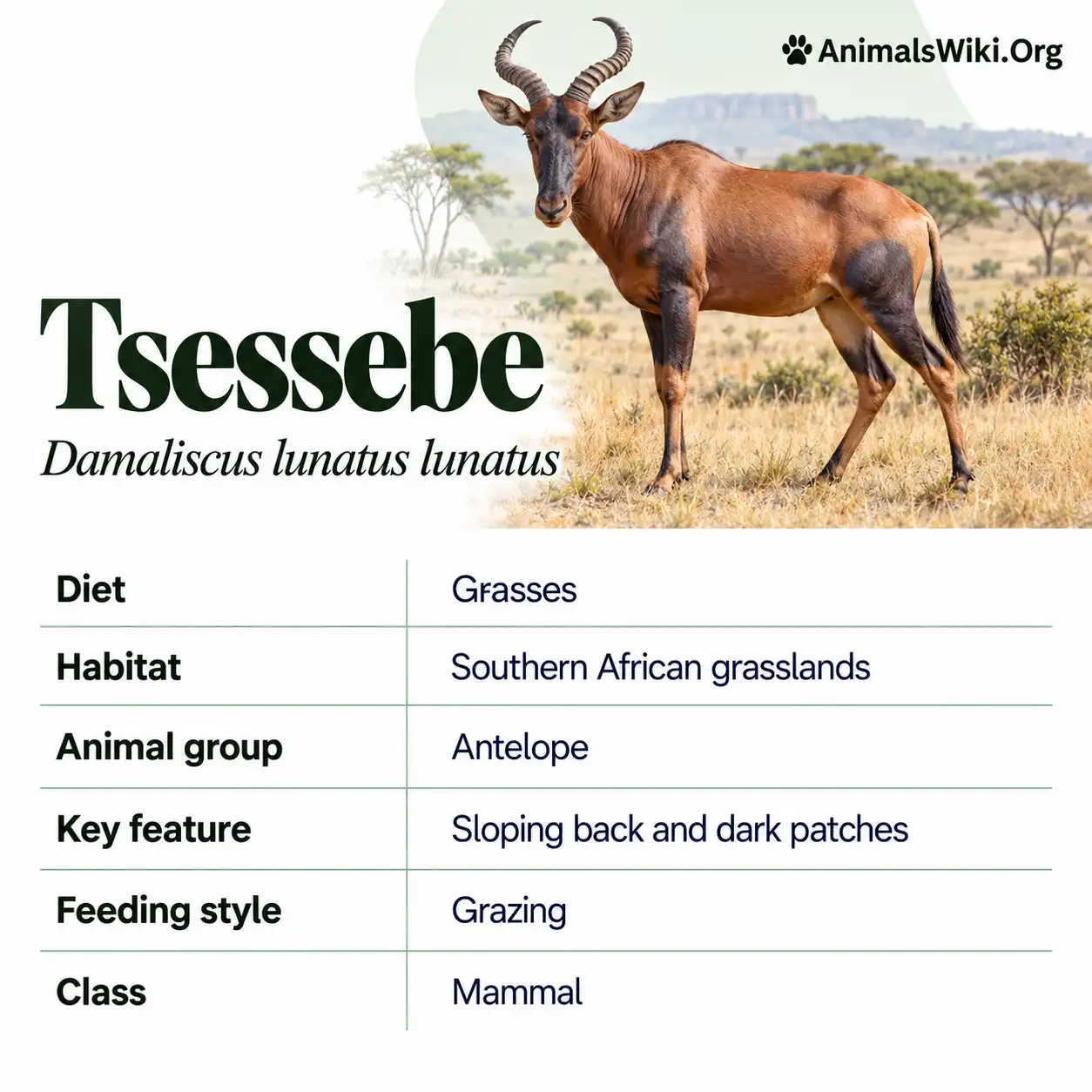
Tsessebe, A Complete Guide to Africa’s Swift Savanna Antelope
A tsessebe standing on a termite mound can look almost sculpted into the landscape. Its shoulders rise above its hindquarters, its long face points toward the grassland, and its reddish-brown coat catches the light with an unexpected purplish sheen. When it runs, that unusual outline becomes a picture of speed and control.
Yet there is much more to this antelope than its reputation as a fast runner. The tsessebe is a selective grazer, a territorial animal, and a revealing example of how grass quality, rainfall, predators, and land management interact.
It also presents a naming challenge. Depending on the classification used, “tsessebe” may refer specifically to the southern African form or appear within a broader species that includes topi, tiang, korrigum, and related populations. The Mammal Diversity Database currently groups these forms within Damaliscus lunatus, while other authorities have recognized narrower species boundaries.
This article focuses primarily on the southern or common tsessebe, often called Damaliscus lunatus lunatus. Broader comparisons are identified clearly so that information about East African topi is not automatically presented as a fact about southern tsessebe.
That distinction matters for conservation as well as naming. An antelope can belong to a widespread species complex while remaining rare or threatened within a particular region.
From its distinctive appearance to the challenges of managing its habitat, the tsessebe offers an engaging introduction to the complexity of African grassland wildlife.
Tsessebe Facts
| Feature | Information |
|---|---|
| Common name | Tsessebe |
| Other names | Common tsessebe, southern tsessebe, sassaby |
| Broad scientific name | Damaliscus lunatus |
| Southern subspecies name | Damaliscus lunatus lunatus |
| Family | Bovidae |
| Tribe | Alcelaphini |
| Animal type | Herbivorous antelope |
| General appearance | Reddish-brown coat, darker markings, long face, sloping back |
| Horns | Present in both sexes |
| Approximate shoulder height | Roughly 1.1–1.3 meters |
| Approximate adult mass | Commonly around 120–160 kilograms, varying by sex and population |
| Main food | Grasses, especially selected leaves and fresh growth |
| Social organization | Breeding groups, territorial males, and bachelor groups |
| Typical pregnancy | Approximately eight months |
| Young | Usually one calf |
| General longevity reference | Around 15 years; individual survival varies |
| Broad global status | Least Concern under the inclusive species treatment |
| Regional concern | Southern tsessebe were assessed as Vulnerable in the 2016 South African regional assessment |
What Is a Tsessebe?
A tsessebe is an African antelope belonging to the cattle family, Bovidae. Within that family, it is associated with the alcelaphine antelopes, a group that also includes hartebeest and wildebeest.
These animals share recognizable features, including relatively long faces and bodies built for movement across open landscapes. However, the tsessebe has its own distinctive combination of coloration, horn shape, proportions, and behavior.
The name “sassaby” appears in older books and some modern accounts. It refers to the same familiar southern African antelope rather than a separate species that must be added to the wildlife list.
A Specialist Within a Varied Landscape
The tsessebe may occupy a landscape containing woodland, but its feeding opportunities depend heavily on grass.
This helps explain why a reserve can appear green and extensive while providing limited suitable habitat. Trees, coarse vegetation, or dense shrubs may dominate much of the area, leaving only scattered places where the animal can feed effectively.
A tsessebe’s habitat therefore needs to be understood at the level of usable resources. The presence of vegetation alone says little about whether that vegetation supplies the right food at the most difficult time of year.
Why It Deserves Attention
Lions, elephants, and giraffes often dominate discussions of African wildlife. Tsessebe reveal another side of conservation: the needs of less conspicuous species can differ substantially from those of more abundant animals.
Maintaining a diverse savanna means making room for such differences.
Scientific Classification
The tsessebe belongs to the genus Damaliscus, which also contains the blesbok–bontebok group.
Taxonomic references differ in some higher-level arrangements. For example, some place alcelaphine antelopes in the subfamily Alcelaphinae, while the Mammal Diversity Database uses a broader Antilopinae containing the tribe Alcelaphini.
| Taxonomic rank | Classification |
|---|---|
| Kingdom | Animalia |
| Phylum | Chordata |
| Class | Mammalia |
| Order | Artiodactyla |
| Family | Bovidae |
| Subfamily treatment | Alcelaphinae in many references; Antilopinae in the Mammal Diversity Database |
| Tribe | Alcelaphini |
| Genus | Damaliscus |
| Broad species | Damaliscus lunatus |
| Southern form | Damaliscus lunatus lunatus |
| Species authority | Burchell, 1824 |
The Mammal Diversity Database documents the original name, Antilope lunata, and the subsequent classification within Damaliscus.
What the Scientific Name Tells Us
A three-part name identifies a subspecies within a species. Thus, Damaliscus lunatus lunatus describes the southern nominate form under a classification that recognizes subspecies.
If an authority treats that form as a separate species, the two-part name Damaliscus lunatus may have a narrower meaning.
Consequently, two sources can use the same two words while discussing different geographical scopes. Checking the animals included is more informative than comparing names alone.
Tsessebe, Topi, and Disputed Species Boundaries
The relationship between tsessebe and topi is one of the most important points to understand before comparing facts or population figures.
The Broad Species Approach
An inclusive treatment groups several geographically separated forms within Damaliscus lunatus.
Names associated with this complex include southern tsessebe, Bangweulu tsessebe, topi, coastal topi, tiang, and korrigum. Some classifications recognize additional divisions.
Under this approach, these animals belong to one species with geographical variation.
The Split Approach
Other taxonomists recognize several of these forms as separate species. The Bangweulu tsessebe, for example, was described as Damaliscus superstes and remains recognized under that name by some authorities, including the treatment reflected in ITIS.
These disagreements concern how differences between populations should be interpreted, including anatomy, geographical separation, and the criteria used to define species.
What Should Readers Conclude?
There is no need to choose a classification casually or portray an alternative as inherently unscientific.
Instead, descriptions should specify their scope.
| Term | Common geographical association | Important caution |
|---|---|---|
| Southern or common tsessebe | Southern Africa | Main focus of this article |
| Bangweulu tsessebe | Bangweulu region of Zambia | Treated as a subspecies or separate species |
| Topi | Mainly eastern Africa | Often has its own ecological literature |
| Tiang | Parts of north-central and northeastern Africa | Migration and population information are not automatically transferable |
| Korrigum | Western and central African populations | Conservation circumstances differ from southern tsessebe |
An account of topi breeding arenas in East Africa should therefore not be used as proof that every southern tsessebe population behaves identically.
Appearance and Identification
The tsessebe has a long face, relatively high shoulders, and lower hindquarters. This produces its characteristic backward-sloping profile.
Its coat is generally reddish-brown to dark brown. In favorable light, it can show a glossy purple or bluish cast. Darker areas occur on the face, shoulders, and upper legs, while lower parts of the legs are lighter.
South African National Parks describes these markings, the black tail tassel, and the ringed horns carried by both sexes.
Males and Females
Males are generally heavier and may appear darker than females, but the sexes resemble each other sufficiently that a distant view can be misleading.
Body size alone is especially unreliable when animals stand at different distances. Age, posture, and condition also influence apparent proportions.
The clearest identification usually comes from several features considered together.
Horn Shape
Tsessebe horns are ridged through much of their length and curve into a broadly lyre-like outline.
Horn shape changes with development and can be altered by damage. A photograph of only the horns is therefore less informative than one showing the face and body as well.
The Sloping Back
The animal’s proportions sometimes lead people to describe it as awkward-looking. That impression disappears when it moves.
Its structure is functional rather than ungainly: the body supports efficient movement, grazing, and rapid escape. Human judgments about elegance do not describe an animal’s performance.
Identifying Calves
Calves lack the fully developed appearance of adults. Their smaller bodies, immature horns, and dependence on nearby females provide useful clues.
A wildlife identification guide should therefore include young animals rather than showing only mature males.
Comparisons With Similar Antelopes
The tsessebe can be confused with other long-faced, grass-eating antelopes, particularly when seen briefly.
| Animal | Helpful identifying features | Difference from southern tsessebe |
|---|---|---|
| Southern tsessebe | Dark reddish coat, sloping back, dark patches, curved horns | Reference animal |
| Topi | Similar general outline; geographically variable markings | Location and taxonomic treatment are essential |
| Red hartebeest | Very elongated face and distinctive angular horn arrangement | Head and horns usually create a different silhouette |
| Blue wildebeest | Heavy forequarters, broad muzzle, mane, differently shaped horns | More robust head and strongly contrasting outline |
| Blesbok | Conspicuous white facial blaze | White face is an immediate distinction |
| Bontebok | Bold white markings and different body pattern | More sharply contrasting coloration |
Tsessebe Versus Hartebeest
Both have long faces and higher shoulders, but horn configuration and head shape help separate them.
A hartebeest’s head often looks more elongated, and its horns usually create a more angular arrangement.
Identification should still account for local species and subspecies rather than relying on a generic image of “hartebeest.”
Tsessebe Versus Wildebeest
Wildebeest generally look heavier through the head and forequarters. Their mane, broad muzzle, and horn spread give them a different appearance.
The similarity lies mainly in their wider evolutionary group and adaptation to grazing, rather than in identical body form.
Why Location Matters
A photograph labeled “tsessebe” from an East African migration may actually show topi or another form within the broader complex.
For educational publishing, the location and original identification should be checked before choosing an image.
Distribution and Range
Southern tsessebe occur in parts of southern Africa, with populations associated with countries including Botswana, Namibia, Zambia, Zimbabwe, Angola, and South Africa.
Their distribution is uneven. They occupy suitable areas within countries rather than spreading continuously across national territories.
The Dutch government’s species account describes a southern and south-central African distribution and emphasizes grasslands adjoining woodland.
Historical Range Versus Present Range
A historical range map can include places where the animal no longer occurs. Conversely, a modern map may contain reintroduced populations or animals established outside the best-supported natural range.
These are different kinds of occurrence.
A useful distribution map should identify whether it shows historical presence, current native populations, reintroductions, or other managed introductions.
Protected Areas and Private Land
Tsessebe occur in national parks, provincial reserves, and privately managed wildlife areas.
Private ownership does not by itself establish whether animals are captive or free-living. The relevant questions concern enclosure size, dependence on intensive management, movement opportunities, and the definitions used by the assessment.
Local Rarity
A visitor may spend several days in a reserve without seeing tsessebe even where the species is present.
Low numbers and concentrated habitat use can make sightings uncommon. Failure to observe an animal from tourist roads does not automatically demonstrate local extinction.
Habitat Requirements
Tsessebe favor open grassland and relatively open woodland where feeding opportunities and visibility occur together.
Dense scrub can reduce both the accessible grass layer and the ability to detect approaching danger.
More Than a Preference for Short Grass
Descriptions sometimes appear contradictory because one source mentions short grass while another mentions medium or taller grass.
The distinction can concern the height of the plant, the part eaten, the amount of dead material, or the structure of the surrounding patch.
A selective animal may feed within a moderately tall sward while choosing fresh leaves, avoiding coarse stems, and maintaining visibility.
Drainage Lines and Moisture
Places retaining moisture can remain valuable after nearby areas dry out.
Research in Borakalalo found that tracked animals concentrated their core use around temporary water points and drainage features. The study illustrates how a small part of a reserve can contain disproportionately important resources.
Habitat Changes Through the Year
A site suitable during the wet season may become nutritionally poor later.
Conservation therefore requires identifying the resources that carry animals through difficult months. Protecting only wet-season feeding areas can leave the most important limitation unresolved.
Habitat Suitability Is Local
A study specifically modeling tsessebe habitat selection demonstrates the need to examine environmental variables rather than assume all savanna is equivalent.
The practical question is whether a landscape supplies the right conditions consistently enough to support survival and reproduction.
Diet and Feeding
Tsessebe are predominantly grazers. Their feeding depends heavily on grasses, with particular attention to nutritious plant parts.
Selecting Leaves Over Stems
Fresh leaves generally offer different nutritional opportunities from old, fibrous stems.
By selecting bites carefully, tsessebe can obtain a diet that differs from the average composition of the grassland around them. A field covered in standing vegetation may therefore contain much less useful food than its appearance suggests.
Seasonal Food Quality
Grass changes as it grows and matures. Rain can stimulate fresh growth, while dry conditions leave increasing amounts of dead material.
An animal’s challenge is to obtain sufficient digestible nutrients rather than simply fill its stomach with anything green or brown.
This helps explain why a selective grazer can struggle while a less selective herbivore remains numerous nearby.
Feeding After Fire
Fresh growth following suitable burning conditions can attract tsessebe.
A 2002 field study comparing several grazers found that tsessebe concentrated grazing within burned areas at the study site. It also found ecological differences among the species using those areas.
This finding supports the importance of post-fire resources, but it does not justify burning every part of a reserve at the same time.
Ruminant Digestion
Tsessebe are ruminants. Microorganisms in their digestive system help process plant material, and rechewing cud supports digestion.
Efficient fermentation still depends on the quality and balance of food available. A specialized digestive system cannot make severely depleted forage nutritionally adequate under every condition.
Water and Seasonal Resources
Water affects tsessebe through both drinking opportunities and its influence on vegetation.
These two pathways should be considered separately.
Drinking Water
Some accounts characterize tsessebe as water-associated antelopes, while others describe extended periods without drinking when fresh grass supplies sufficient moisture.
The sensible conclusion is that water needs depend partly on diet and conditions. A statement that every animal must drink a fixed quantity every day would be too rigid.
Water in the Soil
Rainfall can sustain grass growth even when drinking water is available elsewhere.
For a selective grazer, a pool does not compensate for a landscape lacking adequate nutritious leaves. Animal water provision and plant productivity are connected but different management issues.
Natural Seasonal Patterns
Temporary pools, drying drainage lines, and changing grass conditions help create a varied landscape.
Animals respond to that variation by adjusting where they feed and move. Maintaining every location in the same condition throughout the year can remove differences that help species coexist.
Why More Water Is Not Always Better
Research on water management in Kruger shows that changing surface-water availability can alter the distribution of grazers.
Artificial water provision can therefore influence other animals, vegetation, and predator activity in addition to the species managers originally intended to help.
Water management should be based on the whole system rather than the assumption that additional permanent water always improves wildlife habitat.
Speed and Other Adaptations
Tsessebe are widely recognized as fast, capable runners.
Popular accounts attach various maximum speeds to them and sometimes call them Africa’s fastest antelope. Those rankings should be treated cautiously because published claims use different methods and are not consistently supported by standardized measurements.
Why an Exact Speed Ranking Is Difficult
A reliable comparison would need comparable distances, surfaces, motivation, age classes, and measurement equipment.
An estimate from an animal running near a vehicle is not directly equivalent to a controlled instrumented measurement.
The established practical point is that tsessebe can escape rapidly across suitable terrain. Their biology does not depend on winning a numerical ranking.
Long Limbs and Efficient Movement
Their limb proportions and body structure support movement through open country.
Escape also involves acceleration, turning, terrain choice, and deciding when to flee. Maximum straight-line speed is only one component.
Vision and Visibility
Open surroundings allow earlier detection of danger.
An animal that sees a predator sooner gains time to respond. Maintaining sightlines can therefore be useful even when vegetation offers abundant food.
Horns and Defense
Horns play important roles in competition and social interactions.
They may also contribute to defense, but they do not make an antelope invulnerable. Avoidance and escape remain essential in landscapes containing large carnivores.
Daily Activity and Movement
Tsessebe divide their time among grazing, resting, rumination, social interaction, and movement.
The balance changes with temperature, food distribution, disturbance, and reproductive activity.
Managing Heat
Feeding and movement can impose additional costs during hot conditions.
Using cooler periods, resting, or selecting suitable locations can reduce those costs. However, animals must also find enough food, so avoiding heat cannot be their only priority.
Food and Risk Together
A high-quality feeding patch may also expose an animal to predators.
Movement decisions therefore involve competing needs rather than a simple search for the greenest grass.
A 2026 study used tracking data from tsessebe and zebra in Botswana’s Okavango Delta to investigate movement in relation to season, temperature, and vegetation conditions. Its dataset came from animals monitored during 2014–2016, illustrating why publication dates and fieldwork dates should remain distinct.
Home Range Is Not Territory
A home range is the broader area an animal uses. A territory is an area defended against particular competitors.
Females can use feeding areas that overlap several male territories. A territorial bull’s defended area therefore should not automatically be treated as the complete range of every female nearby.
Social Organization
Tsessebe social life includes breeding groups, territorial males, and bachelor groups.
A familiar sight is a small group of females and young within a landscape occupied by established bulls. Larger gatherings can form around favorable resources.
Female Groups
Females gain feeding opportunities and vigilance benefits from associating with others.
However, membership need not remain identical throughout the year. A group seen on one morning may later divide or join other animals.
A herd is a dynamic association rather than a fixed attendance list.
Bachelor Groups
Young males and males without established territories can occur together.
Such groups provide a social setting outside breeding territories, but their size and stability depend on local circumstances.
Resource Concentrations
Several groups gathering at one feeding area do not necessarily form a single permanent herd.
This distinction matters during population surveys. Counting animals at a resource-rich location provides information about abundance at that moment, while repeated observations are needed to understand social structure.
Density and Behavior
Animals at high density may interact differently from those living in small, scattered populations.
Behavioral descriptions should therefore identify the population studied, especially when drawing comparisons with topi populations elsewhere in Africa.
Territorial Behavior and Communication
Territorial bulls use a combination of scent, visible presence, movement, and direct confrontation.
The behavior has been studied specifically in Kruger, providing an important foundation for accounts of southern tsessebe social organization.
Standing Above the Grass
A bull on a termite mound or another raised feature becomes more visible to nearby animals.
That position can also improve its own view of the surroundings. Several functions can occur together; a prominent stance need not have only one explanation.
Scent Marking
Tsessebe use facial glands and other marking behaviors during communication.
Territorial males may also use dung deposits, scraping, and ground-horning. Such signs can communicate presence without requiring constant physical encounters.
Displays and Fights
Rivals can assess one another through posture and movement before fighting.
If an encounter escalates, horn contact and wrestling may follow. Avoiding unnecessary injury is valuable because a wounded territory holder could lose feeding access, reproductive opportunities, or protection from predators.
What a Territory Provides
The value of a territory can depend on the resources it contains and the females using them.
Territorial ownership should therefore be understood as part of a changing ecological and reproductive system rather than a permanent property boundary.
Reproduction
Southern tsessebe are seasonal breeders, although the exact timing varies among locations and conditions.
Pregnancy is approximately eight months, and a female usually produces one calf.
Seasonal Births
Research reviewing African ungulate reproduction describes a relatively narrow southern tsessebe birth period extending from the late dry season into the early rains.
The timing connects reproduction with conditions affecting maternal nutrition and calf development. It should not be converted into one exact birth date applying across the entire range.
Mating and Competition
Territorial males compete for access to females, but reproductive success depends on more than holding an area.
Female movement, timing, age, condition, and local social arrangements also matter. A mature male may be physically capable of breeding without securing many mating opportunities.
First Reproduction
Young animals need time to grow before contributing to the next generation.
Age at first reproduction can vary with nutrition and circumstances. Exact values from a managed population should not automatically be treated as universal wild averages.
Births Versus Population Growth
A high proportion of females giving birth does not guarantee a growing population.
If calves fail to survive, adults die at a high rate, or animals leave the area, total numbers can still decline. Conservation monitoring must therefore follow survival and recruitment alongside births.
Calf Development
A young tsessebe is a calf.
Calves develop mobility quickly and follow their mothers rather than depending on prolonged concealment in the way some other antelope young do. A University of Limpopo synthesis reports birth masses around 10–12 kilograms and describes this early following behavior.
Early Mobility
Following the mother helps a calf remain within the social and protective setting of the group.
However, being able to move does not mean it can match an adult’s speed or endurance. Early life remains a vulnerable period.
Milk and Growth
Maternal milk provides energy and nutrients while the calf develops.
A 2021 study examined the composition of milk from free-ranging tsessebe and impala. Such research shows that even familiar statements about maternal care rest on complex physiological investment.
Learning the Landscape
Development includes learning where to feed, how to respond to alarm, and how to remain associated with suitable companions.
The mother’s movements can expose a calf to seasonal resources and safe routes. These experiences add a behavioral dimension to survival.
The First Difficult Season
A calf born under favorable conditions may later encounter declining forage.
Its prospects depend on maternal condition, its own development, predator pressure, and the timing of environmental changes. A successful birth is the beginning of the survival challenge.
Lifespan and Survival
Around 15 years is a commonly used longevity reference for southern tsessebe.
It should be understood as a general biological guide rather than proof that the average wild calf will survive to that age.
Three Different Longevity Measures
Potential lifespan, average age at death, and maximum recorded age answer different questions.
A population experiencing heavy juvenile mortality can have a low average age at death even though surviving adults are capable of living much longer.
Captive Records Need Taxonomic Context
Longevity databases may combine records under the broad name Damaliscus lunatus and label the animals as topi.
AnAge reports wild and captive longevity information under that broad heading. Such records should not automatically be presented as verified maximum ages for southern tsessebe specifically.
What Determines Survival?
Food availability, body condition, injury, disease, and predation can all matter.
Their relative importance differs between populations. A single explanation for every decline is unlikely to capture the full range of circumstances experienced by tsessebe.
Predators and Escape Strategies
Tsessebe live alongside carnivores capable of killing medium-to-large antelopes.
Lions, African wild dogs, spotted hyenas, cheetahs, and other predators may pose risks depending on location, animal age, and circumstances. Their importance is not equal everywhere.
More Than Running Away
Predator avoidance begins before a chase.
Animals can adjust when they move, which habitats they use, and how closely they associate with others. Detecting danger early may prevent an encounter from becoming a high-speed pursuit.
Evidence From the Okavango
A 2024 tracking study examined tsessebe and other herbivores alongside lions and African wild dogs.
It found that herbivore movements and habitat use reflected predator activity, with important seasonal differences. These findings support a view of escape strategy that includes timing and location as well as physical performance.
Calves and Adults
Calves usually face different risks from healthy adults because of their smaller size and developing abilities.
An adult in poor condition may also become more vulnerable. Nutrition and predation can therefore interact: the factors should not always be treated as competing explanations.
Avoiding Simplistic Predator Blame
Seeing a predator kill an antelope does not establish that predators are driving the population downward.
Determining the cause of a decline requires evidence about mortality, reproduction, food conditions, and changes over time.
Competitors and Shared Grazing
Tsessebe share grasslands with other antelopes, zebra, buffalo, and sometimes livestock.
These animals may consume some of the same plants, but their feeding styles differ.
Overlap Is Not Automatically Competition
Two species can use the same place without significantly reducing one another’s food supply.
Competition becomes important when shared resources are limiting and their use affects survival, growth, or reproduction.
Different Feeding Opportunities
A taller grazer may crop vegetation differently from a selective leaf-feeder. Animals can also use different landscape positions or visit the same patch at different stages of plant growth.
The burned-grassland research discussed earlier found separation among species even when they were attracted to the same broad resource.
Lessons From a Zimbabwe Decline
A 2003 study investigated falling tsessebe numbers on a mixed cattle-and-wildlife ranch.
The researchers did not find convincing support for several proposed causes, including cheetah predation, excessive hunting losses, or competition with wild herbivores. This is a useful reminder that plausible explanations require testing.
Density Still Matters
Even without strong competition from other species, tsessebe can compete with one another.
A habitat supporting a herd during productive years may support fewer animals after prolonged poor conditions.
Ecological Importance
Tsessebe contribute to savanna ecosystems as grazers, prey, and participants in nutrient cycling.
The scale of their effects depends on abundance and local conditions.
Grazing Effects
Selective feeding removes particular plant parts and can influence the structure of vegetation patches.
Those effects occur alongside grazing by other herbivores, fire, rainfall, and plant growth. Tsessebe should therefore be considered part of a wider system rather than the sole manager of a grassland.
Nutrient Cycling
Dung and urine return nutrients to the environment.
Movements between feeding, resting, and territorial locations can redistribute those nutrients unevenly. Decomposers and dung-associated organisms participate in processing the material.
These are general ecological mechanisms, not a quantified estimate of the tsessebe’s contribution across Africa.
Food-Web Relationships
Tsessebe support predators and, after death, scavengers and decomposers.
Their ecological significance includes the interactions surrounding them rather than only the amount of grass they consume.
An Indicator of Management Differences
Where common grazers thrive while tsessebe decline, managers have a reason to examine habitat quality and species-specific requirements.
This does not make tsessebe a universal indicator of ecosystem health. It makes their response useful evidence that a landscape is affecting herbivores differently.
Population Estimates and Conservation Status
There is no single modern worldwide census that can be quoted confidently as the number of southern tsessebe alive in 2026.
Available figures vary in age, geography, taxonomic scope, and management categories.
Broad Species Status
The inclusive Damaliscus lunatus treatment is listed as Least Concern in the sources reviewed.
That classification concerns a geographically extensive group. It does not imply that every form or local population is secure.
The Historical 30,000 Estimate
The 1999 African antelope compilation cited an estimate of approximately 30,000 tsessebe.
This is historical information, not a current count. It should also be read in the context of the classification used at the time.
South African Regional Figures
The 2016 regional assessment, using information mainly from 2013–2015, estimated 2,256–2,803 eligible individuals and 1,353–1,962 mature individuals after applying its geographical and management criteria.
It assessed the southern form as Vulnerable regionally. Those figures are neither a worldwide estimate nor a current census.
| Figure or label | What it describes | What it does not describe |
|---|---|---|
| Approximately 30,000 | Historical tsessebe estimate cited in 1999 | A verified 2026 population |
| 2,256–2,803 | Eligible animals in the 2016 regional assessment | All tsessebe worldwide |
| 1,353–1,962 | Estimated mature subset in that assessment | Calves plus adults |
| Least Concern | Broad global assessment context | Security of every local population |
| Vulnerable | Dated regional assessment | A contradictory global classification |
Wild, Captive, and Managed Animals
A fenced wildlife population is not automatically equivalent to a small captive breeding group.
Assessments need to evaluate management intensity and eligibility. Equally, a total from all ranches should not simply be added to wild counts without checking definitions and duplication.
No comprehensive current captive total was verified for this article.
Threats to Tsessebe
Threats operate through both direct mortality and changes in the resources animals need.
Drought and Poor Dry-Season Forage
A 2004 Kruger study linked changes in tsessebe survival to rainfall and the availability of dry-season food.
It emphasized the importance of green grass and moisture retained in feeding areas. The findings concern a particular population and historical period, but they demonstrate why annual rainfall totals alone may miss important nutritional effects.
Habitat Degradation
Dense woody growth, unsuitable grazing pressure, and loss of productive patches can reduce usable habitat.
A landscape may retain vegetation while losing the specific resources required by a selective grazer.
Fragmentation
Fences, settlement, and converted land can separate populations from seasonal resources or other herds.
Isolation can make a local drought or decline more consequential because immigration becomes difficult.
Illegal Hunting
Poaching and snares can add mortality to already small populations.
A snare does not need to be intended specifically for tsessebe to injure or kill one.
Climate and Vegetation Interactions
Long-term research in Kruger has examined how climate, plant performance, forage quality, and herbivore trends interact.
Such analyses show that climate effects can operate through food quality as well as the visible amount of vegetation. They should not be simplified into one guaranteed outcome for every reserve.
Genetic Risks
Small isolated groups can lose diversity, while poorly planned transfers may mix populations without adequate understanding.
A 2022 conservation review highlights the importance of genetic information and the potential consequences of management decisions for tsessebe and other specialist antelopes.
Conservation and Habitat Management
Effective conservation begins by identifying what limits a particular population.
Introducing more animals into unsuitable habitat can increase numbers briefly without solving the underlying problem.
Maintain Seasonal Resource Variety
A useful landscape contains different feeding opportunities across the year.
That can involve protecting drainage features, retaining productive grassland, and maintaining a varied vegetation structure.
Manage Fire With Specific Objectives
Fire management should consider season, frequency, extent, and available recovery moisture.
A 2015 study modeled fire-related habitat suitability for tsessebe, roan, and sable in Kruger. Its approach illustrates why management intended to help one rare grazer may have different consequences for another.
Assess Water Provision Carefully
Research on rare antelope conservation in Kruger describes the complicated consequences of artificial water and changes in other herbivores.
Much of that case study concerned roan, so its mechanisms should not be transferred unquestioningly to tsessebe. Its broader lesson is the need to test management outcomes rather than assume them.
Match Stocking to Resources
Managers should consider the combined demands of all grazers.
A reserve can have room for more animals while lacking enough suitable dry-season forage. Ecological capacity is not simply the number of hectares divided by a standard stocking figure.
Plan Reintroductions Carefully
A release plan should address habitat suitability, source population, health, social structure, monitoring, and long-term management.
IUCN translocation guidance emphasizes clear justification and assessment of risks and benefits. Moving animals is a tool whose value depends on the circumstances.
Monitor More Than Total Numbers
Useful measures include adult survival, calf recruitment, body condition, habitat use, and causes of mortality.
SANParks’ March 2025 summary of its 2023 Kruger survey continued to identify tsessebe among the park’s rare large mammals. Monitoring remains important even within a very large protected area.
Responsible Wildlife Watching
Tsessebe are rewarding animals to observe because ordinary behavior reveals so much about their ecology.
Watch the Whole Animal
Notice the coat, horns, back profile, and posture before concentrating on a close-up photograph.
A clear side view can be particularly useful for identification.
Observe Without Forcing Movement
Do not drive toward an animal to make it run.
Disturbance interrupts feeding and can separate group members. A speed demonstration is not necessary to appreciate a fast antelope.
Give Calves Space
Avoid moving between females and young.
A calf that remains still is not necessarily abandoned. Observers can create a problem by approaching too closely.
Record Useful Details
For an unusual sighting, note the date, location, number of animals, and presence of calves.
Original photographs can support identification and distribution records when shared through appropriate conservation channels.
Respect Protected-Area Rules
Remain in designated areas, follow guide instructions, and avoid blocking an animal’s route.
Patient observation usually reveals more than repeatedly repositioning a vehicle at close range.
Frequently Asked Questions About Tsessebe
1. What is a tsessebe?
A tsessebe is a grass-eating African antelope related to hartebeest and wildebeest. The southern form has a glossy reddish-brown coat, darker patches, curved horns, and a back that slopes downward from the shoulders.
2. Is tsessebe the same as sassaby?
Yes. Sassaby is another common name, especially familiar from older literature. Different common names should not be interpreted as evidence of separate animals without checking the scientific classification.
3. What is the scientific name?
The broad species name is Damaliscus lunatus. Southern tsessebe are often called Damaliscus lunatus lunatus. Some classifications use narrower species boundaries, so the geographical scope of a source matters.
4. Are tsessebe and topi the same species?
Some authorities place them within one species, while others recognize separate species. Even under a shared species classification, the names commonly refer to different geographical forms whose behavior and conservation circumstances should be described separately.
5. Where do southern tsessebe live?
They occur in suitable parts of southern and south-central Africa. Their range includes populations in several countries, but occurrence is patchy and includes protected areas, private wildlife land, and some reintroduced populations.
6. What habitat do they prefer?
They favor grasslands and relatively open woodland with suitable grazing and visibility. Seasonal moisture, productive drainage areas, and access to resources during difficult months can be more important than the broad habitat label.
7. What do tsessebe eat?
They eat mainly grasses, selecting nutritious parts such as leaves and fresh growth. Diet quality changes with season, and a large amount of standing grass does not necessarily provide adequate food.
8. Do tsessebe hunt other animals?
No. They are herbivores. Their speed and horns serve roles in escape, competition, and defense rather than hunting animal prey.
9. Are tsessebe Africa’s fastest antelopes?
They are very fast runners, but exact rankings are difficult to verify. Popular maximum-speed figures are not consistently based on comparable measurements. It is more accurate to describe their strong running ability without declaring a settled record.
10. Why is their back sloped?
Their shoulders are higher than their hindquarters, producing the familiar outline. This is a normal feature of their body proportions rather than evidence of injury or poor condition.
11. Do females have horns?
Yes. Both males and females have horns. Their overall appearance is similar enough that determining sex from a distant photograph can require care.
12. Why do tsessebe stand on termite mounds?
Raised ground can improve visibility and make a territorial animal more conspicuous. The behavior may combine watching the surroundings with advertising presence to other tsessebe.
13. Do they live in herds?
Yes. Their social organization includes female-and-young groups, territorial bulls, and bachelor groups. Larger gatherings can form around good feeding areas without becoming permanent herds.
14. Do tsessebe migrate?
They can change their movements and habitat use seasonally. Large migrations described for other members of the broader Damaliscus lunatus complex should not automatically be attributed to southern tsessebe.
15. How long is pregnancy?
Approximately eight months is a useful reference. Birth timing varies by location and conditions, so an exact calendar should be linked to a particular population rather than applied throughout Africa.
16. How many young do they have?
A female usually gives birth to one calf. Population growth depends on whether that calf survives and eventually joins the breeding population, as well as on adult survival.
17. Are baby tsessebe called cubs?
No. They are called calves. “Cub” is generally used for young animals such as lions and hyenas, while antelope young are commonly described as calves.
18. Do calves hide after birth?
Southern tsessebe calves are generally described as following their mothers relatively soon after birth rather than relying on prolonged hiding. Their early mobility does not remove the need for maternal protection.
19. How long do tsessebe live?
Around 15 years is a common reference, but survival varies. Captive longevity records published under the broad species name may concern other forms and should not automatically be assigned to southern tsessebe.
20. What predators eat tsessebe?
Several African carnivores can threaten them, depending on location and age. Predation risk involves more than actual kills: animals also adjust their movements and habitat use in response to carnivore activity.
21. Are tsessebe endangered?
The broad species is listed as Least Concern in the sources reviewed, while southern tsessebe received a Vulnerable regional assessment in 2016. Global and regional assessments describe different populations and should not be treated as contradictory.
22. How many tsessebe remain?
No verified worldwide 2026 count of southern tsessebe was established for this article. Historical and regional figures exist, but they should retain their dates, geographical coverage, and assessment definitions.
23. Why can tsessebe decline inside national parks?
Legal protection does not guarantee suitable food or habitat. Drought, changing vegetation, isolation, competition, and other pressures can affect populations even where direct hunting is controlled.
24. Does adding water help them?
It can help under some conditions, but it can also alter grazer distribution and ecological interactions. Managers need to distinguish drinking needs from the moisture required to sustain nutritious grass.
25. What is the best way to conserve tsessebe?
Protect suitable seasonal habitat, monitor population performance, manage grazing and water carefully, reduce illegal killing, and plan transfers using ecological and genetic information. The appropriate combination depends on the population’s actual limiting factors.
Tsessebe (Damaliscus lunatus)
The tsessebe is a distinctive antelope whose importance extends well beyond its reputation for speed. Its glossy coat, sloping profile, territorial displays, and quick-developing calves make it fascinating to observe.
Its ecology also carries a practical conservation lesson. A landscape that supports abundant wildlife may still fail a selective grazer if nutritious grass disappears during the difficult season.
Understanding tsessebe therefore requires attention to detail: which geographical form is being discussed, which population a figure describes, when an estimate was made, and how management affects the resources animals use.
Protecting these antelopes means maintaining the variety within savannas—the feeding patches, seasonal moisture, movement opportunities, and ecological relationships that allow less common species to persist alongside more numerous neighbors.



