
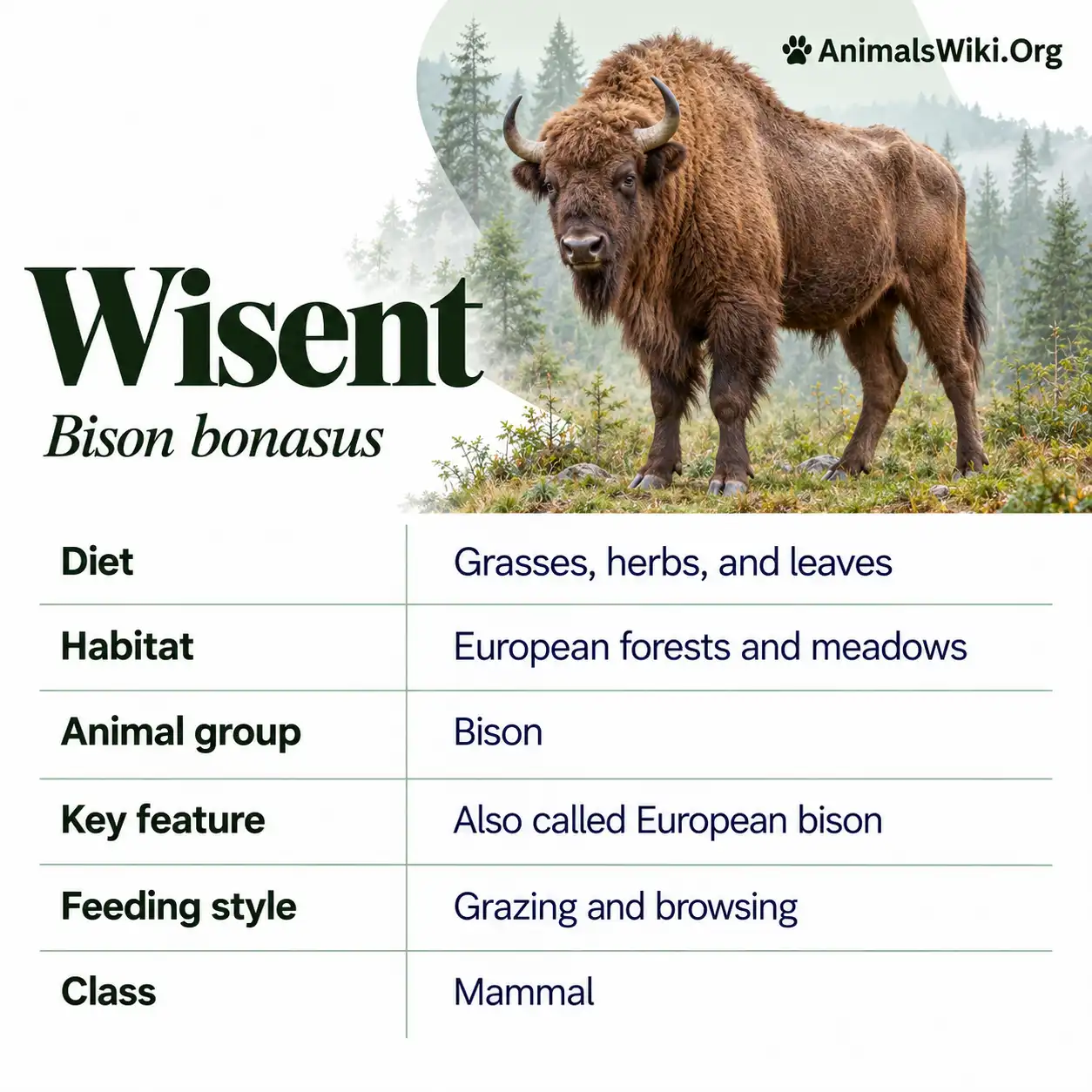
Wisent, A Complete Guide to the European Bison
A wisent emerging from the trees is an unforgettable sight. Its massive shoulders, curved horns, thick brown coat, and deliberate movements give it the appearance of an animal belonging to another age. Yet the wisent is part of modern Europe—a living wild bovine whose recovery demonstrates what sustained conservation can achieve.
Also called the European bison, the wisent disappeared from the wild during the early twentieth century. Animals surviving under human care provided the foundation for breeding and reintroduction programs. Their descendants now inhabit forests, grasslands, and other landscapes across several countries.
The recovery is substantial. Statistics for December 2025 report 13,055 European bison worldwide, including 10,668 free-living animals, 669 in semi-free conditions, and 1,718 in captivity. These categories matter: the worldwide total is not the same as the wild population, and neither figure represents a count of breeding adults alone.
Behind this success lies a continuing challenge. Modern wisent descend from very few founders, many herds remain isolated, and restoring a large herbivore requires cooperation with the people sharing its landscape.
The wisent is also more adaptable than its popular image as a deep-forest animal suggests. Understanding its future means looking beyond the trees to feeding areas, movement routes, seasonal resources, and opportunities for coexistence.
This guide explores the animal’s identification, classification, history, diet, behavior, reproduction, ecological importance, and conservation, while separating established findings from questions scientists continue to investigate.
Wisent Facts
| Feature | Information |
|---|---|
| Common name | Wisent |
| Alternative name | European bison |
| Widely used scientific name | Bison bonasus |
| Alternative current taxonomic treatment | Bos bonasus |
| Family | Bovidae |
| Animal type | Large herbivorous mammal |
| General appearance | Heavy shoulders, brown coat, beard, curved horns |
| Sexual differences | Bulls are generally larger and heavier than cows |
| Large adult bull mass | Can approach approximately 1,000 kilograms |
| Shoulder height | Large animals can approach 2 meters |
| Diet | Grasses, herbs, sedges, leaves, shoots, bark, and other vegetation |
| Social organization | Female-and-young groups; adult bulls often separate outside breeding periods |
| Typical gestation | Approximately nine months |
| Young | Usually one calf |
| Lifespan | Around 20 years is a useful general reference; some live longer |
| Global conservation assessment | Near Threatened in the 2020 IUCN assessment |
| Worldwide registered population | 13,055 in December 2025 |
| Free-living population | 10,668 in December 2025 |
What Is a Wisent?
A wisent is the European member of the living bison group. It is a wild bovine related to American bison, cattle, and other members of the cattle tribe.
The name “European bison” is useful because it immediately connects the animal with its better-known North American relative. “Wisent” provides a distinctive common name that avoids confusion between the two species.
It is generally recognized as Europe’s largest living wild land mammal. That description concerns its overall size and mass; it does not mean every wisent outweighs every individual of another large species.
A Wild Animal With a Managed Recovery
The wisent’s conservation history creates an unusual situation. Many animals live freely, choose their movements, reproduce within herds, and interact with native wildlife, yet their populations remain subject to monitoring and management.
Those activities may include veterinary surveillance, supplementary feeding, transfers between populations, and measures to reduce conflict.
Being monitored does not make a free-living wisent a domestic animal. Domestication involves a different history of breeding and adaptation to human use.
Why Its Comeback Matters
The wisent survived a stage at which its future depended entirely on animals kept under human care. Its return shows that extinction in the wild can sometimes be reversed when a viable captive foundation remains.
However, numerical recovery and full ecological recovery are separate achievements. A growing population can still have limited genetic diversity or occupy only a fraction of its former range.
Scientific Classification and Naming
Many conservation organizations, research papers, and studbooks use the scientific name Bison bonasus. The Mammal Diversity Database currently treats the species as Bos bonasus, placing bison within a broader cattle genus.
These are alternative genus treatments of the wisent, rather than evidence that the European bison has become a different animal.
| Taxonomic rank | Classification |
|---|---|
| Kingdom | Animalia |
| Phylum | Chordata |
| Class | Mammalia |
| Order | Artiodactyla |
| Family | Bovidae |
| Subfamily | Bovinae |
| Tribe | Bovini |
| Genus in widely used conservation literature | Bison |
| Genus in the Mammal Diversity Database treatment | Bos |
| Species name | Bison bonasus or Bos bonasus |
| Scientific authority | Linnaeus, 1758 |
Why Do Genus Names Differ?
Classification attempts to represent evolutionary relationships, but authorities may choose different boundaries for genera.
A narrowly defined genus can emphasize distinctions between a group and its relatives. A broader genus can emphasize their shared ancestry and close relationships.
Consequently, an article should acknowledge important alternative treatments without describing one naming convention as evidence that all other sources are mistaken.
For consistency, this guide primarily uses “wisent” and “European bison,” with Bison bonasus where a scientific name is helpful.
Is a Wisent a Buffalo?
The wisent is a bison. True buffalo include animals such as African buffalo and Asian water buffalo.
The word “buffalo” is sometimes applied informally to bison, particularly in North America, but common usage does not make these animals the same biological group.
Subspecies and Conservation Breeding Lines
Wisent conservation literature commonly distinguishes the historical lowland and Caucasian forms. It also recognizes two principal managed breeding lines.
These concepts are related, but they are not interchangeable.
Historical Subspecies
The lowland European bison is usually named Bison bonasus bonasus. The Caucasian form is usually named Bison bonasus caucasicus and no longer survives as a separate pure population.
Older literature may discuss additional extinct forms or use different taxonomic arrangements. Such historical names should be evaluated in their original context rather than automatically treated as accepted living subspecies.
The Lowland Line
The Lowland line preserves ancestry assigned to the lowland form.
Its extremely restricted founder base makes pedigree management important. Having many descendants does not recreate the diversity that disappeared during the population bottleneck.
The Lowland–Caucasian Line
The Lowland–Caucasian line includes ancestry from lowland animals and a surviving male of the historical Caucasian form.
Genetic research describes modern European bison as descending from 12 founders overall, with the Lowland line tracing to seven founders. The wider founder group included one Caucasian bull.
| Term | Meaning | Important distinction |
|---|---|---|
| Lowland subspecies | Historical geographical form | A taxonomic concept |
| Caucasian subspecies | Historical Caucasian form | No separate pure living population remains |
| Lowland line | Managed ancestry descended from lowland founders | A conservation breeding line |
| Lowland–Caucasian line | Managed ancestry including Caucasian contribution | Does not recreate the original Caucasian population in full |
Why Breeding Lines Matter
Conservationists use pedigree information to retain ancestry, plan transfers, and avoid unnecessary loss of genetic variation.
The objective is more demanding than producing calves. Managers must consider which animals reproduce and how their descendants contribute to future generations.
Appearance and Identification
The wisent has a heavy forebody, prominent shoulders, a relatively narrow rear, and a large head carried beneath the shoulder line. Its brown coat becomes especially substantial around the neck and front of the body.
Both sexes have horns. These project outward before curving upward and inward, although shape varies with age and individual development.
Bulls and Cows
Adult bulls are generally heavier and more powerfully built than cows. A large bull’s neck and shoulders can create a particularly imposing silhouette.
Females remain substantial animals despite their smaller average size. A cow accompanied by a calf should never be treated as harmless because a nearby bull looks larger.
Sex and age influence proportions, so a young male may resemble an adult female more closely than a mature breeding bull.
Coat and Seasonal Appearance
Wisent have insulating coats suited to seasonal conditions. They shed as temperatures rise, sometimes appearing patchy or untidy during the transition.
A shedding animal is not necessarily unhealthy. However, appearance alone cannot reliably establish its condition, because parasites, injuries, and other problems can also affect the coat.
Gdańsk Zoo describes the species’ winter insulation and seasonal shedding alongside its characteristic herd structure and plant-based diet.
Horns Are Not Antlers
Wisent horns are permanent structures, unlike the antlers shed and regrown by many deer.
This distinction helps explain why broken horns and other injuries can remain visible rather than disappearing during an annual replacement cycle.
Identifying an Animal From Photographs
Useful features include the shoulder profile, relative head size, horn position, beard, body proportions, and overall coat distribution.
A single close-up of the face may be less informative than a clear side view. Camera angle and age can make closely related bovines appear more similar than expected.
Wisent Compared With American Bison
The wisent and American bison are close relatives, but they are usually treated as separate species.
Popular comparisons often reduce them to a few visual rules. These are useful starting points, provided readers remember that individuals vary.
| Feature | Wisent or European bison | American bison |
|---|---|---|
| Widely used scientific name | Bison bonasus | Bison bison |
| Main geographical association | Europe and adjoining Eurasian regions | North America |
| General outline | Often relatively taller and more slender | Often more massive through the forebody |
| Head carriage | Commonly appears somewhat higher | Commonly appears lower |
| Hair | Shaggy front, beard, seasonal coat | Especially conspicuous shaggy forequarters |
| Feeding | Flexible mixture of grazing and browsing | Predominantly grazing, with variation |
| Conservation history | Recovered after extinction in the wild | Severe historical decline followed by varied conservation and commercial recovery |
Comparative genomic research confirms the close relationship between wisent and American bison while investigating their different evolutionary histories.
Is the Wisent Larger?
There is no useful universal answer based on one maximum weight.
Sex, age, population, nutrition, and the American bison form being compared all affect the result. Wisent may appear taller and leggier, while a large American bull may look considerably heavier.
Comparisons should therefore specify the measurement rather than declaring one species “bigger” in every respect.
Why the Differences Matter
An American bison photograph should not be used as an accurate illustration of a wisent simply because both animals have humps and horns.
For educational publishing, correct image identification is as important as correct naming in the article.
Evolutionary History
The wisent belongs to an evolutionary history involving extinct bison, cattle relatives, changing environments, and occasional gene exchange.
Ancient DNA has made this history clearer, although some interpretations remain debated.
The Ancient Hybrid-Origin Hypothesis
A prominent 2016 study proposed that wisent ancestry involved hybridization between steppe bison and aurochs ancestors.
The researchers combined ancient genetic evidence with discussion of changing bison representations in prehistoric art. Their conclusions attracted attention because they suggested a more complicated origin than a simple, isolated lineage.
An Alternative Explanation
A 2018 study argued that incomplete lineage sorting offered a better explanation for important genetic inconsistencies.
Incomplete lineage sorting occurs when ancestral genetic variation persists across branching species lineages. Different sections of a genome can consequently suggest different relationships without requiring the same hybridization scenario.
The responsible conclusion is that wisent evolutionary history should not be reduced to a settled statement that it is “half cattle and half bison.”
What More Recent Ancient DNA Shows
Research published in 2025 examined mitochondrial genomes from 135 ancient bison samples spanning more than 50,000 years. It identified distinct bison lineages and investigated their changing distribution through time.
Such studies help distinguish ancient diversity from the narrow genetic inheritance surviving today. Modern populations represent the descendants of a bottleneck, rather than a complete sample of all wisent diversity that ever existed.
Historical Distribution and Extinction in the Wild
European bison once occupied a much wider geographical range than they do today.
Historical distribution changed over centuries as hunting, agricultural expansion, settlement, and other pressures reduced populations. By the late nineteenth century, the surviving wild strongholds were concentrated in the Białowieża region and the Caucasus.
A European Commission conservation report describes these two remaining populations and their associated historical forms.
The Last Wild Strongholds
The Białowieża population disappeared around the end of the First World War, with the final wild animals generally dated to 1919.
The remaining Caucasian population survived somewhat longer, until 1927. At that point, the species was extinct in the wild, although animals remained in zoos and other collections.
Survival Under Human Care
The surviving captive animals made recovery possible, but saving the species required more than keeping a few individuals alive.
Breeders needed to locate animals, establish their ancestry, arrange pairings, and cooperate across institutions. The historical development of the pedigree book reflects these efforts and the difficulty of reconstructing reliable ancestry records.
Returning to Białowieża
European bison returned to an enclosed breeding reserve in Białowieża in 1929. Releases into the surrounding forest began in 1952.
These dates refer to different stages: return to a breeding facility and return to free-living conditions. Confusing them can make accounts of reintroduction appear contradictory.
The recovery subsequently expanded through additional breeding, releases, and the establishment of new herds.
Present Distribution and Population
The wisent now exists in a network of free-living populations, enclosed conservation herds, breeding centers, and zoos.
Major free-living populations occur in eastern and central Europe, while reintroduction and restoration projects have extended its presence into additional landscapes.
Latest Verified Population Figures
The European Bison Friends Society reports the following figures from the International European Bison Studbook for 2025:
| Population category | December 2025 |
|---|---|
| Free-living animals | 10,668 |
| Semi-free animals | 669 |
| Captive animals | 1,718 |
| Worldwide total | 13,055 |
The same source reports 3,491 animals in Poland, including 3,285 free-living animals and 206 captive animals. These are dated registered figures, rather than an estimate of the population on the article’s publication day.
For comparison, the European Bison Pedigree Book recorded 12,209 worldwide in 2024, including 9,762 free-living animals.
What “Free-Living” Means
A free-living population can still receive substantial management.
Animals may have access to supplementary food, be counted annually, or be selected for transfers. The category therefore does not necessarily mean complete independence from human intervention.
“Semi-free” usually describes an intermediate management situation, often involving larger enclosed areas. Exact classification should follow the reporting system used.
Mature Individuals Are a Different Measure
Population totals include calves and immature animals.
The 2020 IUCN assessment also evaluated mature animals in selected sufficiently large free-living subpopulations. Its frequently cited figure of 2,518 mature individuals referred to eight qualifying subpopulations in 2019, not to every European bison alive worldwide.
Comparing that figure directly with the 2025 total would confuse age classes, geographical coverage, and assessment methods.
Habitat and Seasonal Movement
The wisent is often pictured in dense forest, but its habitat requirements are broader.
Trees can provide shelter and security, while open areas offer abundant feeding opportunities. The combination of resources often matters more than a single habitat label.
Forests, Meadows, and Mosaics
Useful environments can include deciduous and mixed forests, clearings, grasslands, scrub, and other vegetation.
A forest with little accessible ground vegetation may provide less food than an open woodland containing productive glades. Conversely, an exposed grassland without suitable shelter or safe movement routes may create other difficulties.
Rewilding Europe emphasizes open and semi-open land alongside nearby woodland when discussing habitat suitability.
Evidence From Tracking
A 2026 study analyzed GPS information from multiple European bison populations and found substantial flexibility in habitat use.
Its broad dataset helps move discussion beyond assumptions based on one famous forest. It also shows why human influence, seasonal food availability, and supplementary feeding need consideration when interpreting habitat preferences.
Seasonal Movement
Animals may shift their activities as vegetation grows, dries, or becomes covered by snow.
Winter can encourage movement toward accessible forage, including agricultural land. Summer shade and feeding opportunities can influence different choices.
These patterns do not amount to one fixed migration followed by every herd. Movements depend on local conditions and management.
Space and Connectivity
A reserve needs more than enough room for animals to stand or graze during a favorable month.
It must support seasonal resources, reproduction, dispersal, and the possibility of contact with other herds. Tracking studies provide information about these requirements that cannot be obtained simply by drawing a boundary around suitable-looking trees.
Diet and Digestion
Wisent are herbivorous ruminants with flexible feeding habits.
Their diet can include grasses, herbs, sedges, leaves, shoots, bark, and other vegetation. The proportions vary with season, habitat, availability, and management.
Grazing and Browsing
Grazing involves feeding mainly on low-growing vegetation such as grasses. Browsing involves material from shrubs and trees.
European bison can do both. Describing every population as having one fixed percentage of grass and woody food overlooks differences between landscapes.
Research in Białowieża found that habitat and supplementary feeding influenced diet, with woody material becoming more important as supplementary feeding decreased.
| Food source | Examples | What influences its use? |
|---|---|---|
| Grasses and sedges | Meadow and wet-ground vegetation | Growth stage and accessibility |
| Herbs | Broad-leaved ground plants | Season and local abundance |
| Leaves and shoots | Shrubs and young trees | Availability and plant condition |
| Bark and twigs | Woody vegetation | Seasonal constraints and feeding opportunities |
| Supplied forage | Hay or other managed food | Local conservation practice |
| Agricultural plants | Crops and stored fodder | Access, availability, and human land use |
How Digestion Works
The ruminant stomach supports microbial fermentation, allowing wisent to obtain nutrients from fibrous vegetation.
Food is also regurgitated and rechewed as cud. Feeding and rumination therefore form connected parts of the daily activity cycle.
Białowieża National Park describes the large rumen and the continuing digestive processes that underpin the species’ need for repeated feeding.
Food Quantity Is Not Food Quality
A landscape containing abundant vegetation can still provide poor nutrition if much of that material is mature, fibrous, or inaccessible.
Fresh growth and old stems differ in nutritional value. Snow, drought, and competition can also alter what an animal can actually consume.
Consequently, estimating carrying capacity requires more information than measuring the area covered by plants.
Physical and Behavioral Adaptations
The wisent’s survival depends on a combination of body structure, digestion, sensory awareness, and flexible behavior.
Insulation and Seasonal Shedding
A substantial winter coat helps conserve heat. Seasonal shedding reduces the burden of that insulation during warmer conditions.
Cold tolerance does not remove the need for adequate nutrition. Maintaining body condition still requires energy, especially when food becomes difficult to reach.
Strength and Mobility
The heavy shoulders and muscular body make wisent formidable animals, but their mass should not be confused with slowness.
They can move quickly when disturbed. Exact performance claims are less useful to visitors than the practical fact that a person should never rely on outrunning or physically controlling one.
Horns and Defense
Horns can be used during competition and defense. Body mass, positioning, and the support of nearby animals can also influence an encounter.
These defenses reduce some risks without making wisent immune to injury or predation.
Flexible Resource Use
An ability to use several food types provides options when a preferred resource becomes scarce.
However, flexibility has limits. A population cannot adapt behaviorally to every combination of fencing, traffic, poor forage, and disturbance.
The conservation implication is straightforward: adaptability creates opportunities for restoration, but it does not eliminate the need for suitable landscapes.
Social Behavior and Communication
Wisent social organization changes with age, sex, season, and local conditions.
Mixed groups commonly contain adult females, calves, and immature animals. Adult males may live alone or in smaller male groups outside the breeding season.
Female Groups
Experienced cows play important roles in mixed-herd movements. Their familiarity with feeding areas and routes can benefit younger animals.
Groups are not necessarily permanent collections of the same individuals. Animals can associate, separate, and regroup as conditions change.
A herd observed at one moment is therefore a snapshot of a social system.
Adult Bulls
The largest bull is not automatically the permanent leader of every group.
Adult males often join female groups during the breeding period and may move between them. Białowieża National Park specifically notes that bulls do not head the herds as permanent residents.
Communication
Wisent communicate through posture, movement, scent, physical interaction, and vocal sounds.
During breeding periods, males investigate females and respond to competitors. Not every interaction develops into a fight: assessment and avoidance can prevent costly injury.
Feeding, Resting, and Rumination
Daily behavior includes repeated periods of eating, resting, moving, and chewing cud.
Disturbance can interrupt these activities. Repeatedly forcing animals to move for photographs may impose a cost even when no obvious injury occurs.
The Influence of Feeding Sites
Artificial food can draw animals together and alter group size.
Such concentrations may improve opportunities for counting or management while also changing social contact and disease exposure. A gathering around supplied food should not automatically be treated as the species’ natural year-round social pattern.
Reproduction and Calf Development
Wisent reproduction is seasonal in many populations, with breeding commonly concentrated in late summer and births mainly in spring and early summer.
The timing is biologically useful because calves begin life when vegetation and maternal nutrition are often improving.
The Breeding Season
The rut commonly occurs during August and September, although timing varies.
Adult bulls join mixed groups and compete for mating opportunities. Biological maturity does not guarantee success: younger males may be capable of reproduction before they can compete effectively with older bulls.
Białowieża observations distinguish sexual maturity from the later ages at which males usually participate strongly in breeding.
Pregnancy and Birth
Gestation lasts approximately nine months, commonly reported around 264 days. A female usually gives birth to one calf.
She may separate from the group around birth, reducing disturbance during a vulnerable period.
These are typical patterns, not an exact calendar applying to every individual.
Newborn Development
Wisent calves are relatively well developed at birth. They must become mobile quickly enough to remain with their mother.
Milk supplies early nutrition, while plant feeding becomes increasingly important as development proceeds. The calf also learns routes, social relationships, and responses to the surrounding environment.
Maternal Protection
A calf depends on more than food. Staying close to its mother can provide protection, and nearby cows may participate in responses to danger.
Observers should avoid creating separation between a female and her young.
Environment and Breeding Timing
Research published in 2026 investigated how winter feeding conditions and seasonal diet relate to breeding synchrony across free and semi-free herds.
The study illustrates that reproduction is connected to nutrition and management, rather than controlled by the calendar alone.
Lifespan and Mortality
A lifespan around 20 years is a useful general reference, while some individuals live longer under favorable conditions.
It is important to distinguish potential longevity from the average age reached in a particular population.
Why Some Animals Die Young
Mortality can involve illness, injury, poor condition, accidents, and other causes. Management removals add a separate category that should not be confused with natural death.
A population with supplementary food and few effective predators may have a different age structure from one facing stronger natural constraints.
Old Age in Managed Populations
Long-term Białowieża records document deaths and management decisions across many decades. They show the value of following populations over time rather than relying entirely on general species summaries.
Why Longevity Matters for Conservation
Long-lived females can contribute calves over multiple years, while mature males can contribute substantially to the next generation.
However, allowing only a few individuals to reproduce can reduce effective genetic diversity. A herd containing many animals may still have a much smaller number of influential breeders.
For this reason, head counts and reproductive contribution need to be considered together.
Predators and Competitors
Adult wisent are difficult prey because of their size, strength, horns, and potential group defense.
Nevertheless, they should not be described as animals with absolutely no natural predators.
Wolves and Wisent
A study published in 2026 documented wolves attacking a European bison group in Białowieża. The recorded event occurred in September 2025 and involved a newborn calf.
The cows defended the calf, and the footage did not show a kill. This establishes a predation attempt, rather than a measured rate of successful wolf predation.
The finding is important because rare events can be missed when research focuses on more common prey.
Which Animals Are Most Vulnerable?
Calves, injured animals, and individuals in poor condition would generally be easier targets than healthy adults.
However, the frequency of attacks and the population-level importance of predation remain questions requiring evidence from particular regions.
Competition With Other Herbivores
Wisent can share landscapes with deer and livestock. Overlapping diets do not automatically mean that one species is harming another.
Competition depends on whether resources become limiting and whether that shortage affects growth, reproduction, or survival.
Research comparing European bison and deer in a Mediterranean landscape demonstrates why local feeding relationships deserve direct study rather than assumptions based solely on body size.
Ecological Importance
The wisent influences its environment through feeding, movement, dung, and physical disturbance.
These effects make it an important participant in restoration projects, but ecological benefits should be evaluated rather than presumed to occur identically everywhere.
Vegetation Structure
By consuming plant material, wisent can change vegetation height and density.
Uneven feeding can help create a patchwork of conditions. Some areas remain taller, others become shorter, and the balance can affect plants and smaller animals.
Heavy pressure in a confined area can produce different outcomes from moderate use across a large landscape.
Plant Diversity
A 2024 study found evidence that European bison can increase plant species richness in forest habitats through processes including biomass removal, seed movement, and microhabitat creation.
The authors also emphasized that empirical evidence remained limited. The result supports ecological potential without proving that every release will increase every measure of biodiversity.
Seeds and Nutrients
Animals can transport seeds in their coats or digestive systems. Dung and urine redistribute nutrients between feeding and resting areas.
These processes connect parts of a landscape and can create opportunities for plants to establish beyond their immediate source.
Ecological Restoration Needs Monitoring
A project should ask what changes it expects and then measure them.
Useful outcomes might include vegetation variety, regeneration patterns, or habitat conditions for selected wildlife. Unwanted effects, such as excessive browsing in a restricted enclosure, also need attention.
The wisent is an ecological actor with context-dependent effects, rather than a universal solution for every degraded habitat.
Threats and Human–Wisent Conflict
The wisent’s recovery has reduced its immediate extinction risk, but several threats continue.
Low Genetic Diversity
The severe historical bottleneck remains visible in modern ancestry.
Research on European bison in Lithuania found limited genetic variation and differences among sampled populations, reinforcing the importance of thoughtful breeding and movement decisions.
A growing population does not automatically recover alleles that were lost during the bottleneck.
Isolation and Barriers
Roads, fences, settlement, and distance can prevent animals from moving between herds.
Without exchange, small populations may remain genetically restricted. Barriers can also concentrate pressure within limited areas or increase the likelihood of risky crossings.
Disease and Parasites
European bison can be affected by infectious diseases and parasites. Health surveillance matters when populations share environments with livestock or when animals are transferred.
Recent research has investigated methods for monitoring tuberculosis-complex material in wisent environments, demonstrating the continuing attention required for population health.
Supplementary Feeding Tradeoffs
Food provision can help managers address particular winter or conflict problems, but it can also concentrate animals.
Studies have linked intensive feeding, larger aggregations, and greater parasite burdens in studied herds. This is a reason to evaluate feeding practices carefully rather than treating more supplied food as automatically better conservation.
Agricultural Damage
Crops can provide attractive food, especially when natural resources are less accessible.
For a farmer, a successful wildlife recovery may bring real costs. Compensation, prevention, and prompt communication can therefore be central conservation measures.
Conflict and Institutional Disruption
Political conflict can interfere with monitoring, funding, animal transfers, and cooperation.
IUCN’s 2022 review highlighted the importance of multinational collaboration and the implications of war for the species’ recovery. That statement should retain its date rather than being treated as a complete assessment of every current herd.
Conservation, Breeding, and Reintroduction
The wisent moved from Vulnerable to Near Threatened in the 2020 IUCN assessment, reflecting sustained recovery.
IUCN reported growth in the wild population from approximately 1,800 in 2003 to more than 6,200 in 2019. These are historical assessment figures, distinct from the newer studbook totals presented earlier.
Near Threatened Still Requires Action
Near Threatened does not mean conservation work is finished.
A species can recover numerically while remaining dependent on management, genetically restricted, or divided among vulnerable populations.
Pedigree-Based Breeding
Studbooks record ancestry and population information that support coordinated decisions.
The European Bison Pedigree Book’s online resource explains the long-running effort to document animals with known pedigrees and record free-living populations.
Accurate records help managers identify underrepresented ancestry and evaluate potential transfers.
Zoos and Breeding Centers
Captive populations remain part of the conservation network.
Zoo Berlin describes its contribution to breeding and reintroduction, illustrating how animals under human care can support wider recovery rather than existing solely as exhibits.
Choosing Release Sites
A release site needs suitable food, shelter, water, space, and realistic prospects for coexistence.
Managers also need to consider veterinary risks, future population growth, and what happens if animals move beyond the intended area.
A picturesque reserve is not sufficient evidence of long-term suitability.
Connecting Populations
A 2025 modeling study examined interventions including wildlife crossings, additional reintroductions, and changes in supplementary feeding to improve European bison metapopulations.
Such work emphasizes connections between herds rather than treating every small release as a self-contained success.
Measuring Recovery Properly
Useful measures include calf survival, recruitment, health, genetic contribution, movement, and local acceptance.
A herd producing calves is encouraging. A population maintaining itself across generations while fitting into the surrounding landscape is a stronger conservation outcome.
Responsible Wisent Watching
Watching wisent can support appreciation and local conservation, provided the animals retain space to behave normally.
Keep Your Distance
Follow the rules of the site and the guidance of staff or local authorities.
Do not approach an animal because it appears calm. A resting or feeding wisent can respond quickly when its tolerance is exceeded.
Never Feed Wild Animals
Offering food can encourage animals to approach people and alter their behavior.
Białowieża National Park notes that frequent human contact can reduce avoidance and increase the potential for dangerous interactions.
Respect Cows and Calves
Avoid moving between animals, especially a mother and her young.
If a herd changes direction or stops feeding because of your presence, give it more room.
Use Photography Responsibly
A long lens and patience are better tools than repeated approach.
Never surround animals with vehicles, block their route, or encourage others to crowd them. A memorable photograph should not come at the cost of disturbance or risk.
Frequently Asked Questions About Wisent
1. What is a wisent?
A wisent is the European bison, a large wild bovine native to Europe and adjoining Eurasian regions. It is a close relative of the American bison and is widely recognized as Europe’s largest living wild land mammal.
2. Are wisent and European bison the same animal?
Yes. “Wisent” and “European bison” are common names for the same species. Using both terms can help readers distinguish it from American bison while recognizing its relationship to them.
3. What is the scientific name of the wisent?
Bison bonasus remains widely used in conservation literature. The Mammal Diversity Database uses Bos bonasus. The difference concerns genus classification, rather than the existence of two separate European bison species.
4. How many wisent are there?
The latest verified figures used here report 13,055 worldwide in December 2025. Of these, 10,668 were free-living, 669 semi-free, and 1,718 captive. These totals include different ages and are not counts of mature breeding animals alone.
5. Is the wisent endangered?
The 2020 global IUCN assessment classified it as Near Threatened. Its recovery is significant, but low genetic diversity, isolated herds, disease risks, and continuing management needs mean conservation remains necessary.
6. Did the wisent become extinct?
It became extinct in the wild during the early twentieth century. Animals survived under human care, allowing breeding programs and later reintroductions. The species as a whole therefore survived.
7. When were wisent returned to the wild?
Releases into Białowieża Forest began in 1952. Animals had already returned to an enclosed breeding reserve there in 1929. These dates describe separate stages of recovery.
8. Where do wisent live today?
They occur in free-living populations, semi-free conservation areas, breeding centers, and zoos across several countries. Major populations remain concentrated in parts of eastern and central Europe, with additional restoration projects elsewhere.
9. Do wisent live only in forests?
No. They can use forests, meadows, clearings, scrub, and other habitats. Research increasingly emphasizes their flexibility and the importance of landscapes containing a useful mixture of feeding areas, shelter, and safe movement routes.
10. What do wisent eat?
They consume grasses, herbs, sedges, leaves, shoots, bark, and other vegetation. Diet varies by season and location. Supplied forage and agricultural plants can also influence the feeding patterns of managed or free-living populations.
11. Do wisent hunt other animals?
No. Wisent are herbivores. Their large bodies and horns are associated with defense, competition, and other interactions, rather than pursuing animal prey.
12. How big can a wisent become?
Large adult bulls can approach approximately 1,000 kilograms, and large animals can stand close to 2 meters at the shoulder. Females are generally smaller. These upper reference values should not be treated as typical measurements for every individual.
13. Are wisent bigger than American bison?
It depends on the comparison. Wisent often look taller and more slender, while American bison can appear heavier through the forebody. Sex, age, population, and the measurement chosen all influence the answer.
14. Do female wisent have horns?
Yes. Both sexes have horns. Mature males generally have a more powerful overall build, but horns alone do not provide a simple way to determine sex from every photograph.
15. How long do wisent live?
Around 20 years is a useful general reference, with some individuals living longer. Lifespan varies with health, conditions, and management. A maximum recorded age is different from the average lifespan of a wild population.
16. How many calves does a cow have?
A female usually gives birth to one calf at a time. Reproductive success depends on more than birth numbers: calf survival, maternal condition, and later recruitment into the breeding population also matter.
17. How long is wisent pregnancy?
Gestation is approximately nine months, commonly reported around 264 days. Individual pregnancies vary, so the figure is an average reference rather than an exact duration.
18. Do wolves attack wisent?
Yes, attacks can occur. A study published in 2026 documented a wolf attack on a group containing a newborn calf. The cows defended it, and no kill was recorded in that event.
19. Are wisent dangerous to people?
They can be. Their size, horns, speed, and strength make close encounters potentially dangerous. Visitors should follow site rules, keep their distance, avoid feeding animals, and never move between a female and her calf.
20. Can wisent survive winter?
They are adapted to seasonal climates, including cold conditions. However, winter survival still depends on food access, body condition, health, and local circumstances. Some populations receive supplementary feeding.
21. Why do some wisent receive food from conservation managers?
Feeding may be used to address seasonal shortages, influence distribution, or reduce conflict. It also has tradeoffs, including animal concentration and possible changes in parasite transmission, movement, and natural feeding behavior.
22. What are the two main conservation breeding lines?
They are the Lowland and Lowland–Caucasian lines. These managed ancestry groups are related to historical subspecies, but they should not be confused with two independently surviving original wild subspecies.
23. Why does genetic diversity matter if numbers are increasing?
More descendants do not automatically restore genetic variants lost during a bottleneck. Genetic diversity can influence long-term adaptability and resilience, making ancestry and reproductive contribution important alongside total numbers.
24. Do wisent help biodiversity?
They can influence vegetation structure, move seeds, and redistribute nutrients. Research has documented benefits in some settings, including increased plant richness. Outcomes depend on habitat, animal density, management, and the biodiversity measure being considered.
25. Can a small wisent herd recover without further management?
Possibly, under suitable conditions, but this cannot be assumed. Isolation, limited ancestry, disease, and insufficient space may constrain its future. Monitoring should establish whether the population remains healthy and viable across generations.
Wisent (Bison bonasus)
The wisent’s return is one of Europe’s most significant wildlife recoveries. A species that vanished from the wild now numbers more than 13,000 registered animals worldwide, with most living in free-ranging populations.
That achievement rests on decades of breeding, protection, research, and cooperation. It also creates new responsibilities: maintaining genetic diversity, connecting herds, managing health risks, and helping people coexist with a very large herbivore.
The wisent deserves attention as both an impressive animal and a functioning part of living landscapes. Its future will depend on whether recovery continues beyond increasing head counts toward healthy populations with space to move, reproduce, and contribute to their ecosystems.



