
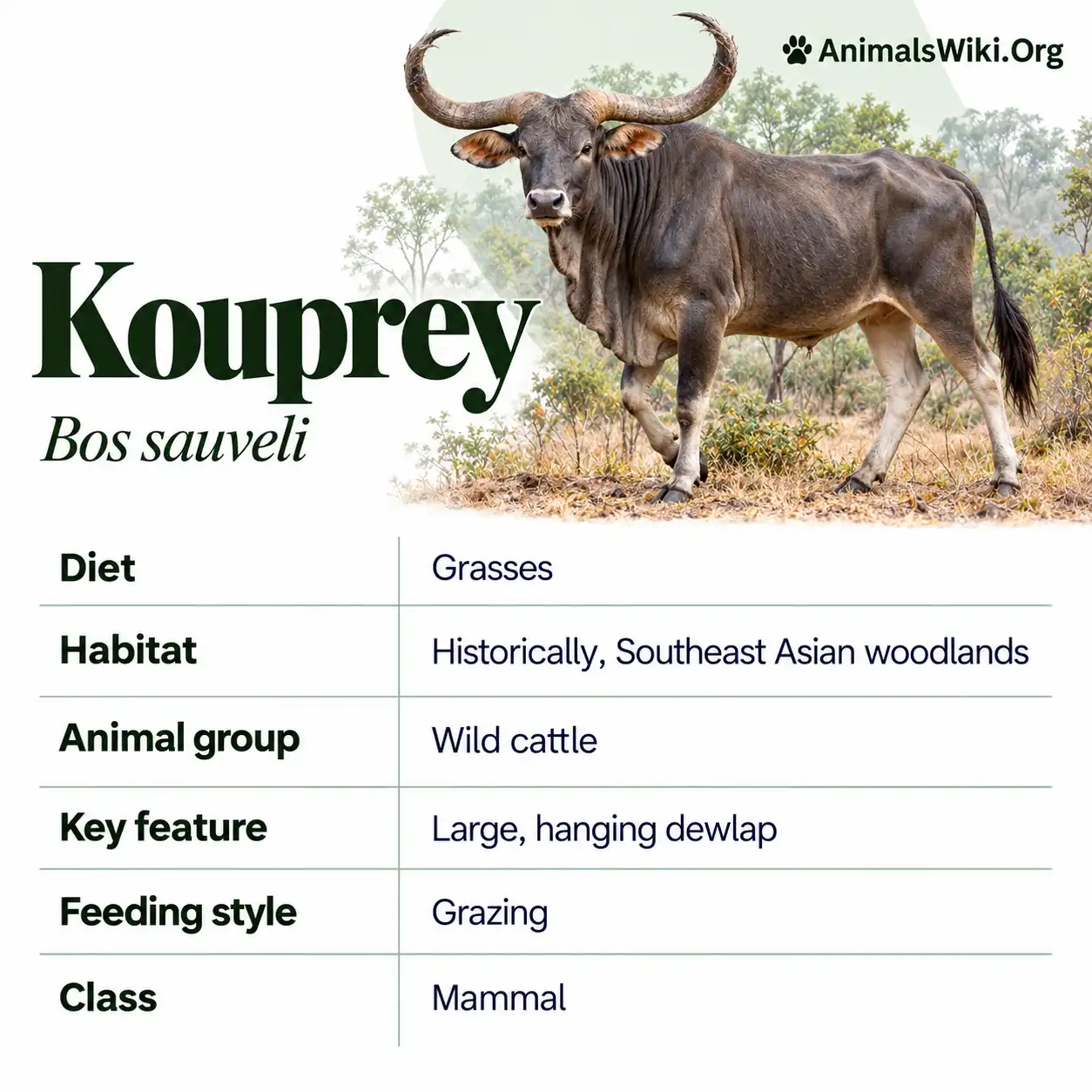
Kouprey, A Complete Guide to Cambodia’s Mysterious Forest Ox
The kouprey is a remarkable example of how much can remain unknown about a very large animal. This imposing wild ox once inhabited the seasonal forests of mainland Southeast Asia. With its long legs, distinctive horns, and enormous hanging dewlap, a mature bull would have been difficult to overlook. Yet the species has gone without reliably verified modern records for decades.
Known scientifically as Bos sauveli, the kouprey is closely associated with Cambodia. Its Khmer name means “forest ox,” and it holds a prominent place in the country’s natural heritage. Conservation specialists describe it as Critically Endangered, possibly extinct—a status that acknowledges the likelihood of extinction while retaining uncertainty about whether any animals survive.
The kouprey’s story combines natural history, museum research, disputed sightings, and advances in genetics. Scientists have debated its relationship to other cattle, examined old specimens for DNA, and searched historical habitat for signs of survival. Meanwhile, many basic details of its life remain known mainly from observations made during the twentieth century.
Understanding this animal requires care. A historical estimate is not a current census. An unverified sighting is not a rediscovery. A genetic sequence recovered from a museum specimen does not demonstrate that living animals remain.
This guide explains what is established about the kouprey, what historical accounts suggest, and where the evidence still leaves unanswered questions.
Kouprey Facts
| Feature | Information |
|---|---|
| Common name | Kouprey |
| Other names | Forest ox; grey ox |
| Scientific name | Bos sauveli |
| Animal group | Mammal; wild cattle |
| Family | Bovidae |
| Genus | Bos |
| Scientific description | Published by Achille Urbain in 1937 |
| Historical range | Cambodia and adjoining parts of Laos, Thailand, and Vietnam |
| Typical habitat | Seasonal forest mosaics containing grasslands, woodland, water, and mineral resources |
| Diet | Herbivorous; grasses and other vegetation |
| Approximate adult mass | Commonly reported as 600–900 kilograms |
| Approximate shoulder height | Commonly reported as 1.7–1.9 meters |
| Distinctive features | Long legs, prominent dewlap, long tail, and characteristic horns |
| Young | Calves |
| Reported litter size | Usually one calf |
| Conservation status | Critically Endangered, possibly extinct |
| Verified current wild population | Unknown; no confirmed surviving population |
| Known living captive population | None documented |
| Information reviewed | October 2026 |
What Is a Kouprey?
A kouprey is a species of wild cattle native to mainland Southeast Asia. It belongs to the same broad evolutionary group as gaur, banteng, domestic cattle, and several other large bovines.
Calling it a forest ox describes both its appearance and its association with wooded landscapes. However, that name should not suggest an animal restricted to dense, continuously shaded rainforest. Historical accounts place it in varied seasonal environments where trees, grass, water, and open feeding areas occurred together.
The kouprey is also a documented animal, rather than a creature known only through folklore. Museum specimens, historical photographs, anatomical descriptions, and genetic studies establish its existence. The central uncertainty concerns its survival today.
This distinction is useful when reading dramatic claims about a “mystery animal.” Its identity has been investigated scientifically. Its present whereabouts have not been established.
Another distinction concerns domestication. A wild animal may resemble livestock, share ancestry with domestic cattle, or exchange genes with related populations without becoming a domestic breed. Those possibilities require separate evidence.
For the kouprey, modern taxonomic and genetic research supports recognition as a distinct species. That conclusion is stronger than the evidence for any claim that an identifiable population survives in the wild.
Scientific Classification and Naming
The Mammal Diversity Database recognizes the kouprey as Bos sauveli. Its classification places it among the bovines, the group containing cattle and their close relatives. Kouprey
| Taxonomic rank | Classification |
|---|---|
| Kingdom | Animalia |
| Phylum | Chordata |
| Class | Mammalia |
| Order | Artiodactyla |
| Family | Bovidae |
| Subfamily | Bovinae |
| Tribe | Bovini |
| Genus | Bos |
| Species | Bos sauveli |
| Scientific authority | Urbain, 1937 |
Why Older Books Use Different Names
Older literature may refer to the kouprey as Novibos sauveli or place it within a subdivision of Bos. These names reflect changing interpretations of its anatomy and relationships.
In 1940, zoologist Harold Jefferson Coolidge published a detailed study of the animal and argued for recognition of a separate genus, Novibos. Later treatments generally placed the species within Bos. Readers researching historical accounts therefore need to recognize several combinations of the same species name.
A change in genus does not mean that one animal disappeared and another was discovered. It means that scientists revised how they grouped the species with its relatives.
Are There Kouprey Subspecies?
There is no widely accepted set of living kouprey subspecies to describe. The principal modern taxonomic question has concerned the species’ identity and evolutionary relationships, rather than a well-supported division into geographical subspecies.
It would therefore be misleading to invent Cambodian, Laotian, or Vietnamese subspecies simply because historical records span several countries. Political borders do not automatically identify biological divisions.
Appearance and Identification
The kouprey combined the size of a large bovine with a comparatively lean outline. Its legs appeared long, and its body looked less heavily built than that of a large gaur.
Historical descriptions distinguish grayish adult females from darker males. Bulls developed a particularly conspicuous dewlap: the loose fold of skin hanging beneath the neck and throat. This feature could become strikingly large in older males.
Both sexes carried horns, but their horn shapes differed. Bulls had outward-sweeping horns that curved upward, with unusually worn or frayed tips in mature animals. Female horns were slimmer and curved upward in a more twisting form. Comparative anatomical research identifies these features as useful parts of the species’ overall appearance.
The Famous Frayed Horn Tips
The ragged horn tips of adult bulls are among the kouprey’s best-known characteristics. Historical explanations connect this wear with rubbing and digging behavior.
However, a frayed horn is not a reliable identification by itself. Damage, wear, camera angle, and individual variation can complicate interpretation. A credible identification should consider the complete animal, including body proportions, horn placement, neck, coloration, and tail.
Why Photographs Can Be Misleading
A dark bovine photographed at night may lose many of its most useful identifying features. Infrared illumination can alter apparent color, while vegetation can hide the lower body or horns.
For a claimed modern kouprey photograph, the original image sequence would matter more than a single compressed frame. Several views might reveal that an unusual-looking animal is a familiar species seen from an awkward angle.
Identification becomes especially difficult when an animal’s expected appearance has been reconstructed from relatively few specimens. Researchers must allow for age, sex, posture, and ordinary variation without accepting every unusual feature as evidence of a rediscovery.
Kouprey Compared With Other Wild Cattle
Southeast Asia historically supported several large bovines. Distinguishing them is essential when evaluating kouprey reports.
| Animal | Scientific name | Broad identifying features | Main caution |
|---|---|---|---|
| Kouprey | Bos sauveli | Long-legged outline; prominent male dewlap; distinctive mature bull horns | Present survival remains unconfirmed |
| Banteng | Bos javanicus | Strong differences between male and female appearance; cattle-like build | Dark bulls can be confused with other bovines in poor images |
| Gaur | Bos gaurus | Very powerful build and prominent shoulder region | Size is difficult to judge without scale |
| Wild water buffalo | Bubalus arnee | Broad horn spread and association with wet lowland environments | Domestic and feral buffalo complicate identification |
| Domestic cattle | Various domestic cattle populations | Highly variable body shape, coat, and horns | Unusual livestock should not automatically be treated as wild species |
Specialist accounts describe banteng as sexually dimorphic wild cattle, gaur as exceptionally large bovines, and wild water buffalo as inhabitants of waterlogged grasslands and floodplain environments. These differences provide context, although field identification requires more than a brief comparison table.
Kouprey Versus Gaur
Gaur generally present a much more massive impression. A powerful shoulder region and heavy body distinguish them from the kouprey’s relatively slender historical profile.
Nevertheless, apparent proportions change with posture. A walking gaur photographed from behind may look unusually narrow, while a kouprey illustration may exaggerate the contrast. Reliable comparison requires suitable views and expert review.
Kouprey Versus Banteng
Banteng deserve particular attention because they occurred in parts of the same landscape and have featured prominently in the kouprey’s genetic history.
Their resemblance does not make them interchangeable. Identifying a banteng population provides evidence that wild cattle remain in an area, but it does not establish that kouprey occur there as well.
Scientific Discovery and Historical Research
The kouprey was formally described in 1937, remarkably late for such a large mammal. That date marks its entry into modern zoological classification, rather than the first time people knew it existed.
Local communities had their own knowledge of the animals living around them. Historical writing that treats scientific description as discovery by humanity overlooks that knowledge.
The Wildlife Conservation Society emphasizes how limited the scientific information remained until Charles Wharton’s fieldwork. His observations supplied much of the ecological foundation used in later accounts of the species.
The Famous Paris Animal
A young male from Cambodia reached the Paris Zoological Park in 1937 and became central to the species’ scientific description. It died during the Second World War, and preserved material subsequently remained available for study.
This animal’s importance extended beyond its life in captivity. A specimen associated with the original description gives later researchers an essential reference when evaluating disputed anatomy or genetic identity.
Fieldwork in a Changing Landscape
Historical expeditions faced substantial practical and political obstacles. Wharton’s 1966 paper described work during 1951–1952 and 1963–1964, including the role of Cambodian conservation personnel such as Ou Kim San.
That paper also treated human activity, fire, vegetation, and wild cattle as interacting parts of the landscape. It provides a reminder that kouprey habitat was shaped by a complicated ecological history rather than existing outside human influence.
These records are valuable, but their age matters. Observations made during a short expedition cannot answer every question that a modern, multiyear field study would investigate.
Evolution, Genetics, and the Hybrid Debate
The kouprey’s evolutionary identity has generated more research than many other aspects of its biology.
Anatomical interpretations once portrayed it as an unusually ancient or primitive bovine. Later genetic studies tested its relationships more directly. The resulting history illustrates why conclusions based on limited evidence may change when additional data become available.
Why Scientists Considered a Hybrid Origin
A major controversy concerned whether the kouprey might be a hybrid involving banteng and zebu, the humped domestic cattle associated with much of tropical Asia.
Part of the problem involved mitochondrial DNA. This genetic material follows a maternal line and represents only one component of ancestry. A species’ mitochondrial relationships can differ from the broader history recorded across its nuclear genome.
In a 2007 study, researchers examined several genetic markers and supported the kouprey as a genuine species. Their results challenged the interpretation that it was simply a recent domestic hybrid.
What the 2021 Genome Study Added
A study published in 2021 reconstructed genomes from two museum kouprey specimens. It supported recognition of the species while revealing a complex evolutionary history among Asian wild cattle.
The analysis involved rapid divergence, ancestral variation, and gene flow. These processes can make the relationships among closely related species difficult to represent as one simple, fully resolved branching tree.
Why Shared Genes Do Not Erase Species Identity
Closely related species can retain ancestral genetic variants. They can also exchange genes after their lineages diverge.
Consequently, discovering shared genetic material does not automatically prove that two named species are identical. Nor does it establish that one is merely a recent cross between the other and livestock.
An everyday analogy is to distinguish a family’s entire history from one inherited possession. A single object may reveal something about ancestry, but it cannot describe every relationship in the family.
For the kouprey, the practical conclusion is that species recognition has substantial scientific support. The unresolved details concern aspects of evolutionary history, rather than evidence that the animal was an invented species.
Historical Distribution
The kouprey’s historical distribution centered on Cambodia and extended into adjoining parts of mainland Southeast Asia.
Conservation accounts include southern Laos, southeastern Thailand, and western Vietnam within its historical range. These records should be presented as historical occurrence, rather than a map of confirmed surviving populations.
| Country | Historical interpretation | Present-day interpretation |
|---|---|---|
| Cambodia | Core area of scientific observations and specimens | No verified surviving population established |
| Laos | Included in historical range accounts | Historical inclusion does not confirm current survival |
| Thailand | Included along the southeastern part of the historical range | Requires modern evidence before being described as occupied |
| Vietnam | Included in western historical range accounts | No confirmed modern population established |
Why Range Maps Need Dates
A shaded range map can hide several different meanings. It might show where a species lived a century ago, where habitat appears suitable, or where it has recently been recorded.
Those are different datasets.
For a possibly extinct animal, an undated map can leave readers with the mistaken impression that populations still occupy every shaded region. A responsible map should state whether it represents historical distribution, potential habitat, or verified recent records.
Suitable Habitat Does Not Confirm Occupancy
An area may contain the vegetation and water resources that an animal could use while no longer containing the animal itself.
This is especially relevant where hunting has removed large mammals without clearing all the trees. Forest cover can survive after much of the original wildlife has disappeared.
Habitat and Seasonal Resources
Historical kouprey habitat was structurally varied. Accounts describe seasonal woodland and forest associated with grassy openings, denser cover, waterholes, and mineral resources.
The important feature was the combination of resources. An animal needed somewhere to feed, somewhere to rest, access to water, and routes between those places.
Forest and Grassland Worked Together
Open areas could provide accessible forage, while nearby trees offered shade and cover. A landscape containing both could support a different pattern of use from either continuous grassland or closed forest alone.
This helps explain why protecting only one attractive habitat feature would be inadequate. A waterhole without safe access to feeding areas might offer little security to a large herbivore.
The Importance of Seasonal Waterholes
Cambodia’s seasonal pools, known as trapeang, support numerous large animals and waterbirds. Research on eastern Cambodian dry forests identifies these waterholes as important components of the landscape.
For a hypothetical surviving kouprey population, water availability would be a reasonable consideration when designing searches. That is a habitat-based inference, rather than evidence that animals currently visit any particular pool.
Fire Requires Careful Interpretation
Fire can change the balance between grasses, shrubs, and trees. Its effects depend on timing, frequency, intensity, and local conditions.
Historical observations linking cattle and burned landscapes should not be converted into a universal recommendation to burn potential habitat. Equally, every open patch should not be assumed to represent recent destructive clearing.
Habitat management requires understanding the actual ecological processes operating at a site.
Diet and Digestion
The kouprey was herbivorous. Historical accounts describe feeding on grasses and other vegetation, but its complete diet remains poorly documented.
Some older treatments emphasize grazing, while others give greater importance to browsing. An FAO account, for example, describes forest-edge feeding and seasonal use of fresh grass. This variation is a reason to avoid portraying the species as an exclusively specialized grass eater.
What Did It Eat?
A cautious summary is that kouprey consumed plant material available within their seasonal habitat, including grasses and browse.
The evidence does not justify a precise modern menu stating the percentage of each plant species in the diet. Nor does it support detailed daily food requirements for free-ranging animals.
Historical observations also associate kouprey with mineral resources. Such sites can supplement the mineral intake of herbivores, although the nutritional importance of individual resources would require direct investigation.
How Ruminant Digestion Works
As cattle, kouprey belonged to the ruminants. In ruminant digestion, microorganisms help break down fibrous plant material within the specialized stomach system. Animals also regurgitate and rechew food as cud.
This general digestive arrangement explains how cattle obtain nutrition from vegetation that many other mammals cannot use efficiently. It does not mean that all grasses have equal nutritional value or that food quality is irrelevant.
A large supply of dry stems may contain less usable nutrition than a smaller patch of fresh growth. Seasonal differences in forage quality could therefore matter alongside the quantity of vegetation present.
Adaptations to a Seasonal Environment
The kouprey’s form and reported habits suggest several ways it used a hot, seasonally changing landscape. Some are directly observable physical traits; others are reasonable interpretations that remain less firmly tested.
Long Legs and Mobility
Long legs contributed to the animal’s distinctive outline. They would have supported movement through open woodland and grassland.
However, reliable measurements of maximum running speed or travel efficiency are unavailable. Assigning an impressive numerical speed would add apparent precision without dependable evidence.
Horns and Body Size
Large size and horns could help an adult resist threats. Their presence also influenced interactions among cattle.
Yet physical defenses have limits. Horns offer little protection against firearms, concealed snares, or the loss of access to essential resources.
The Large Dewlap
The dewlap is an established anatomical feature, particularly in mature males. Its exact functional significance in kouprey has not been experimentally established.
Heat exchange, communication, and other roles can be discussed as possibilities, but a dramatic body feature does not automatically reveal its primary function.
Behavioral Flexibility
Using shade during hot periods and feeding when conditions are cooler would be sensible strategies for a large tropical herbivore. Historical descriptions support patterns involving forest retreat and activity outside the hottest hours.
However, disturbance can influence observed behavior. An animal encountered mainly at night in a hunted landscape is not necessarily restricted to nocturnal activity under all circumstances.
Behavior and Social Organization
Historical accounts describe kouprey as social cattle, with females and young occurring in herds and adult males varying in their association with those groups.
They were often characterized as alert and difficult to approach. Such descriptions fit observations of animals living under hunting pressure, but they should not be treated as controlled comparisons of temperament.
Herd Structure
A herd can provide several advantages: more individuals can detect danger, calves can remain near experienced adults, and animals can move together between resources.
Those advantages do not establish a fixed herd size. A count made at a waterhole might represent only part of a group, while animals gathered temporarily at a feeding site might appear to form a larger social unit.
Bulls and Female Groups
Adult male cattle often differ from females in their grouping patterns. Kouprey accounts likewise describe bulls associating with female groups at some times and occurring separately at others.
The available record is insufficient to construct a detailed annual social calendar applying to every population.
Communication and Awareness
Kouprey presumably used the sensory and social abilities expected of cattle, but their vocal repertoire and detailed communication system were not comprehensively documented.
Descriptions of specific calls, their exact meanings, or elaborate dominance rituals should therefore require stronger evidence than a general comparison with familiar livestock.
The main scientific opportunity, if the species were rediscovered, would be to observe ordinary behavior carefully rather than merely obtain a dramatic photograph.
Reproduction and Calf Development
Reproductive information comes largely from historical observations and later summaries.
Reported gestation is approximately eight to nine months, with a single calf usually described. Accounts also suggest seasonal births and a period during which a mother remained apart from the main herd with her newborn. Animal Diversity Web summarizes these observations while noting the limited information on parental care.
Breeding Season
Some sources describe mating around April and births during the following dry-season months. These details should be understood as historical reports from particular conditions.
Without repeated observations across regions and years, they cannot establish an inflexible species-wide schedule.
Rainfall patterns, female condition, and local circumstances could all influence reproduction. Their actual effects on kouprey were never measured adequately.
Newborn Calves
The young are calves. Maternal milk would support their early development, followed by increasing dependence on vegetation as they grew.
Historical descriptions suggest that calves differed in coloration from adults. However, a complete developmental timetable—including dependable birth weights, age-specific growth rates, and weaning ages—is unavailable.
Why Reproduction Matters for Recovery
A large mammal producing one calf at a time cannot replace heavy losses quickly. Even favorable reproduction would not compensate indefinitely for continued killing of adults.
This is a demographic inference, rather than a measured kouprey recovery rate.
If a surviving group were found, conservationists would need to establish whether it contained breeding females, males, and young. Finding one individual would be extraordinary, but it would not by itself demonstrate a population capable of recovery.
Lifespan
A lifespan of approximately 20 years appears in commonly used species summaries. It should be treated cautiously.
A useful lifespan estimate normally depends on evidence such as known-age individuals, repeated monitoring, or documented captive histories. The kouprey lacks the extensive records available for familiar zoo mammals.
Three different ideas should remain separate:
- Potential lifespan: How long an individual might live under favorable conditions.
- Average lifespan: The average age reached within a particular population.
- Documented maximum: The oldest reliably recorded individual.
These values are not interchangeable.
A young captive animal dying during wartime does not establish the species’ natural maximum age. Equally, a repeated estimate of 20 years does not demonstrate that wild kouprey commonly reached that age.
The most accurate general statement is that dependable population-level longevity data are lacking.
Predators and Competitors
The kouprey lived within a community of large herbivores and predators. Unfortunately, direct records are insufficient for a detailed account of predator-specific mortality.
Potential Natural Predators
Tigers are a plausible historical predator because they can kill large Asian bovines. Specialist accounts document their capacity to prey on healthy adult gaur, demonstrating that even very large cattle are not entirely beyond their capabilities.
That comparison does not establish how frequently tigers killed kouprey.
Calves would generally be more vulnerable than healthy adults, but the available evidence does not support precise claims about the relative importance of leopards, wild dogs, or other carnivores.
Other Herbivores
Banteng, gaur, buffalo, deer, and livestock could overlap with kouprey in their use of vegetation or water.
Overlap is not automatically harmful competition. Animals may use different plants, feeding heights, locations, or times of day.
To demonstrate competition, researchers would need evidence that one group reduced a resource sufficiently to affect another. Such ecological measurements are largely missing for kouprey.
Humans as a Source of Mortality
The evidence for human pressure is much clearer than the evidence for natural predation. Conservation accounts repeatedly identify hunting as a central factor in the species’ decline.
Its disappearance should therefore not be explained as an ordinary consequence of living alongside predators.
Ecological Importance
The kouprey’s ecological importance can be considered through its role as a large herbivore, while recognizing that species-specific measurements are unavailable.
Vegetation Use
Feeding removes plant material and can influence which plants grow successfully. The effect depends on animal density, feeding preferences, season, and the ability of plants to recover.
It would be reasonable to expect kouprey to have contributed to these processes where they occurred. It would be excessive to claim that they maintained entire Cambodian grasslands without direct evidence.
Nutrient Movement
Large herbivores move nutrients as they feed in one location and deposit dung or urine elsewhere. This can connect different parts of a landscape.
Again, this is a general ecological mechanism that likely applied to kouprey, rather than a measured estimate of their historical contribution.
Food-Web Connections
A large bovine can provide food for predators and, after death, scavengers and decomposers. Its disappearance can therefore remove more than an isolated branch of the species list.
However, related herbivores may overlap in some functions. Understanding whether any kouprey role was unique would require comparative research.
Why Uncertainty Does Not Make It Unimportant
Conservation value does not depend entirely on proving a species performs an irreplaceable service. Evolutionary history, cultural meaning, and the integrity of native wildlife communities also matter.
The kouprey’s poorly understood ecology is a reason to acknowledge lost knowledge, rather than invent ecological achievements to justify protecting it.
Population Estimates and Possible Extinction
The kouprey has no verified current population count.
This is the most important point to retain when encountering numbers in popular articles.
Historical Estimates Are Not Modern Counts
Twentieth-century estimates attempted to describe a species that was difficult to survey, already rare, and distributed across areas where fieldwork could be challenging.
Such figures may provide evidence of perceived decline, but they should retain their dates and uncertainty.
A number copied repeatedly across websites can appear authoritative even when its original basis was weak. Repetition does not transform an estimate into a census.
What “Fewer Than 50” Actually Means
The 2008 IUCN assessment stated that, if kouprey survived, their numbers would almost certainly be fewer than 50 mature individuals. This was a conditional assessment of an extremely depleted species, not proof that a known group of 49 or fewer animals had been counted.
It would therefore be inaccurate to write, “There are 50 kouprey left in 2026.”
Total Animals Versus Mature Individuals
A total population estimate includes animals of all ages. A mature-individual estimate concerns individuals capable of reproduction under the assessment’s definitions.
For illustration, an imaginary group of 12 adults and eight dependent calves contains 20 animals, but those 20 should not all be counted as mature individuals.
That example explains terminology. It is not a kouprey population estimate.
| Statement | Correct interpretation |
|---|---|
| “A historical estimate suggested several hundred” | A dated reconstruction, requiring its original context |
| “Fewer than 50 mature individuals, if surviving” | A conditional assessment, not a confirmed count |
| “No animals were recorded in a survey” | No detections within that survey’s coverage |
| “No known captive animals” | No documented living captive population |
| “Possibly extinct” | Extinction is considered likely, but uncertainty remains |
Why the Qualifier Matters
IUCN guidance explains that “possibly extinct” identifies Critically Endangered species considered likely to be extinct while some reasonable doubt remains. It is not a declaration that a small population has been found.
Last Sightings and the Quality of Evidence
There is no universally consistent last-sighting date across authoritative kouprey accounts.
The 2008 IUCN assessment referred to 1969–1970 as the last absolutely confirmed date. The Asian Wild Cattle Specialist Group’s account states that there have been no confirmed sightings since 1983. Other historical summaries emphasize earlier published observations.
These disagreements should remain visible rather than being concealed behind one confident date.
Why Dates Can Differ
Different accounts may be referring to:
- The last published field observation.
- The last sighting accepted by a particular author.
- A later report with incomplete documentation.
- A specimen whose collection date was uncertain.
- The publication date of a report describing an earlier event.
Without tracing each record, it is difficult to determine why every discrepancy arose.
The defensible general conclusion is that the species has lacked securely established modern records for decades.
What Would Count as Strong Evidence?
An alleged rediscovery would need material that could be examined independently.
Clear photographs, a well-documented fresh biological sample, or several mutually supporting forms of evidence would be more persuasive than an unidentified distant animal.
| Evidence | Potential value | Main limitation |
|---|---|---|
| Detailed recent photographs | Can show diagnostic anatomy | Poor angle or quality can prevent identification |
| Fresh DNA sample | Can support species identification | Requires contamination control and reference comparisons |
| Tracks | Can guide further investigation | Often difficult to assign confidently among bovines |
| Local observations | Can identify places worth investigating | Date, description, and identification require evaluation |
| Horns or skulls | May establish species identity | May be old, traded, or collected elsewhere |
| Historical photograph | Confirms historical presence | Does not establish present survival |
A horn sold in a market is therefore not automatically evidence that a kouprey was recently killed nearby.
Hunting and Other Threats
Illegal hunting and habitat loss are the principal threats emphasized by wild-cattle specialists. Hunting for meat and valued horns, together with the disruption associated with conflict, features prominently in accounts of decline.
Direct Hunting
Large bovines provide substantial meat, making them vulnerable where hunting pressure is high. Valuable body parts can add another incentive.
An animal does not need to be targeted by a large international trade to disappear. Persistent local mortality can be enough when a population is already small and reproduction is slow.
Snares
Snares can injure or kill animals regardless of whether hunters intended to catch that species.
A WWF report released in 2020 estimated more than 12 million snares in protected areas across Cambodia, Laos, and Vietnam. This regional estimate illustrates the severity of the wider threat; it is neither a 2026 count nor a measurement of kouprey mortality.
Habitat Loss and Fragmentation
Clearing can remove feeding areas, cover, and movement routes. Fragmentation can also separate animals that might otherwise meet and breed.
A protected patch may appear substantial on a map while lacking the combination of resources needed through the entire year.
Conflict and Interrupted Conservation
War can increase access to weapons, displace people, weaken institutions, and prevent field research. Its consequences for wildlife extend beyond direct habitat damage.
For kouprey, the missing years of observation also created a scientific problem: researchers could not follow the decline closely enough to document its final stages.
Small-Population Risks
If a few animals persisted in isolation, random events could become especially consequential. The loss of one breeding female or the absence of a suitable mate could affect the prospects of the entire group.
This is a possible consequence of extreme rarity, not evidence that a particular remnant herd exists.
Captivity, Museums, and Genetic Research
No documented living captive kouprey population provides a reserve for recovery.
A 2011 conservation project report explicitly noted the absence of captive animals and the resulting lack of an immediate captive-conservation option. No verified modern breeding population was established in the authoritative material reviewed for this article.
Why Museum Specimens Matter
Preserved skins, skulls, bones, and associated records allow scientists to investigate questions long after an animal’s death.
A specimen’s usefulness depends on more than physical preservation. Locality, date, collector information, and the relationship between different pieces of material can all matter.
Museum collections can therefore preserve both biological material and historical context.
The Bourges Specimen
Research on an old museum mount at Bourges in France raised questions about an animal preserved before the formal 1937 description. Genetic work linked it to kouprey and prompted discussion of possible historical domestication.
That hypothesis does not establish that a recognizable domestic kouprey population survives today. An unusual historical specimen can raise a question without resolving every part of it.
DNA Does Not Equal a Living Backup
Sequencing museum DNA can recover genetic information from dead tissue. It does not turn a preserved skin into a living animal.
Likewise, a genome sequence is not a functioning reproductive system or a ready-made conservation population.
Claims that biotechnology can simply restore the kouprey overlook the difference between obtaining information and producing healthy animals capable of surviving and reproducing in suitable habitat.
Conservation and Future Searches
Conservation planning must address two possibilities: the kouprey may already be extinct, or an undiscovered remnant may survive.
Actions can remain useful under either possibility when they protect broader wildlife communities and improve the quality of evidence.
Review Existing Records First
A sensible search begins by examining what has already been collected.
The 2011 “Searching for the Last Kouprey” project reviewed survey information and camera-trap material, assessed potential habitat, and identified gaps that could guide further work.
This approach avoids treating every apparently empty area as equally promising.
Use Camera Traps Strategically
Camera traps can monitor animals without requiring an observer to be present continuously. Placement matters: a camera surveys a particular location and field of view, rather than an entire forest.
A negative result needs context. Researchers should know how many cameras operated, for how long, in which habitats, and during which seasons.
A search that detects several other large bovines may demonstrate that the equipment worked, while still leaving questions about whether it covered the locations most relevant to kouprey.
Consider Environmental DNA Carefully
Environmental DNA comes from biological material organisms leave in their surroundings. IUCN identifies it as a useful complement to conventional biodiversity monitoring.
For kouprey, it could be considered as a possible search tool where methods and reference comparisons are suitable. This is a prospective application, not evidence that a recent sample has confirmed survival.
Closely related cattle, contamination, sample movement, and weak genetic signals would require careful handling. Research on environmental DNA also warns that detecting a species and estimating its population are different tasks.
Work With Local Knowledge
People who use or patrol a landscape may notice changes that occasional visitors miss. Their observations can help identify promising sites or explain the history of an area.
Good interviews should record descriptions and dates carefully, while allowing people to express uncertainty.
Local knowledge should contribute to an investigation without being reduced either to unquestionable proof or to something dismissed automatically.
Protect Before Publicizing
If convincing evidence emerged, immediate publicity about precise locations could create additional risk.
A proposed response would be to verify the record, coordinate with responsible authorities and specialists, assess threats, and protect the site before promoting access.
Rediscovery would begin a difficult conservation task. It would not mean the species was secure.
Recovery Would Require More Than Capture
Any proposal to move surviving animals would need to compare risks and benefits carefully. IUCN conservation-translocation guidance emphasizes justification, design, and implementation rather than assuming movement is inherently beneficial.
For a hypothetical kouprey remnant, capturing an animal could remove it from immediate danger while introducing handling, health, and reproductive risks. No universal answer can be chosen before the circumstances are known.
Cultural Importance in Cambodia
The kouprey is widely recognized as Cambodia’s national mammal and an important symbol of its wildlife heritage.
That cultural role survives even while the animal’s biological survival remains uncertain. Images and names can remain familiar to people who have never had an opportunity to see the living species.
A Symbol With a Landscape Behind It
The kouprey represents more than a striking silhouette. Its history connects to forests, seasonal grasslands, local knowledge, scientific expeditions, and the effects of political upheaval on conservation.
Education can make those connections visible.
An exhibit or article that discusses only the animal’s rarity misses the wider story of the landscape and the people involved in documenting it.
Learning From Its Disappearance
The kouprey shows how scientific attention can arrive after a species has already become vulnerable.
It also illustrates a difficult conservation problem: a species may retain symbolic importance while practical knowledge of its living population disappears.
Protecting the remaining wild cattle of Southeast Asia is one way to apply that lesson to animals whose populations can still be located, monitored, and defended.
Frequently Asked Questions About Kouprey
1. What is a kouprey?
The kouprey is a large wild bovine from mainland Southeast Asia. Its scientific name is Bos sauveli. It is particularly associated with Cambodia and is currently described by conservation specialists as Critically Endangered, possibly extinct.
2. Is the kouprey extinct?
It may be. Its accepted conservation description retains the possibility that some animals survive, but there is no verified modern population. “Possibly extinct” should not be interpreted as confirmation that a small herd remains.
3. What does the name kouprey mean?
The name comes from Khmer and means “forest ox.” It reflects the animal’s association with wooded landscapes, although its historical environment also included grassy openings and other seasonal resources.
4. Where did kouprey live?
Historical range accounts include Cambodia, southern Laos, southeastern Thailand, and western Vietnam. Those countries describe its former distribution. They should not be presented as countries with confirmed surviving populations.
5. How many kouprey are left?
There is no verified current count. A frequently repeated figure of fewer than 50 mature individuals comes from a conditional assessment of possible survivors. It does not mean researchers have located and counted that many living animals.
6. When was the last kouprey seen?
Sources disagree. The 2008 IUCN assessment referenced 1969–1970 as the last absolutely confirmed date, while the specialist group’s account uses 1983. The safest general statement is that reliable modern records have been absent for decades.
7. How big was a kouprey?
Reference accounts commonly give an adult mass of about 600–900 kilograms and a shoulder height of approximately 1.7–1.9 meters. These broad figures come from limited historical material and should not imply a thoroughly measured population.
8. What did kouprey eat?
Kouprey were herbivores that consumed grasses and other plant material. Historical sources differ in the emphasis they place on grazing and browsing. Detailed seasonal diet measurements are lacking.
9. Did kouprey hunt other animals?
No. They were plant-eating cattle. Discussions of “kouprey hunting” usually concern people hunting kouprey, rather than kouprey pursuing prey.
10. Did both sexes have horns?
Yes. Historical descriptions identify horns in both males and females, with differences in thickness and curvature. The frayed tips associated with mature bulls are among the species’ most recognizable features.
11. Why did male kouprey have such large dewlaps?
The large dewlap is well documented, but its exact function has not been established experimentally for the species. Explanations involving temperature regulation or communication should remain hypotheses rather than settled facts.
12. Was the kouprey a hybrid?
Modern research supports it as a distinct species. Earlier hybrid interpretations were challenged by additional genetic evidence. Its deeper ancestry is complex, but that complexity does not reduce it to an ordinary recent livestock cross.
13. Is a kouprey the same as a gaur?
No. They are different species. Gaur are generally more massive in appearance, with a powerful shoulder region. Poor photographs can still cause confusion, which is why identification should use several features together.
14. Is a kouprey the same as a banteng?
No. They are distinct wild cattle. Banteng have been important in research on kouprey relationships, but finding banteng in a forest does not establish that kouprey also survive there.
15. Are there kouprey in zoos?
No documented living zoo population is known. The famous young male kept in Paris during the twentieth century died long ago. Museum specimens remain, but preserved specimens are not a captive breeding reserve.
16. How many calves did a female have?
Historical summaries usually describe one calf per birth. The reproductive record is too limited to provide dependable modern estimates of birth intervals, calf survival, or population growth.
17. How long was pregnancy?
Reported gestation is about eight to nine months. This figure should be understood as historical biological information rather than a result established through a large, monitored breeding population.
18. How long did kouprey live?
Approximately 20 years is often repeated, but robust longevity data are lacking. Potential lifespan, average age at death, and the longest documented life are different measurements and should not be treated as equivalent.
19. What animals preyed on kouprey?
Direct evidence is sparse. Tigers are plausible historical predators of such a large bovine, but reliable figures on kouprey predation do not exist. Detailed predator lists often go beyond what has been documented.
20. Why did kouprey decline?
Hunting, habitat loss, and severe disruption during periods of conflict are the main pressures identified in conservation accounts. If tiny isolated groups remained, small-population problems could have increased their vulnerability.
21. Can scientists find kouprey using DNA?
Genetic methods could potentially help evaluate fresh samples or environmental traces. Results would require careful validation, particularly because related cattle may occur nearby. No hypothetical method should be confused with a confirmed rediscovery.
22. Can museum DNA bring kouprey back?
Museum DNA can reveal ancestry and help identify specimens. It does not itself provide living animals or a practical recovery program. Reading a genome and restoring a viable species are fundamentally different undertakings.
23. Why has the species not been formally declared extinct?
Formal extinction assessments require strong evidence. IUCN guidance refers to exhaustive surveys of known or likely habitat, conducted at appropriate times and over a suitable period. Remaining doubt can justify retaining the “possibly extinct” qualifier.
24. What should someone do after a possible sighting?
Record the date and circumstances, preserve original photographs or video, and contact appropriate wildlife authorities or qualified researchers. Avoid approaching the animal or publicly sharing a precise location before the report has been evaluated.
25. Why does the kouprey still matter?
It represents a distinct evolutionary lineage, a part of Cambodia’s cultural identity, and a major gap in scientific knowledge. Its story also provides a practical warning about delaying conservation until a species becomes almost impossible to find.
Kouprey (Bos sauveli)
The kouprey was a distinctive wild ox whose known history remains much larger than the scientific record explaining its life. Its anatomy, museum specimens, and genetic identity are established. Its current survival is not.
A responsible account therefore holds two ideas together: extinction is a serious and likely possibility, while the accepted conservation assessment still recognizes uncertainty.
Its story also reaches beyond the search for one animal. The landscapes that once supported kouprey contain other wildlife, seasonal resources, and ecological relationships worth protecting. Better habitat protection, reduced hunting, careful research, and respect for local knowledge remain useful whether or not a surviving kouprey is eventually found.
The most valuable lesson is to act while animals can still be located and their populations understood. The kouprey shows how much can be lost when rarity progresses into silence.



