
Gaur, A Complete Guide to the World’s Largest Wild Cattle
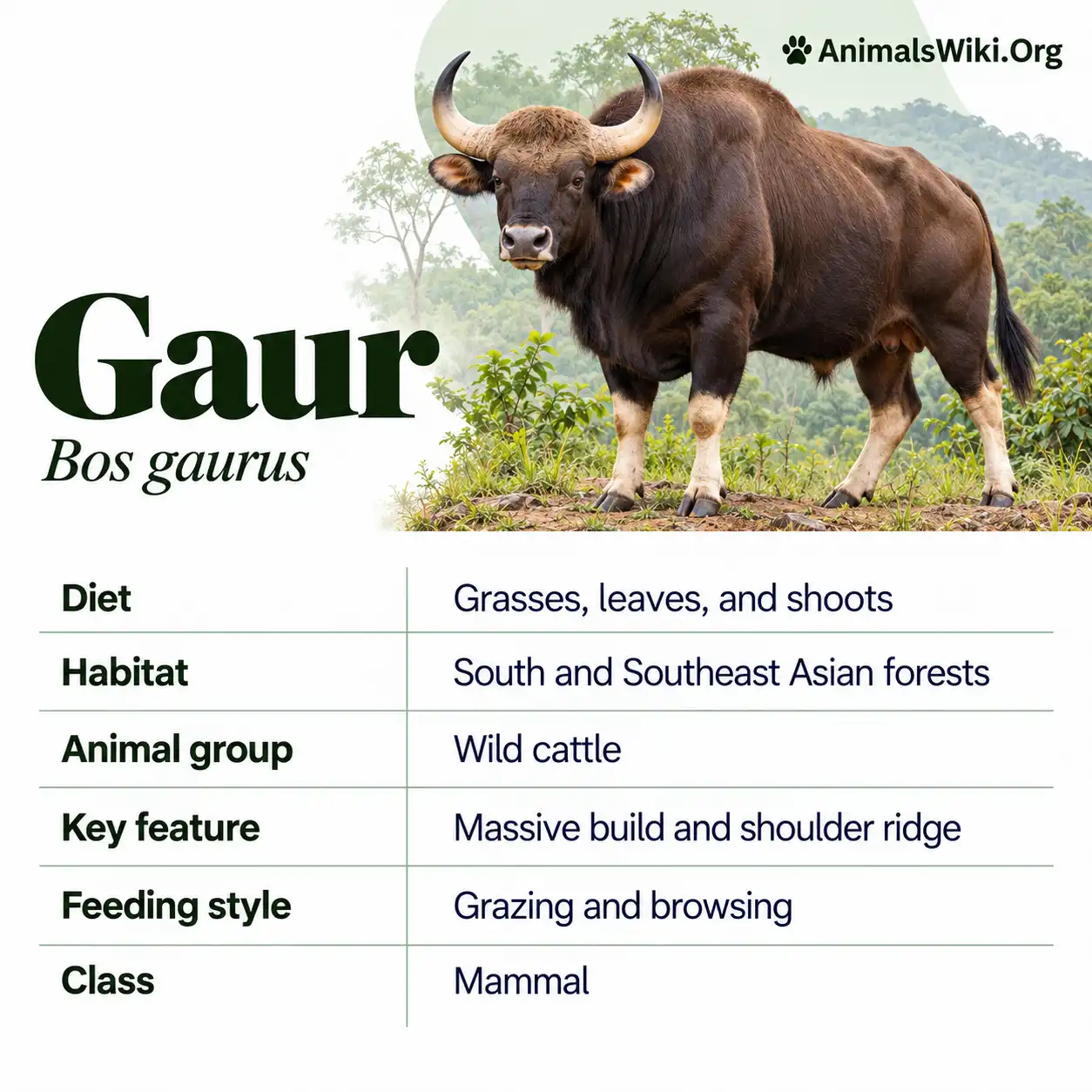
A massive dark animal stands at the edge of a forest clearing. Its shoulders rise above a muscular body, pale stockings contrast with its coat, and curved horns frame a broad forehead. Nearby, several females feed while a calf remains close to its mother.
This is the gaur, one of Asia’s most impressive mammals and the largest living wild cattle species.
Often called the Indian bison, the gaur is native to South and Southeast Asia. It belongs to the same broad cattle group as banteng, domestic cattle and true bison, but it has its own evolutionary history, appearance and ecological role.
Its strength can create a misleading impression of security. Gaur remain vulnerable to hunting, habitat fragmentation, livestock-associated disease and conflict with people. Some protected populations have recovered, while others have declined or disappeared locally.
Understanding the species requires looking beyond spectacular photographs of enormous bulls. Female survival, calf recruitment, connected habitat and genetic diversity all influence whether a population can persist.
This guide covers gaur identification, classification, regional taxonomy, distribution, feeding, adaptations, behavior, reproduction and conservation. It also explains the relationship with domestic mithun and distinguishes dated wild population estimates from captive or domestic animal counts.
Gaur Facts
| Feature | Key information |
|---|---|
| Common name | Gaur |
| Familiar alternative name | Indian bison |
| Scientific name | Bos gaurus |
| Family | Bovidae |
| Subfamily | Bovinae |
| Native region | South and Southeast Asia |
| Animal type | Large wild cattle and ruminant |
| General adult mass | Approximately 440–1,000 kilograms in specialist summaries; exceptional individuals may differ |
| Shoulder height | Approximately 1.5–2.2 meters across sexes and populations |
| Distinctive features | Powerful shoulders, dorsal ridge, curved horns and pale lower legs |
| Main diet | Grasses, together with leaves, herbs and other plant material |
| Social organization | Herds centered on females and young; adult males may be solitary or join herds |
| Young | Calves |
| Pregnancy | Approximately nine months |
| Typical birth | One calf |
| Longevity | Managed animals can survive beyond 20 years |
| Current global category | Vulnerable |
| Dated global estimate | 15,000–35,000 wild animals in the 2016 IUCN assessment |
| Mature-individual estimate | Approximately 6,000–21,000 in that assessment |
| Domestic relative | Mithun or gayal, usually called Bos frontalis |
What Is a Gaur?
A gaur is a large wild bovine native to the forests and associated landscapes of South and Southeast Asia. Its scientific name is Bos gaurus.
The species belongs to Bovidae, the family containing cattle, buffaloes, antelopes, sheep and goats. Within this family, gaur belong to the cattle-related subfamily Bovinae and tribe Bovini.
Its common alternative name, Indian bison, is deeply established in wildlife writing. However, “gaur” is the clearer name because it avoids confusing the animal with American or European bison.
Gaur are herbivores. Their size, digestive system and feeding behavior allow them to use substantial amounts of vegetation, including grasses that are difficult to process without microbial fermentation.
They also occupy an important position in Asian food webs. A mature bull is a formidable animal, yet gaur remain prey for tigers in landscapes where both survive.
The domestic relationship is equally interesting. Mithun, also known as gayal, are closely associated with gaur ancestry and are important managed bovines in parts of northeastern India and neighboring regions.
Wild gaur conservation nevertheless concerns more than preserving cattle-like animals. It aims to maintain populations that reproduce, move and function within their natural landscapes.
Identification and Physical Appearance
A powerful shoulder region
The gaur’s most striking feature is its muscular build.
Mature males have especially massive shoulders and a prominent ridge along the upper back. Their body shape differs from that of a typical domestic cow and contributes to the species’ imposing silhouette.
A fold of skin, or dewlap, may be visible beneath the neck.
The degree of development varies with sex and age. A young gaur should not be expected to resemble a fully grown bull.
Dark coats and pale stockings
Adults commonly have brown to very dark coats, with males often appearing darker than females.
The lower legs are pale, creating the familiar stocking-like markings. Calves are lighter, frequently appearing golden or reddish-brown.
These color differences are useful, but lighting can be deceptive. A wet coat in deep forest shade may appear almost black, while the same animal can look browner in sunlight.
The forehead and horns
Both sexes carry horns.
The broad forehead and pale area between the horn bases are characteristic identification features. Horns extend outward and curve upward, with dark tips contrasting against paler portions in older animals.
Their appearance changes during development.
A study following captive gaur found that horn shape and the amount of pale coloration helped classify age and sex. However, exact ages of mature animals could not be reliably read from a photograph alone.
How large is a gaur?
Specialist summaries describe adult mass across a broad range of several hundred kilograms to around one tonne, with males generally heavier than females.
Large bulls may stand close to or above two meters at the shoulder.
These figures describe variation rather than the normal size of every individual. Females, young animals and populations in different regions can be substantially smaller.
The Kadoorie Farm and Botanic Garden describes mature bulls reaching approximately 2.2 meters at the shoulder and about a tonne in weight.
For identification, proportions are usually more useful than an unsupported weight estimate from a photograph.
Scientific Classification
Gaur taxonomy
| Taxonomic rank | Classification |
|---|---|
| Kingdom | Animalia |
| Phylum | Chordata |
| Class | Mammalia |
| Order | Artiodactyla |
| Suborder | Ruminantia |
| Family | Bovidae |
| Subfamily | Bovinae |
| Tribe | Bovini |
| Genus | Bos |
| Species | Bos gaurus |
The Mammal Diversity Database recognizes wild gaur as Bos gaurus and lists their current global conservation category as Vulnerable.
Some references use Cetartiodactyla for the wider order that includes even-toed ungulates and whales. This terminology does not change the gaur’s placement among ruminant bovids.
Why some sources use Bos frontalis
Historical and current sources do not always handle wild and domestic forms identically.
The name Bos frontalis is generally applied to mithun or gayal, while Bos gaurus is used for the wild animal.
Some databases and older biological compilations combine information under one of these names. Researchers and writers must therefore inspect the population being described rather than assume that every record concerns wild gaur.
India’s Central Zoo Authority explains the distinction between the wild name and the domestic name in its species documentation.
Naming does not establish a census category
A domestic population can be closely related to a wild species without belonging in its wild population estimate.
Likewise, captive gaur held in a zoo are biologically gaur but remain a managed population.
Taxonomy describes relationships and naming. A conservation count must additionally specify ancestry, management and location.
Keeping these categories clear prevents livestock abundance from creating a false impression that wild populations are secure.
Subspecies and Regional Taxonomy
The traditional three-subspecies arrangement
Many books and zoo labels recognize three regional forms.
| Traditional name | Broad geographical association |
|---|---|
| Bos gaurus gaurus | India and neighboring parts of the subcontinent |
| Bos gaurus readei | Myanmar and adjoining mainland Southeast Asian areas |
| Bos gaurus hubbacki | Peninsular Malaysia and southern Thailand |
The name seladang is particularly associated with gaur in Malaysia.
These regional labels remain familiar, but their taxonomic basis needs qualification.
A two-subspecies alternative
Other treatments combine much of the Southeast Asian variation under Bos gaurus laosiensis, producing a two-subspecies arrangement.
The 2016 IUCN account provisionally used an Indian form and a Southeast Asian form, while noting the need for further study.
The older three-part system relied heavily on limited morphological material, and a 2018 species account questioned the characters originally used to separate those forms.
What can be stated confidently?
Gaur populations show geographical variation.
However, one universally accepted subspecies map should not be assumed. The names used can depend on the taxonomic source and its interpretation of morphological and genetic evidence.
A practical article can identify the traditional names while explaining that two-subspecies treatments also exist.
For conservation, protecting regional diversity remains important even where the exact rank is unsettled. A population does not become expendable because scientists disagree over whether it represents a subspecies.
Why the distinction matters
Breeding programs and translocations may need to consider ancestry and regional adaptation.
Moving animals purely because they share the same species name can overlook differences relevant to disease, behavior or genetic management.
Conversely, a historical subspecies label alone should not be treated as proof that two populations can never be managed together.
Evidence must guide the decision.
Gaur Compared With Bison, Banteng and Buffalo
Gaur are often confused with other large bovines.
The comparison is easiest when body shape, markings and geographical context are considered together.
| Animal | Useful identifying features | Important distinction |
|---|---|---|
| Gaur | Massive shoulders, dorsal ridge, pale stockings and broad forehead | Asian wild cattle, usually called Bos gaurus |
| Banteng | White rump patch and pale legs; adult cows often reddish-brown | A separate Southeast Asian wild cattle species |
| American bison | Shaggy forequarters, large head and pronounced shoulder hump | Native to North America |
| European bison | Tall, heavy-bodied European bovine with a different head and coat profile | A separate species from gaur |
| Wild Asian water buffalo | Broad horn spread and a different body profile | Belongs to Bubalus |
| Mithun or gayal | Managed bovine with close gaur ancestry; appearance varies | Domestic or semi-domestic populations |
The name Indian bison does not make gaur an Indian population of American bison.
Nor does a dark coat with pale legs automatically identify a gaur: banteng and some domestic bovines can share parts of that pattern.
For a field record, location and population history can be as important as a clear photograph.
Distribution
South and Southeast Asia
Gaur occur across parts of the Indian subcontinent and mainland Southeast Asia.
The current Mammal Diversity Database lists India, Nepal, Bhutan, Myanmar, Thailand, Laos, Cambodia, Vietnam, Malaysia and China, while marking Bangladesh with uncertainty.
This is a country-level overview, not evidence of continuous occupation within every listed country.
The species has disappeared from many former areas and now occupies a fragmented distribution.
India
India holds the largest share of the remaining wild population.
Important landscapes include the Western Ghats, central Indian forests and parts of northeastern India.
Even within India, gaur are not uniformly distributed. Large protected populations coexist with isolated groups and places where the species has become locally extinct.
A photograph of a large herd in one reserve cannot establish the condition of the species across the country.
Nepal and Bhutan
Gaur occupy suitable forest landscapes in the Himalayan foothills and adjoining regions.
Recent Nepalese research has examined habitat use in Chitwan and Parsa, emphasizing the importance of local ecological conditions and human pressures.
These populations help demonstrate that gaur are not limited to one particular type of Indian forest.
Mainland Southeast Asia
Thailand retains several important populations, including places where protection has supported recovery.
Elsewhere, hunting and habitat loss have severely reduced numbers.
China’s remaining gaur are restricted to southern areas, while conservation initiatives have worked with community forests to protect surviving populations.
The regional picture is therefore uneven. Broad statements that gaur are either “common everywhere” or “disappearing everywhere” both obscure important differences.
Habitat Requirements
Forest is central
Gaur use evergreen, semi-evergreen, moist deciduous and other forest types, together with associated grasslands and openings.
They need feeding opportunities, cover, water and sufficient space to move between resources.
A forest without accessible forage may be less useful than a varied landscape containing suitable clearings.
However, an isolated feeding patch surrounded by dangerous human activity may also be inadequate.
Hills are not the whole story
Gaur are frequently described as hill animals, partly because they survive in rugged areas where lowlands have been converted.
That description should not be mistaken for proof that steep terrain is always preferred.
Historical field studies found important use of low-lying areas where suitable habitat remained.
The distinction matters when restoring habitat: conserving only difficult terrain can overlook productive lowland areas that animals formerly used.
Seasonal habitat changes
Food quality and water availability change through the year.
In a South Indian study, gaur shifted their use of moist and dry deciduous habitats between seasons.
Such movements connect patches that may appear separate on a static map.
Protecting one seasonal feeding area while blocking access to another can leave a population vulnerable during part of the year.
Local studies improve management
A study published in 2024 investigated summer habitat use in Chitwan National Park using direct observations and indirect signs collected in July and August 2022.
Its value lies in connecting animal occurrence with conditions at a defined place and time.
Winter research in Parsa provides a complementary perspective, showing why one season’s survey should not be treated as a complete description of habitat use.
Diet and Feeding
What do gaur eat?
Gaur consume grasses, leaves, herbs, shoots and other plant material.
They are often predominantly grazers, but they also browse. The balance depends on habitat and season.
Their diet is more selective than the phrase “eats vegetation” suggests. Plant species, growth stage and nutrient content affect what is useful.
A landscape can look green while containing little high-quality forage.
Evidence from South India
A study comparing gaur, chital, sambar and Asian elephants used plant-quality data, habitat surveys and stable isotopes to examine feeding relationships.
Gaur remained primarily grazers for much of the year in that study, while other herbivores used different combinations of grass and browse.
This is a useful example of resource partitioning: large herbivores can share a landscape without using every food in the same way.
Evidence from Nepal
A Nepalese study identified a diverse diet from microscopic plant remains in fecal samples.
Grasses formed the largest component, accompanied by browse and other foods. The proportions varied between months.
The findings reinforce the importance of a mixed food supply rather than reliance on one grass species.
Food quality changes
Young growth and mature vegetation differ in digestibility and nutrients.
A separate fecal-analysis study found seasonal changes in gaur diet quality associated with plant development.
This helps explain why animals move even when vegetation remains visibly abundant.
Do gaur hunt?
No. Their normal feeding strategy is herbivorous grazing and browsing.
References to gaur hunting usually concern humans hunting gaur or predators attacking them.
Powerful horns and a muscular body are not evidence of a predatory diet.
Digestion and Adaptations
Rumination
Gaur are ruminants.
They swallow plant material, later regurgitate it as cud and chew it again. Microorganisms in the digestive system help break down fibrous components.
This partnership enables them to obtain energy from foods that humans cannot digest efficiently.
It also means that resting behavior is part of feeding. An apparently inactive animal may be processing food consumed earlier.
A large body brings advantages and costs
Size can reduce vulnerability to many predators and allow the use of substantial food volumes.
At the same time, a large animal needs a dependable resource base.
A forest fragment that supports small deer may not provide enough connected habitat for a viable gaur population.
Hooves and movement
Cloven hooves support travel across forest floors, slopes and open ground.
Gaur can move surprisingly quickly despite their size, which is important for both escape and safe observation.
Their appearance should never encourage close approaches on foot.
Horns and defensive ability
Horns are useful in competition and defense, but avoidance is often the first response to danger.
An animal can be normally wary and still become dangerous when cornered.
Strength does not remove vulnerability to snares, firearms or habitat loss. Those threats operate very differently from a natural contest between animals.
Sensory awareness
Like other cattle, gaur use hearing, smell, vision and body position to assess their surroundings.
A herd’s alert posture can spread rapidly as individuals respond to one another.
For observers, a lifted head or paused feeding is a reason to remain still and give space rather than move closer.
Herd Organization and Communication
Females and young
Females and young form the core of gaur herds.
Herd membership provides a social setting for calves and can improve detection of danger.
The number of animals together changes with resources and local conditions. A large aggregation at an attractive feeding site is not necessarily a stable permanent herd.
Adult males
Adult bulls may accompany herds or live alone.
Older males are especially likely to be solitary, although this is a tendency rather than an inflexible rule.
A solitary bull is not automatically injured, abandoned or unable to find companions.
Social relationships
Gaur interactions include attention to body size, posture and access to space.
Conflict can occur without every encounter ending in a fight.
Avoiding unnecessary injury is important for a large herbivore whose ability to walk and feed determines survival.
Sounds
Gaur use vocalizations as well as visual and chemical information.
San Diego Zoo’s wild-cattle account notes distinctive male gaur calls, illustrating that their social behavior includes more than horn displays.
Specific meanings should be interpreted from observed context rather than assigned to every sound.
Herd flexibility
Protected-area descriptions from Khao Yai document variable group sizes and changing associations of bulls, cows and young.
These observations support a flexible picture rather than a universal one-bull herd model.
Daily Activity and Seasonal Movements
Feeding and resting cycles
Gaur alternate between feeding, movement and rest.
Heat, shade, food distribution and disturbance influence when these activities occur.
They may be active during daylight, twilight or darkness. Describing them as strictly nocturnal everywhere is inaccurate.
Responses to people
Where contact with people is frequent or threatening, animals may change their timing or use of space.
This flexibility can reduce encounters, but it may carry costs if animals lose access to productive feeding periods or safe routes.
A shift toward nighttime activity does not necessarily mean the population is unaffected by disturbance.
Home range
A home range is the area an animal uses during normal activities.
It is not necessarily a territory defended against every other gaur.
Range size varies with resource distribution, season, sex and individual history.
Movement at forest edges
A 2024 study in eastern Thailand investigated gaur moving through the transition between protected forest and human-dominated land.
The work connects ranging behavior with crop-raiding challenges around a recovering population.
Such studies show why a protected-area boundary is a human line rather than an ecological barrier recognized by the animals.
Reproduction and Mating
Maturity and breeding opportunity
Sexual maturity does not always mean immediate reproductive success.
Young males must still develop the size and condition needed to compete with mature bulls.
Females also need adequate nutrition to sustain pregnancy and lactation.
A detailed life-history study combining field and captive records found a mean age at first birth of about three years in its data.
Breeding season
Gaur can breed throughout the year, with peaks varying between populations.
Rainfall, forage and local conditions influence the timing.
A breeding peak reported from one Thai park should not be applied unchanged to every population in India or Nepal.
Pregnancy and birth
Pregnancy lasts approximately nine months, with about 275 days commonly cited.
Females generally give birth to one calf.
The rounded description is appropriate because biological records and individual pregnancies vary.
The cost of raising a calf
A female invests in pregnancy and then milk production over many months.
This slow reproductive pattern affects recovery.
A population cannot rapidly replace sustained losses of adult females in the way a short-lived, highly prolific rodent might.
Why births alone are insufficient
Managers must distinguish births from recruitment.
Recruitment means young surviving into later stages and contributing to the population.
A herd producing calves can still decline if adult mortality or juvenile losses remain high.
Calf Development
A golden-brown beginning
Newborn gaur are lighter than mature adults, often with a conspicuous golden or reddish-brown coat.
They can stand and move relatively soon after birth but remain dependent on their mothers.
The mother may separate temporarily from the main herd around calving and use concealment before returning with the calf.
India’s national studbook describes this early hiding phase and its potential protective role.
Milk and vegetation
Calves begin investigating and eating plants while still nursing.
This overlap is normal. A calf nibbling grass has not necessarily become nutritionally independent.
Weaning is gradual, and reported timing varies among sources and management conditions.
Changing appearance
Growth includes changes in height, horn development, color and body proportions.
Young males and females can be difficult to distinguish reliably.
The same calf may look quite different across a year of camera-trap records, which complicates individual recognition.
An unusual nursing observation
A report published in 2026 described allonursing observed during March 2025: a female allowed a calf from another natal herd to suckle in a translocation enclosure.
This documents a possible behavior under those circumstances, not a claim that all gaur routinely share nursing duties.
It adds to the evidence that gaur social responses can be flexible, particularly when groups are reorganized.
Lifespan and Survival
Potential longevity
Gaur can live beyond 20 years in managed conditions.
AnAge records a captive longevity of 26.2 years in a compilation using the older Bos frontalis treatment for gaur.
This is an exceptional record, not an average for wild animals.
Wild survival
Wild life expectancy depends on age, sex, population and threat levels.
Hunting, injury, disease, food shortages and predation all influence outcomes.
An adult surviving for many years in a well-protected reserve does not establish the survival prospects of an animal near an intensively hunted forest edge.
Differences between sexes
The life-history analysis published in 2011 found higher female survival than male survival beyond the early years in its study material.
It also reported females remaining fertile beyond 15 years.
These findings demonstrate why age and sex structure matter alongside the total count.
Why demographic structure matters
A population dominated by older animals may contain many individuals but produce relatively few recruits.
A population with many calves but few surviving breeding adults faces a different problem.
Counts become more informative when accompanied by age classes, sex ratios and repeated observations.
Predators and Competitors
Tigers
Tigers are the principal natural predator capable of regularly taking large gaur.
They can kill calves and adults, although attacking a substantial bovine carries risk.
Research in Thailand has examined the sizes of gaur and banteng killed by tigers, emphasizing their importance as large prey.
Claims that only sick gaur can ever be killed are too absolute.
Other predators
Calves and weakened individuals can be vulnerable to other carnivores, depending on location.
Predator communities vary across the gaur’s range, so a single universal list can be misleading.
The vulnerability of a newborn calf is not equivalent to that of a mature bull.
Defensive behavior
Adults may face a threat, bunch together or position themselves near vulnerable young.
Horns and body mass make a close attack dangerous.
However, natural defense offers little protection against concealed snares or long-distance shooting.
Competition
Gaur share landscapes with deer, elephants, other bovines and domestic livestock.
Dietary overlap does not automatically mean harmful competition. Animals can use different foods, heights, seasons or habitats.
Competition becomes more significant when a limited resource is reduced by one consumer in a way that affects another.
Livestock also create disease and management risks separate from competition for food.
Ecological Importance
Herbivory
Gaur consume substantial amounts of vegetation.
Their feeding influences plant structure and the distribution of grazing pressure.
The result depends on plant community, animal density and season. Herbivory is a process, not an automatic guarantee of increased biodiversity.
Dung and decomposers
Dung provides resources for insects and microorganisms.
A study in the Western Ghats examined the dung-beetle community attracted to gaur dung and compared it with beetles associated with elephant dung.
This makes the ecological connection tangible: a large mammal supports many smaller organisms that help break down and redistribute organic material.
Supporting predators
Gaur are important prey in some tiger landscapes.
Their recovery can improve the food base available to large carnivores.
This relationship also explains why effective tiger conservation needs attention to herbivores, not only the predator itself.
Landscape function
Moving, feeding and depositing dung connect different parts of a landscape.
A gaur’s ecological role is therefore not confined to the place where it is photographed.
Maintaining natural movement supports these processes and helps animals respond to seasonal conditions.
Domestic cattle cannot simply be assumed to replace the same role without changing other ecological relationships.
Population Estimates Explained
The widely cited global figures
The 2016 IUCN assessment estimated 15,000–35,000 wild gaur of all ages.
It separately estimated approximately 6,000–21,000 mature individuals, based on an assumed mature fraction of about 40–60%.
The assessment cautioned that many available population figures were uncertain.
These estimates should remain labeled 2016. They are not a verified new global count for October 2026.
Why the ranges are broad
Gaur occupy large and sometimes difficult landscapes.
Detection varies with vegetation, animal movement, survey effort and method.
Some sites have repeated systematic surveys, while others depend on sparse observations or expert judgments.
A broad range honestly reflects this uneven evidence.
Total animals versus mature individuals
| Measurement | What it describes |
|---|---|
| Total wild individuals | Calves, juveniles and adults in wild populations |
| Mature individuals | The reproductive population component under assessment definitions |
| Local survey estimate | Animals inferred within a specific study area |
| Captive inventory | Managed gaur alive within identified institutions |
| Domestic mithun count | Livestock populations, reported separately from wild gaur |
The two global figures do not contradict each other. They count different biological categories.
Local recovery
A 2022 study described recovery from roughly 35 to 300 gaur over about three decades at Khao Phaeng Ma in Thailand.
It simultaneously found low genetic diversity and growing conflict around the protected area.
Population growth can therefore be real while additional conservation problems remain.
Why captive counts stay separate
A zoo population contributes to conservation but does not demonstrate recovery in native habitat.
The same applies to domestic mithun.
Combining wild, captive and domestic animals into one headline number would obscure the condition the assessment is intended to measure.
Conservation Status
Vulnerable
Gaur remain listed as Vulnerable in the current Mammal Diversity Database and IUCN specialist-group information checked for this article.
Vulnerable is a threatened category.
It does not mean the species is close to disappearing from every site. Nor does it mean conservation action can be postponed until only a few animals remain.
Global and local assessments differ
A species can be globally Vulnerable while a particular national population is in a more serious condition.
Conversely, one well-protected herd can increase while the wider species continues to face decline.
The scale of an assessment must remain clear.
Legal protection and extinction risk
A legal listing regulates activities. A Red List category evaluates extinction risk.
They are related but separate systems.
Strong protection on paper does not guarantee low hunting pressure, connected habitat or sufficient management resources.
Conservation success must ultimately be demonstrated through populations and habitat, not legal designation alone.
Threats to Gaur
Hunting
Gaur are hunted for meat and trophies.
Loss of breeding adults can be particularly damaging because reproduction is slow.
Even where animals are not deliberately targeted, indiscriminate traps can injure or kill them.
Habitat loss
Forest conversion removes feeding areas, cover and movement routes.
A population may persist temporarily after fragmentation while becoming increasingly isolated.
The apparent presence of animals should not be treated as evidence that enough habitat remains for long-term survival.
Livestock contact
Domestic livestock can compete for forage and create opportunities for pathogen transmission.
Disease concerns are part of gaur conservation planning, particularly where cattle enter wildlife habitat.
The importance of each disease varies between places and time periods; a general risk should not be turned into an unsupported claim of an ongoing outbreak.
Small-population genetics
An isolated population may increase numerically while retaining the genetic limitations of a small founder group.
The Thai genetic study provides a direct example.
More animals can improve demographic security, but genetic diversity may recover only through appropriate connectivity or carefully planned management.
Human infrastructure
Roads, settlement expansion and other barriers can alter movement and increase close encounters.
The impact depends on placement and use, not simply the total area occupied.
A narrow development corridor can have an outsized effect if it cuts the only practical route between seasonal habitats.
Human–Gaur Conflict
Why gaur enter farms
Crops can provide concentrated, nutritious food.
Fields may lie beside shelter or along established movement routes.
Gaur entering farms are responding to resources, but the resulting losses can be serious for people.
Understanding that mechanism is necessary for effective management.
Crop loss and safety
Conflict can include damaged crops, property loss, injuries and deaths.
A 2025 study analyzed compensation records across 48 forest divisions in Tamil Nadu for 2016–2024, documenting the spatial and seasonal nature of reported incidents.
These records are valuable, but they represent reported and recorded events rather than every encounter.
Conflict is not evidence of aggression everywhere
An animal can normally avoid people and still injure someone during a close, unexpected encounter.
The immediate circumstances matter: blocked escape, crowding, calves, dogs and attempts to drive animals can all influence risk.
A dramatic incident should not become a description of every gaur.
Better responses
Useful approaches connect site-specific barriers, land-use planning, reliable reporting and trained response teams.
Communities also need practical support for losses and realistic expectations about what conservation requires.
A study spanning parts of the Eastern and Western Ghats showed that human–megaherbivore interactions are shaped by both landscape and household conditions.
Conflict management works best when it addresses both the animals’ movements and the costs borne by people.
Conservation and Reintroduction
Protect connected habitat
Connected landscapes allow movement, mating and responses to changing conditions.
A corridor must be usable and reasonably safe, not merely a green strip on a map.
Protection from hunting remains essential within corridors as well as reserves.
Restore locally extinct populations
Gaur were reintroduced to Bandhavgarh Tiger Reserve from Kanha in two stages: 19 animals in January 2011 and 31 in March 2012.
The Wildlife Institute of India documented subsequent monitoring of movement, habitat and feeding.
This was a managed restoration project, not spontaneous recolonization.
Follow animals after release
A 2013 study examined the first reintroduced gaur’s home ranges, habitat use and diet.
Such monitoring helps establish whether animals remain, feed successfully and integrate into the landscape.
Release is a starting point rather than the final measure of success.
Supplementation
Adding animals to an existing population can address demographic or genetic objectives.
A Wildlife Institute of India project running from 2024–2027 focuses on gaur population management and supplementation at Bandhavgarh.
The relevant questions include source-population effects, health, social compatibility and survival after movement.
Captive breeding
Managed populations can preserve animals, support research and contribute to conservation planning.
Their value increases with accurate pedigrees, coordinated breeding and clear links to wild-population needs.
However, captive breeding cannot compensate indefinitely for habitat loss and hunting outside the enclosure.
Gaur, Mithun and Domestic Cattle
What is mithun?
Mithun, also called gayal or mithan, are managed bovines associated with northeastern India and neighboring countries.
They are generally named Bos frontalis and are commonly described as domestic derivatives of gaur.
Their management can include free-ranging or semi-domestic systems, so an animal outside a conventional cattle shed is not necessarily wild.
What does genetic research show?
Mitochondrial studies have found a close relationship between mithun and gaur, supporting gaur ancestry.
Genome research provides additional tools for examining their history, diversity and relationships with other cattle.
The details of domestication and historical interbreeding remain more complicated than a simple statement that every mithun is a recent first-generation hybrid.
Cultural importance
Mithun have substantial social and agricultural importance in parts of their range.
Their value includes more than commercial production and can be connected with community identity and customary practices.
That domestic importance deserves recognition without treating livestock conservation and wild gaur conservation as interchangeable.
Why the distinction matters
A thriving mithun population does not establish that wild gaur are secure.
Wild animals retain natural ecological relationships, regional histories and movement patterns.
Domestic populations represent a related part of bovine diversity, managed under different selection pressures and human institutions.
Both can be valuable, while requiring different conservation and management goals.
Research and Responsible Observation
Studying gaur
Researchers use direct observations, dung and tracks, camera traps, genetic samples, satellite tracking and demographic records.
Each method answers different questions.
| Method | Main contribution |
|---|---|
| Direct observations | Group composition, feeding and behavior |
| Camera traps | Presence, activity and repeated records |
| Dung analysis | Diet, genetics or health information |
| Tracking collars | Movement and space use |
| Repeated surveys | Population trends |
| Pedigree records | Captive breeding management |
No single method reveals every aspect of the species.
Avoid false precision
A herd count, an occupancy estimate and a global population estimate are different measurements.
Likewise, camera detections do not equal unique animals unless identification is possible.
The most useful reports explain what was measured and attach a date and location.
Observe safely
Remain in authorized viewing areas and follow local guidance.
Do not approach calves, surround animals or block their movement.
A gaur feeding calmly near a road is still a powerful wild mammal.
Responsible observation protects both people and animals by allowing the herd to continue its normal behavior without being forced into a response.
Frequently Asked Questions About Gaur
1. What is a gaur?
A gaur is a large Asian wild cattle species named Bos gaurus. It is native to South and Southeast Asia and is recognized by its muscular shoulders, dorsal ridge, curved horns and pale lower legs.
2. Is gaur the same as Indian bison?
Indian bison is a common alternative name for gaur. It does not mean the animal is an Indian population of American or European bison. “Gaur” is the clearer name when discussing its biology and conservation.
3. Is the gaur the largest wild cattle species?
Yes, it is widely recognized as the largest living wild cattle species. Adult males are especially massive. However, exceptional bull measurements should not be presented as the normal size of every gaur, including females and juveniles.
4. How much does a gaur weigh?
Specialist summaries give a broad adult range of approximately 440–1,000 kilograms. Sex, age, population and body condition affect weight. Estimates made from photographs are much less reliable than actual measurements.
5. Do female gaur have horns?
Yes. Both sexes carry horns, but their size and shape differ with age and sex. Horn characteristics can help classify animals, although exact adult ages are difficult to determine from appearance alone.
6. Where do gaur live?
They occur in parts of the Indian subcontinent and mainland Southeast Asia. India holds the largest share of the remaining population. Their distribution is fragmented rather than continuous across every country where they are recorded.
7. Do gaur live only in mountains?
No. They use hills but can also occupy suitable lowland forests and associated habitats. Their survival in rugged terrain partly reflects the loss or conversion of more accessible areas.
8. What do gaur eat?
They eat grasses, leaves, herbs, shoots and other plant material. Many populations are predominantly grazing, but browsing contributes to the diet. Food use changes with habitat, plant growth and season.
9. Are gaur carnivores?
No. They are herbivorous ruminants. Their strength, horns and ability to defend themselves do not indicate a hunting lifestyle. References to gaur hunting usually concern people or predators hunting them.
10. Do gaur live in herds?
Females and young generally live in herds. Adult males may accompany them or live alone. Group size and membership change, so a single herd arrangement should not be applied universally.
11. Why are some bulls solitary?
Solitary living is part of normal adult male behavior, particularly among older bulls. It does not automatically indicate sickness or rejection. Males can change their associations over time.
12. Are gaur nocturnal?
They can be active at night, but they are not strictly nocturnal throughout their range. Temperature, food, disturbance and habitat influence the timing of feeding and rest.
13. How long is pregnancy?
Pregnancy lasts approximately nine months, with around 275 days commonly cited. Females usually produce one calf, making their reproductive turnover relatively slow compared with many smaller mammals.
14. What is a baby gaur called?
A baby gaur is called a calf. Newborns are lighter than adults and can stand and move relatively soon after birth. They still depend on maternal milk and protection.
15. When do females first give birth?
A detailed life-history study found a mean first-birth age of about three years in its data. Nutrition, management and individual circumstances affect the timing, so this is not a fixed deadline for every female.
16. How long can gaur live?
Managed animals can survive beyond 20 years, and a compiled captive record reaches 26.2 years. That figure is a longevity record rather than an average for wild gaur.
17. Can a tiger kill an adult gaur?
Yes. Tigers can kill large gaur, although these are dangerous prey. Field research has examined gaur killed by tigers. Claims that healthy adults are completely invulnerable are incorrect.
18. Are gaur dangerous to people?
They can cause serious injury during close encounters. They often avoid confrontation, but a cornered or disturbed animal may defend itself. Observers should maintain distance and follow protected-area guidance.
19. Are gaur endangered?
Their current global IUCN category is Vulnerable, which is a threatened category. Some national or local populations face more severe conditions, while particular protected populations have recovered.
20. How many gaur remain in the wild?
The widely cited 2016 assessment estimated 15,000–35,000 animals of all ages. This is a dated estimate with substantial uncertainty, not a new global census conducted in 2026.
21. Why do some sources say 6,000–21,000?
That figure refers to estimated mature individuals in the same assessment. It excludes the non-mature component represented in an all-age total. The two ranges measure different categories and should not be treated as contradictory counts.
22. What is the difference between gaur and banteng?
Gaur generally have a more massive shoulder region. Banteng are especially recognizable by a large white rump patch. They are separate Asian wild cattle species with different distributions and conservation circumstances.
23. Is mithun a wild gaur?
Mithun are domestic or semi-domestic bovines closely associated with gaur ancestry, usually named Bos frontalis. Their management and history distinguish them from native wild gaur populations.
24. Can gaur populations recover?
Yes. Protection and well-planned restoration have supported local recovery. However, increased numbers can coexist with low genetic diversity, restricted habitat or crop conflict. Recovery must be assessed through several measures.
25. What are the main conservation priorities?
Reduce hunting, maintain connected habitat, manage livestock-related risks and support communities experiencing losses. Reintroduction and supplementation can help where justified, but they require careful planning and long-term monitoring.
Gaur (Bos gaurus)
The gaur’s enormous body is only the most visible part of its story.
Its survival depends on nutritious vegetation, forest cover, water, social relationships and safe movement through a changing landscape. Its ecological importance extends from grazing and dung production to supporting tigers and other components of Asian food webs.
Some populations show that recovery is possible. Others remain isolated or under pressure, and the global Vulnerable category reflects that broader concern.
Accurate reporting is part of understanding the species: dated estimates must remain dated, mature individuals must be distinguished from all-age totals, and domestic mithun must remain separate from wild counts.
Protecting gaur means preserving functioning populations within connected landscapes while addressing the practical needs of people who share those places.



