
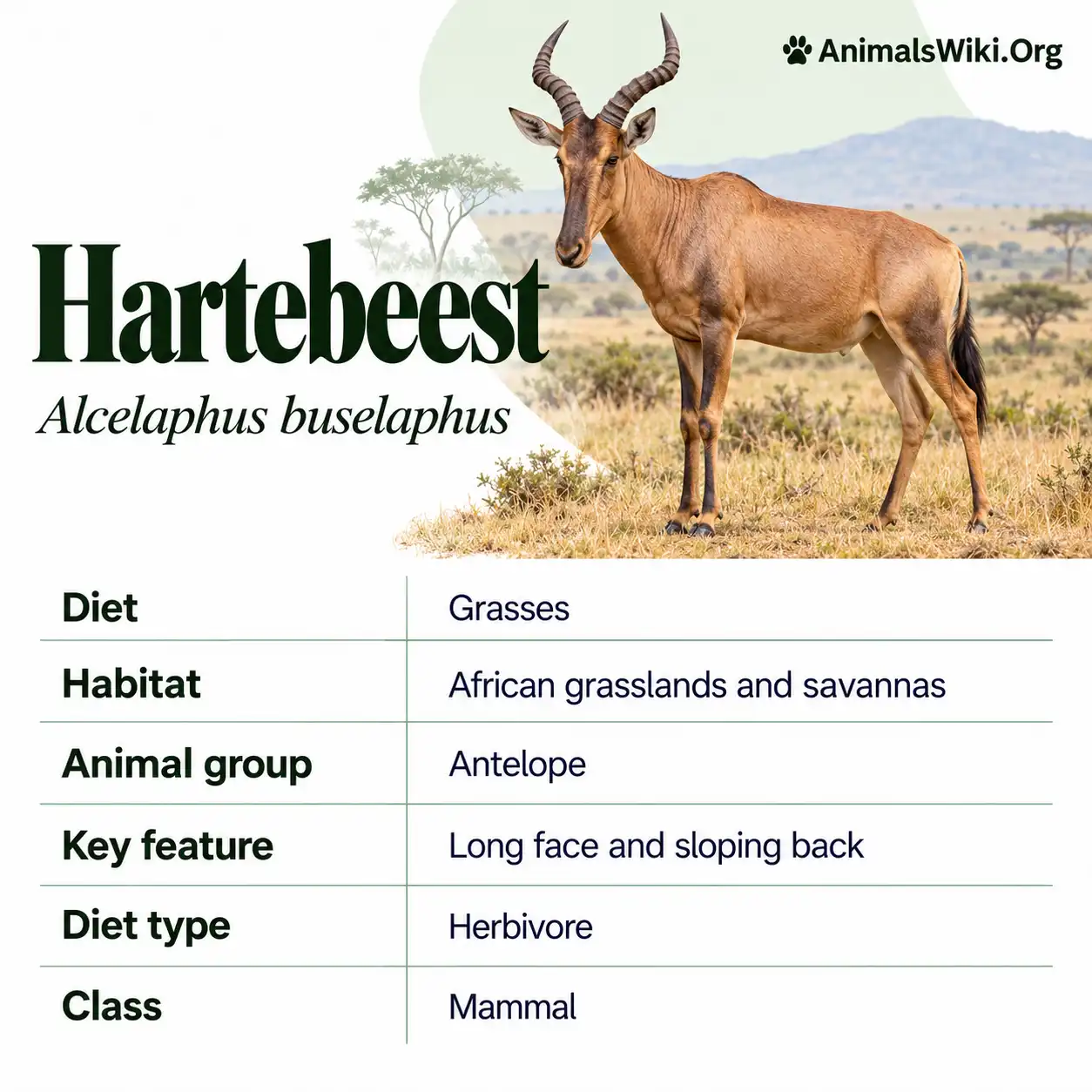
Hartebeest, A Complete Guide to Africa’s Remarkable Long-Faced Antelope
The hartebeest is one of Africa’s most recognizable antelopes once you know what to look for. Its unusually long face, high shoulders, sloping back, and sharply curved horns create a silhouette unlike almost any other grassland animal. Standing quietly, it can appear oddly proportioned. Running across a plain, it reveals the strength and coordination behind that distinctive shape.
Hartebeest belong to a widespread African antelope group whose populations have experienced very different fortunes. Red hartebeest remain relatively numerous in parts of southern Africa. Swayne’s hartebeest survive in a much more restricted setting in Ethiopia. The northern Bubal hartebeest is extinct, while the Tora hartebeest is considered possibly extinct.
These contrasts make it misleading to describe every hartebeest population with one conservation label or an undated worldwide number.
Classification also requires care. Many conservation authorities include eight named subspecies within Alcelaphus buselaphus. Other treatments recognize some of those forms as separate species. The Mammal Diversity Database currently follows an inclusive species arrangement, while acknowledging alternative classifications.
This guide uses the broad species treatment and explains differences among the main forms. It covers identification, distribution, habitat, feeding, behavior, reproduction, ecological relationships, population estimates, and conservation.
The result is a closer look at an animal whose unusual appearance is matched by an equally interesting natural history.
Hartebeest Facts
| Feature | Information |
|---|---|
| Common name | Hartebeest |
| Scientific name | Alcelaphus buselaphus under the inclusive classification |
| Family | Bovidae |
| Tribe | Alcelaphini |
| Animal type | Large herbivorous antelope |
| Main identifying features | Elongated face, high shoulders, sloping back, curved horns |
| Approximate adult mass | Broadly 75–200 kilograms across different forms |
| Approximate shoulder height | Around 1–1.5 meters |
| Coat | Varies from pale sandy brown to reddish or dark brown |
| Horns | Present in both males and females |
| Main food | Grasses |
| Social organization | Female-and-young groups, territorial males, and bachelor groups |
| Pregnancy | Approximately eight months |
| Young | Usually one calf |
| General lifespan reference | Often around 12–15 years; some individuals live longer |
| Broad global status | Least Concern |
| Important exception | Several subspecies face much greater risk |
| Current worldwide census | No comprehensive 2026 count verified for this article |
What Is a Hartebeest?
A hartebeest is an African antelope belonging to the cattle family, Bovidae. It is part of the alcelaphine group, which also includes wildebeest and the tsessebe–topi group.
These relatives share adaptations associated with grazing and life in relatively open environments. However, hartebeest are recognizable through their particularly elongated heads and characteristic horn arrangements.
The word “hartebeest” can refer to the species as a whole or to a particular geographical form. In southern African wildlife discussions, it often means red hartebeest. In East Africa, visitors may encounter Coke’s hartebeest or animals described using regional names.
Why the Name Alone Is Not Enough
A photograph labeled simply “hartebeest” may show an animal from Namibia, Kenya, Ethiopia, or another part of Africa. Those animals can differ noticeably in coat, horns, size, and conservation circumstances.
A complete description should therefore identify the form and location whenever those details are known.
This is particularly important when discussing population numbers. A successful southern African population does not demonstrate recovery of an endangered Ethiopian form.
A Grassland Animal With Local Differences
Hartebeest are strongly associated with grass-based environments, but they do not all occupy identical landscapes.
Some use open plains, others make extensive use of woodland clearings, and some survive in comparatively dry country. Their shared identity should not obscure the ecological differences produced by geography and local conditions.
Scientific Classification
The inclusive classification recognizes Alcelaphus buselaphus as the hartebeest species.
Its original scientific description was published by Peter Simon Pallas in 1766. The Mammal Diversity Database records the original name as Antilope buselaphus and places the modern species within Alcelaphus.
| Taxonomic rank | Classification |
|---|---|
| Kingdom | Animalia |
| Phylum | Chordata |
| Class | Mammalia |
| Order | Artiodactyla |
| Family | Bovidae |
| Subfamily | Alcelaphinae in many references; Antilopinae in the Mammal Diversity Database |
| Tribe | Alcelaphini |
| Genus | Alcelaphus |
| Species | Alcelaphus buselaphus |
| Scientific authority | Pallas, 1766 |
Why Subfamily Names Differ
Some references retain Alcelaphinae as a separate subfamily. Others place the same animals within a broader Antilopinae and recognize Alcelaphini as their tribe.
These arrangements represent different ways of organizing relationships. They do not imply that hartebeest have suddenly become unrelated to wildebeest or tsessebe.
Scientific Names and Common Names
Scientific names are especially useful when common names overlap.
“Kongoni,” for example, is closely associated with East African hartebeest, while “kaama” is associated with the red form. Neither name should be assumed to describe every population identically.
For clarity, this article uses geographical names alongside scientific names where useful.
Subspecies and Taxonomic Differences
The IUCN’s broad treatment includes eight subspecies, one of which is extinct.
Its taxonomy notes specifically include red hartebeest and Lichtenstein’s hartebeest within Alcelaphus buselaphus, while acknowledging classifications that recognize them separately.
| Common name | Subspecies name | Broad geographical association |
|---|---|---|
| Bubal hartebeest | A. b. buselaphus | Formerly North Africa |
| Red hartebeest | A. b. caama | Southern Africa |
| Coke’s hartebeest | A. b. cokii | Eastern Africa |
| Lelwel hartebeest | A. b. lelwel | Parts of central and eastern Africa |
| Lichtenstein’s hartebeest | A. b. lichtensteinii | South-central and southeastern Africa |
| Western hartebeest | A. b. major | Western and west-central Africa |
| Swayne’s hartebeest | A. b. swaynei | Ethiopia; historically a wider northeastern range |
| Tora hartebeest | A. b. tora | Northeastern Africa |
Why Some Authorities Split Them
Differences in horns, body proportions, coloration, geographical history, and genetic evidence have prompted alternative arrangements.
Older reference works, for example, recognized Lichtenstein’s hartebeest as Alcelaphus lichtensteinii. Other authors have proposed broader splitting among hartebeest forms.
There is no benefit in presenting this disagreement as fully resolved when authoritative sources still use different treatments.
What Is Jackson’s Hartebeest?
“Jackson’s hartebeest” appears frequently in research and conservation work in Kenya and neighboring areas.
The name is not an additional ninth subspecies in the eight-form IUCN arrangement used above. It has been applied to regional animals associated with the Lelwel–Coke’s transition and to local conservation populations.
Readers should follow the definition given by the study rather than automatically adding every familiar name to a subspecies list.
Practical Consequences of Taxonomy
Classification affects which populations are combined in a status assessment.
If several forms are grouped, a relatively secure population can contribute substantially to the species total. Under a split treatment, each narrower species may require its own assessment.
The animals still need protection regardless of which arrangement is adopted.
Appearance and Identification
The hartebeest’s most useful identifying feature is its head. The face is long, the forehead extends upward toward the horns, and the muzzle appears comparatively narrow.
The body has strong shoulders and lower hindquarters, producing a sloping back. The legs are long, while the neck can appear relatively short beneath the elongated head.
Coat Variation
Hartebeest do not all have the same color.
Western animals can be relatively pale, red hartebeest have a rich reddish tone with contrasting dark areas, and Swayne’s hartebeest can appear much darker.
Light changes the appearance of these colors considerably. Early sunlight may make an animal look warmer and redder than it appears in shade.
Horns in Both Sexes
Males and females carry horns, although male horns are generally heavier.
The horns often appear angular, rising from a relatively high base and bending in ways that differ among forms. Horn shape is therefore useful, but it should be considered alongside location and body pattern.
A broken horn, unusual viewing angle, or immature animal can complicate identification.
Telling Males From Females
Males are generally larger and more strongly built. However, differences are less obvious when animals stand apart or when their ages differ.
One photograph without scale may not provide enough information for a confident sex determination.
Recognizing Healthy Variation
A lean adult is not necessarily starving, and an animal with worn horns is not necessarily diseased.
Reliable assessments of condition require more than appearance. Movement, feeding, injury, age, and repeated observations can all help explain what a viewer sees.
Hartebeest Compared With Similar Antelopes
Hartebeest can be confused with tsessebe, topi, or wildebeest when viewed at a distance.
| Animal | Useful identification features | Main difference from hartebeest |
|---|---|---|
| Hartebeest | Very long face, high horn bases, sloping back | Reference animal |
| Tsessebe | Glossy reddish-brown coat, darker patches, smoother horn outline | Face and horn arrangement usually appear less elongated |
| Topi | Similar outline to tsessebe; regional markings vary | Geographical context is especially important |
| Wildebeest | Broad muzzle, mane, heavy head, spreading horns | More robust head and very different horn profile |
| Blesbok | Strong white facial blaze | Bold facial marking is usually conspicuous |
| Bontebok | Contrasting white areas and different body proportions | More sharply patterned appearance |
Hartebeest Versus Wildebeest
Both belong to the same wider antelope tribe, but their heads create very different impressions.
A wildebeest has a broad muzzle and a heavy-looking face. A hartebeest appears longer and narrower through the head, with the horns arising much higher.
Their young also illustrate different survival strategies. Wildebeest calves commonly follow mothers quickly within open groups, while hiding behavior is important in studied hartebeest populations.
Hartebeest Versus Tsessebe
Both have elevated shoulders and sloping backs.
The hartebeest’s especially long face and angular horns are generally the clearest distinctions. Tsessebe often show a smoother, darker, glossier body outline.
The comparison is most reliable when animals are seen from the side and front rather than only from behind.
Evolutionary History
Hartebeest belong to an African radiation of grazing antelopes shaped by changing climates and landscapes.
Their history involves geographical separation, population expansion, and periods when suitable habitat contracted.
Climate and Population Separation
A 2001 genetic study investigated the hartebeest complex in relation to past environmental change.
Its results supported an important role for large climatic fluctuations and separation within favorable refuges. This helps explain how a widespread animal can develop substantial geographical variation over time.
Relationships With Other Grazers
Research comparing hartebeest, topi, and wildebeest found different geographical genetic patterns among these related animals.
Sharing a tribe and a grazing lifestyle does not mean they experienced identical evolutionary histories. Differences in movement and habitat can influence how populations remain connected.
Beyond Present-Day Distribution
Modern range maps show only the surviving part of a longer history.
A 2025 study examined extinct Levantine hartebeest using anatomical and genetic evidence. It adds to understanding of populations that once occurred beyond the species’ present African distribution.
Such findings should not be interpreted as proof that every ancient population belongs neatly to one living subspecies. Historical relationships require evidence rather than resemblance alone.
Historical and Present Distribution
Hartebeest once occupied a much more extensive range.
Their history includes North Africa, broad areas south of the Sahara, and parts of the adjoining Middle East. Today, surviving populations are scattered across suitable African landscapes.
A Range Broken Into Pieces
Agricultural expansion, hunting, settlement, and other pressures have removed populations from many former areas.
The result is not one continuous belt of hartebeest. It is a patchwork of protected areas, wildlife lands, and other surviving populations.
Southern Africa
Red hartebeest occur in parts of Namibia, Botswana, South Africa, and adjoining areas.
Reintroductions and managed wildlife populations have expanded their occurrence in some places. However, an animal established on a property outside its historical range should not automatically be described as a surviving native population.
Eastern and Northeastern Africa
Coke’s and related regional hartebeest occur in parts of eastern Africa. Swayne’s hartebeest have a much more restricted conservation situation in Ethiopia.
Lichtenstein’s hartebeest are particularly associated with south-central African landscapes, including miombo woodland systems and their grassy openings.
Western and Central Africa
Western and Lelwel populations occupy scattered areas rather than an uninterrupted range.
A country appearing on a species distribution list does not mean hartebeest remain common throughout that country. Local surveys are needed to establish current abundance and occupancy.
Habitat Requirements
Hartebeest are associated primarily with grassy environments, but these can include plains, savannas, woodland edges, and clearings.
Compared with some other alcelaphine antelopes, they can make substantial use of taller vegetation and wooded settings.
Open Habitat Does Not Mean Treeless Habitat
A landscape can provide good grazing while retaining scattered trees or woodland patches.
The important questions include how much grass grows, which parts remain accessible, and whether animals can move safely between resources.
Dense vegetation may offer concealment for calves while reducing visibility for adults. Habitat features can therefore have different values at different life stages.
Grass Height and Local Preference
A general species description cannot predict every population’s preferences.
Research on Swayne’s hartebeest in Maze National Park found strong use of grassland and a preference for relatively short available grass. Animals also concentrated in burned areas for a period following fire. The authors cautioned that longer-term evidence was still needed.
Habitat Quantity Versus Habitat Quality
A large reserve can contain only a limited amount of useful feeding habitat.
Equally, a smaller area with productive seasonal resources may support more animals than its size suggests. Conservation planning needs to identify the resources that limit survival rather than rely only on total hectares.
Diet and Digestion
Hartebeest are predominantly grazers.
They consume a high proportion of grass, although feeding choices vary with season, vegetation, and the population concerned.
Are They Selective Feeders?
Descriptions sometimes call hartebeest tolerant of poor-quality forage. That does not mean they eat every plant part indiscriminately.
They can still select leaves, fresh growth, and particular feeding patches. Tolerance and selectivity are compatible: an animal may remain dependent on grass while choosing the best available bites.
The Long-Faced Hypothesis
A 1998 study in Burkina Faso compared hartebeest and roan antelope.
As the hot dry season progressed, hartebeest maintained a grass-dominated diet while roan increased their use of other plants. The researchers linked differences in skull morphology with the ability to acquire and chew scarce grass regrowth.
This provides a functional explanation for the hartebeest’s unusual face without suggesting that one feature explains every aspect of its ecology.
Digestion and Rumination
As ruminants, hartebeest depend on microorganisms to help process fibrous vegetation.
They also regurgitate and rechew food as cud. Grazing, resting, and rumination form connected parts of their daily routine.
Fermentation does not remove nutritional limitations. Very fibrous forage may fill the digestive tract while providing insufficient usable nutrients.
Comparing Grazers
Research in Kenyan rangelands examined feeding choices among hartebeest, wildebeest, zebra, and cattle.
Such studies show why “all eat grass” is an incomplete description of their relationships. The plants and plant parts selected can differ even when animals occupy the same landscape.
Water, Drought, and Seasonal Survival
Water affects hartebeest both directly and through its influence on vegetation.
An animal may obtain moisture from food, visit drinking places, or combine those sources in different proportions.
Flexibility Has Limits
Some hartebeest populations live in relatively dry environments, but drought can still reduce their survival.
Less water in the soil can mean less fresh growth. A visible waterhole therefore cannot compensate fully for a shortage of suitable forage.
Dry-Season Feeding
As grasses mature and dry, animals must spend time locating usable plant material.
The difficulty concerns quality as well as quantity. A plain containing abundant dry stems may offer fewer nutritional opportunities than a much smaller patch of regrowth.
Drought Is Not One Uniform Event
A brief dry period after good rains differs from several poor years in succession.
The effects also depend on soil, vegetation, access to alternative feeding areas, and population density.
Managers should therefore avoid assuming that a strategy successful during one drought will perform identically during another.
Artificial Water
Additional water can alter the distribution of other herbivores and predators as well as hartebeest.
Any decision to provide or remove water should consider those wider effects, particularly in fenced landscapes where animals have limited options for relocation.
Speed and Physical Adaptations
Hartebeest are capable runners despite their unfamiliar proportions.
Their long limbs, strong forequarters, and coordinated movements support rapid travel and escape.
Speed Claims Need Context
Conservation summaries often quote speeds around 70 kilometers per hour. Such figures are useful as broad descriptions of running ability, but they should not be treated as standardized records for every subspecies.
Terrain, age, motivation, and the method of measurement all affect the result.
The more useful biological point is that hartebeest combine speed with the ability to move efficiently over open ground.
The Long Face
An elongated skull accommodates structures involved in gathering and processing grass.
It also contributes to the animal’s distinctive feeding posture. The face is therefore part of its functional anatomy rather than merely an unusual visual feature.
High Shoulders and Long Legs
The sloping outline reflects body structure, not poor balance.
Judging an animal’s abilities from its resemblance to familiar livestock can be misleading. Hartebeest have evolved within environments where movement, grazing, and predator avoidance matter directly to survival.
Horns
Horns play roles in social competition and defense.
They do not replace vigilance or escape. Avoiding a dangerous encounter is usually less costly than relying on a physical confrontation.
Daily Activity and Movement
Hartebeest spend much of their time feeding, resting, ruminating, and interacting with other animals.
The timing of these activities varies with temperature, food distribution, disturbance, and reproductive behavior.
Feeding and Resting
Grazing fills the digestive system, while resting periods allow continued processing of food.
An animal lying down is therefore not necessarily inactive in a physiological sense. Rumination remains an important part of obtaining nutrition.
Responding to Heat
Moving and feeding can increase heat load during hot conditions.
Animals may alter their schedules or use suitable resting locations, but they must balance temperature management with the need to eat.
Movement Does Not Always Mean Migration
Many hartebeest populations are relatively resident, although animals can shift their distribution when resources change.
Short movements within a range, drought-related relocation, and regular long-distance migration are different processes.
An article should not assume that living beside migratory wildebeest means hartebeest follow the same route.
Home Ranges and Territories
A home range describes the area an animal uses. A territory is defended against particular competitors.
Female ranges can overlap several male territories. These concepts should remain separate when interpreting a map or a behavioral observation.
Social Organization
Hartebeest social systems include females with offspring, territorial males, and males without territories.
Group sizes vary, and temporary concentrations should not be confused with permanent herds.
Mothers and Offspring
Maternal relationships can remain important after a calf becomes less dependent on milk.
Older offspring may continue associating with their mother, producing groups containing animals of different ages. This adds complexity to what initially looks like a simple collection of adult females.
Bachelor Males
Young or nonterritorial males can associate outside established breeding territories.
Their opportunities change as they grow, gain experience, or encounter vacancies. Physical maturity does not automatically provide a territory.
Female Relationships
Female groups are not free of competition.
A study of captive female Jackson’s hartebeest examined dominance and aggression, demonstrating that social management can affect animal welfare. Because it concerned captive animals, its findings should not be applied unchanged to every wild herd.
Why Group Size Changes
Food concentration, water, disturbance, births, and interactions with other groups can alter the number of animals together.
A herd count is therefore a snapshot. Repeated observations are needed to understand its social structure.
Territorial Behavior and Communication
Adult males can defend territories containing resources used by females.
Territorial ownership involves repeated communication rather than continuous fighting.
Visual Signals
Posture, orientation, head movements, and deliberate approaches can help rivals assess one another.
A display may prevent a more costly confrontation if one animal withdraws.
Scent and Dung
Hartebeest use scent-related behavior as part of communication.
Research on territorial scent marking discusses the importance of matching scent information with the animal displaying ownership. The general mechanism helps explain why marking and direct encounters can work together.
Fighting
When displays fail, males may engage their horns and wrestle.
Even when most contests end without severe injury, fighting carries costs. Energy expenditure and wounds can affect an animal’s condition and ability to maintain a territory.
Territories Are Ecological
Territorial behavior is connected to how resources and females are distributed.
General research on ungulate mating systems emphasizes the interaction between social conditions and environmental resources. Defending an area makes sense only when its benefits exceed the costs.
Reproduction and Birth
Hartebeest usually produce one calf after a pregnancy of approximately eight months.
Breeding timing differs among regions, so one calendar should not be applied across the entire species.
Seasonal Differences
Some populations have strongly concentrated birth periods, while others reproduce more broadly through the year.
Rainfall and food conditions can influence the benefits of giving birth at particular times. The important relationship is between maternal investment, calf development, and resource availability.
Mating Opportunities
Territorial males may gain access to females moving through their areas.
However, breeding outcomes also depend on female condition, timing, age, and local competition. Holding a territory is one part of reproductive success.
Preparing to Give Birth
Females commonly separate from other animals around birth and use locations providing concealment.
Descriptions of pregnancy length and birth behavior should allow for differences among the forms and studies included under the broad species name. Animal Diversity Web summarizes that geographical variation.
Reproduction Is Only Part of Population Growth
Counting newborn calves does not establish whether a population is increasing.
Adult survival, calf mortality, dispersal, and later recruitment into the breeding population also matter. A herd can produce calves every year and still decline if losses remain high.
Calf Development
A young hartebeest is called a calf.
Its early survival depends on maternal care, suitable cover, and a gradual transition toward greater mobility and independence.
Hiding Behavior
A detailed 1969 study of Coke’s hartebeest documented females separating for birth and calves remaining concealed during roughly their first two weeks.
In the observed births, calves stood and began nursing within the first hour. These are valuable direct observations, but their exact timings should not be treated as universal deadlines.
Why Hiding Can Help
Concealment reduces the chance that a predator detects a vulnerable calf.
A mother remaining some distance away may be participating in this strategy. A solitary calf is therefore not automatically abandoned.
Milk, Grazing, and Growth
Milk supports early development while the calf begins learning to feed on vegetation.
Weaning is a process rather than a single moment when milk suddenly becomes irrelevant. Social learning and association with the mother can continue beyond nutritional dependence.
Growing Horns and Changing Proportions
Young animals gradually develop the head shape and horns associated with adults.
Identification guides based entirely on mature individuals can therefore be misleading when applied to calves or juveniles.
Lifespan and Mortality
General accounts often give a lifespan around 12–15 years, although some hartebeest live longer.
A dependable discussion should distinguish a typical reference range from an exceptional record.
Captive Longevity
The AnAge database reports a captive longevity record of approximately 22.5 years, involving a wild-born animal whose age was estimated when it died under human care.
That record does not mean wild hartebeest commonly reach that age.
Different Causes of Death
Predation, illness, injury, nutritional stress, and human killing can all contribute to mortality.
Their importance differs by location. A population with few predators and active veterinary management experiences different conditions from animals living in an open ecosystem.
Why Adult Survival Matters
A breeding female can contribute offspring over several years.
Losing adults can therefore affect future population growth more strongly than a simple count of current births suggests. Managers need to understand age structure and survival rather than focus only on herd size.
Predators and Escape Strategies
Hartebeest encounter several large African carnivores. The predators involved depend on the landscape and the animal’s age.
Healthy adults, young calves, and individuals in poor condition face different risks.
Detecting Danger
Vigilance can prevent a close encounter.
Seeing a predator early gives an animal time to move toward safer ground or remain alert while feeding. Group members may benefit from one another’s responses.
Escape
Running ability, turning, terrain choice, and distance from cover all influence the outcome of a pursuit.
A top-speed figure alone cannot describe the probability of survival.
Evidence From Laikipia
A 2017 study provided experimental evidence that lion predation contributed strongly to hartebeest declines in a particular Kenyan setting. It also suggested that increasing woody cover could worsen risk.
This is evidence about a studied system, not proof that lions are the principal threat to every hartebeest population.
Apparent Competition
A 2019 study examined how abundant zebra, lions, grazing areas, and hartebeest interacted at Ol Pejeta.
Hartebeest experienced greater mortality risk near locations concentrating zebra and lion activity. This illustrates “apparent competition,” where prey species affect one another indirectly through a shared predator.
Competitors and Livestock
Hartebeest share vegetation with other wild herbivores and, in many places, livestock.
Sharing food creates the possibility of competition, but overlap alone does not establish a harmful effect.
When Competition Becomes Important
Competition matters when one group reduces a limiting resource enough to affect another’s survival or reproduction.
The same two species may coexist with little difficulty during productive months and experience stronger competition during drought.
Livestock Management
Livestock numbers, timing of grazing, access to water, and movement patterns can influence wildlife.
Conservation planning should therefore examine actual land use rather than assume every livestock presence has the same effect.
Shared Landscapes
Research on African savanna herbivores shows that predator recovery, abundant prey, and land management can interact in complicated ways.
A change benefiting one species can create difficulties for another. Those interactions support carefully monitored management rather than simple rules applied everywhere.
Coexistence Requires People
Pastoralists and neighboring communities depend on land and livestock for their livelihoods.
Solutions are more likely to endure when they address those needs alongside wildlife requirements. Conservation cannot be reduced to drawing boundaries without considering how people use the surrounding landscape.
Ecological Importance
Hartebeest contribute to ecosystems through grazing, nutrient cycling, and food-web relationships.
Their effects depend on population density, vegetation, and interactions with other animals.
Vegetation Use
Feeding removes plant material and influences the structure of grazing patches.
Selective use can create uneven patterns, but the outcome also depends on rain, fire, and other herbivores. Hartebeest should not be credited with maintaining an entire ecosystem independently.
Nutrient Redistribution
Dung and urine return nutrients to the soil.
Movement between feeding and resting areas can redistribute those nutrients, while insects and decomposers process the material. These are general herbivore functions rather than a measured continent-wide service supplied exclusively by hartebeest.
Supporting Predators and Scavengers
Hartebeest form part of the prey community.
After death, carcasses can support scavengers and decomposers. Their ecological significance therefore extends beyond the vegetation they consume.
Maintaining Diversity
Different grazers respond differently to the same conditions.
Retaining hartebeest alongside wildebeest, zebra, and other herbivores preserves a wider variety of feeding strategies and ecological interactions.
Population Estimates and Conservation Status
The broad hartebeest species is classified as Least Concern in the IUCN’s 2019 amended assessment, which updates an earlier assessment.
That status should not be confused with the very different conditions of individual subspecies.
The Frequently Repeated 360,000 Figure
An estimate of approximately 362,000 hartebeest traces to the 1999 African antelope compilation.
It remains widely repeated, sometimes rounded to 360,000. It should not be described as a verified 2026 census.
The Endangered Wildlife Trust identifies the historical source and also notes more recent declines in several red hartebeest populations, showing why old positive trends should not be assumed to continue.
Total Animals and Mature Individuals
A total estimate includes calves and immature animals. A mature-individual estimate concerns animals capable of reproduction under the assessment’s definitions.
For example, an imaginary herd containing 30 adults and 15 calves has 45 animals. It does not contain 45 mature individuals.
That example explains terminology; it is not a real population estimate.
Wild and Captive Populations
A managed population on extensive wildlife land is not automatically equivalent to a zoo population.
Assessment rules may distinguish free-living animals, intensively managed breeding groups, and populations outside the native range. Counts should retain those definitions.
No comprehensive current captive hartebeest total was verified for this article.
A Dated Swayne’s Hartebeest Example
A study published in 2022, based on counts conducted during February–August 2017, estimated 1,528 Swayne’s hartebeest: 518 at Senkele and 1,010 at Maze.
Those were total population estimates, not mature-only counts or a 2026 census.
Threats and Conservation
Hartebeest conservation combines species-wide protection with attention to the most threatened forms.
Different Forms, Different Risks
| Form | Conservation picture in the cited assessments |
|---|---|
| Bubal | Extinct |
| Red | Least Concern, with local declines requiring attention |
| Coke’s | Least Concern |
| Lichtenstein’s | Least Concern, despite losses in parts of its range |
| Western | Vulnerable in the 2017 assessment |
| Swayne’s | Endangered |
| Tora | Critically Endangered, possibly extinct |
| Lelwel | Recognized as threatened in conservation assessments |
These categories and descriptions come from assessments of different dates. They should not be interpreted as fresh censuses conducted simultaneously.
Habitat Loss and Hunting
Conversion to cultivation or settlement can remove grazing areas and movement routes.
Illegal hunting adds direct mortality, while snares can kill animals regardless of the intended target. Smaller isolated populations have less capacity to absorb repeated losses.
Tora: Possibly Extinct Is Not a Count
The Tora assessment describes a critically depleted population and attaches the possibility of extinction.
Its threshold of fewer than 250 mature animals should not be read as proof that researchers recently counted living survivors. Extinction uncertainty and a population estimate are different kinds of information.
Genetic Management
A 2024 study confirmed hybridization between red hartebeest and blesbok in an isolated managed group.
The authors cautioned about reproductive losses in captive settings and did not establish widespread hybridization across natural populations. The finding supports careful management without justifying exaggerated claims about every mixed-species reserve.
Reintroduction and Habitat Protection
Reintroductions can restore populations where the original pressures have been addressed.
An IUCN case study of Lichtenstein’s hartebeest in Zimbabwe illustrates the practical planning involved. Releases need suitable habitat, protection, monitoring, and realistic long-term objectives.
Current Research
Ol Pejeta described continuing Laikipia hartebeest conservation work in March 2026, including efforts to understand predation risk through monitoring technology.
Such projects can improve decisions by establishing where mortality occurs and how animals use the landscape. Their findings remain specific to the populations studied.
Responsible Hartebeest Watching
Hartebeest are rewarding animals to watch because feeding, social behavior, and vigilance are often visible without close approach.
Identify Before Photographing
Look at the head, horns, coat pattern, and body profile.
Record the location, because geography helps distinguish forms that may appear similar.
Avoid Forcing a Run
Never approach an animal merely to demonstrate its speed.
Running uses energy and may separate group members. A quiet feeding sequence often reveals more about its life than a disturbance-driven chase.
Respect Hidden Calves
A calf lying alone may be following a normal hiding strategy.
Do not approach, touch, or attempt to “rescue” it without appropriate wildlife expertise.
Support Useful Records
Clear photographs, dates, locations, and group counts can assist monitoring when submitted through suitable conservation channels.
Rare observations are most useful when documentation is accurate and the animals remain undisturbed.
Frequently Asked Questions About Hartebeest
1. What is a hartebeest?
A hartebeest is a large African grazing antelope with an elongated face, high shoulders, a sloping back, and distinctive curved horns. It belongs to the same wider antelope tribe as wildebeest, tsessebe, and topi.
2. What is its scientific name?
Under the inclusive classification used here, the scientific name is Alcelaphus buselaphus. Some authorities recognize particular geographical forms as separate species, so scientific names can differ between sources.
3. How many hartebeest subspecies are recognized?
The broad IUCN treatment recognizes eight, including the extinct Bubal hartebeest. Other classifications split some forms into separate species. The eight-subspecies arrangement is therefore a useful framework rather than an entirely undisputed system.
4. Are hartebeest and wildebeest the same?
No. They are related but distinct antelopes. Wildebeest have broader muzzles, heavier-looking heads, manes, and differently shaped horns. Hartebeest are especially recognizable through their long faces and high horn bases.
5. Are hartebeest and tsessebe the same?
No. Both have sloping backs and share broader ancestry, but hartebeest generally have more elongated faces and more angular horns. Tsessebe often have a darker, glossier coat with characteristic patches.
6. Where do hartebeest live?
They occupy scattered suitable areas across Africa. Different forms occur in western, central, eastern, northeastern, and southern regions. Their current distribution is substantially reduced from the historical range.
7. What habitat do they prefer?
They mainly use grasslands, savannas, and grassy woodland environments. Preferences vary by population, season, vegetation structure, and the availability of suitable food and cover.
8. What do hartebeest eat?
Their diet consists predominantly of grasses. They can select nutritious leaves and regrowth even when feeding in relatively coarse vegetation. Some populations use additional plants when grass resources become limited.
9. Do hartebeest hunt other animals?
No. They are herbivores. Their horns and running ability are associated with social competition, defense, and predator avoidance rather than pursuing animal prey.
10. Why are their faces so long?
The elongated skull is associated with their grazing anatomy. Research comparing hartebeest and roan supports a relationship between skull structure and the ability to obtain and process scarce grass regrowth.
11. Do females have horns?
Yes. Both sexes carry horns, although male horns are usually heavier. Age and viewing angle can make sex identification difficult, especially in photographs without scale.
12. How fast can they run?
They are strong, fast runners, and summaries often cite approximately 70 kilometers per hour. Exact maximum speeds should be treated as approximate rather than standardized records applying equally to every animal.
13. How large are hartebeest?
Adult mass varies broadly across forms, with general reference ranges around 75–200 kilograms. Shoulder height is commonly around 1–1.5 meters. Sex, age, nutrition, and geographical variation affect size.
14. Do they live in herds?
Yes. Their social organization includes females with young, territorial males, and nonterritorial males. Group sizes change, and temporary gatherings should not automatically be interpreted as permanent herds.
15. Do hartebeest migrate?
Many populations are relatively resident, although animals can change their distribution when conditions deteriorate. Seasonal movements and drought-related relocation should be distinguished from regular long-distance migration.
16. How long is pregnancy?
Approximately eight months is a useful general reference. Published figures vary with the populations and records included, so an exact duration should not be treated as universal.
17. How many calves are born?
A female normally gives birth to one calf. Whether a population grows also depends on calf survival, adult mortality, and recruitment into the breeding population.
18. Do calves hide after birth?
Hiding is well documented in studied hartebeest populations, especially Coke’s hartebeest. A mother may leave her calf concealed and return to nurse it. Being alone does not necessarily mean the calf is abandoned.
19. How long do hartebeest live?
General summaries often suggest around 12–15 years, with some individuals living longer. A captive record near 22.5 years should not be confused with the average lifespan of a wild population.
20. What predators kill hartebeest?
Several African carnivores can prey on them, including lions and other large predators. The importance of each predator varies by region and age class, and local studies are needed to explain population-level effects.
21. Are hartebeest endangered?
The broad species is Least Concern, but several subspecies face much greater risks. Swayne’s is Endangered, Tora is Critically Endangered and possibly extinct, and Bubal is extinct.
22. How many hartebeest remain?
No comprehensive 2026 worldwide census was verified. The frequently repeated total around 362,000 comes from an older compilation published in 1999 and should retain that historical context.
23. Is the Bubal hartebeest extinct?
Yes. The northern Bubal form is classified as extinct. Accounts differ on the final dates of occurrence, so extinction should not be tied casually to one precise year without examining the underlying records.
24. Is the Tora hartebeest definitely extinct?
Its assessment retains uncertainty and describes it as possibly extinct. That is a serious warning, but it is different from a formal conclusion that no reasonable doubt about extinction remains.
25. How can hartebeest be conserved?
Protect habitat, reduce illegal killing, maintain suitable grazing, and monitor survival and reproduction. Where transfers are proposed, source identity, health, genetics, and the causes of the original decline all require consideration.
Hartebeest (Alcelaphus buselaphus)
The hartebeest is far more than an unusual-looking antelope. Its long face supports a specialized grazing life, its social behavior reflects the distribution of resources, and its populations reveal the different pressures operating across African landscapes.
Its conservation story contains both persistence and loss. Relatively widespread forms coexist with endangered ones, while the extinct Bubal hartebeest demonstrates that broad species survival cannot replace a lost geographical population.
Understanding hartebeest means keeping those differences visible. Accurate identification, dated population estimates, careful taxonomy, and locally informed conservation provide a stronger foundation than one undifferentiated label.
Protecting these antelopes also helps preserve the variety of grazing strategies, social systems, and ecological relationships that make African wildlife communities so distinctive.



