
Roan Antelope, A Complete Guide to Africa’s Powerful Savanna Grazer
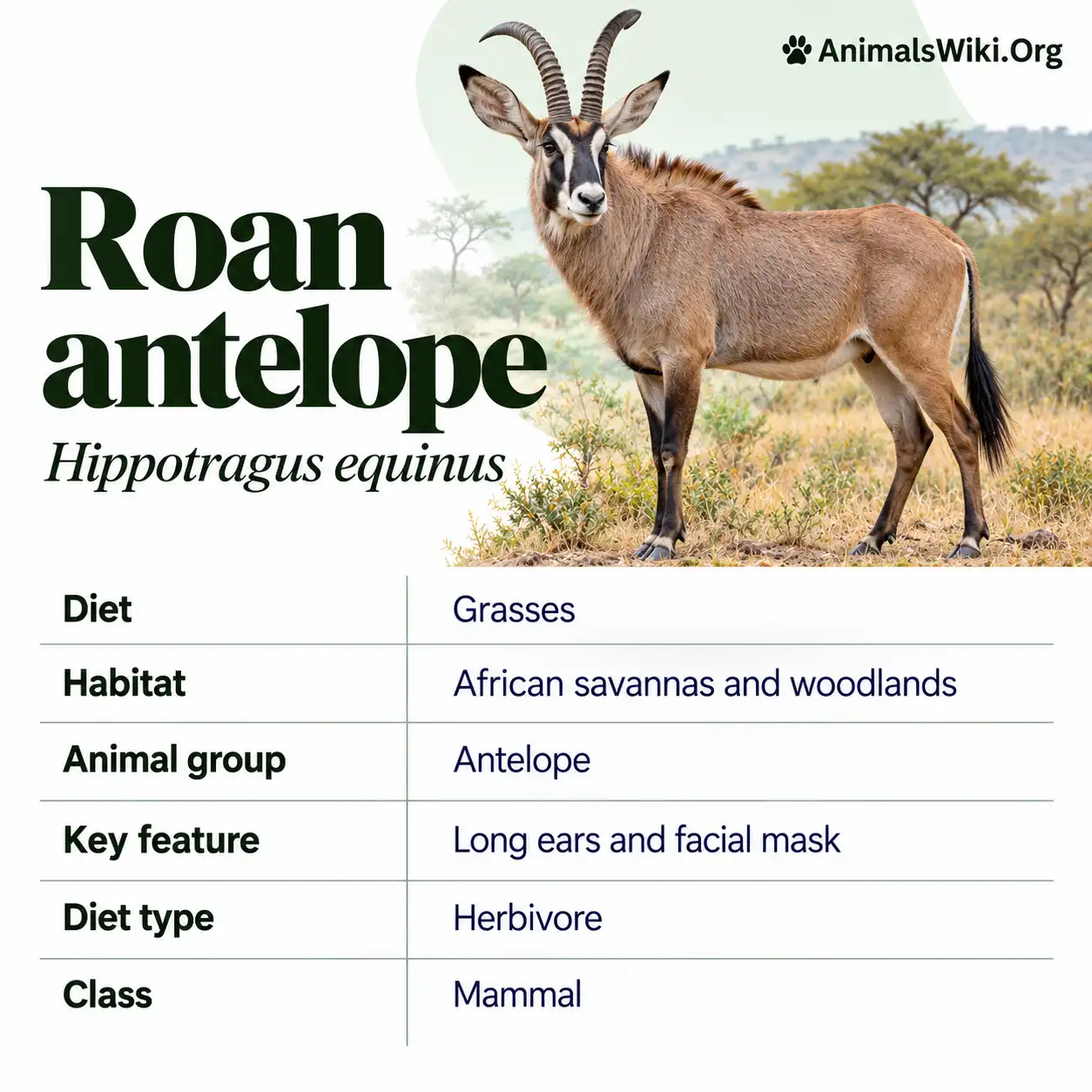
The roan antelope combines the size of a large grazing animal with the striking face of something far more theatrical. Its black-and-white mask, long tasseled ears, upright mane, and backward-curving horns make it one of Africa’s most distinctive antelopes. Its name comes from its coat, where pale and reddish-brown hairs create a roan appearance.
A mature animal is impressive even before it moves. Broad through the body and strong through the neck, it can defend itself vigorously when threatened. Yet physical strength does not make the species immune to environmental change.
Roan antelope depend on a particular combination of feeding opportunities, cover, water, and space. A reserve full of grass and other wildlife may still fail to provide what they need. Their conservation story shows why protecting habitat requires more than preserving a large area on a map.
The global assessment and the local picture also differ. The IUCN assessment conducted in 2016 and published in 2017 classified roan antelope as Least Concern, with a decreasing population trend and an estimated 50,000–60,000 mature individuals. Those are dated assessment figures, rather than a worldwide census conducted in 2026.
Some regional populations face much more severe difficulties. Understanding those differences is essential to understanding the animal itself.
This guide explores roan antelope identification, classification, distribution, feeding, behavior, reproduction, ecological relationships, and conservation, including the important distinctions between roan and sable antelopes.
Roan Antelope Facts
| Feature | Information |
|---|---|
| Common name | Roan antelope |
| Scientific name | Hippotragus equinus |
| Family | Bovidae |
| Tribe | Hippotragini |
| Animal type | Large herbivorous antelope |
| Main identifying features | Roan coat, black-and-white face, long tasseled ears, mane, curved horns |
| Approximate adult male mass | Commonly around 235–300 kilograms |
| Approximate adult female mass | Commonly around 215–280 kilograms |
| Approximate shoulder height | Around 1.25–1.5 meters |
| Horns | Present in both sexes |
| Main habitat | Savanna woodland and grassland mosaics |
| Diet | Mainly grasses, with browsing important in some conditions |
| Social organization | Female-and-young herds, dominant breeding males, and bachelor groups |
| Pregnancy | Approximately nine months |
| Young | Usually one calf |
| Calf strategy | Concealment in vegetation during early life |
| Global assessment | Least Concern; decreasing trend in the 2016 assessment |
| Current worldwide census | No comprehensive 2026 census verified for this article |
What Is a Roan Antelope?
The roan antelope is a large African member of the cattle family, Bovidae. It belongs to the genus Hippotragus, alongside the sable antelope and the extinct bluebuck.
It is often called a horse antelope because of its strong neck, mane, long legs, and general carriage. That resemblance is visual rather than evidence of a close relationship with horses.
Roan are among Africa’s largest antelopes. However, descriptions that rank them as the continent’s second-largest antelope need qualification. Different eland species, sex differences, and the measurement being compared can change the ranking.
A Wild Animal With Specific Needs
Roan can look sturdy and adaptable, but appearance does not reveal all of an animal’s requirements.
They need access to suitable forage through changing seasons. They also need cover for calves, drinking opportunities, and enough space to use different resources without excessive disturbance.
These requirements help explain why roan may remain scarce in a landscape where zebra, impala, or other herbivores are abundant.
Why They Matter to Conservation
A decline in roan does not necessarily mean every part of an ecosystem is failing. It can indicate that conditions are changing in ways particularly unfavorable to this species.
Their response can therefore help managers identify problems that would be missed by monitoring only the most common animals.
Scientific Classification
The accepted species name is Hippotragus equinus. The species was formally described by Étienne Geoffroy Saint-Hilaire in 1803.
The Mammal Diversity Database places it within the tribe Hippotragini, using a broad subfamily Antilopinae. Many other references retain Hippotraginae as a separate subfamily.
| Taxonomic rank | Classification |
|---|---|
| Kingdom | Animalia |
| Phylum | Chordata |
| Class | Mammalia |
| Order | Artiodactyla |
| Family | Bovidae |
| Subfamily treatment | Hippotraginae in many references; Antilopinae in the Mammal Diversity Database |
| Tribe | Hippotragini |
| Genus | Hippotragus |
| Species | Hippotragus equinus |
| Scientific authority | É. Geoffroy Saint-Hilaire, 1803 |
What Does the Name Mean?
The genus name is associated with the idea of a horse-like antelope. The species name, equinus, also refers to a horse-like appearance.
The common name “roan” describes the mixture of differently colored hairs in the coat. It does not identify a domestic breed or a color variety of sable antelope.
Why Classification Can Look Different
A source using Hippotraginae and one using Hippotragini may be describing the same relationships at different taxonomic levels.
Readers should check the actual animals included rather than assume that every difference in a classification table represents a disagreement about species identity.
Subspecies and Genetic Differences
Six traditional roan subspecies have been described. Their boundaries were established largely through geographical and physical differences.
They remain useful historical labels, but they should not be presented as six equally secure genetic divisions.
| Traditional name | Broad historical association |
|---|---|
| H. e. bakeri | Parts of northeastern Africa |
| H. e. cottoni | Parts of south-central Africa |
| H. e. equinus | Southern Africa |
| H. e. koba | Western Africa |
| H. e. langheldi | Parts of eastern and central Africa |
| H. e. scharicus | Parts of north-central Africa |
These are broad associations, not precise maps of current surviving populations.
What Early Genetic Research Found
A 2004 study examined roan from multiple populations using mitochondrial DNA and microsatellites.
It strongly supported a distinction between sampled West African animals and those from the rest of Africa. Other genetic relationships did not correspond neatly to all the traditional subspecies boundaries.
What Later Research Added
A later range-wide study found a more complex pattern, including five nuclear genetic groups and four mitochondrial lineages, with contact zones between them.
That result demonstrates why the older statement that there are only two meaningful roan groups is an incomplete summary of present knowledge.
Why This Matters for Transfers
An animal’s ancestry can matter when it is moved into a wild population.
Conservationists need to consider local genetic structure, the purpose of the transfer, and whether the movement preserves or disrupts meaningful diversity. Simply labeling animals “roan” does not answer those questions.
Appearance and Identification
Roan antelope have a distinctive combination of body color and facial pattern.
The coat can appear gray-brown, reddish-brown, or strawberry-colored, depending on the individual and light. The face carries strong dark areas interrupted by pale markings around the eyes and muzzle.
The Ears
Their long ears are particularly useful for identification.
They have dark tufts near the tips and can appear almost oversized compared with those of some other antelopes. An animal partly hidden in grass may reveal its identity through the ears before the rest of the body becomes visible.
The Mane and Neck
A short upright mane runs along the neck.
The neck is strong, and a mature male can look especially powerful through the shoulders. This supports the horse-like impression behind the scientific and common descriptions.
Horns
Both sexes carry ridged horns that curve backward.
Male horns are generally thicker and longer, but females are also well armed. Horn size alone is not a dependable way to determine sex when ages differ or the viewing angle is poor.
Safari West describes the coat, facial mask, ears, and ridged horns as central identifying features.
Calves and Adults
Young roan do not have the full appearance of mature animals.
Their horns develop gradually, and their smaller bodies and less imposing proportions can make identification harder. A guide showing only adult bulls leaves out an important part of the species’ appearance.
Roan Antelope Compared With Sable Antelope
Roan and sable antelopes are close relatives, but they are separate species.
The easiest comparison usually involves mature adults. Juveniles and females can be more difficult because their colors overlap more than popular illustrations suggest.
| Feature | Roan antelope | Sable antelope |
|---|---|---|
| Scientific name | Hippotragus equinus | Hippotragus niger |
| Mature male color | Usually roan, gray-brown, or reddish-brown | Commonly very dark brown or black |
| Ears | Particularly long and tasseled | Generally less conspicuously elongated |
| Horns | Backward-curving, usually less sweeping | Often longer and more dramatically curved |
| Body impression | Large, robust, and relatively heavy | Strongly arched neck and elegant profile |
| Facial pattern | Bold black-and-white mask | Contrasting pale facial markings |
| Identification caution | Color changes with light and population | Females and young may be brown rather than black |
The African Wildlife Foundation describes the sable’s age-related darkening and its characteristic horns, mane, and posture.
Why Color Alone Is Not Enough
A young sable is not necessarily black. A roan photographed in deep shade can appear much darker than expected.
For dependable identification, consider ear shape, horn curvature, face, body proportions, and location together.
Similar Names, Different Conservation Needs
Both species require appropriate habitat management, but a successful sable population does not prove that the same area or management approach will support roan.
Closely related species can respond differently to grazing pressure, vegetation structure, and predator distribution.
Evolution and the Extinct Bluebuck
The extinct bluebuck belongs to the same genus as roan and sable.
Its relationship with the living species has attracted attention because museum specimens and ancient DNA allow questions to be investigated long after extinction.
Evidence From Ancient Genomes
A 2022 genomic study supported bluebuck and sable as sister species and identified evidence of ancient gene flow involving roan.
A 2024 study also investigated gene exchange among these lineages during their early evolutionary history.
These findings are more informative than a simple claim that one living species is an unchanged stand-in for an extinct relative.
Shared Ancestry Does Not Mean Identity
Related animals can share genes while remaining distinct species.
Ancient gene exchange also does not make modern roan ordinary hybrids. Their present identity reflects a long evolutionary history, including divergence, population structure, and adaptation.
Genomic Resources for Living Roan
A 2021 study produced a roan reference genome and additional sequencing resources.
These tools can support research on relationships, demographic history, and conservation. However, genomic information becomes useful through careful interpretation and appropriate management, rather than automatically solving problems in the wild.
Distribution Across Africa
Roan antelope occur in scattered parts of sub-Saharan Africa.
Their distribution extends across western, central, eastern, and southern regions, but the surviving range is fragmented. They are absent from many areas where they formerly occurred.
Western and Central Africa
These regions contain important parts of the species’ remaining distribution.
However, a country-level occurrence record should not be interpreted as evidence that roan are common throughout that country. Local abundance can vary substantially.
Eastern Africa
Eastern populations include some particularly depleted groups.
Kenya’s remaining indigenous population is associated with Ruma National Park and its managed roan sanctuary. This setting illustrates how a species with a broad continental range can approach disappearance within one country.
Southern Africa
Roan occur in protected areas and on privately managed wildlife land.
Some populations result from reintroductions or transfers. Their presence needs to be interpreted alongside ancestry, location, and management intensity.
Historical Range Maps Need Labels
A map can show former distribution, recent records, or areas considered potentially suitable.
Those categories answer different questions. Without dates and definitions, a shaded map can make the species appear more widespread and secure than evidence supports.
Habitat Requirements
Roan usually occupy savanna woodland and grassland mosaics.
They need a combination of feeding opportunities, suitable cover, and access to water. The balance varies among regions and seasons.
Tall Grass Has Several Functions
Grass supplies food, but it can also conceal calves.
Removing too much cover can therefore affect reproduction even where adults still find enough to eat. Conversely, a dense mass of old stems may offer concealment while providing poor forage.
Good habitat contains useful structure, not simply the greatest possible amount of vegetation.
Woodland and Open Areas
Scattered woody vegetation can provide shade and contribute to a varied landscape.
Dense thickets may create different conditions, including reduced grass growth and altered predator concealment. Habitat suitability depends on the arrangement of features rather than one broad label such as “woodland.”
Critical Resource Patches
A 2006 field study found that roan used tall grasses in drainage-line grassland during difficult dry-season months.
These patches helped separate their feeding ecology from that of more common grazers.
The implication is important: a small seasonal resource can influence the usefulness of a much larger home range.
Local Studies Are Essential
Research in Ruma has examined habitat distribution and suitability specifically for that population.
Such work is necessary because habitat relationships established in Kruger cannot simply be assumed to apply unchanged in Kenya.
Diet and Digestion
Roan are predominantly grazers, but browsing can become important in some environments.
Their food may include grasses, leaves, shoots, and other plant material. The mixture changes with season and availability.
Selecting Suitable Bites
A roan does not feed on every part of a grass plant equally.
Leaves, stems, fresh growth, and dead material differ in nutrient content and digestibility. Feeding choices determine the quality of the diet actually swallowed.
This explains why a landscape’s average grass condition can be a poor description of what an animal is able to obtain.
Browsing During Difficult Conditions
Research comparing roan and hartebeest in Burkina Faso found that roan increased browsing as the hot dry season progressed.
Hartebeest remained more strongly dependent on grass in that study. The difference shows that two grazing antelopes can respond differently to the same seasonal shortage.
Ruminant Digestion
Roan have a digestive system supported by microbial fermentation.
They also regurgitate and rechew food as cud. Feeding and rumination therefore form connected stages rather than independent activities.
The ability to ferment plant material does not make nutritional quality irrelevant. Intake rate and the amount of digestible material still limit what an animal gains.
Avoid One Universal Diet Percentage
A figure measured in one place during one season should not become a fixed species-wide menu.
It is more accurate to describe roan as grass-focused herbivores with some capacity to use browse, particularly when local conditions favor it.
Seasonal Feeding and Drought
Seasonal survival depends on retaining access to useful food as the landscape changes.
During productive periods, many locations may provide acceptable forage. Later, suitable patches can become fewer and more widely separated.
Quality and Quantity
A large quantity of dry vegetation may provide less usable nutrition than a smaller amount of fresh growth.
Animals must balance bite size, feeding time, movement, and the nutritional value of each mouthful.
Reserve Resources
Some plants or landscape positions remain useful after preferred forage declines.
A 2023 ecological review discusses how large herbivores use different resource types across difficult periods, including the importance of suitable leafy grasses and seasonal alternatives for roan and related antelopes.
Drought Can Have Delayed Effects
Poor conditions can affect body reserves, pregnancy, milk production, and calf growth.
Consequences may continue after rain returns. A green landscape does not necessarily mean every animal has recovered from the previous shortage.
Why Population Density Matters
A site supporting several herds during favorable years may support fewer animals during prolonged drought.
The relevant limit is the resource available during the bottleneck, rather than the amount present during the best month.
Water Requirements
Roan generally need regular access to drinking water.
They are therefore associated with landscapes where water remains accessible, even when surrounding conditions become relatively dry.
Drinking and Feeding Are Connected
A water source is useful only if animals can also obtain food and move to it safely.
Concentrating animals near permanent water can increase pressure on surrounding vegetation. Over time, the resource intended to help them may contribute to local habitat deterioration.
Water Changes Other Species’ Distribution
Additional water can attract other grazers into places they formerly used only seasonally.
Predators may then respond to the increased prey concentration. Roan can be affected indirectly even if the water source itself remains adequate.
The Kruger Lesson
A 1999 study investigated the severe historical decline of roan in Kruger.
The authors identified increased adult predation following changes in other herbivore and lion numbers as an important explanation, within a wider environmental and management context.
This does not mean artificial water is always harmful. It means its effects should be evaluated across the ecosystem rather than assumed beneficial.
Seasonal Variety
A mix of permanent and seasonal resources can create opportunities for different animals.
Management should preserve useful differences where possible, while responding to the specific limitations of the roan population concerned.
Physical Adaptations
Roan combine large body size with strong legs, horns, and the ability to move rapidly.
Their anatomy supports both grazing and defense.
Body Size
A large body can provide advantages during confrontations and influence the amount and type of food an animal can use.
It also creates demands. A substantial animal needs enough energy and nutrients to maintain condition through difficult periods.
Horns
Backward-curving horns are important during competition and can help deter predators.
However, possessing horns does not guarantee safety. A calf, injured adult, or isolated animal may remain vulnerable despite the species’ defensive reputation.
Mane and Neck
The mane contributes to the animal’s horse-like outline, while the muscular neck supports movements involved in social encounters.
An imposing display may allow rivals to assess one another before contact becomes necessary.
Ears and Awareness
Long ears are prominent identification features, but their presence should not be turned into unsupported claims about exceptional hearing distances.
Roan rely on multiple senses and social information when assessing their surroundings. Exact sensory performance requires measurement rather than inference from appearance.
Daily Activity and Movement
Roan often feed during cooler parts of the day and spend other periods resting, ruminating, or interacting socially.
These are tendencies rather than an inflexible timetable.
Responding to Temperature
Hot conditions can increase the cost of movement and grazing.
Animals may alter their schedule, but avoiding heat competes with other needs, including obtaining enough food and remaining close to the herd.
Home Range
A home range is the broader area an animal uses.
Its size depends on resource distribution, season, group composition, and local constraints. It should not be reduced to one species-wide number.
A study of Ruma roan specifically examined home ranges and their implications for management.
Movement and Fences
A fence can prevent access to resources without changing the vegetation visible inside the enclosure.
It can also stop dispersal or contact between herds. Assessing habitat therefore requires considering what animals can reach, rather than only what exists nearby.
Disturbance
Repeatedly forcing roan to move interrupts feeding and resting.
Even if no obvious injury occurs, unnecessary disturbance can consume time and energy. This is especially undesirable around cows with hidden calves.
Herd Structure and Social Behavior
Roan commonly form herds of females and young, associated with a dominant breeding male.
Nonbreeding males may occur separately or in bachelor groups.
Female Leadership
Experienced females can play important roles in guiding herd movement.
The Aspinall Foundation describes a social unit composed of females and a dominant male, while other husbandry accounts emphasize leadership among the females. These roles need not be contradictory: movement leadership and breeding dominance are different functions.
Young Males
As males mature, they usually leave their original female group.
Joining other males provides a social setting before they can compete effectively for breeding opportunities.
Group Size
Small herds are common, but larger gatherings occur.
A concentration near food or water should not automatically be interpreted as one permanent herd. Groups can separate again when conditions change.
Social Relationships Matter
A herd is more than a collection of interchangeable animals.
Removing or introducing individuals can affect aggression, movement, and breeding. This is one reason conservation transfers require social planning alongside veterinary checks.
Competition Between Males
Adult males compete for reproductive access.
Descriptions differ over how strongly roan defend fixed areas compared with defending access to females. A careful account should allow for variation rather than insist that every population follows one rigid territorial system.
Displays Before Contact
Posture, head position, and deliberate approaches can communicate strength.
These interactions can prevent costly fighting if one animal yields.
Horn Fighting
When a contest escalates, males may lower themselves and engage their horns.
Such encounters can be dangerous, even if many end without severe injury. A wound can affect feeding, mobility, and future reproductive success.
Maturity Is Not Breeding Success
A young male may be physiologically capable of reproduction before it can compete with an established adult.
That difference explains why age at sexual maturity should not be treated as the age at which every male begins fathering calves.
Captive Research
A 2020 study examined hormone patterns and reproductive events in captive male roan.
It contributes to understanding reproductive physiology, but the management and feeding conditions mean it should not be treated as a complete description of wild male behavior.
Reproduction and Birth
Female roan usually produce one calf following a pregnancy of roughly nine months.
Breeding can occur throughout the year, although birth timing and reproductive performance vary with conditions.
Nutrition and Reproduction
A female needs sufficient resources to support pregnancy and lactation.
Poor condition may affect conception, calf growth, or the ability to raise a young animal successfully. Reproduction is therefore closely linked to habitat quality.
Preparing for Birth
Females separate from the main herd and seek suitable cover.
This reduces disturbance during birth and provides a concealed location for the calf’s early life.
Birth Intervals
A female’s capacity to reproduce does not mean every individual produces a surviving calf on the shortest possible schedule.
Age, nutrition, health, and the demands of the previous calf all influence performance.
Reproduction Under Human Care
Researchers have also studied stress-related hormone patterns in captive roan across reproductive states and seasons.
Such work can help improve management while emphasizing how much reproductive biology depends on conditions.
Population Growth
Births are only one component.
A population may decline despite regular calving if adults die, calves fail to survive, or too few animals reach breeding age.
Calf Development
A baby roan antelope is called a calf.
Its early strategy differs from that of a young wildebeest following a large open-plains herd almost immediately.
Concealment
Roan calves remain hidden in vegetation during their first weeks.
The mother returns to nurse and clean the calf, while its stillness and coloration reduce detection. Marwell describes this hiding phase as lasting several weeks, with variation in how the mother associates with the herd.
A Hidden Calf Is Not Necessarily Abandoned
A calf lying alone may be behaving normally.
Approaching it can reveal its position, cause it to flee, or interfere with the mother’s return. Human intervention should never be based only on temporary separation.
Joining the Herd
As mobility and endurance improve, the calf spends more time with other roan.
It must learn movement patterns, feeding choices, and responses to social signals.
Milk and Weaning
Milk supports early growth, followed by increasing use of vegetation.
Weaning is gradual. Reduced dependence on milk does not immediately end the value of maternal association.
Grass Cover and Survival
The requirement for concealment makes vegetation structure important.
Managing only for short, easily grazed lawns may overlook the cover needed during the calf stage.
Lifespan and Mortality
Roan can live into their late teens in the wild, although many individuals die younger.
Reported potential lifespan should not be confused with average survival from birth.
Captive Longevity
AnAge records a maximum captive lifespan of 25.9 years and lists life-history information compiled from published sources.
That exceptional age does not establish how long animals usually live in a particular wild population.
Different Mortality Patterns
Predation, nutritional stress, injury, disease, and human killing can all contribute.
A breeding center with veterinary care and predator exclusion will have a different mortality pattern from an open savanna population.
Why Adults Matter
Long-lived breeding females can contribute several calves over time.
Losing one adult therefore removes both the animal and part of the population’s future reproductive potential.
Why Calves Matter
A herd can contain healthy adults while failing to recruit enough young.
Age structure is therefore essential. A stable-looking group may already be experiencing a problem that becomes obvious only after older animals disappear.
Predators and Defense
Roan are powerful enough to confront dangerous predators, but they remain prey animals.
Lions, spotted hyenas, African wild dogs, and other carnivores can pose threats, with calves vulnerable to additional predators.
Standing Their Ground
An adult may turn toward a threat rather than immediately flee.
White Oak Conservation describes the species’ strong defensive behavior, including responses to lions, while also noting that its size and aggression create management challenges under human care.
Defense Has Limits
A horned adult is not immune to coordinated attacks, injury, or poor condition.
A calf’s survival depends more heavily on concealment and maternal behavior than on physical resistance.
Predator Risk Changes With Habitat
Cover can help conceal young roan but may also conceal approaching carnivores.
The value of vegetation therefore depends on scale, structure, and the animals involved. “More cover” is not automatically good or bad.
Avoid Simple Explanations
Predators may be important in a local decline without explaining the species’ status everywhere.
Conservation needs evidence about mortality, recruitment, habitat, and predator distribution before choosing an intervention.
Competitors and Shared Resources
Roan share landscapes with other wild grazers and livestock.
Their relationships can include competition, ecological separation, and indirect effects involving predators.
Feeding Overlap
Two animals eating grass do not necessarily obtain it in the same way.
Height, plant species, growth stage, and the proportion of leaves and stems can differ.
When Resources Become Limiting
Competition becomes more consequential during drought or heavy grazing.
A resource plentiful in the wet season may become the limiting factor several months later.
Indirect Effects
Additional grazers can attract or support predators.
This means a species can affect roan without consuming exactly the same food. The Kruger experience demonstrates why managers must examine more than direct feeding overlap.
Fire and Shared Grazing
A 2002 study compared use of burned grassland by rare antelopes and zebra.
The species differed in feeding height and landscape use, showing that even a shared attraction to regrowth does not produce identical ecological requirements.
Ecological Importance
Roan contribute to ecosystems through grazing, browsing, nutrient cycling, and their place in food webs.
Their effects depend on abundance and local conditions.
Vegetation Use
Feeding removes plant material unevenly.
Selective use can influence vegetation patches, while browsing adds another connection to shrubs and trees in some seasons.
Nutrient Cycling
Dung and urine return nutrients to the environment.
Movement between feeding and resting areas redistributes those materials, and decomposers help make them available again.
These are general herbivore processes rather than a quantified service supplied exclusively by roan.
Food-Web Connections
Roan support predators and, after death, scavengers and decomposers.
Their disappearance removes interactions as well as individual animals.
Ecological Variety
Roan represent a feeding and social strategy different from those of many abundant savanna herbivores.
Maintaining them helps retain that ecological variety. It also prevents conservation success from being judged solely by increasing the numbers of already common species.
Population Estimates and Conservation Status
The global assessment classifies roan as Least Concern, with a decreasing trend.
That combination is possible because a species can remain sufficiently widespread or numerous to avoid a threatened category while still declining.
Global Mature-Individual Estimate
The 2016 IUCN assessment, published in 2017, reports 50,000–60,000 mature individuals.
This figure should retain its date and meaning. It is not a count of all ages and should not be relabeled as a 2026 total.
Why Other Global Numbers Differ
A 2016 review discussed estimates ranging broadly from 39,000 to 76,000 individuals in the available literature.
Those values reflect the difficulty of combining information across a large, fragmented range. They do not constitute a fresh range-wide census conducted for this article.
Regional Status
The 2016 South African regional assessment classified roan as Endangered.
Its estimated 218–294 mature individuals concerned eligible wild populations under the assessment rules. It did not include every animal in intensive breeding camps, nor did it describe the worldwide population.
Kenya’s Recent Report
Kenya’s 2025 National Wildlife Census Technical Report recorded 21 roan in the Ruma sanctuary population.
This is a national and site-specific figure, including different age classes, rather than a global count or a count of 21 breeding adults.
| Figure | Scope and date | Important limitation |
|---|---|---|
| 50,000–60,000 mature individuals | Global IUCN assessment conducted in 2016 | Mature animals, not all ages |
| 39,000–76,000 individuals | Estimates discussed in a 2016 review | Literature range, not one synchronized census |
| 218–294 mature individuals | 2016 South African regional assessment | Eligible wild populations under specific rules |
| 21 animals | Ruma sanctuary population in Kenya’s 2025 report | Local population, not worldwide abundance |
Threats to Wild Populations
Roan face pressures that differ among regions.
The principal challenge is identifying which pressures actually limit a particular population.
Habitat Loss
Agriculture, settlement, roads, and other development can remove feeding areas and movement routes.
Fragmentation can leave enough space for animals during favorable periods while cutting off resources needed in difficult months.
Habitat Degradation
Heavy grazing, unsuitable vegetation structure, and poorly timed fire can reduce habitat quality without removing all vegetation.
A protected boundary does not prevent such changes automatically.
Illegal Hunting and Snares
Snares can kill animals regardless of the intended target.
A 2014 study mapped snaring patterns in Ruma and discussed their implications for roan and other wildlife. It illustrates how patrol planning can use spatial evidence rather than distribute effort blindly.
Small Population Size
Very small herds are exposed to chance events.
The death of one breeding female, a run of male-biased births, or failure to raise calves can alter prospects substantially.
Disease and Intensive Management
Parasites and infectious disease can affect both managed and wild animals.
Moving animals also moves potential health risks. Disease screening and quarantine therefore support conservation rather than merely adding administrative steps.
Genetic Mixing
Transfers can help restore diversity, but poorly informed mixing can disrupt meaningful population structure.
The objective should be maintaining healthy, appropriate wild populations rather than maximizing head counts alone.
Conservation and Reintroduction
Roan conservation requires coordinated work on habitat, survival, genetics, and people.
No single intervention is suitable everywhere.
Protect Seasonal Resources
Managers need to identify the feeding areas and cover that matter during difficult periods.
An average measure of grass abundance may miss the patches on which survival depends.
Test Water and Fire Decisions
Changes should have clear objectives and be monitored.
The Kruger rare-antelope case study shows that improving one measured habitat feature does not necessarily produce immediate population recovery. Ecological interactions and the consequences of earlier decline can persist.
Use Population Models Carefully
A 2018 Ruma population-viability study compared management options affecting mortality, habitat pressures, restocking, and sanctuary protection.
Such models help compare scenarios, but their results depend on assumptions and input data. They are decision tools rather than predictions guaranteed to occur.
Choose Appropriate Source Animals
Reintroduction planning should examine ancestry, health, social composition, and experience under natural conditions.
Animals from intensive facilities may require preparation before release.
Work With Local Communities
Reducing illegal killing and protecting habitat are easier when neighboring people see legitimate benefits and have practical alternatives.
Conservation depends on trust, local knowledge, and sustained support as well as ecological research.
Measure Recovery Across Generations
Successful release is only the beginning.
Long-term outcomes include adult survival, calf recruitment, reproduction, appropriate movement, and the ability to persist without escalating intervention.
Roan Antelope in Human Care
Zoos, conservation centers, and wildlife properties maintain roan populations.
Their contribution depends on the aims and quality of management.
Breeding Can Support Conservation
Well-managed populations can preserve ancestry, support research, and sometimes provide animals for recovery projects.
White Oak documents a long-running breeding program and a historical transfer of young roan to South Africa. That example demonstrates a possible role for human care without proving every captive population has equivalent conservation value.
Welfare and Social Management
Roan need appropriate space, diet, social arrangements, and veterinary attention.
Their strength and potential aggression require facilities and handling procedures designed for the species.
Captive Numbers Are Not Wild Recovery
A rise in breeding-camp numbers may be encouraging, but it does not establish that wild habitat has improved.
The distinction is especially important when animals receive daily supplementary food, intensive parasite control, or complete predator exclusion.
Do Not Treat Them as Pets
Roan are large wild antelopes with substantial physical and social needs.
Their calm appearance at a distance should not be interpreted as suitability for casual private handling.
Responsible Wildlife Watching
Roan sightings can be memorable without requiring close approach.
Observe the Whole Animal
Look at the ears, face, coat, mane, and horn shape.
These features are more useful than color alone when distinguishing roan from sable.
Avoid Blocking Movement
Do not position vehicles across the herd’s route to water, cover, or feeding areas.
An animal that repeatedly changes direction because of people is already responding to disturbance.
Respect Calving Cover
Stay away from hidden calves.
The mother may remain out of sight while waiting for the area to become quiet.
Record Useful Information
Dates, locations, clear photographs, group size, and visible calves can assist monitoring when shared appropriately.
Follow Local Rules
Remain in designated areas and follow guides or park staff.
A roan’s ability to defend itself makes distance important for people as well as for the animal’s welfare.
Frequently Asked Questions About Roan Antelope
1. What is a roan antelope?
The roan antelope is a large African herbivore with a mixed reddish-gray coat, black-and-white facial mask, long tasseled ears, mane, and backward-curving horns. Its scientific name is Hippotragus equinus.
2. Why is it called roan?
The name refers to its coat, which contains a mixture of differently colored hairs. The effect can appear gray-brown, reddish-brown, or strawberry-colored depending on the individual and light.
3. Is it related to horses?
The resemblance is superficial. Roan belong to Bovidae, the cattle and antelope family. Their horse-like neck, mane, and carriage help explain the scientific name but do not place them among equids.
4. How large are roan antelope?
Adults commonly weigh more than 200 kilograms, with males generally heavier than females. Reference ranges vary, and sex, age, population, and condition all influence size.
5. Are they Africa’s second-largest antelopes?
They are among the largest. Exact rankings depend on which eland species and measurements are compared, so a simple second-place claim should be treated cautiously.
6. What is the difference between roan and sable?
Mature male sable are usually much darker and have more sweeping horns. Roan generally have a paler mixed coat and particularly long tasseled ears. Females and juveniles require more careful comparison.
7. Do female roan have horns?
Yes. Both sexes carry horns, although those of adult males are generally thicker and longer. Horns alone are not sufficient to determine sex in every distant view.
8. Where do roan live?
They occur in scattered parts of sub-Saharan Africa. Surviving populations are distributed across western, central, eastern, and southern regions, often within protected or managed landscapes.
9. What habitat do they need?
They use savanna woodland and grassland mosaics containing suitable forage, calf cover, and accessible water. Seasonal resources and movement opportunities are as important as the broad habitat category.
10. What do roan eat?
They mainly eat grasses, selecting suitable leaves and growth stages. Browsing can become important in some places during difficult seasons, so one fixed grass percentage does not describe every population.
11. Do they drink regularly?
Generally, yes. Access to water is an important habitat requirement. However, water provision must be considered alongside forage and its effects on other wildlife.
12. Do they live in herds?
Yes. Female-and-young herds are commonly associated with a dominant breeding male. Young and nonbreeding males may occur separately or in bachelor groups.
13. Are roan territorial?
Descriptions vary between area defense and defense of access to females. It is safer to recognize that male competition and space use depend on the population and circumstances.
14. How long is pregnancy?
Approximately nine months, with published reference ranges around 276–287 days. Individual pregnancies vary, so the figure should not be treated as an exact countdown.
15. How many calves are born?
Usually one calf. Whether that birth contributes to population recovery depends on subsequent survival and recruitment into the breeding population.
16. Do calves hide after birth?
Yes. Early concealment is a normal strategy. The mother returns to nurse, and temporary separation does not mean abandonment.
17. How long do roan live?
They can reach their late teens in the wild, although many die younger. AnAge records a captive maximum of 25.9 years, which is an exceptional record rather than an average.
18. Can roan defend themselves against lions?
Adults can confront predators and use their horns defensively. However, they remain vulnerable, and defense does not guarantee survival against every attack.
19. Are roan dangerous to people?
They can be. Large size, horns, and defensive behavior make close encounters risky. Observers should maintain distance and follow site rules.
20. Are roan endangered?
Globally, the 2016 IUCN assessment classified them as Least Concern with a decreasing trend. Some regional populations are Endangered or severely depleted, so the geographical scope matters.
21. How many roan remain?
No comprehensive 2026 global census was verified. The IUCN’s dated estimate of 50,000–60,000 concerns mature individuals, while other literature figures may include different ages and geographical coverage.
22. How many remain in Kenya?
Kenya’s 2025 census report recorded 21 in the Ruma sanctuary population. That is a dated local figure and should not be confused with global abundance or a mature-only estimate.
23. Are all six subspecies genetically established?
No. Traditional subspecies boundaries do not map perfectly onto genetic results. Later research reveals substantial structure, including multiple nuclear groups and mitochondrial lineages, requiring careful conservation interpretation.
24. Does captive breeding guarantee recovery?
No. It can help, but wild recovery also requires suitable habitat, appropriate source animals, health management, social planning, and successful reproduction after release.
25. What is the best way to conserve roan?
Identify the actual limiting pressures, protect seasonal resources, reduce illegal killing, preserve appropriate genetic diversity, and monitor survival and recruitment. Effective conservation also requires cooperation with people sharing the landscape.
Roan Antelope (Hippotragus equinus)
The roan antelope is an impressive animal whose strength can obscure its vulnerability. Its size, horns, and bold appearance help it face predators, but they cannot replace suitable grass, water, calf cover, and space.
Its conservation story also demonstrates why numbers need context. A broad global assessment can coexist with severe regional depletion, and growing captive populations do not automatically mean wild recovery.
Protecting roan requires attention to their particular ecology: the resources that remain useful during drought, the vegetation that conceals calves, the social relationships within herds, and the genetic differences across their range.
With those needs understood and managed carefully, roan can continue to contribute to the variety of life in African savannas.



