
Sable Antelope, A Complete Guide to Africa’s Magnificent Woodland Antelope
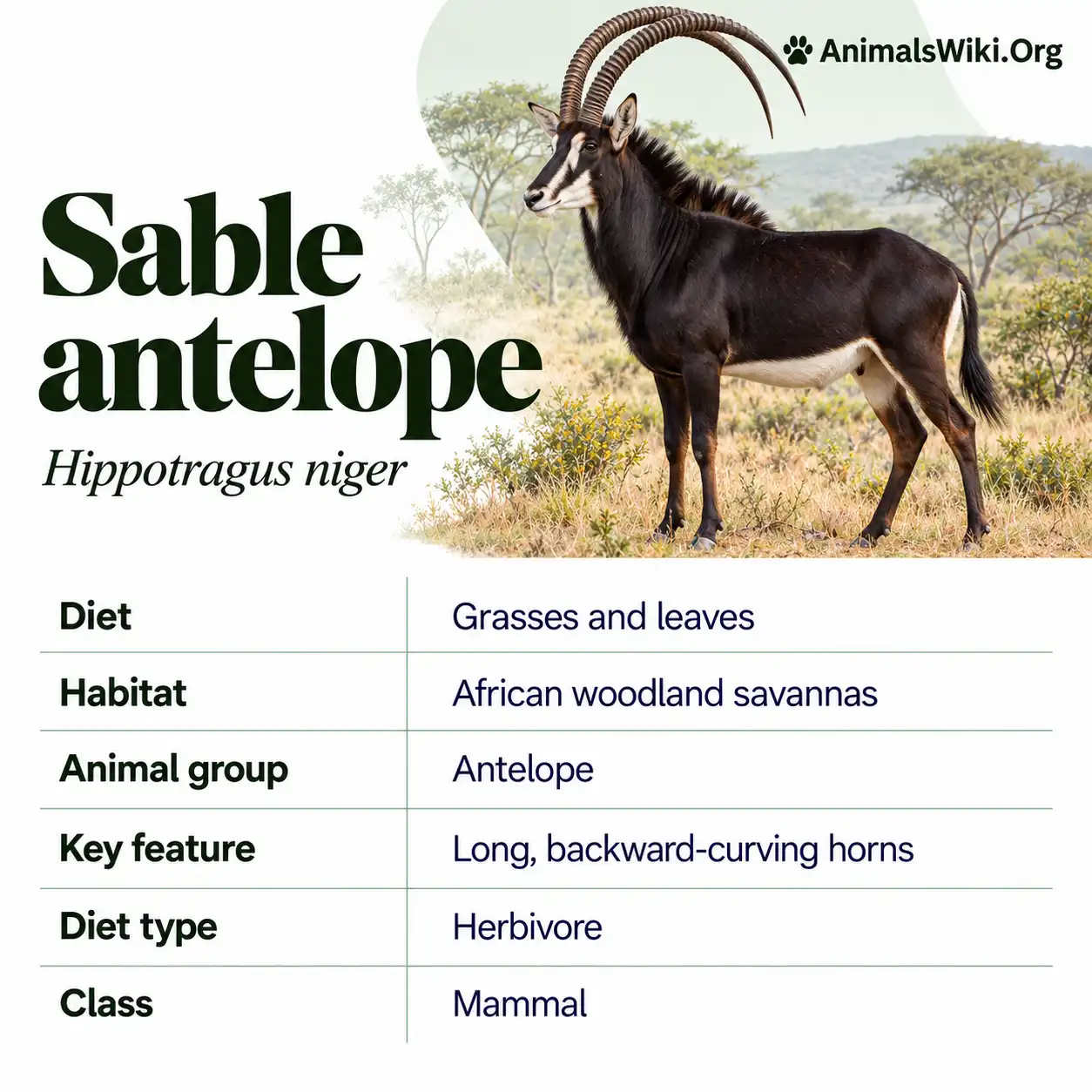
A sable antelope bull standing at the edge of an African woodland is difficult to mistake for anything else. Its dark coat contrasts with a white belly and sharply marked face, while two long, curved horns sweep backward above a thick neck. An upright mane and a high head carriage give the animal a striking, almost horse-like outline.
Yet the sable antelope is much more than an impressive silhouette. It is a selective grazer whose survival depends on the relationship between grass, water, woodland cover and safe movement. A landscape can appear green and spacious while still failing to provide the particular feeding opportunities a sable herd needs.
Its conservation story also contains an important distinction. The sable antelope as a species is classified as Least Concern globally, but some regional populations are threatened. Angola’s giant sable, usually treated as a subspecies, remains Critically Endangered. Increasing numbers on private properties do not automatically mean that every wild population, or every distinctive genetic lineage, is secure.
This guide explores how sable antelopes live, how to identify them, where they occur, and why conserving them requires more than counting animals with long horns.
Sable Antelope Facts
| Feature | Details |
|---|---|
| Common name | Sable antelope |
| Scientific name | Hippotragus niger |
| Family | Bovidae |
| Native region | Eastern and southern Africa, including Angola |
| Typical environment | Savanna woodland and adjoining grassland |
| Diet | Mainly grass, with some other vegetation |
| Adult size | Commonly around 200–250 kilograms, depending on sex and population |
| Shoulder height | Approximately 1.1–1.45 meters; measurements vary |
| Horns | Present in both sexes; generally longer and heavier in adult males |
| Main social groups | Female herds with young, bachelor groups and territorial males |
| Gestation | Approximately nine months |
| Usual number of offspring | One calf |
| Lifespan | Can reach the mid-to-late teens; some captive animals live around 20 years |
| Global conservation category | Least Concern |
| Giant sable conservation category | Critically Endangered |
What Is a Sable Antelope?
The sable antelope is a large African hoofed mammal belonging to the cattle and antelope family, Bovidae. Its scientific name is Hippotragus niger. It shares its genus with the living roan antelope and the extinct bluebuck.
Like other bovids, a sable has permanent horns rather than the seasonally shed antlers found in deer. It is also a ruminant, meaning that its digestive system uses microbial fermentation to help extract nutrients from plant material.
The word “antelope” describes a broad collection of bovids rather than one narrow scientific group. Sable antelopes therefore share family membership with animals as different in appearance as buffalo, gazelles, goats and sheep.
The species is particularly associated with wooded savannas. These environments contain trees, grass and open feeding areas in varying proportions. Sable do not simply occupy every available grassland within their geographic range. Their distribution is patchy because suitable food, water and other conditions must occur together.
That patchiness helps explain why they may be less frequently encountered than more widespread grazers, even in reserves where they are established. Seeing one herd does not necessarily indicate that many others are nearby.
The sable antelope should also not be confused with the sable, Martes zibellina, a small carnivorous mammal belonging to the weasel family. The animals share an English name associated with dark coloration but are not close relatives.
Scientific Classification and Subspecies
Scientific Classification
The Mammal Diversity Database recognizes the sable antelope as Hippotragus niger, with the authority W. C. Harris, 1838. Its placement within Bovidae is well established.
| Taxonomic rank | Classification |
|---|---|
| Kingdom | Animalia |
| Phylum | Chordata |
| Class | Mammalia |
| Order | Artiodactyla |
| Family | Bovidae |
| Subfamily in the Mammal Diversity Database | Antilopinae |
| Tribe | Hippotragini |
| Genus | Hippotragus |
| Species | Hippotragus niger |
Readers may encounter Hippotraginae as the subfamily in older books and other classifications. Different treatments of higher bovid relationships can use different ranks for substantially overlapping groups. The difference does not mean that these sources are discussing a different animal.
Commonly Recognized Sable Antelope Subspecies
Four subspecies are frequently recognized:
| Common name | Scientific name | Broad association |
|---|---|---|
| Southern sable | Hippotragus niger niger | Southern parts of the species’ range |
| Zambian sable | Hippotragus niger kirkii | Parts of south-central Africa |
| Eastern sable | Hippotragus niger roosevelti | Eastern populations, including coastal East Africa |
| Giant sable | Hippotragus niger variani | Central Angola |
These labels provide a useful introduction, but their boundaries should not be treated as perfectly settled. Traditional descriptions were based on geography and visible characteristics, while genetic research examines ancestry through different kinds of evidence.
Research has identified genetic structure that does not map neatly onto a simple four-box arrangement. A 2020 genomic study discussed five populations while noting the four commonly recognized subspecies. More recent work also distinguishes five wild ancestries. Genetic clusters, named subspecies and conservation management units are related concepts, but they are not interchangeable.
Why the Classification Matters
Taxonomy influences how animals are recorded, moved and managed. If a conservation program treats all sable as interchangeable, it may overlook geographically distinctive ancestry.
However, uncertain boundaries do not justify inventing additional species or presenting every genetic cluster as a formally accepted subspecies. A careful account should state which classification it follows and acknowledge where researchers are still refining the picture.
For practical conservation, maintaining well-documented populations and protecting natural variation can remain important even while taxonomic questions are being investigated.
How to Identify a Sable Antelope
Body Shape and Overall Appearance
A sable has a deep chest, sturdy legs, a substantial neck and a long face. Its mane runs along the upper neck, adding to the impression of height and strength.
The animal’s posture is especially distinctive. A raised head and arched neck can make an adult appear imposing even when it is standing still. African Wildlife Foundation describes this carriage as an important part of male dominance display.
At a distance, the combination of body shape and backward-curving horns is often more useful than coat color alone. Shade, dust and backlighting can make a brown animal appear nearly black or obscure its white markings.
Male and Female Coloration
Mature bulls are usually the darkest animals. Their coats may become deep brown or black, contrasting strongly with the pale underside and facial pattern.
Females are commonly reddish brown to dark brown. Some southern females become particularly dark, so “black means male” is an unreliable identification rule.
Age matters as well. Young males do not immediately display the full appearance of an older territorial bull. A herd containing several brown individuals may include females, immature males and calves at different stages of development.
Facial markings generally include pale areas that contrast with the darker face. The white belly and rump markings become more conspicuous as the animal matures. Geographic variation can affect the exact pattern and intensity.
Horns
Both sexes carry horns. Those of mature bulls are generally longer, thicker and more strongly curved than those of females.
The horns rise upward before sweeping backward. Prominent ridges occur along much of their length, while the tips are smoother. They are living structures associated with bony cores, covered by a keratin sheath.
Animal Diversity Web reports a broad male horn range of approximately 81–165 centimeters and a female range of about 61–102 centimeters. These ranges should not be interpreted as the size of every adult; exceptional lengths are not typical measurements.
Horn shape is useful in identification, but judging age precisely from a distant photograph is difficult. Breakage, viewing angle and individual growth can all mislead the observer.
Sable Antelope vs. Roan Antelope
Sable and roan antelopes are close relatives with similar body plans. Both have strong necks, conspicuous facial markings and curved horns in males and females. Nevertheless, several features help distinguish them.
| Feature | Sable antelope | Roan antelope |
|---|---|---|
| Scientific name | Hippotragus niger | Hippotragus equinus |
| General adult coloration | Mature bulls often dark brown or black | Usually grayish, reddish or roan-colored |
| Typical build | Large and muscular | Generally larger and heavier |
| Ears | Prominent, but usually less conspicuously long | Particularly long ears, often with dark tips or tassels |
| Horn appearance | Often long with a pronounced backward sweep | Generally shorter relative to the animal’s large body |
| Young animals | Brown coloration can complicate identification | Can resemble brown sable at a distance |
| Relationship | Separate species within Hippotragus | Separate species within Hippotragus |
For field identification, begin with the whole animal. A black adult bull with very long sweeping horns strongly suggests sable. A larger, paler animal with exceptionally long ears suggests roan.
Brown females and immature animals require more attention. Examine the face, ear proportions, horn curvature and body size together.
Geographic location can help, but it should not replace visual evidence. Private reserves and translocations have placed some antelopes outside their historical distributions.
The distinction also has conservation relevance. Although the species are separate, hybridization between roan and giant sable has been documented under exceptional conditions following a severe population collapse in Angola. That event was a specific conservation problem, not evidence that mixed herds normally produce hybrids throughout Africa.
Geographic Distribution
The Native Range
Sable antelopes occur across parts of eastern and southern Africa. Their native distribution includes portions of Angola, Botswana, the Democratic Republic of the Congo, Kenya, Malawi, Mozambique, Namibia, South Africa, Tanzania, Zambia and Zimbabwe. Presence within these countries is uneven rather than continuous.
A national range map can therefore exaggerate the impression of abundance. A species may occupy only selected reserves or suitable habitat blocks within a large country.
Woodland belts, river systems, agricultural development and historical hunting pressure all help shape the present distribution. Some populations have persisted in extensive landscapes; others are isolated remnants or have been restored through management.
Eastern and Southern Populations
In East Africa, sable are associated with suitable habitats in Tanzania and the small Kenyan population centered on Shimba Hills.
Kenya illustrates why national assessments matter. Its Wildlife Research and Training Institute and Kenya Wildlife Service have treated sable as a priority species requiring focused monitoring. Small national populations cannot be assumed secure because the species remains more numerous elsewhere.
Across southern Africa, sable occur in a mixture of national parks, other protected areas, conservancies and private properties. The conservation meaning of each population depends on its origin, management and connection with other populations.
Native, Reintroduced and Introduced Animals
These terms describe different situations.
A native population occurs within the species’ natural distribution. A reintroduced population has been returned to an area from which it disappeared. An introduced population has been established outside its natural range.
Captive and intensively managed populations add further categories. An animal photographed behind a game fence may be within its historical range, outside it, or part of a breeding operation.
For anyone writing about distribution, these distinctions prevent a common mistake: treating every modern location containing sable as evidence of the animal’s natural geographic range.
Habitat and Landscape Requirements
Woodland and Grassland Together
Sable antelope habitat commonly combines woodland with accessible grass. Miombo woodland is particularly important across much of their range, although the species uses other savanna environments as well.
The value of woodland is not simply the presence of trees. Tree cover affects shade, grass growth, visibility and the arrangement of feeding patches. Openings, drainage lines and adjoining grasslands may provide resources unavailable beneath a continuous canopy.
A useful habitat must offer opportunities across the year. A location that supplies excellent food after rain may become unsuitable later if water disappears or the grass becomes too fibrous.
Habitat Use Changes with Place and Season
It is tempting to describe sable as animals that always choose one vegetation type in one season. Field research shows a more flexible picture.
A study of three neighboring herds near Botswana’s Okavango Delta found that access to surface water appeared to limit seasonal range occupation. The herds generally favored dryland grassland in the dry season and floodplain grassland in the wet season, contrary to the researchers’ initial expectations. Competition and predation were possible influences.
This finding demonstrates why a habitat description from one reserve should not become a universal rule.
Why Habitat Quality Exceeds Habitat Size
A large fenced property is not necessarily good sable habitat. It may lack a dependable dry-season food supply, contain too few suitable grass patches, or force animals to travel through risky areas to reach water.
Conversely, a relatively modest area can be valuable if it connects larger habitat blocks or contains an essential seasonal refuge.
For management, the useful question is not only “How many hectares are available?” It is also “Can the animals obtain food, water, cover and breeding opportunities throughout the year?”
Diet and Feeding
What Do Sable Antelopes Eat?
Sable antelopes are primarily grazers. Grass forms the main part of their diet, although they may also consume herbs and browse from woody plants.
Calling them grazers does not mean that they eat all grass equally. Different species and different parts of the same plant vary in digestibility, protein, moisture and structural fiber.
A green leaf and a dry stalk may stand only centimeters apart but offer very different nutritional returns. Selective feeding allows the antelope to concentrate on more useful material where it is available.
Browsing Is a Real Part of Their Flexibility
Some older descriptions give the impression that sable almost never browse. Observations from northern Botswana show why that statement is too rigid.
Research published in 2012 documented browsing during the dry season, with browse accounting for about a quarter of feeding time toward the end of the observed season. The finding applies to that study population and period; it does not establish one fixed percentage for the entire species.
The broader lesson is that diet can change when the balance of available foods changes. A primarily grazing animal may still depend on alternative vegetation at difficult times.
Digestion and Rumination
As a ruminant, the sable relies on microorganisms to help break down plant material in its digestive system. Food is swallowed, processed through fermentation and later regurgitated as cud for further chewing.
This system makes grasses usable, but it does not eliminate nutritional limits. An animal can consume a substantial volume of poor forage while still struggling to obtain enough usable energy or protein.
Feeding time also competes with other needs. Traveling, drinking, avoiding disturbance and responding to predators all occupy hours that cannot simultaneously be spent grazing.
Selective Grazing Compared with Other Herbivores
| Feeding strategy | General approach | Practical consequence |
|---|---|---|
| Sable antelope | Selects suitable grazing patches and plant material | Can be sensitive to changes in the quality and arrangement of forage |
| Zebra | Can exploit a different range of grassy feeding opportunities | May use a broader set of feeding areas |
| Browsing antelope | Obtains much food from shrubs or trees | Depends more directly on woody vegetation |
| Mixed feeder | Shifts substantially between grass and browse | May have different seasonal options |
These are broad ecological contrasts. They do not mean that every individual follows an identical menu or that one strategy is superior in every habitat.
Water, Heat and Seasonal Movement
Dependence on Drinking Water
Sable are water-dependent antelopes, but that does not mean every herd must drink at exactly the same interval.
A comparative study found sable traveling to water at intervals of two to four days, compared with one to two days for zebra in the study conditions. Such observations describe a particular ecological setting, not a universal drinking timetable.
The frequency and cost of drinking depend on weather, food moisture, water distribution and the distance between feeding areas and drinking sites.
The Cost of Reaching Water
Water is valuable only if the animal can reach it safely and without excessive expense.
A herd feeding far from a permanent river may gain access to relatively undisturbed forage. However, each drinking trip requires movement, uses energy and may expose animals to predators or human activity.
This creates a trade-off. Remaining close to water can reduce travel but increase contact with other herbivores and predators. Feeding farther away can improve access to some resources while making drinking journeys longer.
What Recent Research Shows
A study published in 2026 tracked ten sable antelopes in Namibia’s Bwabwata National Park using observations collected during 2016–2018.
As conditions became hotter and vegetation browner, their ranges extended toward the Kavango River. Long movements associated with reaching water became more important late in the dry season. Under high heat loads and brown vegetation, the animals devoted less time to the movement state interpreted as foraging.
The result provides a concrete explanation for drought vulnerability: an antelope may need to walk farther precisely when food is becoming less rewarding.
It also shows why publication date and fieldwork date should be distinguished. A newly published paper does not necessarily describe conditions measured in that same year.
Physical Adaptations
Horns for Competition and Defense
The sable’s horns serve both social and defensive functions. They can be used against rival antelopes and can make a predator’s attack dangerous.
However, horns do not make an animal invulnerable. Their effectiveness depends on the position of the attacker, the condition of the antelope and whether the animal has room to turn or escape.
Large horns also involve costs. They must be grown and carried, and injuries can affect their usefulness. Their impressive appearance should not obscure the fact that survival depends on the entire animal and its environment.
A Strong Body for a Woodland Landscape
The sable’s muscular neck and sturdy frame support forceful movements during confrontations. Its legs allow it to travel between feeding patches and water while responding quickly to danger.
These features work alongside behavior. Choosing when to move, where to rest and which areas to avoid can matter as much as physical strength.
Behavioral Adaptation
Adaptation is often imagined only in terms of body parts, but decisions are equally important.
A sable can alter its use of a landscape as rainfall, heat and forage change. It can leave a feeding patch, seek shade, join other animals or remain vigilant.
Such flexibility has limits. If all nearby options deteriorate together, movement may not solve the problem. A fence, settlement or heavily disturbed corridor can further restrict the choices available.
This is why preserving habitat variety is valuable. A diverse landscape gives animals more possible responses to changing conditions.
Daily Activity and Social Behavior
Feeding, Resting and Moving
A sable’s day includes grazing, traveling, resting, ruminating, drinking and interacting with other animals.
Activity is influenced by temperature and risk. Cooler hours can offer better opportunities for feeding or travel, while shaded resting sites become more useful during hot conditions.
Descriptions such as “diurnal” summarize a tendency rather than a strict rule. Wildlife behavior rarely fits a timetable that applies equally across seasons, reserves and disturbance levels.
Female Herds
The central social unit usually includes females and their young. Membership and group size can change, and groups may divide or come together as conditions shift.
Female relationships include dominance differences. These affect access and interactions within a herd, although a group should not be imagined as following one unchanging order in every situation.
Herd life offers opportunities for shared vigilance and continued social contact. It also creates competition when animals want access to the same feeding patch.
Bachelor Groups and Solitary Bulls
Young males commonly leave the female group as they mature. They may join bachelor groups before gaining the size and experience needed to compete successfully with established bulls.
Some adult males occupy territories, while others remain outside the breeding positions they might eventually obtain.
This produces a changing social landscape. The absence of a bull from a female herd during one observation does not mean that the females lack contact with territorial males over a longer period.
Local Knowledge and Repeated Space Use
Research comparing sable and zebra found that sable herds concentrated their activity within local feeding areas, while zebra used a wider selection more opportunistically.
For sable, the arrangement of familiar feeding patches can therefore matter greatly. Disturbing one repeatedly used area may have consequences beyond the small number of hectares directly affected.
Territoriality and Communication
How Bulls Compete
A territorial bull gains potential access to females using his area. His success depends partly on the resources within that territory and partly on his ability to discourage competitors.
Competition includes posture, approach, withdrawal and direct confrontation. Not every meeting becomes a serious fight.
Displays can convey information about size, condition and willingness to escalate. If one animal withdraws early, both may avoid an injury that would reduce their ability to feed, move or breed.
Horn Clashes and Injury
When contests escalate, bulls can engage their horns and push against one another. Their strength and horn shape make these encounters potentially dangerous.
Nevertheless, describing sable as animals that routinely fight to the death exaggerates their normal social behavior. Avoidance and assessment are important parts of competition.
Management conditions can change the risks. Animals confined in unsuitable spaces may have fewer opportunities to retreat from an aggressive individual.
Scent and Reproductive Information
Scent provides information that cannot be obtained simply by looking at another animal.
Knuthenborg Safaripark describes the bull’s flehmen response during investigation of female urine. The raised-lip expression helps the animal assess chemical cues associated with reproductive condition.
For observers, this is a useful reminder that apparently unusual facial movements can be part of normal reproductive behavior.
Reproduction and Mating
Breeding Opportunities
Sable have a polygynous breeding system: a successful male may mate with multiple females.
That does not mean a bull permanently owns a fixed group. Female movements, male territories and seasonal changes create a more dynamic arrangement.
A young male may become physiologically capable of reproduction before he can successfully compete with older bulls. Biological maturity and actual breeding success are therefore different milestones.
Breeding Seasons Vary
Some populations show concentrated mating and calving periods associated with seasonal conditions.
However, assigning one fixed breeding calendar to all sable would ignore the differences between eastern and southern Africa, local rainfall patterns and managed populations.
The relevant biological advantage of seasonal timing is the relationship between a mother’s nutritional needs, the availability of food and the conditions a calf encounters after birth.
Pregnancy and Birth
Gestation lasts approximately nine months, and a female normally produces one calf.
Before giving birth, the mother seeks a relatively secluded location. Birth away from the main group forms part of the calf’s early concealment strategy.
For population growth, the important measure is not simply how many females become pregnant. Successful recovery also requires calves to survive and eventually enter the breeding population.
A herd can produce calves regularly while remaining static or declining if too few young survive to replace adults.
Calf Development
The Hiding Phase
A newborn sable calf does not immediately travel continuously with the main herd. It spends its early period concealed while its mother returns to nurse it.
The strategy reduces the need for a very young calf to keep pace with adults. It also means that a calf lying alone is not automatically abandoned.
Disturbing such an animal can interrupt a normal mother–calf arrangement. Wildlife staff should assess genuine concerns without unnecessary handling.
Learning and Increasing Mobility
As the calf grows stronger, it becomes more able to move with other animals. Its development involves coordination, feeding, social recognition and responses to possible danger.
The transition is gradual. Nursing and grazing can overlap, and joining the herd does not mean that the young animal is immediately independent.
A study of captive sable mother–infant relationships found flexibility within the species’ hiding behavior. Captive observations should not be applied uncritically to every wild herd, but they demonstrate that development is not governed by an inflexible minute-by-minute schedule.
Color Changes
Young calves are much paler and less strongly marked than mature bulls. Their brown coloration changes as they grow, and the adult pattern becomes more apparent.
The dramatic black-and-white appearance seen in many photographs represents a later life stage, particularly in males.
A General Development Timeline
| Stage | Typical features |
|---|---|
| Birth | Usually one calf; pale brown coloration |
| First weeks | Much time spent hidden; dependent on milk |
| Following months | Increasing movement with the group and greater use of vegetation |
| Around six to eight months | Weaning commonly reported within this general period |
| Following years | Continued body and horn growth; males become darker |
| Young adulthood | Females may begin breeding; males often face additional social barriers to breeding |
The weaning range is approximate, and progress varies with individual and environmental conditions.
Lifespan and Survival
Sable antelopes can live into their mid-to-late teens. Some animals under human care reach around 20 years, although reported maximum ages differ among sources.
A maximum lifespan is not an average. It describes what some individuals can achieve, not what every calf should be expected to reach.
Wild animals face risks from predation, food shortages, injuries, disease and human activity. Captive animals face a different set of conditions, including managed feeding and veterinary care, so their longevity records should be presented separately.
African Wildlife Foundation reports up to 16 years in the wild and up to 20 years in captivity, while SeaWorld’s educational account gives a lifespan of up to 18 years. These figures support a general description rather than one universal cutoff.
Age also changes an animal’s role. A calf’s main challenge is survival through early development. A young male must negotiate social displacement and competition. An older bull may struggle to retain breeding access even while remaining alive and capable of feeding.
For conservation, protecting animals long enough to reproduce successfully matters more than focusing only on exceptional longevity.
Predators and Competitors
Natural Predators
Lions, spotted hyenas and African wild dogs can prey on sable. Leopards may be especially relevant to smaller animals, and crocodiles can pose a risk around water.
Predator importance varies between places. A predator listed for the species is not necessarily a major cause of mortality in every population.
Adult sable can defend themselves vigorously, but young, injured or weakened animals have different levels of vulnerability.
Defense and Escape
Escape is often the safest response when an animal has a clear route. If closely confronted, a sable can turn its horns toward an attacker.
The outcome depends on circumstances. Popular accounts sometimes portray a sable as almost unbeatable in a confrontation with a lion, but such claims turn a defensive capacity into an unrealistic guarantee.
A more accurate view is that sable are dangerous prey whose defenses reduce some risks without eliminating predation.
Competition with Other Herbivores
Other grazers may use some of the same food and water resources.
Competition is strongest when shared resources become limiting. Two species grazing near each other after good rain may have little effect on one another, while the same overlap can matter greatly near the end of a drought.
Research in Shimba Hills has examined sable population status alongside foraging ecology, reflecting the importance of understanding food use in a local conservation setting.
Indirect Effects of Other Species
The influence of neighboring herbivores can extend beyond direct food competition.
A common prey species may affect where predators spend time. Grazing by one animal can also alter vegetation for another, sometimes improving access and sometimes reducing it.
These interactions explain why a declining sable population should not automatically be blamed on whichever large herbivore is most visible. Good management requires evidence about the actual mechanisms operating at the site.
Ecological Importance
A Distinctive Grazing Role
Sable contribute to the diversity of feeding strategies within African savannas.
Different herbivores remove different vegetation, feed at different heights and use landscapes in different ways. Retaining that variety helps preserve ecological processes that would be simplified if only a few common grazers remained.
Sable do not need to be the most abundant animals in a reserve to be ecologically meaningful.
Nutrient Movement
Like other large herbivores, sable transfer nutrients through feeding, digestion, dung and urine.
An animal may consume vegetation in one patch and release nutrients elsewhere. Over time, the combined activity of herbivores contributes to the movement of nutrients across a landscape.
The scale of that contribution depends on animal abundance, movement and local conditions. It should not be exaggerated into a claim that sable alone maintain an entire savanna.
Food-Web Connections
Sable are part of food webs as consumers of vegetation and potential prey for carnivores.
Their disappearance can remove one set of ecological relationships even if other herbivores remain. However, the precise effects vary, and there is no sound basis for assuming that every local sable decline will produce the same chain of consequences.
Cultural Importance
The giant sable has a particularly strong cultural role in Angola. Known as the Palanca Negra Gigante, it is a national symbol represented in public imagery and associated with national identity.
A conservation synthesis describes this shared recognition as a valuable basis for public support and national pride. Cultural significance can help unite support for protection, but it must be translated into sustained work on the ground.
Population Estimates and Conservation Status
Is the Sable Antelope Endangered?
The sable antelope is classified as Least Concern at the global species level. This category does not mean that all populations are abundant or that further monitoring is unnecessary.
Regional assessments can reach different conclusions because they examine a smaller geographic area. South African regional assessment material treats sable as Vulnerable, illustrating the difference between species-wide and regional risk.
The giant sable is assessed separately as Critically Endangered.
How Many Sable Antelopes Are There?
Published figures require careful labeling.
A historical total of approximately 75,000 has been widely repeated from population information associated with East’s 1999 African antelope database. It should not be presented as a newly completed worldwide census.
Another frequently reproduced figure is approximately 50,000–60,000 mature individuals. Conservation summaries identify this as a mature-population estimate; it is associated with the older global assessment information, not a fresh 2026 count.
Because these figures differ in age, scope and population category, subtracting one from the other does not produce a valid measure of recent decline.
Understanding Different Population Terms
| Term | What it describes | Why it matters |
|---|---|---|
| Total population | Animals across relevant age classes | Can include calves and juveniles |
| Mature individuals | Animals capable of reproduction under the assessment definition | Commonly used in extinction-risk assessments |
| Observed count | Animals actually recorded during a survey | May miss hidden or unobserved animals |
| Estimated population | A calculated figure allowing for animals not directly seen | Depends on methods and assumptions |
| Wild population | Animals qualifying as wild under the relevant framework | Should be distinguished from captive stock |
| Captive population | Animals maintained under human control | Does not automatically represent wild conservation recovery |
| Regional population | Animals within a specified area | Cannot be substituted for a global estimate |
A mature count is not necessarily the number actively breeding during one season. For example, an adult male may be reproductively capable while temporarily excluded from mating by a dominant bull.
Why Counting Sable Is Difficult
Woodland can hide animals from observers and aircraft. Herds may split, individuals may move, and one survey may have different visibility from another.
A lower observed count can indicate fewer animals, poorer detection, or both. Repeated surveys with comparable methods are therefore more informative than isolated totals.
Conservation assessments also consider distribution, trends and threats. A population number alone cannot describe the full risk.
The Giant Sable Antelope
What Makes the Giant Sable Distinctive?
The giant sable is the Angolan form usually named Hippotragus niger variani. It is especially famous for the extraordinary horns of mature bulls.
Its importance extends beyond horn length. Geographic isolation, distinctive ancestry and cultural significance make it a major conservation priority.
It should not be described as a separate species without explaining that the usual treatment recognizes it as a subspecies of Hippotragus niger.
Survival Through War and Rediscovery
Angola’s civil war severely disrupted wildlife protection and access to the giant sable’s remaining habitat. The animal’s survival became uncertain.
After the war, conservationists used field investigations and camera traps to establish that a remnant population remained. Pedro Vaz Pinto’s work became central to the subsequent recovery effort.
The Whitley Fund for Nature’s account documents the early project and its focus on the surviving populations associated with Cangandala National Park and Luando Reserve.
The phrase “rediscovered” should be understood in that context. It refers to renewed documented confirmation after a long period of uncertainty, not the reappearance of an animal that had been scientifically proven extinct.
The Hybridization Crisis
Population collapse created an additional problem in Cangandala: hybridization with roan antelope.
A scientific study documented the process using camera trapping and molecular evidence. Conservation interventions during 2009–2011 included capturing surviving animals, managing them in large enclosures and moving giant sable from Luando to support recovery.
This episode shows that conservation can require attention to reproductive structure as well as total abundance. A few surviving females do not necessarily constitute a functioning population if suitable mates are absent.
The Latest Dated Estimate Discussed Here
A June 2025 update in the IUCN antelope specialist newsletter reported approximately 300 giant sable across the two remaining protected areas, based on recent monitoring.
The report estimated around 120 animals in the managed Cangandala camp in 2024 and approximately 185 in Luando entering the last quarter of that year. In Luando, 154 animals were observed, while the estimated total was higher.
These figures include younger animals and combine different management circumstances. They should not be labeled as 300 mature, unmanaged wild adults.
The update still described the giant sable as Critically Endangered. Recovery was encouraging, but a future reduction in risk category was a goal rather than an accomplished reassessment.
Major Threats
Habitat Conversion and Fragmentation
Agriculture, settlement and infrastructure can remove habitat or divide it into smaller blocks.
Fragmentation can have effects beyond the area directly cleared. A route between wet-season feeding grounds and dry-season water may be disrupted even when most woodland remains.
For a selective grazer, losing an important seasonal patch can matter more than its small size suggests.
Illegal Hunting and Snares
Snares are particularly damaging because they can injure animals that are not immediately killed.
A trapped antelope may survive with lasting damage that affects movement, condition or reproduction. Patrol teams therefore need to assess both mortality and nonfatal injuries.
The 2025 giant sable update identified snares and gin traps as an immediate threat in Luando and documented serious injuries among monitored animals.
Drought and Increasing Heat
Drought can reduce food quality while concentrating water into fewer locations.
Higher temperatures can increase the difficulty of traveling and feeding. These effects can reinforce one another: animals spend more effort meeting water needs while obtaining less from the available vegetation.
The risk is especially concerning where fences or land conversion prevent access to alternative seasonal habitat.
Unsuitable Fire Management
Fire influences savanna vegetation, but its effects depend on timing, intensity and rainfall.
A burn followed by suitable rain can produce useful regrowth. A burn without recovery conditions may remove forage or cover when animals have few alternatives.
Management should therefore evaluate actual vegetation responses rather than assume that more burning always benefits grazers.
Small-Population Problems
Small populations are vulnerable to random losses, skewed sex ratios and reduced genetic variation.
A few deaths can have a disproportionate effect when only a small number of breeding animals remain. An isolated group may also be unable to receive natural immigrants.
These risks explain why recovery planning must consider age structure, ancestry and connectivity alongside abundance.
Conservation and Captive Management
Protect Functional Landscapes
Effective habitat conservation maintains the resources and routes animals need across seasons.
Protecting woodland while losing its associated grassland or water access can leave an incomplete habitat. Conversely, protecting a water point without considering surrounding food and predator conditions may deliver limited benefit.
The goal is a functioning landscape rather than a collection of disconnected features.
Support Monitoring and Local Protection
Regular monitoring can detect changes before a population reaches a crisis.
Useful information includes calf survival, adult mortality, herd composition, injuries, movement and the condition of important feeding areas.
Local participation can improve both knowledge and protection. People living near wildlife often notice changes that occasional surveys miss, while lasting conservation depends on practical relationships with neighboring communities.
Evaluate Translocations Carefully
Moving sable can support restoration, but success requires more than transporting healthy animals.
Managers need to consider habitat suitability, disease risk, population origin, social composition and the reasons the original population disappeared.
If the causes of decline remain, adding animals may temporarily increase a count without creating a self-sustaining population.
Captive Numbers and Genetic Representation
Captive populations can support research and conservation, but large numbers alone do not guarantee that natural diversity has been retained.
A 2026 study analyzed 7,271 sable from 358 South African wildlife farms. It found extensive admixture and representation of only two of the five wild ancestries used in the analysis, with a bias toward Zambian ancestry. Native southern ancestry was underrepresented.
This finding concerns the sampled farm population. It should not be generalized into a claim that every captive sable lacks conservation value.
Instead, it supports a specific management principle: animals intended for conservation interventions need documented genetic backgrounds.
Define Success Beyond Births
A breeding program may produce many calves while failing to preserve a particular lineage or prepare animals for wild conditions.
Conservation success requires a clear objective. That might be retaining documented ancestry, supporting a managed insurance population or restoring an ecologically suitable wild population.
Research on North American sable has compared genetic diversity and population structure across zoos, conservation centers and private ranches, showing why management category alone is not enough to judge genetic value.
Responsible Wildlife Watching
Watching sable is most rewarding when the animals can continue their normal behavior.
Stay within the viewing arrangements of the reserve or park, allow space around herds and avoid blocking their route. An animal repeatedly lifting its head, withdrawing or abandoning a feeding patch may be responding to your presence.
Do not approach a calf lying alone. Its mother may be nearby or away feeding, and concealment can be normal.
Photographers should avoid pursuing animals simply to obtain a frontal horn image. Long lenses and patience usually provide better opportunities without forcing a confrontation.
When sharing photographs, identify the location and management setting accurately where appropriate. A captive bull, a free-ranging herd and a managed recovery population tell different conservation stories.
Supporting responsible operators and legitimate local conservation programs can also make wildlife tourism more useful to the places where sable survive.
Frequently Asked Questions About Sable Antelope
1. What is a sable antelope?
A sable antelope is a large African bovid scientifically named Hippotragus niger. It is recognized by its strong build, mane, facial markings and backward-curving horns. Mature bulls are often dark brown or black, while females and younger animals are generally browner.
2. Where do sable antelopes live?
They occur in parts of eastern and southern Africa, including Angola. Their distribution is patchy, with populations concentrated in suitable woodland and grassland landscapes. A country being included in their range does not mean sable occupy every part of it.
3. What do sable antelopes eat?
They eat mainly grass, selecting useful feeding patches and plant material. They may also consume herbs and woody browse. The balance changes with location and season, particularly when dry conditions reduce the quality of available grass.
4. Are sable antelopes carnivores?
No. Sable antelopes are herbivores. Their horns are used in competition and defense, not to hunt prey. Reports of a sable injuring a predator describe defensive encounters rather than meat-eating behavior.
5. Do female sable antelopes have horns?
Yes. Both sexes have permanent horns. Adult females generally have shorter and more slender horns than mature bulls, although there is individual variation. Horns alone should be assessed alongside body size, coloration and other features when identifying sex.
6. Why are male sable antelopes black?
Dark coloration develops as males mature. Young males are browner and may resemble females. Coat color is also influenced by geographic variation, so a simple black-versus-brown distinction does not reliably identify every animal’s sex or age.
7. How big is a sable antelope?
Adults commonly weigh around 200–250 kilograms, with males generally larger than females. Shoulder height is roughly 1.1–1.45 meters in commonly reported measurements. These are approximate ranges, and sources differ according to the animals and measurements included.
8. Is the sable larger than the roan antelope?
Generally, no. Roan antelopes are usually larger and heavier. Sable can nevertheless appear exceptionally imposing because of their dark coloration, raised head carriage and long horns. A mature bull’s visual impact is not a reliable guide to comparative body mass.
9. Are sable antelopes dangerous?
They are powerful wild animals capable of inflicting serious injuries with their horns. A trapped, threatened or closely approached animal can be dangerous. Visitors should maintain distance and follow local viewing rules, including in reserves where animals appear accustomed to vehicles.
10. Can a sable antelope defend itself against a lion?
Yes. A sable can use its horns to make an attack dangerous for a lion. However, successful defense is not guaranteed. Lions remain predators of sable, and circumstances such as the antelope’s condition, position and opportunity to escape affect the outcome.
11. What is a baby sable antelope called?
A baby sable is called a calf. It is usually born alone and spends its early period hidden rather than continuously following the main herd. Its mother returns to nurse it while it develops the strength needed for greater movement.
12. How long is a sable antelope pregnant?
Pregnancy lasts approximately nine months. Descriptions sometimes give a range of eight to nine months or around 270 days. A female normally gives birth to one calf rather than a litter.
13. Do sable calves change color?
Yes. Calves are relatively pale brown and less strongly marked than adults. Their appearance changes as they grow. Young males gradually develop the darker coloration associated with mature bulls, so adult appearance is not present immediately after birth.
14. How long do sable antelopes live?
They can reach their mid-to-late teens, and some captive animals live around 20 years. Those figures represent possible longevity rather than the average survival of all newborn calves. Wild and captive records should be kept separate.
15. Do sable antelopes live in herds?
Yes. Females and young commonly form herds. Young males may join bachelor groups, while adult bulls can occupy territories or live separately. Social organization changes with age, reproductive opportunities, season and local conditions.
16. Do sable antelopes migrate?
They make seasonal movements within their landscapes, but should not automatically be compared with the vast long-distance migrations of some other African herbivores. Their movements respond to changing food, water and risk, and the scale differs among populations.
17. How often do sable antelopes drink?
There is no single interval for every population. Their need to visit water depends on heat, food moisture and local water availability. Field observations of particular intervals should be understood as study results rather than a fixed biological schedule.
18. Is the sable antelope endangered?
The species is classified as Least Concern globally. However, some regional populations face greater risk, and the giant sable is Critically Endangered. Conservation status should always be identified at the correct geographic and taxonomic level.
19. What is the giant sable antelope?
The giant sable is the Angolan subspecies usually named Hippotragus niger variani. It is famous for the horns of adult bulls and its importance as an Angolan national symbol. It is geographically restricted and remains a major conservation priority.
20. How many giant sable antelopes remain?
A June 2025 specialist update estimated approximately 300 across the two remaining protected areas, using recent monitoring including 2024 observations. The total included young animals and a managed camp population. It was not a count of 300 mature, unmanaged wild adults.
21. Was the giant sable extinct?
It was feared lost during a prolonged period of uncertainty associated with Angola’s civil war. Later fieldwork confirmed its survival. Being feared extinct is different from a formally established extinction, and “rediscovery” refers to renewed documented confirmation.
22. Can sable and roan antelopes interbreed?
Hybridization has been documented between giant sable and roan in Angola following a severe sable population collapse. It was an exceptional conservation concern involving a depleted population. It should not be presented as the normal reproductive pattern of the two species.
23. Why are captive sable not automatically a substitute for wild populations?
Captive animals may have different ancestry, management histories and ecological experience. A large captive population may represent only part of the species’ natural genetic diversity. Its conservation usefulness depends on documented origins and a clearly defined management purpose.
24. Are sable antelopes suitable pets?
No. They are large wild hoofed mammals requiring specialist facilities, appropriate social management and substantial habitat. Their strength and horns make close handling hazardous. Keeping them is fundamentally different from caring for domesticated livestock or household companion animals.
25. What is the biggest threat to sable antelopes?
There is no single threat that dominates everywhere. Habitat change, illegal hunting, drought, unsuitable management and small-population problems can all matter. Conservation is most effective when it identifies the causes operating in a particular population rather than applying one explanation across the whole range.
26. How can people help conserve sable antelopes?
People can support credible habitat protection, monitoring and locally grounded conservation programs. Responsible tourism can contribute where it benefits wildlife and neighboring communities. Sharing accurate information also helps, especially when population estimates are dated and giant sable are distinguished from the wider species.
Sable Antelope (Hippotragus niger)
The sable antelope combines an extraordinary appearance with a demanding ecological life. Its curved horns and dark adult coloration attract attention, but its future depends on less visible details: the quality of seasonal grass, access to water, safe movement routes, calf survival and the retention of natural genetic diversity.
Its conservation story cannot be captured by one global label or one population figure. A species can remain Least Concern while regional populations struggle, and a breeding population can grow without representing every wild lineage.
The giant sable’s recovery provides a particularly clear example of what sustained protection, research and carefully targeted intervention can achieve. It also shows why progress must be measured carefully. More animals are encouraging; secure, functioning populations are the lasting goal.
Understanding sable therefore means looking beyond the magnificent bull in a photograph to the herds, habitats and conservation work that make its continued survival possible.



