
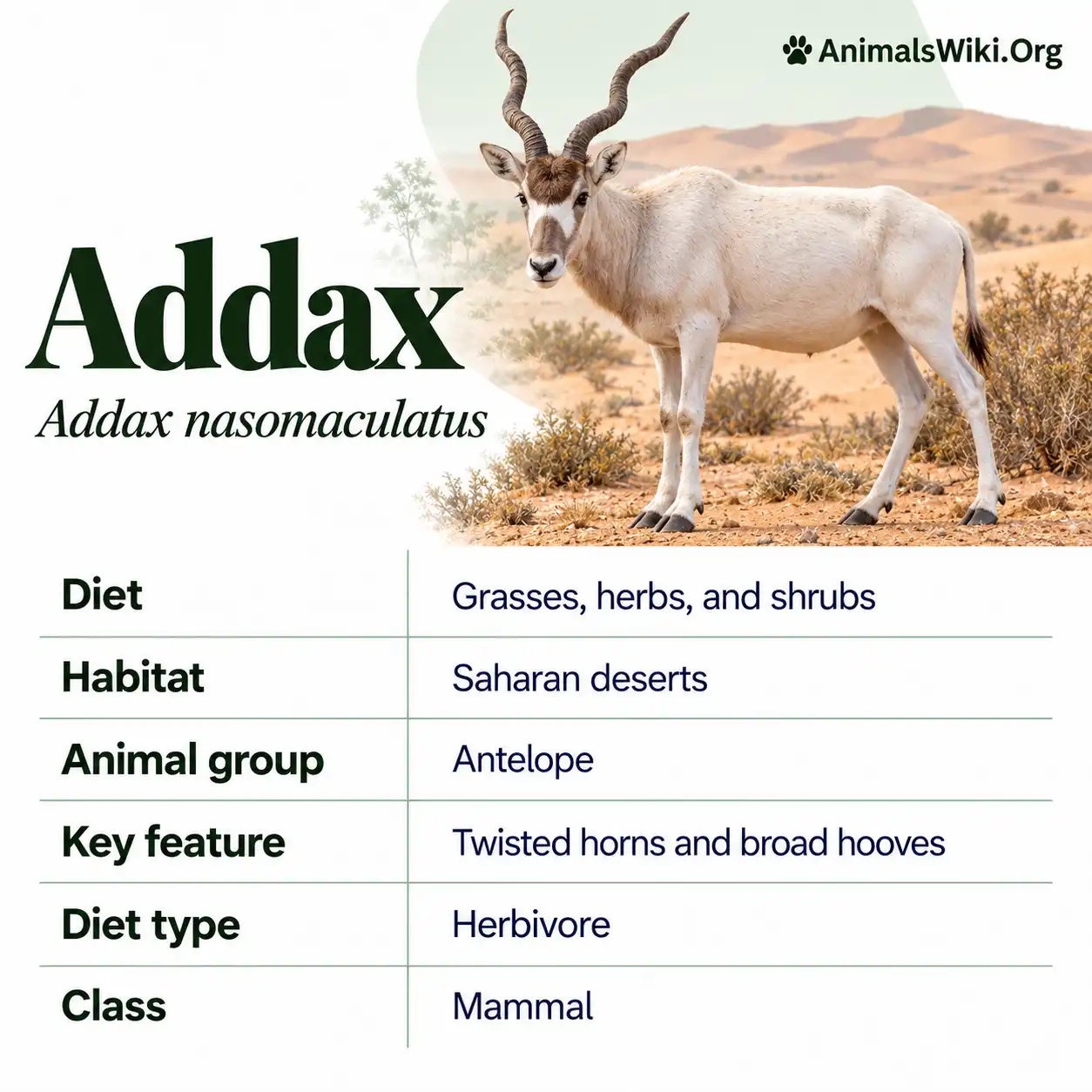
Addax, A Complete Guide to the Sahara’s Remarkable Desert Antelope
An addax moving across the Sahara looks almost perfectly matched to its surroundings. Its pale coat blends with sand and dry vegetation, its broad hooves spread over loose ground, and its long horns twist upward like corkscrews. In a landscape where shade is scarce and rain unpredictable, this antelope survives through an extraordinary combination of water conservation, careful feeding and economical movement.
The addax is also one of the world’s most threatened large mammals. It once ranged widely across North Africa’s deserts and surrounding drylands. Today, its remaining natural populations are extremely small, while conservationists are working to restore the species through protection, breeding programs and reintroductions.
Understanding its situation requires care with numbers. The frequently quoted estimate of 30–90 mature wild addax belongs to an older global assessment. Subsequent releases in Chad have established additional free-ranging animals, but release totals, surviving population estimates and counts of mature individuals describe different things. They cannot simply be combined into one current worldwide census.
The addax’s story is therefore both a warning and a source of hope. Desert specialization could not protect it from modern hunting and disturbance, yet coordinated conservation has created opportunities for recovery. This guide explains its identification, biology, habitat, behavior and conservation without confusing established facts with uncertain or outdated information.
Addax Facts
| Feature | Details |
|---|---|
| Common name | Addax |
| Other names | White antelope; screw-horned antelope |
| Scientific name | Addax nasomaculatus |
| Family | Bovidae |
| Native region | Sahara and adjoining drylands of North Africa |
| Typical habitat | Sandy desert, gravel plains, semidesert and sparse desert grassland |
| Adult weight | Commonly about 60–125 kilograms, depending on sex and individual |
| Shoulder height | Around one meter; published measurements vary |
| Distinctive feature | Long spiral horns in both sexes |
| Diet | Desert grasses, herbs, shrubs and moisture-rich plants |
| Water strategy | Can obtain its water needs from food under suitable conditions |
| Social organization | Small herds; group structure varies |
| Gestation | Approximately nine months |
| Usual offspring | One calf |
| Wild lifespan | Poorly established |
| Recorded captive longevity | Approximately 28 years in an exceptional record |
| IUCN category | Critically Endangered |
What Is an Addax?
The addax is a medium-to-large African antelope specialized for life in extremely dry environments. Its scientific name is Addax nasomaculatus, and it belongs to Bovidae, the family that includes antelopes, cattle, goats and sheep.
Although it is sometimes called the white antelope, it is not white throughout the year. Its coat changes seasonally, becoming paler in summer and darker during cooler months.
The animal is a ruminant. Like cattle and many other antelopes, it uses microbial fermentation to help digest plant material and later rechews partially processed food as cud.
An addax is also a hoofed mammal with permanent horns. These horns differ from deer antlers, which are normally shed and regrown. Its horns remain throughout life, although they can be damaged or broken.
The species belongs to a broader group of antelopes that includes oryx, sable and roan. However, its appearance and ecology are distinctive enough that it occupies its own genus.
Perhaps the most important thing to understand is that the addax survives through efficiency. It does not dominate its environment by being the fastest antelope or by having unlimited access to food. It reduces waste, uses suitable vegetation and avoids unnecessary exposure to the Sahara’s harsh conditions.
That strategy worked across enormous landscapes for a long time. Its present rarity reflects pressures that desert adaptations alone cannot overcome.
Scientific Classification and Subspecies
Scientific Classification
The Mammal Diversity Database recognizes the addax as Addax nasomaculatus, with the authority de Blainville, 1816. The species was originally described under the name Antilope nasomaculata.
| Taxonomic rank | Classification |
|---|---|
| Kingdom | Animalia |
| Phylum | Chordata |
| Class | Mammalia |
| Order | Artiodactyla |
| Suborder | Ruminantia |
| Family | Bovidae |
| Subfamily in the Mammal Diversity Database | Antilopinae |
| Tribe | Hippotragini |
| Genus | Addax |
| Species | Addax nasomaculatus |
Older references may place the animal in the subfamily Hippotraginae. This reflects differences in how higher bovid groups are ranked, rather than disagreement about the identity of the addax.
Does the Addax Have Subspecies?
The standard treatment recognizes one living addax species, without a commonly accepted set of named subspecies.
This does not mean that all addax are genetically identical. Populations can differ genetically without being formally recognized as subspecies.
It is particularly important not to invent separate “white,” “brown” or “desert” addax subspecies from seasonal coat changes or differences between captive herds. Those observations do not establish taxonomic divisions.
What Genetic Research Adds
Research using historical specimens has helped investigate the species’ former population structure. A 2021 study found relatively weak geographic structure in the mitochondrial material examined, consistent with substantial historical movement and mixing across its range.
That conclusion is based on a limited set of samples and genetic evidence. It does not prove that every former population was identical in all biological characteristics.
For conservation, the useful approach is to recognize the species consistently while preserving as much documented genetic variation as possible.
Identification and Physical Appearance
Body Shape
The addax has a stocky body, relatively short legs and a short tail. Compared with many fleet-footed savanna antelopes, it looks sturdy and compact.
Its build is suited to steady travel and survival in arid surroundings. The animal does not have the extremely slender proportions associated with gazelles.
Adult males are generally larger than females, although the sexes overlap in size. A distant photograph rarely provides enough information to determine sex from body mass alone.
Seasonal Coat Color
The coat is usually white or very pale during summer. In winter, it can become grayish, beige or brownish.
This seasonal change helps explain why photographs of the same species can look surprisingly different. A darker animal is not necessarily a different species, a hybrid or an unhealthy individual.
Both sexes have conspicuous facial markings, including a pale pattern across the face and a darker patch of hair on the forehead. A short mane also contributes to the animal’s distinctive profile.
Spiral Horns
The horns are the clearest identification feature. They rise above the head with a pronounced spiral twist rather than forming the long, simple backward curve of an oryx.
Both males and females carry horns. Published accounts describe approximately one and a half to three turns, although shape and length vary with age and individual growth.
A young addax has much smaller horns than a mature adult. Broken or irregular horns can also alter the expected appearance, so identification should consider the whole animal.
Broad Hooves
The hooves are unusually broad and can spread as the animal walks. This helps distribute its weight over loose sand.
A useful comparison is a person walking on soft snow. Spreading weight over a larger area reduces how deeply each step sinks. The addax’s hooves achieve a comparable mechanical benefit on sandy ground.
They do not allow it to ignore difficult terrain, but they make movement through its habitat more efficient.
Addax Compared with Other Desert Antelopes
An unfamiliar observer may confuse a pale addax with an oryx. The horn shape provides the most immediate distinction, but other features are useful.
| Feature | Addax | Scimitar-horned oryx | Arabian oryx |
|---|---|---|---|
| Scientific name | Addax nasomaculatus | Oryx dammah | Oryx leucoryx |
| Native region | North African desert belt | North African and Sahelian drylands | Arabian Peninsula |
| Horn form | Clearly spiral | Long and curved backward | Long and comparatively straight |
| General appearance | Stocky, pale, dark forehead patch | Pale body with reddish neck and chest | White body with strong dark markings |
| Seasonal coloration | Noticeable seasonal change | Different pattern from addax | Different pattern from addax |
| Genus | Addax | Oryx | Oryx |
These animals share adaptations to dry environments, but they are separate species with different histories and conservation situations.
The addax should also be distinguished from the greater kudu. Kudu males have spiral horns, but their bodies, facial patterns, large ears and striped coats are very different. Female kudu normally lack horns, whereas female addax have them.
For practical identification, begin with three questions: Are the horns spiraled? Is the animal compact and pale? Does it have the characteristic dark forehead patch and contrasting face? Together, these clues are more reliable than color alone.
Historical and Present Distribution
A Formerly Widespread Desert Antelope
Historically, addax occupied a broad belt across the Sahara and adjoining drylands, extending from western North Africa toward Egypt and Sudan.
This was not a continuous carpet of animals. Suitable habitat shifted with rainfall, vegetation and local conditions, while herds moved through landscapes that could be sparsely occupied.
Historical range descriptions also combine observations from different periods. A species being recorded in a country centuries ago does not establish that it remained widespread there into modern times.
Remaining Natural Populations
The Termit–Tin Toumma region of Niger has been the principal documented stronghold of the remnant natural population in recent conservation assessments.
Other historical range areas have uncertain, sporadic or outdated records. Older species accounts may list several countries as current range states even when recent evidence no longer confirms a viable resident population.
For this reason, broad country lists should be read cautiously. The conservation question is whether animals are present now, whether they reproduce, and whether the population can persist.
Restored Populations
Reintroduced addax now add another layer to the distribution picture. Restoration programs have involved Chad, Tunisia and Morocco, with different degrees of fencing and management.
These animals are biologically addax, but their population histories differ from those of the last surviving natural herds.
An accurate map should therefore distinguish remnant populations, reintroduced free-ranging groups and animals within managed enclosures. Combining all three without explanation creates a misleading picture of recovery.
Habitat Requirements
More Than Sand Dunes
The Sahara is often imagined as an endless sea of dunes. In reality, it contains gravel plains, rocky ground, shallow drainage systems, scattered vegetation and extensive areas of sparse grass.
Addax can use several of these environments. They are especially associated with arid landscapes where suitable food occurs in scattered patches.
They do not require permanent open water in the way many woodland antelopes do. This allows them to use areas far from rivers, lakes or dependable waterholes.
However, an absence of open water does not mean an absence of resources. The animal still needs vegetation capable of supplying food and moisture.
Important Vegetation
Field research in Niger has shown that addax occurrence is associated with more than a simple measure of how green the landscape appears.
A study based on surveys from 2008–2014 identified the perennial grass Stipagrostis acutiflora and surface characteristics as important predictors. It also recorded a strong negative response to human disturbance.
This matters because satellite images alone cannot show every feature that makes habitat usable. A relatively barren-looking area may contain particularly valuable plants, while a greener location may be too disturbed.
Habitat Must Function Across Time
A site that supports addax after rain may become inadequate during a prolonged dry period. Conservation planning must therefore consider seasonal and year-to-year variation.
Movement routes can be as important as feeding patches. If animals cannot reach the next useful area, a good patch may become an ecological dead end.
Protecting desert habitat consequently requires attention to connections across large landscapes, not just the places where animals happened to be seen during one survey.
Diet and Feeding
What Does an Addax Eat?
Addax eat grasses, herbs, shrubs and other desert vegetation. Their diet can include moisture-rich plants and wild melons where these are available.
They are primarily adapted to grazing but are not restricted to grass alone. The balance between grazing and browsing changes with the plants present and their condition.
Los Angeles Zoo describes a varied plant diet that includes grasses, succulents, wild melons and some browse. This should be understood as a range of foods used by the species, rather than a menu consumed in identical proportions everywhere.
Food Quality Matters
Desert plants differ greatly in their usefulness. A dry stem, a green shoot and a succulent leaf offer different amounts of digestible material and water.
An addax must balance the benefits of a plant against the effort of finding and processing it. A patch containing little vegetation may still be useful if the available plants meet important nutritional needs.
Conversely, the presence of abundant plant material does not guarantee that an animal can maintain good condition. Tough, poorly digestible vegetation can limit the amount of usable energy obtained.
A Digestive System Built for Slow Processing
Research on eight addax fed grass hay found relatively long retention times for food particles and fluid within the digestive system.
The researchers interpreted these findings as consistent with processing slowly fermenting grasses and conserving water. Because the study involved animals under controlled feeding conditions, its measured intake and retention times should not be treated as exact values for every wild addax.
The biological principle is useful: food does not need to pass rapidly through the body to be valuable. Taking time to process difficult vegetation can be part of survival in an environment where meals are limited.
Water Conservation
Can Addax Live Without Drinking?
Addax can survive without drinking open water when their food provides enough moisture and environmental conditions allow them to maintain their water balance.
That is different from surviving without water altogether. Every addax requires water for normal body function; it simply has the ability to obtain much or all of it through food.
It may also obtain moisture associated with dew on vegetation. If accessible drinking water is available, addax can drink.
Reducing Water Loss
Water conservation involves several processes working together.
Concentrated urine and relatively dry feces reduce losses through excretion. Behavior reduces exposure to the hottest conditions, while food choice influences how much water enters the body.
These mechanisms make the animal less dependent on permanent water sources, but they are not unlimited. Poor forage, extreme conditions, illness or disturbance can still disrupt the balance.
The Smithsonian’s account emphasizes both plant-derived moisture and efficient excretion as important parts of the addax’s strategy.
Why “Never Needs Water” Is Misleading
Statements that addax “never need water” confuse drinking with biological water requirements.
The distinction matters for understanding both wild ecology and animal care. A species adapted to obtaining water from vegetation cannot necessarily maintain the same balance on any dry diet.
The safe scientific description is that addax are exceptionally independent of free-standing water under suitable conditions. It is not that their bodies function without water.
Comparison of Water Strategies
| Animal strategy | Main approach | Ecological effect |
|---|---|---|
| Strong dependence on open water | Frequent drinking | Range often linked closely to water distribution |
| Flexible drinking dependence | Food moisture plus periodic drinking | Can use some areas farther from water |
| Addax’s desert strategy | Efficient conservation and substantial plant-derived water | Can occupy extremely arid habitats |
| Marine mammal strategy | Water from food and metabolism, with different physiological adaptations | Functions in a completely different environment |
The comparison highlights an ecological distinction, not a ranking of which animal is “best” at surviving.
Other Desert Adaptations
Pale Summer Coat
The pale summer coat reduces the absorption of solar radiation compared with a darker surface, although the full heat balance also depends on hair properties, wind and behavior.
Seasonal darkening during cooler weather is another reason to view the coat as a dynamic feature rather than fixed decoration.
The French National Museum of Natural History describes coat change, broad hooves, water-saving excretion and temperature regulation as parts of the addax’s desert specialization.
Resting Shelters
Addax may scrape shallow depressions in which to rest. They can also use the shelter offered by vegetation, rocks or other landscape features.
A shallow resting place does not create an underground refuge. Its value depends on local shade, wind and surface conditions.
Avoiding unnecessary movement during intense heat can reduce the combined costs of activity and environmental exposure.
Temperature Regulation
Desert survival requires more than keeping the whole body at one unchanging temperature.
Physiological adjustments can influence heat storage, heat loss and the protection of sensitive tissues. Nasal heat exchange and variation in body temperature are described in museum accounts of the species.
However, popular claims that an addax can withstand any temperature are unjustified. Adaptations increase tolerance within limits; they do not abolish those limits.
What Genomics Suggests
A recent comparative genomic study identified candidate genetic changes associated with water balance, stress responses and energy metabolism.
These results help investigate how desert adaptations evolved. They do not establish that one gene alone explains the addax’s abilities, and the researchers noted limitations associated with the small number of addax examined.
Movement and Daily Activity
Economical Movement
Addax travel to obtain useful food, but they do not necessarily move whenever movement is possible.
In a desert, walking has costs. It uses energy, can increase heat exposure and may carry an animal away from a reliable feeding area.
The useful strategy is therefore flexible: remain where needs are being met, and move when conditions justify the expense.
Nomadism and Rainfall
The species is often described as nomadic because its movements respond to changing resources rather than following one simple permanent grazing circuit.
Rain can transform scattered patches of desert vegetation. Yet rainfall is uneven, and the best destination depends on which plants respond and how long their benefits last.
It would be misleading to describe every addax movement as a predictable migration comparable to a large seasonal wildebeest movement.
Daily Timing
Addax commonly feed during cooler periods and may be especially active at night. Rest becomes more important during the hottest part of the day.
This pattern is flexible. Temperature, food, disturbance and management conditions all influence when animals move.
A zoo observation at midday does not necessarily contradict the species’ tendency to reduce activity during extreme desert heat.
Why Movement Freedom Matters
A fence or heavily disturbed corridor can prevent animals from responding to changing conditions.
This makes movement a conservation issue. Protecting enough food in one season may be insufficient if animals cannot reach the resources needed later.
Social Behavior and Communication
Herd Structure
Traditional accounts describe addax herds of roughly five to twenty animals, often organized around a dominant male. Female relationships also include differences in social rank.
However, the severe reduction of natural populations means that historical group descriptions may not match the tiny clusters now observed.
A group of only a few animals could reflect normal temporary separation, population depletion or local conditions. Context is essential before interpreting it as a standard herd size.
Dominance and Competition
Dominance affects access to social and reproductive opportunities. Animals may assess one another through posture, movement and direct interaction.
Not every disagreement becomes a serious fight. Avoiding unnecessary injury is valuable to animals that must continue walking and feeding in demanding conditions.
Nevertheless, horns make close confrontations potentially dangerous.
Communication
Addax communicate through vocalizations and scent as well as body posture. Reported sounds include grunts, snorts and alarm calls.
Scent glands associated with the feet contribute chemical information to the environment. Such signals can persist after the animal has moved away, providing information beyond immediate visual contact.
Captive and Wild Behavior
Managed groups are easier to observe than the last natural herds, but their conditions differ.
Food may be concentrated, escape space limited and group membership selected by people. Observations remain valuable, but they should not automatically be treated as a complete description of behavior across a large natural desert landscape.
Reproduction
Mating System
A dominant male may obtain breeding access to several females. Male competition and female reproductive condition influence which matings occur.
Reproductive capability and breeding success are different. A young male may be physically capable of mating before it can consistently compete with an established adult.
Likewise, age at first reproduction varies with nutrition and social circumstances.
Breeding Season
Addax can breed throughout the year. Some accounts report seasonal birth peaks, but a single calendar should not be imposed on every wild and captive population.
Environmental conditions influence the costs of pregnancy and nursing. Food availability matters because a female must support both her own maintenance and the growth of her calf.
Gestation and Birth
Pregnancy lasts approximately nine months. Commonly quoted ranges include around 257–270 days, although life-history databases contain somewhat different compiled values.
A female normally gives birth to one calf. Newborn weights are commonly around five to six kilograms.
The mother seeks a relatively sheltered location, and the calf’s first days involve a different balance of concealment and movement from that of an adult.
Successful reproduction is only the beginning of population growth. A calf must survive, mature and eventually contribute to the next generation.
Calf Development
Early Mobility
An addax calf can stand and walk soon after birth. This early mobility is valuable in an exposed environment.
However, being able to walk does not mean that the calf immediately travels continuously with the main herd.
Taronga Zoo describes newborn calves as quickly capable of walking and notes the small horn structures present in both sexes.
Concealment and Nursing
During its early period, a calf may remain concealed while its mother feeds nearby or returns to the herd.
A calf lying alone is therefore not automatically abandoned. Human interference can disturb an arrangement that is normal for the species.
As the calf becomes stronger, it spends more time moving with other animals. The pace of this transition depends on development and conditions.
Growing Horns and Social Learning
Young calves do not display the long spirals of adults. Their horns develop gradually alongside body growth.
They also learn through contact with their mother and other herd members. Following, feeding, play and responses to disturbance all contribute to development.
The Smithsonian documented a captive calf’s early introduction to its father and described the interactions among the three animals. Such observations provide useful detail while remaining examples from one managed family.
General Development Timeline
| Stage | Typical characteristics |
|---|---|
| Birth | Usually one calf; small horn buds or short developing horns |
| First days | Milk dependence and early ability to stand and walk |
| Early weeks | Concealment alternates with nursing and increasing movement |
| Following months | Greater contact with the herd and increasing plant consumption |
| Around six months | Weaning commonly occurs within a broader period around this age |
| Later development | Continued growth, horn development and changing social relationships |
Marwell reports calves joining the herd after roughly two weeks and weaning at approximately 23–29 weeks. These are useful general observations rather than deadlines every calf must meet.
Lifespan and Survival
Wild Lifespan Is Uncertain
The lifespan of wild addax is poorly established. Extremely small populations, difficult field conditions and limited long-term individual histories make a reliable average difficult to calculate.
It is therefore inappropriate to present one precise wild lifespan as firmly known.
Different educational sources give different general longevity figures, sometimes without explaining whether they concern wild animals, captive animals or exceptional records.
Captive Longevity
The AnAge database records a maximum of approximately 28 years in captivity, based on a wild-born individual that died under human care.
This is a longevity record, not an expectation for every addax. It also does not establish how long that animal would have survived in the wild.
Survival Changes with Age
Calves face risks associated with early development and dependence. Adults must cope with food shortages, injury, disease and human threats.
An old animal may survive for years while contributing little to reproduction, whereas losing a healthy breeding female can have an immediate effect on population recovery.
For conservation, age structure matters alongside total numbers. A group containing many adults but very few surviving young may have a very different future from one with regular recruitment.
Predators and Competitors
Natural Predators
Detailed current information on natural predation in the remaining addax populations is limited.
Zoo accounts report jackals as potential calf predators. However, assembling a long list of African carnivores and presenting all of them as major current addax predators would go beyond the available evidence.
Predation risk depends on which carnivores actually share a landscape with addax, the age and condition of the antelope, and local opportunities for attack.
Defense
The horns can be used defensively, but they do not make an addax invulnerable.
Young calves have different abilities from adults, and a weakened animal may be less capable of escaping or resisting an attack.
In the species’ recent decline, uncontrolled human hunting has been much more clearly documented than any species-wide problem caused by natural predators.
Competition for Vegetation
Domestic livestock and wild herbivores may use some of the same plants.
The extent of competition depends on whether shared resources are limiting. Two animals eating vegetation in the same broad landscape are not automatically competing strongly.
During a difficult dry period, however, concentrated grazing can reduce the options available to a small wildlife population.
Avoiding Oversimplification
Pastoral communities have long lived within Saharan and Sahelian landscapes. Conservation should distinguish specific pressures, such as locally excessive grazing or blocked movement routes, from the mere presence of people and livestock.
Understanding where and when resource use becomes a problem is more useful than treating all human activity as ecologically identical.
Ecological Importance
A Specialized Large Herbivore
Addax represent a distinctive way of using desert vegetation. Their ability to persist far from open water allows them to occupy environments unavailable to many other large herbivores.
Their loss would remove more than one animal from a species list. It would eliminate a particular combination of feeding, movement and physiological adaptation from the desert ecosystem.
Nutrient Cycling
Through feeding, dung and urine, addax participate in the movement and recycling of nutrients.
An animal may feed in one place and rest elsewhere, transferring material between patches. The effect depends on abundance, movement and local conditions.
Because present populations are tiny, their current ecological influence may be much smaller than it was historically.
Food-Web Relationships
Addax connect vegetation with other organisms, including potential predators, scavengers and decomposers.
The exact consequences of their disappearance vary between locations. It is unnecessary to claim that the entire Sahara depends on addax to recognize that their loss would simplify its biological communities.
Value Beyond Immediate Function
The species also preserves evolutionary history and provides opportunities to study survival under severe aridity.
Its scientific value does not justify reducing it to a collection of useful genes or adaptations. Protecting the living animal requires protecting the relationships and landscapes that allow those traits to function.
Population Estimates and Conservation Status
Current Conservation Category
The addax remains classified as Critically Endangered on the IUCN Red List.
The global Red List assessment displayed by IUCN was assessed in April 2016. A separate Green Status assessment was published in 2025. The existence of a newer Green Status assessment does not mean that the extinction-risk category was newly reassessed in the same year.
The Frequently Quoted Wild Estimate
The estimate of 30–90 mature individuals is widely reproduced from the global assessment information.
It should be labeled as an assessment estimate rather than a precise October 2026 headcount. It also concerns mature animals, not every calf and juvenile.
Newer restoration projects make it especially important to explain the origin of this figure.
Dated Figures That Describe Different Things
| Date or reporting period | Population or project | Figure | Meaning |
|---|---|---|---|
| 2016 global assessment | Remnant wild population | 30–90 mature individuals | Assessment estimate, not a present-day census |
| March 2016 survey | Surveyed area in Niger | Three living addax directly located | Observation count, not proof that only three existed worldwide |
| December 2023 release | Ennedi, Chad | Ten addax | Founding release, not a later population total |
| End of 2025 | Ouadi Rimé–Ouadi Achim, Chad | Approximately 130 | Field estimate for that reserve |
| 2025 annual reporting | Chad recovery program | 150 cumulative releases since the initial 2020 release | Release history, not the number necessarily alive |
The Chad figures come from Sahara Conservation’s 2025 report, published in 2026. The distinction between cumulative releases and estimated survivors is essential.
Mature, Total, Wild and Captive
A total population can include calves and juveniles. A mature population estimate focuses on animals capable of reproduction under assessment definitions.
Captive animals are recorded separately from wild populations. Reintroduced animals may qualify for assessment under particular rules, but release alone does not establish that a population is self-sustaining.
A cumulative release total is different again. Births, deaths, movements and subsequent transfers all affect how many animals remain at a site.
Major Threats
Uncontrolled Hunting
Hunting has been a central driver of the addax’s decline. Modern weapons and motorized pursuit remove much of the protection once provided by distance and difficult terrain.
An animal specialized for economical desert survival is poorly equipped to escape a vehicle.
IUCN’s reporting on the 2016 crisis linked the species’ deterioration to insecurity, increased access and illegal hunting associated with the oil-development landscape.
Industrial Disturbance
Roads, extraction sites and associated traffic can affect wildlife beyond the land directly occupied by infrastructure.
They can create access into previously remote habitat, increase disturbance and change how animals move.
The strongest management response is to address these mechanisms specifically: access, enforcement, sensitive areas and the behavior of people working in the landscape.
Drought and Resource Failure
Addax tolerate aridity, but drought tolerance does not mean immunity to prolonged food failure.
A landscape can become unsuitable if useful plants decline over too large an area or if animals cannot reach alternative patches.
Human disturbance can compound this problem by making remaining resources inaccessible.
Small-Population Risks
Very small populations can be affected disproportionately by individual deaths, unbalanced sex ratios and chance events.
A group may contain animals but lack enough breeding opportunities for sustained growth. Isolation can also limit genetic exchange.
These risks help explain why recovery requires more than preventing the immediate death of the final few animals.
Reintroductions and Recovery
Chad’s Recovery Program
Captive-bred addax have been returned to Chad’s Ouadi Rimé–Ouadi Achim Faunal Reserve, creating a major opportunity for recovery.
The first release into the wild occurred in 2020, following earlier translocation and preparation.
Sahara Conservation’s reporting describes continued releases, reproduction and monitoring. These achievements demonstrate progress, while the species’ continuing global risk shows how much work remains.
Learning from Animal Behavior
The 2025 program changed release strategy by placing addax directly into more typical Saharan habitat farther north within the reserve.
Earlier animals had remained near suitable resources in the more southern release area rather than automatically moving north.
This is an important practical lesson: managers cannot assume that animals will choose the destination intended by a restoration plan. Release location and available resources influence what happens next.
Ennedi
African Parks announced the release of ten addax into Chad’s Ennedi Natural and Cultural Reserve in December 2023.
The organization described it as the start of a pilot effort, with an eventual ambition to establish a much larger viable population. That ambition should not be confused with a population already achieved.
Tunisia
Tunisia has a longer history of addax restoration.
An IUCN translocation case study describes releases into Djebil National Park involving animals from Tunisian, European and North American sources. Monitoring documented reproduction but also challenges involving fences, dispersal and supplementary feeding during drought.
The case shows that successful releases still require continuing management and adaptation.
Genetics and Captive Conservation
Why Captive Animals Matter
Managed populations can prevent the complete loss of a species and provide animals for restoration.
Their value depends partly on health, reproductive management and the genetic diversity retained across institutions.
A large number of animals descended from a narrow set of founders does not necessarily preserve all the variation once present in the wild.
The Remaining Wild Animals Are Irreplaceable
A study published in the 2023 issue of Evolutionary Applications found that the remnant wild addax retained more diverse mitochondrial haplotypes than the sampled captive and reintroduced populations.
The researchers also found unique genetic variation within different managed populations. Their findings support coordinated management and the protection of surviving wild animals.
This should not be exaggerated into a claim that captive addax are useless. The result explains why captive breeding and wild protection need to work together.
Choosing Founders
Animals selected for a new population should be considered for more than appearance or availability.
Relatedness, ancestry, health, sex ratio and age structure all influence the prospects of a release group.
Genetic research can help identify combinations that retain more diversity and reduce avoidable inbreeding.
International Cooperation
The addax is listed on CMS Appendix I, and international conservation programs involve range-country authorities, zoos, research organizations and field teams.
CITES Appendix I also places strict controls on international trade. These agreements support conservation, but their effectiveness ultimately depends on implementation and protection where animals live.
Research and Monitoring
Finding Rare Animals
Surveying addax is difficult because the landscape is vast and the animals are scarce.
Researchers may combine direct sightings, tracks, local knowledge, aerial observations and satellite information. Each method has strengths and limitations.
A track record indicates presence, but estimating the number and age of animals from tracks involves uncertainty. A sighting confirms an animal but may not reveal how many remain elsewhere.
Tracking Reintroduced Herds
Satellite collars can show movements after release and help teams locate animals for observation.
However, a collar location alone does not explain everything. Field teams still need to assess condition, births, deaths and habitat use.
Monitoring is most useful when it tests practical questions: Are animals finding suitable food? Are calves surviving? Are movements bringing them into danger?
Historical Specimens
Museum material can provide information that living populations alone cannot recover.
The 2021 genetic study used historical samples to investigate past diversity and population history. Such research creates a baseline against which modern populations can be evaluated.
The aim is not simply to produce more data. It is to make better decisions about preserving the diversity and ecological function that remain.
Responsible Wildlife Watching
Most people encounter addax in zoos, wildlife parks or managed reserves rather than in the last natural population.
These opportunities can be valuable when they provide accurate information and support legitimate conservation.
Give animals room, follow staff instructions and do not interpret a calm appearance as permission to approach. Addax are strong wild mammals with potentially dangerous horns.
Avoid disturbing calves resting alone. Their position may be part of normal maternal behavior.
When sharing photographs, describe the setting accurately. A zoo herd, a reintroduced reserve population and a remnant wild group represent different parts of the conservation story.
Support organizations that explain their work clearly, distinguish goals from achievements and report outcomes beyond the number of animals transported.
Frequently Asked Questions About Addax
1. What is an addax?
An addax is a desert antelope native to North Africa. Its scientific name is Addax nasomaculatus. It is recognized by its pale seasonal coat, sturdy body, broad hooves and long spiral horns in both males and females.
2. Is an addax the same as an oryx?
No. Addax and oryx are related bovids, but they belong to different genera. The addax’s horns have a pronounced spiral, while oryx horns are comparatively straight or curve backward without the same corkscrew form.
3. Where do addax live?
They are native to the Sahara and adjoining drylands. The principal documented remnant natural stronghold has been in Niger. Reintroduced populations have also been established through conservation programs in countries including Chad, Tunisia and Morocco.
4. Why is the addax called the white antelope?
Its coat becomes very pale during summer, producing the appearance behind that common name. During cooler months, the coat may become grayish or brownish. Seasonal changes should not be mistaken for different subspecies.
5. What does an addax eat?
Addax consume desert grasses, herbs, shrubs and moisture-rich vegetation. Wild melons can be useful where available. Their diet changes with local resources, so no single list describes everything eaten by every population throughout the year.
6. Can addax survive without water?
They cannot survive without water biologically. However, they can obtain their needs from moisture in food under suitable conditions and may live without drinking open water. Efficient conservation reduces the amount they lose.
7. Do addax drink if water is available?
Yes, they can drink when water is accessible. Their independence from permanent water sources is an adaptation, not an inability to drink. The important distinction is between requiring water and requiring frequent visits to a waterhole.
8. Do female addax have horns?
Yes. Both sexes carry spiral horns. Male horns are often longer, but individual variation and age complicate identification. Horn presence alone cannot be used to identify an addax as male.
9. How big is an addax?
Adults commonly weigh around 60–125 kilograms, with males generally larger than females. They stand roughly around one meter at the shoulder, although published measurements vary. These are broad descriptions rather than exact limits.
10. Are addax fast runners?
They are not especially fast compared with many other antelopes. Their survival strategy emphasizes efficiency, water conservation and use of arid habitat. This makes motorized pursuit particularly dangerous because natural desert advantages do not protect them from vehicles.
11. Are addax active at night?
They are often active during cooler periods, including nighttime. They commonly rest during intense daytime heat. Activity remains flexible and can change with weather, food, disturbance and the conditions of a managed environment.
12. Do addax live alone?
They are social animals that form small groups. Historical accounts often describe herds of five to twenty, but severely depleted natural populations may occur in much smaller clusters. A single observation does not establish a universal social pattern.
13. What is a baby addax called?
A baby addax is called a calf. Usually one is born at a time. It can stand and walk early but may spend part of its first period concealed while its mother feeds and returns to nurse.
14. How long is an addax pregnant?
Pregnancy lasts approximately nine months. Common species accounts report about 257–270 days, although compiled life-history information varies. It is more useful to give an approximate range than imply every birth follows one exact schedule.
15. Are addax calves born with horns?
They have small horn buds or short developing horns rather than adult spirals. Horns grow as the animal develops. Both male and female calves eventually acquire the characteristic spiral horn form.
16. How long do addax live?
Wild lifespan is not well established. An exceptional captive longevity record is approximately 28 years. That record should not be presented as an average or as proof that wild addax commonly survive for nearly three decades.
17. Is the addax extinct?
No. The species survives in remnant natural populations, reintroduced populations and human care. It remains Critically Endangered, which indicates an extremely high risk of extinction in the wild rather than an extinction already completed.
18. How many addax remain in the wild?
There is no single current worldwide census established here. The older assessment estimate of 30–90 mature individuals is frequently quoted, while later releases have added free-ranging populations. These figures require dates and clear explanations of what was counted.
19. Were there really only three addax left?
A March 2016 survey directly located three living animals in the surveyed landscape. That was an alarming observation, but it did not prove that only three addax existed anywhere in the wild or worldwide.
20. Why are addax endangered despite their desert adaptations?
Their adaptations address challenges such as water shortage, heat and difficult ground. They do not provide protection against firearms, motor vehicles or widespread disturbance. Modern hunting and habitat pressures can overwhelm an animal that is highly successful under natural desert conditions.
21. Do addax have natural predators?
Calves can be vulnerable to carnivores, and species accounts mention jackals. Detailed modern data on predation in remnant populations are limited. Human hunting is much more clearly established as a major cause of the species’ recent collapse.
22. Can captive addax help restore wild populations?
Yes. Captive-bred animals have already supported reintroductions. Successful restoration also requires suitable habitat, protection, appropriate founder selection and long-term monitoring. Breeding animals alone does not remove the threats that caused their disappearance.
23. Why protect the last natural addax if captive animals exist?
The remaining natural population retains valuable genetic variation and represents continued survival within the species’ native ecological setting. Captive populations do not necessarily contain every lineage or combination of variation found in the wild.
24. Are addax dangerous to people?
They can be. Their calm appearance should not obscure their strength and sharp horns. Close approach, confinement or disturbance can create danger. Visitors should maintain distance and follow the instructions of wildlife staff.
25. Are addax suitable pets?
No. They are wild antelopes requiring specialist facilities, appropriate social management and experienced veterinary care. Their conservation importance and physical capabilities make them unsuitable as household pets.
26. What would successful addax conservation look like?
It would include secure, reproducing populations across suitable parts of the native range, surviving calves, retained genetic diversity and protection from unsustainable hunting. Release numbers are useful milestones, but long-term persistence is the more meaningful result.
Addax (Addax nasomaculatus)
The addax is one of the Sahara’s most remarkable survivors. Its spiral horns and pale coat make it memorable, while its digestive efficiency, broad hooves and ability to conserve water reveal a much deeper specialization for desert life.
Its rarity shows the limits of that specialization. An animal can be superbly adapted to drought and still be devastated by modern hunting, disturbance and the loss of safe movement across its habitat.
Recovery efforts have created real opportunities, particularly through reintroductions and international cooperation. Their lasting value will depend on protection, surviving calves, genetic management and the ability of populations to sustain themselves.
The addax’s future therefore rests on preserving more than a few spectacular animals. It requires restoring the conditions in which this desert antelope can once again live as a functioning part of the Sahara.



