
Arabian Oryx, The Desert Antelope That Returned from Extinction in the Wild
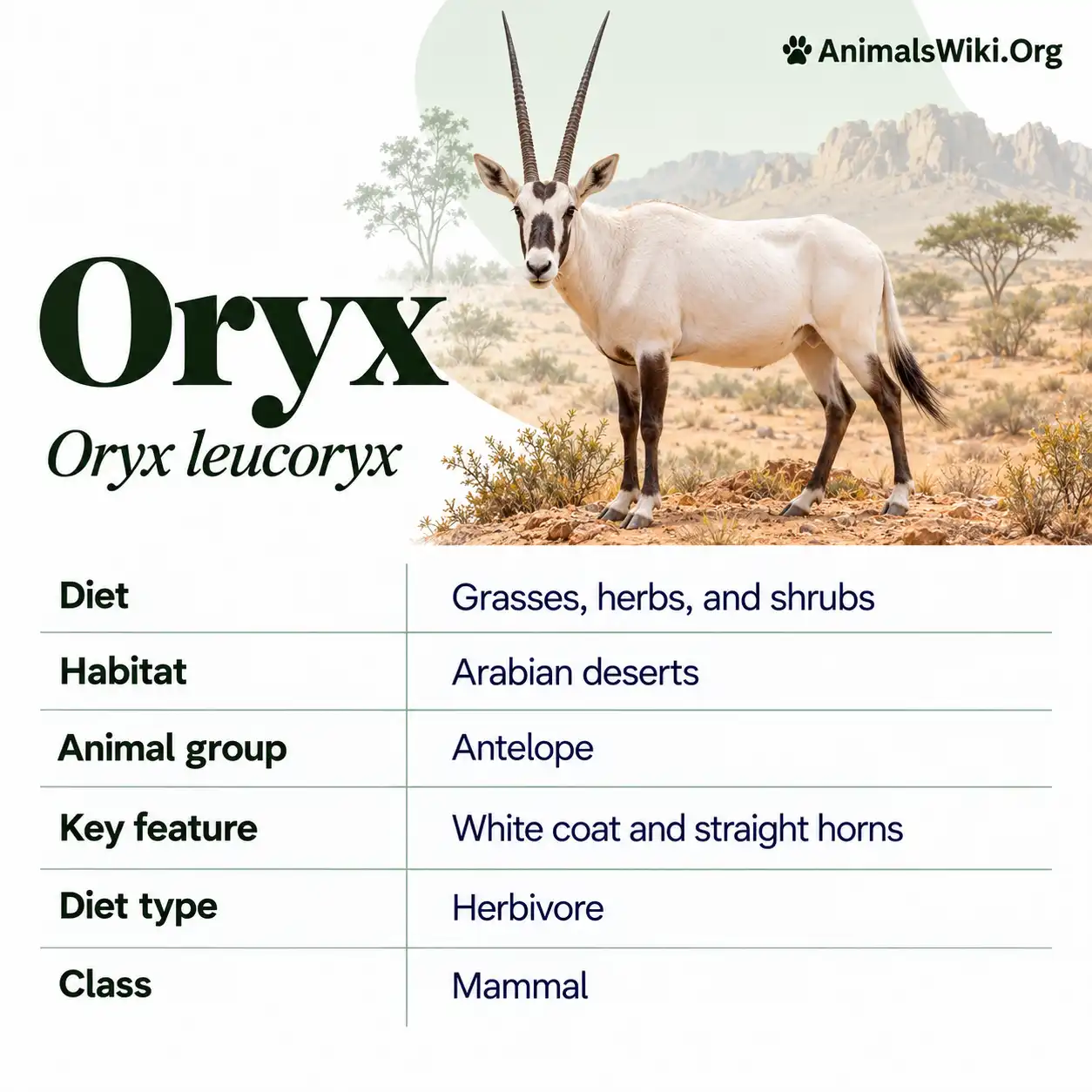
A white antelope stands against the warm colors of an Arabian desert. Dark markings frame its face, slender horns rise above its head, and its broad hooves rest on ground where food and water may be scattered far apart. This is the Arabian oryx, an animal whose appearance is as distinctive as its conservation history.
The Arabian oryx survives through a combination of physiology and behavior. It obtains moisture from vegetation, adjusts its activity to changing temperatures, and moves through dry landscapes in search of useful grazing. Its success depends on making limited resources last.
Yet these adaptations could not protect it from modern hunting. By 1972, the last known members of the original wild population had been killed. The species survived in human care, where a coordinated breeding effort preserved the possibility of returning it to its homeland.
Reintroductions made that return possible. In 2011, the Arabian oryx became the first species that had previously been Extinct in the Wild to recover sufficiently to be classified as Vulnerable on the IUCN Red List. It remains Vulnerable today.
That achievement does not mean the work is finished. Population figures describe different combinations of wild, managed and captive animals, while drought, hunting and habitat limitations continue to affect recovery. Understanding the Arabian oryx requires looking beyond its celebrated comeback to the conditions that will keep it secure.
Arabian Oryx Facts
| Feature | Details |
|---|---|
| Common name | Arabian oryx |
| Other common name | White oryx |
| Scientific name | Oryx leucoryx |
| Family | Bovidae |
| Native region | Arabian Peninsula and adjoining parts of the Middle East |
| Typical habitat | Desert plains, open wadis, sandy areas and stony desert |
| Adult weight | Commonly around 55–80 kilograms, with variation |
| Shoulder height | Approximately 80–100 centimeters |
| Main identifying features | White body, dark facial and leg markings, long nearly straight horns |
| Horns | Present in both sexes |
| Diet | Mainly grasses, with other available vegetation |
| Gestation | Approximately eight to nine months |
| Usual offspring | One calf |
| Social organization | Small herds, bachelor groups and sometimes solitary males |
| Captive longevity | Can exceed 20 years |
| Original wild population lost | By 1972 |
| First major release back into the wild | Oman, 1982 |
| IUCN category | Vulnerable |
What Is an Arabian Oryx?
The Arabian oryx is a desert antelope belonging to the family Bovidae. Its scientific name is Oryx leucoryx. It is the smallest living oryx species and is native to Arabia and neighboring parts of the Middle East.
Like other bovids, it has permanent horns rather than annually shed antlers. Both males and females carry horns, which help distinguish an oryx herd from some antelope species in which only males are horned.
The Arabian oryx is also a ruminant. Microorganisms in its digestive system help process plant material, and the animal regurgitates partially digested food as cud for further chewing.
Its relatively modest body size is important when comparing it with African relatives. A gemsbok may look superficially similar, but it is generally much larger and has a different pattern of markings.
The word “oryx” is sometimes used loosely in travel descriptions or animal collections. Scientific names help prevent confusion between the Arabian oryx, scimitar-horned oryx and other related antelopes.
Most importantly, the Arabian oryx is a restored wild species. Its present free-ranging populations descend from animals preserved and bred under human care. Its return shows what long-term conservation can accomplish, while also revealing how much planning is required after the first animals are released.
Scientific Classification and Subspecies
Scientific Classification
The Mammal Diversity Database recognizes the Arabian oryx as Oryx leucoryx, with the authority Pallas, 1777. It places the species within the tribe Hippotragini, alongside other oryx and their relatives.
| Taxonomic rank | Classification |
|---|---|
| Kingdom | Animalia |
| Phylum | Chordata |
| Class | Mammalia |
| Order | Artiodactyla |
| Suborder | Ruminantia |
| Family | Bovidae |
| Subfamily in the Mammal Diversity Database | Antilopinae |
| Tribe | Hippotragini |
| Genus | Oryx |
| Species | Oryx leucoryx |
Some books use Hippotraginae as the subfamily name. This reflects differences in the ranking of higher bovid groups rather than a disagreement about whether the Arabian oryx is a distinct species.
Are There Arabian Oryx Subspecies?
The Arabian oryx is generally treated as a single species without a standard set of recognized living subspecies.
Different breeding herds may have different founder histories or genetic characteristics. Those differences do not automatically establish subspecies.
Similarly, an animal with darker legs, a slightly different facial pattern or unusual horns should not be assigned to an invented regional form without scientific evidence.
Taxonomy and Conservation Are Related but Different
Taxonomy concerns how organisms are classified. Conservation management also needs to understand ancestry, relatedness and the genetic variation retained in particular herds.
A species can lack recognized subspecies while still requiring careful management of different founder lineages.
For the Arabian oryx, this distinction is especially important because modern populations passed through a severe reduction in numbers and were rebuilt through several breeding programs. Maintaining those surviving lineages matters even when all the animals carry the same scientific name.
Identification and Appearance
White Body and Dark Markings
An adult Arabian oryx is predominantly white, with contrasting darker markings on the face and legs.
The pale coat is particularly conspicuous against red dunes or dark gravel. However, dust, shade and lighting can alter its apparent color.
The face usually provides useful identification clues. Dark areas contrast with pale regions around the head, producing the familiar masked appearance seen in photographs.
Young animals look different from adults. Calves are initially brownish or sandy-colored and develop the more strongly contrasting adult appearance as they grow.
Long, Nearly Straight Horns
Both sexes have long horns that are straight or only slightly curved. Prominent ridges occur along the lower portions, while the ends taper to sharp points.
Male horns tend to be thicker, while female horns may be more slender and longer. Horn length alone is therefore an unreliable way to determine sex.
The Environment Agency–Abu Dhabi describes this difference in horn proportions and emphasizes the species’ characteristic white coloration and dark markings.
Body Shape and Hooves
The Arabian oryx has a compact, sturdy body, a relatively long face and a tufted tail. Its proportions are more substantial than those of a small gazelle.
Broad hooves help support it on softer ground. Nevertheless, it should not be imagined as an animal restricted to deep dunes. Firm sandy areas, gravel plains and interdunal flats are also important.
Field Identification
Look at the whole animal rather than relying on one feature.
The combination of a pale body, strong facial contrast, comparatively small oryx size and long straight horns is distinctive. A broken horn, unusual posture or partial view can make identification harder.
Location also matters. An oryx photographed in a managed collection may be outside its native range, so geography alone is not enough.
Arabian Oryx Compared with Other Antelopes
| Feature | Arabian oryx | Scimitar-horned oryx | Gemsbok | Addax |
|---|---|---|---|---|
| Scientific name | Oryx leucoryx | Oryx dammah | Oryx gazella | Addax nasomaculatus |
| Native region | Arabia and neighboring Middle East | North Africa and Sahel | Southern Africa | Sahara and adjoining drylands |
| Horn shape | Nearly straight | Sweeps backward in a long curve | Long and straight | Spiral |
| Typical body color | Predominantly white | Pale, with reddish neck and chest | Gray-brown with strong black-and-white markings | Pale in summer, darker in cooler weather |
| Relative size | Smallest oryx | Larger | Much larger | Generally heavier than Arabian oryx |
| Main identification clue | White body and straight horns | Curved horns and reddish neck | Large body and bold dark pattern | Corkscrew horns |
These species share adaptations to dry environments, but their ecology and conservation histories differ.
The addax is not an oryx, despite its pale coat and desert specialization. Its spiral horns are the easiest distinction.
The scimitar-horned oryx has a superficially similar pale body, but its horns curve much more strongly. It also has a different native range.
Comparisons should use species-specific information. A dramatic temperature measurement or body-weight range reported for one African oryx should not automatically be applied to the Arabian species.
Historical and Present Distribution
The Original Range
Historically, Arabian oryx occurred across much of the Arabian Peninsula and extended north into neighboring areas, including parts of what are now Jordan, Iraq, Syria and the Sinai region.
Exact historical boundaries remain incomplete because records differ in age and reliability. Desert animals can also move beyond their usual range during unusual conditions.
The broad historical picture is nevertheless clear: the species occupied a much larger landscape before modern hunting eliminated the original wild population.
Reintroduced Populations
Arabian oryx have been returned to protected areas in Oman, Saudi Arabia, the United Arab Emirates, Jordan and Israel.
These populations differ in size, movement freedom and management. Some occupy extensive landscapes, while others receive substantial support within fenced reserves.
Fauna & Flora’s account documents the species’ restored presence across these countries, while emphasizing that recovery has not removed all threats.
Why Distribution Maps Need Explanation
A modern map may include wild populations, managed reserve herds, breeding centers and private collections.
Those categories do not describe the same conservation situation. Animals maintained in a breeding facility cannot simply be counted as occupying natural habitat.
Likewise, a country with many captive oryx may contain fewer animals qualifying as wild under assessment criteria.
For readers and researchers, the useful questions are where animals live, how independently they survive, whether they reproduce, and whether their population can persist without continual replacement.
Habitat Requirements
Desert Diversity
Arabian oryx habitat includes gravel plains, open drainage systems, sandy ground, dune margins and stony areas between dunes.
This variety matters. Deserts are not uniformly empty, and their resources are distributed unevenly.
A shallow wadi may support better vegetation than the surrounding plain. A firm interdunal area can provide easier movement than neighboring soft sand. A scattered tree may become valuable shade during hot weather.
Food, Shade and Movement
Suitable habitat needs to provide more than enough space for animals to stand.
Oryx require access to vegetation with useful nutritional and moisture content. They also benefit from opportunities to regulate heat through shade, timing and movement.
The resources may not occur in the same place. Animals must therefore be able to move between them without excessive disturbance or barriers.
Uruq Bani Ma’arid
Saudi Arabia’s Uruq Bani Ma’arid is a particularly important landscape for Arabian oryx recovery.
UNESCO describes the site as a diverse desert environment on the edge of the Empty Quarter, notable for the restoration of Arabian oryx and other native species. Its varied topography supports different habitats within a broader arid system.
The site illustrates why conserving a desert animal requires conserving landscape processes, not simply enclosing a patch of sand.
Habitat Changes over Time
A useful feeding area can deteriorate as plants dry out. Conversely, localized rain can create temporary opportunities.
Habitat quality must therefore be assessed across seasons and drought cycles. A survey during favorable conditions may underestimate the difficulty of surviving the next prolonged dry period.
Diet and Feeding
What Do Arabian Oryx Eat?
Arabian oryx feed mainly on grasses, while also taking other available vegetation, including shoots and shrubs.
Their diet supplies both nutrients and moisture. This gives food quality a double importance: vegetation must support energy needs while contributing to water balance.
The species is not restricted to one grass, and its precise diet varies with location and season.
Choosing Useful Plant Material
A plant’s usefulness changes as it grows and dries.
Green leaves, flowering parts and old stems can differ substantially in protein, moisture and digestibility. An oryx gains more from some parts than others, even when they belong to the same plant.
Research in Oman found that the nutritional value of important grasses declined after rainfall. Fog and dew helped some plants retain green material during extended dry periods, but usable forage still became increasingly limited.
This explains why an animal can lose condition in a landscape where dry vegetation remains visible. The quantity of standing material is not the same as the quantity of adequate food.
Ruminant Digestion
Microbial fermentation helps the oryx process fibrous vegetation. Rumination allows further chewing and supports the breakdown of plant material.
This system expands the range of foods the animal can use, but it does not make nutrition irrelevant. Extremely poor forage can still fail to meet maintenance or reproductive needs.
Feeding and Reproduction
Pregnancy, milk production and calf growth increase nutritional demands.
A female may survive difficult conditions while becoming less able to reproduce successfully. Population decline can therefore begin through reduced recruitment before adult mortality becomes obvious.
For conservation teams, births and calf survival are useful indicators of how well the food environment is supporting the herd.
Water Conservation
Surviving without Frequent Drinking
Arabian oryx can obtain sufficient moisture from food for extended periods when conditions are suitable.
This ability allows them to live far from permanent water. It does not mean they survive without water biologically.
They drink when water is available, and their dependence on drinking changes with food moisture, heat and management conditions.
Water and Energy Together
A field study in Saudi Arabia examined seasonal energy expenditure, water movement through the body and food consumption.
The animals relied largely on grasses for both energy and preformed water, apart from temporary pools after rain. Such findings show that feeding and water supply cannot be treated as separate issues.
If vegetation becomes drier, an oryx may need to change what it eats or where it feeds. If useful plants become scarce, obtaining enough moisture can also require more effort.
Reducing Losses
Concentrated urine and relatively dry feces help conserve water. Behavioral adjustments reduce some of the need for evaporative cooling.
These adaptations work together. No single mechanism accounts for the animal’s desert survival.
Managed Water Changes Behavior
A study tracking two Arabian oryx in Dubai Desert Conservation Reserve found that the animals sought drinking water almost daily during summer.
Because only two individuals were studied, the result should not be generalized to all oryx. It does demonstrate that animals use accessible water and that managed conditions can influence behavior.
What “Does Not Need Water” Gets Wrong
The accurate statement is that Arabian oryx can be highly independent of open water under suitable conditions.
That differs from claiming they never drink, never become dehydrated or can survive indefinitely on any dry food. Their water balance remains dependent on real resources.
Temperature Regulation and Desert Adaptations
Reflective Coloration
The white coat reflects a substantial portion of incoming sunlight, helping limit heat gain.
However, coat color is only one part of temperature regulation. Hair structure, wind, posture, shade and activity all influence the animal’s heat balance.
A pale animal standing in full sun still experiences a significant environmental heat load.
Flexible Body Temperature
Arabian oryx can allow body temperature to vary over the day rather than defending one narrow value at all times.
This is called heterothermy. Under some conditions, allowing temporary heat storage can reduce the amount of water needed for evaporative cooling.
Research on free-living animals indicates that water limitation is particularly important in driving this response. It should not be simplified into the claim that all oryx routinely tolerate the same extreme temperature.
Selective Brain Cooling
Arabian oryx possess anatomical arrangements that allow heat exchange between blood associated with the nasal region and arterial blood traveling toward the brain.
Research has investigated selective brain cooling as a mechanism associated with coping with aridity and conserving water.
The response varies with conditions and individual circumstances. It is more accurate to describe a regulated physiological mechanism than to call it a permanent natural air conditioner.
Behavioral Cooling
Shade seeking and reduced activity during intense heat can reduce physiological demands.
Resting in a shallow depression may also alter exposure to wind, sunlight and the ground surface.
These choices matter because preventing heat gain can be less costly than losing additional water to remove heat already absorbed.
Adaptations Have Limits
No desert adaptation creates unlimited tolerance.
If food fails over a large area, animals are prevented from moving, or conditions remain severe for too long, survival and reproduction can deteriorate.
The Arabian oryx’s abilities are impressive precisely because they operate within biological limits, not because those limits disappear.
Movement and Daily Activity
Following Changing Resources
Rainfall can transform desert grazing, but it rarely does so evenly.
A study of female Arabian oryx in Oman found substantial variation in their response to localized rain. Some moved rapidly toward improved grazing, while others did not reach it. These differences affected survival and reproduction.
Movement is therefore central to desert ecology. A herd’s success may depend partly on reaching a temporary resource before its value declines.
Nomadic Rather Than Uniformly Migratory
Arabian oryx movements do not necessarily follow a simple annual route.
Animals may remain where resources are adequate, expand their movements during scarcity, or shift after localized rain.
Describing them as nomadic captures some of this flexibility, but even that word should not imply constant wandering. Unnecessary travel uses energy.
Daily Timing
In hot weather, activity can shift toward cooler hours and nighttime. During cooler periods, daytime feeding and basking can become more useful.
This flexibility means a fixed schedule cannot describe every season or reserve.
Barriers and Restricted Choices
Fences can prevent animals from reaching newly improved grazing. Roads, settlements and disturbance can also affect movement.
Even a large reserve can be limiting if its resources fail at the same time and animals have no alternative.
The conservation challenge is to provide enough room, habitat variety and management flexibility for animals to respond to an unpredictable environment.
Social Behavior and Communication
Herd Life
Arabian oryx are social animals. Groups commonly contain relatively small numbers, although larger aggregations occur under some conditions.
Group size can change when food becomes concentrated, animals separate or social relationships shift.
A herd should therefore be viewed as a changing association rather than a permanently fixed collection of individuals.
Males and Social Rank
Adult males may compete for access to females. Bachelor groups and solitary males can also occur.
Dominance is influenced by strength, experience and relationships. It is not simply a matter of whichever animal has the longest horns.
Animals communicate through approach, withdrawal, posture and physical interaction. Many encounters can be resolved without serious fighting.
Horns in Social Encounters
Horns can be used in contests, but they also create a risk of injury.
In a managed setting, enclosure design and opportunities to retreat can influence how dangerous aggressive encounters become.
Staff need to understand the behavior of particular animals as well as general species tendencies.
Wild and Managed Observations
Some detailed behavioral knowledge comes from captive or reintroduced herds.
Those observations are valuable, but concentrated feeding, selected group membership and restricted movement can alter social conditions.
Animal Diversity Web describes herds, bachelor hierarchies and defensive horn positioning, while its older conservation figures should not be used as current population information.
Reproduction and Mating
Breeding Opportunities
Arabian oryx can breed throughout the year. Birth peaks may occur locally, but there is no single calendar that applies across every population.
Food, weather and management influence reproductive outcomes.
The presence of a mature male and female does not guarantee successful breeding. Condition, social compatibility and health also matter.
Sexual Maturity and First Birth
Physiological maturity is different from successful reproduction.
A young male may be capable of mating before it obtains regular access to females. A female may mature before conditions support her first successful pregnancy.
Compiled life-history sources report different ages, making broad descriptions more appropriate than one universal deadline.
Pregnancy
Gestation is commonly described as approximately eight to nine months.
Published figures vary between sources. Marwell gives around 240 days, while regional conservation material reports a longer range. These differences support an approximate description rather than a claim that every pregnancy lasts exactly the same number of days.
Birth
A female normally produces one calf, although twins have occasionally been reported.
Birth requires an appropriate balance of privacy and safety. The mother’s condition and the quality of the surrounding food supply influence what happens next.
The regional conservation strategy notes that births occur in all months and that calves can become mobile within hours.
Calf Development
Newborn Appearance
A young Arabian oryx is generally sandy or light brown rather than displaying the strong white-and-dark contrast of an adult.
This difference is important for identification. A brown calf beside a white adult is not evidence that the herd contains different species.
As the animal grows, its coat and facial markings change toward the adult pattern.
Standing and Following
Calves become capable of standing and moving early. Mobility is valuable in open environments because a completely immobile youngster would be difficult to protect.
However, early walking does not mean complete independence. The calf still relies on its mother for milk and protection.
Its behavior reflects a balance between following, resting and remaining inconspicuous.
Feeding Development
Milk supports early growth. Plant consumption increases gradually as the digestive system develops and the youngster gains experience.
Weaning is a process rather than an instantaneous event. Nursing and grazing can overlap for a period.
AnAge’s compiled information gives weaning at approximately four and a half months, but individual and environmental variation should be expected.
General Development Timeline
| Stage | Typical features |
|---|---|
| Birth | Usually one calf, with a sandy or brownish coat |
| First hours | Increasing ability to stand and follow |
| Early weeks | Strong milk dependence and rapid physical development |
| Following months | Increasing grazing and continued social learning |
| Around four to five months | Weaning commonly reported around this general period |
| Later development | Adult coloration, continued horn growth and changing social relationships |
Population recovery depends on calves surviving beyond these early stages. Births alone do not establish successful recruitment.
Lifespan and Survival
Arabian oryx can live for more than 20 years under human care.
AnAge records captive longevity of approximately 20.8 years. That figure is an exceptional recorded lifespan, not the average age every animal reaches.
Wild survival is influenced by drought, food availability, injury, disease and human threats. Reintroduced populations also experience different conditions depending on the degree of management.
A frequently repeated lifespan estimate may conceal these differences. A maximum captive record should not be relabeled as a typical wild lifespan.
Age structure is particularly important in a restored population. A herd containing many adults but few surviving calves may face future decline even if its present total looks encouraging.
Conversely, a population with regular calf survival and several breeding age classes may be better positioned to withstand occasional losses.
Monitoring survival therefore requires more than recording the oldest individual. It involves understanding which animals die, why they die, and whether enough young survive to replace them.
Predators and Competitors
Natural Predation
Natural predation on Arabian oryx has been reported relatively infrequently in the available conservation literature.
Wolves and other carnivores may pose risks under appropriate circumstances, particularly to vulnerable animals. Calves face different dangers from healthy adults.
Regional conservation material also records an unusual case involving brown-necked ravens killing a young calf. An exceptional observation should not be turned into a claim that ravens are a major species-wide predator.
Defensive Ability
An oryx can lower its head and direct its horns toward a threat.
The horns make close attack dangerous, but they do not guarantee survival. The animal’s condition, the terrain and the circumstances of the encounter all matter.
It is equally misleading to portray the species as defenseless or as effectively immune to predators.
Competition with Livestock and Wildlife
Other herbivores may use some of the same food.
Competition becomes important when shared resources are limiting. Overlap after good rain may have little effect, while the same overlap during prolonged drought can matter greatly.
Livestock pressure should be evaluated locally. The presence of pastoral communities is not itself proof of damaging competition.
Evidence Before Intervention
Managers should investigate causes of mortality before assuming that predators or competing herbivores are responsible.
Food limitation, disease, social conflict and human activity can produce different problems that require different responses.
Ecological and Cultural Importance
A Native Desert Herbivore
The Arabian oryx restores a distinctive large-herbivore role to landscapes from which it disappeared.
Its grazing, movements and nutrient release connect different parts of the desert ecosystem.
The scale of these effects depends on population size and distribution. A small restored herd cannot immediately recreate the ecological influence of a historically widespread population.
Nutrient Cycling
Dung and urine return nutrients to the environment. Movement can transfer those nutrients between feeding and resting sites.
These effects occur alongside those of other animals and physical processes. The oryx contributes to the system without being solely responsible for its functioning.
Cultural Recognition
Known widely as Al Maha, the Arabian oryx has a strong place in regional cultural imagery.
Its eyes, pale body and elegant horns have attracted attention in poetry, art and modern conservation messaging.
This familiarity makes it a useful flagship species: protecting an animal people recognize can encourage interest in less familiar desert wildlife and habitat.
The Unicorn Connection
The Arabian oryx is sometimes proposed as one possible inspiration for unicorn imagery.
Viewed from the side, its two nearly aligned horns can appear to form one. An individual with a damaged horn could reinforce that impression.
This is a plausible association, not established proof of a single origin for every unicorn tradition. Fauna & Flora presents the connection as a possibility rather than a demonstrated historical fact.
Extinction in the Wild and Operation Oryx
Why the Original Population Disappeared
Hunting became increasingly destructive as firearms and motor vehicles made remote areas easier to reach.
The animal’s traditional advantages against hunters traveling on foot offered far less protection against mechanized pursuit.
By 1972, the last known animals of the original wild population had been killed.
This was extinction in the wild, not total species extinction. Animals still survived in human care, preserving the opportunity for recovery.
Operation Oryx
Operation Oryx began in 1962 through cooperation involving the Fauna Preservation Society, now Fauna & Flora, and other partners.
The plan was to establish a breeding population that could eventually provide animals for return to the wild.
Captured animals and contributions from existing collections helped create the group known as the World Herd at Phoenix Zoo. The project’s history involved cooperation across countries, institutions and private supporters.
More Than One Institution
The recovery should not be attributed to a single zoo or one release.
Regional breeding collections, additional institutions, range-country authorities and field teams all contributed.
San Diego Zoo Wildlife Alliance, for example, developed a substantial breeding history and supplied animals for restoration.
Why the Rescue Was Significant
Captive breeding preserved the possibility of a future wild population.
It also created difficult responsibilities: maintaining health, managing relatedness, choosing release animals and ensuring that suitable protected habitat existed.
The achievement was not simply producing calves. It was connecting breeding success with practical restoration in the native range.
Reintroductions and Recovery
Oman’s First Release
Animals arrived in Oman in preparation for restoration before the first major release into the wild in 1982.
The distinction between arrival, acclimatization and release matters. Different historical accounts may give different starting dates because they describe different stages of the same process.
The first release represented the beginning of a new wild population rather than the completion of recovery.
Expansion into Other Countries
Further programs established populations across several range states.
Saudi Arabia developed major reintroduction efforts from the late 1980s and early 1990s, including Mahazat as-Sayd and later Uruq Bani Ma’arid.
Other programs followed their own combinations of breeding, protected-area development, release and monitoring.
Recovery Can Be Reversed
Oman provides an important warning.
UNESCO reported that the sanctuary population fell from about 450 in 1996 to 65 by 2007, linking the decline to poaching and habitat degradation. The sanctuary was removed from the World Heritage List in 2007 following a major reduction in its protected area.
These are historical figures, not a current national census.
The episode demonstrates that a successful reintroduction can deteriorate if protection weakens.
A Network of Populations
Restoration across multiple sites reduces dependence on one location.
However, separate herds still require coordination. Their value depends on habitat, survival, reproductive performance and the ability to retain genetic diversity.
Population Estimates and Conservation Status
Current IUCN Category
The Arabian oryx remains Vulnerable globally.
Vulnerable is a threatened category. It recognizes substantial improvement from extinction in the wild while indicating that significant extinction risk remains.
The widely cited global assessment was conducted in 2016 and published in 2017. It should not be described as a newly completed 2026 census.
Dated Population Figures
| Source period | Population category | Reported figure | Interpretation |
|---|---|---|---|
| 2016 assessment information | Global wild population | Approximately 1,220 | Historical assessment estimate |
| 2016 assessment information | Mature wild individuals | Approximately 850 | Reproductive-age estimate within the assessed wild population |
| 2016 assessment information | Captive population worldwide | Approximately 6,000–7,000 | Separate from the wild estimate |
| 2026 Saudi recovery account | Wild and lightly managed animals across 11 Saudi sites | Approximately 3,064 | Newer national program estimate using its stated categories |
The IUCN Antelope Specialist Group provides the older global figures. The newer Saudi estimate comes from a 2026 recovery account contributed by Saudi Arabia’s National Center for Wildlife.
These numbers should not be added together. They overlap in geography and time and use different definitions.
Why National Totals Can Be Much Higher
National conservation reporting may include animals in large managed reserves, breeding centers and other collections.
For example, an Environment Agency–Abu Dhabi webpage reports more than 6,900 Arabian oryx in the UAE. The page does not establish that all those animals qualify as wild under the global Red List framework, nor does it provide a new census date for that headline figure.
A larger national total therefore does not automatically invalidate an older, more narrowly defined wild estimate.
Total versus Mature Individuals
A total count includes different age classes. Mature-individual estimates concern animals capable of reproduction under assessment definitions.
Not every mature male breeds in every season. Conversely, a population can contain many calves while having relatively few breeding adults.
Clear labels make the figures useful. Missing labels make them easy to misinterpret.
Continuing Threats
Illegal Hunting and Capture
Hunting caused the original disappearance and remains a conservation concern.
Live capture can also damage populations. Removing animals for private collections may reduce breeding opportunities and disrupt herd composition even when the captured animals remain alive.
Protection must therefore address both killing and unauthorized removal.
Drought
Arabian oryx are adapted to aridity, but severe drought can still reduce reproduction and cause mortality.
Research from Mahazat as-Sayd examined changes in activity and reproductive performance during an exceptional drought and discussed the risks created when limited movement combines with resource failure.
The relevant question is not whether the species can tolerate dry weather. It is whether enough suitable food remains accessible throughout an extreme event.
Fencing
Fences can protect animals from some threats while preventing natural responses to patchy rainfall.
Their effects depend on reserve size, vegetation, stocking levels and management.
A fence is therefore neither automatically beneficial nor automatically harmful. Its consequences must be evaluated in the landscape where it operates.
Disease
Disease can affect restored and managed populations.
A study documenting a foot-and-mouth disease outbreak in an Omani Arabian oryx population illustrates the importance of health surveillance and veterinary planning. A site-specific outbreak should not be generalized into a claim that all populations are experiencing the same problem.
Increasing Environmental Pressure
Hotter conditions and changing rainfall can increase management challenges.
Their effects will depend on local forage, movement freedom and water conditions. Strong adaptation does not remove the need to investigate future environmental limits.
Conservation, Genetics and Management
Protecting Functional Habitat
The aim is to maintain enough suitable habitat for animals to survive and reproduce across good years and bad years.
That includes feeding areas, shade and movement opportunities.
A protected area that supports a rapidly growing herd after rain may have much lower capacity during prolonged drought. Management needs to anticipate that change.
Genetic Diversity
Modern populations descend from a limited number of founders.
Research in Oman has examined historical and present genetic material to guide breeding and restoration. The authors emphasized retaining diversity rather than focusing only on population growth.
This principle applies across the recovery effort. More animals are valuable, but their relatedness and representation of surviving lineages also matter.
Coordinated Breeding
Breeding recommendations can help avoid repeated use of a narrow set of parents.
Transfers between institutions or managed populations may support genetic goals, provided health and welfare requirements are also addressed.
A study comparing Phoenix Zoo and Jordanian material specifically investigated the role of captive populations as sources of genetic variation for reintroduction.
Regional Cooperation
Arabian oryx conservation crosses national borders because the species’ history and surviving populations are distributed across several countries.
The Environment Agency–Abu Dhabi has described regional coordination and a 2022–2026 strategic action plan intended to support shared conservation objectives.
Measuring Success
Successful conservation includes survival, recruitment, retained diversity and reduced dependence on emergency intervention.
The number transported or released is only one milestone. Long-term persistence is the more demanding measure.
Research and Monitoring
Follow Individuals and Populations
Tracking individual animals can reveal movement, habitat use and responses to weather.
Population monitoring adds information on births, deaths, sex ratios and age structure.
Neither approach is sufficient alone. A collar can show where an animal is without explaining the condition of the entire herd.
Learn from Long-Term Records
A 2026 study examined Arabian oryx and sand gazelle population records across Middle Eastern sites.
It highlighted density-dependent regulation and the importance of long-term monitoring for adaptive management. In practical terms, growth can slow as a population approaches the resources available to support it.
Keep Publication and Observation Dates Separate
A paper published recently may analyze fieldwork completed years earlier.
Similarly, a webpage updated today may repeat an old population estimate.
Reliable reporting identifies the date of the underlying information whenever possible, rather than assuming that a recent publication date makes every number current.
Responsible Wildlife Watching
Arabian oryx can be observed in protected areas, conservation reserves and zoological collections.
Respect the rules of the site and allow animals space to feed, rest and move. A calm appearance does not make a horned wild antelope safe to approach.
Avoid surrounding a herd with vehicles or blocking its direction of travel.
Do not disturb a resting calf. Staff should evaluate genuine concerns rather than visitors attempting to intervene.
Photographs are more informative when their setting is accurately described. A managed reserve herd and a free-ranging population represent different conservation circumstances.
Supporting responsible operators can contribute to protection where tourism income benefits habitat, staff and local communities. The strongest claims are those supported by clear reporting rather than vague promises that every visit automatically saves wildlife.
Frequently Asked Questions About Arabian Oryx
1. What is an Arabian oryx?
The Arabian oryx is a desert antelope scientifically named Oryx leucoryx. It is recognized by its white body, dark facial and leg markings, and long nearly straight horns. It is native to Arabia and neighboring parts of the Middle East.
2. Is the Arabian oryx extinct?
No. It disappeared from the wild by 1972 but survived in human care. Breeding and reintroduction restored free-ranging populations. Its current global IUCN category is Vulnerable, so it remains threatened despite its recovery.
3. Where do Arabian oryx live today?
Reintroduced populations occur in countries including Oman, Saudi Arabia, the United Arab Emirates, Jordan and Israel. Animals also live in breeding centers and zoological collections. The level of management differs substantially between sites.
4. Is the Arabian oryx the same as a gemsbok?
No. The Arabian oryx is Oryx leucoryx, while the gemsbok is Oryx gazella. Gemsbok are generally much larger and have a gray-brown body with different markings. They are related species with different native distributions.
5. What do Arabian oryx eat?
They feed mainly on grasses and also consume other available vegetation. Their food supplies nutrients and moisture. The diet varies with location and conditions, and the quality of plants can be more important than the total amount of dry material present.
6. Can Arabian oryx survive without drinking?
They can remain independent of open water for extended periods when vegetation supplies enough moisture. That does not mean their bodies function without water. They can drink when water is available, and requirements vary with conditions.
7. How do Arabian oryx keep cool?
They combine pale coloration, behavioral adjustments, flexible body temperature and physiological heat exchange. These mechanisms work together. Their effectiveness depends on food, water balance, shade and the intensity and duration of environmental heat.
8. Why are Arabian oryx white?
The pale coat helps reflect sunlight and reduce solar heat gain. It also gives the species its distinctive appearance. Color alone does not explain desert survival; behavior and physiology are equally important.
9. Do female Arabian oryx have horns?
Yes. Both sexes have permanent horns. Female horns tend to be more slender and may be longer than male horns, which are often thicker. Length alone is not a dependable way to identify sex.
10. How big is an Arabian oryx?
Adults commonly weigh around 55–80 kilograms and stand approximately 80–100 centimeters at the shoulder. Males are generally heavier than females. Measurements vary, so those figures should be treated as approximate descriptions.
11. Is the Arabian oryx a gazelle?
No. Both are bovids, but Arabian oryx and gazelles belong to different groups within the family. The oryx has a sturdier body and different horn structure from the smaller gazelles that share some Arabian landscapes.
12. What is a baby Arabian oryx called?
A baby is called a calf. It is usually born singly and has a sandy or brownish coat. The strong white-and-dark adult pattern develops later, so newborns can look quite different from their parents.
13. How long is an Arabian oryx pregnant?
Pregnancy lasts approximately eight to nine months. Published sources give somewhat different durations. A broad range is more accurate than suggesting that every female gives birth after an identical number of days.
14. Can Arabian oryx breed throughout the year?
Yes. Births can occur in all months, although local peaks are possible. Food, weather and management influence reproductive performance, so one fixed breeding calendar does not describe every population.
15. How long do Arabian oryx live?
They can exceed 20 years under human care, with a recorded captive longevity of about 20.8 years in AnAge. That is a maximum record rather than an average wild lifespan. Wild survival depends on local conditions and threats.
16. Do Arabian oryx live in herds?
Yes. Small herds are common, while larger aggregations occur under some circumstances. Bachelor groups and solitary males can also be found. Group size and membership can change with resources, age and social relationships.
17. Do Arabian oryx migrate?
They move in response to changing resources, particularly rainfall and grazing conditions. Their movements are not necessarily a fixed annual migration. Some remain where food is adequate, while others travel farther when resources deteriorate.
18. What predators eat Arabian oryx?
Natural predation is relatively rarely documented in the available conservation literature. Wolves and other carnivores can present risks, particularly to vulnerable animals. Current mortality patterns vary by site, and human threats have been much more important in the species’ historical collapse.
19. Can an Arabian oryx defend itself?
Yes. Its sharp horns can make an attack dangerous. However, defense is not guaranteed, especially for calves, injured animals or weakened adults. The outcome depends on circumstances rather than horn length alone.
20. What was Operation Oryx?
Operation Oryx was a rescue effort launched in 1962 to establish a breeding population capable of supporting future restoration. It involved captured animals, contributions from existing collections and international cooperation, with Phoenix Zoo becoming home to the World Herd.
21. When were Arabian oryx first returned to the wild?
The first major release occurred in Oman in 1982 after preparation and acclimatization. Some accounts mention earlier dates because they describe the arrival of animals or the beginning of the restoration program rather than the actual release.
22. How many Arabian oryx remain?
There is no single newly verified global census presented here. Older assessment information estimated approximately 1,220 wild animals, while newer national programs report larger totals under different categories. Dates, geography and management definitions must accompany every figure.
23. Why does Vulnerable not mean completely safe?
Vulnerable is an IUCN threatened category. It means the species still faces a significant extinction risk. The Arabian oryx has improved enormously, but illegal hunting, drought, restricted movement and management challenges can still undermine populations.
24. Did the Arabian oryx inspire the unicorn?
It is one proposed explanation because its horns can align visually when viewed from the side. This is a plausible association rather than proof that the species was the sole source of unicorn imagery across different cultures.
25. Are Arabian oryx dangerous to people?
They can be. Their horns are sharp, and a threatened or confined animal can cause serious injury. Visitors should maintain distance and follow staff instructions, even where animals appear accustomed to people or vehicles.
26. How can people support Arabian oryx conservation?
Support credible habitat protection, monitoring and coordinated breeding programs. Responsible tourism can help where it contributes directly to conservation. Sharing accurate information is also useful, particularly when population figures distinguish wild animals from managed and captive herds.
Arabian Oryx (Oryx leucoryx)
The Arabian oryx is a powerful example of conservation changing a species’ future. Its disappearance from the wild could have become permanent, but breeding programs, protected areas and sustained cooperation made its return possible.
Its biology is equally remarkable. Pale coloration, flexible temperature regulation, efficient use of plant moisture and responses to patchy rainfall allow it to survive in demanding desert landscapes.
The next challenge is to make recovery durable. That requires secure habitat, protection from illegal hunting, healthy breeding populations and enough flexibility to withstand drought.
The Arabian oryx’s greatest achievement is its renewed place in the wild. Keeping it there requires the same patience and coordination that made its return possible.



