
Gemsbok, A Complete Guide to Southern Africa’s Remarkable Desert Antelope
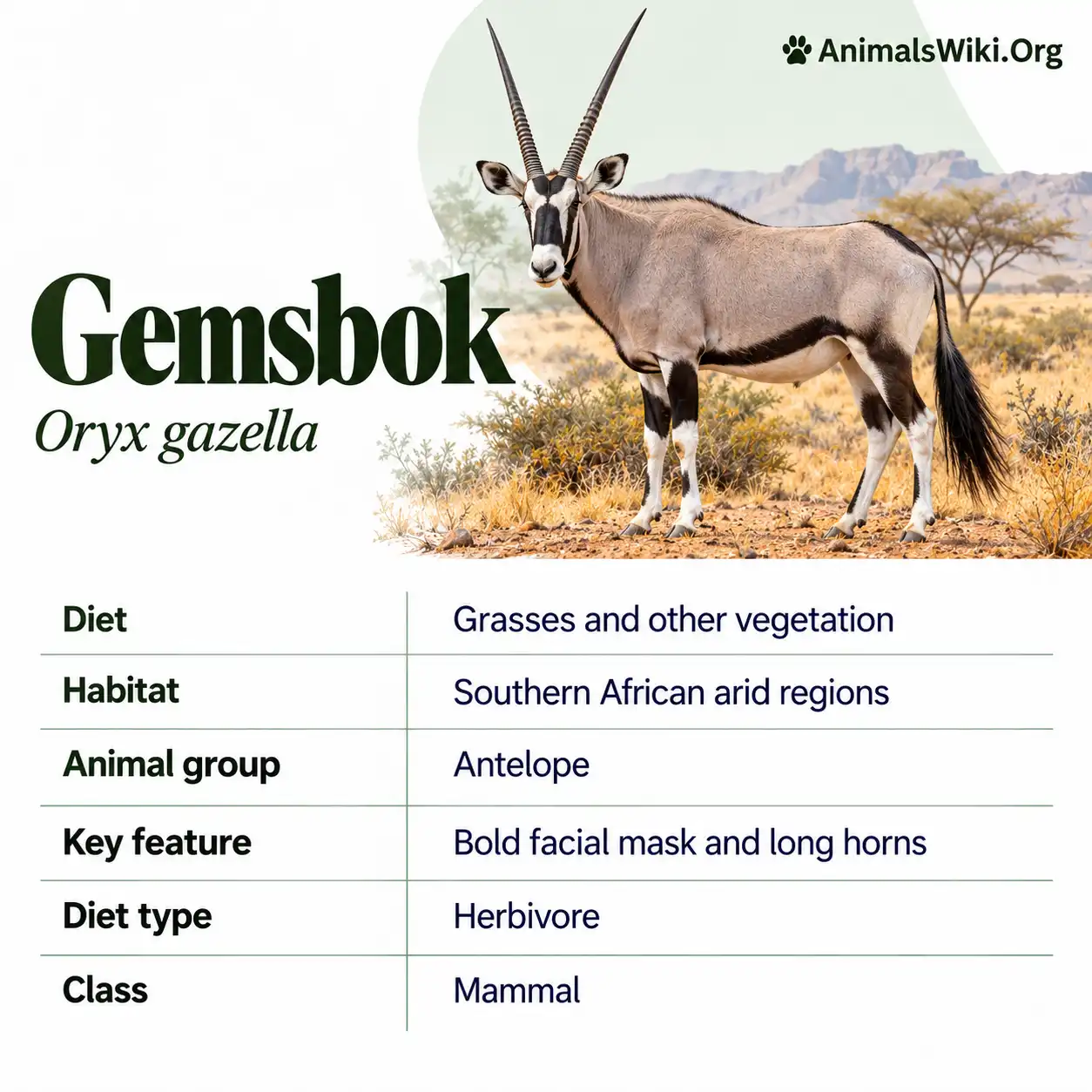
A gemsbok standing on a red Kalahari dune is one of southern Africa’s most recognizable wildlife sights. Its gray-brown body contrasts with a sharply marked black-and-white face, while two long horns rise above its head like slender spears. Dark bands along the sides and legs complete an appearance that seems almost deliberately drawn.
Behind that striking pattern is an animal exceptionally well suited to dry environments. Gemsbok can obtain much of their water from vegetation, alter their feeding choices when conditions deteriorate, and adjust their activity to avoid some of the costs of extreme heat. Their survival depends on a coordinated set of behaviors and physiological mechanisms rather than one extraordinary trick.
The gemsbok is also an example of why wildlife facts deserve careful explanation. Popular accounts sometimes claim that it routinely lets its body reach exceptionally high temperatures or never needs water. Field research provides a more detailed picture. Adaptation depends on circumstances, and even an arid-adapted animal must maintain its water, energy and temperature balance.
Globally, the gemsbok is classified as Least Concern. However, its conservation story varies between places: it is native wildlife in southern Africa, a managed game animal in some settings, and an introduced species with ecological consequences in the southwestern United States.
This guide explains how gemsbok live, how to identify them, what scientific research reveals about their desert adaptations, and why population figures and conservation labels need context.
Gemsbok Facts
| Feature | Details |
|---|---|
| Common name | Gemsbok |
| Alternative spelling | Gemsbuck |
| Other common name | Southern oryx |
| Scientific name | Oryx gazella |
| Family | Bovidae |
| Native region | Arid and semiarid southern Africa |
| Important range countries | Namibia, Botswana and South Africa, with additional populations elsewhere in the region |
| Typical habitat | Dry grassland, open shrubland, desert margins and sandy or stony plains |
| Adult weight | Commonly around 180–240 kilograms; varies with sex and individual |
| Shoulder height | Approximately 1.1–1.25 meters |
| Horns | Long, nearly straight and present in both sexes |
| Diet | Mainly grass, supplemented by other vegetation |
| Gestation | Approximately eight and a half to nine months |
| Usual offspring | One calf |
| Social organization | Mixed herds, nursery groups, bachelor groups and solitary males |
| Captive longevity record | At least 23.8 years |
| IUCN category | Least Concern |
What Is a Gemsbok?
The gemsbok is a large African antelope belonging to the genus Oryx. Its scientific name is Oryx gazella, and it is often called the southern oryx.
It belongs to Bovidae, the family that includes cattle, goats, sheep and many different antelopes. Despite the word gazella in its scientific name, it is not a gazelle.
Like other bovids, a gemsbok carries permanent horns rather than the antlers of a deer. Both males and females are horned, making horn presence an unreliable way to distinguish the sexes.
The species is particularly associated with southern Africa’s dry landscapes. It can live in areas where permanent drinking water is absent, provided that suitable food and other conditions allow it to maintain its water balance.
That ability is important, but it should not overshadow the animal’s broader ecology. Gemsbok need enough nutrients, opportunities to rest, safe movement and suitable conditions for reproduction. A desert is not automatically good habitat simply because the animal tolerates aridity.
The gemsbok’s distinctive appearance also makes it a prominent tourism species. Its long horns and bold face pattern are easy to recognize, even when the animal stands among pale grasses or scattered shrubs.
Understanding it as a living part of a changing landscape is more useful than viewing it only as a symbol of toughness. Its adaptations reduce environmental difficulties; they do not eliminate the need for resources.
Scientific Classification and Taxonomic Questions
Scientific Classification
The Mammal Diversity Database recognizes the gemsbok as Oryx gazella, with the authority Linnaeus, 1758. Its original scientific description used the name Capra gazella.
| Taxonomic rank | Classification |
|---|---|
| Kingdom | Animalia |
| Phylum | Chordata |
| Class | Mammalia |
| Order | Artiodactyla |
| Suborder | Ruminantia |
| Family | Bovidae |
| Subfamily in the Mammal Diversity Database | Antilopinae |
| Tribe | Hippotragini |
| Genus | Oryx |
| Species | Oryx gazella |
Some references use Hippotraginae as the subfamily. This reflects differences in the ranking of larger bovid groups rather than a disagreement about the identity of the gemsbok.
Why Some Sources Use Oryx gazella gazella
Scientific papers and older accounts may call the southern animal Oryx gazella gazella.
Historically, some classifications grouped southern and East African oryx more broadly. Modern treatments commonly recognize the beisa oryx separately as Oryx beisa.
The older three-part name can therefore reflect the classification used when a paper was written. It does not necessarily indicate that the research concerned a different southern African animal.
Gemsbok and Beisa Oryx
The Mammal Diversity Database treats Oryx gazella and Oryx beisa as separate species. Other questions about the classification of East African forms have received different treatments in different sources.
For this article, “gemsbok” refers to the southern African species Oryx gazella.
This boundary matters because broad older accounts sometimes combine information from several oryx populations. Their measurements, distribution descriptions or temperature claims may not all apply directly to the southern gemsbok.
Color Variants Are Not Automatically Subspecies
Unusual coloration in a managed herd does not establish a new subspecies.
Formal taxonomic recognition requires evidence about population history and biological differences. A distinctive individual or selectively bred color form is not enough.
Identification and Physical Appearance
Body Shape and Size
A gemsbok has a deep chest, substantial shoulders and a thick muscular neck. Its body is more heavily built than that of a small gazelle.
Males are generally heavier and more robust than females, although there is overlap. Body size alone can be difficult to judge when an animal is far away or partly hidden.
Adults commonly stand around 1.2 meters at the shoulder. Their apparent height is increased considerably by their long horns.
The Black-and-White Face
The face is one of the most useful identification features.
Dark markings extend across the head and contrast strongly with pale areas around the eyes and muzzle. The arrangement creates the familiar masked appearance.
The body is generally grayish, tan or brownish, with pale lower areas and strong dark markings along the sides and legs.
A dark tail and a short mane contribute to the animal’s overall outline. Dust, lighting and age can change how strongly the colors appear in photographs.
Horns in Both Sexes
Both male and female gemsbok have long, nearly straight horns with ridges along much of their lower length.
Female horns are commonly more slender, while males generally have thicker horns. Female horns can be longer, so the longest-horned animal in a group is not necessarily a bull.
Horn damage and viewing angle can complicate identification. A broken tip may make an older animal appear to have shorter horns than a younger one.
How to Identify a Gemsbok at a Distance
Start with the combination of features: a large gray-brown antelope, bold facial contrast, a dark flank stripe and two straight horns.
Then consider the surroundings and location.
A head-only photograph can be misleading, while a side view usually reveals the body pattern more clearly. In collections containing several oryx species, the animal’s full appearance is more reliable than the general label “African oryx.”
Gemsbok Compared with Other Oryx
| Feature | Gemsbok | Arabian oryx | Scimitar-horned oryx | Beisa oryx |
|---|---|---|---|---|
| Scientific name | Oryx gazella | Oryx leucoryx | Oryx dammah | Oryx beisa |
| Native region | Southern Africa | Arabia and adjoining Middle East | North Africa and Sahel | Eastern Africa |
| General body color | Gray-brown or tan | Predominantly white | Pale with reddish neck and chest | Gray-brown |
| Horn shape | Nearly straight | Nearly straight | Long backward curve | Nearly straight |
| Relative appearance | Large, strongly marked | Smaller and pale | Distinct reddish neck | Similar overall form, with different markings |
| Main identification clue | Bold face and strong dark body pattern | White body and smaller size | Curved horns | East African range and marking pattern |
These are related but distinct animals.
The gemsbok should not be confused with the addax either. An addax has clearly spiraled horns and a different body pattern.
Comparisons also help expose misleading generalizations. A fact about one oryx species is not automatically a fact about every other species. This is particularly important for measurements, habitat preferences and physiological responses to water shortage.
The most useful approach is to identify the scientific name attached to a claim before applying it to the animal being discussed.
Native Distribution
The Southern African Range
The gemsbok is native to dry parts of southern Africa, with especially important populations in Namibia, Botswana and South Africa.
Its regional distribution also includes Angola and Zimbabwe, although local histories involve uncertainty, introductions and changes in status.
Older range summaries may be incomplete or outdated. For example, a species database can preserve an old note questioning survival in an area where a later conservation assessment reports a population.
Country lists should therefore be treated as broad guides rather than proof of current abundance everywhere within those borders.
The Kalahari
The Kalahari is one of the species’ best-known landscapes.
Despite its reputation as a desert, much of it supports grasses, shrubs and scattered trees. Rainfall varies, and resources can change greatly between seasons and years.
Gemsbok occupy this environment through a combination of feeding flexibility and reduced dependence on permanent surface water.
Namibia
Gemsbok occur across extensive suitable parts of Namibia, including dry inland and desert-associated landscapes.
Their ability to use sparse vegetation helps explain their prominence in some areas where other large herbivores are less common.
However, Namibia is environmentally diverse. It would be inaccurate to describe every gemsbok population there as living under the same conditions.
Reintroductions and Range Expansion
Within southern Africa, animals have been moved to reserves and private properties, including locations outside their historical distribution.
A modern sighting therefore does not necessarily demonstrate native occurrence.
For conservation planning, managers need to distinguish natural populations, restored populations and introductions into areas where the species did not historically occur.
Habitat and Landscape Requirements
Open Dry Landscapes
Gemsbok use arid and semiarid grassland, shrubland and open savanna. They also occupy sandy plains, stony areas, dune systems and other dry habitats.
Open space provides feeding opportunities and visibility, but the value of a habitat depends on its vegetation and seasonal resources.
An area does not need dense grass to be useful. Scattered plants can support animals if their combined quality and availability meet requirements.
Shade Still Matters
A desert-adapted animal does not ignore the sun.
Trees and other shade features can reduce heat exposure. Their importance may increase during hot periods even when they occupy only a small fraction of the landscape.
Removing scattered shade trees can therefore affect animals in ways that are not obvious from a simple map of grazing area.
Seasonal Refuges
Different parts of a landscape may become valuable at different times.
A drainage line, patch of moisture-rich plants or area of recent grass growth can provide temporary support during difficult conditions.
If animals can move between such patches, the wider landscape may support them better than any single patch could alone.
Beyond Reserve Size
The number of hectares within a fence does not fully describe habitat capacity.
Managers also need to consider food diversity, drought refuges, access routes, shade and the effects of other herbivores.
A large reserve with little useful forage during drought may offer fewer practical options than its size suggests.
Diet and Feeding
What Do Gemsbok Eat?
Gemsbok are primarily grazers, but their diet is more flexible than the label alone suggests.
They eat grasses and may supplement them with browse, fruits, succulents, roots and tubers.
The importance of these foods varies by location and season. A herd feeding mainly on grass after rain may use a broader range of plants during drought.
Food Supplies Water Too
A meal provides more than calories.
For an animal living far from drinking water, moisture content can strongly influence the value of a plant. Succulent vegetation and underground storage organs may be particularly useful when grasses dry out.
A gemsbok must obtain enough usable nutrients while also maintaining water balance. These needs are related but not identical.
Evidence from Namibia
Research in Namibia’s Kunene region used stable isotopes to investigate feeding responses across drought and unusually wet conditions.
The study found substantial dietary flexibility. During drought, the inferred diet included a larger contribution from non-grass vegetation, including a succulent plant with defensive chemical compounds.
This was a finding from a particular study, not evidence that every gemsbok eats the same plants or is immune to plant toxins.
It demonstrates that a species commonly described as a grazer can use alternative resources when conditions change.
Digging for Food
Gemsbok can uncover underground plant parts using their front hooves.
This behavior makes resources available that are not immediately visible above the surface. However, digging costs time and energy, so it is useful only where the reward justifies the effort.
Ruminant Digestion
Like other ruminants, gemsbok rely on microbial fermentation and repeated chewing to process vegetation.
This system helps extract nutrients from fibrous food. It does not make all dry vegetation equally adequate.
An animal can be surrounded by plant material and still experience nutritional limitation if most of that material is too poor or inaccessible.
Water Conservation
Can Gemsbok Live without Drinking?
Gemsbok can survive and reproduce in environments without permanent drinking water when food and conditions allow them to maintain water balance.
This is independence from open water, not independence from water itself.
They still require water for circulation, digestion, temperature regulation and other body functions.
Water from Vegetation
Moisture in food can supply much of their needs. The amount varies between plants and changes as vegetation dries.
The timing of feeding can also matter because plant moisture and environmental conditions change over the day.
An animal that shifts its feeding schedule may gain benefits without changing its geographic location.
Drinking When Water Is Available
Gemsbok will drink when they have access to water.
A photograph of a gemsbok at a waterhole does not contradict its ability to survive away from permanent water. It shows that an available resource is being used.
Likewise, an animal seen far from water is not necessarily dehydrated.
Field Evidence
A study in Botswana’s Kalahari recorded gemsbok frequently more than 20 kilometers from potential water sources.
The researchers also documented seasonal changes in activity and use of shade, showing that water independence operates alongside behavioral adjustments.
What the Term “Water-Independent” Means
In ecological research, “water-independent” describes reduced reliance on drinking compared with more water-dependent species.
It does not mean that drought has no consequences, that any diet is sufficient, or that captive animals should be denied drinking water.
The term is useful when its limits remain clear.
Temperature Regulation and Desert Adaptations
A Combination of Mechanisms
Gemsbok survive heat through behavior, water conservation, circulation and normal physiological regulation.
No single adaptation explains their success.
Shade seeking reduces heat gain. Changes in activity reduce exposure during difficult periods. Feeding choices influence both energy and moisture intake.
Selective Brain Cooling
Gemsbok can use selective brain cooling, in which heat exchange affects the temperature of blood supplying the brain.
A study measuring gemsbok, red hartebeest and blue wildebeest found that all three species used the mechanism. Under the study’s conditions, there were no clear species differences in several measures of its use.
This is important because selective brain cooling is sometimes presented as a unique gemsbok ability. It is neither unique nor a complete explanation for the species’ drought tolerance.
Correcting the Extreme-Temperature Claim
Popular accounts often state that gemsbok routinely allow body temperature to climb to approximately 45°C.
Field studies do not support treating this as a universal daily strategy.
Research on free-ranging animals has shown relatively controlled temperature patterns under some conditions, including drought. Earlier findings also questioned simple claims about routine adaptive heterothermy in free-living oryx.
The useful conclusion is that the animal’s response depends on circumstances, including water access and the opportunity to use behavioral adjustments.
Drought Tolerance Is Not Invulnerability
A comparison of gemsbok and wildebeest during unusually dry conditions found that gemsbok coped better in several respects.
The gemsbok reduced some movement while the more water-dependent wildebeest traveled farther. The study does not prove that gemsbok can withstand unlimited drought; it documents a comparative advantage under measured conditions.
Common Myths and More Accurate Explanations
| Common claim | More accurate explanation |
|---|---|
| Gemsbok never need water | They can obtain much of their water from food under suitable conditions |
| They never drink | They drink when water is available |
| Their bodies routinely reach extreme temperatures | Field responses vary; simple universal temperature claims are misleading |
| They are unaffected by drought | They are drought-adapted but remain dependent on usable resources |
| One special cooling system explains everything | Behavior, diet and several physiological processes work together |
Movement and Daily Activity
When Gemsbok Feed
Gemsbok commonly feed during cooler periods, including early morning, late afternoon and nighttime.
During hot conditions, reducing exposure can lower the cost of activity. Resting also provides time for rumination.
This schedule is flexible. Cooler weather can make daytime feeding less costly, while disturbance can alter the timing of movement.
Seasonal Changes
Research has documented increased nighttime activity during hot seasons and greater use of shaded microclimates during the heat of the day.
These adjustments show that animals respond to changing conditions rather than following one fixed timetable throughout the year.
Nomadic Movement
Gemsbok can move in response to changing food resources.
Their movements are often better described as flexible or nomadic than as one predictable annual migration.
Some animals remain within relatively stable areas, while others shift their use of a wider landscape.
Individual Differences
Not every member of a population makes identical choices.
Age, sex, reproductive state and previous experience can influence which areas an animal uses.
A short study of one herd should therefore not become a universal movement rule.
Why Barriers Matter
Fences and land conversion can prevent access to useful feeding areas.
Even a drought-adapted animal may struggle if the remaining resources lie beyond a barrier.
Preserving options is part of conserving the species’ ability to respond to environmental variability.
Herd Structure and Social Behavior
Different Group Types
Gemsbok occur in mixed herds, groups containing females and young, bachelor groups and as solitary males.
These categories describe patterns rather than rigid social units. Animals can separate or join groups as conditions change.
A herd seen on one morning may have a different membership later.
Group Size
Small and medium-sized groups are common, while larger aggregations can form where conditions bring animals together.
A large gathering after rain should not be treated as the normal group size across all habitats.
Likewise, a solitary bull is not necessarily lost or abandoned.
Benefits and Costs of Herd Life
A group can provide more opportunities to detect danger. However, group members also compete for food and space.
The balance changes with conditions. Concentrated resources may support a larger gathering, while scattered forage can favor smaller groups.
Relationships Within Groups
Dominance influences interactions, but a herd is not simply a collection of animals obeying one male at every moment.
Movement, feeding and social relationships involve several individuals. Descriptions based on managed herds can also differ from behavior in extensive natural landscapes.
Zoo de La Flèche describes mixed groups and the tolerance of subordinate males, while noting changes in grouping during larger movements.
Territoriality and Communication
Territorial Males
Some adult males defend territories that provide opportunities to encounter females.
A male’s reproductive success depends partly on access to resources and partly on interactions with other males.
Holding a territory is costly. It requires attention, movement and the risk of confrontation.
Displays Before Fighting
Male encounters can include postures and assessment before physical contact.
Réserve Africaine de Sigean describes ritualized contests involving threatening posture, horn engagement and pushing.
Such behavior can allow animals to assess strength without immediately attempting to inflict severe injury.
Nevertheless, serious injuries remain possible. Ritualized does not mean harmless.
Scent and Spatial Information
Dung, urine and other chemical cues can contribute information about an animal’s presence.
Visual posture also matters. The position of the head and horns can signal a very different intention from relaxed grazing.
Space Within a Herd
Long horns make close spacing potentially hazardous.
Animals need room to feed, turn and withdraw. In managed environments, limited space or poorly arranged feeding sites can intensify conflict.
This is one reason why a group that looks peaceful in a photograph still requires knowledgeable management.
Reproduction and Mating
A Polygynous System
Gemsbok have a polygynous mating system, meaning that a successful male may breed with multiple females.
That does not imply permanent ownership of a fixed herd. Female movements and male competition create changing opportunities.
Maturity and Breeding Success
Animals can become physiologically capable of reproduction before they become regular breeders.
For males, competition with established adults can delay effective breeding opportunities.
For females, condition and available food influence whether reproduction is successful.
Breeding Season
Gemsbok can breed throughout the year. Local birth peaks may occur, but one fixed calendar does not describe the entire species.
This flexibility suits environments where rainfall and food do not always follow a dependable schedule.
Pregnancy and Birth
Gestation lasts approximately eight and a half to nine months, and a female normally produces one calf.
AnAge’s compiled life-history information lists gestation at about 270 days.
Before giving birth, a female usually separates from the main group and chooses a location where the calf can remain relatively inconspicuous.
Reproduction as a Conservation Measure
A population can produce calves without increasing if too few survive.
Managers therefore need to monitor recruitment, not just pregnancies or births.
The condition of mothers, the timing of difficult weather and access to suitable forage all affect the transition from a newborn calf to a future breeding adult.
Calf Development
A Brown Newborn
A newborn gemsbok is browner and less strongly marked than an adult.
Its subdued appearance makes sense for an animal whose early survival involves concealment.
The black-and-white adult pattern develops as it grows, so a young calf may initially look surprisingly different from its mother.
The Hiding Strategy
Gemsbok calves are commonly described as hiders.
The mother leaves the calf concealed while she feeds and returns to nurse it. Concealment can continue for several weeks before the youngster becomes a more regular member of the moving herd.
Being alone is therefore not automatic evidence of abandonment.
Early Mobility
The calf can stand and move relatively soon after birth.
Early mobility and hiding are compatible strategies. A calf can be capable of walking while still spending much of its time concealed.
Nursing and Weaning
Milk supports early growth, while plant consumption gradually increases.
Published accounts give somewhat different weaning ages, commonly around several months rather than one exact date. Nutritional condition and individual development influence the process.
Development at a Glance
| Stage | Typical features |
|---|---|
| Birth | Usually one calf, with a brownish coat |
| First days | Early mobility but strong dependence on milk |
| Early weeks | Concealment, nursing and limited movement with the mother |
| Following months | Increasing grazing, horn growth and more adult-like markings |
| Around four to five months | Weaning commonly reported around this broad period |
| Later development | Continued growth and changing social roles |
Species accounts from Animal Diversity Web and Beekse Bergen describe the hiding phase and brown early coloration. Their exact timelines should be treated as approximate.
Lifespan and Survival
Gemsbok can live into their late teens, and some captive animals survive beyond 20 years.
AnAge records a captive individual that lived at least 23.8 years. That is a maximum longevity record rather than an average expectation.
Wild survival depends on predation, drought, food, injury, disease and human activity. These pressures differ among locations.
A commonly repeated lifespan number may therefore conceal substantial variation. It is better to distinguish possible longevity from average survival.
Age also changes an animal’s role. A calf depends on maternal care, while a young male faces social changes as it matures. An older bull may remain alive after losing regular breeding access.
For population management, the important issue is whether enough animals survive through the stages needed to reproduce and replace losses.
A herd with many old adults but few surviving calves has a different future from a herd with balanced age classes, even if both contain the same number of animals today.
Predators and Defensive Behavior
Natural Predators
Lions and spotted hyenas are important predators of gemsbok in parts of their native range.
The importance of each predator depends on local conditions and the age of the prey. Young animals are generally vulnerable to a wider range of attackers than healthy adults.
Predator lists should not be interpreted as showing equal mortality from every carnivore wherever gemsbok occur.
Horns as Defensive Weapons
The horns can make an attack dangerous.
A gemsbok can turn toward a threat and use the horns in defense. Its muscular neck supports forceful movements.
However, defensive ability does not make the species invulnerable. Lions can kill adults, and calves have very different abilities from mature animals.
Escape and Confrontation
The best response depends on circumstances.
An animal with a clear route may escape, while a closely approached or cornered individual may confront the threat.
A dramatic photograph of a gemsbok facing a predator captures one moment, not a universal rule about how every encounter ends.
Human Safety
The same horns that deter predators can injure people.
A habituated animal is still a wild animal. Close approach, confinement or interference with a calf can create danger.
Beekse Bergen’s species account specifically emphasizes the defensive value of the horns against predators such as lions and hyenas.
Competition and Ecological Importance
Sharing Food Resources
Gemsbok share landscapes with other herbivores, including springbok, wildebeest and livestock.
Using some of the same plants does not automatically create severe competition. Competition becomes more important when shared resources are limiting.
During good conditions, different feeding choices can allow animals to coexist. During drought, overlap may become more consequential.
Dietary Differences Help Coexistence
Research in Namibia found different dietary responses in gemsbok and springbok.
Such differences help explain how several herbivores can occupy the same broad landscape without consuming identical foods in identical proportions.
The relationship can change as vegetation changes, so coexistence should be understood as dynamic rather than fixed.
Nutrient Cycling
Gemsbok contribute nutrients through dung and urine.
They can move material between feeding areas and resting places, linking patches across the landscape.
The scale of these effects depends on abundance and movement. The species contributes to ecological processes without being solely responsible for maintaining them.
Prey and Food-Web Connections
As prey, gemsbok support carnivores. Carcasses also provide resources for scavengers and decomposers.
Their ecological role is therefore broader than grazing alone.
Native Role versus Introduced Impact
An animal’s effects depend on where it occurs.
Processes that form part of a native ecosystem can become problematic when the species is introduced elsewhere. Conservation should recognize that distinction rather than assume that the same management goal belongs everywhere.
Population Estimates and Conservation Status
Is the Gemsbok Endangered?
The gemsbok is classified as Least Concern globally.
This means that the species does not currently meet the thresholds for a threatened global category. It does not mean every population is increasing or that monitoring is unnecessary.
The current Mammal Diversity Database reflects the Least Concern listing.
The Widely Repeated Population Figure
Approximately 373,000 gemsbok is a frequently repeated population estimate.
The 2016 southern African regional assessment traces that figure to an estimate attributed to the IUCN Antelope Specialist Group in 2008. It should not be presented as a new October 2026 census.
Nor should it be described as a precise mature-individual count or as the population of Namibia alone.
Dated Population Information
| Reporting period | Geographic scope | Figure | What it describes |
|---|---|---|---|
| Estimate attributed to 2008 | Southern Africa | Approximately 373,000 | Historical total estimate |
| 2016 regional assessment, using mainly earlier counts | South Africa | At least 55,376 | Combined estimate from protected areas and private wildlife properties |
| 2012–2013 counts cited in the regional assessment | Kgalagadi population context | Approximately 6,615–14,606 | Variation associated with season and survey period |
These figures come from the regional assessment and should be read within its dates, coverage and methods.
Total Animals and Mature Individuals
A total population includes calves and juveniles. A mature-individual estimate concerns animals capable of reproduction under the relevant assessment definition.
It is not sound to convert one into the other without age-structure information.
I have not identified a fresh, comparable global mature-individual census that would justify presenting a precise current number here.
Wild, Managed and Captive Animals
Private ownership does not automatically mean an animal is captive under every conservation framework. Conversely, a large fenced property does not automatically represent an unmanaged wild population.
The appropriate label depends on movement, management and dependence on human support.
Captive zoo populations should be recorded separately rather than added casually to old regional estimates.
Threats and Conservation
Habitat Fragmentation
Fences, agriculture and other land uses can divide the landscape and reduce movement options.
A population may remain abundant within one property while losing opportunities for natural exchange with neighboring groups.
Fragmentation can become especially important during drought if useful resources lie outside the accessible area.
Hunting and Illegal Killing
Gemsbok are hunted for meat, skins and trophies.
The effects depend on the scale, legality and management of the activity. Regulated use and uncontrolled killing should not be treated as identical.
Monitoring is needed to establish whether removals are compatible with population replacement.
Drought and Climate Change
The species is well adapted to aridity, but future conditions may involve combinations of heat, rainfall variability and habitat restriction that differ from past conditions.
Research showing resilience under one drought does not establish unlimited protection from environmental change.
Management Outside the Natural Range
Moving animals into unsuitable or historically unoccupied habitats can create problems for both the animals and the receiving ecosystem.
Management should consider vegetation, animal density and ecological context rather than assuming that a commercially valuable species belongs on every property.
Maintaining Secure Populations
For a relatively widespread species, conservation often involves preventing deterioration: retaining habitat, monitoring trends and avoiding unnecessary fragmentation.
This differs from the emergency rescue approach required for species reduced to a few dozen animals.
Gemsbok in New Mexico
How They Arrived
Gemsbok are not native to North America.
Between 1969 and 1977, 95 animals were released on White Sands Missile Range and surrounding areas in New Mexico as part of an effort to establish a huntable population.
The introduced population grew and spread through suitable desert environments.
Why Establishment Was Successful
Arid conditions were not a major obstacle because the species already possessed useful adaptations.
Available food and relatively limited effective predation also helped its establishment.
Nevertheless, similarities between African and American deserts do not make their ecosystems interchangeable.
Ecological Concerns
The National Park Service identifies gemsbok as a non-native species of concern at White Sands.
Their feeding and presence can affect native vegetation and other ecological relationships. Management has included measures to keep them out of sensitive park habitat.
The aim there is different from conserving native gemsbok populations in southern Africa.
What Recent Research Suggests
A 2026 study modeled potential range expansion of introduced gemsbok under climate change in the southwestern United States.
It examined how climate, vegetation and other environmental variables might influence future suitability. Such models describe conditional possibilities rather than guaranteed future distributions.
A Useful Conservation Lesson
A species can be valued and protected in its native range while requiring control elsewhere.
That is not inconsistent. Conservation concerns ecological relationships and native biodiversity, not simply maximizing the number of a particular animal everywhere it can survive.
Cultural and Economic Importance
A Namibian Wildlife Symbol
The gemsbok is closely associated with Namibia and appears in the national coat of arms.
Official explanatory material describes the animal in terms of courage, elegance and pride.
Its appearance has also made it familiar in wildlife imagery, tourism promotion and conservation communication.
Tourism
Gemsbok are rewarding animals to observe because they combine a distinctive appearance with interesting behavior.
Watching a herd feed, rest or interact can reveal much more than a quick photograph of horns.
Tourism can support conservation where it helps maintain habitat and provides meaningful benefits to local people.
Wildlife Economies
The species also has economic value in wildlife ranching and hunting industries.
Economic value can encourage habitat retention, but it does not automatically guarantee good ecological management.
Animal welfare, habitat suitability, population monitoring and transparent use remain important.
Local Knowledge
People living and working in gemsbok habitat can contribute valuable observations about rainfall, movement and unusual mortality.
Such knowledge is most useful when combined with systematic monitoring rather than dismissed or treated as a substitute for all other evidence.
Research and Wildlife Monitoring
Counting Animals
Gemsbok counts may use aerial surveys, vehicle routes, direct observation and other methods.
Different methods detect different proportions of animals. Visibility, weather and animal movement can influence results.
A higher count may represent population growth, better detection or animals moving into the surveyed area.
Repeated Monitoring
Comparable surveys across several years are more informative than one isolated number.
A 2024 conservancy count report from Kavango East described gemsbok numbers as being at more typical levels than in 2023 and emphasized that estimates were approximate guides to abundance.
That finding concerns the surveyed area, not the whole species.
Physiology in the Field
Biologgers have improved understanding of activity, temperature regulation and habitat use.
Their value is that they record what free-living animals actually do rather than relying entirely on controlled experiments.
Reading Research Carefully
Fieldwork dates, sample sizes and conditions matter.
A paper published recently may contain observations collected many years earlier. Likewise, a study of a few individuals can reveal a mechanism without establishing a universal rule.
Good wildlife information explains both what the research found and the limits of that finding.
Responsible Wildlife Watching
Watch gemsbok from an appropriate distance and allow them to continue feeding or resting.
Do not block a herd’s path or repeatedly approach animals to make them raise their heads for photographs.
A resting calf should be left alone. Its mother may be nearby, and concealment can be normal.
Long horns deserve respect even when an animal appears calm. Follow reserve rules and remain in vehicles where required.
When sharing photographs, identify the setting accurately. A zoo animal, a native free-ranging herd and an introduced New Mexican population represent different ecological situations.
Responsible interpretation makes a photograph more useful. It helps viewers understand what they are seeing without confusing captivity, restoration and natural distribution.
Frequently Asked Questions About Gemsbok
1. What is a gemsbok?
A gemsbok is a large southern African antelope scientifically named Oryx gazella. It is recognized by its gray-brown coat, bold black-and-white face, dark body markings and long nearly straight horns.
2. Is a gemsbok the same as an oryx?
A gemsbok is one species of oryx. The word “oryx” also includes other species, such as the Arabian oryx and scimitar-horned oryx. The terms are therefore related, but “oryx” is broader.
3. Where do gemsbok live naturally?
They are native to arid and semiarid southern Africa, especially Namibia, Botswana and South Africa. Regional occurrence also involves Angola and Zimbabwe. Some modern populations result from introductions or management.
4. Are gemsbok native to New Mexico?
No. They were introduced during the late 1960s and 1970s to establish a huntable population. Their presence in New Mexico is an introduction, not a natural extension of their African range.
5. What do gemsbok eat?
They eat mainly grasses but can also use browse, fruits, succulents, roots and tubers. The balance varies with location and conditions. During drought, alternative foods can become more important.
6. Can gemsbok survive without water?
They cannot survive without water biologically. However, they can obtain much of their water from food and live without permanent drinking sources under suitable conditions. This reduces dependence on waterholes.
7. Do gemsbok drink at waterholes?
Yes. They drink when water is available. Their ability to survive away from permanent water does not mean they avoid drinking or receive no benefit from accessible water.
8. Do female gemsbok have horns?
Yes. Both sexes carry horns. Female horns are commonly more slender and can be longer, while male horns tend to be thicker. Horn length alone does not reliably identify sex.
9. How big is a gemsbok?
Adults commonly weigh around 180–240 kilograms and stand approximately 1.1–1.25 meters at the shoulder. Males are generally more robust, but measurements vary and the sexes overlap.
10. Why do gemsbok have black-and-white faces?
The contrasting pattern is a characteristic identifying feature of the species. It is easy to recognize, but explanations assigning one precise function to every marking should not be presented as settled without supporting evidence.
11. Are gemsbok dangerous?
They can be. Their long sharp horns can cause severe injuries. A calm or habituated animal should still be treated as wildlife, especially if cornered or accompanied by a calf.
12. Can a gemsbok defend itself against a lion?
Yes. Its horns make close attack dangerous, and adults can defend themselves forcefully. However, lions remain predators of gemsbok. Defensive ability does not guarantee survival.
13. What is a baby gemsbok called?
A baby is called a calf. It is usually born alone and initially has a brownish coat. Its adult markings develop later, and early survival involves concealment and maternal care.
14. Why is a gemsbok calf left alone?
Concealment is part of its normal early development. The mother feeds and returns to nurse it. A calf lying alone is not automatically abandoned and should not be approached or handled by visitors.
15. How long is a gemsbok pregnant?
Pregnancy lasts approximately eight and a half to nine months. Figures around 264–270 days are commonly reported. Variation among sources makes an approximate duration more appropriate than one rigid number.
16. Do gemsbok have a fixed breeding season?
They can breed throughout the year, although local birth peaks occur. Reproductive outcomes depend on environmental conditions and maternal condition, so one calendar does not apply to every population.
17. How long do gemsbok live?
They can reach their late teens, and some captive animals exceed 20 years. A recorded captive individual lived at least 23.8 years. That record is not an average wild lifespan.
18. Do gemsbok live in herds?
Yes. They form mixed herds, nursery groups and bachelor groups, while some males live alone. Group composition changes with resources, social relationships and the stage of an animal’s life.
19. Do gemsbok migrate?
They can move widely in response to resources, but their movements are often flexible rather than a fixed annual migration. Some animals remain relatively local, while others shift across larger landscapes.
20. Are gemsbok endangered?
The species is classified as Least Concern globally. That does not mean every population is secure. Habitat fragmentation, unsuitable management and local pressures still require monitoring.
21. How many gemsbok are there?
A widely repeated historical estimate is approximately 373,000, traced to information attributed to 2008. It should not be presented as a new global census or a precise current mature-individual count.
22. Do gemsbok routinely reach a body temperature of 45°C?
That claim is too simplistic. Field studies show that temperature regulation depends on conditions and that free-living animals may maintain relatively controlled body temperatures. Desert survival involves several mechanisms rather than one routine extreme-temperature response.
23. Is selective brain cooling unique to gemsbok?
No. It has been documented in other antelopes. Research comparing gemsbok, red hartebeest and blue wildebeest found similar underlying use under the study conditions.
24. Why are gemsbok controlled in parts of the United States?
They are non-native there and can affect native vegetation and ecological relationships. Their management in an introduced range has different objectives from conservation within their native African ecosystems.
25. Are gemsbok suitable pets?
No. They are large wild antelopes requiring specialist facilities, experienced management and appropriate veterinary care. Their horns and strength make close handling hazardous.
26. What is most important for gemsbok conservation?
Maintaining suitable connected habitat, monitoring local trends and managing wildlife use responsibly are central priorities. Their drought adaptations are valuable, but they still need access to adequate food, space and functioning ecosystems.
Gemsbok (Oryx gazella)
The gemsbok is far more than an antelope with spectacular horns. Its feeding flexibility, reduced dependence on drinking water and carefully adjusted behavior allow it to occupy some of southern Africa’s most demanding environments.
Scientific research makes that story more interesting by replacing simple myths with a clearer understanding of how desert survival works. The animal does not escape biological limits; it manages scarce resources remarkably well.
Its conservation situation also depends on place. Native populations form part of southern African ecosystems, while introduced populations can create different challenges elsewhere.
Protecting the gemsbok’s future means maintaining the landscapes and choices that make its adaptations useful: suitable vegetation, room to move, opportunities to rest and management grounded in evidence.



