
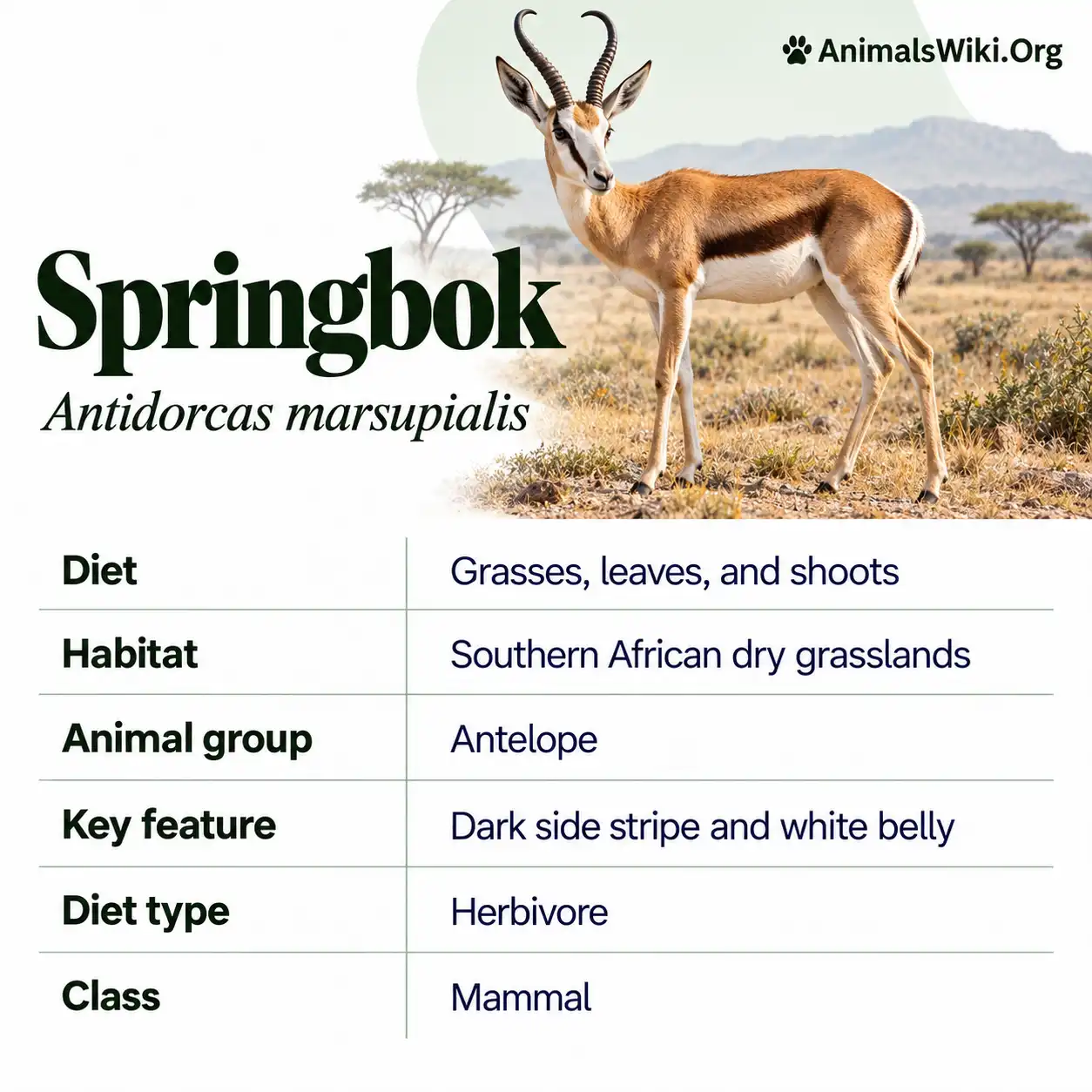
Springbok, A Complete Guide to Southern Africa’s Famous Leaping Antelope
A springbok feeding on an open plain may appear calm and delicate. Its slender legs move between scattered plants, its dark side stripe divides a reddish-brown back from a white belly, and its ears turn toward nearby sounds. Then, sometimes without an obvious warning, the animal springs upward with a curved back and stiff legs.
That remarkable display is called pronking. During it, a fold along the springbok’s back opens to reveal a conspicuous crest of white hair. The leap has helped make the species one of southern Africa’s most recognizable animals.
There is much more to the springbok than jumping. It is a flexible feeder, an efficient user of scarce water, a social animal with changing herd relationships, and an important prey species. Its history also includes enormous movements across the Karoo that no longer occur on their former scale.
The springbok is South Africa’s national animal, and it remains classified as Least Concern globally. Nevertheless, its familiar appearance and widespread management can conceal local declines, fragmented movement routes and uncertainty about population totals.
This guide examines its biology and conservation while separating observations from hypotheses. Pronking is well documented; one universal explanation for every leap is not. Population estimates exist, but their dates, geographic coverage and definitions matter.
Springbok Facts
| Feature | Details |
|---|---|
| Common name | Springbok |
| Alternative spelling | Springbuck |
| Scientific name | Antidorcas marsupialis |
| Family | Bovidae |
| Native region | Southern and southwestern Africa |
| Principal range countries | South Africa, Namibia, Botswana and southwestern Angola |
| Typical habitat | Open dry grassland, shrubland, semidesert and plains |
| Adult size | Generally a few tens of kilograms; many adults fall around 25–50 kilograms |
| Shoulder height | Usually approximately 70–85 centimeters |
| Horns | Present in both sexes; generally heavier in males |
| Diet | Grass, leaves, shoots and other available vegetation |
| Famous behavior | Pronking: repeated leaps with an arched back |
| Gestation | Approximately five and a half to six months |
| Usual offspring | One |
| Name for the young | Lamb; calf is also used in some accounts |
| Weaning | Commonly around four months |
| Captive longevity record | Approximately 19.8 years |
| IUCN category | Least Concern |
| Cultural distinction | National animal of South Africa |
What Is a Springbok?
The springbok is a small-to-medium-sized African antelope scientifically named Antidorcas marsupialis. It belongs to Bovidae, the family that includes cattle, sheep, goats and many other antelopes.
It resembles a gazelle, but it belongs to a separate genus, Antidorcas. Its proportions, facial markings and jumping behavior make the resemblance understandable without making the two names interchangeable.
Like other bovids, a springbok has permanent horns rather than deer-like antlers that are regularly shed. Both males and females carry horns, although male horns are usually more substantial.
The springbok is also a ruminant. Microorganisms in its digestive system help process plant material, and the animal rechews partially digested food as cud.
One of its most unusual features is a fold of skin along the back. This can open to display long white hairs, producing the conspicuous dorsal fan associated with pronking.
The scientific name marsupialis refers to this pouch-like feature. It does not mean that the springbok is a marsupial or carries its young in a pouch.
Its way of life is closely linked to open country. Springbok feed, watch for predators, interact socially and move between resources within landscapes where visibility and the arrangement of vegetation strongly affect their choices.
Scientific Classification and Subspecies
Scientific Classification
The Mammal Diversity Database recognizes the springbok as Antidorcas marsupialis, with the authority E. A. W. von Zimmermann, 1780. The original scientific name was Antilope marsupialis.
| Taxonomic rank | Classification |
|---|---|
| Kingdom | Animalia |
| Phylum | Chordata |
| Class | Mammalia |
| Order | Artiodactyla |
| Suborder | Ruminantia |
| Family | Bovidae |
| Subfamily | Antilopinae |
| Tribe | Antilopini |
| Genus | Antidorcas |
| Species | Antidorcas marsupialis |
The springbok is the only living species generally retained in Antidorcas under the single-species treatment followed here. Fossil relatives show that the genus has a deeper history than its living representative alone suggests.
Commonly Described Subspecies
Three geographic forms are frequently described:
| Common geographic label | Scientific name | Broad association |
|---|---|---|
| Southern or Cape springbok | Antidorcas marsupialis marsupialis | Southern parts of the range |
| Kalahari springbok | Antidorcas marsupialis hofmeyri | Parts of Namibia, Botswana and northern South Africa |
| Angolan springbok | Antidorcas marsupialis angolensis | Southwestern Angola and adjoining northwestern areas |
These names are useful, but their taxonomic status is not universally treated in the same way.
Some classifications recognize subspecies, some have questioned their distinctness, and others have proposed recognizing separate species. Geographic differences in body size and anatomy are real subjects of investigation, but the interpretation of those differences remains important.
A 2022 anatomical study explicitly discussed the competing classifications while using a three-subspecies framework.
Why the Distinction Matters
Taxonomy affects how animals are recorded and managed. Moving springbok between regions can mix populations with different histories and potentially different environmental adaptations.
However, not every regional difference proves the existence of a separate species. Body size can also respond to nutrition, climate and other conditions.
A careful account therefore identifies the classification being followed without presenting disputed boundaries as settled.
Identification and Physical Appearance
The Familiar Coat Pattern
A typical springbok has a reddish or cinnamon-brown back, white underparts and a dark stripe along the side.
The face is mostly pale, with a darker stripe running between the eye and muzzle region. The rump is white, and the tail carries darker hair toward its end.
This combination gives the animal a sharply divided appearance. From a distance, the side stripe and pale underside can be more useful than the exact shade of the back.
Lighting changes the impression considerably. An animal standing in shade may look darker than one photographed under strong sun.
Body Shape
Springbok have slender legs, a relatively small head and an agile build.
Males, often called rams, are generally larger and more robust than females, commonly called ewes. Their size difference is useful when animals stand together but less dependable when judging an isolated individual.
Young animals also complicate comparisons. An immature male can resemble a smaller adult female in overall proportions.
Horns
Both sexes have dark, ridged horns with a lyre-like shape.
Male horns are generally thicker and more strongly developed. Female horns are usually more slender.
The South African government’s description of the national animal identifies horn differences between the sexes as a useful characteristic.
The Dorsal Fold
The fold along the back is an especially distinctive feature.
When opened, it exposes a crest of white hair that contrasts with the normal upper-body coloration. During pronking, this creates a much more conspicuous animal than the quietly feeding springbok seen moments earlier.
The fold is a display structure, not a pouch for carrying young. Its visibility changes with behavior, so it may be almost unnoticeable in a relaxed animal.
Springbok Compared with Similar Antelopes
| Feature | Springbok | Impala | Thomson’s gazelle |
|---|---|---|---|
| Scientific name | Antidorcas marsupialis | Aepyceros melampus | Eudorcas thomsonii |
| Main native region | Southern and southwestern Africa | Eastern and southern Africa | Eastern Africa |
| General appearance | Reddish-brown back, white belly, dark flank stripe | More uniformly reddish-brown body | Pale belly and dark side stripe |
| Horns | Both sexes | Males only | Both sexes, with smaller female horns |
| Distinctive feature | Expandable white dorsal fan | Characteristic rump pattern and long male horns | Smaller gazelle form and East African setting |
| Famous movement | Pronking | Powerful leaps and agile escape | Fast running and stotting |
These comparisons are broad identification aids, not substitutes for a clear view of the animal.
The springbok is sometimes confused with the impala because both are athletic African antelopes. However, the impala lacks the springbok’s characteristic dorsal fan, and female impala normally have no horns.
Thomson’s gazelle can look more similar in photographs because of its dark flank stripe. Geographic context, horn shape, body proportions and the dorsal feature help separate them.
The name “springbok” should also not be used as a general term for any antelope that jumps. Several unrelated hoofed mammals leap or stot.
Pronking Explained
What Does Pronking Look Like?
Pronking consists of repeated leaps in which the springbok arches its back and holds its legs relatively stiffly.
The head is often lowered, and the white dorsal hairs become erect. A sequence can make the animal appear to bounce above the ground rather than run across it.
Pronking is a well-established observation in springbok behavior. The difficulty lies in explaining why a particular animal performs it at a particular moment.
How High Can a Springbok Jump?
Species accounts commonly describe leaps reaching around two meters under some circumstances.
This is a reported capability, not a measurement that applies to every leap or every individual. The height also depends on how it is estimated.
It is more useful to recognize the display’s form than to assume that the highest quoted number describes ordinary movement.
Proposed Functions
| Proposed explanation | What it suggests | How to interpret it |
|---|---|---|
| Signaling condition | A strong leap may indicate that the animal would be difficult to catch | A hypothesis requiring evidence about predator responses |
| Alerting other springbok | The display could make danger or arousal conspicuous | Possible social function, not established for every display |
| Movement over obstacles | Leaping can help cross uneven or obstructed ground | Supported as a potential mechanical benefit |
| Play or youthful activity | Young animals may leap outside an immediate attack | Behavior does not reveal one simple emotional explanation |
Different functions are not necessarily mutually exclusive. A movement could have benefits in more than one context.
What Research Can and Cannot Establish
A 2023 modeling study examined how pronking and bounding could help animals cross landscapes containing scattered obstacles.
It showed a potential mechanical advantage under modeled conditions. It did not prove that obstacle crossing explains every springbok display.
Other explanations involve communication with predators or herd members. These should be presented as hypotheses rather than one universally demonstrated answer.
Pronking Is Not the Same as Maximum-Speed Escape
A springbok moving vertically is not necessarily maximizing forward speed.
The animal has several ways of moving, including ordinary walking, trotting and galloping. Pronking belongs within that broader behavioral repertoire.
Observational research has described these different gaits and their relationship to display.
Geographic Distribution
The Native Range
Springbok are native to southern and southwestern Africa, principally South Africa, Namibia, Botswana and southwestern Angola.
Their distribution is uneven. Suitable habitat, historical hunting, land use and modern animal movements all influence where they occur.
A country being included in the range does not mean the species occupies every landscape within it.
South Africa
Springbok are strongly associated with the Karoo, dry western and central areas, and open grassland environments.
Some populations occupy natural habitat, while others have been reintroduced or established through wildlife management.
This distinction matters when interpreting a modern photograph or reserve species list. Present-day occurrence can reflect both natural history and human decisions.
Namibia and Botswana
In Namibia and Botswana, springbok occupy extensive suitable dryland environments, including landscapes associated with the Namib and Kalahari regions.
They may concentrate around productive patches, pans or other locally favorable areas.
Their abundance can vary greatly between sites. A large herd in one location does not establish that nearby populations are also thriving.
Angola and Historical Changes
Southwestern Angola forms the northern extension of the traditional range.
Historical distribution information is incomplete in some areas, and local populations have experienced substantial changes.
The Mammal Diversity Database provides the broad native-country framework, while more detailed status requires local evidence.
Habitat Requirements
Open Landscapes
Springbok favor open country, including dry grassland, low shrubland, semidesert and plains.
These habitats provide opportunities to feed while maintaining a view of approaching threats.
“Open” does not mean completely bare. Short vegetation, scattered shrubs and productive depressions can be important resources.
Pans and Feeding Patches
Pans and their surroundings can provide distinctive vegetation and useful feeding areas.
A Botswana study found strong selection for particular habitats and foods, showing that springbok do not use every part of an apparently similar landscape equally.
This selectivity can make animals predictable in where they occur, with consequences for both feeding success and exposure to danger.
Visibility and Safety
Vegetation affects more than diet.
A shrub patch may offer food while also reducing visibility. Predators can use cover, and an animal may need to spend more time watching rather than eating.
The best feeding patch is therefore not always the one with the largest quantity of plants.
Habitat Through the Year
A site can change rapidly after rain. Grass growth may create temporary opportunities, while later drying shifts the value of different foods.
Springbok need access to a set of usable resources across changing conditions.
A reserve that looks productive during one season may still contain a difficult nutritional period later. Understanding those seasonal limits is more useful than judging habitat from one visit.
Diet and Feeding
Grazing and Browsing
Springbok are mixed feeders. They eat grasses as well as leaves, shoots and other plant material.
The balance changes with local availability and season. Fresh grass can be attractive after rain, while browse may become more important when grass quality falls.
This flexibility is a major part of their ability to live in dry environments.
Food Quality
Not all green vegetation has equal value, and not all dry vegetation is useless.
Protein, moisture, fiber and digestibility vary between plant species and between parts of the same plant.
A narrow muzzle and selective feeding behavior allow springbok to choose small amounts of useful material among less rewarding vegetation.
Evidence from Namibia
Research in Namibia’s arid Kunene region used stable isotopes to investigate the diets of springbok and gemsbok across contrasting conditions.
The springbok maintained a relatively broad feeding strategy, with substantial use of plants other than the grasses more strongly associated with gemsbok feeding during favorable periods.
The study illustrates dietary flexibility in one environment. It does not establish one fixed percentage of grass or browse for the whole species.
Ruminant Digestion
Springbok use microbial fermentation to extract nutrients from plant material.
After feeding, resting and rumination form part of the digestive process. Time spent lying quietly is therefore not necessarily time without biological activity.
Their digestive system helps them use fibrous food, but it does not remove nutritional limits. An animal can consume plants and still fail to obtain enough usable energy or protein.
Feeding as a Daily Trade-Off
Eating competes with watching for predators, traveling, nursing young and regulating body temperature.
A springbok cannot maximize all these activities simultaneously. Its daily choices reflect the costs and benefits of the conditions it faces.
Water Conservation
Can Springbok Survive without Drinking?
Springbok can remain independent of open water when their diet supplies enough moisture and conditions allow them to maintain water balance.
This does not mean they function without water.
Water remains essential for digestion, circulation, temperature regulation and other normal processes. The difference is the source from which it is obtained.
Drinking When Available
Springbok drink when suitable water is accessible.
Seeing them at a waterhole does not contradict their dryland adaptations. It shows that they are using an available resource.
Similarly, the absence of drinking observations does not prove that an animal has no water requirement.
Food Moisture
Leaves, shoots and other plant parts differ in moisture content. Their condition also changes over the day and after rainfall.
Choosing food can therefore influence water intake as well as nutrition.
Under some conditions, feeding during cooler periods may improve the balance between obtaining moisture and losing it.
Research on Water and Energy
A field study in the Kalahari examined springbok energy expenditure, water use and food consumption.
It found comparatively low water and energy use during much of the year, consistent with desert adaptation.
These findings concern measured animals and conditions. They should not be converted into an exact daily allowance that applies to every springbok.
Why Captive Care Is Different
A dry captive diet does not necessarily provide the same moisture as natural vegetation.
The ecological description “water-independent” should never be treated as an instruction to withhold drinking water from animals in human care.
The adaptation concerns the complete relationship between food, behavior and environment.
Heat, Cold and Other Adaptations
Behavioral Flexibility
Springbok can alter the timing of feeding, movement and resting.
Cooler periods may make activity less costly, while severe heat can reduce the value of traveling long distances.
The response depends on the availability of food, shade and other resources. There is no fixed schedule that applies throughout the range.
Small Body, Different Costs
A relatively small body has advantages and disadvantages.
Springbok require less total food than a very large antelope, but smaller mammals generally have higher requirements per unit of body mass.
Their slender form and agility are useful, yet they still need to balance heat loss, heat gain and energy expenditure.
Coat Color and Temperature
Coat color affects how much solar radiation reaches and heats the animal.
A study comparing normal, black and white springbok found differences in body temperature and behavior across seasons. Black animals experienced greater solar heat load, while white animals faced different challenges in cold conditions.
This shows that a color variant can have physiological consequences. It does not establish that one color is superior in every environment.
Avoiding Simple Superpower Claims
Descriptions of desert animals often reduce complex biology to dramatic statements.
Springbok are not unaffected by drought, incapable of dehydration or able to ignore extreme temperatures.
Their success depends on several adjustments operating together. When food deteriorates, movement becomes restricted or conditions remain severe, those adjustments may no longer be sufficient.
Adaptation and Local Differences
Populations from different environments may differ in body size, anatomy or performance.
Such differences deserve investigation, especially before moving animals between regions.
Local variation is not merely an inconvenience for classification; it can be relevant to how animals function in their habitat.
Movement and Historical Migrations
Present-Day Movement
Springbok can move between feeding patches and shift their use of a landscape as conditions change.
Some populations are relatively resident, while others use much larger areas.
The distances traveled depend on food distribution, barriers, social conditions and the scale of available habitat.
The Trekbokke
Historical accounts describe enormous springbok movements known as the trekbokke.
These were not simply large herds standing together. They involved movements through extensive parts of the landscape, sometimes creating remarkable concentrations of animals.
Because they occurred before modern wildlife monitoring, precise numbers and routes are difficult to verify.
The existence of the phenomenon is well established; the most dramatic numerical descriptions require caution.
Why the Great Treks Ended
A historical study examined the cessation of springbok treks in the Karoo and argued against a simple explanation based on rinderpest alone.
It emphasized interacting effects of fencing, hunting, livestock and human expansion, together with drought.
This interpretation highlights an important distinction: a species can remain abundant while losing a major ecological process.
Numbers Are Not the Whole Recovery Story
Reintroducing springbok to many properties can increase their distribution without restoring unrestricted movement.
A landscape containing numerous fenced populations differs from one through which animals can travel as resources change.
Conserving a species and conserving its former movements are related goals, but they are not identical.
Herd Structure and Social Behavior
Changing Groups
Springbok form female groups, mixed herds and bachelor groups. Territorial males may also occur separately.
Group membership changes with reproduction, food and social relationships.
A herd should therefore be understood as a dynamic association rather than a permanently fixed family.
Small Herds and Large Gatherings
A few dozen animals may be seen together under ordinary conditions, while much larger aggregations can form where feeding opportunities bring animals into the same area.
Large groups do not necessarily indicate the same social arrangement as small herds.
The conditions producing a gathering matter more than the number alone.
Benefits of Herd Life
More animals can provide more opportunities to detect danger.
However, group living also creates competition for food and space. The benefits depend on the distribution of resources and the behavior of predators.
Animals near the edge may face different risks from those surrounded by other herd members.
Resting and Feeding Together
Herd members can influence one another’s activities without acting in complete synchrony.
One animal may continue feeding while another raises its head. Some may rest while others move between patches.
This flexibility allows individuals to meet different needs within the same group.
Managed Herds
Managed populations provide opportunities for detailed observation, but their behavior can be affected by enclosure size and concentrated resources.
Findings from such populations are useful when the management setting is clearly identified.
Territoriality and Communication
Territorial Rams
Adult males may defend areas through which females move.
A territory provides opportunities rather than guaranteed ownership of females. Its usefulness depends partly on resources and partly on the behavior of other animals.
Maintaining it requires effort and can involve conflict.
Displays and Marking
Posture, scent marking and aggressive encounters communicate information.
Springbok males may engage in behaviors such as horning vegetation. Such activity can form part of territorial and social interactions.
Not every confrontation becomes a serious fight. Assessment and withdrawal can reduce the costs of injury.
Evidence from a Managed Population
A year-long study in a large enclosure found that adult males occupied largely separate areas, while females moved through them.
The study also documented differences between adult and younger males in marking, aggression and avoidance.
Because the animals were in an enclosure, the findings should not be presented as an exact map of every wild population.
Signals Work in Context
A raised head, horn posture or exposed dorsal fan can mean different things depending on what is happening nearby.
Interpreting behavior requires watching the sequence rather than assigning a meaning to one photograph.
Reproduction and Mating
Breeding System
Springbok have a polygynous breeding system, in which a successful male may mate with multiple females.
Male competition and female reproductive condition shape the opportunities available.
The presence of a territorial ram does not mean all females using the area reproduce with him throughout their lives.
Breeding Seasons Vary
Some populations show concentrated mating and birth periods. Others can reproduce over a broader part of the year.
Rainfall, nutrition and local conditions influence the pattern.
It is therefore misleading to give one calendar month as the universal springbok breeding season.
Pregnancy
Gestation lasts approximately five and a half to six months.
AnAge’s compiled life-history information gives a value of about 168 days, consistent with that broad description.
A female normally produces one young.
Maturity and First Reproduction
Physical maturity and successful breeding are different milestones.
Young animals may become capable of reproduction before they breed regularly. Nutrition, social opportunity and condition influence when the first successful offspring are produced.
A single age should not be treated as a guarantee for every individual.
Reproductive Success
Producing a lamb is only the first stage of recruitment.
The mother must support milk production, and the young animal must survive long enough to enter the breeding population.
A population with regular births can still decline if early survival is poor.
Lamb Development
Birth and Early Appearance
A young springbok is commonly called a lamb, although some accounts use calf.
It is born relatively well developed and becomes capable of standing and moving early.
That mobility does not mean it immediately travels continuously with the herd.
The Hiding Phase
The mother initially leaves the lamb concealed while she feeds and returns to nurse it.
Low vegetation that seems insignificant beside an adult can provide useful cover for a small youngster.
A lone lamb is therefore not automatically abandoned.
SANParks describes young springbok remaining hidden before developing the ability to keep pace with the herd.
Nursing and Grazing
Milk supports early growth. Grazing and browsing increase gradually as the digestive system develops.
Nursing and plant consumption overlap, so weaning is a transition rather than a single sudden event.
Compiled life-history information commonly places weaning around four months, but individual progress varies.
Development Timeline
| Stage | Typical features |
|---|---|
| Birth | Usually one lamb; strong dependence on the mother |
| First days | Early standing and movement, combined with concealment |
| Early weeks | Nursing, hiding and increasing coordination |
| Following weeks | Greater ability to move with the herd |
| Following months | Increasing plant consumption and horn growth |
| Around four months | Weaning commonly reported around this period |
What Matters for Population Growth
The proportion of young surviving is often more informative than the number born.
A study of declining springbok in Botswana recorded a substantial seasonal reduction in the number of juveniles relative to adult females, suggesting poor recruitment as a possible contributor to decline.
Lifespan and Survival
Springbok can survive for many years, but a maximum lifespan should not be confused with an average.
AnAge records captive longevity of approximately 19.8 years. Its summary also indicates that average survival in the wild is considerably shorter.
Predation, drought, disease, injury and human activity all influence survival.
The pressures also change with age. A hidden lamb faces different risks from an adult ewe or territorial ram.
For conservation, it is important to understand which age classes are being lost. A population can maintain a reasonable adult count temporarily while too few young survive to replace aging animals.
Similarly, losing breeding females can affect future growth more directly than the same number of losses distributed differently across the herd.
Long-term individual records are difficult to obtain in free-ranging populations. General lifespan claims should therefore be presented with their setting and uncertainty intact.
Predators and Vigilance
Natural Predators
Springbok are prey for several African carnivores.
Cheetahs are particularly important in some populations. Other predators can include caracals, hyenas and larger carnivores where their ranges overlap.
Young lambs are vulnerable to a wider range of attackers than healthy adults.
A predator’s inclusion in a species account does not mean it causes equal mortality in every reserve. |
Watching for Danger
Springbok interrupt feeding to raise their heads and scan.
This vigilance has a cost: time spent watching cannot simultaneously be spent selecting food.
The balance changes with group size, location within the herd and vegetation.
Evidence from Nxai Pan
Research in Botswana examined vigilance in different positions within springbok herds.
It found that animals approaching tree clumps were more vigilant than comparable individuals moving in the open.
The result makes ecological sense because vegetation changes visibility and the opportunities for concealment.
Speed, Agility and Choice
Springbok can run rapidly and change direction, but no single speed figure captures their entire escape strategy.
Detection distance, terrain, surprise and the condition of the animal can matter as much as maximum speed.
An animal that notices danger early may avoid a chase altogether. One surprised at close range faces a different problem.
Ecological Importance
Mixed Feeding
Springbok contribute a flexible feeding strategy to dryland herbivore communities.
They use grasses and woody or herbaceous plants in changing proportions, connecting them to several parts of the vegetation system.
This differs from the more specialized feeding of some neighboring species.
Food-Web Connections
Springbok transfer plant-derived energy to predators.
Their carcasses also support scavengers and decomposers, while dung and urine contribute to nutrient cycling.
The size of these effects depends on local abundance and movement.
Historical Movements
The former trekbokke likely redistributed grazing pressure and nutrients over large areas.
Their disappearance illustrates how ecological processes can be lost even when the species survives.
Restoring a population on one property cannot automatically recreate that larger pattern.
A Common Species Still Matters
Conservation value is not restricted to animals close to extinction.
Abundant herbivores can support important ecological functions precisely because they occur in substantial numbers.
Allowing a widespread species to become progressively confined to small managed units can change those functions long before global extinction risk becomes high.
Population Estimates and Conservation Status
Current Category
The springbok is classified as Least Concern globally.
This category indicates that it does not currently meet the thresholds for a threatened global listing. It does not establish that every population is increasing.
The Mammal Diversity Database reflects the Least Concern classification.
Why Population Figures Differ
Broad estimates and detailed surveys can produce very different numbers.
They may cover different countries, include different management settings and rely on incomplete information.
Comparing them requires more than placing two totals beside one another.
Dated Estimates
| Source period | Geographic scope | Figure | Interpretation |
|---|---|---|---|
| Estimate cited to 2013 | Southern Africa | Approximately 2–2.5 million | Broad historical estimate with substantial uncertainty |
| Mainly 2013–2015 data, published in the 2016 regional assessment | Surveyed South African population | Approximately 109,209–110,778 | Incomplete national compilation, not a global total |
| Same regional assessment | Estimated mature animals | Approximately 76,446–77,545 | Derived mature-population estimate |
The regional assessment questioned some earlier broad estimates while acknowledging gaps in private-land coverage. These figures should not be presented as fresh 2026 counts or as a directly comparable time series.
Wild and Captive Populations
Privately owned animals are not automatically captive under every conservation framework.
However, intensively managed breeding herds cannot automatically be treated as equivalent to independent wild populations.
Zoo animals should be recorded separately. Assessment eligibility depends on the management setting and relevant definitions.
Mature versus Total
Total counts include lambs and other immature animals.
Mature-individual estimates concern animals capable of reproduction. They are not necessarily the number actually breeding during one season.
A current global mature count cannot be responsibly created by applying one assumed percentage to a loosely defined historical total.
Threats and Management Challenges
Fragmentation
Fencing and land conversion can restrict movement between resources and populations.
The effect may become especially important during drought, when an animal needs access to a patch outside its usual area.
A species can remain common overall while becoming ecologically constrained.
Local Declines
Some populations have declined despite the species’ global status.
Botswana research has investigated habitat selection, movement and recruitment as possible contributors rather than assuming a single cause.
That approach is important because food limitation, predation and human disturbance can interact.
Uncontrolled Killing
Illegal killing can reduce local populations.
Regulated use and uncontrolled removal are different situations. Their effects depend on the number and type of animals removed relative to replacement.
Conservation decisions require local evidence rather than a blanket assumption that every form of use is either harmless or destructive.
Translocations
Moving animals can establish populations but can also mix regional histories or place animals in unsuitable environments.
Health, ancestry and habitat should be considered together.
The presence of an empty fenced property does not by itself establish a conservation need for springbok there.
Color-Focused Breeding
Managed springbok include unusual color variants.
Research has examined genetic variation among these variants, reflecting concern about how selective breeding influences managed populations.
A distinctive color is not automatically evidence of greater conservation value.
Conservation and Research
Protecting Habitat and Options
Conservation should preserve usable feeding areas, movement routes and opportunities for natural exchange.
For a dryland species, maintaining several options can be more valuable than maximizing numbers within one small area.
Monitoring Recruitment
Counts should include age and sex information where practical.
A stable total can hide declining recruitment if adults live long enough to mask the change temporarily.
Repeated observations of lamb survival can therefore provide early warning.
Learning from Reintroductions
South African parks have a long history of springbok restoration.
Published documentation of these efforts shows that establishing a herd is only part of the task. Population growth, habitat suitability and later management all influence outcomes.
Improving Genetic Understanding
Genetic studies can help evaluate relationships among populations and managed lines.
Their usefulness depends on sampling and the questions being asked. A small study of a few markers cannot settle every issue about local adaptation or taxonomy.
Research Dates Matter
A recently available webpage may describe old fieldwork.
Readers should distinguish publication dates, observation dates and assessment dates. This is particularly important for population numbers and claims about current threats.
Cultural and Economic Importance
South Africa’s National Animal
The springbok is officially recognized as South Africa’s national animal.
Its distinctive appearance and pronking behavior make it a recognizable symbol, while its name also has a strong place in sporting identity.
Cultural familiarity can support conservation interest, but it should not replace practical habitat protection.
Tourism
Watching springbok offers opportunities to observe feeding, social interactions, vigilance and movement.
Pronking is memorable, but quiet behavior is equally informative.
Tourism contributes most effectively when it supports habitat, knowledgeable staff and local communities.
Wildlife Use
Springbok also have economic importance through wildlife ranching, meat production and hunting.
The conservation outcome depends on management. Economic value can encourage habitat retention, while poor stocking or breeding decisions can create problems.
Historical Knowledge
Accounts from people who lived alongside springbok provide valuable evidence about former movements and abundance.
Such records need careful interpretation, especially when dramatic descriptions were written before systematic counts.
Combining historical knowledge with ecology helps reconstruct a richer picture than either source alone.
Responsible Wildlife Watching
Give springbok enough space to continue feeding and moving normally.
Repeatedly approaching a herd can force animals to spend more time vigilant and less time eating. During heat or food shortage, that disturbance can carry additional costs.
Do not try to provoke pronking for photographs.
A hidden lamb should be left alone. Its mother may be nearby or temporarily feeding elsewhere, and human attention can disrupt normal behavior.
Follow reserve instructions and avoid blocking travel routes with vehicles.
When sharing photographs, identify the setting accurately. A managed breeding herd, a zoo group and a free-ranging population represent different circumstances.
Accurate interpretation makes wildlife content more useful without reducing the appeal of the animal.
Frequently Asked Questions About Springbok
1. What is a springbok?
A springbok is a southern African antelope scientifically named Antidorcas marsupialis. It is recognized by its brown-and-white coat, dark side stripe, horns in both sexes and an expandable white dorsal fan.
2. Is a springbok a gazelle?
It is gazelle-like but belongs to a separate genus, Antidorcas. Both are bovids, yet “gazelle” and “springbok” are not interchangeable scientific names.
3. Where do springbok live?
They are native mainly to South Africa, Namibia, Botswana and southwestern Angola. They occupy open dry landscapes, although modern distribution also reflects reintroductions and movement by wildlife managers.
4. What do springbok eat?
They eat grass, leaves, shoots and other plant material. The balance changes with season and location. Their mixed-feeding strategy helps them use different resources as conditions change.
5. Can springbok survive without drinking?
They can obtain sufficient water from food under suitable conditions. However, they still require water biologically and drink when it is available. Water independence depends on the complete diet and environment.
6. What is pronking?
Pronking is a leaping display involving an arched back and relatively stiff legs. The white dorsal hairs become conspicuous. It is different from ordinary running, although both belong to the animal’s movement repertoire.
7. Why do springbok pronk?
Several explanations have been proposed, including communication, signaling physical condition, play-related activity and movement over obstacles. One universal explanation has not been demonstrated for every springbok display.
8. How high can a springbok jump?
Reported leaps can reach around two meters under some circumstances. This is a capability rather than a standard height for every jump. Estimates depend on the animal and how the leap is measured.
9. Does pronking mean a springbok is happy?
A leap alone does not establish one emotional state. Context matters: the animal may be responding to other springbok, disturbance or another stimulus. Scientific explanations should avoid assigning a single emotion to every display.
10. Why is the scientific name marsupialis?
The name refers to the pouch-like fold along the back that opens to reveal white hair. It does not mean the springbok is a marsupial or carries young in a pouch.
11. Do female springbok have horns?
Yes. Both sexes have horns. Male horns are generally thicker and more strongly developed, while female horns are more slender. Age and individual variation can complicate identification.
12. How big is a springbok?
Many adults fall broadly around 25–50 kilograms and approximately 70–85 centimeters at the shoulder. Males are generally larger, and regional differences mean that one measurement cannot represent every population.
13. What is a baby springbok called?
A young springbok is commonly called a lamb. Some general accounts use calf. It initially depends on milk and concealment before becoming able to move more regularly with the herd.
14. Why is a springbok lamb left alone?
Hiding is part of normal early development. The mother feeds and returns to nurse it. A lamb resting alone is not automatically abandoned, so visitors should not approach or handle it.
15. How long is a springbok pregnant?
Pregnancy lasts approximately five and a half to six months. A commonly compiled value is about 168 days. A female normally produces one young rather than a litter.
16. Do springbok breed throughout the year?
Some populations can reproduce over much of the year, while others show stronger seasonal patterns. Rainfall, food and maternal condition influence the timing, so no single breeding calendar applies everywhere.
17. How long do springbok live?
Wild survival is variable and generally shorter than exceptional captive records. AnAge lists a captive longevity record of approximately 19.8 years. That should not be described as the average lifespan of wild springbok.
18. What animals hunt springbok?
Cheetahs are important predators in some populations. Other carnivores can include caracals, hyenas and larger predators where they overlap. Lambs are vulnerable to a wider range of attackers than healthy adults.
19. Are springbok faster than cheetahs?
Cheetahs can exceed springbok in maximum sprint speed. However, a chase depends on surprise, distance, terrain and endurance as well as speed. Early detection may allow a springbok to avoid a close pursuit.
20. Do springbok migrate?
They can move in response to resources, and historical populations formed enormous movements called trekbokke. Modern populations often have more restricted movement because landscapes and management conditions have changed.
21. Are springbok endangered?
The species is classified as Least Concern globally. Nevertheless, some local populations decline. The global category should not be interpreted as proof that every herd or movement system is secure.
22. How many springbok are there?
A broad estimate cited to 2013 placed southern African numbers around two to two and a half million, but substantial uncertainty exists. More detailed regional surveys cover smaller areas and use different methods. None should be presented as a new global census.
23. Are black and white springbok separate species?
No. Unusual color variants do not automatically represent separate species or subspecies. They are different from geographic taxonomic forms, and selective breeding can increase their frequency in managed populations.
24. Why is the springbok important to South Africa?
It is the national animal and a major cultural and sporting symbol. It also has ecological, tourism and economic importance. Symbolic recognition is most meaningful when accompanied by protection of living populations and habitat.
25. Are springbok suitable pets?
No. They are wild antelopes requiring specialist facilities, appropriate social conditions and experienced care. Their agility, horns and sensitivity to disturbance make them unsuitable household companions.
26. What is most important for springbok conservation?
Maintaining suitable habitat, monitoring recruitment, retaining movement opportunities and managing animal transfers responsibly are central priorities. Conservation should consider ecological processes and regional variation as well as total numbers.
Springbok (Antidorcas marsupialis)
The springbok combines a remarkable display with an equally interesting everyday life. Pronking attracts attention, but mixed feeding, efficient water use, vigilance and flexible social behavior explain much of its success in southern Africa’s dry landscapes.
Its story also shows why familiarity should not lead to complacency. A species can remain widespread while local populations decline and former movements disappear.
Reliable conservation depends on understanding those differences. Population estimates need dates and definitions, behavior needs context, and management needs to preserve the resources and choices animals use.
The springbok remains a powerful symbol of southern African wildlife. Its lasting future depends on keeping it connected to functioning landscapes, not simply maintaining its image or counting animals behind fences.



