
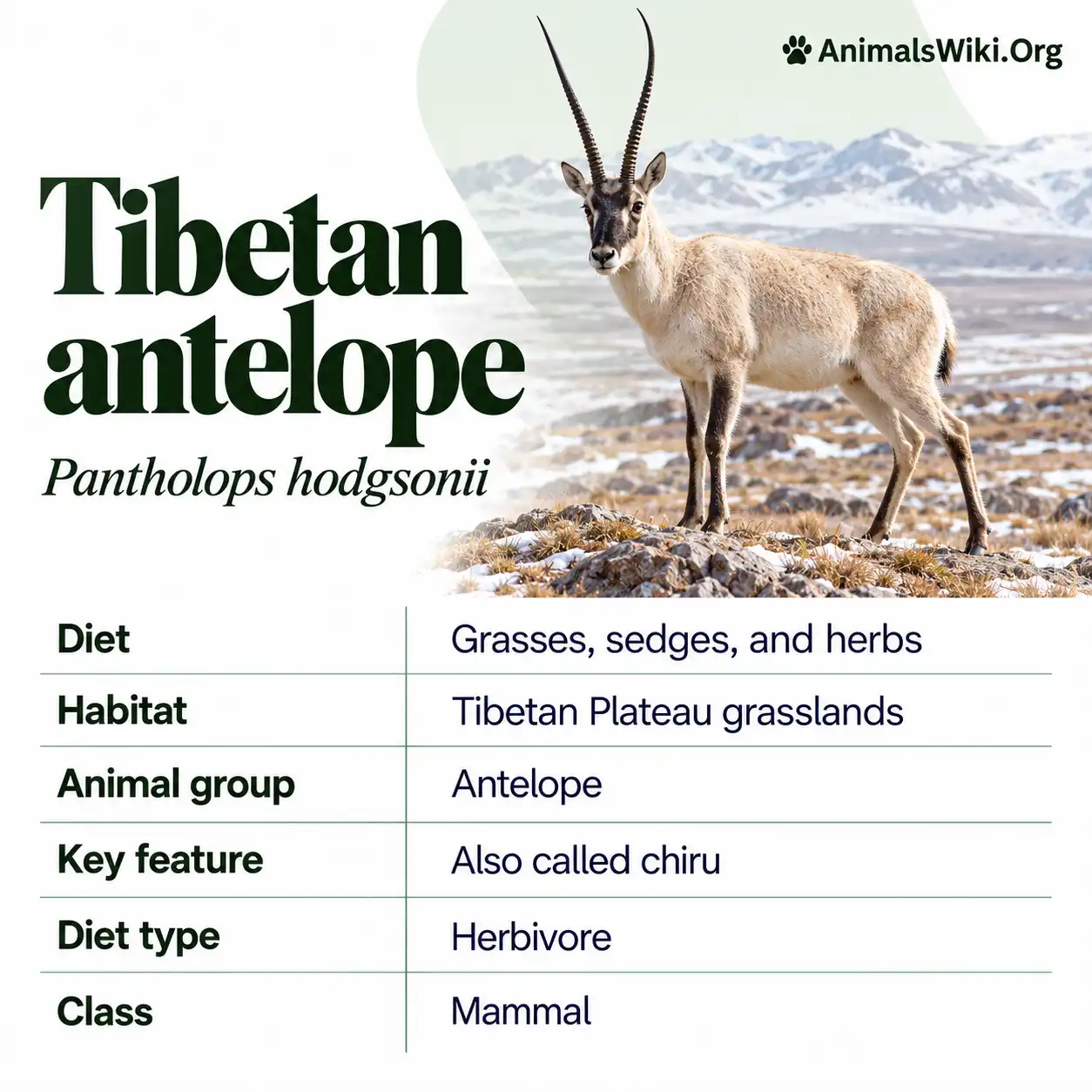
Tibetan Antelope, The Remarkable Survivor of the Tibetan Plateau
The Tibetan antelope is one of the most remarkable mammals of the high Asian mountains. Known scientifically as Pantholops hodgsonii and commonly called the chiru, this graceful hoofed animal lives across the vast, cold grasslands and open plains of the Tibetan Plateau. Its home is a challenging world of thin air, freezing winters, powerful winds, and limited vegetation, yet the species has evolved to survive where many other large mammals would struggle.
Tibetan antelopes are famous for their speed, seasonal movements, and the fine insulating undercoat that protects them from extreme cold. Males carry long, slender, ridged horns, while females generally lack horns. Their lives are closely connected to the open landscape: they graze on low-growing plants, travel across broad plateaus, and gather in large groups during parts of the year.
The species is also an important conservation story. For decades, illegal hunting for shahtoosh, an exceptionally fine wool obtained from the animal’s undercoat, caused severe population declines. Stronger protection, anti-poaching patrols, and conservation work have helped populations recover in important parts of the species’ range. Nevertheless, habitat changes, infrastructure, disturbance, and the continuing threat of illegal trade make long-term monitoring essential.
Learning about Tibetan antelopes reveals more than the life of a beautiful mountain mammal. It also shows how wildlife can be shaped by extreme environments and how sustained conservation can help a threatened species recover.
Facts About the Tibetan Antelope
| Fact | Details |
|---|---|
| Common name | Tibetan antelope, chiru |
| Scientific name | Pantholops hodgsonii |
| Animal group | Mammal |
| Class | Mammalia |
| Order | Artiodactyla |
| Family | Bovidae |
| Subfamily | Pantholopinae |
| Genus | Pantholops |
| Diet | Herbivore |
| Main habitat | High-altitude grasslands, steppes, and open plateaus |
| Native region | Tibetan Plateau and neighboring high-altitude areas |
| Typical elevation | Commonly around 3,250–5,500 meters, depending on location |
| Distinctive feature | Fine insulating undercoat and long horns in males |
| Social behavior | Often forms groups; group size varies by season and activity |
| Reproduction | Usually one calf per pregnancy |
| Main natural predators | Wolves and other large carnivores capable of catching them |
| Major historical threat | Illegal hunting for shahtoosh |
| Conservation status | Reported as Near Threatened in some recent specialist assessments; check the latest authoritative assessment for current status |
| Main conservation concern | Protecting migration routes, habitat, and the species from illegal hunting |
1. What Is a Tibetan Antelope?
The Tibetan antelope is a wild member of the cattle, sheep, goat, and antelope family, Bovidae. Despite its common name, it belongs to a distinct evolutionary branch and is not simply another species of gazelle. Its scientific name, Pantholops hodgsonii, identifies it as the sole living species in the genus Pantholops.
The animal is best known as the chiru, a name widely used in wildlife research and conservation. It is specially adapted to the Tibetan Plateau, an immense high-altitude region where cold temperatures and low oxygen levels make life demanding.
Unlike forest-dwelling mammals, Tibetan antelopes depend on open country. Their long legs help them travel over broad plains, while their coat provides insulation against severe cold. Their body shape and behavior suit a landscape where there are few trees or other places to hide.
Why Is the Tibetan Antelope Special?
Several characteristics make the chiru unusual:
-
High-altitude specialist: It lives in one of the world’s most demanding terrestrial environments.
-
Exceptional undercoat: Its fine woolly underfur provides protection from cold.
-
Sexual differences: Adult males have long, slender horns, while females are usually hornless.
-
Seasonal movement: Some populations travel long distances between winter ranges and traditional calving areas.
-
Conservation significance: Its recovery from intense hunting pressure is an important example of wildlife protection.
The Tibetan antelope is not just a symbol of the Tibetan Plateau. It is also an important example of how a mammal can evolve a specialized combination of physical features, feeding habits, and seasonal behavior to survive in a harsh environment.
2. Scientific Classification and Taxonomy
Scientific classification helps researchers distinguish the Tibetan antelope from other hoofed mammals that share its habitat.
| Classification level | Name |
|---|---|
| Kingdom | Animalia |
| Phylum | Chordata |
| Class | Mammalia |
| Order | Artiodactyla |
| Family | Bovidae |
| Genus | Pantholops |
| Species | Pantholops hodgsonii |
The Tibetan antelope is the only living species in its genus, making Pantholops a monotypic genus. Although it is called an antelope in English, its evolutionary relationships are distinctive within the bovid family.
Is the Chiru the Same Animal as the Tibetan Antelope?
Yes. Chiru and Tibetan antelope are two common names for the same species. The scientific name is Pantholops hodgsonii. The name “Tibetan antelope” reflects its geographic association with the Tibetan Plateau, while “chiru” is widely used in conservation and wildlife literature.
Does the Tibetan Antelope Have Subspecies?
The species is generally treated as a single species without widely accepted living subspecies in major conservation references. Researchers study different geographic populations because some migrate while others may remain in a more restricted area. Population differences do not automatically mean that separate subspecies exist.
This distinction matters because conservation planning often focuses on migration routes, regional population trends, and habitat connections rather than assuming every group is a separate taxonomic unit.
3. What Does a Tibetan Antelope Look Like?
Tibetan antelopes have a slim, long-legged build suited to moving across wide, open terrain. Their coats usually appear pale fawn, sandy brown, or grayish tan, with lighter areas on the belly and darker markings around the face and legs. These colors provide a degree of visual blending with the dry grasses, rocky ground, and muted colors of the plateau.
Their thick coat is especially important during the cold season. The outer hair and dense underfur help retain body heat, protecting the animal against freezing temperatures and strong winds. The exceptionally fine underfur is also the material that became infamous in the illegal shahtoosh trade.
Coat Color and Seasonal Appearance
The coat’s exact shade can vary with age, sex, season, and lighting. Adults may look warmer brown in sunlight and more gray or cream-colored in overcast conditions. Their pale underparts contrast with darker markings on the face and legs.
The coat is not merely decorative. Insulation is essential in an environment where cold weather can persist for months and temperatures may fall far below freezing.
The Face and Nose
The face is relatively dark compared with the body. Males may have more prominent nasal swellings than females, a feature noted in species descriptions. Their nostrils and nasal passages are part of the respiratory system that must function in thin, cold air, although the exact contribution of individual nasal features to high-altitude performance should not be overstated without specific evidence.
Male and Female Differences
Adult males and females look noticeably different in one major respect: their horns.
-
Males: Usually carry long, dark, slender horns with ridges.
-
Females: Generally do not have horns.
-
Body size: Males tend to be larger and heavier than females.
-
Seasonal behavior: The sexes often form separate groups outside the breeding season.
These differences are known as sexual dimorphism. Male horns are especially conspicuous in a landscape where few objects interrupt the horizon.
4. Tibetan Antelope Size, Weight, and Horns
The Tibetan antelope is a medium-sized wild bovid. It is not as massive as a yak or large cattle species, but it is powerfully adapted to long-distance movement across open ground.
Exact measurements vary among individuals and reference sources. The following figures are useful approximate values rather than strict limits for every animal.
| Physical feature | Approximate measurement |
|---|---|
| Male shoulder height | Around 80–85 cm |
| Female shoulder height | Around 70–75 cm |
| Male weight | Around 35–40 kg |
| Female weight | Around 25–30 kg |
| Male horn length | Commonly around 50–60 cm |
| Body build | Slim, long-legged, and lightly built |
These measurements are consistent with wildlife descriptions that report males as larger and horned, while females are smaller and generally hornless.
Why Are the Horns So Long?
The male’s long horns play a role in competition with other males, particularly during the breeding season. Males may display, challenge one another, and use their horns in contests over access to females.
The horns are not antlers. Antlers are branched structures that are usually shed and regrown in deer, whereas bovine horns have a permanent bony core covered by keratin. Tibetan antelope horns are therefore expected to remain throughout the adult male’s life.
How Does Body Size Help?
A relatively light body can be advantageous when traveling across extensive open terrain. Long legs help the animal cover ground efficiently, and the slim build is well suited to movement between feeding areas and seasonal ranges.
However, high-altitude survival is not explained by body shape alone. The chiru also depends on its physiology, insulating coat, feeding behavior, and access to suitable habitat.
5. Where Do Tibetan Antelopes Live?
Tibetan antelopes are native to the high-altitude landscapes of Central Asia, especially the Qinghai–Tibetan Plateau. Their main strongholds are in China, including areas of the Tibet Autonomous Region and Qinghai, with additional range areas in Xinjiang. Some animals may move seasonally into the Ladakh region of India. Historical records also describe the species in parts of Nepal, where it is considered absent or possibly locally extinct in many accounts.
The Chang Tang Region
The Chang Tang region of northwestern Tibet is one of the most important strongholds for the species. Its extensive, remote plains provide broad stretches of open habitat with relatively little human settlement in many areas.
The region also forms part of a larger landscape of protected areas. Since migratory populations may cross administrative boundaries and travel long distances, conserving one isolated patch of land is not always sufficient. Protection needs to account for the wider network of feeding areas, winter ranges, and calving grounds.
Elevation and Geography
Chiru commonly occupy elevations of roughly 3,250 to 5,500 meters. At these heights, the air contains less oxygen per breath than at sea level, the growing season is short, and vegetation is often sparse.
The animal’s range includes broad plains, rolling steppe, alpine meadows, and desert-steppe landscapes. Despite the word “mountain” often associated with Tibet, Tibetan antelopes are particularly associated with open plateaus rather than steep, forested slopes.
Do Tibetan Antelopes Live Outside Tibet?
Their native range extends beyond the modern political and cultural region commonly called Tibet. The species occupies parts of the broader plateau across several administrative regions, and some populations move seasonally across large distances. It is not naturally distributed worldwide.
Tibetan antelopes are also uncommon in captivity compared with many familiar antelope species. Their specialized habitat and movement needs make them challenging animals to maintain outside their natural environment.
6. Habitat and Climate
The Tibetan Plateau is sometimes described as the “Roof of the World.” Its wide-open landscapes combine high elevations, intense sunlight, strong winds, cold nights, and long winters. Tibetan antelopes have evolved to live in these conditions.
Alpine Steppe
Alpine steppe is one of the species’ key habitats. It typically has low vegetation, grasses, sedges, and scattered herbaceous plants. Trees are scarce or absent across much of this open landscape.
The limited plant cover means food availability can change sharply with season and weather. In summer, plant growth may provide better grazing, while winter conditions can restrict access to vegetation.
Desert Steppe
Desert steppe is another important habitat. Although it is not necessarily a sandy desert, it can be dry and sparsely vegetated. Plants must tolerate low temperatures, limited moisture, and a short growing season.
Chiru can feed on the low vegetation available in these environments. Their survival depends on being able to locate suitable feeding patches across a large area.
Extreme Weather
The climate can be severe. Cold snaps, snowstorms, and strong winds may increase energy demands while reducing the amount of food available. Deep snow can make some plants difficult to reach and can disrupt the animals’ normal movement patterns.
A winter storm is particularly challenging when animals must spend more energy staying warm but have less access to food. Young calves, pregnant females, and animals in poor condition may be especially vulnerable during difficult periods.
7. What Do Tibetan Antelopes Eat?
Tibetan antelopes are herbivores. They feed on low-growing vegetation, including grasses, sedges, flowering herbs, and selected dwarf shrubs. Their diet changes with plant availability, habitat, and season.
Main Foods
| Food type | Role in the diet |
|---|---|
| Grasses | Provide a major source of plant material when available |
| Sedges | Important in suitable alpine and wet-meadow areas |
| Forbs | Broad-leaved herbaceous plants that can provide varied nutrients |
| Dwarf shrubs | Used where preferred grasses and herbs are limited |
| Seasonal new growth | Can offer relatively nutritious feeding opportunities |
They are ruminants, meaning their digestive system includes a specialized stomach with multiple compartments. Microbes in the rumen help break down plant material that would otherwise be difficult to digest efficiently.
How Do They Find Food?
Tibetan antelopes generally graze while moving through suitable feeding areas. Rather than relying on a single plant species, they can consume a mixture of vegetation according to what is available. Research on their diet indicates that the proportions of grasses, herbs, and dwarf shrubs can vary considerably.
Do Tibetan Antelopes Eat Meat?
No. Tibetan antelopes are herbivores and do not hunt other animals for food. They may accidentally ingest small organisms with vegetation, as many grazing mammals do, but their normal diet consists of plants.
How Does Winter Affect Their Diet?
Winter may reduce both the availability and accessibility of food. Snow can cover low-growing plants, and cold weather can limit plant growth. During these periods, chiru may need to travel or search more intensively to find sufficient forage.
If vegetation remains inaccessible for an extended period, animals can lose condition. This is one reason extreme weather remains a natural challenge even in areas where hunting is well controlled.
8. Adaptations to High Altitude
The Tibetan antelope survives in conditions that challenge many large mammals. Its success depends on a combination of insulation, movement, feeding flexibility, and physiological adaptations.
Dense Underfur for Insulation
One of the chiru’s most remarkable features is its dense, fine undercoat. It traps air close to the body, helping reduce heat loss during cold weather. This insulation is especially valuable in a landscape where strong winds can make the environment feel even colder.
The fine fibers are known for their exceptional softness. Unfortunately, the commercial demand for this underfur also became one of the greatest threats the species has faced.
Coping With Thin Air
At elevations above 4,000 meters, oxygen availability is lower than at sea level. Tibetan antelopes live in this environment throughout their lives, so their bodies must support normal activity under these conditions.
High-altitude mammals can possess physiological and genetic traits that help them function in low-oxygen environments. Research into Tibetan antelope genetics continues to improve scientific understanding of how the species has adapted to its environment. However, no single trait explains its survival; altitude tolerance involves multiple biological systems.
Efficient Movement
Tibetan antelopes have long legs and a relatively light build, allowing them to travel across broad plains. They may cover substantial distances while searching for food or moving between seasonal ranges.
Their ability to travel is important because vegetation is scattered across the plateau. An animal that can move efficiently between feeding areas has more opportunities to find suitable forage.
Behavioral Adaptations
Behavior also contributes to survival. Chiru use open terrain to detect potential danger, and they may gather in groups that improve collective awareness. Seasonal movement allows certain populations to reach important calving areas when conditions are suitable.
These behaviors complement the species’ physical adaptations, helping it manage a combination of cold, limited food, predators, and long distances.
9. Migration and Seasonal Movements
Migration is among the most fascinating aspects of Tibetan antelope behavior. Some populations make long seasonal journeys between wintering areas and summer calving grounds, while others appear more resident or move shorter distances.
Specialist accounts describe at least five migratory populations, with some journeys reaching approximately 300–400 kilometers. The exact distance and timing depend on the population and its geography.
Why Do Tibetan Antelopes Migrate?
Seasonal migration is associated with reproduction, food availability, and the need to reach suitable calving areas.
Pregnant females in some populations travel to traditional birthing grounds before giving birth. These areas can provide the conditions needed for females to deliver and care for their calves. The journey is energetically demanding, but access to appropriate calving habitat can be crucial to reproductive success.
When Does Migration Happen?
The timing varies by location, but females in well-studied migratory populations commonly travel toward calving grounds in late spring and early summer. Calves are generally born in early summer, after which females and their young return toward their seasonal ranges.
Migration is not necessarily identical every year. Snow conditions, forage availability, weather, and disturbance can influence movement. Some groups may change their routes or timing when conditions are unfavorable.
How Do Calves Survive the Journey?
Newborn calves are vulnerable, so timing migration around birth is important. Females typically give birth to a single calf, and the young must become mobile quickly enough to remain with the herd.
The return journey requires the mother to balance feeding, protecting her offspring, and keeping pace with the group’s movements. Calves that are weak or exposed to severe weather may face greater risks.
Migration Corridors Need Protection
Roads, railways, fences, settlements, and other infrastructure can affect wildlife movement if they obstruct traditional routes. Some projects incorporate wildlife passages or monitoring to reduce disruption.
In July 2025, Chinese government reporting described seasonal movements through the Senlong Zangbo River corridor in Chang Tang National Nature Reserve. The report said that more than 150,000 antelopes had crossed the river annually over the preceding three years. That figure refers to animals recorded at this particular migration corridor, not necessarily a count of the entire species.
Protecting these routes is essential because even a large population can be harmed if important breeding grounds become inaccessible.
10. Social Behavior and Daily Life
Tibetan antelopes are social animals, but their group structure changes according to season, sex, and reproductive activity.
Herds and Group Size
Chiru may gather in groups ranging from small parties to much larger herds. Some groups consist mostly of females and young, while others include males outside the breeding season. Group size depends on the location, time of year, and behavior being observed.
Herding can provide several advantages:
-
More eyes and ears to detect danger.
-
Opportunities to locate feeding areas used by other animals.
-
Protection through collective vigilance.
-
Social contact among individuals of similar age or reproductive status.
However, gathering in a group does not make every animal safe. Predators may still target isolated, injured, young, or otherwise vulnerable individuals.
Do Males and Females Live Together?
Outside the breeding season, males and females often remain in separate groups. During the rut, males compete for mating opportunities, and the sexes come together for reproduction.
This seasonal separation is common in several hoofed mammals. It can reduce competition between the sexes when their feeding patterns or habitat use differ.
Territorial and Competitive Behavior
Male Tibetan antelopes may compete with other males through displays, posturing, and horn-to-horn contests. These interactions help establish dominance and influence access to females during the breeding period.
Such contests can be physically demanding. A male’s long horns are useful in these encounters, but fighting also carries risks of injury and wasted energy.
Are Tibetan Antelopes Active During the Day?
They are often observed feeding and moving during daylight hours, although activity patterns can vary with weather, season, disturbance, and local conditions. On a cold plateau, the timing of activity may be influenced by temperature and the availability of suitable forage.
11. Speed, Senses, and Survival
Tibetan antelopes are built for open landscapes, where seeing danger early and moving quickly can be more important than hiding behind dense vegetation.
How Fast Can a Tibetan Antelope Run?
Chiru are fast-running hoofed mammals, but reliable maximum-speed measurements are not consistently established across authoritative species references. It is therefore better not to assign a precise top speed without a dependable source.
Their long legs, light build, and open-country habitat suggest an advantage in covering ground rapidly when alarmed. Running helps them escape danger, but successful survival also depends on detecting threats early and choosing an effective direction of escape.
Vision and Awareness
Open landscapes provide long sightlines, allowing an alert antelope to notice movement at a considerable distance. Herd members may also respond to the behavior of nearby animals, helping the group react when one individual detects a threat.
Their hearing and sense of smell are also likely to contribute to awareness, as they do in many grazing mammals. The precise relative importance of each sense in chiru behavior is less well documented than their habitat, migration, and feeding patterns.
Can Tibetan Antelopes Hide From Predators?
Their coat colors blend reasonably well with the muted tones of the plateau, especially when the animals are standing among dry grasses or on pale ground. Nevertheless, they cannot rely on camouflage alone.
Their main defenses include alertness, group behavior, suitable habitat, and the ability to run. Calves are especially vulnerable because they have less experience and limited physical reserves.
12. Reproduction and Mating
Reproduction is closely connected to the seasons. In migratory populations, the timing of mating and birth helps coordinate the arrival of calves with suitable environmental conditions.
The Breeding Season
Mating generally occurs in late autumn, although timing can vary among populations. During the breeding period, males become more competitive and may defend access to groups of females.
Courtship and Competition
Males may display their size and horns, challenge rivals, and engage in contests. The outcome of these encounters can influence mating opportunities.
Females do not simply select a mate based on horn size alone; natural mating behavior is complex and can be influenced by dominance, condition, timing, and local social structure.
Gestation and Birth
The gestation period is approximately six months, with estimates varying slightly among references. Females usually give birth to one calf at a time. In migratory populations, birth commonly occurs in early summer.
A single calf places substantial responsibility on the mother. She must provide milk, protect the young animal, and help it remain with the group.
Why Is Birth Timing Important?
Early summer can provide more favorable conditions than the depths of winter. Seasonal plant growth may improve feeding opportunities for mothers, while warmer conditions can reduce some of the challenges faced by newborn calves.
The plateau remains unpredictable, however. Cold snaps, snow, and other severe weather can still threaten calves during the early weeks of life.
13. Calves and Early Development
The First Days of Life
The calf depends on its mother for milk and protection. Early in life, remaining close to the mother and becoming mobile are essential. The ability to stand and move helps the calf stay with the herd as it travels.
Females in migratory populations often give birth at traditional calving grounds. These seasonal destinations are important because the mother needs both suitable conditions for the newborn and a practical way to rejoin the group’s movements.
Growth and Feeding
Milk provides the main nutrition during the earliest stage of life. As the calf grows, it gradually begins consuming plant material and becomes increasingly independent.
The exact pace of development can vary with nutrition, weather, and individual condition. A calf born during a favorable season may have better access to food and more favorable conditions than one born during an unusually harsh period.
Why Are Calves Important for Population Recovery?
A healthy population needs more than surviving adults; it also needs enough young animals to reach adulthood and reproduce. Calf survival is therefore a key part of long-term conservation.
Protecting calving grounds, reducing disturbance, preserving migration routes, and preventing poaching all contribute to the conditions that allow young chiru to survive.
14. Lifespan and Natural Predators
Tibetan antelopes face threats from natural predators as well as environmental conditions. The danger varies according to age, season, location, and the availability of other prey.
How Long Do Tibetan Antelopes Live?
A lifespan of around a decade is often reported in species summaries, but lifespan can differ between wild and managed conditions. Reliable estimates of maximum lifespan in the wild are limited, so a single number should not be treated as a universal limit.
Survival depends on many factors, including access to food, severe winter weather, disease, injuries, and predation.
What Eats Tibetan Antelopes?
Potential natural predators include wolves, snow leopards, and lynxes in parts of the species’ range. The predators present in a particular location depend on the local ecosystem.
Predators are more likely to capture animals that are isolated, injured, young, or weakened by harsh conditions. A herd’s alertness and the ability to run help reduce this risk.
Are Calves at Greater Risk?
Yes. Newborn calves have less experience and are physically more vulnerable than healthy adults. Their survival depends partly on the mother’s care, the availability of suitable habitat, and the timing of birth.
Predation is a natural part of the ecosystem. Unlike illegal hunting, natural predation is not generally considered a conservation problem on its own; it is part of the ecological relationships in which the species evolved.
Can Weather Be as Dangerous as Predators?
Severe weather can be a major source of mortality. Heavy snow may cover food, while prolonged cold increases energy demands. If an animal cannot find enough vegetation, its body condition may deteriorate.
The most serious outcomes often arise when several pressures occur together—for example, poor forage, extreme cold, and disturbance that limits access to suitable habitat.
15. Ecological Importance
Tibetan antelopes are an important part of the high-altitude grassland ecosystem. Their grazing connects plant communities, herbivore populations, and carnivores within the food web.
Grazing and Vegetation
By feeding on grasses, sedges, and other plants, chiru influence the distribution and growth of vegetation. The precise ecological effect depends on grazing intensity, plant type, and local conditions.
Grazing is not automatically beneficial or harmful. At natural levels, herbivory is a normal ecological process; when domestic livestock and wild herbivores compete for limited forage, the balance can become more complicated.
A Food Source for Predators
Tibetan antelopes contribute to the diets of predators such as wolves and, in some areas, snow leopards and lynxes. Their presence forms part of the natural food web of the plateau.
The species’ abundance can influence predator opportunities, although predators typically rely on a range of prey rather than only one animal.
Nutrient Cycling
As herbivores feed, move, and excrete waste, they help redistribute nutrients across their habitat. Their movement can connect different feeding areas and contribute to ecological processes.
These effects are shared with other grazing animals and should not be interpreted as unique to chiru. Their ecological importance comes from being one component of a broader high-altitude ecosystem.
Why Their Conservation Matters Beyond One Species
Protecting Tibetan antelopes can also benefit other wildlife that uses the same remote grasslands and protected areas. Conservation measures that maintain large open landscapes and functioning migration corridors may help preserve habitat for multiple species.
16. Shahtoosh and the History of Illegal Hunting
The Tibetan antelope’s history is inseparable from the illegal trade in shahtoosh. Shahtoosh is a fine wool obtained from the animal’s underfur and used to make extremely soft, lightweight shawls.
The fibers became commercially valuable, creating an incentive for hunters to kill animals for their coats. This demand contributed to a severe decline during the late twentieth century.
Why Was Shahtoosh So Valuable?
The fibers are exceptionally fine and can produce fabric that feels soft and light. These qualities made shahtoosh shawls desirable among some buyers.
However, the material’s luxury reputation came at a serious cost to wildlife. Because the fiber is obtained from the animal itself, the trade created direct pressure on wild chiru populations.
Why Is the Trade Prohibited?
The Tibetan antelope is listed in Appendix I of CITES, the Convention on International Trade in Endangered Species of Wild Fauna and Flora. Appendix I provides the strictest level of CITES trade protection for species threatened with extinction and restricts international commercial trade in their specimens.
Domestic laws in range and consumer countries can impose additional prohibitions and penalties. For example, a 2026 Indian government report described a conviction relating to attempted illegal export of shahtoosh shawls, illustrating that enforcement remains relevant decades after the original bans.
Why Is Enforcement Still Necessary?
Illegal wildlife products may be hidden in shipments or mixed with other fibers, making identification difficult. Enforcement can require trained officers, laboratory testing, intelligence sharing, and cooperation between customs and wildlife agencies.
Consumer awareness also matters. Buyers may not know what a shawl contains, and some products can be marketed in ways that obscure the source of the fiber.
The safest conservation choice is to avoid buying, selling, or promoting shahtoosh products.
17. Conservation and Population Recovery
The Tibetan antelope provides an important example of a wildlife species recovering after intensive protection. The recovery has been linked to anti-poaching enforcement, protected areas, habitat conservation, and greater attention to migration routes.
How Serious Was the Decline?
Population estimates vary by source and historical period, but the species experienced a dramatic decline during the late twentieth century. One major factor was illegal hunting for shahtoosh. Research summaries describe the population as falling to roughly 60,000–70,000 animals in the late 1990s.
These figures are historical estimates, not a current global census.
What Is the Population Today?
In March 2025, China’s government reported that Tibetan antelope numbers had increased from around 60,000–70,000 in the late 1990s to more than 300,000. A separate July 2025 report stated that the population in the Xizang Autonomous Region exceeded 300,000.
These reports demonstrate substantial recovery, but population figures should be interpreted carefully. Estimates may use different geographic boundaries, survey methods, and dates. A regional count should not automatically be treated as a precise global total.
What Is the Conservation Status?
The CMS Central Asian Mammals Initiative lists the Tibetan antelope as Near Threatened. Conservation organizations also describe its improvement from Endangered to Near Threatened following population recovery.
Older sources may still show the historical Endangered category, so articles should distinguish the date of an assessment from current status. Conservation categories can change as new evidence becomes available.
Near Threatened does not mean that the species faces no danger. It means that its status is less severe than during the period of greatest decline, while continued monitoring and protection remain important.
Conservation Measures That Have Helped
Key measures include:
-
Anti-poaching patrols and law enforcement.
-
Protection of major habitat areas.
-
Restrictions on international trade in chiru products.
-
Monitoring of herds and migration corridors.
-
Rescue and care for calves separated from their mothers.
-
Public awareness of the connection between shahtoosh and wildlife killing.
China’s reporting describes continued patrols, anti-poaching work, and monitoring in protected areas such as Hoh Xil.
Why Recovery Must Continue
A rising population is encouraging, but recovery can be reversed if illegal hunting returns or habitat becomes fragmented. Long-term conservation must protect not only the animals themselves but also the ecological processes they depend on.
A viable population needs access to feeding grounds, winter ranges, calving areas, and migration corridors. Preserving only small isolated patches may not be enough for a species whose seasonal movements can span hundreds of kilometers.
18. Threats Facing Tibetan Antelopes Today
Although conservation has reduced some major pressures, Tibetan antelopes still face risks.
1. Illegal Hunting and Wildlife Trade
Illegal hunting remains a concern because the underfur can command high prices. Strong enforcement and consumer awareness are necessary to prevent renewed pressure.
2. Habitat Fragmentation
Roads, railways, fences, and development may interfere with traditional movement routes if not planned carefully. Infrastructure can also increase disturbance in sensitive areas.
Wildlife passages, route planning, and long-term monitoring can help reduce these impacts, but their effectiveness depends on location and design.
3. Competition With Livestock
Domestic sheep, goats, and other grazing animals may compete with wild herbivores for vegetation where food is limited. The degree of competition varies by area and season.
Conservation planning must consider local livelihoods as well as wildlife needs. Well-designed grazing management can help reduce conflict while supporting people who depend on plateau grasslands.
4. Climate Change
Climate change may affect snow patterns, plant growth, water availability, and the timing of seasonal conditions. The effects are not necessarily uniform across the plateau, and predicting the precise response of each population requires more research.
Because chiru depend on seasonal vegetation and open habitat, changes in temperature and precipitation could influence food availability and movement.
5. Severe Winter Weather
Even without human interference, the plateau can experience harsh weather. Deep snow may restrict access to plants and make travel difficult. Severe conditions can reduce survival, particularly among young or weakened animals.
6. Disturbance Around Calving Areas
Pregnant females and newborn calves may be particularly sensitive to disturbance. Repeated human activity in important calving areas could interfere with normal behavior or movement.
Seasonal management of tourism, transport, and other activities may help protect sensitive locations.
19. Tibetan Antelope vs. Tibetan Gazelle
The Tibetan antelope and Tibetan gazelle share parts of the high-altitude landscape, but they are different species with distinct appearances.
| Feature | Tibetan antelope | Tibetan gazelle |
|---|---|---|
| Scientific name | Pantholops hodgsonii | Procapra picticaudata |
| Family | Bovidae | Bovidae |
| Build | Slim, with dense insulating underfur | Generally smaller and more gazelle-like |
| Male horns | Long, slender, ridged horns | Shorter, slender horns |
| Female horns | Generally absent | Generally absent |
| Coat | Often pale tan or grayish tan, with a woolly undercoat | Typically sandy or brownish, with lighter underparts |
| Habitat | High plateau steppe and open plains | Open plateau grasslands and steppe |
| Best-known distinction | Fine underfur linked to shahtoosh | Compact gazelle form |
Both species are adapted to high-altitude environments, but their appearance, behavior, and ecological roles are not identical. The Tibetan antelope’s long male horns and exceptionally fine undercoat are particularly distinctive.
20. Tibetan Antelope vs. Saiga Antelope
The saiga antelope is another unusual Eurasian bovid, but it lives in a very different landscape and has a strikingly different nose.
| Feature | Tibetan antelope | Saiga antelope |
|---|---|---|
| Scientific name | Pantholops hodgsonii | Saiga tatarica |
| Main environment | High-altitude Tibetan Plateau | Eurasian steppe and semi-arid plains |
| Elevation | Commonly 3,250–5,500 meters | Mostly lowland or moderate-elevation steppe |
| Nose | Relatively conventional bovid nose, with male-specific nasal features | Distinctive enlarged, flexible nose |
| Male horns | Long, dark, slender horns | Pale, often translucent-looking horns |
| Coat adaptation | Dense fine underfur for cold high-altitude conditions | Seasonal coat changes suited to steppe climates |
| Major conservation history | Severe hunting for shahtoosh | Major hunting pressures, disease events, and habitat concerns |
Both species have faced serious human-caused pressures, and both demonstrate the importance of habitat protection and effective wildlife management. Their adaptations reflect the different challenges of the environments they occupy.
21. Interesting Tibetan Antelope Facts
These are two common names for the same species, Pantholops hodgsonii.
2. Some populations migrate hundreds of kilometers.
Certain herds travel between seasonal ranges and traditional calving areas.
3. Females generally do not have horns.
Long, ridged horns are a characteristic feature of adult males.
The fiber became known as shahtoosh and drove illegal hunting for luxury shawls.
Its habitat can reach approximately 5,500 meters above sea level.
The chiru is associated with wide steppe and plateau landscapes rather than dense forests.
Their social organization changes during the year.
The mother must feed and protect the young animal in a challenging environment.
Chinese government reports in 2025 put the population above 300,000, though estimates depend on the area and method counted.
10. Migration corridors can be as important as protected land.
A reserve cannot fully protect a migratory animal if barriers prevent it from reaching seasonal habitat.
22. Frequently Asked Questions About Tibetan Antelopes
1. What is a Tibetan antelope?
The Tibetan antelope is a wild bovid native to the high-altitude Tibetan Plateau. Its scientific name is Pantholops hodgsonii, and it is also known as the chiru.
2. What is the scientific name of the Tibetan antelope?
Its scientific name is Pantholops hodgsonii. It is the only living species in the genus Pantholops.
3. Where do Tibetan antelopes live?
They live mainly across the high-altitude grasslands and steppe of the Tibetan Plateau, especially in parts of China. Some animals move seasonally into areas of Ladakh in India.
4. How high do Tibetan antelopes live?
They commonly inhabit elevations of approximately 3,250 to 5,500 meters, depending on the area.
5. What do Tibetan antelopes eat?
They are herbivores that feed on grasses, sedges, flowering herbs, and some dwarf shrubs. Their exact diet changes with the availability of plants.
6. How big is a Tibetan antelope?
Adult males may stand around 80–85 centimeters at the shoulder and weigh roughly 35–40 kilograms. Females are usually smaller, though measurements vary among individuals and sources.
7. Do female Tibetan antelopes have horns?
Females are generally hornless. Adult males have long, slender, dark horns with ridges.
8. Why do male Tibetan antelopes have horns?
The horns are used in competition with other males, particularly during the breeding season. They are permanent horns, not the annually shed antlers found in deer.
9. What is a chiru?
Chiru is another common name for the Tibetan antelope. Both names refer to the same species.
10. Why is the Tibetan antelope famous?
It is known for surviving at high elevations, its fine insulating underfur, the long migrations of some populations, and the conservation crisis caused by illegal hunting for shahtoosh.
11. What is shahtoosh?
Shahtoosh is a fine wool made from the underfur of the Tibetan antelope. Demand for shawls made from this fiber drove extensive illegal hunting.
12. Is shahtoosh legal?
International commercial trade in Tibetan antelope specimens is severely restricted under CITES Appendix I, and shahtoosh products are prohibited under relevant domestic laws in many jurisdictions. The exact legal consequences depend on the country, but buying or selling these products can support illegal wildlife trade.
13. Are Tibetan antelopes endangered?
The CMS Central Asian Mammals Initiative lists the species as Near Threatened, reflecting substantial recovery from earlier declines. Older sources may report its historical Endangered status. Always check the date and authority of a conservation assessment.
14. How many Tibetan antelopes are left?
Chinese government reports published in 2025 placed the population above 300,000. This is a reported estimate rather than a single, precise global census, and population figures depend on the area and counting method.
15. Why did Tibetan antelope numbers decline?
Illegal hunting for shahtoosh was a major cause of the severe decline during the late twentieth century. Habitat pressures and competition for resources have also been identified as concerns.
16. What do Tibetan antelopes do during winter?
They continue searching for available vegetation while relying on their insulating coats to withstand cold. Snow and severe weather can make feeding and movement more difficult.
17. Do Tibetan antelopes migrate?
Yes. Some populations undertake long seasonal migrations between wintering areas and calving grounds. Others may be resident or travel shorter distances.
18. How far can Tibetan antelopes migrate?
Some documented populations travel roughly 300–400 kilometers. The distance depends on the population and its route.
19. When do Tibetan antelopes give birth?
In migratory populations, females commonly give birth in early summer, often around late June or early July. Exact timing varies with location and conditions.
20. How many calves does a Tibetan antelope have?
A female usually gives birth to one calf at a time.
21. What are the natural predators of Tibetan antelopes?
Potential predators include wolves, snow leopards, and lynxes in parts of their range. The predators present vary by location.
22. Can Tibetan antelopes survive without their herd?
They may survive alone for some time, but group living can improve vigilance and provide social benefits. Young calves are particularly dependent on maternal care.
23. Are Tibetan antelopes kept in zoos?
They are uncommon in captivity compared with many other hoofed mammals. Their specialized environmental and movement requirements make their management challenging.
24. What is the biggest threat to Tibetan antelopes today?
Illegal hunting and trade remain important concerns, while habitat fragmentation, infrastructure, competition for forage, disturbance, and climate-related changes may also affect populations.
25. How can people help protect Tibetan antelopes?
People can avoid shahtoosh products, support credible wildlife conservation programs, respect protected habitats, and promote awareness of illegal wildlife trade. Governments and conservation groups also need to maintain effective patrols, migration corridors, and long-term population monitoring.
Tibetan Antelope (Pantholops hodgsonii)
The Tibetan antelope, is a remarkable mammal shaped by the cold, open, high-altitude landscapes of the Tibetan Plateau. Its dense insulating underfur, long-legged build, seasonal movements, and specialized way of life allow it to survive in one of the world’s most demanding environments.
The species’ history also demonstrates how human demand can threaten wildlife. Illegal hunting for shahtoosh caused severe declines, but protection measures and anti-poaching work have helped populations recover. That progress is encouraging, yet it does not remove the need to safeguard migration routes, calving grounds, and the wide landscapes the chiru depends on.
Protecting Tibetan antelopes means protecting more than an individual species. It helps preserve the ecological character of the plateau and the wildlife that shares its fragile grasslands. With continued conservation, this distinctive animal can remain a living part of the Roof of the World for generations to come



